1. Introduction
The cigarette manufacturing industry is undergoing a significant transformation towards intelligence and digitalization [
1]. As the core component of production, the rolling and packaging system is characterized by high-speed operation and complex integration. Any failure in this system—ranging from mechanical wear to electrical faults—can lead to production stagnation, safety accidents, and significant economic losses [
2,
3]. Yet, this critical system’s operational complexity has been further amplified in modern production lines—typified by mainstream models like the ZJ17 and ZJ112 series. Operating at ultra-high speeds (up to 800 packets/min), these lines feature intricate coupling between mechanical transmission, electrical control, and even intelligent sensing modules. This heightened integration not only exacerbates the difficulty of fault diagnosis and risk identification but also gives rise to unique data characteristics: failure data in tobacco packaging is often sparse and discrete due to the system’s high reliability, while on-site risk evaluation heavily relies on expert knowledge, which is inherently vague and subjective [
4]. Therefore, accurate risk assessment and prioritization of failure modes are critical for ensuring production continuity and optimizing maintenance strategies [
5,
6,
7]. Recent reviews in tobacco industry research highlight that traditional data-driven methods, which rely on large-scale continuous data, often struggle with such “small sample, high dimension, strong uncertainty” scenarios. This underscores the urgent need for more robust uncertainty modeling approaches to address the practical challenges of risk assessment in modern cigarette packaging systems [
8].
Failure Mode and Effects Analysis (FMEA) is the most widely used tool for risk assessment in this domain. However, traditional FMEA and its Risk Priority Number (RPN) method suffer from several critical limitations when applied to complex packaging systems [
9]:
Subjectivity and Uncertainty: Experts often struggle to provide precise numerical ratings for risk factors due to cognitive uncertainty. The “crisp” numbers used in traditional RPN fail to capture the fuzziness of human judgment [
10].
Information Loss: Converting linguistic terms (e.g., “High Risk”) directly into single numbers ignores the randomness and boundary ambiguity of these concepts [
11].
Equal Weighting: Traditional RPN treats Severity (S), Occurrence (O), and Detection (D) as equally important, which contradicts the reality that safety or cost might be the dominant concern in specific production contexts [
12].
Homogeneous Data Assumption: Traditional methods force all risk factors into a single data format. However, in reality, risk information is heterogeneous. For instance, “Maintenance Cost” is often a deterministic value, “Occurrence Frequency” is an estimated range, while “Severity” is a highly subjective qualitative concept. Forcing heterogeneous risk information into a single uncertainty representation inevitably leads to information distortion, particularly when quantitative costs and qualitative judgments coexist in the same evaluation framework.
Recent studies have attempted to address these issues using various uncertainty theories, such as Intuitionistic Fuzzy Sets, Z-numbers, and Hesitant Fuzzy Sets [
13,
14,
15,
16,
17]. While methods like Z-numbers provide strong reliability information, their computational complexity—often involving cumbersome reliability parameter calibration, intricate semantic conversion processes, and redundant uncertainty modeling—can be prohibitive for rapid engineering applications, particularly ill-suited for the time-sensitive maintenance decision-making of cigarette factory packaging systems [
18]. Conversely, Heterogeneous Information approaches allow for the flexible combination of different data structures to match the natural characteristics of each risk factor [
19]. For example, Hua et al. (2023) proposed a heterogeneous framework for propulsion systems [
20], and recent works have integrated entropy methods to objectively determine weights [
21,
22].
Despite these advancements, few studies have applied a heterogeneous information framework specifically to cigarette packaging systems, where the coupling of mechanical precision and cost constraints is unique. To address the inconsistency in risk prioritization caused by using inappropriate information structures, this study proposes a Risk Priority Assessment Method based on Heterogeneous Entropy Weighting.
This paper makes the following contributions:
- (1)
It introduces a heterogeneous information structure that models Maintenance Cost (C) with crisp numbers, Occurrence (O) with Triangular Fuzzy Numbers, and Severity (S)/Detection (D) with cloud models. This selection balances mathematical precision with engineering practicality, effectively capturing the “randomness and fuzziness” of expert evaluation that traditional methods miss.
- (2)
It utilizes a Heterogeneous Entropy Weight Method to objectively calculate risk factor weights, overcoming the bias of subjective weighting.
- (3)
A case study of a cigarette factory packaging system validates the method’s applicability and superiority over traditional RPN.
2. Heterogeneous Information and the Principle of Entropy Weight Method
2.1. Determination of the Evaluation Indicator System
In the classical FMEA framework, the Risk Priority Number (RPN) evaluates technical risk by combining Severity (S), Occurrence (O), and Detection (D). Although effective for identifying technically critical failure modes, this structure does not explicitly represent the economic consequences associated with maintenance activities.
In practice, failure modes with similar or even lower RPN values may result in significantly different maintenance costs. For example, a frequently occurring failure with moderate technical impact may lead to substantial cumulative maintenance expenses, while a technically severe but rare failure may impose a lower overall economic burden. As a result, economically critical failure modes may be underestimated when only S, O, and D are considered.
To address this limitation, Maintenance Cost (C) is introduced as an independent and economically meaningful risk factor. The inclusion of C is complementary to, rather than redundant with, S, O, and D, as economic impact cannot be reliably inferred from technical Severity alone. Similar limitations of the S–O–D structure have also been recognized in early multi-attribute failure analysis approaches, such as MAFMA, which provide methodological support for extending risk evaluation beyond technical indicators [
23].
Accordingly, this study adopts S, O, D, and C as the evaluation indicators. Clear numbers, triangular fuzzy numbers, and cloud models are employed to represent these indicators according to their intrinsic characteristics, enabling an integrated treatment of deterministic, fuzzy, and random information within a unified evaluation framework.
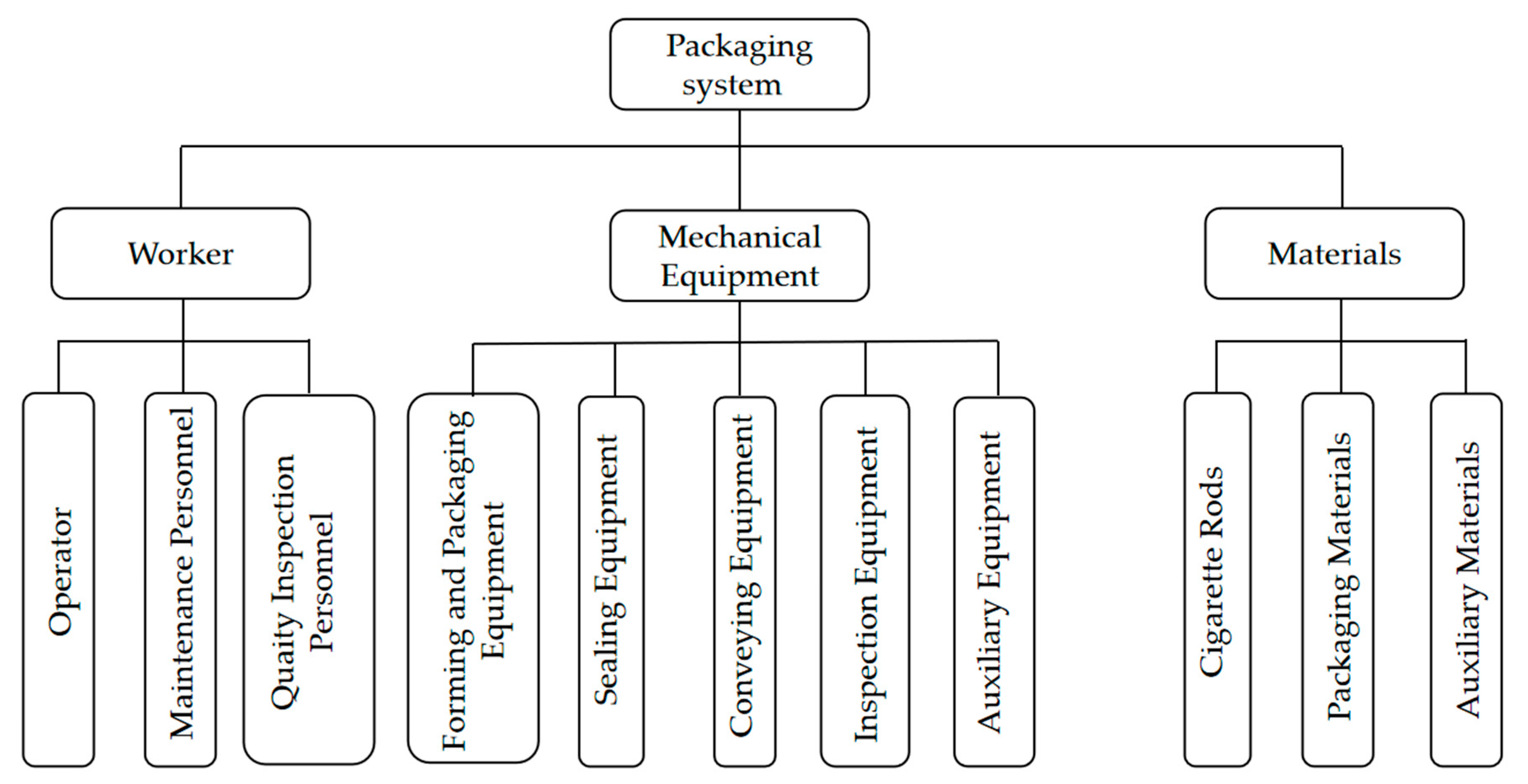
Through this method, the failure modes of the three main components, namely people, mechanical equipment, and materials, can be evaluated more accurately and comprehensively.
Figure 1 presents the hierarchical decomposition of the cigarette factory packaging system, which provides the basis for identifying and classifying potential failure modes in subsequent analysis.
2.2. The Matching Logic Between Heterogeneous Information and Risk Factors
Heterogeneous information refers to the integrated use of different mathematical structures to represent data attributes that possess distinct characteristics. In the context of cigarette factory packaging system risk assessment, forcing all evaluation indicators (defined in
Section 2.1) into a single format (e.g., linguistic variables) leads to information distortion. Based on the intrinsic characteristics of the four evaluation indicators (S/O/D/C) defined in
Section 2.1:
Fuzzy mathematics is adopted as the core methodological framework in this study because it is particularly suitable for modeling subjective and imprecise information derived from expert judgments. Unlike probabilistic methods, which require sufficient historical data, fuzzy-based approaches can effectively represent uncertainty using limited expert knowledge. Compared with evidence theory and linguistic Z-numbers, fuzzy numbers and cloud models provide a favorable balance between expressive capability and computational efficiency. Therefore, fuzzy mathematics is selected as the foundational tool for handling heterogeneous risk information in the proposed failure mode evaluation method.
2.3. Triangular Fuzzy Number
The triangular fuzzy number is an important concept in fuzzy mathematics, which is used to handle uncertainty and fuzziness problems [
24]. It represents the elements in a fuzzy set through three values, which respectively represent the lower bound, upper bound, and most likely value of the fuzzy set.
Definition (1):
is a triangular fuzzy number with the following membership function:
In the formula, and represent the lower and upper limits of the triangular fuzzy number, representing the median.
2.4. Cloud Model
The cloud model was proposed by Li Deyi et al. [
25] and is used to study the uncertainty transformation between qualitative concepts and quantitative descriptions. It can effectively represent ambiguity and randomness by transforming qualitative concepts into quantitative descriptions, which is particularly important in expert evaluations. When dealing with expert opinions, cloud models can simultaneously consider the randomness of evaluation (differences in expert opinions) and fuzziness (fuzzy boundaries during evaluation).
The cloud model uses the triplet to describe the numerical characteristics of qualitative concepts, and the meanings of each parameter are clear:
(Expectation): The center position of a cloud droplet in the domain interval is the most representative quantitative value for qualitative concepts;
(Entropy): Reflecting the uncertainty of qualitative concepts, it not only reflects the fuzzy boundaries of concepts, but also includes the degree of dispersion of cloud droplets;
(Hyper-entropy): The entropy of entropy, which characterizes the uncertainty of En and reflects the degree of dispersion of cloud droplet distribution. The larger the hyper-entropy, the more obvious the “thickness” of the cloud.
Definition (2) Basic operation rules: Suppose there are two normal clouds in the given domain
;
The basic operation formula is as follows:
Definition (3): The golden section method of cloud model. This method is used to transform qualitative evaluation language (such as “low impact” and “severe”) into a computable base cloud, with the following core steps:
Determine the evaluation domain (i.e., the evaluation score range);
If r evaluation levels need to be divided r parts, that is . Then, according to the golden ratio, divide the domain into r consecutive subintervals;
Each subinterval corresponds to a base cloud, and its triplet parameters are calculated according to the following core formula (taking
evaluation items as an example,
is an even number
):
2.5. Entropy Weight Method
The entropy weight method is an objective weighting approach for evaluation indicators. It determines the weights of each evaluation indicator by calculating the information entropy of the evaluation results [
21,
26]. The calculation steps are as follows:
Construct an n × m-dimensional judgment matrix T for n evaluation objects and m evaluation indicators. In this study, n represents the number of experts and i denotes the number of evaluation indicators (S, O, D, and C).
- 2.
Standardize the matrix to eliminate unit differences.
In this study, different normalization formulas are adopted to accommodate benefit-type and cost-type evaluation indicators. Specifically, Severity (S), Occurrence (O), and Detection (D) are treated as benefit-type indicators, where larger values indicate higher risk levels. In contrast, Maintenance Cost (C) is regarded as a cost-type indicator, where larger values represent greater economic loss. Accordingly, the normalization procedure in Equation (9) is applied to ensure the comparability of heterogeneous indicators prior to entropy weight calculation.
- 3.
Calculate the information entropy
where
.
- 4.
Determine the entropy weight of the evaluation indicators.
The entropy weight method is particularly suitable for this study because it determines indicator weights based on the degree of information dispersion rather than subjective preference. In the cigarette factory packaging system, risk assessment data are mainly derived from expert judgments and limited historical records, which are characterized by small sample sizes and strong uncertainty. Compared with subjective weighting methods such as AHP or expert scoring, the entropy method can effectively reduce human bias and objectively reflect the relative importance of different risk factors. Moreover, the entropy weight method can be naturally extended to handle heterogeneous information after appropriate normalization, which makes it well-suited for the proposed heterogeneous risk evaluation framework [
27,
28].
3. Failure Mode Evaluation of Cigarette Factory Packaging System Based on Heterogeneous Entropy Weight Method
In this chapter, three mathematical methods—triangular fuzzy numbers, the cloud model, and the entropy weight method—are applied to address uncertainty and subjectivity in the failure mode evaluation process. Triangular fuzzy numbers are commonly used to represent uncertainty and fuzziness, providing a convenient way to quantify and handle fuzzy data. The cloud model focuses on the fuzziness and randomness of expert judgment, particularly subjective factors in expert evaluations. The entropy weight method is an objective weighting approach that determines the weights of evaluation indicators by considering the degree of variation between observations, thereby minimizing subjective bias.
These three methods are mathematically correlated and jointly account for randomness and subjectivity in the evaluation process. In this study, we comprehensively apply the cloud model and entropy weight theory to ensure that each step in the evaluation process minimizes the interference of subjectivity and randomness, ultimately achieving an objective and comprehensive failure mode assessment.
3.1. Evaluation Scale Generation and Standardization
Based on the four evaluation indicators (S/O/D/C) defined in
Section 2.1 and the heterogeneous information matching logic in
Section 2.2, this section generates corresponding evaluation scales using Formulas (1) to (7) (derived from
Section 2.3 and
Section 2.4) and standardizes the linguistic terms into quantitative parameters.
The grade classifications and corresponding numerical parameters in
Table 1 and
Table 2 are established based on standard fuzzy evaluation practices and the golden section rule, with parameter settings calibrated through expert consensus to ensure consistency with practical maintenance experience. Linguistic evaluation terms are systematically mapped to quantitative representations within a normalized evaluation domain of [0, 10], enabling unified processing of fuzzy and cloud-based information in subsequent analysis.
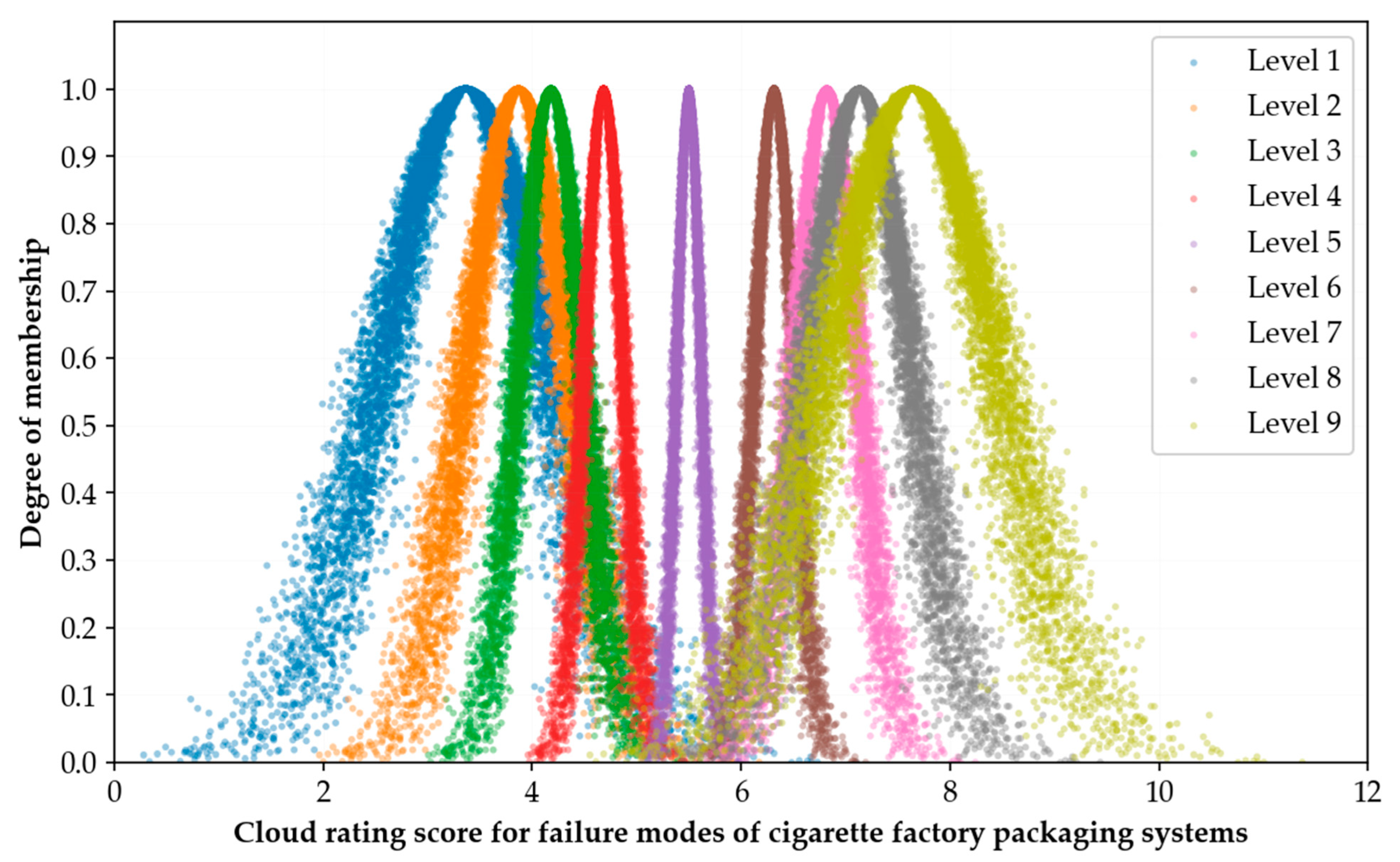
Figure 2 illustrates the cloud model representations of the standard linguistic evaluation terms listed in
Table 2, where differences in the cloud parameters (
,
and
) reflect both the fuzziness and randomness of qualitative expert judgments, as well as the distinguishability among different linguistic risk levels. differences between linguistic terms.
3.2. Method for Selecting Appropriate Evaluation Term Structures
During the failure mode assessment process, cigarette factory experts may give different opinions due to differences in professional backgrounds. To reduce the impact of information bias and ensure that the majority of expert opinions support the final evaluation results, after screening and comparison, three experts with more than 10 years of equipment maintenance experience and similar qualifications were selected to evaluate the information description structure of risk factors.
Experts select appropriate evaluation terms from language scales, use crisp numbers evaluation expressions to assign values to each risk factor, and construct an initial evaluation matrix based on the expert evaluation information. The entropy weight of risk factors is calculated using Formulas (8) to (11), and the obtained weights are multiplied by the corresponding elements of the initial evaluation matrix to obtain a comprehensive evaluation matrix, thereby determining the final evaluation terms for the risk factors.
The evaluation terms will be converted into their corresponding mathematical forms (cloud models and triangular fuzzy numbers) according to the definition in
Section 2.
3.3. Calculate the Weight of Risk Factors for Failure Modes of the Packaging System
Among various objective weighting methods, the entropy weight method has been widely applied in decision analysis and risk assessment due to its ability to objectively reflect the amount of information contained in evaluation data [
10,
15,
20]. The entropy method quantifies the importance of each factor based on its degree of differentiation. The higher the degree of differentiation of a factor, the more information it can bring evaluation indicators [
29]. Therefore, this factor should be given greater weight, and vice versa. However, traditional entropy methods can only handle accurate data, while most extended versions can only handle one type of data. To handle heterogeneous risk information, this study extends the classical information entropy method to calculate the objective weights of risk factors in a heterogeneous background [
25].
When assessing risk factors, experts will directly describe them in words rather than their corresponding semantics. In this step, three appropriate experts are selected to assess the risk factors of the failure mode. The risk factors were evaluated using the terms
of the 9-level language evaluation scale. The standard evaluation glossary of the language terminology set used for assessment as the rating indicator is shown in
Table 1 and
Table 2. Then translate each evaluation term into the corresponding data representation.
In the process of calculating the weight of risk factors for failure modes in the packaging system, the heterogeneous entropy weight method is adopted. Formulas (8) to (11) can be used for calculation to obtain the weight of the failure mode evaluation indicators.
3.4. Calculate the Failure Mode Score of the Production System
RPN is a key indicator used in FMEA to quantify the priority of failure mode risk. FMEA prioritizes failure mode risks based on the final RPN size and proposes corresponding improvement measures to avoid the occurrence of critical failure modes [
30]. In the classical approach, RPN is calculated as the product of Severity, Occurrence, and Detection scores, assuming equal importance among these factors. The traditional calculation method for RPN is shown in Formula (13):
This assumption, however, is often unrealistic in complex industrial systems.
Let denote the comprehensive evaluation matrix of failure modes, where represents the quantified evaluation value of the risk factor for the failure model after heterogeneous information transformation (i.e., cloud models, triangular fuzzy numbers, or crisp numbers). Let represent the corresponding weight vector of the four risk factors derived from the heterogeneous entropy weight method.
Based on the comprehensive evaluation matrix and entropy-based weights, this study proposes an improved Risk Priority Number, denoted as
, which integrates heterogeneous risk information and objective weighting. The
of the
failure mode is calculated as follows:
The proposed extends the classical multiplicative by replacing equal weighting with entropy-derived objective weights and allowing heterogeneous data representations while preserving the fundamental prioritization logic of FMEA.
4. Case Study
4.1. Overview of Failure Modes of Packaging Systems in Cigarette Factories
The packaging process is the core of cigarette manufacturing, whose stability and reliability are crucial to the entire production—problems here may cause production interruption, affect product quality, and affect enterprise economic benefits. Specific failures include the following: mechanical failures (component wear, breakage, or jamming due to long-term operation or improper maintenance), electrical faults (malfunction of electrical components in control/drive systems caused by aging, overload, or short circuit), and supply issues (unstable raw material supply or quality problems leading to production interruption or yield decline) [
3,
31]. The case study focuses on the ZJ17 cigarette packaging unit in a cigarette factory. The factory is located in Henan Province, China, with an annual production capacity of 1,070,000 cases. According to maintenance logs from 2023, the packaging workshop recorded 120 mechanical failures, accounting for 40% of total downtime. This system is critical for production continuity.
4.2. Acquisition of Evaluation Data
Three experts with the same experience and qualifications were selected from a certain cigarette factory, and then six representative failure modes were chosen from the 436 failure modes in the packaging system failure mode library. Three experts first evaluated the information structure of failure mode risk factors using crisp numbers, selected appropriate information description structures for the risk factors, and obtained an initial evaluation matrix.
Table 3 lists six representative failure modes selected from the maintenance records of ZJ17 cigarette packaging machines over the past year. These modes were chosen based on their high frequency of Occurrence and significant impact on production downtime. The data source includes both the automated error logs from the machine’s PLC system and the manual shift reports from operators, ensuring the case study reflects real-world production conditions. Then, the experts evaluated the six failure modes using corresponding evaluation scales to obtain the initial evaluation matrix
X.
4.3. Case-Based Determination of Evaluation Terms for Risk Factors
Experts from the cigarette factories used the crisp number evaluation scale to assess the evaluation terms of failure mode risk factors and obtained the initial evaluation matrix. The three selected terms have the same weight. The entropy weight method is used to calculate the weights of the three evaluation terms. The comprehensive evaluation matrix is obtained from Formulas (8) to (12) to select appropriate evaluation terms for the risk factors of failure modes. The weights of each evaluation term obtained from the expert assessment of risk factors are shown in
Table 4.
To determine the most suitable information structure for each risk factor, experts scored the applicability of crisp numbers, cloud models, and triangular fuzzy numbers on a scale of 0–1.
Table 4 and
Table 5 present the calculation results derived from the entropy weight method. It can be obtained from the data in
Table 5 that the term with the highest score in the S evaluation of risk factors is the cloud model term, with a score of 4.0562. The term with the highest score in the evaluation of risk factor O is the triangular fuzzy number term, with a score of 4.3658. The term with the highest score in the risk factor D evaluation is the cloud model term, with a score of 4.0979. The term with the highest score in the risk factor C evaluation is the clarity number term, with a score of 3.9016. Therefore, the risk factors S and D are evaluated using
Table 2; risk factor O was evaluated using
Table 1; risk factor C was evaluated using crisp numbers.
4.4. Determine the Weights of Risk Factors for Failure Modes
The four risk factors were evaluated using
Table 1 and
Table 2 to obtain the initial evaluation matrix. Then, the heterogeneous entropy weight method is used to calculate the weights of failure mode risk factors. Three experts evaluated the importance levels of failure mode risk factors, and the evaluation results are shown in
Table 6.
Experts convert the corresponding terms for the failure mode evaluation grades in
Table 6 to obtain the initial evaluation data of the failure mode risk factors.
The weights of the four risk factors are obtained by using Formulas (8) to (11) .
4.5. Determine the Comprehensive Evaluation Result
Experts from the tobacco factory evaluated the six failure modes in
Table 3 using evaluation scales 1 and 2 (
Table 1 and
Table 2) and obtained the initial data table of failure modes through corresponding term conversions. The initial evaluation data table of the failure mode by the experts is shown in
Table 7.
The weights
of risk factors are respectively multiplied by the failure mode evaluation matrix to obtain the comprehensive evaluation result. The final assessment results are shown in
Table 8.
4.6. Evaluation Results and Comparative Analysis
To systematically verify the innovative aspects and engineering superiority of the proposed heterogeneous entropy weight RPN* method, it is necessary to first clarify the essential differences in core design logic between it, the traditional RPN method, and the single entropy weight RPN method. The divergences among the three methods are concentrated in the dimensions of evaluation indicators, information processing adaptability, and weight determination methods, which directly determine the rationality of the risk ranking results. Based on this,
Table 9 compares the three methods from five key dimensions, laying a qualitative foundation for subsequent quantitative analysis.
The proposed method addresses the core limitations of traditional methods and the single entropy weight method through three major improvements: adding economic cost indicators, adapting heterogeneous information, and optimizing weight calculation. To comprehensively verify the rationality, superiority, and robustness of the proposed heterogeneous entropy weight FMEA method, this study employs a dual correlation coefficient system for analysis: firstly, the Spearman rank correlation coefficient is used to quantify the consistency of risk ranking among different methods; secondly, the Pearson and Spearman correlation coefficients are employed to verify the linear correlation of entropy weight interference values. This section first clarifies the definitions, functions, and calculation logic of the two coefficients and then proceeds with verification in two parts.
4.6.1. Description of Core Validation Indicators
- (1)
Spearman’s rank correlation coefficient ()
The Spearman rank correlation coefficient is a nonparametric statistical measure that specifically evaluates the correlation between the ranks (ordering positions) of two variables [
32]. It does not depend on the numerical scale of the variables and focuses solely on ranking order. Therefore, it can accurately capture the consistency of risk prioritization logic among different methods and is well-suited for assessing “ranking rationality” in FMEA applications. The coefficient ranges from −1 to 1.
Where
indicates completely identical rankings, values closer to 1 represent stronger ranking consistency,
indicates no correlation, and
indicates completely opposite rankings. The coefficient is calculated as
where
is the number of samples (in this study,
, corresponding to six failure modes),
denotes the rank difference in the
failure mode between the two methods, and
is the sum of squared rank differences.
- (2)
Pearson’s correlation coefficient ()
Pearson’s correlation coefficient (
) is a parametric statistical measure used to quantify the degree of linear correlation between two continuous variables [
32]. It depends on the numerical distributions of the variables and reflects the consistency of numerical variation trends. In this study, Pearson’s coefficient is used to complement ranking-based analysis by verifying numerical stability underweight perturbations or across different methods. The coefficient ranges from −1 to 1.
Where
indicates perfect positive linear correlation, values closer to 1 indicate more consistent numerical variation trends,
indicates no linear correlation, and
indicates perfect negative linear correlation. The coefficient is calculated as
In the Formula (16) and are the observed values of X and Y, respectively; and are the average values of X and Y, respectively. The Pearson correlation coefficient is adopted in this study because it provides a straightforward and widely accepted measure of ranking consistency between different risk assessment methods.
4.6.2. Quantification of Ranking Consistency Among Different Methods
Based on the traditional RPN method (Equation (13)), the single entropy-weighted RPN method, and the proposed RPN* method (Equation (14)), the risk values and ranking results of six failure modes are calculated. The Spearman rank correlation coefficient is used to quantify ranking consistency, and the results are summarized in
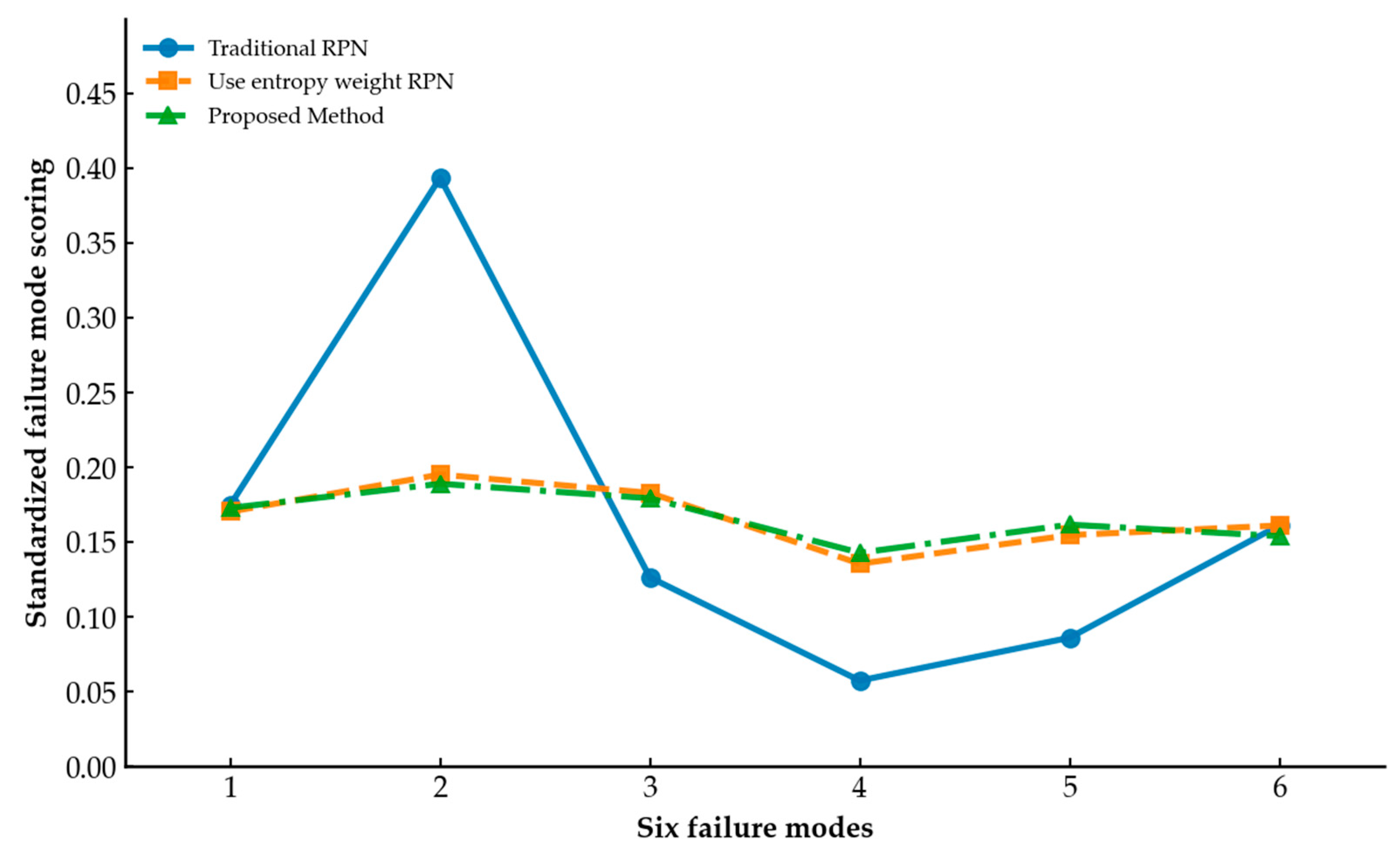
Table 10. To visually illustrate differences in numerical distributions among the methods, the quantitative results are normalized using Equation (17). The normalized values and their linear relationships are shown in
Figure 3.
In order to visually observe the failure mode evaluation results calculated by different methods and their linear relationships, the scoring results of these three methods were standardized, as shown in Formula (17).
The normalized scores and linear relationships of these three methods are shown in
Figure 3.
The discrepancies mainly arise because the traditional RPN method adopts an equal-weight assumption and does not consider maintenance cost, leading to deviations from practical maintenance priorities. For example, FM1 is ranked second by the traditional RPN despite its relatively low maintenance cost, while FM3 and FM6 are underestimated. Although the single entropy-weighted RPN method alleviates subjectivity in weight assignment, it does not account for heterogeneous information structures, resulting in minor information distortion.
The final ranking obtained by the proposed method is .
This ranking is consistent with actual maintenance records of the cigarette factory. FM2 exhibits both high technical risk and substantial economic loss and is therefore ranked first, whereas FM4 shows low technical impact and economic cost and is ranked last. These results confirm the rationality and practical relevance of the proposed method.
4.6.3. Robustness Analysis Under Entropy Weight Perturbation
To examine robustness against weight uncertainty, four entropy-weight perturbation scenarios are designed by independently disturbing individual risk factors: ±10% for Severity (S), +10% for Occurrence (O), and −10% for Detection (D). After proportional normalization, RPN* values are recalculated based on the comprehensive evaluation matrix .
Both Pearson and Spearman correlation coefficients are calculated between each perturbation scenario and the baseline case. As shown in
Table 11, all perturbation scenarios achieve Spearman coefficients of 1.0000, indicating completely identical rankings. Meanwhile, Pearson coefficients are all greater than 0.9995, demonstrating strong numerical stability.
These results indicate that the proposed method maintains both ranking stability and numerical robustness even under significant entropy-weight fluctuations. Therefore, the method exhibits strong anti-interference capability and is suitable for practical application in complex industrial systems such as cigarette packaging systems.
5. Discussion
5.1. Advantages of the Proposed Method
The proposed heterogeneous entropy weighting method addresses two critical gaps identified in the literature [
20,
21]:
- ■
Targeted Heterogeneous Information Adaptation: By using cloud models for Severity (S) and Detection (D), the method successfully captures the “fuzziness and randomness” inherent in expert judgments of technical risk—a limitation that traditional crisp-number-based FMEA fails to resolve. Simultaneously, retaining crisp numbers for Maintenance Cost (C) ensures that precise economic data specific to packaging equipment maintenance is not distorted. This dual-mode information processing is well-suited to the technical-economic dual constraints of cigarette packaging systems, which is rarely considered in existing FMEA variants.
- ■
Objective and Scenario-Aligned Weighting: The introduction of heterogeneous entropy weighting eliminates the subjectivity of traditional FMEA (where S, O, and D are arbitrarily assigned equal weights) and compensates for the shortcomings of single entropy-based methods (which ignore the structural differences in heterogeneous data). The case study results confirm that Maintenance Cost (C) often carries significant weight in practical risk prioritization, a critical factor ignored by both traditional RPN and single entropy-based RPN methods.
5.2. Limitations and Future Work
Despite its effectiveness, this study has several limitations. First, the proposed method relies on expert evaluations as primary inputs. Although cloud models are employed to mitigate fuzziness and randomness in subjective judgments, they cannot completely eliminate potential expert bias. In this study, three experienced frontline engineers and technical managers participated in the assessment, and the standard deviations of the scores for S, O, D, and C. However, due to the relatively small expert sample size, formal inter-expert consistency indices were not reported, as such metrics may be overly sensitive and potentially misleading when applied to small panels. Future research will expand the expert pool and incorporate explicit consistency analysis to further strengthen the reliability of expert judgments.
Second, the proposed model evaluates failure modes independently and does not explicitly consider interactions or cascading effects among failure modes. In complex industrial systems, one failure may trigger or amplify others, which could influence overall risk prioritization. Future studies may integrate methods such as DEMATEL or complex network theory to capture coupling relationships between failure modes and enhance modeling accuracy.
Third, the validation of the proposed method is based on a single real-world case study from a cigarette factory’s packaging system. Although this ensures engineering authenticity, broader validation across multiple factories or different industrial systems would further improve the generalizability of the conclusions. Extending the application scope of the proposed framework will therefore be an important direction for future work.
6. Conclusions
This study aims to apply heterogeneous information to the evaluation of failure modes of cigarette factory packaging systems, thereby extending the traditional entropy weight method to the heterogeneous entropy weight method and constructing a failure mode evaluation model of cigarette factory packaging systems based on the heterogeneous entropy weight method. By using quantitative risk factors, minor qualitative risk factors, and qualitative risks to explain the risk factors, the fuzziness and randomness of the risk factor information of the failure mode of the cigarette factory packaging system are effectively reflected. The heterogeneous entropy weight method is introduced to improve the calculation of risk factor weights, making the weight distribution more reasonable, accurately reflecting the importance of risk factors, and making the overall evaluation results more accurate and reasonable.
This method was applied to analyze the packaging system of a cigarette factory and was compared with the actual failure mode of the cigarette factory. The evaluation results obtained were consistent. By using the Pearson correlation coefficient method to analyze the method proposed in this paper with the traditional RPN and single entropy weight methods, it is found that the three are positively correlated. Moreover, compared with these two methods, this method has certain improvements, which to some extent prove that this method has certain feasibility and applicability.
Author Contributions
Conceptualization, X.L. and Z.L.; methodology, X.L.; software, Z.L. and J.W.; validation, J.W.; formal analysis, X.L.; investigation, J.W. and L.Y.; resources, J.W.; data curation, L.Y.; writing—original draft preparation, X.L.; writing—review and editing, L.Y. and Z.L.; visualization, J.W.; supervision, Z.L.; project administration, L.Y.; funding acquisition, L.Y. All authors have read and agreed to the published version of the manuscript.
Funding
This research was funded by the National Natural Science Foundation of China (Grant No. 62373330), the National Natural Science Foundation of China Youth Program (Grant No. 52106030), and a Horizontal Scientific Research Project entitled “Development and Application of Digital Failure Mode Impact Analysis” (no grant number). The APC was funded by the above-mentioned projects.
Data Availability Statement
The data presented in this study are not publicly available due to privacy and experimental restrictions.
Conflicts of Interest
Zhuwen Liu, Jing Wang, and Longfei Yang are employed by China Tobacco Henan Industrial Co., Ltd. The remaining authors declare that the research was conducted in the absence of any commercial or financial relationships that could be construed as a potential conflict of interest.
Abbreviations
The following abbreviations are used in this manuscript:
| AHP | Analytic Hierarchy Process |
| BWM | Best-Worst Method |
| C | Maintenance Cost |
| CN | Clear Number |
| D | Detectability |
| FM | Failure Mode |
| FMEA | Failure Mode and Effects Analysis |
| L | Low impact |
| MARCOS | Measurement of Alternatives and Ranking According to Compromise Solution |
| MCDM | Multi-Criteria Decision Making |
| MI | Less impact |
| MO | Moderate impact |
| N | No influence |
| O | Occurrence Frequency |
| Pc | Pearson’s Correlation Coefficient |
| RPN | Risk Priority Number |
| RPN* | Improved Risk Priority Number |
| S | Severity |
| TOPSIS | Technique for Order Preference by Similarity to Ideal Solution |
| VH | Very dangerous |
| E | Extremely high |
| Z | Z-numbers |
References
- Cheng, L.; Zhao, Y.F.; Li, Y.; Wang, S.H.; Li, Q. Analysis of Improvement in Cigarette Process Quality Control. Mech. Electr. Prod. Dev. Innov. 2022, 35, 113–115. [Google Scholar]
- Wang, Y.; Sun, C.; Wang, X.L. Analysis of Equipment Health Management and Application of an Informationization Platform in the Tobacco Industry. China Equip. Eng. 2022, 16, 19–21. [Google Scholar]
- Li, D.W.; Zai, X.W.; Zhang, S.; Sun, T.; Chu, J.Y.; Liu, Z.P. Risk Assessment of ZPW-2000A track Circuit based on Fuzzy Grey Theory. J. Zhengzhou Univ. 2019, 41, 73–78. [Google Scholar]
- Akhtar, M.J.; Afshan, N.; Faaiz, A. A novel hybrid approach to explore the interaction among faults in production process with extended FMEA model using DEMATEL and cloud model theory. Eng. Fail. Anal. 2024, 157, 107876. [Google Scholar] [CrossRef]
- Mei, Y.P.; Chen, C.; Tan, J.Q.; Liu, F.; Zhou, X.; Tang, Y.H.; Li, C.C. Research on Problems and Reform Ideas of Science and Technology Evaluation in Tobacco Enterprises. J. Anhui Agric. Sci. 2024, 52, 215–218. [Google Scholar]
- Li, Q.; Tu, K.J.; Lü, X.Z. Thoughts on Intelligent Manufacturing in Cigarette Rolling and Packaging Workshops. Equip. Manag. Maint. 2022, 1, 5–6. [Google Scholar] [CrossRef]
- Sheng, X. Application Research on Quality Control Methods in Cigarette Processing. Mod. Bus. Trade Ind. 2021, 42, 32–33. [Google Scholar]
- Sinha, K. Harnessing machine learning in contemporary tobacco research. Toxicol. Rep. 2025, 14, 101877. [Google Scholar] [CrossRef]
- Liu, S.M.; Zhou, F.R.; Wang, J.; Shi, Y.-Z.; Li, J.-Y.; Cao, X.-D.; Jian, R. Improvement of tipping Paper Conveying System of ZJ17 cigarette machine. Food Mach. 2019, 36, 119–121+228. Available online: https://www.ifoodmm.cn/journal/vol36/iss2/22 (accessed on 1 February 2026).
- Zhang, P.; Zhong, S.; Zhu, R.; Jiao, M.J. Technical status assessment of stone arch bridge based on entropy weight method and cloud model. J. Zhengzhou Univ. 2022, 43, 69–75. [Google Scholar]
- Chen, X.Y. Exploring the Cost Control Model of Lean Production in Cigarette Factories. Money China 2022, 1, 55–57. Available online: https://www.scirp.org/reference/referencespapers?referenceid=3694559 (accessed on 1 February 2026).
- Akram, M.; Luqman, A.; Alcantud, J.C.R. An integrated ELECTRE-I approach for risk evaluation with hesitant Pythagorean fuzzy information. Expert Syst. Appl. 2022, 200, 116945. [Google Scholar] [CrossRef]
- Celik, E.; Gul, M. Hazard identification, risk assessment and control for dam construction safety using an integrated bwm and marcos approach under interval type-2 fuzzy sets environment. Autom. Constr. 2021, 127, 103699. [Google Scholar] [CrossRef]
- Reda, H.; Dvivedi, A. Decision-making on the selection of lean tools using fuzzy qfd and fmea approach in the manufacturing industry. Expert Syst. Appl. 2022, 192, 116416. [Google Scholar] [CrossRef]
- Liu, P.; Li, Y. An improved failure mode and effect analysis method for multi-criteria group decision-making in green logistics risk assessment. Reliab. Eng. Syst. Saf. 2021, 215, 107826. [Google Scholar] [CrossRef]
- Yuesan, M.; Kahraman, G. Risk evaluation and prevention in hydropower plant operations: A model based on Pythagorean fuzzy AHP. Energy Policy 2019, 126, 343–351. [Google Scholar] [CrossRef]
- Yazdi, M. Linguistic Methods Under Fuzzy Information in System Safety and Reliability Analysis; Springer: Berlin/Heidelberg, Germany, 2022. [Google Scholar]
- Hu, Z.; Lin, J. An integrated multicriteria group decision making methodology for property concealment risk assessment under z-number environment. Expert Syst. Appl. 2022, 205, 117369. [Google Scholar] [CrossRef]
- Shahri, M.M.; Jahromi, A.E.; Houshmand, M. Failure Mode and Effect Analysis using an integrated approach of clustering and MCDM under pythagorean fuzzy environment. J. Loss Prev. Process Ind. 2021, 72, 104591. [Google Scholar] [CrossRef]
- Hua, Z.; Fei, L.; Jing, X. An improved risk prioritization method for propulsion system based on heterogeneous information and PageRank algorithm. Expert Syst. Appl. 2023, 212, 118798. [Google Scholar] [CrossRef]
- Qian, G. Risk Assessment Model for Converter Transformers Based on Entropy-Weight Analytic Hierarchy Process. Energies 2025, 18, 1757. [Google Scholar] [CrossRef]
- Waseem, H.M. Data-driven FMEA approach for hazard identification and risk evaluation in digital health. Sci. Rep. 2025, 15, 26856. [Google Scholar] [CrossRef]
- Braglia, M. MAFMA: Multi-Attribute Failure Mode Analysis. Int. J. Qual. Reliab. Manag. 2000, 17, 1017–1033. [Google Scholar] [CrossRef]
- Liu, H.C.; Wang, L.E.; Li, Z.; Hu, Y.P. Improving risk evaluation in FMEA with cloud model and hierarchical TOPSIS method. IEEE Trans. Fuzzy Syst. 2018, 27, 84–95. [Google Scholar] [CrossRef]
- Li, D.; Liu, C.; Gan, W. A new cognitive model: Cloud model. Int. J. Intell. Syst. 2009, 24, 357–375. [Google Scholar] [CrossRef]
- Liao, H. An enhanced failure mode and effect analysis method based on preference disaggregation in risk analysis of intelligent wearable medical devices. Eng. Appl. Artif. Intell. 2025, 147, 110384. [Google Scholar] [CrossRef]
- He, D.; Xu, J.; Chen, X. An Information-Theoretic-Entropy-Based Weight Aggregation Method in Multiple-Attribute Group Decision-Making. Entropy 2016, 18, 171. [Google Scholar] [CrossRef]
- Shen, Y.; Liu, Y.; Zhang, J.; Wang, X. An Entropy Weight-Based Decision Model for Risk Assessment Under Uncertain Information. Medicine 2021, 100, e24539. [Google Scholar] [CrossRef]
- Gong, Y.Q.; Tong, L.C.; Yu, Z.; Zhang, X. Research on fault diagnosis method of rotating machinery misalignment based on Pearson correlation coefficient. China New Technol. New Prod. 2022, 5, 48–50. [Google Scholar]
- Wang, L.C. Practical Guide to Failure Mode and Effects Analysis (FMEA); China Machine Press: Beijing, China, 2020. [Google Scholar]
- Ostadi, B.; Ahmadabadi, M.; Khalesi, N. Application of FMEA and RPN techniques for man-machine system failure analysis of a tobacco production line. Cogent Eng. 2019, 6, 1640101. [Google Scholar] [CrossRef]
- Schober, P.; Boer, C.; Schwarte, L.A. Correlation Coefficients: Appropriate Use and Interpretation. Anesth. Analg. 2018, 126, 1763–1768. [Google Scholar] [CrossRef]
| Disclaimer/Publisher’s Note: The statements, opinions and data contained in all publications are solely those of the individual author(s) and contributor(s) and not of MDPI and/or the editor(s). MDPI and/or the editor(s) disclaim responsibility for any injury to people or property resulting from any ideas, methods, instructions or products referred to in the content. |