Article

Physics-Based Metaheuristic Optimization Algorithms for Pathfinding

1
Computer Science Department, The University of Jordan, Amman 11942, Jordan
2
Basic for Medical Sciences Department, Ibn Sina University for Medical Sciences, Amman 16197, Jordan
*
Author to whom correspondence should be addressed.
Algorithms 2026, 19(1), 12; https://doi.org/10.3390/a19010012
Submission received: 7 November 2025 / Revised: 12 December 2025 / Accepted: 14 December 2025 / Published: 22 December 2025
(This article belongs to the Section Algorithms for Multidisciplinary Applications)

Abstract

This paper examines the performance of nine physics-based metaheuristic algorithms—Electromagnetism-Like Algorithm (EMLA), Fluid Search Algorithm (FSA), Gravitational Search Algorithm (GSA), and six hybrids (EMLA + FSA, EMLA + GSA, FSA + ELMA, FSA + GSA, GSA + EMLA, GSA + FSA) for vehicle pathfinding. Performance is evaluated using four metrics: travel distance, time, energy consumption, and number of obstacles encountered, along with a weighted multi-objective cost combining these metrics. Simulation results show that hybrid algorithms generally outperform their individual counterparts. The ranking of algorithms varies with the weighting of the metrics. The hybrids involving EMLA consistently achieve the best overall performance across grid sizes. FSA + EMLA performs best when minimizing distance. EMLA + GSA is most effective when time is the priority. EMLA + GSA also performs best when energy use and obstacle avoidance dominate. It is recommended to use the cases FSA + GSA or FSA + EMLA for energy-efficient and obstacle-aware navigation, GSA or GSA + EMLA for achieving global optimality on complex maps, and EMLA + FSA and FSA + EMLA for dynamic environments requiring high safety.

1. Introduction

Pathfinding is one of the most challenging issues in mobile robotic or autonomous vehicle navigation, especially in terrain characterized by obstacles and changeable elevation [1]. There are different approaches or algorithms to find the optimal path, including brute force, heuristic, and metaheuristic optimization algorithms [2,3]. Identifying an optimal objective function for a path between a source and destination point while minimizing criteria such as distance, travel time, or energy consumption can be deceptively complicated and often categorized as NP-hard. However, challenges can arise as terrain complexity increases or when multiple objectives need to be optimized [4].
Heuristic algorithms such as Dijkstra and A* algorithms have been used frequently for path planning because of their deterministic characteristics and computational efficiency [5]. To address the challenges of brute force and heuristic approaches, metaheuristic algorithms have been adapted as effective methods for solving high-dimensional and nonlinear optimization problems. Metaheuristic methods are inspired by physical, biological, or evolutionary phenomena and provide added flexibility and adaptability for exploring large, complex search spaces [6]. Physical-based metaheuristic algorithms imitate the behaviors of natural physical systems and have shown good performance in solving constrained optimization problems in a variety of fields [7,8].
This study presents a comprehensive evaluation of nine physics-based metaheuristic algorithms for vehicle pathfinding in static terrain environments with sparse obstacles. The algorithms investigated include three established physics-inspired optimizers Electromagnetism-Like Algorithm (EMLA), Fluid Search Algorithm (FSA), and Gravitational Search Algorithm (GSA) as well as six newly developed hybrid variants formed by combining these algorithms pairwise. These hybrids EMLA + FSA, EML + GSA, FSA + EMLA, FSA + GSA, GSA + EMLA, and GSA + FSA are designed to exploit and explore search behaviors and enhance robustness across diverse terrain conditions.
We adapt each algorithm to incorporate terrain-dependent metrics: travel distance, traversal time, energy consumption, and the number of obstacles encountered. A weighted multi-objective cost function is also employed to capture trade-offs among these metrics. Simulated terrains are generated to create controlled virtual environments for algorithm testing. Each algorithm is assessed under multiple objectives, including minimizing distance, time, and energy while ensuring safe obstacle avoidance, convergence speed, and execution time.
This study employs a structured methodology composed of seven stages: problem formulation, data preparation, conceptual modeling, model translation, verification and validation, and simulation experimentation. The methodology formulates a multi-objective terrain-based path-finding problem using four heterogeneous metrics combined through a normalized weighted cost function and evaluates algorithm performance across both synthetic terrains and real elevation data from Jibal Sharat region to ensure controlled and realistic testing conditions. A unified conceptual model is developed in which agents interact with the terrain under algorithm-specific physical forces: gravity, electromagnetism, and fluid dynamics. Nine metaheuristic algorithms, including hybrid variants, are implemented within a standardized Python v3.11.2 framework to enable consistent cross-algorithm comparison. A verification and validation strategy incorporating A* provides baseline feasibility and supports visualization-driven debugging. The methodology further includes reproducible simulation experiments with multiple replications, statistical performance summaries, and generation of visual outputs. Finally, the study produces comprehensive path visualizations, cost summaries, and comparative analyses to support robust interpretation of algorithmic behavior and overall effectiveness.
The stepwise methodological contributions are as follows: (1) formulation of a terrain-based multi-objective pathfinding model integrating distance, energy, time, and obstacle avoidance using a normalized weighted cost: (2) use of both synthetic and real elevation-based terrains (Jibal Sharat) for comprehensive evaluation; (3) development of a unified conceptual model integrating physics-based forces into agent behavior across algorithms; (4) standardized Python implementation of nine algorithms, ensuring fair, reproducible comparison; (5) verification framework using A* for baseline path generation and visual debugging; (6) structured simulation protocol with multiple replications and statistical output; (7) multi-modal output generation, including summary tables, performance logs, and visual path plots. These contributions are highlighted as:
(1)
A unified simulation and evaluation framework for benchmarking physics-based metaheuristic algorithms on terrain-constrained vehicle pathfinding problems, incorporating elevation, obstacles, and multi-objective cost functions.
(2)
The development of six novel hybrid physics-based metaheuristic algorithms by pairwise combining EMLA, FSA, and GSA, offering extended search capabilities and improved adaptability.
(3)
Investigating the performance of the six-hybrid physical-based optimization algorithms in terms of path length, energy consumed, time, and number of obstacles encountered.
The algorithms can successfully adapt the metaheuristic nature of the work to address path optimization problems that exist in disrupting or non-dynamic, obstacle-sparse fields, such as those applied in autonomous navigation systems and intelligent transportation problems.
Simulation results indicate that hybrid algorithms consistently outperform their individual counterparts, with performance rankings varying based on metric weightings. Hybrids involving EMLA show the most stable and competitive results across grid sizes. Specifically, FSA + EMLA excels when distance minimization is the priority, while EMLA + GSA is most effective for optimizing traversal time, energy efficiency, and obstacle avoidance.
This paper is organized as follows: Section 2 presents a review of related work. Section 3 explains the hybrid algorithms based on a simulation framework. Section 4 shows the experimental results and discussion. Finally, Section 5 presents conclusions and future work.

2. Related Work

Metaheuristic algorithms improve the efficiency of pathfinding algorithms in complex environments. They have natural or physical inspiration and typically perform well when traditional pathfinding fails to find an optimal path due to the complexity of the network representing the environment.
Recent research on metaheuristic algorithms has shown remarkable improvements in pathfinding optimization in static environments with irregular terrain with sparse obstacles [9,10,11]. Table 1 summarizes recent metaheuristic pathfinding studies between 2020 and 2025 based on the performance characteristics of the algorithm, adaptability to the environment, and the context of implementation.
Promkaew et al. in [12] have applied the Artificial Bee Colony (ABC) algorithm, Improved Particle Swarm Optimization (PSO), and Improved Grey Wolf Optimizer (GWO) for planning smooth paths at high speeds. The implementation was applied using indoor robots, creating paths that were 19% shorter and 10 × faster than the A* path planning algorithm. Almoaili and Kurdi [13] suggested the “MetaPath,” which is a biochemistry approach that was 3000 × faster and generated a path with a quality close to Ant Colony Optimization (ACO) and Genetic Algorithm (GA).
There has been increased interest in research that proposes hybrid approaches. Zhang and Zhang [14] suggested a hybrid Three-Rule Chaotic Harris Hawk Optimization Algorithm (TRCHOA) with Elite Particle Algorithm (EPA), resulting in a better success rate and time compared to PRM. Qadir et al. [15] used a Dynamic Group-Based Cooperative Optimization (DGBCO) approach as part of a UAV deployment in a disaster response project and reduced transport costs by 24.5%. Some studies have connected simulations to real-world deployment. Peñacoba et al. [16] used Particle Swarm Optimization (PSO) on a LiDAR-equipped surveillance robot, with a coverage of 86.7 in complex maps. Wahab et al. [17] explored the competitiveness of meta-heuristic algorithms: GA, PSO, Differential Evolution (DE), and Cuckoo Search Algorithm (CSA) against Dijkstra Algorithm (DA) in multiple planning scenarios.
Qiao et al. [18] proposed the Improved Red-Billed Blue Magpie Optimization (IRBMO), introducing chaotic initialization and dual-mode perturbation to avoid premature convergence in 3D UAV path planning. IRBMO obtained superior path quality, significantly outperforming 14 other methods, with a 15.3% lower standard deviation compared with the original RBMO algorithm. Analogously, Lv et al. [19] proposed the RLHSSA for multi-UAV cooperative path planning over mountainous terrain and used a dynamic scheduling mechanism to obtain a 100% success rate and the lowest standard deviation among competitor algorithms, proving that it is much more stable.
The remaining research focused on the comparison of basic mathematics and the implementation of hybrids by making use of conventional search techniques. In the comparative review of Ant Colony Optimization (ACO), Artificial Bee Colony (ABC), Firefly Algorithm (FA), Moth Flame Optimization (MFO), and Tabu Search (TS) for TSP and shortest path problems conducted by Trivedi et al. [2]. It was found that ACO consistently identified optimal paths but required high computational time, while TS offered a better trade-off between efficiency and solution quality. To overcome the disadvantage of basic methods, Sowrirajan et al. [21] developed a new hybrid by combining multi-agent ACO with GBFS, where GBFS provided an efficient initial tour. This hybrid framework achieved shorter tour length and faster convergence when applied on TSP cases and significantly outperformed standalone methods like ACO, Genetic Algorithms (GA), and Simulated Annealing. Idoko in [20] also developed a hybrid of PSO and BFS to optimize the routes taken by Electric Vehicles on a realistic road network and was able to apply the proposed method in streamlining the network, removing nodes not useful in the computation, and finding the shortest feasible EV travel path. For optimization problems in logistics and transportation, Ishtaiwi et al. [22] proposed FVIMDE, a hybrid framework combining the local search of FVIM with the global search of DE for VRPs. Experimental results indicated that FVIMDE consistently obtained high-quality routes. The RPD from the best-known solutions was mostly less than 1%.
Physics-based metaheuristic algorithms are optimization techniques inspired by physical principles, offering robust and flexible solutions to complex, nonlinear, and high-dimensional problems. Examples of physics-based metaheuristic optimization algorithms are Central Force Optimization Algorithm (CFOA), Particle Collision Algorithm (PCA), Big Bang-Big Crunch (BB-BC), Galaxy Based Search Algorithm (GBSA), Intelligent Water Drops Algorithm (IWDA), Big Crunch Algorithm (BCA), Integrated Radiation Algorithm (IRA), Charged System Search Algorithm (CSSA), River Formation Dynamics Algorithm (RFDA), Ion motion algorithm (IMO), Artificial Physics Algorithm (APA), Space Gravitational Algorithm (SGA), Gravitational Search Algorithm (GSA), Electromagnetism-Like Algorithm (E MLA), and Fluid Search Algorithm (FSA) are physics-based metaheuristic algorithms. The GSA, EMLA, and FSA are used in our pathfinding optimization framework and are presented in this section. The selection of Gravitational Search Algorithm (GSA), Electromagnetism-Like Algorithm (EMLA), and Fluid Search Algorithm (FSA) is based on the unique physics-inspired backgrounds, which offer orthogonal optimization characteristics. GSA mimics gravitational forces among masses with a robust global search capability well-suited for dominating difficult search areas. EMLA mimics electromagnetic attraction and repulsion laws, which work best to fine-tune the local style with great accuracy. FSA captures fluid dynamic behavior in efficient convergence and dynamic adaptability. The algorithms collectively represent distinct physical phenomena—gravity, electromagnetic, and fluid dynamics—yet support a unifying comparison of physics-based optimization of path planning, their metaheuristic architecture ensuring flexibility in representing multi-objective constraints without tuning-based problems.

2.1. Gravitational Search Algorithm (GSA)

The Gravitational Search Algorithm was introduced by Rashedi et al. in 2009 [23]. The GSA is inspired by Newton’s laws of gravity and laws of motion. In GSA, the agent (candidate solution) is assigned a mass, which acts as the potential source of attraction to the other agents as a function of the fitness of the candidate solution. The core mechanism of GSA is that each agent’s mass corresponds to its fitness value. Agents with better solutions and higher fitness value are assigned a larger mass. This larger mass value is under a stronger gravitational force. The heavier mass will ultimately move towards the position of the global optimum as determined by the other agents [23].
Each agent updates its velocity and position based on the net gravitational force exerted by agents and has determined that a gravitational pull or force is being exerted upon them. The force of attraction enables the algorithm to explore new areas and exploit existing areas of the solution search space for an optimum solution.
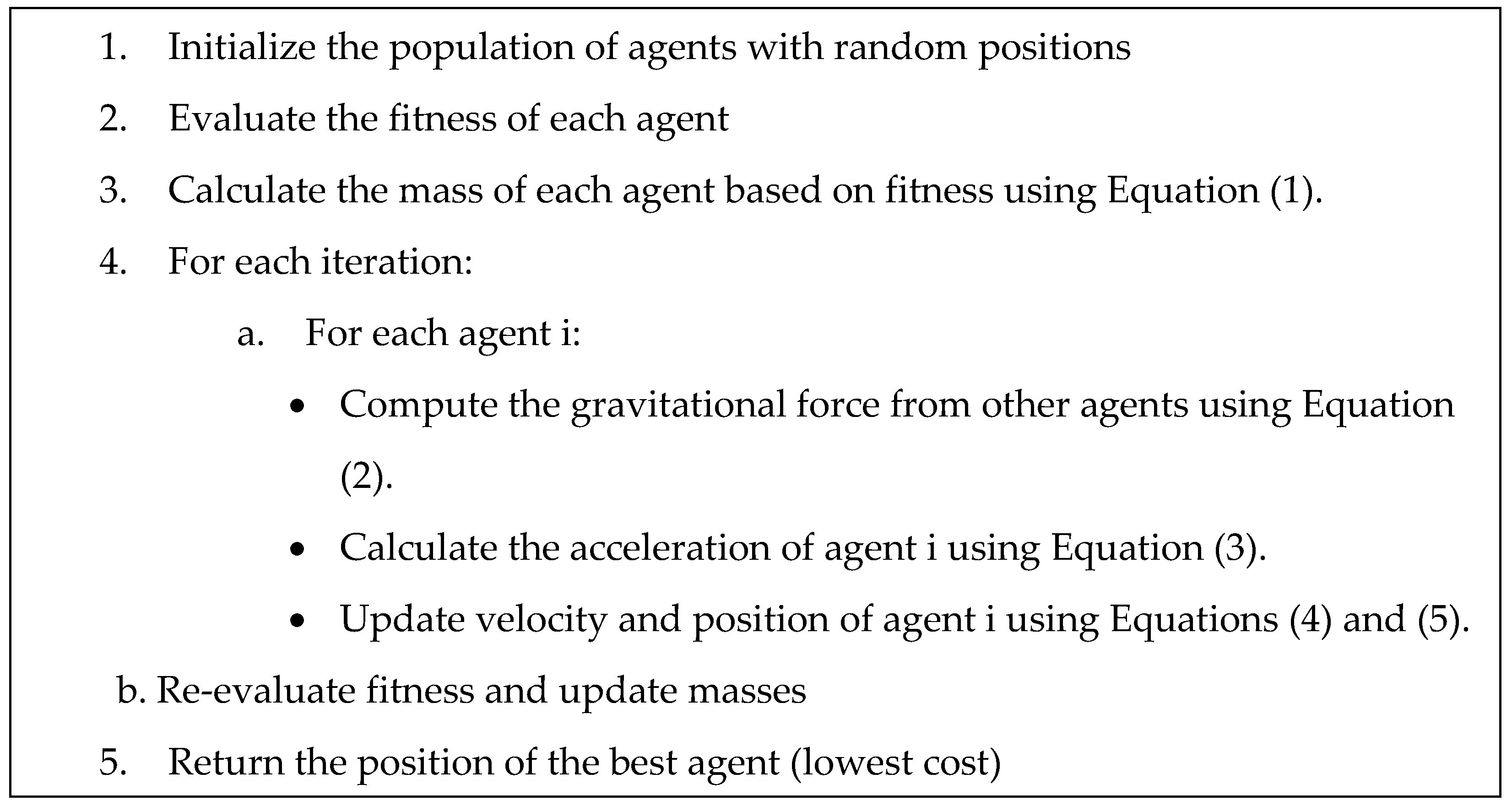
Equations (1)–(5) represent the mathematical modeling for GSA [24]. The Mass calculation is expressed in Equation (1). Equation (2) represents the gravitational force. The acceleration, velocity, and position updates are expressed in Equations (3), (4), and (5), respectively.
m i t = f i t w o r s t t b e s t t w o r s t t , M i t = m i t j = 1 N m j t
where fi(t): Fitness of agent i, and best(t), worst(t): Best and worst fitness at iteration (t).
F i j t = G t M i t M j t R i j t + ϵ x j t x i t
where G(t): gravitational constant decreasing over time, Rij (t): Euclidean distance between agents i and j, and ϵ: small constant to avoid division by zero.
a i t = F i t M i t
v i t + 1 = r v i t + a i t
x i t + 1 = x i t + v i t + 1
Figure 1 presents the steps in GSA.
To derive the theoretical runtime complexity of the nine metaheuristic algorithms, let N be the number of agents, L be the dimensionality of the search space, and I be number of iterations. The GSA consists of several computational components per iteration. Each agent evaluates its fitness by Equation (1), based on the L-dimensional position, with O ( N L ) . The mass update requires finding the best and worst fitness and computing normalized values total of O(N). Computing the gravitational force from other agents using Equation (2) cost O(N2L). Calculating the acceleration of an agent, using Equation (3), cost O(L). Calculating update velocity and position of the agent, using Equations (4) and (5), cost 3O(L) O(L). The total theoretical run time complexity in each iteration is O N L + O N + O N 2 L + O N L . Thus, for I iterations, the run time complexity of GSA is approximated by O(IN2L). This complexity agrees with the formal complexity of standard GSA as defined by Rashedi et al. (2009) [23].

2.2. Electromagnetism-like Algorithm (EMLA)

The Electromagnetism-Like Algorithm proposed by Birbil and Fang [25]. The EMLA is based on the foundation of Coulomb’s law of electromagnetism. Each solution within EMLA is modeled as a charged particle. For this set of solutions, the amount of charge (magnitude) is proportional to the quality of fitness. These charged particles produce some combination of attraction or repulsion forces between the particles. Strong solutions attract and weak solutions repel.
The EMLA is divided into four major phases: initialization, attraction and repulsion force calculations, movement based on the net force calculated, and the local search phase. The interaction between particles helps converge values fairly easily and leads to a global optimum. The EMLA has been used successfully for a variety of problems, including the training of neural networks, timetabling, and designing fuzzy controllers, where fast convergence and a satisfactory solution might be equally desired.
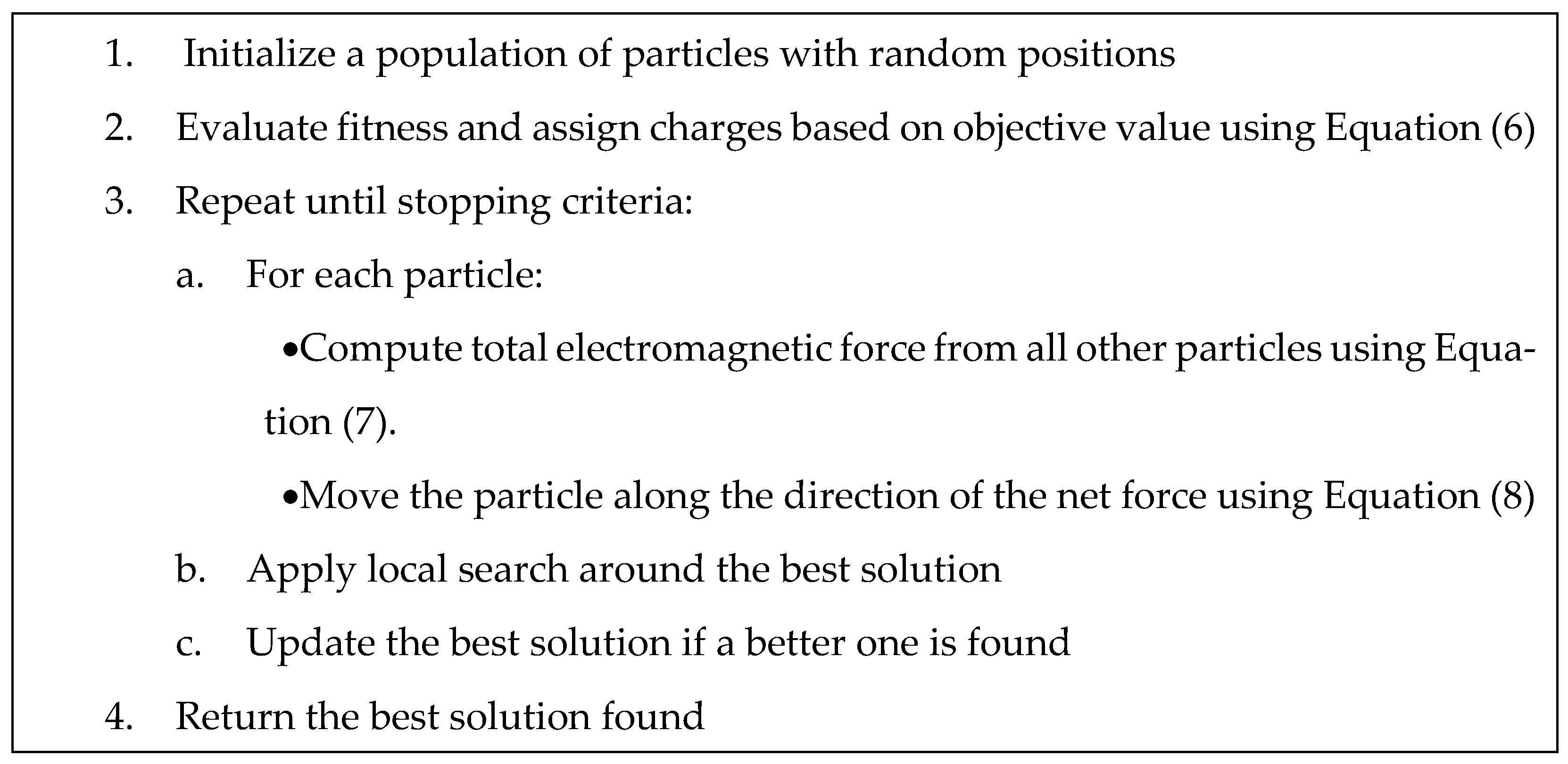
Equations (6)–(9) represent a mathematical model of the EMLA, and Figure 2 presents the pseudocode of EMLA [25]. The charge of a particle is expressed by Equation (6). The movement is expressed by Equation (8)
q i = exp n   f i f b e s t f w o r s t f b e s t
F i j = q i     q j x i x j 2     x j x i , i f f j < f i a t t r a c t i o n
F i j = q i     q j x i x j 2   x j x i , o t h e r w i s e r e p u l s i o n
x i = x i + λ F i
where λ is a random scalar in [0,1].
F i = j i F i j
A derivation of the theoretical complexity of the EMLA can be in the same style as it is for GSA. Randomly generate particle positions in L-dimensional space cost O ( N L ) . The fitness evaluation of all particles cost O(NL). The charge computation, using Equation (6), is dominated by fitness computation O ( N L ) for N particles. The pairwise electromagnetic force computation, using Equation (7), comes from computing the different vector cost O(L), computing the squared norm O(L), scaling the vector cost O(L). There are N ( N 1 ) O ( N 2 ) . Thus, the cost of force per iteration is O N 2 L . For N particles, updating L-dimensions position cost O ( N L ) per iteration. The local search cost at most O N L . Thus, for I iterations, the theoretical run time complexity   O I N 2 L . This agrees with “…EMLA exhibits the same O ( T N 2 D ) complexity because electromagnetic interactions are computed between all particles,” Birbil & Fang (2003)” [25], where they used N for number of agents, D for dimensionality of the search space, and T for number of iterations.

2.3. Fluid Search Algorithm (FSA)

The Fluid Search Algorithm [7] is based on the behavior of fluid particles in motion and the pressure-driven flow process. The paper covers a larger area of fluid-inspired approaches, including methods such as River Formation Dynamics (RFDA) and Intelligent Water Drops (IWD)- FSA is included within this family of methods, which rely on the metaphor of particles moving to follow gradients based on environmental pressure or cost surfaces.
The FSA simulates how fluid flows naturally through the paths with the lowest resistance in the context of pathfinding. The FSA effectively navigates the terrain while avoiding obstructions and expensive areas by modeling dynamic pressure changes and flow interactions. Equations (10) and (11) represent the mathematical modeling for FSA [7].
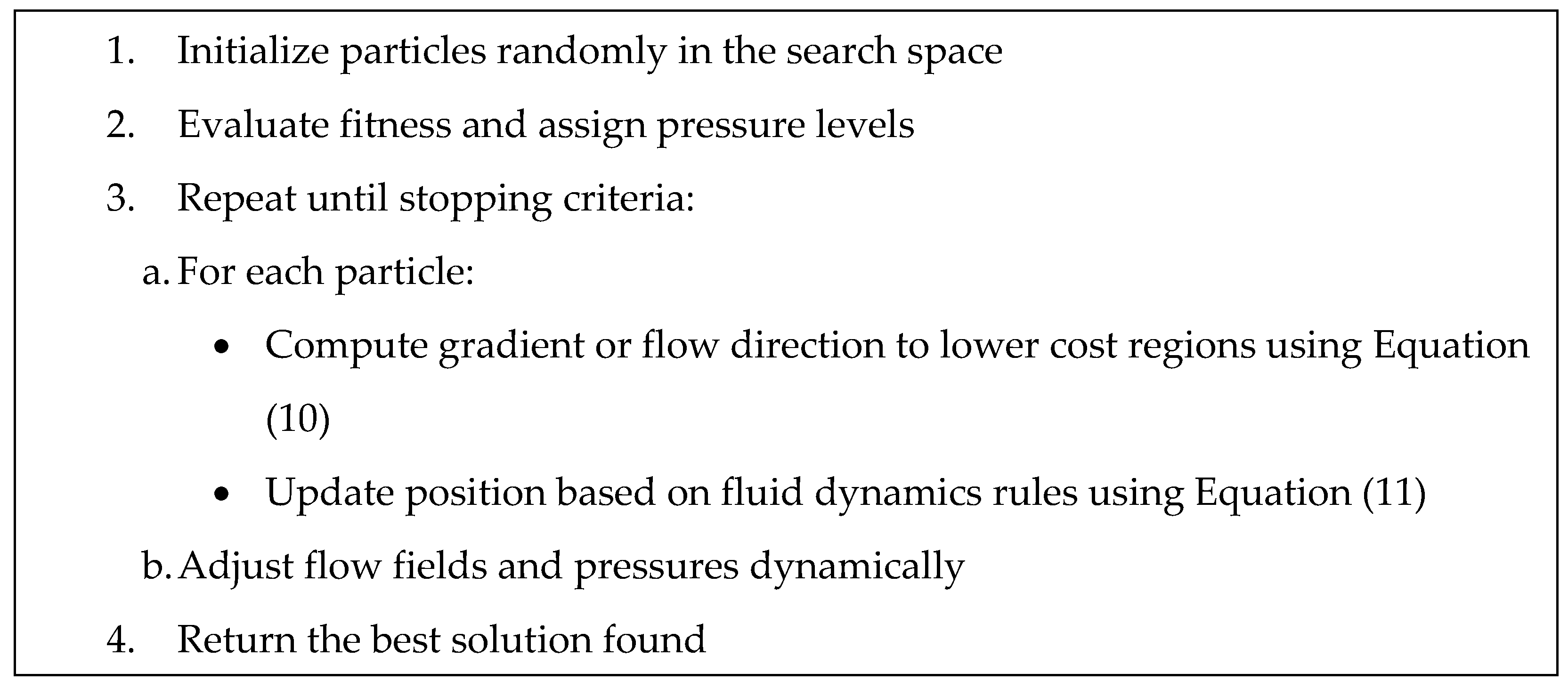
The flow rate (like pressure difference) is expressed by Equation (10), and Equation (11) is integral to the movement mechanism of the Fluid Search Algorithm (FSA). It describes how the position of an agent (particle) is updated based on fluid dynamics rules.
Q i j = K P i P j R i j
x i t + 1 = x i t + δ j N b i Q i j
where Pi and Pj are the pressure (or fitness) at nodes i and j, respectively, the Rij is the resistance (cost or elevation gradient), and the δ is a step control parameter that scales the magnitude of the movement. Nb(i) represents the set of neighbors connected to node i.
Figure 3 presents the steps in FSA.
In FSA, the randomly initialize positions for N particles in a L-dimensional space cost O ( N L ) . Th fitness evaluation and pressure assignment requires O ( N L ) per iteration. For pathfinding on grids with local moves, the local-neighborhood model O ( N L ) . The flow/pressure adjustment at most requires O ( N L ) . Thus, the theoretical run time complexity of the FSA is O I N L . This agrees with “…FSA avoids quadratic interactions by using local gradient-based flow dynamics, resulting in O ( T N D ) runtime Rabanal et al. (2011) [26].

3. Methodology

Physics-inspired metaheuristic algorithms can be used to solve the optimal pathfinding problem in static environments with sparse obstacles and irregular terrain. Our main objective is to evaluate and compare the effectiveness of the FSA, EMLA, GSA, and dual hybrid (combined) of these three algorithms. An agent must navigate from a starting point to a destination while dodging obstacles and minimizing cost metrics, including energy, distance, travel time, and number of turns, in a grid-based environment to test these algorithms.

3.1. Modeling and Simulation Framework

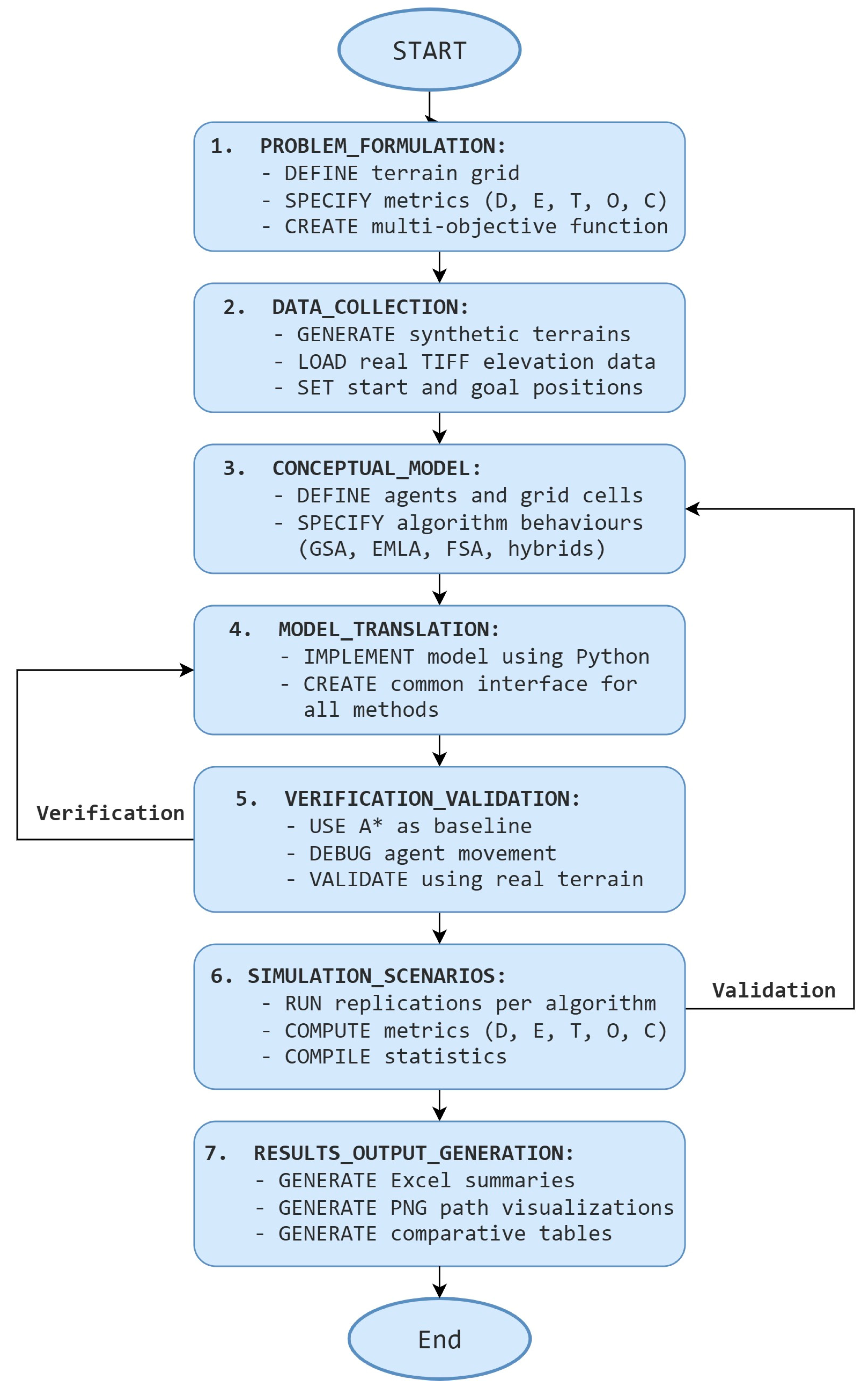
In our methodology, we apply the following seven phases like developing a modeling and simulation project. The modeling and simulation framework is presented in Figure 4.
  • In Problem Formulation, the goal is to find optimal paths in a 2D terrain with obstacles using physics-inspired metaheuristic algorithms. The environment is represented in a grid-based terrain (synthetic or real data from TIFF files) with 15% obstacle density. The challenge is to navigate from a start point to a goal point while minimizing metrics such as energy (E), distance (D), travel time (T), and avoiding obstacles (O), and the weighted cost (C) of these metrics.
  • The objectives are to: a) find optimal path from a starting point to a goal point using the GSA, EMLA, FSA, and dual hybrid algorithms, and b) evaluate and compare the performance of these algorithms in terms of E, T, D, O, and C. Equation (12) presents a weighted cost (multi-objective optimization function). We use Min-Max for normalization because the values of the metrics have different measurement units.
f i t n e s s v a l u e = w 1     N o r m a l i z e D + w 2     N o r m a l i z e E + w 3     N o r m a l i z e ( T ) + w 4     N o r m a l i z e ( O )
where w1, w2, w3, and w4 are weight coefficients that balance the importance (its contribution percentage) of each factor, and w1 + w2 + w3 + w4= 1.
The D represents the Euclidean Distance, and it is calculated by Equation (13) [27]. On the other hand, the E represents the energy consumed, that calculated based on the elevation difference (Δh) between the current step (i) and the neighbor (i + 1) as in Equations (14) and (15) [27]. Equation (16) defines the calculation for the total Energy Cost for a path segment, the total energy cost is derived by multiplying the distance traveled by the per-unit energy consumed, where that consumption (E) is dynamically modulated by the elevation change (slope) via Equation (15).
D x i = x i + 1 x i 2 + y i + 1 y i 2
Δ h = e l e v a t i o n x i + 1 e l e v a t i o n x i
E x i = E x i + 1     1 + Δ h     α
E n e r g y cos t = D E
where α is the threshold for the slope steepness. Equation (17) calculates the traversal time (T) taken to travel through a path segment based on the distance (D) and the change in elevation (Δh) [28].
T = D max 0.1 , 1 0.05 Δ h
3.
The Data Collection: The terrain (synthetic or real) is generated, and the start and goal points are specified. The data and performance metrics were collected. The optimal paths were visualized.
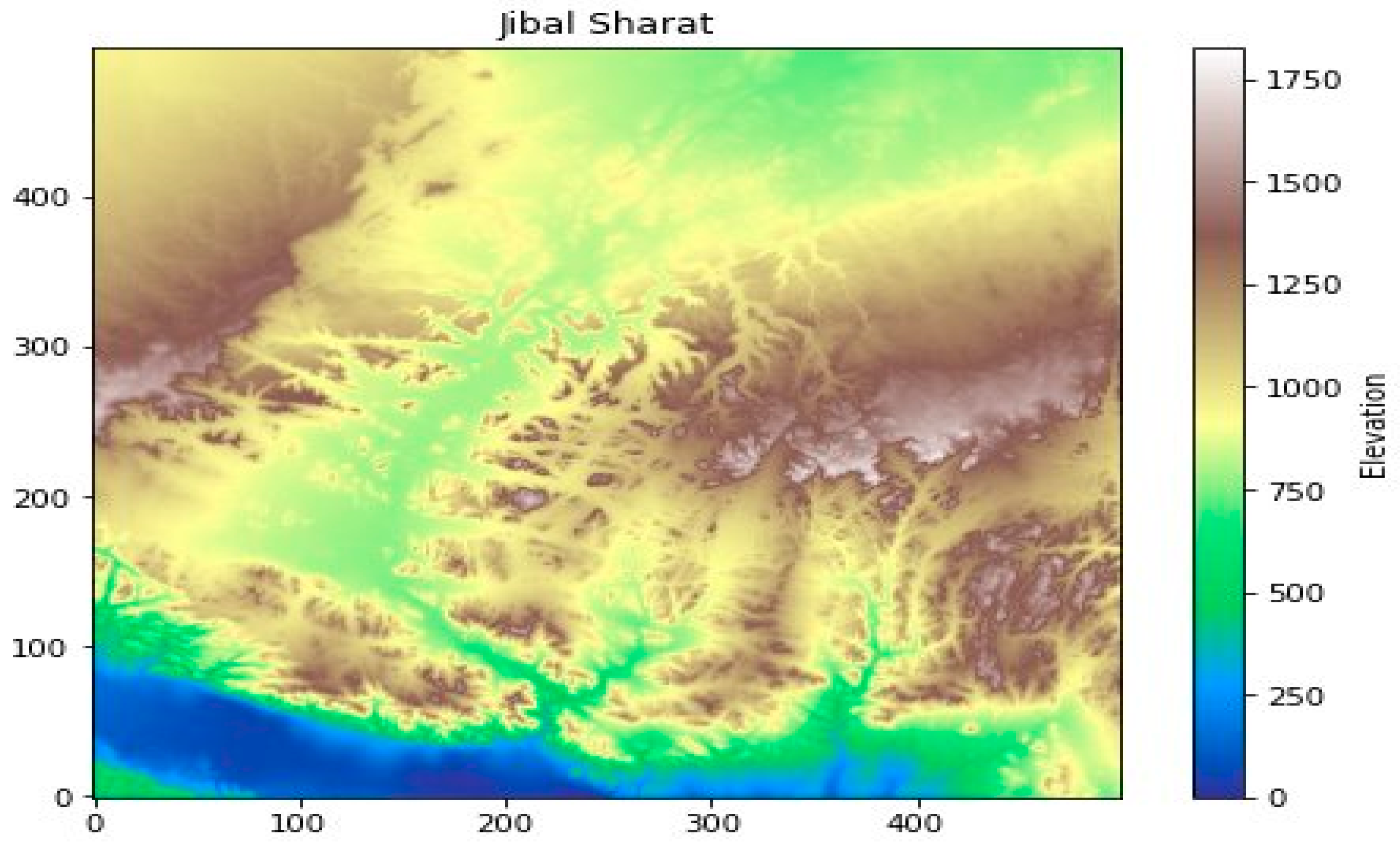
The synthetic terrain has different grid sizes, such as 100 by 100, 200 by 200, …, and 500 by 500, with 15% obstacle probability, for example. A real terrain is Jibal Sharat raster data, as in Figure 5, where it was loaded from TIFF files and rescaled [29]. The obstacle placement was randomly generated using Bernoulli-distributed function, and the agent’s movement is a stochastic one.
4.
In the Model Conceptualization, the entities are agents, where each has position, energy, direction, and fitness. Agents interact with terrain and are influenced by algorithm-specific forces. A grid cell has elevation, obstacle status, and energy cost. The events are initialization, movement, and termination. In the GSA, the agents move based on gravitational attraction. The EMLA is deployed for its agent attraction and repulsion based on charge. In the FSA, the agents mix paths like fluid particles. The hybrid algorithms aim at having all or some of the advantages of these three algorithms. These are explained in Section 3.2.
5.
In Model Translation, the nine algorithms are implemented in Python using numpy, matplotlib, rasterio, scipy, and pandas’ packages.
6.
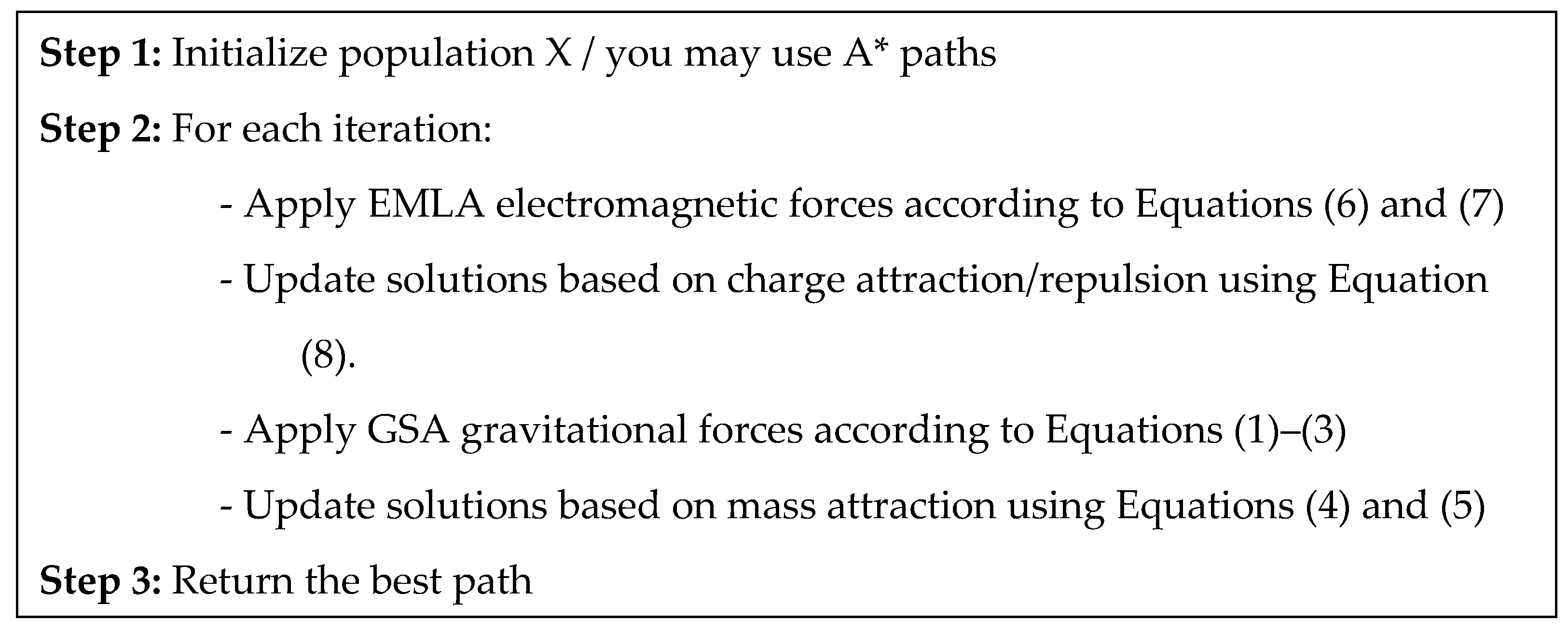
Verification and Validation: In this phase, the A* algorithm is used to generate baseline paths in the initialization population phase. The debugging and visualization of agent paths are traced to check if an agent moves from a start point through the paths to a destination. In the Validation, the real terrain data is used for realism for Jibal Sharat, tracing the consistent start and goal points across runs, and statistical analysis of results.
7.
In the Simulation and Scenarios, the code of each algorithm was run 5 times (replications). The objective path cost is computed for each path, and a summary statistic of minimum, maximum, average, a standard deviation values is computed. The outputs are an Excel file with a performance summary and PNG images of optimal paths for each algorithm.

3.2. The Hybrid Approaches

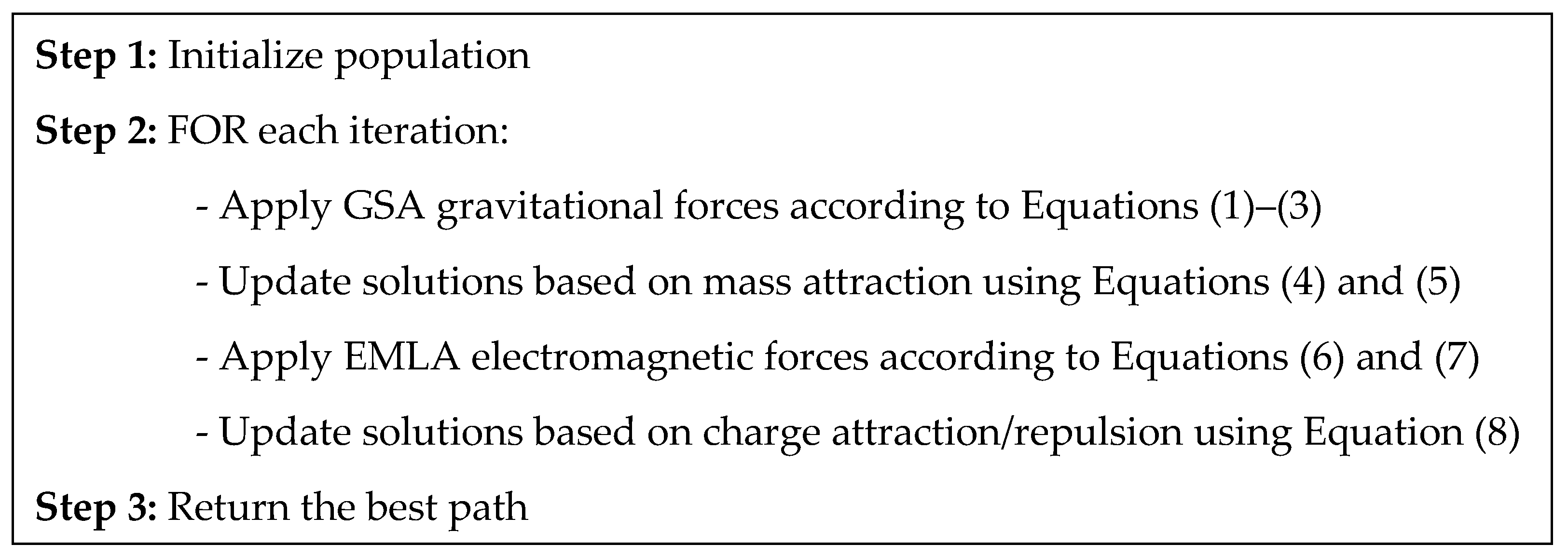
Using an alternating iterative framework, hybrid approaches are designed in a sequential update scheme. The first algorithm performs a complete update of the shared population in each iteration, considering positions, objective values, and the global best. Then, the second algorithm operates on the same updated population using its operators. Only the order of application of the two algorithms differs, e.g., EMLA → GSA or GSA → EMLA. The schedule is fixed per iteration; the first algorithm runs, followed by the second one. Each algorithm (EMLA, GSA, FSA) operates with its own independent parameter sets.

3.2.1. EMLA + GSA

The sequence approach of EMLA + GSA hybrid, where the local refinement goes first, followed by global exploration. First, the Electromagnetism-Like Algorithm applies electromagnetic forces to solutions, attracting them toward local optima while rejecting poor areas. This ensures early refinement and convergence toward promising areas. The Gravitational Search Algorithm then takes over, using gravitational forces to explore the larger surroundings in search space and to escape from the local optima. In fact, this approach is particularly effective in those scenarios where initial local refinement may accelerate convergence, while subsequent global search maintains diversity and solution quality. Figure 6 presents the pseudocode of the EMLA + GSA.

3.2.2. GSA + EMLA

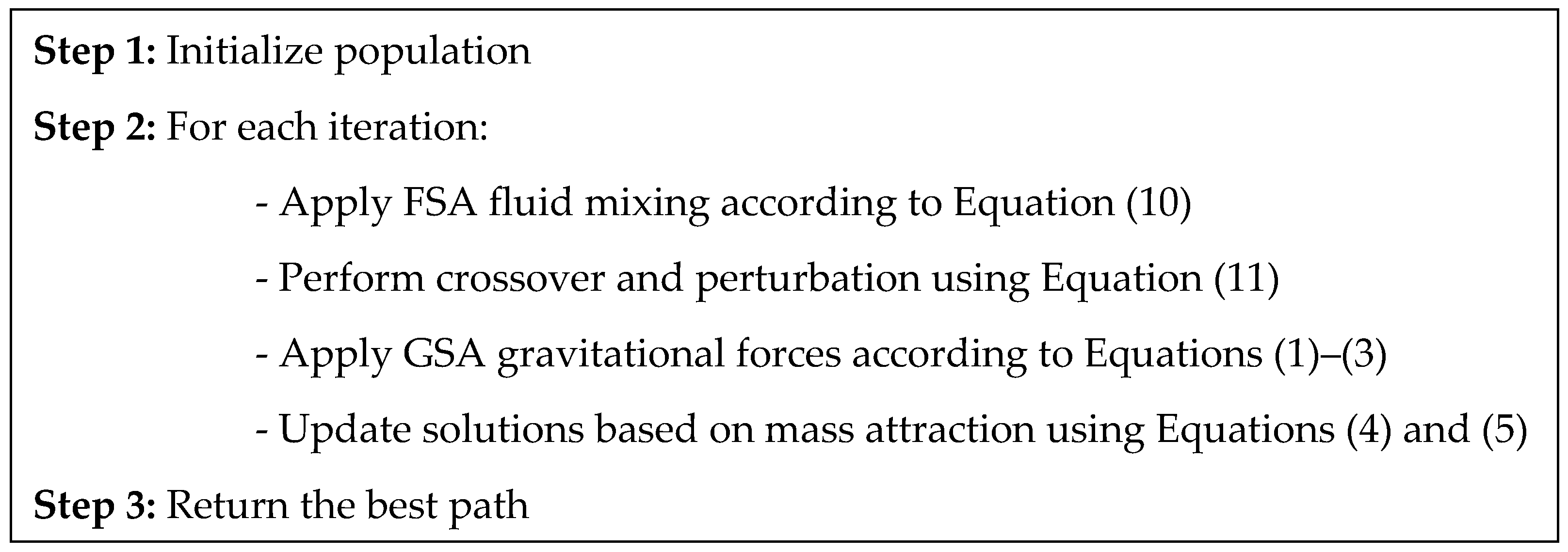
GSA + EMLA is a sequential optimization method that merges electromagnetic with gravitational forces. This hybrid starts with the Gravitational Search Algorithm, which employs mass-based attraction to drive the population toward promising regions of the search space, ensuring wide exploration. The solutions produced by GSA are further refined by using the Electromagnetism-Like Algorithm, which performs charge-based attraction and repulsion forces for the fine-tuning of paths locally. This approach ensures that the algorithm explores diverse solutions globally before exploiting the best areas with precision, which leads to a balanced and robust optimization process suitable for complex terrains where both exploration and accuracy are critical. Figure 7 shows the pseudocode of the GSA+EMLA.

3.2.3. GSA + FSA

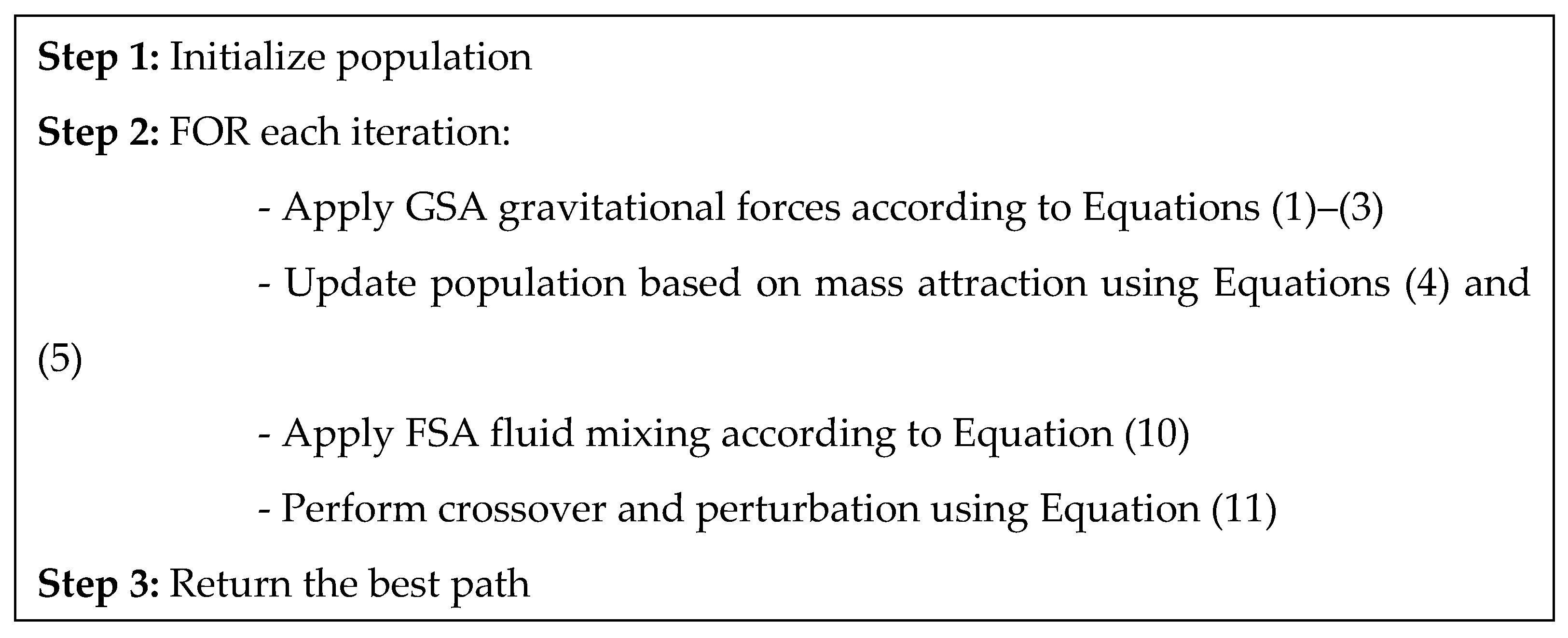
The GSA + FSA sequence hybrid algorithm combines gravitational search with fluid-inspired dynamics to enhance its adaptability. The GSA initiates the process, using mass-based forces to direct the population toward high-quality solutions. FSA then utilizes fluid-like mixing mechanisms, such as crossover and perturbation, to introduce diversity into the solution pool and avoid any premature convergence. This way, the proposed hybrid can efficiently navigate the search space by leveraging the structured exploration of GSA first and then employing the flexibility of FSA in complex environments and dynamic constraints. Figure 8 presents the pseudocode of the GSA+FSA.

3.2.4. FSA +GSA

The sequence hybrid FSA + GSA method starts with fluid-inspired exploration and then goes to gravitational refinement. FSA starts the search process by encouraging diversity via mixing and random perturbations for a wide coverage of the search space. GSA refines these diverse solutions by attracting them toward the higher-mass regions (better fitness). This is particularly suitable in the sequence for problems needing extensive early explorations because the randomness inherent in FSA will tend to avoid local optima, while gravitational forces from GSA provide necessary convergence to optimal solutions. Figure 9 shows the pseudocode of the FSA+GSA.

3.2.5. EMLA +FSA

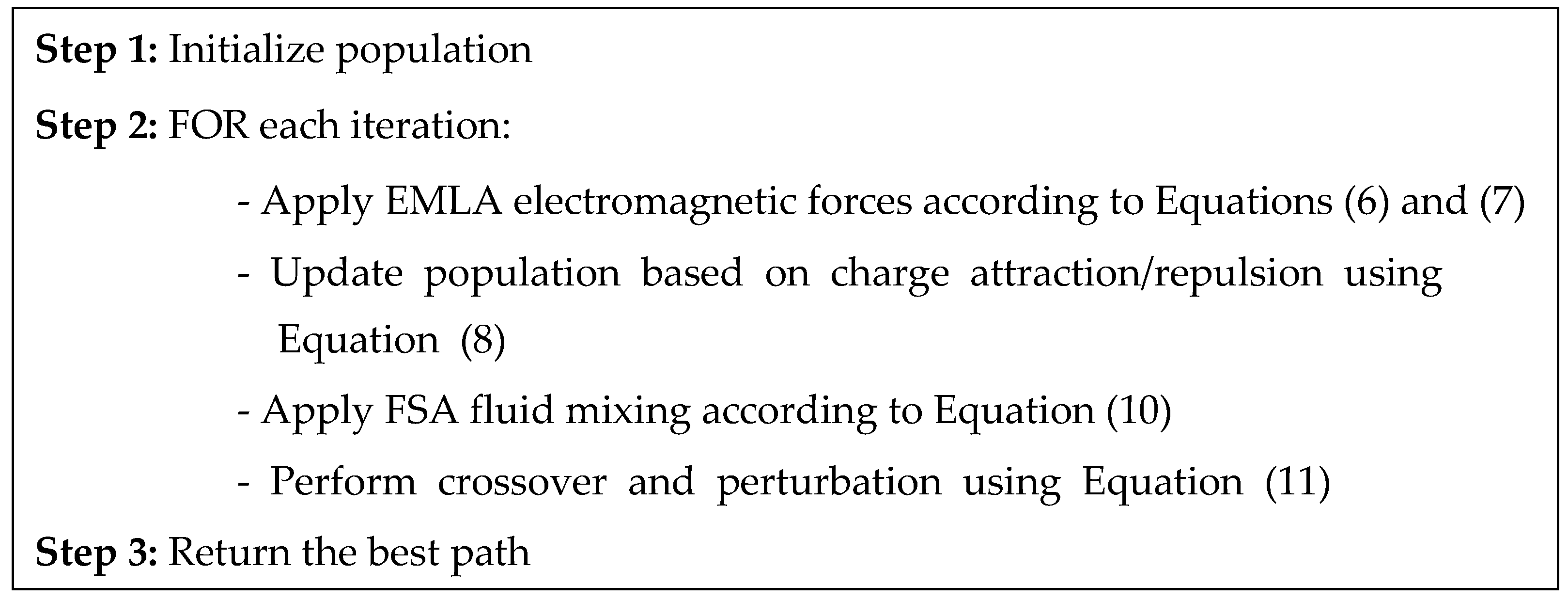
The sequential hybrid method EMLA + FSA combines the precision of electromagnetic methods with the flexibility of fluid dynamics for balancing the optimization procedure. The hybrid starts with the Electromagnetism-Like Algorithm, which uses the forces of attraction and repulsion for refining solutions locally and enhancing convergence. It is followed by the Fluid Search Algorithm, which introduces the fluid-like mixing and crossover operations to enhance the diversity in the population and explore the neighborhood. Such an approach is rather fruitful in those cases where local refinement should be supplemented with ongoing exploration to avoid stagnation and maintain diversity in solutions. Figure 10 illustrates the structure of the EMLA + FSA.

3.2.6. FSA + EMLA

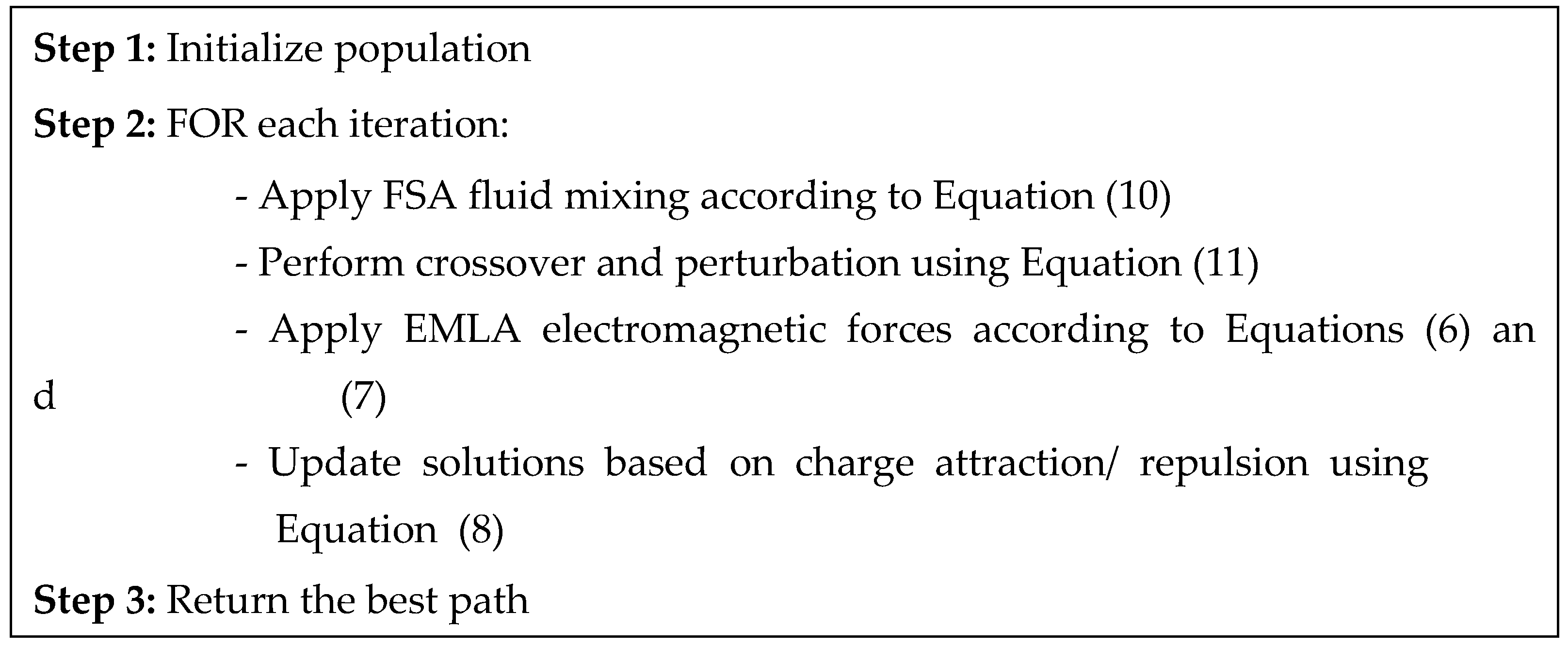
This hybrid FSA + EMLA sequentially starts with broad exploration and ends with focused refinement. The FSA begins the process with fluid dynamics to mix and perturb solutions to ensure a diverse, well-distributed population. The resulting solutions are then fine-tuned by electromagnetic forces of the EMLA, which attract them toward the local optima while repelling them from the worst regions. This hybrid is highly effective in environments where the initial diversity is indispensable for finding promising areas, and then the electromagnetic forces do their work, assuring precise and high-quality solutions. Figure 11 provides the pseudocode of the FSA_GSA.
The run time complexities of the hybrids EMLA + GSA and GSA + EMLA come from both components in each iteration. So, the complexity per iteration is the sum of GSA’s part which is O ( N 2 L ) and the EMLA’s part which is O ( N 2 L ) . Thus, the run time complexity of each of EMLA + GSA and GSA + EMLA over I iterations is O ( I N 2 L ). The run time complexity of FSA is a linear cost ( I N L ) and run time complexity of each of EMLA and GSA is a quadratic cost O I N 2 L .   Therefore, the run time complexity of each FSA + GFS and GSA + FSA is dominated by   O I N 2 L .

4. Simulated Experiment Results

The performances of the algorithms: Gravitational Search Algorithm (GSA), Electromagnetism-Like Algorithm (EMLA), Fluid Search Algorithm (FSA), hybrid GSA + EMLA, EMLA + GSA, GSA + FSA, FSA + GSA, ELMA + FSA, and FSA + ELMA, and A* were investigated for optimal path finding of vehicles. These nine algorithms deploy metaheuristic techniques to find optimal or feasible paths. The brute force and heuristics methods cost high in path finding problems for large grids.
To have a base line algorithm to compare the performance of the metaheuristic algorithms with, we ran four widely used path-planning heuristic algorithms: A*, Theta*, RRT*, and D* Lite on grid 100 × 100 with 15% obstacles, each 30 replications. In Table 2, the 143.26, 0.0127, and 145.12 are the averages of distance (D), time(T), and energy(E), respectively, when we ran A* algorithm 30 replications (or trials). We did the same for the other heuristic algorithms on the same data. We computed the normalized values for each algorithm across the metrics. For example, the minimum value of average distances across all algorithms is 140.8 and the maximum value is 173.78. The normalized values of the distances for A*, D* Lite, Theta*, and RRT*, are computed as (143.26 − 104.8)/(173.78 − 140.8) = 0.075, (143.26 − 140.8)/32.98 = 0.075, (140.8 − 140.8)/32.98 = 0, and (173.38)/32.98 = 1, respectively. Table 2 shows the results where a weighted C (multiple objective function) was computed by Equation (12), where the weight is 0.3, 0.4, 0.2, 01, for D, T, E, and number of encountered obstacles (O), respectively. The normalization in a table is performed across all algorithms for each metric on the averages of an n replications and per scenario.
Since A* algorithm guarantees optimal solution, works well on grids, especially in grid with small size, and ranks the highest in average C as in Table 2, we considered A* for validation and base line.
Each of the D, T, E, and O was computed by each of the above algorithms as a single objective function and a multiple objective function (weighted cost C of these metrics). Equation (12) is written with normalization. We use the Min-Max normalization where (value(k) − Min(value(k))/(Max(value(k)) − Min(value(k)), for k = 1, 2, 3, …, 30. The Min(D(k)), for example, is the minim average distances resulted by running the four algorithms. The experiments in Section 4.1 are to verify and validate the outputs of the metaheuristic algorithms. compared to the performance of the A* algorithm. In Section 4.2, we used two approaches: the first one uses different scenarios of the weights to measure the cost of multiple objective functions, and the second one compares the average ranks of the metaheuristic algorithms across the four metrics without weights on different grids.
Each code of an algorithm was initialized with the population, number of iterations, density of the obstacles, grid size, start point, goal point, and the weights of D, T, E, O, to compute the cost C. The codes are written in the Python programming language. The output includes the values of five metrics and the optimal paths.

4.1. Verification and Validation

For verification and validation, we implemented the ten algorithms on a grid of 100 × 100 with 10 trials, where weighed C = 0.3Normalize(D) + 0.4Nor(T) + 0.2Nor(E) + 0.10Nor (O) and obtained results as shown in Table 3.
Table 3 shows the average results of running the ten algorithms 10 trials on grid 100 × 100. The performance of A* on small problems outperforms the other algorithms in D, T and O, primarily due to the small grid size as well as the weights of D (30%) and T (40%). It shows simulated values to demonstrate the valid results compared to the A* algorithm. The rank is from lowest C (best = 1) to highest C (worst = 10). Since A* is a deterministic shortest-path algorithm, its distance is the smallest, and the distance of the hybrid FSA + GSA comes next. The average C for A* is 0.08 using Min-Max normalization. The smallest value of C = 0.3 × (141.5 − 140.2)/(150 − 140.2) + 0.4 × (151.2 − 150)/((164 − 150) + 0.2 × (1755 − 1755)/(1870 – 17,550 + 0.1 × (0 − 0)/(0.2 − 0) = 0.074, rounded to 3 digits. The last row in Table 3 shows the relative differences between the lowest average values produced by A* and the highest average of a metric produced by other metaheuristic algorithms. For example, the relative difference in Av D = 0.0699 was computed as (150 − 140.2)/140.2. For example, the largest relative difference between the distance, the time, and the energy produced by hybrid GSA + FSA compared to that produced by the A* algorithm is 0.067, 0.093, and 0.038, respectively. These are the largest deviations from the best measures, which indicates acceptable metric values resulted from running the metaheuristic algorithms. The averages and the standard deviations of each column are shown in the Table. These also assure the acceptance of the results from the metaheuristic algorithms compared to the base line A*.
The hybrid GSA + FSA had the largest values in all metrics. The FSA + GSA has the best rank in C, and the GSA + FSA has the worst in all grid sizes. Even though Table 4 shows results for grids 100 × 100 and 500 × 500, the hybrid GSA + FSA shows the highest measures of D, T, E, O, and C. We tested the algorithms on five grids, but we present those with the smallest and the largest grids, due to space limitations. In Scenario (1), the distance, time, and energy generally increase with grid size. The E scales directly with D. When comparing A* with metaheuristic algorithms in multi-objective problems, it tends to obtain the lowest C, especially on small or medium grids. The metaheuristic FSA, GSA, EMLA, and the hybrids are stochastic and are better at handling multi-objective trade-offs in complex scenarios. As the grid size grows or obstacles increase, metaheuristic may find better energy-efficient paths.
We ran the algorithms on grid 100 × 100 with 15% obstacles, each 5 replications (trials). Table 4 and Table 5 show the results coming from each replication. The scenario C = 0.3Normalize(D) + 0.4Nor(T) + 0.2Nor(E) + 0.10Nor (O) was assumed to have the results in Table 4 and Table 5. For example, in trail 1 (Rep 1), A* produced the minimum distance 128, and FSA produced the highest distance., Thus the normalize (D) = (128 − 128)/(210 − 128) = 0 for A*, Norm(D) = (210 − 128)/(210 − 128) = 1 for FSA, and Norm(D) = (153 − 128)/(210 − 153) ~ 0.44 for FSA + GSA. The C is computed by Equation (12). In all replications, A* has the smallest values for the four metrics because the grid is small, and this is not the case for other larger grids.
Table 5 shows the results after replications 4 and 5 on grid 100 × 100. The normalized values are rounded up to two digits in both Table 4 and Table 5. The performance of the hybrid algorithms dominates single metaheuristic algorithms. The combining of EMLA with other metaheuristic algorithms has better performance than the other metaheuristic algorithms in the 5 replications.
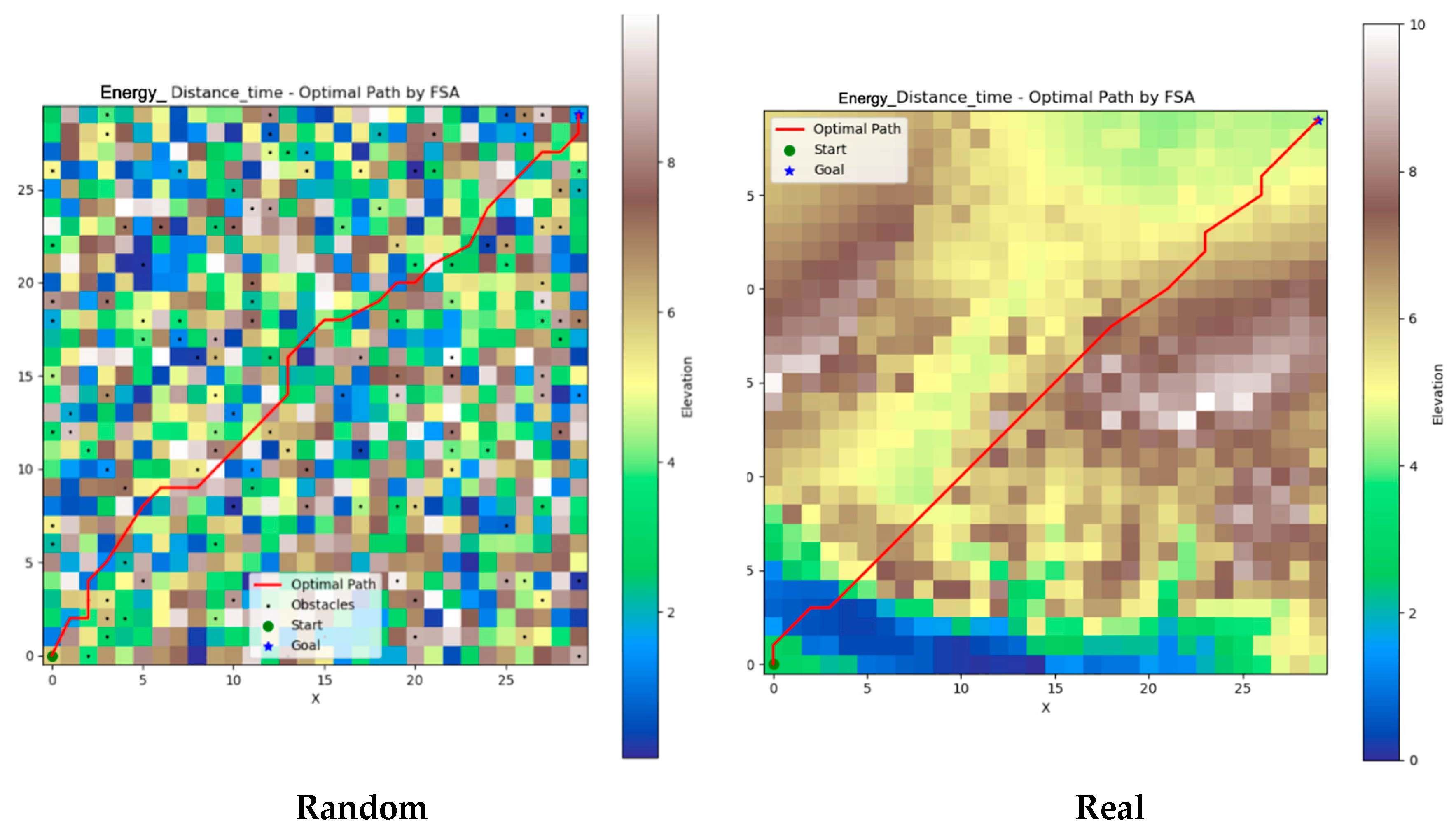
Additionally, we ran FSA and obtained results as shown in Figure 12, where the starting point is (0, 0) and the goal point is (99, 99). Figure 12 illustrates samples of optimal path visualization for implementing the FSA optimization algorithm in both synthetic and real terrains (Jibal Sharat, Jordan), based on a weighted multi-objective fitness function with grid 100 × 100 and the specification as in Table 2.

4.2. Experiment Results and Discussion

The ten algorithms were implemented in the Python programming language, and ran on randomly generated grids 100 × 100, 200 × 200, …, 500 × 500. Table 6 shows results based on Scenario (1), where weighted cost C = 0.3Normalize(D) + 0.4Nor(T) + 0.2Nor(E) + 0.1Nor (O) and on the grid 100 × 100, using Min-Max normalization, with population = 30, number of iterations = 50, and number of obstacles is 15% of the grid size. The minimum, maximum, standard deviation, and averages of replications were recorded. Only the averages are reported in the following tables and figures.
Table 7 shows the results for grids 100 × 100, 200 × 200, …, 500 × 500, where C = 0.2Nor(D) + 0.2Nor(T) + 0.4Nor(E) + 0.2Nor(O), Scenario (2). In this case, it is observed that the hybrid FSA + GSA consistently ranks best for all grid sizes compared with other metaheuristic algorithms and ranked the lowest in C because energy efficiency now dominates the cost. All the metaheuristic algorithms outperformed A* in average weighted cost. The FSA + GSA ranked 1, but GAS + FSA ranked 9 (worst) among the hybrids in C. The ranks remain consistent across grids, and the metaheuristic scale better for energy-focused multi-objective optimization. For a balanced D, T, and E scenario where C = 0.3D + 0.3T + 0.3E + 0.1O, the hybrids consistently best and provide the multi-objective trade-off. The results show that the methods adaptively optimize energy. The hybrids adaptively optimize the obstacle avoidance, so for large grids with more complex paths, they outperform A* when E or O has a higher weight. When the sizes of the grid increase, more differences between metaheuristic algorithms and A* emerge. Since larger grids imply longer distances, more time, and more energy expenditure, the weighted cost increases with grid size for all algorithms. These results indicate that a hybrid metaheuristic is preferred when energy efficiency, obstacle avoidance, and scalability matter for practical vehicle pathfinding.
Since the weight cost depends on the importance of each metric, we computed the rank of each algorithm for each metric across all grid sizes and then ranked each algorithm by the average rank. Table 8 shows the results when we did not compute the C, but we computed the ranks of the algorithms and their averages on grids 200 to 500. The rank of each metric is displayed, where the small value 1 indicates the least cost. The R-Met is the average of the ranks for the four metrics across each algorithm of the nine metaheuristics.
Table 7 shows the average ranks for all metrics on grids 200, 300, 400, and 500. The FSA + EMLA achieved the best performance over the nine algorithms; EMLA + FSA comes next. The EMLA outperformed FSA and GSA. The hybrids of EMLA with the others outperformed the GSA + FSA, FSA + GSA, FSA, and GSA. The FSA + EMLA, EMLA + FAS, and EMLA + GSA performed better than the other six algorithms. The results in Table 6 agree with results from experiments with weighted cost in that the hybrids FSA + EMLA, EMLA + FSA, and EMLA + GSA with EML outperformed the other algorithms.
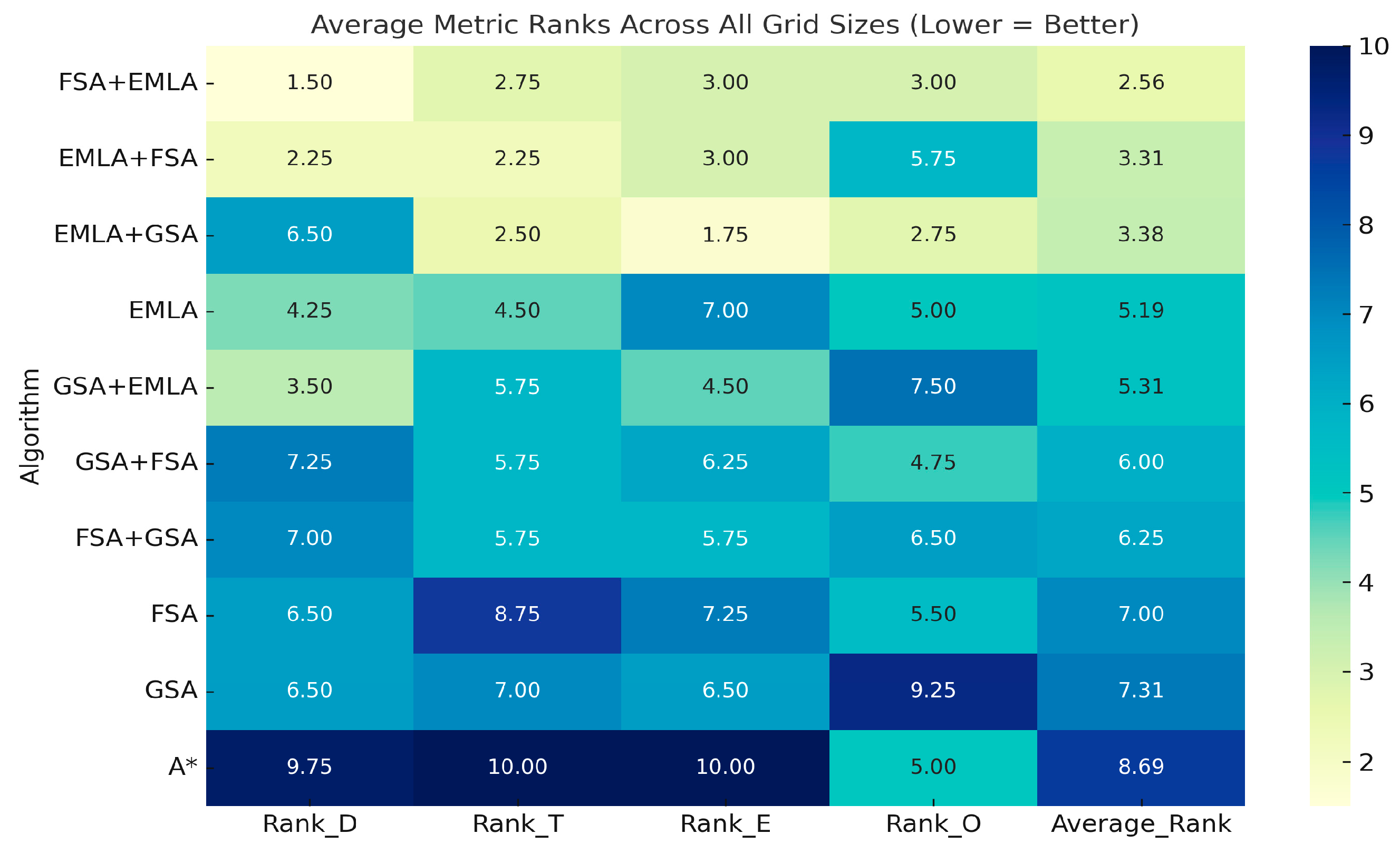
Figure 13 shows the heat map of average metric ranks across the grids 100, 200, …, 500. The lower rank is the better (The color goes from white (the lower) to dark blue (higher)). The FSA + EMLA, EMLA + FSA, EMLA + GSA, EMLA, and GSA + EMLA have the lowest average rank, and in these orders. Thus, the hybrid with EMLA performed the other hybrids, FSA, GSA, and A*. The FSA + EMLA is the best if the D is a matter, the EMLA + GSA is the best if the T is the matter, and the EMLA + GSA is the best if the E and O are matters. These results indicate which algorithms for cars, robots, or drones.
The path weighted cost C increases with grid size for all algorithms. In larger grids, the metaheuristic is better to use because there is more path choice, which allows optimization for multiple objectives. The E penalties accumulate, leading to more efficient paths, and obstacles are more frequent, which need avoidance. When E and O avoidance are important, the metaheuristic hybrids leverage stochastic search to explore alternative paths, balancing D, T, E, and O more effectively.
Table 9 shows the synthetic results when the A* and the nine metaheuristic algorithms were tested on grid 500 × 500 with obstacles 5%, 15%, and 30%. It was assumed that C = 0.2Norm(D) + 0.3Norm(T) + 0.3Norm(E) + 0.2Norm(O). Each algorithm was run 10 times, and the average was recorded. The hybrids containing EMLA are always the best for our assumptions and A* is worse than all physics-based methods. The table shows the average cost and rank for those three obstacle levels. The four EMLA hybrids had ranks 1–4. The C increases for more difficult environment compared to 5% obstacles. All algorithms show increased as obstacles increase from 5% to 30%.
It is clear from Table 10 that the execution time grows with grid size and increases nonlinearly from grid 100 × 100 to grid 500 × 500. Since the nine metaheuristic algorithms are population-based algorithms they took longer than deterministic A*. The hybrids took more time than single metaheuristic because they combined more rules as is the case with GSA + FSA. The FSA + EMLA has less running time because it balances exploration and refinement, reduces number of iterations, and requires less candidates’ evaluations. The hybrid GSA + FSA is the slowest in both convergence and runtime.
The convergence speed is the number of iterations an algorithm needs to reach. Table 11 shows the averages convergence speed (10 trials each). The number of iterations increases as the grid size increases. This is because there is larger search space, more cells to explore, and there are more solutions to be evaluated. The hybrid FSA + EMLA and GSA + EMLA converge faster than single FSA or pure GSA. This is because hybrids combine exploration abilities with the exploitation strengths and avoid becoming stuck in local minimum. The A* requires fewer iterations because it is deterministic and expands nodes only once, but it runs slower on grid with large size.
Based on observation of the results and previous research, the hybrid FSA + GSA consistently performs well in scenarios that prioritize E or balance D, T, and E equally when the rank is based on weighted cost. For large grids with more complex paths, the metaheuristic algorithms outperform A* when E or O has a higher weight, because they adapt energy and obstacle avoidance. Even A* remains excellent in distance and time metrics, but it does not optimize energy or dynamic obstacle negotiation. Thus, A* is limited in multi-objective scenarios and has the lowest normalized C. Physics-based metaheuristic algorithms can explore energy-optimal and obstacle-avoiding paths, and that is why they obtain a lower C than A* in some scenarios of metric weights. The C formulas influence ranking, because if the weights of D and T are high, then A* is better to use, and if the weights of E and O are high, then the metaheuristic is better to use.
Inspired by fluid dynamics, the FSA has continuously shown better computing efficiency with the lowest energy consumption and execution times in most cases. This is consistent with its nature as a fast, fluid search process that moves across solution spaces rapidly converging to local optima, which would lead to somewhat lower fitness ratings. On the other hand, GSA, which is based on gravitational forces, performed more steadily and conservatively, offering consistent but unexceptional results on all metrics. The EMLA demonstrated remarkable adaptive capabilities, especially in hybrid setups where it successfully balanced the phases of exploration and exploitation. EMLA is based on electromagnetic attraction and repulsion.
The hybrid approaches of GSA + EMLA and EMLA + GSA showed interesting synergies between the physical laws of gravitation and electromagnetism. GSA + EMLA showed superior performance, which can perform well, especially in fitness-oriented scenarios where superior solutions were obtained via gravitational convergence followed by electromagnetic refining. In large and complicated terrains, EMLA + GSA performed efficient strength, indicating that gravitational acceleration after electromagnetic search results in a positive response to uncertain environments. However, the two hybrid schemes also registered an increase in variability for certain measures, an indicator of parameter setting sensitivity and the need for careful tuning to make their performance stable across problem domains.
The results illustrate the importance of adapting algorithms based on application requirements. The FSA is the preferred option for tasks where speed and energy efficiency are top priorities. The GSA + EMLA is better for balanced optimization, particularly when fitness is important. In large, erratic terrains, the EMLA + GSA works especially well. It should be noted that energy values were unusually low in terrain scenarios, potentially due to oversimplified simulation assumptions. Furthermore, hybrid algorithms exhibited increased variability in a few metrics, indicating that parameter tuning is necessary.
If the rank is based on the weighted cost, then if D and T are priorities, the GSA + EMLA and FSA + GSA perform well in the multi-objective function. If E is a priority, the FSA performs better for energy-limited vehicles or battery-powered robots and drones. If the O is priority, then the EMLA and the EMLA-based hybrids excel in dense or dynamic environments.
The execution times in Table 11 demonstrate a clear relationship between theoretical complexity and empirical runtime. All algorithms exhibit increasing execution time as grid size increases from 100 to 500. The relative growth rate of execution time differs substantially among algorithms. For example, algorithms with quadratic complexity, such as GSA (1.65 s at grid 500), EMLA + GSA (1.60 s), and GSA + FSA (1.90 s), show the steepest increases in computational cost. These results align with their O N 2 D scaling, in which pairwise interactions dominate the runtime as the search space expands. In other side, algorithms based on FSA or incorporating substantial FSA components demonstrate markedly lower execution times and slower growth. For example, FSA (1.30 s), FSA + EMLA (1.00 s), and FSA + GSA (1.15 s) grow more gently with grid size, which is consistent with the linear complexity O ( N L ) of the underlying fluid-dynamics mechanism. The empirical data therefore confirms the theoretical predictions. Overall, hybrids that incorporate GSA or EMLA inherit their quadratic costs, while hybrids centered on FSA retain the favorable linear-time scaling. These results provide a coherent validation that theoretical complexity directly explains and predicts empirical runtime differences across the algorithms.
Note we presented some formal statistics such minimum, maximum, averages, standard deviation, and relative differences. In this study, we focused primarily on evaluating trends in performance, convergence behavior, and robustness across multiple replications. Incorporating formal statistical significance testing is an important direction for future research and will further strengthen the empirical validity of the findings.


5. Conclusions and Future Work

To find an optimal path for a vehicle across sparse-obstacle terrains, this study examines the effectiveness of physics-inspired metaheuristic, including EMLA, FSA, and GSA. The results show that each algorithm has unique abilities. The FSA is good for exploration of the search space, can handle dynamic obstacles, and provides energy-efficient paths. The FSA excelled in speed and energy efficiency, making it perfect for time-sensitive applications. The GSA performed well in larger grids, such as those with a terrain size of 500 × 500, for example, and the EMLA demonstrated a high degree of consistency in minimizing distance.
The hybrid EMLA + FSA has strong local search, obstacle handling, and energy-efficient paths. It is suitable for drones with obstacle-dense areas and mobile robots in warehouses. The EMLA + GSA is strong for global search and adaptive obstacle handling and good multi-objective performance. It is advisable to use it in cars for traffic-aware path planning and drones for long-distance navigation. The FSA + EMLA is a good balance of path efficiency and obstacle avoidance and is more robust than single algorithms; it is suggested to use it in drones navigating urban environments and robots in semi-dynamic space. The FSA + GSA combines global search by GSA with adaptive local search by FSA, best multi-objective performance, and balances D, T, E. It is preferable for autonomous cars for multi-objective optimization, and mobile robots need energy and time efficiency. The GSA + EMLA combines global search and adaptive obstacle avoidance and is good for dynamic environments. It is better to use drones in dense obstacle areas and robots in dynamic warehouse settings. The GSA + FSA is strong for global search and local adaptation, high energy, and time efficiency. It is better to use it in vehicles that require an energy-time trade-off and robots in complex and large-scale grids. Based on the results from the average of ranks, the hybrid FSA + EMLA consistently outperforms all others across all grids, and the hybrid GSA + EMLA and EMLA + GSA dominate over the single heuristic A* algorithm and single metaheuristic. The EMLA performs better than the FSA and GSA and slightly worse than the hybrid algorithms.
This study achieved its objectives by evaluating GSA, EMLA, FSA, and the hybrids across various terrain and grid resolution conditions, clarifying their strengths, weaknesses, and specific suitable applications. In conclusion, if the focus is on D and T and the size of the grid is small, the heuristic A* is preferable. If the focus is on the multi-objective of D, T, E, and O, then a hybrid choice is advisable. When energy, efficiency, obstacle avoidance, and scalability matter, a hybrid method of algorithm is preferred for practical vehicle path finding. Always consider what the weighted cost emphasizes: distance, time, energy, or safety. For real-world vehicle path finding, energy and obstacles are often more important than raw short distances, so the metaheuristic algorithm can outperform A*.
Despite this strong performance, several limitations remain. Normalization and the weighted-cost formulation might introduce sensitivity across scenarios and only mean values have been reported without formal statistical testing across repeated runs. The experiments were limited to one DEM, static obstacles, and did not fully analyze the computational complexity that may affect real-time deployment. To overcome these gaps in future work, we will test other normalization strategies, conduct repeated-run statistical analysis, extend the experiments to dynamic environments, explore Pareto-front multi-objective optimization, and include other physics-based methods such as CFOA, PCA, BB-BC, IWDA, etc., for vehicle path finding. We plan to concentrate on computing Pareto fronts instead of a single weighted cost, which shows trade-offs between D, T, E, and O more clearly.

Author Contributions

Conceptualization, A.S.; methodology, A.S., H.M., and T.A.K.; software, A.S. and H.M.; validation, A.S. and H.M.; formal analysis, A.S.; investigation, A.S., H.M., and T.A.K.; resources, H.M., and T.A.K.; data curation, A.S., H.M.; writing—original draft preparation, H.M.; writing—review and editing, A.S.; visualization, A.S., H.M., and T.A.K.; supervision, A.S.; project administration, A.S. All authors have read and agreed to the published version of the manuscript.

Funding

There is no fund.

Data Availability Statement

The original contributions presented in this study are included in the article. Further inquiries can be directed at the corresponding author.

Acknowledgments

This work has been carried out during a sabbatical leave granted to the author (Ahmad Sharieh) from the University of Jordan during the academic year 2023–2024.

Conflicts of Interest

The authors declare no conflict of interest.

Nomenclature

This table summarizes the mathematical symbols and acronyms utilized in the research for physics-based metaheuristic optimization algorithms:
SymbolDescription
Metrics and Optimization
DTravel distance or path length
EEnergy consumption
TTraversal time
OObstacles encountered
CWeighted cost (multi-objective optimization function)
fitnessvalueValue of the multi-objective optimization function
w1, w2, w3, w4Weight coefficients for D, E, T, and O, respectively
Normalize()Function used to normalize metric values (Min-Max normalization used)
D(x)iEuclidean Distance
xi, yiCoordinates of the current step i
x i+1, y i +1Coordinates of the neighbor step i + 1
ΔhElevation difference
αThreshold for the slope steepness
Gravitational Search Algorithm (GSA)
m i(t)Intermediate mass calculation
M i(t)Mass of agent i
f i(t)Fitness of agent i
best(t)Best fitness at iteration t
worst(t)Worst fitness at iteration t
NTotal number of agents
Fij(t)Gravitational force between agents i and j
G(t)Gravitational constant
Rij(t)Euclidean distance between agents i and j
ϵSmall constant
ai(t)Acceleration of agent i
vi(t + 1)Velocity of agent i at the next iteration
rRandom scalar
xi(t + 1)Position of agent i at the next iteration
LDimension
INumber of iterations
Electromagnetism-Like Algorithm (EMLA)
qiCharge of a particle i
nParameter in the exponent for charge calculation
fbest, fworstBest and worst fitness values
FijElectromagnetic force between particles i and j
λRandom scalar in 10
FiNet electromagnetic force on particle i
Fluid Search Algorithm (FSA)
QijFlow rate
KConstant
Pi, PjPressure (or fitness) at nodes i and j
RijResistance
Nb(i)Represents the set of neighbors connected to node i.
δStep control parameter
General Variables
tIteration count (time step)
i, jIndices representing agents or particles
xiPosition of particle/agent i

References

  1. Duan, P.; Yu, Z.; Gao, K.; Meng, L.; Han, Y.; Ye, F. Solving the Multi-Objective Path Planning Problem for Mobile Robot Using an Improved NSGA-II Algorithm. Swarm Evol. Comput. 2024, 87, 101576. [Google Scholar] [CrossRef]
  2. Trivedi, S.; Gupta, R.; Bharti, S. Metaheuristic Approaches in Path Finding and Optimization. In Proceedings of the 2025 International Conference on Computational, Communication and Information Technology (ICCCIT), Indore, India, 7–8 February 2025; IEEE: New York, NY, USA, 2025; pp. 38–43. [Google Scholar]
  3. Sulaiman, A.T.; Bello-Salau, H.; Onumanyi, A.J.; Mu’azu, M.B.; Adedokun, E.A.; Salawudeen, A.T.; Adekale, A.D. A particle swarm and smell agent-based hybrid algorithm for enhanced optimization. Algorithms 2024, 17, 53. [Google Scholar] [CrossRef]
  4. Sharieh, A. Modeling Metaheuristic Algorithms to Optimal Pathfinding for Vehicles. WSEAS Trans. Comput. 2024, 23, 300–317. [Google Scholar] [CrossRef]
  5. Labonté, G. An Algorithm to Find the Shortest Path through Obstacles of Arbitrary Shapes and Positions in 2D. Algorithms 2024, 17, 420. [Google Scholar] [CrossRef]
  6. Chattopadhyay, S.; Marik, A.; Pramanik, R. A Brief Overview of Physics-Inspired Metaheuristic Optimization Techniques. Available online: http://arxiv.org/abs/2201.12810 (accessed on 30 January 2022).
  7. Can, U.; Alatas, B. Physics-Based Metaheuristic Algorithms for Global Optimization. Am. J. Inf. Sci. Comput. Eng. 2015, 1, 94–106. Available online: https://www.semanticscholar.org/paper/Physics-Based-Metaheuristic-Algorithms-for-Global-Can-Alatas/2361bb472dcf367792085a06a7b8379279fa1315 (accessed on 29 June 2025).
  8. Abdel-Basset, M.; Mohamed, R.; Sallam, K.M.; Chakrabortty, R.K. Light Spectrum Optimizer: A Novel Physics-Inspired Metaheuristic Optimization Algorithm. Mathematics 2022, 10, 3466. [Google Scholar] [CrossRef]
  9. Chattopadhyay, S.; Marik, A.; Pramanik, R. A Brief Overview of Physics-Inspired Metaheuristic. In Comprehensive Metaheuristic; Elsevier: Amsterdam, The Netherlands, 2023; pp. 49–63. [Google Scholar]
  10. Tomar, V.; Bansal, M.; Singh, P. Metaheuristic Algorithms for Optimization: A Brief Review. In Proceedings of the RAiSE-2023, Dubai, United Arab Emirates, 4–5 October 2023; MDPI: Basel, Switzerland, 2024; p. 238. [Google Scholar]
  11. Mbah, O.; Zeeshan, Q. Optimizing Path Planning for Smart Vehicles: A Comprehensive Review of Metaheuristic Algorithms. J. Eng. Manag. Syst. Eng. 2023, 2, 231–271. [Google Scholar] [CrossRef]
  12. Promkaew, N.; Thammawiset, S.; Srisan, P.; Sanitchon, P.; Tummawai, T.; Sukpancharoen, S. Development of Metaheuristic Algorithms for Efficient Path Planning of Autonomous Mobile Robots in Indoor Environments. Results Eng. 2024, 22, 102280. [Google Scholar] [CrossRef]
  13. Almoaili, E.; Kurdi, H. A Biochemistry-Inspired Algorithm for Path Planning in Unmanned Ground Vehicles. Machines 2024, 12, 853. [Google Scholar] [CrossRef]
  14. Zhang, Y.; Zhang, H. Enhancing Robot Path Planning Through a Twin-Reinforced Chimp Optimization Algorithm and Evolutionary Programming Algorithm. IEEE Access 2024, 12, 170057–170078. [Google Scholar] [CrossRef]
  15. Qadir, Z.; Zafar, M.H.; Moosavi, S.K.R.; Le, K.N.; Mahmud, M.A.P. Autonomous UAV Path-Planning Optimization Using Metaheuristic Approach for Predisaster Assessment. IEEE Internet Things J. 2022, 9, 12505–12514. [Google Scholar] [CrossRef]
  16. Peñacoba, M.; Sierra-García, J.E.; Santos, M.; Mariolis, I. Path Optimization Using Metaheuristic Techniques for a Surveillance Robot. Appl. Sci. 2023, 13, 11182. [Google Scholar] [CrossRef]
  17. Wahab, M.N.A.; Nefti-Meziani, S.; Atyabi, A. A Comparative Review on Mobile Robot Path Planning: Classical or Meta-Heuristic Methods? Annu. Rev. Control 2020, 50, 233–252. [Google Scholar] [CrossRef]
  18. Qiao, Y.; Han, Z.; Fu, H.; Gao, Y. An Improved Red-Billed Blue Magpie Algorithm and Its Application to Constrained Optimization Problems. Biomimetics 2025, 10, 788. [Google Scholar] [CrossRef] [PubMed]
  19. Lv, L.; Jia, W.; He, R.; Sun, W. Adaptive Strategy for the Path Planning of Fixed-Wing UAV Swarms in Complex Mountain Terrain via Reinforcement Learning. Aerospace 2025, 12, 1025. [Google Scholar] [CrossRef]
  20. Idoko, G.O. Drive Path Optimization for Electric Vehicles Using Particle Swarm Optimization. In Proceedings of the 2023 13th International Symposium on Advanced Topics in Electrical Engineering (ATEE), Bucharest, Romania, 23–25 March 2023; IEEE: New York, NY, USA, 2023; pp. 1–6. [Google Scholar]
  21. Sowrirajan, A.; Harish, M. Optimizing Pathfinding: A Confluence of Ant Colony Optimization and GBFS. In Proceedings of the 2023 International Conference on Data Science, Agents & Artificial Intelligence (ICDSAAI), Chennai, India, 21–23 December 2023; IEEE: New York, NY, USA, 2023; pp. 1–4. [Google Scholar]
  22. Ishtaiwi, A.; Alshahwan, F.; Issa, A.; Nasir, O. A Hybrid Four Vector Intelligent Metaheuristic with Differential Evolution for Vehicle Routing Optimization. In Proceedings of the 2025 1st International Conference on Computational Intelligence Approaches and Applications (ICCIAA), Amman, Jordan, 28–30 April 2025; IEEE: New York, NY, USA, 2025; pp. 1–7. [Google Scholar]
  23. Rashedi, E.; Nezamabadi-Pour, H.; Saryazdi, S. GSA: A Gravitational Search Algorithm. Inf. Sci. 2009, 179, 2232–2248. [Google Scholar] [CrossRef]
  24. Lalwani, P.; Mishra, M.K.; Chadha, J.S.; Sethi, P. Customer Churn Prediction System: A Machine Learning Approach. Computing 2022, 104, 271–294. [Google Scholar] [CrossRef]
  25. Birbil, Ş.İ.; Fang, S.C. An Electromagnetism-like Mechanism for Global Optimization. J. Glob. Optim. 2003, 25, 263–282. [Google Scholar] [CrossRef]
  26. Rabanal, P.; Rodríguez, I.; Rubio, F. Using River formation dynamics to design heuristic algorithms. Artif. Intell. Rev. 2011, 35, 307–327. [Google Scholar]
  27. Weisstein, E.W. Euclidean Distance. Available online: https://mathworld.wolfram.com/EuclideanDistance.html (accessed on 29 June 2025).
  28. Minetti, A.E.; Moia, C.; Roi, G.S.; Susta, D.; Ferretti, G. Energy Cost of Walking and Running at Extreme Uphill and Downhill Slopes. J. Appl. Physiol. 2002, 93, 1039–1046. [Google Scholar] [CrossRef] [PubMed]
  29. U.S. Geological Survey (USGS). Earth Explorer—Al-Sharat Mountain Area, Ma’an, Jordan. Available online: https://earthexplorer.usgs.gov/ (accessed on 5 June 2025).
Figure 1. Steps in GSA.
Algorithms 19 00012 g001
Figure 2. Steps in EMLA.
Algorithms 19 00012 g002
Figure 3. The process of the FSA.
Algorithms 19 00012 g003
Figure 4. Modeling and simulation framework phases.
Algorithms 19 00012 g004
Figure 5. The visualization of Jibal Sharat in Jordan.
Algorithms 19 00012 g005
Figure 6. Pseudocode for the hybrid EMLA + GSA.
Algorithms 19 00012 g006
Figure 7. Pseudocode for the hybrid GSA + EMLA.
Algorithms 19 00012 g007
Figure 8. Pseudocode for the hybrid GSA-FSA.
Algorithms 19 00012 g008
Figure 9. Pseudocode for the hybrid FSA + GSA.
Algorithms 19 00012 g009
Figure 10. Pseudocode for the hybrid EMLA + FSA.
Algorithms 19 00012 g010
Figure 11. Pseudocode for the hybrid FSA + EMLA.
Algorithms 19 00012 g011
Figure 12. The visualization of the FSA optimal path in synthetic and real terrains (Jibal Sharat) is based on the weighted multi-objective fitness function with a 100 × 100 grid size.
Algorithms 19 00012 g012
Figure 13. The average metric ranks across grids 100 × 100, 200 × 200, …, 500 × 500.
Algorithms 19 00012 g013
Table 1. Summary of Recent Metaheuristic Pathfinding Studies.
StudyAlgorithm(s)EnvironmentProblem Type/GoalKey FindingsContribution TypePerformance Advantage
Promkaew et al. [12]ABC, IPSO, IGWOIndoor AMR environmentsStatic shortest-path planningABC paths are 7% shorter than A* with 10× less timeImproved metaheuristic for AMRFaster convergence + smoother motion
Almoaili & Kurdi [13]MetaPathRandom & benchmark 2D gridsGlobal pathfinding (UGV)3× faster than A*, up to 3000× faster than ACO/GABiochemistry inspired AlgorithmMassive runtime reduction
Zhang & Zhang [14]TRCHOA-EPARobot habitat simulationsCollision-free path planningBetter path length & smoothnessHybrid metaheuristicStatistically superior path quality
Qadir et al. [15]DGBCOUAV real-time scenariosUAV pre-disaster pathfinding24.5% shorter cost, 13.3% less runtimeNew cooperative optimizationConsistent improvement across scenarios
Peñacoba et al. [16]PS, PSO, GACCPP with obstaclesComplete coverage planningPSO best in high complexity; PS best in mediumComparative + improved methodBetter coverage-time balance
Wahab et al. [17]CPSOMaze & symmetric layoutsLocal motion planningOutperformed 12 algorithmsLarge-scale comparisonVery close to Dijkstra optimal
Qiao et al. [18] IRBMO3D terrainUAV 3D path planningOutperformed 14 algorithmsEnhanced (chaotic + perturbation)15.3% improvement in Std
Lv et al. [19]RLHSSA3D mountainous terrain; UAV swarmCooperative multi-UAV path planningPerfect success rate; lowest StdRL-guided hybrid SSABest solution stability
Idoko [20]PSO + BFSReal road networkEV route optimizationShortest feasible EV routeHybrid graph + swarm methodReduced unnecessary nodes
Trivedi et al. [2]ACO, ABC, FA, MFO, TSTSP & static shortest pathNavigation & TSPACO best; TS good balanceComparative reviewIdentifies strengths/weaknesses
Sowrirajan et al. [21]ACO + GBFSTSP casesOptimal TSP routeOutperformed ACO, GA, SANew hybrid frameworkFaster convergence + shorter tours
A. Ishtaiwi et al. [22]FVIMDE (FVIM + DE hybrid)VRP & CVRP benchmark sets + real logistics casesVehicle routing optimizationAchieved high-quality routes with RPD < 1% from best-known solutionsHybrid metaheuristic combining local (2-opt/3-opt) and global searchBetter solution quality and faster convergence than FVIM, DE, ALNS, and ILS
Table 2. Averages across 30 trials of running A*, D* lite, Theta, and RTT* algorithms, and rank of objective function C = 0.3Nor(D) + 0.4Nor(T) + 0.2Nor(E) + 0.1Nor(O) on grid 100 × 100.
RankAlgorithmAvg. Weighted Cost (C)Avg.Avg. Time (s)Avg.Success Rate
DistanceEnergy
1A*0.069143.260.0127145.1296.70%
2D* Lite0.07143.260.012145.1296.70%
3Theta*0.220140.80.0544140.8696.70%
4RRT*0.835173.780.1735175.4450.00%
Minimum 0.069 Rank (1)104.80.012140.86
Maximum 0.835 Rank (4)173.780.1735175.44
Table 3. Scenario (1)-Results of average weighted cost (C), rank, and validation of average D, T, E, and O of the metaheuristic algorithms compared with A*. The grid is 100 × 100.
AlgorithmAv DAv TAv EAv OCRank
FSA + GSA141.5151.2175500.0741
A*140.2150180100.082
GSA + EMLA143.2156180000.3423
FSA14415417760.20.3664
FSA + EMLA145.5157181500.4675
EMLA + FSA147.5160183000.646
EMLA14615918200.20.6487
EMLA + GSA149162185500.7868
GSA14816118450.20.819
GSA + FSA15016418700.2110
Mean145.49157.421816.70.080.5213145.49
Standard Deviation3.2434.64135.4150.1030.3103.243
Relative Differences0.0670.0930.038
Table 4. Metric values: Distance, Time, Energy, and Obstacles with their normalized values and the ranks based on the Weighed Cost in replications 1, 2, and 3.
RepAlgorithmDTEONor(D)Nor(T)Nor(E)Nor(O)CRank
1A*128179220.000.000.000.000.001
EMLA + GSA133189830.060.060.080.130.072
FSA + EMLA1361910330.100.110.140.130.123
GSA + EMLA1412010840.160.170.210.250.184
ELMA + FSA1452111340.210.220.280.250.235
FSA + GSA1532312050.300.330.370.380.346
GSA + FSA1622513060.410.440.500.500.457
EMLA1702714060.510.560.630.500.558
GSA1853015270.700.720.790.630.729
FSA21035168101.001.001.001.001.0010
2A*129189420.000.000.000.000.001
EMLA + GSA1341910030.060.060.080.130.072
FSA + EMLA1382010530.110.130.140.130.123
GSA + EMLA1422111140.160.190.220.250.194
ELMA + FSA1482211740.230.250.300.250.255
FSA + GSA1552312450.310.310.390.380.336
GSA + FSA1652513460.430.440.520.500.467
EMLA1752614460.550.500.650.500.558
GSA1882915770.710.690.820.630.719
FSA21234171101.001.001.001.001.0010
3A*131189320.000.000.000.000.001
EMLA + GSA135199930.050.060.080.130.072
FSA + EMLA1392010430.100.120.140.130.123
GSA + EMLA1432110940.150.180.200.250.184
ELMA + FSA1482211440.210.240.270.250.235
FSA + GSA1552412250.290.350.370.380.346
GSA + FSA1652613160.410.470.480.500.467
EMLA1762814360.550.590.630.500.588
GSA189301570.710.710.780.630.719
FSA2133517101.001.001.001.001.0010
Table 5. Metric values: Distance, Time, Energy, and Obstacles with their normalized values and the ranks based on the Weighed Cost in replications 4 and 5.
RepAlgorithmDTEON(D)N(T)N(E)N(O)CRank
4A*130179220.000.000.000.000.001
EMLA + GSA134189830.050.060.080.130.072
FSA + EMLA1371910330.090.120.140.130.113
GSA + EMLA1422010940.150.180.220.250.184
ELMA + FSA1462111440.200.240.280.250.235
FSA + GSA1542312150.300.350.370.380.346
GSA + FSA1642513260.420.470.510.500.477
EMLA1742714260.540.590.630.500.578
GSA1872915470.700.710.780.630.719
FSA21134171101.001.001.001.001.0010
5A*129189320.000.000.000.000.001
EMLA + GSA133199930.050.060.080.130.072
FSA + EMLA1372010430.100.130.140.130.123
GSA + EMLA1412110940.150.190.210.250.194
ELMA + FSA1472211540.220.250.280.250.255
FSA + GSA1542312250.310.310.370.380.336
GSA + FSA1642513260.430.440.500.500.457
EMLA1732714160.540.560.620.500.568
GSA1872915570.720.690.790.630.719
FSA21034171101.001.001.001.001.0010
Table 6. Scenario (2)-The results of running the 10 algorithms for grid 100 × 100 to 500 × 500, with Scenario (2): C = 0.2Norm(D) + 0.2Norm(T) + 0.4Norm(E) + 0.2Norm(O).
GridRankAlgorithmDTEOC
1001FSA + GSA143151.2176000
2FSA + EMLA144.5153.5177800.045
3FSA14515417850.20.082
4GSA + EMLA145.5155179000.088
5EMLA146156.518050.20.12
6EMLA + FSA146.5156.8180800.118
7GSA147157.218100.20.135
8EMLA + GSA147.5158182000.145
9GSA + FSA14815918350.20.162
10A*142150177500.175
200RankAlgorithmDTEOC
1FSA + GSA287.5312.5358000
2FSA + EMLA288.5313.5360500.045
3FSA29031536250.20.082
4GSA + EMLA291316363000.09
5EMLA292317.536450.20.122
6EMLA + FSA292.5317364000.12
7GSA293318.536500.20.135
8EMLA + GSA294319366000.145
9GSA + FSA29532036750.20.162
10A*285310360000.17
300RankAlgDTEOC
1FSA + GSA430470540000
2FSA + EMLA432472.5542500.046
3FSA43547554500.20.082
4GSA + EMLA437477546000.091
5EMLA438478.554750.20.12
6EMLA + FSA439479547000.118
7GSA44048054800.20.135
8EMLA + GSA441482549000.145
9GSA + FSA44248455000.20.162
10A*425465539000.17
400RankAlgDTEOC
1FSA + GSA570620715000
2FSA + EMLA572622718000.045
3FSA57562572000.20.082
4GSA + EMLA577627721000.091
5EMLA578628.572250.20.12
6Hybrid EMLA + FSA579629722000.118
7GSA58063072300.20.135
8EMLA + GSA581632724000.145
9Hybrid GSA + FSA58263472500.20.162
10A*560610713000.17
500RankAlgDTEOC
1FSA + GSA710770890000
2FSA + EMLA712772893000.045
3FSA71577589500.20.082
4GSA + EMLA717777896000.091
5EMLA718778.589750.20.12
6EMLA + FSA719779897000.118
7GSA72078089800.20.135
8EMLA + GSA721782899000.145
9GSA + FSA72278490000.20.162
10A*700760888000.17
Table 7. Values of metrics with ranks in the scenario without weighted cost, for the grids 200–500.
AlgorithmD-200RDTRTEREOROR-Met
FSA + EMLA251.913.92333.440.3112.25
EMLA + FSA257.423.68133.550.4422.5
GSA + EMLA258.734.0153330.543.75
FSA + GSA270.144.16735.280.5366.25
EMLA271.954.03636.190.5156.25
FSA27764.25834.160.7197.25
EMLA + GSA283.573.93430.310.4733.75
GSA284.784.42932.120.6786.75
GSA + FSA287.293.89234.170.5876.25
AlgorithmD-300RDTRTEREOROR-Met
GSA426.265.99452.270.7396.5
EMLA421.246.02553.990.4955.75
FSA45396.98953.380.5578.25
GSA + EMLA428.886.41849.750.6687.25
EMLA + GSA425.355.53243.810.3612.25
GSA + FSA41236.25750.960.4645
FSA + GSA428.676.08648.940.4324.75
EMLA + FSA382.815.7934620.5263
FSA + EMLA392.925.51146.430.4532.25
AlgorithmD-400RDTRTEREOROR-Met
GSA578.178.99872.180.6887.75
EMLA539.848.29563.130.654.25
FSA547.159.09970.670.5436
GSA + EMLA514.618.46764.350.7595.5
EMLA + GSA558.368.07363.340.5944.25
GSA + FSA595.498.45670.560.4915.5
FSA + GSA586.788.11474.290.6377
EMLA + FSA532.137.65162.420.6163
FSA + EMLA524.927.86261.810.521.75
AlgorithmD-500RDTRTEREOROR-Met
GSA683.4510.4786.490.6787.25
EMLA674.649.77282.970.6134
FSA687.1610.9985.280.5316
GSA + EMLA623.429.79379.250.6364
EMLA + GSA707.689.41170.710.5423
GSA + FSA691.8710.6879.860.6356.5
FSA + GSA713.6910.1673.720.6896.5
EMLA + FSA667.539.82476.330.6674.25
FSA + EMLA60319.91579.140.6143.5
Table 8. Ranks of the 9 algorithms based on the average ranks of 4 ranks of metrics of each algorithm in grids 200, 300, 400, and 500.
Algorithm200300400500Avg
FSA + EMLA2.252.251.753.52.44
EMLA + FSA2.5334.253.19
EMLA + GSA3.752.254.2533.31
EMLA6.255.754.2545.06
GSA + EMLA3.757.55.545.19
GSA + FSA6.2555.56.55.81
FSA + GSA6.254.7576.56.13
FSA7.258.25666.88
GSA6.256.57.757.256.94
Avg4.9445.028554.99
Table 9. Averages of C values test as 5%, 15%, and 30% tested on 500 × 500.
Algorithm5% Obstacles15% Obstacles30% Obstacles
EMLA + FSA0.1810.2520.346
EMLA + GSA0.1910.2610.348
FSA + ELMA0.20.2760.361
GSA + EMLA0.210.2830.386
FSA + GSA0.2270.3020.407
GSA + FSA0.2360.3160.41
EMLA0.2590.3290.424
GSA0.2830.3630.46
FSA0.3010.380.477
A*0.3470.4540.582
Table 10. Average of execution times (in seconds) against grids of 10 algorithms.
Algorithm/Grids100200300400500
A*0.120.250.410.60.85
FSA + GSA0.180.350.550.81.15
FSA0.20.40.620.881.3
GSA + EMLA0.170.320.50.721.05
EMLA0.190.380.580.821.2
GSA0.250.50.781.11.65
FSA + EMLA0.160.30.470.71
EMLA + FSA0.220.450.711.5
EMLA + GSA0.240.480.751.081.6
GSA + FSA0.280.550.851.251.9
Table 11. Convergence Speed (number of iterations to converge).
Algorithm100200300400500
A*1522324155
FSA + GSA1827374862
FSA2030425570
GSA + EMLA1726354560
EMLA1928385065
GSA2235486078
FSA + EMLA1625344458
EMLA + FSA2132445772
EMLA + GSA2334465975
GSA + FSA2538526585
Disclaimer/Publisher’s Note: The statements, opinions and data contained in all publications are solely those of the individual author(s) and contributor(s) and not of MDPI and/or the editor(s). MDPI and/or the editor(s) disclaim responsibility for any injury to people or property resulting from any ideas, methods, instructions or products referred to in the content.