

You are currently viewing a new version of our website. To view the old version click .
Algorithms
  • Article
  • Open Access

8 December 2024

Variational Autoencoders-Based Algorithm for Multi-Criteria Recommendation Systems
,
,
and
1
Artificial Intelligence Research Center, College of Engineering and Information Technology, Ajman University, Ajman P.O. Box 346, United Arab Emirates
2
Department of Software Engineering, Faculty of Information Technology, Al-Ahliyya Amman University, Amman 19111, Jordan
3
Department of Information Technology, King Abdullah II School for Information Technology, The University of Jordan, Amman 11942, Jordan
*
Author to whom correspondence should be addressed.
This article belongs to the Special Issue Algorithms for Complex Problems

Abstract

In recent years, recommender systems have become a crucial tool, assisting users in discovering and engaging with valuable information and services. Multi-criteria recommender systems have demonstrated significant value in assisting users to identify the most relevant items by considering various aspects of user experiences. Deep learning (DL) models demonstrated outstanding performance across different domains: computer vision, natural language processing, image analysis, pattern recognition, and recommender systems. In this study, we introduce a deep learning model using VAE to improve multi-criteria recommendation systems. Specifically, we propose a variational autoencoder-based model for multi-criteria recommendation systems (VAE-MCRS). The VAE-MCRS model is sequentially trained across multiple criteria to uncover patterns that allow for better representation of user–item interactions. The VAE-MCRS model utilizes the latent features generated by the VAE in conjunction with user–item interactions to enhance recommendation accuracy and predict ratings for unrated items. Experiments carried out using the Yahoo! Movies multi-criteria dataset demonstrate that the proposed model surpasses other state-of-the-art recommendation algorithms, achieving a Mean Absolute Error (MAE) of 0.6038 and a Root Mean Squared Error (RMSE) of 0.7085, demonstrating its superior performance in providing more precise recommendations for multi-criteria recommendation tasks.

1. Introduction

The advancement of online resources has led to a significant increase in online information, resulting in information overload that complicates users’ ability to acquire the items, information, and services they require. Such users are faced with the challenge of navigating a vast amount of available content and selecting from a wide range of items. To address this challenge, recommender systems (RSs) provide an efficient solution to this problem. RSs aid users in making correct decisions by analyzing their preferences and suggesting items that satisfy their preferences. In recent years, RSs attracted significant attention and are utilized across various online platforms, including e-learning, e-commerce, e-tourism, and others [1,2].
Collaborative filtering (CF) is a widely utilized method in RS. CF produces recommendations based on the user interactions with items. By analyzing such interactions, CF utilizes ratings to determine similarities between users or items and generate recommendations based on those similarities [3,4]. Despite its effectiveness, CF techniques face several limitations, including issues like the cold start problem, sparsity, inaccurate predictions, and scalability. In addition, most of the CF methods rely on a single criterion rating, an overall score, and based on that, recommendations are generated. This strategy does not effectively reflect user needs, leading to inaccurate recommendations as they do not take into consideration the various aspects of user preferences [5].
In practice, end users are inclined to assess an item with respect to many attributes at the same time. For example, one can evaluate a hotel by its location, amenities, food, and atmosphere. RSs can fail to predict this kind of preference if the end user is asked to provide a single overall rating. To address this limitation and extend the usability of the recommendation models, Multi-Criteria Recommender Systems (MCRSs) have emerged [6,7]. MCRSs improve the quality of the recommendations, in particular, the recommendation accuracy, by allowing the user to incorporate multiple criteria into the recommendation process instead of only one. Nonetheless, MCRSs have their own set of challenges. A significant issue is the need for accurate user preference modeling to capture user preferences across several aspects of an item. Without this, such recommendations will not take into consideration some of the tastes a user has. Additionally, the interdependencies among criteria can lead to multi-collinearity issues, complicating the modeling process and potentially degrading recommendation accuracy. Apart from that, another challenge comes from incomplete ratings across criteria. In most cases, users rate only a few of the criteria required, hence making it very hard to make models that can predict preferences accurately. Solving this sparsity while recommending relevant items is critical. Furthermore, the models should be biased to overfitting through joint training and regularization so that the representations learned are relevant to all the criteria and not just a select few [8,9,10]. To tackle these issues, this paper proposes a VAE-based model designed for multi-criteria recommendation systems (VAE-MCRS). The architecture of the VAE model is trained sequentially on many criteria, taking into account the complex relationship between users, their preferences, and the properties of the items. By integrating VAE with MCRS, the proposed model leverages the generative modeling capabilities of the VAE alongside MCRS interactions for capturing complex user preferences, and improves recommendation accuracy.
The major contributions of this study are outlined as follows:
  • We propose a novel VAE-based model tailored for multi-criteria recommendation systems (VAE-MCRS), which incorporates both latent representation vectors and user–item interactions.
  • We demonstrate that incorporating multiple item aspects (i.e., multi-criteria ratings) enables the proposed VAE-MCRS model to utilize its generative capabilities effectively within the multi-criteria recommendation framework. The proposed model is capable of capturing rather complex dependencies among the various criteria as well as the overall user preferences, thus enhancing recommendation accuracy.
  • We conduct an extensive set of experiments on a real-world multi-criteria dataset (Yahoo! Movies), comparing the VAE-MCRS model with various stare-of-the-art recommendation models. The experimental results validate the effectiveness of the proposed model, highlighting its advantage over other baseline recommendation models in terms of recommendation accuracy.
The rest of the paper is organized as follows: Section 2 presents the background of deep learning models, VAE, and outlines relevant related works on VAE-based recommender systems. Section 3, details the design and development of the VAE-MCRS model. Section 4 presents and discusses the performance evaluation of the VAE-MCRS model through a series of experiments with related recommendation methods as benchmarks. Finally, Section 5 illustrates the conclusion of this study and proposes further research directions.

3. Proposed Variational Autoencoder Model

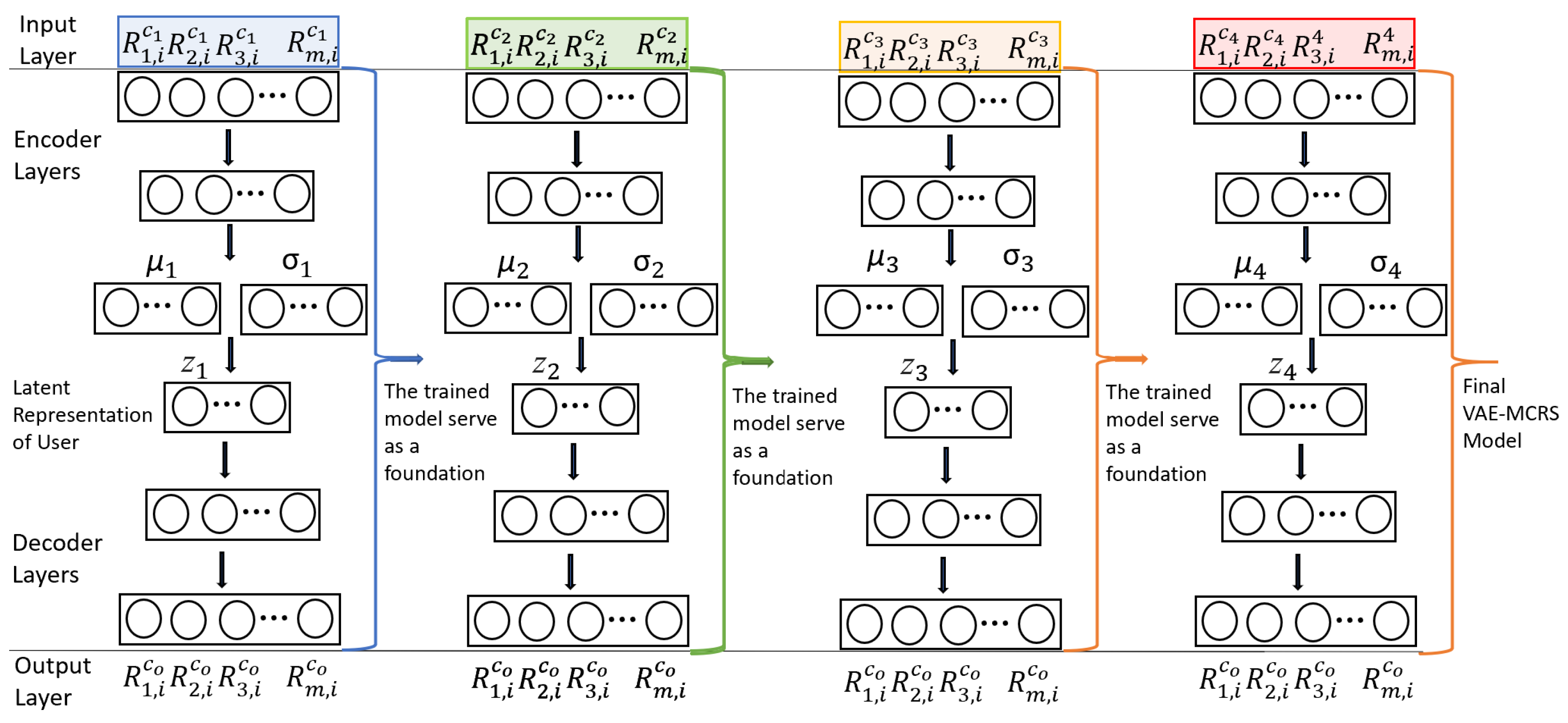
As presented in Figure 2, the proposed VAE-MCRS model is built on two core concepts: first, the sequential training of the VAE model on different datasets, and second, utilizing the VAE model for prediction.
Figure 2. The proposed VAE-MCRS model architecture. R: Rating, C: Criterion, m: Movie, i: User.
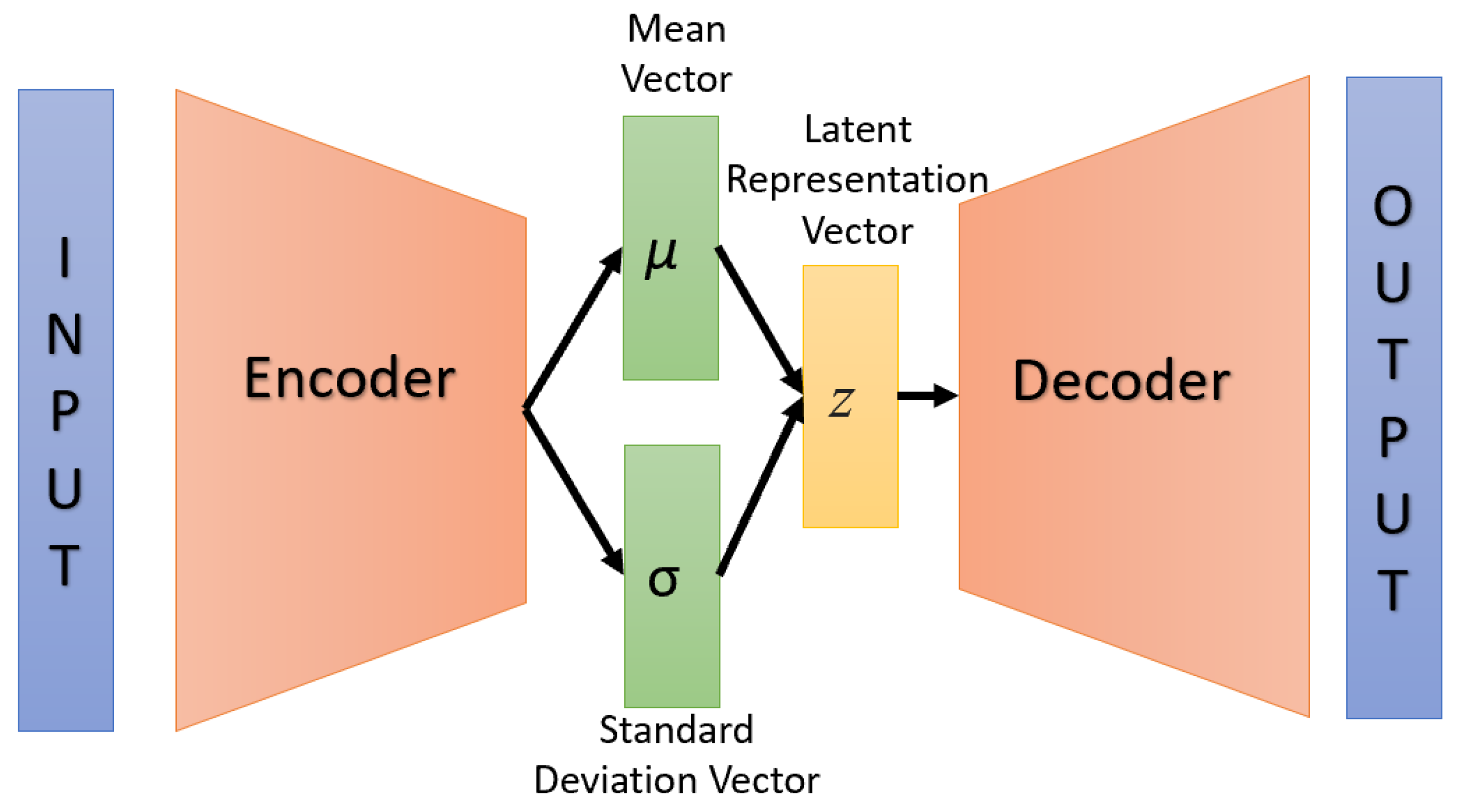
As shown in Figure 2, the VAE architecture comprises three main components: encoder, latent, and decoder layers. The encoder begins with an input layer containing m neurons, representing the number of movies. It includes a hidden layer with a reduced number of neurons, with several configurations tested in the experiment section to determine the optimal structure for the model. The latent layers contain parameters for the mean ( μ ), standard deviation ( σ ), and latent variable (z).
The decoder mirrors the encoder structure in reverse. It starts with z as the input layer, followed by a hidden layer, and concludes with an output layer that has the same number of neurons as the encoder’s input layer.
The proposed VAE-based model VAE-MCRS is trained sequentially on multiple criteria datasets to enhance the model’s ability to understand complex user preferences in a collaborative filtering recommendation system. The use of multiple criteria ratings like Acting, Story, Direction, and Visuals helps the model to capture the dependencies and correlations between these criteria, which leads to more personalized and accurate recommendations.
The interaction between criteria is modeled by leveraging the latent feature space in the VAE. Specifically, after training on a criterion, the learned representations capture the unique patterns of that criteria. When the model moves to the next criterion, the previously learned latent features provide a foundation that enhances the model’s ability to capture correlations between criteria, as these are inherently influenced by the patterns established in the earlier training stages. During training, each criterion-specific dataset is passed through the VAE, which consists of an encoder and a decoder. The encoder compresses the user–item interactions into a latent representation, while the decoder reconstructs these interactions, refining the latent features as it iterates through each criterion. This sequential training across multiple criteria progressively enhances the model’s capability to learn complex interactions that might exist across different aspects of user preferences.
As shown in Figure 2, the VAE-MCRS learning process begins with training the VAE model on the dataset for the first criterion. During this phase, the model parameters are optimized to identify the patterns between the first criterion ratings and the overall ratings, which serve as the output to be predicted by the model. Once the training with the first criterion dataset is complete, the model is then trained on the dataset for the next criterion. This process continues in sequence for each criterion dataset.
The sequential aspect of the proposed approach enables the VAE-MCRS model to identify patterns where a user preference for one criterion might influence or correlate with another. For example, a user who prefers to always rate movies highly based on the visuals criteria might also prefer movies with strong direction criteria. By training the model with all criteria sequentially, it learns these multi-dimensional patterns, improving its ability to predict overall user preferences more effectively. In addition, training the same model sequentially on all criteria leads to more robust recommendations instead of training a distinct model for each criterion task. The model can predict a user overall movie rating by combining the criteria. This helps the model to generalize better across various types of movie ratings and provide recommendations that reflect user preferences.
This approach can also better handle situations where users may not have provided ratings for all criteria. By learning relationships between the different criteria, the model can deduce a user preference for certain criteria even when explicit ratings are missing, leading to more accurate predictions.
Algorithm 1 represents the general pseudocode for the VAE-MCRS model. As indicated after step 9, the model is trained, enabling the VAE-MCRS model to generate recommendations by sampling from the latent space and employing the decoder to predict ratings for unrated user–movie pairs. These predictions are derived from the learned relationships among various criteria and user preferences. The VAE-MCRS model is subsequently evaluated using the testing dataset.
Algorithm 1 Multi-criteria variational autoencoder for collaborative filtering-based recommender systems VAE-MCRS.
     Input: Multi-criteria dataset.
     Output: Recommendation prediction.
First stage: Dataset and VAE-MCRS model preparation
     Step 1: Clean missing values, duplication, standardization (rating range [1–5]) ▹ Data preprocessing
     Step 2: For each criterion, construct a matrix where N rows represent N users and M columns represent M movies.                     ▹ Construct User–Movie Matrix
     Step 3: Split dataset on 80% for training and 20% for testing.
     Step 4: Initialize the hyper-parameters of the VAE-MCRS encoder and decoder networks.                     ▹ Initialization phase.

Second stage: Train VAE-MCRS model
Step 5: Maps the user’s ratings to two vectors: mean and standard deviation of the latent space (representing latent features).                     ▹ Encoding phase.
     Step 6 The encoder produces two vectors:
  • μ (mean): The center of the distribution in latent space.
  • σ (variance): The spread or uncertainty in the latent space.
                            ▹ Latent representation phase.
     Step 7: Construct the latent representation vector z using the mean and the standard deviation vectors.                   ▹ Reparameterization phase.

     Step 8: Decodes the latent vector z back into predicted ratings for all movies, including those that the user has not rated.                   ▹ Decoding phase.

     Step 9: For each new criterion, go back to Step 5 to train the trained VAE-MCRS model with the rating matrix of the new criteria.
     Step 10: Feed VAE-MCRS with testing data for prediction.
The second key motivation for using a variational autoencoder in the development of the proposed VAE-MCRS model is its ability to significantly improve the performance of collaborative filtering approaches in several critical aspects:
  • When trained sequentially on a multiple criteria ratings dataset (for example, Acting, Story, Direction, and Visuals), the VAE can learn a shared latent space that effectively captures users’ preferences across all the criteria. This process results in a compact latent representation of a user’s overall preferences, considering how preferences for one criterion (e.g., Acting) may relate to others (e.g., Direction). For example, the VAE might learn that users who rate Acting highly also tend to rate Direction highly, or that users with strong Visuals preferences might not care as much about the Story. This shared latent space enables the model to gain a deeper understanding of user behavior across all criteria, ultimately improving its predictive accuracy and recommendation effectiveness.
  • In a multi-criteria recommendation system, user preferences are not always independent. There may be complex, nonlinear interactions between different criteria. For example, a user might only value strong Direction if the Story is equally compelling. Traditional linear models may struggle to capture these relationships. However, the VAE is designed to handle such nonlinear interactions through the learning of the compressed latent vector. The VAE can learn how different criteria influence each other and combine them into one preference profile that reflects the complex dynamics of user preferences.
  • In a real case, users do not provide ratings for all criteria (for example, a user may rate Acting and Visuals, but omit Story and Direction). The VAE model, well regarded for handling missing data, addresses this challenge by inferring missing ratings based on the ratings provided. By learning the distribution of preferences across all users and criteria, the VAE can estimate likely values for unrated criteria. For instance, if a user rates highly on Acting and Direction but leaves Visuals unrated, the VAE can predict the likely Visuals rating based on patterns learned from similar users. This ability is crucial when training the model on multiple criteria datasets sequentially, as it ensures robust performance even when full information is not available for every user or criterion.
  • The VAE applies Gaussian distribution to the latent space for regularization. This regularization helps prevent overfitting to specific criteria and encourages the model to generalize across the dataset. As a result, the VAE balances the influence of each criterion and achieves a balanced representation of user preferences across all criteria (i.e., no single criterion dominates).
  • By training on all criteria datasets sequentially, the VAE can generate personalized recommendations that reflect users’ true preferences across different aspects. Rather than optimizing the model for each criterion independently (which may lead to partial or less coherent recommendations), the VAE enables the model to understand how user ratings for criteria such as Acting, Story, Direction, and Visuals are correlated. For example, if a user rates Visuals ‘very good’ but has moderate preferences for Acting, the VAE will use the learned latent representation to recommend movies that balance these preferences, like movies with strong visuals but average acting. It also enables the model to make a list of recommendations by understanding user preferences across different combinations of criteria.
  • When VAE is trained on a multi-criteria dataset, it can suggest items based on different aspects. For example, if a user favors Story and Visuals, the VAE might recommend a movie that excels in these aspects or suggest a movie with strong Direction and Acting, providing diverse relevant options.
The proposed VAE-MCRS model is well suited for deployment across various real-world recommendation systems, making it practically relevant in industries such as e-commerce, streaming platforms, and tourism. Its flexible architecture allows for simple adaptation to specific domains by adjusting criteria to reflect domain-specific aspects. For example, in e-commerce, criteria could include product quality, price, brand, and customer reviews, enabling the model to deliver recommendations that more accurately match user preferences. The model can be integrated as a backend recommendation engine, processing user interactions and historical data to generate recommendations in real time. This adaptability and ease of integration demonstrate the model’s utility for businesses looking to offer tailored, data-driven recommendations to their users.

4. Experimental Results and Discussion

To assess the performance of the proposed VAE-MCRS model, different experiments were conducted. The results were benchmarked against various multi-criteria and single-criterion recommender systems: MCEDSL [24], MMEDSL [24], AEMC [21], MovieANN [25], MC-UCF [6], and SC-UCF [26].
MCEDSL and MMEDSL refer to Multi-Criteria and Multi-Modal Deep Encoder–Decoder-based Shared Learning systems. AEMC is based on deep autoencoder architectures tailored for multi-criteria recommendations. MovieANN utilizes a multi-layer feedforward artificial neural network to leverage multi-criteria ratings for overall rating predictions. MC-UCF serves as a multi-criteria user-based collaborative filtering recommender system, whereas SC-UCF is a single-criterion user-based collaborative filtering model.

4.1. Evaluation Metrics

The proposed models’ and other algorithms’ performances are measured by evaluating their prediction accuracies through statistical metrics, specifically MAE (Equation (5)) and RMSE (Equation (6)).
M A E = 1 N u , i N | P u , i r u , i |
R M S E = 1 N u , i N ( P u , i r u , i ) 2
Here, N is the total number of ratings, P u , i is the predicted rating provided by user u for item i, and r u , i is the actual rating given by user u for the same item i.

4.2. Dataset

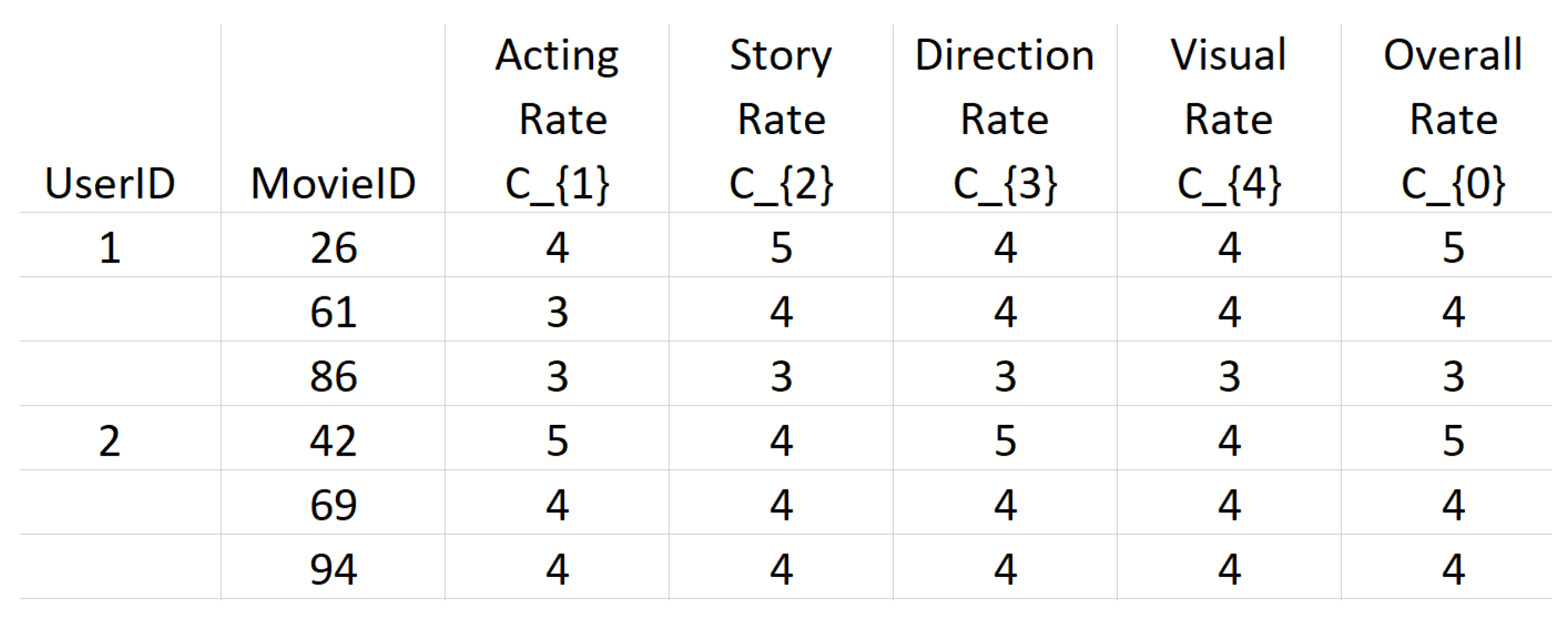
The experimental dataset used is the Yahoo! Movies multi-criteria dataset [27]. This dataset includes 34,800 ratings from 1716 users across 965 movies. Each user rates a movie based on four specific criteria: acting, story, visuals, and direction, along with an overall rating. Figure 3 presents a sample of the Yahoo! Movies multi-criteria with four different criteria and an overall rating for each user–movie pair.
Figure 3. Yahoo dataset sample.
As detailed in Algorithm 1, each criterion dataset is used to generate a 2D M × N , M is the number of items (movies), and N is the number of users. Regarding these dimensions, as shown in Figure 2, the input layer of the VAE-MCRS model consists of 965 neurons, corresponding to the number of movies. The output layer of the VAE-MCRS model is similarly structured, with 965 neurons, reflecting the number of movies based on the overall ratings dataset.

4.3. Sensitivity Analysis

Multiple assessments were performed to identify the best values for the VAE-MCRS model hyperparameters, such as the number of hidden layers, optimization algorithms, and activation functions.
Table 1 displays the hyperparameter values tested in the experiments to find the optimal settings for the proposed model. Table 2 illustrates the optimal hyperparameters of the VAE-MCRS model.
Table 1. Hyperparameters of the VAE-MCRS model.
Table 2. Tuned hyperparameters of VAE-MCRS.
Table 3 demonstrates the impact of different values of the number of hidden layers on VAE-MCRS’s effectiveness. The findings show that three hidden layers provide the most optimal performance for VAE-MCRS. Increasing the number of hidden layers leads to higher MAE and RMSE, indicating potential overfitting with deeper architectures.
Table 3. Effect of hidden layer on the model performances.
The results of the sensitivity analysis in Table 4 highlight the impact of various activation functions on the VAE-MCRS model effectiveness. Combining the ELU activation function in the hidden layers and the Sigmoid function in the output layer yields the best performance, with an MAE of 0.6038 and an RMSE of 0.7085. In contrast, using ELU in both layers results in higher errors, while the ELU–Softmax combination improves performance but does not surpass the ELU–Sigmoid configuration. The results demonstrate that the Sigmoid activation function is most effective for mapping discrete ratings to the discrete range of [1, 5].
Table 4. Effect of activation functions on the model performances.
Table 5 summarizes the results obtained by applying VAE-MCRS with four different optimizers. The analysis reveals that the VAE-MCRS model achieved its best performance using the Adam optimizer, while the RMSprop optimizer provided the optimal results for the VAE-MCRS model with the highest performance metrics.
Table 5. Effect of the optimizer on the model performances.

4.4. Results and Discussion

Table 6 provides a detailed evaluation of prediction accuracy using the VAE-MCRS model and other recommender systems on the Yahoo! dataset. The proposed VAE-MCRS model demonstrates the highest accuracy with an MAE of 0.6038 and an RMSE of 0.7085, showing its superiority to predict ratings accurately. The MCEDSL and MMEDSL methods show strong performance. These results indicate that both methods effectively utilize autoencoder-based frameworks for multi-criteria data, with the VAE demonstrating superiority over the traditional AE in learning from multi-criteria inputs. The ability of the VAE to capture complex latent representations and handle the variability inherent in multi-criteria ratings allows it to provide more accurate predictions. This good performance shows that the VAE can understand the relations between different criteria, which makes it helpful for collaborative filtering tasks where many factors affect what users like.
Table 6. Prediction accuracy across all methods.
We also compared our proposed model with SC-UCF, a single-criterion model, which performs less effectively with an MAE of 0.8720 and an RMSE of 0.9843, highlighting its limitations in capturing complex user preferences compared with multi-criteria methods. MC-UCF, which uses a multi-criteria CF approach, shows an MAE of 0.7722 and an RMSE of 0.8617, indicating better accuracy than SC-UCF but still not as satisfactory as the other advanced models. For MovieANN, which uses a multilayer feedforward neural network for multi-criteria ratings and has an MAE of 0.7190 and an RMSE of 0.7834, the performance is good but not like the precision of the VAE-MCRS model. For AEMC, utilizing a deep autoencoder-based approach achieves an MAE of 0.6435 and an RMSE of 0.7257, which is considered a very good result but does not perform as well as the VAE-MCRS model. In summary, the VAE-MCRS model excels in the integration of multi-criteria data with deep learning techniques, with the most accurate predictions compared with the other methods tested.
The VAE-MCRS model presents several advantages alongside some limitations when compared with the techniques outlined in Table 6. One of its key strengths is its ability to capture complex, nonlinear patterns in user preferences, allowing for a nuanced representation of user–item interactions across multiple criteria. This model is particularly adept at handling data sparsity, as it learns a probability distribution over the latent space, making it effective in scenarios where users have rated only a small subset of items. Furthermore, VAE-MCRS utilizes a sequential training approach, uncovering relationships where preferences in one criterion may influence another, leading to a more comprehensive understanding of user behavior. Its generative capability also allows for the prediction of ratings for unrated items, effectively addressing the “cold start” problem. Experimental results indicate that VAE-MCRS outperforms baseline models in terms of accuracy, as evidenced by MAE and RMSE. On the other hand, the main disadvantage of the VAE-MCRS model is its computational complexity, as the iterative training across multiple criteria can increase resource demands, particularly with large datasets.

5. Conclusions

This research paper introduces VAE-MCRS, a variational autoencoder-based algorithm for multi-criteria recommendation systems. The VAE-MCRS model uses a sequential learning process that adapts its internal representations. The experiment results demonstrate its effectiveness in identifying the relationships between individual criteria and the overall rating. This method improves prediction accuracy and offers a deep understanding within a multi-criteria framework. By combining collaborative filtering with this VAE-based approach, the system utilizes both latent representation vector and user–item interactions, resulting in more precise recommendations and offering users personalized and relevant suggestions.
The experimental results reveal that the proposed VAE-MCRS model improves recommendation accuracy compared with leading baseline recommendation algorithms. This enhancement stems from the model’s capacity to capture complex, nonlinear patterns in user preferences, resulting in a more effective representation of user–item interactions across multiple criteria. However, a significant drawback of the VAE-MCRS model is its computational complexity; the iterative training process across multiple criteria can lead to increased resource requirements, especially when working with large datasets.
In future work, we plan to explore the use of temporal data to study how user preferences change over time. By investigating the change in user preferences and understanding how past behaviors influence current recommendations, we can develop more adaptive and precise recommendation systems.

Author Contributions

Conceptualization, S.F. and Q.S.; methodology, S.F. and M.A.A.-B.; validation, S.F. and M.A.A.-B.; formal analysis, S.F. and S.N.M.; investigation, S.F. and Q.S.; data curation, S.F. and S.N.M.; writing—original draft preparation, S.F., Q.S., M.A.A.-B. and S.N.M.; writing—review and editing, S.F., Q.S., M.A.A.-B. and S.N.M.; visualization, S.F.; supervision, S.F.; project administration, S.F.; funding acquisition, S.F. All authors have read and agreed to the published version of the manuscript.

Funding

This article’s study was funded by the Artificial Intelligence Research Center (AIRC), College of Engineering and Information Technology, Ajman University, Ajman, UAE. Grant No. 2023-IRG-ENIT-6.

Data Availability Statement

Public datasets were used with the following links: https://webscope.sandbox.yahoo.com/catalog.php?datatype=r, accessed on 1 June 2023.

Acknowledgments

We thank Ajman University for supporting this research.

Conflicts of Interest

The authors declare no conflicts of interest.

References

  1. Ko, H.; Lee, S.; Park, Y.; Choi, A. A survey of recommendation systems: Recommendation models, techniques, and application fields. Electronics 2022, 11, 141. [Google Scholar] [CrossRef]
  2. Li, Y.; Liu, K.; Satapathy, R.; Wang, S.; Cambria, E. Recent developments in recommender systems: A survey. IEEE Comput. Intell. Mag. 2024, 19, 78–95. [Google Scholar] [CrossRef]
  3. Shambour, Q.Y.; Hussein, A.H.; Kharma, Q.M.; Abualhaj, M.M. Effective Hybrid Content-Based Collaborative Filtering Approach for Requirements Engineering. Comput. Syst. Sci. Eng. 2022, 40, 113–125. [Google Scholar] [CrossRef]
  4. Shambour, Q.Y.; Abu-Alhaj, M.M.; Al-Tahrawi, M.M. A Hybrid Collaborative Filtering Recommendation Algorithm for Requirements Elicitation. Int. J. Comput. Appl. Technol. 2020, 63, 135–146. [Google Scholar] [CrossRef]
  5. Aggarwal, C.C. Neighborhood-based collaborative filtering. In Recommender Systems: The Textbook; Springer: Berlin/Heidelberg, Germany, 2016; pp. 29–70. [Google Scholar]
  6. Adomavicius, G.; Kwon, Y. New recommendation techniques for multicriteria rating systems. IEEE Intell. Syst. 2007, 22, 48–55. [Google Scholar] [CrossRef]
  7. Monti, D.; Rizzo, G.; Morisio, M. A systematic literature review of multicriteria recommender systems. Artif. Intell. Rev. 2021, 54, 427–468. [Google Scholar] [CrossRef]
  8. Adomavicius, G.; Manouselis, N.; Kwon, Y. Multi-criteria recommender systems. In Recommender Systems Handbook; Springer: Berlin/Heidelberg, Germany, 2010; pp. 769–803. [Google Scholar]
  9. Nilashi, M.; Dalvi-Esfahani, M.; Roudbaraki, M.Z.; Ramayah, T.; Ibrahim, O. A Multi-Criteria Collaborative Filtering Recommender System Using Clustering and Regression Techniques. J. Soft Comput. Decis. Support Syst. 2016, 3, 5. [Google Scholar]
  10. Nilashi, M.; Ibrahim, O.B.; Ithnin, N. Hybrid recommendation approaches for multi-criteria collaborative filtering. Expert Syst. Appl. 2014, 41, 3879–3900. [Google Scholar] [CrossRef]
  11. Sengupta, S.; Basak, S.; Saikia, P.; Paul, S.; Tsalavoutis, V.; Atiah, F.; Ravi, V.; Peters, A. A review of deep learning with special emphasis on architectures, applications and recent trends. Knowl.-Based Syst. 2020, 194, 105596. [Google Scholar] [CrossRef]
  12. Ayemowa, M.O.; Ibrahim, R.; Bena, Y.A. A systematic review of the literature on deep learning approaches for cross-domain recommender systems. Decis. Anal. J. 2024, 13, 100518. [Google Scholar] [CrossRef]
  13. Debbah, A.; Lagrini, S. Latest advances in deep learning-based recommender systems. Int. J. Reason.-Based Intell. Syst. 2024, 16, 249–266. [Google Scholar] [CrossRef]
  14. Zhang, S.; Yao, L.; Sun, A.; Tay, Y. Deep learning based recommender system: A survey and new perspectives. ACM Comput. Surv. (CSUR) 2019, 52, 5. [Google Scholar] [CrossRef]
  15. Askari, B.; Szlichta, J.; Salehi-Abari, A. Variational autoencoders for top-k recommendation with implicit feedback. In Proceedings of the 44th International ACM SIGIR Conference on Research and Development in Information Retrieval, Virtual Event, Canada, 11–15 July 2021; pp. 2061–2065. [Google Scholar]
  16. Liu, W.; Hou, L.; Liang, S.; Zhu, H.; Yu, J.; Liu, Y.; Yin, J. Revisiting Positive and Negative Samples in Variational Autoencoders for Top-N Recommendation. In International Conference on Database Systems for Advanced Applications; Springer: Berlin/Heidelberg, Germany, 2023; pp. 563–573. [Google Scholar]
  17. Liu, W.; Uu, R.L.H.; Liang, S.; Zhu, H.; Yu, J.; Liu, Y.; Yin, J. VAE*: A Novel Variational Autoencoder via Revisiting Positive and Negative Samples for Top-N Recommendation. ACM Trans. Knowl. Discov. Data 2024, 18, 9. [Google Scholar] [CrossRef]
  18. Rajput, I.S.; Tewari, A.S.; Tiwari, A.K. An autoencoder-based deep learning model for solving the sparsity issues of Multi-Criteria Recommender System. Procedia Comput. Sci. 2024, 235, 414–425. [Google Scholar] [CrossRef]
  19. Shenbin, I.; Alekseev, A.; Tutubalina, E.; Malykh, V.; Nikolenko, S.I. Recvae: A new variational autoencoder for top-n recommendations with implicit feedback. In Proceedings of the 13th International Conference on Web Search and Data Mining, Houston, TX, USA, 3–7 February 2020; pp. 528–536. [Google Scholar]
  20. Spoorthy, G.; Sanjeevi, S.G. Multi-criteria recommendations using autoencoder and deep neural networks with weight optimization using firefly algorithm. Int. J. Eng. 2023, 36, 130–138. [Google Scholar] [CrossRef]
  21. Shambour, Q. A deep learning based algorithm for multi-criteria recommender systems. Knowl.-Based Syst. 2021, 211, 106545. [Google Scholar] [CrossRef]
  22. Batmaz, Z.; Kaleli, C. AE-MCCF: An autoencoder-based multi-criteria recommendation algorithm. Arab. J. Sci. Eng. 2019, 44, 9235–9247. [Google Scholar] [CrossRef]
  23. Liang, D.; Krishnan, R.G.; Hoffman, M.D.; Jebara, T. Variational autoencoders for collaborative filtering. In Proceedings of the 2018 World Wide Web Conference, Lyon, France, 23–27 April 2018; pp. 689–698. [Google Scholar]
  24. Fraihat, S.; Tahon, B.A.; Alhijawi, B.; Awajan, A. Deep encoder–decoder-based shared learning for multi-criteria recommendation systems. Neural Comput. Appl. 2023, 35, 24347–24356. [Google Scholar] [CrossRef]
  25. Yücebacs, S.C. MovieANN: A Hybrid Approach to Movie Recommender Systems Using Multi Layer Artificial Neural Networks. Çanakkale Onsekiz Mart Üniversitesi Fen Bilimleri Enstitüsü Dergisi 2019, 5, 214–232. [Google Scholar] [CrossRef][Green Version]
  26. Shardanand, U.; Maes, P. Social information filtering: Algorithms for automating “word of mouth”. In Proceedings of the SIGCHI Conference on Human Factors in Computing Systems, Denver, FL, USA, 7–11 May 1995; pp. 210–217. [Google Scholar]
  27. Alodhaibi, K. Decision-Guided Recommenders with Composite Alternatives. Ph.D. Thesis, George Mason University, Fairfax County, VA, USA, 2011. [Google Scholar]
Disclaimer/Publisher’s Note: The statements, opinions and data contained in all publications are solely those of the individual author(s) and contributor(s) and not of MDPI and/or the editor(s). MDPI and/or the editor(s) disclaim responsibility for any injury to people or property resulting from any ideas, methods, instructions or products referred to in the content.

Article Metrics

Citations

Article Access Statistics

Multiple requests from the same IP address are counted as one view.