Article

Quadratic Multilinear Discriminant Analysis for Tensorial Data Classification


1
Department of Computational Medicine and Bioinformatics, University of Michigan, Ann Arbor, MI 48109, USA
2
Computer Science Department, Queen’s College, CUNY, New York, NY 11367, USA
3
Michigan Institute for Data Science (MIDAS), University of Michigan, Ann Arbor, MI 48109, USA
4
Michigan Center for Integrative Research in Critical Care (MCIRCC), University of Michigan, Ann Arbor, MI 48109, USA
5
Emergency Medicine, University of Michigan, Ann Arbor, MI 48109, USA
6
Mathematics Department, Northeastern University, Boston, MA 02115, USA
*
Author to whom correspondence should be addressed.
Algorithms 2023, 16(2), 104; https://doi.org/10.3390/a16020104
Submission received: 10 January 2023 / Revised: 7 February 2023 / Accepted: 10 February 2023 / Published: 11 February 2023
(This article belongs to the Section Algorithms for Multidisciplinary Applications)

Abstract

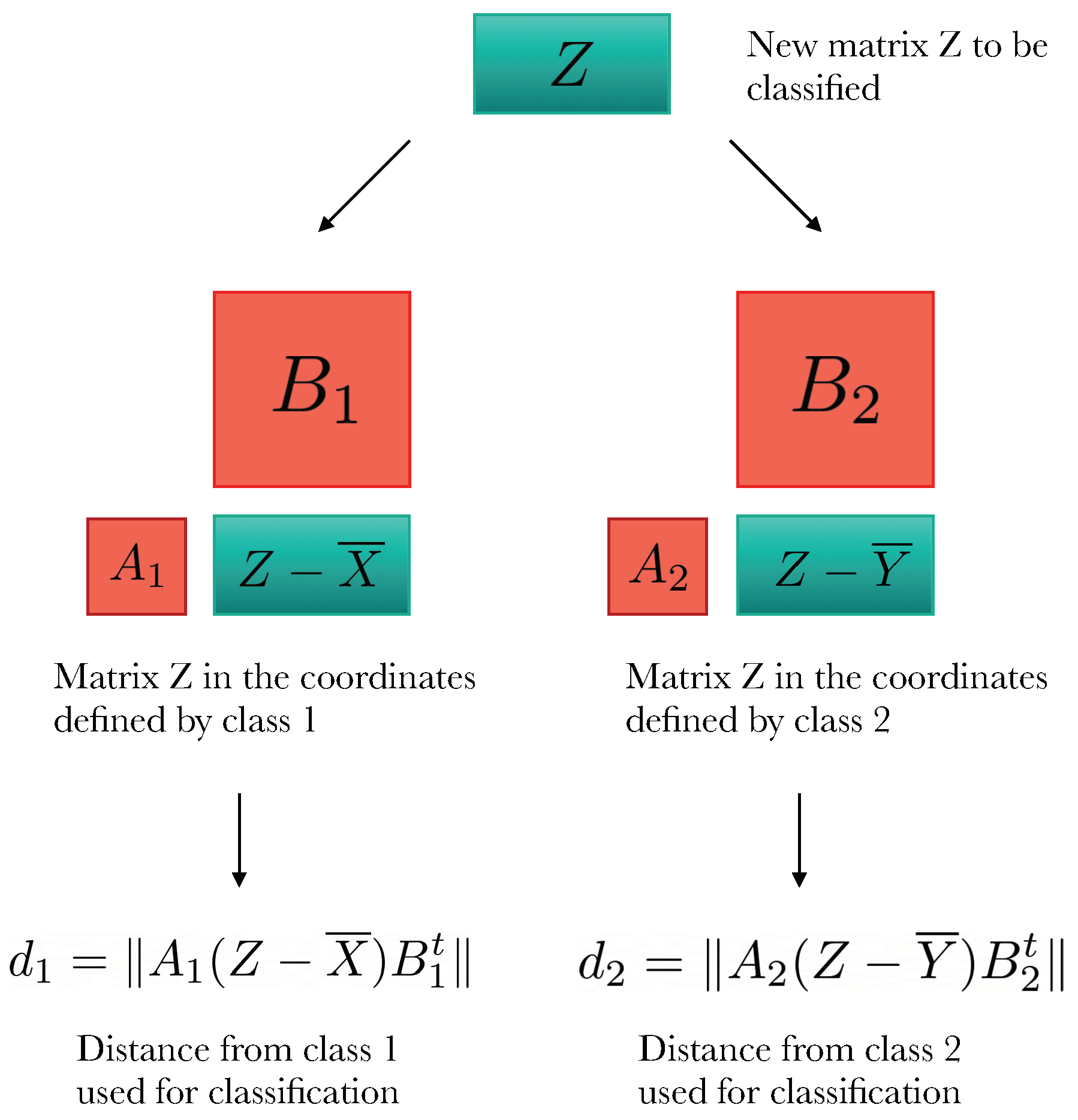
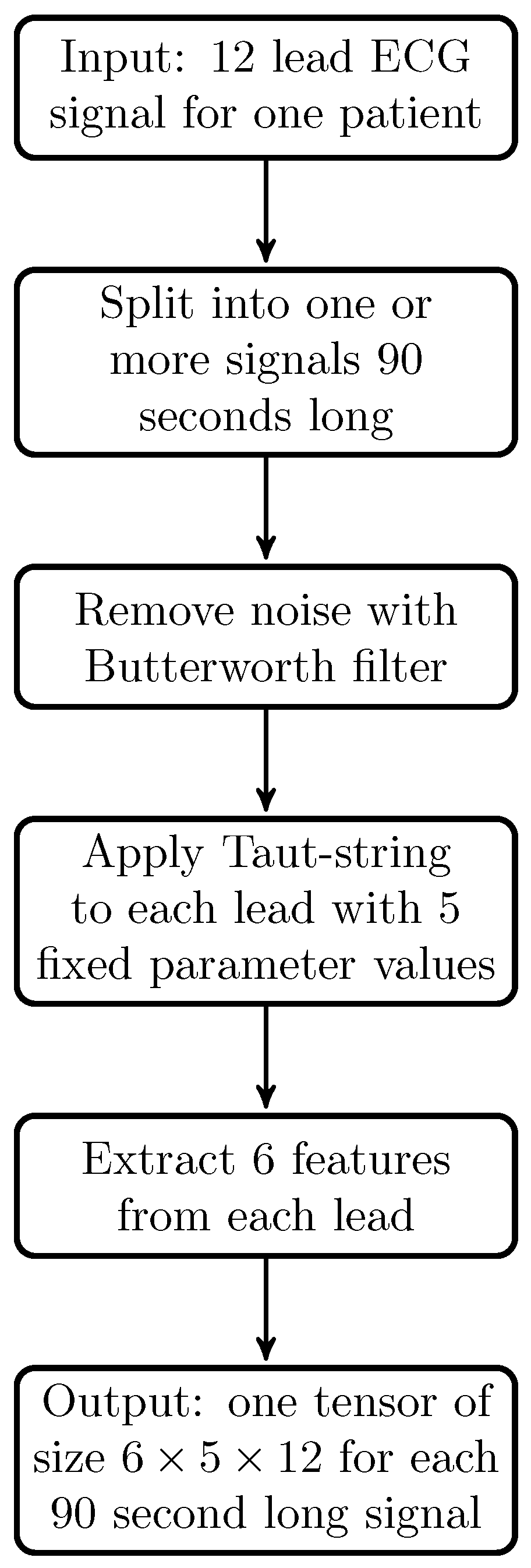
Over the past decades, there has been an increase of attention to adapting machine learning methods to fully exploit the higher order structure of tensorial data. One problem of great interest is tensor classification, and in particular the extension of linear discriminant analysis to the multilinear setting. We propose a novel method for multilinear discriminant analysis that is radically different from the ones considered so far, and it is the first extension to tensors of quadratic discriminant analysis. Our proposed approach uses invariant theory to extend the nearest Mahalanobis distance classifier to the higher-order setting, and to formulate a well-behaved optimization problem. We extensively test our method on a variety of synthetic data, outperforming previously proposed MDA techniques. We also show how to leverage multi-lead ECG data by constructing tensors via taut string, and use our method to classify healthy signals versus unhealthy ones; our method outperforms state-of-the-art MDA methods, especially after adding significant levels of noise to the signals. Our approach reached an AUC of 0.95(0.03) on clean signals—where the second best method reached 0.91(0.03)—and an AUC of 0.89(0.03) after adding noise to the signals (with a signal-to-noise-ratio of 30)—where the second best method reached 0.85(0.05). Our approach is fundamentally different than previous work in this direction, and proves to be faster, more stable, and more accurate on the tests we performed.
Keywords: tensors; multilinear discriminant analysis; quadratic discriminant analysis; classification tensors; multilinear discriminant analysis; quadratic discriminant analysis; classification