
Revisiting the Design of Parallel Stream Joins on Trusted Execution Environments

Abstract
:1. Introduction
- (1)
- the enclave definition language (EDL) puts a limitation on the data-types that can be communicated to the enclave, which often prompts major code refactoring and potential serialization efforts as only the most basic data-types are supported;
- (2)
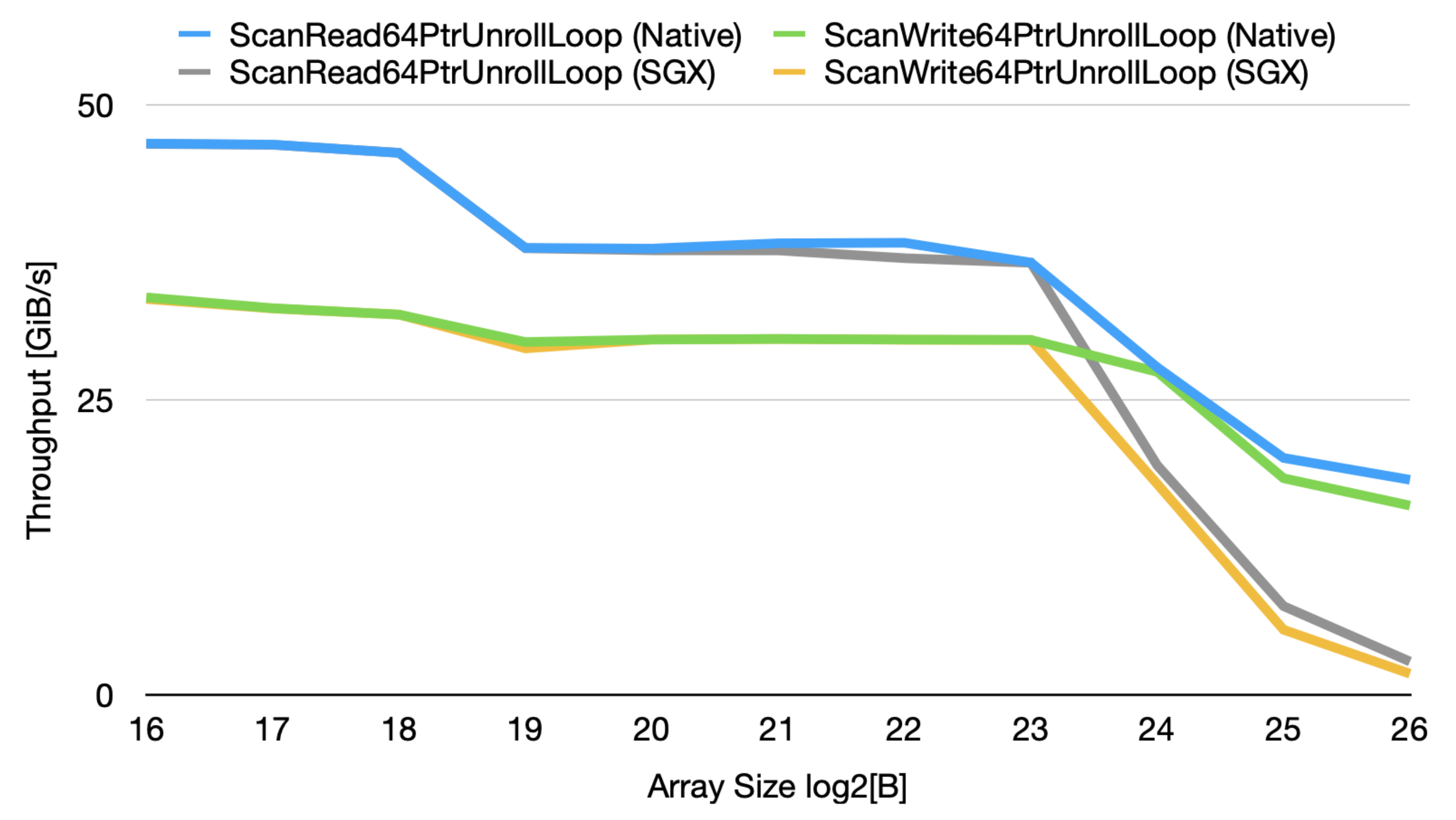
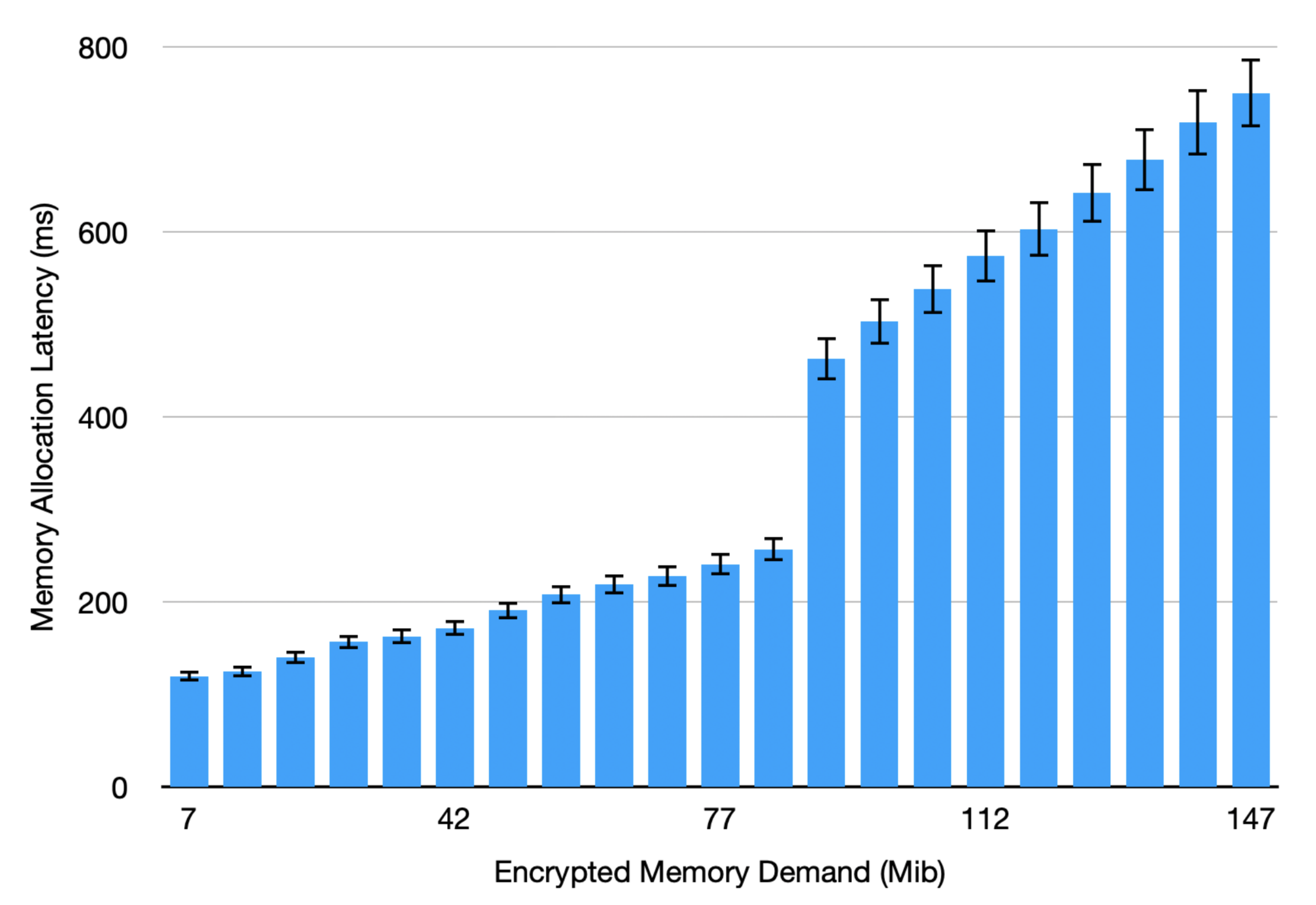
- the restrictive enclave size effectively limits software development capabilities and performance in applications that are data-driven or memory-intensive. A larger memory usage entails more page swap operations, triggering more cryptographic primitives, and hence, more computational overhead;
- (3)
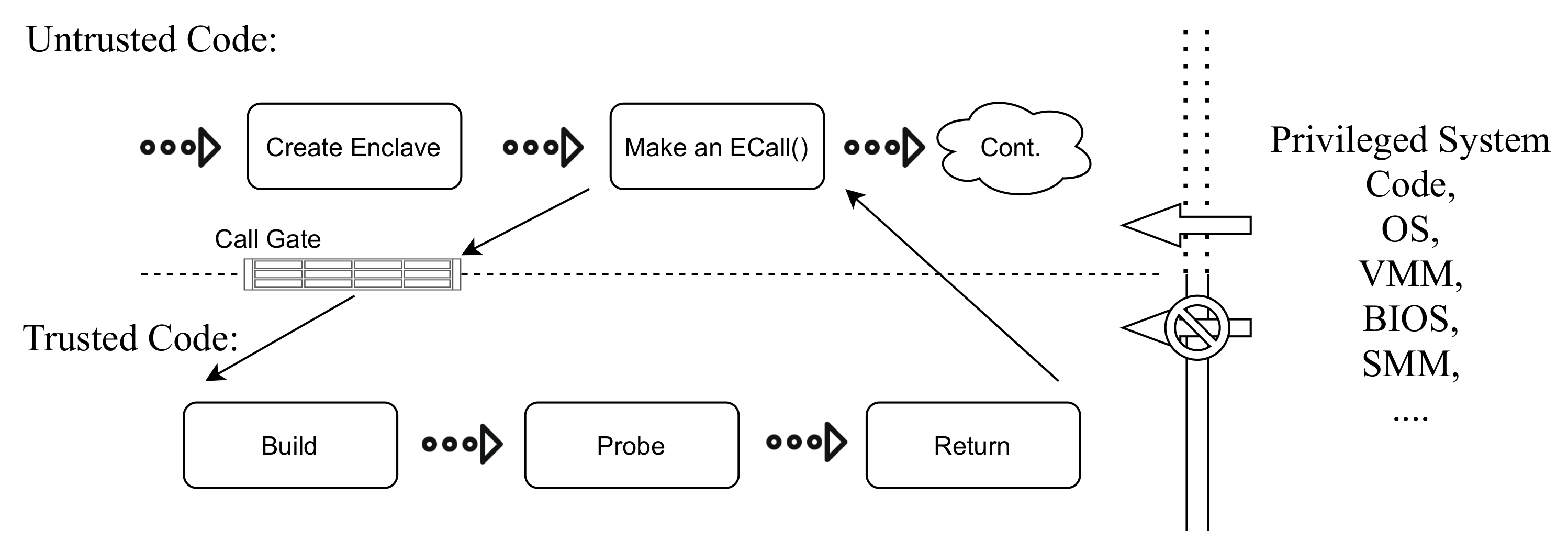
- the ECall and OCall function call interfaces that enable untrusted code and enclaves to communicate seamlessly impose a heavy performance penalty of 10 k–18 k CPU cycles whenever the application needs to enter or exit an enclave for any system call, including I/O operations. Heavy performance penalties would have to be endured if an algorithm is inappropriately designed based on TEEs. Unfortunately, there is no study on the design of parallel stream join algorithms in distributed environments with TEEs.
2. Preliminaries and Background
2.1. Stream Joins
2.2. Trusted Execution Environments
2.3. Threat Model
3. Challenges of Parallelizing Stream Joins on TEEs
3.1. Challenges
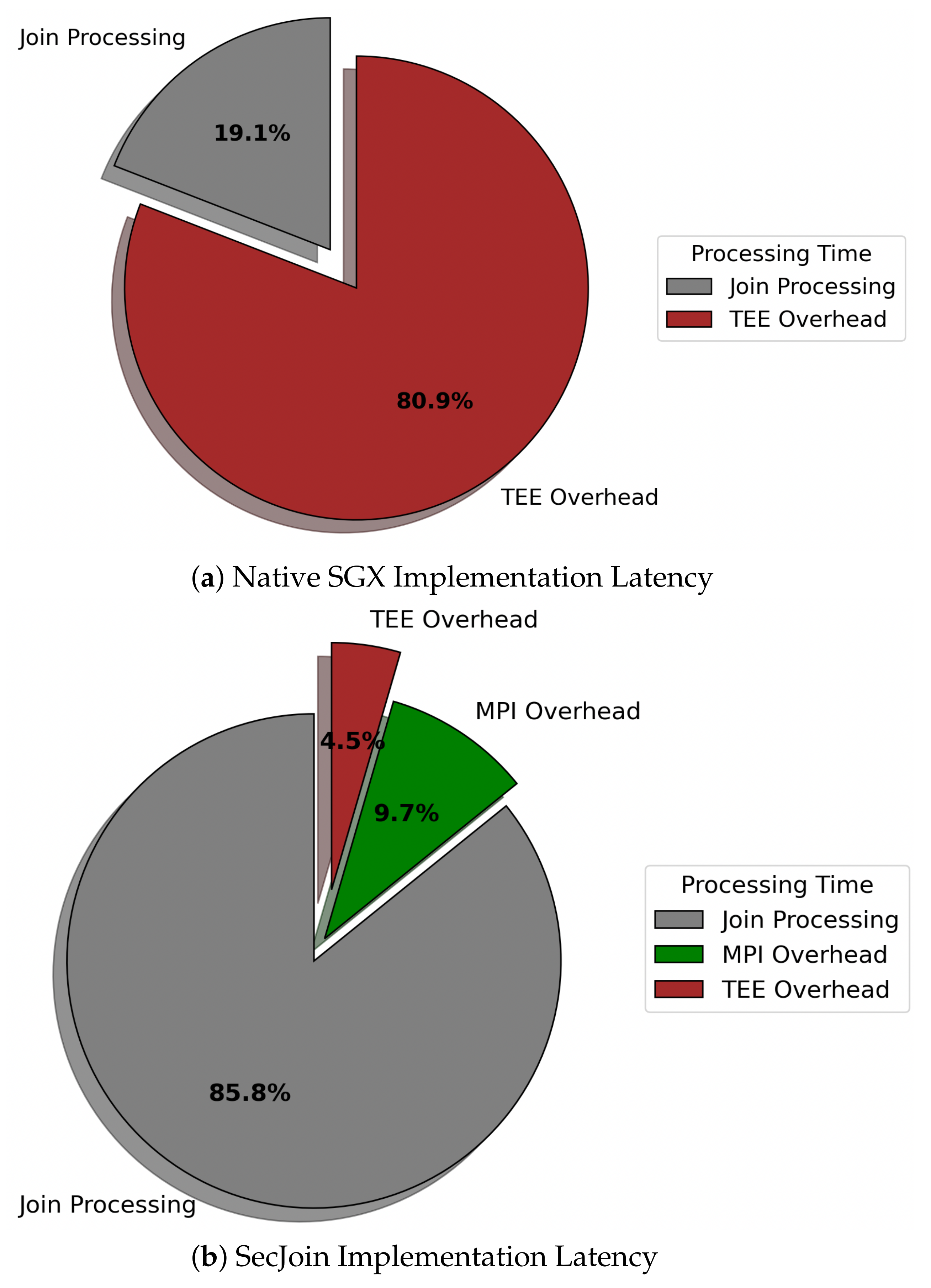
3.2. Motivating Experiments
4. Design Aspects of Parallelizing Stream Joins on Multicore Processors with TEEs
4.1. Execution Approaches
4.2. Join Methods
4.3. Partitioning Schemes
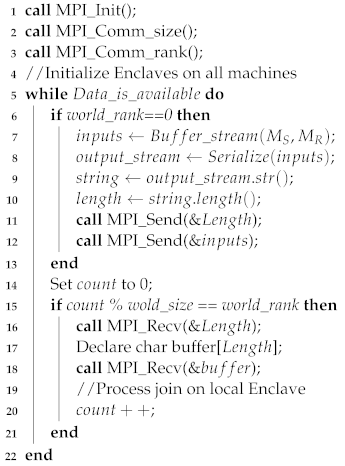
4.4. Distributed Scheduling Strategies
| Algorithm 1: Pseudo-code for an MPI Join distribution |
 |
5. Profiling Study
5.1. Evaluation Goals
5.2. Benchmark Workload
5.3. Evaluation Setup
5.4. Preliminary Results
6. Towards More Efficient Parallel Stream Join on Multicore Processors with TEEs
6.1. Optimal Partitioning Configuration
6.2. Optimal Hardware Requirements
6.3. Put It All Together
7. Conclusions and Future Works
Author Contributions
Funding
Institutional Review Board Statement
Informed Consent Statement
Data Availability Statement
Conflicts of Interest
Sample Availability
References
- Jacques-Silva, G.; Lei, R.; Cheng, L.; Chen, G.J.; Ching, K.; Hu, T.; Mei, Y.; Wilfong, K.; Shetty, R.; Yilmaz, S.; et al. Providing Streaming Joins as a Service at Facebook. Proc. VLDB Endow. 2018, 11, 1809–1821. [Google Scholar] [CrossRef] [Green Version]
- Linden, T.; Khandelwal, R.; Harkous, H.; Fawaz, K. The Privacy Policy Landscape After the GDPR. arXiv 2018, arXiv:1809.08396. [Google Scholar] [CrossRef] [Green Version]
- Wong YongQuan, B. Data privacy law in Singapore: The Personal Data Protection Act 2012. Int. Data Priv. Law 2017, 7, 287–302. [Google Scholar] [CrossRef]
- Najafi, M.; Sadoghi, M.; Jacobsen, H.A. SplitJoin: A Scalable, Low-latency Stream Join Architecture with Adjustable Ordering Precision. In Proceedings of the 2016 USENIX Annual Technical Conference (USENIX ATC 16), Denver, CO, USA, 22–24 June 2016; pp. 493–505. [Google Scholar]
- Roy, P.; Teubner, J.; Gemulla, R. Low-Latency Handshake Join. Proc. VLDB Endow. 2014, 7, 709–720. [Google Scholar] [CrossRef] [Green Version]
- Teubner, J.; Mueller, R. How Soccer Players Would Do Stream Joins; Association for Computing Machinery: New York, NY, USA, 2011; pp. 625–636. [Google Scholar] [CrossRef]
- Shahvarani, A.; Jacobsen, H.A. Parallel Index-Based Stream Join on a Multicore CPU; Association for Computing Machinery: New York, NY, USA, 2020; pp. 2523–2537. [Google Scholar]
- Behzadnia, P. Shared-Memory Parallel Hash-Based Stream Join in Continuous Data Streams. In Proceedings of the DEXA, Bratislava, Slovakia, 14–17 September 2021. [Google Scholar]
- Lin, Q.; Ooi, B.C.; Wang, Z.; Yu, C. Scalable Distributed Stream Join Processing; Association for Computing Machinery: New York, NY, USA, 2015; pp. 811–825. [Google Scholar] [CrossRef]
- Qiu, Y.; Papadias, S.; Yi, K. Streaming HyperCube: A Massively Parallel Stream Join Algorithm; Herschel, M., Galhardas, H., Reinwald, B., Fundulaki, I., Binnig, C., Kaoudi, Z., Eds.; EDBT: Copenhagen, Denmark, 2019; pp. 642–645. [Google Scholar] [CrossRef]
- Mast, K.; Chen, L.; Sirer, E. Enabling Strong Database Integrity using Trusted Execution Environments. arXiv 2018, arXiv:1801.01618. [Google Scholar]
- EdgelessDB—The SQL Database Tailor-Made for Confidential Computing. Available online: https://www.edgeless.systems/products/edgelessdb/ (accessed on 23 May 2022).
- Han, Z.; Hu, H. ProDB: A Memory-Secure Database Using Hardware Enclave and Practical Oblivious RAM. Available online: https://www.sciencedirect.com/science/article/pii/S0306437920301332?via%3Dihub (accessed on 23 May 2022).
- Ribeiro, P.S.; Santos, N.; Duarte, N.O. DBStore: A TrustZone-Backed Database Management System for Mobile Applications; ICETE: Panama City, Panama, 2018. [Google Scholar]
- Zheng, W.; Dave, A.; Beekman, J.G.; Popa, R.A.; Gonzalez, J.E.; Stoica, I. Opaque: An Oblivious and Encrypted Distributed Analytics Platform. In Proceedings of the 14th USENIX Conference on Networked Systems Design and Implementation, Boston, MA, USA, 27–29 March 2017; USENIX Association: Denver, CO, USA, 2017; pp. 283–298. [Google Scholar]
- Eskandarian, S.; Zaharia, M. ObliDB: Oblivious Query Processing for Secure Databases. arXiv 2019, arXiv:1710.00458. [Google Scholar] [CrossRef]
- Nilsson, A.; Bideh, P.N.; Brorsson, J. A Survey of Published Attacks on Intel SGX. arXiv 2020, arXiv:2006.13598. [Google Scholar]
- Jauernig, P.; Sadeghi, A.R.; Stapf, E. Trusted Execution Environments: Properties, Applications, and Challenges. IEEE Secur. Priv. 2020, 18, 56–60. [Google Scholar] [CrossRef]
- Brasser, F.; Müller, U.; Dmitrienko, A.; Kostiainen, K.; Capkun, S.; Sadeghi, A.R. Software Grand Exposure: SGX Cache Attacks Are Practical. In Proceedings of the 11th USENIX Workshop on Offensive Technologies (WOOT 17), Vancouver, BC, Canada, 14–15 August 2017; USENIX Association: Vancouver, BC, Canada, 2017. [Google Scholar]
- Canella, C.; Bulck, J.V.; Schwarz, M.; Lipp, M.; von Berg, B.; Ortner, P.; Piessens, F.; Evtyushkin, D.; Gruss, D. A Systematic Evaluation of Transient Execution Attacks and Defenses. In Proceedings of the 28th USENIX Security Symposium (USENIX Security 19), Santa Clara, CA, USA, 14–16 August 2019; USENIX Association: Santa Clara, CA, USA, 2019; pp. 249–266. [Google Scholar]
- Costan, V.; Devadas, S. Intel SGX Explained. Cryptology ePrint Archive, Report 2016/086. 2016. Available online: https://eprint.iacr.org/2016/086 (accessed on 3 October 2021).
- Halevi, S.; Shoup, V. Algorithms in HElib. In Advances in Cryptology—CRYPTO 2014; Garay, J.A., Gennaro, R., Eds.; Springer: Berlin/Heidelberg, Germany, 2014; pp. 554–571. [Google Scholar]
- Meftah, S.; Tan, B.H.M.; Mun, C.F.; Aung, K.M.M.; Veeravalli, B.; Chandrasekhar, V. DOReN: Toward Efficient Deep Convolutional Neural Networks with Fully Homomorphic Encryption. IEEE Trans. Inf. Forensics Secur. 2021, 16, 3740–3752. [Google Scholar] [CrossRef]
- Meftah, S.; Tan, B.H.M.; Aung, K.M.M.; Yuxiao, L.; Jie, L.; Veeravalli, B. Towards high performance homomorphic encryption for inference tasks on CPU: An MPI approach. Future Gener. Comput. Syst. 2022, 134, 13–21. [Google Scholar] [CrossRef]
- Castro Fernandez, R.; Migliavacca, M.; Kalyvianaki, E.; Pietzuch, P. Integrating Scale out and Fault Tolerance in Stream Processing Using Operator State Management. In Proceedings of the 2013 ACM SIGMOD International Conference on Management of Data, New York, NY, USA, 22–27 June 2013; ACM: New York, NY, USA, 2013; pp. 725–736. [Google Scholar] [CrossRef] [Green Version]
- Elseidy, M.; Elguindy, A.; Vitorovic, A.; Koch, C. Scalable and Adaptive Online Joins. Proc. VLDB Endow. 2014, 7, 441–452. [Google Scholar] [CrossRef] [Green Version]
- Wilschut, A.N.; Apers, P.M.G. Dataflow query execution in a parallel main-memory environment. In Proceedings of the First International Conference on Parallel and Distributed Information Systems, Miami Beach, FL, USA, 4–6 December 1991; pp. 68–77. [Google Scholar] [CrossRef] [Green Version]
- Dittrich, J.P.; Seeger, B.; Taylor, D.S.; Widmayer, P. Progressive Merge Join: A Generic and Non-blocking Sort-based Join Algorithm. In Proceedings of the 28th International Conference on Very Large Data Bases, VLDB Endowment, Hong Kong, China, 20–23 August 2002; pp. 299–310. [Google Scholar]
- Urhan, T.; Franklin, M.J. Xjoin: A Reactively-Scheduled Pipelined Join Operator ë; IEEE: Piscataway, NJ, USA, 2000; p. 27. [Google Scholar]
- Mokbel, M.F.; Lu, M.; Aref, W.G. Hash-Merge Join: A Non-blocking Join Algorithm for Producing Fast and Early Join Results. In Proceedings of the 20th International Conference on Data Engineering, Boston, MA, USA, 2 April 2004; IEEE Computer Society: Washington, DC, USA, 2004; pp. 251–262. [Google Scholar] [CrossRef]
- Lawrence, R. Early Hash Join: A Configurable Algorithm for the Efficient and Early Production of Join Results. In Proceedings of the 31st International Conference on Very Large Data Bases, Trondheim, Norway, 30 August–2 September 2005; pp. 841–852. [Google Scholar]
- Tao, Y.; Yiu, M.L.; Papadias, D.; Hadjieleftheriou, M.; Mamoulis, N. RPJ: Producing Fast Join Results on Streams Through Rate-based Optimization. In Proceedings of the 2005 ACM SIGMOD International Conference on Management of Data, Baltimore, MD, USA, 14–16 June 2005; ACM: New York, NY, USA, 2005; pp. 371–382. [Google Scholar] [CrossRef] [Green Version]
- Haas, P.J.; Hellerstein, J.M. Ripple Joins for Online Aggregation. SIGMOD Rec. 1999, 28, 287–298. [Google Scholar] [CrossRef]
- Li, F.; Wu, B.; Yi, K.; Zhao, Z. Wander Join: Online Aggregation via Random Walks. In Proceedings of the 2016 International Conference on Management of Data, San Francisco, CA, USA, 26 June–1 July 2016; ACM: New York, NY, USA, 2016; pp. 615–629. [Google Scholar] [CrossRef]
- Kaplan, D. AMD x86 Memory Encryption Technologies; USENIX Association: Austin, TX, USA, 2016. [Google Scholar]
- Alves, T.; Felton, D. Trustzone: Integrated Hardware and Software Security. 2004. Available online: https://www.techonline.com/tech-papers/trustzone-integrated-hardware-and-software-security/ (accessed on 3 October 2021).
- Hill, M.D.; Masters, J.; Ranganathan, P.; Turner, P.; Hennessy, J.L. On the Spectre and Meltdown Processor Security Vulnerabilities. IEEE Micro 2019, 39, 9–19. [Google Scholar] [CrossRef]
- Barber, R.; Lohman, G.; Pandis, I.; Raman, V.; Sidle, R.; Attaluri, G.; Chainani, N.; Lightstone, S.; Sharpe, D. Memory-Efficient Hash Joins. Proc. VLDB Endow. 2014, 8, 353–364. [Google Scholar] [CrossRef] [Green Version]
- Blanas, S.; Li, Y.; Patel, J.M. Design and Evaluation of Main Memory Hash Join Algorithms for Multi-Core CPUs. In Proceedings of the 2011 ACM SIGMOD International Conference on Management of Data, Athens, Greece, 12–16 June 2011; Association for Computing Machinery: New York, NY, USA, 2011; pp. 37–48. [Google Scholar] [CrossRef] [Green Version]
- Taassori, M.; Shafiee, A.; Balasubramonian, R. VAULT: Reducing Paging Overheads in SGX with Efficient Integrity Verification Structures. In Proceedings of the Twenty-Third International Conference on Architectural Support for Programming Languages and Operating Systems, Williamsburg, VA, USA, 24–28 March 2018; Association for Computing Machinery: New York, NY, USA, 2018; pp. 665–678. [Google Scholar] [CrossRef]
- Graefe, G. Sort-merge-join: An idea whose time has(h) passed? In Proceedings of the 1994 IEEE 10th International Conference on Data Engineering, Washington, DC, USA, 14–18 February 1994; pp. 406–417. [Google Scholar] [CrossRef]
- Brenner, S.; Wulf, C.; Goltzsche, D.; Weichbrodt, N.; Lorenz, M.; Fetzer, C.; Pietzuch, P.; Kapitza, R. SecureKeeper: Confidential ZooKeeper Using Intel SGX. In Proceedings of the 17th International Middleware Conference, Trento, Italy, 12–16 December 2016; Association for Computing Machinery: New York, NY, USA, 2016. [Google Scholar] [CrossRef] [Green Version]
- Zhao, C.; Saifuding, D.; Tian, H.; Zhang, Y.; Xing, C. On the Performance of Intel SGX. In Proceedings of the 13th Web Information Systems and Applications Conference (WISA), Wuhan, China, 23–25 September 2016; pp. 184–187. [Google Scholar] [CrossRef]
- Dinh Ngoc, T.; Bui, B.; Bitchebe, S.; Tchana, A.; Schiavoni, V.; Felber, P.; Hagimont, D. Everything You Should Know About Intel SGX Performance on Virtualized Systems. Proc. ACM Meas. Anal. Comput. Syst. 2019, 3, 1–21. [Google Scholar] [CrossRef]
- pmbw—Parallel Memory Bandwidth Benchmark/Measure. Available online: https://github.com/bingmann/pmbw (accessed on 3 October 2021).
- Che Tsai, C.; Porter, D.E.; Vij, M. Graphene-SGX: A Practical Library OS for Unmodified Applications on SGX. In Proceedings of the 2017 USENIX Annual Technical Conference (USENIX ATC 17), Santa Clara, CA, USA, 12–14 July 2017; USENIX Association: Santa Clara, CA, USA, 2017; pp. 645–658. [Google Scholar]
- Kim, C.; Kaldewey, T.; Lee, V.W.; Sedlar, E.; Nguyen, A.D.; Satish, N.; Chhugani, J.; Di Blas, A.; Dubey, P. Sort vs. Hash Revisited: Fast Join Implementation on Modern Multi-Core CPUs. Proc. VLDB Endow. 2009, 2, 1378–1389. [Google Scholar] [CrossRef] [Green Version]
- Gropp, W.; Lusk, E.; Doss, N.; Skjellum, A. A high-performance, portable implementation of the MPI message passing interface standard. Parallel Comput. 1996, 22, 789–828. [Google Scholar] [CrossRef]
- Peng, I.B.; Markidis, S.; Gioiosa, R.; Kestor, G.; Laure, E. MPI Streams for HPC Applications. arXiv 2017, arXiv:1708.01306. [Google Scholar] [CrossRef]
- Karimov, J.; Rabl, T.; Katsifodimos, A.; Samarev, R.; Heiskanen, H.; Markl, V. Benchmarking distributed stream data processing systems. In Proceedings of the 2018 IEEE 34th International Conference on Data Engineering, Paris, France, 16–19 April 201; IEEE: Piscataway, NJ, USA, 2018; pp. 1507–1518. [Google Scholar]
- Chintapalli, S.; Dagit, D.; Evans, B.; Farivar, R.; Graves, T.; Holderbaugh, M.; Liu, Z.; Nusbaum, K.; Patil, K.; Peng, B.J.; et al. Benchmarking streaming computation engines: Storm, flink and spark streaming. In Proceedings of the 2016 IEEE International Parallel and Distributed Processing Symposium Workshops (IPDPSW), Chicago, IL, USA, 23–27 May 2016; IEEE: Piscataway, NJ, USA, 2016; pp. 1789–1792. [Google Scholar]
- Gulisano, V.; Jerzak, Z.; Voulgaris, S.; Ziekow, H. The DEBS 2016 grand challenge. In Proceedings of the 10th ACM International Conference on Distributed and Event-Based Systems, Irvine, CA, USA, 20–24 June 2016; ACM: New York, NY, USA, 2016; pp. 289–292. [Google Scholar]
- McKeen, F.; Alexandrovich, I.; Anati, I.; Caspi, D.; Johnson, S.; Leslie-Hurd, R.; Rozas, C. Intel® Software Guard Extensions (Intel® SGX) Support for Dynamic Memory Management Inside an Enclave. In Proceedings of the Hardware and Architectural Support for Security and Privacy 2016, Seoul, Korea, 18 June 2016; Association for Computing Machinery: New York, NY, USA, 2016. [Google Scholar] [CrossRef]
- Peng, I.B.; Markidis, S.; Laure, E.; Holmes, D.; Bull, M. A Data Streaming Model in MPI. In Proceedings of the 3rd Workshop on Exascale MPI, Texas, AX, USA, 15 November 2015; Association for Computing Machinery: New York, NY, USA, 2015. [Google Scholar] [CrossRef]



| Notations | Description |
|---|---|
| An input tuple x with three attributes | |
| R, S | Two input streams to join |
| Key skewness (unique or zipf) | |
| Timestamp skewness (uniform or zipf) | |
| Average number of duplicates per key | |
| v | Input arrival rate (tuples/ms) |
| w | Window length (ms) |
| Total Number of Tuples in Stream R | |
| Total Number of Tuples in Stream S | |
| Maximum Size of Tuple {R; S} or resulting Join {J} | |
| Number of Tuples in Join-Matrix Partition over Stream {R; S} | |
| Tuple arrival rate for {R; S} | |
| The amount of effective enclave memory available | |
| #Encl | The Number of Secure Enclaves Available |
| #Thr | The Number of CPU Threads Available |
| The Number of Enclave Page Cache Swaps within a given Enclave | |
| The Access Latency of an Enclave Call (ECall) | |
| The Access Latency of an Outside Call (OCall) | |
| The Latency of an Enclave Page Cache Swap | |
| The execution time of a join in a secure enclave | |
| C | Sum of Initialization and shutdown overheads for app using exact enclave memory size |
| Enclave Initialization overhead per extra EPC page | |
| Enclave Shutdown overhead per extra EPC page |
| Design Aspects | Design Decisions | Description |
|---|---|---|
| Execution Approaches | Lazy | Joins a complete set of tuples |
| Eager | Joins a subset of tuples | |
| Join Methods | Hash-Based | Builds hash tables before probing |
| Sort-Merge | Sorts both relations before merging | |
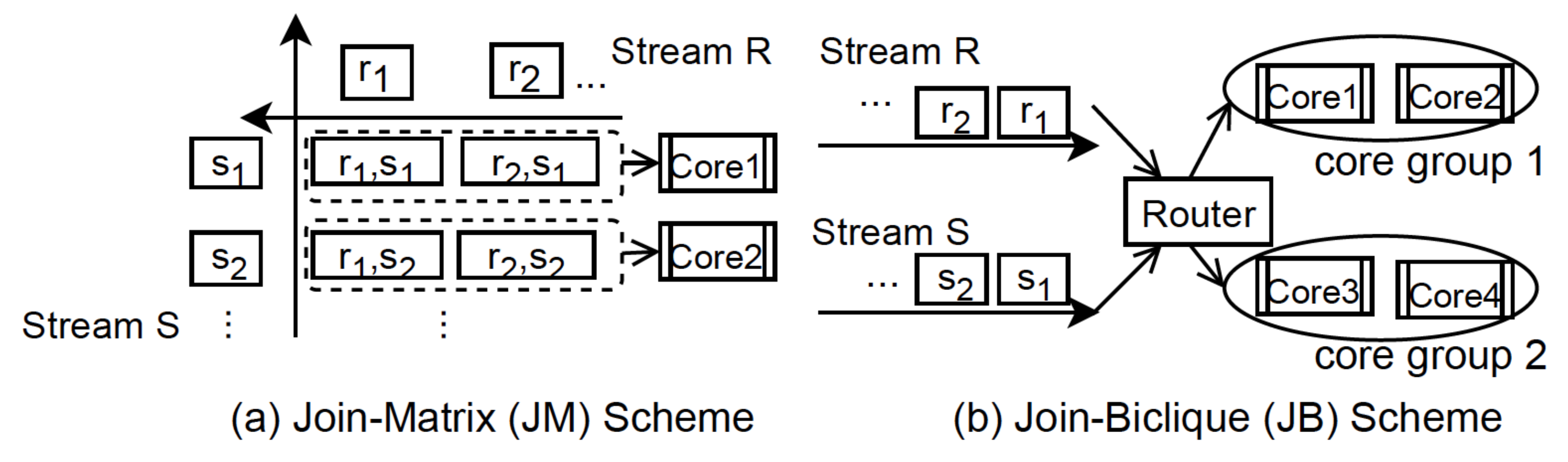
| Partitioning Schemes | Logical Partitioning | Passes pointers instead of values |
| Physical Partitioning | Passes values instead of pointers | |
| Join-Matrix Partitioning | Content-insensitive matrix | |
| Join -Biclique Partitioning | Content-sensitive bipartite graph | |
| Distributed Scheduling Strategies | Static Initialization | Assumes equal partition sizes |
| Dynamic Adaptation | Adjusts partition sizes dynamically |
| Tuple Size (in Bytes) | Attributes Joined Oven in R | Attributes Joined Oven in S | |
| Rovio | 30 | 1.2 | 1.2 |
| YSB | 100 | 1 | 1 |
| DEBS | 5000 | 3.5 | 4.6 |
Publisher’s Note: MDPI stays neutral with regard to jurisdictional claims in published maps and institutional affiliations. |
© 2022 by the authors. Licensee MDPI, Basel, Switzerland. This article is an open access article distributed under the terms and conditions of the Creative Commons Attribution (CC BY) license (https://creativecommons.org/licenses/by/4.0/).
Share and Cite
Meftah, S.; Zhang, S.; Veeravalli, B.; Aung, K.M.M. Revisiting the Design of Parallel Stream Joins on Trusted Execution Environments. Algorithms 2022, 15, 183. https://doi.org/10.3390/a15060183
Meftah S, Zhang S, Veeravalli B, Aung KMM. Revisiting the Design of Parallel Stream Joins on Trusted Execution Environments. Algorithms. 2022; 15(6):183. https://doi.org/10.3390/a15060183
Chicago/Turabian StyleMeftah, Souhail, Shuhao Zhang, Bharadwaj Veeravalli, and Khin Mi Mi Aung. 2022. "Revisiting the Design of Parallel Stream Joins on Trusted Execution Environments" Algorithms 15, no. 6: 183. https://doi.org/10.3390/a15060183
APA StyleMeftah, S., Zhang, S., Veeravalli, B., & Aung, K. M. M. (2022). Revisiting the Design of Parallel Stream Joins on Trusted Execution Environments. Algorithms, 15(6), 183. https://doi.org/10.3390/a15060183