Article

Environmental Assessment and Eco-Efficiency of Airport Pavements Incorporating Warm RAP Base Layers

by
Washington Camatari Junior
1,
Tales Ribeiro Santos
1,
Vinicius Storto Martinez Senra
1,
Matheus Assis Maia
1,
Filipe Almeida Corrêa do Nascimento
1,
Antônio Carlos Rodrigues Guimarães
1,
Sergio Neves Monteiro
2 and
Lisley Madeira Coelho
1,*
1
Department of Fortification and Construction, Military Institute of Engineering-IME, Praça General Tibúrcio, 80, Urca, Rio de Janeiro 22290-270, Brazil
2
Department of Materials Science, Military Institute of Engineering-IME, Praça General Tibúrcio, 80, Urca, Rio de Janeiro 22290-270, Brazil
*
Author to whom correspondence should be addressed.
Materials 2026, 19(9), 1794; https://doi.org/10.3390/ma19091794
Submission received: 12 February 2026 / Revised: 31 March 2026 / Accepted: 24 April 2026 / Published: 28 April 2026
(This article belongs to the Special Issue Life-Cycle Assessment of Sustainable Concrete)

Abstract

Strategies based on the use of recycled materials have been widely discussed as alternatives to reduce environmental impacts in transport infrastructure. In pavement engineering, the use of Reclaimed Asphalt Pavement (RAP) in base layers offers environmental benefits; however, its benefits depend on processing conditions and structural performance. Chemical stabilization techniques, although mechanically effective, tend to introduce environmental hotspots associated with binder production. In this study, controlled thermal conditioning of RAP is evaluated as a warm base solution without chemical stabilizers in the context of airport pavements. A comparative life cycle assessment was conducted under a production- and construction-stage scope (A1–A3 and A5, excluding transportation under equivalent logistical assumptions), considering untreated RAP, heated RAP, and RAP stabilized with emulsion and cement, and was integrated with mechanistic–empirical structural performance analyses. The results indicate that, although heated RAP presents intermediate absolute environmental impacts due to additional energy consumption, it achieves the highest eco-efficiency, expressed as the lowest ratio between global warming potential (IPCC 2023) and estimated structural service life. In the analyzed scenarios, the warm base showed approximately 71% lower environmental impact per year of service than untreated RAP and about 90% lower than the emulsion-stabilized alternative. These findings suggest that performance-based sustainability assessment can reveal environmental advantages in solutions that exhibit moderate increases in production-stage impacts but enhanced structural longevity. It should be noted that the conclusions are conditioned by the adopted production and construction system boundaries, which do not include the use, rehabilitation, or end-of-life phases.

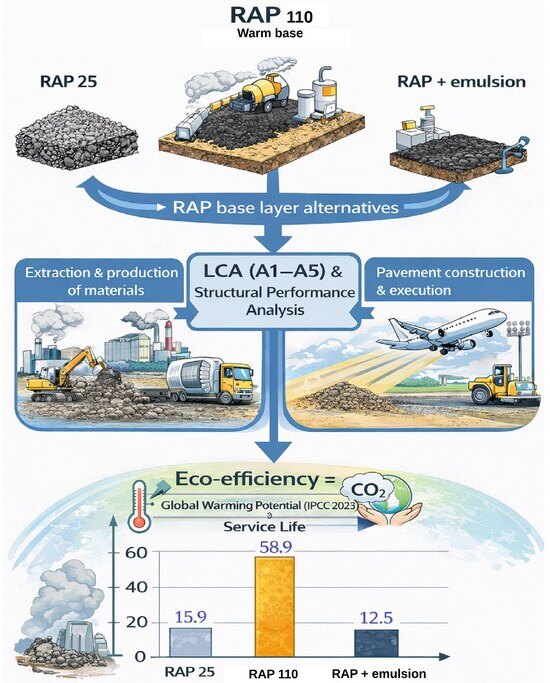
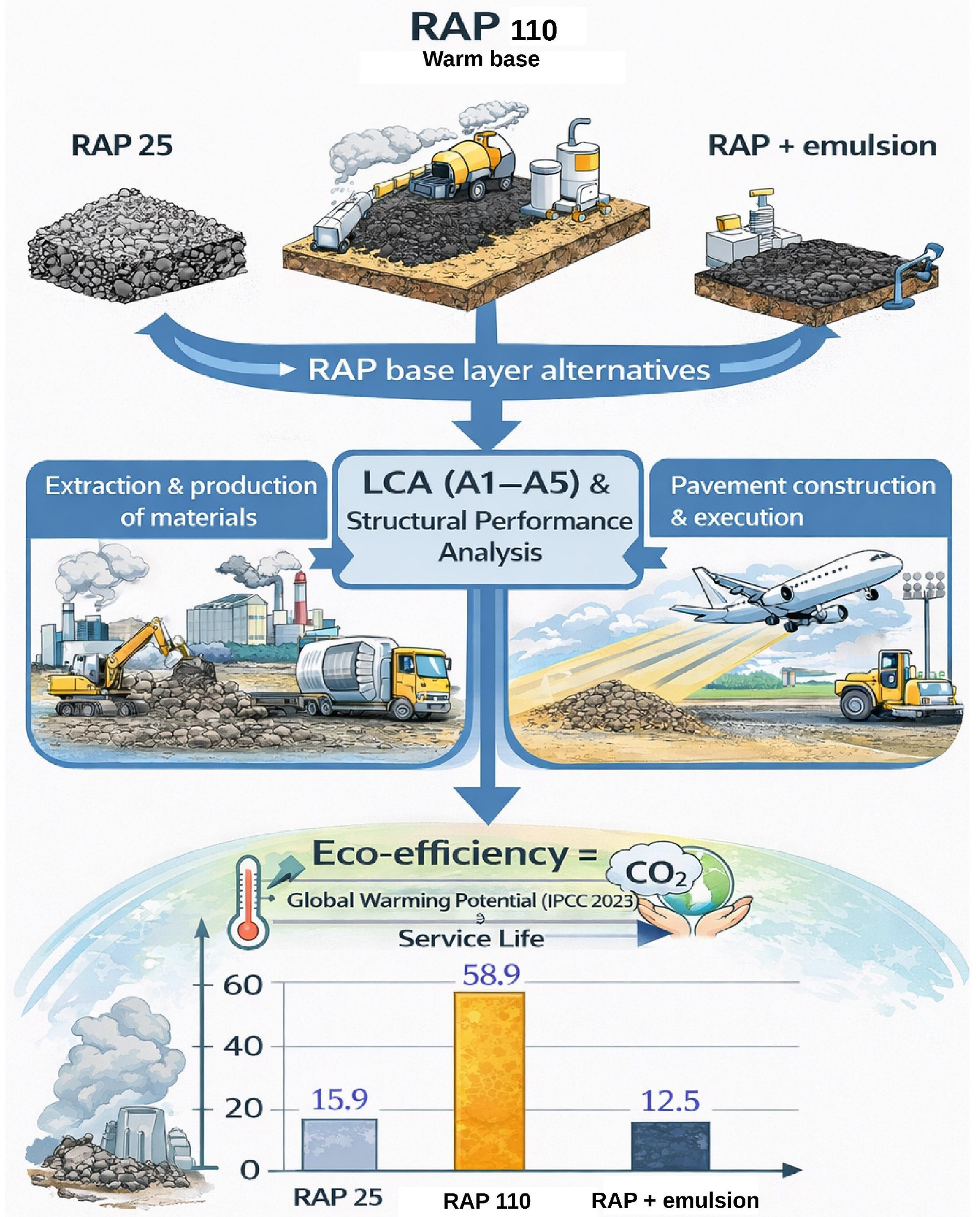
Graphical Abstract

1. Introduction

The incorporation of recycled materials and the adoption of construction processes at moderate temperatures (100–150 °C) have been proposed as promising ways to reduce the environmental impacts of transportation infrastructure and, simultaneously, to increase the value of waste materials generated during construction [1]. However, the environmental benefits associated with these approaches are not automatic: they may vary according to the energy consumption of the processes, the logistics of transport, and, above all, the effects on performance and durability, which determine the need for interventions and maintenance over time [2]. For these reasons, the evaluation of the environmental potential of a process demands a life cycle perspective, including construction, maintenance, use, and end-of-life stages, avoiding impact “displacement” between stages (burden shifting) [3].
The approach is aligned with the development of the literature: research in pavement sustainability has been growing and diversifying, with emphasis on both the implementation of new technologies (recycled materials and industrial byproducts) and the adaptation of LCA methodologies to the peculiarities of construction, operation, maintenance, and rehabilitation [1,4,5,6].
Among circular economy strategies with promising prospects in pavements, the use of milled material from asphalt layers (Reclaimed Asphalt Pavement) stands out. RAP is produced in maintenance and rehabilitation activities and is already employed in several countries in asphalt mixtures and as a granular material in base and sub-base layers [7,8,9,10,11]. Data from 2020 indicate that, generally, the main destination of RAP is the production of hot/warm mixtures: in the United States, for example, 90.3% of available RAP was directed to that application, while 6.0% was used in granular layers and 0.4% in cold recycling [12,13]. In Europe, the same trends can be observed in several countries (e.g., Germany 84%, Denmark 85%, France 86%, Finland 100% and Ireland 100% in hot/warm mixtures), while cold recycling is only relevant in some specific contexts (e.g., Slovakia 30%, Czechia 25% and Romania 100%) [12,13]. However, in some countries, RAP is frequently employed in granular pavement layers (63% in the UK, 65% in Norway, 60% in Italy and 98% in Turkey), indicating that, while this is not the main route on a global scale, its structural application as a granular material is still widely employed in different technological contexts [12,13]. In this respect, recent research on mixed reclaimed asphalt materials (MRAMs) has shown that thermal processing, including the use of solar energy, combined with appropriate compaction, can activate the load-bearing capacity of the material by promoting particle bonding and the formation of a cohesive load-bearing structure [14]. This finding further supports the broader technical rationale for thermally conditioned RAP applications in structural pavement layers.
In that scenario, Brazil emerges as an example in which, while institutional incentives exist [15], RAP is still underutilized and not properly tracked: appraisals from concessionaires (2019–2021) indicate a predominance of poorly elaborated destinations (53.2% donations and 37.6% stockpiling), while its use in pavements has a low share (3.1% in base layers and 0.7% in hot/warm mixes) [16]. Furthermore, in contexts where recycling is consolidated, more maturity in the control of and content of the incorporated RAP can be observed: in Japan, the content of RAP in hot/warm recycled mixtures increased from 33% (2000) to 47% (2013) [17,18], and, in the Canadian province of Quebec, 56% of hot/warm mixes produced contain up to 20% RAP. In Brazil, however, only a few concessionaires reported recycling in hot/warm mixes, with an average proportion of around 15% [16]. This scenario reinforces the pertinence of investigating methods with better technological control and higher percentages of RAP.
From a mechanical performance standpoint, the literature indicates that RAP–virgin aggregate blends may exhibit resilient modulus (MR) values exceeding those of unbound virgin aggregate [8,9,10,11,19], indicating enhanced structural stiffness. However, the permanent deformation (PD) response remains less conclusive, with inconsistent findings and pronounced dependence on the stress state, binder content and aging condition, particle size distribution, and compaction and testing protocols [20,21,22,23,24]. The presence of an aged binder film coating RAP particles may promote the accumulation of plastic strains under cyclic loading [25], and repeated load triaxial testing demonstrates the high sensitivity of deformation behavior to stress conditions and mixture composition [26,27,28,29,30]. This response is consistent with the hybrid mechanical nature of RAP, which exhibits characteristics intermediate between granular geomaterials and asphalt-bound composites, thereby imposing additional complexities for constitutive modeling and pavement design. Consequently, design approaches based solely on the resilient response may underestimate rutting susceptibility under specific loading regimes, and the incorporation of permanent deformation as a complementary performance criterion is recommended [11,22,30,31].
To address this complexity, research has investigated the thermal conditioning of RAP as a strategy to enhance its mechanical response when used as an unbound material in structural layers, promoting reduced compressibility and changes in behavior under repeated loading [32,33]. Additional studies demonstrate that compaction temperature and the thermal history of the material significantly influence permanent deformation and resilient modulus measured at ambient temperature, establishing temperature as a critical variable governing both construction procedures and mechanical performance [10,23,34,35,36]. In light of these findings, it is evident that thermal conditions during construction directly affect the mechanical response of RAP, which explains why the literature associates warmer climatic contexts with more favorable performance conditions. More recently, investigations focused on the thermal conditioning of RAP from the perspective of aged binder activation and recycled mixture behavior, although not directly applied to base layer structural solutions, have further reinforced the role of temperature in governing the mechanical response of the material [37].
Collectively, these findings underpin the warm base concept proposed by Coelho et al. [38,39], defined as the application of RAP in base layers following controlled thermal conditioning to enhance compaction and partially mobilize the contribution of the residual binder, thereby expanding its applicability for structural purposes. Nevertheless, the warm base concept incorporates a recurring point of concern: the additional energy demand associated with heating, which may raise questions regarding the net environmental benefit of the solution. Consequently, framing the warm base as a sustainable alternative, or, more precisely, as an alternative with environmental potential, requires quantifying, from a life cycle perspective, the trade-off between process-related energy consumption, the reduction in virgin material inputs, and indirect effects on durability and maintenance. In this context, life cycle assessment (LCA) provides an appropriate methodological framework for evaluating such trade-offs in a consistent and transparent manner.
In this context, eco-efficiency-based approaches provide a structured pathway for integrating performance and environmental assessment by relating the “value” delivered by the pavement system (e.g., service life) to the environmental burdens quantified through LCA [40,41,42,43,44]. Operationally, this enables the comparison of alternatives not solely on a cradle-to-gate impact basis, but also in terms of their capacity to sustain the required level of service over the analysis horizon, incorporating maintenance interventions and their associated environmental impacts.
Although this discussion is applicable to pavement engineering in general, the airport context represents a more critical application scenario, characterized by high reliability requirements, operational constraints, and the strategic importance of pavement management. As reported by several authors, there remains a scarcity of studies and specific guidelines addressing recycling practices and the use of alternative materials in airport pavements [45,46,47], including RAP. This scenario makes it particularly relevant to assess, in an integrated manner, alternatives capable of reconciling structural performance and life cycle considerations, since durability directly influences the frequency of interventions and, consequently, the associated environmental and operational impacts.
In this context, the central hypothesis of this study is that thermal conditioning of RAP, applied as a warm base without chemical stabilizers, may achieve environmental performance equal to or superior to that of binder-stabilized alternatives when evaluated up to the construction stage, while maintaining equivalent structural functionality in terms of service life. The innovative aspect of this work lies in the integrated evaluation of experimentally calibrated mechanical parameters, mechanistic–empirical structural modeling, and LCA within a unified performance-based framework. By coupling stress-dependent constitutive behavior with environmental assessment, the study provides a quantitative basis for assessing eco-efficiency in recycled pavement base layers under functionally equivalent conditions. Accordingly, this study aims to quantify the environmental potential and eco-efficiency of RAP-based structural alternatives, including the warm base solution, using airport pavements as an applied case study.

2. Literature Review

Table 1 synthesizes recent studies published over the past five years with the explicit objective of identifying methodological patterns and research gaps in LCA approaches applied to RAP-based pavement layers. The synthesis emphasizes the impact assessment phase (Life Cycle Impact Assessment-LCIA), system boundaries, functional units, and stabilization strategies, as these dimensions directly influence the comparability and interpretation of environmental results.
Rather than providing a detailed review of intrinsic physical or microstructural material properties, the table organizes the literature according to key methodological parameters that define how environmental performance is quantified. The selected columns reflect the principal analytical dimensions of LCA studies, namely the assessment phase (LCI, LCIA, or full LCA), system boundary definition (e.g., cradle-to-gate or cradle-to-construction), impact assessment method, and base-layer configuration, thereby enabling identification of recurring evaluation patterns and potential gaps.
The literature indicates that, although the use of RAP in base layers has been consistently associated with environmental advantages when evaluated through LCA, such benefits have been achieved almost exclusively through stabilization strategies involving additives, including hydraulic binders (cement, slags, fly ash), asphalt emulsions, recycling agents, polymers, or mechanical reinforcement solutions such as geocells. Among studies that effectively apply LCA to RAP base layers, a recurrent pattern emerges: improvements in structural performance and reductions in environmental impacts are generally dependent on the incorporation of additional materials, which frequently become environmental hotspots during the production phase, particularly under cradle-to-gate or cradle-to-construction scopes.
A closer examination of the studies summarized in Table 1 further clarifies the structural–environmental trade-offs reported in the literature. Compared with conventional non-recycled materials, RAP-based solutions tend to reduce the demand for virgin aggregates and binders, resulting in lower environmental impacts during the production phase, as reported by [48,49,50].
However, when RAP is used without stabilization, its behavior resembles that of unbound granular materials, which may compromise mechanical performance, particularly in terms of permanent deformation and structural stability. To address these limitations, several studies [51,52,53] demonstrate that the incorporation of binders such as asphalt emulsions and cement significantly improves stiffness and structural capacity.
Nevertheless, these improvements are systematically associated with the addition of new materials, which become relevant environmental hotspots during the production stage. Even in analyses adopting broader system boundaries [54,55,56], the environmental performance of RAP-based solutions remains strongly dependent on stabilization strategies and subsequent maintenance interventions. Similarly, mechanical reinforcement approaches [57] and optimization of cementitious systems [58,59] confirm that structural gains are predominantly achieved through material addition, implying increased embodied impacts during the production phase.
Notably, within the scope of the surveyed literature, no studies were identified that explicitly assess RAP base layers stabilized exclusively through controlled thermal conditioning without chemical additives under an LCA framework. Although the warm base technique has previously demonstrated mechanical feasibility in terms of resilient modulus and resistance to permanent deformation, its environmental performance has not yet been systematically evaluated through LCA under functionally equivalent structural conditions. This observation indicates a relevant gap in the literature regarding the integrated environmental assessment of thermally conditioned RAP bases and their comparison with additive-stabilized alternatives based on equivalent structural performance assumptions.
Table 1. Overview of recent LCA studies on RAP-based pavement layers.
ArticlePavement LayerMaterialLCA Scope (Main Processes)System BoundaryLCA PhaseImpact Method
Costa et al. [48]Asphalt surface layerAsphalt mixture with RAPRaw materials; binder/aggregates; mixture productionCradle-to-gateLCI + LCIAIPCC GWP (100 years)
Oreto et al. [49]Asphalt surface layerAsphalt mixtures with RAPRaw materials; binder/aggregates; mixture production; internal transportCradle-to-gateLCI + LCIACML 2001
Sarabandi et al. [51]Base layerCold recycled RAP (CRM) + emulsion + additivesVirgin aggregates; RAP milling/processing; emulsion/additives; transport; plant productionCradle-to-gateFull LCAReCiPe 2016 Endpoint (H)
Moins et al. [54]Base layer (pavement level)Lean asphalt base with RAP (38–56%) vs. RCA/CTB optionsMaterials; RAP/RCA processing; production; transport; construction; demolition; waste; recycling creditCradle-to-cradleFull LCAReCiPe 2016 Endpoint (H)
Russo et al. [56]Binder course and base layerHMA and CRM with RAP + CDW/JGW/FAAggregates/filler; binders; transport; production; construction; EoLCradle-to-graveFull LCAReCiPe 2016 Midpoint (H)
Hasan et al. [50]Asphalt surface layerAsphalt mixtures with RAP (varying content)Aggregates; binder; RAP processing; mixture productionCradle-to-gateLCI + LCIAIPCC GWP (100 years)
Xu et al. [53]Base + underlying layerCSPM base + CRME underlying layerMaterial production; transport; mixture production/transport; constructionCradle-to-constructionLCI + LCIACO2-eq + energy (factor-based)
Xia et al. [52]Base layer (FDR)FDR with RAP + Portland cement (cold)Materials; transport; constructionCradle-to-constructionSimplified LCI + LCIACO2-eq + energy (factor-based)
Moins et al. [55]Surface and base layersHMA with RAP (40–70%) + rejuvenatorsMaterials; transport; production; construction; rehab (mill & replace)Cradle-to-graveLCI + LCIA + LCCAReCiPe 2016 (H) Endpoint (SS)
Lei et al. [58]Not applicable (concrete)Concrete mixes (cement variations/additions)Raw materials; cement; concrete production; transport; construction (scenario)Cradle-to-gate/to-constructionFull LCA (incl. optimization)ReCiPe 2016 Midpoint (H)
Badiger et al. [59]Not applicable (cementitious)Cement/concrete scenarios (optimization)Raw materials; binder production; material production; transportCradle-to-gateFull LCAReCiPe 2016 Midpoint (H)
Khan & Puppala [57]Base layerRAP base reinforced with geocell (GRRB)Materials; transport; base constructionCradle-to-constructionLCI + simplified assessmentPaLATE (energy + emissions)

3. Materials and Methods

This section presents the methodological framework adopted for the comparative environmental and structural assessment of RAP base-course alternatives in airport pavements. The analysis integrates mechanistic–empirical structural modeling with LCA.
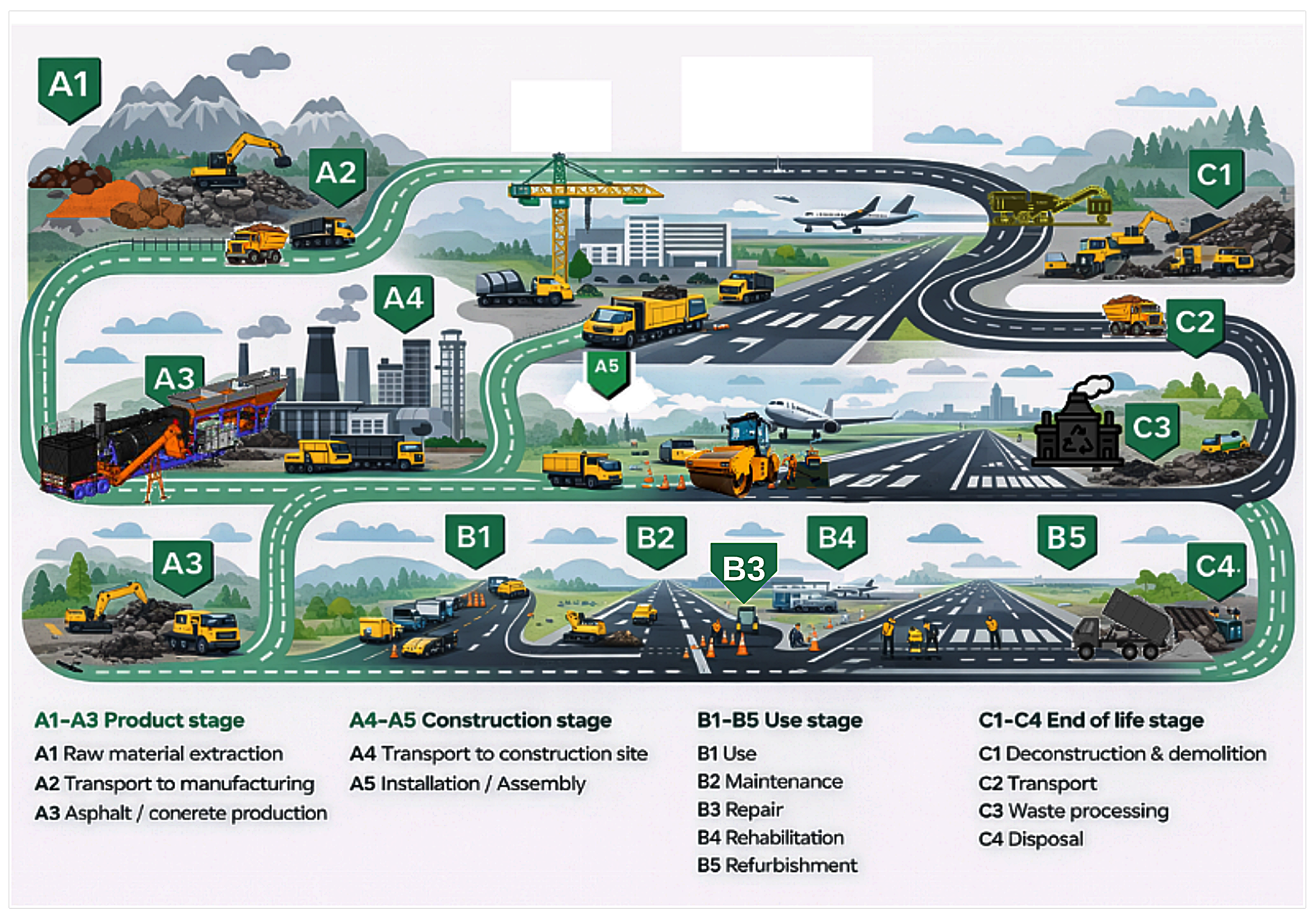
The LCA was conducted under a cradle-to-construction perspective, encompassing raw material supply and production (A1–A3) and construction and installation processes (A5), as illustrated in Figure 1. The transportation stage (A4) was not included in the life cycle calculations, as identical sourcing conditions and transport distances were assumed for all alternatives. Under this assumption, transportation would contribute equally to each scenario and would not influence the comparative results.
As part of the visual preparation of Figure 1, the original reference image from One Click LCA [60] was adapted with the assistance of ChatGPT (OpenAI, GPT-5.4 Thinking) exclusively for visual stylization so that the final scheme better matched the airport pavement context addressed in this study. The final layout and flowchart structure were subsequently reviewed and refined by the authors using Lucidchart. No scientific data, results, or technical interpretations were generated or modified by AI.
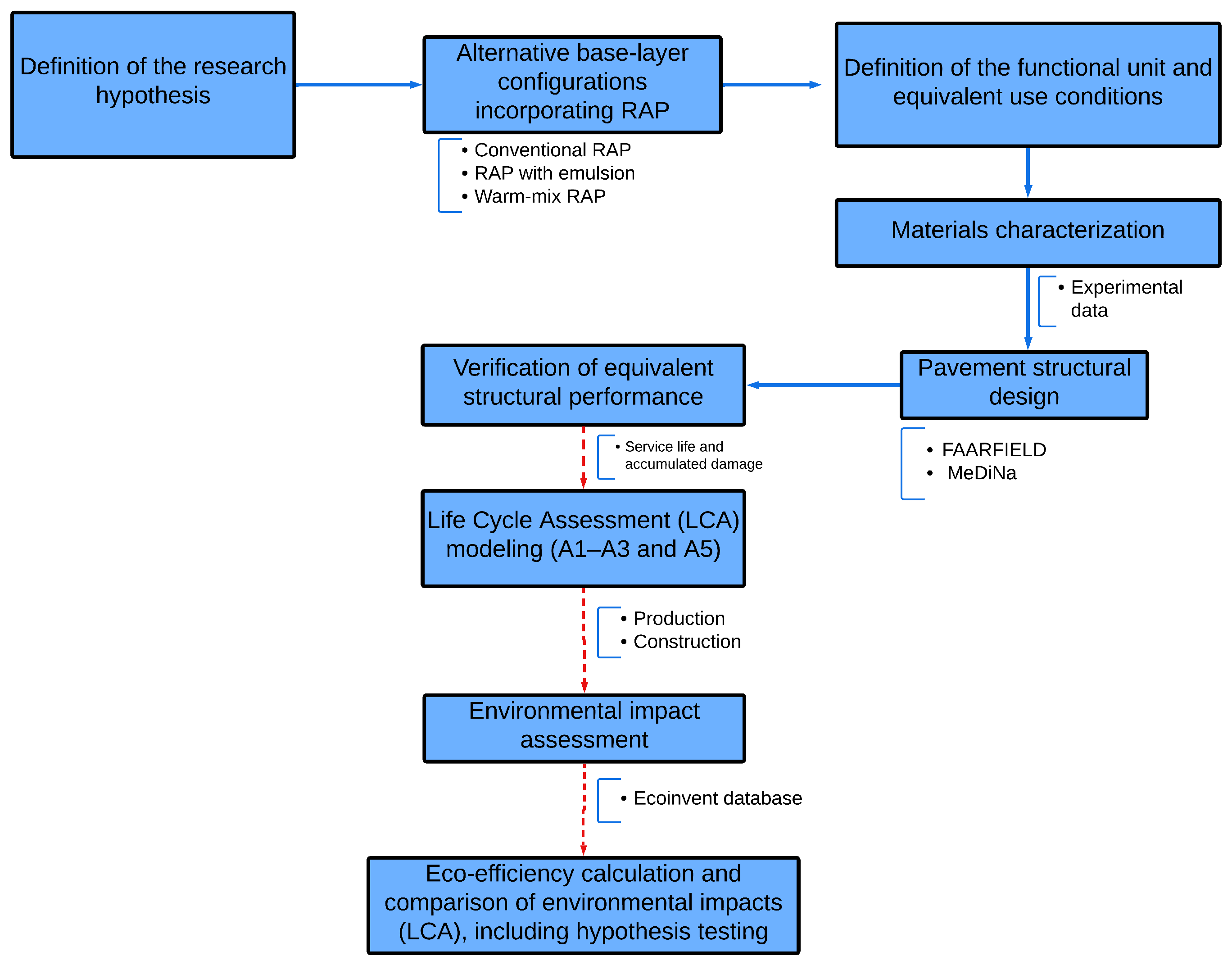
The overall methodological workflow adopted in this study is summarized in Figure 2, highlighting the integration of laboratory testing, mechanistic structural modeling, and LCA. The individual stages of this procedure are described in detail in the following subsections.

3.1. Pavement Structure and Base Alternatives

A representative airport pavement structure was defined based on geometric, structural, and traffic parameters consistent with typical operational conditions. The reference configuration was established to ensure that all alternatives were evaluated under identical loading, layer configurations, and performance criteria, so that differences in structural and environmental responses could be attributed exclusively to the base-layer solution.
Three base-course alternatives incorporating RAP were analyzed, differing only in their processing and stabilization strategies. Each alternative was designed to fulfill the same structural function within the pavement system, enabling a consistent comparative assessment within the LCA framework.
In the present study, material characterization encompasses the origin, compositional features, and processing conditions of each alternative, as well as the mechanical parameters governing structural response. Detailed physical and mineralogical characterization of the RAP material, including aggregate composition and residual binder properties, has been previously reported in [30,39]. The emphasis herein is placed on the mechanical behavior parameters that directly influence structural performance modeling and subsequent environmental assessment.

3.1.1. Conventional RAP

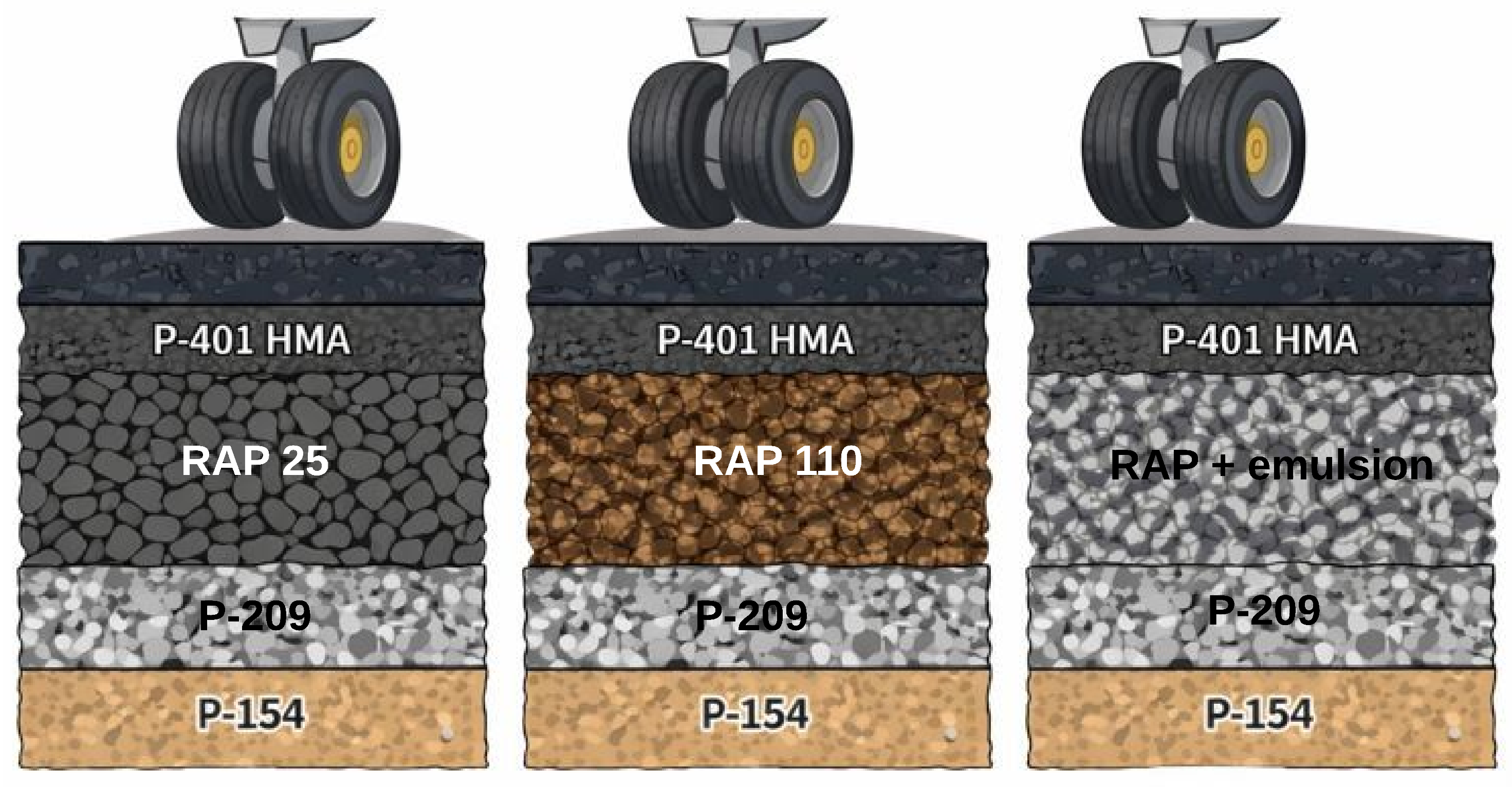
The conventional RAP, named RAP 25, corresponds to the use of RAP as a granular material, without additional thermal treatment or chemical stabilization, as described by Coelho et al. [39]. The RAP was obtained from milling operations on urban pavements in Rio de Janeiro, Brazil, and its physical and mineralogical characteristics were previously reported by the authors. In summary, the material is composed predominantly of quartz-rich crushed aggregates with silicate mineral constituents commonly associated with basaltic-type aggregates used in pavement construction and contains residual asphalt binder typically classified as CAP 30/45.
The material is incorporated directly into the base layer at room temperature (approximately 25 °C), with a moisture content of 5.4%, and its composition was considered to be 100% RAP. Under these conditions, the mechanical behavior of the layer is predominantly associated with that of an unbound granular material.

3.1.2. Warm Base

In the alternative designated as RAP 110, the same RAP material as described for RAP 25 is subjected to controlled thermal conditioning prior to compaction, according to the warm base concept proposed by Coelho et al. [39]. The material is heated to approximately 110 °C in order to reach a compaction temperature close to 80 °C. The base composition remains 100% RAP, without the incorporation of any additional materials, including water. The objective of the thermal treatment is to promote partial mobilization of the aged residual asphalt binder, thereby enhancing internal cohesion between aggregate particles. The energy demand associated with the heating process is explicitly accounted for in the life cycle assessment modeling.

3.1.3. Cold Recycled Asphalt Mixture

The third alternative corresponds to a cold recycled asphalt mixture (CRAM) base. In this study, the mixture design and experimental data reported by Coelho et al. [30] were adopted and, for identification throughout the manuscript, this option is known as RAP + emulsion. In general, CRAM solutions are composed of RAP, virgin aggregates for gradation adjustment, a bituminous binder (asphalt emulsion or foamed asphalt), and an active filler such as ordinary Portland cement (OPC) or hydrated lime.
In the specific configuration considered herein, RAP is stabilized predominantly through the addition of an RL-1C cationic asphalt emulsion, with CP-II-F-32 Portland cement used as a supplementary hydraulic binder. The adopted mix design comprises 76% RAP, 23% fine aggregate (stone dust), 3% asphalt emulsion, and 1% cement, characterizing a cold-stabilization approach widely documented in the technical literature [61,62,63,64,65]. The additional inputs associated with the emulsion and cement are explicitly accounted for in the life cycle inventory of this alternative.

3.2. Mechanical Characterization and Structural Definition of the Pavement

The mechanical behavior of the RAP and granular materials was evaluated through repeated load triaxial (RLT) tests (Owntec equipment), in accordance with DNIT 134 [66] for resilient modulus (RM) and DNIT 179 [67] for permanent deformation (PD). The tests were conducted on cylindrical specimens (100 mm diameter × 200 mm height) under controlled confining and deviator stress states, and axial strains were measured to characterize the stress-dependent response of the materials. All RM and PD parameters correspond to laboratory-controlled RLT conditions at ambient temperature (approximately 25 °C), ensuring that the thermal conditioning applied during construction does not directly influence the constitutive calibration.
The resilient modulus was represented using the composite nonlinear model, as given in Equation (1):
R M = K 1 σ 3 K 2 σ d K 3
where R M is the resilient modulus (MPa), σ 3 is the confining stress (kPa), σ d is the deviator stress (kPa), and K 1 K 3 are regression coefficients obtained from laboratory testing.
The specific permanent deformation was modeled using the empirical expression prescribed by DNIT Standard 179 [67]:
ε p ( % ) = ψ 1 σ 3 ρ 0 ψ 2 σ d ρ 0 ψ 3 N ψ 4
where ε p is the specific permanent deformation (%), σ 3 is the confining stress (kPa), σ d is the deviator stress (kPa), ρ 0 is the reference pressure (kPa), N represents the number of load cycles, and ψ 1 ψ 4 are regression coefficients obtained from laboratory tests.
The PD parameters were used exclusively to characterize the nonlinear accumulation behavior of unbound and recycled layers within the mechanistic framework implemented in the Brazilian National Pavement Design Method (MeDiNa software, version 1.1.9).
The calibrated regression parameters obtained from the RLT tests for each base alternative are presented in Table 2. The coefficients correspond to the composite resilient modulus model (K1–K3) and the permanent deformation model ( ψ 1 ψ 4 ), together with the respective coefficients of determination (R2). The R2 values obtained for both models indicate an adequate statistical fit, supporting the reliability of the calibrated parameters for use in the mechanistic analyses.
The structural analysis and design of the airport pavement were carried out using FAARFIELD (version 2.1.1). The software was employed to define the structural sections considered and to establish an aircraft traffic mix representative of the operational conditions considered, based on the annual number of departures and aircraft operational parameters (Table 3).
Based on the estimated cumulative damage factors (CDF) for the considered aircraft fleet, the Boeing B777-300ER was identified as the critical aircraft, based on the maximum CDF value obtained in the FAARFIELD damage accumulation analysis.
An initial structural configuration was analyzed in FAARFIELD using tabulated elastic modulus values to define the aircraft loading conditions and stress levels within the pavement structure. The corresponding stress states were then implemented in the Brazilian National Pavement Design Method (MeDiNa software, version 1.1.9), which operates through the AEMC routine (Elastic Analysis of Multilayer Systems), together with the calibrated composite model parameters (K1–K3) obtained from the RLT tests.
Within this framework, the nonlinear, stress-dependent behavior of granular and recycled layers was explicitly considered. The AEMC analysis was used to compute the confining and deviator stresses ( σ 3 , σ d ) at multiple points within each layer of the pavement structure. Based on these results, the critical stress condition was identified, and the corresponding resilient modulus was calculated using Equation (1), resulting in a stress-adjusted equivalent linear modulus for each layer. The representative modulus values reported in Table 4 correspond to the average equivalent modulus obtained under the critical stress condition. These updated linearized modulus values were subsequently reintroduced into FAARFIELD for structural life estimation under aircraft loading.
It is important to emphasize that, although only the base-layer composition was modified among the alternatives, the equivalent modulus values of the overlying and underlying layers also vary. The same calibrated nonlinear material parameters were adopted for all configurations; however, due to the stress-dependent behavior of the granular materials, changes in base stiffness alter the stress distribution within the multilayer system, thereby modifying the confining and deviator stresses acting in each layer. Since the resilient modulus is computed as a function of these stress states, distinct stress-adjusted equivalent linear modulus values are obtained for each structural configuration. This behavior reflects the inherent coupling between layer stiffness and stress redistribution in multilayer elastic systems. The subgrade (natural foundation layer) was modeled as a semi-infinite linear elastic layer; therefore, its modulus remained constant among the analyzed alternatives.
Figure 3 schematically illustrates the structural sections considered in order to facilitate the visualization of the different base solutions evaluated.
It is important to emphasize that, although only the base-layer composition was modified among the alternatives, the equivalent modulus values of the overlying and underlying layers also vary. The same calibrated nonlinear material parameters were adopted for all configurations; however, due to the stress-dependent behavior of the granular materials, changes in base stiffness alter the stress distribution within the multilayer system, thereby modifying the confining and deviator stresses acting in each layer. Since the resilient modulus is computed as a function of these stress states, distinct stress-adjusted equivalent linear modulus values are obtained for each structural configuration. The subgrade (natural foundation layer) was modeled as a semi-infinite linear elastic layer; therefore, its modulus remained constant among the analyzed alternatives.

3.3. Life Cycle Assessment

The LCA was conducted in accordance with the guidelines of ISO 14040 [68] and ISO 14044 [69], comprising the stages of goal and scope definition, life cycle inventory (LCI) analysis, life cycle impact assessment (LCIA), and interpretation of the results.

3.3.1. Objective and Scope

The objective of the LCA was to quantify and compare the environmental impacts associated with different RAP-containing base-layer alternatives under equivalent structural conditions, within the context of airport pavements. The system boundaries were defined according to a cradle-to-construction perspective, encompassing raw material extraction and production (A1–A3) and construction processes (A5). The transportation stage to the construction site (A4) was not included in the life cycle calculations, under the assumption of equivalent logistical conditions for all evaluated alternatives.
The functional unit adopted was 1.0 kg of base material produced and applied, allowing a direct comparison among the evaluated alternatives in terms of environmental impacts per unit of material. This functional unit was selected exclusively for comparative purposes, given that the evaluated alternatives were defined under equivalent structural and construction conditions.

3.3.2. Life Cycle Inventory Analysis and Life Cycle Impact Assessment

LCI analysis was carried out based on secondary data extracted from the Ecoinvent database (version 3.8), complemented by specific data on mixture composition and energy consumption associated with the alternatives analyzed.
The processes considered in the inventory represent the main inputs and activities related to the production and execution of the base layers, including the production of aggregates, bituminous binders, Portland cement, non-ionic surfactant (associated with asphalt emulsion), and thermal energy consumption. The corresponding environmental impact factors for these processes, used as input data in the LCA, are presented in Table 5. In the present study, material transportation was not explicitly included in the life cycle inventory, since the analysis is comparative in nature and assumes equivalent application conditions for all evaluated alternatives.
The LCIA was conducted using the IPCC 2023 method for global warming potential (GWP), the Abiotic Depletion Potential (ADP) for abiotic resource depletion, and the Ecological Scarcity (ES) method, enabling the quantification of the environmental impacts associated with each analyzed alternative. The environmental impact factors adopted as input data for the LCA of the main processes considered in the analysis are presented in Table 5.
In the case of heated RAP, the energy required to raise the material temperature from ambient conditions (25 °C) to 110 °C was estimated. The energy consumption associated with RAP heating was calculated based on specific heat values of asphaltic materials reported in the literature. For this purpose, an average value of 0.92 kJ kg−1 K−1 was adopted, obtained from experimental data on volumetric heat capacity and density of asphalt mixtures reported by Mirzanamadi et al. [70]. This value was calculated as the ratio between volumetric heat capacity and material density, considering the average of the experimental results reported for different asphalt concrete mixtures.
The energy required to raise the material temperature from ambient conditions (25 °C) to 110 °C was then modeled in the LCA through the thermal energy process presented in Table 5, using the corresponding environmental impact factors. It is emphasized that only experimental values reported in the reference study were used, rather than values obtained from numerical modeling.
The environmental impacts were primarily expressed in terms of carbon dioxide equivalent emissions (CO2-eq), allowing a direct comparison among the evaluated alternatives.

3.3.3. Interpretation and Integration with Structural Performance

The interpretation of the results was guided by the concept of eco-efficiency, originally disseminated by Schmidheiny and co-authors and later consolidated by the World Business Council for Sustainable Development (WBCSD) [71,72,73,74]. In the present study, eco-efficiency was operationalized by integrating the environmental impacts estimated through LCA with the structural performance results. In general, eco-efficiency is interpreted as the ecological optimization of production systems, often expressed as the relationship between the value generated and the associated environmental burden. In the context of asphalt pavements, eco-efficiency has been applied as a decision-support tool to compare structural and rehabilitation alternatives by integrating environmental, energy, economic, and performance indicators over the life cycle. Such assessments have been used both for long-life pavements and for maintenance and recycling strategies, demonstrating their suitability for comparative analyses of solutions with different structural configurations and design horizons [41,75].
In this study, eco-efficiency was implemented by integrating structural response outcomes with the environmental impacts estimated by LCA, following an approach in which impacts are normalized as a function of performance and structural service life, consistent with methodologies previously applied in transport infrastructure studies [76]. The structural service life obtained in FAARFIELD was adopted as the indicator of technical value, while the LCA impacts represented the environmental dimension of the analysis. This integration enables a comparative assessment of each pavement alternative in terms of its ability to deliver greater structural performance over its service life with lower environmental impact.


4. Results and Discussion

4.1. Structural Performance and Estimated Service Life

Based on the mechanical parameters of the materials and the adopted aircraft mix, the structural service life and the cumulative damage contributions for the analyzed pavements were estimated. Table 6 presents the estimated service life values and the cumulative damage factors associated with the considered structural layers.
The results indicate significant differences in structural performance among the evaluated alternatives. The pavement with a warm RAP base exhibited the highest structural service life, associated with the lowest cumulative damage factors in both the subbase and the asphalt layer.
In quantitative terms, the estimated service life for RAP 110 was approximately 270% greater than that of the RAP 25 pavement and about 370% greater than that of the RAP + emulsion alternative. Conversely, the RAP + emulsion solution presented a service life approximately 21% lower than that of RAP 25, indicating that, under the evaluated conditions, the stabilization effect did not result in substantial structural gains. It should be noted that this result reflects the specific mechanical response of the cold recycled mixture adopted in this study and should not be interpreted as a generalized behavior of emulsion-treated RAP bases. Nevertheless, it highlights that emulsion stabilization does not necessarily lead to superior structural performance, reinforcing the importance of material-specific evaluation when compared with alternative techniques such as warm RAP bases.
The superior performance observed for heated RAP can be attributed to the improvement in the mechanical behavior of the base layer, associated with greater activation of the aged binder and increased internal cohesion of the mixture [77]. Unlike cold-recycled or emulsion-stabilized mixtures, in which particle bonding occurs predominantly through localized binder connections, RAP heating promotes the formation of a more continuous and mechanically efficient structure, resulting in a more stable response under repeated loading [39,77].
This behavior is consistent with observations reported in the literature, according to which heated RAP mixtures exhibit lower susceptibility to permanent deformation and lower damage accumulation rates than cold-recycled mixtures, as evidenced by multi-stage mechanistic tests [38]. In contrast, studies indicate that, although the addition of emulsion or stabilizing agents improves the initial performance of recycled mixtures, this mechanism is not sufficient to eliminate the progressive accumulation of deformations under repeated loading [30], which explains the more modest differences observed between the non-heated RAP and emulsion-stabilized RAP alternatives.
The environmental assessment of the materials was carried out based on life cycle inventory data, considering the IPCC 2023, ADP, and ecological scarcity indicators. Table 7 presents the estimated environmental impacts for each analyzed alternative.
The results indicate that heated RAP presents intermediate environmental impacts when compared to the other analyzed alternatives. This behavior is associated with the additional energy consumption required for heating the material, resulting in higher emissions than those observed for non-heated RAP. On the other hand, the RAP stabilized with emulsion exhibited the highest environmental impacts, reflecting the additional contribution of processes related to binder and stabilizing agent production. Similar trends have been reported in LCA studies applied to recycled asphalt mixtures [52,54,78].
Comparable findings have also been reported in the literature, indicating that the incorporation of recycled materials into asphalt base layers can reduce environmental impacts relative to conventional solutions. However, the introduction of additional processes, such as heating or chemical stabilization, tends to increase environmental burdens during the production phase [51,54]. From a mechanical standpoint, although recycling and stabilization techniques contribute to mitigating permanent deformation, these mixtures may still exhibit cumulative deformation over time, particularly under repeated loading, as indicated in consolidated technical guidelines and recent experimental studies [30,79]. In this context, structural service life plays a fundamental role in the sustainability assessment of the analyzed alternatives.

4.2. Eco-Efficiency Analysis

The eco-efficiency of the analyzed alternatives was evaluated by normalizing the environmental impacts with respect to the estimated structural service life (SSL). For this purpose, an eco-efficiency indicator was adopted, defined as the ratio between the environmental impact associated with greenhouse gas emissions (IPCC 2023, in kg CO2-eq) and the estimated structural service life for each alternative, as expressed in Equation (3).
E E = EII S S L
where:
  • E E Eco-efficiency indicator (kg CO2-eq · year−1);
  • E I I Environmental impact indicator (kg CO2-eq);
  • S S L Structural service life (years).
Table 8 presents the eco-efficiency indicator values obtained for the analyzed alternatives, enabling a direct comparison of environmental impacts normalized by structural performance over the service period.
The eco-efficiency analysis results indicate that, although heated RAP presents intermediate absolute environmental impacts, this alternative exhibits the lowest environmental impact when normalized by structural service life. As shown in Table 8, the IPCC 2023 impact per year of service estimated for RAP 110 is approximately 3.5 times lower than that of untreated RAP and nearly one order of magnitude lower than that of the emulsion-stabilized RAP alternative.
However, when environmental impacts are analyzed jointly with structural performance and estimated service life, the mechanical superiority of the warm base plays a decisive role in reducing environmental impacts over the service period. The significantly longer service life of this solution enables the initial environmental burdens to be distributed over time, reducing the need for future interventions and the impacts associated with maintenance activities, in line with integrated approaches combining LCA and mechanical performance reported in the literature [23,33,51,80]. Previous studies comparing hot- and cold-mix asphalt mixtures containing RAP in base layers have likewise indicated that solutions with enhanced mechanical performance may achieve environmental advantages when assessed from a life cycle perspective, despite requiring higher energy consumption during the production phase [54,80].

5. Conclusions

This study evaluated the structural performance and environmental impacts of different base-layer solutions containing Reclaimed Asphalt Pavement (RAP), with a focus on the application of heated RAP in airport pavements. The analysis was conducted through an integrated approach, combining mechanistic–empirical modeling of structural performance with a Life Cycle Assessment (LCA) covering material production (A1–A3) and construction processes (A5), while excluding transportation (A4) under equivalent logistical assumptions. The aim was to investigate the eco-efficiency of the alternatives under functionally equivalent service conditions. The results demonstrated significant differences among the analyzed solutions, which can be summarized as follows:
  • The heated RAP (RAP 110) solution presented the highest estimated structural service life (58.9 years), approximately 270% higher than that of RAP 25 (15.9 years) and 370% higher than that of RAP + emulsion (12.5 years). This performance was associated with substantially lower cumulative damage factors in both the subbase (CDF = 0.28) and the HMA layer (CDF = 0.17), indicating a more stable mechanical response under repeated aircraft loading.
  • In terms of environmental impacts within the adopted production and construction scope, RAP 110 exhibited an intermediate global warming potential (0.00739 kg CO2-eq), slightly higher than that of RAP 25 (0.00688 kg CO2-eq) due to the additional heating energy, but substantially lower than that of RAP + emulsion (0.01551 kg CO2-eq). Similar trends were observed for the ADP and ecological scarcity indicators.
  • When structural performance and environmental impact were evaluated jointly through the eco-efficiency indicator (IPCC/service life), RAP 110 presented the lowest normalized impact ( 1.26 × 10 4 kg CO2-eq · year−1), approximately 3.5 times lower than that of RAP 25 and nearly one order of magnitude lower than that of RAP + emulsion. These results indicate that the extended service life of the heated RAP base offsets the moderate increase in production-related emissions, resulting in the most favorable balance between structural performance and environmental impact among the analyzed alternatives.
These results support the research hypothesis that the application of heated RAP in base layers may achieve environmental performance equal to or superior to that of conventional or binder-stabilized solutions within the defined production and construction scope. The findings indicate that construction strategies capable of improving the mechanical response of the base layer can significantly influence the overall sustainability of airport pavements, suggesting that heated RAP (warm base) represents a technically viable and environmentally competitive alternative under the adopted system boundaries. These findings further suggest that construction techniques such as thermal conditioning, which may initially appear less sustainable due to additional energy demand, can exhibit significant environmental potential when evaluated in conjunction with structural performance and service life. This highlights the importance of performance-based sustainability assessments in identifying solutions whose long-term benefits offset moderate increases in production-stage impacts.
Future research adopting an extended life cycle perspective and integrating structural performance modeling with rehabilitation scenarios is recommended to further assess the long-term sustainability of heated RAP base solutions. Although evaluated here within the airport context, the proposed analytical framework may be extended to other pavement applications.

Author Contributions

Conceptualization, W.C.J., L.M.C. and F.A.C.d.N.; methodology, W.C.J., F.A.C.d.N. and L.M.C.; software, W.C.J., T.R.S. and V.S.M.S.; validation, W.C.J. and F.A.C.d.N.; formal analysis, L.M.C.; investigation, W.C.J., L.M.C. and F.A.C.d.N.; data curation, W.C.J. and M.A.M.; writing—original draft preparation, W.C.J. and L.M.C.; writing—review and editing, L.M.C.; M.A.M. and F.A.C.d.N.; supervision, S.N.M., A.C.R.G. and F.A.C.d.N.; project administration, F.A.C.d.N. All authors have read and agreed to the published version of the manuscript.

Funding

This study was financed in part by the Coordenação de Aperfeiçoamento de Pessoal de Nível Superior (CAPES), Brasil—Finance Code 001.

Data Availability Statement

The original contributions presented in this study are included in the article. Further inquiries can be directed to the corresponding author.

Acknowledgments

The authors acknowledge the use of ChatGPT (OpenAI, GPT-5.4 Thinking, accessed in March 2026) for AI-assisted visual adaptation of Figure 1 and the graphical abstract, while the final editing and flowchart refinement were performed using Lucidchart.

Conflicts of Interest

The authors declare no conflicts of interest.

References

  1. Anthonissen, J.; Van den bergh, W.; Braet, J. Review and environmental impact assessment of green technologies for base courses in bituminous pavements. Environ. Impact Assess. Rev. 2016, 60, 139–147. [Google Scholar] [CrossRef]
  2. Liu, Z.; Balieu, R.; Kringos, N. Integrating sustainability into pavement maintenance effectiveness evaluation: A systematic review. Transp. Res. Part D Transp. Environ. 2022, 104, 103187. [Google Scholar] [CrossRef]
  3. Jackson, D.J.; Brander, M. The risk of burden shifting from embodied carbon calculation tools for the infrastructure sector. J. Clean. Prod. 2019, 223, 739–746. [Google Scholar] [CrossRef]
  4. Chen, X.; Wang, H. Life cycle assessment of asphalt pavement recycling for greenhouse gas emission with temporal aspect. J. Clean. Prod. 2018, 187, 148–157. [Google Scholar] [CrossRef]
  5. Shi, X.; Mukhopadhyay, A.; Zollinger, D.; Grasley, Z. Economic input-output life cycle assessment of concrete pavement containing recycled concrete aggregate. J. Clean. Prod. 2019, 225, 414–425. [Google Scholar] [CrossRef]
  6. Alam, M.; Hossain, K.; Bazan, C. Life cycle analysis for asphalt pavement in Canadian context: Modelling and application. Int. J. Pavement Eng. 2022, 23, 2606–2620. [Google Scholar] [CrossRef]
  7. Maher, M.; Gucunski, N.; Papp, W.J. Recycled asphalt pavement as a base and sub-base material. ASTM Spec. Technol. Publ. 1997, 1275, 42–53. [Google Scholar]
  8. Kim, W.; Labuz, J.; Dai, S. Resilient Modulus of Base Course Containing Recycled Asphalt Pavement. J. Transp. Res. Board 2007, 2005, 27–35. [Google Scholar] [CrossRef]
  9. Song, Y.; Ooi, P. Resilient modulus characteristics of varying percent of reclaimed asphalt pavement. In Proceedings of the GeoShanghai International Conference, Shanghai, China, 26–29 May 2010; pp. 43–50. [Google Scholar]
  10. Dong, Q.; Huang, B. Laboratory Evaluation on Resilient Modulus and Rate Dependencies of RAP Used as Unbound Base Material. J. Mater. Civ. Eng. 2014, 26, 379–383. [Google Scholar] [CrossRef]
  11. Hoppe, E.; Lane, S.; Fitch, M.; Shetty, S. Feasibility of Reclaimed Asphalt Pavement (RAP) Use as Road Base and Subbase Material; Report No VCTIR 15-R6; Virginia Center for Transportation Innovation and Research, University of Virginia: Charlottesville, VA, USA, 2015. [Google Scholar]
  12. European Asphalt Pavement Association (EAPA). Asphalt in Figures 2020; Technical Report; European Asphalt Pavement Association: Brussels, Belgium, 2020. [Google Scholar]
  13. National Asphalt Pavement Association. Annual Asphalt Pavement Industry Survey on Recycled Materials and Warm-Mix Asphalt Usage: 2021; Technical Report; National Asphalt Pavement Association (NAPA): Greenbelt, MD, USA, 2022. [Google Scholar]
  14. Decký, M.; Remišová, E.; Samek, M. Research on the Possibilities of Reusing Mixed Reclaimed Asphalt Materials with a Focus on the Circular Economy. Appl. Sci. 2025, 15, 12004. [Google Scholar] [CrossRef]
  15. DNIT. DNIT Resolução N° 14. 2021. Available online: https://www.gov.br/dnit/pt-br/central-de-conteudos/atos-normativos/tipo/resolucoes/resolucao-14-2021-dg-dispoe-sobre-o-reaproveitamento-do-rap-reclaimed-asphalt-pavement.pdf (accessed on 11 February 2026).
  16. Lopes, A.F.D.; Vasconcelos, K.; Almeida, M.S.S.; Bernucci, L. Geração E Utilização Do Rap No Brasil. Rev. Paviment. Mater. 2024, 3, 201–217. [Google Scholar] [CrossRef]
  17. West, R.C.; Copeland, A. High RAP Asphalt Pavements: Japan Practice—Lessons Learned; Information Series IS-139; National Asphalt Pavement Association (NAPA): Greenbelt, MD, USA, 2015. [Google Scholar]
  18. Japan Asphalt Mixture Association. Annual Reports of Asphalt Mixture; Japan Asphalt Mixture Association: Tokyo, Japan, 2023. [Google Scholar]
  19. Alam, T.; Abdelrahman, M.; Schram, S. Laboratory characterisation of recycled asphalt pavement as a base layer. Int. J. Pavement Eng. 2009, 11, 123–131. [Google Scholar] [CrossRef]
  20. Kootstra, B.; Ebrahimi, A.; Edil, T.; Benson, C. Plastic deformation of recycled base materials. In GeoFlorida 2010: Advances in Analysis, Modeling and Design; American Society of Civil Engineers: Reston, VA, USA, 2010. [Google Scholar]
  21. Edil, T.; Tinjum, J.; Benson, C. Recycled Unbound Materials; Minnesota Department of Transportation Research Services, Office of Policy Analysis, Research & Innovation: New Delhi, India, 2012.
  22. Bilodeau, J.P.; Doré, G.; Depatie, J. Mitigation of permanent deformation of base layer containing recycled asphalt aggregates. Can. J. Civ. Eng. 2013, 40, 181–187. [Google Scholar] [CrossRef]
  23. Soleimanbeigi, A.; Edil, T. Thermal Conditioning to Improve Geotechnical Properties of Recycled Asphalt Pavements. Geotech. Test. J. 2015, 38, 537–548. [Google Scholar] [CrossRef]
  24. Ullah, S.; Tanyu, B.; Hoppe, E. Optimizing the Gradation of Fine Processed Reclaimed Asphalt Pavement and Aggregate Blends for Unbound Base Courses. Transp. Res. Rec. 2018, 2672, 57–66. [Google Scholar] [CrossRef]
  25. Viyanant, C.; Rathje, E.; Rauch, F. Creep of Compacted Recycled Asphalt Pavement. Can. Geotech. J. 2007, 44, 687–697. [Google Scholar] [CrossRef]
  26. Jeon, E.; Steven, B.; Harvey, J. Comprehensive laboratory testing and performance evaluation of recycled pulverized hot-mix asphalt material. Transportat. Res. Rec. J. Transport. Res. Board 2009, 2104, 42–52. [Google Scholar] [CrossRef]
  27. Attia, M.; Abdelrahman, M. Effect of State of Stress on the Resilient Modulus of Base Layer Containing Reclaimed Asphalt Pavement. Road Mater. Pavement Des. 2011, 12, 79–97. [Google Scholar] [CrossRef]
  28. Gu, F.; Zhang, Y.; Luo, X.; Sahin, H.; Lytton, R.L. Characterization and prediction of permanent deformation properties of unbound granular materials for Pavement ME Design. Constr. Build. Mater. 2017, 155, 584–592. [Google Scholar] [CrossRef]
  29. Guimarães, A.; Motta, L.D. A Study on Permanent Deformation of Lateritic Soils Including the Shakedown Concept, 1st ed.; CRC Press: Boca Raton, FL, USA, 2008; pp. 149–156. [Google Scholar]
  30. Coelho, L.; Kox, R.; Guimarães, A.; Travincas, R.; Monteiro, S. Influence of Curing Time on the Mechanical Behavior of Cold Recycled Bituminous Mix in Flexible Pavement Base Layer. Appl. Sci. 2024, 14, 7612. [Google Scholar] [CrossRef]
  31. Allah, S.; Tanyu, B.F.; Dawson, A. Reclaimed Asphalt Pavement (RAP) as an Unbound Base Course Material: A Mechanistic Design Approach Based on Multi-stage Repeated Load Triaxial Tests. Transp. Geotech. 2022, 33, 100729. [Google Scholar] [CrossRef]
  32. Soleimanbeigi, A.; Edil, T.; Benson, C. Effect of Temperature on Geotechnical Properties of Recycled Asphalt Shingle Mixtures. J. Geotech. Geoenviron. Eng. 2014, 141, 04014097. [Google Scholar] [CrossRef]
  33. Barzegar, M.; Wen, H.; Akin, I.D.; Edil, T. Laboratory Assessment of Recycled Asphalt Pavement as Roadway Embankment Material. Transp. Res. Board 2023, 2677, 112–121. [Google Scholar] [CrossRef]
  34. Yin, J.; Soleimanbeigi, A.; Likos, W.J.; Edil, T.B. Effects of Temperature on Creep Behavior of Compacted Recycled Asphalt Pavement. J. Geotech. Geoenviron. Eng. 2017, 143, 06016028. [Google Scholar] [CrossRef]
  35. Yin, J.; Wang, X.; Hu, M.; Tang, Y. Direct shear creep test of recyclable asphalt pavement materials considering compaction temperature. J. Jiangsu Univ. (Nat. Sci. Ed.) 2020, 41, 478–483. [Google Scholar] [CrossRef]
  36. Zhu, D.; Liu, K.; Yin, J.; Zhang, J.; Tang, Y. Effect of temperature on compression and permeability characteristics of RAP filler. J. Jiangsu Univ. (Nat. Sci. Ed.) 2022, 43, 346–350. [Google Scholar] [CrossRef]
  37. Pinheiro, G.; Mazzoni, L.N.; Lopes, A.F.D.; Vasconcelos, K. Influence of rap thermal conditioning on the balanced mix design of recycled asphalt mixtures. Constr. Build. Mater. 2025, 505, 144784. [Google Scholar] [CrossRef]
  38. Coelho, L.M.; Guimarães, A.C.R.; Azevedo, A.R.G.D.; Monteiro, S.N. Sustainable Reclaimed Asphalt Emulsified Granular Mixture for Pavement Base Stabilization: Prediction of Mechanical Behavior Based on Repeated Load Triaxial Tests. Sustainability 2024, 16, 5335. [Google Scholar] [CrossRef]
  39. Coelho, L.M.; Marchi, B.Z.; da Silveira, P.H.P.M.; Azevedo, A.G.D.; Monteiro, S.N.; Guimarães, A.C.R. Thermal compaction as an alternative approach for full-RAP base layer construction. Sci. Rep. 2025, 15, 16394. [Google Scholar] [CrossRef]
  40. Pacheco-Torgal, F.; Amirkhanian, S.; Wang, H.; Schlangen, E. (Eds.) Eco-Efficient Pavement Construction Materials; Woodhead Publishing Series in Civil and Structural Engineering; Woodhead Publishing: London, UK, 2020. [Google Scholar] [CrossRef]
  41. Chen, W.; Yuan, X.X. Eco-efficiency assessment of long-life asphalt pavement technologies. Transp. Res. Part D Transp. Environ. 2023, 122, 103874. [Google Scholar] [CrossRef]
  42. Mascarenhas, Z.M.G.; Piao, Z.; Vasconcelos, K.L.; Poulikakos, L.D.; Bernucci, L.L.B. Comparative environmental performance of pavement structures considering recycled materials and regional differences. Sci. Total Environ. 2023, 858, 159862. [Google Scholar] [CrossRef] [PubMed]
  43. Mohammad, A.A.S.; Mohammad, S.I.; Oraini, B.A.; Alenazi, S.A.; Vasudevan, A.; Hassanshahi, O. Assessing the Eco-Efficiency of High Recycled Content Pavement Solutions: An Evaluation of the Mechanical, Durability, and Environmental Impacts. J. Compos. Sci. 2025, 9, 692. [Google Scholar] [CrossRef]
  44. Azarhoosh, A.; Koohmishi, M. Integrating 10R Principles in Pavement Engineering: Circular Economy Pathway for Reclaimed Asphalt Pavement. Clean. Waste Syst. 2026, 13, 100483. [Google Scholar] [CrossRef]
  45. Pittenger, D.M. Evaluating Sustainability of Selected Airport Pavement Treatments with Life-Cycle Cost, Raw Material Consumption, and Greenroads Standards. Transp. Res. Rec. J. Transp. Res. Board 2011, 2206, 61–68. [Google Scholar] [CrossRef]
  46. Nascimento, F.; Gouveia, B.; Dias, F.; Ribeiro, F.; Silva, M.A. A method to select a road pavement structure with life cycle assessment. J. Clean. Prod. 2020, 271, 122210. [Google Scholar] [CrossRef]
  47. Pinheiro, J.G.D.O.; de Medeiros, A.S.; Nascimento, F.; Fernandes, V.A.; da Silva, M. Load Factor Influence on Lifecycle Analysis for a Brazilian Domestic Route. SSRN 2022. [Google Scholar] [CrossRef]
  48. Costa, J.O.; Borges, P.H.; dos Santos, F.A.; Bezerra, A.C.S.; den bergh, W.V.; Blom, J. Cementitious binders and reclaimed asphalt aggregates for sustainable pavement base layers: Potential, challenges and research needs. Constr. Build. Mater. 2020, 265, 120325. [Google Scholar] [CrossRef]
  49. Oreto, C.; Veropalumbo, R.; Viscione, N.; Biancardo, S.A.; Russo, F. Investigating the environmental impacts and engineering performance of road asphalt pavement mixtures made up of jet grouting waste and reclaimed asphalt pavement. Environ. Res. 2021, 198, 111277. [Google Scholar] [CrossRef]
  50. Hasan, A.; Hasan, U.; Whyte, A.; Jassmi, H.A. Lifecycle Analysis of Recycled Asphalt Pavements: Case Study Scenario Analyses of an Urban Highway Section. CivilEng 2022, 3, 242–262. [Google Scholar] [CrossRef]
  51. Sarabandi, A.; Hajikarimi, P.; Nejad, F.M. A combined LCA–circular economy approach for investigating the effect of additives on sustainability of cold recycled asphalt mixtures. J. Clean. Prod. 2025, 529, 146800. [Google Scholar] [CrossRef]
  52. Xia, Q.; Zhang, H.; Miao, W.; Guo, X.; Zhang, Q. Multi-objective optimization of full depth reclamation with Portland cement using NSGA-II for sustainable pavement rehabilitation. Front. Built Environ. 2025, 11, 1631169. [Google Scholar] [CrossRef]
  53. Xu, X.; Kong, L.; Li, X.; Lei, B.; Sun, B.; Li, X.; Qu, F.; Pang, B.; Dong, W. Energy conservation and carbon emission reduction of cold recycled petroleum asphalt concrete pavement with cement-stabilized phosphogypsum. Constr. Build. Mater. 2024, 433, 136696. [Google Scholar] [CrossRef]
  54. Moins, B.; Beck, C.; Hernando, D.; den bergh, W.V.; Audenaert, A. An investigation on the use of lean asphalt as an alternative base material in asphalt pavements by means of laboratory testing, life cycle assessment, and life cycle cost analysis. Resour. Conserv. Recycl. 2023, 194, 106992. [Google Scholar] [CrossRef]
  55. Moins, B.; Hernando, D.; Buyle, M.; France, C.; Van den bergh, W.; Audenaert, A. On the road again! An economic and environmental break-even and hotspot analysis of reclaimed asphalt pavement and rejuvenators. Resour. Conserv. Recycl. 2022, 177, 106014. [Google Scholar] [CrossRef]
  56. Russo, F.; Oreto, C.; Veropalumbo, R. A practice for the application of waste in road asphalt pavements in an eco-friendly way. Appl. Sci. 2021, 11, 9268. [Google Scholar] [CrossRef]
  57. Khan, M.A.; Puppala, A.J. Sustainable pavement with geocell reinforced reclaimed-asphalt-pavement (RAP) base layer. J. Clean. Prod. 2023, 387, 135802. [Google Scholar] [CrossRef]
  58. Lei, B.; Kong, L.; Guo, Y.; Sun, B.; Li, X.; Wu, K.; Tam, V.W.; Li, W. Optimizing decarbonation and sustainability of concrete pavement: A case study. Case Stud. Constr. Mater. 2024, 21, e03574. [Google Scholar] [CrossRef]
  59. Badiger, M.; Mamatha, K.H.; Dinesh, S.V. Use of Geocell for Reinforcing CDW in GSB of Flexible Pavements: An Experimental Investigation. Int. J. Pavement Res. Technol. 2024, 19, 769–791. [Google Scholar] [CrossRef]
  60. One Click LCA. Life Cycle Stages in Construction (A1–C4). 2023. Available online: https://help.oneclicklca.com/en/articles/275901-life-cycle-stages (accessed on 9 January 2026).
  61. Unger Filho, W.; Klinsky, L.; Motta, R.; Bernucci, L.L. Cold Recycled Asphalt Mixture using 100% RAP with Emulsified Asphalt-Recycling Agent as a New Pavement Base Course. Adv. Mater. Sci. Eng. 2020, 2020, 5863458. [Google Scholar] [CrossRef]
  62. Chakravarthi, S.; Kumar, G.; Shankar, S.; Vishnu, R. Effect of Emulsified Asphalt Content on Creep Behavior and Mechanical Properties of Cold Recycled Emulsified Asphalt Bases. J. Rehabil. Civ. Eng. 2021, 9, 133–147. [Google Scholar] [CrossRef]
  63. Andrews, J.; Radhakrishnan, V.; Koshy, R. Laboratory Evaluation of Emulsion-Treated Base Layer Mixes Incorporating Reclaimed Asphalt Pavement Materials. J. Mater. Civ. Eng. 2023, 35, 04023198. [Google Scholar] [CrossRef]
  64. Silva, V.D.; Meneses, J.P.C.; Vasconcelos, K.; Bernucci, L.L.B. Permanent Deformation Assessment of Cold Recycled Asphalt Mixtures. Adv. Mater. Sci. Eng. 2022, 2022, 8247787. [Google Scholar] [CrossRef]
  65. de Andrade, L.R. Comparação do Comportamento de Pavimentos Asfálticos com Camadas de Base Granular, Tratada com Cimento e com Estabilizantes Asfálticas para Tráfego Muito Pesado. Master’s Thesis, Escola Politécnica da Universidade de São Paulo, São Paulo, Brazil, 2017. [Google Scholar]
  66. Departamento Nacional de Infraestrutura de Transportes. Pavimentação–Solos—Determinação do Módulo de Resiliência—Método de Ensaio; DNIT: Rio de Janeiro, Brazil, 2018.
  67. Departamento Nacional de Infraestrutura de Transportes. Pavimentação–Solos—Determinação do Módulo da Deformação Permanente—Instrução de Ensaio; DNIT: Rio de Janeiro, Brazil, 2018.
  68. ABNT NBR ISO 14040; Gestão Ambiental—Avaliação do Ciclo de vida—Princípios e Estrutura, Terceira Edição. Associação Brasileira de Normas Técnicas: Rio de Janeiro, Brazil, 2025.
  69. ABNT NBR ISO 14044; Gestão Ambiental—Avaliação do Ciclo de vida—Requisitos e Orientações, Segunda Edição. Associação Brasileira de Normas Técnicas: Rio de Janeiro, Brazil, 2025.
  70. Mirzanamadi, R.; Johansson, P.; Grammatikos, S.A. Thermal properties of asphalt concrete: A numerical and experimental study. Constr. Build. Mater. 2018, 158, 774–785. [Google Scholar] [CrossRef]
  71. Fussler, C. Die Öko-Innovation; S. Hirzel Verlag: Stuttgart, Germany; Leipzig, Germany, 1999; p. 127. [Google Scholar]
  72. World Business Council for Sustainable Development. Eco-Efficient Leadership for Improved Economic and Environmental Performance; WBCSD: Geneva, Switzerland, 1996. [Google Scholar]
  73. von Weizsäcker, E.U.; Seiler-Hausmann, J. (Eds.) Ökoeffizienz: Management der Zukunft; Birkhäuser: Basel, Switzerland, 1999. [Google Scholar]
  74. Hungerbühler, K.; Ranke, J.; Mettier, T. Chemische Produkte und Prozesse; Springer: Berlin, Germany, 1999. [Google Scholar]
  75. Cao, R.; Leng, Z.; Hsu, S.C. Comparative eco-efficiency analysis on asphalt pavement rehabilitation alternatives: Hot in-place recycling and milling-and-filling. J. Clean. Prod. 2019, 210, 1385–1395. [Google Scholar] [CrossRef]
  76. Ribeiro, F.B.; Nascimento, F.A.C.d.; Silva, M.A.V.d. Environmental performance analysis of railway infrastructure using life cycle assessment: Selecting pavement projects based on global warming potential impacts. J. Clean. Prod. 2022, 365, 132558. [Google Scholar] [CrossRef]
  77. Wirtgen GmbH. Cold Recycling Technology; Wirtgen GmbH: Windhagen, Germany, 2012. [Google Scholar]
  78. Moreira, T.; Barros, R.; Farias, M.M.; Motta, R.S. Avaliação do ciclo de vida de misturas asfálticas recicladas estabilizadas com emulsão. In Proceedings of the Anais do Encontro Nacional de Conservação Rodoviária (ENACOR), Aracaju, Brazil, 19–22 August 2024. [Google Scholar]
  79. RILEM TC-247-DTA. Performance-Based Design of Bitumen-Stabilised Materials; RILEM: Champs-sur-Marne, France, 2020. [Google Scholar]
  80. Oreto, C.; Veropalumbo, R.; Viscione, N.; Biancardo, S.A.; Botte, M.; Russo, F. Integration of life cycle assessment into a decision support system for selecting sustainable road asphalt pavement mixtures prepared with waste. Int. J. Life Cycle Assess. 2021, 26, 2391–2407. [Google Scholar] [CrossRef]
Figure 1. Construction life cycle stages (A1–A5), with A1–A3 and A5 included in the LCA and A4 excluded from the calculations. Adapted from One Click LCA [60]; visually stylized with AI assistance and finalized by the authors in Lucidchart, web-based free plan.
Materials 19 01794 g001
Figure 2. Methodological workflow adopted in this study for the comparative LCA-based assessment (A1–A3 and A5) of RAP base-course alternatives.
Materials 19 01794 g002
Figure 3. Schematic representation of the analyzed airport pavement structural sections, indicating the base-layer alternatives evaluated.
Materials 19 01794 g003
Table 2. Calibrated regression parameters for the RM and PD models obtained from RLT testing.
MaterialPD ModelRM Model
ψ 1 ψ 2 ψ 3 ψ 4 R2 K 1 K 2 K 3 R2
RAP 250.112020.2478840.537630.147840.9891822048.470.6097010.0467430.989182
RAP 1100.1209290.1602140.5519420.0883120.8631713586.5240.4119130.0062390.863171
RAP + emulsion0.2767020.0772291.1961110.1319120.9401943666.4560.5934840.0349150.885892
Table 3. Aircraft mix adopted as input data for the FAARFIELD analyses.
AircraftGTW (kg)Annual Growth RateGrowthAnnual DeparturesCDFMaximum CDFP/C
A320-200 std73,90070631.13157,2220.000.001.08
A321-100 std83,40056791.13126,4150.000.001.08
B767-300163,74753011.13118,0000.000.001.06
Bombardier CL-604/60521,86334951.1377,7990.000.001.22
B777-300 ER352,44130561.1368,0270.890.891.04
B787-9255,37228031.1362,3960.010.011.03
B777-200248,12037991.1384,5660.000.001.04
A330-300 WW20230,9008421.1318,7430.000.001.03
B787-8228,3835791.1312,8890.000.001.04
A310-300142,9007721.1317,1850.000.001.08
B747-400397,8012451.1354540.000.001.06
B747-400 Belly397,8012451.1354540.000.001.06
A380-800 WW00562,0001051.1323370.000.001.04
A380-800 WW00 Belly562,0001051.1323370.000.001.03
DHC-719,86730,8301.13686,2760.000.001.22
B737-80079,24219,7061.13438,6560.000.001.09
CRJ100/20021,63685521.13190,3680.000.001.21
Table 4. Mechanical properties of the pavement layers for each base-course alternative.
LayerThickness (mm)Modulus (MPa)
RAP 25RAP 110RAP + Emulsion
P-401 HMA Surface3041778.321543.231803.69
P-209 Crushed aggregate300185.75741.05151.36
P-154 Uncrushed aggregate900163.83163.20163.39
Subgrade51.71
Table 5. Environmental impact indicators considered in the LCA.
ProcessIPCC 2023ADPEcologicalEcoinvent
(kg CO2-eq)(kg Sb-eq)Scarcity
Gravel production0.00505 2.85 × 10 8 13.8gravel production, crushed–BR–gravel, crushed
Pitch production0.0417 1.55 × 10 7 586pitch production, petroleum refinery operation–BR–pitch
Non-ionic surfactant4.01 3.96 × 10 5 14,200market for non-ionic surfactant–GLO–non-ionic surfactant
Heat0.00513 8.75 × 10 8 5.63market for heat, future–GLO–heat, future
Cement production0.837 3.00 × 10 6 631cement production, Portland–BR–cement, Portland
Table 6. Structural service life and cumulative damage factors for the analyzed pavements.
Pavement AlternativeService Life (years)Subbase-Layer CDFHMA CDF
RAP 2515.91.295.08
RAP 11058.90.280.17
RAP + emulsion12.51.666.72
Table 7. Estimated environmental impacts for the materials analyzed.
MaterialIPCC 2023ADPEcological Scarcity
(kg CO2-eq)(kg Sb-eq)(-)
RAP 250.0068825 3.48 × 10 8 42.41
RAP 1100.0073944 4.36 × 10 8 42.97
RAP + emulsion0.0155076 7.30 × 10 8 44.51
Table 8. Eco-efficiency indicator based on the ratio between environmental impact and structural service life.
Pavement AlternativeIPCC 2023Service LifeIPCC/Service LifeADPADP/Service LifeESES/Service Life
(kg CO2-eq)(years)(kg CO2-eq · year−1)(kg Sb-eq)(kg Sb-eq · year−1)(-)(-year−1)
RAP 250.006882515.9 4.33 × 10 4 3.59 × 10 8 2.19 × 10 9 42.412.67
RAP 1100.007394458.9 1.26 × 10 4 1.35 × 10 9 7.40 × 10 10 42.970.73
RAP + emulsion0.015507612.5 1.24 × 10 3 2.18 × 10 8 5.84 × 10 9 44.513.56
Disclaimer/Publisher’s Note: The statements, opinions and data contained in all publications are solely those of the individual author(s) and contributor(s) and not of MDPI and/or the editor(s). MDPI and/or the editor(s) disclaim responsibility for any injury to people or property resulting from any ideas, methods, instructions or products referred to in the content.