Fracture Properties of High-Elasticity Asphalt Concrete Reinforced with Rubber Particles and Polyester Fibers

Highlights
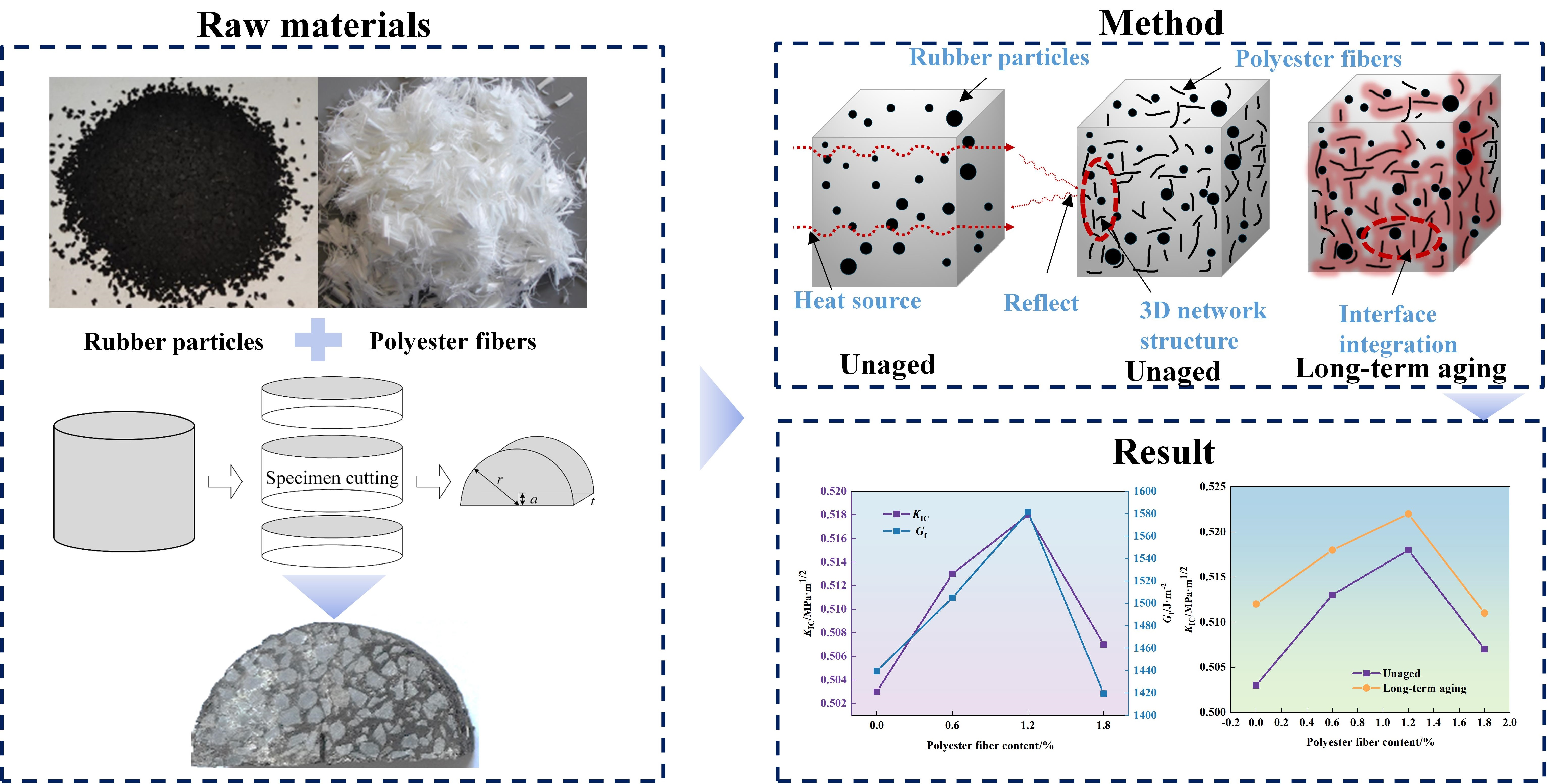
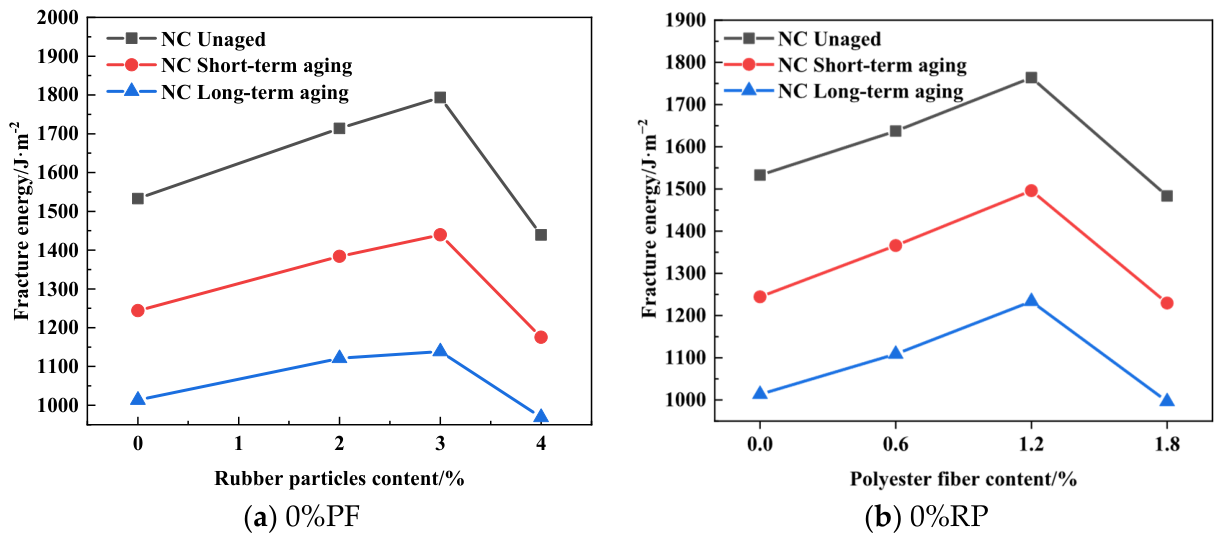
- The addition of rubber particles increases the fracture energy by approximately 15%.
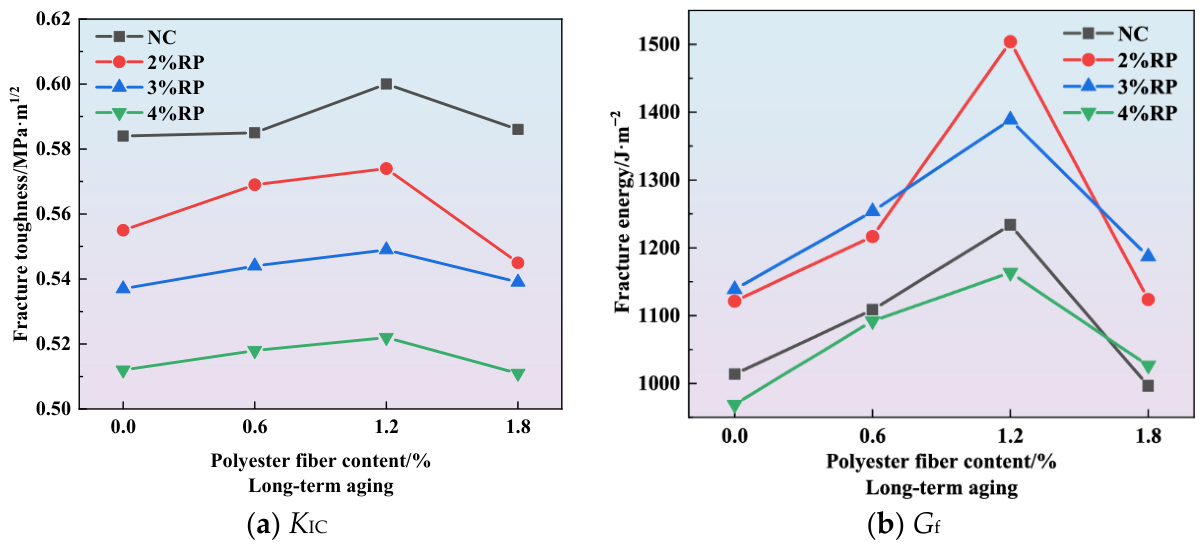
- The incorporation of polyester fibers increases the fracture energy by approximately 19%.
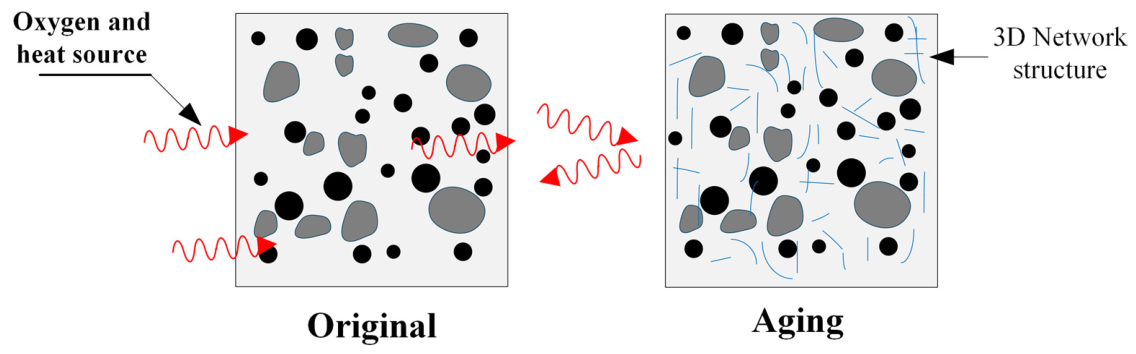
- Aged asphalt concrete is more susceptible to brittle fracture.
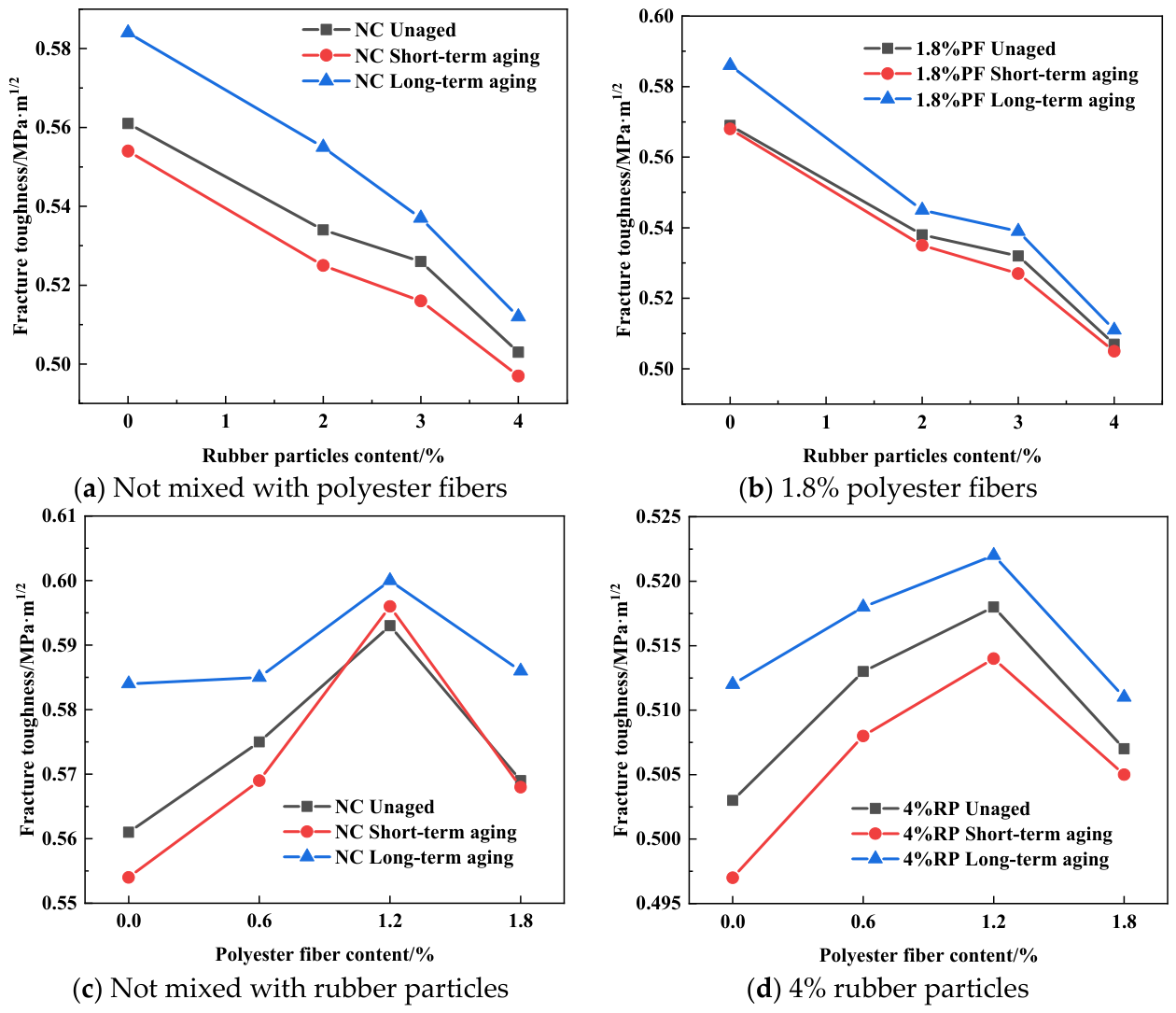
- Aged asphalt concrete exhibits higher fracture toughness.
Abstract
1. Introduction
2. Experimental Procedures
2.1. Raw Materials
2.2. Test Method
- (1)
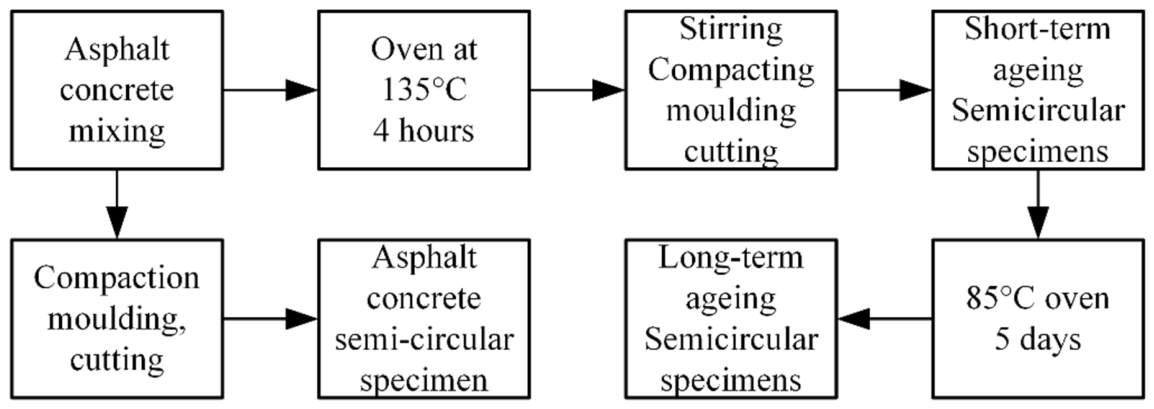
- Unaged group: SCB fracture specimens of high-elasticity asphalt concrete were prepared directly without aging treatment.
- (2)
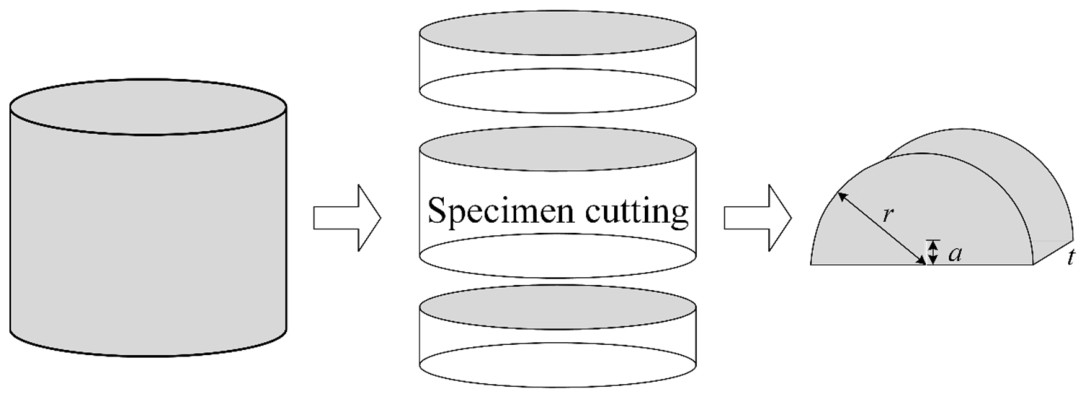
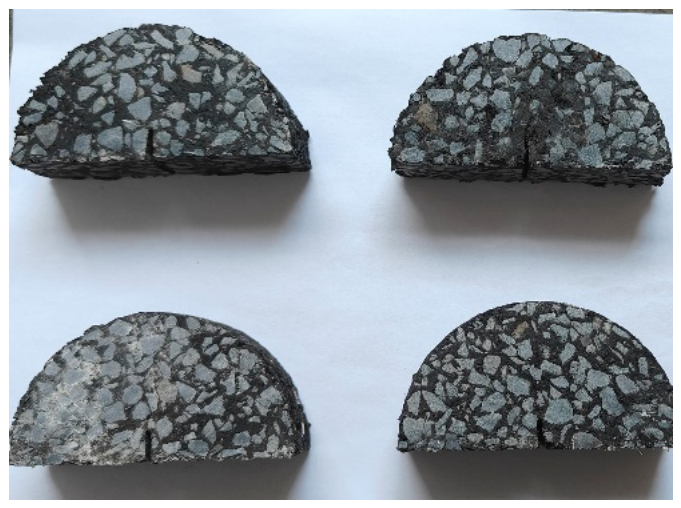
- Short-term aging group: Short-term aging tests were performed according to the standard procedure. After mixing, the asphalt mixture was evenly spread on a metal tray and placed in an oven maintained at 135 °C for 4 h. The mixture was turned every hour to ensure sufficient contact with air. After 4 h, the mixture was removed, returned to the mixing drum, and agitated for 45 s. It was then placed into the mold and compacted with 50 blows on each side. After 12 h, the specimen was demolded. The formed specimen was cut into the required semi-circular shape for testing. The short-term aging test primarily simulates the aging conditions experienced during the mixing and paving of asphalt concrete.
- (3)
- Long-term aging group: Before the long-term aging treatment, the asphalt concrete specimens were first subjected to short-term aging according to the same procedure used for the short-term aging group.
3. Results and Discussion
3.1. Peak Load
3.2. Effect of Rubber Particle Content on Fracture Properties
3.3. Effect of Polyester Fiber Content on Fracture Properties
3.4. Effect of Different Aging Durations on Fracture Properties
3.4.1. Fracture Toughness
3.4.2. Fracture Energy
3.4.3. Effect of Aging Duration on Crack Propagation Pathways
4. Conclusions
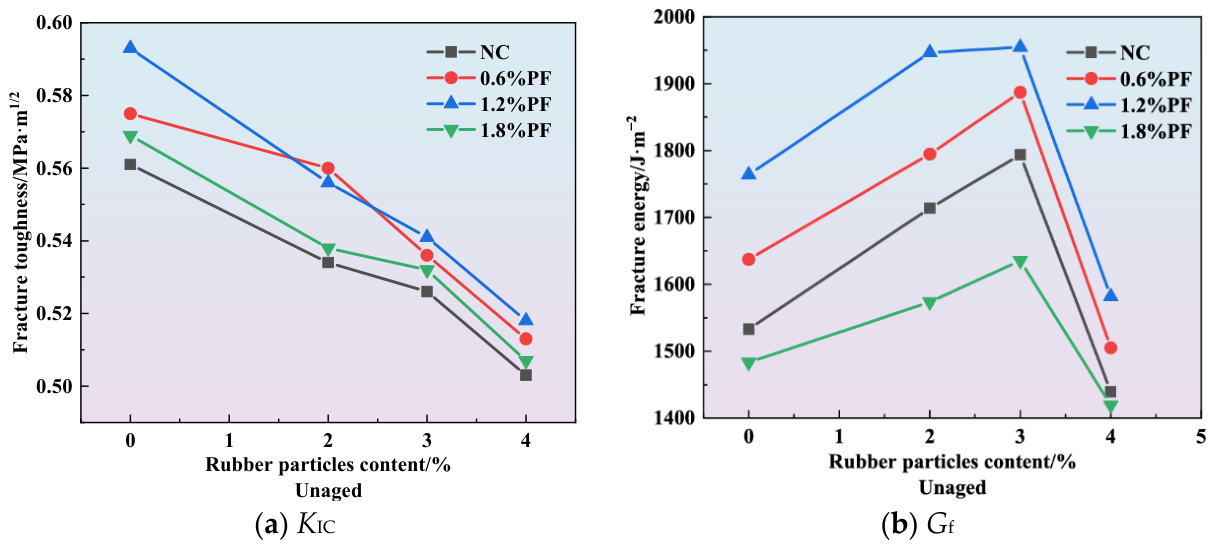
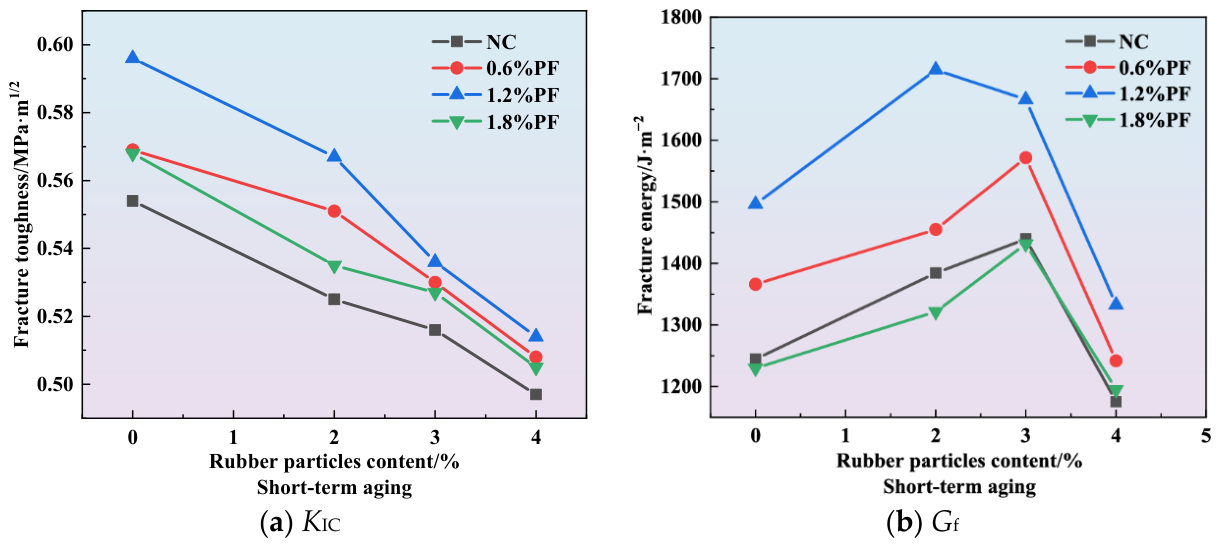
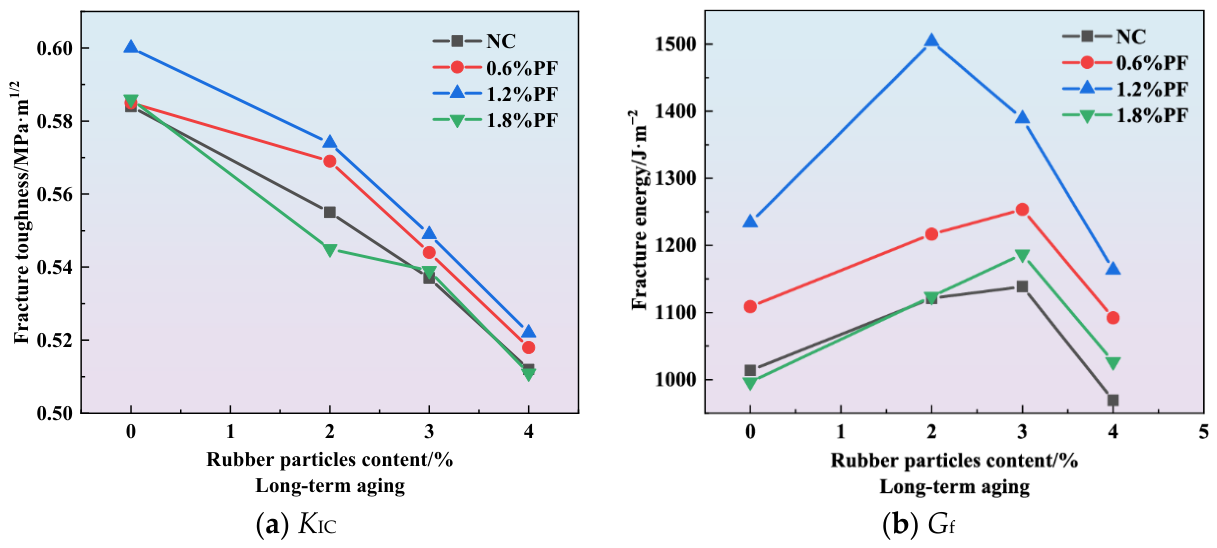
- As the rubber particle content increases, the fracture toughness and peak load of high-elasticity asphalt concrete gradually decrease, while the fracture energy initially increases before decreasing. At a rubber particle content of 3%, the fracture energy of high-elasticity asphalt concrete increases by approximately 15% compared with the group without rubber particles. However, when the rubber particle content exceeds 4%, the asphalt binder cannot fully encapsulate all rubber particles, which may result in an increase in internal defects and a rapid reduction in fracture energy.
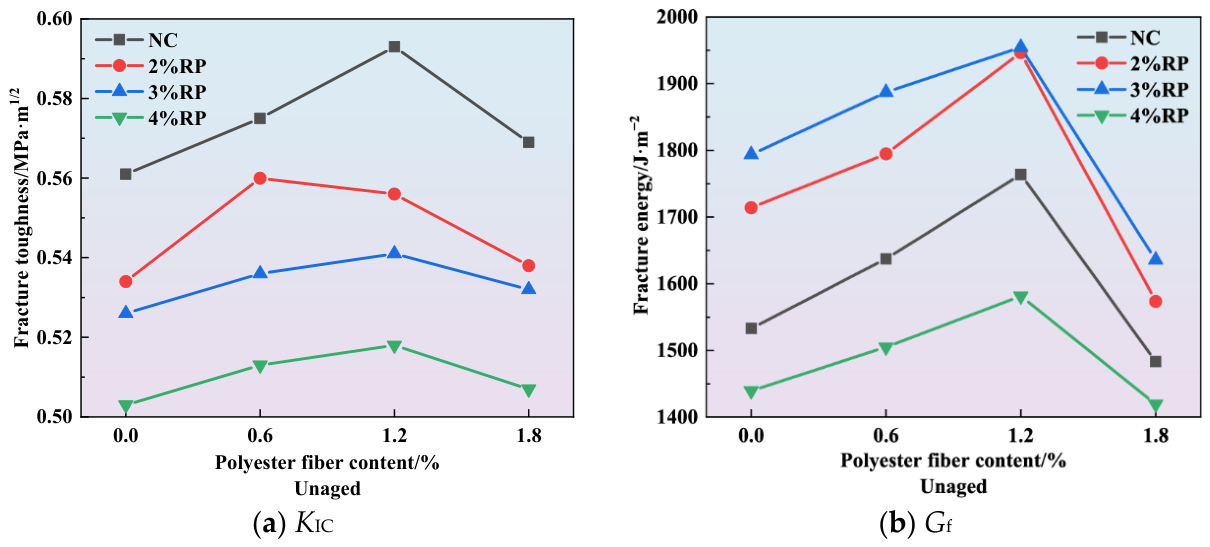
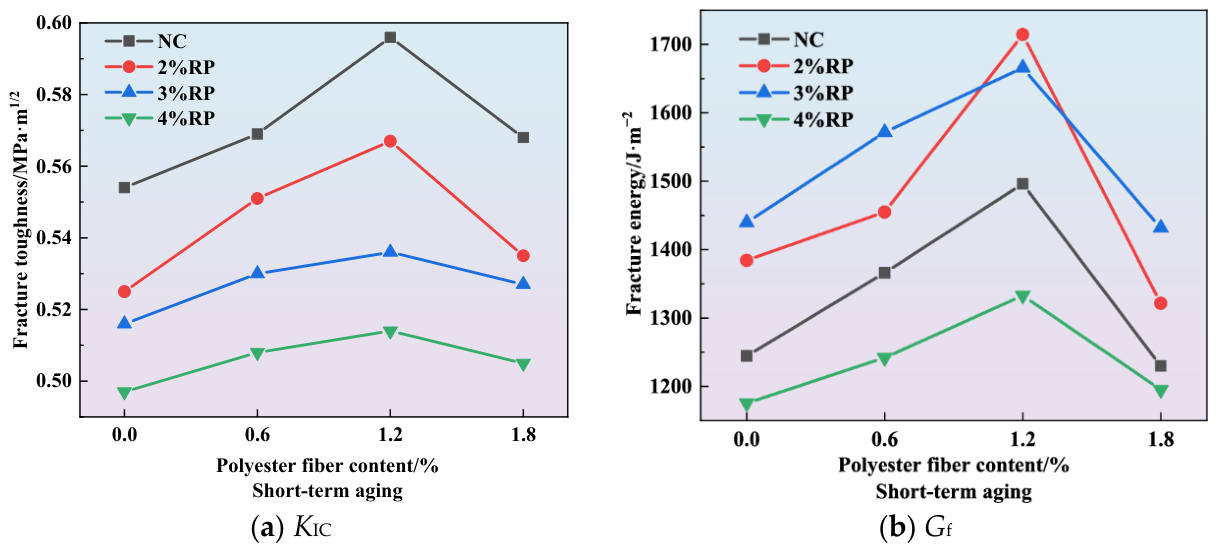
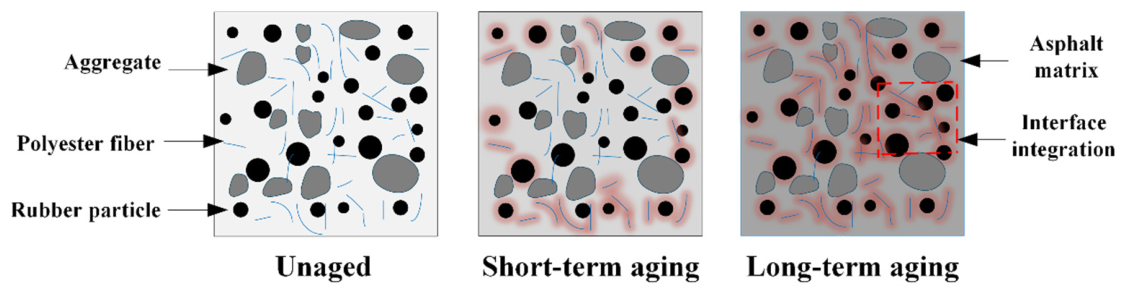
- As the polyester fiber content increases, the fracture toughness and fracture energy of high-elasticity asphalt concrete tend to increase first and then decrease. When the polyester fiber content is 1.2%, the fracture energy reaches its maximum value, increasing by 15.1%, 20.2%, and 21.7% in the three aging groups, respectively. The incorporation of polyester fibers promotes the formation of a three-dimensional network structure within asphalt concrete, enhancing its crack bridging capacity.
- High-elasticity asphalt concrete exhibits higher fracture toughness under long-term service conditions than both the unaged group and the short-term aged group. When rubber particles are incorporated at 4%, the fracture toughness of the short-term aged group tends to decrease. However, the fracture energy gradually decreases with increasing service duration. The maximum fracture energy is achieved at 3% rubber particle content or 1.2% polyester fiber content under single-additive conditions.
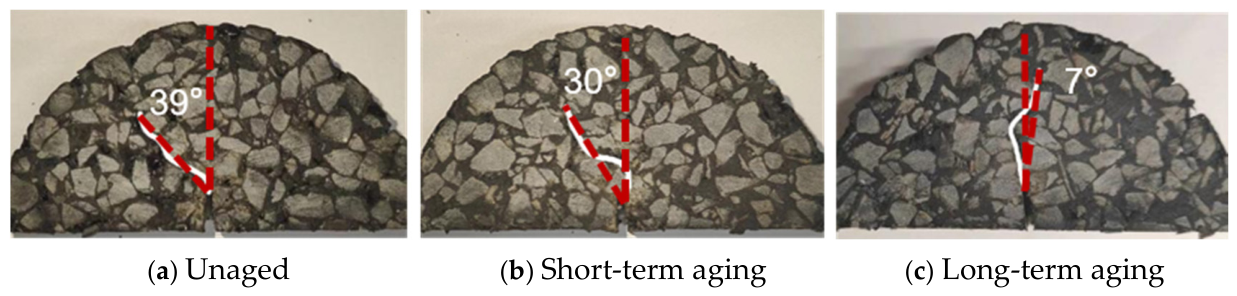
- Unaged and short-term aged asphalt concrete exhibits favorable elastoplastic behavior, with cracks opening at an angle of 39 degrees and propagating along paths with higher resistance. In contrast, after long-term aging, the asphalt concrete becomes more brittle and less viscoelastic, causing cracks to open at smaller angles and propagate rapidly along paths with lower resistance.
Author Contributions
Funding
Data Availability Statement
Conflicts of Interest
References
- Polaczyk, P.; Ma, Y.T.; Xiao, R.; Hu, W.; Jiang, X.; Huang, B. Characterization of aggregate interlocking in hot mix asphalt by mechanistic performance tests. Road Mater. Pavement Des. 2021, 22, S498–S513. [Google Scholar] [CrossRef]
- Dong, Q.; Chen, X.Q.; Gong, H.R. Performance Evaluation of Asphalt Pavement Resurfacing Treatments Using Structural Equation Modeling. J. Transp. Eng. Part B Pavements 2020, 146, 4019043. [Google Scholar] [CrossRef]
- Sun, W.; Wu, S.C.; Guo, W.B. Study on the semi-circular bend method for characterizing the mixed mode I/II fracture toughness of sandstone: A micro-perspective. Theor. Appl. Fract. Mech. 2023, 127, 104064. [Google Scholar] [CrossRef]
- Radhi Radeef, H.; Abdul Hassan, N.; Zul Hanif Mahmud, M.; Al Saffar, H.Z.; Fadhil Abass, H.; Abidin, A.R.Z.; Ismail, C.R. Fracture resistance of polymeric wastes modified asphalt using R-curve and digital image correlation. Theor. Appl. Fract. Mech. 2023, 123, 103691. [Google Scholar] [CrossRef]
- Han, D.D.; Liu, G.Q.; Yang, T.; Xie, Y.C.; Zhao, Y.L. A phase-field cohesive zone model for fracture simulation of asphalt mixture. Eng. Fract. Mech. 2023, 281, 109149. [Google Scholar] [CrossRef]
- Xia, C.; Wu, C.; Liu, K.; Jiang, K. Study on the Durability of Bamboo Fiber Asphalt Mixture. Materials 2021, 14, 1667. [Google Scholar] [CrossRef]
- Zhao, S.; Huang, B.S.; Shu, X.; Ye, P. Laboratory investigation of biochar-modified asphalt mixture. Transp. Res. Rec. 2014, 2445, 56–63. [Google Scholar] [CrossRef]
- Huang, H.; Wang, Y.; Wu, X.; Zhang, J.; Huang, X. Nanomaterials for Modified Asphalt and Their Effects on Viscosity Characteristics: A Comprehensive Review. Nanomaterials 2024, 14, 1503. [Google Scholar] [CrossRef]
- Ameri, M.; Nowbakht, S.; Molayem, M.; Aliha, M.R.A. Investigation of fatigue and fracture properties of asphalt mixtures modified with carbon nanotubes. Fatigue Fract. Eng. Mater. Struct. 2016, 39, 896–906. [Google Scholar] [CrossRef]
- Afshin, A.; Behnood, A. Nanomaterials in asphalt pavements: A state-of-the-art review. Clean. Waste Syst. 2025, 10, 100214. [Google Scholar] [CrossRef]
- Pirmohammad, S.; Majd Shokorlou, Y.; Amani, B. Experimental investigation of fracture properties of asphalt mixtures modified with Nano Fe2O3 and carbon nanotubes. Road Mater. Pavement Des. 2019, 21, 2321–2343. [Google Scholar] [CrossRef]
- Xue, Z.; Fang, S.; Xiong, L.; Ma, J.; Wang, M.; Sun, B.; Wu, K. Experimental-numerical investigation on the performance of basalt fiber reinforced asphalt mixture. Front. Mater. 2025, 12, 1704032. [Google Scholar] [CrossRef]
- Pei, Z.H.; Lou, K.K.; Kong, H.Y.; Wu, B.W.; Wu, X.; Xiao, P.; Qi, Y. Effects of Fiber Diameter on Crack Resistance of Asphalt Mixtures Reinforced by Basalt Fibers Based on Digital Image Correlation Technology. Materials 2021, 14, 7426. [Google Scholar] [CrossRef]
- Alsheyab, M.A.T.; Khedaywi, T.; Ogiliat, O. Effect of Waste Tire Rubber on Properties of Asphalt Cement and Asphalt Concrete Mixtures: State of the Art. Int. J. Pavement Res. Technol. 2023, 18, 516–527. [Google Scholar] [CrossRef]
- Fahad, M.; Nagy, R. Performance comparison of polymer and fiber modified asphalt mixtures. Discov. Appl. Sci. 2025, 7, 570. [Google Scholar] [CrossRef]
- Wang, J.; Huo, T.X.; Wang, D.H.; Zhang, P. Study on Basic Pavement Performance of High-Elasticity Asphalt Concrete. Polymers 2024, 16, 2156. [Google Scholar] [CrossRef] [PubMed]
- Saeidi, H.; Aghayan, I. Investigating the effects of aging and loading rate on low-temperature cracking resistance of core-based asphalt samples using semi-circular bending test. Constr. Build. Mater. 2016, 126, 682–690. [Google Scholar] [CrossRef]
- Yang, Q.; Lin, J.; Wang, X.; Wang, D.; Xie, N.; Shi, X. A review of polymer-modified asphalt binder: Modification mechanisms and mechanical properties. Clean. Mater. 2024, 12, 100255. [Google Scholar] [CrossRef]
- Jin, D.Z.; Boateng, K.A.; Ge, D.; Che, T.; Yin, L.; Harrall, W.; You, Z. A case study of the comparison between rubberized and polymer modified asphalt on heavy traffic pavement in wet and freeze environment. Case Stud. Constr. Mater. 2023, 18, e01847. [Google Scholar] [CrossRef]
- Peter, G.; Amira, B.A.; Jan, V. The Influence of Synthetic Reinforcing Fibers on Selected Properties of Asphalt Mixtures for Surface and Binder Layers. Infrastructures 2025, 10, 303. [Google Scholar] [CrossRef]
- Zhao, X.; Su, P.F.; Xie, J.K.; Dai, Q. Experimental and numerical investigation of concrete properties and crack propagation in concrete incorporating different sizes of recycled tire rubber particles. Constr. Build. Mater. 2025, 499, 144117. [Google Scholar] [CrossRef]
- Yu, J.; Yao, Y.L.; Xu, T.F.; Shang, A.F.; Wang, K.Z. Evaluation of the strength and brittleness of mortar containing fissures and rubber. Constr. Build. Mater. 2025, 464, 140091. [Google Scholar] [CrossRef]
- Real Herráiz, T.; Real Herráiz, J.I.; Montalbán Domingo, L.; Carrión Domingo, F. Posidonia oceanica used as a new natural fibre to enhance the performance of asphalt mixtures. Constr. Build. Mater. 2016, 102, 601–612. [Google Scholar] [CrossRef]
- Alnadish, A.M.; Aman, M.Y.; Katman, H.Y.B.; Ibrahim, M.R. Influence of the long-term oven aging on the performance of the reinforced asphalt mixtures. Coatings 2020, 10, 953. [Google Scholar] [CrossRef]
- Alnadish, A.; Aman, M.; Katman, H.; Ibrahim, M. Laboratory assessment of the performance and elastic behavior of asphalt mixtures containing steel slag aggregate and synthetic fibers. Int. J. Pavement Res. Technol. 2021, 14, 473–481. [Google Scholar] [CrossRef]
- Zarei, M.; Abdi Kordani, A.; Ghamarimajd, Z.; Khajehzadeh, M.; Khanjari, M.; Zahedi, M. Evaluation of fracture resistance of asphalt concrete involving calcium lignosulfonate and polyester fiber under freeze-thaw damage. Theor. Appl. Fract. Mech. 2022, 117, 103168. [Google Scholar] [CrossRef]
- Esmaeili, N.; Alavi, M.Z.; Samadzad, M. Evaluation of the impacts of polymeric fibers and modifiers on the fracture properties of asphalt mixtures. Results Eng. 2025, 25, 103862. [Google Scholar] [CrossRef]
- Varas, L.M.; Quesada, M.D.; Raposeiras, A.; Castro-Fresno, D. Rheological behaviour of modified binders for different loading conditions and temperatures: A case of using pig tallow and crumb rubber from end-of-life tyres. Results Eng. 2024, 23, 102570. [Google Scholar] [CrossRef]
- Mojabi, A.S.; Kordani, A.A.; Hajikarimi, P.; Nazari, M. Evaluating fracture performance of stone mastic asphalt with SBS and SEBS modifications. Theor. Appl. Fract. Mech. 2024, 134, 104703. [Google Scholar] [CrossRef]
- White, G.; Kidd, A. Analysis of the Effects of Rubber Dosage and Digestion Time on the Mechanical Properties of Low Dosage Crumb-Rubber-Modified Asphalt Concrete Mixtures. Materials 2025, 18, 1419. [Google Scholar] [CrossRef]
- Wu, J.; Hu, Y.; Jin, Q.; Ren, H. Macro-microscopic study on the crack resistance of polyester fiber asphalt mixture under dry-wet cycling and neural network prediction. Case Stud. Constr. Mater. 2024, 20, e03058. [Google Scholar] [CrossRef]
- Amani, S.; Jahangiri, B.; Karimi, M.M. Performance characterization of asphalt mixtures under different aging levels: A fracture-based method. Constr. Build. Mater. 2023, 383, 131126. [Google Scholar] [CrossRef]
- Zieliński, P. The use of the semi-circular bending method to assess the intermediate-temperature fracture toughness of asphalt concrete mixes with reclaimed asphalt shingles. Road Mater. Pavement Des. 2024, 25, 81–98. [Google Scholar] [CrossRef]
- Fan, S.P.; Zhang, W.L.; Gan, X.L. Evaluation of low-temperature fracture properties of asphalt mixtures using SCB fracture test and finite element method (FEM). Innov. Infrastruct. Solut. 2025, 10, 286. [Google Scholar] [CrossRef]
- Ren, H.S.; Qian, Z.; Huang, W.; Wu, B.; Chen, T.J.; Cao, H. Evaluation of fracture behavior in asphalt concrete through the combination of semi-circular bending test and digital image correlation technology. Constr. Build. Mater. 2024, 451, 138854. [Google Scholar] [CrossRef]
- JTG 3410-2025; Standard Test Methods of Bitumen and Bituminous Mixtures for Highway Engineering. Ministry of Transportation: Beijing, China, 2025.
- JT/T 798-2019; Crumb Rubber Asphalt for Highway Engineering. Ministry of Transportation: Beijing, China, 2019.
- Wu, J.R.; Li, F.; Ma, Q.Y. Effect of Polyester Fiber on Air Voids and Low-Temperature Crack Resistance of Permeable Asphalt Mixture. Adv. Civ. Eng. 2020, 2020, 2381504. [Google Scholar] [CrossRef]
- Xia, L.; Cao, D.; Zhang, H.; Zhang, M.; Shan, L.; Zhang, H.; Wang, T. Surface Modification of Recycled Polyester Fiber and Performance Evaluation of Its Asphalt Mastic and Mixture. Sustainability 2023, 16, 278. [Google Scholar] [CrossRef]
- Wu, B.W.; Pei, Z.H.; Xiao, P.; Lou, K.; Wu, X. Influence of fiber-asphalt interface property on crack resistance of asphalt mixture. Case Stud. Constr. Mater. 2022, 17, e01703. [Google Scholar] [CrossRef]
- Lou, K.; Jia, S.; Xiao, P.; Wu, H.; Wu, Y. Effects of Moisture Infiltration on Interfacial Characteristics of Fiber Asphalt Mastic-Aggregate and the Cracking Resistance of Mixture. Materials 2024, 18, 53. [Google Scholar] [CrossRef]
- Szydowski, C.; Smakosz, U.; Stienss, M.; Górski, J. Monte Carlo simulations of the fracture resistance degradation of asphalt concrete subjected to environmental factors. Arch. Civ. Eng. 2023, 69, 245–257. [Google Scholar] [CrossRef]



| Parameters | BJ200 |
| Softening point, °C | 93.8 |
| Penetration (5 °C), cm | 14.5 |
| Penetration (25 °C), 0.1 mm | 25 |
| Elastic recovery rate, % | 75 |
| Viscosity (190 °C), Pa·s | 4.5 |
| 70 °C Complex modulus, kPa | 6.0 |
| 70 °C Phase angle, ° | 57 |
| 70 °C Non-recoverable creep compliance Jnr3.2, kPa−1 | 0.07 |
| 70 °C Percent recovery R3.2, % | 80 |
| Indicators | Combustion Residues (%) | Ash Content (%) | Rubber Content (%) | Fiber Content (%) | Moisture Content (%) |
|---|---|---|---|---|---|
| Value | 37.5 | 4.5 | 51 | 0.5 | 0.6 |
| Indicators | Specific Gravity | Modulus of Elasticity (GPa) | Elongation at Break (%) | Tensile Strength (MPa) | Melting Point (°C) | Ignition Point (°C) |
|---|---|---|---|---|---|---|
| Value | 0.91 | 13.5 | 9 ± 3 | 550 | 259 | 554 |
| Specimen Number | Number of Each Group | Oil-Stone Ratio | Asphalt kg/m3 | Aggregate kg/m3 | Rubber Particles kg/m3 | Rubber Particles% | Polyester % |
|---|---|---|---|---|---|---|---|
| NC | 3 | 1:5 | 388 | 1938 | 0 | 0 | 0 |
| F0.6 | 1:5 | 388 | 1938 | 0 | 0 | 0.6 | |
| F1.2 | 1:4 | 451 | 1803 | 0 | 0 | 1.2 | |
| F1.8 | 1:4 | 451 | 1803 | 0 | 0 | 1.8 | |
| R2 | 1:5 | 388 | 1899 | 39 | 2 | 0 | |
| R3 | 1:5 | 388 | 1880 | 58 | 3 | 0 | |
| R4 | 1:5 | 388 | 1860 | 78 | 4 | 0 | |
| R2F0.6 | 1:5 | 388 | 1899 | 39 | 2 | 0.6 | |
| R2F1.2 | 1:4 | 451 | 1767 | 36 | 2 | 1.2 | |
| R2F1.8 | 1:4 | 451 | 1767 | 36 | 2 | 1.8 | |
| R3F0.6 | 1:5 | 388 | 1880 | 58 | 3 | 0.6 | |
| R3F1.2 | 1:4 | 451 | 1749 | 54 | 3 | 1.2 | |
| R3F1.8 | 1:4 | 451 | 1749 | 54 | 3 | 1.8 | |
| R4F0.6 | 1:5 | 388 | 1860 | 78 | 4 | 0.6 | |
| R4F1.2 | 1:4 | 451 | 1731 | 72 | 4 | 1.2 | |
| R4F1.8 | 1:4 | 451 | 1731 | 72 | 4 | 1.8 |
| Specimen Number | Peak Load/(Mean ± SD, N) | |||||
|---|---|---|---|---|---|---|
| Unaged | CV, % | Short-Term Aging | CV, % | Long-Term Aging | CV, % | |
| NC | 1797.14 ± 106.53 | 5.9 | 1774.31 ± 132.25 | 7.5 | 1872.18 ± 110.98 | 5.9 |
| F0.6 | 1841.53 ± 137.26 | 7.4 | 1821.54 ± 107.98 | 5.9 | 1874.51 ± 139.73 | 7.4 |
| F1.2 | 1899.54 ± 143.61 | 7.5 | 1908.81 ± 144.32 | 7.7 | 1921.66 ± 145.28 | 7.5 |
| F1.8 | 1821.36 ± 122.52 | 6.7 | 1819.34 ± 122.38 | 6.7 | 1877.85 ± 126.32 | 6.7 |
| R2 | 1711.32 ± 101.95 | 5.9 | 1681.48 ± 100.17 | 6.0 | 1777.14 ± 105.87 | 5.9 |
| R2F0.6 | 1794.65 ± 106.38 | 5.9 | 1764.94 ± 140.09 | 7.9 | 1822.94 ± 108.06 | 5.9 |
| R2F1.2 | 1780.51 ± 141.33 | 7.9 | 1817.14 ± 135.44 | 7.5 | 1837.15 ± 145.82 | 7.9 |
| R2F1.8 | 1723.84 ± 59.29 | 3.4 | 1715.31 ± 59.00 | 3.4 | 1745.63 ± 60.04 | 3.4 |
| R3 | 1684.85 ± 133.73 | 7.9 | 1654.31 ± 131.31 | 7.9 | 1719.45 ± 136.48 | 7.9 |
| R3F0.6 | 1717.42 ± 115.53 | 6.7 | 1697.54 ± 114.19 | 6.7 | 1741.36 ± 117.14 | 6.7 |
| R3F1.2 | 1733.65 ± 129.22 | 7.4 | 1717.46 ± 136.32 | 7.9 | 1757.91 ± 131.03 | 7.4 |
| R3F1.8 | 1703.14 ± 101.46 | 5.9 | 1688.56 ± 100.59 | 6.0 | 1725.16 ± 102.78 | 5.9 |
| R4 | 1612.62 ± 121.93 | 7.5 | 1592.18 ± 120.38 | 7.6 | 1641.31 ± 124.09 | 7.5 |
| R4F0.6 | 1642.05 ± 56.48 | 3.4 | 1627.94 ± 96.50 | 5.9 | 1659.64 ± 57.09 | 3.4 |
| R4F1.2 | 1658.65 ± 131.65 | 7.9 | 1646.35 ± 56.63 | 3.4 | 1671.18 ± 132.65 | 7.9 |
| R4F1.8 | 1624.31 ± 96.29 | 5.9 | 1617.61 ± 120.57 | 7.5 | 1637.56 ± 218.02 | 13.3 |
| Specimen Number | KIC/(Mean ± SD, MPa·m1/2) | |||||
|---|---|---|---|---|---|---|
| Unaged | CV, % | Short-Term Aging | CV, % | Long-Term Aging | CV, % | |
| NC | 0.561 ± 0.033 | 5.8 | 0.554 ± 0.041 | 7.4 | 0.584 ± 0.035 | 5.9 |
| F0.6 | 0.575 ± 0.043 | 7.4 | 0.568 ± 0.034 | 5.9 | 0.585 ± 0.044 | 7.4 |
| F1.2 | 0.593 ± 0.045 | 7.5 | 0.596 ± 0.045 | 7.5 | 0.600 ± 0.046 | 7.6 |
| F1.8 | 0.568 ± 0.038 | 6.7 | 0.568 ± 0.038 | 6.7 | 0.586 ± 0.039 | 6.7 |
| R2 | 0.534 ± 0.032 | 5.9 | 0.525 ± 0.031 | 6.0 | 0.555 ± 0.033 | 5.9 |
| R2F0.6 | 0.560 ± 0.034 | 6.0 | 0.551 ± 0.044 | 8.0 | 0.569 ± 0.034 | 5.9 |
| R2F1.2 | 0.556 ± 0.044 | 7.9 | 0.567 ± 0.042 | 7.4 | 0.574 ± 0.045 | 7.9 |
| R2F1.8 | 0.538 ± 0.018 | 3.4 | 0.535 ± 0.018 | 3.4 | 0.545 ± 0.018 | 3.4 |
| R3 | 0.526 ± 0.042 | 7.9 | 0.516 ± 0.041 | 8.0 | 0.537 ± 0.042 | 7.9 |
| R3F0.6 | 0.536 ± 0.036 | 6.6 | 0.530 ± 0.036 | 6.8 | 0.544 ± 0.036 | 6.7 |
| R3F1.2 | 0.541 ± 0.040 | 7.4 | 0.536 ± 0.042 | 7.9 | 0.549 ± 0.041 | 7.4 |
| R3F1.8 | 0.532 ± 0.032 | 5.9 | 0.527 ± 0.031 | 6.0 | 0.538 ± 0.032 | 6.0 |
| R4 | 0.504 ± 0.038 | 7.6 | 0.497 ± 0.038 | 7.6 | 0.512 ± 0.039 | 7.6 |
| R4F0.6 | 0.513 ± 0.017 | 3.4 | 0.508 ± 0.030 | 5.9 | 0.518 ± 0.018 | 3.5 |
| R4F1.2 | 0.518 ± 0.041 | 8.0 | 0.514 ± 0.018 | 3.4 | 0.522 ± 0.041 | 7.9 |
| R4F1.8 | 0.507 ± 0.030 | 5.9 | 0.505 ± 0.037 | 7.4 | 0.511 ± 0.068 | 13.4 |
| Specimen Number | Gf/(Mean ± SD, J·m−2) | |||||
|---|---|---|---|---|---|---|
| Unaged | CV, % | Short-Term Aging | CV, % | Long-Term Aging | CV, % | |
| NC | 1532.86 ± 65.92 | 4.3 | 1244.29 ± 60.97 | 4.9 | 1013.54 ± 58.79 | 5.8 |
| F0.6 | 1637.15 ± 178.45 | 10.9 | 1365.91 ± 128.39 | 9.4 | 1108.65 ± 106.43 | 9.6 |
| F1.2 | 1763.66 ± 142.85 | 8.1 | 1495.99 ± 160.07 | 10.7 | 1233.64 ± 56.75 | 4.6 |
| F1.8 | 1483.24 ± 94.93 | 6.4 | 1229.61 ± 75.01 | 6.1 | 996.34 ± 107.60 | 10.8 |
| R2 | 1713.79 ± 89.11 | 5.2 | 1384.11 ± 76.13 | 5.5 | 1121.19 ± 69.51 | 6.2 |
| R2F0.6 | 1794.59 ± 202.78 | 11.3 | 1454.94 ± 120.76 | 8.3 | 1216.63 ± 103.41 | 8.5 |
| R2F1.2 | 1946.21 ± 147.91 | 7.6 | 1714.31 ± 195.43 | 11.4 | 1503.63 ± 106.75 | 7.1 |
| R2F1.8 | 1573.54 ± 143.19 | 9.1 | 1321.35 ± 92.50 | 7.0 | 1123.65 ± 124.72 | 11.1 |
| R3 | 1793.49 ± 86.09 | 4.8 | 1439.51 ± 64.78 | 4.5 | 1138.56 ± 56.93 | 5.0 |
| R3F0.6 | 1886.94 ± 192.47 | 10.2 | 1571.46 ± 155.58 | 9.9 | 1253.32 ± 112.81 | 9.0 |
| R3F1.2 | 1954.39 ± 170.04 | 8.7 | 1665.83 ± 146.59 | 8.8 | 1388.69 ± 94.43 | 6.8 |
| R3F1.8 | 1635.47 ± 112.85 | 6.9 | 1431.61 ± 94.49 | 6.6 | 1186.84 ± 122.25 | 10.3 |
| R4 | 1439.47 ± 82.05 | 5.7 | 1175.41 ± 59.95 | 5.1 | 968.94 ± 42.64 | 4.4 |
| R4F0.6 | 1504.94 ± 165.54 | 11.0 | 1241.65 ± 130.37 | 10.5 | 1091.96 ± 88.45 | 8.1 |
| R4F1.2 | 1581.51 ± 115.45 | 7.3 | 1332.96 ± 102.64 | 7.7 | 1163.36 ± 61.66 | 5.3 |
| R4F1.8 | 1419.36 ± 139.10 | 9.8 | 1194.96 ± 109.93 | 9.2 | 1026.32 ± 99.56 | 9.7 |
Disclaimer/Publisher’s Note: The statements, opinions and data contained in all publications are solely those of the individual author(s) and contributor(s) and not of MDPI and/or the editor(s). MDPI and/or the editor(s) disclaim responsibility for any injury to people or property resulting from any ideas, methods, instructions or products referred to in the content. |
© 2026 by the authors. Licensee MDPI, Basel, Switzerland. This article is an open access article distributed under the terms and conditions of the Creative Commons Attribution (CC BY) license.
Share and Cite
Wu, J.; Huo, T.; Wang, J.; Gao, X.; Liu, H.; Wang, J. Fracture Properties of High-Elasticity Asphalt Concrete Reinforced with Rubber Particles and Polyester Fibers. Materials 2026, 19, 1780. https://doi.org/10.3390/ma19091780
Wu J, Huo T, Wang J, Gao X, Liu H, Wang J. Fracture Properties of High-Elasticity Asphalt Concrete Reinforced with Rubber Particles and Polyester Fibers. Materials. 2026; 19(9):1780. https://doi.org/10.3390/ma19091780
Chicago/Turabian StyleWu, Jingjiang, Taixu Huo, Juan Wang, Xiaobo Gao, Hui Liu, and Jingjing Wang. 2026. "Fracture Properties of High-Elasticity Asphalt Concrete Reinforced with Rubber Particles and Polyester Fibers" Materials 19, no. 9: 1780. https://doi.org/10.3390/ma19091780
APA StyleWu, J., Huo, T., Wang, J., Gao, X., Liu, H., & Wang, J. (2026). Fracture Properties of High-Elasticity Asphalt Concrete Reinforced with Rubber Particles and Polyester Fibers. Materials, 19(9), 1780. https://doi.org/10.3390/ma19091780