Article

Development and Performance Evaluation of Composite Modified Nano-TiO2 for Permeable Asphalt Mixtures: Focus on Exhaust Degradation and Dispersion Properties

1
School of Mechanical and Electrical Engineering, Anhui Jianzhu University, Hefei 230601, China
2
School of Civil Engineering and Architecture, Anhui University of Science & Technology, Huainan 232001, China
3
School of Highway, Chang’an University, Xi’an 710064, China
4
School of Business, Fuyang Normal University, Fuyang 236041, China
5
College of Engineering, Computer Science, and Construction Management, California State University-Chico, Chico, CA 95929, USA
*
Author to whom correspondence should be addressed.
Materials 2026, 19(9), 1777; https://doi.org/10.3390/ma19091777
Submission received: 21 March 2026 / Revised: 20 April 2026 / Accepted: 24 April 2026 / Published: 27 April 2026
(This article belongs to the Section Construction and Building Materials)

Abstract

Rapid urbanization has intensified challenges regarding urban waterlogging and vehicle exhaust pollution. While permeable asphalt mixtures mitigate waterlogging and nano-TiO2 offers photocatalytic exhaust degradation capabilities, the direct application of nano-TiO2 is hindered by agglomeration and low photocatalytic efficiency. This study developed a composite modified nano-TiO2 via metal ion doping and support treatment to enhance its performance in asphalt pavements. Specifically, nano-TiO2 was doped with Fe3+, Ag+, and La3+ via the sol–gel method, and supported on activated carbon (AC) or Al2O3. The exhaust degradation performance was evaluated using a custom-built system, while dispersion properties were assessed via fluorescence microscopy and UV-Vis spectrophotometry. Furthermore, X-ray diffraction (XRD) and Fourier-transform infrared (FTIR) spectroscopy were conducted to investigate the microstructural mechanisms underlying the doping modification and support treatment. Photocatalytic permeable asphalt mixtures were prepared by partially replacing mineral powder with the composite modified nano-TiO2 to validate exhaust degradation and pavement performance. The results indicated that metal doping substituted Ti4+ in the lattice, inducing defects and reducing crystallite size to boost photocatalytic activity. The optimal doping concentrations are determined to be 1.0% for Fe3+, 1.5% for Ag+, and 1.0% for La3+. Among these, Fe3+-doped nano-TiO2 at 1.0% content exhibits superior exhaust degradation, achieving 46.7% efficiency for hydrocarbons (HC) and 33.5% for nitrogen oxides (NO). Regarding dispersion, while AC performs better at low support content, Al2O3 at 40% content provides superior dispersion properties by increasing active sites and surface hydroxyl groups. For photocatalytic permeable asphalt mixtures, replacing 40–50% of mineral filler with the composite modifier is recommended. The optimized mixture demonstrates superior exhaust degradation performance while maintaining the required high-temperature stability, low-temperature cracking resistance, water stability, and fatigue life. Specifically, compared to the control group, these indicators for the mixture with 50% of the mineral filler replaced by the composite modifier increases by 7.0%, 12.5%, 13.4%, and 22.9%, respectively. This study presents a viable technical solution for developing multifunctional asphalt mixtures with photocatalytic functionality as the core innovation and mechanical performance as the application baseline.

1. Introduction

In recent years, urban waterlogging during rainfall has become a persistent problem in many large and medium-sized cities [1]. Meanwhile, with social development, frequent and large-scale haze events have occurred in numerous cities. Excessively high concentrations of PM2.5 in the atmosphere are the primary cause of haze, and vehicle exhaust emitted during fuel combustion represents the major mobile source of PM2.5. With the continuous growth in number of vehicles in traffic, vehicle exhaust has become the dominant contributor to urban PM2.5 pollution, ranking first among all emission sources. Vehicle exhaust poses a severe threat to the atmospheric environment and human health, and has become one of the main causes of urban haze [2]. Urban roads cover extensive areas, serving as a critical component of urban infrastructure. The dual challenges of frequent waterlogging and worsening vehicle exhaust pollution have imposed stringent requirements on the ecological and environmental performance of urban roads. Therefore, it is particularly important for urban pavements to possess both rapid drainage and exhaust purification functions [3].
Nano-TiO2 is widely employed as air-purification material owing to its excellent photocatalytic activity, chemical stability, and recyclability [4,5,6]. Based on the photocatalytic effect of nano-TiO2, the purification of nitrogen oxides (NOₓ) and hydrocarbons (HC) in vehicle exhaust can be effectively achieved. To date, numerous scientists have conducted extensive research on vehicle exhaust purification using nano-TiO2. Khiavi et al. [7] investigated the influence of nano-TiO2 as an additive on the pollutant absorption efficiency of micro-surfacing mixtures. The absorption rate of NOₓ increased with the nano-TiO2 content, reaching 40% at a dosage of 11% by weight of asphalt. Fang et al. [8] proposed a strategy of incorporating nano-TiO2 into pavement marking materials to reduce NOₓ from vehicle exhaust. Guo et al. [9] added photocatalytic mixed-crystal nano-TiO2 particles into concrete via internal doping and spraying, revealing that illumination conditions affect the photocatalytic degradation efficiency of nano-TiO2-modified concrete. Xu et al. [10,11] combined nano-TiO2 with fog seal technology, investigated the influences of material and environmental factors on three-dimensionally ordered macroporous (3DOM) TiO2 fog seals, and proposed measures to improve the exhaust degradation efficiency of 3DOM TiO2 materials. Liang et al. [12] prepared five rubberized open-graded (ROG) asphalt mixtures with different TiO2 contents, observing that TiO2 exhibited significant absorption effects on CO, HC, and NO, and recommended an optimal TiO2 dosage of 0.4%.
Doping is defined as the intentional introduction of impurity elements into a semi-conductor lattice to alter its physical and chemical properties [13]. Recently, Hu et al. [14,15] developed green and sustainable photocatalytic pavement materials for vehicle exhaust purification, and confirmed that Fe3+ ion doping enhances the catalytic efficiency of TiO2 under visible light irradiation. Wu et al. [16] prepared TiO2 photocatalysts with different Ag+ contents, demonstrating that Ag+ deposition on TiO2 narrows the band gap and enhances visible-light absorption. The 5% Ag+ modified TiO2 sample exhibited superior photocatalytic activity. Qian et al. [17] synthesized three composite photocatalytic coating nanomaterials and evaluated their NO degradation efficiency, with Fe2O3 modified TiO2 showing the best performance. Alcantara et al. [18] verified the potential of chitosan–TiO2 (CS–TiO2) functionalized asphalt mixtures in reducing high NO2 concentrations and improving durability. Zhang et al. [19] incorporated nano-TiO2 into low-carbon concrete, finding that it effectively modified the mechanical properties, pore structure, and photocatalytic performance of hardened concrete, thus enhancing self-cleaning efficiency. Xu et al. [20] prepared BOCN–TiO2 with a large specific surface area via composite modification, reporting that its degradation capacity for NO and HC is more than twice that of traditional g-C3N4. Shan et al. [21] synthesized Bi-doped TiO2 nanoparticles via sol–gel and hydrothermal methods, achieving a NO degradation efficiency of 77.6% under visible light. Moreover, Bukichev et al. [22] revealed that nano-TiO2 tends to agglomerate when introduced into polymer matrices, and the dispersion uniformity affects the mechanical properties of composites. Lei et al. [23] found that activated carbon (AC) support improves the dispersion of nano-TiO2, and the Fe3+-TiO2-AC composite catalyst exhibits better degradation of CO, NO, and HC than pure nano-TiO2.
Porous asphalt pavements enable rapid drainage of urban roads through the porous structure, which efficiently drains surface water in a timely manner. The incorporation of photocatalytic materials into porous asphalt mixtures allows sufficient contact between vehicle exhaust and catalytic materials due to the high porosity of the mixture, thereby effectively improving the photocatalytic degradation efficiency of gaseous pollutants [24]. Yan et al. [3] employed porous asphalt mixtures as supports for photocatalytic pavements and systematically investigated the effects of void ratio, pavement thickness, and type on exhaust degradation performance, providing valuable guidelines for structural design. However, despite these advancements, current applications of nano-TiO2 for exhaust degradation mainly involve direct mixing into asphalt mixtures or surface coating on pavements, often neglecting the unique challenges of the asphalt binder environment. The activation of nano-TiO2 requires ultraviolet light with a wavelength shorter than 387.5 nm, and the catalytic activity cannot be fully exerted in the visible light region [25]. Meanwhile, the high recombination rate of photoinduced electron–hole pairs in nano-TiO2 also limits the catalytic efficiency [26]. Most importantly, nano-TiO2 is difficult to disperse uniformly due to the small particle size and often agglomerates in asphalt mixtures, which reduces the effective active surface area within the porous structure [27]. Existing studies often address these issues separately, such as using doping modification to improve activity or using support to enhance dispersion, and lack a systematic composite strategy tailored for permeable asphalt mixtures. Therefore, the development of environment-friendly asphalt mixtures with both exhaust degradation and permeable functions requires systematic research on the synergistic effects of catalytic efficiency and dispersion behavior of nano-TiO2, as well as validation of the pavement performance of nano-TiO2-modified asphalt mixtures.
To bridge this gap, the novelty of this study lies in the development of a composite modified nano-TiO2 via a synergistic strategy of metal ion doping and support treatment. The primary objective is to effectively enhance the photocatalytic exhaust degradation performance of permeable asphalt mixtures while quantitatively evaluating the dispersion properties. Meanwhile, the pavement performance (including high-temperature stability, low-temperature cracking resistance, and water stability) was evaluated as a critical constraint to ensure engineering feasibility. Therefore, the development of environment-friendly asphalt mixtures with both exhaust degradation and dispersion optimization is the central focus, with mechanical stability serving as the necessary prerequisite for application. This approach aims to provide a viable technical solution for developing multifunctional asphalt mixtures that balance environmental functionality with engineering reliability.

2. Materials and Methods

2.1. Raw Materials

2.1.1. Development of Composite Modified Nano-TiO2

The laboratory synthesis of composite modified nano-TiO2 utilized the following raw materials: butyl titanate, iron (III) nitrate nonahydrate, lanthanum nitrate hexahydrate, absolute ethanol, concentrated hydrochloric acid, silver nitrate, concentrated nitric acid, and glacial acetic acid, as detailed in Table 1. Activated carbon (AC) and aluminum oxide (Al2O3) supports were purchased from Tianjin Dengfeng Chemical Reagent Factory (Tianjin, China) and were of analytical reagent (AR) grade. According to the manufacturer’s specifications, the AC typically exhibits a specific surface area of 800–1200 m2/g, pore volume of 0.4–0.8 cm3/g, and a particle size of 100–200 mesh. The Al2O3 support typically has a specific surface area of 150–250 m2/g, pore volume of 0.35–0.6 cm3/g, and a particle size of 200–300 mesh.
The metal ion-doped nano-TiO2 was fabricated via a sol–gel process involving the following steps:
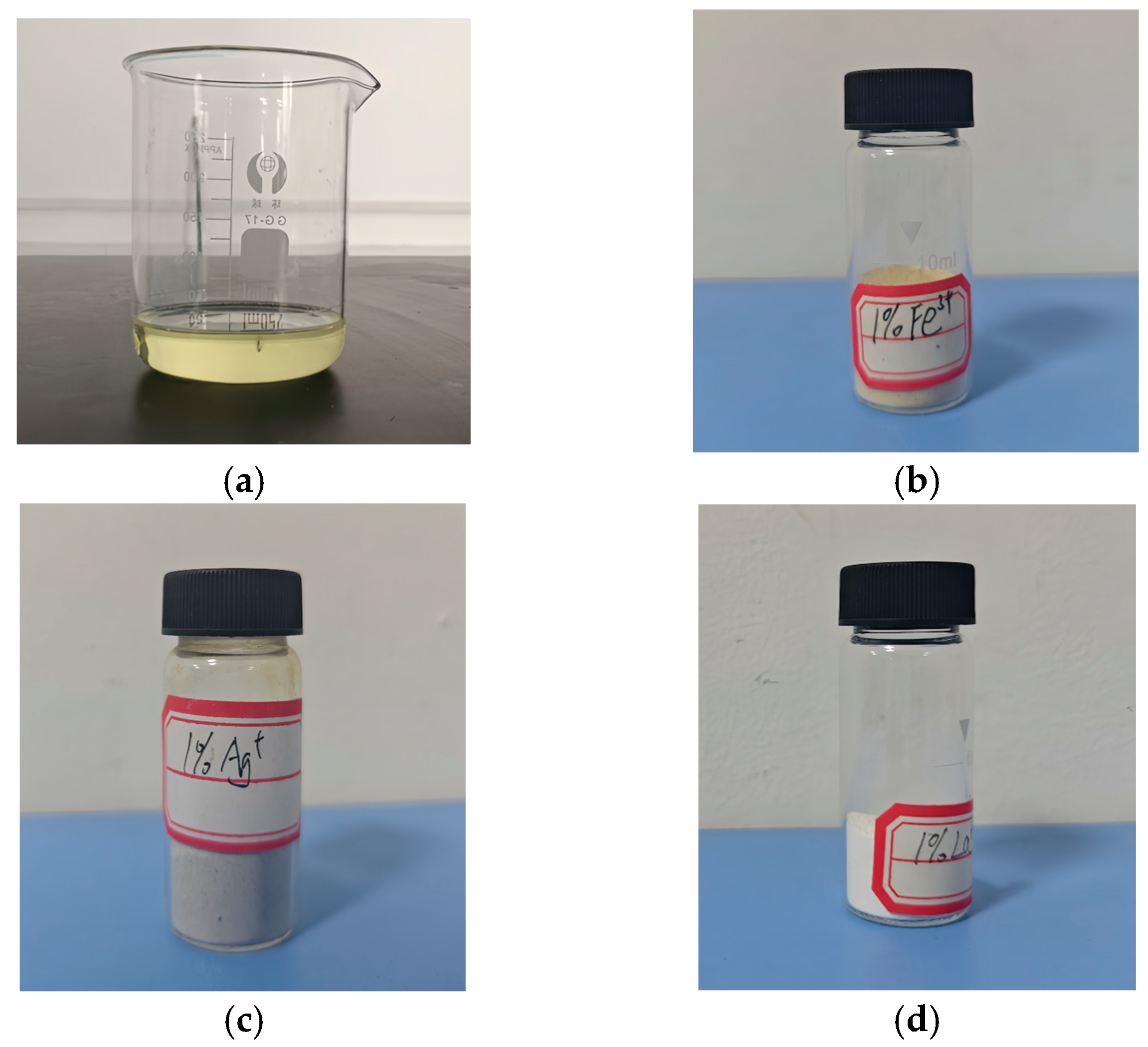
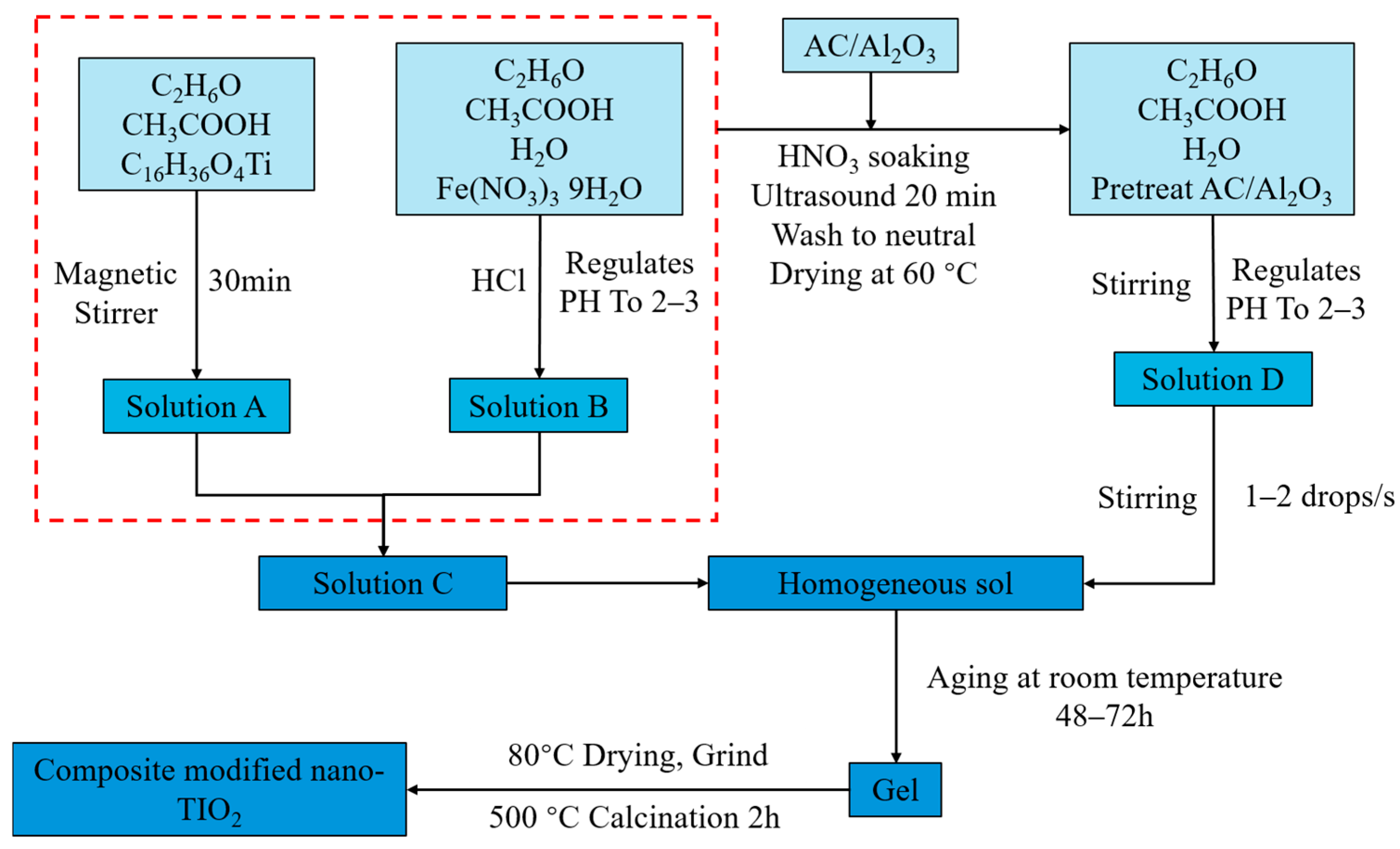
First, Solution A was prepared by mixing absolute ethanol (25 mL) and glacial acetic acid (5 mL) in a beaker, followed by the addition of butyl titanate (15 mL). The beaker was sealed with plastic wrap during magnetic stirring for 30 min at room temperature to inhibit premature hydrolysis and prevent splashing, resulting in a homogeneous, pale yellow solution (Figure 1a).
Second, Solution B was prepared by mixing absolute ethanol (20 mL), distilled water (10 mL), and glacial acetic acid (5 mL). Metal precursors (iron(III) nitrate nonahydrate, silver nitrate, and lanthanum nitrate hexahydrate) were added to achieve metal ion-to-Ti molar ratios of 0.5%, 1%, 1.5%, and 2%. The pH was adjusted to 2–3 using concentrated hydrochloric acid. For gelation, Solution B was added dropwise to Solution A via a dropping funnel at a rate of 1–2 drops/s. The resulting sol was aged at room temperature for 48–72 h to form a gel [21].
Finally, the gel was dried at 80 °C for 12 h in a blast oven to produce a xerogel [28]. The xerogel was ground and calcined at 500 °C for 2 h in a muffle furnace to obtain the metal ion-doped nano-TiO2 (Figure 1b–d).
Subsequently, support treatment was performed on 1.0% Fe3+ doped nano-TiO2 using activated carbon (AC) and aluminum oxide (Al2O3) as follows:
AC and Al2O3 were dispersed in a mixture of absolute ethanol (20 mL), distilled water (10 mL), and glacial acetic acid (5 mL) using ultrasonic agitation for 30 min to form solution D. The support contents (AC/Al2O3 to Ti) were set at 20%, 30%, 40%, and 50%, with the pH adjusted to 2–3. Solution D was added dropwise to the Fe3+-doped sol (Solution C) at 1–2 drops/s. The mixture was aged for 48–72 h to form a composite gel. The final composite was dried at 80 °C for 12 h, ground into powder, and calcined at 500 °C for 2 h.
The overall preparation scheme is illustrated in Figure 2.

2.1.2. Preparation of Photocatalytic Permeable Asphalt Mixture

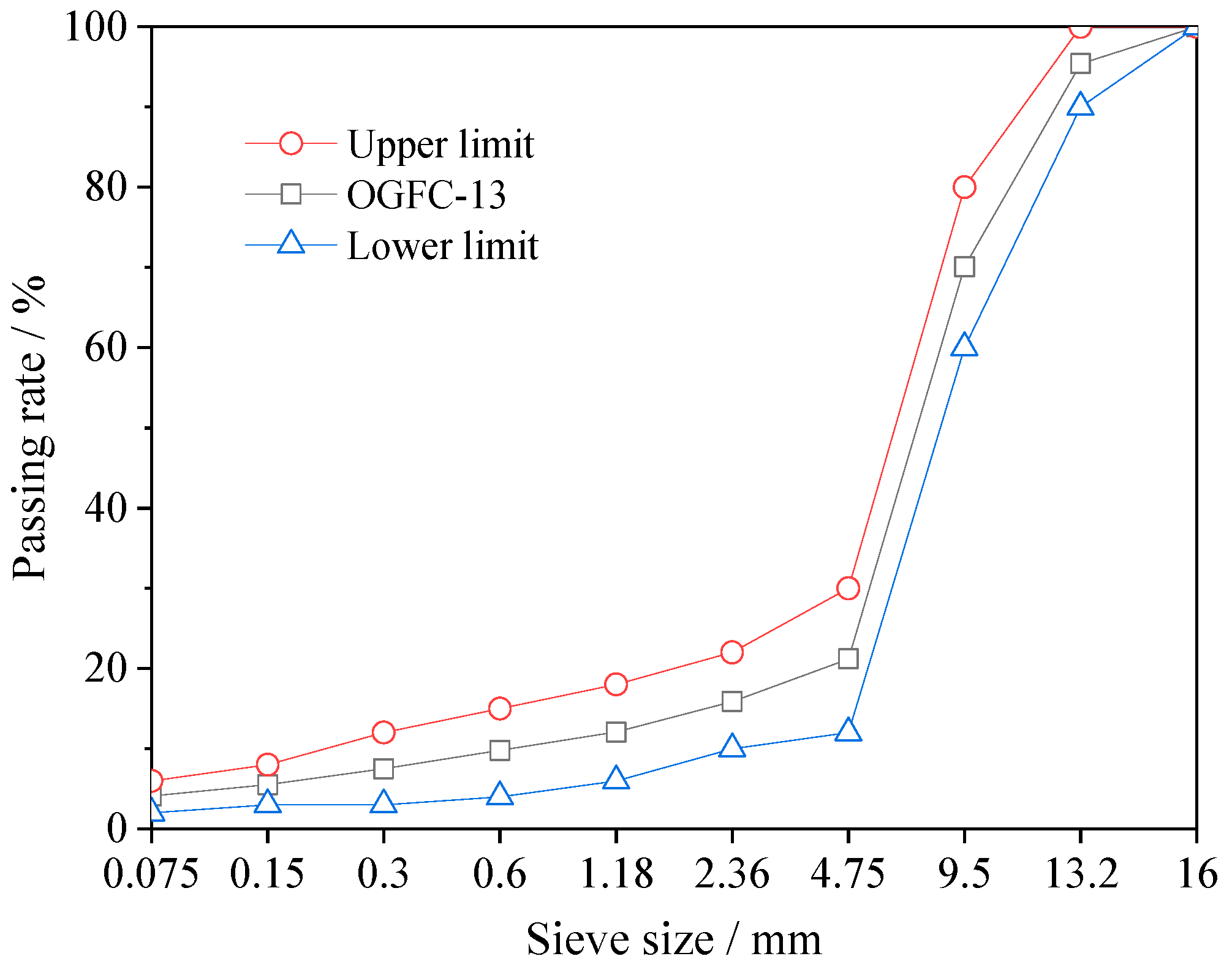
The gradation was selected as an open-graded structure to ensure interconnected voids. Specifically, the photocatalytic permeable asphalt mixture was designed with an OGFC-13 aggregate gradation, and the gradation curve is shown in Figure 3. Composite modified nano-TiO2 was used to replace the mineral filler at mass ratios of 0%, 30%, 40%, 50%, and 60%. The binder used was SBS modified asphalt, satisfying the specification requirements.
To determine the optimal asphalt content, a series of mixtures with asphalt–aggregate ratios ranging from 4.0% to 6.0% (in 0.5% increments) were prepared. The allowable range of asphalt content was established through drainage and Cantabro tests to prevent bleeding and raveling, respectively [29]. Specifically, the specimens of permeable asphalt mixture for Cantabro tests were prepared using the Marshall compaction method. The mixtures were compacted with 50 blows on each side. Based on these criteria, the optimal asphalt–aggregate ratio was determined to be 4.75%. At this dosage, the mixture achieved an air void content of 21.4% and a permeability coefficient of 1264 mL/min, which complies with the required specifications for permeable asphalt pavement [30]. The mixture gradation was uniformed by the dual targets of water permeability to mitigate waterlogging and gas diffusion to ensure exhaust gases can fully contact the nano-TiO2 [31].

2.2. Test Methods

2.2.1. Exhaust Degradation Effect of Composite Modified Nano-TiO2

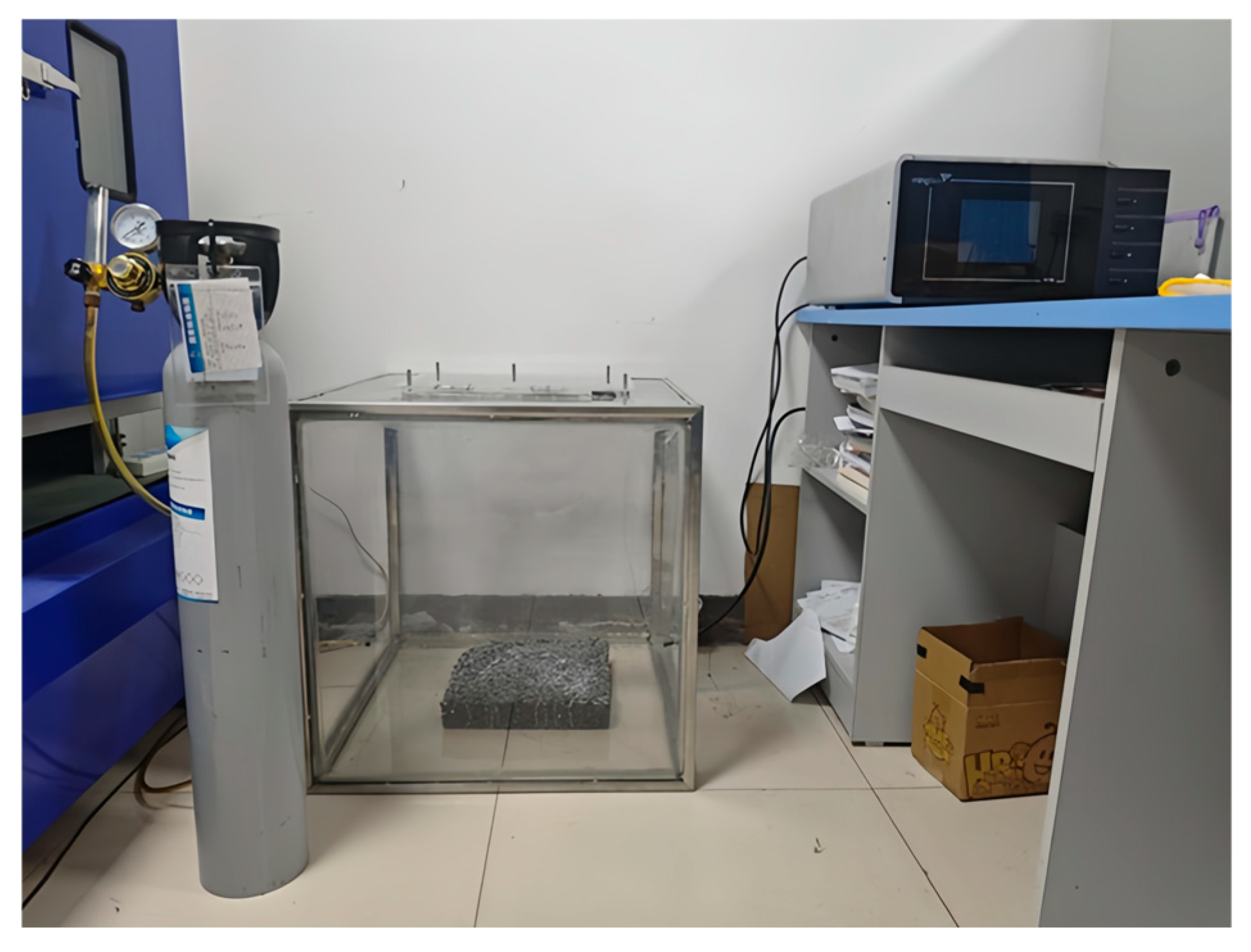
To evaluate the degradation performance of the developed composite-modified nano-TiO2 on vehicle exhaust, a specialized testing system suitable for asphalt pavement was designed in collaboration with Fuyang Xiaguang Motor Vehicle Testing Co., Ltd. (Fuyang, China). As illustrated in Figure 4, the system primarily comprises three components: an exhaust gas cylinder, a reaction chamber, and an exhaust gas analyzer, which is consistent with previous studies [3]. The photocatalytic reaction was driven by a 100 W simulated sunlight lamp providing full-spectrum irradiation to activate the photocatalyst. The light intensity was 27.8 mW/cm2, and the lamp was placed 55 cm vertically above the samples to ensure uniform illumination. The exhaust gas cylinder is a customized standard tank containing pollutant gases, such as hydrocarbons (HC) and nitrogen monoxide (NO), enabling precise control of the initial gas concentration. The exhaust gas analyzer with the model of MQW-50 made by Zhejiang Mingquan Technology Co., Ltd. (Hangzhou, China) enables real-time monitoring of pollutant concentration changes.
For the coating preparation, 0.5 g of composite modified nano-TiO2 powder was dispersed in 50 g of distilled water at a ratio of 1:100. A high-speed shear mixer homogenized the mixture at 1500 r/min for 30 min to prepare a water-based modified TiO2 coating solution. This solution was uniformly applied to a standard rutting plate (30 cm × 30 cm× 5 cm) and allowed to dry at room conditions prior to testing. Additionally, the plate specimens of the photocatalytic permeable asphalt mixture coated with unmodified nano-TiO2 solution were also prepared for exhaust degradation test. The number of parallel samples for exhaust degradation test was 3 [32].
The photocatalytic degradation tests were carried out at a controlled temperature of 25 °C, with relative humidity maintained under consistent ambient laboratory conditions. The photocatalytic degradation rate was defined as the reduction in exhaust concentration per unit reaction time. The degradation rate was calculated using Equation (1).
η = ( N t 1 N t 2 ) N W Δ t
where η is the degradation rate, ppm/min; Nt1 and Nt2 represent the gas concentrations (ppm) of the photocatalytic sample group at times t1 and t2, respectively, ppm; and Δt refers to the reaction interval, with t2 − t1 = 20 min. The term (Nt1Nt2) represents the total concentration reduction observed in the experimental group, ppm.
To isolate the photocatalytic effect from physical interference, a blank correction value NW was introduced, defined as:
N w = N t 1 N t 2
where Nt1 and Nt2 are the gas concentrations of the blank control group without nano-TiO2, ppm. The value NW represents the concentration loss due to non-photocatalytic factors such as physical adsorption, or natural decay. Therefore, subtracting NW from the sample’s total concentration difference ensures that the calculated degradation rate reflects only the net photocatalytic activity, excluding background interference.
Degradation efficiency served as the primary evaluation index for the vehicle exhaust degradation performance. It was defined as the percentage of vehicle exhaust catalytically degraded by the composite modified nano-TiO2 relative to the initial concentration over the period from 0 to 120 min, as shown in Equation (3) [15].
D = N 0 N 120 N W N 0 × 100 %
where D is the catalytic degradation efficiency, %; N0 is the initial concentration, ppm; N120 is the concentration at 120 min, ppm; NW is the correction value from 0 to 120 min, ppm.

2.2.2. Dispersion Characteristics of Composite Modified Nano-TiO2

(1) Fluorescence microscopy observation.
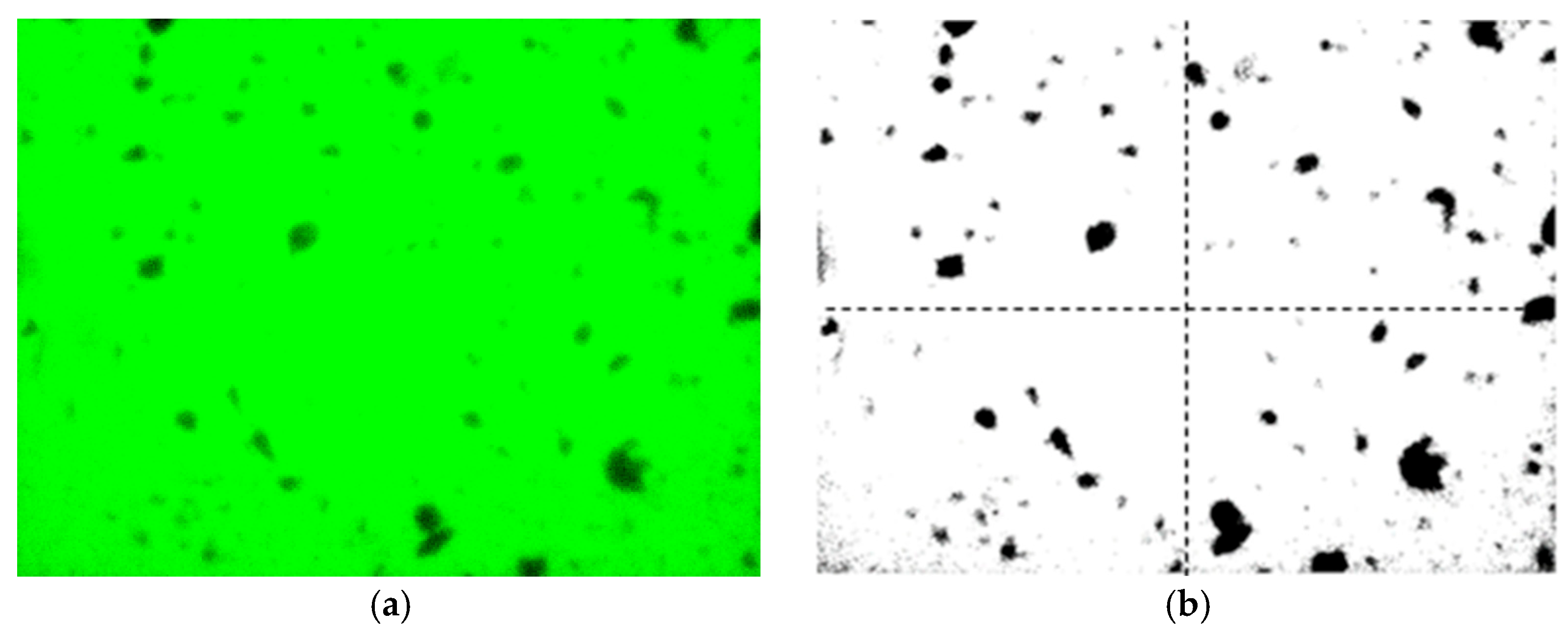
To evaluate the dispersion of composite modified nano-TiO2 within the asphalt binder following support treatment with AC and Al2O3, a fluorescence tracing method was employed [33]. The composite modified nano-TiO2 was homogenized with a fluorescent dye (C20H12O5) at a mass ratio of 100:5. Subsequently, this mixture was pre-dispersed with the asphalt binder at a ratio of 4:100 using ultrasonic vibration for 30 min followed by high-speed shear mixing at 160 °C for 15 min. Micrographs of the asphalt samples were captured using a fluorescence microscope. Image analysis was conducted using MATLAB R2024a software. The acquired images were converted into 8-bit grayscale format. Subsequently, the images were converted into binary format using Otsu’s thresholding algorithm to automatically determine the optimal threshold separating the nano-TiO2 modifier from the asphalt background. This automated approach minimizes manual bias and ensures consistency in pixel quantification [34]. The binary images were then segmented into four equal regions, as illustrated in Figure 5.
The pixel counts for the black areas and white areas in each region were quantified. The area ratio of the black phase in each region and the range of these area ratios were calculated using Equations (4) and (5), respectively.
S i = M i M i + N i
S = S max S min
where Si is the black area ratio in the i-th region; Mi and Ni are the pixel counts of the black and white areas in the i-th region, respectively; S denotes the range of the black area ratio; Smax and Smin represent the maximum and minimum black area ratios among the four regions, respectively.
(2) UV-Vis spectrophotometer test.
Furthermore, UV-Vis spectrophotometry was utilized to test the dispersion uniformity of the composite-modified nano-TiO2. Specifically, 20 mL of absolute ethanol was placed in a beaker, to which modified nano-TiO2 samples (prepared with varying AC and Al2O3 support contents) were added. The mixtures underwent ultrasonication for 30 min to prepare suspensions. After allowing the suspensions to settle for 12 h, the sedimentation behavior was visually observed. This settling duration was selected based on preliminary time-dependent experiments, where significant differences in sedimentation behavior between samples became distinct and stabilized within this period [35]. Subsequently, the absorbance of the upper liquid was measured using a UV-Vis spectrophotometer. The instrument model is UV-1950, manufactured by Beijing Puxi General Instrument Co., Ltd. (Beijing, China). The number of parallel samples for UV-Vis spectrophotometer test was 3. Higher absorbance values in the supernatant indicate better dispersion uniformity and less sedimentation of the nanoparticles [36].

2.2.3. Microscopic Properties of Composite Modified Nano-TiO2

(1) XRD test.
XRD is a fundamental technique used to characterize the crystal structure and phase composition of materials. Based on Bragg’s law, X-rays interacting with atomic lattices produce diffraction patterns via constructive interference, facilitating the determination of interplanar spacing and material identification. XRD analysis was performed on the nano-TiO2 samples doped with metal ions (Fe3+, Ag+, La3+) and loaded with supports (AC and Al2O3) to verify their crystalline phases.
Lattice parameters serve as sensitive indicators of subtle structural variations induced by metal ion doping. To further investigate the influence of metal ion type and doping content on the crystallite size, the values were calculated using the Scherrer equation (Equation (6)) [37].
D = K λ B cos θ
Specifically, the full width at half maximum (FWHM) of the most intense anatase (101) diffraction peak located at 25.6° was selected for this calculation to ensure consistency across all doped samples. In the equation, D is the crystallite size, nm; K is the Scherrer constant (typically 0.89); λ is the X-ray wavelength, nm; B is the FWHM of the diffraction peak, rad; and θ is the Bragg diffraction angle, °.
(2) FTIR test.
FTIR was employed to investigate the molecular structure and functional group composition of the samples. This technique relies on the absorption of infrared radiation by chemical bonds, which undergo vibrational transitions at specific frequencies [38]. Characteristic absorption peaks corresponding to specific bonds of C-H, O-H and C=O were analyzed to identify chemical interactions. FTIR tests were conducted on the modified nano-TiO2, including those doped with Fe3+, Ag+, and La3+, as well as those supported with AC and Al2O3.

2.2.4. Pavement Performance of Photocatalytic Permeable Asphalt Mixture

Photocatalytic permeable asphalt mixture specimens were prepared by substituting mineral filler with composite modified nano-TiO2 at replacement ratios of 30%, 40%, 50%, and 60% by weight. The composite modified nano-TiO2 was mixed with aggregate and SBS modified asphalt according to the standard mixing process of permeable asphalt mixture to ensure uniform dispersion [3]. The control group consisted of unmodified permeable asphalt mixtures were also prepared. To comprehensively evaluate the performance of the photocatalytic permeable asphalt mixture, a series of mechanical tests were conducted, including the dynamic water scouring Marshall test, low-temperature splitting test, rutting test, and four-point bending fatigue test. The number of parallel samples for pavement performance test was 3. The average value of three parallel samples was taken as the representative value. These tests assess water stability, low-temperature crack resistance, high-temperature stability, and fatigue resistance, respectively.
The detailed test parameters and evaluation indexes were as follows: An SYD-0777 hydrothermal sensitivity tester made by Shanghai Changji Geological Instrument Co., Ltd. (Shanghai, China) was employed to subject Marshall specimens to water scouring at 30 °C and 200 kPa for 3500 cycles. The scouring residual stability ratio was adopted as the evaluation index for water stability. The low-temperature splitting test was conducted at −10 °C with a loading rate of 50 mm/min. The splitting strength served as the performance indicator for low-temperature crack resistance. The rutting test was performed at 60 °C under a wheel pressure of 0.7 MPa. Dynamic stability was calculated to evaluate high-temperature stability. The fatigue test was carried out at 15 °C with a loading frequency of 10 Hz. Fatigue life was recorded as the index for fatigue resistance [31].

3. Results and Discussion

3.1. Evaluation of Exhaust Degradation Effect by Modified Nano-TiO2

3.1.1. HC Degradation Effect Analysis

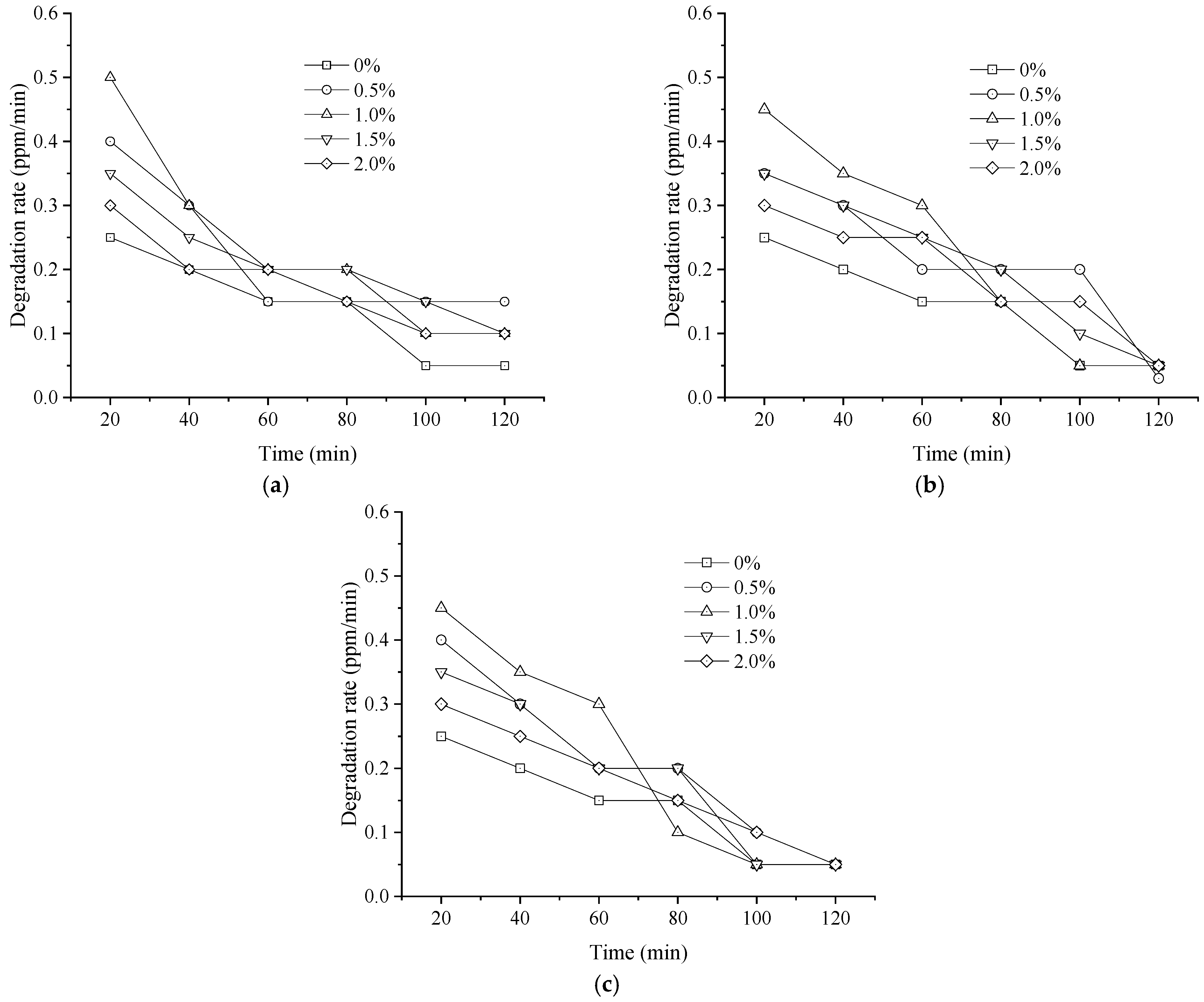
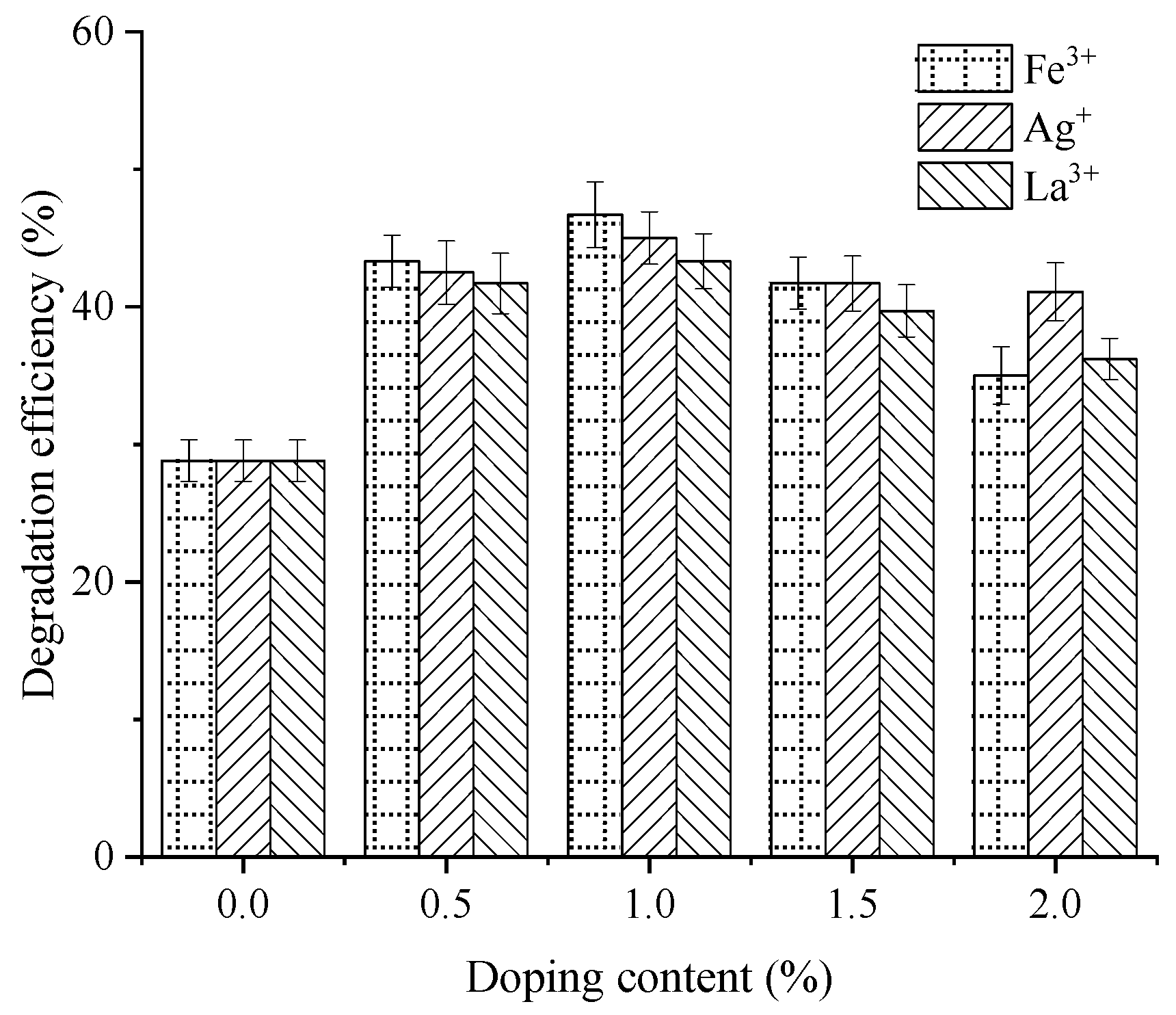
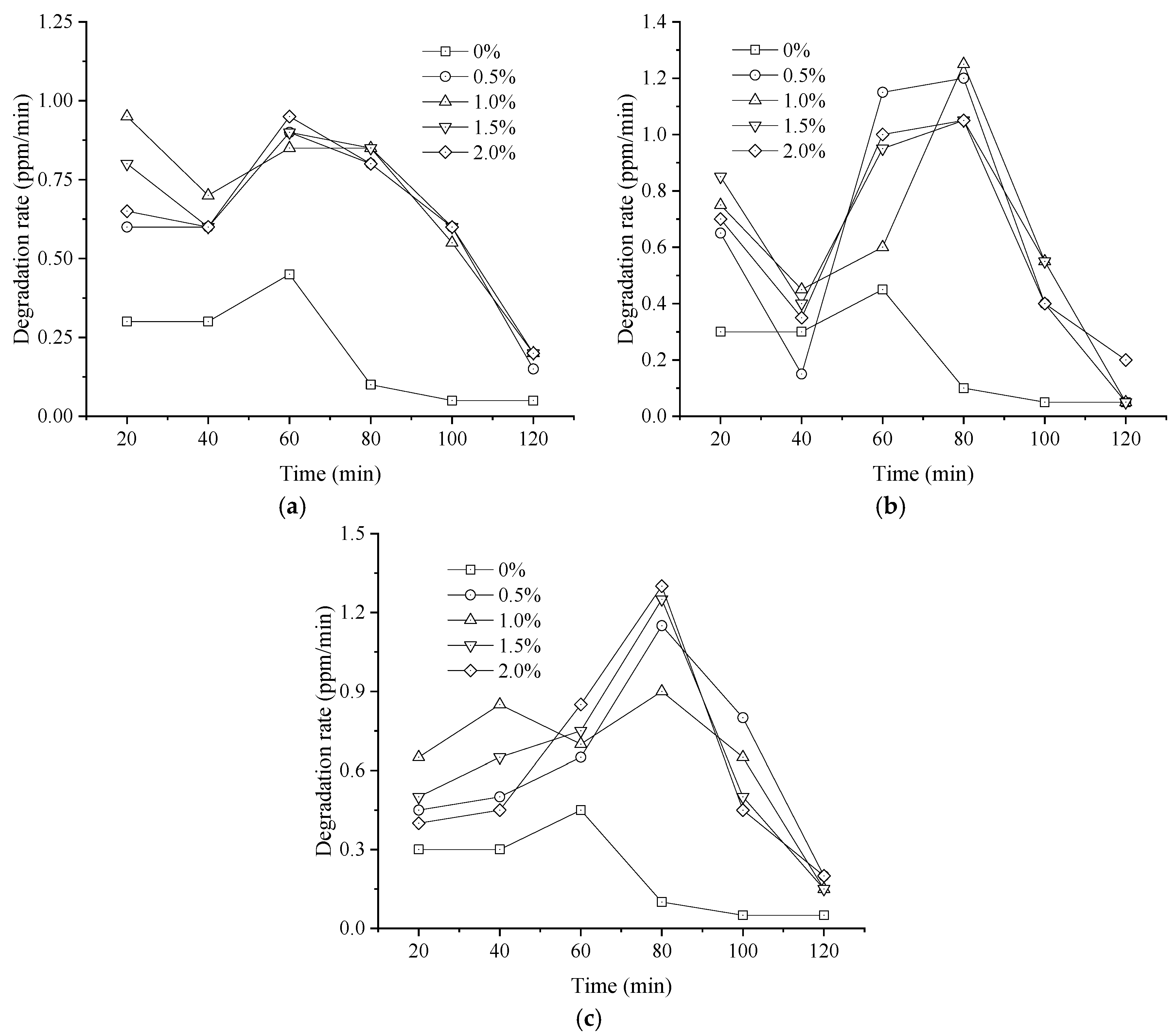
Figure 6 and Figure 7 illustrated the effects of metal ion type and doping content on the degradation rate and efficiency of HC over a 120 min period, including a control group containing unmodified nano-TiO2.
As shown in Figure 6 and Figure 7, the HC degradation rate exhibits a gradual decline over time across all Fe3+, Ag+, and La3+ doping levels. The gradual decline in degradation rate over time is not due to deactivation of the modified nano-TiO2 but reflects the photocatalytic kinetics, where the reaction rate decreases as the pollutant concentration is consumed [39]. The unmodified nano-TiO2 exhibited a slow reduction in degradation rate, whereas modification with metal ions results in a notably higher initial rate. The degradation process could be divided into three stages based on the rate profile: a rapid degradation (0–60 min), a slow degradation (60–100 min), and a stable stage (100–120 min). The degradation process transitions from an initial rapid stage driven by high concentration gradients and abundant active sites, to a slow stage limited by decreased collision frequency and intermediate competition, and finally to a stable stage reflecting adsorption–desorption equilibrium at low concentrations [3]. Taking the initial 20 min interval as an example, the degradation rate for unmodified nano-TiO2 was 0.25 ppm/min. These rates were calculated using Equation (1) over a fixed time interval (Δt = 20 min). Metal ion doping markedly enhances this rate. Specifically, at doping contents of 0.5%, 1.0%, 1.5%, and 2.0%, the HC degradation rates for Fe3+-doped nano-TiO2 were 0.40, 0.50, 0.35, and 0.30 ppm/min, respectively. For Ag+-doped nano-TiO2, the rates were 0.35, 0.45, 0.35, and 0.30 ppm/min. For La3+-doped nano-TiO2, they were 0.40, 0.45, 0.35, and 0.30 ppm/min. Notably, the 1.0% Fe3+-doped sample exhibited the highest degradation rate (0.50 ppm/min) in this interval, outperforming the Ag+ and La3+ samples at the same concentration. The influence of metal ion type and content on HC degradation rate in other time intervals was consistent with the trends observed at 0–20 min.
Meanwhile, substantial differences in the cumulative HC degradation efficiency were evident among the various composite modifiers after 120 min. The unmodified nano-TiO2 achieved an efficiency of 28.8%. For Fe3+-doped samples (0.5%, 1.0%, 1.5%, and 2.0%), efficiencies reached 43.3%, 46.7%, 41.7%, and 35.0%, corresponding to increases of 50.4%, 62.0%, 44.6%, and 21.5% over the unmodified control, respectively. For Ag+-doped samples, efficiencies were 42.5%, 45.0%, 41.7%, and 41.1%, representing improvements of 47.5%, 56.2%, 44.6%, and 42.5%. For La3+-doped samples, efficiencies were 41.7%, 43.3%, 39.7%, and 36.2%, reflecting increases of 44.6%, 50.3%, 37.6%, and 25.7%. Evidently, the optimal HC degradation efficiency was achieved at a doping content of 1.0% for Fe3+, Ag+, and La3+ during material preparation. At this concentration, the HC degradation efficiencies for Fe3+, Ag+, and La3+-modified nano-TiO2 reached 46.7%, 45.0%, and 43.3%, respectively. Moreover, to contextualize these findings, the results were benchmarked with recent studies on nano-modified pavements. Compared to single-doped nano-TiO2 studies in semi-flexible pavements [14] or cement mortar [16], the composite modified nano-TiO2 in this study achieved higher HC degradation efficiency, attributed to the synergistic effects of metal ion doping and support treatment [23].

3.1.2. NO Degradation Effect Analysis

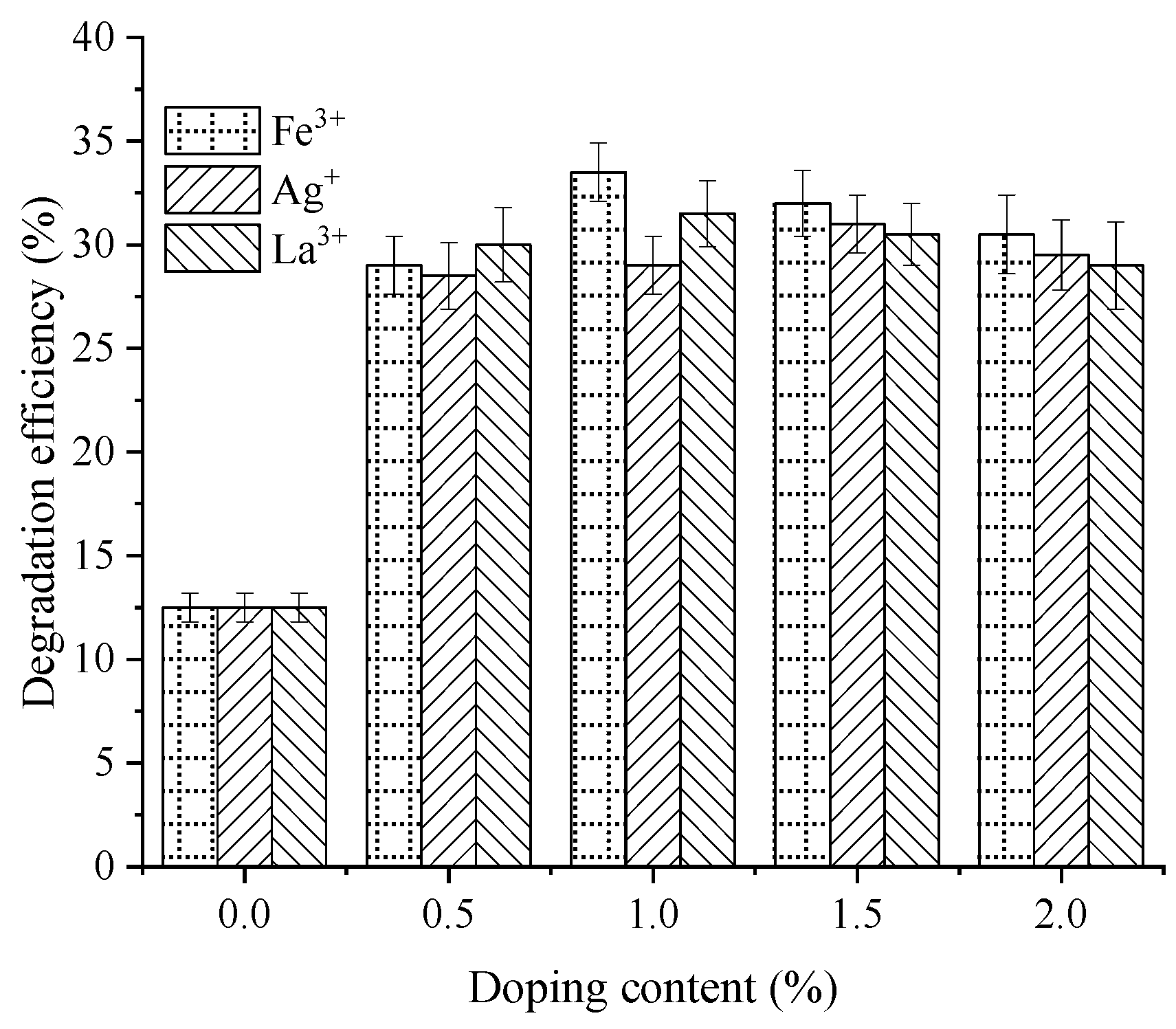
The effects of modified nano-TiO2 with varying Fe3+, Ag+, and La3+ contents on NO degradation rate and efficiency within 120 min are illustrated in Figure 8 and Figure 9. The control group for this test consisted of asphalt mixture specimens containing unmodified nano-TiO2.
As shown in Figure 8 and Figure 9, the NO degradation rate of modified nano-TiO2 fluctuated over time under different doping contents, with relatively high rates observed during the 0–20 min and 60–80 min intervals. These rates were calculated based on the concentration difference over each 20 min interval. In the initial 20 min interval, the NO degradation rate of the control group was 0.30 ppm/min. Compared with the control group, at metal ion contents of 0.5%, 1.0%, 1.5%, and 2.0%, the NO degradation rates for Fe3+-doped nano-TiO2 increased by 100.0%, 216.7%, 166.7%, and 116.7%, respectively. For Ag+-doped nano-TiO2, the degradation rates increased by 116.7%, 150.0%, 183.3%, and 133.3%. For La3+-doped nano-TiO2, the rates increased by 50.0%, 116.7%, 66.7%, and 33.3%. The maximum NO degradation rates were observed at doping contents of 1.0% for Fe3+, 1.5% for Ag+, and 1.0% for La3+. Furthermore, the NO degradation efficiency of Fe3+-doped nano-TiO2 was generally higher than that of the Ag+ and La3+ variants.
Moreover, regarding total efficiency over 120 min, the unmodified nano-TiO2 reached 12.5%. For Fe3+-doped samples (0.5%, 1.0%, 1.5%, and 2.0%), NO degradation efficiencies were 29.0%, 33.5%, 32.0%, and 30.5%. These values represent increases of 132.0%, 168.0%, 156.0%, and 144.0% compared with the unmodified group. For Ag+-doped samples, the efficiency improvements relative to the control were 128.0%, 132.0%, 148.0%, and 136.0% for doping contents of 0.5%, 1.0%, 1.5%, and 2.0%, respectively. For La3+-doped samples, efficiencies increased by 140.0%, 152.0%, 144.0%, and 132.0%. Consequently, the peak NO degradation efficiencies were achieved at Fe3+, Ag+, and La3+ contents of 1.0%, 1.5%, and 1.0%, respectively, reaching 33.5%, 31.0%, and 31.5%.

3.2. Evaluation of Dispersion Properties of Composite Modified Nano-TiO2

3.2.1. Quantitative Analysis of Dispersion Uniformity

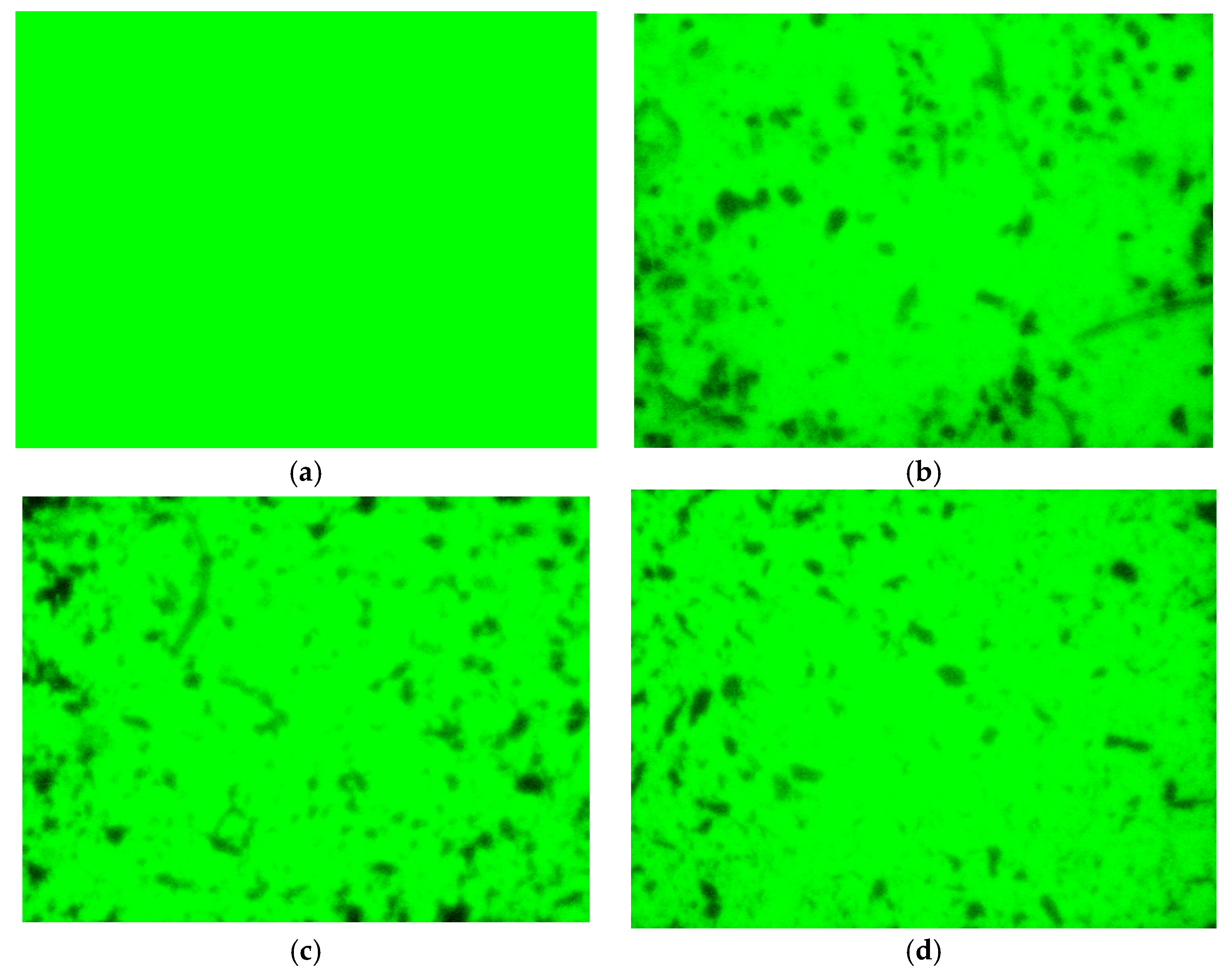
AC and Al2O3 were employed as supports for Fe3+-doped modified nano-TiO2 (1.0% doping content). The dispersion of the composite modified nano-TiO2 in asphalt under varying AC and Al2O3 contents is illustrated in Figure 10.
As shown in Figure 10, the asphalt doped solely with the fluorescent dye exhibited a homogeneous green background. This indicated that the fluorescent dye added to the asphalt does not interfere with the subsequently loaded nano-TiO2. Compared with the modified nano-TiO2 without support, AC and Al2O3 supports improved the dispersion of modified nano-TiO2 within the asphalt binder and effectively reduced agglomeration. This enhancement increased the contact area between the modified nano-TiO2 and exhaust gases, thereby boosting exhaust gas degradation efficiency. However, the benefit of the support treatment on dispersion diminished as the support content increased beyond a certain threshold.
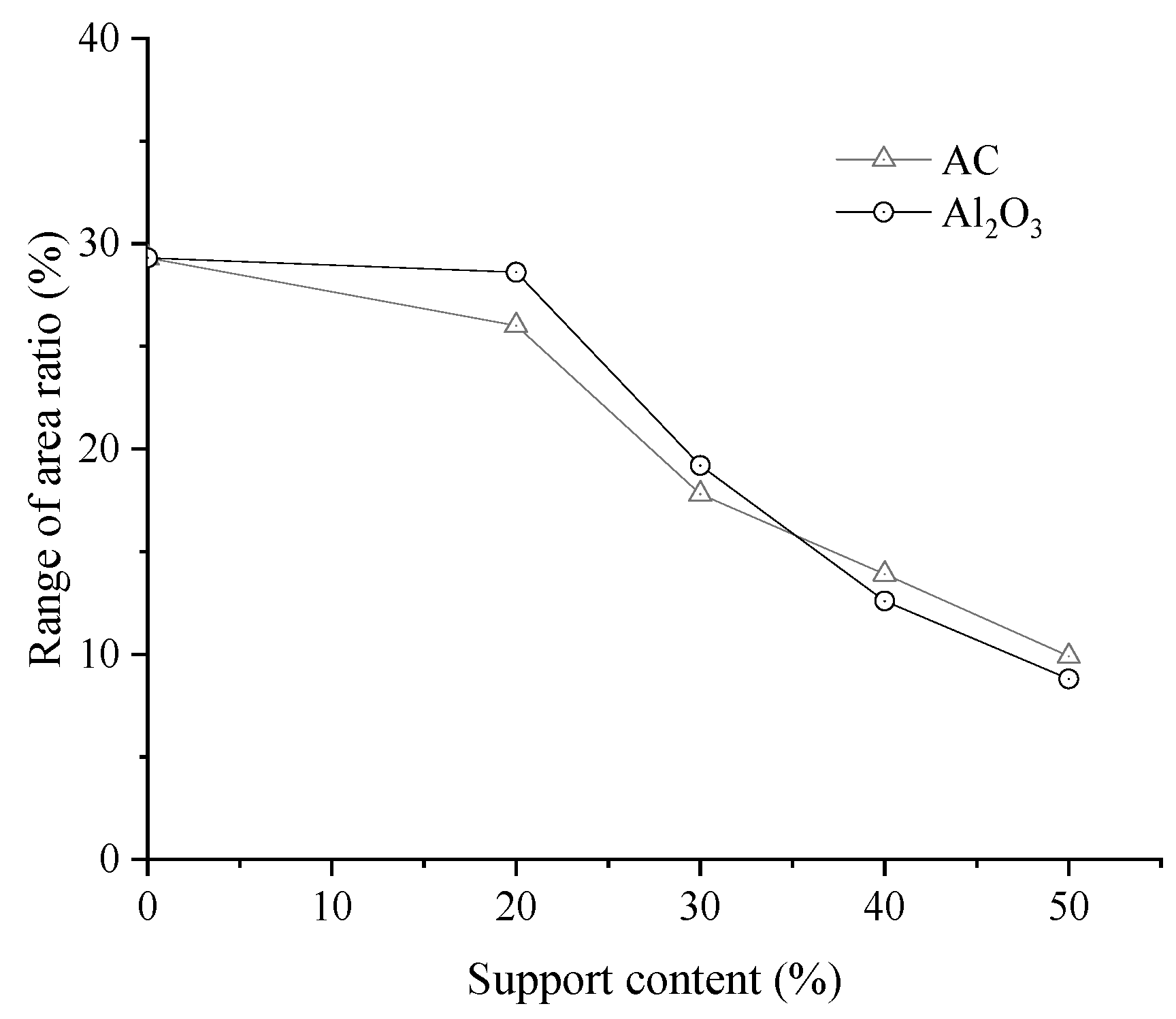
To quantitatively analyze the effect of AC and Al2O3 supports on dispersion, the asphalt images were processed using MATLAB. The range of area ratios of the black regions under different support conditions is presented in Figure 11.
As illustrated in Figure 11, both the type of supports and the support content influenced the dispersion of modified nano-TiO2 in asphalt. With increasing support content, the dispersion uniformity of the composite initially improved and subsequently stabilized. The range of area ratios for unsupported nano-TiO2 was 29.3%. At support contents of 20%, 30%, 40%, and 50%, the ranges of area ratios for AC-supported nano-TiO2 decreased by 11.3%, 39.2%, 52.6%, and 66.2%, respectively. For Al2O3-supported nano-TiO2, the corresponding decreases were 2.4%, 34.5%, 57.0%, and 70.0%. At lower support contents (20% and 30%), the ranges of area ratios of AC-supported samples were lower than those of the Al2O3-supported samples, indicating more uniform dispersion. However, after the support content exceeded 40%, the Al2O3-supported samples exhibited a smaller range of area ratios, reflecting superior compatibility and bonding strength between Al2O3 and the modified nano-TiO2. This ensured uniform dispersion, minimized agglomeration, and maximizes the contact area with asphalt, thereby enhancing exhaust gas degradation performance.

3.2.2. Characterization and Verification of Dispersion Uniformity

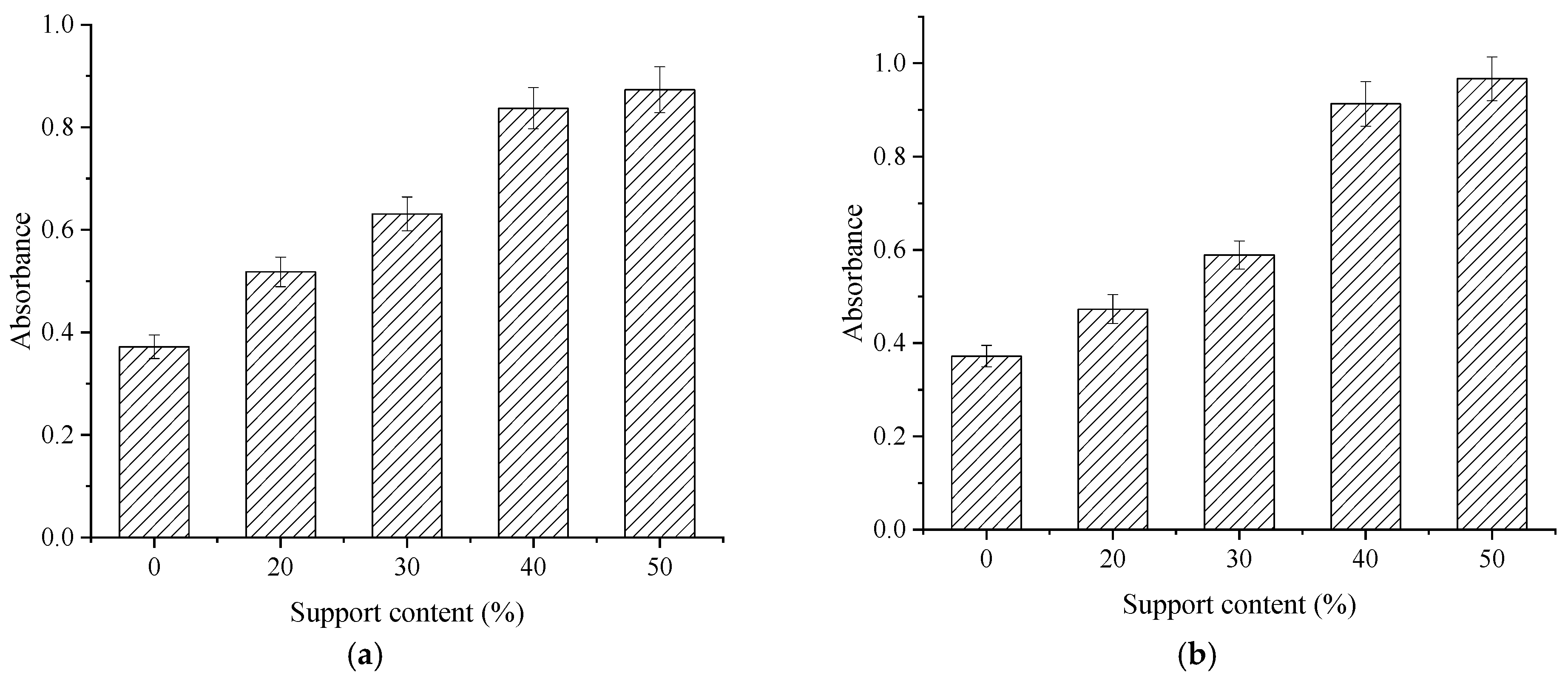
To further verify the dispersion uniformity of the composite modified nano-TiO2, UV–Vis spectrophotometry was conducted on treated suspensions, with results presented in Figure 12.
As shown in Figure 12, the absorbance of the unsupported nano-TiO2 suspension was relatively low, at 0.372. With the increase in AC and Al2O3 support contents, the absorbance of the composite suspensions increased progressively, indicating effectively improved dispersion uniformity. Compared with the unsupported sample, the absorbance of AC-supported samples increased by 39.2%, 69.6%, 125.0%, and 134.7% at support contents of 20%, 30%, 40%, and 50%, respectively. For Al2O3-supported samples, the increases were 27.2%, 58.3%, 145.4%, and 159.9%, respectively. At support contents of 20% and 30%, the dispersion uniformity was only partially improved, suggesting insufficient support coverage for the modified nano-TiO2. When the support content reached 40%, the absorbance increased notably, indicating that the modified nano-TiO2 is fully supported on the surfaces of AC and Al2O3, effectively reducing agglomeration. At 50% support content, the rate of increase in absorbance diminished, suggesting that the support surfaces are saturated and optimal dispersion uniformity is achieved. Consistent with the fluorescence microscopy results, a support content of 40% for both AC and Al2O3 effectively reduced agglomeration and improved uniformity. Notably, the dispersion effect of Al2O3-supported nano-TiO2 is superior to that of the AC-supported samples. Therefore, Al2O3 with a support content of 40% is recommended as the optimal support for modified nano-TiO2.

3.3. Microstructural Characterization and Enhancement Mechanism

3.3.1. Crystallographic Properties and Crystallite Size Effects

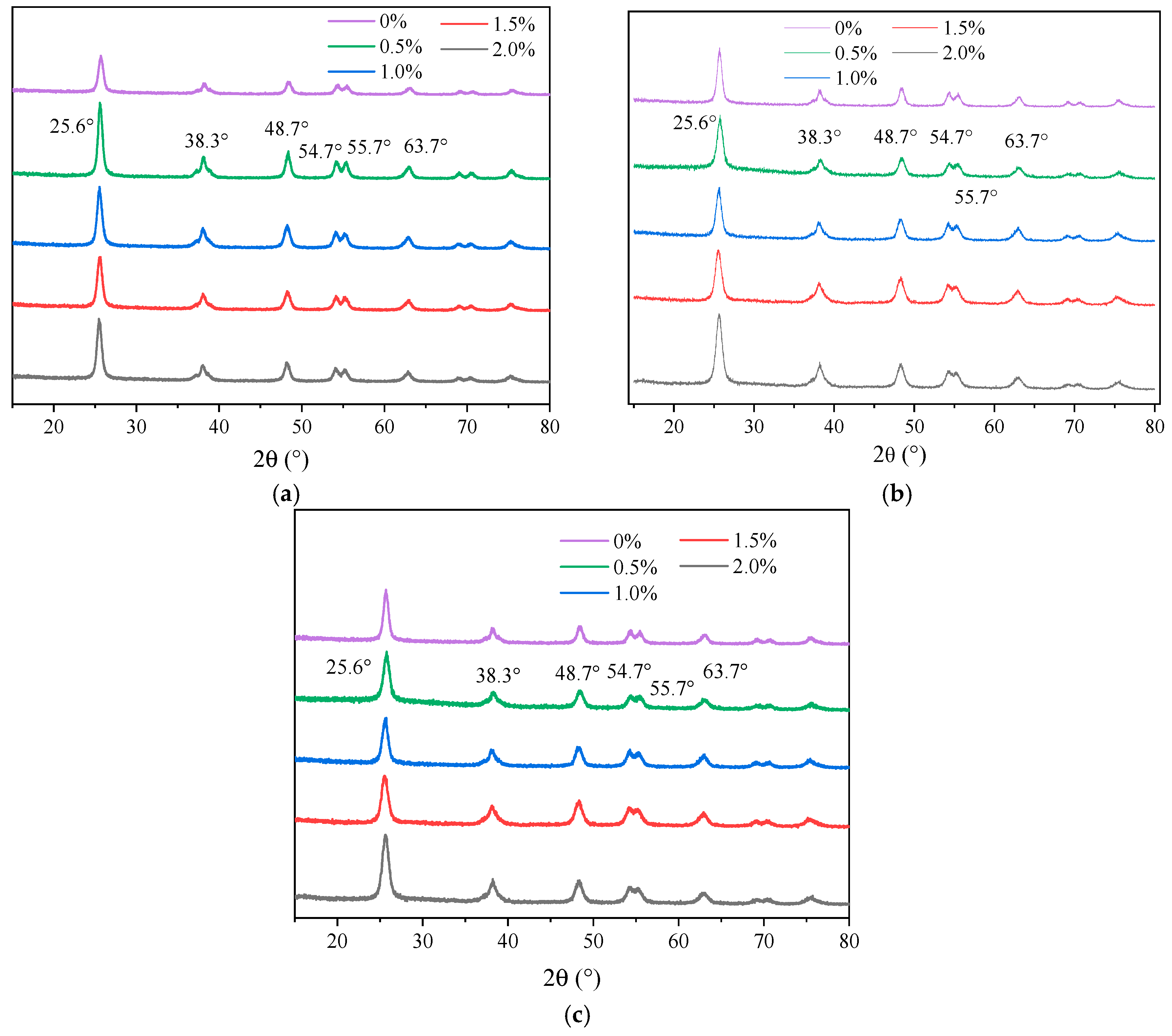
The XRD patterns of nano-TiO2 doped with Fe3+, Ag+, and La3+ at various concentrations are presented in Figure 13.
As shown in Figure 13, the diffraction peaks of the unmodified nano-TiO2 were located at 2θ = 25.6°, 38.3°, 48.7°, 54.7°, 55.7°, and 63.7°, corresponding to the (101), (004), (200), (105), (211), and (204) crystal planes of anatase TiO2, respectively. This confirmed that the samples prepared via the sol–gel method using tetrabutyl titanate as the precursor consist primarily of the anatase phase [40]. Notably, no characteristic diffraction peaks corresponding to metal oxide impurities or secondary phases derived from Fe3+, Ag+, or La3+ were detected in any of the doped samples. However, the intensity and full width at half maximum of the diffraction peaks vary depending on the type and content of the doped metal ions. These changes suggested that during the doping process, metal ions substitute for Ti4+ ions within the nano-TiO2 lattice. Such substitution introduced lattice defects, inhibited crystal growth, and consequently altered the crystallite size of the materials [41].
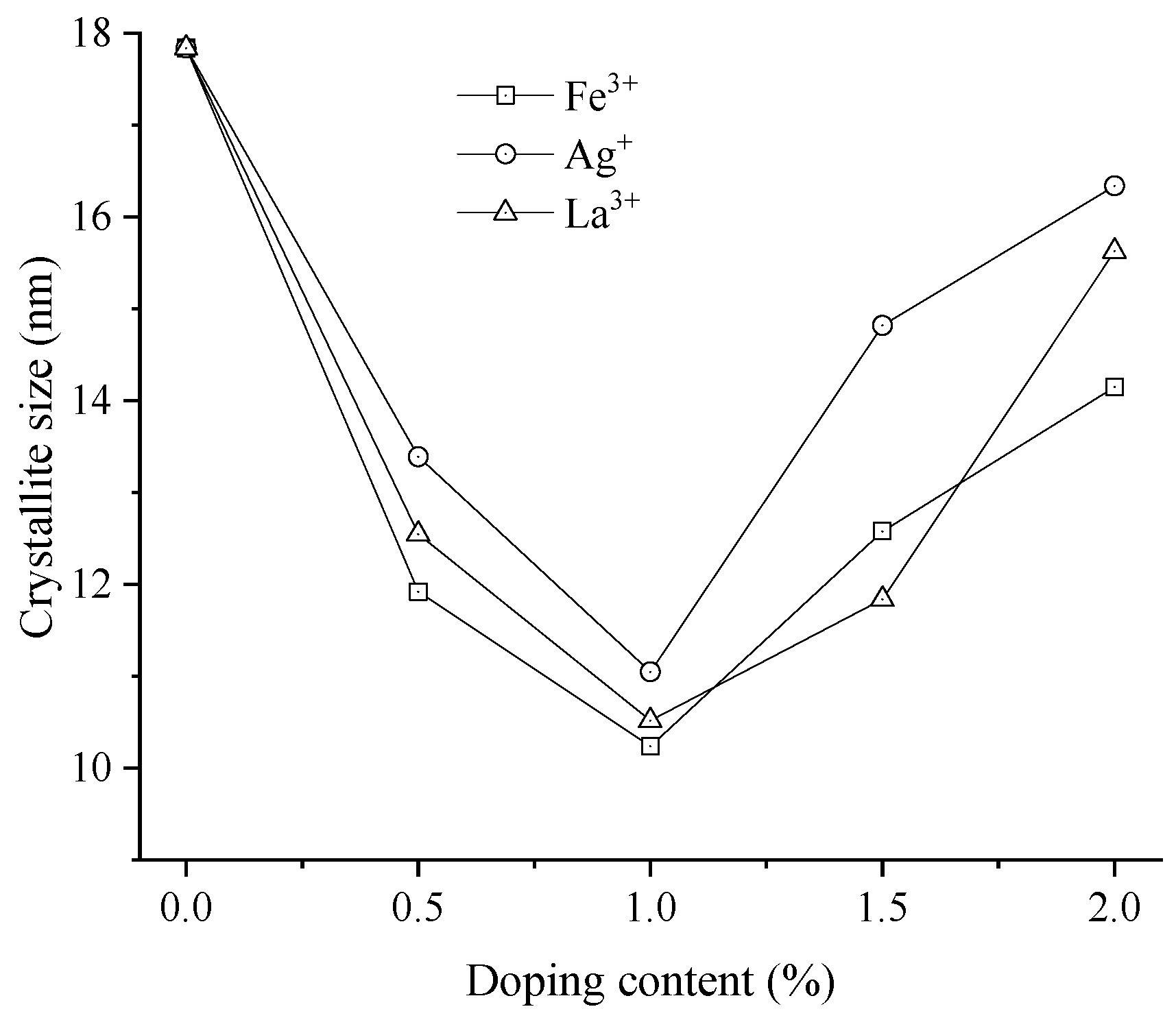
Given that particle size is a critical parameter influencing the photocatalytic performance of the modified nano-TiO2 [42], rigorous characterization was conducted to quantify the effects of different metal ion doping modifications. The calculated crystallite sizes of the modified nano-TiO2 samples with different metal ion types and contents are presented in Figure 14.
As illustrated in Figure 14, the crystallite size of the modified nano-TiO2 varied obviously with metal ion content. The trend showed an initial decrease followed by an increase, reaching a minimum value at a doping content of 1.0%. This behavior aligned with recent studies on metal-doped TiO2, where low doping concentrations inhibit grain growth by restricting crystal nucleation and growth, while excessive doping leads to dopant agglomeration and subsequent crystallite coarsening [43]. At this optimal doping content, the crystallite sizes for Fe3+-, Ag+-, and La3+-doped nano-TiO2 were 10.24 nm, 11.05 nm, and 10.52 nm, respectively. These metal ions induced lattice contraction or distortion depending on their ionic radii relative to Ti4+. Specifically, Fe3+ possessed a radius similar to Ti4+, facilitating substitutional doping and lattice contraction, while larger ions (La3+ and Ag+) tended to occupy interstitial sites, causing lattice distortion. Smaller crystallite sizes enhanced the surface-to-volume ratio, effectively increasing the contact area with exhaust gases and promoting photocatalytic reaction kinetics [44]. Thus, the modulation of crystallite size via metal ion doping directly governed the photocatalytic performance and exhaust degradation efficiency.
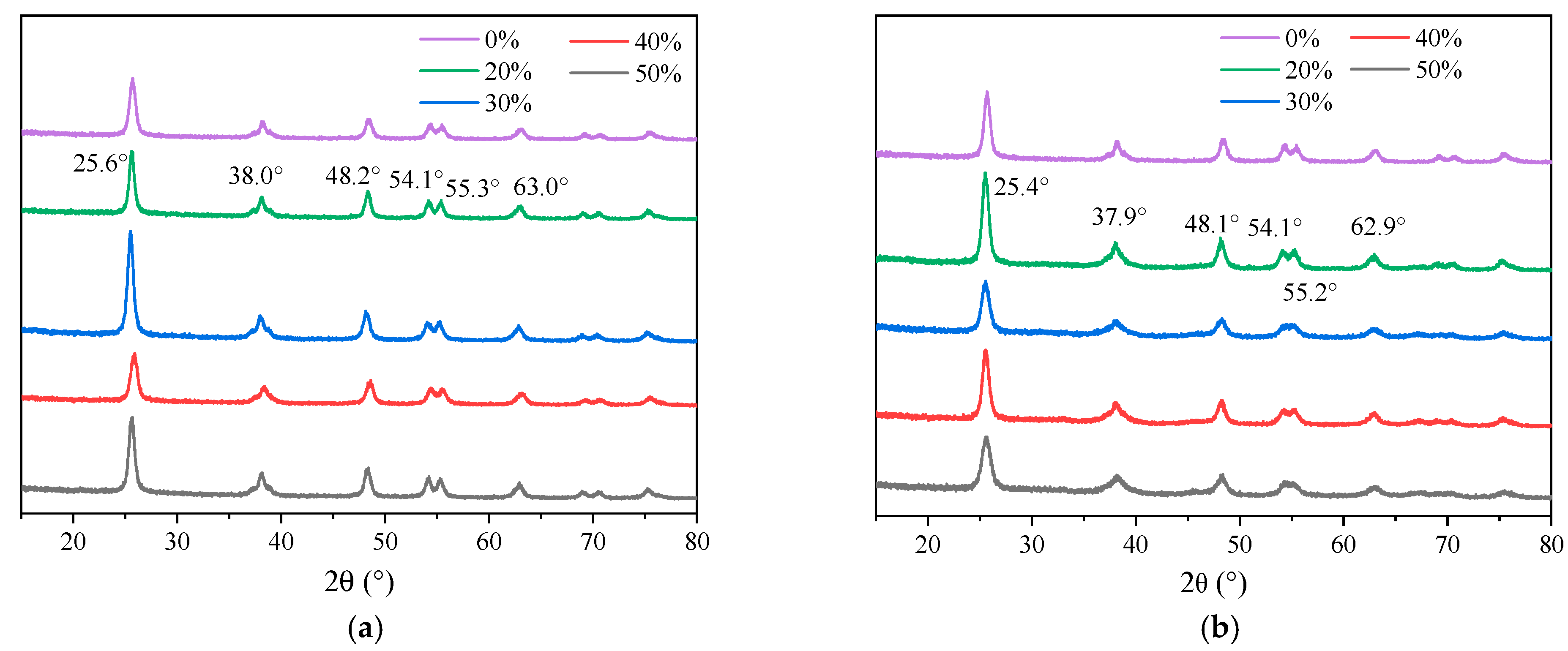
Moreover, the XRD patterns of the composite modified nano-TiO2, prepared by supporting 1.0% Fe3+-doped nano-TiO2 with AC and Al2O3, are shown in Figure 15.
As shown in Figure 15, the composite samples retained the characteristic diffraction peaks of anatase TiO2 at 2θ = 25.6°, 38.0°, 48.2°, 54.1°, 55.3°, and 63.0°. The preservation of this crystalline structure is crucial for maintaining high photocatalytic activity [45]. No characteristic peaks corresponding to crystalline carbon phases were detected, likely due to peak overlap or the amorphous nature of the activated carbon. Similarly, the absence of new peaks in the Al2O3-supported samples was attributed to the amorphous structure or low crystallinity of the aluminum oxide support. This suggested that the sol–gel preparation may induce interactions between Al and Ti species, potentially generating amorphous Ti-Al-O structures [46]. Furthermore, while the peak intensity varied with AC and Al2O3 content, the maintained peak positions indicated that the supports combine well with the modified nano-TiO2 without disrupting its crystalline framework. This structural compatibility provided a favorable basis for the improved dispersion of composite modified nano-TiO2 in the asphalt.

3.3.2. Surface Chemical States and Hydroxyl Group Enrichment

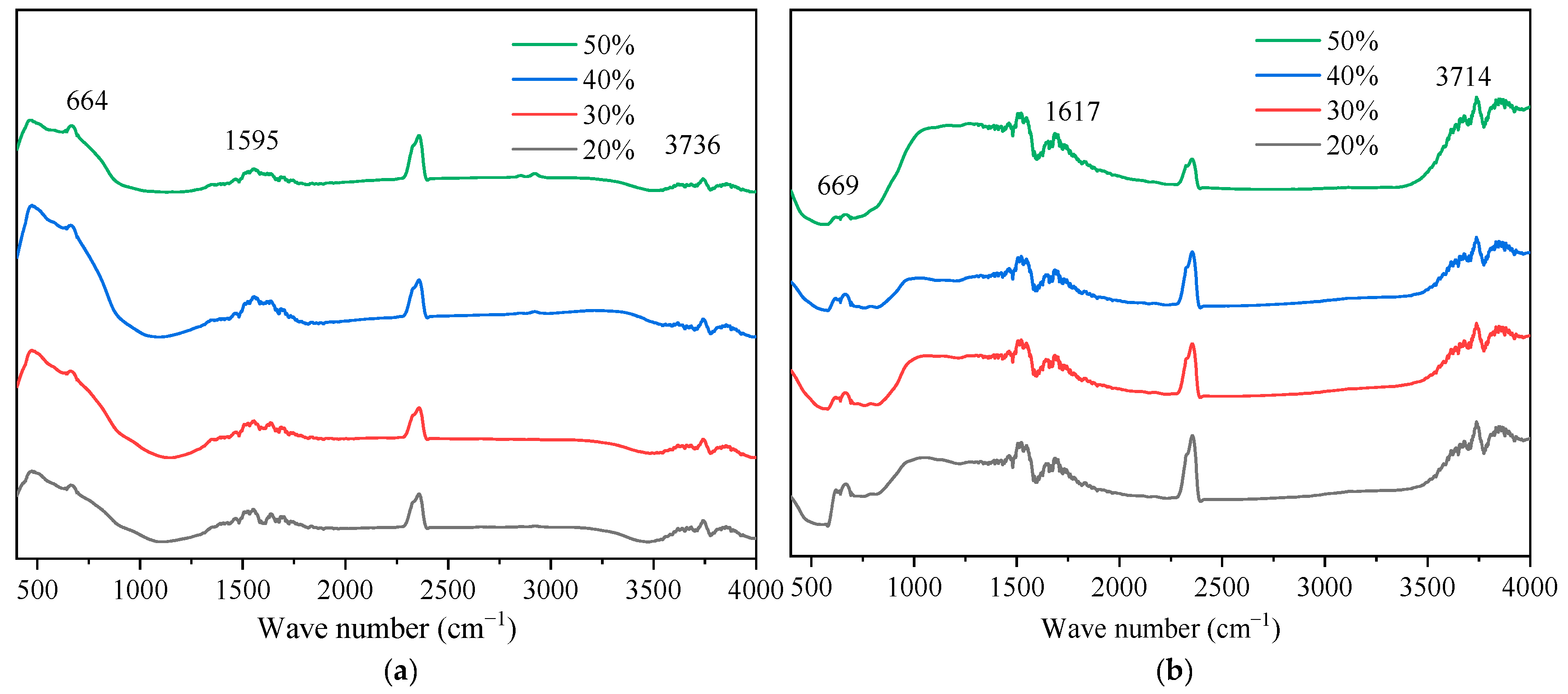
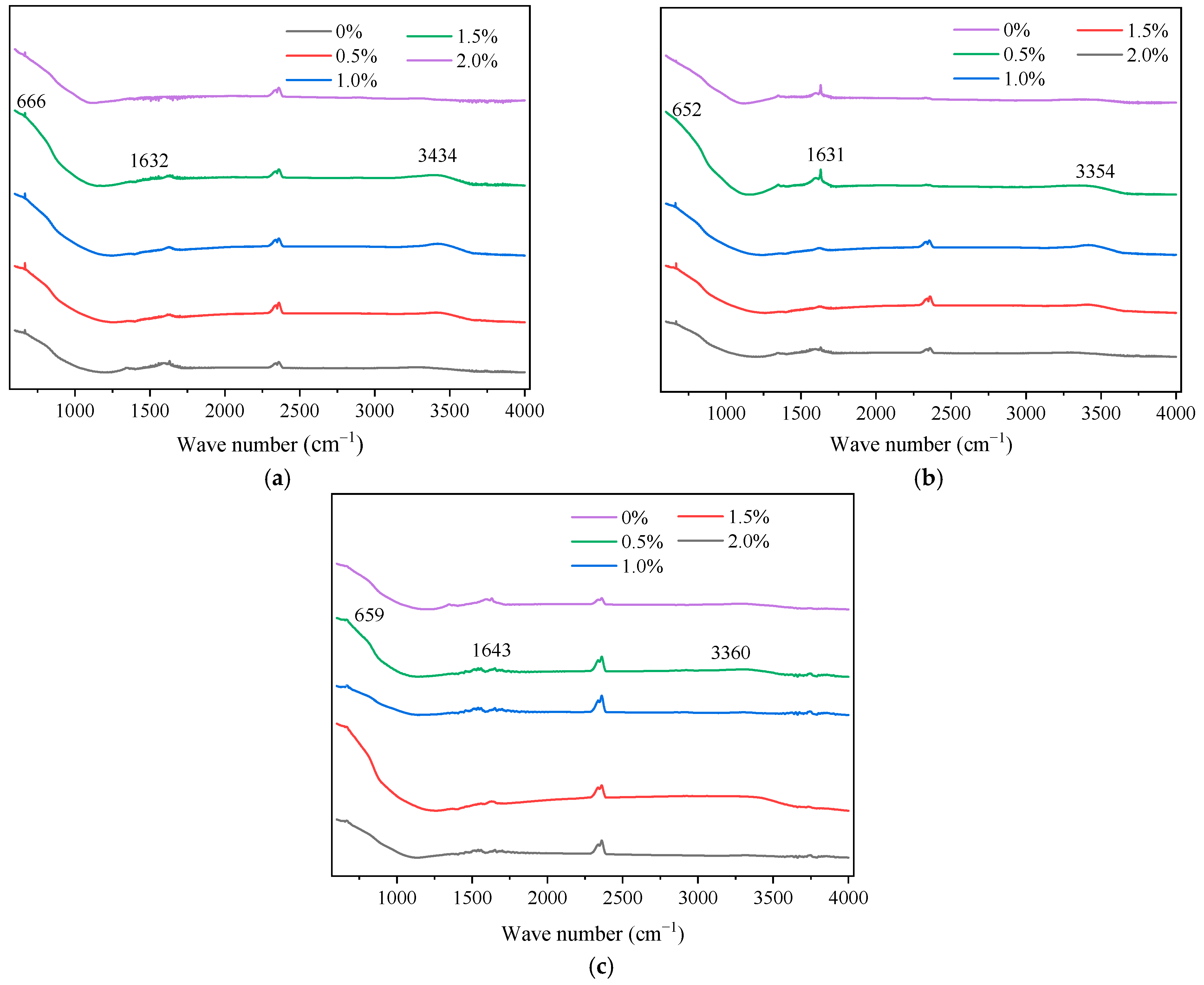
Complementing the crystallographic analysis, FTIR spectroscopy was employed to elucidate the surface chemical states and hydroxyl group enrichment of the metal ion-doped nano-TiO2 samples. The resulting infrared spectra are presented in Figure 16.
As depicted in Figure 16, the spectra of the metal ion-doped samples retained the fundamental structural features of unmodified nano-TiO2, with distinct absorption bands attributed to Ti-O-Ti stretching vibrations observed in the 500–800 cm−1 range. The absorption peak near 1632 cm−1 corresponded to the bending vibration of H-O-H bonds in absorbed water, while the broad band centered around 3473 cm−1 was assigned to the stretching vibration of O-H bonds in bound water molecules. The increased intensity of these peaks indicated that the modified nano-TiO2 has a greater affinity for atmospheric water adsorption, resulting in increased surface hydroxyl density. Since a higher concentration of surface -OH groups facilitates the generation of hydroxyl radicals under visible light irradiation, this enrichment directly contributes to enhanced photocatalytic activity and exhaust gas degradation efficiency [47]. Additionally, the absence of new characteristic peaks corroborated the XRD findings, confirming that metal ions are incorporated into the lattice without forming separate oxide phases. Regarding the influence of doping content, the absorption peak near 660 cm−1 exhibited a noticeable shift as the metal ion content increased, accompanied by a gradual weakening of the Ti-O bond intensity. Consistent with the lattice substitution mechanism identified in the XRD analysis, this indicated that Fe3+, Ag+, and La3+ ions substitute for Ti4+ within the lattice, disrupting lattice symmetry and reducing Ti-O absorption peak intensity [48]. Moreover, the integrated area of the absorption peaks initially increased and subsequently decreased with rising metal ion content.
Furthermore, the FTIR spectra of the composite modified nano-TiO2 supported by AC and Al2O3 are presented in Figure 17.
As illustrated in Figure 17, the composite samples exhibited similar spectral profiles across different support contents. Characteristic absorption peaks were observed at 664.2, 1594.7, and 3736.1 cm−1 for the AC-supported samples, and at 668.6, 1617.4, and 3713.5 cm−1 for the Al2O3-supported samples. The intensity of these peaks varied with support content. Specifically, shifts in the Ti-O absorption band were attributed to interfacial interactions between the support materials and the nano-TiO2 lattice during sol–gel processing and calcination [49]. These interactions are critical for influencing the dispersion behavior of the composite samples. Additionally, the peaks near 1594.7 cm−1 and 3713.5 cm−1 (assigned to H-O-H bending and O-H stretching, respectively) showed increased intensity and area, indicating a further enrichment of surface hydroxyl groups induced by support modification. This enhancement introduces additional active sites and promotes hydroxyl formation, which effectively reduces agglomeration through improved surface compatibility. Consequently, this provides a chemical basis for the improved dispersion uniformity of the composite modified nano-TiO2 within the asphalt binder.

3.4. Performance Analysis of Photocatalytic Permeable Asphalt Mixture

To evaluate the exhaust degradation effect and pavement performance of the composite modified nano-TiO2, photocatalytic permeable asphalt mixtures were prepared by replacing mineral filler with composite modified nano-TiO2 at dosages of 30%, 40%, 50%, and 60%. Both exhaust degradation tests and pavement performance experiments were conducted on the prepared mixtures.

3.4.1. Analysis of Exhaust Degradation Effect

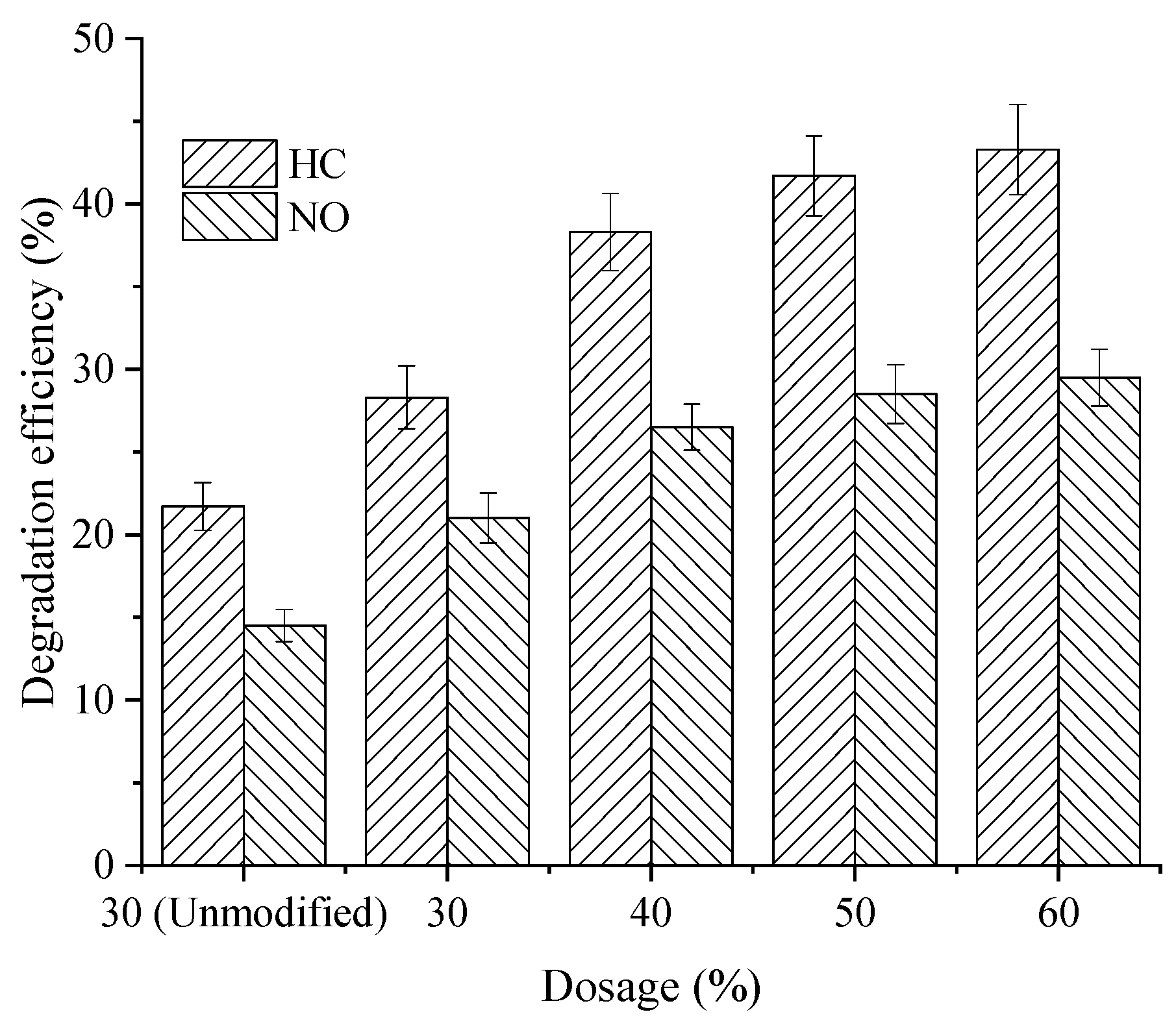
The variation in HC and NO degradation efficiency for the photocatalytic permeable asphalt mixtures with different composite modified nano-TiO2 contents is shown in Figure 18.
As shown in Figure 18, the incorporation of composite modified nano-TiO2 enhanced the HC and NO degradation efficiency of the permeable asphalt mixtures. Specifically, at composite modified nano-TiO2 dosages of 30%, 40%, 50%, and 60%, the HC degradation efficiencies reached 28.3%, 38.3%, 41.7%, and 43.3%, respectively, while the NO degradation efficiencies reached 21.0%, 26.5%, 28.5%, and 29.5%, respectively. The effect of dosage on degradation efficiency is consistent with the findings reported in previous study [3]. Compared with mixtures containing unmodified nano-TiO2, the HC and NO degradation efficiencies of the composite modified mixtures increased by 30.8% and 44.8%, respectively. These results indicated that Fe3+ doping and Al2O3 support treatment effectively improve the dispersion uniformity of nano-TiO2 in the asphalt mixture, thereby enhancing photocatalytic degradation performance for vehicle exhaust. However, the rate of improvement in degradation efficiency diminished when the composite modified nano-TiO2 dosage exceeded 50%. Therefore, a replacement ratio of 40–50% is recommended for preparing photocatalytic permeable asphalt mixtures to balance performance and material usage.

3.4.2. Analysis of Pavement Performance

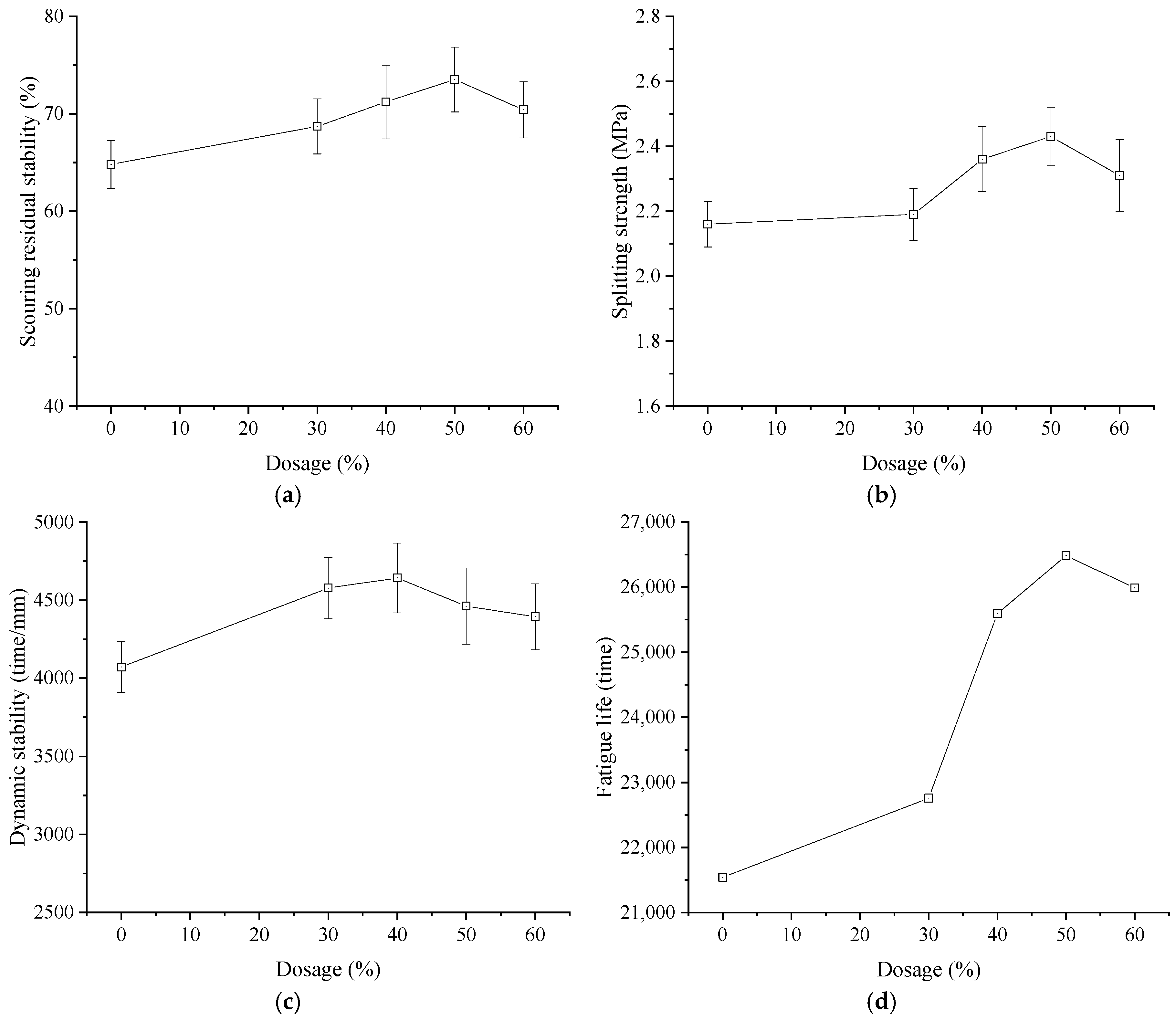
The residual stability after water scouring, low-temperature splitting strength, dynamic stability, and fatigue life of photocatalytic permeable asphalt mixtures with different composite modified nano-TiO2 contents are presented in Figure 19.
As illustrated in Figure 19, after 3500 scouring cycles under hydrodynamic pressure at 30 °C [31], the residual stability of the photocatalytic permeable asphalt mixtures initially increased and subsequently decreased with increasing composite modified nano-TiO2 content. It should be noted that the water sensitivity was evaluated using the dynamic water scouring Marshall test. As there are no specified limits for this method, the control group without nano-TiO2 was used as the benchmark to evaluate the improvement. Compared with the control group, the scouring residual stability increased by 6.0%, 9.9%, 13.4%, and 8.6% at dosages of 30%, 40%, 50%, and 60%, respectively, reaching a maximum at 50% content. Similarly, the low-temperature splitting strength improved across all doping levels, indicating favorable cracking resistance. The splitting strength also peaked at a content of 50%, with an increase of 12.5% compared to the control group. Regarding high-temperature performance, the dynamic stability values for these mixtures substantially exceeded the standard specification limit of 3000 cycles/mm. The maximum dynamic stability of 4542 cycles/mm was achieved at 40% dosage, representing an 11.3% increase over the control group. Furthermore, the fatigue life of the mixtures improved to varying extents. Specifically, the fatigue life reached 26,483 cycles at 50% content, an increase of 22.9%. Moreover, the coefficient of variation for residual stability, splitting strength, dynamic stability and fatigue life is within 6.0%.
Evidently, the addition of composite modified nano-TiO2 enhanced the overall pavement performance of photocatalytic permeable asphalt mixtures to varying degrees. This improvement was attributed to the reduced crystallite size and enlarged specific surface area confirmed by XRD analysis. Fluorescence microscopy and UV-Vis analysis mentioned above also verified the uniform dispersion of the modifier within the asphalt binder. These factors induced microstructural reinforcement at the asphalt interface. The resulting transition layer strengthened the bonding between nanoparticles and asphalt, improving interfacial compatibility through the synergistic effects of chemical bonding and physical anchoring [50]. Additionally, the abundant surface hydroxyl groups evidenced by FTIR spectra retarded the oxidative hardening of the asphalt and form hydrogen or ester bonds with carboxylic groups in the asphalt binder. This enhanced the asphalt–aggregate interfacial bonding strength and inhibits the propagation of micro cracks along the aggregate interface [51]. Consequently, the low-temperature splitting strength, scouring resistance, high-temperature deformation resistance, and fatigue life were improved. It should be noted that while this study focused on initial performance, the gains in fatigue life and water scouring resistance suggested improved long-term durability potential. However, when the composite modified nano-TiO2 dosage was excessive, the dispersion quality decreased. This agglomeration disrupted the continuity of the asphalt mastic and created internal defects, thereby reducing the improvement effect of modified nano-TiO2 on pavement performance.
In terms of permeability performance, the permeability coefficient was validated during the mix design phase, confirming compliance with the specifications for permeable asphalt mixtures. As the composite modified nano-TiO2 was incorporated via volumetric replacement of mineral filler without altering the aggregate gradation, the permeability performance across modified groups remained consistent with the control group without nano-TiO2. Regarding the permeability–strength trade-off, conventional strengthening methods typically compromise permeability by reducing air void content. In contrast, the nano-modifier functions as a filler replacement while maintaining the aggregate skeleton, then the strength enhancements are derived from interfacial reinforcement rather than void reduction. This strategy effectively overcomes the performance conflict, delivering enhanced mechanical properties without compromising drainage capacity. Moreover, while contemporary photocatalytic research predominantly focuses on material synthesis [35], this study validated the engineering performance within the context of permeable asphalt mixtures. The dynamic stability and fatigue life exceeded typical values reported for conventional photocatalytic OGFC mixtures, confirming that the proposed composite strategy offers a superior balance of exhaust degradation and pavement performance.

4. Conclusions

The degradation efficiencies for HC and NO exhibit a trend of initial increase followed by a decrease with rising metal ion content. The maximum degradation efficiencies are achieved at doping concentrations of 1.0% for Fe3+, 1.5% for Ag+, and 1.0% for La3+. Notably, Fe3+-doped nano-TiO2 demonstrates superior exhaust degradation performance achieving efficiencies of 46.7% for HC and 33.5% for NO. Doping nano-TiO2 with 1.0% Fe3+ is recommended to maximize exhaust degradation efficacy.
The enhanced photocatalytic activity is attributed to metal ion doping-induced microstructural modifications. During modification, metal ions substitute for partial Ti4+ within the nano-TiO2 lattice, inducing lattice defects, inhibiting crystal growth, and reducing crystallite sizes. At the optimal doping content of 1.0%, crystallite size of Fe3+-doped sample minimizes to 10.24 nm, which increases the density of photo-absorption sites. Furthermore, the surface hydroxyl group density peaks at this content, facilitating more efficient photocatalytic reactions and directly influencing exhaust degradation performance.
Both AC and Al2O3 support improve the dispersion of modified nano-TiO2 within the asphalt binder. While AC-supported samples show superior dispersion at lower support contents of 20% and 30%, Al2O3-supported samples perform better at a 40% content. At this optimal support content, Al2O3 supports yield a smaller range of area ratios and higher suspension absorbance, effectively mitigating agglomeration and enhancing uniformity. Al2O3 with a 40% support content is recommended as the optimal support to ensure uniform dispersion of modified nano-TiO2 in asphalt.
The improved dispersion properties are governed by the structural compatibility between the support and nano-TiO2. The absence of new diffraction peaks in the AC- and Al2O3-supported composites confirms that the supports load effectively without disrupting the TiO2 crystalline structure. Moreover, the supports introduce additional surface active sites and promote hydroxyl group formation through interfacial interactions. These surface modifications reduce the agglomeration tendency of the modified nano-TiO2, thereby improving its dispersion and long-term stability within the asphalt binder.
Balancing exhaust degradation performance with pavement engineering properties, the optimal dosage of composite modified nano-TiO2 is determined to be 40–50% of the mineral filler mass. Within this range, the composite modifier enhances the pavement performance of photocatalytic permeable asphalt mixtures via physical filling and micro-structural optimization. Specifically, at a 50% replacement ratio, the dynamic stability reaches 4462 cycles/mm and the fatigue life improves to 26,483 cycles, demonstrating excellent engineering applicability.
Despite the promising results, certain limitations are acknowledged in the scope of this study. Permeability performance was inferred from the constant aggregate skeleton established during mix design rather than directly tested for each modifier dosage. Additionally, while statistical variability was assessed via coefficient of variation and error bars, and fatigue tests suggest durability, long-term aging performance was not included. Future work will focus on direct permeability validation under clogging conditions and long-term aging evaluations to further confirm service life.

Author Contributions

Y.L.: Methodology, Funding acquisition, Writing—Original draft preparation. S.Z.: Data Curation, Investigation, Writing—Original draft preparation. D.X.: Data Curation, Investigation, Writing—review & editing. P.L.: Methodology, Supervision, Funding acquisition. K.Z.: Funding acquisition, Resources. Y.Z.: Data Curation, Writing—review & editing. All authors have read and agreed to the published version of the manuscript.

Funding

The study was supported by Key project of Natural Science Research of Anhui Provincial Department of Education (2023AH050198), National Key R&D Program of China (2024YFF1500102), Postdoctoral research project in Anhui Province (2024C929), Fundamental Research Funds for the Central Universities, CHD (300102214504). The authors gratefully acknowledge their financial support.

Data Availability Statement

The original contributions presented in this study are included in the article. Further inquiries can be directed to the corresponding author.

Conflicts of Interest

The authors declare no conflict of interest.

References

  1. Alvarado-Vicencio, R.; Linnemann, V.; Garcia, A.; Wintgens, T. Investigation of the saturated hydraulic conductivity of a novel permeable pavement bonded with polyurethane binder. Constr. Build. Mater. 2025, 471, 140637. [Google Scholar] [CrossRef]
  2. Zhou, B.; Li, H.; Gong, G.; Liu, Y.; Cao, Z. A comprehensive review on the treatment technologies of on-road waste gas: Focusing on exhaust and asphalt VOCs reduction. J. Ind. Eng. Chem. 2026, 153, 227–239. [Google Scholar] [CrossRef]
  3. Yan, W.; Bi, C.; Lu, C.; Fu, J.; Zheng, M.; Ding, Q.; Liu, J. Investigation on the factors affecting the exhaust degradation performance of porous pavement mixtures with nano-TiO2 photocatalysts. Materials 2025, 18, 1139. [Google Scholar] [CrossRef] [PubMed]
  4. Ahmadi, K.; Bathla, A.; Younis, S.A.; Kim, K.H. Engineered titanium dioxide-based photocatalysts for NOx abatement: Navigating design strategies and structure activity relationships for practical air purification. J. Mater. Chem. A 2026, 14, 852–879. [Google Scholar] [CrossRef]
  5. Wei, X.; Zhou, X.; Wang, X.; Chen, S.; Li, W.; Li, J.; Niu, X.; Guo, W. TiO2 loaded MIL-125 modified waterborne polyurethane coatings achieve photodegradation of formaldehyde under visible light. Colloids Surf. A Physicochem. Eng. Asp. 2025, 717, 136824. [Google Scholar] [CrossRef]
  6. Fei, H.; Wu, J.; Zhang, J.; Zhao, T.; Guo, W.; Wang, X.; Yang, S.; Liu, G. Photocatalytic performance and its internal relationship with hydration and carbonation of photocatalytic concrete: A review. J. Build. Eng. 2024, 97, 110782. [Google Scholar] [CrossRef]
  7. Khiavi, A.K.; Yamini, N.; Asadi, M. Effect of different adding methods of Nano-TiO2 to micro-surfacing layer on NOx degradation. Road Mater. Pavement Des. 2024, 25, 1270–1284. [Google Scholar] [CrossRef]
  8. Fang, M.; Peng, L.; Li, Y.; Cheng, Y.; Zhan, L. Evaluation test of NO degradation by Nano-TiO2 coatings on road pavements under natural light. Coatings 2022, 12, 1200. [Google Scholar] [CrossRef]
  9. Guo, Z.; Huang, C.; Chen, Y. Experimental study on photocatalytic degradation efficiency of mixed crystal nano-TiO2 concrete. Nanotechnol. Rev. 2020, 9, 219–229. [Google Scholar] [CrossRef]
  10. Xu, Y.; Wang, Z.; Dai, Y.; Wu, L.; Ye, Y.; Li, X.; Xu, S. Performance of a 3DOM TiO2 fog seal layer in degrading NOx from vehicle exhaust. J. Mater. Civ. Eng. 2025, 37, 04024499. [Google Scholar] [CrossRef]
  11. Xu, Y.; Li, X.; Duan, M.; Fan, Z.; Wang, Z.; Xu, S.; Liu, H. Performance study of 3DOM TiO2 fog seal material for photocatalytic degradation of NO in vehicle exhaust. J. Mater. Civ. Eng. 2023, 35, 04023432. [Google Scholar] [CrossRef]
  12. Liang, X.; Yu, X.; Ding, G.; Jing, Y.; Huang, J. Environmental and mechanical effects of rubberized open graded asphalt mixtures incorporating with titanium dioxide a laboratory investigation. Int. J. Pavement Eng. 2023, 24, 2241604. [Google Scholar] [CrossRef]
  13. Lee, J.C.; Huh, M.W.; Hou, Y.L.; Kim, W.J. Complex challenges in the textile industry and potential solutions in photocatalytic coating technology: A systematic literature review. Materials 2025, 18, 810. [Google Scholar] [CrossRef]
  14. Hu, Z.; Xu, T.; Liu, P.; Jin, G. Developed photocatalytic semi-flexible pavement for automobile exhaust purification using iron-doped titanium dioxide. Constr. Build. Mater. 2020, 262, 119924. [Google Scholar] [CrossRef]
  15. Hu, Z.; Xu, T.; Liu, P.; Oeser, M. Developed photocatalytic asphalt mixture of open graded friction course for degrading vehicle exhaust. J. Clean. Prod. 2021, 279, 123453. [Google Scholar] [CrossRef]
  16. Wu, L.; Pei, X.; Mei, M.; Li, Z.; Lu, S. Study on photocatalytic performance of Ag/TiO2 modified cement mortar. Materials 2022, 15, 4031. [Google Scholar] [CrossRef]
  17. Qian, G.; Zhu, X.; Yu, H.; Shi, C.; Yao, D. The oil pollution and nitric oxide photocatalytic degradation evaluation of composite nanomaterials for asphalt pavement. Constr. Build. Mater. 2022, 314, 125497. [Google Scholar] [CrossRef]
  18. Alcantara, A.P.M.P.; Ribas, L.V.S.; Silva, D.B.; Brito, J.I.C.; Freitas, E.F.; Sousa, F.W.; Branco, V.T.F.C. Chitosan-doped TiO2 functionalized asphalt mixtures for NO2 mitigation under high pollution levels. Materials 2025, 18, 4292. [Google Scholar] [CrossRef] [PubMed]
  19. Zhang, D.; Zhu, H.; Yang, Q.; Mao, M.; Li, J. Hydration kinetics, mechanical, and photocatalytic self-cleaning performance of permeable concrete reinforced with nano-TiO2 hydrosol. Constr. Build. Mater. 2025, 472, 140830. [Google Scholar] [CrossRef]
  20. Xu, P.; Yan, X.; Ge, J.; Cai, J.; Qian, G.; Yu, H.; Gu, F. Research on the preparation of composite BOCN-TiO2 photocatalytic materials and their exhaust gas degradation in road domains. Constr. Build. Mater. 2025, 494, 143584. [Google Scholar] [CrossRef]
  21. Shan, J.; Huang, Y.; Jiang, W. Efficient Bi-TiO2 photocatalytic materials for asphalt applications: Synthesis, characterization, and NO degradation performance. J. Clean. Prod. 2025, 518, 145947. [Google Scholar] [CrossRef]
  22. Bukichev, Y.S.; Bogdanova, L.M.; Lesnichaya, V.A.; Chukanov, N.V.; Golubeva, N.D.; Dzhardimalieva, G.I. Mechanical and thermophysical properties of epoxy nanocomposites with titanium dioxide nanoparticles. Appl. Sci. 2023, 13, 4488. [Google Scholar] [CrossRef]
  23. Lei, J.; Zheng, N.; Luo, F.; He, Y. Purification of automobile exhaust gas by activated carbon supported Fe3+ modified nano-TiO2 and its application on asphalt pavement. Road Mater. Pavement Des. 2021, 22, 2424–2440. [Google Scholar] [CrossRef]
  24. Li, X.; Wang, F.; You, L.; Wu, S.; Yang, C.; Zhang, L.; Barbieri, D.M. A review on photocatalytic asphalt pavement designed for degradation of vehicle exhausts. Transp. Res. Part D Transp. Environ. 2023, 115, 103605. [Google Scholar] [CrossRef]
  25. Zhao, D.; Wu, X.; Gu, X.; Liu, J. Investigation into the degradation of air and runoff pollutants using nano g-C3N4 photocatalytic road surfaces. Constr. Build. Mater. 2024, 411, 134553. [Google Scholar] [CrossRef]
  26. Li, H.; Zhou, B.; Wu, H.; Xu, B.; Wang, C. Development and performance evaluation of a multifunctional pavement coating for exhaust degradation and CO2 absorption. Constr. Build. Mater. 2025, 493, 143211. [Google Scholar] [CrossRef]
  27. Wu, H.; Lu, X.; Feng, Z.; He, R. Dynamic hydrophobicity and surface reconstruction mechanism of self-cleaning traffic marking coatings incorporating modified TiO2 nanoparticles. Constr. Build. Mater. 2025, 497, 143876. [Google Scholar] [CrossRef]
  28. Rachana, K.; Nagaraja, K.K.; Poornesh, P.; Chandra, R.B.J.; Pramodini, S. Third-order nonlinear optical properties of TiO2 nano colloidal synthesized via sol-gel and hydrothermal methods: A comparison. Mater. Sci. Eng. B 2025, 319, 118312. [Google Scholar] [CrossRef]
  29. CJJ/T 190; Technical Specification for Permeable Asphalt Pavement. Ministry of Housing and People’s Republic of China: Beijing, China, 2012.
  30. JTG F40; Technical Specifications for Construction of Highway Asphalt Pavements. Ministry of Transport of the People’s Republic of China: Beijing, China, 2004.
  31. JTG 3410; Standard Test Methods of Asphalt and Asphalt Mixture for Highway Engineering. Ministry of Transport of the People’s Republic of China: Beijing, China, 2025.
  32. Li, Y.; Si, Y.; Wang, S.; Li, P.; Zhang, K.; Zhu, Y. Multiscale investigation of interfacial behaviors in rubber asphalt–aggregate systems under salt erosion: Insights from laboratory tests and molecular dynamics simulations. Materials 2025, 18, 4746. [Google Scholar] [CrossRef]
  33. Ma, F.; Jiang, X.; Fu, Z.; Zhu, C.; Liu, J.; Shi, K.; Wen, Y.; Zhang, Y. Rheological and micro properties of high-viscosity binder-incorporated polyphosphoric acid and rock asphalt. J. Mater. Civ. Eng. 2026, 38, 04025569. [Google Scholar] [CrossRef]
  34. Zhang, W.; Jia, Z.; Zhang, Y.; Hu, K.; Ding, L.; Wang, F. The effect of direct-to-plant Styrene-Butadiene-Styrene block copolymer components on bitumen modification. Polymers 2019, 11, 140. [Google Scholar] [CrossRef] [PubMed]
  35. Kumar, R.S.; Sharma, T. Stability and rheological properties of nanofluids stabilized by SiO2 nanoparticles and SiO2-TiO2 nanocomposites for oilfield applications. Colloids Surf. A Physicochem. Eng. Asp. 2018, 539, 171–183. [Google Scholar] [CrossRef]
  36. Kou, Y.; Luo, P.; Xiao, L.; Xin, Y.; Zhang, G.; Hu, Y.; Yang, J.; Gao, H.; Zhao, F.; Jiang, W.; et al. New insights in nano-copper chromite catalyzing ultrafine AP: Evaluation of dispersity and mixing uniformity. Def. Technol. 2024, 32, 120–133. [Google Scholar] [CrossRef]
  37. Tamanna, N.; Hossain, M.; Tabassum, S.; Bahadur, N.M.; Ahmed, S. Easy and green synthesis of nano-ZnO and nano-TiO2 for efficient photocatalytic degradation of organic pollutants. Heliyon 2024, 10, e37469. [Google Scholar] [CrossRef]
  38. Mehtap, N.; Kabakci, Y.G.; Kiliç, H.S. Investigation of tensile strength of femtosecond laser ablation-based TiO2@Ag nanoalloys in polyacrylonitrile with collagen polymer mixture. MRS Commun. 2025, 15, 1418–1424. [Google Scholar] [CrossRef]
  39. Zhao, Y.; Jia, Z.; Zhang, J.; Shi, J.; Xing, Y. Adsorption kinetic modeling of NO photocatalytic degradation of nano-TiO2 concrete. J. Sustain. Cem.-Based Mater. 2026, 15, 1527–1545. [Google Scholar]
  40. Predoana, L.; Stanciu, I.; Anastasescu, M.; Calderon-Moreno, J.; Stoica, M.; Preda, S.; Gartner, M.; Zaharescu, M. Structure and properties of the V-doped TiO2 thin films obtained by sol-gel and microwave-assisted sol-gel method. J. Sol-Gel Sci. Technol. 2016, 78, 589–599. [Google Scholar] [CrossRef]
  41. Chokri, M.; Jalafi, I.; Azougagh, O.; Jabir, L.; Bendahhou, A.; Malekshah, R.E.; Abida, M.; El Ouardi, Y.; Ahari, M.; Salhi, A. Niobium-tungsten co-doped rutile TiO2 as a new high-efficiency photocatalyst for sunlight-driven degradation of organic Dyes: Synthesis, characterization, computational study and application. Ceram. Int. 2025, 51, 43933–43946. [Google Scholar] [CrossRef]
  42. Luo, G.; Liu, H.; Li, W.; Lyu, X. Automobile exhaust removal performance of pervious concrete with Nano TiO2 under Photocatalysis. Nanomaterials 2020, 10, 2088. [Google Scholar] [CrossRef] [PubMed]
  43. Al Amin, S.M.; Kowser, M.A. Influence of Ag doping on structural, morphological, and optical characteristics of sol–gel spin-coated TiO2 thin films. Heliyon 2024, 10, e37558. [Google Scholar] [CrossRef] [PubMed]
  44. Ayappan, C.; Xing, R.; Zhang, X.; Luo, D.; Liu, S.; Fujishima, A. TiO2-based photocatalysts for emerging gaseous pollutants removal: From photocatalysts to reactors design. Coord. Chem. Rev. 2024, 515, 215960. [Google Scholar] [CrossRef]
  45. Fang, X.; Guo, Z.; Wang, C.; Chen, X.; Chi, X.; Liu, W.; Chen, J. Controlled synthesis and enhanced photocatalytic performance of hexagonal prism-shaped TiO2 via oxalic acid regulation. Dig. J. Nanomater. Biostruct. 2025, 20, 1235–1246. [Google Scholar] [CrossRef]
  46. AL-Rjoub, A.; Bin Yaqub, T.; Cavaleiro, A.; Fernandes, F. The influence of V addition on the structure, mechanical properties, and oxidation behaviour of TiAlSiN coatings deposited by DC magnetron sputtering. J. Mater. Res. Technol. 2022, 20, 2444–2453. [Google Scholar] [CrossRef]
  47. Wu, C.; Tu, K.; Deng, J.; Lo, Y.; Wu, C. Markedly enhanced surface hydroxyl groups of TiO2 nanoparticles with superior water-dispersibility for photocatalysis. Materials 2017, 10, 566. [Google Scholar] [CrossRef] [PubMed]
  48. Kamal, R.; Mogazy, A.M. Effect of doping on TiO2 nanoparticles characteristics: Studying of fertilizing effect on cowpea plant growth and yield. J. Soil Sci. Plant Nutr. 2023, 23, 325–337. [Google Scholar] [CrossRef]
  49. Nannuzzi, C.; Janssens, T.V.W.; Berlier, G. Effect of thermal treatments on high surface area anatase TiO2. Phys. Chem. Chem. Phys. 2025, 27, 15213–15221. [Google Scholar] [CrossRef]
  50. Babagoli, R.; Rezaei, M. Using artificial neural network methods for modeling moisture susceptibility of asphalt mixture modified by Nano TiO2. J. Mater. Civ. Eng. 2022, 34, 04022108. [Google Scholar] [CrossRef]
  51. Hamedipour, A.M.; Shafabakhsh, G.; Sadeghnejad, M. The impact of Nano-TiO2 particles on the moisture susceptibility and fracture toughness of HMA under mixed-mode I/II loading and various crack geometry and temperatures. J. Mater. Civ. Eng. 2023, 35, 04022444. [Google Scholar] [CrossRef]
Figure 1. Metal ion-doped modified nano-TiO2. (a) Solution A; (b) 1.0% Fe3+; (c) 1.0% Ag+; (d) 1.0% La3+.
Materials 19 01777 g001
Figure 2. Preparation flow of composite modified nano-TiO2.
Materials 19 01777 g002
Figure 3. Aggregate gradation of photocatalytic permeable asphalt mixture.
Materials 19 01777 g003
Figure 4. Test on the degradation effect of vehicle exhaust.
Materials 19 01777 g004
Figure 5. Dispersion effect diagram. (a) Fluorescence micrograph; (b) Binary image.
Materials 19 01777 g005
Figure 6. Average HC degradation rate over 20 min intervals for metal ion-doped modified nano-TiO2. (a) Fe3+; (b) Ag+; (c) La3+.
Materials 19 01777 g006
Figure 7. HC degradation efficiency of metal ion-doped modified nano-TiO2.
Materials 19 01777 g007
Figure 8. Average NO degradation rate over 20 min intervals for metal ion-doped modified nano-TiO2. (a) Fe3+; (b) Ag+; (c) La3+.
Materials 19 01777 g008
Figure 9. NO degradation efficiency of metal ion-doped modified nano-TiO2.
Materials 19 01777 g009
Figure 10. Dispersion effect of composite modified nano-TiO2 in asphalt. (a) Asphalt with fluorescent dye; (b) TiO2 without support; (c) 40% AC; (d) 40% Al2O3.
Materials 19 01777 g010
Figure 11. Range of area ratios of composite modified nano-TiO2.
Materials 19 01777 g011
Figure 12. Absorbance of composite modified nano-TiO2 suspensions. (a) AC; (b) Al2O3.
Materials 19 01777 g012
Figure 13. XRD patterns of metal ion-doped modified nano-TiO2. (a) Fe3+; (b) Ag+; (c) La3+.
Materials 19 01777 g013
Figure 14. Crystallite sizes of metal ion-doped modified nano-TiO2.
Materials 19 01777 g014
Figure 15. XRD patterns of nano-TiO2 supported by different supports. (a) AC; (b) Al2O3.
Materials 19 01777 g015
Figure 16. FTIR spectra of metal ion-doped modified nano-TiO2. (a) Fe3+; (b) Ag+; (c) La3+.
Materials 19 01777 g016
Figure 17. FTIR spectra of TiO2 supported by different supports. (a) AC; (b) Al2O3.
Materials 19 01777 g017
Figure 18. Exhaust degradation effect of composite modified nano-TiO2.
Materials 19 01777 g018
Figure 19. Pavement performance of photocatalytic permeable asphalt mixtures. (a) Scouring residual stability; (b) Splitting strength; (c) Dynamic stability; (d) Fatigue life.
Materials 19 01777 g019
Table 1. Raw materials of the composite modified nano-TiO2.
Raw MaterialsMolecular FormulaSpecificationManufacturer
Butyl titanateC16H36O4TiARShanghai Zhanyun Chemical Co., Ltd. (Shanghai, China)
Iron (III) nitrate nonahydrateFe(NO3)3·9H2OARShanghai Zhanyun Chemical Co., Ltd.
Lanthanum nitrate hexahydrateLa(NO3)3·6H2OARShanghai Zhanyun Chemical Co., Ltd.
Anhydrous ethanolC2H6OARBengbu Chemical Reagent Factory (Bengbu, China)
Glacial acetic acidCH3COOHARTianjin Damao Chemical Reagent Co., Ltd. (Tianjin, China)
Distilled water
Hydrochloric acidHClARSinopharm Chemical Reagent Co., Ltd. (Beijing, China)
Silver nitrateAgNO3ARSinopharm Chemical Reagent Co., Ltd.
Nitric acidHNO3ARSinopharm Chemical Reagent Co., Ltd.
Disclaimer/Publisher’s Note: The statements, opinions and data contained in all publications are solely those of the individual author(s) and contributor(s) and not of MDPI and/or the editor(s). MDPI and/or the editor(s) disclaim responsibility for any injury to people or property resulting from any ideas, methods, instructions or products referred to in the content.