


An Experimental and Theoretical Study on the Electrical-Resistance-Based Gage Factor of a Single Carbon Fiber in the Thermal–Mechanical Coupling Effect


Abstract
1. Introduction
2. Theoretical Analysis
2.1. Electrical Parameters
2.2. The GF Theory Model Under the Load Effect (F ≠ 0, ΔT = 0)
2.3. The GF Theory Model Under the Effect of Temperature (F = 0, ΔT ≠ 0)
2.4. The GF Theory Model Under the Thermal–Mechanical Coupling Effect (F ≠ 0, ΔT ≠ 0)
3. Materials and Methods
3.1. Materials and Instruments
3.2. Methods and Procedures
3.2.1. Temperature-Resistance Test Design
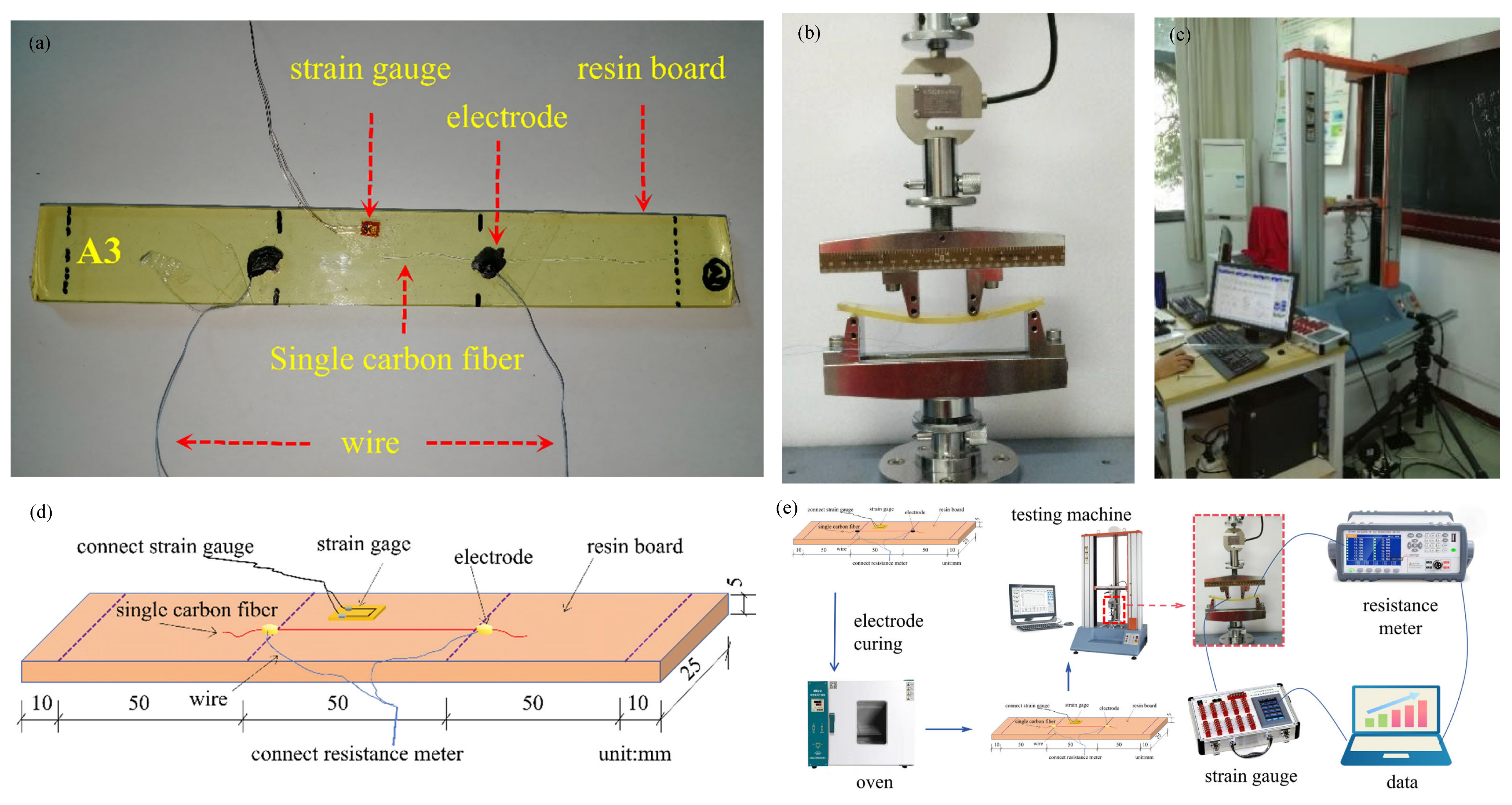
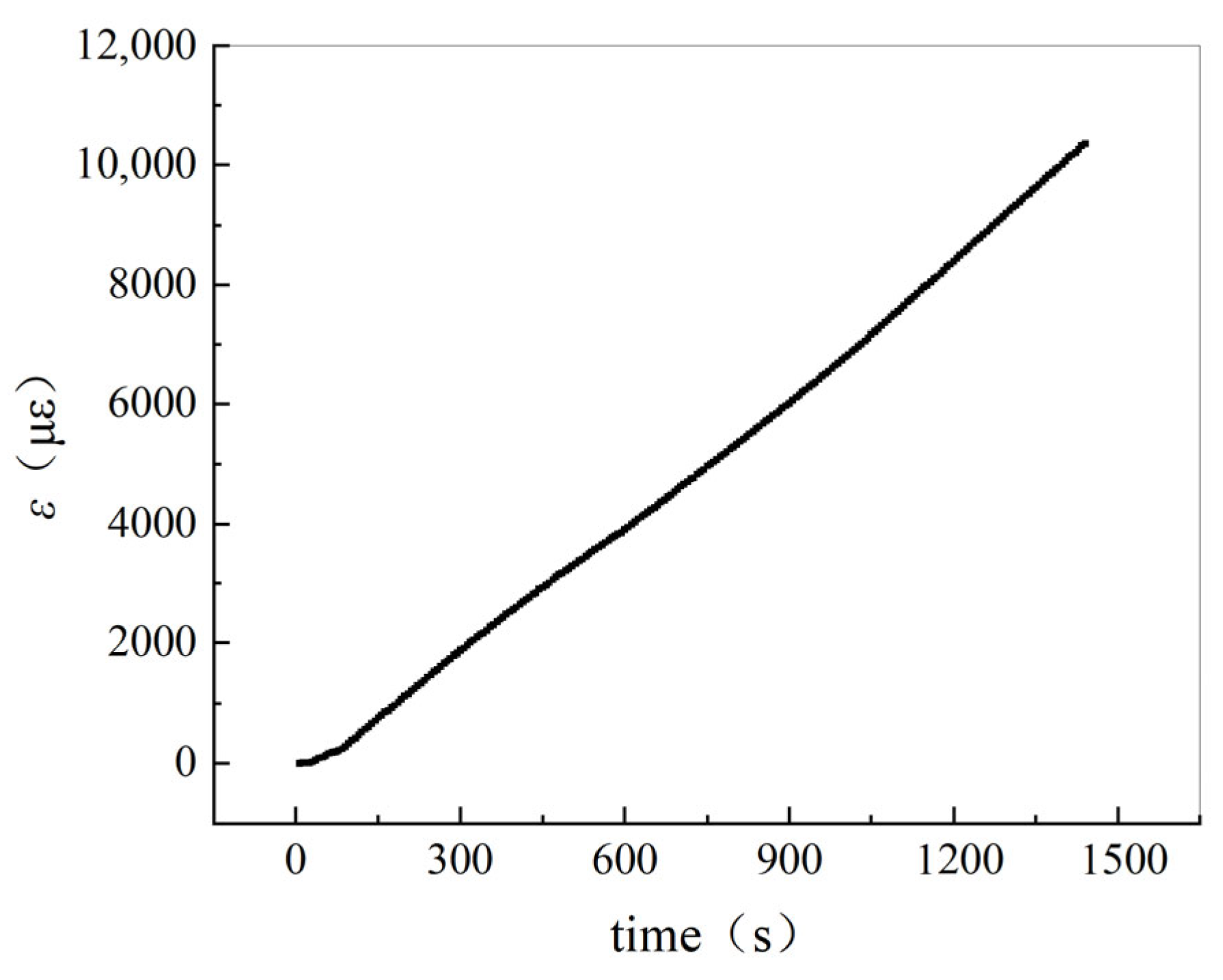
3.2.2. Strain-Resistance Test Design
4. Results and Discussion
4.1. Temperature-Resistance Test
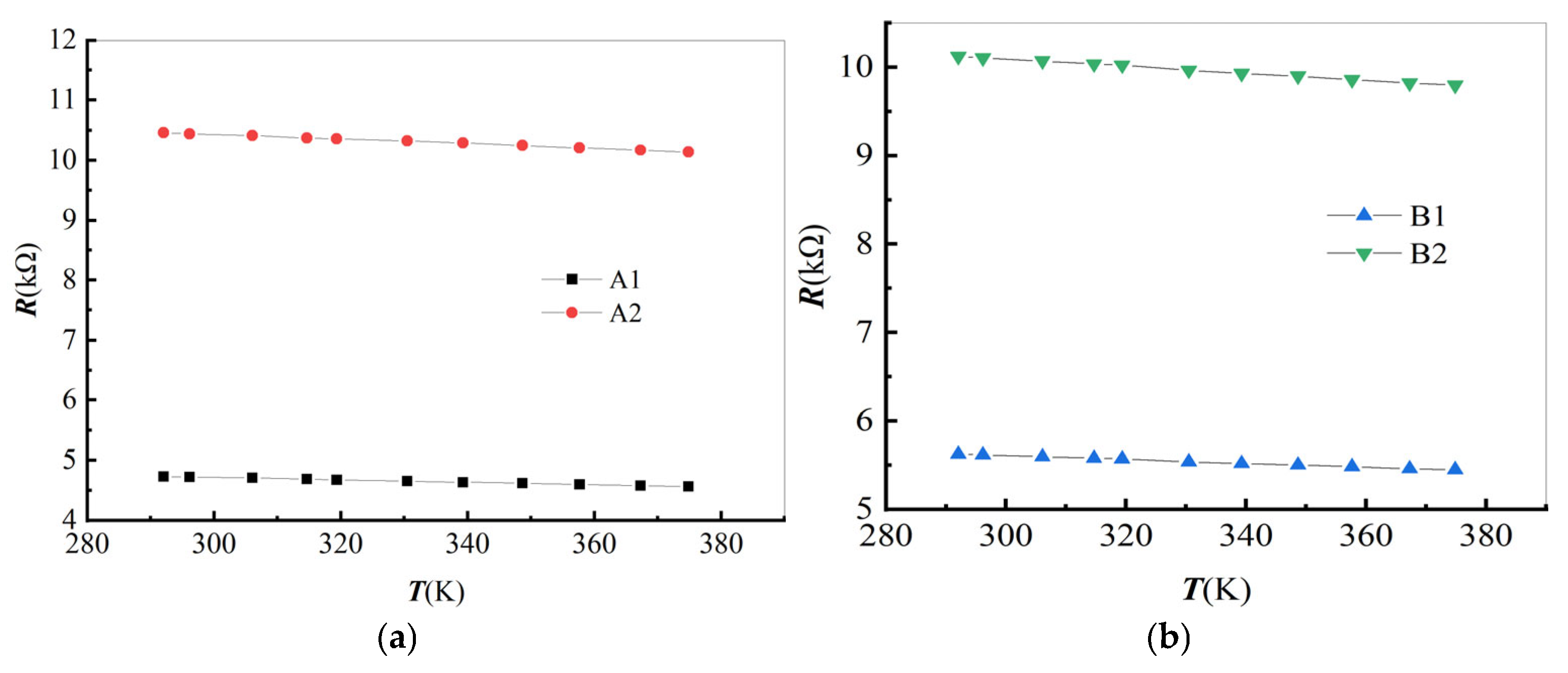
4.2. Temperature-Resistance Analysis
4.2.1. Linear Fitting of Temperature Resistance
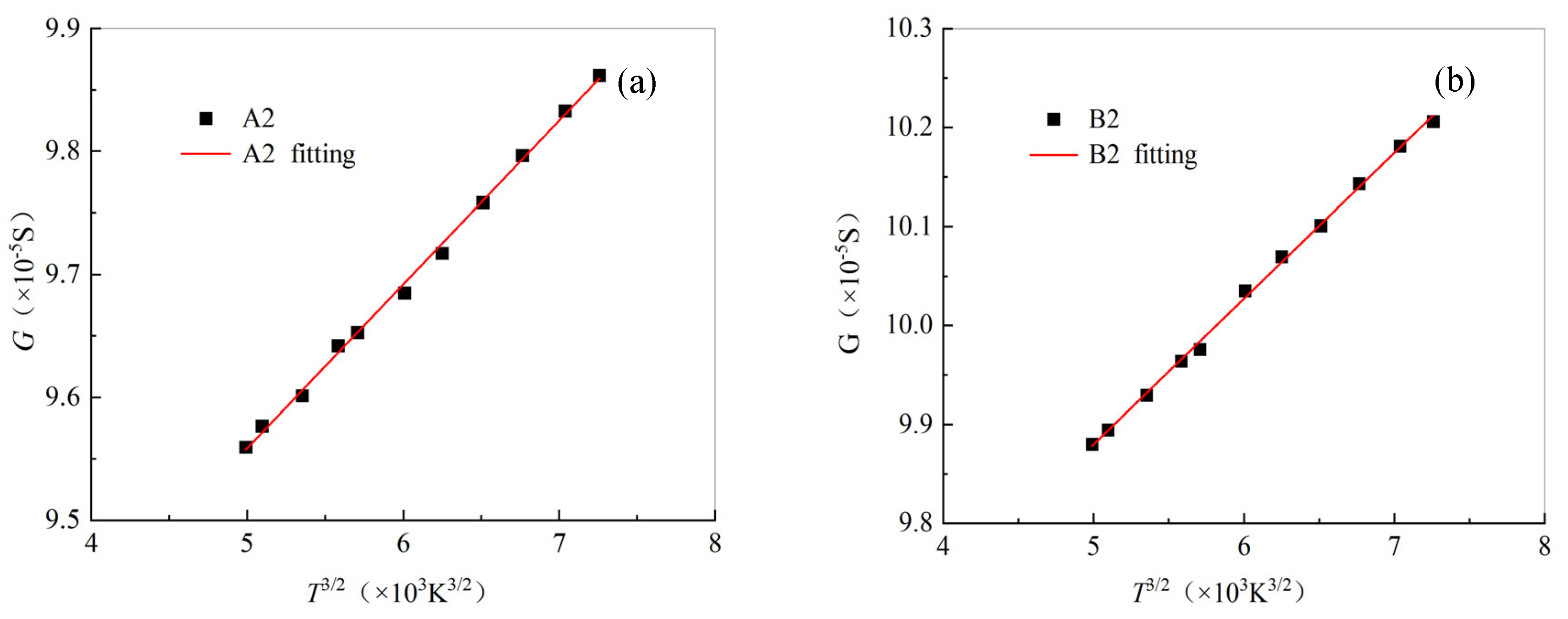
4.2.2. Nonlinear Fitting of Temperature–Conductance
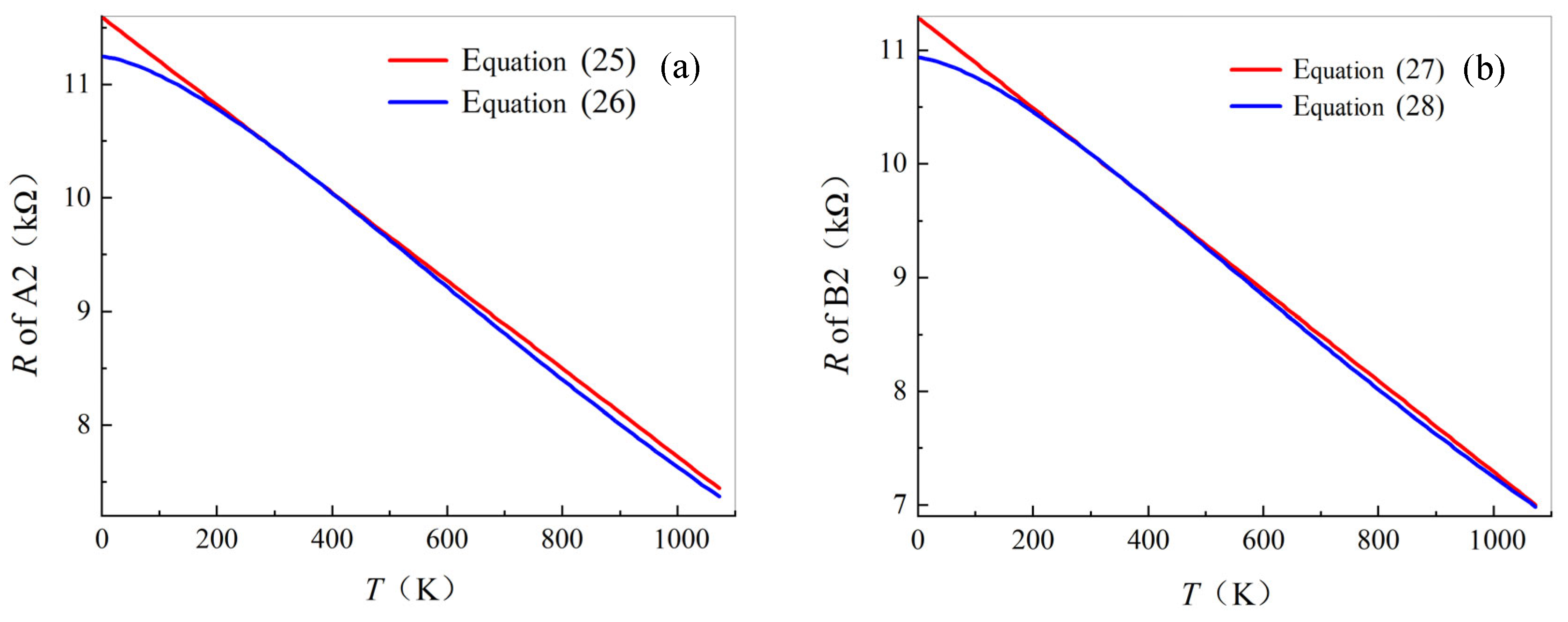
4.2.3. Two Types of Comparison of the Temperature-Resistance Fitting
4.3. Analysis of the Temperature-Resistance Sensitivity Coefficient
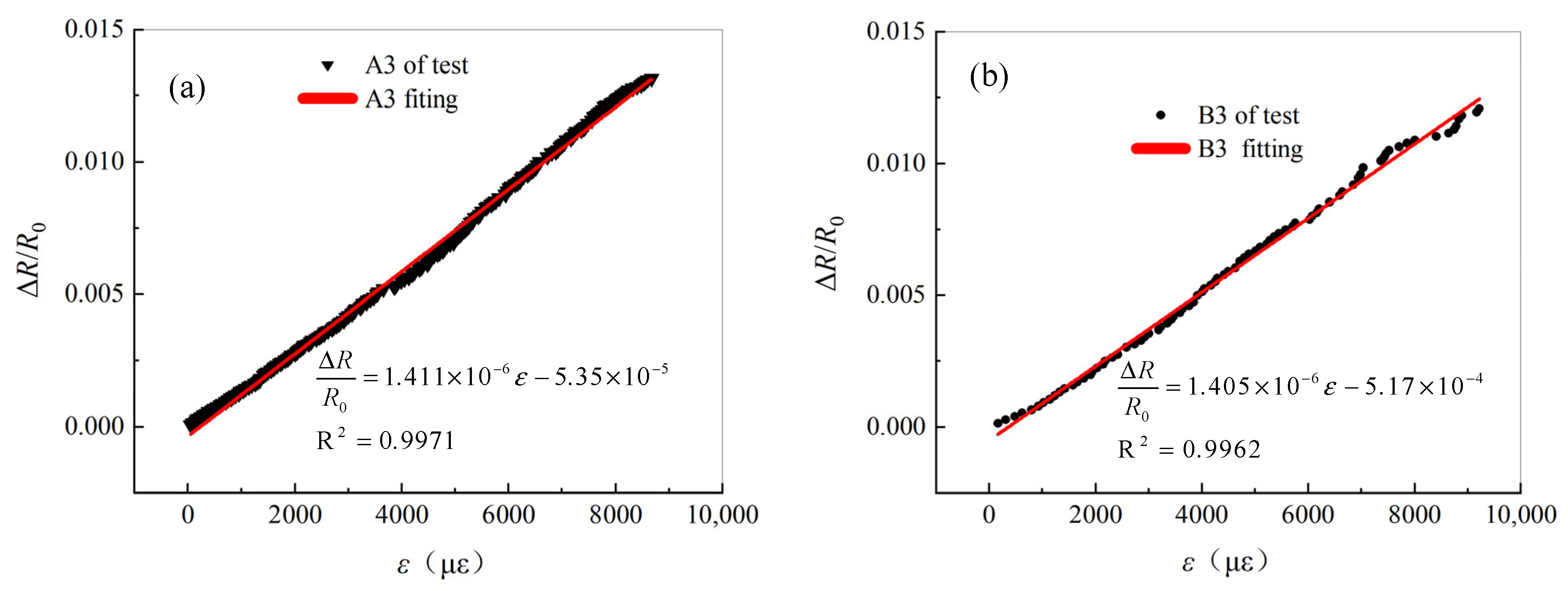
4.4. Analysis of the Strain Resistance Sensitivity Coefficient
5. Conclusions
- (1)
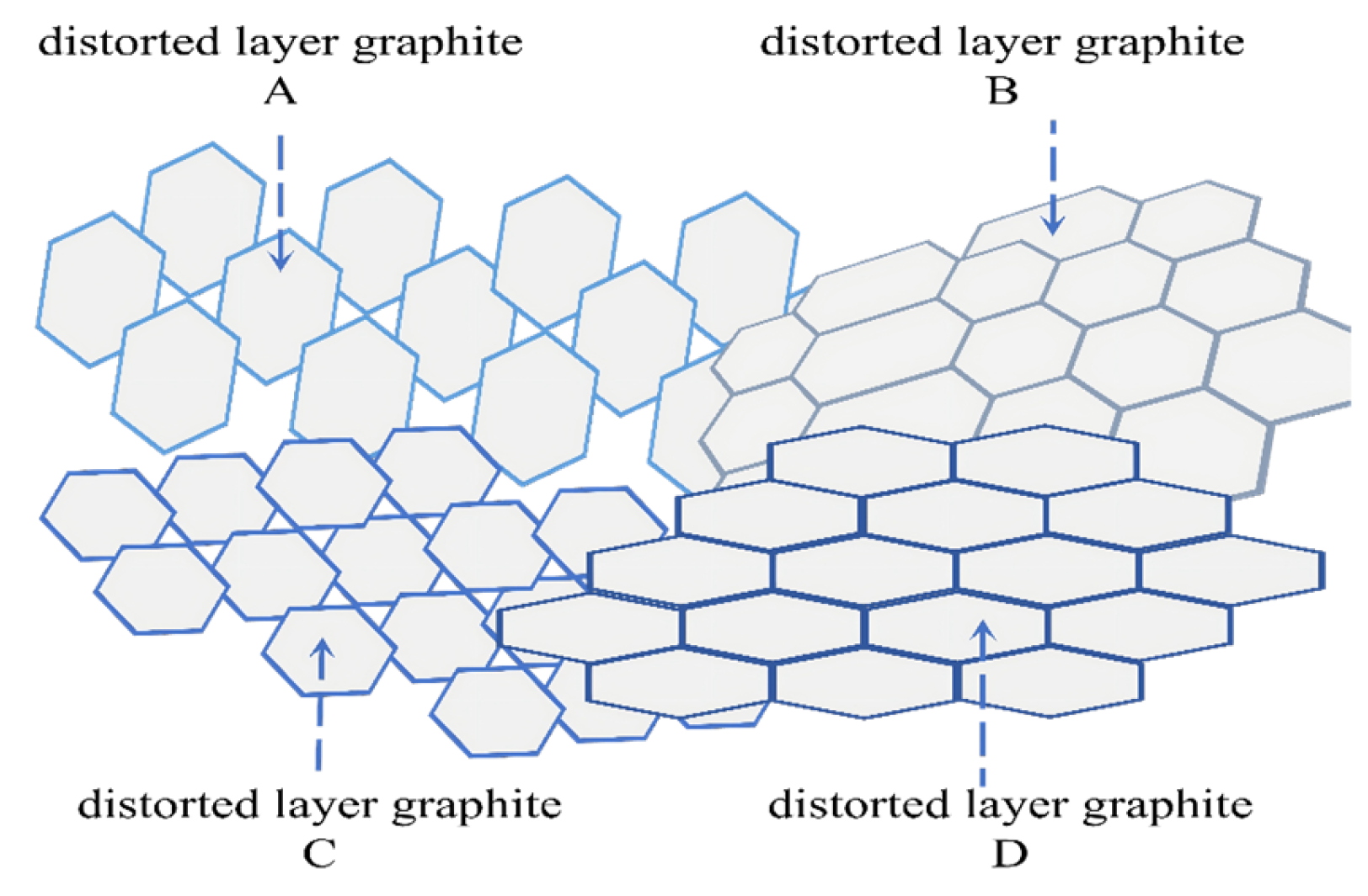
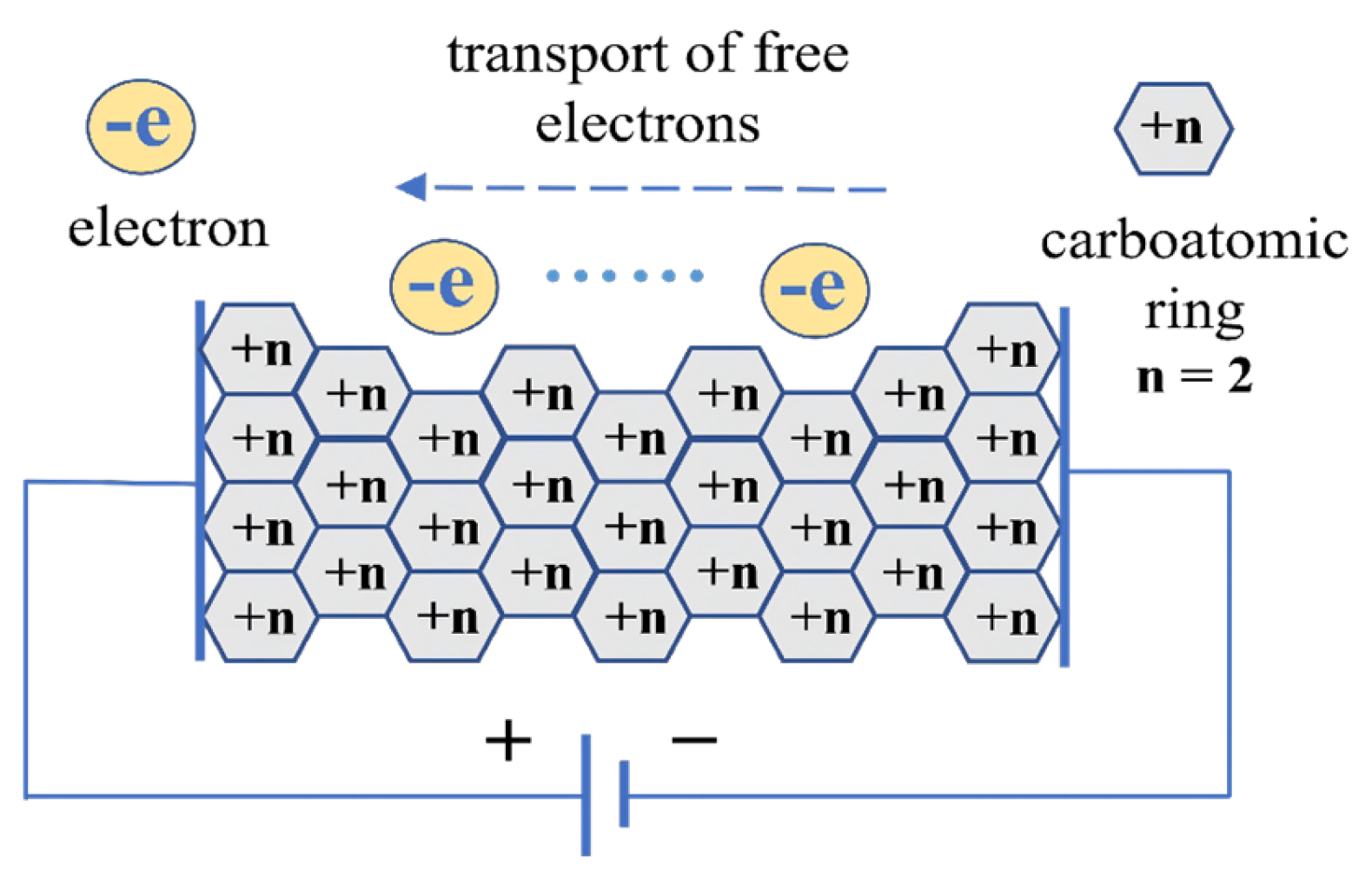
- The g-C3N4 in carbon fibers is a semiconductor, which leads to the semiconductive-like conductive properties of carbon fibers. The theoretical models of resistance and the GF of a single carbon fiber under different effects can reflect the influence of the piezoresistive effect and strain.
- (2)
- Tests on single carbon fiber specimens with different initial states under the effect of temperature show that the strain sensitivity of T700S is higher than that of SYT49S. As the temperature rises, the resistance of single carbon fiber specimens with different initial states linearly decreases. The initial state of the carbon fiber specimen has significant impact on its resistance change rate.
- (3)
- Within 223 K to 473 K, the resistance of free single carbon fibers can be calculated by linear model or nonlinear models, where the relative error between the two is less than 0.2%.
- (4)
- The theoretical calculation results of the GF of single carbon fiber specimens under the coupling effect are consistent with the test fitting results, and the corresponding theoretical model is reliable. Free single carbon fiber is highly sensitive to the effect temperature, making it suitable as a temperature-sensing device.
- (5)
- The four-point bending test analysis shows that the force resistance sensitivity coefficients of A3 and B3 are 1.411 and 1.405, respectively, which are significantly lower than those of the Ni–Cu-based resistance strain gauges. The graphitization degree of SYT49S is higher than that of T700S.
Author Contributions
Funding
Institutional Review Board Statement
Informed Consent Statement
Data Availability Statement
Conflicts of Interest
References
- Chen, P.; Chung, D.D.L. Carbon fiber reinforced concrete as a smart material capable of non-destructive flaw detection. Smart Mater. Struct. 1993, 1, 22–30. [Google Scholar] [CrossRef]
- Scholle, P.; Sinapius, M. A Review on the usage of continuous carbon fibers for piezoresistive self strain sensing fiber reinforced plastics. J. Compos. Sci. 2021, 5, 96. [Google Scholar] [CrossRef]
- Xie, G.H.; Tang, Y.S.; Wang, C.M.; Li, S.Q.; Liu, R.G. Experimental study on fatigue performance of adhesively bonded anchorage system for CFRP tendons. Compos. Part B Eng. 2018, 150, 47–59. [Google Scholar] [CrossRef]
- Xie, G.H.; Yin, J.; Liu, R.G.; Chen, B.; Cai, D.S. Experimental and numerical investigation on the static and dynamic behaviors of cable-stayed bridges with CFRP cables. Compos. Part B Eng. 2017, 111, 235–242. [Google Scholar] [CrossRef]
- Chung, D.D.L. A critical review of piezoresistivity and its application in electrical resistance-based strain sensing. J. Mater. Sci. 2020, 55, 15367–15396. [Google Scholar] [CrossRef]
- Chung, D.D.L. A critical review of electrical-resistance-based self-sensing in conductive cement-based materials. Carbon 2023, 203, 311–325. [Google Scholar] [CrossRef]
- Meehan, D.G.; Wang, S.; Chung, D.D.L. Electrical-resistance-based sensing of impact damage in carbon fiber reinforced cement-based materials. J. Intell. Mater. Syst. Struct. 2010, 21, 83–105. [Google Scholar] [CrossRef]
- Xia, P.F. Trial fabrication and experimental study on longitudinal restraint cables composed of CFRP bars in main navigational channel bridge of Chang-tai Changjiang river bridge. Bridge Constr. 2024, 54, 1–6. [Google Scholar]
- Nagalla, S.A.; Chung, D.D.L. Single carbon fiber as inductor and capacitor. Mater. Res. Bull. 2025, 193, 113692. [Google Scholar] [CrossRef]
- Zhao, Q.; Zhang, K.; Zhu, S.; Xu, H.; Cao, D.; Zhao, L.; Zhang, R.; Yin, W. Review on the electrical resistance/conductivity of carbon fiber reinforced polymer. Appl. Sci. 2019, 9, 2390. [Google Scholar] [CrossRef]
- Shen, G.L.; Hu, G.K.; Liu, B. Mechanics of Composite Materials, 2nd ed.; Tsinghua University Press: Beijing, China, 2013. [Google Scholar]
- Xi, X.; Chung, D.D.L. Effect of nickel coating on the stress-dependent electric permittivity, piezoelectricity and piezoresistivity of carbon fiber, with relevance to stress self-sensing. Carbon 2019, 145, 401–410. [Google Scholar] [CrossRef]
- Han, C.F. Electrical Conductivity, Electric Potential Distribution and Electromechanical Coupling Behavior of CFRP. Ph.D. Thesis, Donghua University, Shanghai, China, 2022. [Google Scholar]
- Yu, F.; Wang, Y.; Tong, Y.J. Evolution of nitrogen-containing structures during the pre-oxidation of PAN fibers. New Chem. Mater. 2016, 44, 199–201. [Google Scholar]
- He, M. Effect of Temperature Gradient on Structural Evolution During Low-Temperature Carbonization of PAN-Based Pre-Oxidized Fibers. Master’s Thesis, Beijing University of Chemical Technology, Beijing, China, 2020. [Google Scholar]
- Huang, L. Polymer Composite Materials, 2nd ed.; China Light Industry Press: Beijing, China, 2013; pp. 103–104. [Google Scholar]
- Guigon, M.; Oberlin, A.; Desarmot, G. Microtexture and structure of some high tensile strength, PAN-base carbon fibers. Fibre Sci. Technol. 1984, 20, 55–72. [Google Scholar] [CrossRef]
- Dong, W.K.; Karalis, G.; Liebscher, M.; Wang, T.L.; Liu, P.F.; Li, W.G.; Mechtcherine, V. Multifunctional carbon fibre reinforced polymer (CFRP) composites for sustainable and smart civil infrastructure: A comprehensive review. Sustain. Mater. Technol. 2025, 45, e01594. [Google Scholar] [CrossRef]
- Yu, H.; Shu, A.Q.; Ding, K.Q. Research on the influence of the size of strain gauge sensitive grid wire on measurement accuracy. China Instrum. 2021, 361, 71–75. [Google Scholar]
- Wu, J.P. Principles and Applications of Sensors, 3rd ed.; China Machine Press: Beijing, China, 2018. [Google Scholar]
- GB/T 13992-2010; Metallic Bonded Resistance Strain Gauges. Standards Press of China: Beijing, China, 2011.
- Song, A.G.; Zhao, H.; Jia, B.N. Sensor Technique, 4th ed.; Southeast University Press: Nanjing, China, 2021; p. 33. [Google Scholar]
- Zheng, J.T.; Len, J.X.; Hu, X.Y.; Hu, F.M.; Chen, N.G.; Huang, J.C.; Chen, Z.M.; Luo, J.Y. Temperature sensing mechanism and application of carbon fiber temperature sensor. Chin. J. Sens. Actuators 2022, 35, 461–466. [Google Scholar]
- Pan, J.S.; Tong, J.M.; Tian, M.B. Fundamentals of Materials Science, Revised ed.; Tsinghua University Press: Beijing, China, 2011. [Google Scholar]
- Ma, Y.E.; Sun, Q. Precise time-integration method for dynamic response of thermal-mechanical coupled problem. J. Mech. Strength 2007, 29, 483–486. [Google Scholar]
- GB/T 32993-2016; Determination of Volume Resistivity of Carbon Fiber. Standards Press of China: Beijing, China, 2016.
- Zheng, L.X.; Li, Z.Q.; Song, X.H. Effect of strain on the electrical resistance of continuous carbon fiber mono-filament. J. Funct. Mater. 2008, 39, 440–442. [Google Scholar]


| Typical Effect | GF | Strain Effect | Piezoresistive Effect | |
|---|---|---|---|---|
| Carrier Concentration | Electron Mobility | |||
| F ≠ 0 ΔT = 0 | 0 | |||
| F = 0 ΔT ≠ 0 | ||||
| F ≠ 0 ΔT ≠ 0 | ||||
| Product Model | Tensile Strength (MPa) | Young’s Modulus E (GPa) | Elongation (%) | Poisson’s Ratio | Diameter D (μm) | Volume Resistivity ρ (×10−5 Ω·m) | Temperature Expansion Coefficient (×10−6 K−1) | |
|---|---|---|---|---|---|---|---|---|
| Axial | Radial | |||||||
| SYT49S-12k | 4900 | 240 | 2.0 | 0.30 | 7.0 | 1.5 | −0.40 | – |
| T700S-6k | 4900 | 230 | 2.1 | 0.30 | 7.0 | 1.6 | −0.38 | 27 |
| Product Model | Specimen | Initial State | Model Type | Electrode Distance (mm) | Initial Resistance R0 (kΩ) | Initial Length L0 (mm) | Diameter D (μm) | Volume Resistivity ρ (×10−5 Ω·m) |
|---|---|---|---|---|---|---|---|---|
| SYT49S-12k | A1 | Straight | I | 13.34 | 4.731 | 13.34 | 7.0 | 1.36 |
| A2 | Curved | II | – | 10.461 | 29.50 | |||
| T700S-6k | B1 | Straight | I | 14.22 | 5.622 | 14.22 | 7.0 | 1.52 |
| B2 | Curved | II | – | 10.121 | 25.60 |
| Product Model | Specimen | Initial State | Mode Type | Effect | L0 (mm) | Resistance Fitting (Ω) | R2 |
|---|---|---|---|---|---|---|---|
| SYT49S-12k | A1 | Straight | I | ΔT, ΔF | 13.34 | 0.9993 | |
| A2 | Curved | II | ΔT | 29.50 | 0.9972 | ||
| T700S-6k | B1 | Straight | I | ΔT, ΔF | 14.22 | 0.9982 | |
| B2 | Curved | II | ΔT | 25.60 | 0.9984 |
| Product Model | Specimen | State | Effect | L0 (mm) | Conductance (μS) | R2 |
|---|---|---|---|---|---|---|
| SYT49S-12k | A2 | Curved | ΔT | 29.50 | 0.9978 | |
| T700S-6k | B2 | Curved | ΔT | 25.60 | 0.9984 |
| Product Model | Specimen | Initial State | Model Type | Effects | Resistance Fitting (Ω) | R2 |
|---|---|---|---|---|---|---|
| SYT49S-12k | A1 | Straight | I | ΔT, ΔF | 0.9993 | |
| A2 | Curved | II | ΔT | 0.9972 | ||
| T700S-6k | B1 | Straight | I | ΔT, ΔF | 0.9982 | |
| B2 | Curved | II | ΔT | 0.9984 |
| Product Model | Specimen | Initial State | Model Type | Resistance Fitting (Ω) | (×10−6 K−1) | ||
|---|---|---|---|---|---|---|---|
| SYT49S-12k | A2 | Curved | II | −0.40 | 925 | ||
| T700S-6k | B2 | Curved | II | −0.38 | 1039 |
| Product Model | Specimen | Initial State | Effect | Strain Effect 1 + 2μ | Piezoresistive Effect πf E | Axial Piezoresistivity πf (m2/N) | |
|---|---|---|---|---|---|---|---|
| SYT49S-12k | A3 | Straight | ΔF | 1.60 | 0.189 | 1.411 | |
| T700S-6k | B3 | Straight | ΔF | 1.60 | 0.195 | 1.405 | |
| Reference [27] | Straight | ΔF | 1.56 | 0.21 | 1.35 | ||
Disclaimer/Publisher’s Note: The statements, opinions and data contained in all publications are solely those of the individual author(s) and contributor(s) and not of MDPI and/or the editor(s). MDPI and/or the editor(s) disclaim responsibility for any injury to people or property resulting from any ideas, methods, instructions or products referred to in the content. |
© 2026 by the authors. Licensee MDPI, Basel, Switzerland. This article is an open access article distributed under the terms and conditions of the Creative Commons Attribution (CC BY) license.
Share and Cite
Li, S.; Chen, Y.; Wang, H. An Experimental and Theoretical Study on the Electrical-Resistance-Based Gage Factor of a Single Carbon Fiber in the Thermal–Mechanical Coupling Effect. Materials 2026, 19, 1697. https://doi.org/10.3390/ma19091697
Li S, Chen Y, Wang H. An Experimental and Theoretical Study on the Electrical-Resistance-Based Gage Factor of a Single Carbon Fiber in the Thermal–Mechanical Coupling Effect. Materials. 2026; 19(9):1697. https://doi.org/10.3390/ma19091697
Chicago/Turabian StyleLi, Shiquan, Yu Chen, and Haojie Wang. 2026. "An Experimental and Theoretical Study on the Electrical-Resistance-Based Gage Factor of a Single Carbon Fiber in the Thermal–Mechanical Coupling Effect" Materials 19, no. 9: 1697. https://doi.org/10.3390/ma19091697
APA StyleLi, S., Chen, Y., & Wang, H. (2026). An Experimental and Theoretical Study on the Electrical-Resistance-Based Gage Factor of a Single Carbon Fiber in the Thermal–Mechanical Coupling Effect. Materials, 19(9), 1697. https://doi.org/10.3390/ma19091697