Volume Deformation Control of Concrete for Hydraulic Structures Using Polyurethane-Modified Polycarboxylate Superplasticizer: A Review
 ,
,
Abstract
1. Introduction
2. Causes of Volume Deformation in Concrete and Theoretical Basis for MPCE Regulation
2.1. Autogenous Shrinkage
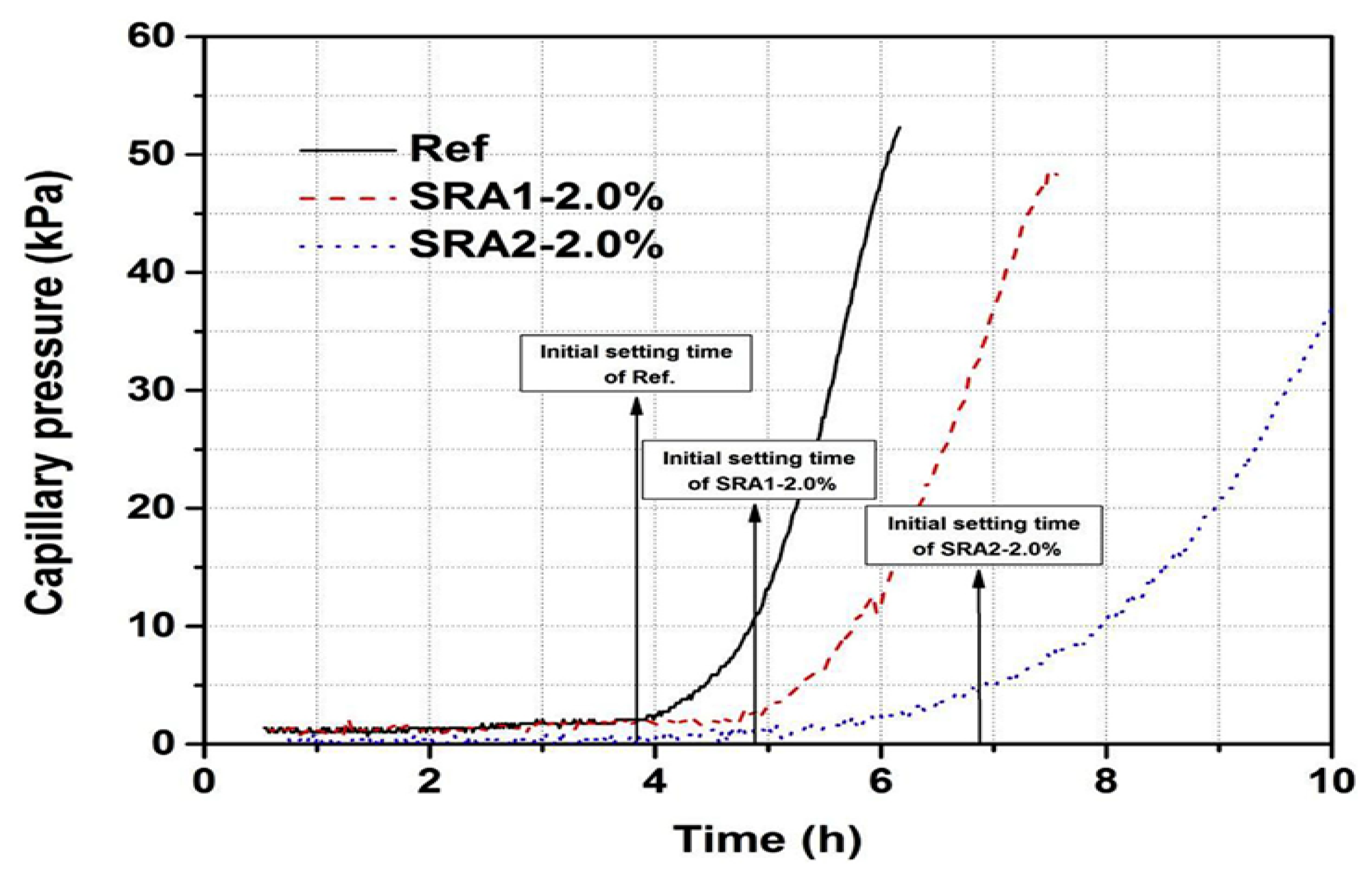
MPCE Regulation Entry Point for Autogenous Shrinkage
2.2. Dry Shrinkage
MPCE Regulation Entry Point for Drying Shrinkage
3. Molecular Design of PCE and Targeted Modification of MPCE for Volume Deformation Control
4. Control of Volume Deformation of Concrete by PCE
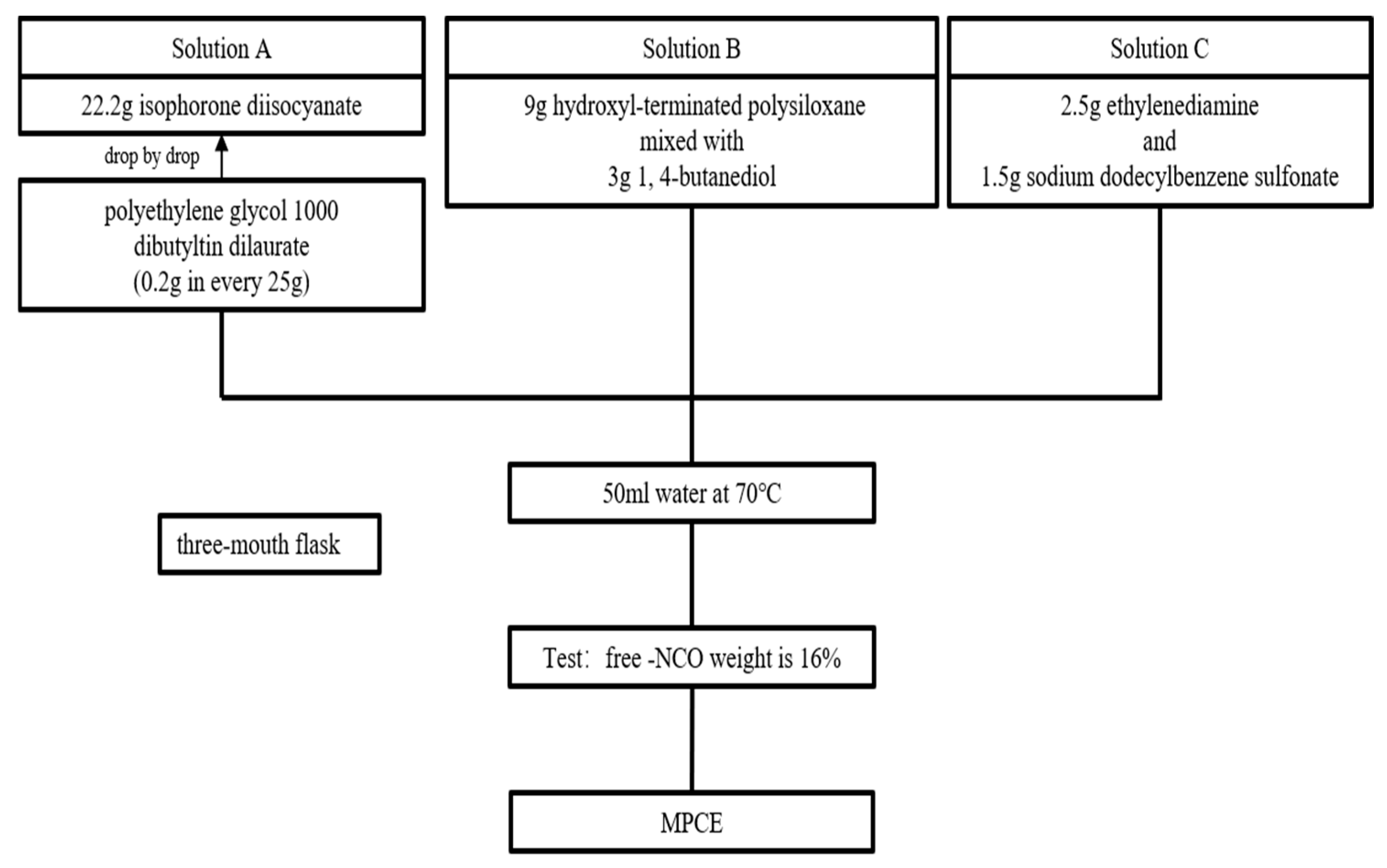
4.1. Materials and Methods
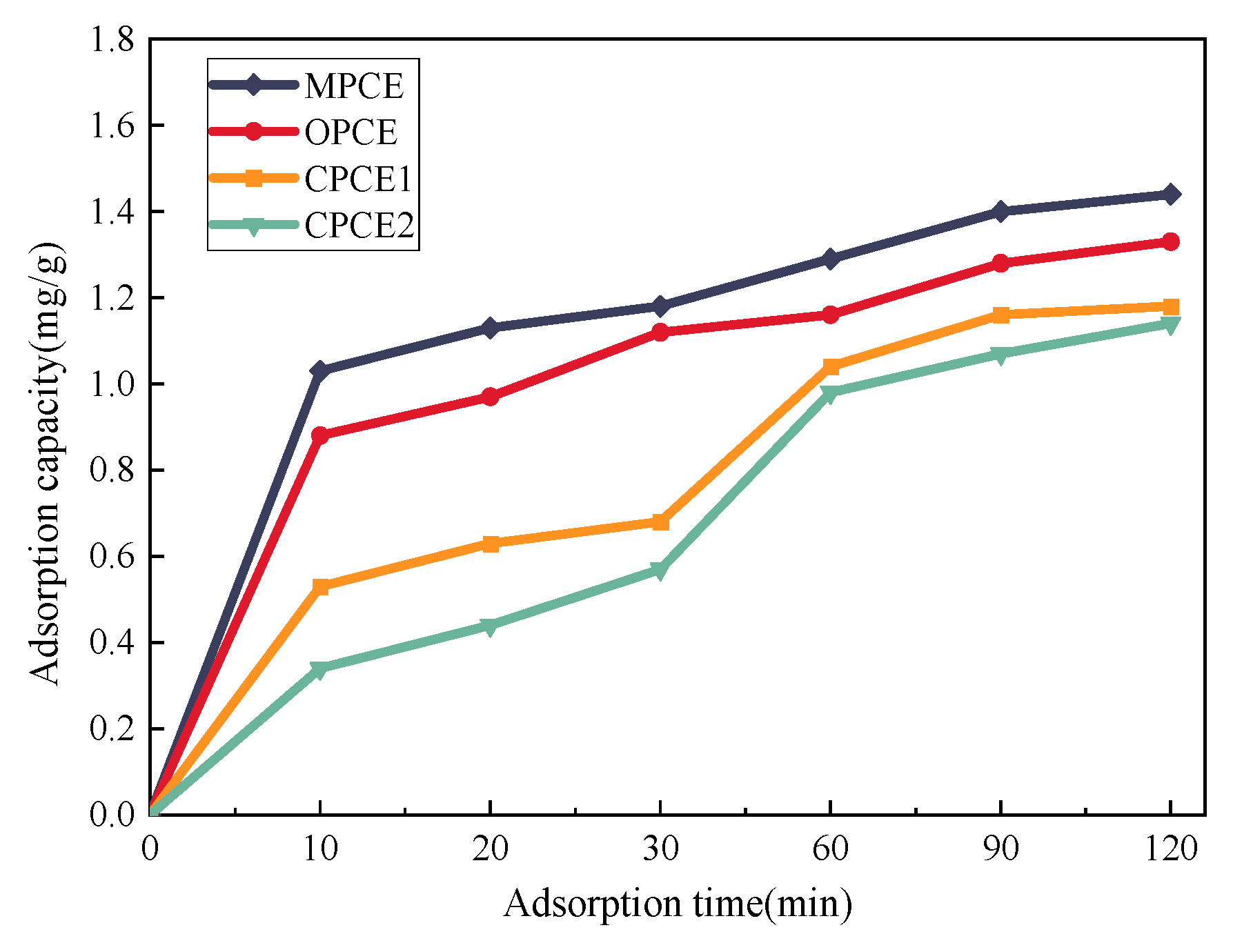
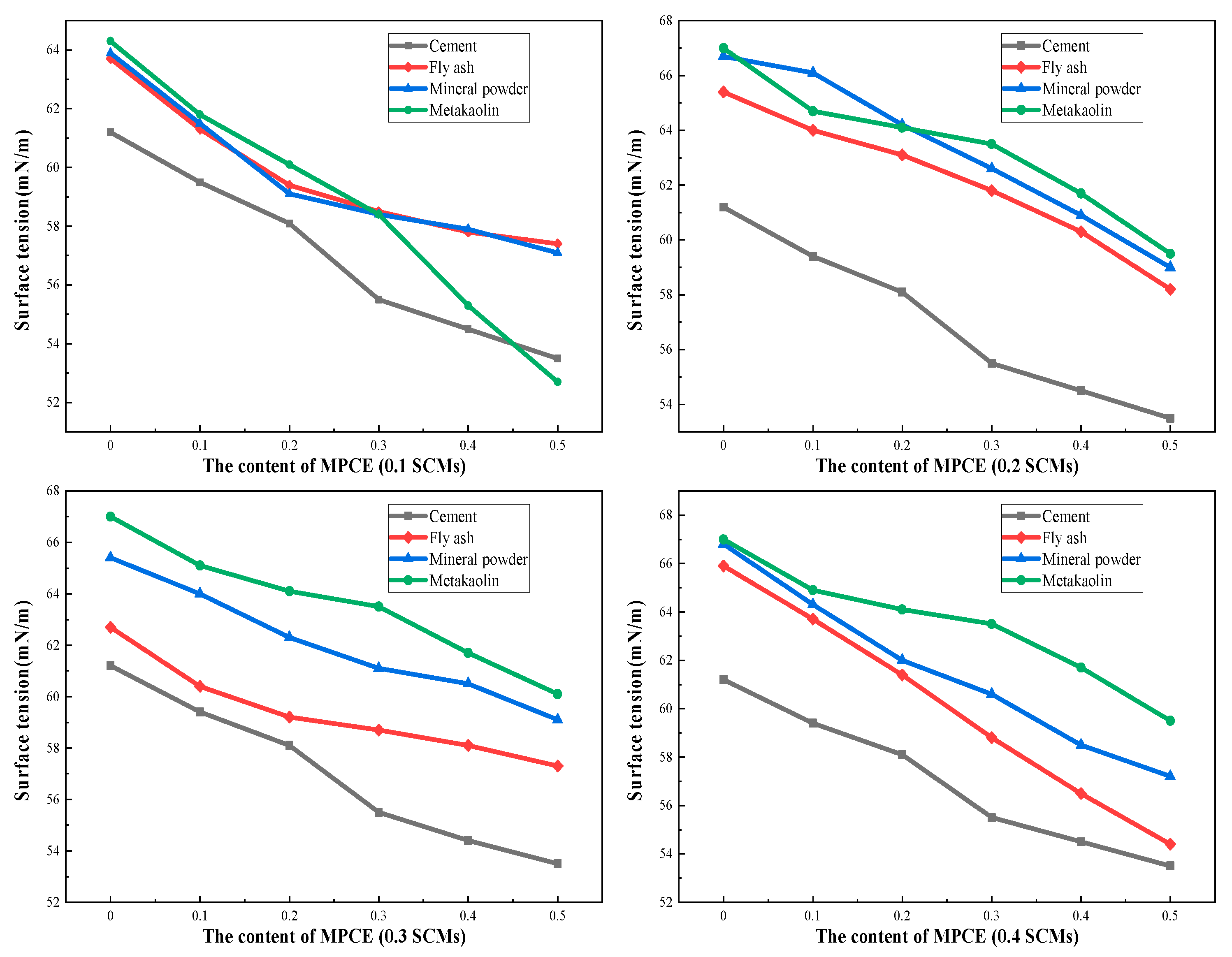
4.2. Adsorption Capacity and Surface Tension
5. Conclusions
- (1)
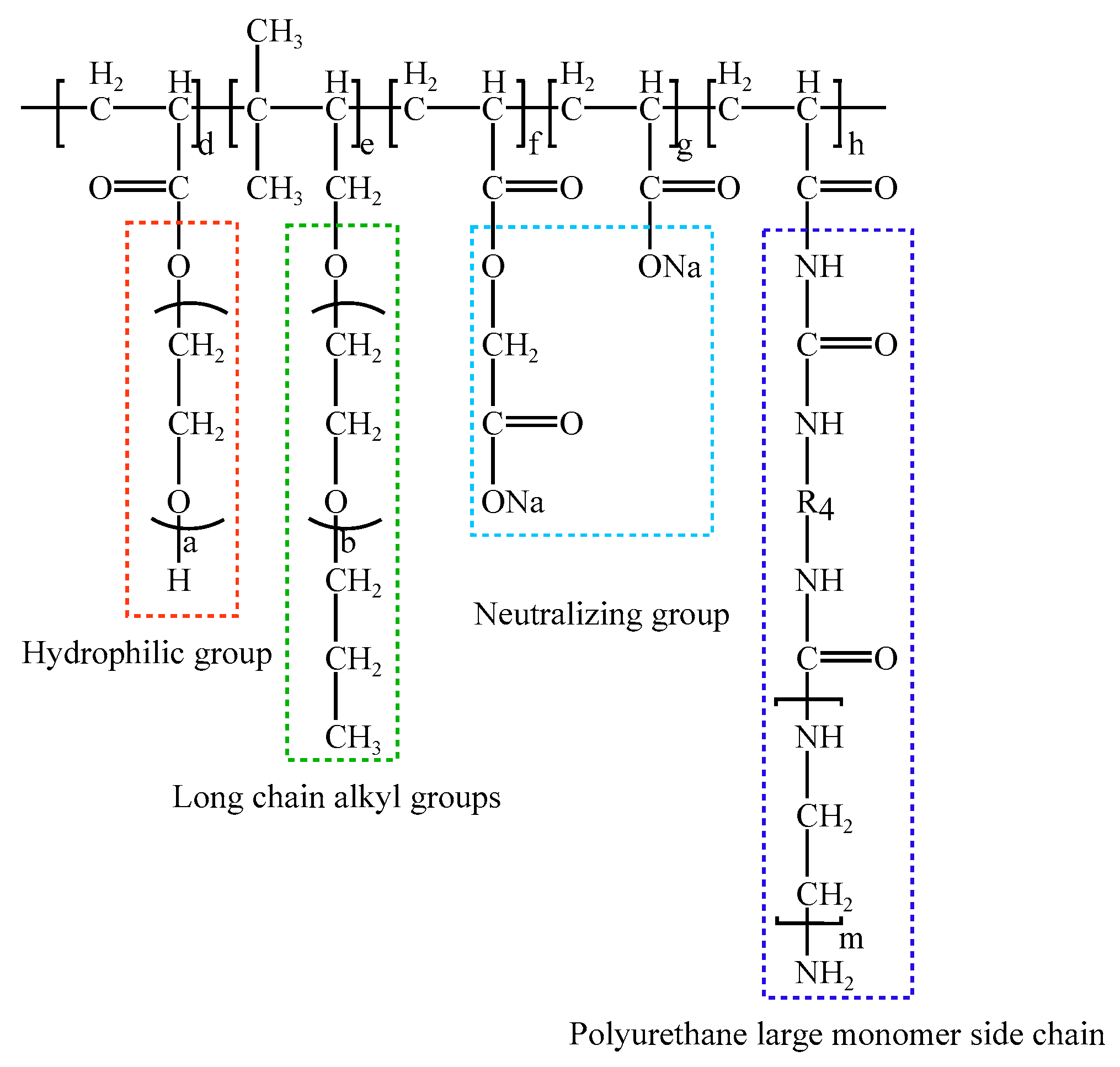
- Compared with ordinary PCE, MPCE significantly reduces the surface tension of the pore solution in cement paste (by up to 10%) through the introduction of polyurethane side chains, thereby directly weakening capillary tension and effectively inhibiting both autogenous and drying shrinkage in concrete.
- (2)
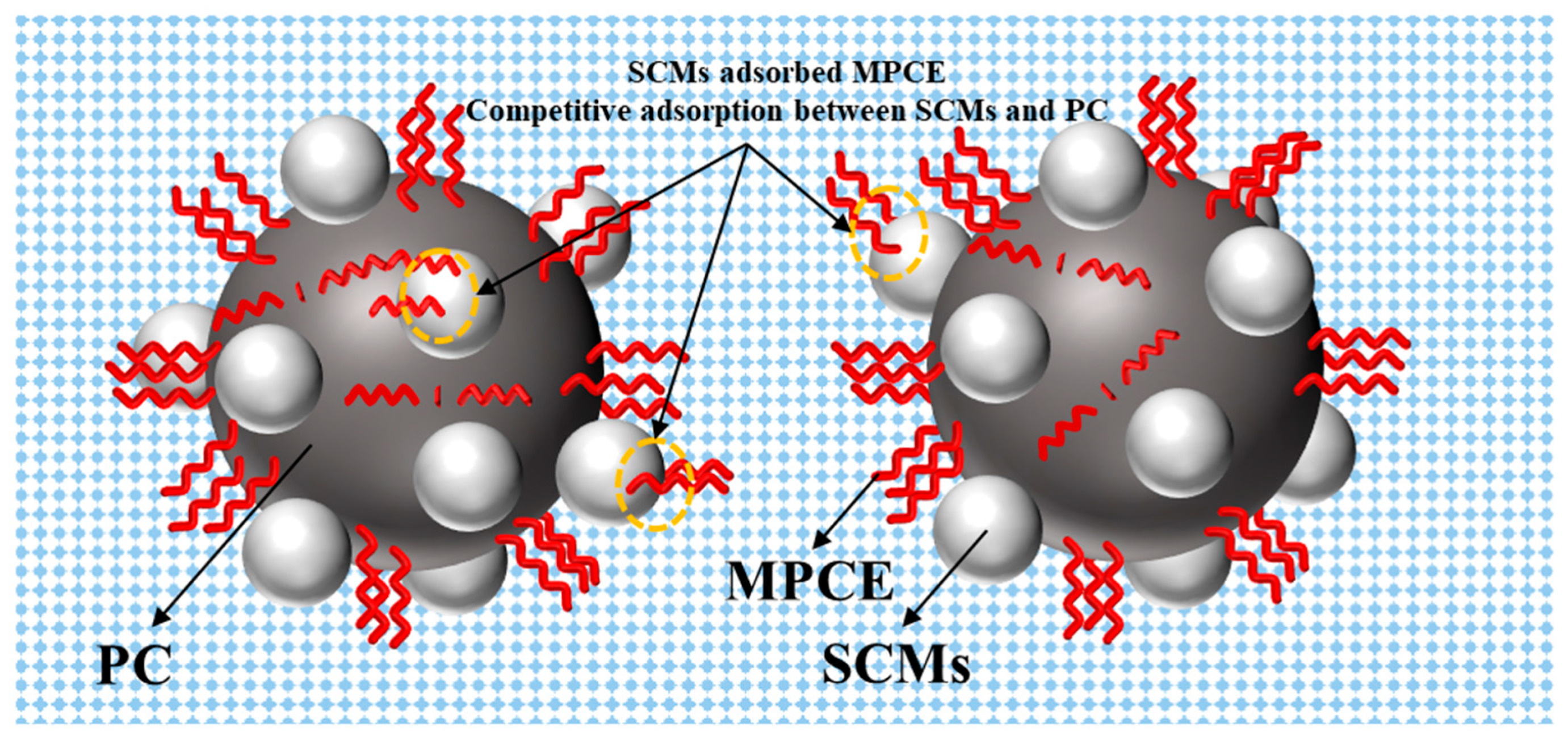
- MPCE exhibits superior adsorption performance: at the same dosage, its adsorption amount on cement particles is 117.1%, 194.3%, and 302.9% that of ordinary PCE, C-PCE1, and C-PCE2, respectively. Furthermore, MPCE shows good compatibility with supplementary cementitious materials (fly ash, slag, metakaolin), enabling synergistic refinement of pore structure and further enhancing shrinkage reduction.
- (3)
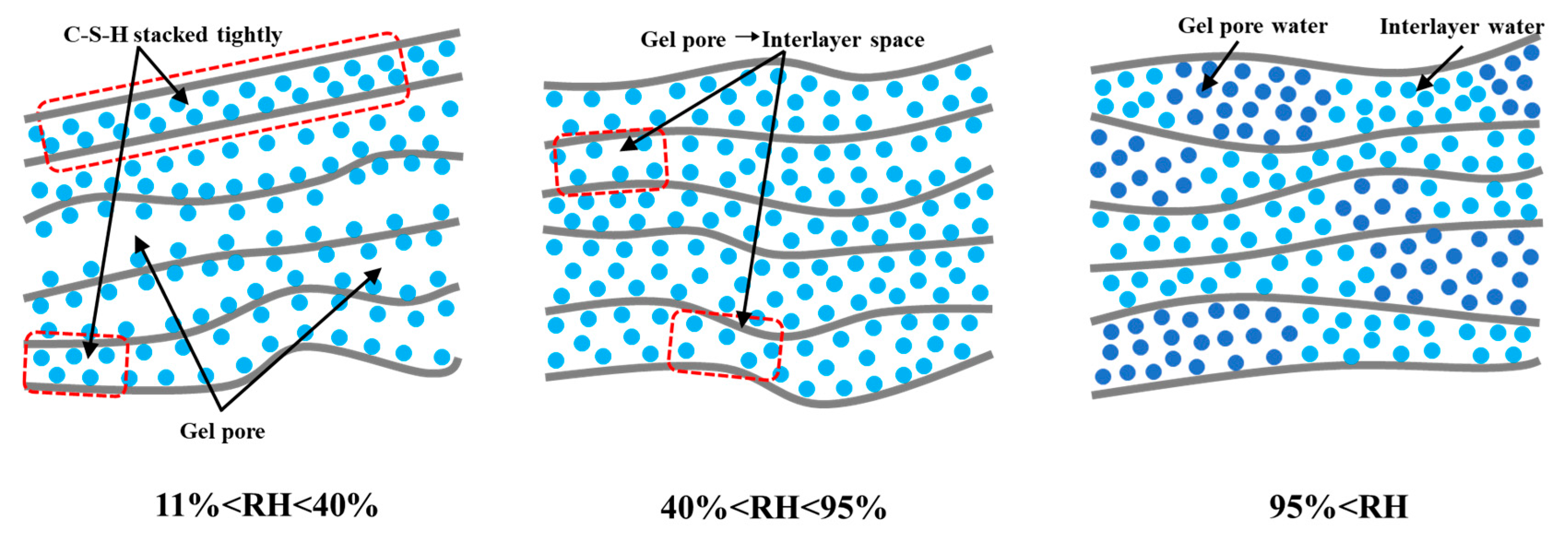
- The dual mechanism of MPCE is elucidated: on one hand, it reduces capillary pressure by lowering the surface tension of the pore solution; on the other hand, it adsorbs onto the C-S-H gel surface, inhibiting interlayer water migration and mitigating late-age drying shrinkage.
- (4)
- For the design of hydraulic concrete structures incorporating MPCE, it is recommended that engineers account for the reduced autogenous and drying shrinkage when determining crack control spacing and reinforcement ratios. Additionally, the lower surface tension of the pore solution may affect the bond strength between concrete and reinforcement, which should be verified through structural-scale tests. Given the improved compatibility with supplementary cementitious materials, MPCE-containing concrete is particularly suitable for mass concrete elements where thermal and shrinkage cracking are critical concerns.
Author Contributions
Funding
Data Availability Statement
Conflicts of Interest
References
- Maruyama, I.; Lura, P. Properties of early-age concrete relevant to cracking in massive concrete. Cem. Concr. Res. 2019, 123, 105770. [Google Scholar] [CrossRef]
- Yang, Z.; Lu, F.; Zhan, X.; Zhu, H.; Zhang, B.; Chen, Z.; Zhang, H. Mechanical properties and mesoscopic damage characteristics of basalt fibre-reinforced seawater sea-sand slag-based geopolymer concrete. J. Build. Eng. 2024, 84, 108688. [Google Scholar] [CrossRef]
- Zhang, B.; Wang, W.; Yang, Z.; Zhu, H. Understanding the bond performance between BFRP bars and alkali-activated seawater coral aggregate concrete under marine environments. Eng. Struct. 2023, 288, 116228. [Google Scholar] [CrossRef]
- Alrefaei, Y.; Wang, Y.-S.; Dai, J.-G. Effect of mixing method on the performance of alkali-activated fly ash/slag pastes along with polycarboxylate admixture. Cem. Concr. Compos. 2021, 117, 103917. [Google Scholar] [CrossRef]
- Li, S.; Pang, H.; Zhang, J.; Meng, Y.; Huang, J.; Lin, X.; Liao, B. Synthesis and performance of a novel amphoteric polycarboxylate superlasticizer with hydrolysable ester group. Colloids Surf. A Physicochem. Eng. Asp. 2019, 564, 78–88. [Google Scholar] [CrossRef]
- Lei, L.; Chan, H.-K. Investigation into the molecular design and plasticizing effectiveness of HPEG-based polycarboxylate superplasticizers in alkali-activated slag. Cem. Concr. Res. 2020, 136, 106150. [Google Scholar] [CrossRef]
- Javadi, A.; Jamil, T.; Abouzari-Lotf, E.; Soucek, M.D.; Heinz, H. Working mechanisms and design principles of comb-like polycarboxylate ether superplasticizers in cement hydration: Quantitative insights for a series of well-defined copolymers. ACS Sustain. Chem. Eng. 2021, 9, 8354–8371. [Google Scholar] [CrossRef]
- Chen, X.; Tang, X.; Zhang, C.; Lu, X.; Guo, H.; Li, X.; Pang, L.; Yang, Y.; Dong, F. Synthesis and property of EPEG-based polycarboxylate ether superplasticizers via RAFT polymerization. Polym. Eng. Sci. 2022, 62, 2769–2778. [Google Scholar] [CrossRef]
- Zhang, L.; Miao, X.; Kong, X.; Zhou, S. Retardation effect of PCE superplasticizers with different architectures and their impacts on early strength of cement mortar. Cem. Concr. Compos. 2019, 104, 103369. [Google Scholar] [CrossRef]
- Honorio, T.; Bary, B.; Benboudjema, F. Thermal properties of cement-based materials: Multiscale estimations at early-age. Cem. Concr. Compos. 2018, 87, 205–219. [Google Scholar] [CrossRef]
- Kanda, T.; Momose, H.; Imamoto, K. Shrinkage cracking resistance of blast furnace slag blended cement concrete—Influencing factors and enhancing measures. J. Adv. Concr. Technol. 2015, 13, 1–14. [Google Scholar] [CrossRef]
- Liu, M.; Lei, J.; Bi, Y.; Du, X.; Zhao, Q.; Zhang, X. Preparation of polcarboxylate-based superplasticizer and its effects on zeta potential and rheological property of cement paste. J. Wuhan Univ. Technol.-Mater. Sci. Ed. 2015, 30, 1008–1012. [Google Scholar] [CrossRef]
- Sun, X.; Yi, S.; Li, X.; Cui, Y.; Zhang, M.; Jiang, T.; Wang, L.; Kong, Q. A novel ultrasonic-velocity-based concrete carbonation monitoring method based on step-wise stretching technique. Struct. Health Monit. 2024, 25, 117–130. [Google Scholar] [CrossRef]
- Zhang, Z.; Liang, G.; Niu, Q.; Wang, F.; Chen, J.; Zhao, B.; Ke, L. A Wiener degradation process with drift-based approach of determining target reliability index of concrete structures. Engineering 2022, 38, 3710–3725. [Google Scholar] [CrossRef]
- Feng, Z.; Li, C.; Ke, L.; Yoo, D.-Y. Experimental and numerical investigations on flexural performance of ultra-high-performance concrete (UHPC) beams with wet joints. Structures 2022, 45, 199–213. [Google Scholar] [CrossRef]
- Dai, L.; Xu, W.; Wang, L.; Yi, S.; Chen, W. Secondary transfer length and residual prestress of fractured strand in post-tensioned concrete beams. Front. Struct. Civ. Eng. 2022, 16, 388–400. [Google Scholar] [CrossRef]
- Li, T.; Yang, J.; Jiang, P.; Abuhussain, M.A.; Zaman, A.; Fawad, M.; Farooq, F. Forecasting the strength of nanocomposite concrete containing carbon nanotubes by interpretable machine learning approaches with graphical user interface. Structures 2024, 59, 105821. [Google Scholar] [CrossRef]
- Xiao, J.; Peng, J.; Cai, C.S.; Bian, H.; Zhang, J. Experimental study of shrinkage and creep behaviors of low-shrinkage and low-creep C60 high-performance concrete and parameter recommendations. J. Mater. Civ. Eng. 2024, 36, 04024035. [Google Scholar] [CrossRef]
- Wang, L.; Yuan, P.; Floyd, R.W. Generation of optimal load paths for corroded reinforced concrete beams part II: Multi-angle truss model. ACI Struct. J. 2023, 120, 115–126. [Google Scholar] [CrossRef]
- De Souza, D.J.; Sanchez, L.F.M. Understanding the efficiency of autogenous and autonomous self-healing of conventional concrete mixtures through mechanical and microscopical analysis. Cem. Concr. Res. 2023, 172, 107219. [Google Scholar] [CrossRef]
- Wu, L.; Farzad Nia, N.; Shi, C. Autogenous shrinkage of high performance concrete: A review. Constr. Build. Mater. 2017, 149, 62–75. [Google Scholar] [CrossRef]
- Silva, D.B.P.; Lima, N.B.; Lima, V.M.E.; Estolano, A.M.L.; Nascimento, H.C.B.; Vilemen, P.; Padron-Hernández, E.; Carneiro, A.M.P.; Lima, N.B.D.; Povoas, Y.V. Producing a gypsum-based self-leveling mortar for subfloor modified by polycarboxylate admixture (PCE). Constr. Build. Mater. 2023, 364, 130007. [Google Scholar] [CrossRef]
- Ilg, M.; Plank, J. A novel kind of concrete superplasticizer based on lignite graft copolymers. Cem. Concr. Res. 2016, 79, 123–130. [Google Scholar] [CrossRef]
- Ribeiro, A.B.; Gonçalves, A.; Carrajola, A. Effect of shrinkage reduction admixtures on the pore structure properties of mortars. Mater. Struct. 2006, 39, 179–187. [Google Scholar] [CrossRef]
- Tazawa, E.-I.; Miyazawa, S. Influence of cement and admixture on autogenous shrinkage of cement paste. Cem. Concr. Res. 1995, 25, 281–287. [Google Scholar] [CrossRef]
- Zuo, W.; Feng, P.; Zhong, P.; Tian, Q.; Gao, N.; Wang, Y.; Yu, C.; Miao, C. Effects of novel polymer-type shrinkage-reducing admixture on early age autogenous deformation of cement pastes. Cem. Concr. Res. 2017, 100, 413–422. [Google Scholar] [CrossRef]
- Maruyama, I.; Sasano, H.; Nishioka, Y.; Igarashi, G. Strength and Young’s modulus change in concrete due to long-term drying and heating up to 90 °C. Cem. Concr. Res. 2014, 66, 48–63. [Google Scholar] [CrossRef]
- Li, L.; Dao, V.; Lura, P. Autogenous deformation and coefficient of thermal expansion of early-age concrete: Initial outcomes of a study using a newly-developed temperature stress testing machine. Cem. Concr. Compos. 2021, 119, 103997. [Google Scholar] [CrossRef]
- Wyrzykowski, M.; Lura, P. Controlling the coefficient of thermal expansion of cementitious materials—A new application for superabsorbent polymers. Cem. Concr. Compos. 2013, 35, 49–58. [Google Scholar] [CrossRef]
- Kou, S.C.; Poon, C.S.; Etxeberria, M. Residue strength, water absorption and pore size distributions of recycled aggregate concrete after exposure to elevated temperatures. Cem. Concr. Compos. 2014, 53, 73–82. [Google Scholar] [CrossRef]
- Mateos, A.; Harvey, J.; Bolander, J.; Wu, R.; Paniagua, J.; Paniagua, F. Field evaluation of the impact of environmental conditions on concrete moisture-related shrinkage and coefficient of thermal expansion. Constr. Build. Mater. 2019, 225, 348–357. [Google Scholar] [CrossRef]
- Wyrzykowski, M.; Lura, P. Moisture dependence of thermal expansion in cement-based materials at early ages. Cem. Concr. Res. 2013, 53, 25–35. [Google Scholar] [CrossRef]
- Maruyama, I.; Teramoto, A. Impact of time-dependant thermal expansion coefficient on the early-age volume changes in cement pastes. Cem. Concr. Res. 2011, 41, 380–391. [Google Scholar] [CrossRef]
- Kamasamudram, K.S.; Ashraf, W.; Landis, E.N. Cellulose nanofibrils with and without nanosilica for the performance enhancement of Portland cement systems. Constr. Build. Mater. 2021, 285, 121547. [Google Scholar] [CrossRef]
- Zahabizadeh, B.; Edalat-Behbahani, A.; Granja, J.; Gomes, J.G.; Faria, R.; Azenha, M. A new test setup for measuring early age coefficient of thermal expansion of concrete. Cem. Concr. Compos. 2019, 98, 14–28. [Google Scholar] [CrossRef]
- Yang, Z.; Zhan, X.; Zhu, H.; Zhang, B.; Lu, F.; Dong, Z. Mesoscopic investigation of the matrix pores and ITZ effects on the mechanical properties of seawater sea-sand coral aggregate concrete. J. Build. Eng. 2024, 90, 109375. [Google Scholar] [CrossRef]
- Wei, H.; Li, J.; Hu, B.; Wang, F.; Zheng, J. Influence of temperature on deformation failure and acoustic emission characterisation of asphalt concrete under uniaxial compression. Int. J. Pavement Eng. 2023, 24, 2038380. [Google Scholar] [CrossRef]
- Zhao, B.; Xu, Y.; Peng, H.; Pan, J.; Li, T.; Zhang, Z.; Peng, X. Experiment and phase-field simulation of uniaxial compression of ultra-high-performance concrete with coarse aggregate. Adv. Struct. Eng. 2022, 25, 2121–2136. [Google Scholar] [CrossRef]
- Zhang, Y.; Sun, X.; Medina, M.A. Thermal performance of concrete masonry units containing insulation and phase change material. J. Build. Eng. 2023, 76, 107184. [Google Scholar] [CrossRef]
- Li, Y.; Huang, L.; Gao, C.; Qu, Y.; Luo, X.; Lv, B.; Chen, Z. Axial compressive behavior of steel reinforced GGBS-RFBP-FA ternary composite geopolymer recycled fireclay brick aggregates concrete columns. Structures 2024, 60, 105913. [Google Scholar] [CrossRef]
- Pei, B.; Chong, A.; Xia, H.; Kang, X. Design and key construction technology of steel-concrete-steel sandwich composite pylon for a large span cable-stayed bridge. Sci. Rep. 2023, 13, 6626. [Google Scholar] [CrossRef] [PubMed]
- MacLeod, A.J.N.; Collins, F.G.; Duan, W. Effects of carbon nanotubes on the early-age hydration kinetics of Portland cement using isothermal calorimetry. Cem. Concr. Compos. 2021, 119, 103994. [Google Scholar] [CrossRef]
- Xu, J.; Liu, Q.; Guo, H.; Wang, M.; Li, Z.; Sun, G. Low melting point alloy modified cement paste with enhanced flexural strength, lower hydration temperature, and improved electrical properties. Compos. B Eng. 2022, 232, 109628. [Google Scholar] [CrossRef]
- Liu, Q.; Ming, X.; Xu, J.; Hou, D.; Sun, G.; Li, Z.; Geng, G. Robust cement composite with low hydration temperature and high mechanical performance achieved by Field’s metal and acrylic acid-acrylamide copolymer. Constr. Build. Mater. 2023, 387, 131655. [Google Scholar] [CrossRef]
- Khan, M.; Rehman, A.; Ali, M. Efficiency of silica-fume content in plain and natural fiber reinforced concrete for concrete road. Constr. Build. Mater. 2020, 244, 118382. [Google Scholar] [CrossRef]
- Zheng, X.; Wang, Y.; Zhang, S.; Xu, F.; Zhu, X.; Jiang, X.; Zhou, L.; Shen, Y.; Chen, Q.; Yan, Z.; et al. Research progress of the thermophysical and mechanical properties of concrete subjected to freeze-thaw cycles. Constr. Build. Mater. 2022, 330, 127254. [Google Scholar] [CrossRef]
- Yeon, J.H.; Choi, S.; Won, M.C. In situ measurement of coefficient of thermal expansion in hardening concrete and its effect on thermal stress development. Constr. Build. Mater. 2013, 38, 306–315. [Google Scholar] [CrossRef]
- Bažant, Z.P. Delayed thermal dilatations of cement paste and concrete due to mass transport. Nucl. Eng. Des. 1970, 14, 308–318. [Google Scholar] [CrossRef]
- Saul, A.G.A. Principles underlying the steam curing of concrete at atmospheric pressure. Mag. Concr. Res. 1951, 2, 127–140. [Google Scholar] [CrossRef]
- Jensen, M.; Hansen, P.F. Autogenous deformation and change of the relative humidity in silica fume-modified cement paste. ACI Mater. J. 1996, 93, 539–543. [Google Scholar] [CrossRef]
- Hansen, P.F.; Pedersen, E.J. Maturity Computer for Controlled Curing and Hardening of Concrete; Nordiska Betongfoerbundet: Stockholm, Sweden, 1977. [Google Scholar]
- Wyrzykowski, M.; Lura, P. Effect of relative humidity decrease due to self-desiccation on the hydration kinetics of cement. Cem. Concr. Res. 2016, 85, 75–81. [Google Scholar] [CrossRef]
- Choudhary, R.; Gupta, R.; Alomayri, T.; Jain, A.; Nagar, R. Permeation, corrosion, and drying shrinkage assessment of self-compacting high strength concrete comprising waste marble slurry and fly ash, with silica fume. Structures 2021, 33, 971–985. [Google Scholar] [CrossRef]
- Behera, M.; Minocha, A.K.; Bhattacharyya, S.K. Flow behavior, microstructure, strength and shrinkage properties of self-compacting concrete incorporating recycled fine aggregate. Constr. Build. Mater. 2019, 228, 116819. [Google Scholar] [CrossRef]
- Lothenbach, B.; Matschei, T.; Möschner, G.; Glasser, F.P. Thermodynamic modelling of the effect of temperature on the hydration and porosity of Portland cement. Cem. Concr. Res. 2008, 38, 1–18. [Google Scholar] [CrossRef]
- Li, Z.; Gao, X.; Lu, D.; Dong, J. Early hydration properties and reaction kinetics of multi-composite cement pastes with supplementary cementitious materials (SCMs). Thermochim. Acta 2022, 709, 179157. [Google Scholar] [CrossRef]
- Kanavaris, F.; Soutsos, M.; Chen, J.-F. Enabling sustainable rapid construction with high volume GGBS concrete through elevated temperature curing and maturity testing. J. Build. Eng. 2023, 63, 105434. [Google Scholar] [CrossRef]
- Shukla, B.K.; Gupta, A.; Gowda, S.; Srivastav, Y. Constructing a greener future: A comprehensive review on the sustainable use of fly ash in the construction industry and beyond. Mater. Today Proc. 2023, 93, 257–264. [Google Scholar] [CrossRef]
- Maruyama, I. Origin of drying shrinkage of hardened cement paste: Hydration pressure. J. Adv. Concr. Technol. 2010, 8, 187–200. [Google Scholar] [CrossRef]
- Li, Z.; Nedeljković, M.; Chen, B.; Ye, G. Mitigating the autogenous shrinkage of alkali-activated slag by metakaolin. Cem. Concr. Res. 2019, 122, 30–41. [Google Scholar] [CrossRef]
- Tran, N.P.; Gunasekara, C.; Law, D.W.; Houshyar, S.; Setunge, S.; Cwirzen, A. A critical review on drying shrinkage mitigation strategies in cement-based materials. J. Build. Eng. 2021, 38, 102210. [Google Scholar] [CrossRef]
- Gawin, D.; Pesavento, F. An Overview of Modeling Cement Based Materials at Elevated Temperatures with Mechanics of Multi-Phase Porous Media. Fire Technol. 2012, 48, 753–793. [Google Scholar] [CrossRef]
- Abdolhosseini Qomi, M.J.; Brochard, L.; Honorio, T.; Maruyama, I.; Vandamme, M. Advances in atomistic modeling and understanding of drying shrinkage in cementitious materials. Cem. Concr. Res. 2021, 148, 106536. [Google Scholar] [CrossRef]
- Krishna, V.; Kumar, R. Water to cement ratio: A simple and effective approach to control plastic and drying shrinkage in concrete. In Proceedings of the 4th International Conference on Sustainable Construction Materials and Technologies (SCMT4), Las Vegas, NV, USA, 7–11 August 2016. [Google Scholar]
- Garboczi, E.J.; Bentz, D.P. Modelling of the microstructure and transport properties of concrete. Constr. Build. Mater. 1996, 10, 293–300. [Google Scholar] [CrossRef]
- Magudeaswaran, P.; Vivek Kumar, C.; Vamsi Krishna, K.; Nagasaibaba, A.; Ravinder, R. Investigational studies on the impact of supplementary cementitious materials (SCM) for identifying the strength and durability characteristics in self curing concrete. Mater. Today Proc. 2023. [Google Scholar] [CrossRef]
- Collins, F.; Sanjayan, J.G. Effect of pore size distribution on drying shrinking of alkali-activated slag concrete. Cem. Concr. Res. 2000, 30, 1401–1406. [Google Scholar] [CrossRef]
- Li, Y.; Ma, H.; Wen, L.; Yuan, J.; Zhang, Y.; Li, Y.; Zhou, H.; Chen, J. Influence of pore size distribution on concrete cracking with different AEA content and curing age using acoustic emission and low-field NMR. J. Build. Eng. 2022, 58, 105059. [Google Scholar] [CrossRef]
- Kovler, K.; Zhutovsky, S. Overview and future trends of shrinkage research. Mater. Struct. 2006, 39, 827–847. [Google Scholar] [CrossRef]
- Wittmann, F.H. Heresies on shrinkage and creep mechanisms. In Proceedings of the 8th International Conference on Creep, Shrinkage and Durability Mechanics of Concrete and Concrete Structures; Taylor and Francis Group: London, UK, 2008; pp. 3–9. [Google Scholar] [CrossRef]
- Almudaiheem, J.A. Prediction of drying shrinkage of Portland cement paste: Influence of shrinkage mechanisms. J. King Saud Univ. Eng. Sci. 1991, 3, 69–86. [Google Scholar] [CrossRef]
- Ye, H.; Radlińska, A. A review and comparative study of existing shrinkage prediction models for Portland and non-Portland cementitious materials. Adv. Mater. Sci. Eng. 2016, 2016, 2418219. [Google Scholar] [CrossRef]
- Idiart, A.E. Coupled Analysis of Degradation Processes in Concrete Specimens at the Meso-Level. Ph.D. Thesis, Universitat Politècnica de Catalunya (UPC), Barcelona, Spain, 2009. [Google Scholar]
- Slowik, V.; Ju, J.W. Discrete modeling of plastic cement paste subjected to drying. Cem. Concr. Compos. 2011, 33, 925–935. [Google Scholar] [CrossRef]
- Di Bella, C.; Wyrzykowski, M.; Lura, P. Evaluation of the ultimate drying shrinkage of cement-based mortars with poroelastic models. Mater. Struct. 2017, 50, 235. [Google Scholar] [CrossRef]
- Ghourchian, S.; Wyrzykowski, M.; Lura, P. The bleeding test: A simple method for obtaining the permeability and bulk modulus of fresh concrete. Cem. Concr. Res. 2016, 89, 249–256. [Google Scholar] [CrossRef]
- Slowik, V.; Schmidt, M.; Fritzsch, R. Capillary pressure in fresh cement-based materials and identification of the air entry value. Cem. Concr. Compos. 2008, 30, 557–565. [Google Scholar] [CrossRef]
- Maruyama, I.; Nishioka, Y.; Igarashi, G.; Matsui, K. Microstructural and bulk property changes in hardened cement paste during the first drying process. Cem. Concr. Res. 2014, 58, 20–34. [Google Scholar] [CrossRef]
- Hlobil, M.; Sotiriadis, K.; Hlobilová, A. Scaling of strength in hardened cement pastes—Unveiling the role of microstructural defects and the susceptibility of C-S-H gel to physical/chemical degradation by multiscale modeling. Cem. Concr. Res. 2022, 154, 106714. [Google Scholar] [CrossRef]
- Shamanth Gowda, T.; Ranganath, R.V. High early strength-high performance concrete produced with combination of ultra-fine slag and ultra-fine silica: Influence on fresh, mechanical, shrinkage and durability properties with microstructural investigation. Constr. Build. Mater. 2023, 385, 131462. [Google Scholar] [CrossRef]
- Maruyama, I.; Igarashi, G.; Nishioka, Y. Bimodal behavior of C-S-H interpreted from short-term length change and water vapor sorption isotherms of hardened cement paste. Cem. Concr. Res. 2015, 73, 158–168. [Google Scholar] [CrossRef]
- Tian, Z.; Cai, Y.; Shi, H.; Wang, G.; Zhang, Z.; Dai, Y.; Xu, B. Simulation of test arch based on concrete damage plasticity model and damage evolution analysis. Appl. Sci. 2023, 13, 11239. [Google Scholar] [CrossRef]
- Su, M.; Chong, Q.; Xie, H.; Xie, Y.; Zeng, Z.-P. On the deformation of CRTS-III ballastless track during the casting process of self-compacting concrete: Numerical simulations and random forest-based prediction models. Eng. Struct. 2024, 307, 117870. [Google Scholar] [CrossRef]
- Zeng, L.; Yang, Z.-R.; Zha, H.-Y.; Wen, W.; Liu, J. Experimental study on vegetation performance improvement of carbonaceous mudstone aggregate vegetation concrete with its micromechanism. Eur. J. Environ. Civ. Eng. 2023, 27, 4379–4395. [Google Scholar] [CrossRef]
- Yu, Z.-P.; Yang, W.-J. Research on thermal properties of polystyrene granular concrete under the influence of multiple factors. J. Build. Eng. 2024, 86, 108799. [Google Scholar] [CrossRef]
- Xin, F.; Xiao, R.; Zhao, Y.; Zhang, J. Surface sulfidation modification of magnetospheres from fly ash for elemental mercury removal from coal combustion flue gas. Chem. Eng. J. 2022, 436, 135212. [Google Scholar] [CrossRef]
- Huang, D.; Yuan, Q.; Chen, P.; Tian, X.; Peng, H. Effect of activator properties on drying shrinkage of alkali-activated fly ash and slag. J. Build. Eng. 2022, 62, 105341. [Google Scholar] [CrossRef]
- Tian, X.; Liu, K.; Yang, X.; Jiang, T.; Chen, B.; Tian, Z.; Wu, J.; Xia, L.; Huang, D.; Peng, H. Synthesis of metakaolin-based geopolymer foamed materials using municipal solid waste incineration fly ash as a foaming agent. Waste Manag. 2023, 166, 101–111. [Google Scholar] [CrossRef]
- Gao, Y.; Zhu, Z.; Zhu, J.; Hu, X. Study on the mechanical properties and water stability of steel slag-fly ash geopolymer for base stabilisation. Int. J. Pavement Eng. 2024, 25, 2308168. [Google Scholar] [CrossRef]
- Afroughsabet, V.; Teng, S. Experiments on drying shrinkage and creep of high performance hybrid-fiber-reinforced concrete. Cem. Concr. Compos. 2020, 106, 103481. [Google Scholar] [CrossRef]
- Li, B.; Gao, A.; Li, Y.; Xiao, H.; Chen, N.; Xia, D.; Wang, S.; Li, C. Effect of silica fume content on the mechanical strengths, compressive stress–strain behavior and microstructures of geopolymeric recycled aggregate concrete. Constr. Build. Mater. 2023, 384, 131417. [Google Scholar] [CrossRef]
- Yang, T.; Zhu, H.; Zhang, Z. Influence of fly ash on the pore structure and shrinkage characteristics of metakaolin-based geopolymer pastes and mortars. Constr. Build. Mater. 2017, 153, 284–293. [Google Scholar] [CrossRef]
- Yang, G.; Wu, Y.; Li, H.; Gao, N.; Jin, M.; Hu, Z.; Liu, J. Effect of shrinkage-reducing polycarboxylate admixture on cracking behavior of ultra-high strength mortar. Cem. Concr. Compos. 2021, 122, 104117. [Google Scholar] [CrossRef]
- Zhang, J.; Ma, Y.F.; Zhao, H.X.; Sun, H.Q.; Liu, J.P. Mitigating autogenous shrinkage of cement paste with novel shrinkage-reducing polycarboxylate superplasticizer. Mater. Struct. 2022, 55, 235. [Google Scholar] [CrossRef]
- Cao, G.; Liu, R.; He, S.; Liao, S.; Zhang, Z. Mechanical properties and chloride salt corrosion resistance of all-lightweight shale ceramsite concrete. Buildings 2024, 14, 1684. [Google Scholar] [CrossRef]
- Zhu, X.; Lei, P.; Chen, X.; Bu, J. Influence of steam curing on cyclic triaxial characteristics of recycled aggregate concrete: Experimental analysis and DEM simulation. Eng. Fract. Mech. 2024, 312, 110643. [Google Scholar] [CrossRef]
- Wang, C.; Kong, F.; Pan, L. Effects of polycarboxylate superplasticizers with different side-chain lengths on the resistance of concrete to chloride penetration and sulfate attack. J. Build. Eng. 2021, 44, 102817. [Google Scholar] [CrossRef]
- Ma, B.; Wang, X.G.; Li, X.; Yang, L. Influence of superplasticizers on strength and shrinkage cracking of cement mortar under drying conditions. J. Wuhan Univ. Technol.-Mater. Sci. Ed. 2007, 22, 358–361. [Google Scholar] [CrossRef]
- Yamada, K.; Ogawa, S.; Hanehara, S. Controlling of the adsorption and dispersing force of polycarboxylate-type superplasticizer by sulfate ion concentration in aqueous phase. Cem. Concr. Res. 2001, 31, 375–383. [Google Scholar] [CrossRef]
- Zhu, Z.; Liu, R.; Yan, J.; Zhang, C.; Wei, B. Effects of a polycarboxylate superplasticiser on the rheological properties of a Portland-sulphoaluminate cement composite slurry. Mater. Lett. 2022, 308, 132147. [Google Scholar] [CrossRef]
- Lövgren, I.; Esping, O. Early age cracking of self-compacting concrete. In International RILEM Conference on Volume Changes of Hardening Concrete: Testing and Mitigation; RILEM Publications SARL: Bagneux, France, 2006. [Google Scholar]
- Bentz, D.P.; Jensen, O.M. Mitigation strategies for autogenous shrinkage cracking. Cem. Concr. Compos. 2004, 26, 677–685. [Google Scholar] [CrossRef]
- Ng, P.G.; Cheah, C.B.; Ng, E.P.; Oo, C.W.; Leow, K.H. The influence of main and side chain densities of PCE superplasticizer on engineering properties and microstructure development of slag and fly ash ternary blended cement concrete. Constr. Build. Mater. 2020, 242, 118103. [Google Scholar] [CrossRef]
- Lei, L.; Hirata, T.; Plank, J. 40 years of PCE superplasticizers—History, current state-of-the-art and an outlook. Cem. Concr. Res. 2022, 157, 106826. [Google Scholar] [CrossRef]
- Tang, H.; Yang, Y.; Li, H.; Xiao, L.; Ge, Y. Effects of chloride salt erosion and freeze-thaw cycle on interface shear behavior between ordinary concrete and self-compacting concrete. Structures 2023, 56, 104990. [Google Scholar] [CrossRef]
- Wan, P.; Wu, S.; Liu, Q.; Wang, H.; Zhao, F.; Wu, J.; Niu, Y.; Ye, Q. Sustained-release calcium alginate/diatomite capsules for sustainable self-healing asphalt concrete. J. Clean. Prod. 2022, 372, 133639. [Google Scholar] [CrossRef]
- Ye, M.; Li, L.; Pei, B.; Yoo, D.-Y.; Li, H. Shear behavior of externally prestressed ultra-high-performance concrete (UHPC) T-beams without stirrups. Eng. Struct. 2023, 288, 116217. [Google Scholar] [CrossRef]
- Su, X.; Ma, Y.; Wang, L.; Guo, Z.; Zhang, J. Fatigue life prediction for prestressed concrete beams under corrosion deterioration process. Structures 2022, 43, 1704–1715. [Google Scholar] [CrossRef]
- Pourchet, S.; Liautaud, S.; Rinaldi, D.; Pochard, I. Effect of the repartition of the PEG side chains on the adsorption and dispersion behaviors of PCP in presence of sulfate. Cem. Concr. Res. 2012, 42, 431–439. [Google Scholar] [CrossRef]
- Palacios, M.; Flatt, R.; Puertas, F.; Sánchez-Herencia, A. Compatibility between polycarboxylate and viscosity-modifying admixtures in cement pastes. ACI Spec. Publ. 2012, 288, 29–42. [Google Scholar] [CrossRef]
- Flatt, R.J.; Schober, I.; Raphael, E.; Plassard, C.; Lesniewska, E. Conformation of adsorbed comb copolymer dispersants. Langmuir 2009, 25, 845–855. [Google Scholar] [CrossRef]
- Feng, Z.; Li, C.; Pan, R.; Yoo, D.-Y.; He, J.; Ke, L. Shear capacity of ultrahigh-performance concrete with monolithic interface and wet-joint interface. J. Mater. Civ. Eng. 2022, 34, 0004297. [Google Scholar] [CrossRef]
- Zhu, X.; Jiang, Z. Reuse of waste rubber in pervious concrete: Experiment and DEM simulation. J. Build. Eng. 2023, 71, 106452. [Google Scholar] [CrossRef]
- Hu, H.; Zha, X.; Li, Z.; Lv, R. Preparation and performance study of solar pavement panel based on transparent resin-concrete. Sustain. Energy Technol. Assess. 2022, 52, 102169. [Google Scholar] [CrossRef]
- Zhu, X.; Chen, X.; Tian, H.; Ning, Y. Experimental and numerical investigation on fracture characteristics of self-compacting concrete mixed with waste rubber particles. J. Clean. Prod. 2023, 412, 137386. [Google Scholar] [CrossRef]
- Li, J.; Peng, Z.; Zhang, H.; Tu, H.; Sun, X.; Peng, F.; Jiang, C. Study on the heat transfer of a concrete wall outfitted with phase change materials. Case Stud. Therm. Eng. 2023, 51, 103520. [Google Scholar] [CrossRef]
- Ye, M.; Li, L.; Pei, B.; Yoo, D.-Y.; Li, H.; Zhou, C. A critical review on shear performance of joints in precast ultra-high-performance concrete (UHPC) segmental bridges. Eng. Struct. 2023, 301, 117224. [Google Scholar] [CrossRef]
- Liu, X.; Guan, J.; Lai, G.; Wang, Z.; Zhu, J.; Cui, S.; Lan, M.; Li, H. Performances and working mechanism of a novel polycarboxylate superplasticizer synthesized through changing molecular topological structure. J. Colloid Interface Sci. 2017, 504, 12–24. [Google Scholar] [CrossRef]
- Zheng, T.; Zheng, D.; Qiu, X.; Yang, D.; Fan, L.; Zheng, J. A novel branched claw-shape lignin-based polycarboxylate superplasticizer: Preparation, performance and mechanism. Cem. Concr. Res. 2019, 119, 89–101. [Google Scholar] [CrossRef]
- Tan, H.; Li, X.; Liu, M.; Ma, B.; Gu, B.; Li, X. Tolerance of clay minerals by cement: Effect of side-chain density in polyethylene oxide (PEO) superplasticizer additives. Clays Clay Miner. 2016, 64, 732–742. [Google Scholar] [CrossRef]
- Zou, F.; Tan, H.; Guo, Y.; Ma, B.; He, X.; Zhou, Y. Effect of sodium gluconate on dispersion of polycarboxylate superplasticizer with different grafting density in side chain. J. Ind. Eng. Chem. 2017, 55, 91–100. [Google Scholar] [CrossRef]
- Chen, S.L.; Zhang, J.L.; Sun, S.M.; Zhong, K.H.; Shao, Q.; Xu, H.; Huang, H.L.; Wei, J.X. Dispersion, fluidity retention and retardation effect of polyacrylate-based ether superplasticizer nanomicelles in Portland cement. Constr. Build. Mater. 2021, 290, 123149. [Google Scholar] [CrossRef]
- Feng, H.; Feng, Z.; Wang, W.; Deng, Z.; Zheng, B. Impact of polycarboxylate superplasticizers (PCEs) with novel molecular structures on fluidity, rheological behavior and adsorption properties of cement mortar. Constr. Build. Mater. 2021, 292, 123285. [Google Scholar] [CrossRef]
- Chen, S.; Sun, S.; Chen, X.; Zhong, K.; Shao, Q.; Xu, H.; Wei, J. Effects of core-shell polycarboxylate superplasticizer on the fluidity and hydration behavior of cement paste. Colloids Surf. A 2020, 590, 124464. [Google Scholar] [CrossRef]
- Ran, Q.; Miao, C.; Liu, J.; Wu, S.; Shen, J. Performance and mechanism of a multifunctional superplasticizer for concrete. Mater. Trans. 2006, 47, 1599–1604. [Google Scholar] [CrossRef]
- Sugiyama, T.; Tanaka, Y. Shrinkage reduction type of advanced superplasticizer. ACI Symp. Publ. 1998, 179, 189–200. [Google Scholar] [CrossRef]
- Qian, Y.; Lesage, K.; El Cheikh, K.; De Schutter, G. Effect of polycarboxylate ether superplasticizer (PCE) on dynamic yield stress, thixotropy and flocculation state of fresh cement pastes in consideration of the critical micelle concentration (CMC). Cem. Concr. Res. 2018, 107, 75–84. [Google Scholar] [CrossRef]
- Kwasny, J.; Sonebi, M.; Plasse, J.; Amziane, S. Influence of rheology on the quality of surface finish of cement-based mortars. Constr. Build. Mater. 2015, 89, 102–109. [Google Scholar] [CrossRef]
- Stecher, J.; Plank, J. Novel concrete superplasticizers based on phosphate esters. Cem. Concr. Res. 2019, 119, 36–43. [Google Scholar] [CrossRef]
- Akhlaghi, O.; Aytas, T.; Tatli, B.; Sezer, D.; Hodaei, A.; Favier, A.; Scrivener, K.; Menceloglu, Y.Z.; Akbulut, O. Modified poly(carboxylate ether)-based superplasticizer for enhanced flowability of calcined clay-limestone-gypsum blended Portland cement. Cem. Concr. Res. 2017, 101, 114–122. [Google Scholar] [CrossRef]
- He, Y.; Zhang, X.; Shui, L.; Wang, Y.; Gu, M.; Wang, X.; Wang, H.; Peng, L. Effects of PCEs with various carboxylic densities and functional groups on the fluidity and hydration performances of cement paste. Constr. Build. Mater. 2019, 202, 656–668. [Google Scholar] [CrossRef]
- Mao, Q.; Ma, J.; Wang, Z.; Wu, W.; Cui, S. The effect of shrinkage-reducing polycarboxylate superplasticizers in cement-based materials. J. Test. Eval. 2020, 48, 2118–2128. [Google Scholar] [CrossRef]
- Zhang, J.; Ma, Y.; Wang, J.; Gao, N.; Hu, Z.; Liu, J.; Wang, K. A novel shrinkage-reducing polycarboxylate superplasticizer for cement-based materials: Synthesis, performance and mechanisms. Constr. Build. Mater. 2022, 321, 126342. [Google Scholar] [CrossRef]
- Bentz, D. Influence of shrinkage-reducing admixtures on early-age properties of cement pastes. J. Adv. Concr. Technol. 2006, 4, 423–429. [Google Scholar] [CrossRef]
- He, Z.; Li, Z.J.; Chen, M.Z.; Liang, W.Q. Properties of shrinkage-reducing admixture-modified pastes and mortar. Mater. Struct. 2006, 39, 445–453. [Google Scholar] [CrossRef]
- Wang, L.; Yi, S.; Yu, Y.; Gao, C.; Samali, B. Automated ultrasonic-based diagnosis of concrete compressive damage amidst temperature variations utilizing deep learning. Mech. Syst. Signal Process. 2024, 221, 111719. [Google Scholar] [CrossRef]
- Tang, Y.; Xiao, J.; Ding, T.; Liu, H.; Zhang, M.; Zhang, J. Trans-layer and inter-layer fracture behavior of extrusion-based 3D printed concrete under three-point bending. Eng. Fract. Mech. 2024, 296, 109836. [Google Scholar] [CrossRef]
- Peng, Q.; Wu, H.; Jia, P.C.; Ma, L.L.; Fang, Q. Numerical studies on rebar-concrete interactions of RC members under impact and explosion. Structures 2022, 47, 63–80. [Google Scholar] [CrossRef]
- Feng, Z.; Li, C.; Ke, L.; Yoo, D.-Y. Tensile behavior of ultra-high-performance fiber-reinforced concrete (UHPFRC) structure with cold joints. Eng. Struct. 2022, 273, 115084. [Google Scholar] [CrossRef]
- Zha, X.; Qiu, M.; Hu, H.; Hu, J.; Lv, R.; Pan, Q. Simulation of structure and power generation for self-compacting concrete hollow slab solar pavement with micro photovoltaic array. Sustain. Energy Technol. Assess. 2022, 53, 102798. [Google Scholar] [CrossRef]
- Wang, L.; Yuan, P.; Xu, G.; Han, Y. Quantification of non-uniform mechanical interlock and rotation in modelling bond-slip between strand and concrete. Structures 2022, 37, 403–410. [Google Scholar] [CrossRef]
- Mora-Ruacho, J.; Gettu, R.; Aguado, A. Influence of shrinkage-reducing admixtures on the reduction of plastic shrinkage cracking in concrete. Cem. Concr. Res. 2009, 39, 141–146. [Google Scholar] [CrossRef]
- Wang, G.; Yu, G.; Chi, T.; Li, Y.; Zhang, Y.; Wang, J.; Li, P.; Liu, J.; Yu, Z.; Wang, Q.; et al. Insights into the enhanced effect of biochar on cadmium removal in vertical flow constructed wetlands. J. Hazard. Mater. 2023, 443, 130148. [Google Scholar] [CrossRef]
- Zhang, H.; Liang, Z.; Li, C.; Zhong, H.; Li, L.; Zhao, C.; Wang, Y.; Wu, Q.M.J. A practical robotic grasping method by using 6-D pose estimation with protective correction. IEEE Trans. Ind. Electron. 2022, 69, 3876–3886. [Google Scholar] [CrossRef]
- Li, H.; Yang, Z.; Liu, H.; Ling, L. Transport properties of 5-nm tunnel field-effect transistor for high-performance switches decorated with blue phosphorene and transition metals. IEEE Trans. Electron Devices 2023, 70, 6029–6036. [Google Scholar] [CrossRef]
- Li, X.; Yang, W.; Yin, L.; Zhang, S.; Wu, Y.; Mao, Y.; Fan, L.; Ling, Z.; Li, C. Application of polymer-based phase change materials in thermal safety management of power batteries. eTransportation 2025, 55, 105646. [Google Scholar] [CrossRef]
- Yan, K.; Yuan, J.; Wang, M.; Ge, D.; Hong, Z. Preparation process and performance of thermoplastic polyurethane/amorphous poly alpha olefin compound modified bitumen. J. Clean. Prod. 2022, 352, 131562. [Google Scholar] [CrossRef]
- Chen, Z.; Liu, F.; Wang, X.; Liu, P.; Yue, Z. Microstructural size effect on the notch fatigue behavior of a Ni-based superalloy using crystal plasticity modelling approach. Int. J. Fatigue 2023, 172, 103857. [Google Scholar] [CrossRef]
- Jin, X.; Huang, Y.; Fan, A.; Gang, W.; Guo, J.; Zhang, M. Investigation and evaluation of building energy flexibility with energy storage system in hot summer and cold winter zones. J. Energy Storage 2022, 46, 103877. [Google Scholar] [CrossRef]
- Zhou, S.; Li, Y.; Lu, M.; Liu, B.; Li, H.; Li, C. Dynamics analysis and image encryption application of Hopfield neural network with a novel multistable and highly tunable memristor. Eur. Phys. J. Plus 2024, 112, 693–708. [Google Scholar] [CrossRef]
- Zuo, W.; Feng, P.; Zhong, P.; Tian, Q.; Liu, J.; She, W. Effects of a novel polymer-type shrinkage-reducing admixture on early age microstructure evolution and transport properties of cement pastes. Cem. Concr. Compos. 2019, 95, 33–41. [Google Scholar] [CrossRef]
- Yang, G.; Wang, J.; Li, H.; Yao, T.; Wang, Y.; Hu, Z.; Jin, M.; Liu, J. Creep behavior of self-compacting rubberized concrete at early age. J. Mater. Civ. Eng. 2022, 34, 04022123. [Google Scholar] [CrossRef]
- Mao, Q.; Ma, J.; Wang, Z.; Lan, M.; Cui, S. Shrinkage reduction of cement-based materials containing polycarboxylate superplasticizer. Mag. Concr. Res. 2021, 73, 217–227. [Google Scholar] [CrossRef]
- Shh, S.P.; Sarigaphuti, M. Effects of shrinkage-reducing admixtures on restrained shrinkage cracking of concrete. ACI Mater. J. 1992, 89, 289–295. [Google Scholar] [CrossRef] [PubMed]
- Wang, X.; Yang, W.; Ge, Y.; Feng, D. The influence of shrinkage-reducing agent solution properties on shrinkage of cementitious composite using grey correlation analysis. Constr. Build. Mater. 2020, 264, 120194. [Google Scholar] [CrossRef]
- Xiang, S.; Zheng, T.; Zhang, J.; Jiang, Z.; Liu, B.; Huang, L. Investigation of the Effects of Polyurethane-Modified Polycarboxylate at Ambient Temperature on the Characteristics of Cement with Supplementary Cementitious Materials. Polymers 2023, 15, 3602. [Google Scholar] [CrossRef]
- Redondo-Soto, C.; Gastaldi, D.; Irico, S.; Canonico, F.; Aranda, M.A.G. Belite clinkers with increasing aluminium content: Effect of calcium aluminates on calcium silicate hydration. Cem. Concr. Res. 2022, 162, 107015. [Google Scholar] [CrossRef]
- Lu, C.; Li, S.; Penaka, S.R.; Olofsson, T. Automated machine learning-based framework of heating and cooling load prediction for quick residential building design. Energy 2023, 282, 127334. [Google Scholar] [CrossRef]
- Zhang, H.; Wu, L.; Chen, Y.; Chen, R.; Kong, S.; Wang, Y.; Hu, J.; Wu, J. Attention-guided multitask convolutional neural network for power line parts detection. IEEE Trans. Instrum. Meas. 2022, 71, 5008213. [Google Scholar] [CrossRef]
- Ma, J.; Wang, J.; Han, Y.; Dong, S.; Yin, L.; Xiao, Y. Towards data-driven modeling for complex contact phenomena via self-optimized artificial neural network methodology. Mech. Mach. Theory 2023, 182, 105223. [Google Scholar] [CrossRef]
- Tian, H.; Wei, Y.; Huang, Z.; Chen, Y.; Tursunov, O.; Cheng, S.; Yang, H.; Yang, Y. The nitrogen transformation and controlling mechanism of NH3 and HCN conversion during the catalytic pyrolysis of amino acid. Fuel 2023, 333, 126215. [Google Scholar] [CrossRef]
- Huang, Z.; Zhang, H.; Wang, D.; Yu, H.; Wang, L.; Yu, D.; Peng, Y. Preference-based multi-attribute decision-making method with spherical-Z fuzzy sets for green product design. Eng. Appl. Artif. Intell. 2023, 126, 106767. [Google Scholar] [CrossRef]
- Zhou, Y.; Ma, Z.; Shi, X.; Zou, S. Multi-agent optimal scheduling for integrated energy system considering the global carbon emission constraint. Energy 2024, 288, 129732. [Google Scholar] [CrossRef]
- Zhang, J.; He, Y.; Wang, S. Learning adaptive sparse spatially-regularized correlation filters for visual tracking. IEEE Signal Process. Lett. 2023, 30, 11–15. [Google Scholar] [CrossRef]
- Li, H.; Qiu, R.; Tang, Y.; Duan, X.; Gu, Y.; Yang, H.; Chen, Q.; Shu, Z.; Xiang, L.; Liu, S.; et al. Formation of Fe(IV) over a wide pH range via iron-carbon composite-catalyzed persulfate activation. Chem. Eng. J. 2023, 461, 141951. [Google Scholar] [CrossRef]
- Ma, Y.; Zhang, B.; Peng, A.; Wang, L. Experimental and analytical investigation on shear mechanism of steel-UHPC composite T-Perfobond shear connectors. Eng. Struct. 2023, 286, 116061. [Google Scholar] [CrossRef]
- Zou, Y.; Wang, J.; Lei, P.; Li, Y. A novel multi-step ahead forecasting model for flood based on time residual LSTM. J. Hydrol. 2023, 620, 129521. [Google Scholar] [CrossRef]
- Chen, Y.; Zhang, L.; Xu, H.; Zhao, J.; Meng, S.; Li, Y. A comparison of compressed carbon dioxide energy storage and compressed air energy storage in aquifers using numerical methods. Energy 2022, 187, 1130–1153. [Google Scholar] [CrossRef]
- Mo, H.; Meng, Y.; Wang, F.-Y.; Wu, D. Interval type-2 fuzzy hierarchical adaptive cruise following-control for intelligent vehicles. IEEE/CAA J. Autom. Sin. 2022, 9, 1658–1672. [Google Scholar] [CrossRef]
- Zou, K.; Xie, S.; Jiang, M.; Wang, P.; Ning, T.; Tan, L.; Li, H.; Zhou, Y.; Wang, W.; Li, L. Insights into the precursor specific surface area for engineering Co-free Ni-rich cathodes with tailorable properties. Chem. Eng. J. 2024, 483, 149189. [Google Scholar] [CrossRef]
- Li, J.; Pan, S.; Chen, Y.; Yao, Y.; Xu, C. Assessment of combined wind and wave energy in the tropical cyclone affected region: An application in China seas. Energy 2022, 260, 125020. [Google Scholar] [CrossRef]
- Zhang, J.; He, Y.; Wang, S. A background-aware correlation filter with adaptive saliency-aware regularization for visual tracking. Neural Comput. Appl. 2022, 34, 6359–6376. [Google Scholar] [CrossRef]
- Chen, S.; Yang, X.; You, Z.; Wang, L. Numerical investigation of aggregate segregation of superpave gyratory compaction and its influence on mechanical properties of asphalt mixtures. J. Mater. Civ. Eng. 2023, 35, 04022371. [Google Scholar] [CrossRef]
- Liu, X.; Feng, P.; Li, W.; Geng, G.; Huang, J.; Gao, Y.; Mu, S.; Hong, J. Effects of pH on the nano/micro structure of calcium silicate hydrate (C-S-H) under sulfate attack. Cem. Concr. Res. 2021, 140, 106306. [Google Scholar] [CrossRef]
- Zailani, W.W.; Abdullah, M.M.; Arshad, M.F.; Razak, R.A.; Tahir, M.F.; Zainol, R.R.; Nabialek, M.; Sandu, A.V.; Wysłocki, J.J.; Błoch, K. Characterisation at the bonding zone between fly ash based geopolymer repair materials (GRM) and ordinary Portland cement concrete (OPCC). Materials 2021, 14, 56. [Google Scholar] [CrossRef]
- Wang, Z.; Li, Y.; Wei, W.; Chen, S.; Mei, S. Joint chance-constrained multi-objective optimal function of multi-energy microgrid containing energy storages and carbon recycling system. J. Mod. Power Syst. Clean Energy 2022, 55, 105842. [Google Scholar] [CrossRef]
- Ma, L.; Wang, F.; Zhang, H.; Liu, Y.; Li, Z. Evaluation of styrene butadiene rubber asphalt modification mechanism and adhesion effect based on molecular simulation. Constr. Build. Mater. 2024, 364, 131023. [Google Scholar] [CrossRef]
- Zhang, H.; Zhou, X.; Wang, L.; Wang, Y.; Liu, Q. Emission characteristics, environmental impacts, and health risks of volatile organic compounds from asphalt materials: A state-of-the-art review. J. Clean. Prod. 2024, 38, 4787–4802. [Google Scholar] [CrossRef]
- He, B.; Yu, Y.; Gong, X.; Liu, S.; Tian, H.; Leng, E. Mechanism of acid-catalyzed pyrolysis of levoglucosan: Formation of anhydro-disaccharides. Fuel 2023, 345, 128242. [Google Scholar] [CrossRef]
- Shan, M.; Chen, Y.F.; Zhai, Z.; Du, J. Investigating the critical issues in the conservation of heritage building: The case of China. J. Build. Eng. 2022, 51, 104319. [Google Scholar] [CrossRef]
- Xie, Y.; Zheng, T.; Zhu, Y.-J.; Zhong, J.-R.; Feng, J.-C.; Sun, C.-Y.; Chen, G.-J. Effects of H2/N2 on CO2 hydrate film growth: Morphology and microstructure. Chem. Eng. J. 2022, 431, 134004. [Google Scholar] [CrossRef]
- Gartner, E.; Maruyama, I.; Chen, J. A new model for the C-S-H phase formed during the hydration of Portland cements. Cem. Concr. Res. 2017, 97, 95–106. [Google Scholar] [CrossRef]




Disclaimer/Publisher’s Note: The statements, opinions and data contained in all publications are solely those of the individual author(s) and contributor(s) and not of MDPI and/or the editor(s). MDPI and/or the editor(s) disclaim responsibility for any injury to people or property resulting from any ideas, methods, instructions or products referred to in the content. |
© 2026 by the authors. Licensee MDPI, Basel, Switzerland. This article is an open access article distributed under the terms and conditions of the Creative Commons Attribution (CC BY) license.
Share and Cite
Lu, B.; Chen, J.; Xiang, S.; Peng, Z.; Liu, C.; Ouyang, Y.; Li, Y.; Zhang, J. Volume Deformation Control of Concrete for Hydraulic Structures Using Polyurethane-Modified Polycarboxylate Superplasticizer: A Review. Materials 2026, 19, 1648. https://doi.org/10.3390/ma19081648
Lu B, Chen J, Xiang S, Peng Z, Liu C, Ouyang Y, Li Y, Zhang J. Volume Deformation Control of Concrete for Hydraulic Structures Using Polyurethane-Modified Polycarboxylate Superplasticizer: A Review. Materials. 2026; 19(8):1648. https://doi.org/10.3390/ma19081648
Chicago/Turabian StyleLu, Benkun, Jie Chen, Shuncheng Xiang, Zhe Peng, Changyu Liu, Yafeng Ouyang, Yuelin Li, and Jing Zhang. 2026. "Volume Deformation Control of Concrete for Hydraulic Structures Using Polyurethane-Modified Polycarboxylate Superplasticizer: A Review" Materials 19, no. 8: 1648. https://doi.org/10.3390/ma19081648
APA StyleLu, B., Chen, J., Xiang, S., Peng, Z., Liu, C., Ouyang, Y., Li, Y., & Zhang, J. (2026). Volume Deformation Control of Concrete for Hydraulic Structures Using Polyurethane-Modified Polycarboxylate Superplasticizer: A Review. Materials, 19(8), 1648. https://doi.org/10.3390/ma19081648