Article

Crystallization Behavior of CaO-SiO2-Al2O3-MgO-TiO2-FeO Slag with Different CaO/SiO2 Ratios

1
College of Metallurgy and Energy, North China University of Science and Technology, Tangshan 063210, China
2
Hebei Puyang Iron and Steel Co., Ltd., Handan 056307, China
3
Institute of Materials Technology Research, HBIS Group Co., Ltd., Shijiazhuang 050023, China
4
Yanzhao Iron and Steel Laboratory, North China University of Science and Technology, Tangshan 063210, China
*
Authors to whom correspondence should be addressed.
Materials 2026, 19(8), 1574; https://doi.org/10.3390/ma19081574
Submission received: 3 March 2026 / Revised: 4 April 2026 / Accepted: 8 April 2026 / Published: 14 April 2026
(This article belongs to the Section Manufacturing Processes and Systems)

Abstract

Titanium-extracted tailing is a by-product generated during titanium-bearing blast furnace slag treatment process. The crystallization behavior of the titanium-extracted tailing during the cooling process is significant to its utilization for glass ceramics preparation. In this work, the CaO-SiO2-Al2O3-MgO-TiO2-FeO slag was used to explore the effect of CaO/SiO2 ratios on titanium-extracted tailing crystallization. FactSage 8.2 calculation and mineralogical characterizations were conducted to investigate the phase and microstructure evolution during the slag cooling process. Single hot thermocouple technique (SHTT) was employed for in situ observation of the crystallization process of the slag during the cooling process. The obtained results indicated that the perovskite, melilite, spinel, diopside and anorthite phases would be crystallized during the cooling process when the CaO/SiO2 ratios of the slag were 0.7–1.1. Increasing the CaO/SiO2 ratio to 1.3 and 1.5 promoted the crystallization of olivine and merwinite phases, however, inhibited the crystallization of diopside and anorthite phases. The initial crystallization temperature and the liquid phase disappeared temperature of the slag enhanced with improving CaO/SiO2 ratios. The initial crystallization temperature was controlled by perovskite phase precipitation when the CaO/SiO2 ratios of slag reached 0.7–1.3. Whereas the initial crystallization temperature was controlled by the crystallization of spinel phase when the CaO/SiO2 ratio of slag was 1.5. The incubation time for crystal nucleation reduced with increasing CaO/SiO2 ratios that promoted slag crystallization. Moreover, increasing the CaO/SiO2 ratio from 0.7 to 1.5 enhanced the critical cooling rate from 4 °C s−1 to 11 °C s−1.

1. Introduction

Titanium-bearing blast furnace slag (TBBFS) is a by-product obtained during the vanadium–titanium magnetite smelting process in a blast furnace [1,2,3]. In vanadium–titanium magnetite rich regions, such as Panzhihua in China, iron is reduced and separated in metallic form during smelting, whereas titanium reacts with other mineral components and is enriched in slag, generating the TBBFS with TiO2 contents of approximately 18–25 wt.% [4,5,6,7]. Statistically, the annual output of TBBFS is increasing rapidly with a rate of approximately 3 million tons, with the cumulative amount exceeding 80 million tons in China [8]. Although a small portion of TBBFS has been recycled to produce glass ceramics and cementitious materials, its utilization rate remains low [9,10,11]. To address this issue, Panzhihua Iron and Steel Group Co., Ltd. developed a “high temperature carbonization-low temperature chlorination” process to treat TBBFS. This technology enables the recovery of more than 60% of titanium from TBBFS [12,13]. However, this process still generates a large amount of residue, referred to as titanium-extracted tailing. Currently, the titanium-extracted tailing is predominantly disposed of in landfills, which not only wastes a large amount of titanium-bearing resources but also poses potential risks to the environment. Therefore, developing an efficient and sustainable route for the utilization of titanium-extracted tailing is of great importance.
Titanium-bearing slags have been investigated as potential raw materials for glass ceramics production [10,11,14]. The prepared glass ceramics are widely applied as shielding materials, electrical materials and biological materials, etc. [15,16,17]. Using titanium-extracted tailing for glass ceramics preparation is a good approach for its high value-added utilization. Hui et al. [18] utilized titanium-extracted tailing, silica tailings, coal fly ash and SiC to produce ceramic foams via the one-step sintering method. The obtained results indicated that the addition of titanium-extracted tailing was conducive to bubble generation and homogeneous distribution. Under the conditions of titanium-extracted tailing:silica tailing:coal flay ash addition ratio of 3:6:1, sintering temperature of 1160 °C, foaming agent contents of 0.1–0.15 wt.%, ceramic foams with a thermal conductivity of 0.23–0.37 W mK−1, flexural strength of 3.2–4.9 MPa, bulk density of 0.74–0.96 g cm−3, and water absorption of 0.24–1.78% were produced. Zheng et al. [19] converted titanium-extracted tailing to high performance glass ceramics by adding waste glass through smelting followed by water-quenching and sintering processes. The addition of waste glass enhanced the SiO2 content of titanium-extracted tailing. After sintering the titanium-extracted tailing and waste glass mixture at 950 °C for 45 min, the prepared glass ceramics with the mineralogical compositions of (Mg,Fe,Al,Ti)(Ca,Mg,Fe)(Si,Al)2O6, CaMg(SiO3)2, and Mg2(SiO3)2 showed Vickers hardness of 21.3 GPa, linear shrinkage rate of 17.40%, water absorption rate of 0.060%, and bulk density of 2.75 g cm−3. Chen et al. [20] prepared diopside-like based ceramics using coal fly ash and titanium-extracted tailing. Adding coal fly ash supplemented Al and Si of titanium-extracted tailing. By doping 20% coal fly ash into titanium-extracted tailing, the melilite would be transformed to diopside at 800–1100 °C and become stable at 1160–1200 °C. After sintering at 1180 °C for 60 min, diopside-like based ceramics with acid resistance of 97.36%, water absorption of 1.3%, bending strength of 141.8 MPa, bulk density of 2.89 g cm−3 and linear shrinkage of 13% were obtained.
The utilization of solid wastes for glass ceramics production mainly includes the high-temperature melting method [21,22], sintering method [23,24,25], and petrurgic method [26,27]. Compared to the other two methods, the petrurgic method regulates the crystal nucleation and growth by controlling the cooling process of the molten solid waste, avoiding the reheat treatment step, which is an energy saving and economical route. However, the petrurgic method also faces several limitations, including challenges in controlling type, nucleation and growth of the crystal during the cooling process. Titanium-extracted tailing mainly consists of CaO (30–35 wt.%), SiO2 (21–27 wt.%), Al2O3 (8–18 wt.%), TiO2 (9–14 wt.%), MgO (7–9 wt.%), and iron oxides (2–6 wt.%) [28,29,30]. The CaO and SiO2 contents account for more than 50 wt.% of the total amount of titanium-extracted tailing. The CaO/SiO2 ratio would significantly influence the crystallization of titanium-extracted tailing during the cooling process. Wu et al. [31] reported that the initial crystallization temperature of argon oxygen decarburization slag reduced with a decreasing CaO/SiO2 ratio. With the reduction in the CaO/SiO2 ratio, the dicalcium silicate, merwinite, and bredigite phases would transform to an amorphous state during the cooling process. Liu et al. [32] also reported that enhancing the CaO/SiO2 ratio increased the initial crystallization temperature of blast furnace slag. Wang et al. [33] investigated the crystallization behavior of the CaO-SiO2-MgO-Al2O3 slag. The results of continuous cooling transformation (CCT) and time-temperature-transformation (TTT) curves showed that the initial crystallization temperature decreased and the incubation time for crystallization increased with decreasing SiO2 content of slag. The morphology, content, type and size of the crystallized minerals were significantly influenced by CaO/SiO2 ratios. Currently, the research on crystallization behavior of titanium-extracted tailing during the cooling process is insufficient. The related work is urgently required for the efficient utilization of titanium-extracted tailing.
In this work, the CaO-SiO2-Al2O3-MgO-TiO2-FeO slag was used to explore the effect of CaO/SiO2 ratios on titanium-extracted tailing crystallization during the cooling process. The prediction of crystallization type, amount and temperature during the cooling process was conducted by FactSage 8.2 calculation. X-ray diffraction (XRD), high-resolution transmission electron microscopy (HRTEM), and field-emission scanning electron microscopy (FESEM) characterizations were carried out to explore the phase and morphology evolution during the cooling process. The slag crystallization process was observed in situ by applying a single hot thermocouple technique (SHTT). Based on the SHTT analysis, the TTT and CCT curves were constructed.

2. Materials and Methods

2.1. Raw Materials

As mentioned above, the chemical compositions of titanium-extracted tailing are CaO (30–35 wt.%), SiO2 (21–27 wt.%), Al2O3 (8–18 wt.%), TiO2 (9–14 wt.%), MgO (7–9 wt.%), and FeO (2–6 wt.%), accounting for more than 90 wt.% of the total amount. To investigate the effect of CaO/SiO2 ratios on the crystallization of titanium-extracted tailing, the CaO-SiO2-Al2O3-MgO-TiO2-FeO slag with the chemical contents close to the titanium-extracted tailing was employed in this work. Analytical-grade chemical reagents were used to synthesize these slags. The contents of Al2O3, MgO, TiO2, and FeO in the slag were held constant at 14.00 wt.%, 9.00 wt.%, 10.00 wt.%, and 5.00 wt.%, respectively. While, the CaO/SiO2 ratio was variable, rising from 0.7 to 1.5. The detailed chemical component of the synthesized slag is shown in Table 1. The CaO (purity ≥ 99.0%) and Al2O3 (purity ≥ 99.0%) were purchased from Tianjin Shentai Chemical Reagent Co., Ltd. (Tianjin, China). TiO2 (purity ≥ 98.0%), SiO2 (purity ≥ 99.0%), and MgO (purity ≥ 98.0%) were supplied by Tianjin Komio Chemical Reagent Co., Ltd. (Tianjin, China). FeO (purity ≥ 99.9%) was obtained from Guangdong Wengjiang Chemical Reagent Co., Ltd. (Shaoguan, China). All of the analytical-grade chemical reagents used in this work are amorphous. The analytical-grade chemical reagents were dried, weighed, and mixed to prepare the CaO-SiO2-Al2O3-MgO-TiO2-FeO slags.

2.2. Sample Preparation

Each of the five samples was prepared individually with its own CaO/SiO2 ratio. The XQM-4 planetary ball mill (Xiangtan Xiangyi Instrument Co., Ltd., Xiangtan, China) was employed to mix the analytical-grade chemical reagents at 500 r min−1 for 4 h to ensure the homogeneous mixture of the slags. The mixed slag samples were sieved using a 200 mesh sieve and then dried using an oven at 105 °C for 8 h. After that, 50 g of the dried sample with particle size less than 74 μm was placed into a corundum crucible and melted using a resistant furnace. By using a heating rate of 5 °C s−1, the temperature was raised from 25 °C to 1500 °C and held at 1500 °C for 2 h to achieve complete melting of the slag. Afterwards, the molten slag was cooled to the target temperatures of 1100–1400 °C with a cooling rate of 3 °C s−1. The cooled slag was then held at the target temperature for 2 h. The slag sample was immediately water-quenched to terminate crystallization after the isothermal treatment. Both the melting and the cooling processes were performed under an air atmosphere at 1 atm. The water-quenched slag sample was dried at 105 °C for 8 h, followed by crushing and sieving. The slag powder with particle size smaller than 74 μm was used for mineralogical and morphological characterization.

2.3. FactSage Thermodynamic Calculation

FactSage thermodynamic calculations were performed to investigate the effect of the CaO/SiO2 ratio on the crystallization of CaO-SiO2-Al2O3-MgO-TiO2-FeO slag during the cooling process using FactSage version 8.2 software. The FactPS and FToxid databases were employed in this work. The atmospheric pressure was set as 1 atm. The temperature range was set from 1000 °C to 1500 °C with a temperature interval of 1 °C. By entering the slag compositions listed in Table 1 into the Equilib module, the evolution of phase types and mass fractions as a function of temperature were calculated. The crystallized phase types during the slag cooling process were determined based on the thermodynamic data of minerals in FactPS and FToxid databases.

2.4. Mineralogical and Morphology Characterization

Mineralogical compositions of the water-quenched slag samples were detected by XRD (Rigaku SmartLab SE, Tokyo, Japan). The XRD measurements were conducted at a 2θ range of 10–90° and a scanning rate of 5° min−1. The morphology of the cooled slag samples was observed by FESEM (ZEISS Sigma 360, Oberkochen, Germany). The transmission electron microscopy (TEM, JEOL JEM-F200, Tokyo, Japan) equipped with selected area electron diffraction (SAED) was used to identify the structure of the crystallized phases. The atomically resolved lattice fringes of the cooled slag were also characterized by HRTEM.

2.5. Single Hot Thermocouple Technique (SHTT)

To observe the crystallization process of the synthesized slag samples during the cooling process, SHTT was employed to conduct the in situ isothermal and continuous cooling tests. All the SHTT experiments were performed under an air atmosphere at 1 atm. The crystallization process was observed in real time through a video camera by SHTT. The real-time slag morphology was captured as an optical image at intervals of 1 s. The images obtained were analyzed using Image J version 2.3 software to determine the initial crystallization time and temperature. The crystallization processes of all the samples was observed and analyzed using this method, consistently. For the isothermal cooling tests, the slag sample was firstly heated from 25 °C to 1500 °C and then held at 1500 °C for 100 s to ensure complete melting. Subsequently, the molten slag sample was cooled to the target temperatures and then held isothermally. The interval between the target temperatures was set as 25 °C. Based on the obtained results of isothermal cooling experiments, the TTT curves of the slag samples during the cooling process were constructed. For the continuous cooling experiments, the slag sample was also heated from 25 °C to 1500 °C, and held at 1500 °C for 100 s. The molten slag sample was then cooled to 1000 °C at controlled cooling rates ranging from 1 °C s−1 to 12 °C s−1. The crystallization process under different cooling rates was monitored, and the corresponding CCT curves were established.

3. Results and Discussion

3.1. FactSage Analysis of Crystallization Behavior of the Synthesized Slag

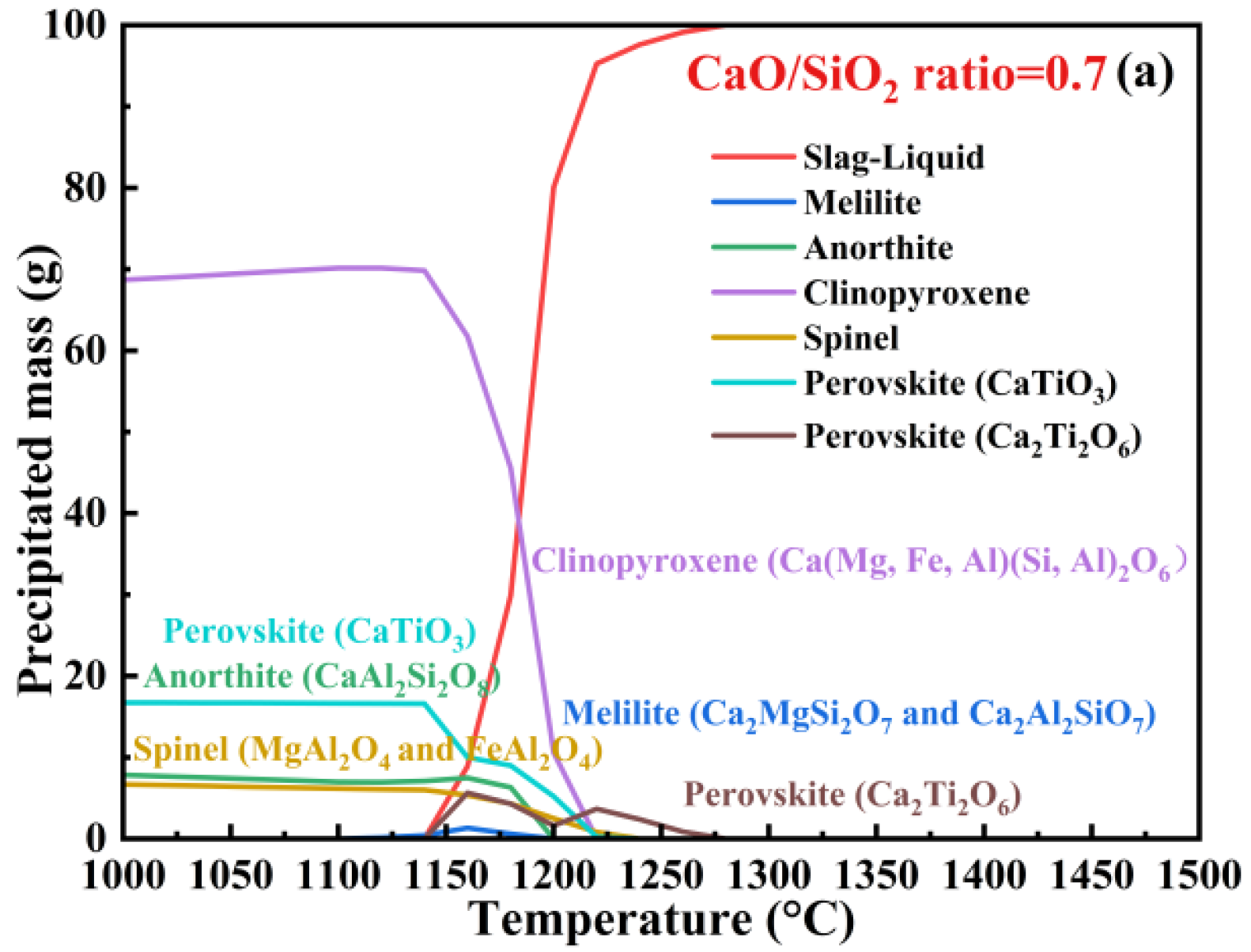
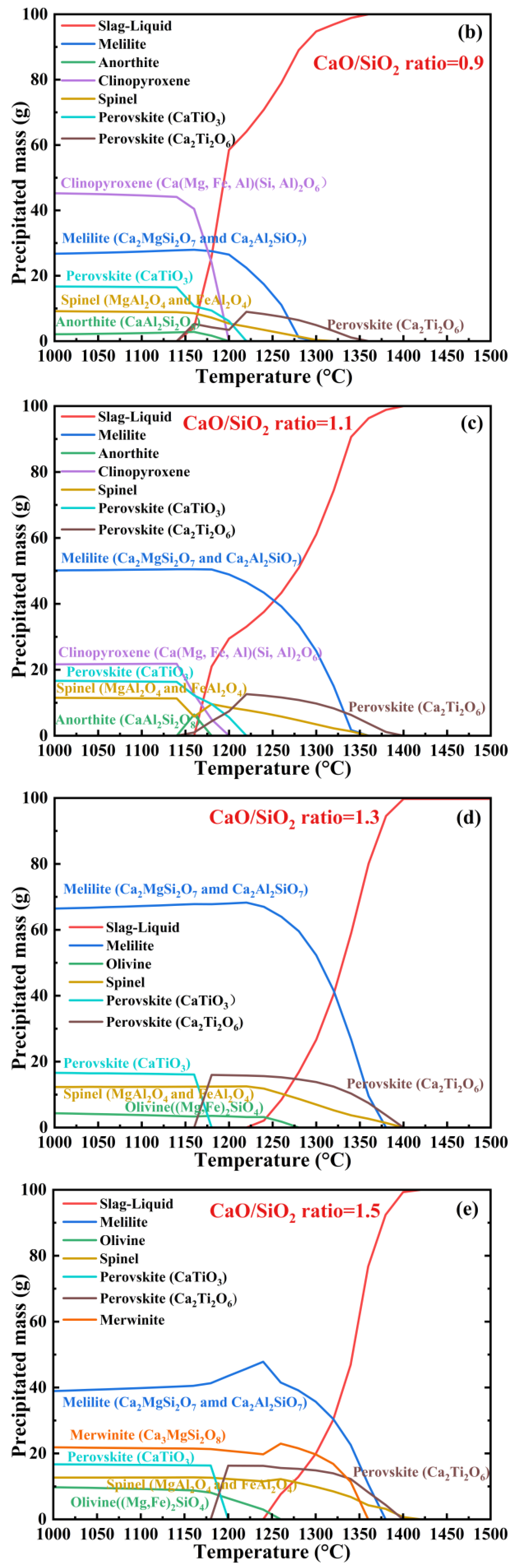
Figure 1 exhibits the phase evolution of the synthesized slag samples with different CaO/SiO2 ratios during the cooling process. All of the slag samples existed as liquid state at 1500 °C. For the slag sample with a CaO/SiO2 ratio of 0.7 (Figure 1a), perovskite with the chemical formula of Ca2Ti2O6 was the first to crystallize when the temperature was reduced to 1270 °C, controlling the initial crystallization temperature. Subsequently, the spinel solid solution, which composed of MgAl2O4 and MgFe2O4, began to crystallize when this slag was cooled to 1236 °C. With the further decrease in temperature, perovskite (CaTiO3), clinopyroxene (Ca(Mg,Fe,Al)(Si,Al)2O6), anorthite (CaAl2Si2O8), and melilite solid solution (Ca2Al2SiO7 and Ca2MgSi2O7) would be precipitated in this order. The liquid phase disappeared temperature (LDT) of the slag with a CaO/SiO2 ratio of 0.7 was 1149 °C. As exhibited in Figure 1b,c, improving the CaO/SiO2 ratio from 0.7 to 1.1 did not change the crystallized phase type. The initial crystallization temperature enhanced from 1270 °C to 1389 °C and the LDT enhanced from 1149 °C to 1160 °C with the increase in CaO/SiO2 ratio from 0.7 to 1.1. As exhibited in Figure 1d, a new phase of olivine ((Mg,Fe)2SiO4) would be precipitated at 1271 °C; meanwhile, the clinopyroxene and anorthite phases were not crystallized during the cooling process when the CaO/SiO2 ratio reached 1.3. When the CaO/SiO2 ratio further improved to 1.5, another new phase of merwinite (Ca3MgSi2O8) was precipitated at 1358 °C (Figure 1e). It is noteworthy that the initial crystallization temperature improved to 1408 °C and was controlled by the crystallization of spinel phase when the CaO/SiO2 ratio reached 1.5.
Table 2 lists the initial crystallization temperatures of the mineralogical phases of the synthesized slag during the cooling process. In summary, improving the CaO/SiO2 ratio from 0.7 to 1.5 increased LDT from 1149 °C to 1257 °C and enhanced the initial crystallization temperature from 1270 °C to 1408 °C, respectively. This indicates that the improvement of the CaO/SiO2 ratio promoted slag crystallization. The initial crystallization temperature was controlled by the crystallization of the perovskite (Ca2Ti2O6) phase when the CaO/SiO2 ratios were 0.7–1.3, while it was controlled by the crystallization of the spinel phase when the CaO/SiO2 ratio was 1.5.

3.2. Mineralogical Composition and Microstructure of the Cooled Slag

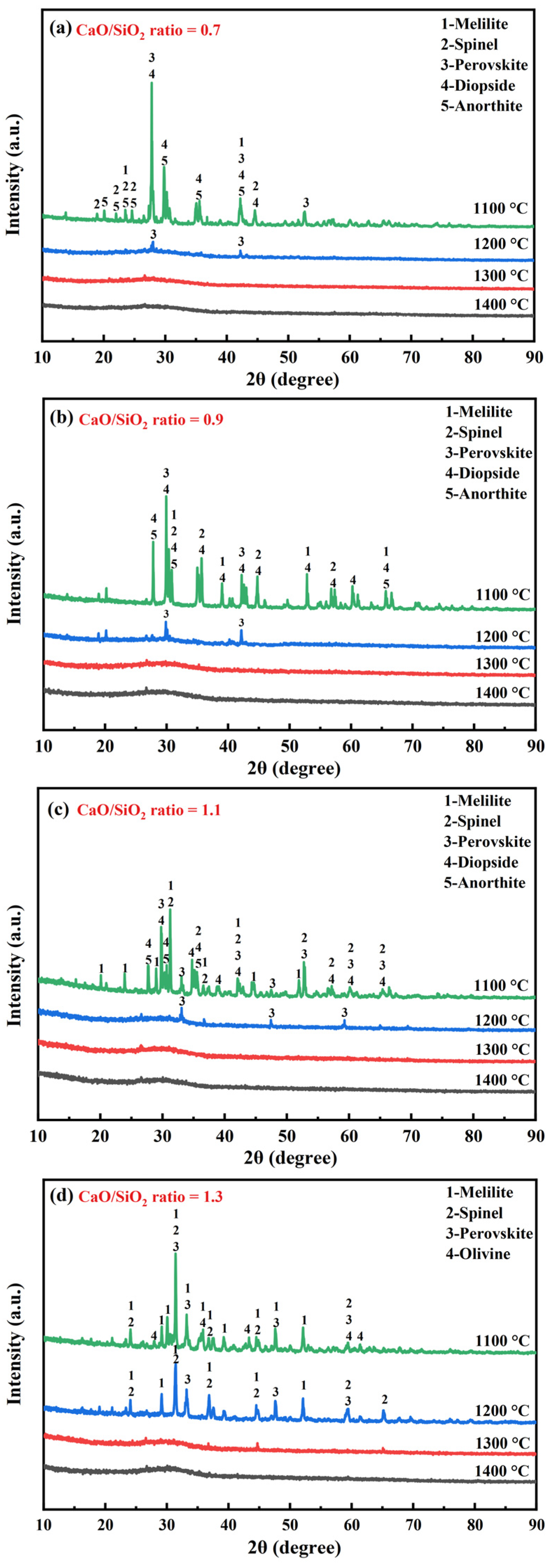
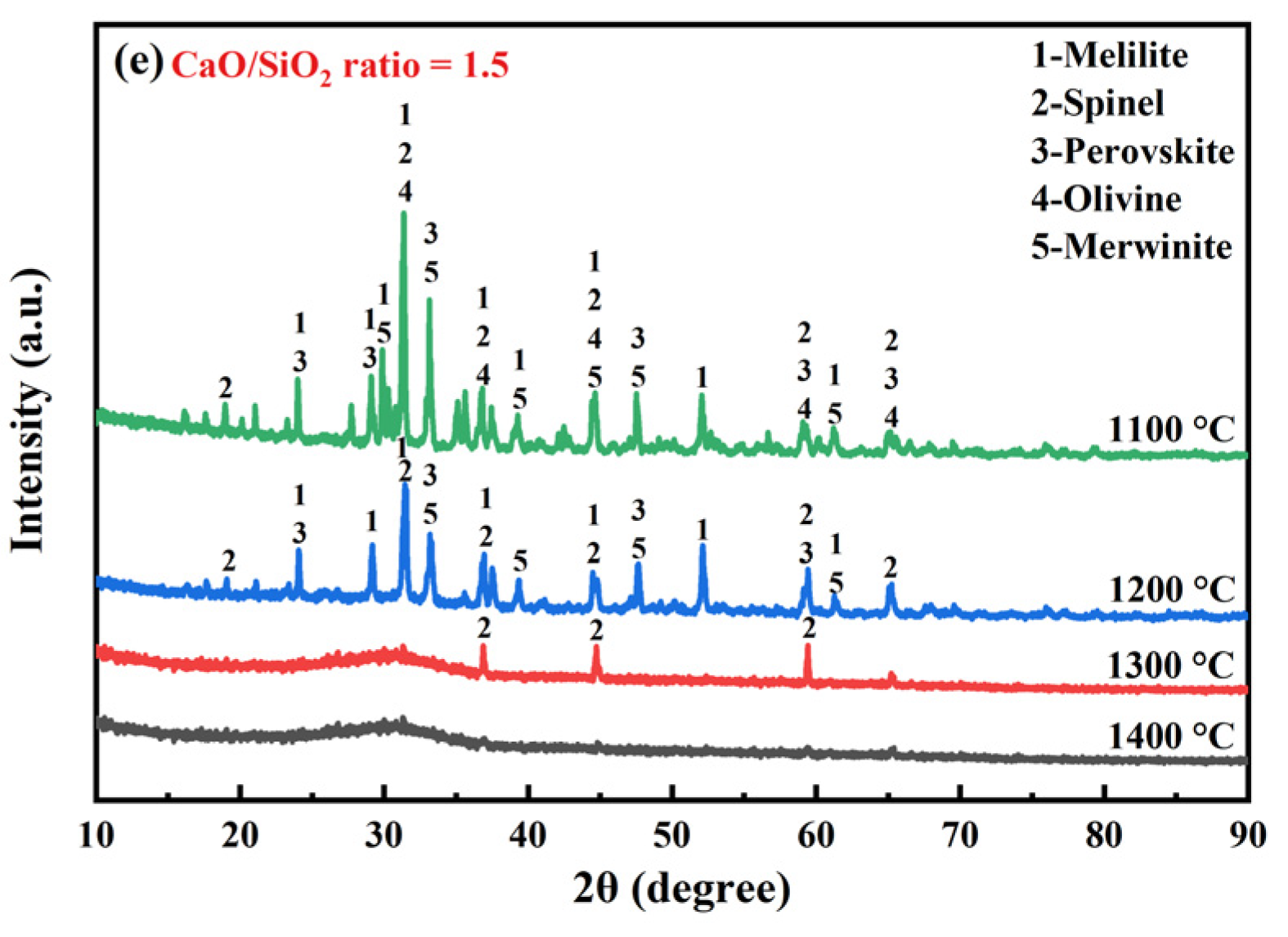
To validate the thermodynamic predictions and further elucidate the effect of the CaO/SiO2 ratio on the crystallization behavior of the synthesized slag, XRD measurements were performed. Figure 2 shows the XRD patterns of the water-quenched slag samples with different CaO/SiO2 ratios. As shown in Figure 2a–d, the XRD patterns of the slag with CaO/SiO2 ratios of 0.7–1.3 exhibited a broad amorphous halo when water-quenching at 1300 °C and 1400 °C. This indicates that these slag samples were predominantly glassy. For the slag with CaO/SiO2 ratios of 0.7–1.1, only the diffraction peaks corresponding to the perovskite phase were observed in the XRD patterns when water-quenching at 1200 °C. This suggests that the precipitation of the perovskite phase controlled the initial crystallization temperature of these slags. Improving the CaO/SiO2 ratio enhanced the intensity of diffraction peaks of the perovskite phase. This indicates that the crystallization of perovskite was promoted by enhancing the CaO/SiO2 ratio of the slag. For the slag with a CaO/SiO2 ratio of 1.3, besides the perovskite phase, the diffraction peaks corresponding to melilite and spinel were also observed in the XRD patterns when water-quenching at 1200 °C. While, for the slag with a CaO/SiO2 ratio of 1.5, the diffraction peaks corresponding to crystalline phases could be observed when this slag was water-quenched at 1300 °C (Figure 2e). The initial crystallized phase was spinel, which controlled the initial crystallization temperature. With the further decrease in temperature, the melilite, perovskite, olivine and merwinite phases would be crystallized.
All of the slag samples with high crystallinity can be obtained when water-quenching at 1100 °C. For the slag with CaO/SiO2 ratios of 0.7–1.1, the main crystallized phases were perovskite, melilite, spinel, diopside and anorthite. For the slag with a CaO/SiO2 ratio of 1.3, besides perovskite, melilite and spinel phases, a new phase of olivine was crystallized. Meanwhile, the crystallization of diopside and anorthite phases was inhibited. The further increase in the CaO/SiO2 ratio to 1.5 would crystallize another new phase of merwinite. It is noteworthy that the initial crystallization temperature obtained by XRD analysis was lower than that calculated by FactSage software. This can be attributed to the FactSage calculation being a thermodynamic analysis method without kinetics control. Due to the high viscosity of the molten slag and insufficient holding time, the experimental crystallization cannot reach the thermodynamic equilibrium, leading to the initial crystallization temperature obtained by the experiment being lower than the FactSage thermodynamic calculation [34].
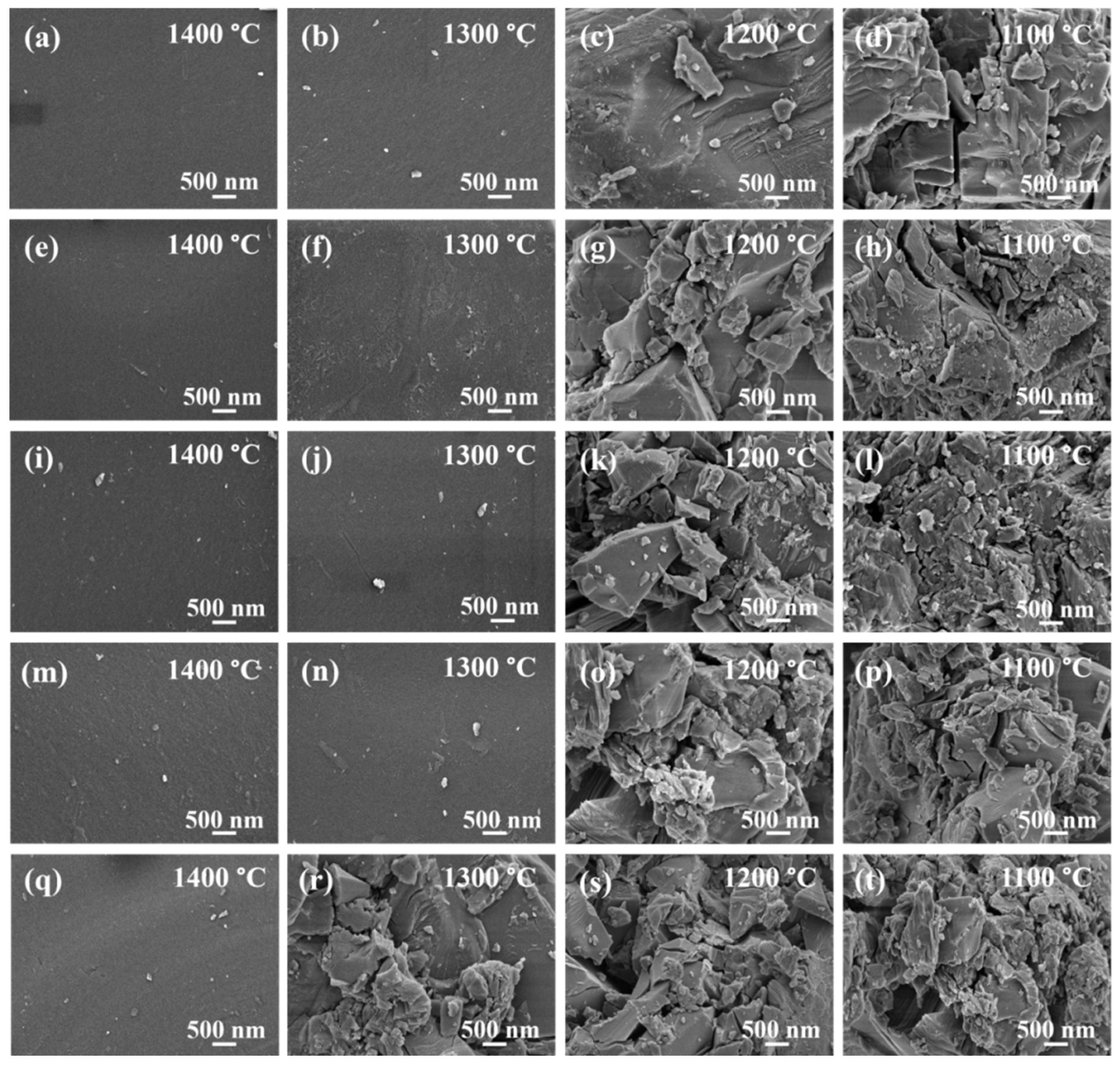
To explore the influence of the CaO/SiO2 ratio on slag morphology, FESEM measurements were performed. Figure 3 exhibits the cooled slag morphology obtained by FESEM analysis. The slag samples with different CaO/SiO2 ratios exhibited smooth morphology when cooling at 1400 °C. This indicates that these slag samples were glassy. No crystalline phase was precipitated at 1400 °C, corresponding to the results of XRD analysis. With the decrease in temperature to 1300 °C, the morphology of the slag samples with CaO/SiO2 ratios of 0.7–1.3 remained smooth, while the rough morphology was observed from the slag with a CaO/SiO2 ratio of 1.5, indicating the crystallization of this slag at 1300 °C. With the further reduction in temperature below 1200 °C, the slag samples with CaO/SiO2 ratios of 0.9–1.5 obviously showed the rough morphology. It is noteworthy that the slag sample with a CaO/SiO2 ratio of 0.7 showed a small portion of roughly crystalline morphology when cooling at 1200 °C. However, most of slag particle areas still exhibited the smoothly amorphous morphology. This indicates that the crystallization amount of this slag was low when cooling at 1200 °C. The rough morphology can be obviously observed from the slag with a CaO/SiO2 ratio of 0.7 when cooling at 1100 °C.
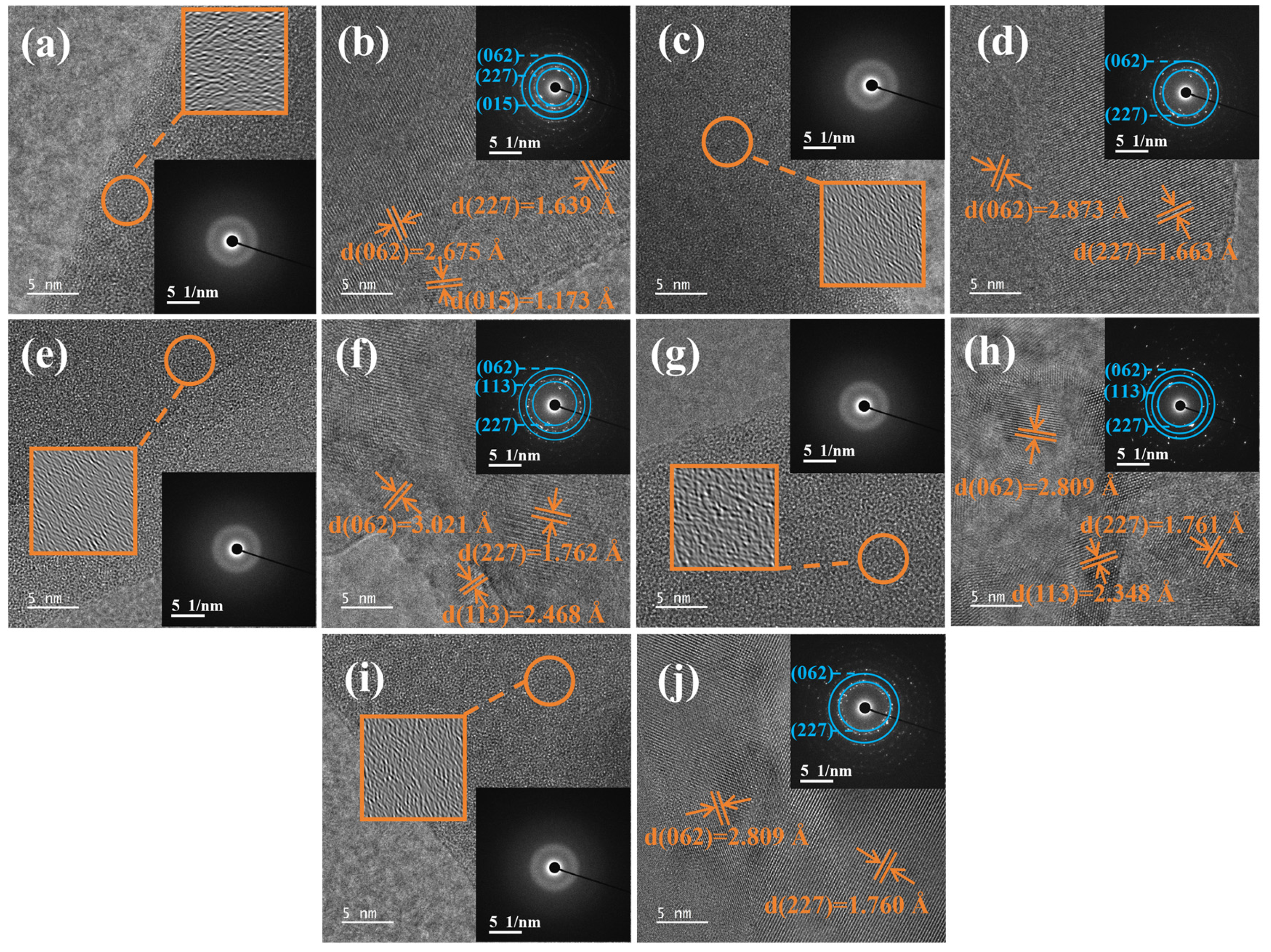
To further investigate the amorphous-to-crystalline transformation of the slag samples, the HRTEM and SAED characterizations were conducted. As shown in Figure 4a,c,e,g,i, irregular lattice fringes and amorphous diffraction halos were observed from the slag samples with a CaO/SiO2 ratio of 0.7 and cooled at 1200 °C, CaO/SiO2 ratios of 0.9–1.3 and cooled at 1300 °C, and a CaO/SiO2 ratio of 1.5 and cooled at 1400 °C. This indicates that the components in these slag samples mainly presented as amorphous state [35]. When cooling at 1100 °C, the lattice fringes of the slag with a CaO/SiO2 ratio of 0.7 became regular and the SAED pattern showed typical polycrystalline ring-like diffraction characteristic, indicating the high crystallinity of this slag (Figure 4b). The crystal interplanar spaces of 1.639 Å, 2.675 Å and 1.173 Å corresponded to the spinel (2, 2, 7) (ICDD: 01-071-3851), perovskite (0, 6, 2) (ICDD: 01-072-9970) and diopside (0, 1, 5) planes (ICDD: 01-072-1497), respectively. As for the slag samples with CaO/SiO2 ratios of 0.9 and 1.1 and cooled at 1200 °C (Figure 4d,f), besides the spinel (2, 2, 7) plane (ICDD: 01-074-9347 and 01-075-6826), the perovskite (0, 6, 2) plane (ICDD: 01-070-8503 and 01-089-0056) and the melilite (1, 1, 3) plane (ICDD: 01-073-2041) were also observed. The difference between the HRTEM and XRD analysis may be attributed to the crystallized amounts of perovskite and melilite being low. These two phases cannot be detected by XRD analysis. For the slag sample with a CaO/SiO2 ratio of 1.3 and cooled at 1200 °C (Figure 4h), the crystal interplanar spaces of 1.761 Å, 2.809 Å and 2.348 Å were observed from the HRTEM image, which corresponded to the spinel (2, 2, 7) (ICDD: 01-072-7246), perovskite (0, 6, 2) (ICDD: 01-070-7337) and melilite (1, 1, 3) planes (ICDD: 01-089-5917), respectively. The HRTEM results align well with the XRD analysis. While, for the slag sample with a CaO/SiO2 ratio of 1.5 and cooled at 1300 °C, the crystal interplanar spaces of 1.760 Å and 2.809 Å can be found from the HRTEM image, corresponding to the spinel (2, 2, 7) and perovskite (0, 6, 2) planes, respectively. This indicates that besides the crystallization of spinel, a small amount of perovskite can also be crystallized during the cooling process. It is noteworthy that the interplanar spaces of the crystallized phases were influenced by the CaO/SiO2 ratio. This may be attributed to the crystallized phases being mainly presented as solid solutions. The variety of the CaO/SiO2 ratio changed the chemical composition of these solid solutions, resulting in interplanar space variation [36].

3.3. Crystallization Behavior of the Slag Under Isothermal and Continuous Cooling Conditions

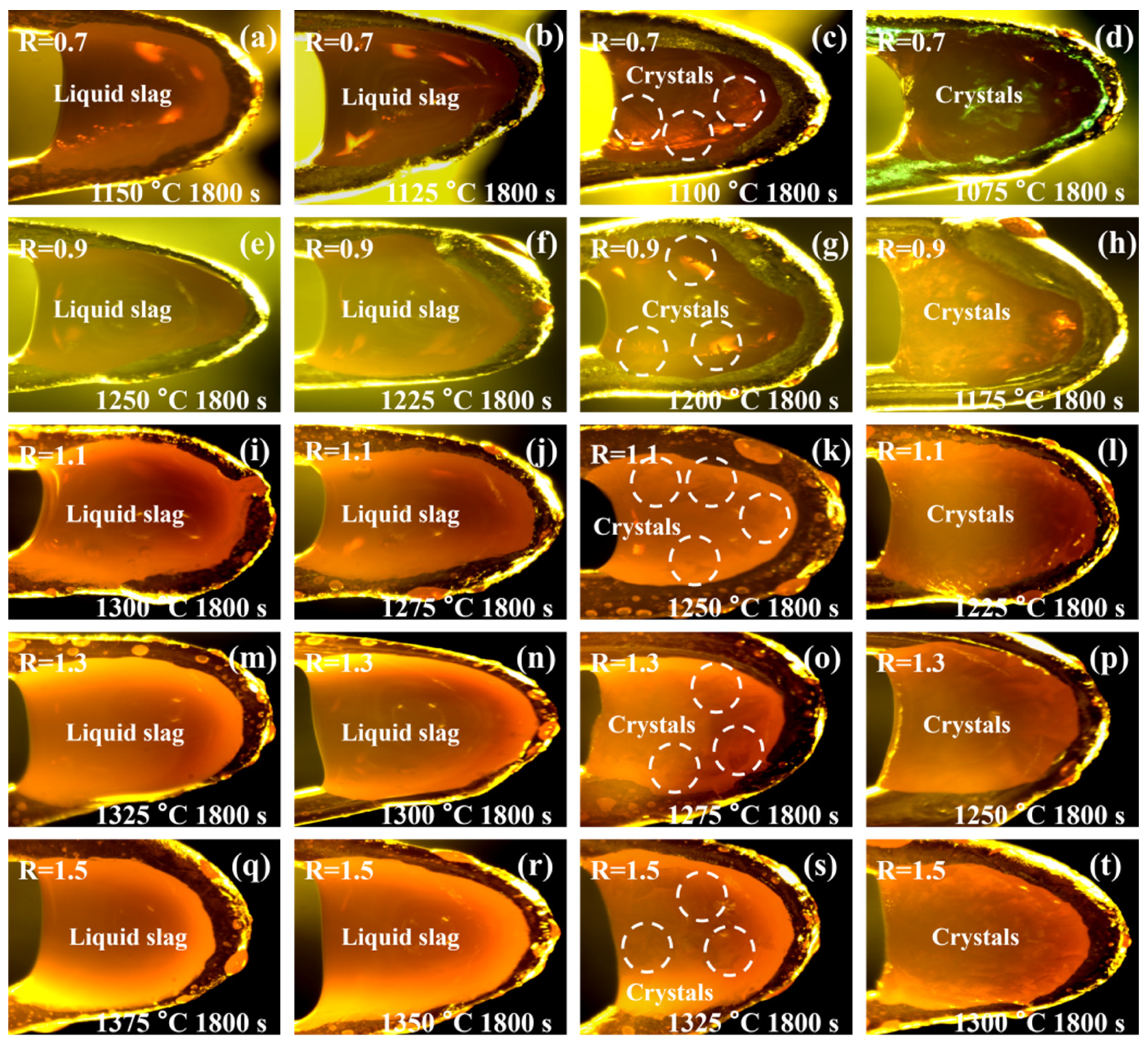
Figure 5 exhibits the crystallization images of the slag samples under isothermal cooling. As shown in Figure 5a,b, the slag with a CaO/SiO2 ratio of 0.7 retained a stable melt when the temperature was higher than 1125 °C. No crystallization was observed during the isothermal cooling process. A small number of crystals with dendritic or angular morphology was observed when the temperature was decreased to 1100 °C (Figure 5c), indicating the start of the crystallization. The further reduction in temperature to 1075 °C significantly increased the crystal amounts of this slag (Figure 5d). With the enhancement of the CaO/SiO2 ratio from 0.7 to 1.5, the initial crystallization temperature increased from 1100 °C to 1325 °C (Figure 5g,k,o,s).
Increasing the CaO/SiO2 ratio promoted slag crystallization. This may be attributed to the increased CaO/SiO2 ratio, which promoted silicate, titanate, and aluminate network structure depolymerization, which reduced the energy barrier for crystallization [37]. The slag with a larger CaO/SiO2 ratio required a lower supercooling temperature to derive the rearrangement of atoms. In addition, enhancing the CaO/SiO2 ratio also reduced the slag viscosity, which promoted the diffusion of atoms and the [38]. The in situ observation also found that the molten slag started to crystallize from the edge to center. This may be attributed to the precipitation of crystals being dominated by heterogeneous nucleation during the slag cooling process. The edge of the U-shape hot thermocouple provided enough nuclei to ensure the heterogeneous nucleation of the crystals. The movement of the floating crystals was observed from the slag with a CaO/SiO2 ratio of 1.5 at the initial crystallization temperature and time. This is attributed to the low viscosity of this slag. With the further reduction in temperature and extension of time, the floating crystals were interlaced together. The crystal position was fixed, and the crystal size became larger.
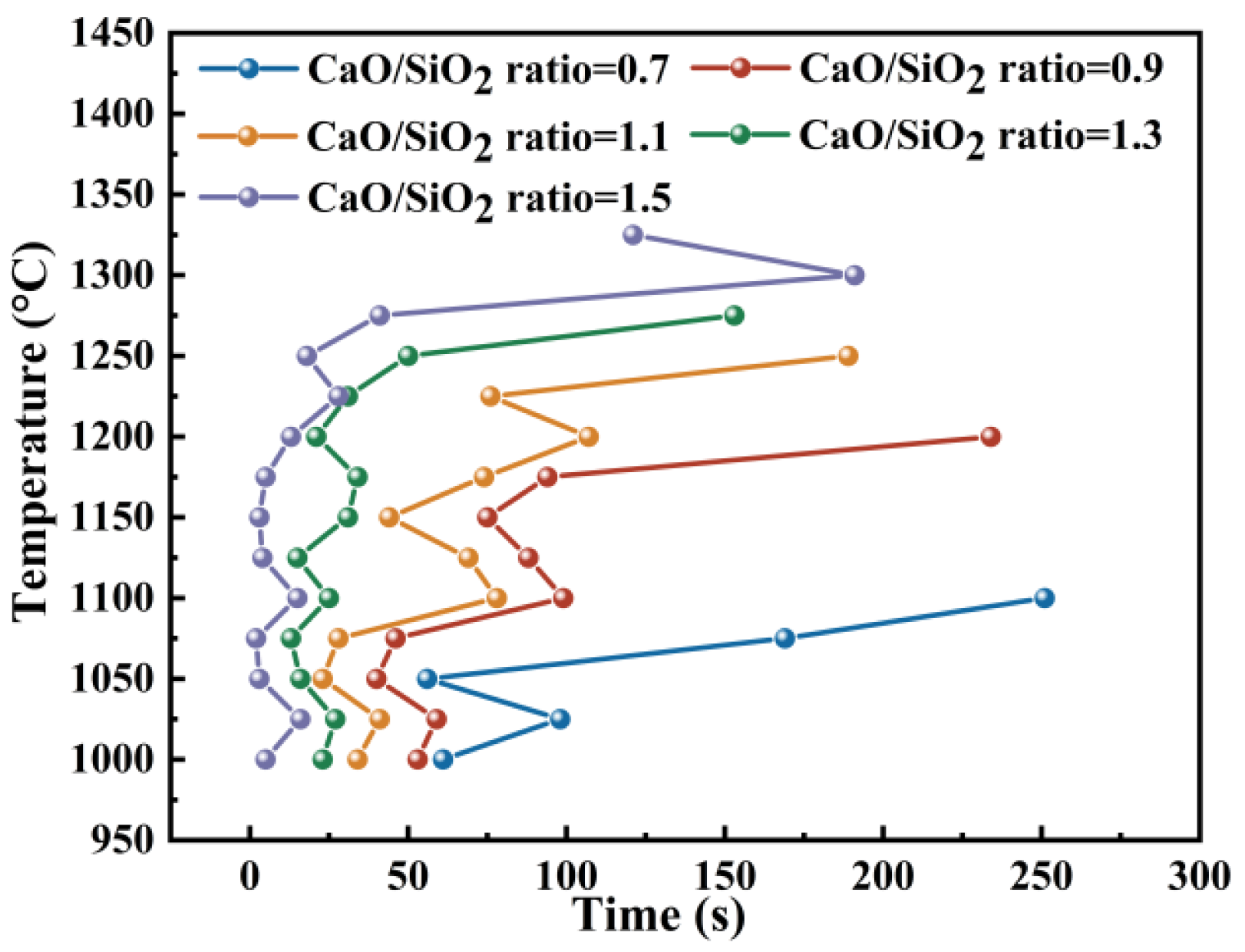
Based on the initial crystallization temperature and time points collected from the isothermal cooling tests, the TTT curves were obtained. Figure 6 shows the TTT curves of the slag with different CaO/SiO2 ratios. The TTT curves showed typically double or triple “C” shapes, which is related to slag crystallization. This indicates that there are at least two or three kinds of phases that were crystallized during the isothermal cooling process [32]. The liquid phase would transform to solid phase when the free energy of the liquid phase is equal to or higher than the solid phase [34]. Increasing supercooling temperature can improve the driving force for this transformation. The “C” shape of the TTT curves is attributed to the evolution of the nucleation rate. The reduction in cooling temperature increased the supercooling degree of the molten slag that enhanced the driving force for nucleation and reduced the incubation time. The further decrease in temperature and the solid crystals precipitation increased the slag viscosity that inhibited the diffusion of the atoms and enhanced the incubation time. Therefore, the TTT curves showed a typical “C” shape.
The incubation time is the time required for initiating nucleation at a fixed supercooling temperature. The TTT analysis results showed that the incubation time decreased when improving the CaO/SiO2 ratio. This implies that the crystallization process was accelerated by enhancing the CaO/SiO2 ratio. In particular, the incubation time of the slag sample with a CaO/SiO2 ratio of 1.5 was near 0 s at the temperatures below 1250 °C, indicating a strong nucleation tendency. This may be attributed to the increasing CaO/SiO2 ratio reducing the viscosity of the molten slag that promoted the rearrangement of atoms for nucleation. It is noteworthy that the initial crystallization temperature obtained by TTT analysis was lower than the results predicted by FactSage calculation when reaching thermodynamic equilibrium. This is attributed to the supercooling degree being not sufficient for deriving crystallization at the calculated temperature. The crystallization of the slag needed quite a long time.
The initial crystallization temperatures obtained from FactSage calculation, quenched sample analysis and isothermal experiment are shown in Table 3. As shown in Table 3, the initial crystallization temperature calculated by FactSage was 100–200 °C higher than those obtained from the quenched sample analysis and isothermal experiment. This is attributed to the FactSage calculation being a thermodynamic analysis method without kinetics control. The FactSage calculation assumes that a sufficiently long time is provided for mineral crystallization. While, for the quenched sample and isothermal experiment, the holding times for mineral crystallization were 120 min and 30 min at the target temperature, respectively. The holding time may be insufficient. The crystallization of minerals requires a larger supercooling degree, resulting in the initial crystallization temperatures obtained from quenched sample analysis and isothermal experiment being lower than the FactSage calculation. For the slag with a CaO/SiO2 ratio of 0.7, the longer holding time led to the initial crystallization temperature obtained from the quenched sample analysis being 100 °C higher than that observed from isothermal experiment. While, for the slag with CaO/SiO2 ratios of 1.1–1.5, the difference between the quenched sample analysis and isothermal experiment can be attributed to the temperature interval set by the isothermal experiment being smaller. In actual production, the initial crystallization temperature obtained from the isothermal experiment may be the most reliable.
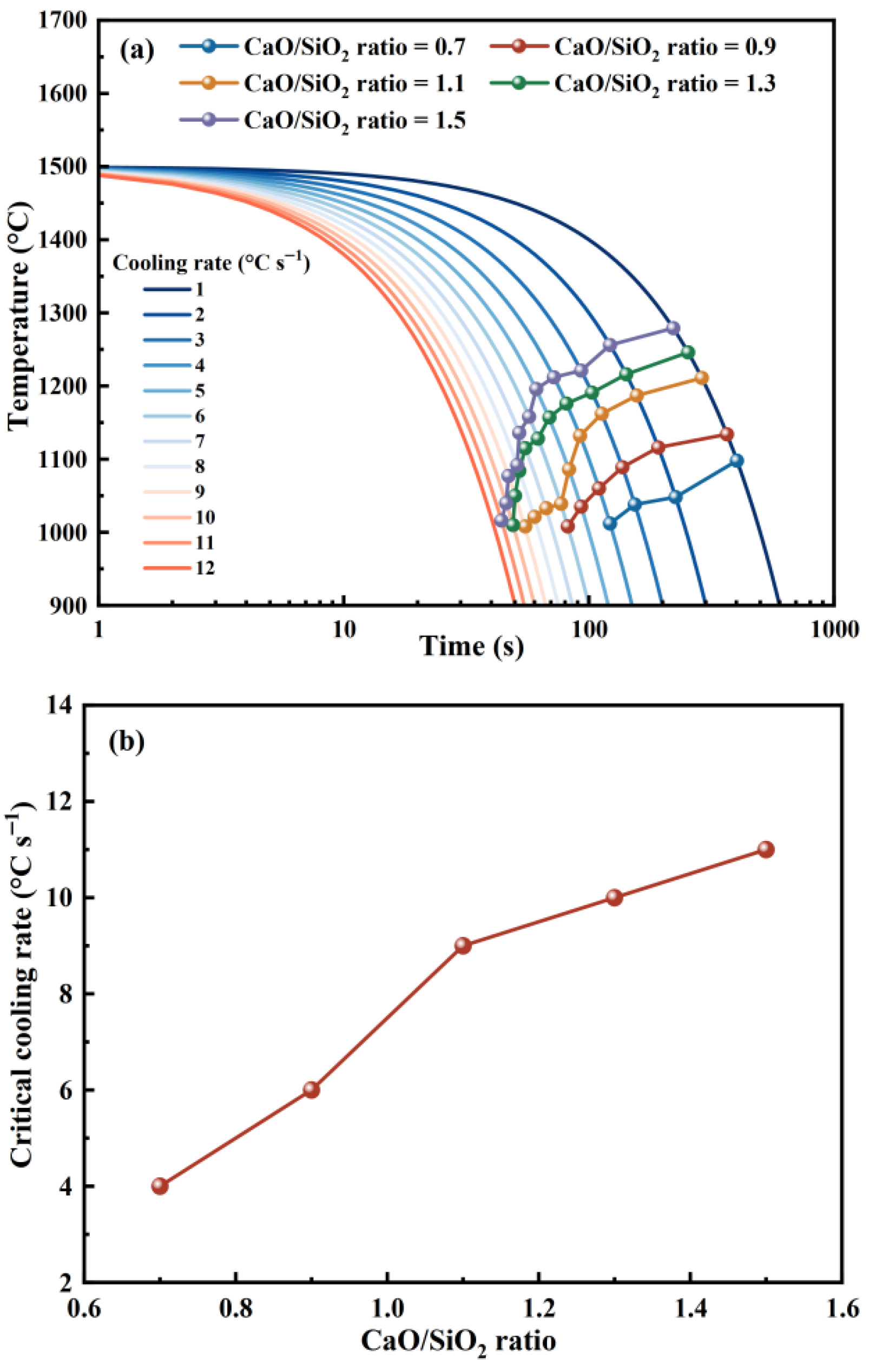
Continuous cooling tests were performed at controlled cooling rates from 1 °C s−1 to 12 °C s−1 to further explore the crystallization behavior. Based on the images collected from the continuous cooling tests, CCT curves were obtained. Figure 7 shows the CCT curves of the slag with different CaO/SiO2 ratios. As shown in Figure 7a, increasing the cooling rate decreased the initial crystallization temperature. This can be attributed to the high cooling rate not being able to provide enough time for the crystallization of the slag. The slag cooled at a high cooling rate requires a larger supercooling degree to drive its crystallization than the slag cooled at a low cooling rate [33]. Figure 7b shows that the critical cooling rate increased with increasing CaO/SiO2 ratios. The critical cooling rates of the slag with CaO/SiO2 ratios of 0.7, 0.9, 1.1, 1.3 and 1.5 were 4, 6, 9, 10, and 11 °C s−1, respectively. Crystallization occurred at a high cooling rate when the CaO/SiO2 ratio was high. This also indicates that increasing the CaO/SiO2 ratio can promote slag crystallization. This can be attributed to the increase in CaO/SiO2 ratio decreasing slag viscosity, which accelerated diffusion of atoms. Compared with the slag with a low CaO/SiO2 ratio, the crystallization of the slag with a high CaO/SiO2 ratio required a shorter time.
The CaO/SiO2 ratio is a key factor governing the crystallization behavior of the molten slag. As mentioned above, increasing the CaO/SiO2 ratio promoted crystallization and enhanced the critical cooling rate of the slag sample. The crystallization type and content were also influenced by the CaO/SiO2 ratio. As reported, the hardness, wear resistance and thermal stability can be improved by enhancing the crystalline phase amount of the glass ceramics [39]. However, excessive precipitation and growth of the crystalline phase would result in the reduction in densification degree and the enhancement of brittleness [40]. Controlling the glass and crystalline phase amounts is important for glass ceramics production. In addition, several studies indicated that the crystallization of the pyroxene phase can improve mechanical strength and hardness of glass ceramics [41]. The obtained results of this work indicate that the initial crystallization temperature and the critical cooling rate of the slag with a large CaO/SiO2 ratio are high, making the amorphous-to-crystalline transformation difficult to be precisely controlled. In addition, increasing the CaO/SiO2 ratio also inhibits the crystallization of the pyroxene phase. In view of this, the CaO/SiO2 ratios within the range of 0.7–0.9 are considered most suitable for glass ceramics production. Since the CaO/SiO2 ratio of titanium-extracted tailing is approximately 1.4, the modification of its chemical composition is required before being used for glass ceramics preparation.
Table 4 shows the investigations on the utilization of titanium-extracted tailing for glass ceramics preparation as reported in the literature and in this work. Currently, studies on the utilization of titanium-extracted tailing for glass ceramics preparation mainly focus on the optimization of sintering parameters, as well as the properties of the prepared glass ceramics. There are few reports on the utilization of titanium-extracted tailing for glass ceramics production using the petrurgic method. Research on crystallization behavior of titanium-extracted tailing during the cooling process is insufficient. This work investigated the effect of CaO/SiO2 ratios on the crystallization thermodynamics and kinetics of titanium-extracted tailing during the cooling process, which can lay a theoretical foundation for titanium-extracted tailing modification and crystallization control during the production process of glass ceramics using the petrurgic method.

4. Conclusions

In this work, the effect of CaO/SiO2 ratios on the crystallization behavior of the CaO-SiO2-Al2O3-MgO-TiO2-FeO slag was investigated. The perovskite, melilite, spinel, diopside and anorthite phases were crystallized during the cooling process when the CaO/SiO2 ratios were 0.7–1.1. Increasing the CaO/SiO2 ratio to 1.3 and 1.5 promoted the crystallization of olivine and merwinite phases, however, inhibited the crystallization of diopside and anorthite phases. The initial crystallization temperature and the liquid phase disappeared temperature of the slag enhanced when improving the CaO/SiO2 ratio. The initial crystallization temperature was controlled by perovskite phase precipitation when the CaO/SiO2 ratios of slag reached 0.7–1.3. Whereas the initial crystallization temperature was controlled by the crystallization of the spinel phase when the CaO/SiO2 ratio of slag was 1.5. Increasing the CaO/SiO2 ratio decreased the incubation time for crystal nucleation that promoted slag crystallization. In particular, the incubation time of the slag sample with a CaO/SiO2 ratio of 1.5 was near 0 s at temperatures below 1250 °C, which showed a strong crystallization tendency. In addition, increasing the CaO/SiO2 ratio from 0.7 to 1.5 enhanced the critical cooling rate from 4 °C s−1 to 11 °C s−1. In view of the control over the amorphous-to-crystalline transformation, a CaO/SiO2 ratio in the range of 0.7–0.9 is considered the most suitable for preparing glass ceramics using titanium-extracted tailing.

Author Contributions

Methodology, J.L. and L.L.; Investigation, W.Z., Q.R., S.C., J.L., L.L., L.D., Y.Z., Y.W. and B.L.; Resources, Q.R., S.C., Y.Z. and Y.W.; Writing—original draft, W.Z.; Writing—review & editing, J.L. and B.L.; Funding acquisition, B.L. All authors have read and agreed to the published version of the manuscript.

Funding

This work was financially supported by the National Key R&D Program of China (No. 2024YFC3909501), Hebei Natural Science Foundation (No. E2024209158), Central Guidance Local Science and Technology Development Fund Project of Hebei Province (No. 236Z1102G), S&T Program of Hebei (No. 25363801D), Key Program of North China University of Science and Technology (No. ZD-ST-202312), Graduate Student Innovation Foundation of North China University of Science and Technology (No. 2026B07).

Data Availability Statement

The original contributions presented in the study are included in the article, further inquiries can be directed to the corresponding authors.

Conflicts of Interest

Author Qianqian Ren was employed by the company Hebei Puyang Iron and Steel Co., Ltd. Author Lanjie Li was employed by the company Institute of Materials Technology Research, HBIS Group Co., Ltd. The remaining authors declare that the research was conducted in the absence of any commercial or financial relationships that could be construed as a potential conflict of interest.

References

  1. Song, H.; Zhang, J.; Cheng, G.; Yang, S.; Xue, X. Study on the high-temperature properties of high-titania slags produced with Cr-bearing vanadia-titania magnetite smelting in blast furnace. Surf. Interfaces 2020, 21, 100767. [Google Scholar] [CrossRef] [Scilit]
  2. Zhang, R.; Hou, Y.; Fan, G.; Huang, D.; Ding, X.; Dang, J. Gas-based reduction and carbonization of titanium minerals in titanium-bearing blast furnace slag: A combined thermodynamic, experimental and DFT study. Int. J. Hydrogen Energy 2022, 47, 7586–7599. [Google Scholar] [CrossRef] [Scilit]
  3. Cheng, S.; Li, W.; Vaughan, J.; Ma, X.; Chan, J.; Wu, X.; Han, Y.; Peng, H. Advances in the integrated recovery of valuable components from titanium-bearing blast furnace slag: A review. Sustain. Mater. Technol. 2025, 44, e01384. [Google Scholar] [CrossRef] [Scilit]
  4. Xie, J.; Ye, Q.; Yang, F.; Qian, G.; Zhang, H. Selective enrichment and extraction of well-catalyzed perovskites on melting-microwave heating process from blast furnace slag. J. Clean. Prod. 2023, 420, 138377. [Google Scholar] [CrossRef] [Scilit]
  5. He, M.; Teng, L.; Gao, Y.; Rohani, S.; Ren, S.; Li, J.; Yang, J.; Liu, Q.; Liu, W. Simultaneous CO2 mineral sequestration and rutile beneficiation by using titanium-bearing blast furnace slag: Process description and optimization. Energy 2022, 248, 123643. [Google Scholar] [CrossRef] [Scilit]
  6. Li, J.; Yang, D.; Ma, W.; Ren, Y.; Yun, L. Cooperative utilization of Ti-containing blast furnace slag and diamond wire cut silicon waste: Preparation of eutectic Si-Ti solder for welding SiC ceramics. Chem. Eng. J. 2025, 515, 163480. [Google Scholar] [CrossRef] [Scilit]
  7. Rui, Y.; Li, N.; Tang, R.; Zhao, S.; Zhang, X.; Zhao, S.; Zheng, Y.; Huang, T. The influence of vanadium titanium slag and blast furnace slag on the properties of cement-based materials: Fluidity, mechanical properties, and hydration. Constr. Build. Mater. 2025, 504, 144679. [Google Scholar] [CrossRef] [Scilit]
  8. Zhang, S.; Yang, H.; Xu, G.; Cui, G. Review on utilization of Ti-bearing blast furnace slag from the past decade: Whole-component utilization and Ti component recovery. Chem. Eng. J. 2025, 514, 163115. [Google Scholar] [CrossRef] [Scilit]
  9. Wang, R.; Huang, X.; Deng, S.; Zhao, W.; Guo, H.; Yan, B.; Li, P. Preparation and characterization of the glass-ceramics by co-utilization of ferrochromium slag and titanium-bearing blast furnace slag. J. Non-Cryst. Solids 2023, 605, 122162. [Google Scholar] [CrossRef] [Scilit]
  10. Jiang, Q.; Feng, K.; Cai, L.; Cai, J.; Zhang, Z. Effect of TiO2 on crystallization and microstructure of foam glass ceramics prepared by high titanium blast furnace slag. Ceram. Int. 2025, 51, 11006–11017. [Google Scholar] [CrossRef] [Scilit]
  11. Luo, Y.; Wang, F.; Zhu, H.; Liao, Q.; Xu, Y.; Liu, L. Preparation and characterization of glass-ceramics with granite tailings and titanium-bearing blast furnace slags. J. Non-Cryst. Solids 2022, 582, 121463. [Google Scholar] [CrossRef] [Scilit]
  12. Li, L.; Jiang, T.; Chen, B.; Wen, J. Overall utilization of Ti-extraction blast furnace slag as a raw building material: Removal of chlorine from slag by water washing and sintering. J. Sustain. Metall. 2021, 7, 1116–1127. [Google Scholar] [CrossRef] [Scilit]
  13. Wang, D.; Hou, Y.; Guo, W. Extraction of titanium from blast furnace slag: Research on the crushing process of TiC-Bearing Slag. Metals 2025, 15, 1063. [Google Scholar] [CrossRef] [Scilit]
  14. Huang, X.; Zhao, W.; Guo, H.; Yan, B.; Li, P.; Li, C. Crystallization enhancement and microstructure evolution characteristics of Ti-bearing blast furnace slag glass-ceramics with the introduction of ferrochromium slag. Ceram. Int. 2023, 49, 9708–9718. [Google Scholar] [CrossRef] [Scilit]
  15. Kozlovskiy, A.L.; Shlimas, D.I.; Zdorovets, M.V.; Elsts, E.; Konuhova, M.; Popov, A.I. Investigation of the effect of PbO doping on telluride glass ceramics as a potential material for gamma radiation shielding. Materials 2023, 16, 2366. [Google Scholar] [CrossRef] [Scilit]
  16. Wang, Z.; Xu, R. A kinetic study on crystallization in TiO2-SiO2-CaO-Al2O3 glass under nucleation saturation conditions for the high value-added utilization of CaO-SiO2-based solid wastes. Materials 2023, 16, 4165. [Google Scholar] [CrossRef] [Scilit]
  17. Abo El-Reesh, G.Y.; Azooz, M.A.; Ouis, M.A.; Gamal, A.A.; Morsi, R.M.M.; Abbas, S.M.; Elkhalik, S.A. TiO2-doped borate glass and glass-ceramic: Properties and prospects for biological and electrical applications. Sci. Rep. 2025, 15, 19381. [Google Scholar] [CrossRef] [Scilit]
  18. Hui, T.; Sun, H.; Peng, T.; Chen, Y. Preparation and characterization of ceramic foams mainly containing extracted titanium residues and silica tailings. J. Environ. Chem. Eng. 2022, 10, 108963. [Google Scholar] [CrossRef] [Scilit]
  19. Zheng, F.; Li, M.; Wang, J.; Xi, C.; Fu, J.; Zhen, Q.; Jiao, Z.; Li, F.; Bashir, S.; Liu, J.L. Effective utilization of extracted titanium tailing to prepare high performance glass-ceramic and their formation mechanism. Ceram. Int. 2021, 47, 17391–17399. [Google Scholar] [CrossRef] [Scilit]
  20. Chen, T.; Peng, T.; Sun, H.; Li, X.; Xiao, S.; You, D.; Chu, L.; Wu, M.; Zhang, T.; Tang, Y.; et al. Diopside-like based ceramics prepared via one-step sintering of extracted titanium slag and coal fly ash. Ceram. Int. 2024, 50, 14040–14053. [Google Scholar] [CrossRef] [Scilit]
  21. Yang, R.; Wang, Z.; Wang, Z.; Wang, X.; Zeng, H.; Wang, J.; Cen, Q.; Zhou, T.; Li, B.; Liu, Z. Properties and heavy metals immobilization mechanism of glass-ceramics derived from lead zinc slag and red mud. Chem. Eng. J. 2025, 508, 161156. [Google Scholar] [CrossRef] [Scilit]
  22. Zhong, J.; Zhao, H.; Li, R.; Liu, J.; Liu, F.; Zhang, S. Preparation of diopside-augite-based glass ceramics derived from magnesium slag and fly ash. Ceram. Int. 2024, 50, 39645–39653. [Google Scholar] [CrossRef] [Scilit]
  23. Cao, K.; Zhang, G. Fabrication of high-performance glass-ceramics from blast furnace slag and coal fly ash. Waste Manag. 2025, 203, 114866. [Google Scholar] [CrossRef] [Scilit] [PubMed]
  24. Liu, Y.; Wan, W.; Lu, J.; Poon, C.S.; Hu, S.; Wang, F. Preparation of glass-ceramic-based artificial aggregates using multiple solid wastes: Crystallization mechanism. J. Clean. Prod. 2023, 421, 138298. [Google Scholar] [CrossRef] [Scilit]
  25. Shi, X.; Liao, Q.; Chen, K.; Wang, Y.; Liu, L.; Wang, F.; Zhu, H.; Zhang, L.; Liu, C. Foaming process and thermal insulation properties of foamed glass-ceramics prepared by recycling muti-solid wastes. Constr. Build. Mater. 2025, 466, 140270. [Google Scholar] [CrossRef] [Scilit]
  26. Wang, C.; Jia, H.; Wang, A.; Wang, X.; Guo, Y.; Zhang, J. Effect of TiO2 on the crystallization and properties of MgO-Al2O3-SiO2 glass-ceramics prepared by an “one-step” method from laterite ore. Ceram. Int. 2019, 45, 5133–5138. [Google Scholar] [CrossRef] [Scilit]
  27. Francis, A.A.; Rawlings, R.D.; Boccaccini, A.R. Glass-ceramics from mixtures of coal ash and soda-lime glass by the petrurgic method. J. Mater. Sci. Lett. 2022, 21, 975–980. [Google Scholar] [CrossRef] [Scilit]
  28. Liu, D.; Zhang, Z.; Wang, S.; Abdalla, J.A.; Hawileh, R.A.; Zhong, J.; Zeng, G. Microstructure and mechanical properties of engineered cementitious composites (ECC) with recycling extracted titanium tailing slag (ETTS). J. Build. Eng. 2024, 98, 111282. [Google Scholar] [CrossRef] [Scilit]
  29. Huang, H.; Liu, G.; Zhao, Z.; Liu, L.; Li, M. Mechanism of enhanced CO2 carbonation resistance of cement stone by titanium-extracted tailings. Mater. Today Commun. 2025, 48, 113669. [Google Scholar] [CrossRef] [Scilit]
  30. Hui, T.; Sun, H.; Peng, T.; Liu, L.; Ding, W.; Liu, B.; Wang, C. Recycling of extracted titanium slag and gold tailings for preparation of self-glazed ceramic foams. Ceram. Int. 2022, 48, 23415–23427. [Google Scholar] [CrossRef] [Scilit]
  31. Wu, S.; Zhang, S.; Zhao, Z.; Zhang, Y. Crystallization behaviors and kinetic of argon oxygen decarburization slag via various SiO2 content: Conditions for obtaining amorphous state. J. Non-Cryst. Solids 2022, 597, 121926. [Google Scholar] [CrossRef] [Scilit]
  32. Liu, W.; Wu, H.; Xing, X.; Wang, J.; Xue, Q.; Zuo, H. Confocal scanning laser microscopy investigation of crystallization behavior of hot blast furnace slag. J. Non-Cryst. Solids 2023, 600, 122013. [Google Scholar] [CrossRef] [Scilit]
  33. Wang, Z.; Sohn, I. Effect of the Al2O3/SiO2 mass ratio on the crystallization behavior of CaO-SiO2-MgO-Al2O3 slags using confocal laser scanning microscopy. Ceram. Int. 2018, 44, 19268–19277. [Google Scholar] [CrossRef] [Scilit]
  34. Xuan, W.; Whitty, K.J.; Guan, Q.; Bi, D.; Zhang, J. Influence of isothermal temperature and cooling rates on crystallization characteristics of a synthetic coal slag. Fuel 2014, 137, 193–199. [Google Scholar] [CrossRef] [Scilit]
  35. Li, Y.; Ran, G.; Pei, K.; Huang, X.; Zhang, R.; Wang, Q.; Niu, B. In-situ TEM study on composition change and amorphous transformation of Laves phase precipitates in FeCrAl alloy during Fe+ irradiation. J. Nucl. Mater. 2022, 563, 153620. [Google Scholar] [CrossRef] [Scilit]
  36. Chen, J.; Omran, M.; Guo, S.; Li, K.; He, F.; Chen, G. Synthesis of rutile TiO2 from titaniferous slag using microwave heating and phosphoric acid leaching. Powder Technol. 2026, 473, 122178. [Google Scholar] [CrossRef] [Scilit]
  37. Zhong, J.; Li, R.; Liu, F.; Liu, J.; Zhang, S.; Fu, J.; Uglanov, D.A. Effects of SiO2/CaO ratio on crystallization behaviors, phase evolution, and properties of high alkaline magnesium slag-derived glass-ceramics. J. Alloys Compd. 2025, 1037, 182245. [Google Scholar] [CrossRef] [Scilit]
  38. Zhao, Y.; Luan, X.; Gao, H.; Cheng, G.; Wang, X.; Dong, C. Effect of SiO2/CaO on viscosity, structure and phase transition of biomass ash slag by experimental study, thermodynamic analysis and MD simulations. Chem. Eng. Res. Des. 2025, 221, 461–471. [Google Scholar] [CrossRef] [Scilit]
  39. He, W.; Wu, Y.; Dong, B.; Wang, H.; Tang, W.; Li, Y.; Bai, M.; Chen, C.; Ming, W. Processing and applications of glass-ceramics: A comparative review of traditional and non-traditional techniques. Ceram. Int. 2026, 52, 5469–5503. [Google Scholar] [CrossRef] [Scilit]
  40. Wang, H.; Jiao, S.; Zhang, G. Effects of CaO/SiO2 ratio and CaCl2 content on the densification, microstructure, and properties of sintered CaO-MgO-Al2O3-SiO2-CaCl2 glass-ceramic. Ceram. Int. 2024, 50, 27462–27469. [Google Scholar] [CrossRef] [Scilit]
  41. Pacurariu, C.; Lazau, I. Non-isothermal crystallization kinetics of some glass-ceramics with pyroxene structure. J. Non-Cryst. Solids 2012, 358, 3332–3337. [Google Scholar] [CrossRef] [Scilit]
Figure 1. Thermodynamic equilibrium analysis of the crystallization behavior of the synthetized slag samples with different CaO/SiO2 ratios during the cooling process, (a) CaO/SiO2 ratio = 0.7, (b) CaO/SiO2 ratio = 0.9, (c) CaO/SiO2 ratio = 1.1, (d) CaO/SiO2 ratio = 1.3, (e) CaO/SiO2 ratio = 1.5.
Materials 19 01574 g001aMaterials 19 01574 g001b
Figure 2. XRD patterns of the cooled slag samples with different CaO/SiO2 ratios, (a) CaO/SiO2 ratio = 0.7, (b) CaO/SiO2 ratio = 0.9, (c) CaO/SiO2 ratio = 1.1, (d) CaO/SiO2 ratio = 1.3, (e) CaO/SiO2 ratio = 1.5.
Materials 19 01574 g002aMaterials 19 01574 g002b
Figure 3. FESEM images of the cooled slag samples with different CaO/SiO2 ratios, (ad) CaO/SiO2 ratio = 0.7, (eh) CaO/SiO2 ratio = 0.9, (il) CaO/SiO2 ratio = 1.1, (mp) CaO/SiO2 ratio = 1.3, (qt) CaO/SiO2 ratio = 1.5.
Materials 19 01574 g003
Figure 4. HRTEM images and corresponding SAED patterns of the cooled slag samples, (a) CaO/SiO2 = 0.7, 1200 °C, (b) CaO/SiO2 = 0.7, 1100 °C, (c) CaO/SiO2 = 0.9, 1300 °C, (d) CaO/SiO2 = 0.9, 1200 °C, (e) CaO/SiO2 = 1.1, 1300 °C, (f) CaO/SiO2 = 1.1, 1200 °C, (g) CaO/SiO2 = 1.3, 1300 °C, (h) CaO/SiO2 = 1.3, 1200 °C, (i) CaO/SiO2 = 1.5, 1400 °C, (j) CaO/SiO2 = 1.5, 1300 °C.
Materials 19 01574 g004
Figure 5. Crystallization images of the slag with different CaO/SiO2 ratios under isothermal cooling condition, (ad) CaO/SiO2 ratio = 0.7, (eh) CaO/SiO2 ratio = 0.9, (il) CaO/SiO2 ratio = 1.1, (mp) CaO/SiO2 ratio = 1.3, (qt) CaO/SiO2 ratio = 1.5.
Materials 19 01574 g005
Figure 6. TTT curves of the slag with different CaO/SiO2 ratios under isothermal cooling condition.
Materials 19 01574 g006
Figure 7. CCT curves and critical cooling rates of the slag with different CaO/SiO2 ratios under continuous cooling condition, (a) CCT curve, (b) critical cooling rate.
Materials 19 01574 g007
Table 1. Chemical component of the synthesized slag samples (wt.%).
SlagCaO/SiO2CaOSiO2Al2O3MgOTiO2FeO
R10.725.5336.4714.009.0010.005.00
R20.929.3732.6314.009.0010.005.00
R31.132.4829.5214.009.0010.005.00
R41.335.0426.6914.009.0010.005.00
R51.537.2024.8014.009.0010.005.00
Table 2. Initial crystallization temperature of the mineralogical phases of the synthetized slag samples during the cooling process.
Slag SampleR1R2R3R4R5
Perovskite
(Ca2Ti2O6)
1270 °C1350 °C1389 °C1400 °C1398 °C
Spinel1236 °C1306 °C1359 °C1392 °C1408 °C
Melilite1189 °C1286 °C1342 °C1371 °C1377 °C
Perovskite
(CaTiO3)
1220 °C1220 °C1213 °C1179 °C1200 °C
Clinopyroxene1203 °C1196 °C1184 °C--
Anorthite1199 °C1188 °C1172 °C--
Olivine---1271 °C1259 °C
Merwinite----1358 °C
LDT1149 °C1155 °C1160 °C1230 °C1257 °C
Initial crystallization temperature1270 °C1350 °C1389 °C1400 °C1408 °C
Table 3. Comparison of the initial crystallization temperatures obtained from different methods.
CaO/SiO2 Ratio0.70.91.11.31.5
FactSage calculation1270 °C1350 °C1389 °C1400 °C1408 °C
Quenched sample analysis1200 °C1200 °C1200 °C1200 °C1300 °C
Isothermal experiment 1100 °C1200 °C1250 °C1275 °C1325 °C
Table 4. Investigations on the utilization of titanium-extracted tailing for glass ceramics preparation as reported in the literature and in this work.
PurposeResultRefs.
Preparing ceramic foams by using titanium-extracted tailing.By enhancing the SiO2 and Al2O3 contents of titanium-extracted tailing, glass ceramics with a flexural strength of 3.2–4.9 MPa can be prepared.[18]
Investigating the formation mechanism of glass ceramics prepared using titanium-extracted tailing.By enhancing the SiO2 content of titanium-extracted tailing, glass ceramics with Vickers hardness of 21.3 GPa can be prepared.[19]
Preparing diopside-like based ceramics using titanium-extracted tailing.By enhancing the SiO2 and Al2O3 contents of titanium-extracted tailing, glass ceramics with a bending strength of 141.8 MPa can be prepared.[20]
Investigating the effect of CaO/SiO2 ratios on the crystallization behavior of titanium-extracted tailing.Increasing the CaO/SiO2 ratio promotes crystallization. The CaO/SiO2 ratios of 0.7–0.9 are suitable for glass ceramics production.This work
Disclaimer/Publisher’s Note: The statements, opinions and data contained in all publications are solely those of the individual author(s) and contributor(s) and not of MDPI and/or the editor(s). MDPI and/or the editor(s) disclaim responsibility for any injury to people or property resulting from any ideas, methods, instructions or products referred to in the content.