Rheological Features and Hereditary Models of Lightweight Sintered Aggregate Concrete Under Cyclic Loading


Abstract
1. Introduction
2. Materials and Methods—Experimental Research Program
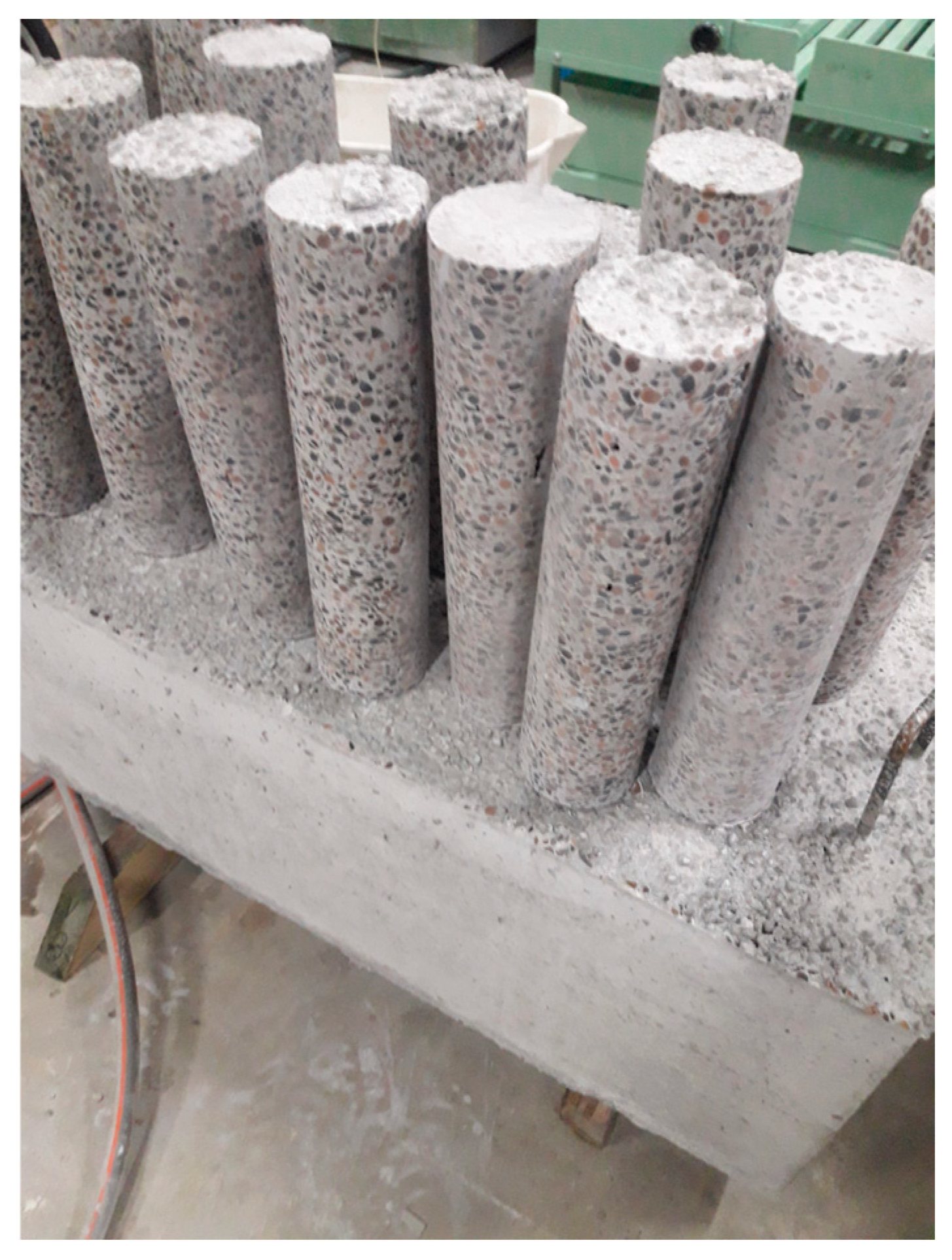
2.1. Preparation of Specimens of LSA Concrete
2.2. Types of Tests and Samples of LSA Concrete
- -
- Secant elasticity modulus of concrete tested on cylindrical specimens, according to [92];
- -
- Compressive strength tested on cube and cylindrical specimens, according to [93];
- -
- Tensile axial strength tested on cylindrical specimens, according to [94];
- -
- Tensile splitting strength tested on cube specimens, according to [95];
- -
- Flexural strength tested on prismatic specimens, according to [96];
- -
- -
- Creep strains tested on cylindrical specimens, according to [94].
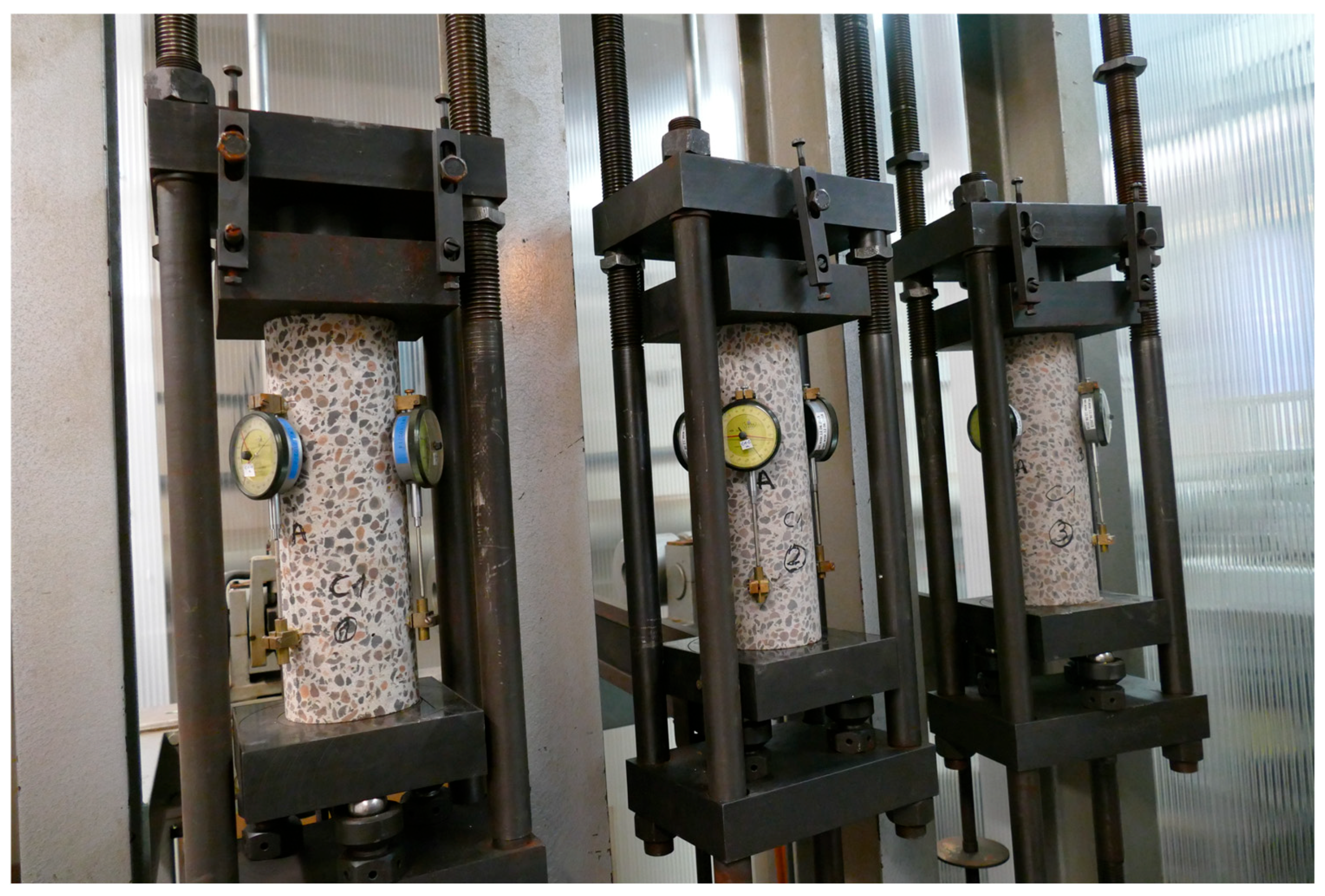
2.3. Testing Machines
2.4. General Schedule for Testing Long-Term Strains of LSA Concrete Under Cyclic Loading
3. Test Results for Mechanical Properties
3.1. Compressive Strength of LSA Concrete
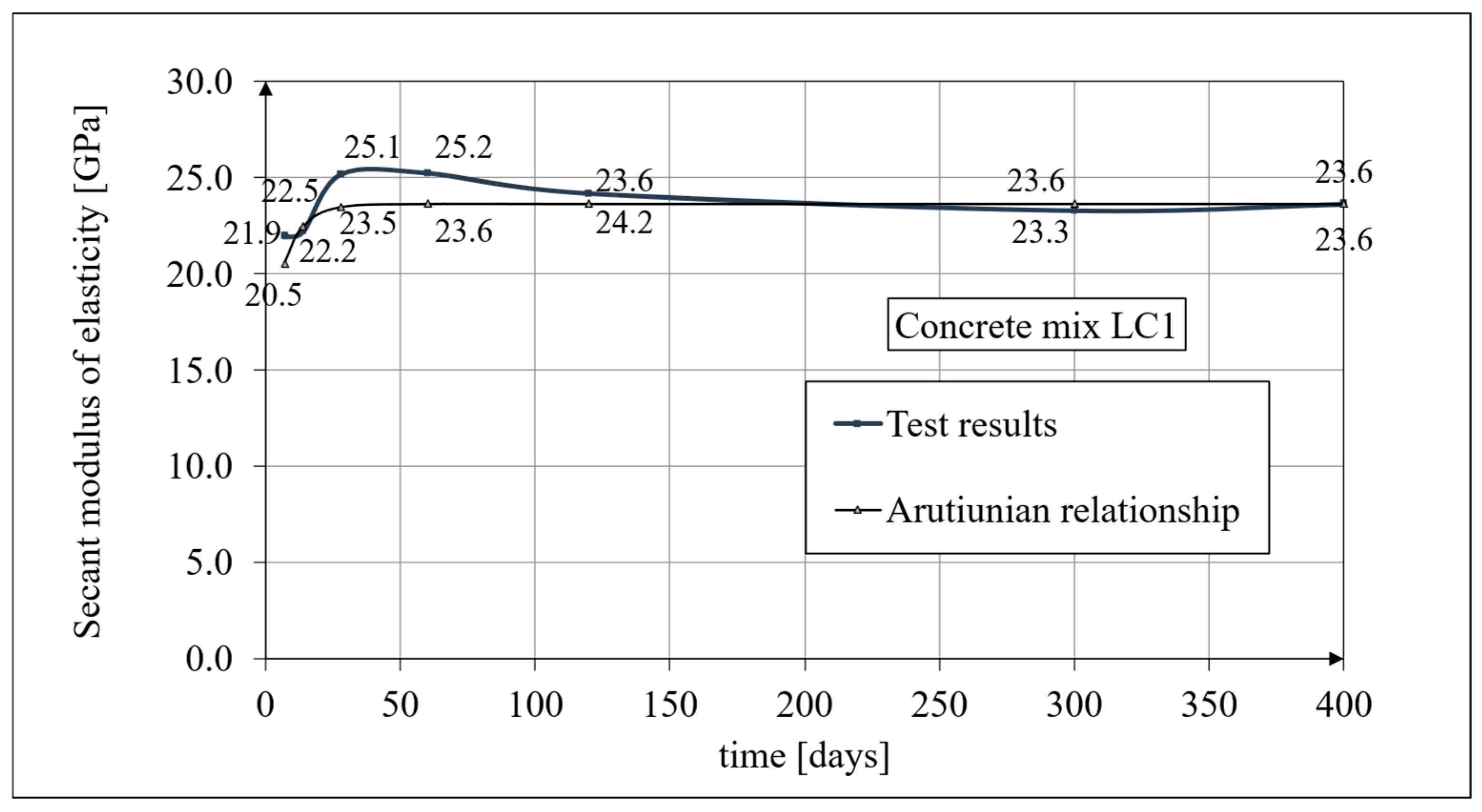
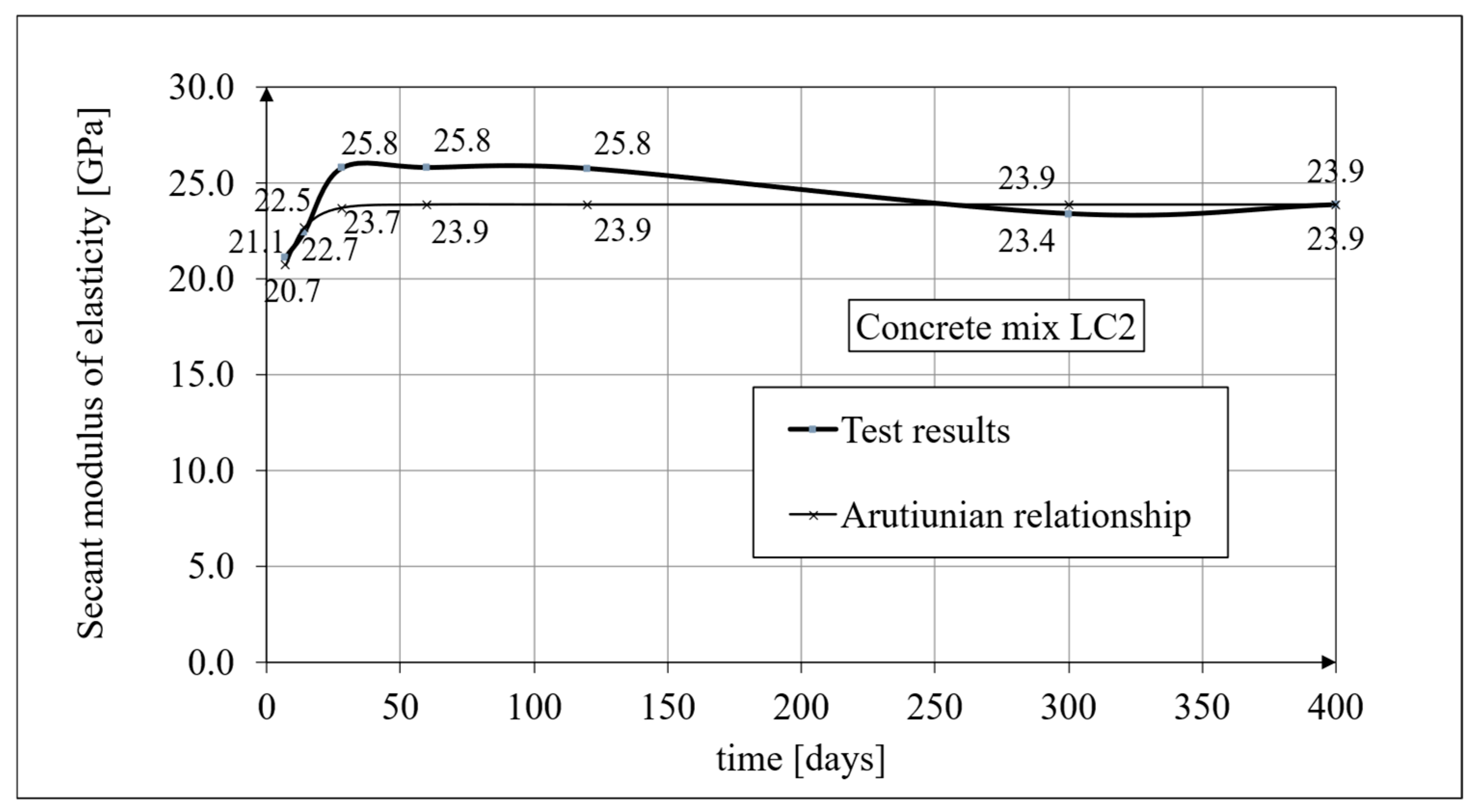
3.2. Investigation and Analysis of Secant Elasticity Modulus of LSA Concrete
3.3. Investigation and Analysis of Shrinkage Strain in LSA Concrete
3.4. Investigation of Creep–Recovery Strain in LSA Concrete Under Cyclic Loading
4. Models for Rheological Behavior of LSA Concrete
4.1. Secant Elasticity Modulus Models of LSA Concrete
4.2. Shrinkage Models for LSA Concrete
4.3. Creep–Recovery Hereditary Models—Parameterization of Constitutive Relationships
- Hereditary model with concrete aging (and its varying elasticity modulus);
- Hereditary strain model with concrete aging (modified by Bažant [23]);
- Hereditary elastic model;
- Concrete aging model.
- Model 2 is a model of hereditary creep strains with aging (and the varying elasticity modulus of concrete), modified by Bažant [23], in which the creep measure has the following form:
4.4. Comparison of Constitutive Rheological Models for Creep–Recovery Strain with Test Results
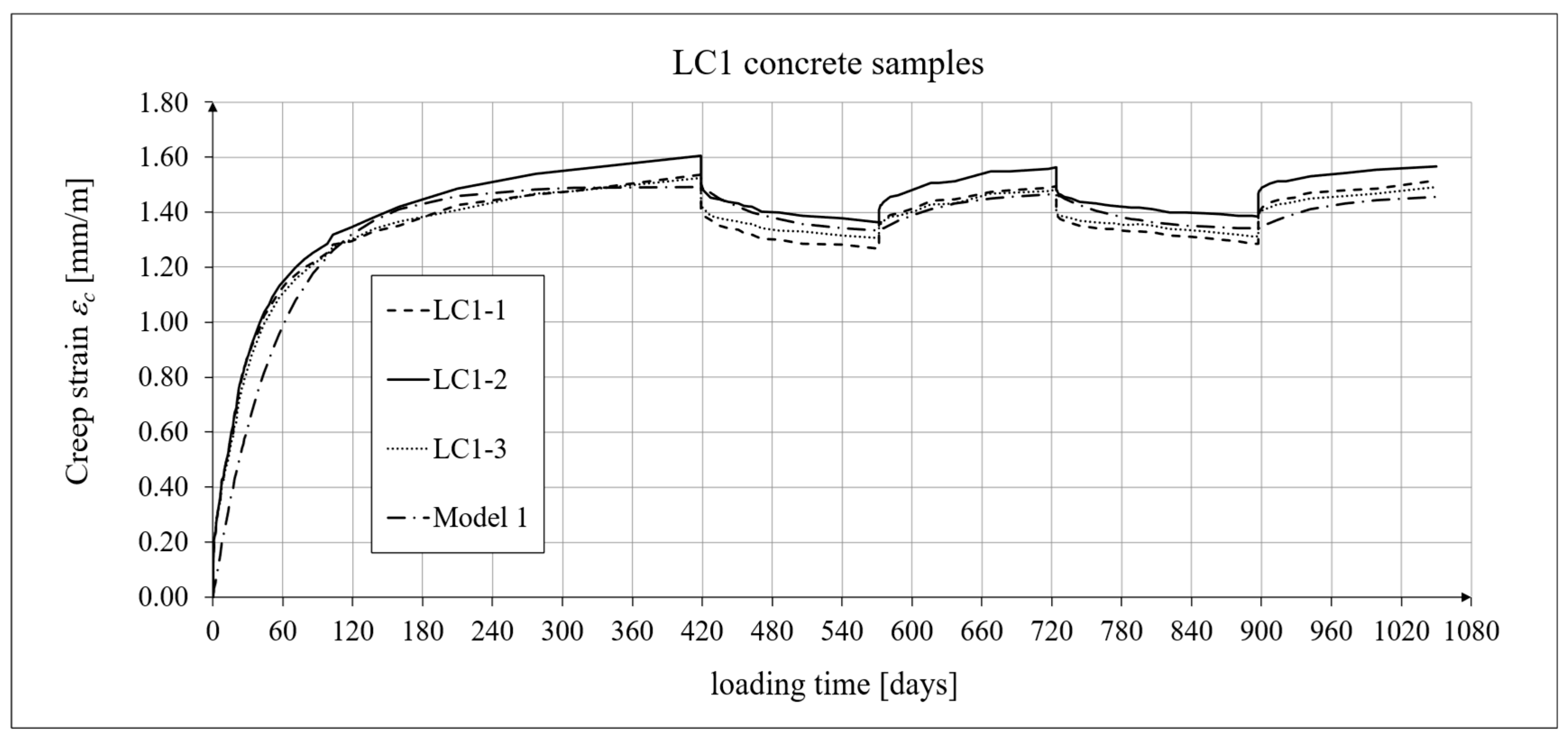
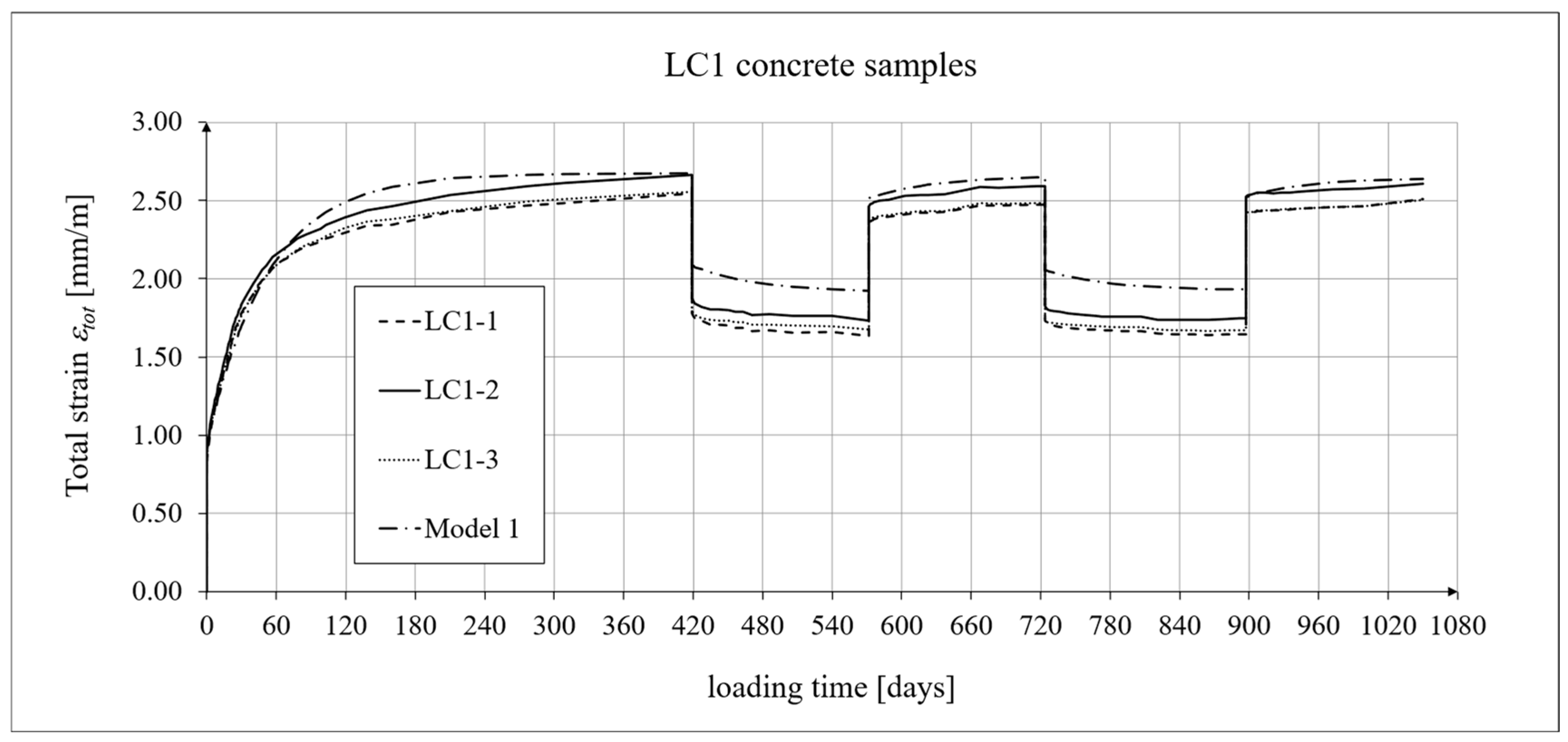
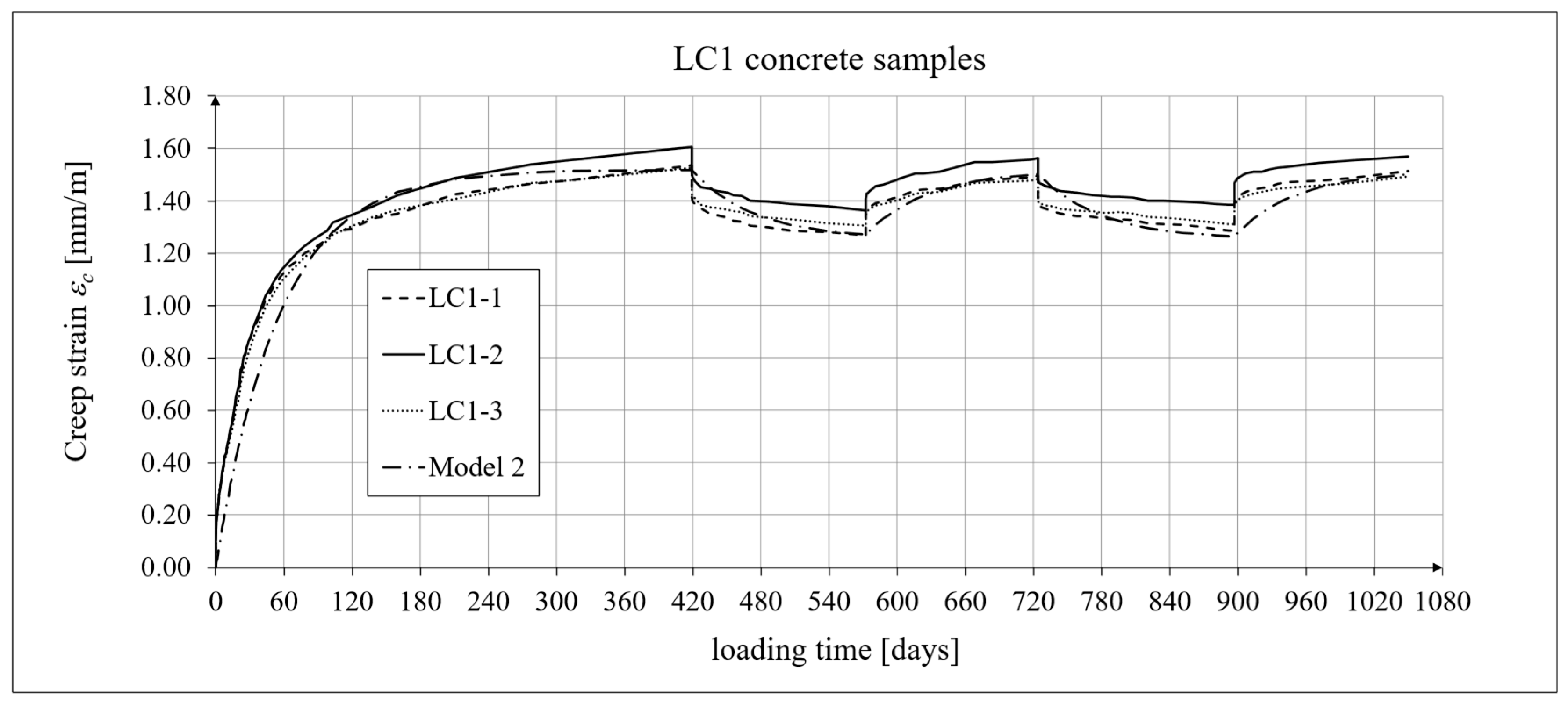
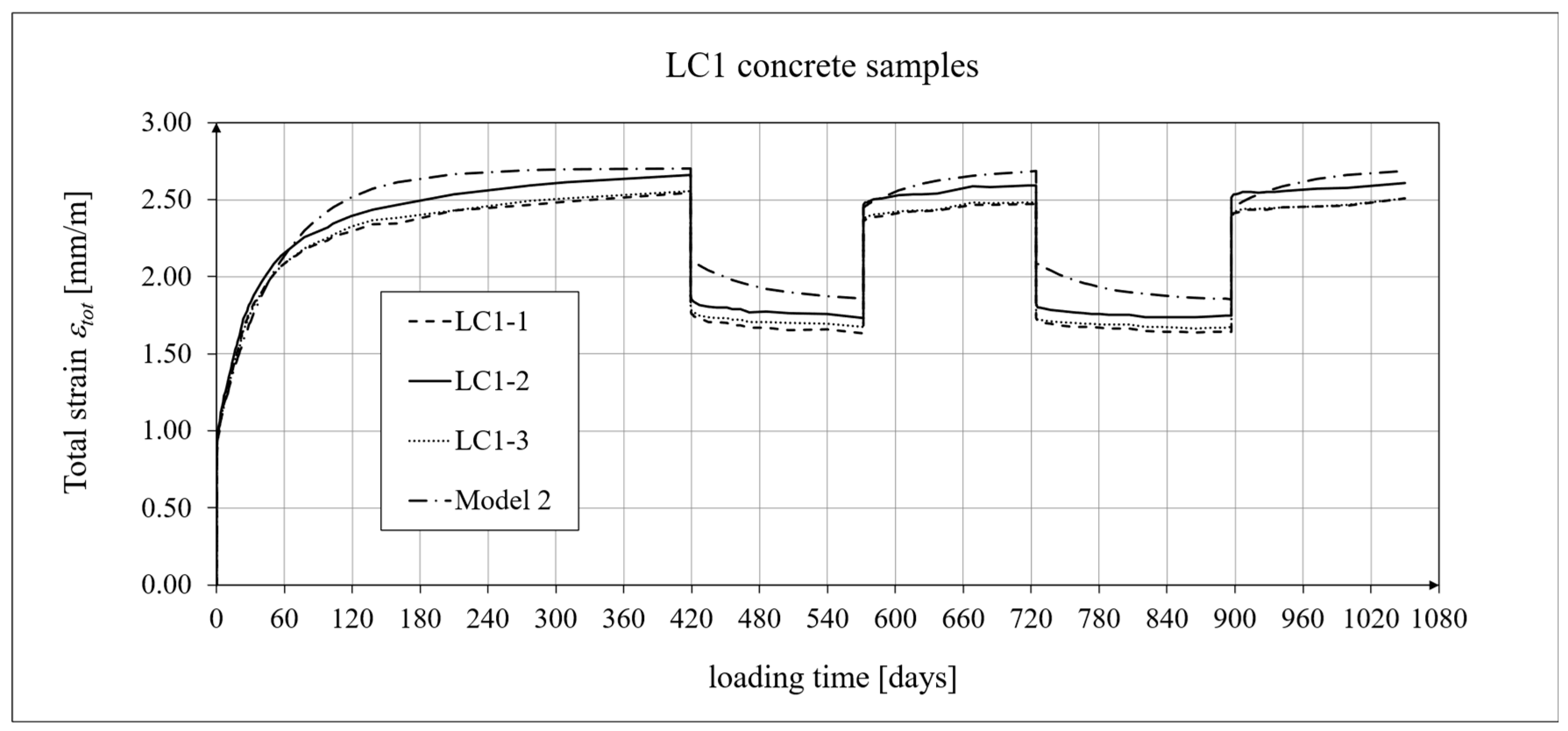
- In the case of samples made of the LC1 concrete, the first loading phase lasted from day 1 to 419 at a stress of 15.55 MPa, the creep–recovery strains were recorded during the first unloading phase from days 419 to 572 at a stress of 1.56 MPa, the first reloading phase lasted from days 572 to 724 at a stress of 15.55 MPa, the next creep–recovery strains were measured during the second unloading phase from days 724 to 897 at a stress of 1.56 MPa, and the second reloading phase lasted from days 897 to 1050 at a stress of 15.55 MPa.
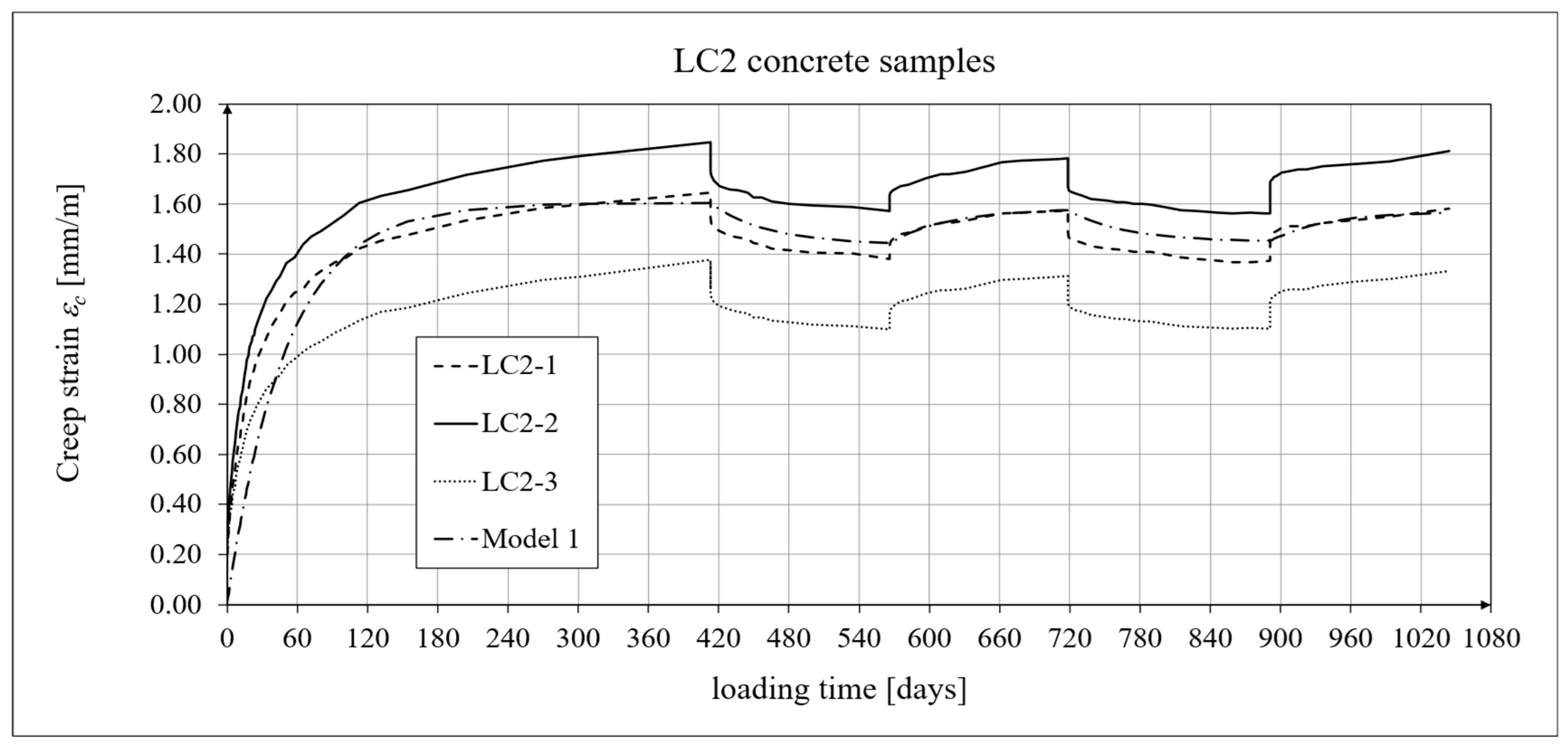
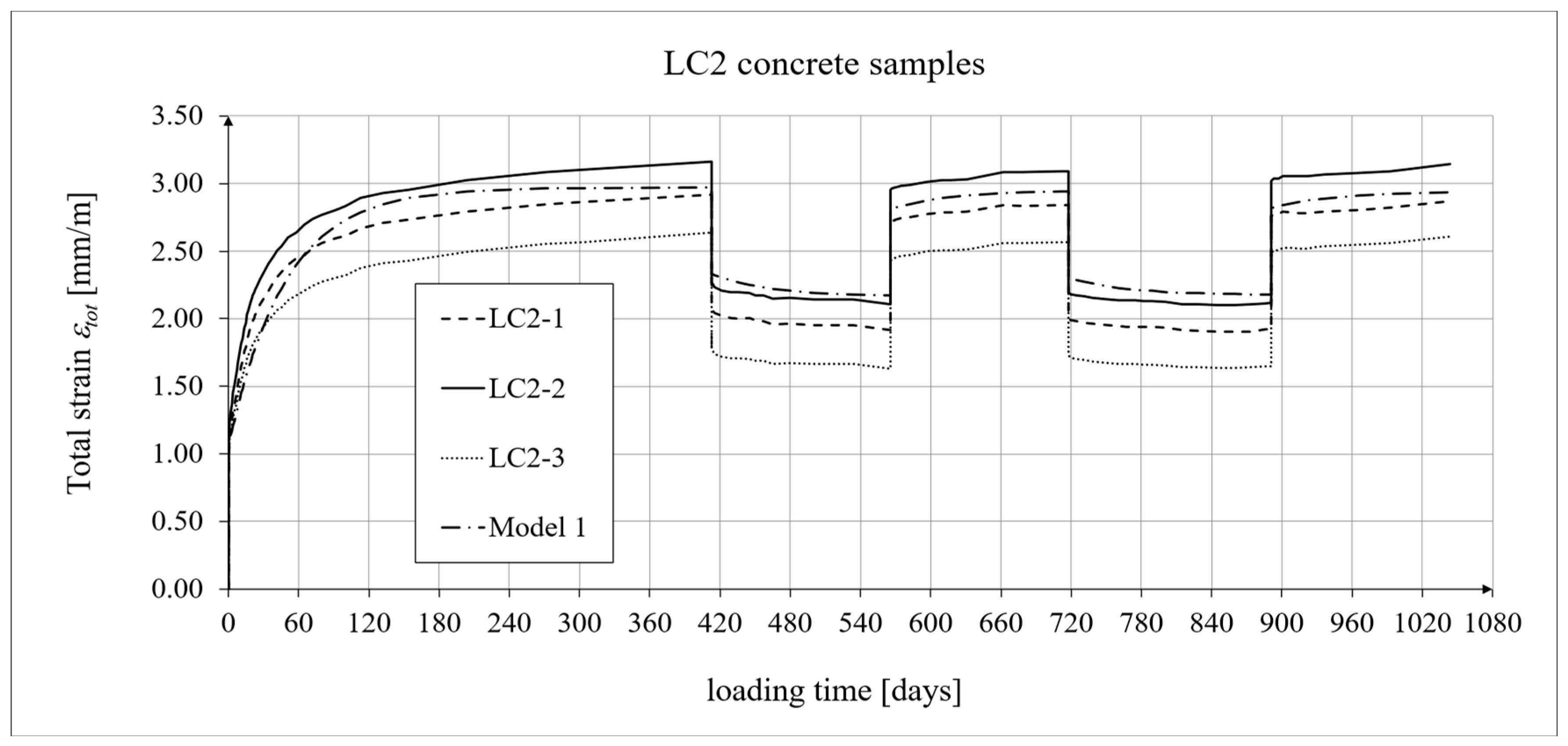
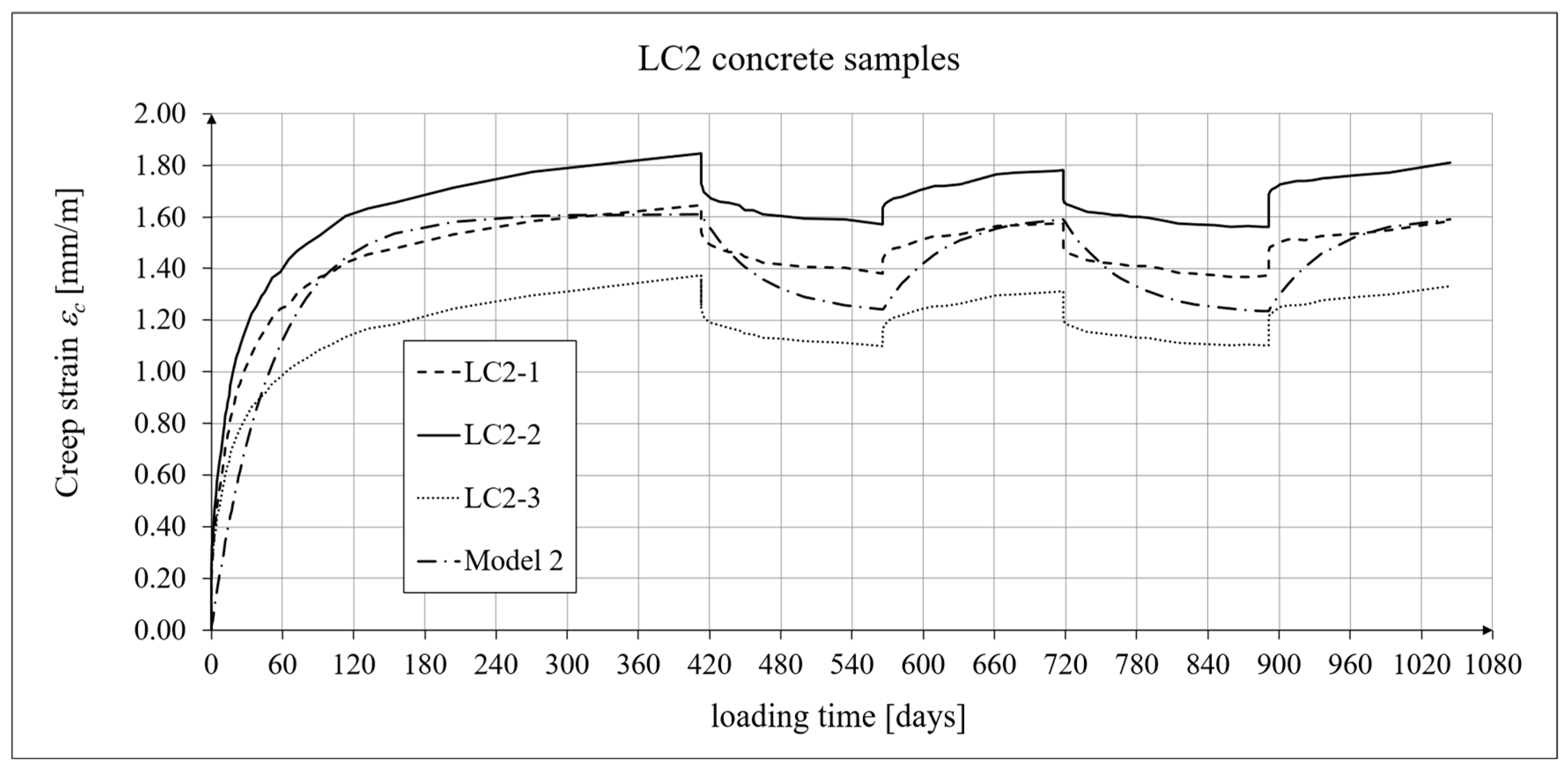
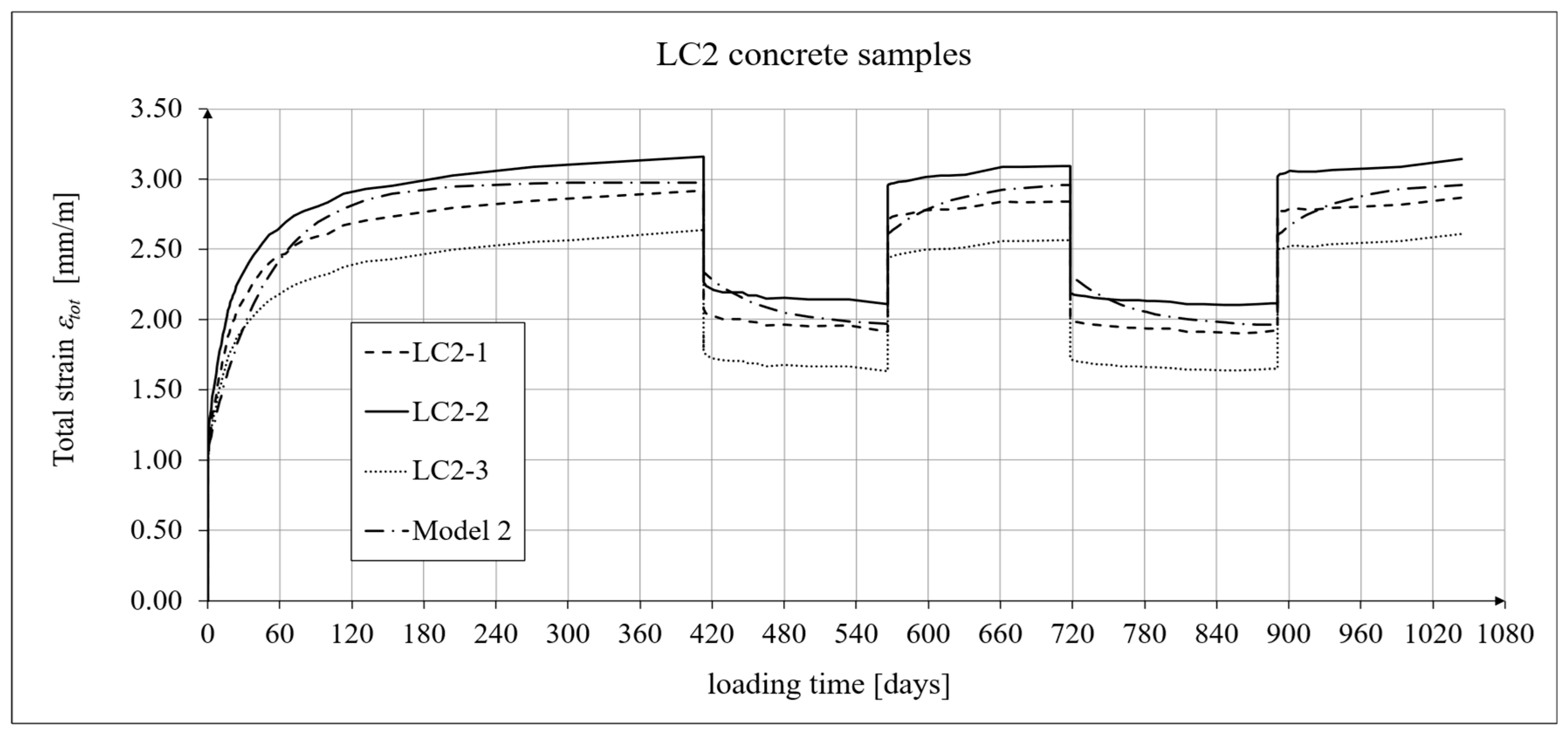
- In the case of the samples made from the LC2 concrete, the first loading phase lasted from day 1 to 413 at a stress of 16.96 MPa, the creep–recovery strains were measured during the first unloading phase from days 413 to 566 at a stress of 1.70 MPa, the first reloading phase lasted from days 566 to 718 at a stress of 16.96 MPa, the next creep–recovery strains were measured during the second unloading phase from days 718 to 891 at a stress of 1.70 MPa, and the second reloading phase lasted from days 891 to 1044 at a stress of 16.96 MPa.
- Adopting iterative steps for the coefficients C0, A1, and γ;
- Initiating forward and backward iterations for these coefficients;
- Comparing the experimental results with the analytical models by calculating the root mean square errors (RMSEs);
- Selecting the variant when the RMSE reaches the minimum value for all coefficients.
5. Discussion
- The cube compressive strength of the LC1 concrete turned out to be 2−9% higher than that of the LC2 concrete, depending on the age of the concrete, while the cylindrical compressive strength was higher by approximately 2.5%.
- The secant modulus of elasticity did not show significant differences for both concretes.
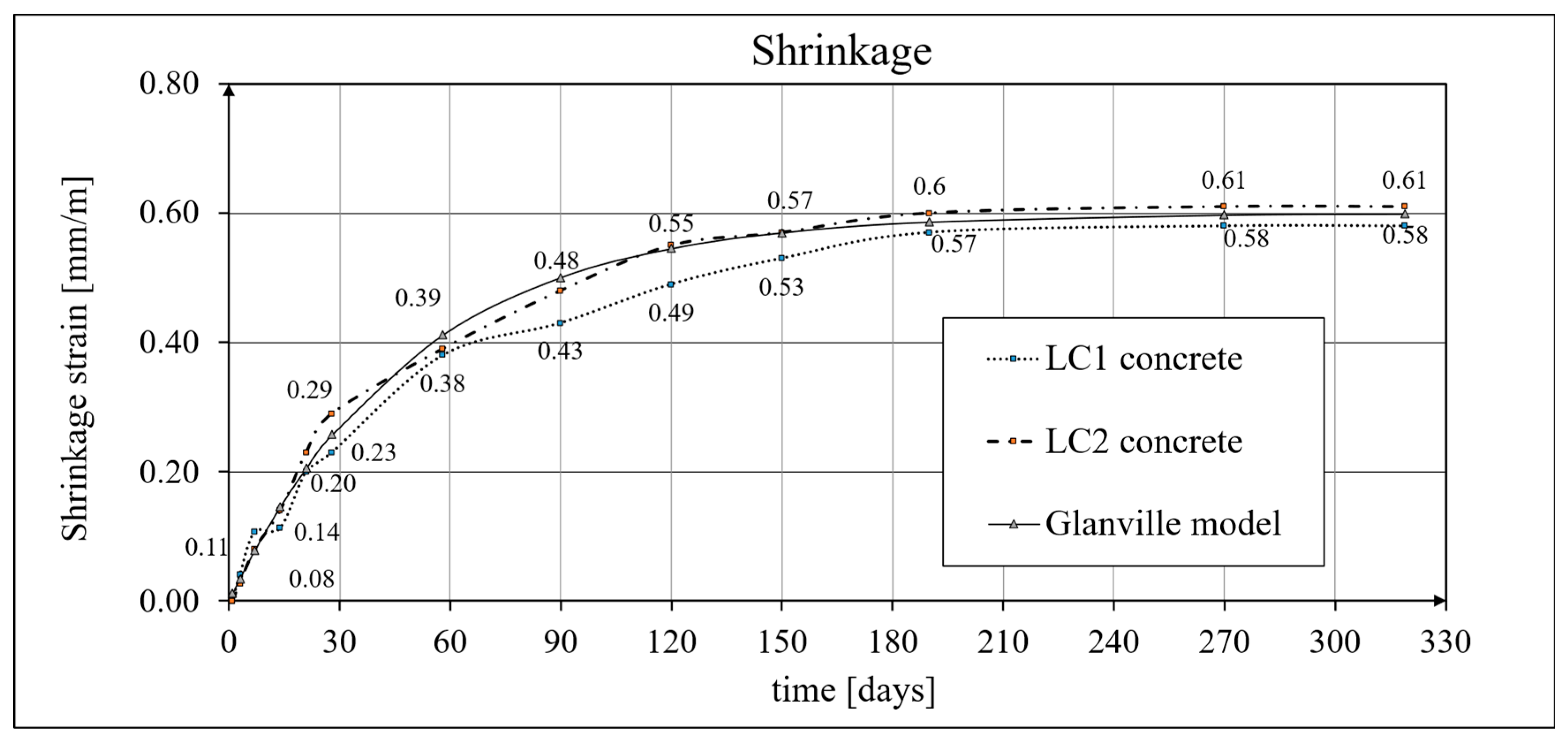
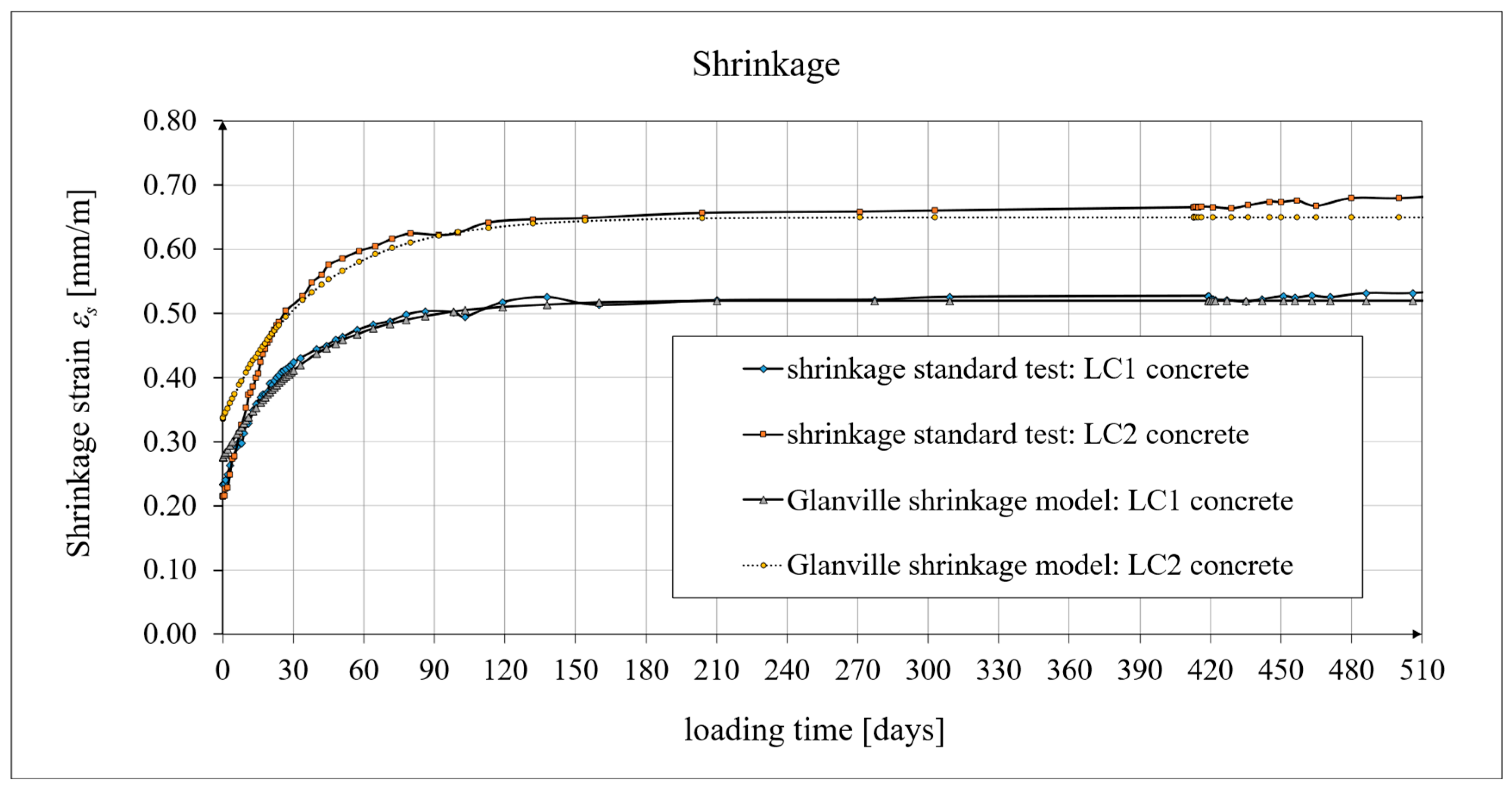
- In the Amsler shrinkage tests, the shrinkage values of the LC2 concrete were higher than those of the LC1 concrete in a time-varying manner, stabilizing after 150 days at a level of 5% higher, while in the shrinkage tests, performed according to the European Standard on cylindrical samples, the shrinkage values were also higher, but stabilized after 120 days at a level of 20% higher.
- In the creep tests on cylindrical samples, the mean values of the creep strains for both concretes were at the same level, but in the case of the LC2 concrete samples, the scatter of the results was much higher than in the case of the LC1 concrete samples.
6. Conclusions
6.1. Conclusions Regarding the Obtained Test Results
- Based on the LSA concrete tests, it was determined that the mean final creep coefficient of the LC1 concrete samples tested after more than one year was approximately 2.1, and for the LC2 concrete samples, approximately 1.9, yielding an average value of 2.0, similar to the value for plain concrete of the same strength.
- The mean recovery value for the LC1 lightweight concrete was determined by comparing the creep strains at the end of the first loading period and the first unloading period, obtaining 15.62%, and for the LC2 concrete, 16.75%, i.e., on average, an approximation 16.2%, which is less than that for plain concrete of the same strength.
- No ratcheting phenomenon was observed (probably due to minor plastic deformations), and therefore, cyclic load changes did not increase the creep deformation of the tested concrete.
- Considering the properties of LSA concrete mixtures, further research is planned using the addition of fibers, which should increase the tensile strength for concrete, elasticity modulus, and frost resistance.
6.2. Conclusions Regarding the Model Analysis Results
- Standard models cannot be applied directly and require additional calibration using correction coefficients. However, these models are very complex compared to those based on the theory of hereditary creep strain.
- Since the use of standard models does not improve the approximation of experimental results without additional calibration, the authors suggest reconsidering the direct application of basic hereditary models for LSA concrete.
- The application of four long-term models was analyzed. Of these models, the Arutiunian theory of hereditary creep strain with aging and the modified hereditary theory with Bažant aging function yielded quantitatively and qualitatively correct results.
- There is no need to correct the Boltzmann superposition principle given in the form of a Volterra integral Equation (3) as long as the initial condition is formulated correctly.
6.3. Conclusions for Structural Applications
- Evaluating the properties of LSA concrete under long-term cyclic loading requires experimental testing, and standard data alone are insufficient. This also results from the need to apply correction factors in accordance with current standards.
- Knowledge of the properties of LSA concrete and useful long-term models, including those based on the theory of hereditary creep, is essential for the design of prestressed structures made of lightweight aggregate concrete subjected to time-varying loads.
- There are no contraindications to using the type of LSA concrete under consideration in structures subjected to long-term cyclic loading.
- The concrete mixtures described in the paper are suitable for use in prestressed structures subjected to long-term cyclic loading, which should contribute to benefits in the field of sustainable construction.
- The advantages include the possibility of using LSA concrete for the construction of prestressed slabs, because despite the lower modulus of elasticity than in the case of plain concrete, the lower density of LSA concrete ensures smaller deflections of the floor slabs. As the ratcheting phenomenon was not observed (probably due to minor plastic deformations), the cyclic load changes did not increase the creep deformation of the tested concrete and the deflection of the floor slabs.
- The disadvantages of the tested LSA concrete include its brittleness, which limits its applications in the case of structures in which the tensile strength of the concrete is important, e.g., in the case of significant shearing or punching.
- In a situation of decreasing access to natural crushed aggregates, reusing waste materials is now an environmental priority. As a result, the reuse of ashes for the production of concrete aggregate may, in the future, reduce the mining of raw materials.
Author Contributions
Funding
Institutional Review Board Statement
Informed Consent Statement
Data Availability Statement
Acknowledgments
Conflicts of Interest
Abbreviations
| ITB | Instytut Techniki Budowlanej (Building Research Institute) |
| LSA | Lightweight Sintered Aggregate |
| LWAC | Lightweight Aggregate Concrete |
| LSA Concrete | Sintered Fly Ash Concrete |
| IMiKB | Instytut Materiałów i Konstrukcji Budowlanych (Inst. of Building Mater. & Struct.) |
| PC struct. | Prestressed concrete structures |
| W/C | Water/Cement Ratio |
| LC | Lightweight Concrete |
| CEM | Cement Class |
| CEB-FIP | the merger of CEB and FIP |
| CEB | Euro-International Committee for Concrete |
| FIP | International Federation for Prestressing |
| MC 2010 | Model Code 2010 |
| MC 2020 | Model Code 2020 |
References
- Chandra, S.; Berntsson, L. Lightweight Aggregate Concrete. Science, Technology, and Applications, 1st ed.; Noyes Publications/William Andrew Publishing: Norwich, CT, USA, 2002. [Google Scholar]
- Clarke, J.L. (Ed.) Structural Lightweight Aggregate Concrete; CRC Press: Boca Raton, FL, USA; Taylor &Francis Group: London, UK, 2014. [Google Scholar]
- Lewiński, P.M.; Fedorczyk, Z.; Więch, P.; Zacharski, Ł. Short-Term and Long-Term Mechanical Properties of Lightweight Concrete with Sintered Aggregate. Materials 2025, 18, 2977. [Google Scholar] [CrossRef]
- Łuczaj, K.; Urbańska, P. Certyd—New lightweight high-strength sintered aggregate. Mat. Bud. 2015, 12, 42–45. (In Polish) [Google Scholar] [CrossRef]
- Lewiński, P.M.; Fedorczyk, Z.; Więch, P.; Zacharski, Ł. Adequacy of Standard Models for Long-Term Behavior of Lightweight Concrete with Sintered Aggregate Under Cyclic Loading. Materials 2026, 19, 59. [Google Scholar] [CrossRef]
- Rogowska, A.M.; Lewiński, P.M. Mechanical properties of lightweight concrete with sintered aggregate. MATEC Web Conf. 2020, 323, 01005. [Google Scholar] [CrossRef]
- Rogowska, A.; Lewiński, P. Structural lightweight concrete with sintered aggregate as a material for strengthening constructions. In XVI Konferencja Naukowo-Techniczna: Warsztat Pracy Rzeczoznawcy Budowlanego, Kielce-Cedzyna, Poland, 26–28 October 2020, 1st ed.; Runkiewicz, L., Goszczyńska, B., Eds.; Zarząd Główny PZITB: Warszawa, Poland, 2020; pp. 483–491. (In Polish) [Google Scholar]
- Domagała, L. Structural Lightweight Aggregate Concrete, 1st ed.; Monografia 462; Cracow University of Technology Publishing House: Cracow, Poland, 2014; Available online: https://repozytorium.biblos.pk.edu.pl/resources/25702 (accessed on 1 October 2020). (In Polish)
- Mieszczak, M. Application of lightweight concrete to construction, especially for prestressed floor slabs. Technical Issues 2016, 4, 55–61. (In Polish) [Google Scholar]
- Szydłowski, R.; Mieszczak, M. Study of application of lightweight aggregate concrete to construct post-tensioned long-span slabs. Proc. Eng. 2017, 172, 1077–1085. [Google Scholar] [CrossRef]
- Mieszczak, M.; Szydłowski, R. Lightweight concrete in prestressed structures. Builder 2017, 240, 90–93. (In Polish) [Google Scholar]
- Mieszczak, M.; Domagała, L. Lightweight Aggregate Concrete as an Alternative for Dense Concrete in Post-Tensioned Concrete Slab. Mater. Sci. Forum. 2018, 926, 140–145. [Google Scholar] [CrossRef]
- Mieszczak, M.; Szydłowski, R. Light aggregate concrete research for the construction of large span slab. In Konferencja Naukowo-Techniczna Konstrukcje Sprężone, Kraków, Poland, 18–20 April 2018, 1st ed.; Derkowski, W., Gwoździewicz, P., Pańtak, M., Politalski, W., Seruga, A., Zych, M., Eds.; Cracow University of Technology Publishing House: Cracow, Poland, 2018; pp. 147–150. (In Polish) [Google Scholar]
- Szydłowski, R.; Kurzyniec, K. Influence of bulk density of lightweight aggregate concrete on strength and performance parameters of a slab-and-beam floor. Inż. Bud. 2018, 74, 162–164. (In Polish) [Google Scholar]
- Szydłowski, R. Concrete properties for long-span post-tensioned slabs. Mater. Sci. Forum 2018, 296, 122–127. [Google Scholar] [CrossRef]
- Szydłowski, R.S.; Łabuzek, B. Experimental Evaluation of Shrinkage, Creep and Prestress Losses in Lightweight Aggregate Concrete with Sintered Fly Ash. Materials 2021, 14, 3895. [Google Scholar] [CrossRef]
- Seruga, A.; Szydłowski, R. Bond Strength of Lightweight Aggregate Concrete to the Plain Seven-Wire Non-pretensioned Steel Strand. In Building for the Future: Durable, Sustainable, Resilient—Proceedings of the Fib Symposium, 1st ed.; Ilki, A., Çavunt, D., Çavunt, Y.S., Eds.; Springer Nature: Cham, Switzerland, 2023; Volume 1, pp. 1742–1753. [Google Scholar] [CrossRef]
- Szydłowski, R.; Mieszczak, M. Analysis of application of lightweight aggregate concrete to construct post-tensioned long-span slabs. Inż. Bud. 2018, 74, 68–72. (In Polish) [Google Scholar]
- Rodacka, M. Influence of Rheological Phenomena on Deflection of Prestressed Lightweight Concrete Beams. Doctoral Thesis, Cracow University of Technology, Cracow, Poland, 2022. (In Polish) [Google Scholar]
- Rodacka, M.; Domagała, L.; Szydłowski, R. Assessment of Properties of Structural Lightweight Concrete with Sintered Fly Ash Aggregate in Terms of Its Suitability for Use in Prestressed Members. Materials 2023, 16, 5429. [Google Scholar] [CrossRef] [PubMed]
- Arutiunian, N.K. Some Problems in the Theory of Creep, 1st ed.; Nowottny, H.E., Translator; Pergamon Press: Oxford, UK, 1966. [Google Scholar]
- Jirásek, M.; Bažant, Z.P. Inelastic Analysis of Structures; John Wiley & Sons, Ltd.: Chichester, UK, 2002. [Google Scholar]
- Bažant, Z.P. Creep stability and buckling strength of concrete columns. Mag. Concr. Res. 1968, 20, 85–94. [Google Scholar] [CrossRef]
- Bažant, Z.P.; Osman, E. Double power law for basic creep of concrete. Matériaux Constr. 1976, 9, 3–11. [Google Scholar] [CrossRef]
- Bažant, Z.P.; Chern, J.C. Log double power law for concrete creep. ACI J. Proc. 1985, 82, 665–675. [Google Scholar] [CrossRef]
- Whaley, C.P.; Neville, A.M. Non-elastic deformation of concrete under cyclic compression. Mag. Concr. Res. 1973, 25, 145–154. [Google Scholar] [CrossRef]
- Hirst, G.A.; Neville, A.M. Activation energy of creep of concrete under short-term static and cyclic stresses. Mag. Concr. Res. 1977, 29, 13–18. [Google Scholar] [CrossRef]
- Bažant, Z.P.; Panula, L. Practical prediction of time-dependent deformation of concrete (Part II: Basic creep). J. Mat. Struct. 1978, 11, 317–328. [Google Scholar] [CrossRef]
- Bažant, Z.P.; Panula, L. Practical prediction of time-dependent deformation of concrete (Part VI: Cyclic creep, nonlinearity and statistical scatter). J. Mat. Struct. 1979, 12, 175–183. [Google Scholar]
- Brooks, J.J.; Forsyth, P. Relaxation of concrete and its relation to creep under uniaxial cyclic compression at various frequencies. Mag. Concr. Res. 1986, 38, 175–182. [Google Scholar] [CrossRef]
- Bažant, Z.P.; Kim, J.K. Improved prediction model for time-dependent deformations of concrete: Part 4—Temperature effects. Mater. Struct. 1992, 25, 84–94. [Google Scholar] [CrossRef]
- Bažant, Z.P.; Kim, J.K. Improved prediction model for time-dependent deformations of concrete: Part 5—Cyclic load and cyclic humidity. Mater. Struct. 1992, 25, 163–169. [Google Scholar]
- Bažant, Z.P.; Murphy, W.P. Creep and shrinkage prediction model for analysis and design of concrete structures—Model B3. Mater. Struct. 1995, 28, 357–365. [Google Scholar] [CrossRef]
- Acker, P.; Ulm, F.-J. Creep and shrinkage of concrete: Physical origins and practical measurements. Nucl. Eng. Des. 2001, 203, 143–158. [Google Scholar] [CrossRef]
- Koh, C.G.; Ang, K.K.; Zhang, L. Effects of Repeated Loading on Creep Deflection of Reinforced Concrete Beams. Eng. Struct. 1997, 19, 2–18. [Google Scholar] [CrossRef]
- König, G.; Dehn, F.; Holschemacher, K.; Weiße, D. Determination of the bond creep coefficient for lightweight aggregate concrete (LWAC) under cyclic loading. In Challenges of Concrete Construction: 6. Concrete for Extreme Conditions, Proceedings of the International Conference, Scotland, UK, 9–11 September 2002; Thomas Telford Ltd.: London, UK, 2002; Volume 6, pp. 673–683. [Google Scholar] [CrossRef]
- Bažant, Z.P.; Hubler, M.H. Theory of cyclic creep of concrete based on Paris law for fatigue growth of subcritical microcracks. J. Mech. Phys. Solids 2014, 63, 187–200. [Google Scholar] [CrossRef]
- Kern, B.; Oneschkow, N.; Podhajecky, A.L.; Lohaus, L.; Anders, S.; Haist, M. Comparative analysis of concrete behaviour under compressive creep and cyclic loading. Int. J. Fatigue 2021, 153, 106409. [Google Scholar] [CrossRef]
- The International Federation for Structural Concrete (fib). Fib Model Code for Concrete Structures (2020); CEB-FIP; Wiley: Lausanne, Switzerland, 2020. [Google Scholar]
- Babu, D.S. Mechanical and Deformational Properties, and Shrinkage Cracking Behaviour of Lightweight Concretes. Ph.D. Thesis, National University of Singapore, Singapore, 2008. [Google Scholar]
- Lo, T.Y.; Sham, F.C.; Cui, H.Z.; Tang, W.C.P. Study of short term shrinkage and creep of lightweight concrete. Mater. Res. Innov. 2008, 12, 151–154. [Google Scholar] [CrossRef]
- Daneti, S.B.; Tam, C.T.; Tamilselvan, T.; Kannan, V.; Kong, K.H.; Islam, M.R. Shrinkage Cracking Potential of Lightweight Aggregate Concrete. J. Phys. Conf. Ser. 2024, 2779, 012067. [Google Scholar] [CrossRef]
- Montazerian, A.; Nili, M.; Haghighat, N.; Loghmani, N. Experimental and simplified visual study to clarify the role of aggregate-paste interface on the early age shrinkage and creep of high-performance concrete. Asian J. Civ. Eng. 2021, 22, 1461–1480. [Google Scholar] [CrossRef]
- Shen, D.; Jiang, J.; Jiao, Y.; Shen, J.; Jiang, G. Early-age tensile creep and cracking potential of concrete internally cured with pre-wetted lightweight aggregate. Constr. Build. Mater. 2017, 135, 420–429. [Google Scholar] [CrossRef]
- Wang, X.F.; Fang, C.; Kuang, W.Q.; Li, D.W.; Han, N.X.; Xing, F. Experimental study on early cracking sensitivity of lightweight aggregate concrete. Constr. Build. Mater. 2017, 136, 173–183. [Google Scholar] [CrossRef]
- Cui, H.; Yang, H.; Xu, X.; Lin, Z.; Lo, T.Y. Effect of cured time on creep of lightweight aggregate concrete. In 5th International Conference on Durability of Concrete Structures, Shenzhen, China, 30 June–1 July 2016, 1st ed.; Shenzhen University: Shenzhen, China, 2016; pp. 134–140. [Google Scholar] [CrossRef][Green Version]
- Domingo-Cabo, A.; Lázaro, C.; López-Gayarre, F.; Serrano-López, M.A.; Serna, P.; Castaño-Tabares, J.O. Creep and shrinkage of recycled aggregate concrete. Constr. Build. Mater. 2009, 23, 2545–2553. [Google Scholar] [CrossRef]
- Domingo, A.; Lázaro, C.; Gayarre, F.L.; Serrano, M.A.; López-Colina, C. Long term deformations by creep and shrinkage in recycled aggregate concrete. Mater. Struct. 2010, 43, 1147–1160. [Google Scholar] [CrossRef]
- Haghighat, N.; Nili, M.; Montazerian, A.; Yousef, R. Proposing an Image Analysis to Study the Effect of Lightweight Aggregate on Shrinkage and Creep of Concrete. Adv. Civ. Engr. Mater. 2020, 9, 22–37. [Google Scholar] [CrossRef]
- Havlásek, P. Creep and Shrinkage of Concrete Subjected to Variable Environmental Conditions. Doctoral Thesis, Czech Technical University, Prague, Czech Republic, 2014. [Google Scholar]
- Nukah, P.D.; Abbey, S.J.; Booth, C.A.; Oti, J. Evaluation of the structural performance of low carbon concrete. Sustainability 2022, 14, 16765. [Google Scholar] [CrossRef]
- Nukah, P.D.; Abbey, S.J.; Booth, C.A.; Oti, J. Development of low carbon concrete and prospective of geopolymer concrete using lightweight coarse aggregate and cement replacement materials. Constr. Build. Mater. 2024, 428, 136295. [Google Scholar] [CrossRef]
- Lye, C.Q.; Dhir, R.K.; Ghataora, G.S. Estimation models for creep and shrinkage of concrete made with natural, recycled and secondary aggregates. Mag. Concr. Res. 2022, 74, 392–418. [Google Scholar] [CrossRef]
- Singh, B.; Singh, S.B.; Barai, S.V.; Singh, A.; Ojha, P.N. Experimental determination of creep coefficients for sintered flyash lightweight aggregate based concrete and verification with creep models. Res. Eng. Struct. Mat. 2024, 1–19. [Google Scholar] [CrossRef]
- Wendling, A.; Sadhasivam, K.; Floyd, R.W. Creep and shrinkage of lightweight self-consolidating concrete for prestressed members. Constr. Build. Mater. 2018, 167, 205–215. [Google Scholar] [CrossRef]
- Zhuang, Y.Z.; Chen, C.Y.; Ji, T. Effect of shale ceramsite type on the tensile creep of lightweight aggregate concrete. Constr. Build. Mater. 2013, 46, 13–18. [Google Scholar] [CrossRef]
- Zheng, X.; Ji, T.; Easa, S.M.; Zhang, B.; Jiang, Z. Tensile basic creep behavior of lightweight aggregate concrete reinforced with steel fiber. Constr. Build. Mater. 2019, 200, 356–367. [Google Scholar] [CrossRef]
- Lopez, M.; Kahn, L.F.; Kurtis, K.E. Effect of internally stored water on creep of high-performance concrete. ACI Mater. J. 2008, 105, 265–273. [Google Scholar] [CrossRef] [PubMed]
- Chia, K.-S.; Liu, X.; Liew, J.-Y.; Zhang, M.-H. Experimental study on creep and shrinkage of high-performance ultralightweight cement composite of 60 MPa. Struct. Eng. Mech. 2014, 50, 635–652. [Google Scholar] [CrossRef]
- Hilaire, A.; Benboudjema, F.; Darquennes, A.; Berthaud, Y.; Nahas, G. Modeling basic creep in concrete at early-age under compressive and tensile loading. Nucl. Eng. Des. 2014, 269, 222–230. [Google Scholar] [CrossRef]
- Hui, R.Y.; Huang, G.X.; Yi, B.R. Tensile creep and compressive creep of concrete with fly ash. Water Res. Hydropower Eng. 1986, 12, 1–5. [Google Scholar]
- Ji, G.M.; Kanstad, T.; Bjøntegaard, Ø.; Sellevold, E.J. Tensile and compressive creep deformations of hardening concrete containing mineral additives. Mater. Struct. 2013, 46, 1167–1182. [Google Scholar] [CrossRef]
- Kim, S.G.; Park, Y.S.; Lee, Y.H. Comparison of Concrete Creep in Compression, Tension, and Bending under Drying Condition. Materials 2019, 12, 3357. [Google Scholar] [CrossRef] [PubMed]
- Klausen, A.E.; Kanstad, T.; Bjøntegaard, Ø.; Sellevold, E. Comparison of tensile and compressive creep of fly ash concretes in the hardening phase. Cem. Concr. Res. 2017, 95, 188–194. [Google Scholar] [CrossRef]
- Ranaivomanana, N.; Multon, S.; Turatsinze, A. Basic creep of concrete under compression, tension and bending. Constr. Build. Mater. 2013, 38, 173–180. [Google Scholar] [CrossRef]
- Rossi, P.; Charron, J.P.; Bastien-Masse, M.; Tailhan, J.L.; Le Maou, F.; Ramanich, S. Tensile basic creep versus compressive basic creep at early ages: Comparison between normal strength concrete and a very high strength fibre reinforced concrete. Mater. Struct. 2014, 47, 1773–1785. [Google Scholar] [CrossRef]
- Wei, Y.; Wu, Z.; Huang, J.; Liang, S. Comparison of compressive, tensile, and flexural creep of early-age concretes under sealed and drying conditions. J. Mater. Civ. Eng. 2018, 30, 04018289. [Google Scholar] [CrossRef]
- Bednář, J. Aggregate rebound effect on elastic and creep recovery of lightweight concrete. Cem. Concr. Res. 1979, 9, 45–50. [Google Scholar] [CrossRef]
- Brooks, J.J. Prediction of Creep Recovery of Concrete from Creep in Tension and in Compression. Doctoral Dissertation, University of Leeds, Leeds, UK, 1976. [Google Scholar]
- Cao, J.; Tu, N.; Liu, T.; Han, Z.; Tu, B.; Zhou, Y. Prediction models for creep and creep recovery of fly ash concrete. Constr. Build. Mater. 2024, 428, 136398. [Google Scholar] [CrossRef]
- Chen, P.; Zheng, W.; Wang, Y.; Du, K.; Chang, W. Strain recovery model for concrete after compressive creep. Constr. Build. Mater. 2019, 199, 746–755. [Google Scholar] [CrossRef]
- Counto, U.J. The effect of the elastic modulus of the aggregate on the elastic modulus, creep and creep recovery of concrete. Mag. Concr. Res. 1964, 16, 129–138. [Google Scholar] [CrossRef]
- Li, J.; Dong, W.; Zhang, B.; Zhou, X. Effects of creep recovery on the fracture properties of concrete. Theor. Appl. Fract. Mech. 2020, 109, 102694. [Google Scholar] [CrossRef]
- Mei, S.Q.; Zhang, J.C.; Wang, Y.F.; Zou, R.F. Creep-recovery of normal strength and high strength concrete. Constr. Build. Mater. 2017, 156, 175–183. [Google Scholar] [CrossRef]
- Mei, S.; Li, X.; Wang, X.; Liu, X.; Rong, L. Rate dependent short-term creep and creep recovery of normal concrete. J. Build. Eng. 2024, 85, 108728. [Google Scholar] [CrossRef]
- Qu, Z.; Si, R.; Jia, P.; Zhang, Y. Creep and relaxation responses of fly ash concrete: Linear and nonlinear cases. Case Stud. Constr. Mater. 2022, 17, e01562. [Google Scholar] [CrossRef]
- Yue, L.L.; Taerwe, L. Creep recovery of plain concrete and its mathematical modelling. Mag. Concr. Res. 1992, 44, 281–290. [Google Scholar] [CrossRef]
- Zhou, Y.; Chen, W.; Yan, P. Measurement and modeling of creep property of high-strength concrete considering stress relaxation effect. J. Build. Eng. 2022, 56, 104726. [Google Scholar] [CrossRef]
- Rossi, P.; Tailhan, J.L.; Le Maou, F. Creep strain versus residual strain of a concrete loaded under various levels of compressive stress. Cem. Concr. Res. 2013, 51, 32–37. [Google Scholar] [CrossRef]
- Huang, Y.; Xie, T.; Ding, Y.; Fei, D.; Ding, S. Comparison of tensile and compressive creep of hydraulic concrete considering loading/unloading under unified test conditions. Construct. Build. Mater. 2021, 286, 122763. [Google Scholar] [CrossRef]
- Huang, Y.; Zhang, Z.; He, Y.; Wei, H. Study of creep test and creep model of hydraulic concrete subjected to cyclic loading. J. Build. Eng. 2024, 86, 108891. [Google Scholar] [CrossRef]
- Wojewódzki, W.; Jemioło, S.; Lewiński, P.M.; Szwed, A. On the Constitutive Relationships Modelling the Mechanical Properties of Concrete, 1st ed.; Oficyna Wydawnicza PW: Warszawa, Poland, 1995. (In Polish) [Google Scholar]
- Biliszczuk, J. Rheological Redistribution of the Stress State in Non-Homogenous Isostatic Concrete Structures, 1st ed.; PWN: Warszawa, Poland, 1982. (In Polish) [Google Scholar]
- Biliszczuk, J. Concrete—A Material for Bridge Building, 1st ed.; Technical University of Wrocław Publishing House: Wrocław, Poland, 1986. (In Polish) [Google Scholar]
- Neville, A.M. Properties of Concrete, 5th ed.; Pearson Education Ltd.: Harlow, UK; New York, NY, USA, 2011. [Google Scholar]
- Neville, A.M. Creep of Concrete: Plain, Reinforced and Prestressed, 1st ed.; Elsevier: Amsterdam, The Netherlands, 1971. [Google Scholar]
- Neville, A.M.; Dilger, W.H.; Brooks, J.J. Creep of Plain and Structural Concrete, 1st ed.; Construction Press: London, UK; New York, NY, USA, 1983. [Google Scholar]
- Bažant, Z.P.; Jirásek, M. Creep and Hygrothermal Effects in Concrete Structures, 1st ed.; Springer: Dordrecht, The Netherlands, 2018. [Google Scholar]
- Mitzel, A. Rheology of Concrete, 1st ed.; Arkady: Warszawa, Poland, 1972. (In Polish) [Google Scholar]
- Brunarski, L. Fundamentals of Rheology of Concrete Structures; Scientific Studies, Monographs; ITB: Warszawa, Poland, 2019. [Google Scholar]
- EN 12390-7:2019; Testing Hardened Concrete—Part 7: Density of Hardened Concrete. CEN: Brussels, Belgium, 2019.
- EN 12390-13:2013; Testing Hardened Concrete—Part 13: Determination of Secant Modulus of Elasticity in Compression. CEN: Brussels, Belgium, 2013.
- EN 12390-3:2019; Testing Hardened Concrete—Part 3: Compressive Strength of Test Specimens. CEN: Brussels, Belgium, 2019.
- Brunarski, L. Testing of Mechanical Properties of Concrete on Samples Made in Moulds; Instrukcja 194/98; ITB: Warszawa, Poland, 1998. (In Polish) [Google Scholar]
- EN 12390-6:2009; Testing Hardened Concrete—Part 6: Tensile Splitting Strength of Test Specimens. CEN: Brussels, Belgium, 2009.
- EN 12390-5:2019; Testing Hardened Concrete—Part 5: Flexural Strength of Test Specimens. CEN: Brussels, Belgium, 2019.
- PN-B-06714-23:1984; Mineral Aggregates–Testing–Determination of Volume Changes by Amsler Method. PKN: Warszawa, Poland, 1984. (In Polish)
- EN 12390-16:2019; Testing Hardened Concrete—Part 16: Determination of the Shrinkage of Concrete. CEN: Brussels, Belgium, 2019.
- EN 1355:1996; Determination of Creep Strains Under Compression of Autoclaved Aerated Concrete or Lightweight Aggregate Concrete with Open Structure. CEN: Brussels, Belgium, 1996.
- EN 1992-1-1:2004; Eurocode 2: Design of Concrete Structures—Part 1-1: General Rules and Rules for Buildings. CEN: Brussels, Belgium, 2004.
- Glanville, W.H. Studies in Reinforced Concrete. Part II Shrinkage Stresses, 1st ed.; Department of Scientific and Industrial Research, Building Research & Technology Paper 11; HM Stationery Office: London, UK, 1930. [Google Scholar]
- Bažant, Z.P. Numerical determination of long-range stress history from strain history in concrete. Mater. Struct. 1972, 5, 135–141. [Google Scholar] [CrossRef]
- Model Code 2010, 1st ed.; First Complete Draft, Fib Bulletin 55; DCC Siegmar Kästl e.K.: Ostfildern-Kemnat, Germany, 2010.
- EN 1992-1-1:2023; Eurocode 2—Design of Concrete Structures—Part 1-1: General Rules, Rules for Buildings, Bridges and Civil Engineering Structures. CEN: Brussels, Belgium, 2023.
- Häussler-Combe, U. Computational Methods for Reinforced Concrete Structures, 1st ed.; Ernst & Sohn: Berlin, Germany, 2015. [Google Scholar]



| Components and Tests | LC1 Mix | LC2 Mix |
|---|---|---|
| Component | Dosage [kg/m3] | |
| Cement CEM I 42.5 N | 409 | 419 |
| Lightweight sintered aggregate Certyd 4/10 | 775 | 802 |
| Sand | 682 | 703 |
| Water | 164 | 209 |
| Admixture SKY 686 | 3.7 | 3.8 |
| Admixture BV 18 | 3.7 | 3.8 |
| Test types | Number of specimens | |
| Cube compressive strength | 18 | 18 |
| Cylinder compressive strength | 25 | 25 |
| Secant modulus of elasticity | 34 | 34 |
| Tensile splitting strength | 18 | 18 |
| Flexural strength | 18 | 18 |
| Amsler shrinkage tests | 3 | 3 |
| Shrinkage tests acc. to CEN standard | 3 | 3 |
| Creep tests | 3 | 3 |
| Sample No. | U (εe) | U (εc) | U (εtot) | U (φ) |
|---|---|---|---|---|
| [%] | [%] | [%] | [%] | |
| LC1-1 | 5.56 1 | 4.55 | 2.75 | 8.42 |
| LC1-2 | 5.26 | 4.35 | 2.63 | 8.02 |
| LC1-3 | 5.41 | 4.58 | 2.73 | 8.22 |
| Average value | 5.41 | 4.49 | 2.70 | 8.22 |
| Standard deviation | 0.146 | 0.124 | 0.063 | 0.195 |
| Sample No. | U (εe) | U (εc) | U (εtot) | U (φ) |
|---|---|---|---|---|
| [%] | [%] | [%] | [%] | |
| LC2-1 | 4.88 | 4.24 | 2.40 | 6.96 |
| LC2-2 | 4.60 | 3.80 | 2.53 | 6.62 |
| LC2-3 | 4.94 1 | 5.07 | 2.65 | 7.63 |
| Average value | 4.80 | 4.37 | 2.53 | 7.07 |
| Standard deviation | 0.182 | 0.644 | 0.127 | 0.515 |
| Samples of Concrete | Loading Time | n | Model 1 | Model 2 | |
|---|---|---|---|---|---|
| From [Day] | To [Day] | [-] | [%] | [%] | |
| LC1 concrete | 48 | 419 | 16 | 6.92 | 6.24 |
| 419 | 572 | 17 | 3.20 | 3.81 | |
| 572 | 724 | 16 | 3.13 | 5.22 | |
| 724 | 897 | 23 | 2.00 | 4.23 | |
| 897 | 1050 | 16 | 5.33 | 8.38 | |
| LC2 concrete | 42 | 413 | 16 | 9.43 | 9.69 |
| 413 | 566 | 17 | 15.05 | 10.92 | |
| 566 | 718 | 16 | 9.13 | 5.97 | |
| 718 | 891 | 23 | 16.36 | 10.98 | |
| 891 | 1044 | 16 | 7.55 | 6.01 | |
Disclaimer/Publisher’s Note: The statements, opinions and data contained in all publications are solely those of the individual author(s) and contributor(s) and not of MDPI and/or the editor(s). MDPI and/or the editor(s) disclaim responsibility for any injury to people or property resulting from any ideas, methods, instructions or products referred to in the content. |
© 2026 by the authors. Licensee MDPI, Basel, Switzerland. This article is an open access article distributed under the terms and conditions of the Creative Commons Attribution (CC BY) license.
Share and Cite
Lewiński, P.M.; Fedorczyk, Z.; Więch, P. Rheological Features and Hereditary Models of Lightweight Sintered Aggregate Concrete Under Cyclic Loading. Materials 2026, 19, 1539. https://doi.org/10.3390/ma19081539
Lewiński PM, Fedorczyk Z, Więch P. Rheological Features and Hereditary Models of Lightweight Sintered Aggregate Concrete Under Cyclic Loading. Materials. 2026; 19(8):1539. https://doi.org/10.3390/ma19081539
Chicago/Turabian StyleLewiński, Paweł M., Zbigniew Fedorczyk, and Przemysław Więch. 2026. "Rheological Features and Hereditary Models of Lightweight Sintered Aggregate Concrete Under Cyclic Loading" Materials 19, no. 8: 1539. https://doi.org/10.3390/ma19081539
APA StyleLewiński, P. M., Fedorczyk, Z., & Więch, P. (2026). Rheological Features and Hereditary Models of Lightweight Sintered Aggregate Concrete Under Cyclic Loading. Materials, 19(8), 1539. https://doi.org/10.3390/ma19081539