Article

A Hybrid-Dimensional Iterative Coupled Modeling of Lubrication Flow in Deformable Geological Media with Discrete Fracture Networks


1
Key Laboratory of Ministry of Education for Geomechanics and Embankment Engineering, Hohai University, Nanjing 210098, China
2
College of Civil and Transportation Engineering, Hohai University, Nanjing 210098, China
3
Department Geoenergy, Montanuniversität Leoben, 8700 Leoben, Austria
*
Author to whom correspondence should be addressed.
Materials 2026, 19(7), 1444; https://doi.org/10.3390/ma19071444
Submission received: 11 February 2026 / Revised: 24 March 2026 / Accepted: 26 March 2026 / Published: 4 April 2026

Abstract

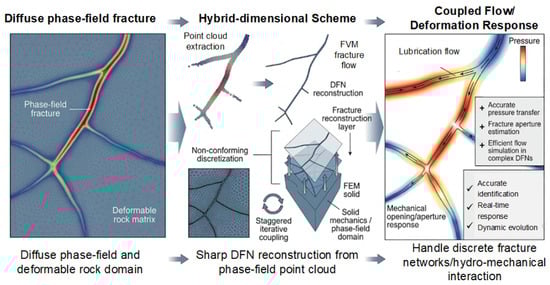
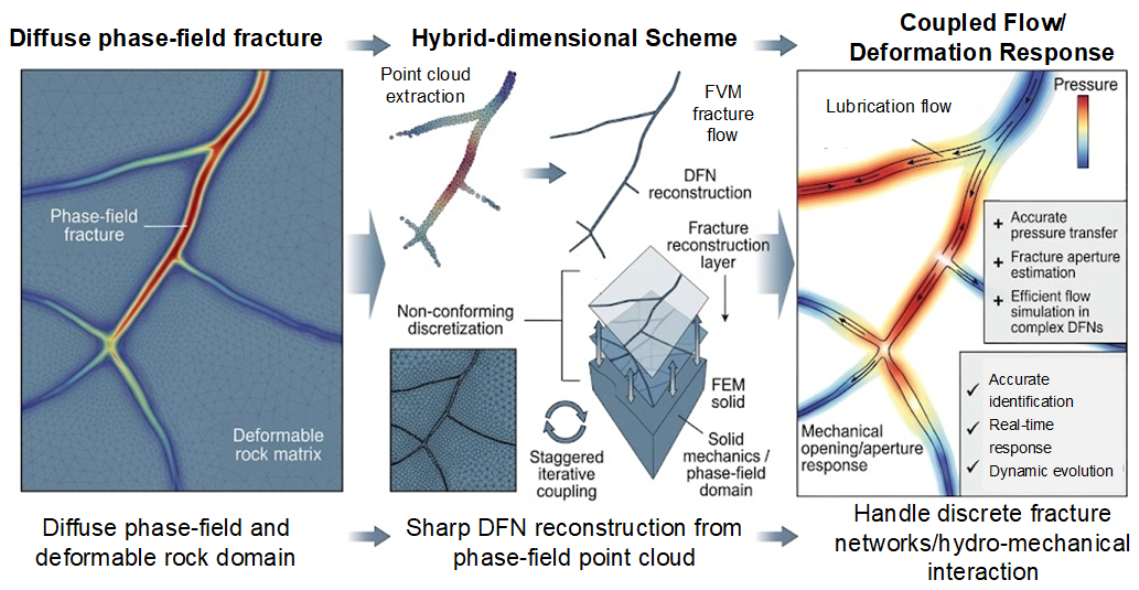
Fluid-driven fracture processes are central to the development of subsurface energy systems such as geothermal and hydrocarbon reservoirs. Although phase-field formulations have become a widely used tool for describing fracture initiation and growth, the diffuse representation of cracks makes it difficult to resolve flow behavior accurately inside discrete fracture networks (DFNs) and to represent hydro-mechanical coupling in a sharp-interface sense. This study develops a hybrid-dimensional iterative framework for lubrication-flow simulation in deformable fractured geomaterials. By leveraging phase-field point clouds together with non-conforming discretization schemes for both the solid matrix and fracture domains, the proposed framework enables the dynamic reconstruction of evolving fracture networks. The theoretical formulation and numerical implementation of the coupling strategy are presented in detail. Hydraulic benchmark examples verify the performance of the fluid flow solver under various physical conditions. The classical Sneddon problem and Khristianovic–Geertsma–de Klerk (KGD) model are employed to validate the solid deformation solver, confirming accurate predictions of crack opening displacement and mesh independence in fracture width calculation. Additional simulations with complex pre-existing fracture patterns further demonstrate the applicability of the framework to coupled hydro-mechanical analysis in fractured media.
Keywords: non-conforming discretization; lower-dimensional crack; hybrid-dimensional coupling strategy; fracture width estimation non-conforming discretization; lower-dimensional crack; hybrid-dimensional coupling strategy; fracture width estimation
Graphical Abstract