Influence of Cycloalkane Carboxylic Acid Ring Size on Tribological Properties of TiN Coatings Under Lubricated Conditions

Abstract
1. Introduction
2. Experimental Section
2.1. Materials
2.2. Characterization of TiN Coatings
2.3. Tribological Tests
3. Results and Discussion
3.1. Tribological Behavior and Morphological Characterization
3.2. Characterization of the Tribofilm
3.3. Lubrication Mechanism Analysis
4. Conclusions
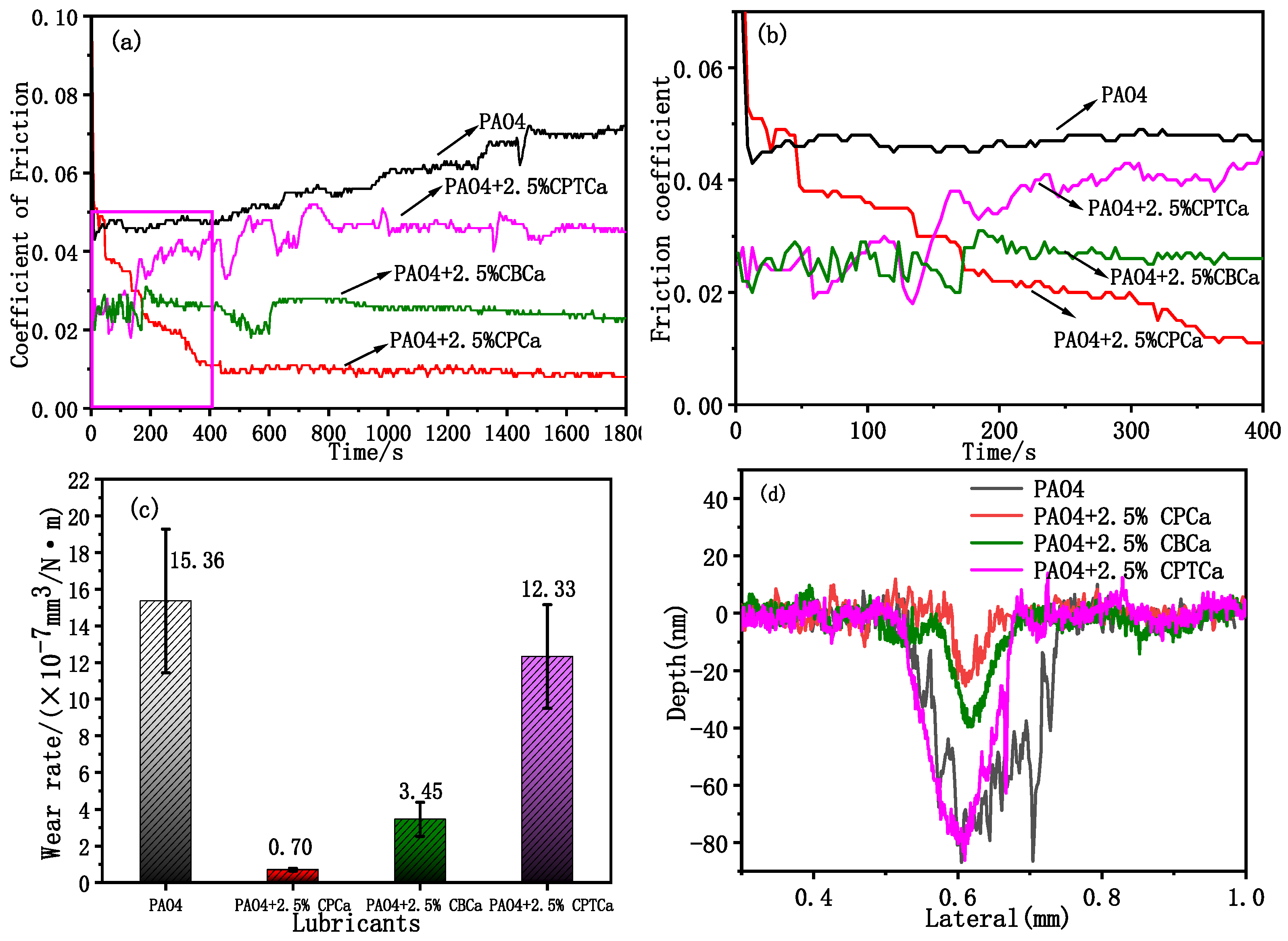
- CPCa demonstrated exceptional tribological performance, achieving an ultra-low coefficient of friction (0.008) and a specific wear rate of 7.0 × 10⁻⁸ mm3/N·m under a contact pressure of 0.9 GPa, outperforming its larger-ring analogs.
- Surface characterization (XPS, Raman and FTIR) confirmed that all additives participate in tribochemical reactions to form carbon-based tribofilm. The extent of graphitization and the resultant film quality are positively correlated with the tribological enhancement.
- A distinct structure–activity relationship was established: the anti-friction and anti-wear efficacy decreases with increasing carbon ring size (C3 > C4 > C5), directly linking molecular ring strain to tribochemical reactivity.
- The superior performance of CPCa is attributed to the high angular strain of its three-membered ring, which significantly lowers the mechanochemical activation barrier for stress-induced ring-opening and facilitates the formation of a highly graphitized, protective tribofilm under severe contact conditions.
Author Contributions
Funding
Data Availability Statement
Conflicts of Interest
References
- Holmberg, K.; Erdemir, A. Influence of tribology on global energy consumption, costs and emissions. Friction 2017, 5, 263–284. [Google Scholar] [CrossRef]
- Spikes, H. The history and mechanisms of ZDDP. Tribol. Lett. 2004, 17, 469–489. [Google Scholar] [CrossRef]
- Elmkhah, H.; Attarzadeh, F.; Fattah-Alhosseini, A.; Kim, K.H. Microstructural and electrochemical comparison between TiN coatings deposited through HIPIMS and DCMS techniques. J. Alloys Compd. 2018, 735, 422–429. [Google Scholar] [CrossRef]
- Xi, Y.; Bai, Y.; Gao, K.; Pang, X.; Yang, H.; Yan, L.; Volinsky, A.A. Residual stress and microstructure effects on mechanical, tribological and electrical properties of TiN coatings on 304 stainless steel. Ceram. Int. 2018, 44, 15851–15858. [Google Scholar] [CrossRef]
- Shukla, K.; Rane, R.; Alphonsa, J.; Maity, P.; Mukherjee, S. Structural, mechanical and corrosion resistance properties of Ti/TiN bilayers deposited by magnetron sputtering on AISI 316L. Surf. Coat. Technol. 2017, 324, 167–174. [Google Scholar] [CrossRef]
- Martin, J.M.; Ohmae, N. Nanolubricants; John Wiley & Sons: Chichester, UK, 2008; ISBN 978-0-470-06552-5. [Google Scholar]
- Luo, Y.; Ding, H.; Guo, J.; Liu, Q.; Wang, W. Coating life and failure mechanism of TiN coating under sliding wear condition with different normal loads. Tribology 2021, 42, 978–989. [Google Scholar] [CrossRef]
- Yan, Z.; Jiang, D.; Gao, X.; Hu, M.; Wang, D.; Fu, Y.; Sun, J.; Feng, D.; Weng, L. Friction and wear behavior of TiN films against ceramic and steel balls. Tribol. Int. 2018, 124, 61–69. [Google Scholar] [CrossRef]
- Fu, X.; Li, Y.; Su, H.; Cao, L.; Wan, Y.; Li, R. Tribological interactions between TiN PVD coating and MoDTC under boundary lubrication conditions. Vacuum 2022, 195, 110646. [Google Scholar] [CrossRef]
- Hou, J.; Tsukamoto, M.; Zhang, H.; Fukuzawa, K.; Itoh, S.; Azuma, N. Characterization of organic friction modifiers using lateral force microscopy and Eyring activation energy model. Tribol. Int. 2023, 178, 108052. [Google Scholar] [CrossRef]
- Cyriac, F.; Tee, X.Y.; Poornachary, S.K.; Chow, P.S. Influence of structural factors on the tribological performance of organic friction modifiers. Friction 2021, 9, 380–400. [Google Scholar] [CrossRef]
- Salinas Ruiz, V.R.; Kuwahara, T.; Galipaud, J.; Masenelli-Varlot, K.; Ben Hassine, M.; Héau, C.; Stoll, M.; Mayrhofer, L.; Moras, G.; Martin, J.M.; et al. Interplay of mechanics and chemistry governs wear of diamond-like carbon coatings interacting with ZDDP-additivated lubricants. Nat. Commun. 2021, 12, 4550. [Google Scholar] [CrossRef] [PubMed]
- Tamura, Y.; Zhao, H.; Wang, C.; Morina, A.; Neville, A. Interaction of DLC and B4C coatings with fully formulated oils in boundary lubrication conditions. Tribol. Int. 2016, 93, 666–680. [Google Scholar] [CrossRef]
- Chen, Y.; Renner, P.; Liang, H. A review of current understanding in tribochemical reactions involving lubricant additives. Friction 2023, 11, 489–512. [Google Scholar] [CrossRef]
- Yuan, Y.; Wang, C.; Lee, S.; Wilson, M.C.; Morina, A. Evaluation of nanoparticles for nanoscale film fabrication harnessing tribochemistry. Tribol. Int. 2025, 210, 110805. [Google Scholar] [CrossRef]
- Umer, J.; Morris, N.; Rahmani, R.; Balakrishnan, S.; Rahnejat, H. Nanoscale frictional characterisation of base and fully formulated lubricants based on activation energy components. Tribol. Int. 2020, 144, 106115. [Google Scholar] [CrossRef]
- Naeini, V.F.; Björling, M.; Larsson, J.A.; Larsson, R. Tribochemistry of glycerol-water mixtures confined between ferrous substrates: An atomic-scale concept by reactive molecular dynamics simulation. Tribol. Int. 2025, 202, 110322. [Google Scholar] [CrossRef]
- Mohammadtabar, K.; Eder, S.J.; Dörr, N.; Martini, A. Shear-driven reactions of organosulfur compounds on ferrous surfaces: A molecular dynamics study. Tribol. Int. 2022, 176, 107922. [Google Scholar] [CrossRef]
- Zhang, J.; Spikes, H. On the mechanism of ZDDP antiwear film formation. Tribol. Lett. 2016, 63, 24. [Google Scholar] [CrossRef]
- Dorgham, A.; Parsaeian, P.; Azam, A.; Wang, C.; Morina, A.; Neville, A. Single-asperity study of the reaction kinetics of P-based triboreactive films. Tribol. Int. 2019, 133, 288–296. [Google Scholar] [CrossRef]
- Yu, H.; Chen, H.; Zheng, Z.; Qiao, D.; Feng, D.; Gong, Z.; Dong, G. Effect of functional groups on tribological properties of lubricants and mechanism investigation. Friction 2023, 11, 911–926. [Google Scholar] [CrossRef]
- Han, Z.; Pan, L.; Xue, K.; Xu, J.; Liu, Q.; Xu, Y.; Shen, Z.; Zhang, X.; Zou, J.-J. Relationship between molecular structure and dehydrogenation performance of cycloalkanes. Fuel 2024, 355, 129471. [Google Scholar] [CrossRef]
- Svatunek, D.; Murnauer, A.; Tan, Z.; Houk, K.N.; Lang, K. How cycloalkane fusion enhances the cycloaddition reactivity of dibenzocyclooctynes. Chem. Sci. 2024, 15, 2229–2235. [Google Scholar] [CrossRef] [PubMed]
- Ma, Q.; Khan, A.M.; Wang, Q.J. Dependence of tribological performance and tribopolymerization on the surface binding strength of selected cycloalkane-carboxylic acid additives. Tribol. Lett. 2020, 68, 86. [Google Scholar] [CrossRef]
- Fu, X.; Cao, L.; Qi, C.; Wan, Y.; Xu, C. Ultralow friction of PVD TiN coating in the presence of glycerol as a green lubricant. Ceram. Int. 2020, 46, 24302–24311. [Google Scholar] [CrossRef]
- ASTM G99; Standard Test Method for Wear and Friction Testing with a Pin-on-Disk or Ball-on-Disk Apparatus. ASTM: West Conshohocken, PA, USA, 2023.
- ASTM G133; Standard Test Method for Linearly Reciprocating Ball-on-Flat Sliding Wear. ASTM: West Conshohocken, PA, USA, 2022.
- Li, J.; Zhang, C.; Deng, M.; Luo, J. Investigation of the difference in liquid superlubricity between water-and oil-based lubricants. RSC Adv. 2015, 5, 63827–63833. [Google Scholar] [CrossRef]
- Dowson, D.; Jin, Z.M. Metal-on-metal hip joint tribology. Proc. Inst. Mech. Eng. Part H J. Eng. Med. 2006, 220, 107–118. [Google Scholar] [CrossRef]
- Ferrari, A.C.; Robertson, J. Resonant Raman spectroscopy of disordered, amorphous, and diamondlike carbon. Phys. Rev. B 2001, 64, 075414. [Google Scholar] [CrossRef]
- Hamrock, B.J.; Dowson, D. Isothermal elastohydrodynamic lubrication of point contacts: Part III—Fully flooded results. J. Lubr. Technol. 1977, 99, 264–275. [Google Scholar] [CrossRef]
- Spikes, H.; Tysoe, W. On the commonality between theoretical models for fluid and solid friction, wear and tribochemistry. Tribol. Lett. 2015, 59, 21. [Google Scholar] [CrossRef]
- Johnson, K.L. Contact Mechanics; Cambridge University Press: Cambridge, UK, 1985. [Google Scholar]
- Erdemir, A. The Role of Hydrogen in Tribological Properties of Diamond-Like Carbon Films. Surf. Coat. Technol. 2001, 146, 292–297. [Google Scholar] [CrossRef]
- Ferrari, A.C.; Robertson, J. Interpretation of Raman spectra of disordered and amorphous carbon. Phys. Rev. B 2000, 61, 14095. [Google Scholar] [CrossRef]
- Ferrari, A.C. Raman spectroscopy of graphene and graphite: Disorder, electron–phonon coupling, doping and nonadiabatic effects. Solid State Commun. 2007, 143, 47–57. [Google Scholar] [CrossRef]
- Wu, H.; Khan, A.M.; Johnson, B.; Sasikumar, K.; Chung, Y.-W.; Wang, Q.J. Formation and nature of carbon-containing tribofilms. ACS Appl. Mater. Interfaces 2019, 11, 16139–16146. [Google Scholar] [CrossRef]
- Zhang, R.; Chen, Q.; He, Z.; Xiong, L. In situ friction-induced amorphous carbon or graphene at sliding interfaces: Effect of loads. Appl. Surf. Sci. 2020, 534, 146990. [Google Scholar] [CrossRef]
- Okpalugo, T.I.T.; Papakonstantinou, P.; Murphy, H.; Mclaughlin, J.; Brown, N. Oxidative functionalization of carbon nanotubes in atmospheric pressure filamentary dielectric barrier discharge (APDBD). Carbon 2005, 43, 2951–2959. [Google Scholar] [CrossRef]
- Diebold, U. The surface science of titanium dioxide. Surf. Sci. Rep. 2003, 48, 53–229. [Google Scholar] [CrossRef]
- Gosvami, N.N.; Bares, J.A.; Mangolini, F.; Konicek, A.R.; Yablon, D.G.; Carpick, R.W. Mechanisms of antiwear tribofilm growth revealed in situ by single-asperity sliding contacts. Science 2015, 348, 102–106. [Google Scholar] [CrossRef] [PubMed]
- Bain, C.D.; Whitesides, G.M. Formation of monolayers by the coadsorption of thiols on gold: Variation in the length of the alkyl chain. J. Am. Chem. Soc. 1989, 111, 7155–7164. [Google Scholar] [CrossRef]
- De Meijere, A. Bonding properties of cyclopropane and their chemical consequences. Angew. Chem. Int. Ed. Engl. 1979, 18, 809–826. [Google Scholar] [CrossRef]
- Goudreau, S.R.; Charette, A.B. Defying ring strain: New approaches to cyclopropanes. Angew. Chem. Int. Ed. 2010, 49, 486–488. [Google Scholar] [CrossRef]
- Confer, M.P.; Qu, T.; Rupar, P.A.; Dixon, D.A. Composite Correlated Molecular Orbital Theory Calculations of Ring Strain for Use in Predicting Polymerization Reactions. ChemPhysChem 2022, 23, e202200133. [Google Scholar] [CrossRef]
- Gordon, M.S. Ring strain in cyclopropane, cyclopropene, silacyclopropane, and silacyclopropene. J. Am. Chem. Soc. 1980, 102, 7419–7422. [Google Scholar] [CrossRef]
- Enyoh, C.E.; Maduka, T.O.; Suzuki, M.; Lu, S.; Wang, Q. Thermoanalytical and Kinetic Studies for the Thermal Stability of Emerging Pharmaceutical Pollutants Under Different Heating Rates. J. Xenobiotics 2024, 14, 1784–1806. [Google Scholar] [CrossRef] [PubMed]
- Dong, B.; Wei, M.; Li, Y.; Yang, Y.; Ma, W.; Zhang, Y.; Ran, Y.; Cui, M.; Su, Z.; Fan, Q.; et al. Self-assembled bilayer for perovskite solar cells with improved tolerance against thermal stresses. Nat. Energy 2025, 10, 342–353. [Google Scholar] [CrossRef]
- Erdemir, A.; Ramirez, G.; Eryilmaz, O.L.; Narayanan, B.; Liao, Y.; Kamath, G.; Sankaranarayanan, S.K. Carbon-based tribofilms from lubricating oils. Nature 2016, 536, 67–71. [Google Scholar] [CrossRef]
- Willcott, R.M.; Cargill, R.L.; Sears, B. Thermal unimolecular reactions. Prog. Phys. Org. Chem. 1972, 9, 25–98. [Google Scholar] [CrossRef]


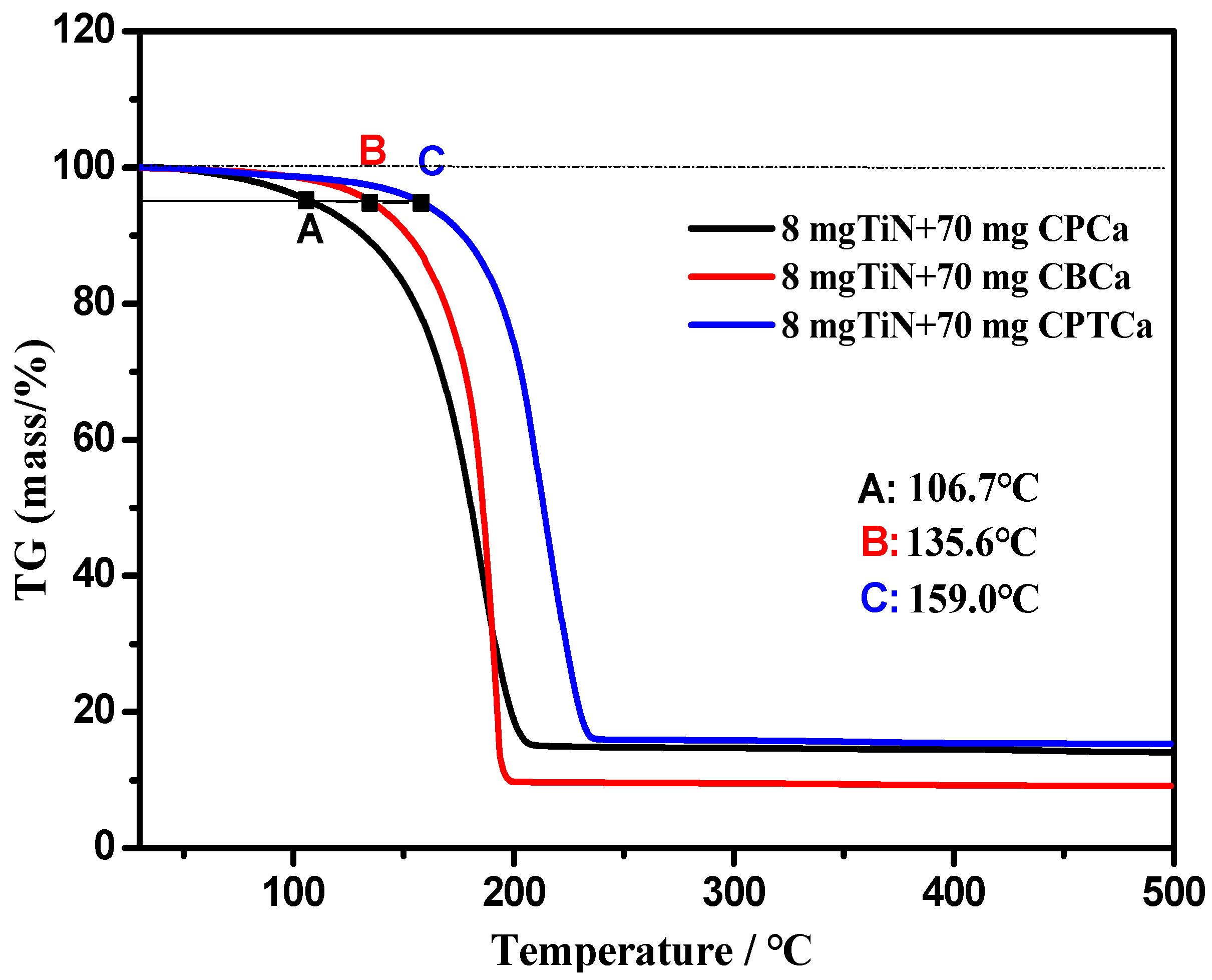

| Additives | Chemical Formula | Purity (%) | Flash Temperature (°C) | Melting Point (°C) |
|---|---|---|---|---|
| CPCa |  | 98 | 71 | 14~17 |
| CBCa |  | 98 | 83 | −7.5 |
| CPTCa |  | 98 | 93 | 4 |
| Nano-Hardness (GPa) | Elastic Modulus (GPa) | Roughness (nm) | |
|---|---|---|---|
| AISI304 stainless steel | 6 | 193 | 20.0 |
| TiN coating | 26 | 329 | 1.5 |
| Steel ball | 9 | 210 | 28.5 |
| Parameters | Symbol (Unit) | Value |
|---|---|---|
| Viscosity–pressure coefficient | α (GPa−1) | 18.0 |
| Viscosity (at 20 °C) | η (mPa·s) | 31.7 |
| Sliding speed | u (m/s) | 0.12 |
| Normal load | F (N) | 2.0 |
| Effective elastic modulus | (GPa) | 234.8 |
| Calculated center film thickness | hc (nm) | 10.98 |
| Composite surface roughness | σ (nm) | ~32.4 |
| Film thickness ratio | λ | 0.34 |
Disclaimer/Publisher’s Note: The statements, opinions and data contained in all publications are solely those of the individual author(s) and contributor(s) and not of MDPI and/or the editor(s). MDPI and/or the editor(s) disclaim responsibility for any injury to people or property resulting from any ideas, methods, instructions or products referred to in the content. |
© 2026 by the authors. Licensee MDPI, Basel, Switzerland. This article is an open access article distributed under the terms and conditions of the Creative Commons Attribution (CC BY) license.
Share and Cite
Fu, X.; Fan, Y.; Jiang, G.; Zheng, C.; Wan, Y. Influence of Cycloalkane Carboxylic Acid Ring Size on Tribological Properties of TiN Coatings Under Lubricated Conditions. Materials 2026, 19, 1394. https://doi.org/10.3390/ma19071394
Fu X, Fan Y, Jiang G, Zheng C, Wan Y. Influence of Cycloalkane Carboxylic Acid Ring Size on Tribological Properties of TiN Coatings Under Lubricated Conditions. Materials. 2026; 19(7):1394. https://doi.org/10.3390/ma19071394
Chicago/Turabian StyleFu, Xiaojing, Yaping Fan, Guoxian Jiang, Changsheng Zheng, and Yong Wan. 2026. "Influence of Cycloalkane Carboxylic Acid Ring Size on Tribological Properties of TiN Coatings Under Lubricated Conditions" Materials 19, no. 7: 1394. https://doi.org/10.3390/ma19071394
APA StyleFu, X., Fan, Y., Jiang, G., Zheng, C., & Wan, Y. (2026). Influence of Cycloalkane Carboxylic Acid Ring Size on Tribological Properties of TiN Coatings Under Lubricated Conditions. Materials, 19(7), 1394. https://doi.org/10.3390/ma19071394