1. Introduction
Soon after the discovery of iron-based superconductors (IBSs) [
1], the 122 family based on
AEFe
2As
2 (
AE being alkali-earth metal Ca, Sr, Ba) parent compound became the most popular material for both physical explorations and applications because of its critical temperature
Tc as high as 38 K [
2], very high upper critical fields µ
0Hc2 (>70 T) [
3,
4] and low anisotropies (γ < 2) [
4]. Superconductivity in
AEFe
2As
2 is primarily induced by alkali metal (
A = Na, K, Rb, Cs) substitution at
AE sites with a concomitant suppression or elimination of the structural and magnetic ordering transition. The structure’s crystallographic space group (
I4/mmm) is not changed by this
A substitution because
AE and
A randomly occupy crystallographically equivalent sites. Thus, (
AE1−xAx)Fe
2As
2 (also noted as (
AE,
A)Fe
2As
2) are solid solutions between
AEFe
2As
2 and
AFe
2As
2 compounds with the same structural type. Later it was found that, if there is a large difference in the ionic radii Δ
r of
AE and
A, such solid solutions are not possible and a new type of IBSs has been reported [
5], having a new structure, abbreviated as
AEA1144, namely Ca
AFe
4As
4 (
A = K, Rb, Cs) and Sr
AFe
4As
4 (
A = Rb, Cs). In these cases, because
A does not mix with
AE due to the large Δ
r,
AEA1144 crystallizes through alternate stacking of the
AE and
A layers across the Fe
2As
2 layers, changing the space group from
I4/mmm to
P/4 mmm, the compounds being superconductors with
Tc values between 31 and 36 K. One of the most studied superconductors (SCs) in this new family is CaKFe
4As
4 (CaK1144) due to its excellent superconducting properties including very high critical current density and very high pinning potential [
6]. Following the discovery of the 1144-type IBS, in 2016 two Eu-containing materials in the family,
AEuFe
4As
4 (
A = Rb, Cs), were subsequently synthesized and characterized [
7,
8]. The two sibling compounds exhibit SC at
Tc = 36.5 K (
A = Rb) and 35 K (
A = Cs), respectively, without extrinsic doping. The Eu
2+ spins order at
Tm = 15 K (
A = Rb) or 15.5 K (
A = Cs) [
8]. The Mössbauer studies [
9] indicate that the Eu
2+ spins in
AEuFe
4As
4 are ferromagnetically (FM) coupled and lie flat in the
ab plane. Intuitively, the removal of every alternating magnetic Eu layer in EuFe
2As
2 would give rise to Eu-spin FM. Nevertheless, recent neutron diffraction study [
10] revealed a helical modulation with the magnetic propagation vector of
k = (0, 0, 1/4) for the Eu-spin ordering. If a small magnetic field (∼0.2 T and ∼0.4 T, respectively, for
H // ab and
H // c) is applied [
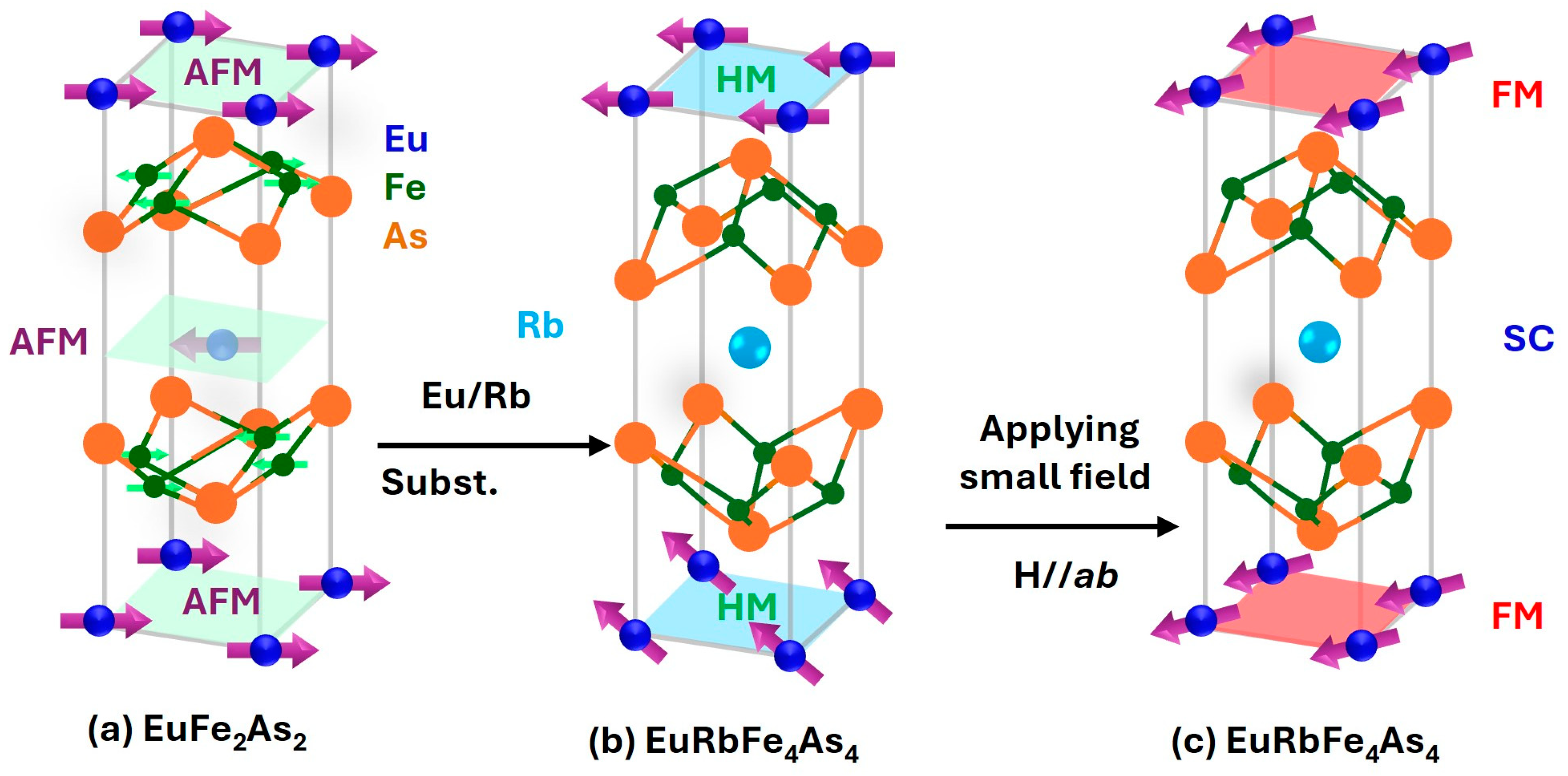
11], this helically modulated magnetic structure easily changes into a genuine FM, the latter of which fully coexists with SC. Therefore, the new materials can be viewed as a natural atomic-thick superconductor–ferromagnet superlattice, as sketched in
Figure 1. The parent compound EuFe
2As
2 is an antiferromagnet (
Figure 1a). Due to the large difference in atomic radii, a 50% substitution of Eu with Rb results not in (Eu
0.5Rb
0.5)Fe
2As
2 solid solution, but in the new, layered 1144 structure, EuRbFe
4As
4, in which the Eu layers having helical magnetism sandwiches a thick superconducting layer composed of two Fe
2As
2 planes with an Rb plane between them (
Figure 1b). By applying a small magnetic field, helical magnetism in the Eu planes is driven into a ferromagnetic state (
Figure 1c).
The new magnetic superconductor was characterized by many techniques to elucidate various aspects of superconductivity. After their discovery by Kawashima et al. [
7], the crystal structure was investigated by XRD and determined to be tetragonal with symmetry group P4/
mmm and by resistivity and DC magnetization that showed a critical temperature of about 36 K, an upper critical field (extrapolated at 0 K) of about 92 T and a coherence length of 1.8 nm [
7]. More importantly, they discovered an anomaly in the magnetic response at 15 K which was correctly interpreted as coexistence of superconductivity and a magnetic ordered state created by Eu
2+ ions. A few months later, Liu et al. [
8] managed to replicate the material, and, in addition to resistivity and magnetization measurements that confirmed previous results, they also performed magnetization hysteresis measurements and specific heat measurements that revealed a very rare third-order type magnetic transition. In a seminal paper, Ishida et al. [
12], by combining neutron diffraction and magnetization measurements, revealed that ferromagnetic alignment of Eu
2+ moments is induced by superconducting vortices. They showed that the direction of the Eu
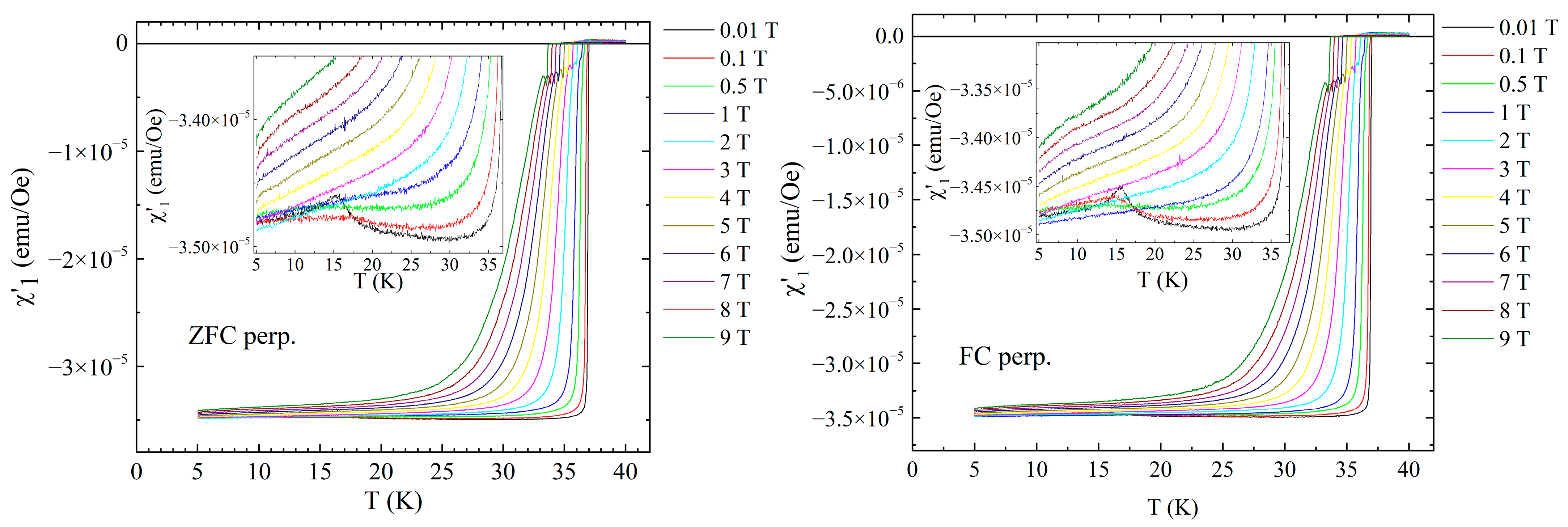
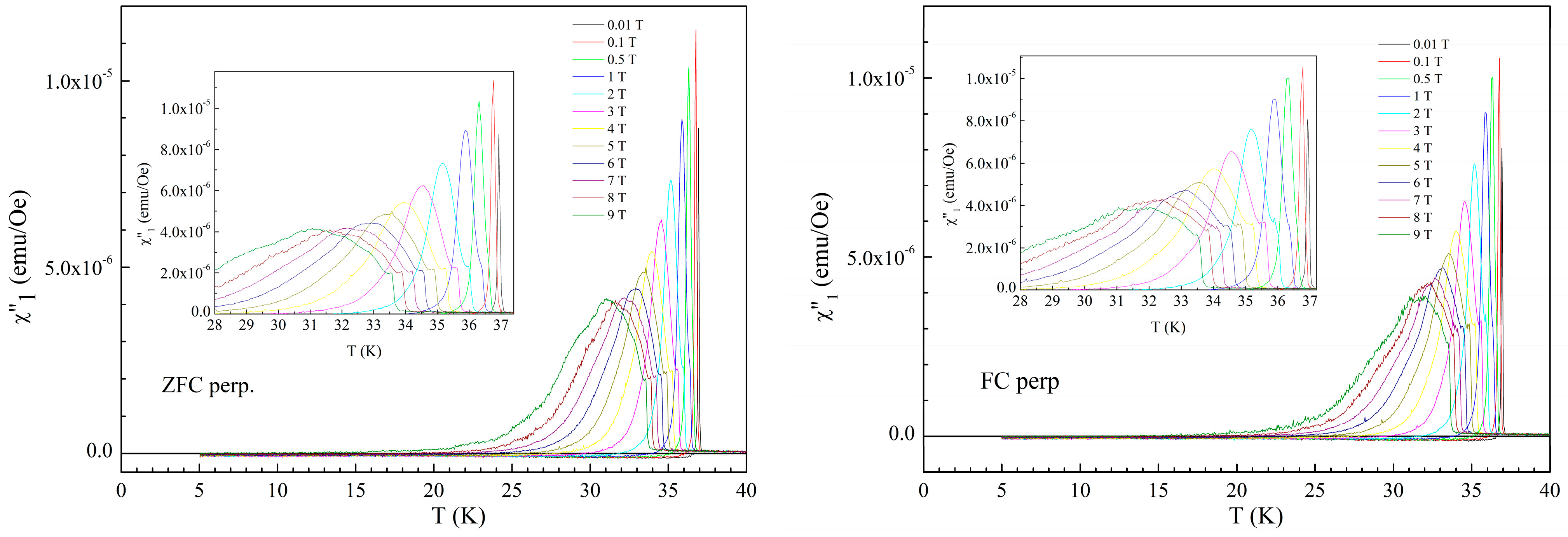
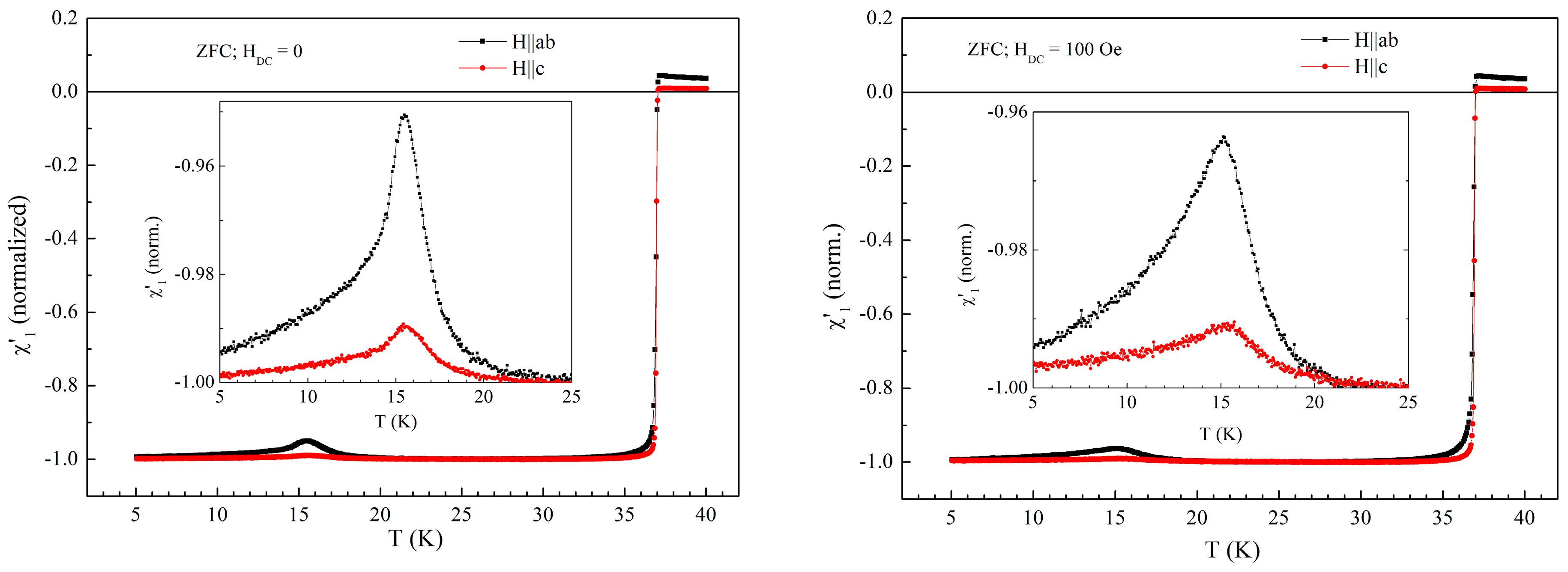
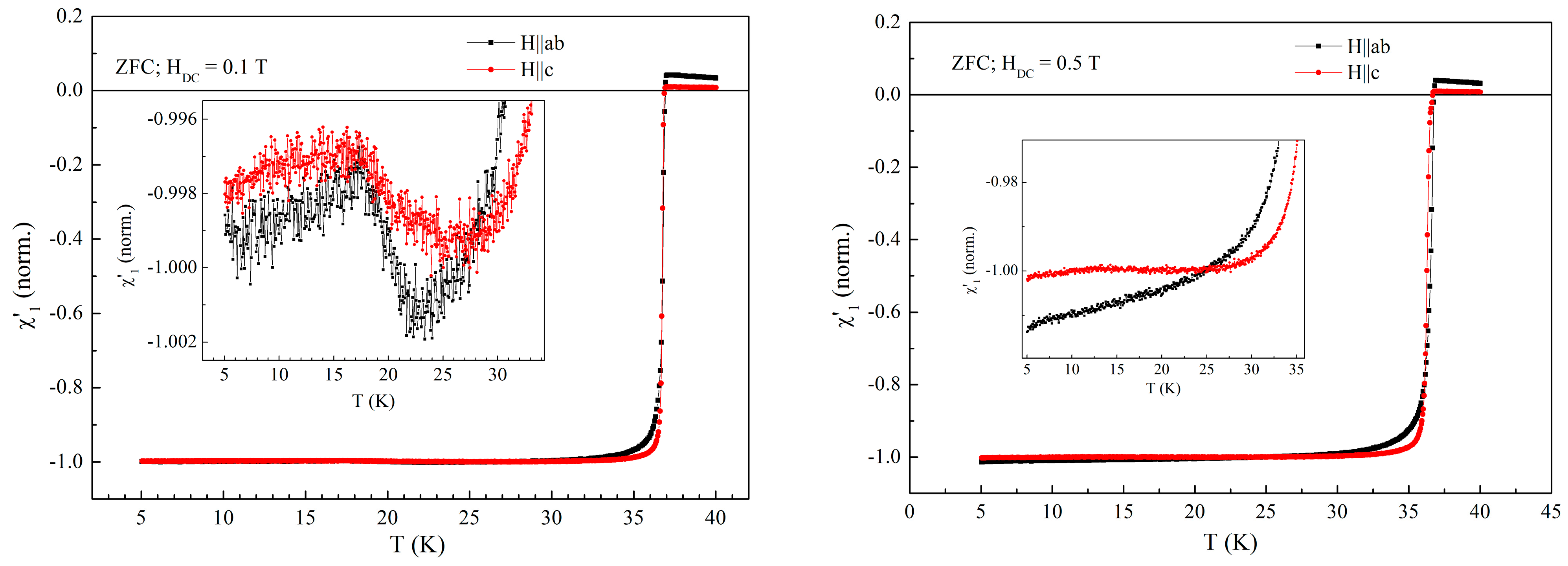
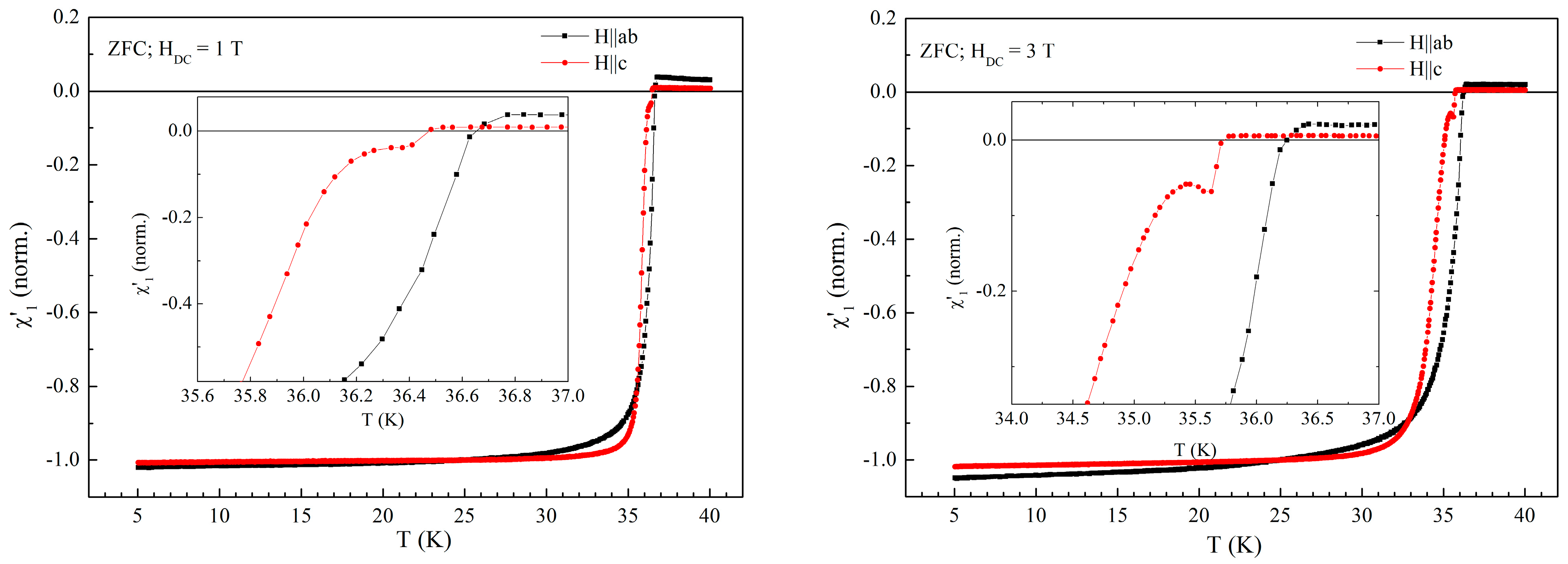
2+ spins is dominated by the distribution of pinned vortices based on the critical state model, highlighting a unique interplay between magnetism and superconductivity. Vortex matter, dynamics and pinning are reflected differently in the case of AC susceptibility as compared to DC studies. For this reason, in this work we investigated the interplay between magnetic moments and vortex matter and dynamics in the case of AC fields superimposed on DC fields up to 9 T, for fields orientations perpendicular and, respectively, parallel to the superconducting planes, in both zero-field cooling (ZFC) and field cooling (FC) procedures. The results showed the expected ferromagnetic signal at around 15 K superimposed on the diamagnetic screening at low DC fields (similar to DC susceptibility measurements), as well as a clear anomaly in the diamagnetic screening due to ferromagnetic ordering of the spins immediately after
Tc at higher fields. The anomaly in the in-phase susceptibility is accompanied by a shoulder in the out-of-phase susceptibility (dissipation peak), in both ZFC and FC regimes, for perpendicular orientation. In the case of measurements with the thin sample parallel to the fields, such anomalies were not detected.
2. Materials and Methods
The EuRbFe
4As
4 single crystals were grown in AIST Tsukuba, Japan, by the RbAs-flux method [
13], in which EuAs, Fe
2As and RbAs precursors were prepared from Eu and As, Fe and As, and Rb and As, respectively, which were thoroughly mixed at appropriate molar ratios. EuAs and Fe
2As mixtures were sealed in evacuated quartz tubes, while RbAs was sealed in a stainless-steel tube within an alumina crucible, followed by sintering processes (750 °C for EuAs, 900 °C for Fe
2As and 600 °C for RbAs). The sintered powders were weighted in the ratio 1:1:15 to a total amount of 9g and placed in an alumina crucible, sealed in a stainless-steel container. The thermodynamical process of crystal growth consisted in heating the sample to 700 °C in 5 h and maintaining this temperature for 5 h; then, it was heated to 970 °C in 5 h and this temperature was maintained for 10 h, with a final step being very slow cooling for 350 h (1 °C/h) to 620 °C. After cleaving the surfaces of the single crystals, XRD patterns showed only the (00
l) peaks from EuRbFe
4As
4 [
12]. The sample investigated in this work is a thin square with length
l = 0.9 ± 0.1 mm and thickness
t ≈ 0.06 ± 0.02 mm.
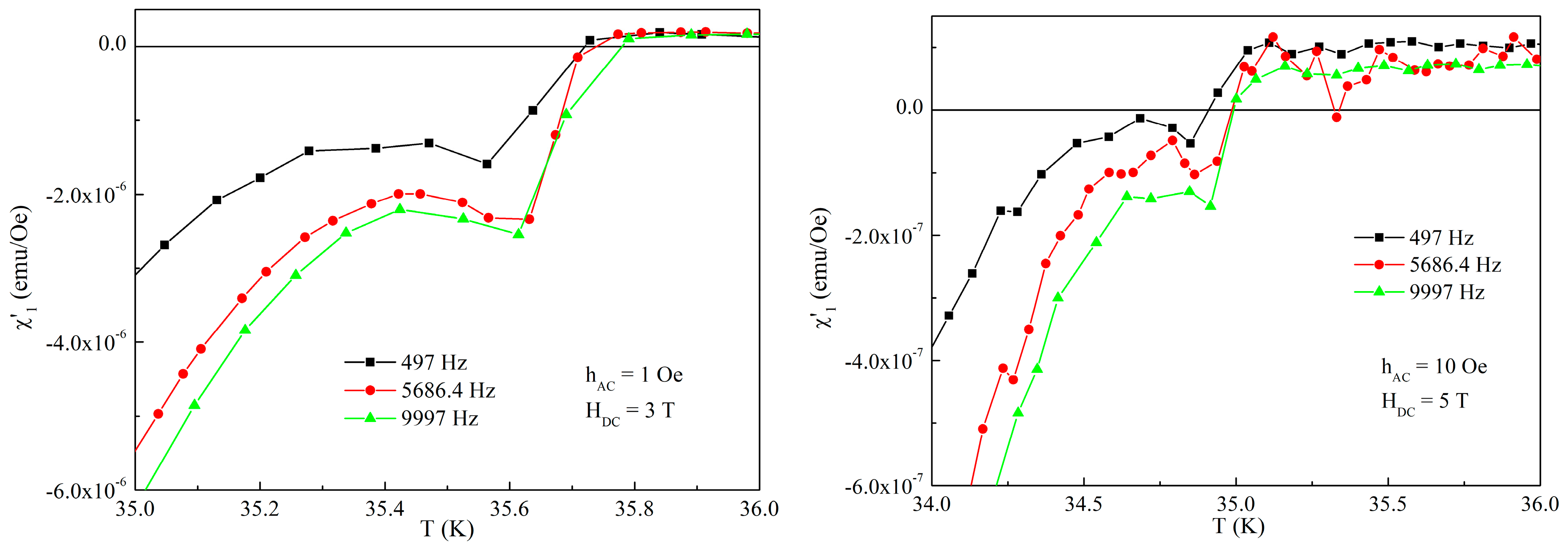
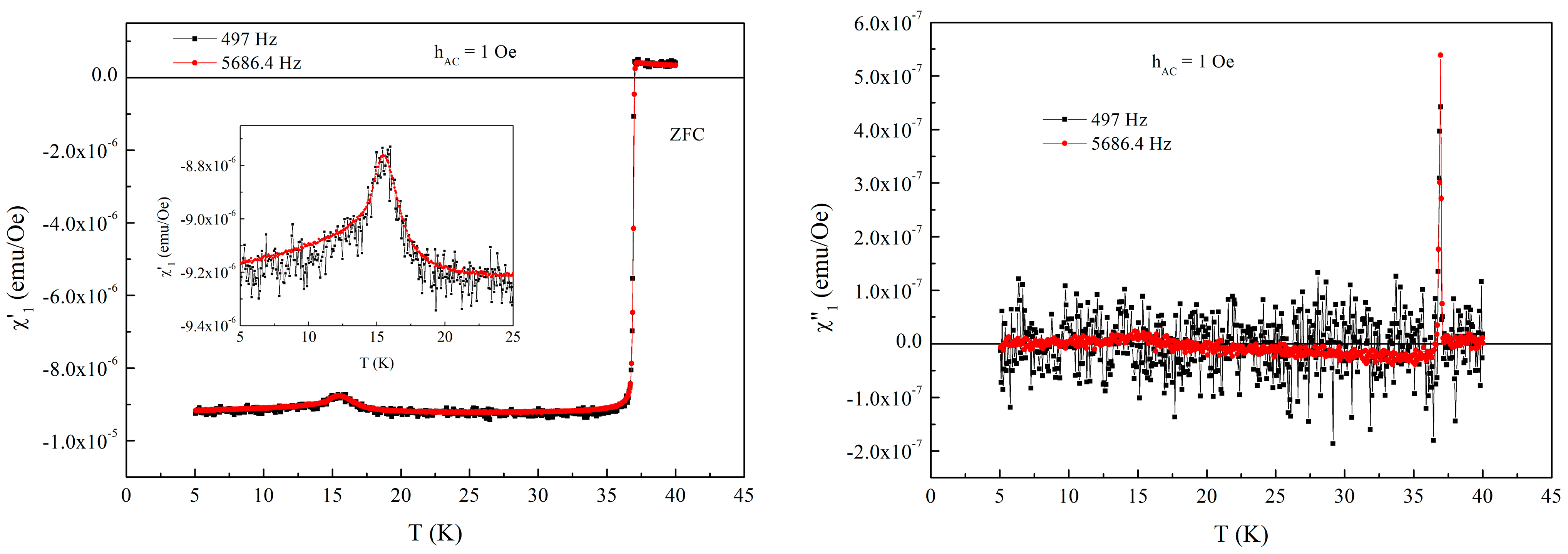
AC magnetic susceptibility was measured using a Quantum Design PPMS-9 T (Quantum Design Inc., San Diego, CA, USA) with an ACMS option and the PPMS MultiVuTM 1.5 software (Quantum Design), which allows to pre-program the type of measurements, the temperature (fixed or variable, between 1.9 and 350 K), the field (fixed or variable, up to 9 T), the frequency of the AC field excitation (up to 10 kHz), and the amplitude of the AC field excitation (up to 16 Oe). For this work, AC susceptibility measurements were conducted as a function of temperature by applying an AC magnetic field perpendicular or parallel to the superconducting layers (a–b planes), with or without a superimposed DC magnetic field up to 9 T, in the zero-field cooling (ZFC) conditions or field cooling (FC) conditions. Most of the measurements were taken at a fixed AC field amplitude hAC = 1 Oe and at the AC field frequency ν = 5686.4 Hz. For a qualitative estimation of the influence of the AC frequency on the observed anomaly, we have repeated the measurements for two more frequencies, 497 and 9997 Hz, and with a larger AC field amplitude of 10 Oe. To prevent any potential effects of residual field trapped within the DC magnet on the sample response, before each measurement we warmed the magnet close to room temperature, applied 2 T and reduced the field to zero in the oscillation mode. This demagnetizing process was proven to reduce the trapped DC field below 1 Oe. After demagnetizing procedure, the sample was cooled to 5 K in ZFC or FC conditions. Susceptibility as function of temperature data were measured between 5 and 40 K with a sweep rate of 0.1 K/min, such small sweeping rate ensuring a large number of measured points for each curve.
4. Discussion
We will start our discussion with a comparison between the EuRb1144 magnetic superconductor and its more studied “relative” non-magnetic CaK1144. Quite unexpectedly, EuRb1144 showed a higher
Tc of 37 K as compared to 35.8 K in CaK1144 [
6,
15] despite the presence of magnetism which usually suppresses critical temperature. However, the interaction between Eu
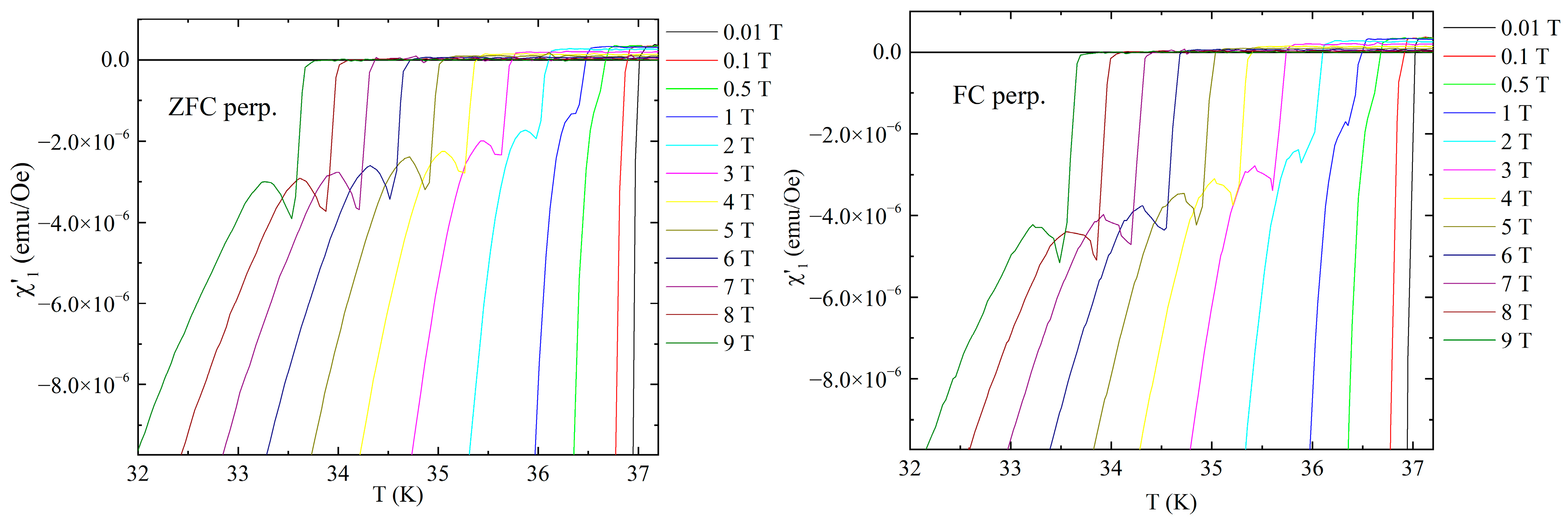
2+ spins and the vortex system leads to a much broader superconducting transition in high magnetic fields and a more pronounced reduction in
Tc with increasing DC field. For example, in a DC field of 9 T,
Tc decreases with 10% in EuRb1144 (see
Figure 3) while in CaK1144
Tc decreases with only 8% (see
Supplementary Material Figure S2). Another important aspect is the comparison between ZFC and FC conditions. Similar to CaK1144, there is no significant difference between ZFC and FC AC susceptibility in EuRb1144, unlike the case of isovalently substituted BaFe
2(As
1−xP
x)
2 122 compound which showed a very pronounced magnetic memory effect [
16,
17]. Of course, the main difference between the two 1144 materials is the signal around 15 K due to the magnetic transition, which was first detected through DC magnetization measurements and reported in the same papers that announced the new material [
7,
8]. Also, the existence of a clear
positive AC susceptibility in the normal state, which is DC field-dependent, due to the interaction between the Eu
2+ spins and the superimposed DC and AC fields, is quite remarkable. For comparison, the AC susceptibility in the CaK1144 system is zero (within the noise level, ±10
−8 emu/Oe). Another feature that was not observed previously in any studies is the
anomaly in the susceptibility response to the AC field perturbation just below Tc in fields larger than approximately 0.5 T,
only with the fields perpendicular to the ab planes. We propose that the explanation of this anomaly is due to the interplay between the temperature dependence of the London penetration depth, λ
ab, near
Tc, and the dimensions of the sample, in the context of the very peculiar interaction between the vortex system and the subsystem of Eu
2+ spins [
18,
19]. Vlasko-Vlasov et al. [
18] performed a study of the magnetic-flux evolution in EuRb1144 using magneto-optical imaging and DC magnetization measurements. They showed that the interplay of magnetic susceptibility amplifying magnetic induction and vortex pinning attenuating the magnetic flux entry results in a field- and temperature-dependent critical state that emulates a paramagnetic Meissner effect. They further concluded that the observed vortex dynamics corresponds to a nontrivial spatial current distribution and yields a self-consistent inhomogeneous enhancement of the sample magnetization. Suppression of superconductivity by correlated magnetic fluctuations was also detected by high-resolution scanning Hall probe microscopy [
19]. Our results are different from the Wohlleben effect (paramagnetic Meissner effect), in which, for certain high-
Tc superconductors (e.g., Bi2212 and Bi2223), they exhibit a paramagnetic response when cooled in a low magnetic field. This effect has been attributed to trapped magnetic flux or π-junctions in granular superconductors that can create spontaneous, persistent currents, at very low constant magnetic fields < 1 Oe. A comprehensive review of Wohlleben paramagnetic Meissner effect can be seen in [
20]. In our case we are dealing with single crystals (not granular superconductors), high magnetic fields, AC susceptibility response in both ZFC and FC conditions. To explain the origin of the anomalous susceptibility response in perpendicular configuration we are extending the concept of paramagnetic Meissner effect (
not Meissner phase as thermodynamic concept) described in [
18] to the case of penetration of AC perturbation of the mixed state stabilized by a large DC field. In this context, just below
Tc the superimposed AC magnetic field disturbs the critical state inside the sample on a scale of London penetration depth, λ
ab, resulting in the AC susceptibility response of the sample. We would describe the region of the sample not perturbed by the AC excitation (in the center of the sample) as paramagnetic Meissner-like state following [
18], although it contains Abrikosov vortices (not perturbed by AC magnetic field excitation) as well as oriented Eu
2+ spins.
For a clearer
qualitative explanation of the anomaly just below
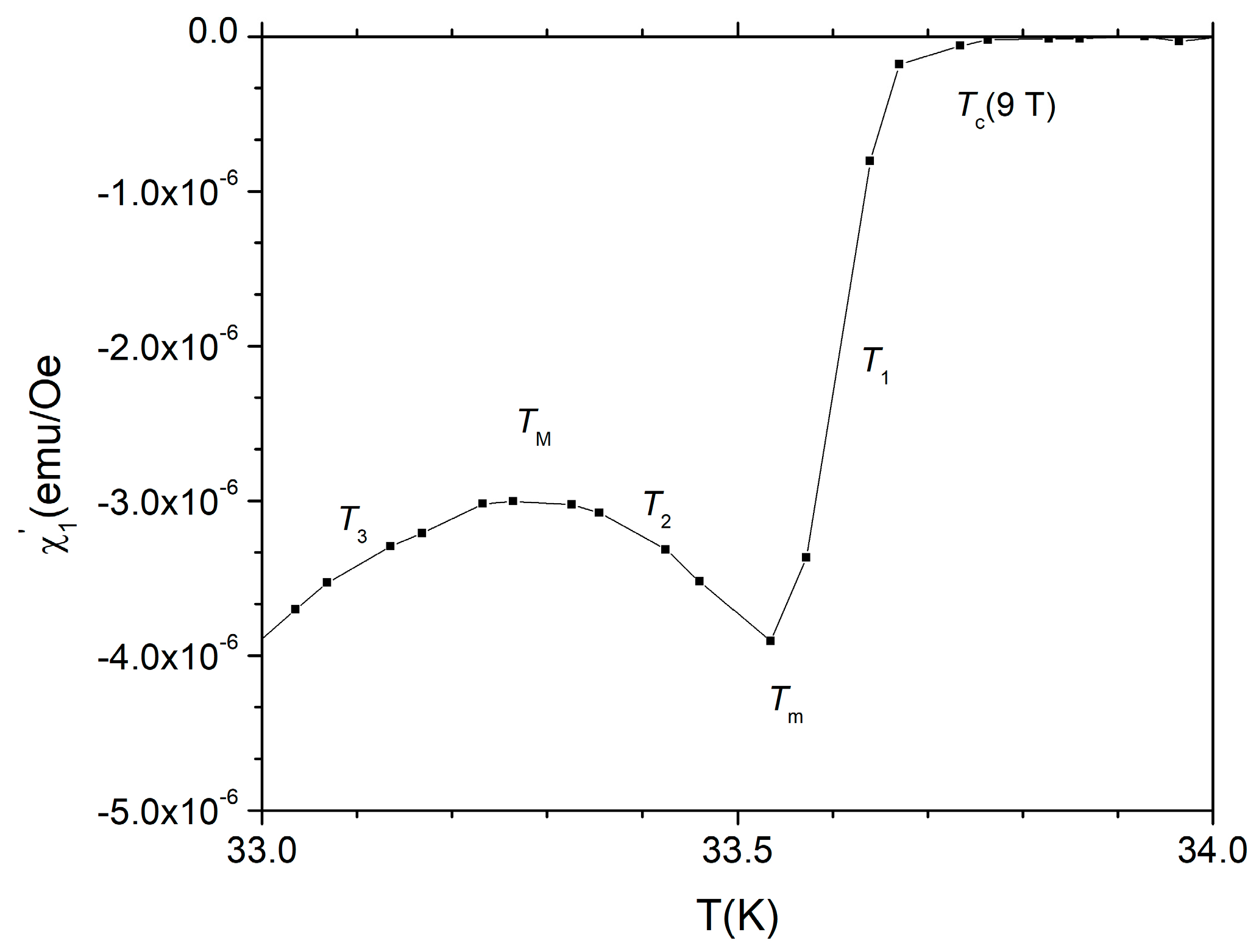
Tc we are using the experimental data (detail near the superconducting transition) of the temperature dependence of the in-phase susceptibility χ’ in a DC field of 9 T, showed in
Figure 10. The temperatures indicated in the figure are
Tc (9 T) = 35.8 K;
T1 is a temperature in the first part of increasing diamagnetic signal,
Tm is the temperature of the starting of anomalous susceptibility response,
T2 is a temperature where the diamagnetic response decrease with decreasing temperature due to Eu
2+ spins,
TM is the temperature where the derivative
dχ’/
dT changes sign again and
T3 a temperature at which the circulating AC currents results in diamagnetic AC shielding overcoming the paramagnetic Eu
2+ spins paramagnetic response due to much higher critical current density at this lower temperature, with the trend continuing towards lower temperature in the expected way.
As previously mentioned we suggest that the anomalous Meissner-like AC susceptibility very near
Tc(
HDC) is determined by the interplay of sample dimensions, the interactions between Eu
2+ spins and magnetic fields, and the temperature dependence of the penetration depth. In a previous work, we have investigated the vortex melting lines (which, for superconductors with small anisotropy, is near the
Hc2 (
T) line) in superconducting single crystals of 1144 and 122 iron-based superconductors [
21]. The experimental data were very well described by a λ
ab(
T) given by the 3D
X-Y critical fluctuations model, λ
ab(
T) = λ
ab(0)(1 −
T/Tc)
−1/3. However, in the case of the anomalous Meissner-like response, we are on the other side of the phase diagram, namely close to
Hc1 (
T). In addition, the temperature dependences of London penetration depth in various models discussed in [
21], i.e., 3D
X-Y critical fluctuations, bi-fluid model, and mean-field model, were originated from well-known, classical adiabatic phonon-mediated superconductivity.
In our case, these materials may be described within atypical non-adiabatic phonon-mediated framework [
22,
23], which seems also to be the case for some bismuthates [
24]. Being discovered much earlier than EuRb1144, the first member of the 1144 family that was thoroughly investigated is CaK1144, using muon spin relaxation (µSR) [
25], inelastic neutron scattering [
26], µSR and angle-resolved photoemission spectroscopy (ARPES) [
27], London penetration depth and tunneling conductance [
28],
75As nuclear magnetic resonance (NMR) [
29], all the experimental results being consistent with a two-gap
s+ s- wave model. It was also shown that the
Hc2 (
T) dependence can be described by a two-band model in the clean limit with band-coupling parameters favoring intraband over interband interactions [
30]. However, it seems that the band structure of CaK1144, and, in extension, of other materials in the 1144 family, including EuRb1144, is not that simple. A measurement of the anisotropy of the London penetration depth λ
L using a microwave-coplanar-resonator technique that allowed to de-convolute the anisotropic contributions λ
L,ab and λ
L,c resulted in a temperature dependence of the anisotropy parameter γ
L = λ
L,c/λ
L,ab consistent with
ab initio density-functional-theory (DFT) calculations showing that the Fermi surface consists of five bands centered around Γ with a hole character and three bands centered around
M with an electron character [
31]. It is obvious that the mechanisms of superconductivity in such complex structures as 1144 (even without additional Eu
2+ spins as in the case of our sample) are not a closed subject; so, a
quantitative explanation of the anomalous Meissner-like AC response, with DC and AC fields, AC field frequency, cooling procedures, field orientation, etc., as parameters, is out of reach, at least for us at this stage.
For a qualitative explanation, we need to take into account that the experimental data, the sample geometry, and the temperature dependence of the London penetration depth are certainly not as straightforward as in classical superconductors. There are various experiments on CaK1144 dealing with temperature dependence of penetration depth, but the focus is on lower temperatures. We could not find in the literature data on λL (T) in EuRb1144 (or in CaK1144) for temperatures close to Tc, but, since the superfluid density vanishes approaching Tc’, the penetration depth will diverge, either following GL theory or other formula considering the very complex system. In addition, Eu2+ spins can modify λL (T) dependence.
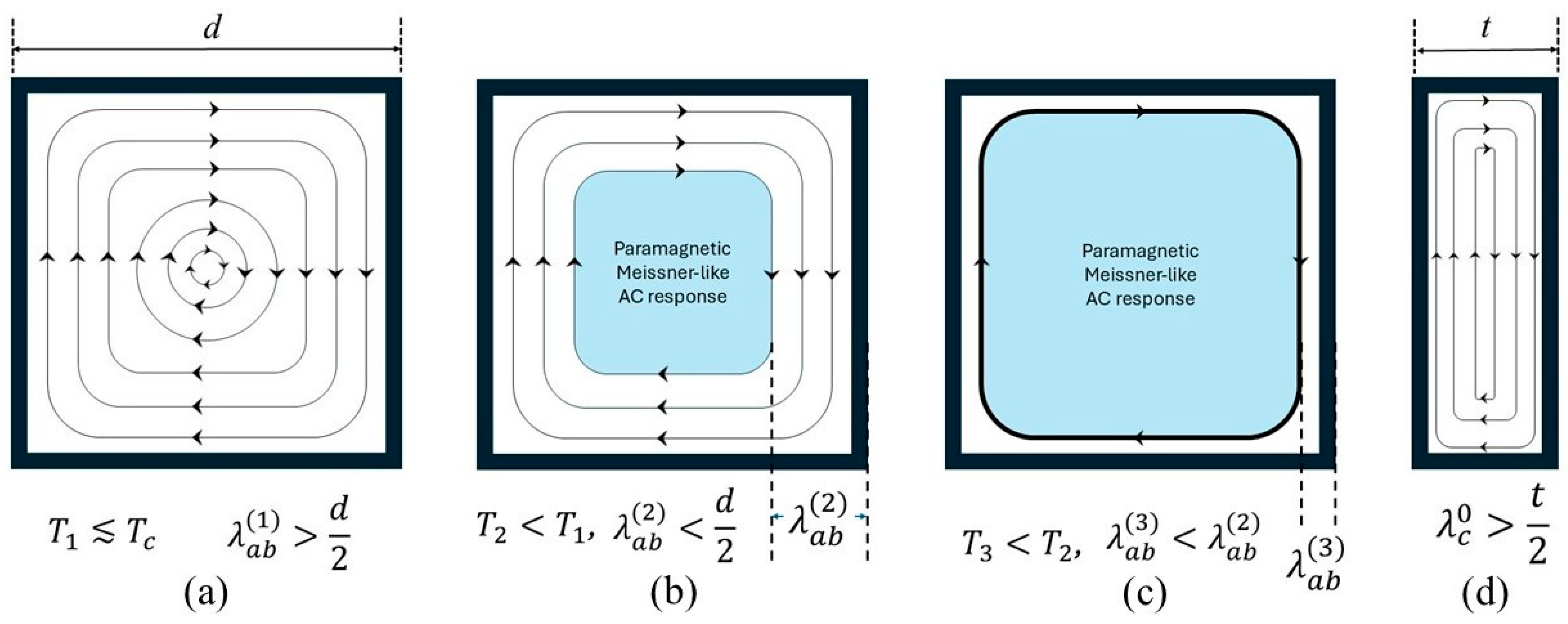
Figure 11 is a sketch that helps understand our qualitative explanation for the anomaly in the AC susceptibility in EuRb1144, only in the perpendicular configuration.
Figure 11a describes the penetration of the circulating AC supercurrents induced by the AC field excitation at temperature
T1 indicated in
Figure 10. At this temperature, λ
ab(
T1) is larger than the half-width of the sample, so the sample is fully penetrated by the AC perturbation, with a very small critical current density due to high temperature. Hence, there is the expected increase in the diamagnetic shielding due to the increase in critical current density with decreasing temperature, down to the temperature
Tm.
With further decrease in temperature, as in
Figure 11b, at
T2, λ
ab(
T2) <
d/2, the AC excitation does not penetrate all the sample, so in the middle there is a region with the paramagnetic Meissner-like AC response, region whose dimensions expand due to the further decrease in London penetration depth with decreasing temperature. Since the circulating supercurrent is still small due to closeness to
Tc, the paramagnetic signal from Eu
2+ spins increases with decreasing λ
ab(
T) faster than the increase in critical current density, their combination leading to the anomalous decrease in the diamagnetic shielding between
Tm and
TM as shown in
Figure 10. Again, please note that the paramagnetic Meissner-like region is not a true Meissner phase as in the phase diagrams of type 2 superconductors, it indicates just the central region where the AC field perturbation does not penetrate. Further decrease in temperature below
TM, at
T3 (
Figure 11c) lead to a larger paramagnetic Meissner-like region, but now the critical current density becomes large enough for the usual dependence of the diamagnetic shielding.
Figure 11d explains the reason for the absence of the anomaly in the parallel configuration: the London penetration depth is much larger than the thickness of the crystal at temperatures close to
Tc, where the critical current is small enough. With decreasing temperature, penetration depth will decrease, which would lead to appearance of a region in the center of sample in which AC excitation does not penetrate, but at this temperature the critical (shielding) current is strong enough, so the diamagnetic response is much larger than the positive AC susceptibility due to Eu
2+ spins.
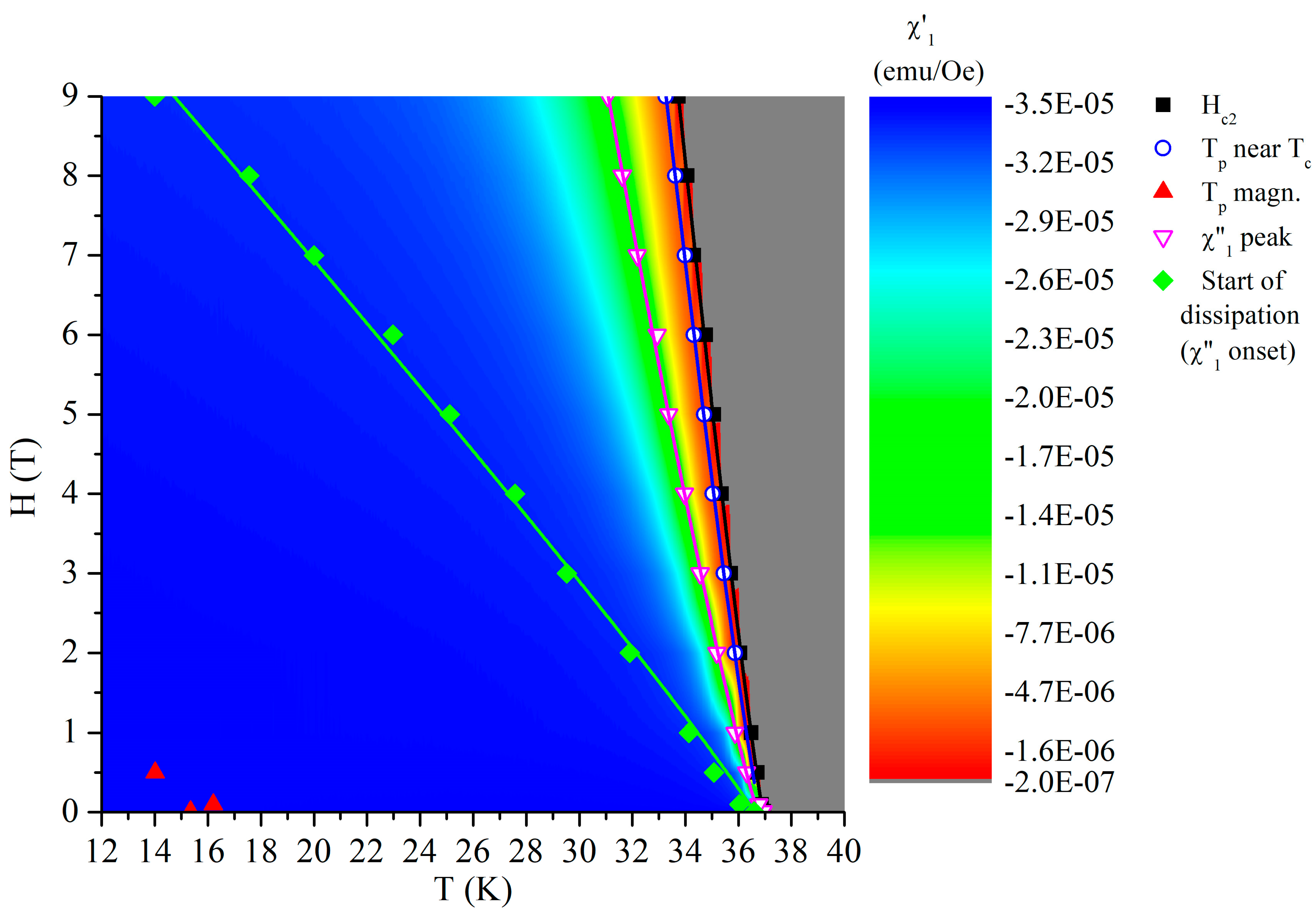
Before the conclusions chapter, a graphical summary of the main findings is shown in
Figure 12 which visualizes the results within a compact
H-T diagram, in perpendicular configuration and ZFC regime.
Starting from lower temperature, red triangle in the lower-left corner indicates the position of the peaks due to magnetic ordering near 15 K; green rhombs indicate the starting of dissipation (on-set of the out-of-phase susceptibility), magenta open triangles indicate the position of the peaks of out-of-phase susceptibility, blue circles represent the peak of anomalous response due to the paramagnetic Meissner-like AC response, and, finally, black squares indicate the field-dependent critical temperatures. As previously mentioned, in normal state the interaction between Eu2+ spins and magnetic flux lines results in positive AC susceptibility. In CaK1144, the data in the normal state are all in the noise level, at about ±10−8 emu/Oe, while in EuRb1144 there is a clear positive AC susceptibility response in the normal state, decreasing from 4.6 × 10⁻⁷ emu/Oe at 0.01 T to 4 × 10⁻⁷ emu/Oe at 0.1 T, then to 3 × 10⁻⁷ emu/Oe between 0.5 and 1 T, and, finally, to 2 × 10⁻⁷ emu/Oe at 3 T. These data are not indicated in the diagram.
5. Conclusions
Using AC susceptibility measurements, we investigated the interplay between Eu2+ spins and vortex matter and dynamics in the magnetic superconducting single-crystal EuRbFe4As4 with AC fields superimposed on DC fields up to 9 T, for fields orientations perpendicular and, respectively, parallel to the superconducting planes, in both zero-field cooling (ZFC) and field cooling (FC) procedures. For DC fields smaller than 0.5 T, in-phase AC susceptibility reveals the magnetic transition at around 15 K which manifests as a small decrease in diamagnetic superconducting shielding (a small local maximum), as was observed also in DC studies. In higher fields the ferromagnetic signal from Eu2+ is masked by the decrease in diamagnetic screening due to the decrease in Jc with increasing DC field. The expected mark of the spin ordering was observed in both field orientations and in both cooling conditions, with small differences in position and height of the local peak. A completely new discovery is the presence of an anomaly in χ’ (T) just below Tc in both cooling procedures (ZFC and FC), but only in the perpendicular field configuration. Just after the superconducting transition, the diamagnetic signal due to screening supercurrent decreases, then increases again upon cooling, as expected. We explained this anomalous paramagnetic Meissner-like AC response through the interplay between the sample dimensions, temperature-dependent penetration depth, temperature (and DC field) critical current Jc and the paramagnetic signal from the Eu2+ spins. Just below Tc, since the London penetration depth is larger than the sample dimension, the AC field perturbation penetrates the whole sample, and the diamagnetic signal increases with decreasing temperature due to the increase in Jc. With further decrease in temperature and subsequent decrease in λL, the AC field perturbation does not penetrate the whole sample, and, in the center, there appears a region with paramagnetic Meissner-like AC response, which leads to decrease in the diamagnetic signal. With further decrease in T, the increase in Jc lead to diamagnetic signal to overcome the paramagnetic signal of Eu2+ spins. So, the condition for the anomaly to appear at a given temperature, in various DC fields, is a London penetration depth smaller than half-sample dimension (so there is in center a region free from AC field excitation, and, at the same time, a low-enough critical current density so the diamagnetic signal is smaller than the paramagnetic signal from Eu2+ spins). This is also the reason for just small shoulders in χ’ (T) in low DC fields, where Jc is large, while with increasing fields (decreasing Jc) the anomaly has a very clear peak. The anomaly does not appear in the parallel configuration for the simple reason of sample dimension being much smaller and a smaller London penetration required a smaller temperature, where the critical current is already too large to be overcome by the paramagnetic signal of the spins. The anomaly was observed also in several experiments with different AC fields and frequencies, although, as expected, χ’ (T) are slightly shifted. Finally, another remarkable finding in our study is the existence of a clear paramagnetic response in the normal state, in both field orientations, of more than one order of magnitude larger than the noise level (and the normal state response in related CaK1144) due to the interaction between the Eu2+ spins and the magnetic flux lines.




 ,
,