


Abstract
Hexagonally ordered mesoporous carbon was ozonized, and the oxidized carbonaceous material was modified with L-arginine. The ozonized and L-arginine-modified carbons were extensively characterized and tested as Pb(II) ion adsorbents, with optimization of Pb(II) solution pH, exposure time, Pb(II) ion concentration and the presence of concurrent ions. Pb(II) adsorption equilibrium was achieved within 5 min at optimal pH = 2.6 or 5.3 for the oxidized and L-arginine-modified carbonaceous materials, respectively. The adsorption kinetics of both investigated materials were best described by the pseudo-first-order model. The maximum adsorption capacity for Pb(II) ions was determined to be 16 mg g−1 (ozonized material) or 45 mg g−1 (L-arginine-modified material). The Langmuir model provided the best fit for the adsorption isotherm data. Fe(III) ions mostly hindered the Pb(II) adsorption (up to 60%) on the L-arginine-modified carbon material. L-arginine-modified carbon was used to enrich Pb(II) from simulated urban roof runoff and its determination using the slurry sampling high-resolution continuum-source graphite furnace atomic absorption spectrometry technique. The developed analytical procedure was characterized by a limit of quantification of 2.63 µg L−1, an enrichment factor of 50, and a recovery rate of 94.8%.
1. Introduction
Nearly 60% of the world’s population will live in areas with insufficient freshwater resources by 2050. The problem with access to fresh water has led to the search for alternative sources. One of them is harvested rainwater (HRW), which is rainwater collected from catchment surfaces like rooftops. The quality of the HRW collected from urban rooftops depends on the roof type and age, atmospheric deposition and weather patterns [1,2,3,4]. It can contain bacteria, fungi, pesticides and various heavy metals (such as Cd, Co, Cr, Ni and Pb). Typically, the HRW pH ranges from 4.7 to 7.1, depending on its composition. An example composition of HRW is as follows: Cl− (2.8 mg L−1), SO42− (2.8 mg L−1), NO3− (0.8 mg L−1), PO43− (0.2 mg L−1), SiO2 (0.8 mg L−1), Ca (1.7 mg L−1), Cu (18.9 µg L−1), K (0.8 mg L−1), Mg (290 µg L−1), Na (0.8 mg L−1), Ag (76.1 µg L−1), Al (41.2 µg L−1), Ba (16.8 µg L−1), Mo (30.7 µg L−1), Sb (3.1 µg L−1), Zn (2.6 mg L−1), and Pb (7.4 µg L−1) [3]. Over 80% of the heavy metals present in a combined sewage system may originate from urban roof runoff. The chronic consumption of HRW contaminated with heavy metals, with concentrations that can exceed the values stated for drinking water quality standards (like 10 µg L−1 for Pb and 6 µg L−1 for Mo according to the World Health Organization guidelines) [3], can cause serious health problems, like tumor development and cardiovascular and metabolic diseases. Thus, monitoring heavy metal concentrations in HRW could become indispensable.
Various analytical techniques can be applied for the determination of Pb traces in HRW: inductively coupled plasma mass spectrometry (ICP-MS), inductively coupled plasma optical emission spectrometry (ICP-OES), graphite furnace atomic absorption spectrometry (GF AAS), etc. ICP-MS provides the best sensitivity and selectivity for Pb analysis in environmental samples, but its high cost is inseparable from the technique. Thus, other low-cost analytical techniques can be used for this purpose, like GF AAS. This technique is commonly used in analytical laboratory practice. In order to improve the analytical parameters of the procedure using GF AAS detection, a preconcentration/enrichment step is introduced into the overall analytical procedure. This additional step in the analytical procedure can lead to interference removal and signal enhancement. The enrichment of Pb from the environmental sample can be performed using the low-cost solid-phase extraction (SPE) technique. Sorbents used in SPE are characterized by a high specific surface area and tunable surface functionalities, which provide selectivity towards the analyte and high enrichment efficiency. Another crucial parameter of SPE sorbents is their degree of purity, which helps prevent increases in background noise [5,6,7]. In SPE, different porous solids can be applied: ordered mesoporous silicas [8], ion-imprinted polymers [9], activated carbons [10,11], carbon nanotubes [5,12], and graphene oxides [13,14]. Ordered mesoporous carbons (OMCs) can also be used for this purpose.
One of the OMCs’ family representatives is the CMK-3 mesoporous carbon (Carbon Mesostructured by KAIST No. 3). CMK-3 is prepared via a hard-templating route using the SBA-15 (Santa Barbara Amorphous No. 15) silica template and a carbon source (e.g., sucrose). This carbonaceous material is characterized by hexagonally ordered mesoporous channels and a highly porous hydrophobic surface (specific surface area > 900 m2 g−1). The ordered mesochannels of this material enable fast analyte transport from the sample solution to the carbon-based surface, thereby considerably shortening the enrichment step. The highly porous surface of the CMK-3-type carbonaceous material can be readily chemically modified with inorganic and organic functionalities, thereby providing a large number of surface active sites. It can give the material selectivity towards the heavy-metal analyte and improve its adsorption capacity, influencing the enrichment factor [15,16,17].
In this work, for the first time, the pristine CMK-3-type carbonaceous material was chemically modified by L-arginine after its ozonation. The prepared materials were characterized using various physicochemical techniques. The adsorption of Pb(II) ions from aqueous solutions onto the investigated materials was optimized by examining the effects of pH, contact time, Pb(II) concentration, and the presence of competing ions. The experimental adsorption kinetics and equilibrium data were analyzed using pseudo-first-order, pseudo-second-order, and Elovich models for kinetics, and Langmuir, Freundlich, and Langmuir–Freundlich models for adsorption isotherms. Also, regeneration studies of the Pb-loaded carbonaceous material were conducted using the following liquid media: HCl(aq), HNO3(aq), and NaHCO3(aq). Finally, the L-arginine-modified CMK-3-type carbonaceous material proved effective for the enrichment of the Pb(II) traces from HRM samples before their determination by the slurry sampling high-resolution continuum source GF AAS technique.
2. Materials and Methods
2.1. Chemicals and Materials
The pristine hexagonally ordered mesoporous carbon of the CMK-3 type (denoted as PMC) was used as the basic adsorbent for subsequent physicochemical modifications. Its synthesis conditions were described in our previous work [18].
The ozone used for carbon oxidation was produced by an ozone generator (ZY-H102, Garbów, Poland) with an efficiency of 500 mg O3 hr.−1. Other reagents used during our study were as follows: HNO3 (65%, Suprapur, Merck, Darmstadt, Germany), NaOH (>95%, Fluka, Buchs. Switzerland), Fe(NO3)3 · 9H2O (p. a., Merck, Darmstadt, Germany), NaHCO3 (>99%, Pol-Aura, Poland), KCl (>99%, Merck, Darmstadt, Germany), NaNO3 (>99%, Merck, Darmstadt, Germany), Na2SO4 (>99%, Merck, Darmstadt, Germany), Mg(NO3)2 (>99%, Merck, Darmstadt, Germany), Ca(NO3)2 · 4H2O (>99%, Merck, Darmstadt, Germany), Na3PO4 (>99%, Merck, Darmstadt, Germany), L-arginine (>99%, Pol-Aura, Poland) and Pb standard solution (Pb(NO3)2, 1 g L−1, Merck, Darmstadt, Germany). All experiments were carried out using double-distilled Milli-Q water from Millipore (Merck, Darmstadt, Germany).
2.2. Carbon Modification Procedures
2.2.1. Ozonation
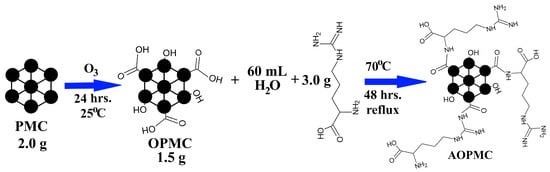
The pristine CMK-3-type carbon ozonation procedure was described in detail in our previous work [17]. The obtained material was denoted as OPMC (Figure 1).
Figure 1.
The modification scheme of the PMC carbonaceous material.
2.2.2. L-Arginine Modification
A total of 1.5 g of the OPMC material was put in the round-bottom flask. Next, the aqueous solution of L-arginine (3 g L-arginine in 60 mL of deionized water) was mixed with the material. The obtained carbonaceous slurry was heated in reflux at 70 °C for 48 h. After that time, the slurry was filtered, and the carbonaceous material was rinsed with distilled water until the filtrate became neutral (pH ≈ 7). The material was dried in the laboratory oven (SML 32/250, Zalmer, Rzeszów, Poland) at 120 °C for 24 h. The L-arginine-modified carbon was denoted as AOPMC (Figure 1).
2.3. Instrumentation
The porosity measurements of the studied carbonaceous materials were performed using an ASAP 2420 analyzer (Micromeritics Inc., Norcross, GA, USA) at −196 °C. Before the analysis, the samples were degassed under vacuum at 120 °C for 12 h. The textural parameters, including BET surface area (SBET [m2 g−1]), total pore volume (VT [cm3 g−1]), and BJH pore diameter (dBJH [nm]), were determined from the desorption branch of the nitrogen adsorption–desorption isotherm.
The morphology of the carbonaceous particles and their elemental composition to a depth of several µm were examined using a scanning electron microscope (SEM) (Carl Zeiss Ultra Plus, Carl Zeiss, Jena, Germany) equipped with a BrukerAXS energy-dispersive X-ray (EDX) detector (Bruker, Karlsruhe, Germany). The microscope was additionally fitted with secondary electron (SE) and backscattered electron (BSE) detectors. The analyses were carried out at an acceleration voltage of 20 kV and a probe current of 5 nA.
The hexagonal ordering of mesopores in the studied carbons was evaluated using X-ray diffraction (XRD) patterns obtained with an Empyrean diffractometer (PANalytical, Malvern, UK) equipped with a CuKα radiation source. The measurements were performed with a step size of 0.02° and a counting time of 10 s per step.
The defect density in the graphene sheets of the studied carbons was analyzed by Raman spectroscopy using a dispersive Raman microscope (inVia Reflex, Renishaw, Wotton-under-Edge, UK) equipped with a 514 nm ion–argon laser (20 mW).
The zeta potential and acid–base properties of the studied samples were determined using a Zetasizer Nano ZS (Malvern Instruments, Malvern, UK) and a CP-401 pH meter (Elmetron, Zabrze, Poland) equipped with a glass electrode. For the zeta potential measurements, 2 mg of the carbon sample was dispersed in 2 mL of a 0.001 mol L−1 KCl solution. The acid–base properties of the carbonaceous materials were evaluated by measuring the pH of 5 mL of 0.001 mol L−1 KCl solution after contact with 20 mg of the carbon material for 24 h.
The CHN elemental composition was determined using an EA 3000 Elemental Analyzer (Euro Vector, Milan, Italy).
Surface functional groups of the studied carbons were identified using Fourier-transform infrared (FT-IR) and X-ray photoelectron spectroscopy (XPS). FT-IR spectra were recorded with a Nicolet 8700A spectrometer (Thermo Scientific, Waltham, MA, USA) in the 400–4000 cm−1 range using KBr pellets. XPS analysis was performed using a Multi-Chamber Analytical System (Prevac, Rogów, Poland) equipped with monochromatic Al Kα radiation (1486.6 eV) (Gammadata Scienta, Uppsala, Sweden) with an X-ray power of 450 W. The C1s peak at 285 eV was used as the reference for binding energy calibration.
Pb concentration in the aqueous phase was determined using a SpectrAA 880 flame atomic absorption spectrometer (FAAS) (Varian, Melbourne, Australia) equipped with a Pb hollow cathode lamp. The operating conditions were as follows: lamp current 10 mA, wavelength 217.0 nm, slit width 1.0 nm, air flow 13.5 L min−1, acetylene flow 2.0 L min−1, and burner height 13.5 mm.
The Pb determination in carbonaceous slurries was performed by the slurry sampling high-resolution continuum source graphite furnace atomic absorption spectrometer (SS HR-CS GF AAS) (ContrAA 700, Analytik Jena AG, Jena, Germany) equipped with the high-pressure xenon short-arc lamp working in a hot spot mode (GLE, Berlin, Germany). The measurement conditions were as follows: wavelength: 217.001 nm, pyrolysis temperature: 1000 °C, atomization temperature: 1500 °C, chemical modifier: 1 wt. % NH4H2PO4, atomization time: 5s, integration time: 5s, integration: CP (central pixel) ± 1, sampling volume: 20 µL, modifier volume: 5 µL, mathematical background correction using the background correction pixels. The calibration was performed using aqueous Pb standard solutions with Pb concentrations in the range 4–40 µg L−1.
2.4. Static Pb(II) Adsorption Studies
A total of 20 mg of OPMC or AOPMC was contacted with 5 mL of an aqueous Pb(II) solution of known concentration and adjusted pH. The resulting carbon suspensions were agitated at 170 rpm for 24 h, except during the adsorption kinetics experiments. After reaching equilibrium, the suspensions were centrifuged to separate the aqueous phase from the solid material. The Pb(II) concentration in the solution before and after adsorption was determined by FAAS. The Pb(II) adsorption (APb(II) [mg/g]) was calculated as follows:
where Cin. [mg L−1] is the starting Pb(II) concentration, Ceq [mg L−1] is the equilibrium Pb(II) concentration, V [mL] is the volume of the adsorbate solution, and m [mg] is the mass of the adsorbent.
Pb(II) adsorption onto the studied carbons was optimized by evaluating the effects of solution pH (1–5), contact time (5–1440 min), and Pb(II) concentration (4–500 mg L−1). The pH of the Pb(II) solution (48 mg L−1) was adjusted using 1 mol L−1 HNO3 or 1 mol L−1 NaOH. The effect of contact time on Pb(II) adsorption was investigated at an initial pH of 5.0 and a Pb(II) concentration of 49 mg L−1. Adsorption isotherms were determined at pH 5.0, a temperature of (25 ± 4) °C, and a contact time of 24 h.
Pb(II) adsorption kinetics were analyzed using three theoretical models: pseudo-first-order (PFO) (Equation (2)), pseudo-second-order (PSO) (Equation (3)), and the Elovich model (Equation (4)) [17,19]. The corresponding equations are given below:
where gt [mg g−1] is the amount of Pb(II) adsorbed at time t, geq [mg g−1] is the equilibrium adsorption capacity, and t [min] denotes the adsorption time. The constants k1 [min−1] and k2 [g mg−1 min−1] represent the rate constants of the pseudo-first-order and pseudo-second-order models, respectively. The parameter α [mg g−1 min−1] corresponds to the initial adsorption rate, while β [g mg−1] is associated with the chemisorption activation energy and surface coverage.
Pb(II) adsorption isotherms were analyzed using three theoretical models: Langmuir (Equation (5)), Freundlich (Equation (6)), and Langmuir–Freundlich (Equation (7)) [17,20]. The corresponding mathematical expressions are given below:
where gm [mg g−1] is the maximum Pb(II) adsorption capacity, Ceq [mg L−1] is the equilibrium Pb(II) concentration, and kL [L mg−1] denotes the Langmuir equilibrium constant. The constants kF [mg(1−nF) LnF] and kLF [L mg−1] represent the Freundlich and Langmuir–Freundlich equilibrium constants, respectively, while nF and nLF are the corresponding dimensionless model parameters.
The effect of competing ions on Pb(II) adsorption onto the AOPMC material was investigated in the presence of HCO3−, Cl−, SO42−, PO43−, NO3−, Mg2+, Ca2+, and Fe3+ ions. For this purpose, 20 mg of AOPMC carbon was mixed with 5 mL of an aqueous solution containing Pb(II) ions (40 mg L−1) and competing ions within the concentration ranges of 0–1000 mmol L−1 for anions and 0–200 mg L−1 for cations. The pH of the solutions was adjusted to 3.0. After shaking the suspensions for 24 h, the initial and equilibrium Pb(II) concentrations were determined, and the adsorption capacity was calculated as described above. Finally, the relative adsorption was calculated according to Equation (8):
where A100% [%] is the relative adsorption of Pb(II) onto AOPMC carbon, whereas Amax [mg g−1] denotes the maximum Pb(II) adsorption achieved in the investigated system.
2.5. Regeneration
Pb desorption from Pb-loaded AOPMC carbon was investigated using three eluents (HCl, HNO3, and NaHCO3) at concentrations of 0.01–1.00 mol L−1. Briefly, 5 mg of Pb-loaded AOPMC (41.2 mg g−1) was mixed with 2 mL of the desorbing solution and shaken for 24 h. The suspension was then centrifuged and the Pb concentration in the supernatant was determined by FAAS. The desorption degree of Pb from AOPMC was calculated using Equation (9):
where OPb [%] represents the degree of Pb desorption from the investigated material, CPb [mg L−1] is the Pb concentration in the liquid phase after the desorption process, and Vlm [mL] denotes the volume of the liquid medium used. The parameter mdes [mg] corresponds to the mass of the Pb-loaded adsorbent, while APb [mg g−1] indicates the Pb content in the Pb-loaded AOPMC carbon.
2.6. Application
The AOPMC carbonaceous material was applied for the Pb(II) enrichment from the simulated urban runoff samples prior to determination by the SS-HR-CS GF AAS technique. Three simulated urban runoff samples were obtained by appropriate dilution of a Pb standard solution to concentrations of 4, 8, and 12 µg L−1 in the matrix reference material (Rain-97, National Water Research Institute of Canada) [21] (Table S1). AOPMC carbon (20 mg) was added to the 50 mL of the simulated urban runoff sample with adjusted pHeq = 5.3. The carbonaceous slurry was shaken for 24 h. Then the Pb-loaded AOPMC carbon was centrifuged, filtered, and dried at 120 °C for 24 h. Next, 20 mg of Pb-loaded AOPMC was added to 1 mL of HNO3 (0.1 mol L−1), and the resulting slurry was homogenized in a Vortex directly before measurements with SS HR-CS GF AAS. The Pb concentration in the analyzed urban runoff wastewater was calculated according to the following equation (Equation (10)):
where ZPb [µg L−1] is the Pb concentration in the analyzed sample, CPbdet. [µg L−1] is the Pb concentration determined in the carbonaceous slurry, Vmed. [mL] is the volume of the 0.1 mol L−1 HNO3 used for the carbonaceous slurry preparation, Vsample [mL] is the analyzed sample volume, m1 [mg] is the AOPMC mass used for Pb adsorption from the analyzed sample and m2 [mg] is the Pb-loaded AOPMC mass used for the slurry preparation. Three replicates were made for each sample. The recovery was estimated using the 1640 reference material (Trace Elements in Natural Water, NIST) [22] by the proposed analytical procedure.
3. Results and Discussion
3.1. Physico-Chemical Properties
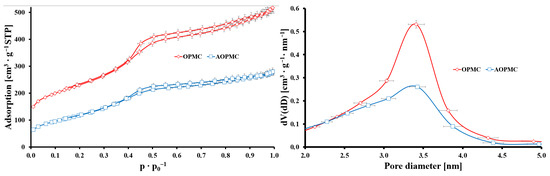
The porosity of the studied carbons was determined based on low-temperature N2 adsorption/desorption isotherms and pore size distribution (PSD) (Figure 2). The isotherms of both materials could be classified as the IVa type with H1 type hysteresis loop starting at p p0−1 = 0.4, which was typical for narrow-mesopored (3.4 nm) carbons of CMK-3 type (Table 1) [17]. Additionally, both carbon materials possessed a large specific surface area (>400 m2 g−1), consistent with their developed microporous structure. Twice as high nitrogen adsorption values for OPMC as for AOPMC corresponded to the substantial change in the specific surface area after L-arginine modification (813 m2 g−1 and 430 m2 g−1 for OPMC and AOPMC, respectively). This change was also observed for total pore volumes of studied samples (0.82 cm3 g−1 (OPMC) and 0.43 cm3 g−1 (AOPMC)) (Table 1). Noticeable changes were also observed in the PSDs of the studied carbons. Probably, L-arginine molecules and their polymeric derivatives could fill part of the micro- and mesoporous structure of the modified carbonaceous material.
Figure 2.
N2 adsorption/desorption isotherms and PSDs for synthesized carbons (error bars—precision from triplicate measurements).
Table 1.
Porosity characteristics (SBET, dBJH, VTot.), Raman factor (ID/IG), pHPZC and ζ-potential for OPMC and AOPMC carbonaceous materials.
In the Raman spectra of the studied materials, two bands were observed: the D band (defects in graphene domains) at 1317 cm−1 and the G band (graphene domains without defects) at 1581 cm−1 [17]. The intensity ratio of these two bands (ID/IG) for both carbonaceous materials was similar and lower than 1.0 (0.86 for OPMC and 0.87 for AOPMC) (Table 1). It could be the result of the incorporation of L-arginine molecules and their polymers, rather than on the edges of graphene domains, than inside its structure.
The L-arginine modification of OPMC carbon resulted in the shift of pHPZC value towards pH = 7 (change from 2.90 to 6.53). Simultaneously, the zeta potential values have been practically preserved (−33.7 mV for OPMC and −33.1 mV for AOPMC) (Table 1). The increase in pHPZC may be attributed to the introduction of basic amine functionalities on the carbon surface. Some of them could react with the carboxylic groups, creating CONH- bonds. Moreover, L-arginine molecules possessed both amine and carboxylic groups, so some carboxylic groups could still be present on the AOPMC surface. Thus, the carbonaceous surface was negatively charged even after amino acid modification.
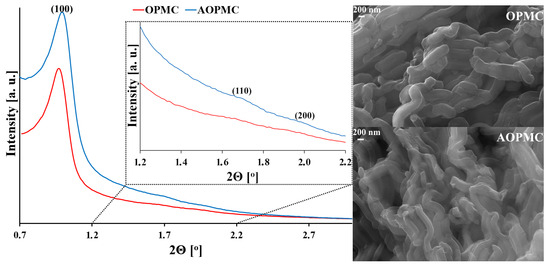
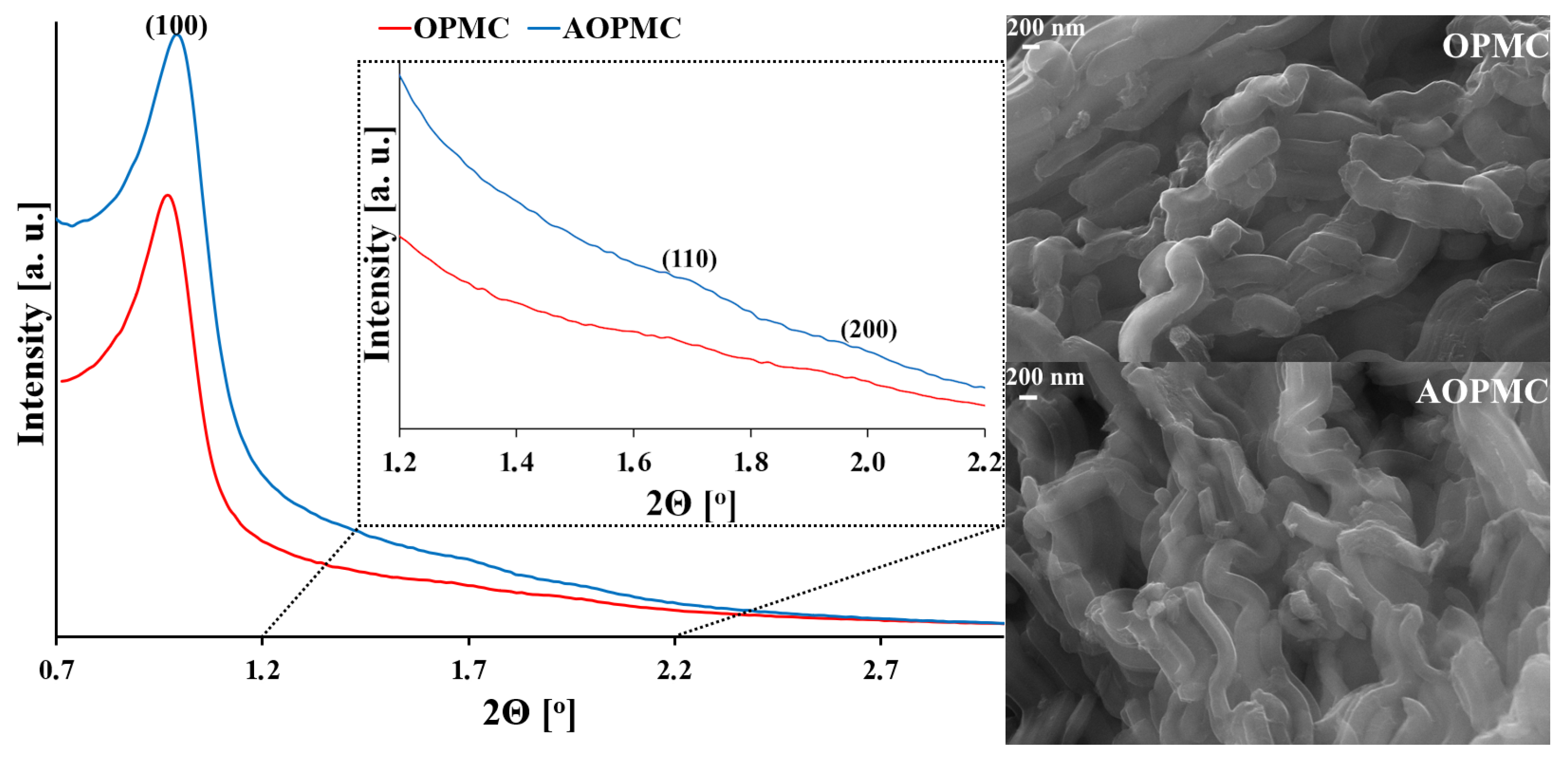
In Figure 3, XRD patterns and SEM microphotographs of the studied carbonaceous materials are presented. For both materials, three reflections were observed at 2θ angles of 1.0°, 1.7°, and 1.9°, which were associated with the hexagonal order of mesopores (p6 mm), similar to CMK-3-type carbon [23]. Modification of OPMC carbon with L-arginine did not affect the degree of mesopore ordering. Moreover, both carbon materials exhibited a rod-like morphology [24]; therefore, the applied surface modification did not affect their microstructure.
Figure 3.
XRD patterns and SEM microphotographs (magn. 50 kx) for the studied carbons.
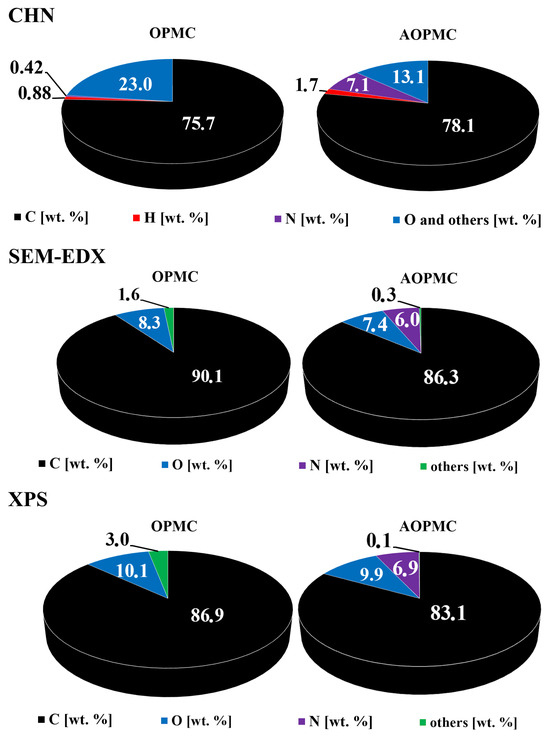
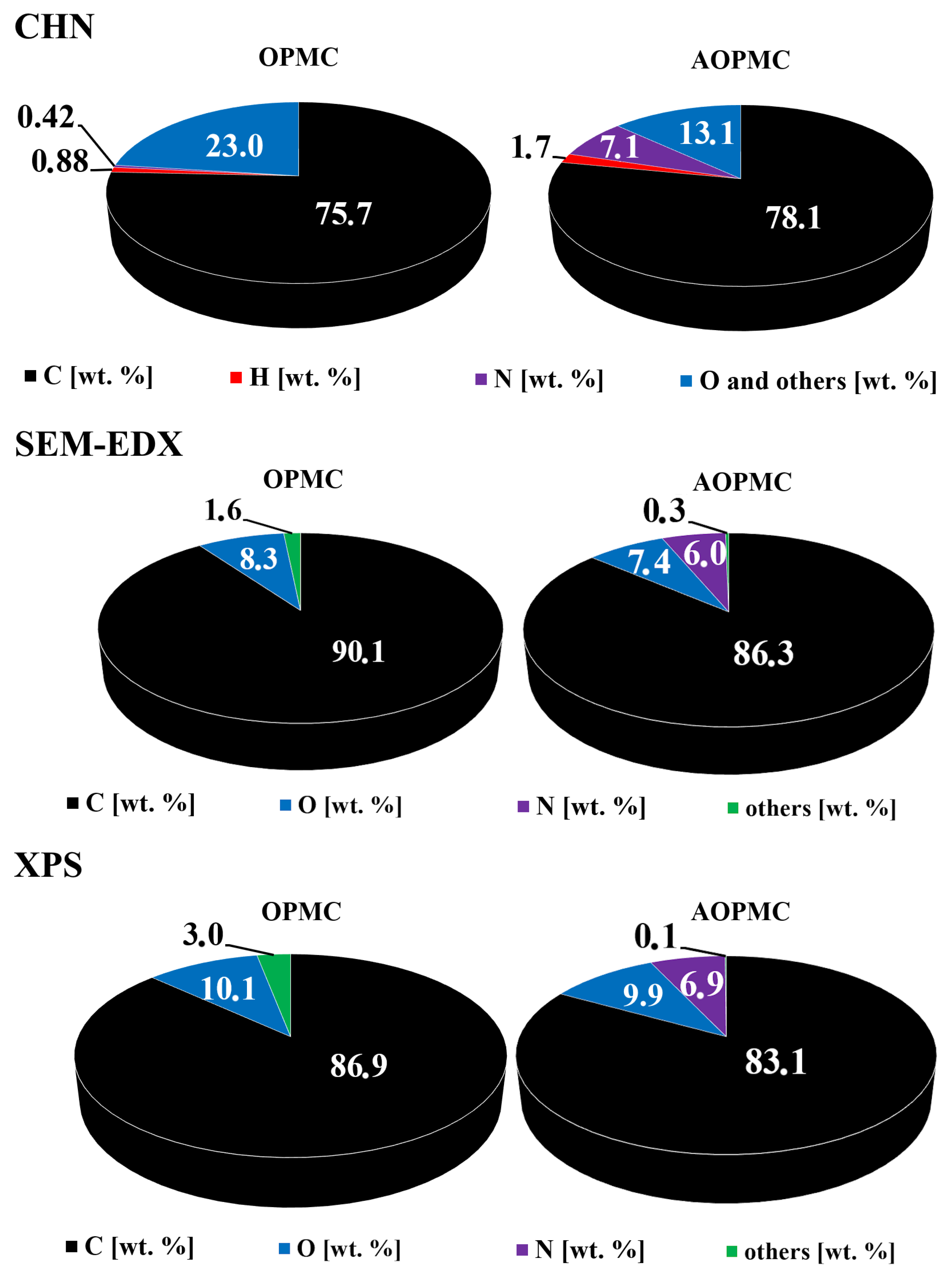
The elemental composition of OPMC and AOPMC materials studied by CHN, SEM-EDX and XPS techniques is presented in Figure 4. The carbon was the main constituent of both materials (75.7–90.1 wt. % (OPMC) and 78.1–86.3 wt. % (AOPMC)). These materials also contained heteroatoms such as oxygen (8.3–10.1 wt. % (OPMC) and 7.4–9.9 wt. % (AOPMC)) and nitrogen (0.42 wt. % (OPMC) and 6.0–7.1 wt. % (AOPMC)), as well as other elements. The L-arginine modification of the OPMC material successfully provided the introduction of nitrogen onto the carbonaceous surface with practically no substantial change in the oxygen content, because of the presence of both elements in L-arginine molecules. Higher values obtained by XPS suggested more oxygen and nitrogen groups on the carbonaceous surface than in the deeper layers of the material. It can be assumed that the L-arginine modification of the OPMC material was based on the L-arginine molecules’ adsorption on the OPMC surface and/or chemical binding of the modifier molecules to the carbonaceous surface by the formation of -CONH- bonds.
Figure 4.
Elemental composition of the studied samples.
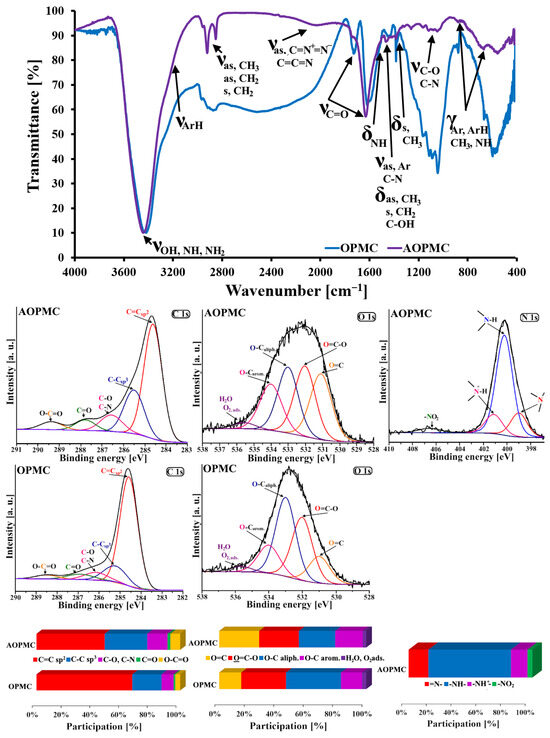
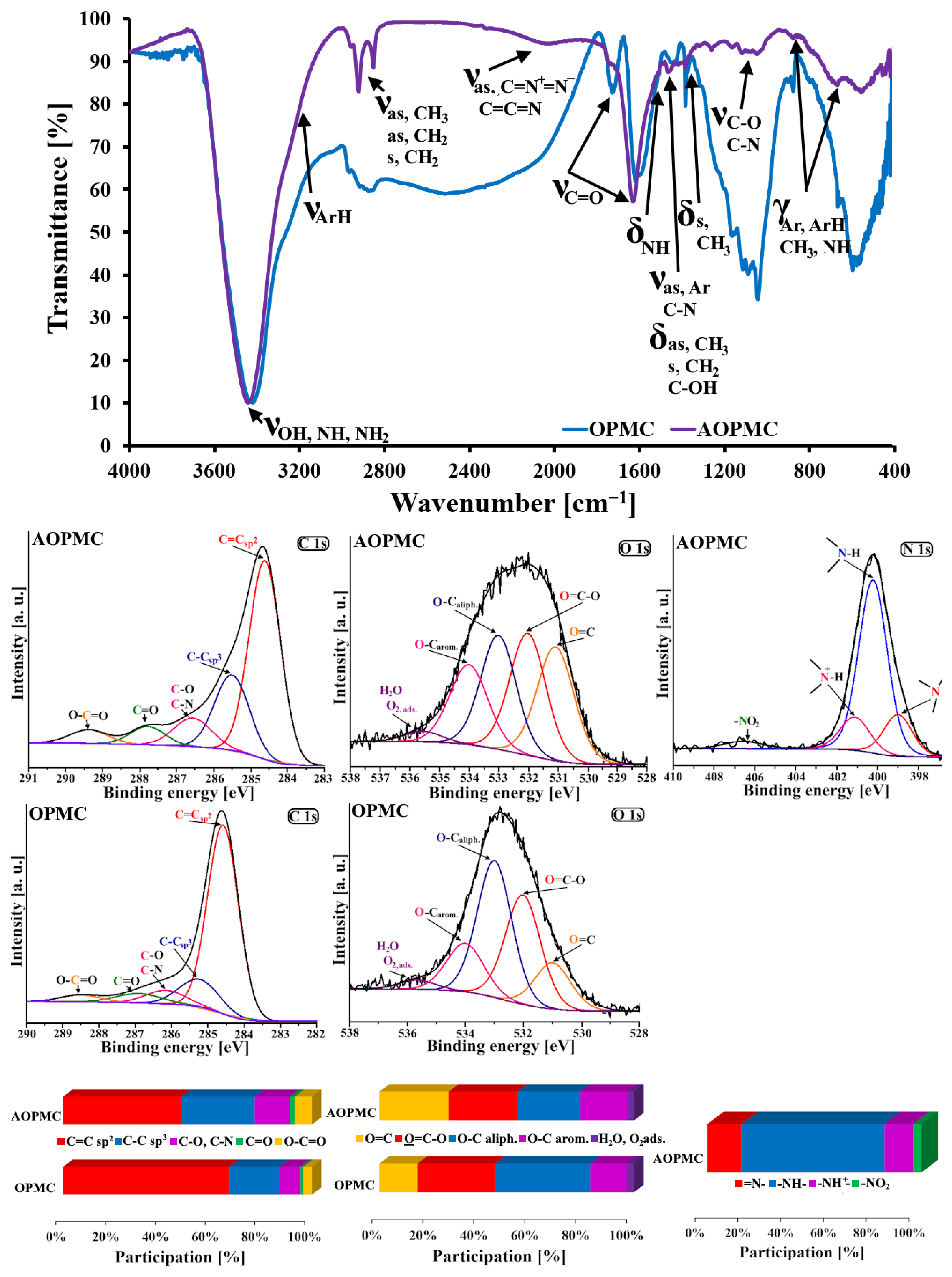
In Figure 5, the results of surface studies on both carbonaceous samples, performed using FT-IR and XPS, are presented. On both FT-IR spectra the following bands are presented: νOH, NH, NH2 (3443 cm−1), νArH (3200–3000 cm−1), νas, CH3 (2963 cm−1), νas, CH2 (2919 cm−1), νs, CH2 (2851 cm−1), νC=O (1746 cm−1, 1629 cm−1), νas, Ar; C-N and δas, CH3; s, CH2; C-OH (1470–1427 cm−1), δs, CH3 (1381 cm−1), νC-O, C-N (1313–1050 cm−1) and γAr, ArH, CH3, NH (882–678 cm−1) [25]. Additionally, during the L-arginine modification of the OPMC carbonaceous material the band νas, C=C=O (2124 cm−1) vanished and the bands νC=C=N; as, C=(N+)=(N-) (2045 cm−1) and δNH (1507 cm−1) appeared [17,25]. The appearance of the FT-IR bands corresponding to N-containing groups confirms the incorporation of this element into the AOPMC surface. Moreover, the significant intensity decrease of bands related to the OH, C-O, C=O (at higher wavelengths), CH2, CH3, ArH, Ar and the simultaneous vanishment of the C=C=O band is probably caused by the creation of -CONH- between the OPMC surface and the L-arginine species during the chemical modification of the carbonaceous surface. Additionally, the large-sized surface functionalities (i.e., rings arginine-carbonaceous surface) could be formed during the modification process of the OPMC carbonaceous material due to the chemical interactions between L-arginine species and the surface oxygen-containing functionalities of the OPMC carbon. These large-sized surface functionalities could be responsible for the vibration damping of the CH3, CH2, Ar and ArH groups.
Figure 5.
Surface analysis of the studied samples using FT-IR and XPS.
The detailed XPS spectra of the C1s, O1s, and N1s regions were also recorded (Figure 5). Deconvolution of the C1s signal for both materials revealed five components: C=C sp2 (284.6 eV), C-C sp3 (285.5 eV), C-O/C-N (286.5 eV), C=O (287.7 eV) and O-C=O (284.6 eV) [26]. In the case of the O1s signal, five peaks were identified at the following binding energies: 530.9 eV (O=C), 531.9 eV (O=C-O), 533.0 eV (O-Caliph.), 534.0 eV (O-Carom.) and 535.6 eV (H2O, O2ads.) [27,28]. Additionally, for AOPMC carbonaceous material the deconvolution of the N1s signal provided 4 peaks located at the following binding energies: 398.9 eV (=N-), 400.0 eV (-NH-), 400.9 eV (-NH+-) and 406.3 eV (-NO2) [29]. According to the deconvoluted peaks’ participation in the appropriate XPS core energy signal intensities for the studied materials, the following statements were formulated. During the chemical modification of the OPMC surface by the L-arginine, the participation of the C=C sp2 peak in the C1s intensity decreased (from 66.7% to 47.5%). Simultaneously, the participation increase in the C1s intensity was observed for C-C sp3 (from 20.4% to 29.6%), C-O/C-N (from 8.4% to 14.1%), C=O (from 0.8% to 2.0%) and O=C-O (from 3.8% to 6.8%). In the case of O1s signal, the participation of its intensity increased for O=C (from 15.0% to 27.2%) and O-Carom. (from 14.4% to 18.7%), and it decreased for O=C-O (from 30.5% to 27.0%) and O-Caliph. (from 37.4% to 24.7%). The content increase of the C atoms located in aliphatic chains and C-N groups could be the result of the incorporation of the arginine in the AOPMC structure. In turn, the content increase of the O atoms located in C=O and the content increase of the C atoms presented in C-N groups, along with the simultaneous content decrease of the O atoms located in O-Caliph. Groups, could be caused by the formation of -CONH- groups as a result of the reaction between the surface -COOH/-OH groups of OPMC material and amine groups of the arginine. Additionally, the content decrease of the O atoms presented in O=C-O and the simultaneous content increase of these atoms located in O-Carom. groups could be due to the reaction between the aromatic carbon rings and arginine, leading to the formation of =N- groups (16.0% contribution to the N1s signal intensity). Moreover, the highest participation of N1s signal intensity for AOPMC material was observed for -NH- groups (66.7%) present in arginine, its condensates and/or -CONH- bonds.
3.2. Pb(II) Adsorption Optimization
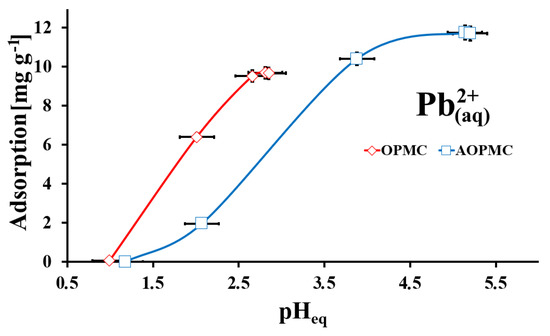
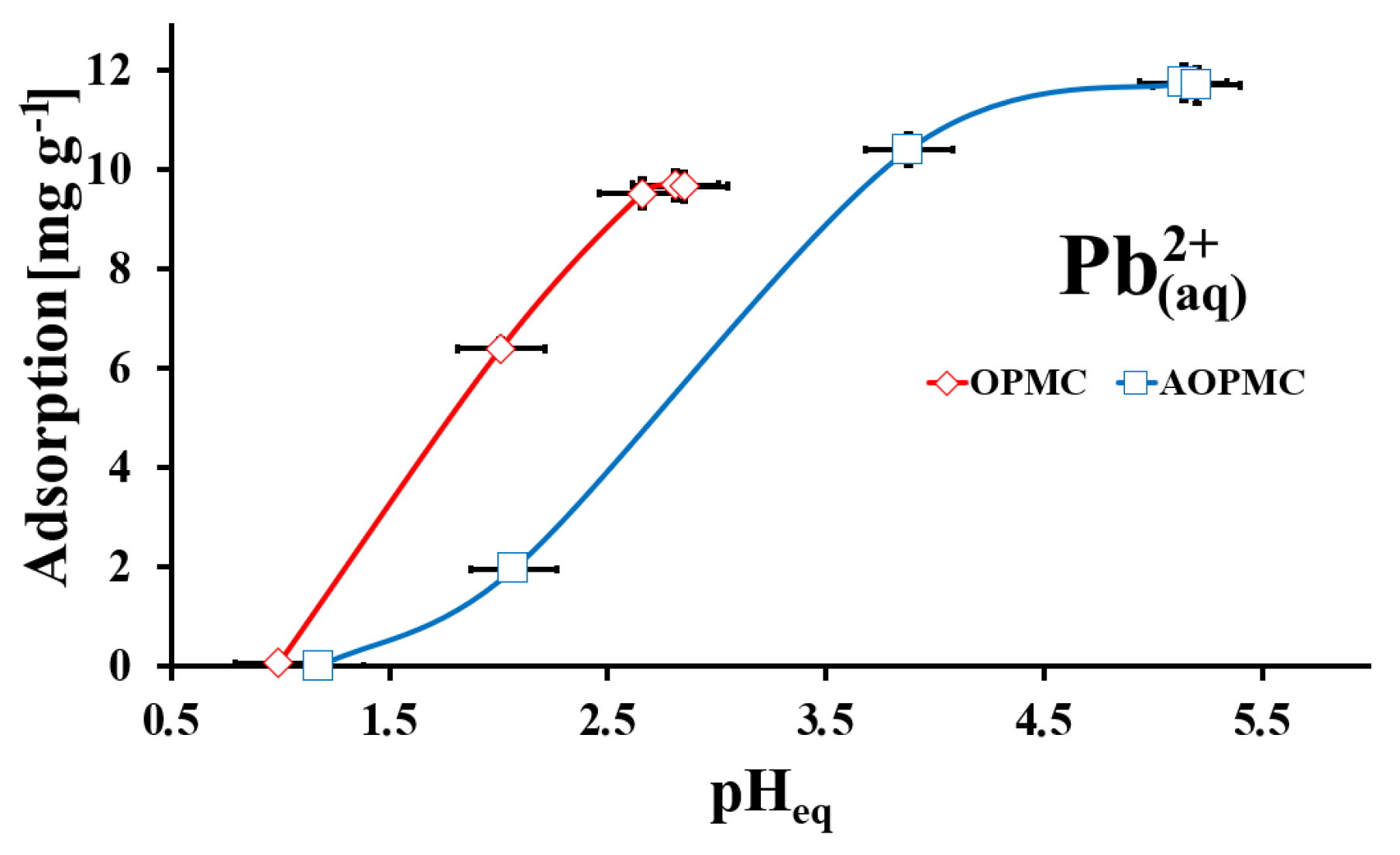
The effect of the pH of the Pb(II) solution on the adsorption of Pb(II) ions onto the surface of OPMC and AOPMC carbonaceous materials was studied (Figure 6). For both studied materials, the tendency was similar: the higher Pb(II) adsorption in the studied adsorption systems due to the pH rise of the solution up to the exact pHeq value (optimal), in which the maximum uptake of Pb(II) was obtained (10 mg g−1 for OPMC at pHeq = 2.6 and 11.8 mg g−1 for AOPMC at pHeq = 5.3) for the experimental pHeq range (1.0–5.3). In the studied pH range, both carbonaceous materials had a positively charged surface (pH < pHPZC). In the case of the OPMC material, practically all acidic oxygen-containing functionalities were protonated in these conditions. But for AOPMC material only -COOH groups were deprotonated, because the pKa values for other acidic oxygen-containing groups and for amine groups originated from the L-arginine were greater than 5.3. Additionally, under experimental conditions, Pb(II) was present as Pb2+(aq). Thus, repulsive electrostatic forces could occur between the carbonaceous surface and the studied ions during the adsorption process. This effect was the smallest at optimal pHeq values. Not only electrostatic forces could influence the adsorption process of Pb(II) ions in the studied adsorption systems. Also, surface complexation (in both cases) and surface precipitation (for AOPMC) could be part of the adsorption mechanism [30,31,32].
Figure 6.
The aqueous solution pH influence on Pb(II) adsorption onto studied materials (m/V = 4 g L−1, Cin_Pb(II) = 48 mg L−1, t = 24 h; error bars—precision from triplicate measurements).
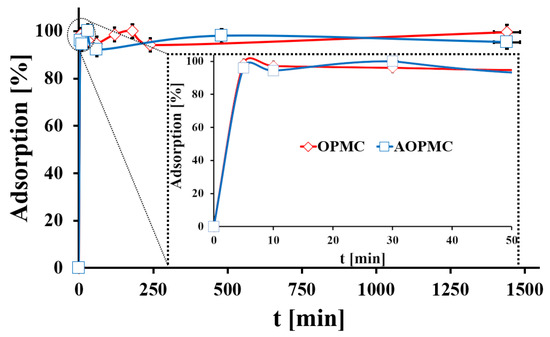
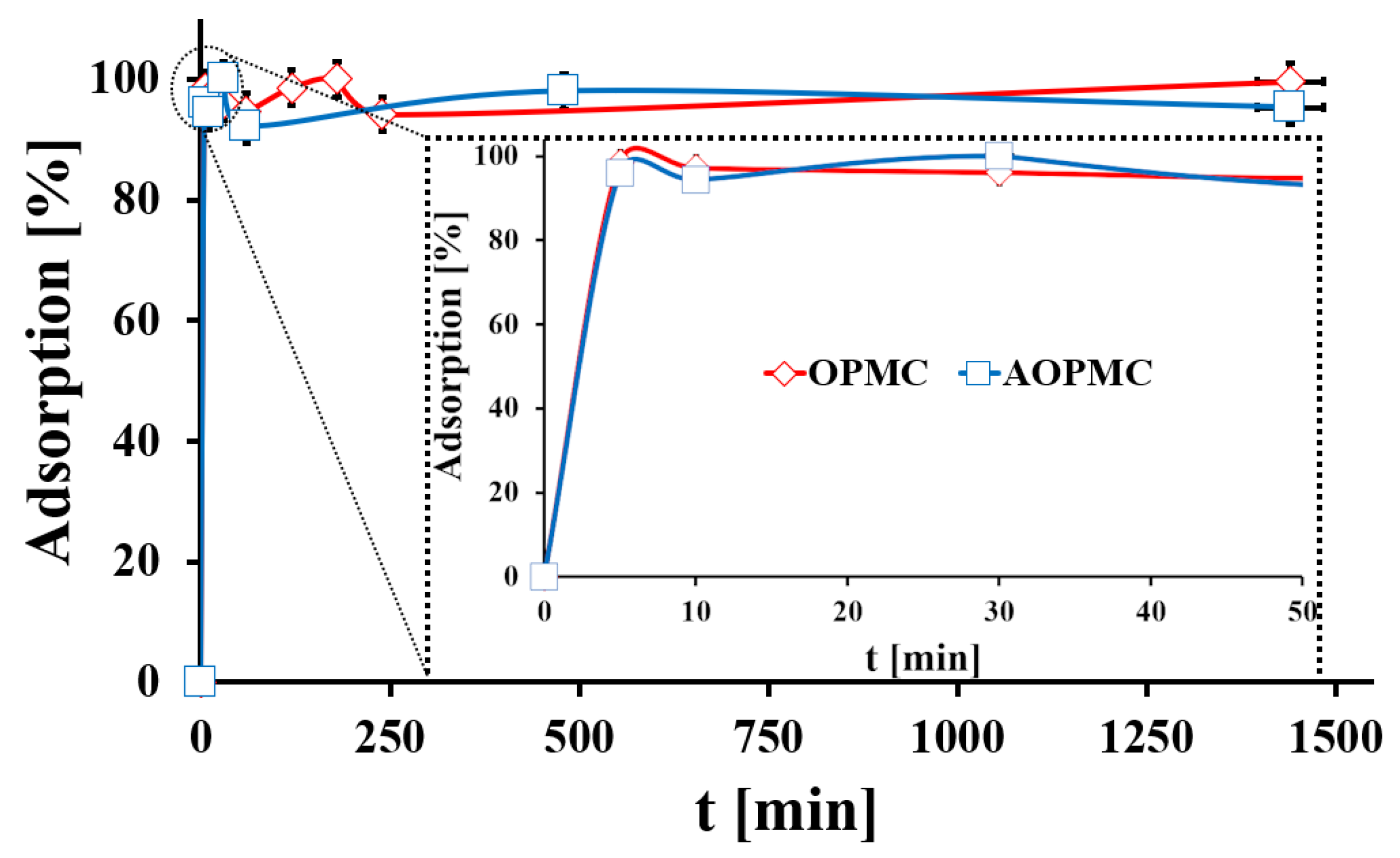
In Figure 7, the Pb(II) adsorption kinetics of both studied carbonaceous materials are presented. For both OPMC and AOPMC carbonaceous materials, the Pb(II) adsorption equilibrium state was achieved after 5 min. This fast adsorption equilibration was probably related to the high mass transfer through the ordered mesoporous channels of the studied materials. The Pb(II) adsorption kinetics data obtained were analyzed using three theoretical models: PFO, PSO, and Elovich [17,19] (Table 2). The PFO model best described the experimental data for OPMC and AOPMC (R2OPMC = 0.957; R2AOPMC = 0.973). In both cases, the Pb(II) diffusion to the surface active centers was the driving force for Pb(II) adsorption kinetics in the studied systems [33]. The similar k1 values for both materials suggested that the chemical surface modification did not influence the Pb(II) transfer to the adsorbent surface.
Figure 7.
The Pb(II) adsorption kinetics onto studied materials (m/V = 4 g L−1, Cin._Pb(II) = 48 mg L−1, pHeq_OPMC = 2.6., pHeq_AOPMC = 5.3, A100%_OPMC = 10.4 mg g−1, A100%_AOPMC = 11.8 mg g−1; error bars—precision from triplicate measurements).
Table 2.
Results of the non-linear fitting of the Pb(II) adsorption kinetics data to PFO, PSO and Elovich models for OPMC and AOPMC.
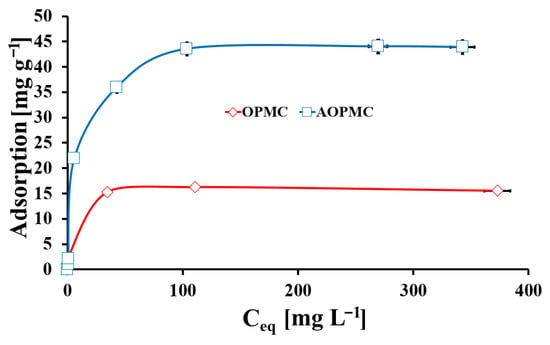
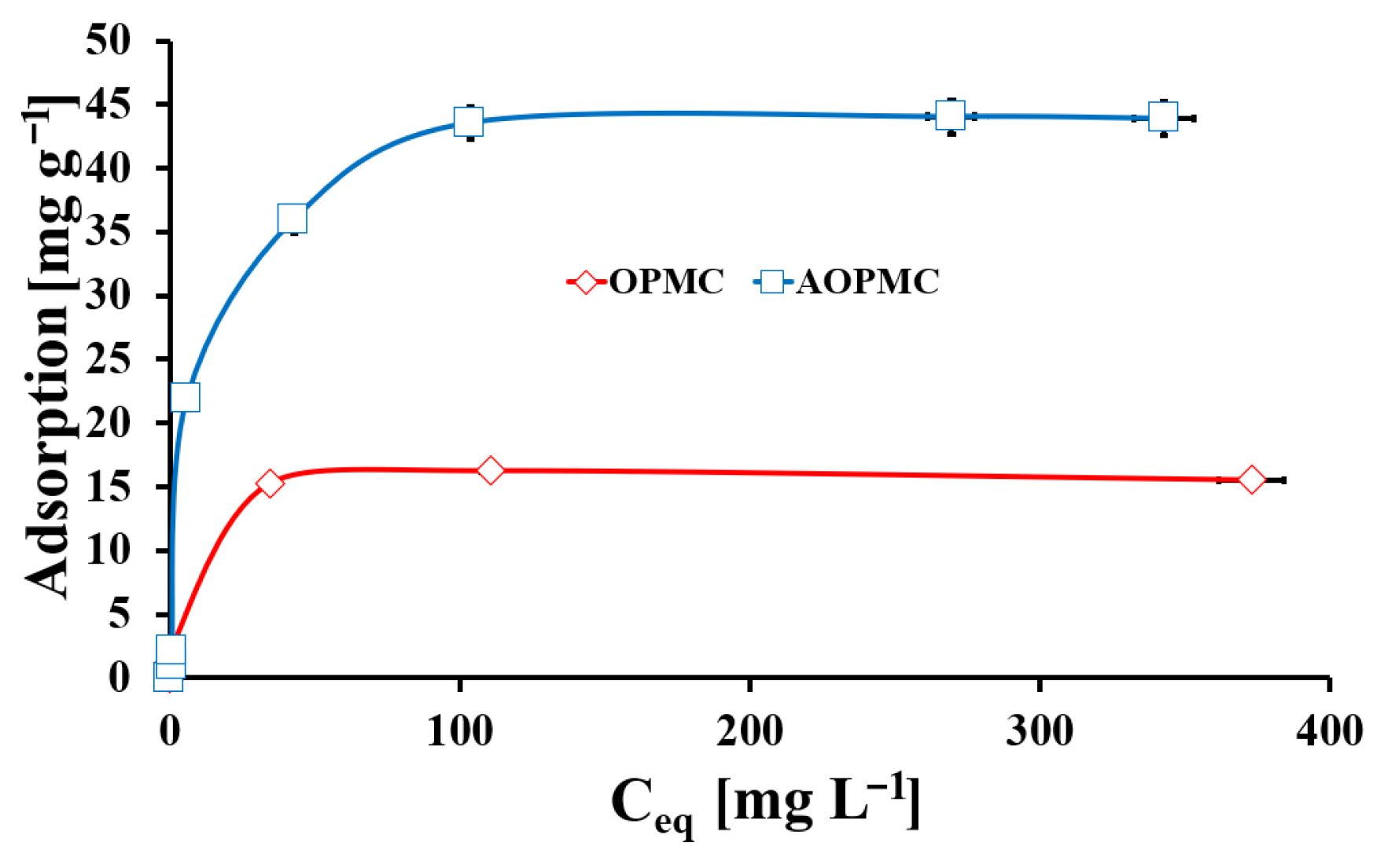
The adsorption equilibrium isotherms of Pb(II) ions for OPMC and AOPMC materials are depicted in Figure 8. The maximum adsorption capacities for Pb(II) ions of OPMC and AOPMC were 16 mg g−1 and 45 mg g−1, respectively. The modification of the OPMC surface by L-arginine resulted in a tripling of the maximum Pb(II) uptake capacity, probably due to an increase in the number of surface active sites. Moreover, the initial part of the Pb(II) adsorption isotherm for AOPMC material was located axially, which meant that for low Pb(II) concentrations, the high Pb(II) adsorption values were obtained. It could provide a higher enrichment factor for AOPMC material than for OPMC. So, the AOPMC material could be successfully applied to the analytical determination of Pb(II) ions. The obtained Pb(II) adsorption equilibrium data were analyzed using the following theoretical models: Langmuir, Freundlich, and Langmuir–Freundlich [17,20] (Table 3). The Langmuir model provided the best fit for both studied materials (R2OPMC = 0.997, R2AOPMC = 0.993). Additional confirmation of the best fitting of the Langmuir model was found in the gm values, similar to the experimental maximum Pb(II) adsorption capacities (qm_OPMC = 15.98 mg g−1, qm_AOPMC = 44.94 mg g−1). It suggested chemisorption as the driving force for Pb(II) adsorption on both studied materials from aqueous solutions. The kL values represented the Pb(II) affinity to the surface binding sites [34]. For OPMC material, the kL value was higher (0.72 L mg−1) than for AOPMC material (0.14 L mg−1). It could be related to the stronger chemical forces between OPMC active sites and Pb(II) ions than between these ions and the AOPMC surface. Thus, the desorption of Pb from the AOPMC surface should be easier than in the case of Pb-loaded OPMC. Additionally, nLF values for both materials were close to 1, indicating surface energetic homogeneity for both studied materials [20]. The Pb(II) adsorption performances of both synthesized carbonaceous materials were compared with other adsorbents in Table S2. For further studies, the AOPMC material was chosen due to its high Pb(II) adsorption capacity and the likely ease of regeneration.
Figure 8.
The Pb(II) adsorption equilibrium isotherms onto OPMC and AOPMC (m/V = 4 g L−1, pHeq_OPMC = 2.6., pHeq_AOPMC = 5.3, teq = 24 h, T = (25 ± 4) oC; error bars—precision from triplicate measurements).
Table 3.
Results of the non-linear fitting of the Pb(II) adsorption equilibrium isotherms to Langmuir, Freundlich and Langmuir–Freundlich models for OPMC and AOPMC.
3.3. Effect of Competing Ions
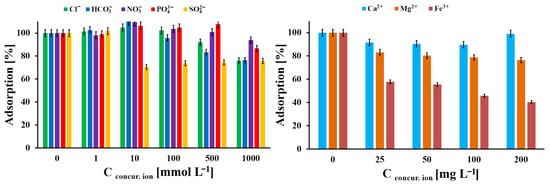
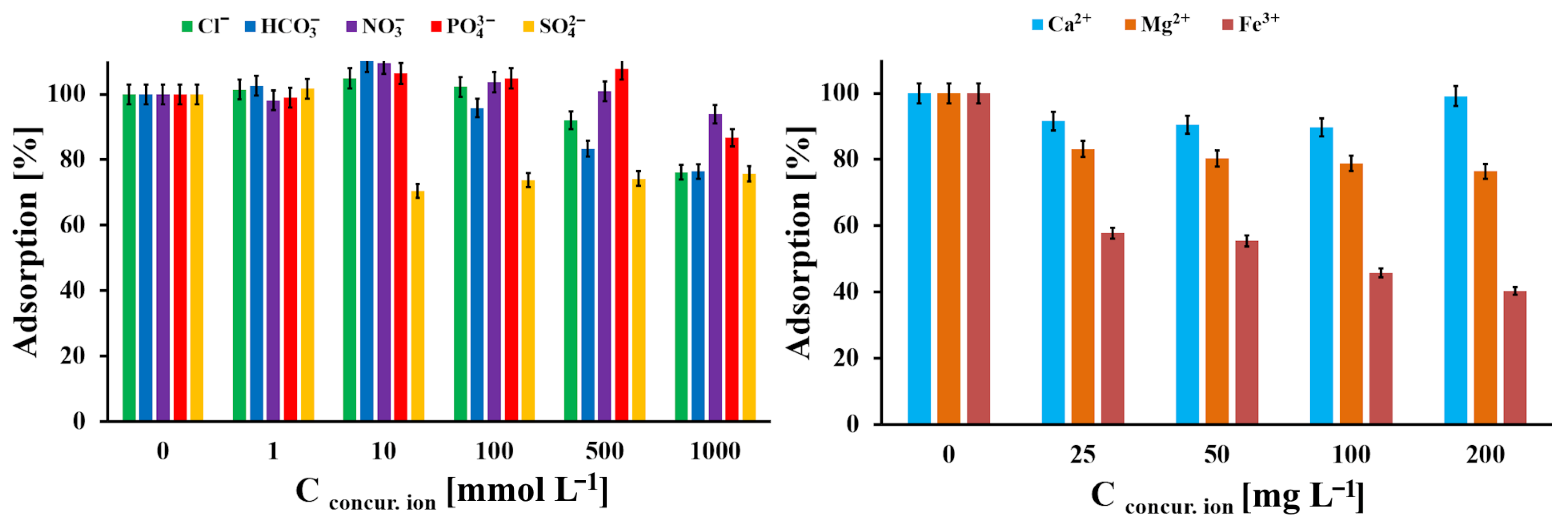
In Figure 9, the influence of concurrent ions in the adsorption system, Pb(II) and AOPMC, was studied. The noticeable interference was observed for SO42− at concentrations from 10 mmol L−1 (30% decrease in Pb(II) adsorption), for HCO3− at concentrations from 500 mmol L−1 (20% decrease in Pb(II) adsorption), for PO43− and Cl− at concentrations 1000 mmol L−1 (20% and 10% decrease in Pb(II) adsorption, respectively) and for Fe(III) at concentrations from 25 mg L−1 (40–60% decrease in Pb(II) adsorption). The Fe(III) ions, which interfered the most in the studied adsorption system, could be complexed to a greater extent than Pb(II) ions by the AOPMC surface, due to its higher electrostatic charge and greater affinity towards amine and carboxyl ligands. In turn, the SO42− ions could form the hardly soluble salt (PbSO4) with Pb(II) ions, and thus they could be concurrent for the adsorbed ions.
Figure 9.
The influence of concurrent ions in studied adsorption system (m/V = 4 g L−1, Cin._Pb(II) = 36 mg L−1, pHeq = 5.3, teq = 24 h, A100% = 10.4 mg g−1; error bars—precision from triplicate measurements).
3.4. Mechanism of Adsorption
The discovery of the Pb(II) adsorption mechanism onto AOPMC carbonaceous material was performed by the XPS study of the Pb-loaded AOPMC. The elemental surface composition of the Pb-loaded AOPMC was presented in Table S3. The following could be indicated after comparing these data with XPS data for the pristine AOPMC material: during the Pb(II) adsorption onto the studied material, the C content declined (from 83.1 wt. % to 68.9 wt. %), the O content improved (from 9.9 wt. % to 15.3 wt. %), the N content did not change, and the Pb appeared (8.2 wt. %). These changes could indicate partial AOPMC surface oxidation by HNO3 in aqueous Pb(II) solution, surface complexation, or precipitation of Pb(II) as hydroxide. More information was obtained from studies of the high-resolution XPS core energy levels: C1s, O1s, N1s and Pb4f. The results of the mathematical deconvolution of the mentioned XPS signals are presented in Table S4. The partial oxidation of the AOPMC surface by the HNO3 was confirmed (the participation increase in C=O, O=C-O, O-Caliph., O-Carom., -NO2 and CO32− in the intensities of C1s, O1s and N1s XPS signals). Additionally, the appearance of the O2−, metal oxide peak in the O1s XPS signal and Pb(NO3)2 peak in the Pb4f XPS signal suggested the presence of Pb-O bonds on the AOPMC surface. Thus, the Pb(II) could be adsorbed onto the AOPMC surface during the surface complexation by the N and O surface functionalities and/or surface precipitation in the form of the Pb(OH)2.
3.5. Reusability Studies
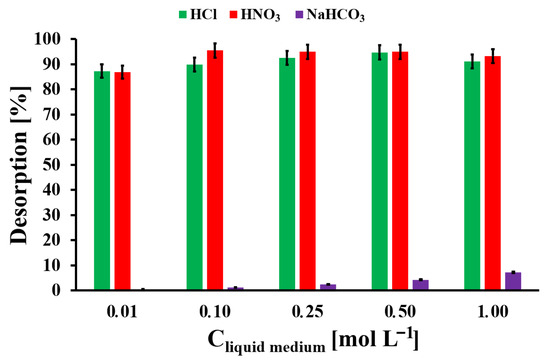
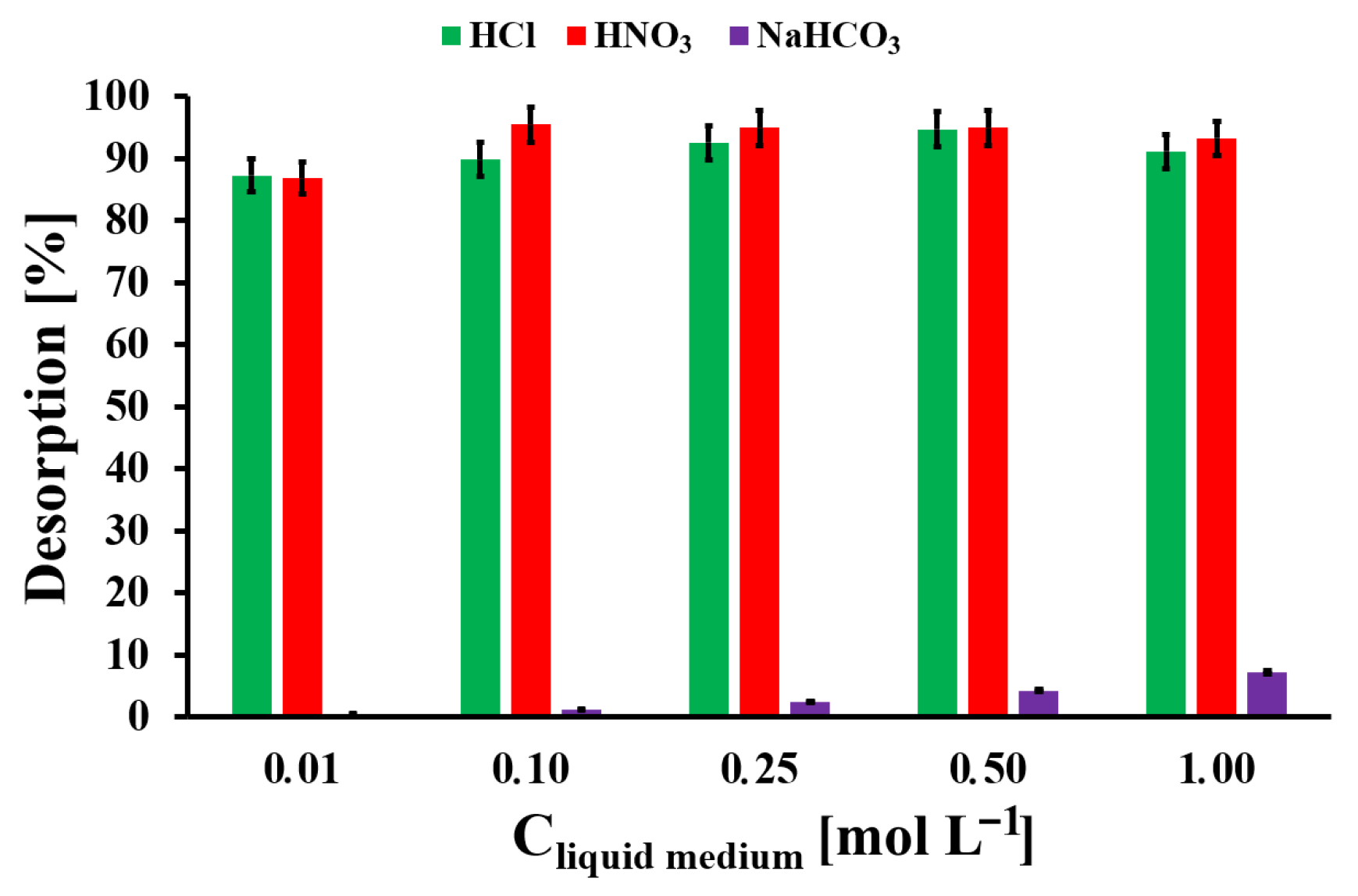
Also, studies on the reusability of the Pb-loaded AOPMC material were conducted using three different liquid media: HCl, HNO3, and NaHCO3(aq) (Figure 10). The best liquid medium, which practically provided the quantitative (100%) Pb desorption from the Pb-loaded AOPMC, was 0.1 mol L−1 HNO3. Similar results were obtained for HCl. It could be the result of the AOPMC surface protonation by the acid and the electrostatic repulsion of the adsorbate ions from the positively charged carbonaceous surface. In turn, the NaHCO3(aq) resulted in a low extent of Pb desorption (<5%). For further studies, 0.1 mol L−1 HNO3 was used, due to the absence of interference in the GFAAS technique (unlike HCl) and its sufficiently low concentration to avoid rapid corrosion of the graphite cuvette.
Figure 10.
The Pb desorption studies from Pb-loaded AOPMC material (APbcarb. = 41.2 mg g−1, mdes. = 5 mg, Vlm = 2 mL, tdes. = 24 h; error bars—precision from triplicate measurements).
3.6. Pb(II) Determination in Simulated Urban Runoff by SS HR-CS GF AAS Technique
The AOPMC carbonaceous material was studied for Pb(II) enrichment from simulated urban runoff and its determination by SS HR-CS GF AAS technique. In order to verify whether the calibration graph based on aqueous Pb standard solutions could be used during determinations by the SS HR-CS GF AAS technique, the absorbance signals for the same Pb amount injected into the graphite tube from the aqueous solution and the AOPMC slurry were compared (Figure S1). The obtained absorbance signals were similar, suggesting that the proposed calibration strategy would be appropriate. The following analytical parameters of the proposed procedure were estimated: the calibration graph linear range of 4–40 µg L−1, the limit of quantification of 2.63 µg L−1 (based on 10 standard deviations of the absorbance for the blank—the AOPMC carbonaceous slurry without adsorbed Pb(II) in 0.1 mol L−1 HNO3–and the slope of the calibration graph) and the recovery of 94.8%. Additionally, the enrichment factor for the proposed analytical procedure was estimated as the ratio of the Pb mass introduced to the graphite atomizer along with the AOPMC carbon to the Pb mass introduced to the graphite atomizer directly from the analyzed sample solution. For the proposed procedure, the enrichment factor of 50 was obtained. In Table 4, the results of Pb determination in the simulated urban runoff samples and SRM1640, using the SS HR-CS GF AAS technique after Pb enrichment with the AOPMC material, are presented. It could be seen that the AOPMC material was successfully applied to the proposed analytical application.
Table 4.
Results of the Pb(II) determination in simulated urban runoff and SRM1640 by SS HR-CS GF AAS.
4. Conclusions
The novel highly porous (>400 m2 g−1) hexagonally ordered mesoporous carbon modified with L-arginine was successfully synthesized and characterized by various physicochemical methods. The L-arginine molecules and their polymeric derivatives were partially incorporated inside the mesoporous channels of the material. The nearly neutral surface of the synthesized material contained both oxygen and nitrogen heteroatoms, which could bond with heavy metal ions such as Pb(II).
The highest adsorption capacity towards Pb(II) ions for the studied material (45 mg g−1) was achieved at pH = 5.3 only after 5 min. The adsorption kinetics were best described by the pseudo-first-order model, suggesting that the diffusion of Pb(II) toward the active surface sites of the studied material controlled the adsorption process. The adsorption isotherm was best fitted by the Langmuir model, indicating that Pb(II) adsorption on the surface of the L-arginine-modified carbonaceous material proceeds via chemisorption.
The adsorption of Pb(II) ions using the synthesized material was driven by surface complexation via nitrogen- and oxygen-containing surface functionalities and/or by surface precipitation as Pb(OH)2.
The material with adsorbed Pb could be easily regenerated with 0.1 mol L−1 HNO3, which protonated the carbonaceous surface and enabled electrostatic repulsion of the adsorbed Pb(II) ions from the material surface. It could substantially decrease the costs of routine analyses by using this material during the enrichment step.
The L-arginine-modified ordered mesoporous carbon was successfully applied to Pb(II) determination in simulated urban runoff using the SS HR-CS GF AAS technique (recovery of 94.8%). It could be used for HRW routine quality control of Pb(II) concentration.
Supplementary Materials
The following supporting information can be downloaded at: https://www.mdpi.com/article/10.3390/ma19071318/s1, Table S1: The composition of the matrix reference material Rain-97; Table S2: The comparison of Pb(II) adsorption performances for mesoporous carbon materials; Table S3: The elemental XPS composition of the Pb-loaded AOPMC material (Pb content: 50 mg/g); Table S4: The participation of the deconvoluted XPS peaks in the intensity of C1s, O1s, N1s and Pb4f XPS signals for Pb-loaded AOPMC material (Pb content: 50 mg g−1); Figure S1: The GF AAS signals for Pb standard solution (10 µg/L) and AOPMC slurry containing Pb (2.14 µg/g).
Author Contributions
Conceptualization, R.O. and R.D.; methodology, R.O. and R.D.; software, R.O. and R.D.; validation, R.O.; formal analysis, R.O.; investigation, R.O.; resources, R.O. and R.D.; data curation, R.O.; writing—original draft preparation, R.O.; writing—review and editing, R.O. and R.D.; visualization, R.O.; supervision, R.D. and A.C.-M. All authors have read and agreed to the published version of the manuscript.
Funding
This research received no external funding.
Institutional Review Board Statement
Not applicable.
Informed Consent Statement
Not applicable.
Data Availability Statement
The original contributions presented in the study are included in the article/Supplementary Materials. Further inquiries can be directed to the corresponding author.
Conflicts of Interest
The authors declare no conflicts of interest.
References
- Nwogu, F.U.; Ubuoh, E.A.; Kanu, S.C. Chemical characteristics and microbiological loads of harvested rainwater run-off from roof tops in South Eastern Nigeria. Discov. Sustain. 2024, 5, 4. [Google Scholar] [CrossRef] [Scilit]
- Faust, B.; Aggarwal, S.; Wilson, B.; Singh, U.; Magner, J. Impacts of impervious surfaces on urban stormwater quality: Minneapolis case study analysis. J. Am. Water Res. Assoc. 2025, 61, e70066. [Google Scholar] [CrossRef] [Scilit]
- Strzebońska, M.; Gruszecka-Kosowska, A.; Kostka, A. Chemistry and microbiology of urban roof runoff in Krakow, Poland with ecological and health risk implications. Appl. Sci. 2020, 10, 8554. [Google Scholar] [CrossRef] [Scilit]
- Bañas, K.; Robles, M.E.; Maniquiz-Redillas, M. Stormwater harvesting from roof catchments: A review of design, efficiency, and sustainability. Water 2023, 15, 1774. [Google Scholar] [CrossRef] [Scilit]
- Dobrzyńska, J.; Mróz, A.; Olchowski, R.; Zięba, E.; Dobrowolski, R. Modified multi-walled carbon nanotubes as effective Pt(IV) ions adsorbent with respect to analytical application. Appl. Surf. Sci. 2022, 602, 154388. [Google Scholar] [CrossRef] [Scilit]
- Pyrzyńska, K. Carbon nanostructures for separation, preconcentration and speciation of metal ions. TrAC Trends Anal. Chem. 2010, 29, 718–727. [Google Scholar] [CrossRef] [Scilit]
- Jagirani, M.S.; Soylak, M. A review: Recent advances in solid phase microextraction of toxic pollutants using nanotechnology scenario. Microchem. J. 2020, 159, 105436. [Google Scholar] [CrossRef] [Scilit]
- Zavalyueva, A.S.; Karpov, S.I.; Zatonskaya, N.A.; Selemenev, V.F. Ordered mesoporous silicas in modern versions of solid-phase extraction. J. Anal. Chem. 2025, 80, 1–14. [Google Scholar] [CrossRef] [Scilit]
- El Ouardi, Y.; Giove, A.; Laatikainen, M.; Branger, C.; Laatikainen, K. Benefit of ion imprinting technique in solid-phase extraction of heavy metals, special focus on the last decade. J. Environ. Chem. Eng. 2021, 9, 106548. [Google Scholar] [CrossRef] [Scilit]
- Caliskan, C.E. Solid phase extraction of Co(II) using activated carbon obtained from grape stalk prior to high-resolution continuum source flame atomic absorption spectrometric detection. Iran. J. Chem. Chem. Eng. 2023, 42, 1282–1293. [Google Scholar]
- Al-Ahmadi, M.N.; Saigl, Z.M.; Al-khateeb, L.A.; Alshareef, F.M.; El-Shahawi, M.S. A novel solid platform-based Ag nanoparticles chemically impregnated activated carbon for selective separation of tungstate species in water: Kinetics and thermodynamic study. Water Air Soil Pollut. 2020, 231, 456. [Google Scholar] [CrossRef] [Scilit]
- Shahryari, T.; Singh, P.; Raizada, P.; Davidyants, A.; Thangavelu, L.; Sivamani, S.; Naseri, A.; Vahidipour, F.; Ivanets, A.; Hosseini-Bandegharaei, A. Adsorption properties of danthron-impregnated carbon nanotubes and their usage for solid phase extraction of heavy metal ions. Coll. Surf. A Phys. Eng. Asp. 2022, 641, 128528. [Google Scholar] [CrossRef] [Scilit]
- Manousi, N.; Deliyanni, E.; Zachariadis, G. Multi-element determination of toxic and nutrient elements by ICP-AES after dispersive solid-phase extraction with modified graphene oxide. Appl. Sci. 2020, 10, 8722. [Google Scholar] [CrossRef] [Scilit]
- Kumar, A.; Srivastava, S.; Bosetti, P.; Kumar, V.; Tiwari, D.K.; Mishra, D.P.; Chandel, V.S.; Srivastava, S. ZnO-RGO nanocomposite based electrochemical sensing platform for highly sensitive and selective detection of Cd2+ ions. Diam. Relat. Mater. 2025, 159, 112873. [Google Scholar] [CrossRef] [Scilit]
- Zhang, J.; Zhang, N.; Tack, F.M.G.; Sato, S.; Alessi, D.S.; Oleszczuk, P.; Wang, H.L.; Wang, X.Z.; Wang, S.S. Modification of ordered mesoporous carbon for removal of environmental contaminants from aqueous phase: A review. J. Hazard. Mater. 2021, 418, 126266. [Google Scholar] [CrossRef] [Scilit]
- Gang, D.; Ahmad, Z.U.; Lian, Q.Y.; Yao, L.G.; Zappi, M.E. A review of adsorptive remediation of environmental pollutants from aqueous phase by ordered mesoporous carbon. Chem. Eng. J. 2021, 403, 126286. [Google Scholar] [CrossRef] [Scilit]
- Olchowski, R.; Morlo, K.; Chałabis-Mazurek, A.; Dobrowolski, R.; Tyszczuk-Rotko, K. Modified ordered mesoporous carbons for Cr(VI) removal from wastewater. Materials 2024, 17, 2881. [Google Scholar] [CrossRef] [Scilit] [PubMed]
- Olchowski, R.; Zięba, E.; Giannakoudakis, D.I.; Anastopoulos, I.; Dobrowolski, R.; Barczak, M. Tailoring surface chemistry of sugar-derived ordered mesoporous carbons towards efficient removal of diclofenac from aquatic environments. Materials 2020, 13, 1625. [Google Scholar] [CrossRef] [Scilit]
- Revellame, E.D.; Fortela, D.L.; Sharp, W.; Hernandez, R.; Zappi, M.E. Adsorption kinetic modeling using pseudo-first order and pseudo-second order rate laws: A review. Clean. Eng. Technol. 2020, 1, 100032. [Google Scholar] [CrossRef] [Scilit]
- Jeppua, G.P.; Clement, T.P. A modified Langmuir-Freundlich isotherm model for simulating pH-dependent adsorption effects. J. Contam. Hydrol. 2012, 129–130, 46–53. [Google Scholar] [CrossRef] [Scilit]
- Montoya-Mayor, R.; Fernández-Espinosa, A.J.; Ternero-Rodríguez, M. Assessment of the sequential principal component analysis chemometric tool to identify the soluble atmospheric pollutants in rainwater. Anal. Bioanal. Chem. 2011, 399, 2031–2041. [Google Scholar] [CrossRef] [Scilit]
- Malec, A.; Borowski, G. The usage of spectroscopy methods for marking the content of elements and ions. Ecol. Eng. Environ. Technol. 2014, 40, 228–238. [Google Scholar] [CrossRef]
- Juárez, J.M.; Costa, M.B.G.; Anunziat, O.A. Synthesis and characterization of Pt-CMK-3 hybrid nanocomposite for hydrogen storage. Int. J. Energy Res. 2015, 39, 128–139. [Google Scholar] [CrossRef] [Scilit]
- Barrera, D.; Dávila, M.; Cornette, V.; de Oliveira, J.C.A.; López, R.H.; Sapag, K. Pore size distribution of ordered nanostructured carbon CMK-3 by means of experimental techniques and Monte Carlo simulations. Microporous Mesoporous Mater. 2013, 180, 71–78. [Google Scholar] [CrossRef] [Scilit]
- Zieliński, W.; Rajca, A. Spectroscopic Methods and Their Application for Organic Compounds Identification, 2nd ed.; PWN: Warsaw, Poland, 2000. [Google Scholar]
- Koinuma, M.; Tateishi, H.; Hatakeyama, K.; Miyamoto, S.; Ogata, C.; Funatsu, A.; Taniguchi, T.; Matsumoto, Y. Analysis of reduced graphene oxides by X-ray photoelectron spectroscopy and electrochemical capacitance. Chem. Lett. 2013, 42, 924–926. [Google Scholar] [CrossRef] [Scilit]
- Oh, Y.J.; Yoo, J.J.; Kim, Y.I.; Yoon, J.K.; Yoon, H.N.; Kim, J.H.; Park, S.B. Oxygen functional groups and electrochemical capacitive behavior of incompletely reduced graphene oxides as a thin-film electrode of supercapacitor. Electrochim. Acta 2014, 116, 118–128. [Google Scholar] [CrossRef] [Scilit]
- Barinov, A.; Malcioǧlu, O.B.; Fabris, S.; Sun, T.; Gregoratti, L.; Dalmiglio, M.; Kiskinova, M. Initial stages of oxidation on graphitic surfaces: Photoemission study and density functional theory calculations. J. Phys. Chem. C 2009, 113, 9009–9013. [Google Scholar] [CrossRef] [Scilit]
- Raicopol, M.; Andronescu, C.; Atasiei, R.; Hanganu, A.; Pilan, L. Post-polymerization electrochemical functionalization of a conducting polymer: Diazonium salt electroreduction at polypyrrole electrodes. J. Electrochem. Soc. 2014, 161, G103–G113. [Google Scholar] [CrossRef] [Scilit]
- Niu, Z.; Zhang, S.; Ma, M.; Wang, Z.; Zhao, H.; Wang, Y. Synthesis of novel waste batteries-sawdust-based adsorbent via a two-stage activation method for Pb2+ removal. Environ. Sci. Pollut. Res. 2019, 26, 4730–4745. [Google Scholar] [CrossRef] [Scilit]
- Cagnon, B.; Chatelain, S.; de Oliveira, T.F.; Versaveau, F.; Delpeux, S.; Chedeville, O. Adsorption of phthalates on activated carbons in monosolute solution and in mix within complex matrices. Water Air Soil Pollut. 2017, 228, 144. [Google Scholar] [CrossRef] [Scilit]
- Noszál, B.; Kassai-Tánczos, R. Microscopic acid-base equilibria of arginine. Talanta 1991, 38, 1439–1444. [Google Scholar] [CrossRef] [Scilit] [PubMed]
- Sangoremi, A.A. Adsorption kinetic models and their applications: A critical review. Int. J. Res. Sci. Innov. 2025, XII, 245–258. [Google Scholar] [CrossRef] [Scilit]
- Juntarasakul, O.; Roongcharoen, P.; Tabelin, C.B.; Phengsaart, T. Municipal solid waste incineration (MSWI) fly ash as a potential adsorbent for phosphate removal. Sustainability 2024, 16, 8869. [Google Scholar] [CrossRef] [Scilit]

Disclaimer/Publisher’s Note: The statements, opinions and data contained in all publications are solely those of the individual author(s) and contributor(s) and not of MDPI and/or the editor(s). MDPI and/or the editor(s) disclaim responsibility for any injury to people or property resulting from any ideas, methods, instructions or products referred to in the content. |
© 2026 by the authors. Licensee MDPI, Basel, Switzerland. This article is an open access article distributed under the terms and conditions of the Creative Commons Attribution (CC BY) license.