Artificial Intelligence in Metal Additive Manufacturing: Applications in Design, Process Modeling, Monitoring, and Quality Optimization




Highlights
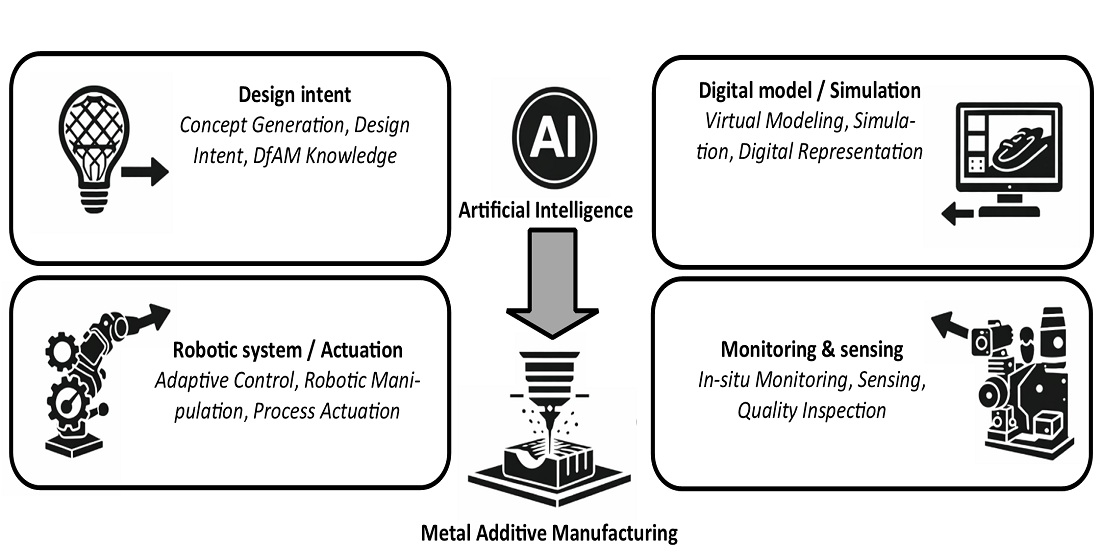
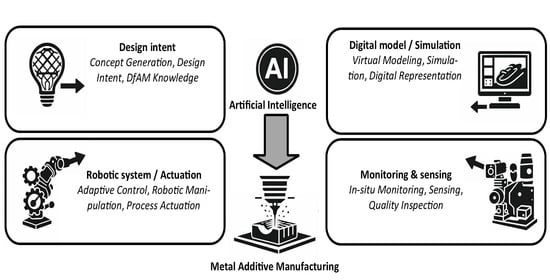
- AI supports DfAM, parameter selection, monitoring, and certification in metal AM.
- ML/DL can predict defects, distortion, and properties from in situ and ex-situ data.
- Hybrid physics–ML models and digital twins are the most promising scalable approach.
- Faster parameter qualification can reduce trial-and-error, scrap, and post-processing.
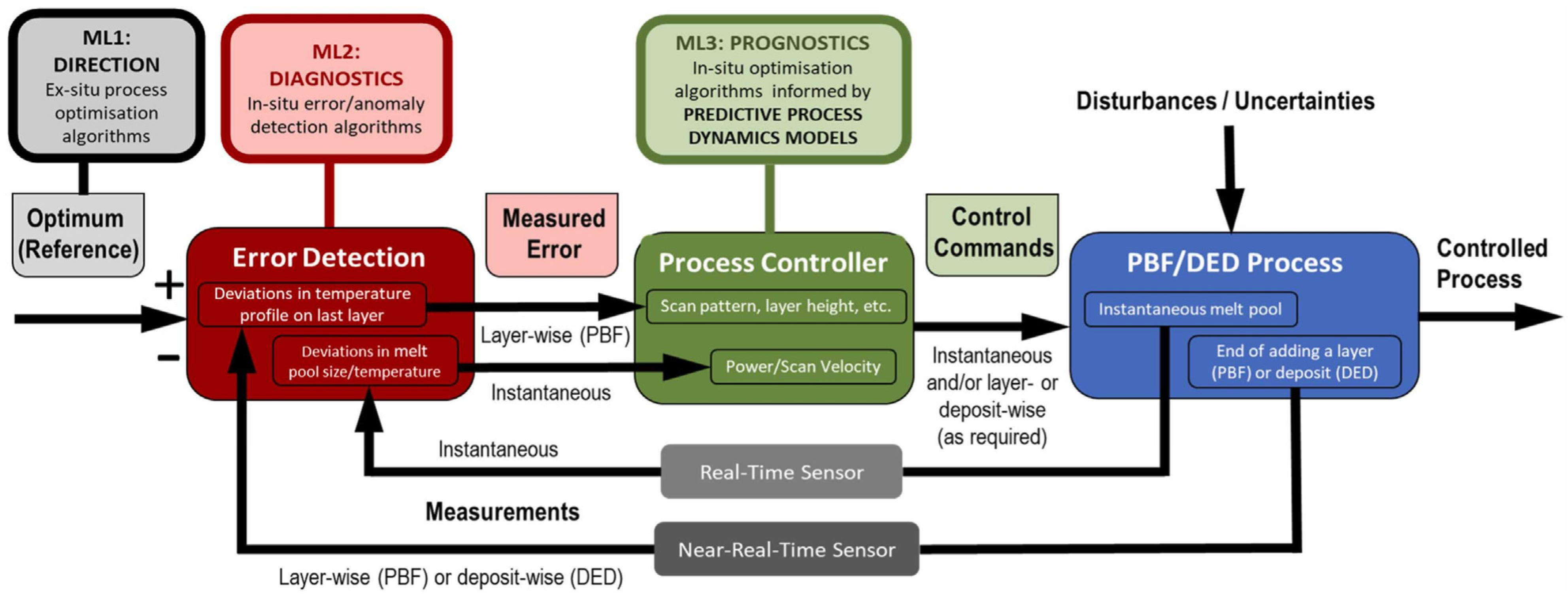
- Closed-loop control with multi-sensor fusion can improve consistency and reliability.
- Standard datasets, uncertainty quantification, and validation are key for adoption.
Abstract
1. Introduction
2. Fundamentals of Metal Additive Manufacturing
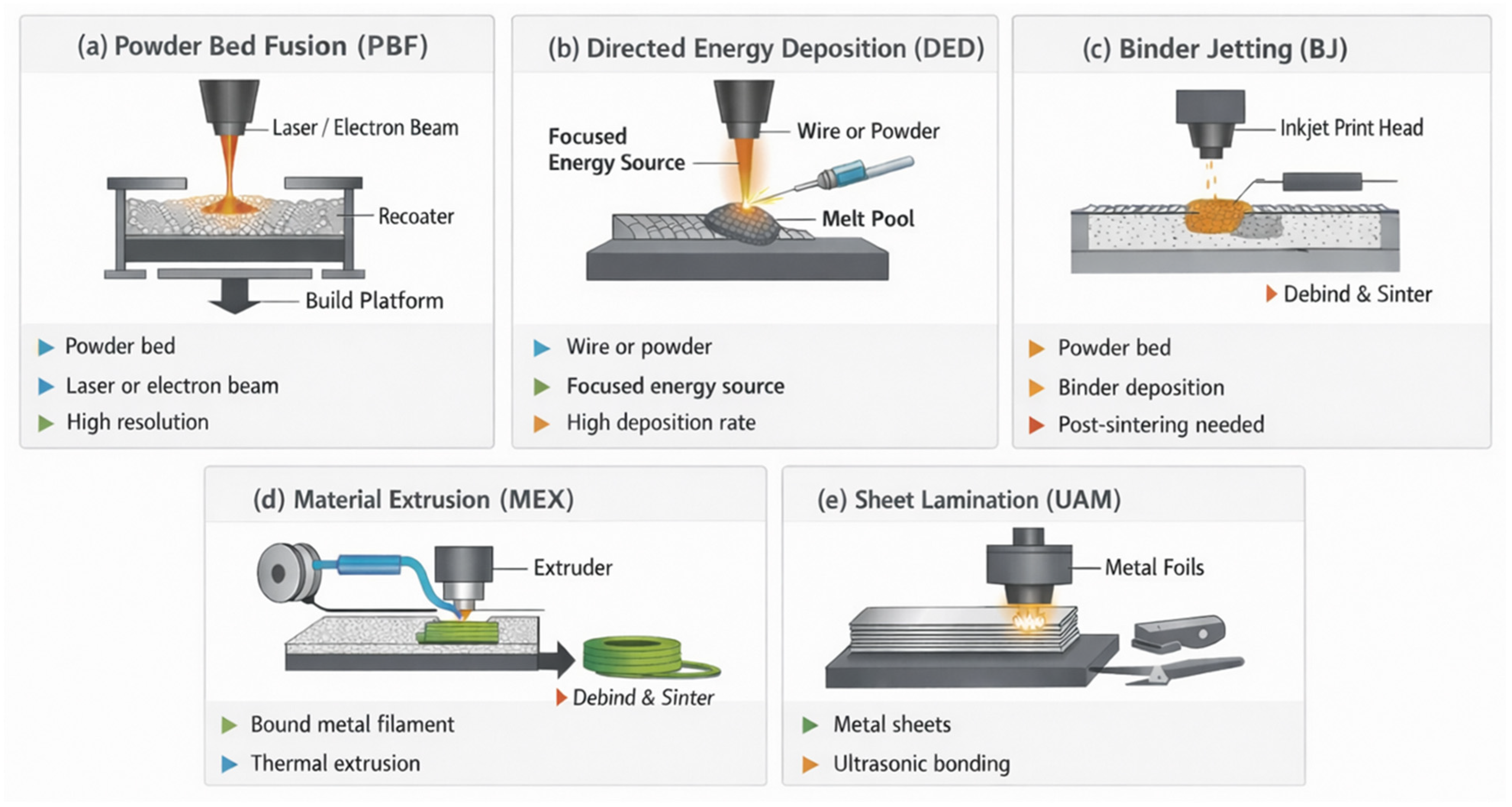
- Powder Bed Fusion (PBF-LB/M or PBF-EB/M): This group includes laser-based powder bed fusion (Laser Beam Powder Bed Fusion, PBF-LB/M) [17] and electron-beam powder bed fusion (Electron Beam Powder Bed Fusion, PBF-EB/M) [18]. Both rely on depositing thin layers of metal powder that are selectively melted by an energy source. These technologies stand out for high geometric resolution and excellent surface finish, making them suitable for producing parts with high dimensional accuracy and superior mechanical properties. Their main limitations are reduced build volume, high costs associated with laser or vacuum systems, and limited productivity compared to other methods [19].
- Directed Energy Deposition (DED): This family includes technologies such as Wire Arc Additive Manufacturing (WAAM or DED-ARC/W) [20] and Laser-Metal Deposition (LMD or DED-LB/M) [21] with metal powder. Unlike powder bed processes, here the material (wire or powder) is delivered in a focused manner onto the part and melted by an energy source (laser, electron beam, or electric arc). The main attraction of DED—and particularly DED-ARC/W—is its high deposition rate, enabling faster production of large components at relatively low cost. However, these technologies offer lower geometric resolution and often require post-machining to reach adequate tolerances and finishes [22].
- Binder Jetting and hybrid technologies: Although less mature in metals, Binder Jetting and hybrid processes combined with CNC machining are gaining interest. They enable rapid production of complex geometries with higher productivity than powder bed technologies, although mechanical properties may be lower due to the need for additional sintering or infiltration steps [23].
- Material Extrusion (MEX/Bound Metal Deposition): Metal material extrusion technologies deposit a filament or pellet feedstock composed of metal powder bound in a polymer matrix, which is subsequently subjected to debinding and sintering to obtain a dense metallic component. These processes are gaining attention due to their lower equipment cost and accessibility compared with powder bed fusion systems. However, dimensional shrinkage during sintering and the control of densification remain important challenges that affect final accuracy and mechanical properties [24,25].
- Sheet Lamination (Ultrasonic Additive Manufacturing–UAM): Sheet lamination processes build components by bonding thin metal sheets layer by layer, typically through ultrasonic welding, followed by machining to achieve the final geometry. This approach enables the fabrication of multi-material structures and the integration of embedded sensors or cooling channels during manufacturing. Nevertheless, the achievable geometric complexity and mechanical bonding quality between layers remain areas of ongoing research [26,27,28].
2.1. Advantages and Technical Challenges of MAM

| Aspect | Advantages | Technical Challenges |
|---|---|---|
| Design | Full geometric freedom, complex structures, topology optimization [43]. | Limitations in dimensional accuracy and surface finish for certain technologies (e.g., DED-ARC/W, DED-LB/M) [44,45]. |
| Materials | Reduced material waste vs. machining. Use of recyclable metal powders and wires. | High cost of raw materials. Possible oxidation or contamination depending on alloy sensitivity and processing atmosphere [1,46]. |
| Mechanical properties | High density and strength in PBF-LB/M and PBF-EB/M. Lightweight and functional structures [39]. | Microstructural variability. Internal defects (porosity, cracks) [47]. |
| Processes | On-demand production. Repair and coating of existing parts [48]. | Complexity of parameter control. Thermal distortions and residual stresses [49]. |
| Applications | Custom biomedical components. Critical parts in aerospace, energy, and automotive [50]. | Lack of consolidated standards and certification frameworks for industry [51]. |
| Economics | Reduced lead times and inventory. | High costs of equipment, post-processing, and maintenance [52]. |
2.2. Potential of Artificial Intelligence in MAM
3. Overview of Artificial Intelligence in Engineering and Manufacturing
- Machine Learning (ML): algorithms capable of identifying patterns and hidden relationships in large volumes of data, enabling prediction and classification without explicitly programming every system rule.
- Deep Learning (DL): a subfield of ML based on deep neural networks, especially useful for processing images, signals, and unstructured data, making it a key tool for real-time monitoring of industrial processes.
- Artificial Neural Networks (ANN): structures inspired by biological nervous systems, capable of approximating complex nonlinear functions and modeling complex physical phenomena.
- Evolutionary and metaheuristic algorithms: techniques inspired by natural processes such as genetic selection or evolution, enabling the solution of multidimensional optimization problems, such as process-parameter allocation or complex geometry design.
4. AI Applications in Metal Additive Manufacturing
4.1. Design Optimization for MAM (DfAM)
4.2. Simulation and Process Modeling
| Aspect | Physics-Based Simulations (FEM/FEA) | AI/Machine Learning Models | Hybrid Approaches |
|---|---|---|---|
| Accuracy | Very high with good meshing and experimental validation [70,71] | Dependent on training data quality and representativeness [76,77] | High, combining fast prediction with physical validation [78,79] |
| Computational cost | High: hours or days on HPC for full simulations [72] | Low after training: predictions in seconds or milliseconds [73,75] | Medium: orders-of-magnitude reduction via ROM and GPUs [83,84] |
| Real-time applicability | Limited to offline analysis; not viable for online control | High: suitable for online monitoring and parameter tuning [67,73] | Very high: suited for closed-loop control and digital twins [78,86] |
| Limitations | Sensitive to mesh quality; high simulation cost [71] | Overfitting risk; poor extrapolation if data are not representative [91,92] | Requires hybrid datasets and continuous experimental validation [93] |
4.3. Quality Control and Real-Time Monitoring
4.4. Digital Twins and Smart Manufacturing
| Application Category | Key Sub-Applications | AI Methods Used | Examples of Use in MAM |
|---|---|---|---|
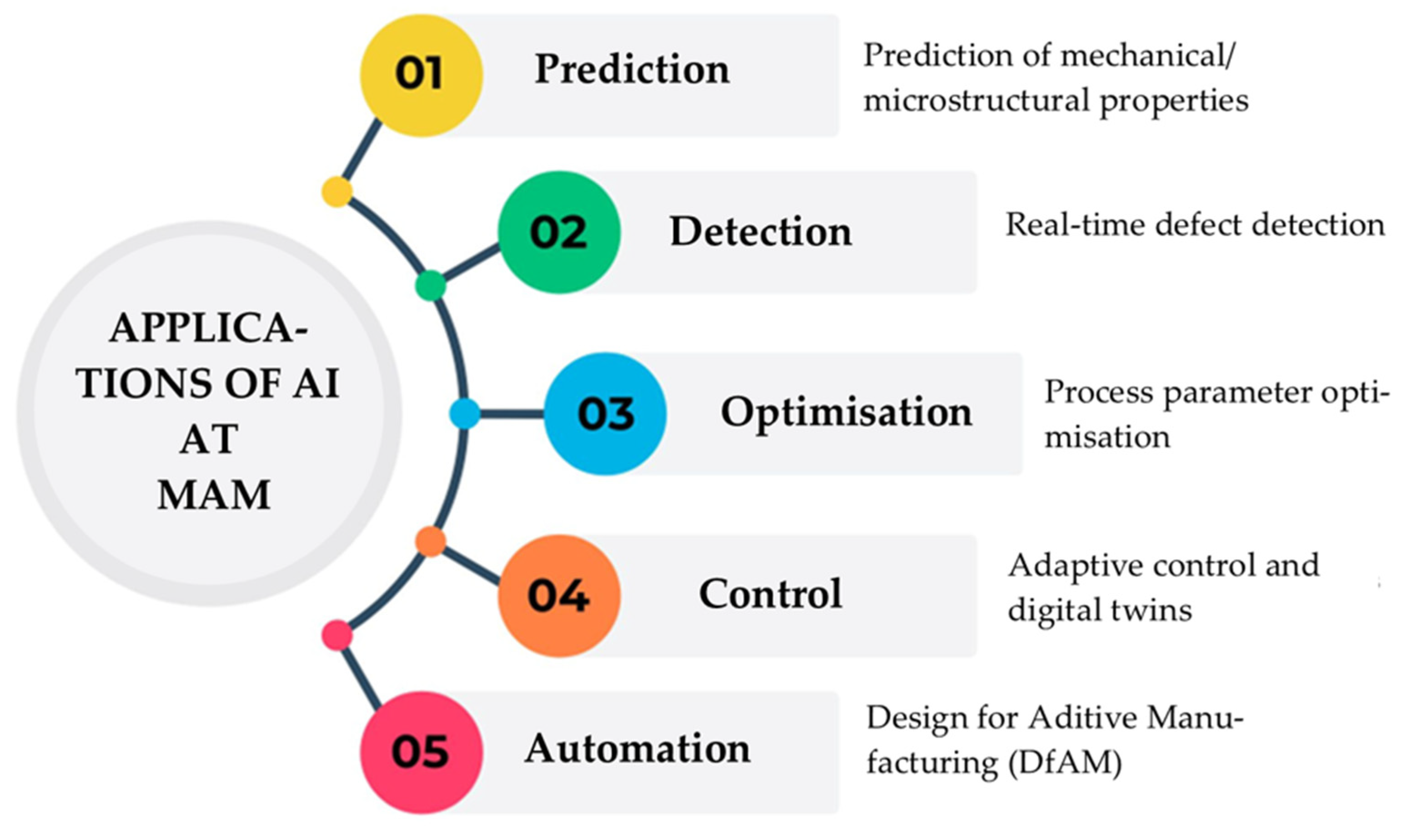
| Design and Optimization | Generative Design | Evolutionary algorithms, generative neural networks | Creation of organic and lightweight structures for aerospace components, reducing the weight of an engine bracket [116,117]. |
| Topology Optimization | ML-based optimization algorithms | Material reduction in a medical implant to improve integration and reduce weight while maintaining strength [45,118]. | |
| Simulation and Modeling | Predictive process models | Neural networks, regression models (SVM, decision trees) | Prediction of deformation and residual stresses in a part before printing to adjust parameters and avoid failures [40]. |
| Microstructure modeling | Convolutional neural networks (CNN) | Prediction of grain structure and hardness based on scanning strategy and laser power [119,120]. | |
| Quality Control and Monitoring | Real-time defect detection | Computer vision, deep learning | Use of thermal cameras to detect porosity, spatter, or cracks in the powder bed during manufacturing [121]. |
| Multi-sensor monitoring | Data fusion, reinforcement learning | Combining acoustic and optical sensor data to identify anomalies and autonomously adjust parameters [122]. | |
| Parameter Optimization | Parameter planning | Genetic algorithms, neural networks | Multi-objective optimization to find the ideal scanning speed and laser power that maximize density and minimize roughness [123]. |
| Adaptive control | Reinforcement learning | The system learns to modulate laser power and speed in real time to maintain an optimal, constant melt temperature [124]. | |
| Property Analysis | Mechanical property prediction | Neural networks, regression algorithms | Prediction of hardness, tensile strength, and fatigue strength based on manufacturing data [125]. |
| Service life prediction | Advanced regression models | Estimation of part lifetime (e.g., a turbine or implant) for predictive maintenance applications [126]. | |
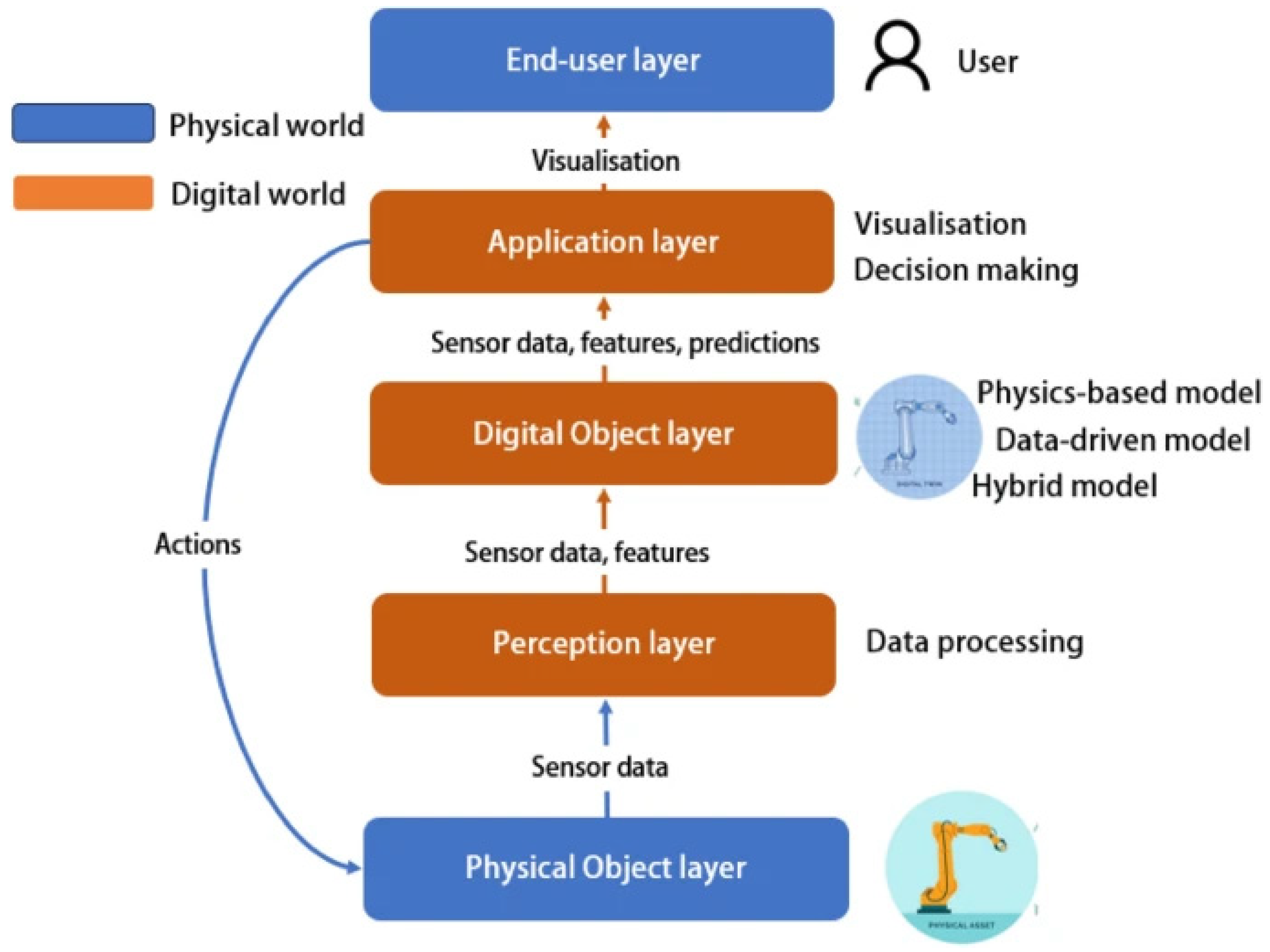
| Systems Integration | Digital twins | Hybrid models (simulation + ML) | Creation of a virtual replica of a part that predicts performance under different loads and service temperatures [127]. |
| Smart manufacturing | AI-based autonomous systems | A fully interconnected factory where 3D printers adjust processes and communicate with each other to optimize production [128]. |
5. Critical Comparison and Emerging Trends
6. Conclusions
Author Contributions
Funding
Institutional Review Board Statement
Informed Consent Statement
Data Availability Statement
Conflicts of Interest
References
- Blakey-Milner, B.; Gradl, P.; Snedden, G.; Brooks, M.; Pitot, J.; Lopez, E.; Leary, M.; Berto, F.; du Plessis, A. Metal Additive Manufacturing in Aerospace: A Review. Mater. Des. 2021, 209, 110008. [Google Scholar] [CrossRef] [Scilit]
- Sarzyński, B.; Śnieżek, L.; Grzelak, K. Metal Additive Manufacturing (MAM) Applications in Production of Vehicle Parts and Components—A Review. Metals 2024, 14, 195. [Google Scholar] [CrossRef] [Scilit]
- Obiora, N.K.; Ujah, C.O.; Kunar, S.; Olubambi, P.A.; Von Kallon, D.V. Metal Additive Manufacturing. In Digital Manufacturing; John Wiley & Sons, Ltd.: Hoboken, NJ, USA, 2025; pp. 187–221. ISBN 978-1-394-36537-1. [Google Scholar]
- Murr, L.E. Additive Manufacturing of Biomedical Devices: An Overview. Mater. Technol. 2018, 33, 57–70. [Google Scholar] [CrossRef] [Scilit]
- Boretti, A. Metal Additive Manufacturing for Internal Combustion Engine Components: A Narrative Review of Applications, Materials, Processes, Challenges, and Future Directions. Int. J. Adv. Manuf. Technol. 2025, 139, 6355–6397. [Google Scholar] [CrossRef] [Scilit]
- Ramos, A.; Angel, V.G.; Siqueiros, M.; Sahagun, T.; Gonzalez, L.; Ballesteros, R. Reviewing Additive Manufacturing Techniques: Material Trends and Weight Optimization Possibilities Through Innovative Printing Patterns. Materials 2025, 18, 1377. [Google Scholar] [CrossRef] [Scilit]
- Badoniya, P.; Srivastava, M.; Jain, P.K.; Rathee, S. A State-of-the-Art Review on Metal Additive Manufacturing: Milestones, Trends, Challenges and Perspectives. J. Braz. Soc. Mech. Sci. Eng. 2024, 46, 339. [Google Scholar] [CrossRef] [Scilit]
- Sæterbø, M.; Solvang, W.D. Metal Additive Manufacturing Adoption in SMEs: Technical Attributes, Challenges, and Opportunities. J. Manuf. Process. 2024, 128, 175–189. [Google Scholar] [CrossRef] [Scilit]
- Zhang, J.; Farbiz, F.; Jafary-Zadeh, M.; Sing, S.L. From Detection to Forecasting: Utilizing Time-Series Foundation Models to Anticipate Defects in Metal Additive Manufacturing. J. Manuf. Process. 2025, 150, 1040–1052. [Google Scholar] [CrossRef] [Scilit]
- Kalla, D. Adoption of Digital Twin and Artificial Intelligence in Metal Additive Manufacturing: Current Status and Vision for Future. In Proceedings of the 2024 ASEE Annual Conference & Exposition, Oregon, OR, USA, 23–26 June 2024. [Google Scholar]
- Chen, K.; Zhang, P.; Yan, H.; Chen, G.; Sun, T.; Lu, Q.; Chen, Y.; Shi, H. A Review of Machine Learning in Additive Manufacturing: Design and Process. Int. J. Adv. Manuf. Technol. 2024, 135, 1051–1087. [Google Scholar] [CrossRef] [Scilit]
- Özel, T. Deep Learning-Based Applications in Metal Additive Manufacturing Processes: Challenges and Opportunities–A Review. Int. J. Lightweight Mater. Manuf. 2025, 8, 453–468. [Google Scholar] [CrossRef] [Scilit]
- Su, J.; Mo, Y.; Sing, S.L. Generative Artificial Intelligence in Lattice Structure Design for Additive Manufacturing: A Critical Review. Eng. Sci. Addit. Manuf. 2025, 1, 025110006. [Google Scholar] [CrossRef] [Scilit]
- Snyder, H. Literature Review as a Research Methodology: An Overview and Guidelines. J. Bus. Res. 2019, 104, 333–339. [Google Scholar] [CrossRef] [Scilit]
- Page, M.J.; McKenzie, J.E.; Bossuyt, P.M.; Boutron, I.; Hoffmann, T.C.; Mulrow, C.D.; Shamseer, L.; Tetzlaff, J.M.; Akl, E.A.; Brennan, S.E.; et al. The PRISMA 2020 Statement: An Updated Guideline for Reporting Systematic Reviews. BMJ 2021, 372, n71. [Google Scholar] [CrossRef] [Scilit] [PubMed]
- Gulanová, J.; Kister, I.; Káčer, N.; Gulan, L. A Comparative Study of Various AM Technologies Based on Their Accuracy. Procedia CIRP 2018, 67, 238–243. [Google Scholar] [CrossRef] [Scilit]
- Jarlöv, A.; Zhu, Z.; Ji, W.; Gao, S.; Hu, Z.; Vivegananthan, P.; Tian, Y.; Kripalani, D.R.; Fan, H.; Seet, H.L.; et al. Recent Progress in High-Entropy Alloys for Laser Powder Bed Fusion: Design, Processing, Microstructure, and Performance. Mater. Sci. Eng. R Rep. 2024, 161, 100834. [Google Scholar] [CrossRef] [Scilit]
- Mehta, A.K.; Gote, G.; Mittal, Y.G.; Patil, Y.; Karunakaran, K.P. Powder Smoking Phenomenon in Electron Beam Powder Bed Fusion: A Comprehensive Review of Prediction, Monitoring and Mitigation Methods. J. Manuf. Process. 2024, 127, 314–327. [Google Scholar] [CrossRef] [Scilit]
- Dejene, N.D.; Lemu, H.G. Current Status and Challenges of Powder Bed Fusion-Based Metal Additive Manufacturing: Literature Review. Metals 2023, 13, 424. [Google Scholar] [CrossRef] [Scilit]
- Williams, S.W.; Martina, F.; Addison, A.C.; Ding, J.; Pardal, G.; Colegrove, P. Wire + Arc Additive Manufacturing. Mater. Sci. Technol. 2016, 32, 641–647. [Google Scholar] [CrossRef] [Scilit]
- John Solomon, I.; Sevvel, P.; Gunasekaran, J.; Tanushkumaar, P. A Review on Additive Manufacturing of Alloys Using Laser Metal Deposition. Mater. Today Proc. 2022, 64, 44–50. [Google Scholar] [CrossRef] [Scilit]
- Rauch, M.; Hascoet, J.-Y. A Comparison of Post-Processing Techniques for Additive Manufacturing Components. Procedia CIRP 2022, 108, 442–447. [Google Scholar] [CrossRef] [Scilit]
- Blunk, H.; Seibel, A. Design Guidelines for Metal Binder Jetting. Prog. Addit. Manuf. 2024, 9, 725–732. [Google Scholar] [CrossRef] [Scilit]
- Musa, N.H.; Mohd Yusuf, S.; Abu Mansor, M.R.; Abdul Kadir, A.Z.; Suhaimi, M.A.; Gao, N.; Yang, S. Material Extrusion (MEX)-Based Additive Manufacturing of Metallic Materials: Review of Current Trends, Challenges, and Opportunities. Int. J. Adv. Manuf. Technol. 2025, 141, 5903–5929. [Google Scholar] [CrossRef] [Scilit]
- Sadaf, M.; Bragaglia, M.; Perše, L.S.; Nanni, F. Advancements in Metal Additive Manufacturing: A Comprehensive Review of Material Extrusion with Highly Filled Polymers. J. Manuf. Mater. Process. 2024, 8, 14. [Google Scholar] [CrossRef] [Scilit]
- Xu, C.; Cheng, Y.; Zhou, Y.; Sun, M.; Wang, Z.; He, X.; Guo, C.; Jiang, F. Structural–Functional Components via Ultrasonic Additive Manufacturing: A Review of Fabrication and Functionality. Int. J. Adv. Manuf. Technol. 2026, 143, 1341–1365. [Google Scholar] [CrossRef] [Scilit]
- Xu, C.; Cheng, Y.; Zhou, Y.; He, X.; Li, H.; Niu, Z.; Wang, Z. Copper-Coated FBG Sensor Embedded in Cu/Al Laminated Metal Composites via Ultrasonic Additive Manufacturing. Opt. Laser Technol. 2026, 194, 114450. [Google Scholar] [CrossRef] [Scilit]
- Behvar, A.; Shakil, S.I.; Pirgazi, H.; Norfolk, M.; Haghshenas, M. Multi-Layer Solid-State Ultrasonic Additive Manufacturing of Aluminum/Copper: Local Properties and Texture. Int. J. Adv. Manuf. Technol. 2024, 132, 2061–2075. [Google Scholar] [CrossRef] [Scilit]
- De Leon, E.; Riensche, A.; Bevans, B.D.; Billings, C.; Siddique, Z.; Liu, Y. A Review of Modeling, Simulation, and Process Qualification of Additively Manufactured Metal Components via the Laser Powder Bed Fusion Method. J. Manuf. Mater. Process. 2025, 9, 22. [Google Scholar] [CrossRef] [Scilit]
- Chowdhury, S.; Yadaiah, N.; Prakash, C.; Ramakrishna, S.; Dixit, S.; Gupta, L.R.; Buddhi, D. Laser Powder Bed Fusion: A State-of-the-Art Review of the Technology, Materials, Properties & Defects, and Numerical Modelling. J. Mater. Res. Technol. 2022, 20, 2109–2172. [Google Scholar] [CrossRef] [Scilit]
- Jiao, M.; Long, H.; Xiao, B.; Liang, X.; Lin, F. Electron Beam Powder Bed Fusion Additive Manufacturing: A Comprehensive Review and Its Development in China. Addit. Manuf. Front. 2024, 3, 200177. [Google Scholar] [CrossRef] [Scilit]
- Grasso, M.; Colosimo, B.M. A Review of the Current State-of-the-Art on in Situ Monitoring in Electron Beam Powder Bed Fusion. Prog. Addit. Manuf. 2024, 9, 1449–1466. [Google Scholar] [CrossRef] [Scilit]
- Piscopo, G.; Atzeni, E.; Saboori, A.; Salmi, A. An Overview of the Process Mechanisms in the Laser Powder Directed Energy Deposition. Appl. Sci. 2023, 13, 117. [Google Scholar] [CrossRef] [Scilit]
- Svetlizky, D.; Das, M.; Zheng, B.; Vyatskikh, A.L.; Bose, S.; Bandyopadhyay, A.; Schoenung, J.M.; Lavernia, E.J.; Eliaz, N. Directed Energy Deposition (DED) Additive Manufacturing: Physical Characteristics, Defects, Challenges and Applications. Mater. Today 2021, 49, 271–295. [Google Scholar] [CrossRef] [Scilit]
- Li, Y.; Su, C.; Zhu, J. Comprehensive Review of Wire Arc Additive Manufacturing: Hardware System, Physical Process, Monitoring, Property Characterization, Application and Future Prospects. Results Eng. 2022, 13, 100330. [Google Scholar] [CrossRef] [Scilit]
- Ziaee, M.; Crane, N.B. Binder Jetting: A Review of Process, Materials, and Methods. Addit. Manuf. 2019, 28, 781–801. [Google Scholar] [CrossRef] [Scilit]
- Zhu, B.; Li, R.; Yuan, T.; Li, W.; Cai, D.; Kang, N. Metal Binder Jetting Additive Manufacturing: An Overview of the Process, Materials and Reinforcement Methods. J. Alloys Compd. 2025, 1037, 182196. [Google Scholar] [CrossRef] [Scilit]
- Sedlacek, F.; Kalina, T.; Stepanek, M. Optimization of Components with Topology Optimization for Direct Additive Manufacturing by DLMS. Materials 2023, 16, 5422. [Google Scholar] [CrossRef] [Scilit]
- Velasco-Castro, M.; León-Cázares, F.D.; Galindo-Nava, E.I. A Comprehensive Review of Microstructural Heterogeneities in the Laser Powder Bed Fusion of Nickel-Base Superalloys with High Γ′ Content. Mater. Des. 2024, 247, 113416. [Google Scholar] [CrossRef] [Scilit]
- Wu, S.-H.; Tariq, U.; Joy, R.; Sparks, T.; Flood, A.; Liou, F. Experimental, Computational, and Machine Learning Methods for Prediction of Residual Stresses in Laser Additive Manufacturing: A Critical Review. Materials 2024, 17, 1498. [Google Scholar] [CrossRef] [Scilit]
- Daskalakis, A.; Suchorska-Woźniak, P.; Rac-Rumijowska, O.; Korbutowicz, R. Optimization of the Photocatalytic Testing Setup Using FFF/FDM 3D Printing Technology. Int. J. Adv. Manuf. Technol. 2026, 143, 2125–2138. [Google Scholar] [CrossRef] [Scilit]
- Surner, N.; Fuse, K.; Wakchaure, K.; Patel, V. Wire Arc Additive Manufacturing: A Review on Quality Enhancement Using Nano-Particle Reinforcement. J. Mater. Res. Technol. 2026, 41, 834–862. [Google Scholar] [CrossRef] [Scilit]
- Mikulikova, A.; Mesicek, J.; Karger, J.; Hajnys, J.; Ma, Q.-P.; Sliva, A.; Smiraus, J.; Srnicek, D.; Cienciala, S.; Pagac, M. Topology Optimization of the Clutch Lever Manufactured by Additive Manufacturing. Materials 2023, 16, 3510. [Google Scholar] [CrossRef] [Scilit]
- ISO/ASTM 52910:2018; Additive Manufacturing—Design—Requirements, Guidelines and Recommendations. ISO: Geneva, Switzerland, 2018. Available online: https://www.iso.org/standard/67289.html (accessed on 29 December 2025).
- Zhu, J.; Zhou, H.; Wang, C.; Zhou, L.; Yuan, S.; Zhang, W. A Review of Topology Optimization for Additive Manufacturing: Status and Challenges. Chin. J. Aeronaut. 2021, 34, 91–110. [Google Scholar] [CrossRef] [Scilit]
- ISO/ASTM 52907:2019; Additive Manufacturing—Feedstock Materials—Methods to Characterize Metal Powders. ISO: Geneva, Switzerland, 2019. Available online: https://www.iso.org/standard/73565.html (accessed on 29 December 2025).
- Sing, S.L.; Yeong, W.Y. Laser Powder Bed Fusion for Metal Additive Manufacturing: Perspectives on Recent Developments. Virtual Phys. Prototyp. 2020, 15, 359–370. [Google Scholar] [CrossRef] [Scilit]
- Ahn, D.-G. Directed Energy Deposition (DED) Process: State of the Art. Int. J. Precis. Eng. Manuf.-Green Technol. 2021, 8, 703–742. [Google Scholar] [CrossRef] [Scilit]
- Bastola, N.; Jahan, M.P.; Rangasamy, N.; Rakurty, C.S. A Review of the Residual Stress Generation in Metal Additive Manufacturing: Analysis of Cause, Measurement, Effects, and Prevention. Micromachines 2023, 14, 1480. [Google Scholar] [CrossRef] [Scilit] [PubMed]
- Jang, T.-S.; Kim, D.; Han, G.; Yoon, C.-B.; Jung, H.-D. Powder Based Additive Manufacturing for Biomedical Application of Titanium and Its Alloys: A Review. Biomed. Eng. Lett. 2020, 10, 505–516. [Google Scholar] [CrossRef] [Scilit]
- Moroni, G.; Petrò, S.; Shao, H. On Standardization Efforts for Additive Manufacturing. In Proceedings of the 5th International Conference on the Industry 4.0 Model for Advanced Manufacturing; Springer: Berlin/Heidelberg, Germany, 2020; pp. 156–172. ISBN 978-3-030-46211-6. [Google Scholar]
- Costabile, G.; Fera, M.; Fruggiero, F.; Lambiase, A.; Pham, D. Cost Models of Additive Manufacturing: A Literature Review. Int. J. Ind. Eng. Comput. 2017, 8, 263–282. [Google Scholar] [CrossRef] [Scilit]
- Jin, W.; Zhang, C.; Jin, S.; Tian, Y.; Wellmann, D.; Liu, W. Wire Arc Additive Manufacturing of Stainless Steels: A Review. Appl. Sci. 2020, 10, 1563. [Google Scholar] [CrossRef] [Scilit]
- Ciccone, F.; Perna, A.; Di Pasquale, G. Optimization with Artificial Intelligence in Additive Manufacturing: A Systematic Review. J. Braz. Soc. Mech. Sci. Eng. 2023, 45, 102. [Google Scholar] [CrossRef] [Scilit]
- Jiang, J.; Xiong, Y.; Zhang, Z.; Rosen, D.W. Machine Learning Integrated Design for Additive Manufacturing. J. Intell. Manuf. 2022, 33, 1073–1086. [Google Scholar] [CrossRef] [Scilit]
- Kumar, S. Machine Learning Techniques in Additive Manufacturing a State of the Art Review on Design Processes and Production Control. Int. J. Adv. Manuf. Technol. 2022, 34, 21–55. [Google Scholar] [CrossRef] [Scilit]
- Almasri, W.; Bettebghor, D.; Ababsa, F.; Danglade, F. Shape Related Constraints Aware Generation of Mechanical Designs through Deep Convolutional GAN. arXiv 2020, arXiv:2010.11833. [Google Scholar] [CrossRef] [Scilit]
- Kim, J.; Kwon, Y.; Kang, N. Deep Generative Design for Mass Production. arXiv 2024, arXiv:2403.12098. [Google Scholar] [CrossRef] [Scilit]
- Mozaffar, M.; Ebrahimi, A.; Cao, J. Toolpath Design for Additive Manufacturing Using Deep Reinforcement Learning. arXiv 2020, arXiv:2009.14365. [Google Scholar] [CrossRef] [Scilit]
- Habeeb, H.A.; Wahab, D.A.; Azman, A.H.; Alkahari, M.R. Design Optimization Method Based on Artificial Intelligence Hybrid Method for Repair and Restoration Using Additive Manufacturing Technology. Metals 2023, 13, 490. [Google Scholar] [CrossRef] [Scilit]
- Jayaram, R.S.; Saravanamuthukumar, P.; Abdullah, A.B.; Krishnamoorthy, R.; Kunar, S.; Yong, X.; Prabhakar, S. Machine Learning Driven Optimization of Compressive Strength of 3D Printed Bio Polymer Composite Material. PLoS ONE 2025, 20, e0330625. [Google Scholar] [CrossRef] [Scilit]
- Ladani, L.J. Applications of Artificial Intelligence and Machine Learning in Metal Additive Manufacturing. J. Phys. Mater. 2021, 4, 042009. [Google Scholar] [CrossRef] [Scilit]
- Baumers, M.; Ozcan, E. Scope for Machine Learning in Digital Manufacturing. arXiv 2016, arXiv:1609.05835. [Google Scholar] [CrossRef] [Scilit]
- Jin, Z.; Zhang, Z.; Demir, K.; Gu, G.X. Machine Learning for Advanced Additive Manufacturing. Matter 2020, 3, 336–345. [Google Scholar] [CrossRef] [Scilit]
- Chen, M.; Hua, L.; Hu, Z.; Dong, K.; Qin, X. Cracking and Suppression Mechanisms of Directed Energy Deposited IN738 Superalloy Revealed by Microstructural Characterization, in-Situ Thermal Monitoring, and Numerical Simulations. J. Alloys Compd. 2025, 1020, 179446. [Google Scholar] [CrossRef] [Scilit]
- Jin, Z.; Zhang, Z.; Gu, G.X. Automated Real-Time Detection and Prediction of Interlayer Imperfections in Additive Manufacturing Processes Using Artificial Intelligence. Adv. Intell. Syst. 2020, 2, 1900130. [Google Scholar] [CrossRef] [Scilit]
- Bakas, G.; Panagiotopoulou, V.C.; Panagiotopoulos, K.; Stavropoulos, P.; Papacharalampopoulos, A. Object Detection: Custom Trained Models for Quality Monitoring of Fused Filament Fabrication Process. Processes 2022, 10, 2147. [Google Scholar] [CrossRef] [Scilit]
- Zhang, Y.; Moon, S.K. A Combination of Vision- and Sensor-Based Defect Classifications in Extrusion-Based Additive Manufacturing. J. Sens. 2023, 2023, 1441936. [Google Scholar] [CrossRef] [Scilit]
- Regalla, S.P.; Kaushal, A.K.; Khetan, S. Machine Learning (ML) Based Prediction of Defects in Extrusion-Type Additively Manufactured Parts. Adv. Sci. Technol. 2023, 123, 89–96. [Google Scholar] [CrossRef] [Scilit]
- Behseresht, S.; Park, Y.H.; Love, A.; Pastrana, O.A.V. Application of Numerical Modeling and Finite Element Analysis in Fused Filament Fabrication: A Review. Materials 2024, 17, 4185. [Google Scholar] [CrossRef] [Scilit] [PubMed]
- Seppala, J.E.; Migler, K.D. Infrared Thermography of Welding Zones Produced by Polymer Extrusion Additive Manufacturing. Addit. Manuf. 2016, 12, 71–76. [Google Scholar] [CrossRef] [Scilit]
- Chiumenti, M.; Neiva, E.; Salsi, E.; Cervera, M.; Badia, S.; Moya, J.; Chen, Z.; Lee, C.; Davies, C. Numerical Modelling and Experimental Validation in Selective Laser Melting. Addit. Manuf. 2017, 18, 171–185. [Google Scholar] [CrossRef] [Scilit]
- Biczo, Z.; Felde, I.; Szenasi, S. Distorsion Prediction of Additive Manufacturing Process Using Machine Learning Methods. In Proceedings of the 2021 IEEE 15th International Symposium on Applied Computational Intelligence and Informatics (SACI), Timisoara, Romania, 19–21 May 2021; pp. 000315–000320. [Google Scholar]
- Butt, J.; Mohaghegh, V. Combining Digital Twin and Machine Learning for the Fused Filament Fabrication Process. Metals 2023, 13, 24. [Google Scholar] [CrossRef] [Scilit]
- Scime, L.; Beuth, J. A Multi-Scale Convolutional Neural Network for Autonomous Anomaly Detection and Classification in a Laser Powder Bed Fusion Additive Manufacturing Process. Addit. Manuf. 2018, 24, 273–286. [Google Scholar] [CrossRef] [Scilit]
- Delli, U.; Chang, S. Automated Process Monitoring in 3D Printing Using Supervised Machine Learning. Procedia Manuf. 2018, 26, 865–870. [Google Scholar] [CrossRef] [Scilit]
- Wang, C.; Tan, X.P.; Tor, S.B.; Lim, C.S. Machine Learning in Additive Manufacturing: State-of-the-Art and Perspectives. Addit. Manuf. 2020, 36, 101538. [Google Scholar] [CrossRef] [Scilit]
- Chen, L.; Yao, X.; Tan, C.; Moon, S.K. Multisensor Fusion-Based Digital Twin in Additive Manufacturing for in-Situ Quality Monitoring and Defect Correction. Proc. Des. Soc. 2023, 3, 2755–2764. [Google Scholar] [CrossRef] [Scilit]
- Abdelhamid, Z.; Mohamed, H.; Kelouwani, S. The Use of Machine Learning in Process–Structure–Property Modeling for Material Extrusion Additive Manufacturing: A State-of-the-Art Review. J. Braz. Soc. Mech. Sci. Eng. 2024, 46, 89. [Google Scholar] [CrossRef] [Scilit]
- Nasrin, T.; Pourkamali-Anaraki, F.; Peterson, A.M. Application of Machine Learning in Polymer Additive Manufacturing: A Review. J. Polym. Sci. 2023, 61, 2639–2669. [Google Scholar] [CrossRef] [Scilit]
- Caggiano, A.; Zhang, J.; Alfieri, V.; Caiazzo, F.; Gao, R.; Teti, R. Machine Learning-Based Image Processing for on-Line Defect Recognition in Additive Manufacturing. CIRP Ann. 2019, 68, 451–454. [Google Scholar] [CrossRef] [Scilit]
- Kapusuzoglu, B.; Sato, M.; Mahadevan, S.; Witherell, P. Information Fusion and Machine Learning for Sensitivity Analysis Using Physics Knowledge and Experimental Data. Reliab. Eng. Syst. Saf. 2022, 214, 107712. [Google Scholar] [CrossRef] [Scilit]
- Roy, S.; Annabattula, R.K. A Comprehensive Framework for Verification, Validation, and Uncertainty Quantification in Scientific Computing. Comput. Methods Appl. Mech. Eng. 2011, 200, 2131–2144. [Google Scholar] [CrossRef] [Scilit]
- Choi, J.Y.; Xue, T.; Liao, S.; Cao, J. Accelerating Phase-Field Simulation of Three-Dimensional Microstructure Evolution in Laser Powder Bed Fusion with Composable Machine Learning Predictions. Addit. Manuf. 2024, 81, 103938. [Google Scholar] [CrossRef] [Scilit]
- Yang, Z.; Lu, Y.C.; Yeung, H.; Krishnamurty, S. From Scan Strategy to Melt Pool Prediction: A Neighboring-Effect Modeling Method. J. Comput. Inf. Sci. Eng. 2019, 20, 051001. [Google Scholar] [CrossRef] [Scilit]
- Razvi, S.S.; Feng, S.; Narayanan, A.; Lee, Y.T.T.; Witherell, P. A Review of Machine Learning Applications in Additive Manufacturing. In Proceedings of the ASME 2019 International Design Engineering Technical Conferences and Computers and Information in Engineering Conference (IDETC/CIE 2019), Anaheim, CA, USA, 18–21 August 2019; Volume 1. [Google Scholar]
- Sood, A.K.; Ohdar, R.K.; Mahapatra, S.S. Parametric Appraisal of Mechanical Property of Fused Deposition Modelling Processed Parts. Mater. Des. 2010, 31, 287–295. [Google Scholar] [CrossRef] [Scilit]
- Zhang, J.; Wang, P.; Gao, R.X. Deep Learning-Based Tensile Strength Prediction in Fused Deposition Modeling. Comput. Ind. 2019, 107, 11–21. [Google Scholar] [CrossRef] [Scilit]
- Parra, D.P.; Ferreira, G.R.B.; Díaz, J.G.; Ribeiro, M.G.d.C.; Braga, A.M.B. Supervised Machine Learning Models for Mechanical Properties Prediction in Additively Manufactured Composites. Appl. Sci. 2024, 14, 7009. [Google Scholar] [CrossRef] [Scilit]
- Sagias, V.D.; Zacharia, P.; Tempeloudis, A.; Stergiou, C. Adaptive Neuro-Fuzzy Inference System-Based Predictive Modeling of Mechanical Properties in Additive Manufacturing. Machines 2024, 12, 523. [Google Scholar] [CrossRef] [Scilit]
- Jin, Y.; Qin, S.J.; Huang, Q. Out-of-Plane Geometric Error Prediction for Additive Manufacturing. In Proceedings of the 2019 IEEE 15th International Conference on Automation Science and Engineering (CASE), Vancouver, BC, Canada, 22–26 August 2019; pp. 918–923. [Google Scholar]
- Francis, J.; Bian, L. Deep Learning for Distortion Prediction in Laser-Based Additive Manufacturing Using Big Data. Manuf. Lett. 2019, 20, 10–14. [Google Scholar] [CrossRef] [Scilit]
- Tapia, G.; Elwany, A.H.; Sang, H. Prediction of Porosity in Metal-Based Additive Manufacturing Using Spatial Gaussian Process Models. Addit. Manuf. 2016, 12, 282–290. [Google Scholar] [CrossRef] [Scilit]
- de Figueiredo Soares, L.; de Abreu, I.R.; Coelho, R.S. A Review of Multi-Scale Modeling Strategies for Metal Additive Manufacturing with Emphasis on Computational Cost and Time Efficiency. J. Mater. Res. Technol. 2026, 41, 5768–5781. [Google Scholar] [CrossRef] [Scilit]
- Nguyen, D.A.; Truong, L.B.G.; Nguyen, V.A.; Vu, M.T.; Bui, H.M.; Le, M.T.; Nguyen, T.D.; Tien, D.H.; Le, X.H. Artificial Intelligence in Metal Additive Manufacturing: Current Status, Challenges, and Future Developments. J. Intell. Manuf. 2026, 1–45. [Google Scholar] [CrossRef] [Scilit]
- Sitthi-Amorn, P.; Ramos, J.E.; Wangy, Y.; Kwan, J.; Lan, J.; Wang, W.; Matusik, W. MultiFab: A Machine Vision Assisted Platform for Multi-Material 3D Printing. ACM Trans. Graph. 2015, 34, 1–11. [Google Scholar] [CrossRef] [Scilit]
- Zhang, Y.; Shen, S.; Li, H.; Hu, Y. Review of in Situ and Real-Time Monitoring of Metal Additive Manufacturing Based on Image Processing. Int. J. Adv. Manuf. Technol. 2022, 123, 1–20. [Google Scholar] [CrossRef] [Scilit]
- Fu, Y.; Priddy, B.; Downey, A.R.J.; Yuan, L. Real-Time Splatter Tracking in Laser Powder Bed Fusion Additive Manufacturing. In Proceedings of the NDE 4.0, Predictive Maintenance, Communication, and Energy Systems: The Digital Transformation of NDE; SPIE: Washington, DC, USA, 2023; Volume 12489, pp. 121–127. [Google Scholar]
- Alamri, N.M.H.; Packianather, M.; Bigot, S. Predicting the Porosity in Selective Laser Melting Parts Using Hybrid Regression Convolutional Neural Network. Appl. Sci. 2022, 12, 12571. [Google Scholar] [CrossRef] [Scilit]
- Pandiyan, V.; Baganis, A.; Axel Richter, R.; Wróbel, R.; Leinenbach, C. Qualify-as-You-Go: Sensor Fusion of Optical and Acoustic Signatures with Contrastive Deep Learning for Multi-Material Composition Monitoring in Laser Powder Bed Fusion Process. Virtual Phys. Prototyp. 2024, 19, e2356080. [Google Scholar] [CrossRef] [Scilit]
- Gunasegaram, D.R.; Barnard, A.S.; Matthews, M.J.; Jared, B.H.; Andreaco, A.M.; Bartsch, K.; Murphy, A.B. Machine Learning-Assisted in-Situ Adaptive Strategies for the Control of Defects and Anomalies in Metal Additive Manufacturing. Addit. Manuf. 2024, 81, 104013. [Google Scholar] [CrossRef] [Scilit]
- Alamri, F.; Barsoum, I.; Bojanampati, S.; Maalouf, M. Prediction of Porosity, Hardness and Surface Roughness in Additive Manufactured AlSi10Mg Samples. PLoS ONE 2025, 20, e0316600. [Google Scholar] [CrossRef] [Scilit] [PubMed]
- Lu, C.; Shi, J. Relative Density Prediction of Additively Manufactured Inconel 718: A Study on Genetic Algorithm Optimized Neural Network Models. Rapid Prototyp. J. 2022, 28, 1425–1436. [Google Scholar] [CrossRef] [Scilit]
- Ball, A.K.; Basak, A. AI Modeling for High-Fidelity Heat Transfer and Thermal Distortion Forecast in Metal Additive Manufacturing. Int. J. Adv. Manuf. Technol. 2023, 128, 2995–3010. [Google Scholar] [CrossRef] [Scilit]
- Luo, Q.; Bartles, D.L.; Beese, A.M. Predicting Interlayer Temperature from in Situ Photodiode Signals Using a Multiview Recurrent Neural Network for Laser Powder Bed Fusion. Rapid Prototyp. J. 2025, 1–16. [Google Scholar] [CrossRef] [Scilit]
- Liu, N.; Li, X.; Rajanna, M.R.; Reutzel, E.W.; Sawyer, B.; Rao, P.; Lua, J.; Phan, N.; Yu, Y. Deep Neural Operator Enabled Digital Twin Modeling for Additive Manufacturing. Adv. Comput. Sci. Eng. 2024, 2, 174–201. [Google Scholar] [CrossRef] [Scilit]
- Knapp, G.L.; Mukherjee, T.; Zuback, J.S.; Wei, H.L.; Palmer, T.A.; De, A.; DebRoy, T. Building Blocks for a Digital Twin of Additive Manufacturing. Acta Mater. 2017, 135, 390–399. [Google Scholar] [CrossRef] [Scilit]
- Nele, L.; Mattera, G.; Yap, E.W.; Vozza, M.; Vespoli, S. Towards the Application of Machine Learning in Digital Twin Technology: A Multi-Scale Review. Discov. Appl. Sci. 2024, 6, 502. [Google Scholar] [CrossRef] [Scilit]
- ASTM. Strategic Guide: Additive Manufacturing In-Situ Monitoring Technology Readiness; ASTM International: Washington, DC, USA, 2023. [Google Scholar]
- Phua, A.; Davies, C.H.J.; Delaney, G.W. A Digital Twin Hierarchy for Metal Additive Manufacturing. Comput. Ind. 2022, 140, 103667. [Google Scholar] [CrossRef] [Scilit]
- Jin, L.; Zhai, X.; Wang, K.; Zhang, K.; Wu, D.; Nazir, A.; Jiang, J.; Liao, W.-H. Big Data, Machine Learning, and Digital Twin Assisted Additive Manufacturing: A Review. Mater. Des. 2024, 244, 113086. [Google Scholar] [CrossRef] [Scilit]
- Ben Amor, S.; Elloumi, N.; Eltaief, A.; Louhichi, B.; Alrasheedi, N.H.; Seibi, A. Digital Twin Implementation in Additive Manufacturing: A Comprehensive Review. Processes 2024, 12, 1062. [Google Scholar] [CrossRef] [Scilit]
- Bevans, B.D.; Carrington, A.; Riensche, A.; Tenequer, A.; Barrett, C.; Halliday, H.S.; Srinivasan, R.; Cole, K.D.; Rao, P. Digital Twins for Rapid In-Situ Qualification of Part Quality in Laser Powder Bed Fusion Additive Manufacturing. Addit. Manuf. 2024, 93, 104415. [Google Scholar] [CrossRef] [Scilit]
- Li, H.; Shi, X.; Wu, B.; Corradi, D.R.; Pan, Z.; Li, H. Wire Arc Additive Manufacturing: A Review on Digital Twinning and Visualization Process. J. Manuf. Process. 2024, 116, 293–305. [Google Scholar] [CrossRef] [Scilit]
- Tudorache, L.; Babur, Ö.; Lucas, S.S.; van den Brand, M. Current Approaches to Digital Twins in Additive Manufacturing: A Systematic Literature Review. Prog. Addit. Manuf. 2025, 10, 10819–10853. [Google Scholar] [CrossRef] [Scilit]
- Watson, M.; Leary, M.; Downing, D.; Brandt, M. Generative Design of Space Frames for Additive Manufacturing Technology. Int. J. Adv. Manuf. Technol. 2023, 127, 4619–4639. [Google Scholar] [CrossRef] [Scilit]
- Yu, L.; Kok, Y.E.; Parry, L.; Özcan, E.; Maskery, I. Generating New Cellular Structures for Additive Manufacturing through an Unconditional 3D Latent Diffusion Model. Addit. Manuf. 2025, 101, 104712. [Google Scholar] [CrossRef] [Scilit]
- Ullah, A.; Asami, K.; Holtz, L.; Röver, T.; Azher, K.; Bartsch, K.; Emmelmann, C. A Machine Learning Approach for Mechanical Component Design Based on Topology Optimization Considering the Restrictions of Additive Manufacturing. J. Manuf. Mater. Process. 2024, 8, 220. [Google Scholar] [CrossRef] [Scilit]
- Faniband, M.; Shamanth, V.; Srikanth, S.; Hemanth, K.; Mahale, R.; Vyavahare, S.; Sanap, S. Machine Learning Prediction and Multivariate Pattern Recognition for Optimizing the Mechanical Behavior of Heat-Treated SLM-Fabricated UNS S32205 Duplex Stainless Steel. J. Manuf. Process. 2026, 157, 144–162. [Google Scholar] [CrossRef] [Scilit]
- Whitney, B.C.; Spangenberger, A.G.; Rodgers, T.M.; Lados, D.A. Part-Scale Microstructure Prediction for Laser Powder Bed Fusion Ti-6Al-4V Using a Hybrid Mechanistic and Machine Learning Model. Addit. Manuf. 2024, 94, 104500. [Google Scholar] [CrossRef] [Scilit]
- Baumgartl, H.; Tomas, J.; Buettner, R.; Merkel, M. A Deep Learning-Based Model for Defect Detection in Laser-Powder Bed Fusion Using in-Situ Thermographic Monitoring. Prog. Addit. Manuf. 2020, 5, 277–285. [Google Scholar] [CrossRef] [Scilit]
- Pandiyan, V.; Masinelli, G.; Claire, N.; Le-Quang, T.; Hamidi-Nasab, M.; de Formanoir, C.; Esmaeilzadeh, R.; Goel, S.; Marone, F.; Logé, R.; et al. Deep Learning-Based Monitoring of Laser Powder Bed Fusion Process on Variable Time-Scales Using Heterogeneous Sensing and operando X-Ray Radiography Guidance. Addit. Manuf. 2022, 58, 103007. [Google Scholar] [CrossRef] [Scilit]
- Li, J.; Hu, J.; Cao, L.; Wang, S.; Liu, H.; Zhou, Q. Multi-Objective Process Parameters Optimization of SLM Using the Ensemble of Metamodels. J. Manuf. Process. 2021, 68, 198–209. [Google Scholar] [CrossRef] [Scilit]
- Ogoke, F.; Farimani, A.B. Thermal Control of Laser Powder Bed Fusion Using Deep Reinforcement Learning. Addit. Manuf. 2021, 46, 102033. [Google Scholar] [CrossRef] [Scilit]
- Zhang, Z.; Mativenga, P.; Zhang, W.; Huang, S. Deep Learning-Driven Prediction of Mechanical Properties of 316L Stainless Steel Metallographic by Laser Powder Bed Fusion. Micromachines 2024, 15, 1167. [Google Scholar] [CrossRef] [Scilit]
- Bao, H.; Wu, S.; Wu, Z.; Kang, G.; Peng, X.; Withers, P.J. A Machine-Learning Fatigue Life Prediction Approach of Additively Manufactured Metals. Eng. Fract. Mech. 2021, 242, 107508. [Google Scholar] [CrossRef] [Scilit]
- Ahsan, M.M.; Liu, Y.; Raman, S.; Siddique, Z. Digital Twins in Additive Manufacturing: A Systematic Review. arXiv 2024, arXiv:2409.00877. [Google Scholar] [CrossRef] [Scilit]
- Soori, M.; Jough, F.K.G.; Dastres, R.; Arezoo, B. Additive Manufacturing Modification by Artificial Intelligence, Machine Learning, and Deep Learning: A Review. Addit. Manuf. Front. 2025, 4, 200198. [Google Scholar] [CrossRef] [Scilit]


| Technology | Feedstock | Main Advantages | Limitations | Representative Applications (Non-Exclusive) |
|---|---|---|---|---|
| PBF-LB/M | Metal powder | High accuracy, good surface finish, high density | Limited volume, long build times, high costs | Aerospace, biomedical implants, high-precision components [29,30] |
| PBF-EB/M | Metal powder | High melting speed, suitability for reactive materials (Ti, Al) | Requires high vacuum, lower resolution than PBF-LB/M | Aerospace, turbines, titanium components [31,32] |
| DED-LB/M or DED-EB/M | Metal powder | Part repair, localized deposition, medium-size parts | Lower accuracy than PBF, machining often required | Aerospace repair, molds, functional prototypes [33,34] |
| DED-ARC/W | Metal wire | High deposition rate, lower costs, large-part fabrication | Low resolution, intensive post-processing required | Large structures, shipbuilding, energy, defense [20,35] |
| Binder Jetting/M | Metal powder | High productivity, complex parts without supports | Lower mechanical properties, infiltration or sintering required | Medium series, automotive, tooling [36,37] |
| Application | Typical Algorithms | Representative Studies and Outcomes |
|---|---|---|
| Topology and optimization | Deep generative models, CNN, GAN, physics-informed networks | Topology generation with GANs and dual discriminators to satisfy mechanical and geometric constraints; mechanically valid 2D structures [57] |
| Generative design | GANs, advanced 2D/3D models, conditional generation | Design frameworks incorporating casting/molding constraints to improve manufacturing feasibility and reduce redesign cycles [58] |
| Parameter optimization | Regression, ensembles, ANN, hybrids (surrogate + GA/metaheuristics) | Polynomial regression predicted compressive strength with R2 = 0.88 and 3.44% error, outperforming Taguchi in an FFF case [61] |
| Quality prediction and monitoring | CNN for images, RF/XGBoost, tuned ANN | In situ anomaly detection in metals and polymers; improved surface and strength prediction using supervised ensembles [62,64] |
| Ref. | Process | Input Mode | Task | Model | Metric(s) | Latency/Speedup |
|---|---|---|---|---|---|---|
| Pak et al. [89] | PBF-LB/M | In situ thermal imaging | Ex situ porosity quantification and localization | CNN for quantification; Video Vision Transformer for localization | (R2 = 0.57) for porosity quantification; average IoU = 0.32 for porosity localization | Not explicitly reported for model inference. Pyrometry acquired at 6–7 kHz, with 1000 frames per layer before filtering |
| Luo et al. [105] | PBF-LB/M | In situ photodiode signals converted to image-like representations | Mechanical-property prediction (UTS and elongation to fracture) | Transfer-learning/DCNN-based regression | 98.7% average cross-validation accuracy, (R2 = 0.89) for UTS; 93.1% average cross-validation accuracy, (R2 = 0.96) for elongation to fracture | Hardware accelerated inference speeds mentioned, but no exact latency value |
| Chen et al. [78] | DED-LB/M | Acoustic + coaxial visible-spectrum vision | Real-time, location-dependent defect detection | Hybrid CNN for multimodal fusion | 98.5% defect-prediction accuracy | Real-time defect detection; 10 Hz was mentioned in your target formulation, but I could not verify that frequency from the accessible snippet |
| Liu et al. [106] | PBF-LB/M | Physics-generated melt-pool temperature fields with DT assimilation framework | Digital-twin surrogate modeling and process-window generation | Fourier Neural Operator (FNO) | Relative (L_2) test error: 0.82% (in-plane section) and 0.96% (scan-direction section) | 1000 parameter combinations evaluated in about 20 s on a single GPU; equivalent full physical simulations reported as 14 days on the same machine with 48 CPU cores |
Disclaimer/Publisher’s Note: The statements, opinions and data contained in all publications are solely those of the individual author(s) and contributor(s) and not of MDPI and/or the editor(s). MDPI and/or the editor(s) disclaim responsibility for any injury to people or property resulting from any ideas, methods, instructions or products referred to in the content. |
© 2026 by the authors. Licensee MDPI, Basel, Switzerland. This article is an open access article distributed under the terms and conditions of the Creative Commons Attribution (CC BY) license.
Share and Cite
Sustacha, J.; Uralde, V.; Rodríguez-Díaz, Á.; Veiga, F. Artificial Intelligence in Metal Additive Manufacturing: Applications in Design, Process Modeling, Monitoring, and Quality Optimization. Materials 2026, 19, 1301. https://doi.org/10.3390/ma19071301
Sustacha J, Uralde V, Rodríguez-Díaz Á, Veiga F. Artificial Intelligence in Metal Additive Manufacturing: Applications in Design, Process Modeling, Monitoring, and Quality Optimization. Materials. 2026; 19(7):1301. https://doi.org/10.3390/ma19071301
Chicago/Turabian StyleSustacha, Juan, Virginia Uralde, Álvaro Rodríguez-Díaz, and Fernando Veiga. 2026. "Artificial Intelligence in Metal Additive Manufacturing: Applications in Design, Process Modeling, Monitoring, and Quality Optimization" Materials 19, no. 7: 1301. https://doi.org/10.3390/ma19071301
APA StyleSustacha, J., Uralde, V., Rodríguez-Díaz, Á., & Veiga, F. (2026). Artificial Intelligence in Metal Additive Manufacturing: Applications in Design, Process Modeling, Monitoring, and Quality Optimization. Materials, 19(7), 1301. https://doi.org/10.3390/ma19071301