Review

Artificial Intelligence in Metal Additive Manufacturing: Applications in Design, Process Modeling, Monitoring, and Quality Optimization


by
Juan Sustacha
1,
Virginia Uralde
2,
Álvaro Rodríguez-Díaz
1,3 and
Fernando Veiga
1,*
1
Department of Engineering, Public University of Navarre, Campus of Arrosadía, 31006 Pamplona, Spain
2
Department of Engineering, Public University of Navarre, Campus of Tudela, 31500 Tudela, Spain
3
Department of Transportation and Maintenance of Vehicles, CIFP Fontecarmoa, 36600 Vilagarcía de Arousa, Spain
*
Author to whom correspondence should be addressed.
Materials 2026, 19(7), 1301; https://doi.org/10.3390/ma19071301
Submission received: 27 February 2026 / Revised: 15 March 2026 / Accepted: 20 March 2026 / Published: 25 March 2026

Abstract

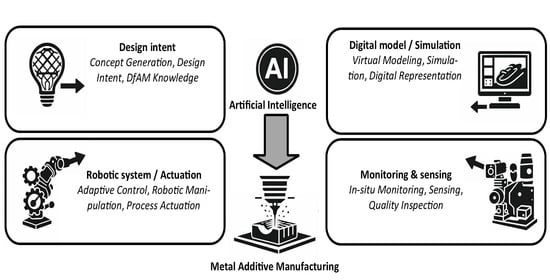
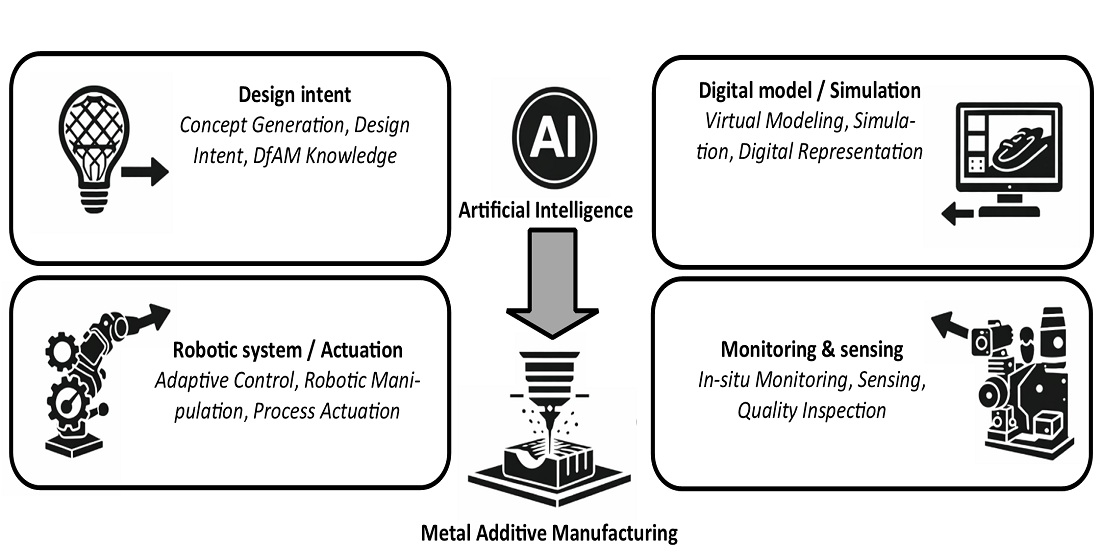
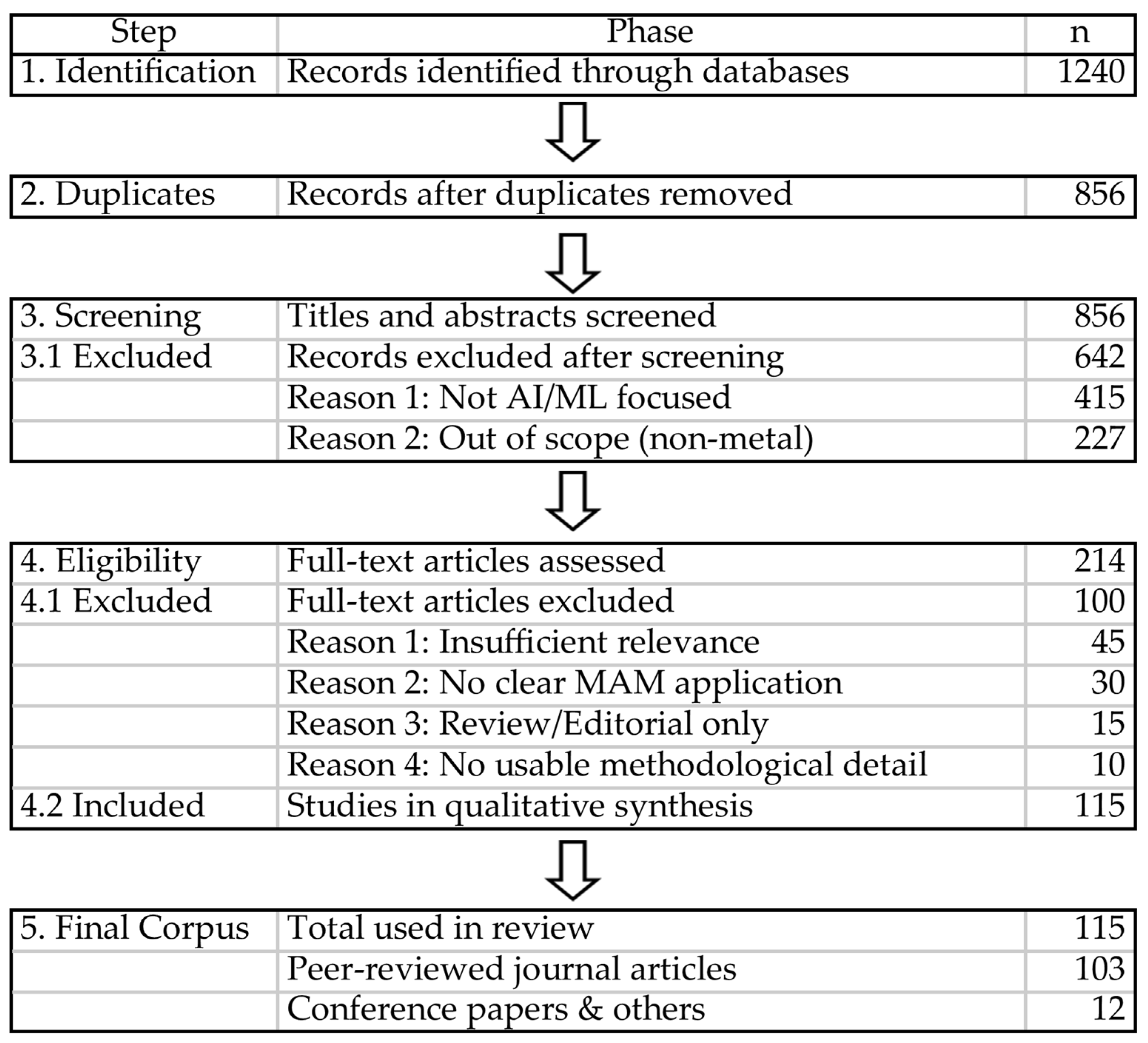
Metal additive manufacturing (MAM) enables the production of complex, high-value components for sectors such as aerospace, energy, and biomedical engineering. However, its large-scale industrial adoption remains constrained by internal defects, residual stresses, distortions, microstructural variability, and the complexity of the coupled process-parameter space. This review examines how artificial intelligence (AI)—including machine learning, deep learning, and optimization algorithms—is being applied to address these challenges across the MAM workflow. A structured literature review was conducted covering studies published between 2015 and 2025, identified through searches in Scopus, Web of Science, and IEEE Xplore. The selected literature is analyzed according to key functional domains of metal additive manufacturing: design for additive manufacturing (DfAM), process modeling and simulation, in situ monitoring and control, and microstructure and property prediction. AI approaches are further categorized by learning paradigm, including supervised learning, deep learning, reinforcement learning, and hybrid physics–machine learning models. The review highlights recent advances in AI-assisted parameter optimization, defect detection, and digital-twin frameworks for process supervision. At the same time, it identifies persistent challenges, particularly the scarcity and heterogeneity of datasets, limited transferability across machines and materials, and the need for uncertainty-aware models capable of supporting validation and certification. Overall, the analysis indicates that the integration of multi-sensor monitoring with hybrid physics-informed AI models represents the most promising near-term pathway to improve process reliability, reduce trial-and-error experimentation, and accelerate industrial qualification in metal additive manufacturing.
Keywords: metal additive manufacturing; artificial intelligence; machine learning; deep learning; DfAM; process monitoring; defect detection; digital twin; physics-informed modeling metal additive manufacturing; artificial intelligence; machine learning; deep learning; DfAM; process monitoring; defect detection; digital twin; physics-informed modeling
Graphical Abstract