1. Introduction
The Acoustic Emissions (AEs) technique is the most mature and widely used structural health monitoring tool worldwide. Its practical application, either for laboratory experiments or for structural applications (structural health monitoring), was long ago standardized. Especially for concrete structures, one could mention the respective standards by ASTM [
1] and the respective recommendations by RILEM [
2]. In addition, one could mention the well-cited volume by Grosse et al. [
3]. Among the main advantages of the AEs technique is the fact that it provides information from the interior of a loaded structural element [
3,
4,
5]. These stress redistributions are caused by sudden changes in the internal structure of the material due, for example, to the generation of microcracks or their coalescence in the direction of forming fatal macrocracks. This inherent correlation between the signals emitted and the degradation of the mechanical properties of the materials (due to the development of the networks of microcracks) provides information regarding the degree (level) of internal damage and the closeness of the loaded element to the critical stage of impending macrocrack propagation [
6,
7,
8,
9].
The need for early warning signals about the upcoming entrance to the stage of impending fracture is imperative for structures made of cementitious materials, especially concrete, due to the increased brittleness of such materials, rendering the phenomenon of fracture abrupt and catastrophic. These materials are broadly used in structural engineering applications due to their increased compressive strength, their low cost, and the fact that structures of complex shapes can be prepared relatively easily [
10]. Their fracture is nowadays confronted as a complex dynamic process,. which is closely related to the onset of development of internal networks of microcracks and their subsequent mutual coalescence [
11].
A large number of relatively recent scientific studies have highlighted that the gradually increasing number of microcracks, which are generated as the applied load increases beyond the linearity level (as well as their gradually increasing length), is interrelated to an increased number of acoustic sources, or, equivalently, to the increased rate of generation of acoustic events with increased amplitude and energy content, and, finally, to an increased number of the respective counts. Especially during the last loading stage (i.e., as the applied load approaches its peak value), it has been indicated that the rate of generation of acoustic events exhibits a strong increasing trend, which is considered as a signal for the upcoming generation of a fatal macrocrack and the final disintegration of the specimen [
12,
13,
14,
15]. Along the same lines, a rapid increase in the rate of the counts recorded [
12,
16,
17], or of the energy content of the acoustic signals [
18,
19,
20,
21] are sometimes considered alternative warning signals about upcoming macroscopic fracture.
It is interesting to note at this point that the signal strength distribution of the acoustic emissions exhibits statistical characteristics similar to those exhibited by the magnitude of seismic excitations (see, for example, refs. [
22,
23,
24]). In this context, the familiar b-value analysis according to Gutenberg and Richter [
25] is successfully applied, also, for the analysis of the acoustic signals [
26,
27,
28]. Concerning structures (or specimens) made of concrete, it is proven that while their load carrying capacity tends to be exhausted, the b-values exhibit a systematic decrease towards a value equal to unity, a response that is attributed to the fast and/or unstable development of microcracks, since the acoustic activity appears to be intensified and acoustic signals of increased amplitude are recorded [
26,
29,
30].
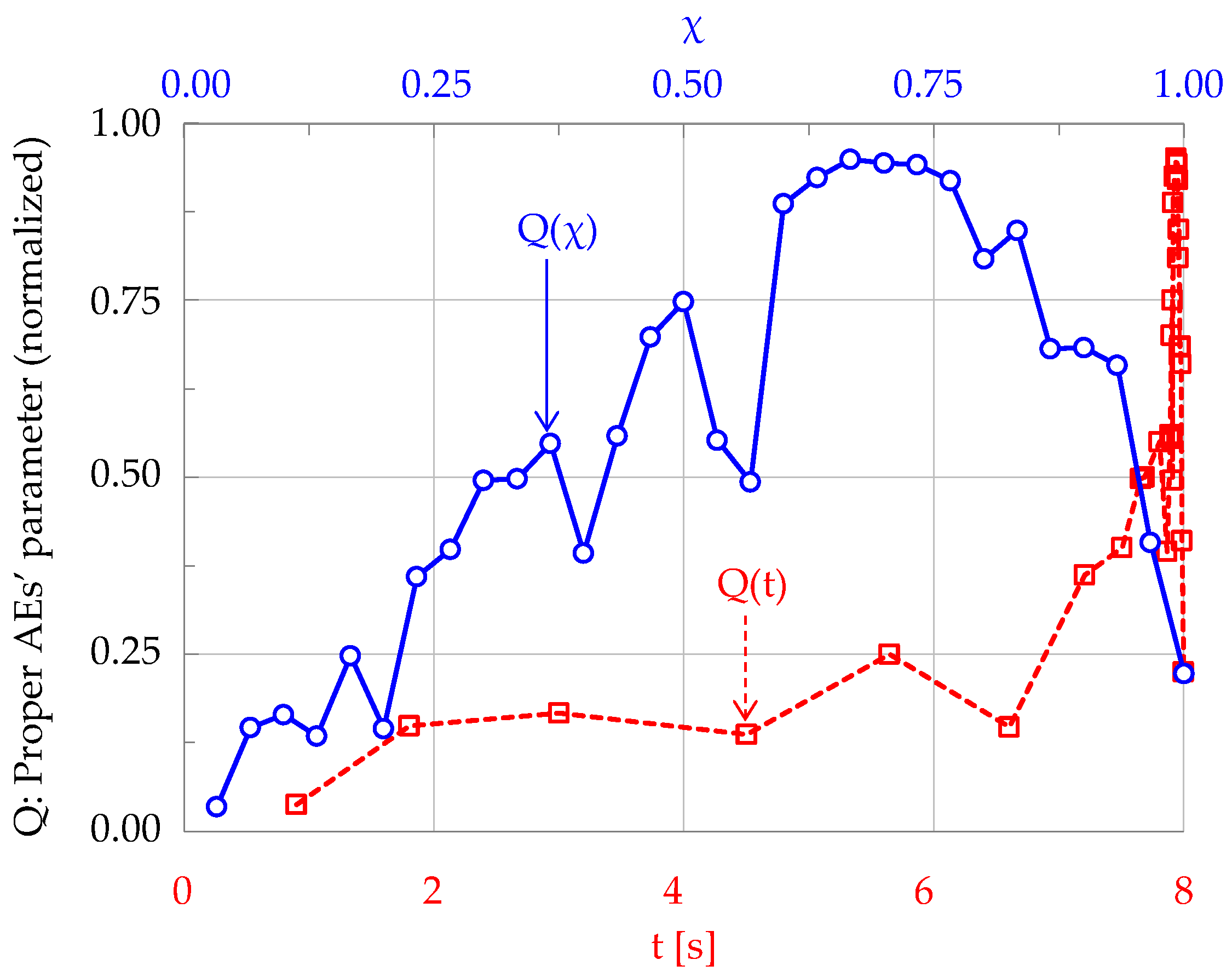
Within the framework of the above discussion, the present study aims to assess a new method for detecting signals heralding imminent fracture. This method is based on the study of the evolution of the time series of the cumulative number of acoustic events, the amplitude of which exceeds the respective average value of all the events recorded during the whole loading procedure. The evolution of this time series is depicted both in the conventional time domain and also in that of natural time. The concept of natural time was introduced by Varotsos et al. [
31,
32,
33] in their effort to describe the conditions under which a system enters a new state during which an extreme event is about to appear. It is nowadays accepted that natural time is a flexible tool for the analysis of the response of complex systems in a broad variety of disciplines, ranging from mechanics and physics to medicine and finance [
34]. The relative literature is very rich, especially in the discipline of mechanics of materials. Quite a few studies are published, which reveal that for mechanically loaded systems, the analysis of the acoustic signals in terms of the natural time concept permits the safe detection of critical stages, signaling early for upcoming fracture [
8,
34,
35,
36,
37,
38,
39]. Quite a few parameters of acoustic activity, like the average rate of generation of events [
15] and the cumulative number of counts [
17], have been analyzed in the natural time domain and it is systematically proven that the specific analysis provides clearly distinguishable pre-failure indicators.
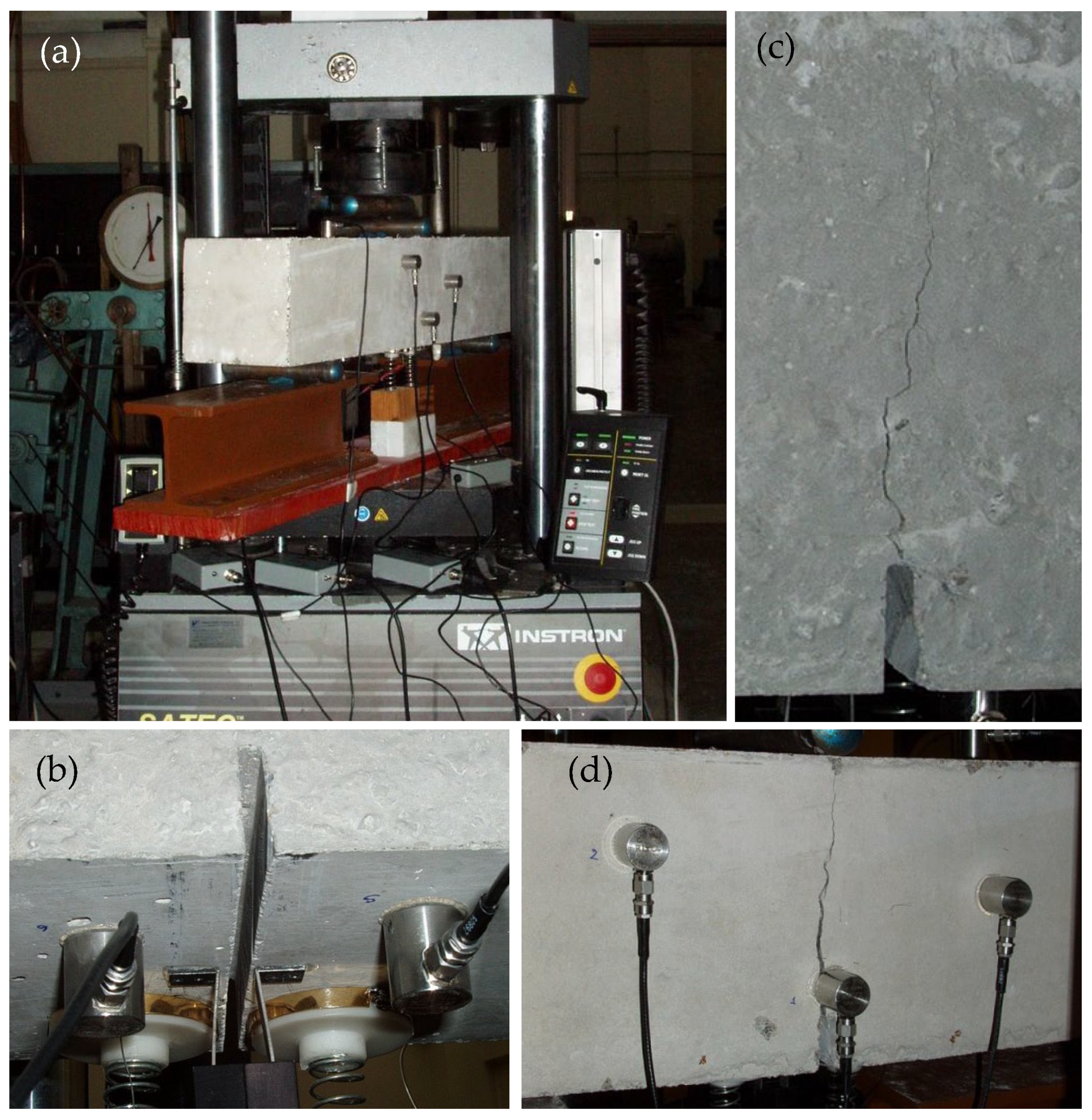
In the present study, advantage was taken of data from an already published experimental protocol [
40,
41] with notched, beam-shaped specimens, made of either plain or fiber-reinforced concrete, under three-point bending. It is proven that the slope of the evolution of the time series of events of amplitude higher than the respective mean value of all the events recorded attains systematically a value equal to unity as the applied load tends to be maximized, providing a potentially interesting pre-failure index. The novelty of the study is that it highlights the fact that the average slope of the above time series is independent of the rate of the generation of events and that it depends exclusively on the rate of generation of events of high amplitude. The conclusions that will be derived aim to support campaigns on concrete and fiber-reinforced concrete specimens at laboratory scale. Any potential extension to specimens made of other materials, or to specimens subjected to different loading schemes, or at larger scales, should be exercised with the utmost caution—or, preferably, only after the respective database has been sufficiently expanded with data from additional experimental protocols.
The manuscript is structured formally. Initially, the materials tested and the experimental protocol are shortly described. The analysis of the methodology introduced for the detection of pre-failure indices follows. Then, the experimental results are discussed thoroughly within the frame of the approach introduced here. Critical discussion of the outcomes of the study follows, together with a comparative assessment of them versus the respective ones of traditional approaches. Finally, the main conclusions drawn are comprehensively described.
3. Results
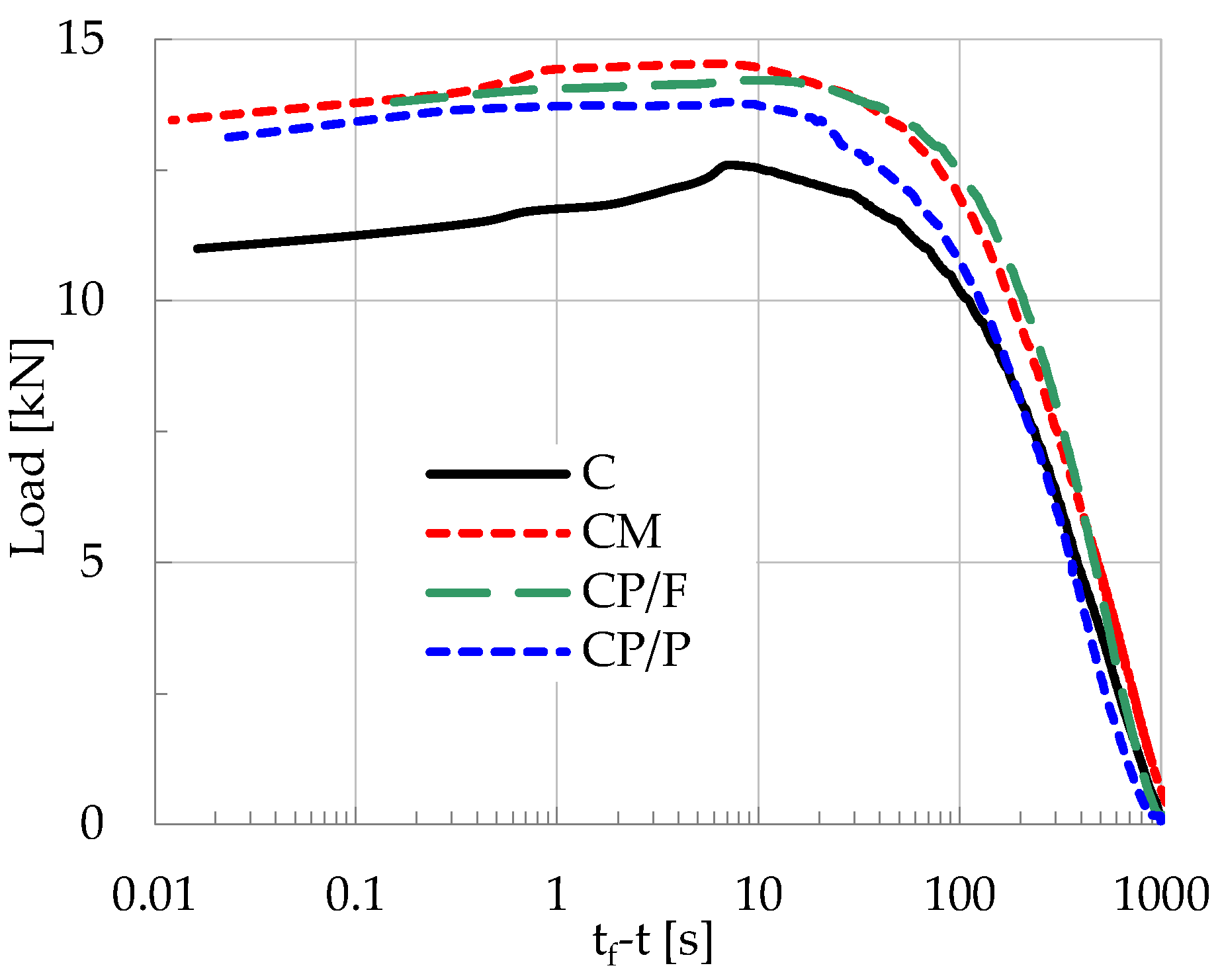
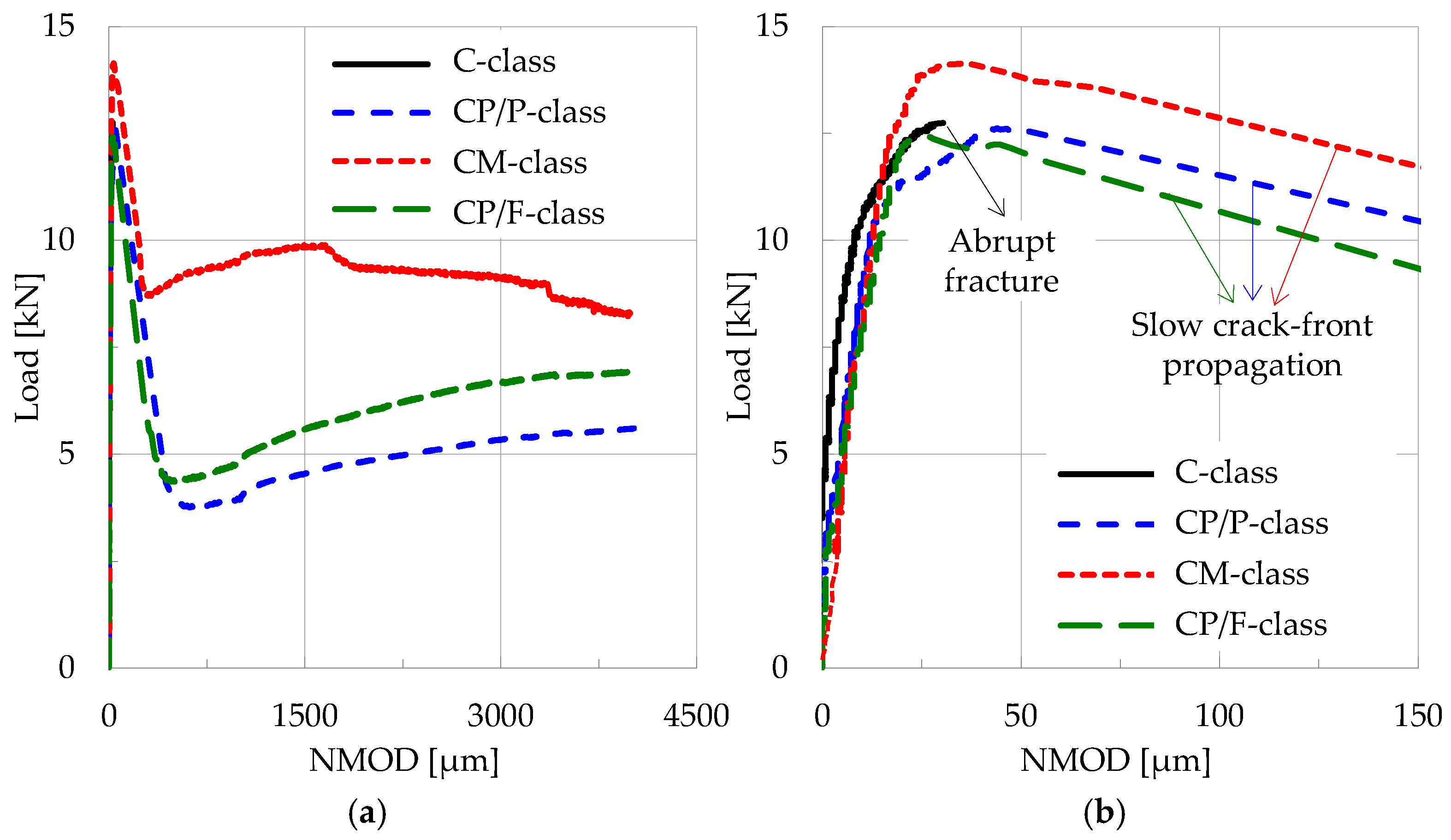
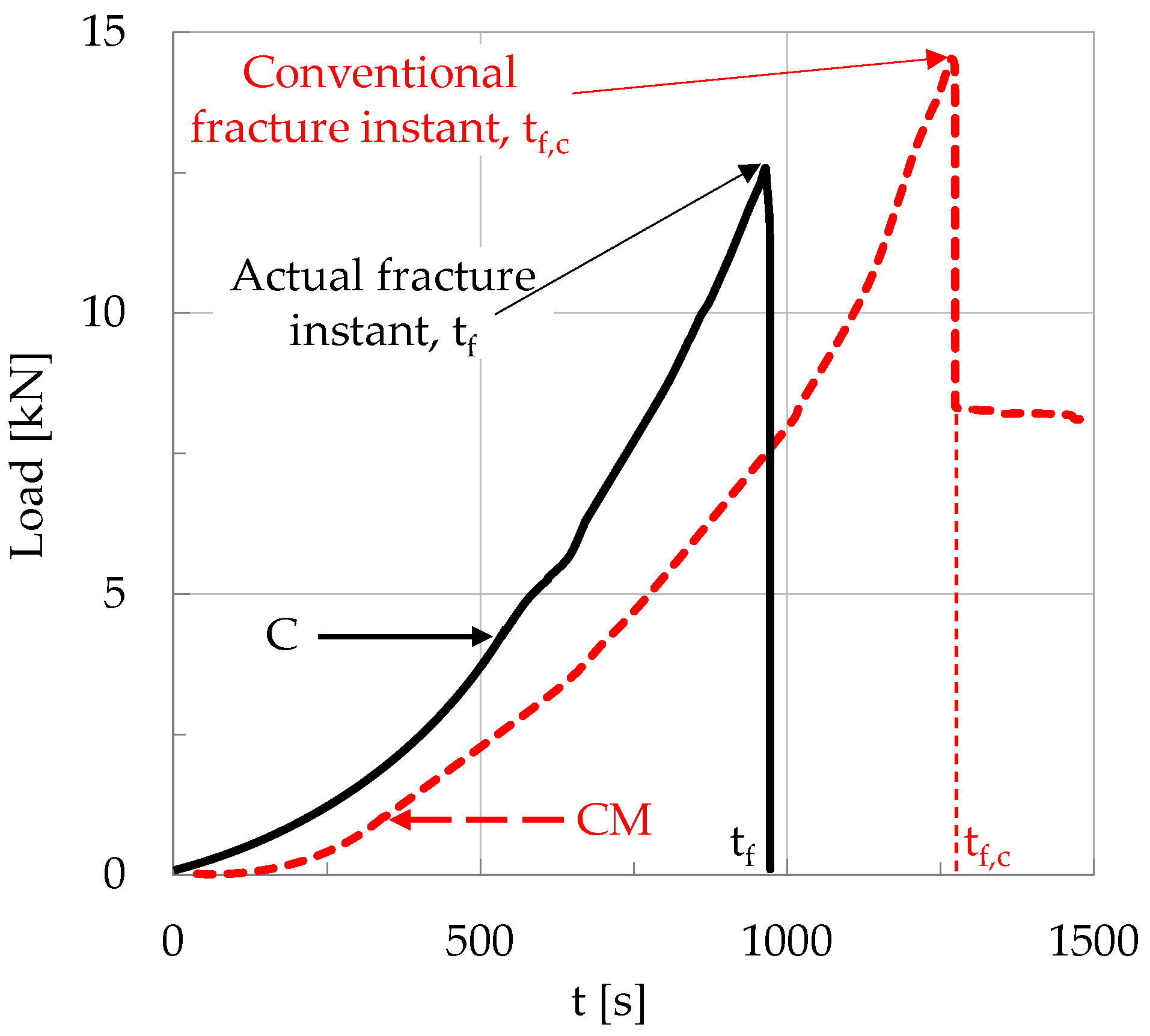
The discrepancies between specimens of the same class were relatively small, concerning both the mechanical and the acoustic data. Numerical values of characteristic quantities are recapitulated in
Table 2, which includes: the maximum load attained (L
max), the time interval between the instants of load maximization and fracture (t
f-t
Lmax), the overall number of acoustic events recorded (N), the average value of the amplitude of all the N acoustic events (
), the number, n, of acoustic events the amplitude A of which fulfills the condition
, and finally, the portion of n with respect to N. In addition (and for convenience reasons), typical characteristics of the reinforcing fibers (namely, their type, content, length, diameter and tensile strength) are also recorded in
Table 2.
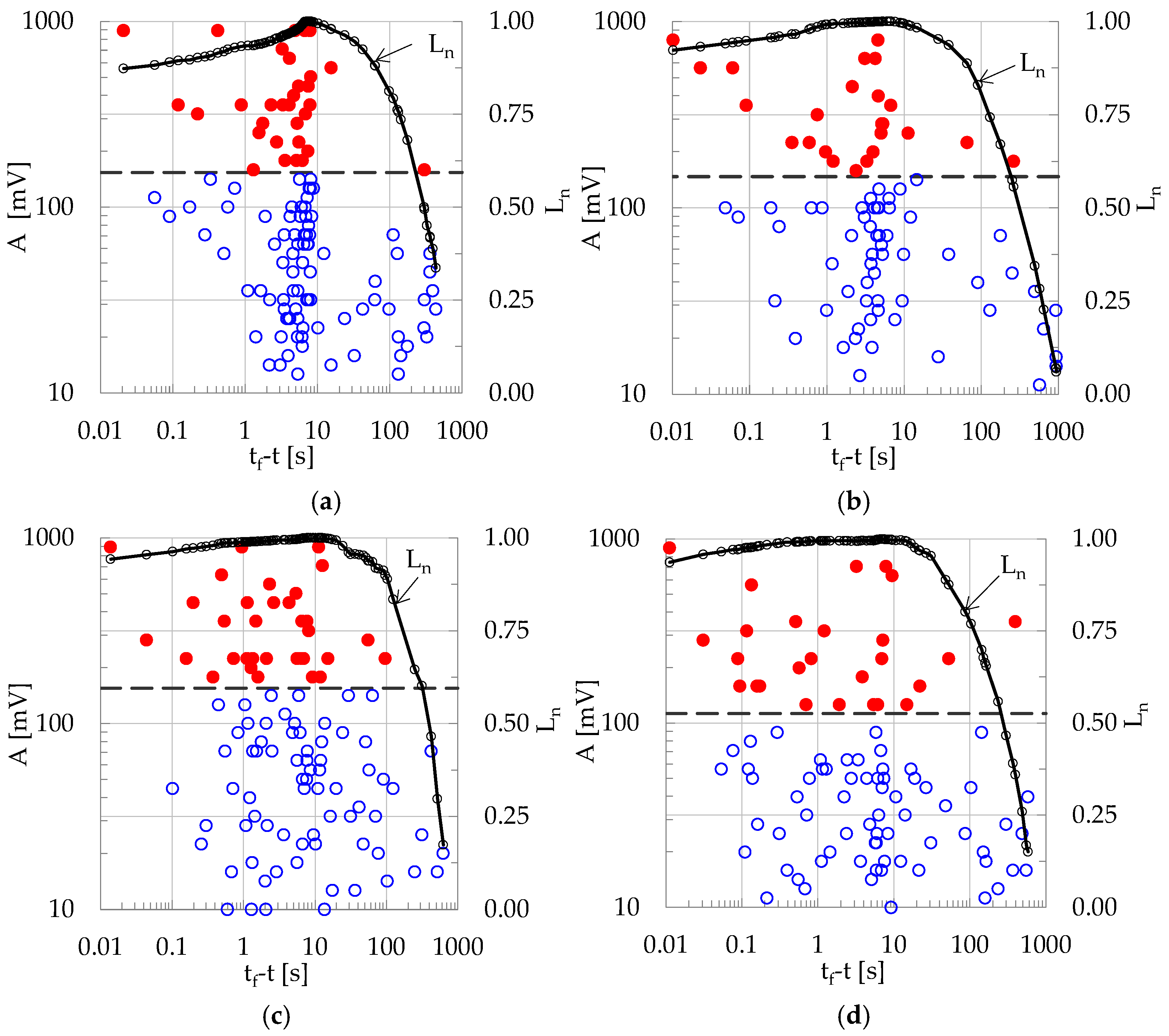
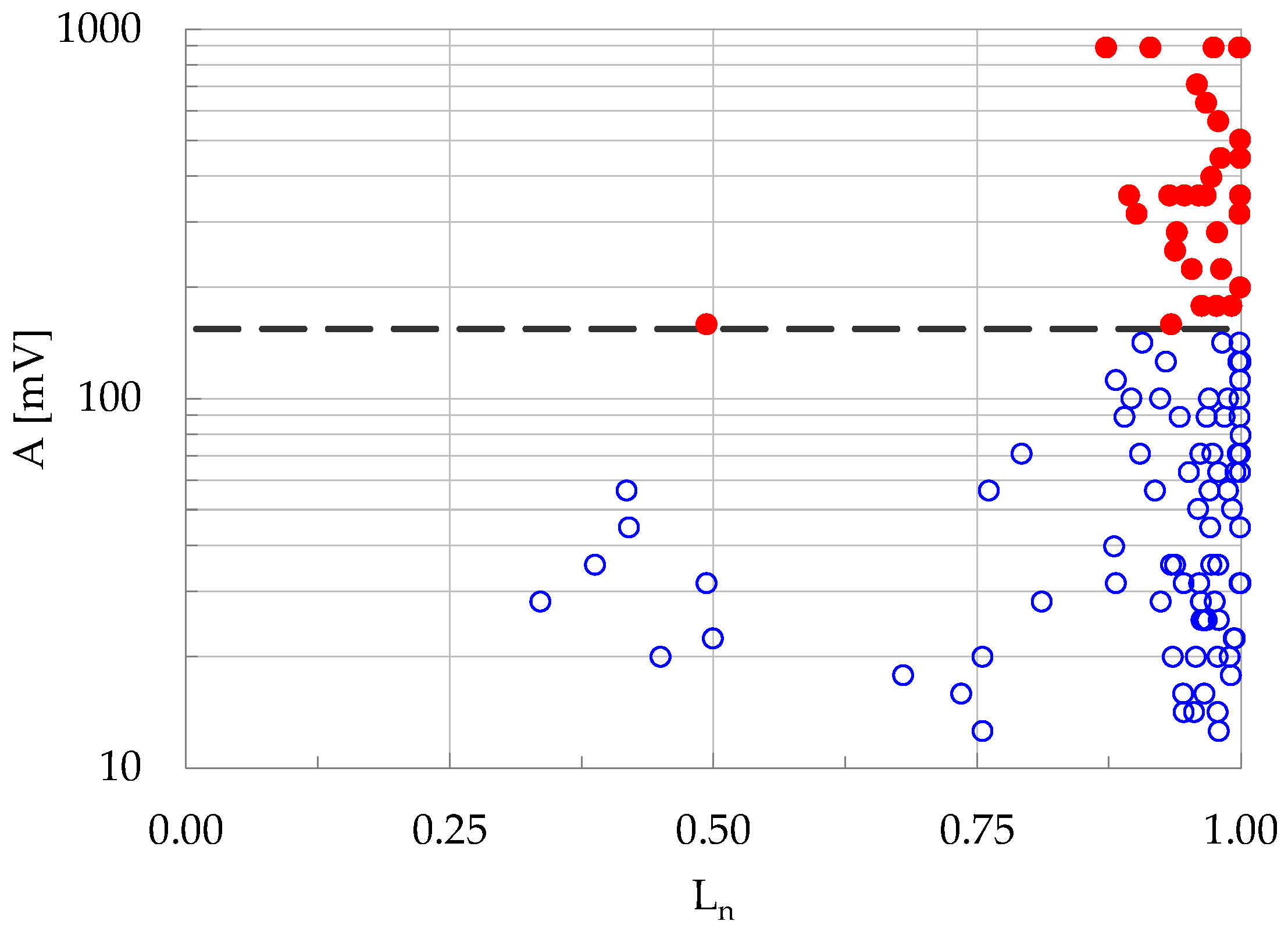
The temporal evolution of the amplitudes of all the N acoustic events (recorded during the overall loading procedure) for one characteristic experiment from each class is plotted in
Figure 6, versus the time-to-failure (t
f-t), along logarithmic scales. The respective evolution of the normalized load L
n is also plotted. The average value of the amplitudes of all the events is denoted by a dashed (black) horizontal line. The events of amplitude below the respective average value are denoted by empty (blue) symbols, while the ones with amplitude exceeding the average value are denoted by filled (red) symbols.
As expected, during the early loading stages the events with
are quite rare. Especially for the plain concrete specimen (C class), it is mentioned characteristically that only one acoustic event with amplitude exceeding the respective average value was recorded until the instant t
f-t ≈ 15 s, i.e., until about fifteen seconds before the fracture of the specific specimen. It is only during the last eight seconds that a significant number of events with
are recorded. The above conclusion is further supported by
Figure 7, in which the amplitudes of all the events recorded is plotted versus the (normalized) applied load L
n for a typical specimen made of plain concrete (C class). It is obvious that during the early loading stages the specimen is either totally silent or the acoustic activity is extremely weak. Acoustic events with amplitude exceeding the average value
are recorded after the applied load exceeds about 87% of its peak value. The overall picture is quite similar, also, for all the fiber-reinforced specimens without any exception, independently of the nature of the reinforcing fibers.
In the next subsections, the results of the above four experiments will be analyzed in depth. The analysis for the plain concrete class will be somewhat more extensive, in order for the procedure introduced in the present study to become clear. For the remaining three classes, the analysis will be focused mainly on the evolution of the parameter during the whole procedure, i.e., from the onset of loading up to the fracture of the specimens.
3.1. The Evolution of the Parameter for the Plain Concrete Specimens
During the specific experiment discussed here, n = 31 acoustic events with
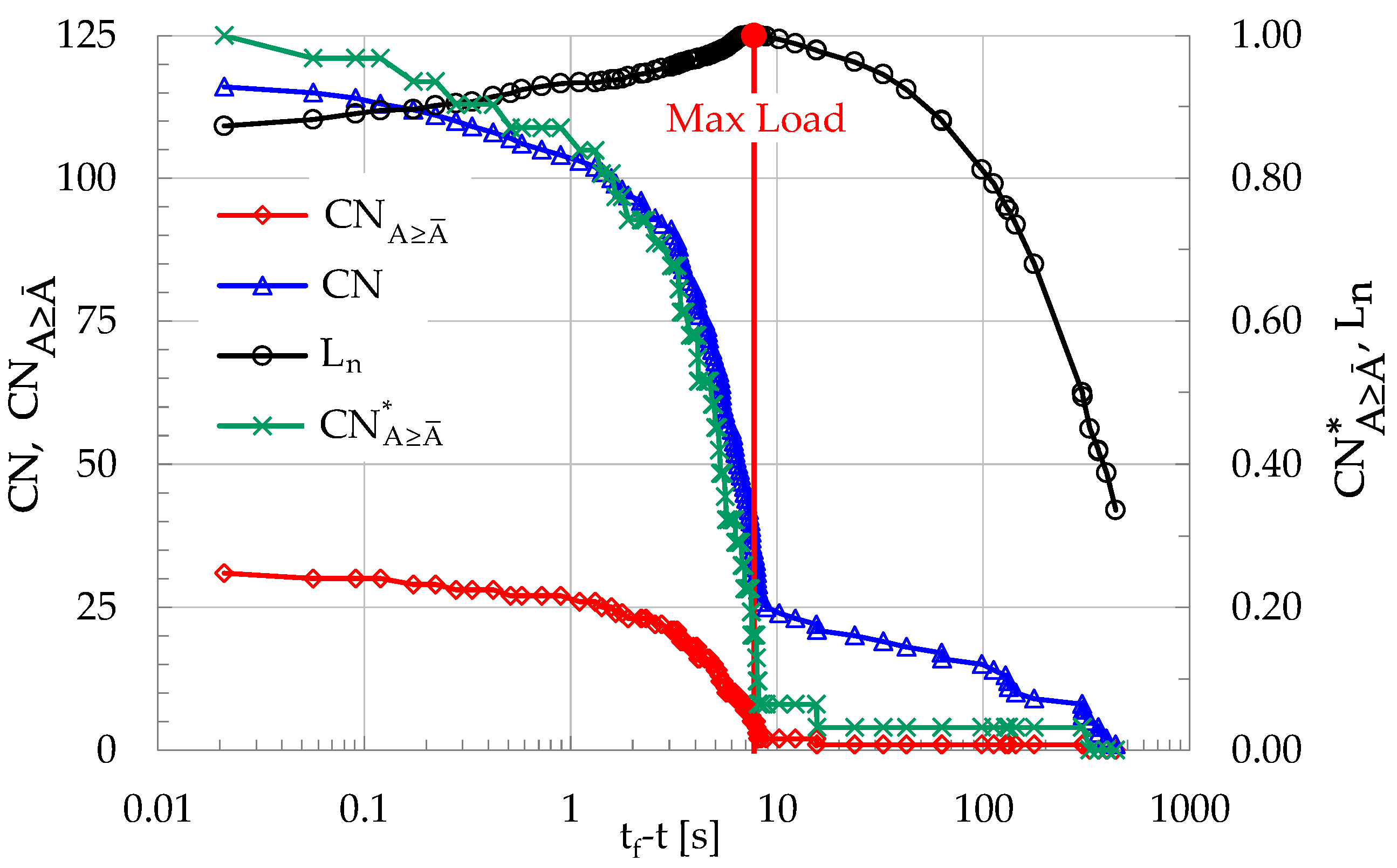
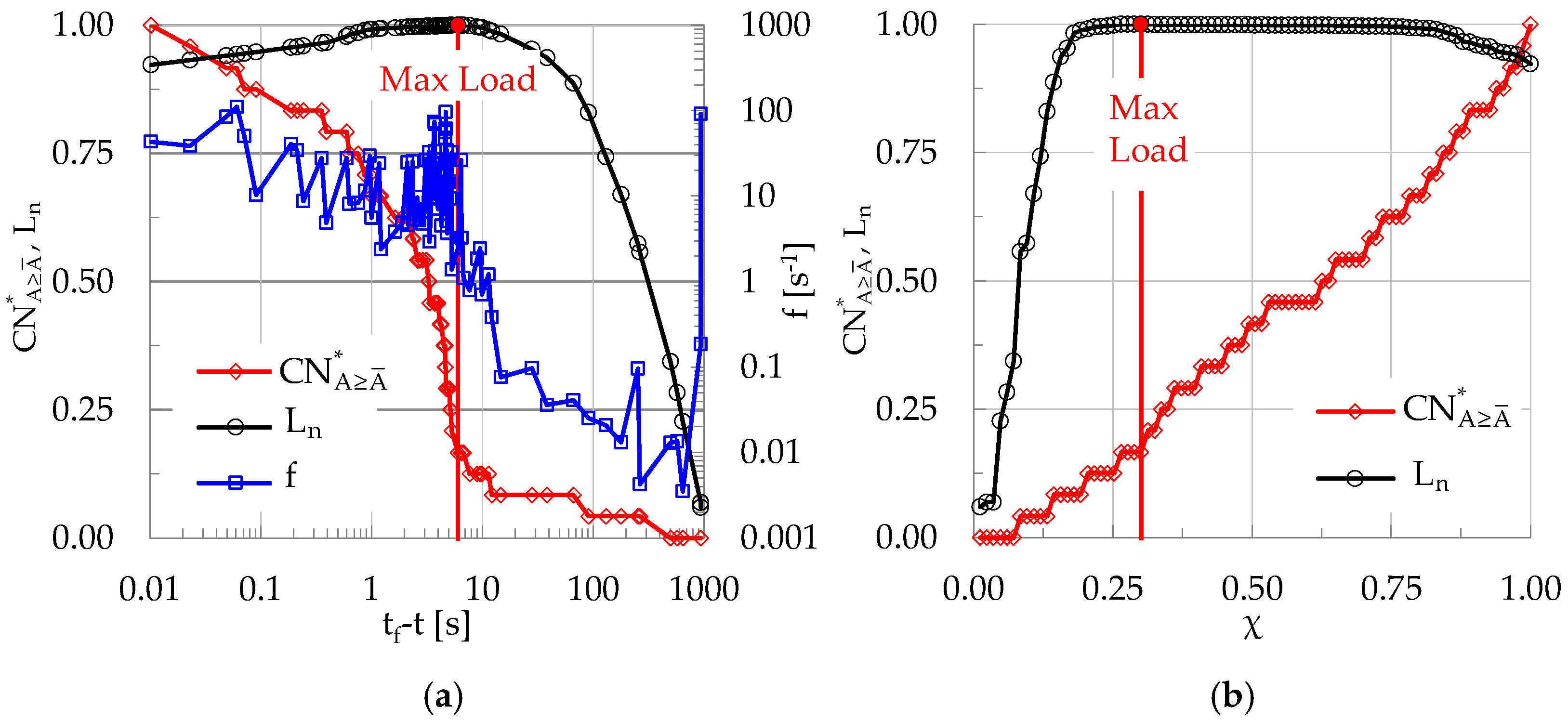
were recorded, corresponding to about 27% of the overall number N of events, which was equal to N = 116. The cumulative number of events CN with amplitude exceeding the threshold of 10 mV (40 dB) are plotted in
Figure 8 versus the time-to-failure (t
f-t) parameter, along a logarithmic scale. In the same figure the respective evolution of the cumulative number of events with
denoted as
, is also plotted together with its normalized version
along the secondary vertical axis. Along the same axis (i.e., the secondary vertical axis) the normalized load L
n is also plotted.
The most striking feature that characterizes the evolution of the quantities plotted in
Figure 8 is that the cumulative number of events with
exhibits an abrupt increase as the load tends to its peak value, which is seen vividly considering the evolution of its normalized value
. This abrupt increase of
(or, equivalently of the non-normalized
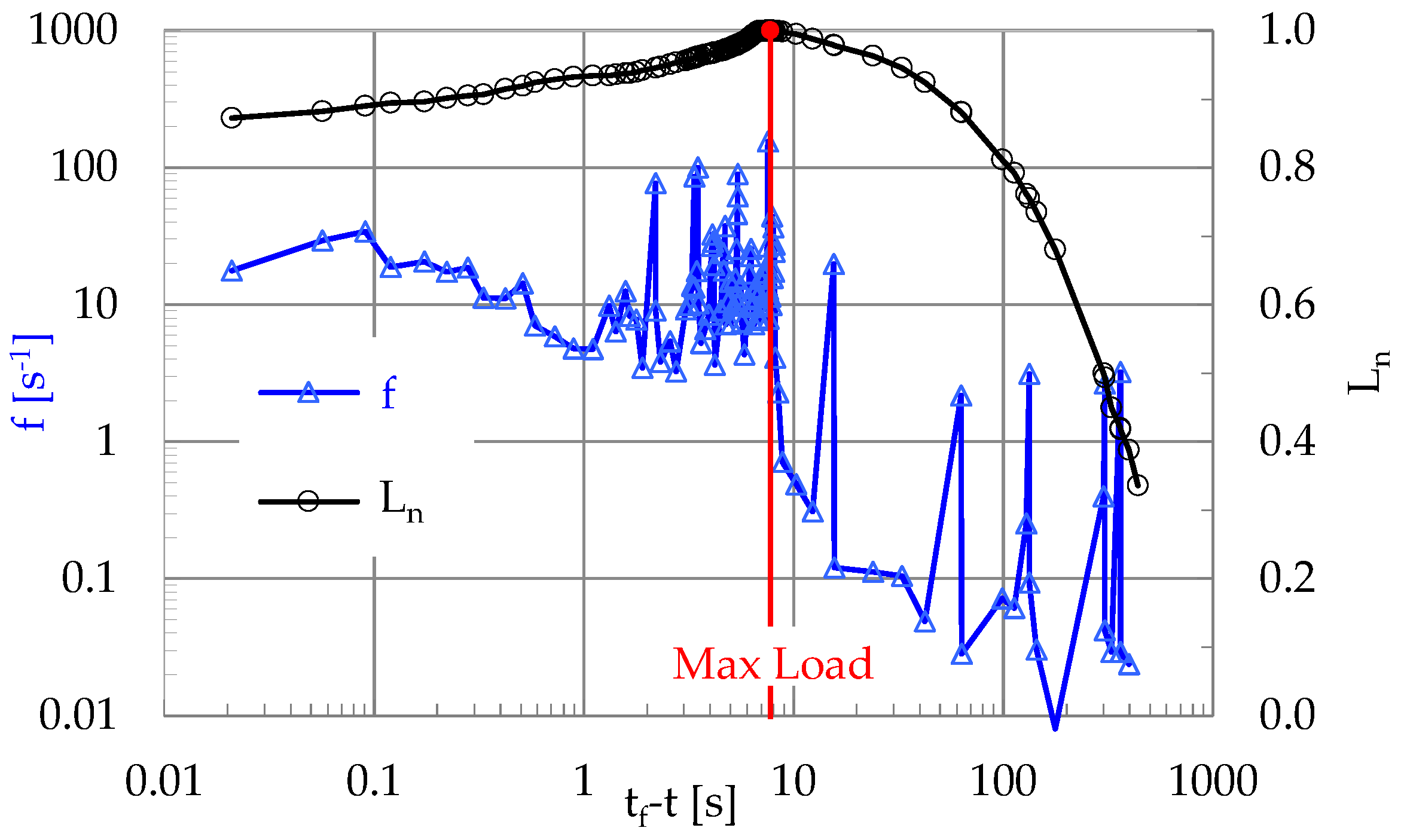
) is attributed to the increased rate of generation of events as the applied load tends to be maximized, or, in other words, as the fracture instant approaches. The above conclusion is further supported by the temporal evolution of the instantaneous frequency, f, of generation of acoustic events, which is defined as the inverse of the interevent time interval, δτ, between any two events, i.e., f = 1/δτ. For the experiment discussed here, the evolution of f is plotted in
Figure 9, versus the logarithm of t
f-t.
It is seen from
Figure 9 that, as long as the applied load is lower than its respective peak value, the instantaneous frequency, f, attains values lower (as an average) than unity (with some strong fluctuations). However, as the load tends to attain its peak value, f exhibits a sudden increase, ranging now around f ≈ 10 s
−1, with a stabilizing trend.
As a next step, the evolution of
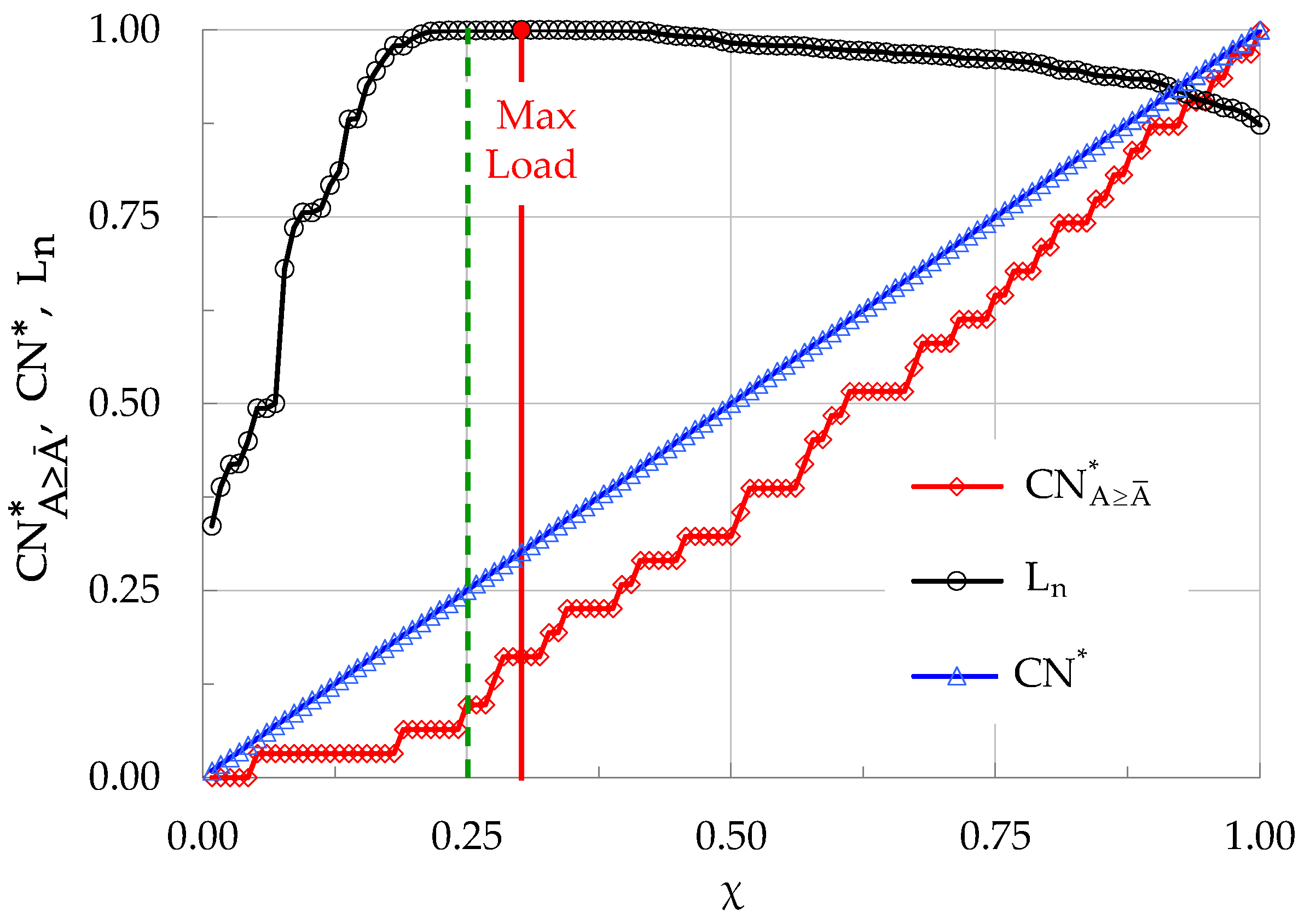
is studied in the natural time domain, i.e., versus the parameter χ, as is shown in
Figure 10. In the same figure, the evolution of normalized cumulative events, CN*, and that of the normalized load, L
n, are also shown. As expected, in the natural time domain the evolution of CN* (i.e., in terms of χ) is just a straight line with a slope equal to 1 (in fact, it is the bisector of the plot). It will be proven in the next sections that the specific value of the constant slope of CN* is an index which distinguishes the intervals with increased generation of events
(slope exceeding one) from intervals with increased generation of events with
(slope smaller than unity). Concerning
, its evolution is now much smoother compared to that observed in
Figure 8, i.e., in the conventional time domain. As already mentioned, the values of
in the natural time domain do not depend on the rate of generation of acoustic signals in general, but rather they depend exclusively on the rate of generation of events with
. Comparing
Figure 10 with
Figure 8, it can be seen that in the conventional time domain the abrupt increase of
is observed at the instant t
f-t ≈ 8 s (which is, in fact, the instant of load maximization). In the natural time domain, the respective instant at which a clearly noticeable increase of
is observed is equal to χ ≈ 0.25 (see the dashed green vertical line in
Figure 10). This natural time instant precedes the instant of load maximization, which for the specific specimen was observed at about χ ≈ 0.30 (see the continuous red vertical line in
Figure 10).
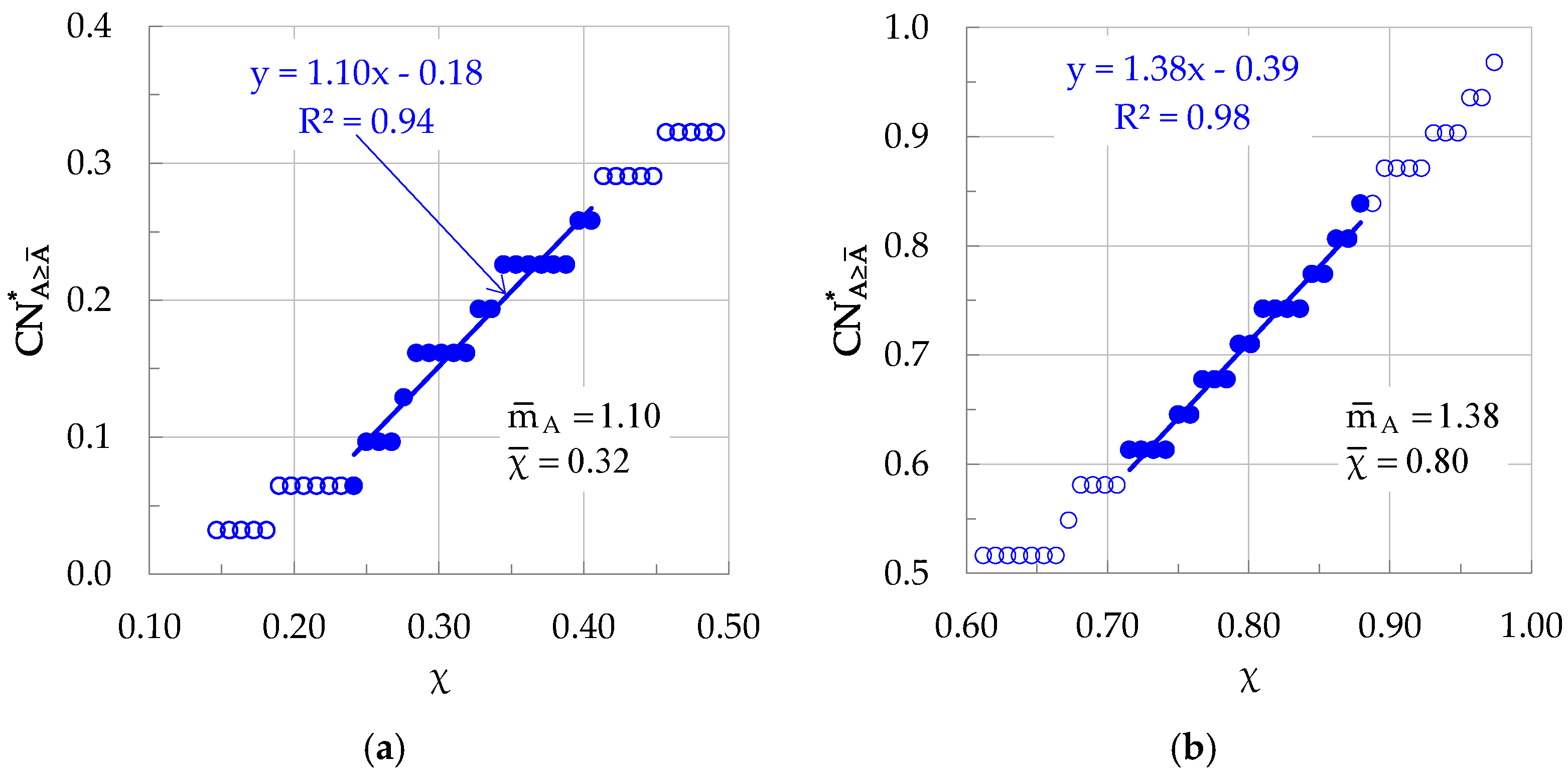
Adopting now the “sliding window” technique, it is possible to determine the evolution of the slope
of the function
= f(χ). In this direction, one starts by isolating a group including the first k successive elements of the
time series. The exact value of k depends on the overall number of elements of the time series studied, being in fact a small portion of it. For the experiment analyzed here, it was set as k = 20. For this first group of elements, a linear trendline is determined and a first value of the slope
is calculated. “Sliding” now the first window by an arbitrary step Δk, a second group is formed. In this study, the “sliding” step was set as equal to Δk = 1. Calculating the slope of the linear trendline of this second group of elements, a second value is determined for
, and so on. The above procedure for two groups of elements (one for relatively small values of χ and one for relatively high ones) is shown indicatively in
Figure 11.
Each value of
is then paired to the average value
of the natural time instants χ
i of the specific group of elements, rendering it possible to plot the
=
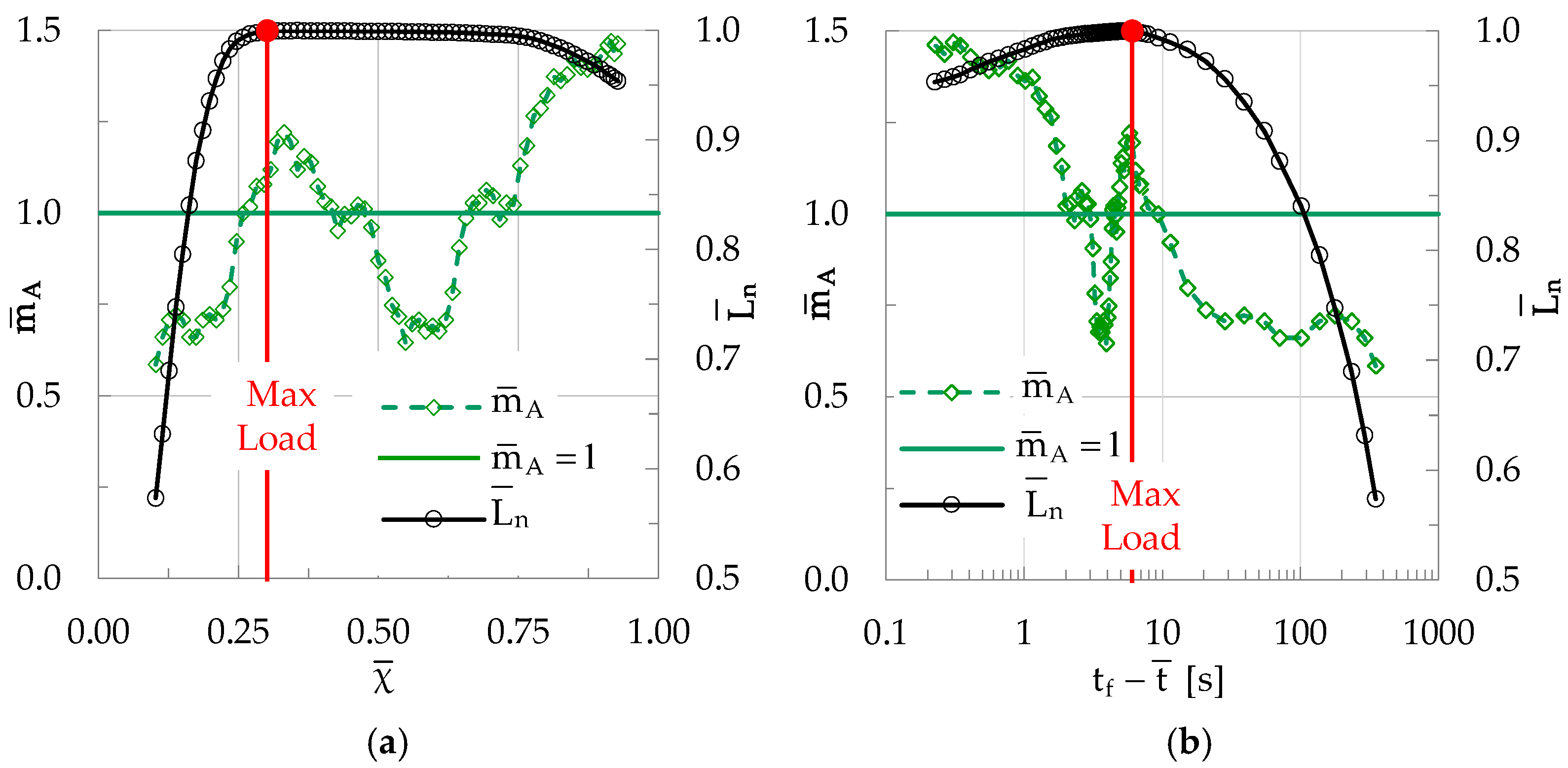
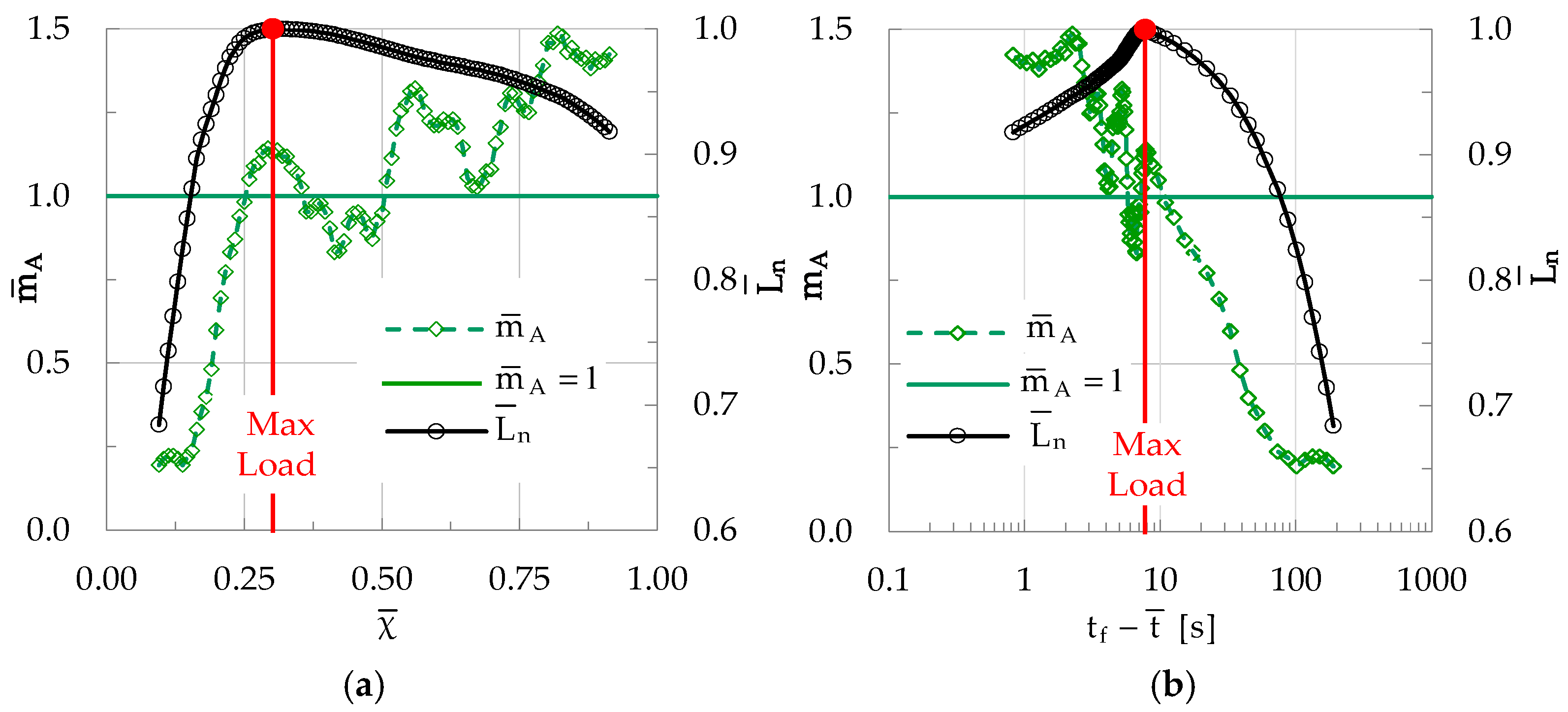
function. For the experiment described here, the respective plot is shown in
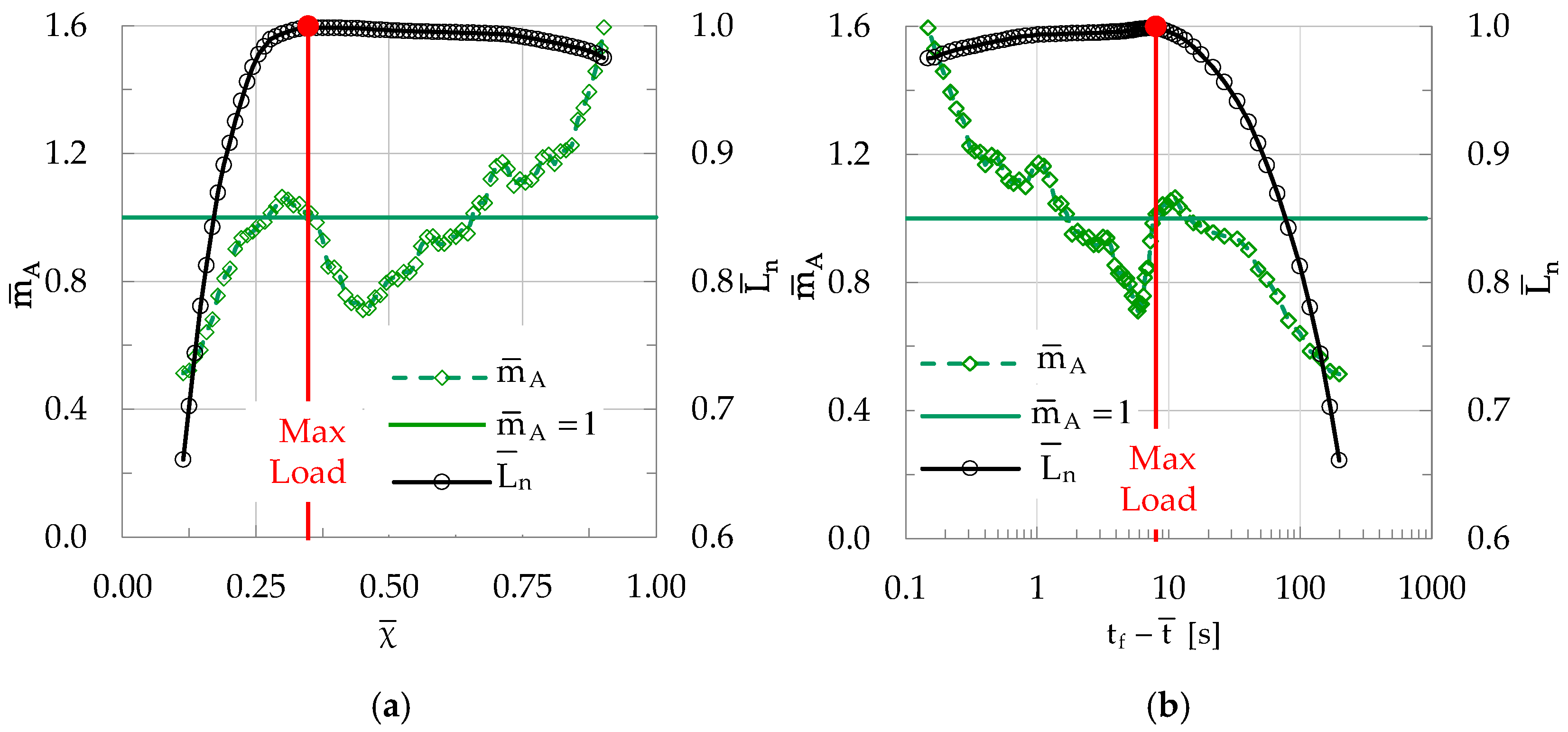
Figure 12a, in which the evolution of
is plotted versus
. In the same figure, the evolution of the normalized average load
(namely, the mean value of the loads corresponding to the instants at which each element of the specific group was recorded) is also plotted, versus
. For comparison reasons the evolution of the same quantities (i.e.,
and
) is plotted in
Figure 12b in the conventional time domain, i.e., versus the average time-to-failure parameter t
f-
, where
is the mean value of the time instants at which the k elements of the group under study were recorded (adopting a logarithmic scale).
It is clearly seen from
Figure 12a that during the early loading stages (i.e., while the load increases towards its peak value), the slope
of the evolution of
is systematically smaller than unity, suggesting that the acoustic signals generated correspond to events with an amplitude smaller than
. During this stage,
increases relatively smoothly, attaining for the first time the value
= 1 at an instant
≈ 0.25, slightly before the instant at which the load is maximized (i.e., the instant with
≈ 0.30). Translating this information in terms of conventional time, it is concluded that
reaches for the first time the limit
= 1 about 3.2 s before the load attains its peak value. From this instant on,
keeps increasing until the maximization of the load applied. Then, as the load starts decreasing
decreases also, attaining values even below the
= 1 limit. However, the values of
“recover” soon, exceeding again the limit
= 1, and they keep increasing with strong fluctuations. At the instant of macroscopic fracture, the terminal value of
is equal to about
≈ 1.5.
It is recalled at this point that the characteristic value
= 1 corresponds to the constant slope of the CN* = f(χ) function, i.e., of the function of the normalized cumulative number of acoustic events plotted in terms of natural time χ (see
Figure 10). An indication is thus highlighted (which will be verified in further sections) that fulfilling the condition
= 1 corresponds to the production of acoustic events with increased energy content, which is a characteristic feature of the stage of rapid development of networks of microcracks, which will lead, in turn, to the stage of their coalescence and the generation of the fatal macrocrack.
3.2. The Evolution of the Parameter for Specimens Made of Fiber-Reiforced Concrete
A characteristic experiment of the CM class of specimens (i.e., the specimens made of concrete reinforced with short metallic fibers) will be considered first in this section. During this experiment, n = 24 events with
were recorded, corresponding to about 29% of the overall number of the N = 83 events recorded. The evolution of the normalized quantity
is plotted in
Figure 13a in the conventional time domain (i.e., versus the time-to-failure parameter), and in
Figure 13b in the natural time one (i.e., versus χ). In both figures the respective evolution of the normalized load, L
n, is also plotted. The instantaneous rate of generation of acoustic events, f, is also plotted in
Figure 13a. It is easily seen from
Figure 13a that while
increases very smoothly for the major portion of the loading process, it exhibits a sudden increasing trend as the load approaches its maximum value. This sudden increase is almost simultaneous with a clearly distinguishable change in the evolution of the instantaneous frequency, f, of the generation of acoustic events.
In order to proceed with the analysis of the data of the specific experiment, groups of acoustic events were now considered, each one of them including k = 15 elements. Concerning the “sliding” step, it was again set equal to δk = 1. Following the “sliding window” procedure, described analytically in the previous section, the average slope
of the evolution of
is, again, determined. The results of the above procedure are plotted in
Figure 14a in the natural time domain and in
Figure 14b in the conventional time one (in juxtaposition to the respective evolution of the normalized average load,
, in both domains, i.e., conventional and natural). As deduced from
Figure 14, the values of the parameter
are, as previously, smaller than unity during the early loading stage, exhibiting a systematic increasing tendency as the applied load is smaller than its peak value.
As the load tends to be maximized, attains for the first time the limiting value = 1, at a natural time instant χ ≈ 0.26, corresponding to tf-≈ 9.3 s, i.e., 9.3 s before the instant of the fracture (“conventional” for the specific class of specimens). After its maximization, the load remains almost constant for a very short time interval, during which decreases significantly (well below the = 1 limit), suggesting that there is now an increased generation of events with . The values of start increasing again only while the load starts decreasing, and they attain a terminal value equal to about = 1.5 at the “conventional” fracture instant.
As a next step, the evolution of the
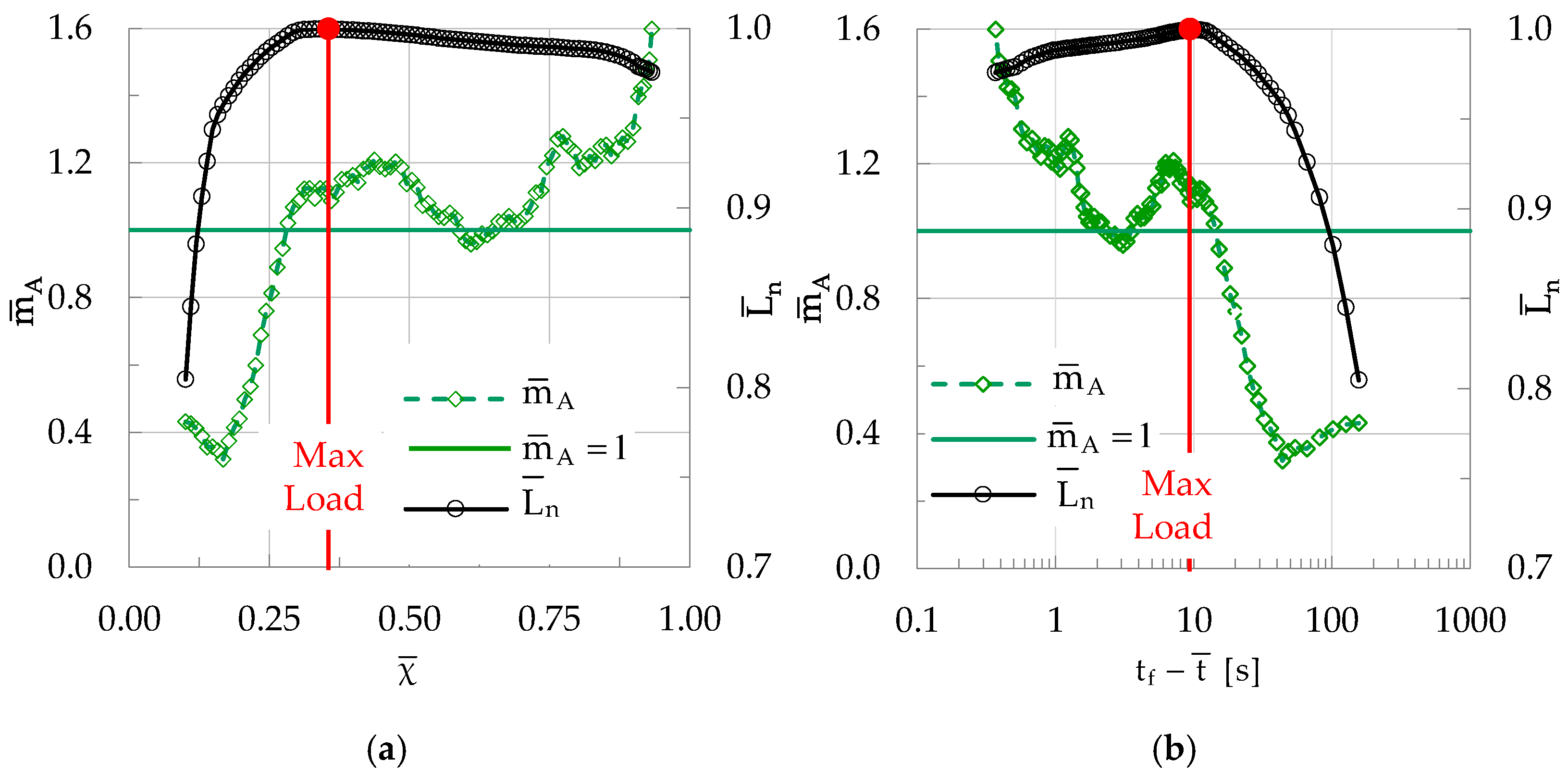
parameter is studied for a specimen made of concrete reinforced with short polyolefin fibers, i.e., of the CP/F class. During the typical experiment analyzed here, N = 104 acoustic events were recorded, among which n = 33 (i.e., about 32% of N) fulfilled the condition
. Following the “sliding window” procedure with groups including k = 20 successive events and a “sliding step” equal to δk = 1, the evolution of
was determined both in the natural time domain and also in the conventional time one. For the sake of brevity, the intermediate steps are here omitted, since they are identical to the ones followed for the analysis of the CM class specimen. The results of the analysis are shown in
Figure 15a versus
(i.e., in the natural time domain), and in
Figure 15b versus t
f-
(i.e., in the conventional time domain).
As can be straightforwardly seen from
Figure 15, the evolution of
is qualitatively similar to that of the CM specimens. Indeed, the values of
are systematically lower than unity during the stage at which the applied stress increases. In this stage, which covers the overwhelmingly larger portion of the test’s duration, the
values increase systematically. A little before the load attains its peak value,
attains the limiting value
= 1 for the first time. This happens at a natural time instant χ ≈ 0.28, which corresponds to t
f-
≈ 14 s, i.e., 14 s before the “conventional” fracture instant. For the specific specimen, the load after its maximization starts decreasing very smoothly while
increases slightly beyond the
= 1 limit, and then it decreases at levels around unity. As the load starts decreasing rapidly (towards its conventional fracture value),
increases rapidly, attaining a value
= 1.6 at the instant of conventional fracture.
As a last example, a specimen of the CP/P class (i.e., made of concrete reinforced with short polypropylene fibers) is considered. For the specific specimen, N = 92 acoustic events were recorded in total.
The amplitude of n = 26 of them (about 28% of N) exceeded the average amplitude of the N events. As conducted for the previously discussed specimens (either made of plain or fiber-reinforced concrete), the evolution of
is studied both in the natural and in the conventional time domains, as exhibited in
Figure 16a and
Figure 16b, respectively.
It is concluded from these figures that the evolution of is similar to that of both the CM and the CP/F classes. Again, is systematically lower than the limiting value of one during the stage of increasing load, increasing monotonically with increasing load. At a time of 13.3 s before the instant of conventional fracture, attains the limiting value of one. This instant corresponds to a natural time instant equal to χ ≈ 0.27. For the characteristic specimen discussed here, after attaining its peak value the load remains almost constant for a few seconds. During this interval decreases smoothly, attaining values well below the = 1 limit. Then, as the load starts decreasing towards the conventional fracture load, starts increasing rapidly, exceeding the = 1 limit and reaching a value equal to about = 1.6 at the instant of conventional fracture.
4. Discussion
The most intriguing observation from the analysis regarding the evolution of the average slope of the cumulative number of acoustic events, the amplitude of which exceeds the average of the amplitudes of all the events recorded during a specific experiment, is that it exhibits some common qualitative and quantitative characteristics independently of the composition of the material of the specimens. Namely, these common features are exhibited both for the specimens that were made of plain concrete, and also for the specimens made of concrete reinforced with all three types of short reinforcing fibers. Indeed, during the early loading stage (namely, as the level of the externally applied load is below its peak value) is well below unity, suggesting a strongly pronounced rarity of acoustic events with amplitude exceeding during this period. In this stage, the events with dominate; however, increases steadily for all the specimens tested. As the load increases towards its maximum value, attains (for the first time) the limiting value = 1 some seconds before the maximization of the load, indicating that the events with and those with reach a balance concerning their rates of production.
After attaining the value = 1, a clearly distinguishable (though temporary) decay of is observed towards values even below unity as the applied load attains its peak level. This is a sign that immediately after the maximization of the load the generation of acoustic events with becomes weaker since the energy content of the loaded element is temporarily relieved (due to the generation of the main macrocrack front which absorbs a portion of the elastic strain energy). Finally, as the load starts decreasing (either smoothly or abruptly) towards its fracture value, the values of start increasing (with some secondary fluctuations), attaining values in the 1.5–1.6 interval at the instant of fracture (either actual or conventional) of the specimen.
Denoting now by
the average time instant at which
becomes equal to unity for the first time, the differences
(namely the time interval between the load maximization and the instant at which the condition
= 1 is fulfilled for the first time) are recapitulated in
Table 3. In the same table, the differences
(i.e., the time interval between the instant of fracture—either conventional or actual—and the instant at which the condition
= 1 is for the first time fulfilled) are also included for convenience and comparison reasons.
The common qualitative and quantitative characteristics of the evolution of
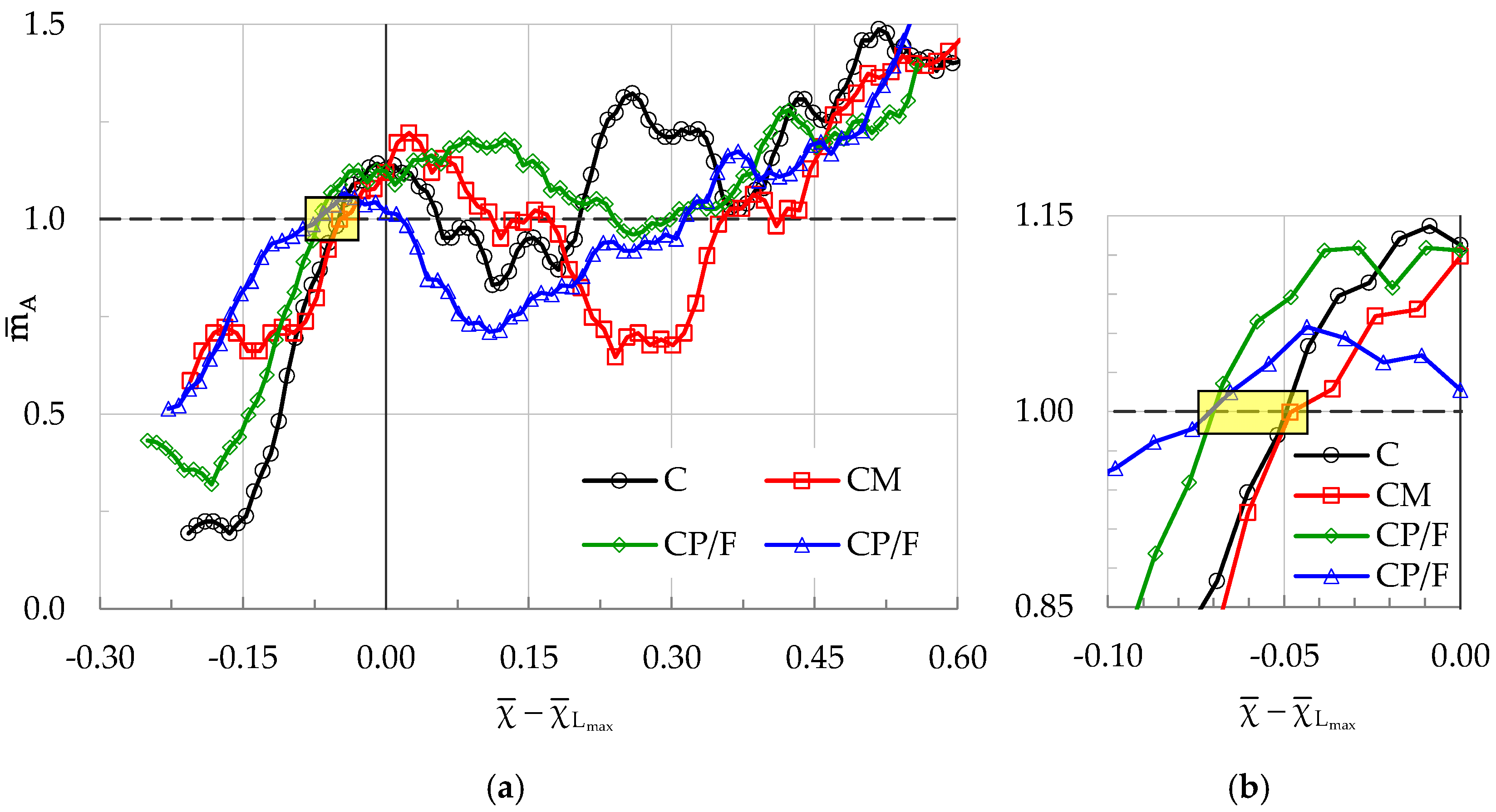
for the four classes of specimens tested are vividly seen in
Figure 17a, in which
is plotted in the natural time domain in terms of the parameter
(i.e., assigning to the instant of load maximization the zero value of the abscissas), so that a common plot of all experiments can be visualized. The most interesting conclusion drawn from
Figure 17 is that the value
= 1 is attained for all four experiments in an extremely narrow interval of χ-values (see the small yellow rectangle in
Figure 17a). This is more clearly seen in the detailed view of this plot, which is shown in
Figure 17b.
The issue that remains to be explored further at this point is the role of the threshold set for the distinction between events with high and low amplitudes. Indeed, up to now this threshold was assumed (somehow arbitrarily) to be the average value of the amplitudes of all the acoustic events recorded during a given experiment. The question is whether a different value for this threshold would significantly influence the conclusions that were drawn.
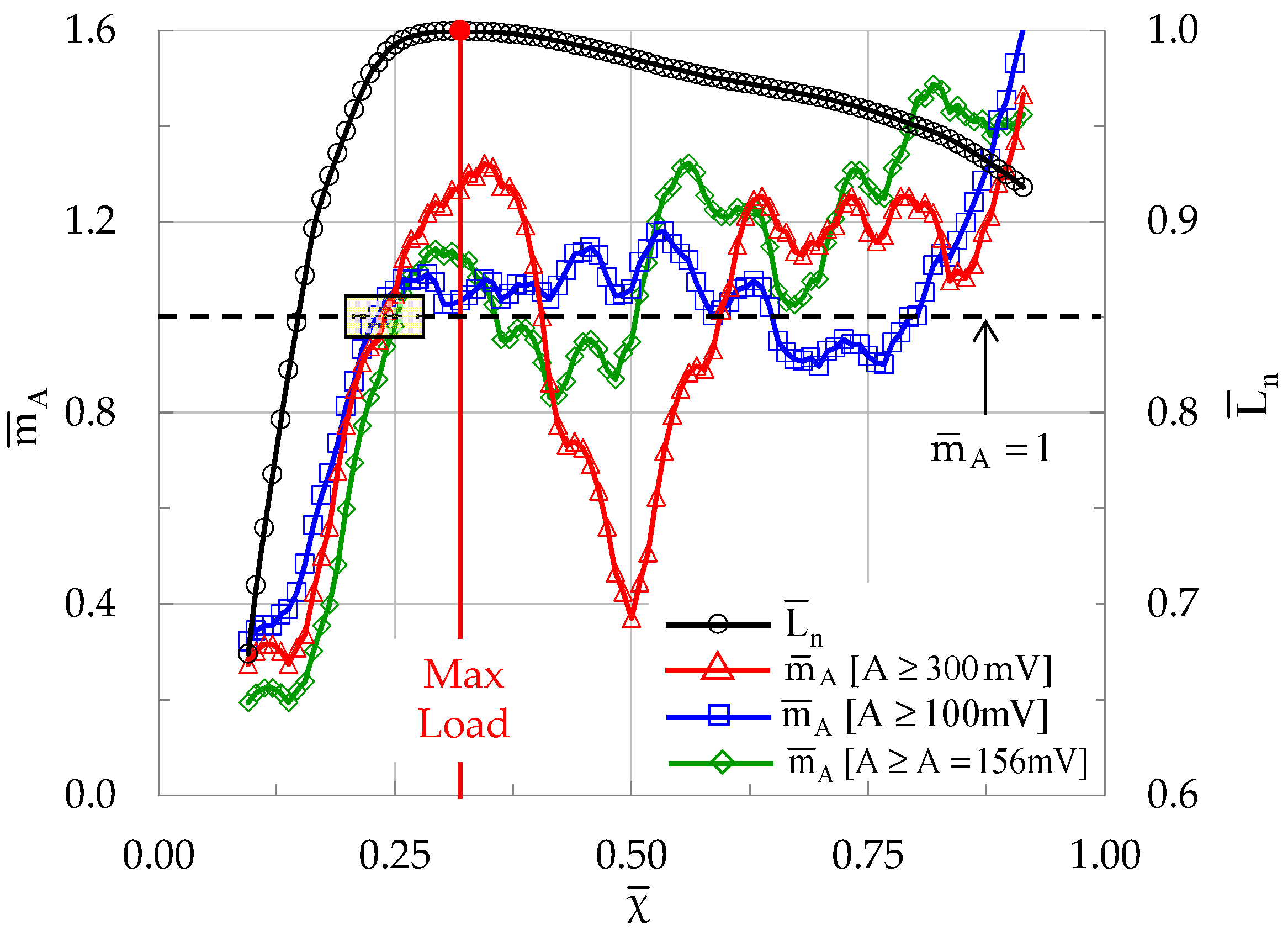
In this context, an experiment of the C class (specimens made of plain concrete) is here analyzed further, assigning different values to the threshold between events with low and high amplitude. For the specific experiment, the average value of the amplitudes of all the events recorded was equal to = 156 mV. Thus, two additional thresholds were adopted, equal to 100 mV and 300 mV, i.e., one higher and one lower than . The portion of events with amplitude exceeding the lower threshold (i.e., A ≥ 100 mV) was equal to 43%. The respective portion for the higher threshold (i.e., events with A ≥ 300 mV) was equal to 19%. Finally, for the respective portion of events was 31%.
For these thresholds, the evolution of
in terms of natural time is plotted in
Figure 18. It can be clearly observed from
Figure 18 that the main feature of the function
=
, i.e., to attain the critical limit
= 1 slightly before the maximization of the externally applied load, appears for all three plots. It is quite striking that the average natural time instants at which the condition
= 1 is fulfilled are very close to each other, in spite of the huge differences between the three thresholds. In fact, for the lower threshold (i.e., A ≥ 100 mV) it holds that χ
cr ≈ 0.22, for the highest one (i.e., A ≥ 300 mV) it holds that χ
cr ≈ 0.24, and for the threshold
it holds that χ
cr ≈ 0.22 (see the small yellow rectangle in
Figure 18). The main qualitative difference between the three plots is the level of fluctuations which increase with increasing threshold.
Before concluding this section, it is interesting to consider the outcomes concerning the temporal evolution of against the respective evolution of alternative quantities that are assumed to provide pre-failure indicators, i.e., signals warning about entrance of the loaded system (or specimen) to the critical stage of impending fracture.
In this context, besides the instantaneous rate, f, of the generation of acoustic events (discussed analytically in
Section 3.1), the evolution of the average Euclidean distance, D, between the sources of acoustic events will be explored comparatively to that of
. The minimization of the distance between the acoustic sources has been recently proposed as a potential pre-failure indicator [
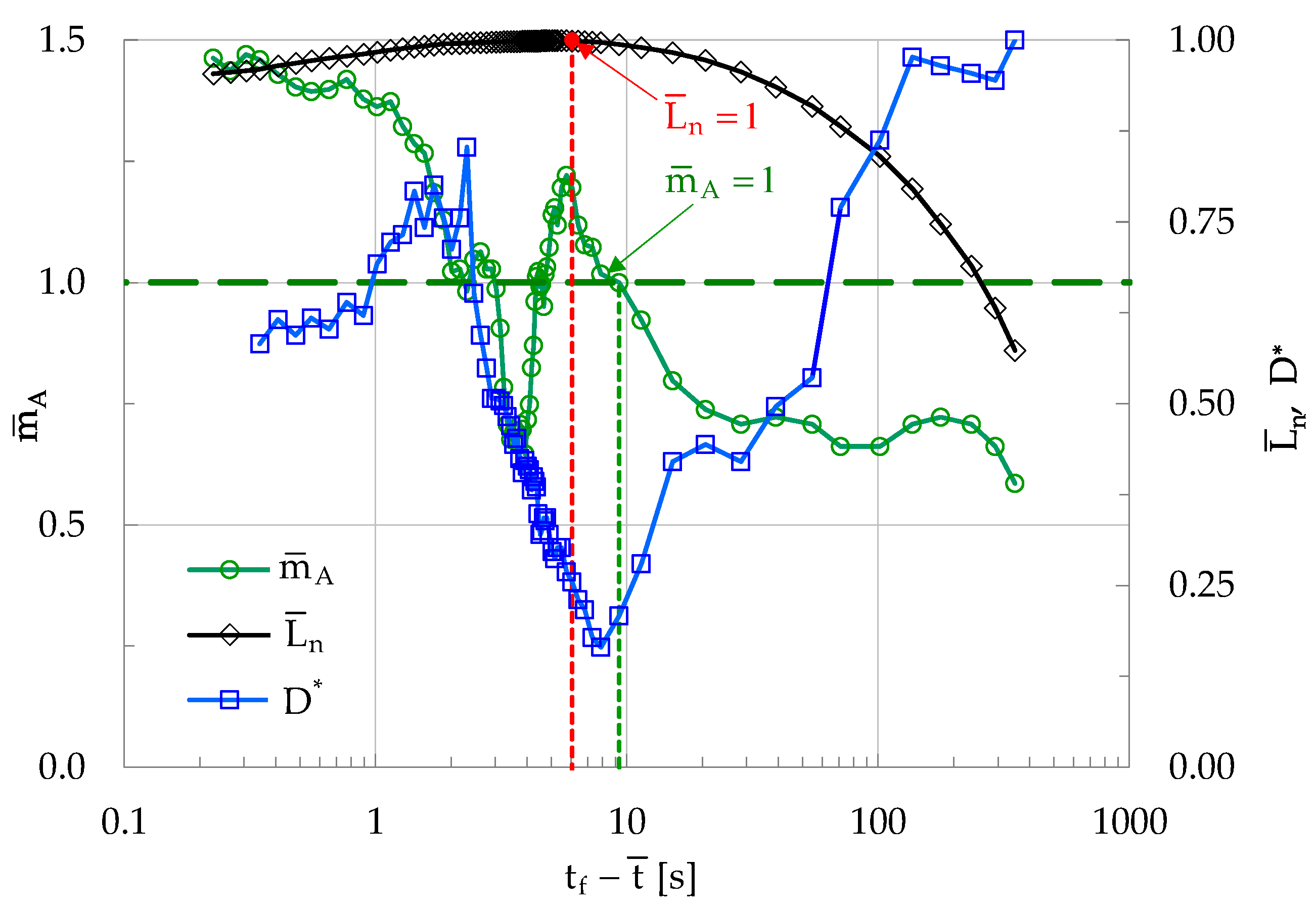
46]. In this direction, and as a characteristic example, the evolution of D for a specimen of the CP/P class is explored. For this example, D is normalized over its maximum value and is denoted as D*. The evolution of D* versus the logarithm of the average time-to-failure, t
f-
, is plotted in
Figure 19 in juxtaposition to the respective evolution of the slope
and that of the normalized average load
. It can be clearly seen from
Figure 19 that the instant at which
fulfills for the first time the condition
=1 is almost identical to the instant at which the average Euclidean distance, D*, between the acoustic sources tends to be minimized.
It is here recalled that the minimization of this distance suggests the intense local concentration of microcracks, being, thus, a precursor of the onset of coalescence of the microcracks towards the direction of forming the fatal macrocrack front. Therefore, the minimization of D is considered as a valuable index signaling entrance of a loaded system to critical stages. In this context, and taking into account
Figure 19, it can be suggested that an intrinsic interrelation exists between the mechanisms leading to the minimization of D and those forcing
to attain the limiting value
=1.
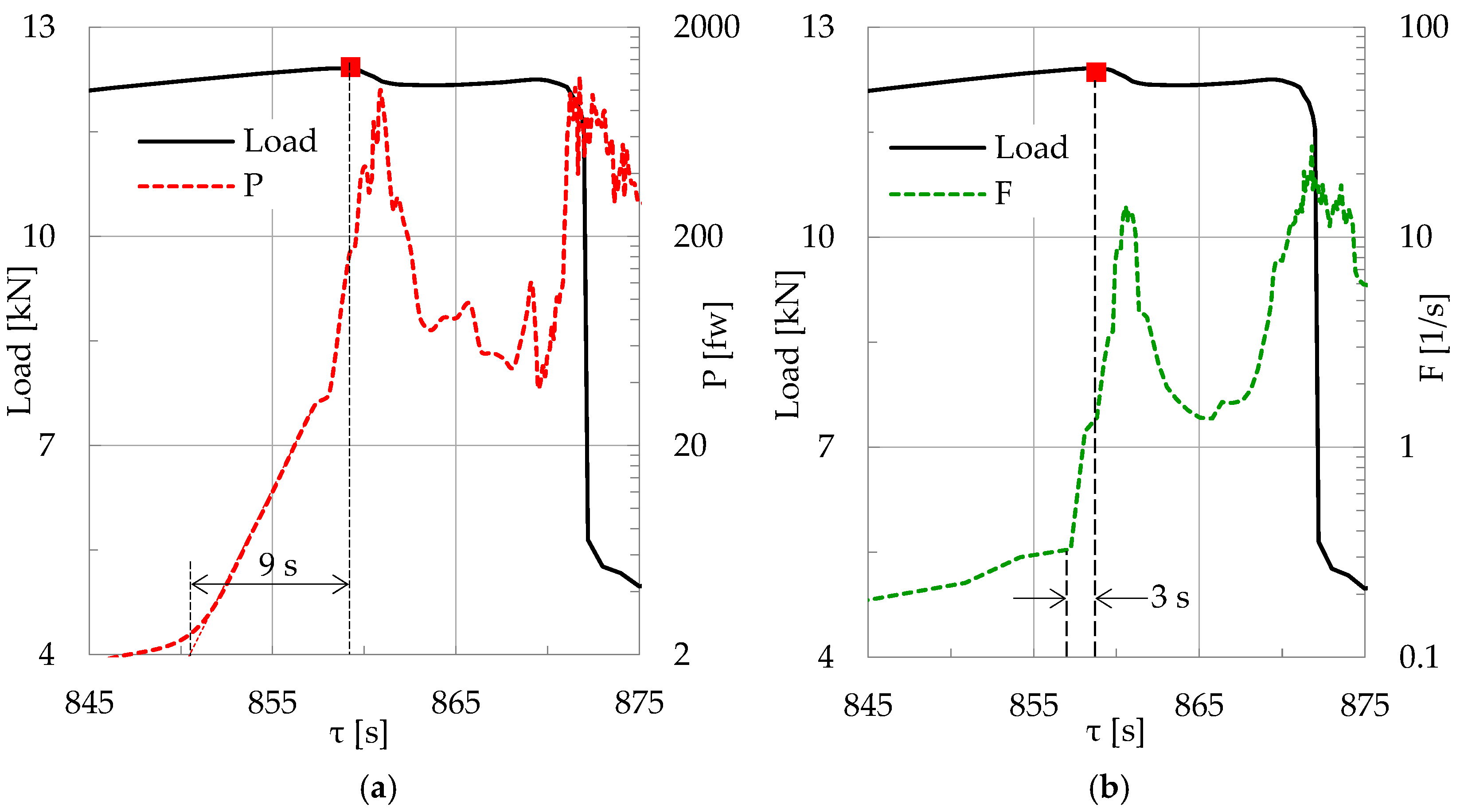
In an attempt for a preliminary quantitative comparison between the outcomes of the present study (concerning the instant at which the pre-failure index is detected) versus the respective instant of traditional approaches, the data for a characteristic specimen made of concrete reinforced with short polyolefin fibers are here analyzed further. The analysis is implemented, again, according to the “sliding window” procedure, in terms of the energy of the acoustic emissions per unit time (i.e., the power P of the emissions recorded) and the average rate of generation of acoustic events, as quantified by the F-function [
47]. The comparison is implemented in terms of the time interval, Δτ, between the onset of rapid increase in either F or P and the instant of maximization of the externally applied load. The results of this analysis are plotted in
Figure 20, in which the power of the acoustic emissions (
Figure 20a) and the F-function (
Figure 20b) are plotted versus the average time, τ, focusing attention on the very last seconds before fracture. In both
Figure 20a and
Figure 20b the respective load applied is also plotted.
It can be seen from this figure that Δτ is equal to about Δτ ≈ 9 s for the power of the AEs and about Δτ ≈ 3 s for the F-function. Considering
Figure 15, it can be seen that
attains its limiting value
= 1 about Δτ ≈ 6 s before the maximization of the load, although the onset of its rapid increase starts about Δτ ≈ 34 s before the load attains its peak value. In light of the above discussion, it is believed that
is indeed an interesting and potentially useful parameter from the practical engineering point of view. However, it is suggested to avoid drawing definite conclusions about its efficiency in comparison to traditional parameters before additional experimental protocols with a wider variety of materials and loading schemes are available.
5. Conclusions
In this study an alternative approach for the detection of early warning signals designating entrance of a loaded specimen into the stage of impending macroscopic fracture was introduced. This approach is based on the study of specific characteristics of a rather disregarded parameter of the Acoustic Emissions technique, namely, the cumulative number of acoustic events which are recorded from the onset of the loading procedure up to the fracture of the specimens.
The objective of the study was achieved by analyzing data from an experimental protocol, previously published by the authors’ team [
40,
41]. The protocol involved beam-shaped specimens (mechanically pre-notched at their mid-span), made of either plain or fiber-reinforced concrete, under a three-point bending loading scheme.
Along this direction, the average slope of the evolution of the normalized cumulative number of acoustic events with amplitude exceeding the respective average value was analyzed both in the conventional and also in the natural time domains. The specific quantity was selected, among others, due to the fact that it is independent of the rate of generation of events depending only on the rate of generation of events with high amplitude. The analysis of the response of all four classes of specimens tested was qualitatively identical. Slightly before the applied load attains its peak value, attains for the first time a limiting value equal to =1. The analysis of in terms of natural time was once again proven advantageous since it offered a smooth distribution, highlighting details that could remain hidden if the analysis was implemented in the conventional time domain.
It could be anticipated that the quantity can only be calculated after the termination of the experiment, or, equivalently, after the fracture of the specimen, because it is only after recording all the acoustic events that the average value can be calculated. Therefore, the potentiality of to provide signs considered as pre-failure indices becomes questionable. In this context, additional thresholds were considered for the amplitude of the acoustic events. It was concluded that, within specific limits, the response of exhibits qualitatively similar characteristics independently of the threshold set. Along these lines, the authors’ team studies the potentialities of “instantaneous” thresholds (like, for example, moving or rolling averages). The preliminary results are very encouraging. However, and in spite of these encouraging results, it is suggested that at this stage of the research project, the approach proposed here for detecting pre-failure warning indices should be considered as supporting already existing approaches, rather than as replacing them.
Before concluding, it is worth mentioning that some inherent correlation between the evolution of and that of other quantities provided by the analysis of acoustic emissions data (like, for example, the instantaneous frequency of generation of acoustic events and the average Euclidean distance between the sources of the acoustic events) was highlighted. In this context, the above-described systematic motif that was observed while analyzing the evolution of the parameter in the natural time domain could provide an interesting tool (at least) for assessing the reliability of the outcomes of various approaches used to detect pre-failure indicators by taking advantage of experimental data recorded with the aid of the Acoustic Emissions technique. In any case, the above interrelations and the conclusions drawn must be further explored for a wider range of materials and loading protocols.