In Situ X-Ray Imaging and Machine Learning in Ultrasonic Field-Assisted Laser-Based Additive Manufacturing: A Review



Abstract
1. Introduction
2. The Fundamental Issues of Ultrasonic-Assisted Metal Additive Manufacturing
3. Scientific Insights from X-Ray Studies on UF-LBAM
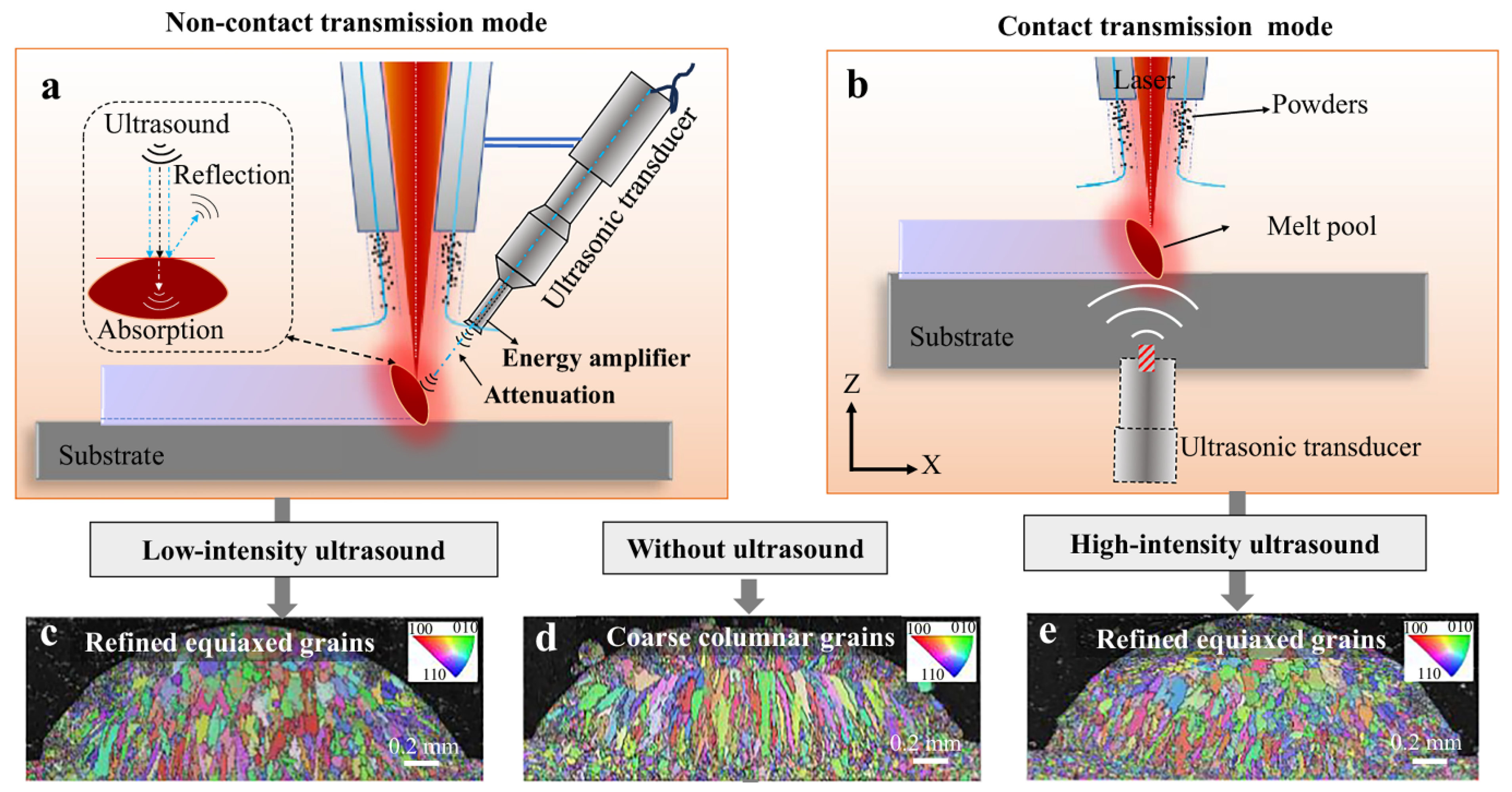
3.1. Ultrasonic Loading Modes
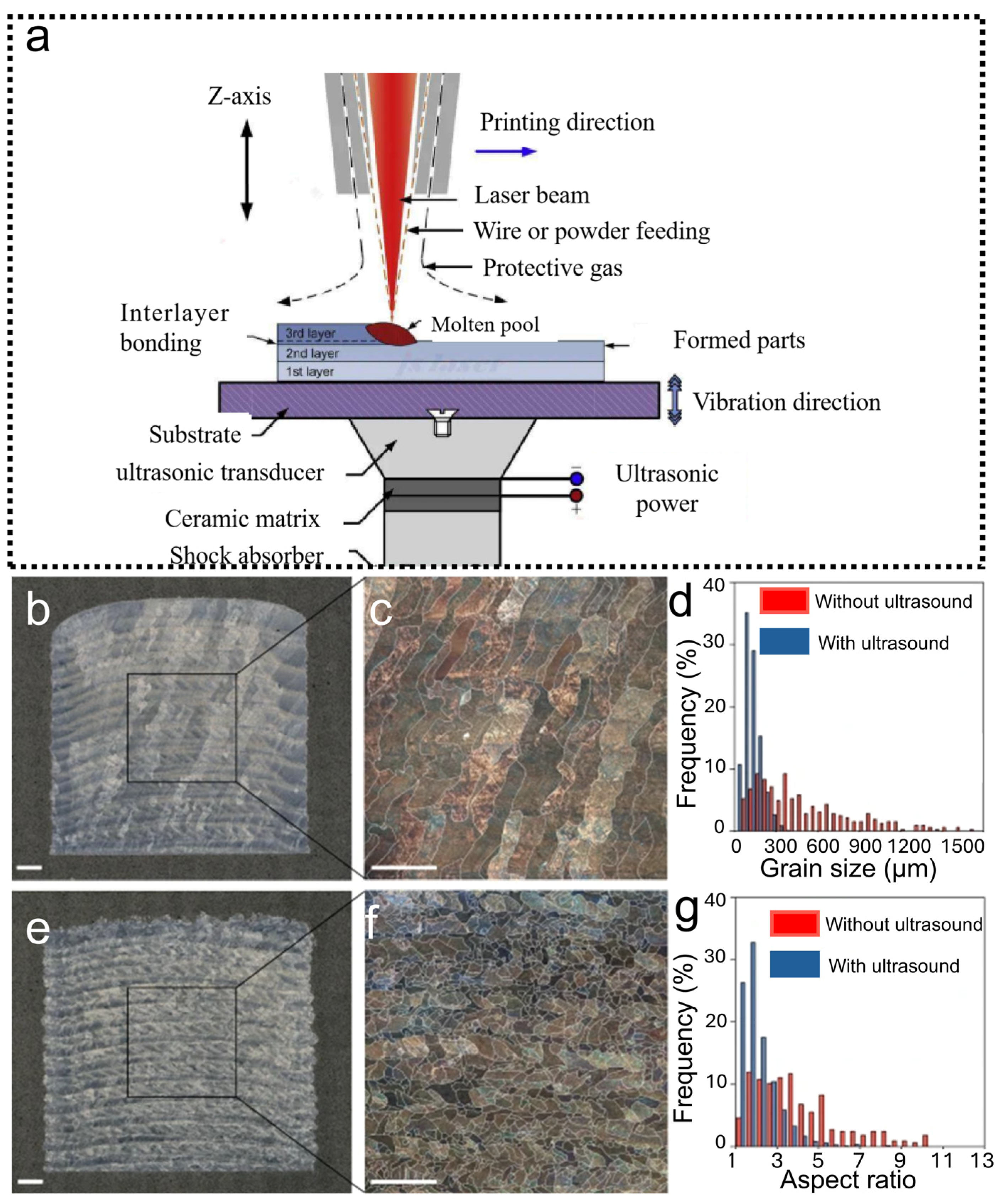

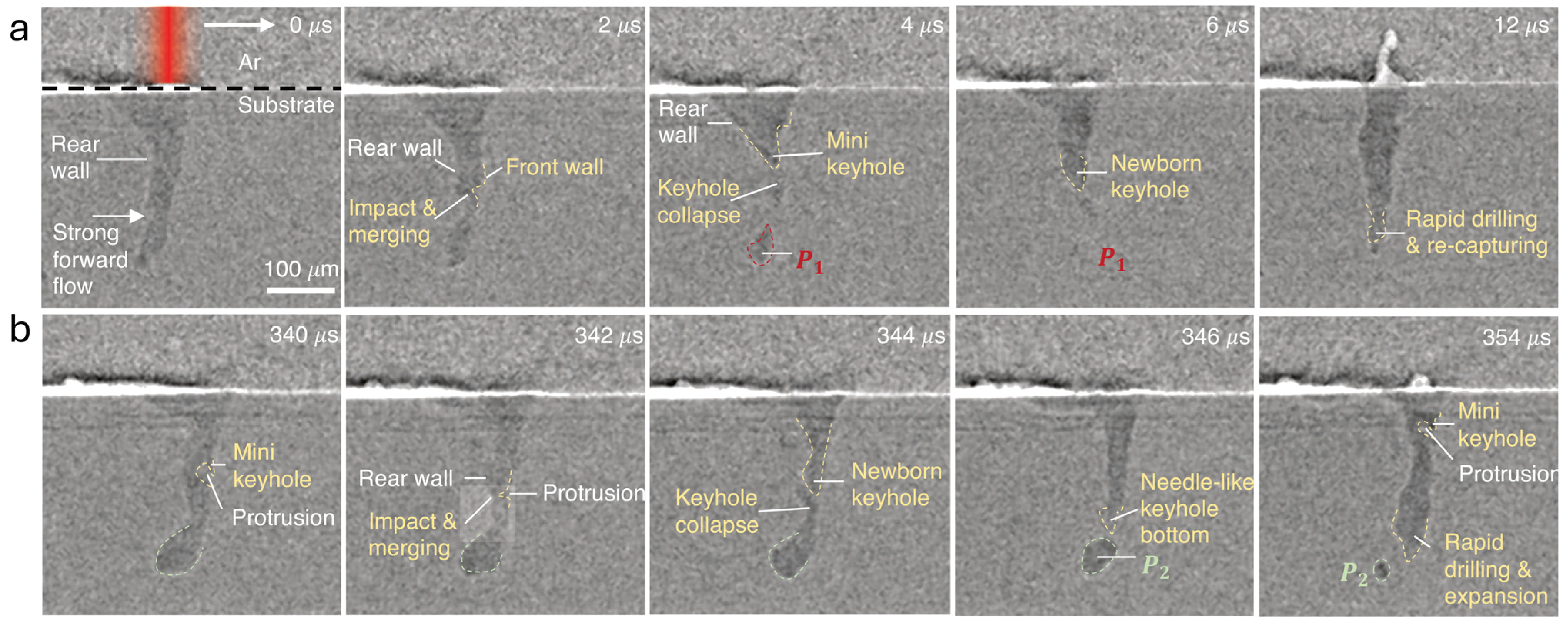
3.2. Melt Pool and Keyhole Dynamics During UF-LBAM
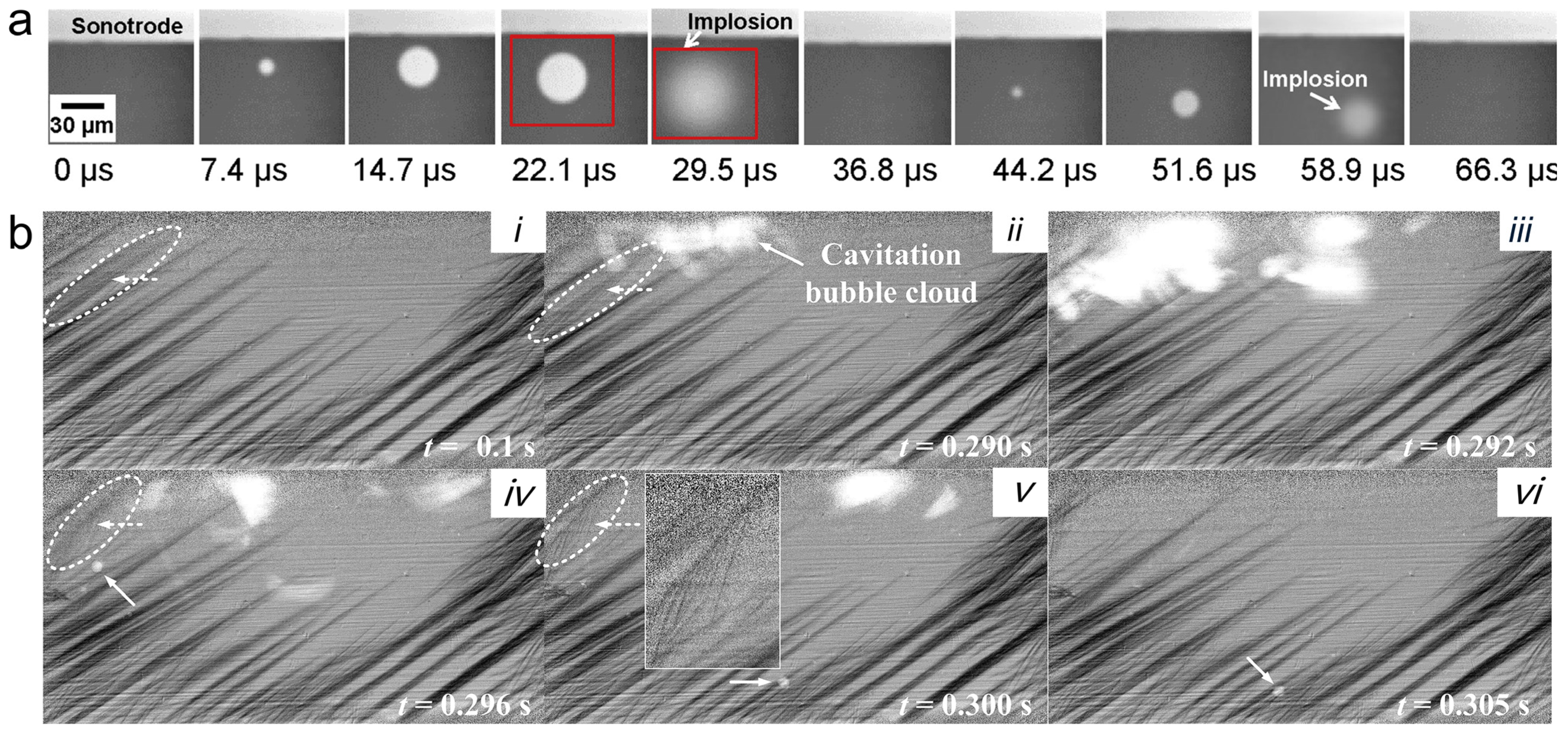
3.3. Cavitation Bubble Dynamics and Solid-Phase Interactions in the Melt Pool
3.4. Ultrasound Excitation Frequency During AM
3.5. Solidification Defects During AM
4. Applications for Machine Learning in Manufacturing

| Machine Learning Algorithm | Definition | Application Scenarios | Advantages | Disadvantages |
|---|---|---|---|---|
| Supervised Learning | Uses large amounts of labeled data to train models and establish direct input → output mappings (classification, regression) | - Image-based defect detection (porosity/cracks/spatter with CNN/YOLO/U-Net) - Process parameter–performance prediction (tensile strength, hardness) - Melt pool geometry regression | Highest accuracy (95–99% common); directly usable for classification/prediction; most mature for industrial deployment | Extremely dependent on high-quality labeled data (metal printing data is expensive, labeling cost is very high); poor generalization (fails easily when changing materials/machines) |
| Unsupervised Learning | No labeled data—automatically discovers inherent data structures (clustering, dimensionality reduction, anomaly detection) | - Anomaly detection (Autoencoder/GAN discovers unknown defects without any defect labels) - Powder spreading/melt pool image clustering - Data dimensionality reduction and feature mining | No labeling required—ideal for data-scarce scenarios; discovers “unknown” defects; reduces labor cost | Usually lower accuracy than supervised learning; results have poor interpretability; difficult to use directly for precise classification/prediction |
| Semi-supervised Learning | Combines a small amount of labeled + large amount of unlabeled data (consistency regularization, self-training, etc.) | - Few-shot defect detection (only label a small number of images, use the rest of unlabeled video for training) - Cross-machine/material transfer learning (leveraging massive unlabeled process data) - GAN-based data augmentation | Dramatically reduces labeling cost (especially practical in metal printing); accuracy close to fully supervised; stronger generalization | Performance heavily depends on the quality of the few labeled samples; training is more complex (needs pseudo-label mechanisms); risk of introducing noise |
| Reinforcement Learning | An agent learns the optimal policy through trial and error + reward feedback interacting with the environment (no supervised labels) | - Closed-loop process control (real-time adjustment of laser power/scanning speed based on melt pool image feedback) - Adaptive parameter optimization (simulator + real-machine joint training) - Sequential decision-making in structural topology optimization | True “adaptive” control; no need for large historical labeled data; handles dynamic uncertainty well | Training is extremely slow and unstable (requires massive simulation interactions); high safety risk in real deployment (initial policy may damage equipment); reward function design is difficult |
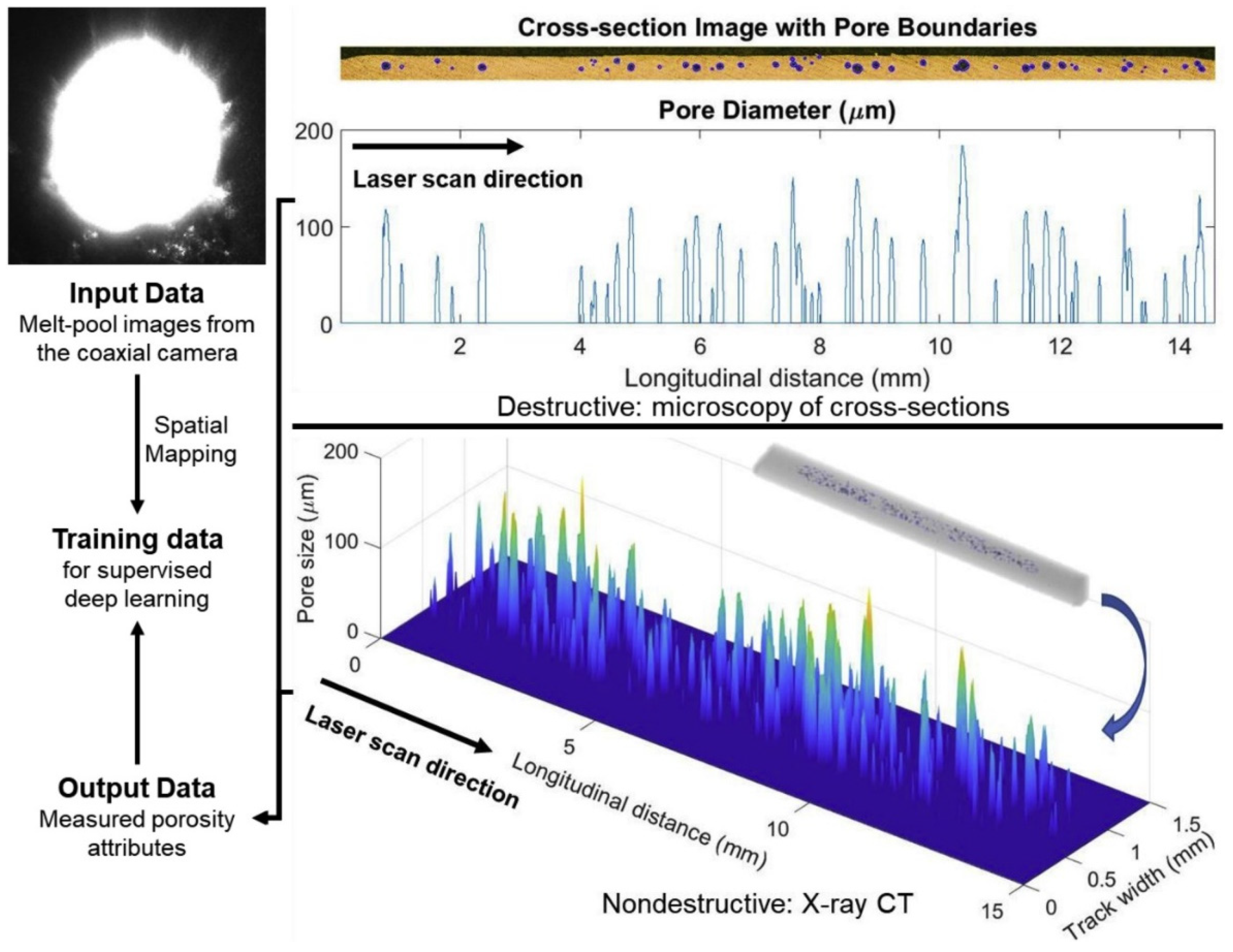
4.1. Melt-Pool State Classification and Defect Detection
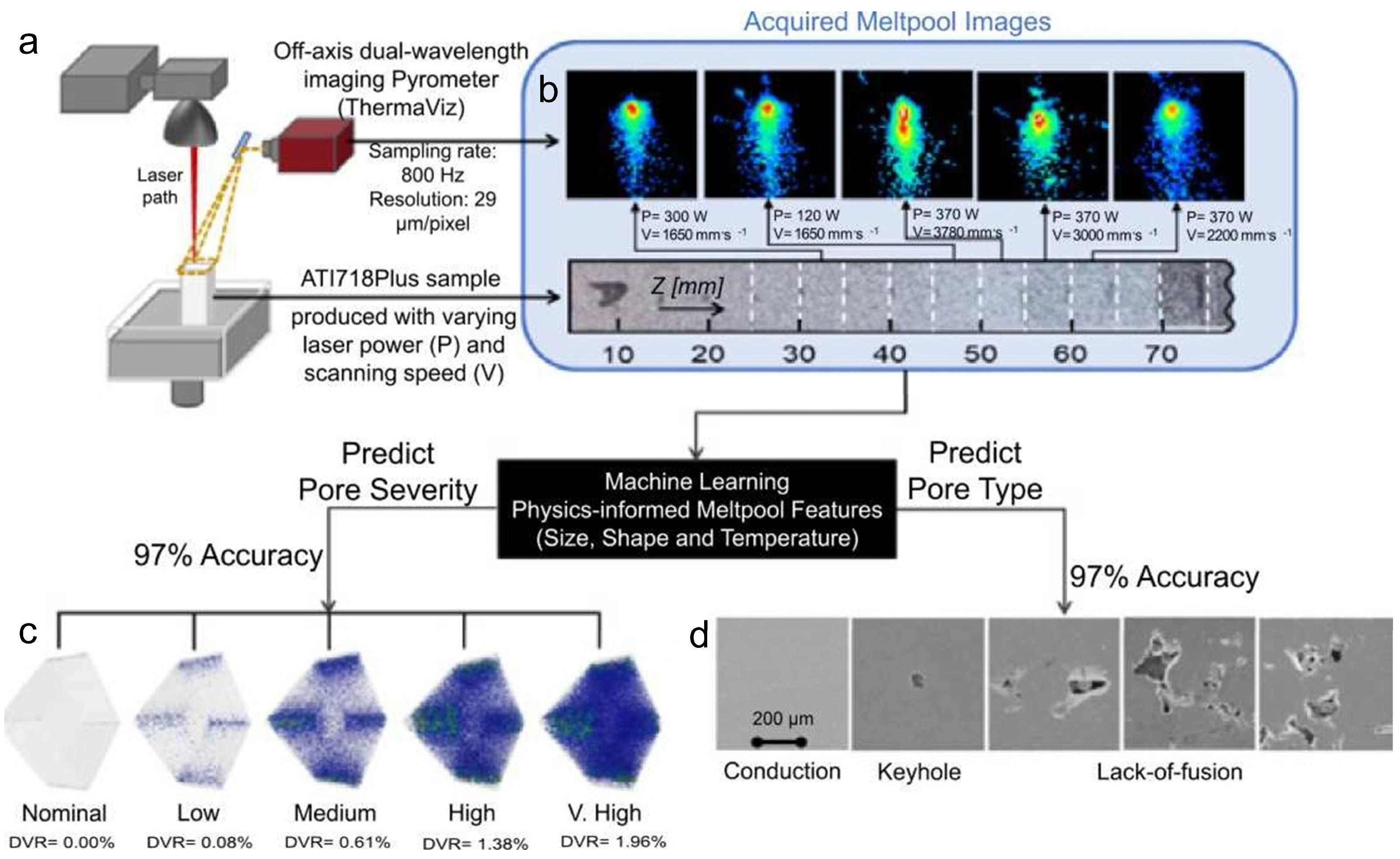

- Global registration and stitching of serial cross-sections: Successive metallographic or XCT images of transverse sections were aligned at pixel-level accuracy using the Speeded-Up Robust Features (SURF) algorithm [81] for feature detection and matching. This establishes a consistent coordinate frame across the entire build height, enabling accurate mapping of melt-pool observations to their corresponding defect locations.
- Orientation correction and region-of-interest cropping: Scan tracks exhibiting tilt or offset relative to the image axes were automatically detected and rotated to align with the primary build direction. Known substrate and fixture geometries were then used to crop extraneous regions (e.g., baseplate, support structures, clamping artifacts, and shadows), isolating the relevant melt tracks.
- Binarization and pore candidate segmentation: Grayscale images were thresholded using Otsu’s method to generate binary masks of dark regions indicative of voids. Connected-component analysis was performed on candidate pores, with geometric descriptors computed for each: solidity (area/filled area), eccentricity, equivalent diameter, perimeter, and aspect ratio. Physically motivated filters were applied to discriminate true metallurgical pores (e.g., gas porosity, lack-of-fusion voids, keyhole collapse pores) from imaging artifacts, polishing scratches, cracks, oxide inclusions, or textural noise (e.g., solidity > 0.7 and eccentricity < 0.85 thresholds to exclude elongated or irregular non-pore features).
4.2. Porosity Prediction
4.3. Microstructures Prediction
4.4. Optimized Process Monitoring and Control
5. Outlook
Funding
Data Availability Statement
Conflicts of Interest
References
- Helal, W.M. 3D Printing and Additive Manufacturing: Technologies, Applications, and Future Directions; Deep Science Publishing: Hangzhou, China, 2025. [Google Scholar]
- Getachew, M.T.; Shiferaw, M.Z.; Ayele, B.S. Recent advances of additive manufacturing for aerospace industries: Methods, materials, challenges, and future outlooks. In Sustainable Development Research in Manufacturing, Process Engineering, Green Infrastructure, and Water Resources: Advancement of Science and Technology; Springer: Cham, Switzerland, 2025; pp. 47–82. [Google Scholar]
- Nguyen, D.A.; Truong, L.B.G.; Nguyen, V.A.; Vu, M.T.; Bui, H.M.; Le, M.T.; Nguyen, T.D.; Tien, D.H.; Le, X.H. Artificial intelligence in metal additive manufacturing: Current status, challenges, and future developments. J. Intell. Manuf. 2026, 1–45. [Google Scholar] [CrossRef]
- Ramos, A.; Angel, V.G.; Siqueiros, M.; Sahagun, T.; Gonzalez, L.; Ballesteros, R. Reviewing additive manufacturing techniques: Material trends and weight optimization possibilities through innovative printing patterns. Materials 2025, 18, 1377. [Google Scholar] [CrossRef] [PubMed]
- Liu, W.-W.; Saleheen, K.M.; Tang, Z.; Wang, H.; Al-Hammadi, G.; Abdelrahman, A.; Yongxin, Z.; Hua, S.-G.; Wang, F.-T. Review on scanning pattern evaluation in laser-based additive manufacturing. Opt. Eng. 2021, 60, 070901. [Google Scholar] [CrossRef]
- Kumar, S. Additive Manufacturing Processes; Springer: Berlin/Heidelberg, Germany, 2020. [Google Scholar]
- Wolff, S.J.; Wang, H.; Gould, B.; Parab, N.; Wu, Z.; Zhao, C.; Greco, A.; Sun, T. In situ X-ray imaging of pore formation mechanisms and dynamics in laser powder-blown directed energy deposition additive manufacturing. Int. J. Mach. Tools Manuf. 2021, 166, 103743. [Google Scholar] [CrossRef]
- Sun, S.; Brandt, M.; Easton, M. Powder bed fusion processes: An overview. In Laser Additive Manufacturing; Woodhead Publishing: Cambridge, UK, 2017; pp. 55–77. [Google Scholar]
- Syed, W.U.H.; Pinkerton, A.J.; Li, L. Simultaneous wire-and powder-feed direct metal deposition: An investigation of the process characteristics and comparison with single-feed methods. J. Laser Appl. 2006, 18, 65–72. [Google Scholar] [CrossRef]
- Zhou, L.; Miller, J.; Vezza, J.; Mayster, M.; Raffay, M.; Justice, Q.; Al Tamimi, Z.; Hansotte, G.; Sunkara, L.D.; Bernat, J. Additive manufacturing: A comprehensive review. Sensors 2024, 24, 2668. [Google Scholar] [CrossRef]
- Xie, S.; Zhu, B.; Qiao, J.; Zhuang, Y.; Zhao, Y.; Zou, J. Molten pool air-liquid interface in high-power laser manufacturing: Evolution law and energy absorption characteristics. Surf. Interfaces 2023, 41, 103214. [Google Scholar] [CrossRef]
- Guo, L.; Wang, H.; Liu, H.; Huang, Y.; Wei, Q.; Leung, C.L.A.; Wu, Y.; Wang, H. Understanding keyhole induced-porosities in laser powder bed fusion of aluminum and elimination strategy. Int. J. Mach. Tools Manuf. 2023, 184, 103977. [Google Scholar] [CrossRef]
- Larimian, T.; AlMangour, B.; Grzesiak, D.; Walunj, G.; Borkar, T. Effect of laser spot size, scanning strategy, scanning speed, and laser power on microstructure and mechanical behavior of 316L stainless steel fabricated via selective laser melting. J. Mater. Eng. Perform. 2022, 31, 2205–2224. [Google Scholar] [CrossRef]
- Liao, Y.-C.; Yu, M.-H. Effects of laser beam energy and incident angle on the pulse laser welding of stainless steel thin sheet. J. Mater. Process. Technol. 2007, 190, 102–108. [Google Scholar] [CrossRef]
- Hojjatzadeh, S.M.H.; Parab, N.D.; Yan, W.; Guo, Q.; Xiong, L.; Zhao, C.; Qu, M.; Escano, L.I.; Xiao, X.; Fezzaa, K.; et al. Pore elimination mechanisms during 3D printing of metals. Nat. Commun. 2019, 10, 3088. [Google Scholar] [CrossRef] [PubMed]
- Smith, P.H.; Murray, J.W.; Jones, D.O.; Segal, J.; Clare, A.T. Magnetically assisted directed energy deposition. J. Mater. Process. Technol. 2021, 288, 116892. [Google Scholar] [CrossRef]
- Al Noman, A.; Kumar, B.K.; Dickens, T. Field assisted additive manufacturing for polymers and metals: Materials and methods. Virtual Phys. Prototyp. 2023, 18, e2256707. [Google Scholar] [CrossRef]
- Wang, B.; Du, J.; Zhang, H.; Cao, Y.; Wen, C.; Iacovacci, V.; Lyu, Z.; Li, T.; Wang, Q. External-field-assisted additive manufacturing for micro/nano device fabrication. Int. J. Extrem. Manuf. 2026, 8, 012005. [Google Scholar] [CrossRef]
- Hu, Y. Recent progress in field-assisted additive manufacturing: Materials, methodologies, and applications. Mater. Horiz. 2021, 8, 885–911. [Google Scholar] [CrossRef]
- Todaro, C.; Easton, M.; Qiu, D.; Brandt, M.; StJohn, D.; Qian, M. Grain refinement of stainless steel in ultrasound-assisted additive manufacturing. Addit. Manuf. 2021, 37, 101632. [Google Scholar] [CrossRef]
- Todaro, C.; Easton, M.; Qiu, D.; Zhang, D.; Bermingham, M.; Lui, E.; Brandt, M.; StJohn, D.; Qian, M. Grain structure control during metal 3D printing by high-intensity ultrasound. Nat. Commun. 2020, 11, 142. [Google Scholar] [CrossRef]
- Ou, X.; Chen, X.; Xu, X.; Xie, L.; Chen, X.; Hong, Z.; Bai, H.; Liu, X.; Chen, Q.; Li, L. Recent development in X-ray imaging technology: Future and challenges. Research 2021, 2021, 9892152. [Google Scholar] [CrossRef]
- Liu, Y.; Nelson, J.; Holzner, C.; Andrews, J.; Pianetta, P. Recent advances in synchrotron-based hard x-ray phase contrast imaging. J. Phys. D Appl. Phys. 2013, 46, 494001. [Google Scholar] [CrossRef]
- Cunningham, R.; Zhao, C.; Parab, N.; Kantzos, C.; Pauza, J.; Fezzaa, K.; Sun, T.; Rollett, A.D. Keyhole threshold and morphology in laser melting revealed by ultrahigh-speed x-ray imaging. Science 2019, 363, 849–852. [Google Scholar] [CrossRef]
- Yang, T.; Kumar, J.; Jin, Y.; Squires, B.; Palaniappan, S.; Spencer, J.; Dussa, S.K.; Gu, Z.; Voevodin, A.A.; Dahotre, N.B. Machine Learning Aided In-situ monitoring of compositional variation during laser additive manufacturing of refractory alloy. J. Mater. Process. Technol. 2026, 349, 119216. [Google Scholar] [CrossRef]
- Snow, Z.; Scime, L.; Ziabari, A.; Fisher, B.; Paquit, V. Scalable in situ non-destructive evaluation of additively manufactured components using process monitoring, sensor fusion, and machine learning. Addit. Manuf. 2023, 78, 103817. [Google Scholar] [CrossRef]
- Herzog, T.; Brandt, M.; Trinchi, A.; Sola, A.; Molotnikov, A. Process monitoring and machine learning for defect detection in laser-based metal additive manufacturing. J. Intell. Manuf. 2024, 35, 1407–1437. [Google Scholar] [CrossRef]
- Papernot, N.; McDaniel, P. Deep k-nearest neighbors: Towards confident, interpretable and robust deep learning. arXiv 2018, arXiv:1803.04765. [Google Scholar] [CrossRef]
- Wen, H.; Huang, C.; Guo, S. The application of convolutional neural networks (CNNs) to recognize defects in 3D-printed parts. Materials 2021, 14, 2575. [Google Scholar] [CrossRef]
- Lashyna, Y.; Kunytsia, A. Comparison and Evaluation of Conventional and Machine Learning-Assisted Reverse Engineering Workflows. Mech. Adv. Technol. 2025, 9, 298–308. [Google Scholar] [CrossRef]
- Zhu, Q.; Liu, Z.; Yan, J. Machine learning for metal additive manufacturing: Predicting temperature and melt pool fluid dynamics using physics-informed neural networks. Comput. Mech. 2021, 67, 619–635. [Google Scholar] [CrossRef]
- Xiao, Y.; Wang, X.; Yang, W.; Yao, X.; Yang, Z.; Lu, Y.; Wang, Z.; Chen, L. Data-driven prediction of future melt pool from built parts during metal additive manufacturing. Addit. Manuf. 2024, 93, 104438. [Google Scholar] [CrossRef]
- Bermingham, M.; StJohn, D.; Easton, M.; Yuan, L.; Dargusch, M. Revealing the Mechanisms of Grain Nucleation and Formation During Additive Manufacturing: Bermingham, StJohn, Easton, Yuan, and Dargusch. J. Miner. Met. Mater. Soc. 2020, 72, 1065–1073. [Google Scholar] [CrossRef]
- Yang, S.; Weng, Y.; Zhao, Q.; Wu, G.; Deng, Z.; Qin, L. Ultrasonic Melt Processing: Progress, Applications, and Future Directions. Materials 2025, 18, 522. [Google Scholar] [CrossRef]
- Yang, Z.; Wang, S.; Zhu, L.; Ning, J.; Xin, B.; Dun, Y.; Yan, W. Manipulating molten pool dynamics during metal 3D printing by ultrasound. Appl. Phys. Rev. 2022, 9, 021416. [Google Scholar] [CrossRef]
- Serdeczny, M.P.; Comminal, R.; Pedersen, D.B.; Spangenberg, J. Numerical simulations of the mesostructure formation in material extrusion additive manufacturing. Addit. Manuf. 2019, 28, 419–429. [Google Scholar] [CrossRef]
- Prem, P.R.; Sanker, A.P.; Sebastian, S.; Kaliyavaradhan, S.K. A review on application of acoustic emission testing during additive manufacturing. J. Nondestruct. Eval. 2023, 42, 96. [Google Scholar] [CrossRef]
- Baiges, J.; Chiumenti, M.; Moreira, C.A.; Cervera, M.; Codina, R. An adaptive finite element strategy for the numerical simulation of additive manufacturing processes. Addit. Manuf. 2021, 37, 101650. [Google Scholar] [CrossRef]
- Chandra, S.; Radhakrishnan, J.; Huang, S.; Wei, S.; Ramamurty, U. Solidification in metal additive manufacturing: Challenges, solutions, and opportunities. Prog. Mater. Sci. 2025, 148, 101361. [Google Scholar] [CrossRef]
- Cong, B.; Cai, X.; Qi, Z.; Qi, B.; Zhang, Y.; Zhang, R.; Guo, W.; Zhou, Z.; Yin, Y.; Bu, X. The effects of ultrasonic frequency pulsed arc on wire+ arc additively manufactured high strength aluminum alloys. Addit. Manuf. 2022, 51, 102617. [Google Scholar] [CrossRef]
- Sun, L.; Huang, L.; Wu, P.; Huang, R.; Fang, N.; Xu, F.; Xu, K. Progress on the effect and mechanism of ultrasonic impact treatment on additive manufactured metal fabrications. Crystals 2023, 13, 995. [Google Scholar] [CrossRef]
- Liu, W.; Zhang, Z.; Li, S.; Xu, C. The research on ultrasonic vibration amplitudes in Ti6Al4V DED additive manufacturing. Alloys 2023, 2, 256–270. [Google Scholar] [CrossRef]
- Han, J.; Wang, S.; Ge, W.; Chen, H.; Sun, Y.; Ai, Y.; Yuan, W.; Ruan, S.; Niu, W.; Yang, H. Non-contact ultrasound to assist laser additive manufacturing. Nat. Commun. 2025, 16, 7613. [Google Scholar] [CrossRef]
- Richter, B.; Hocker, S.J.; Frankforter, E.L.; Tayon, W.A.; Glaessgen, E.H. Influence of ultrasonic excitation on the melt pool and microstructure characteristics of Ti-6Al-4V at powder bed fusion additive manufacturing solidification velocities. Addit. Manuf. 2024, 89, 104228. [Google Scholar] [CrossRef]
- Ren, Z.; Gao, L.; Clark, S.J.; Fezzaa, K.; Shevchenko, P.; Choi, A.; Everhart, W.; Rollett, A.D.; Chen, L.; Sun, T. Machine learning–aided real-time detection of keyhole pore generation in laser powder bed fusion. Science 2023, 379, 89–94. [Google Scholar] [CrossRef] [PubMed]
- Schricker, K.; Schmidt, L.; Nagel, F.; Diegel, C.; Friedmann, H.; Seibold, M.; Hellwig, P.; Fröhlich, F.; Kallage, P.; Chen, Y. A comprehensive study on the influence of spatial power distribution on time-dependent keyhole behavior in laser beam welding of copper by means of high-speed synchrotron X-ray imaging. Opt. Laser Technol. 2025, 192, 113999. [Google Scholar] [CrossRef]
- Mutswatiwa, L.; Katch, L.; Kizer, N.J.; Todd, J.A.; Sun, T.; Clark, S.J.; Fezzaa, K.; Lum, J.S.; Stobbe, D.M.; Jones, G. High-speed synchrotron X-ray imaging of melt pool dynamics during ultrasonic melt processing of Al6061. Commun. Mater. 2024, 5, 143. [Google Scholar] [CrossRef]
- Huang, Y.; Fleming, T.G.; Clark, S.J.; Marussi, S.; Fezzaa, K.; Thiyagalingam, J.; Leung, C.L.A.; Lee, P.D. Keyhole fluctuation and pore formation mechanisms during laser powder bed fusion additive manufacturing. Nat. Commun. 2022, 13, 1170. [Google Scholar] [CrossRef]
- Eskin, D.; Tzanakis, I.; Wang, F.; Lebon, G.; Subroto, T.; Pericleous, K.; Mi, J. Fundamental studies of ultrasonic melt processing. Ultrason. Sonochem. 2019, 52, 455–467. [Google Scholar] [CrossRef]
- Calta, N.P.; Thampy, V.; Lee, D.R.; Martin, A.A.; Ganeriwala, R.; Wang, J.; Depond, P.J.; Roehling, T.T.; Fong, A.Y.; Kiss, A.M. Cooling dynamics of two titanium alloys during laser powder bed fusion probed with in situ X-ray imaging and diffraction. Mater. Des. 2020, 195, 108987. [Google Scholar] [CrossRef]
- Guo, L.; Liu, H.; Tang, Z.; Qian, Y.; Gao, Z.; Wu, Y.; Wang, H.; Wang, P.; Wang, X.; Li, Y. Fluid flow and bubble evolution in the melt pool of high-power (>2500 W) laser additive manufacturing of aluminum captured by X-ray imaging. Trans. Mater. Res. 2025, 1, 100084. [Google Scholar] [CrossRef]
- Wang, B.; Tan, D.; Lee, T.L.; Khong, J.C.; Wang, F.; Eskin, D.; Connolley, T.; Fezzaa, K.; Mi, J. Ultrafast synchrotron X-ray imaging studies of microstructure fragmentation in solidification under ultrasound. Acta Mater. 2018, 144, 505–515. [Google Scholar] [CrossRef]
- Wang, F.; Eskin, D.; Mi, J.; Wang, C.; Koe, B.; King, A.; Reinhard, C.; Connolley, T. A synchrotron X-radiography study of the fragmentation and refinement of primary intermetallic particles in an Al-35 Cu alloy induced by ultrasonic melt processing. Acta Mater. 2017, 141, 142–153. [Google Scholar] [CrossRef]
- Qin, L.; Xiang, K.; Li, L.; Tzanakis, I.; Eskin, D.; Mi, J. An integrated numerical modelling framework for simulation of the multiphysics in sonoprocessing of materials. Ultrason. Sonochem. 2025, 120, 107428. [Google Scholar] [CrossRef]
- Qin, L.; Porfyrakis, K.; Tzanakis, I.; Grobert, N.; Eskin, D.G.; Fezzaa, K.; Mi, J. Multiscale interactions of liquid, bubbles and solid phases in ultrasonic fields revealed by multiphysics modelling and ultrafast X-ray imaging. Ultrason. Sonochem. 2022, 89, 106158. [Google Scholar] [CrossRef]
- Zhang, Z.; Li, B.; Guo, D.; Qin, F.; Chen, L. Thickness inversion of thin additive manufacturing Ti-6Al-4 V based on dispersion curve variation with laser-induced ultrasonic. Ultrasonics 2025, 151, 107629. [Google Scholar] [CrossRef] [PubMed]
- Hu, C.-L.; Lin, J.-L.; Li, C.-J.; Huang, C.-H. High-Throughput Acoustic Separation of Micro-and Macro-Scale Particles via Programmable Multi-Frequency Ultrasound Standing Wave Platform. In 2025 IEEE International Ultrasonics Symposium (IUS); IEEE: Utrecht, The Netherlands, 2025; pp. 1–4. [Google Scholar]
- Chen, X.; Jia, Y.; Le, Q.; Ning, S.; Yin, Z.; Hu, C.; Yu, F. Understanding dual-frequency ultrasonic melt treatment on grain refinement and mechanical properties improvement of AZ80 magnesium alloy: Experiment and simulation. J. Mater. Res. Technol. 2021, 15, 4758–4767. [Google Scholar] [CrossRef]
- Jiang, Z.; Zhu, L.; Zhang, J.; Meng, G.; Yang, Z.; Xu, L. Influence of ultrasonic vibration on molten pool behavior, cladding layer microstructure and pore defects for directed energy deposition. Appl. Therm. Eng. 2024, 247, 123047. [Google Scholar] [CrossRef]
- Vasileska, E.; Argilovski, A.; Tomov, M.; Jovanoski, B.; Gecevska, V. Implementation of machine learning for enhancing lean manufacturing practices for metal additive manufacturing. IEEE Trans. Eng. Manag. 2024, 71, 14836–14845. [Google Scholar] [CrossRef]
- Miller, D.; Song, B.; Farnsworth, M.; Tiwari, D.; Freeman, F.; Todd, I.; Tiwari, A. IoT and Machine learning for in-situ process control using Laser Based Additive Manufacturing (LBAM) case study. Procedia CIRP 2021, 104, 1813–1818. [Google Scholar] [CrossRef]
- Moradi, A.; Tajalli, S.; Mosallanejad, M.H.; Saboori, A. Intelligent laser-based metal additive manufacturing: A review on machine learning for process optimization and property prediction. Int. J. Adv. Manuf. Technol. 2025, 136, 527–560. [Google Scholar] [CrossRef]
- Bhandarkar, V.V.; Shahare, H.Y.; Mall, A.P.; Tandon, P. An overview of traditional and advanced methods to detect part defects in additive manufacturing processes. J. Intell. Manuf. 2025, 36, 4411–4446. [Google Scholar] [CrossRef]
- Chen, L. Multi-Sensor Monitoring for In-Situ Defect Detection and Quality Assurance in Laser-Directed Energy Deposition. 2024. Available online: https://dr.ntu.edu.sg/entities/publication/a11f85d7-2dfb-48a5-ba61-dad5b1923ac8 (accessed on 5 January 2026).
- Chen, K.; Zhang, P.; Yan, H.; Chen, G.; Sun, T.; Lu, Q.; Chen, Y.; Shi, H. A review of machine learning in additive manufacturing: Design and process. Int. J. Adv. Manuf. Technol. 2024, 135, 1051–1087. [Google Scholar] [CrossRef]
- Nasteski, V. An overview of the supervised machine learning methods. Horizons 2017, 4, 51–62. [Google Scholar] [CrossRef]
- Celebi, M.E.; Aydin, K. Unsupervised Learning Algorithms; Springer: Berlin/Heidelberg, Germany, 2016. [Google Scholar]
- Reddy, Y.; Viswanath, P.; Reddy, B.E. Semi-supervised learning: A brief review. Int. J. Eng. Technol. 2018, 7, 81. [Google Scholar] [CrossRef]
- Sutton, R.S.; Barto, A.G. Introduction to Reinforcement Learning; MIT Press: Cambridge, MA, USA, 1998. [Google Scholar]
- DebRoy, T.; Mukherjee, T.; Wei, H.; Elmer, J.; Milewski, J. Metallurgy, mechanistic models and machine learning in metal printing. Nat. Rev. Mater. 2021, 6, 48–68. [Google Scholar] [CrossRef]
- Goh, G.D.; Sing, S.L.; Yeong, W.Y. A review on machine learning in 3D printing: Applications, potential, and challenges. Artif. Intell. Rev. 2021, 54, 63–94. [Google Scholar] [CrossRef]
- Soucy, P.; Mineau, G.W. A simple KNN algorithm for text categorization. In 2001 IEEE International Conference on Data Mining; IEEE Computer Society Press: San Jose, CA, USA, 2001; pp. 647–648. [Google Scholar]
- Smoqi, Z.; Gaikwad, A.; Bevans, B.; Kobir, M.H.; Craig, J.; Abul-Haj, A.; Peralta, A.; Rao, P. Monitoring and prediction of porosity in laser powder bed fusion using physics-informed meltpool signatures and machine learning. J. Mater. Process. Technol. 2022, 304, 117550. [Google Scholar] [CrossRef]
- Suyal, M.; Goyal, P. A review on analysis of k-nearest neighbor classification machine learning algorithms based on supervised learning. Int. J. Eng. Trends Technol. 2022, 70, 43–48. [Google Scholar] [CrossRef]
- Rojas-Duenas, G.; Riba, J.-R.; Moreno-Eguilaz, M. Black-box modeling of DC–DC converters based on wavelet convolutional neural networks. IEEE Trans. Instrum. Meas. 2021, 70, 1–9. [Google Scholar] [CrossRef]
- Yamashita, R.; Nishio, M.; Do, R.K.G.; Togashi, K. Convolutional neural networks: An overview and application in radiology. Insights Imaging 2018, 9, 611–629. [Google Scholar] [CrossRef]
- Zhang, B.; Liu, S.; Shin, Y.C. In-Process monitoring of porosity during laser additive manufacturing process. Addit. Manuf. 2019, 28, 497–505. [Google Scholar] [CrossRef]
- Ho, S.; Zhang, W.; Young, W.; Buchholz, M.; Al Jufout, S.; Dajani, K.; Bian, L.; Mozumdar, M. DLAM: Deep learning based real-time porosity prediction for additive manufacturing using thermal images of the melt pool. IEEE Access 2021, 9, 115100–115114. [Google Scholar] [CrossRef]
- Hossain, M.S.; Taheri, H. In-situ process monitoring for metal additive manufacturing through acoustic techniques using wavelet and convolutional neural network (CNN). Int. J. Adv. Manuf. Technol. 2021, 116, 3473–3488. [Google Scholar] [CrossRef]
- Le Roux, L.; Soroka, A.; Ji, Z.; Kerfiden, P.; Bigot, S. Developing rapid metal AM deformations prediction using CNN. Procedia CIRP 2024, 126, 567–572. [Google Scholar] [CrossRef]
- Bay, H.; Ess, A.; Tuytelaars, T.; Van Gool, L. Speeded-up robust features (SURF). Comput. Vis. Image Underst. 2008, 110, 346–359. [Google Scholar] [CrossRef]
- Sankhye, S.; Hu, G. Machine learning methods for quality prediction in production. Logistics 2020, 4, 35. [Google Scholar] [CrossRef]
- Md, A.Q.; Jha, K.; Haneef, S.; Sivaraman, A.K.; Tee, K.F. A review on data-driven quality prediction in the production process with machine learning for industry 4.0. Processes 2022, 10, 1966. [Google Scholar] [CrossRef]
- Oster, S.; Scheuschner, N.; Chand, K.; Altenburg, S.J. Local porosity prediction in metal powder bed fusion using in-situ thermography: A comparative study of machine learning techniques. Addit. Manuf. 2024, 95, 104502. [Google Scholar] [CrossRef]
- Kats, D.; Wang, Z.; Gan, Z.; Liu, W.K.; Wagner, G.J.; Lian, Y. A physics-informed machine learning method for predicting grain structure characteristics in directed energy deposition. Comput. Mater. Sci. 2022, 202, 110958. [Google Scholar] [CrossRef]
- Li, X.; Zhang, Y.; Zhao, H.; Burkhart, C.; Brinson, L.C.; Chen, W. A transfer learning approach for microstructure reconstruction and structure-property predictions. Sci. Rep. 2018, 8, 13461. [Google Scholar] [CrossRef]
- Petrich, J.; Snow, Z.; Corbin, D.; Reutzel, E.W. Multi-modal sensor fusion with machine learning for data-driven process monitoring for additive manufacturing. Addit. Manuf. 2021, 48, 102364. [Google Scholar] [CrossRef]
- Li, Z.; Zhang, Z.; Zhang, S.; Wang, J.; Bai, Z.; Du, Z.; Huang, K.; Zhang, Q.; Su, Y.; Wen, G. In-situ monitoring in laser powder bed fusion based on acoustic signal time-frequency synchrosqueezing transform and multi-scale spatially interactive fusion convolutional neural network. J. Manuf. Process. 2024, 126, 471–486. [Google Scholar] [CrossRef]
- Chen, L.; Yao, X.; Moon, S.K. In-situ acoustic monitoring of direct energy deposition process with deep learning-assisted signal denoising. Mater. Today Proc. 2022, 70, 136–142. [Google Scholar] [CrossRef]
- Li, C.; Yan, H.; Qian, X.; Zhu, S.; Zhu, P.; Liao, C.; Tian, H.; Li, X.; Wang, X.; Li, X. A domain adaptation YOLOv5 model for industrial defect inspection. Measurement 2023, 213, 112725. [Google Scholar] [CrossRef]
- Pappula, K.K. Edge-Deployed Computer Vision for Real-Time Defect Detection. Int. J. AI Big Data Comput. Manag. Stud. 2023, 4, 72–81. [Google Scholar]
- Xu, W. Application of self-supervised learning in steel surface defect detection. J. Mater. Inform. 2025, 5, 44. [Google Scholar]

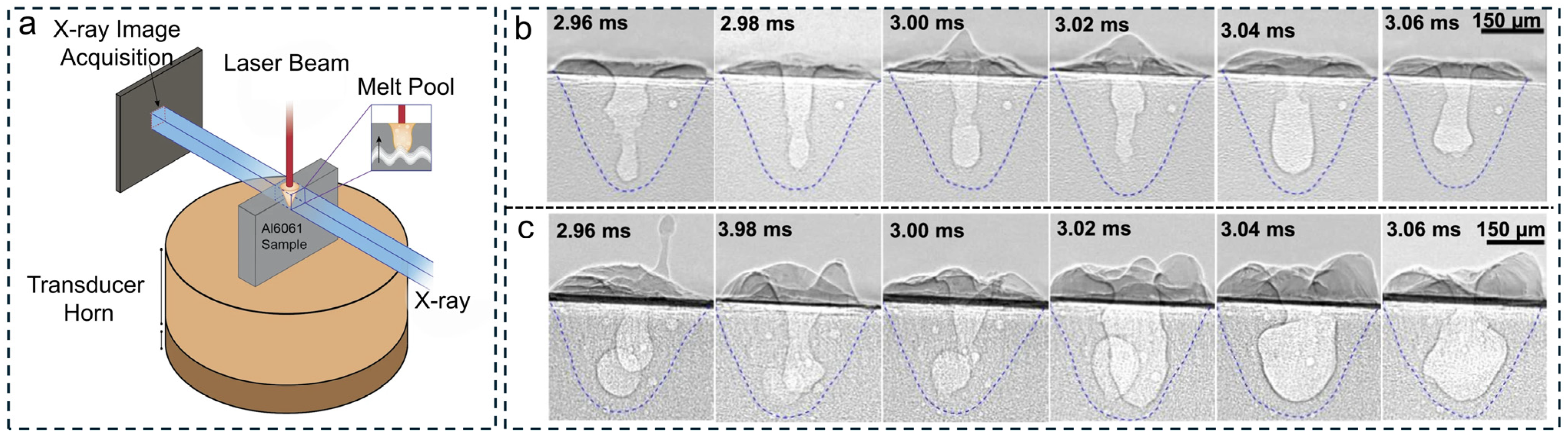

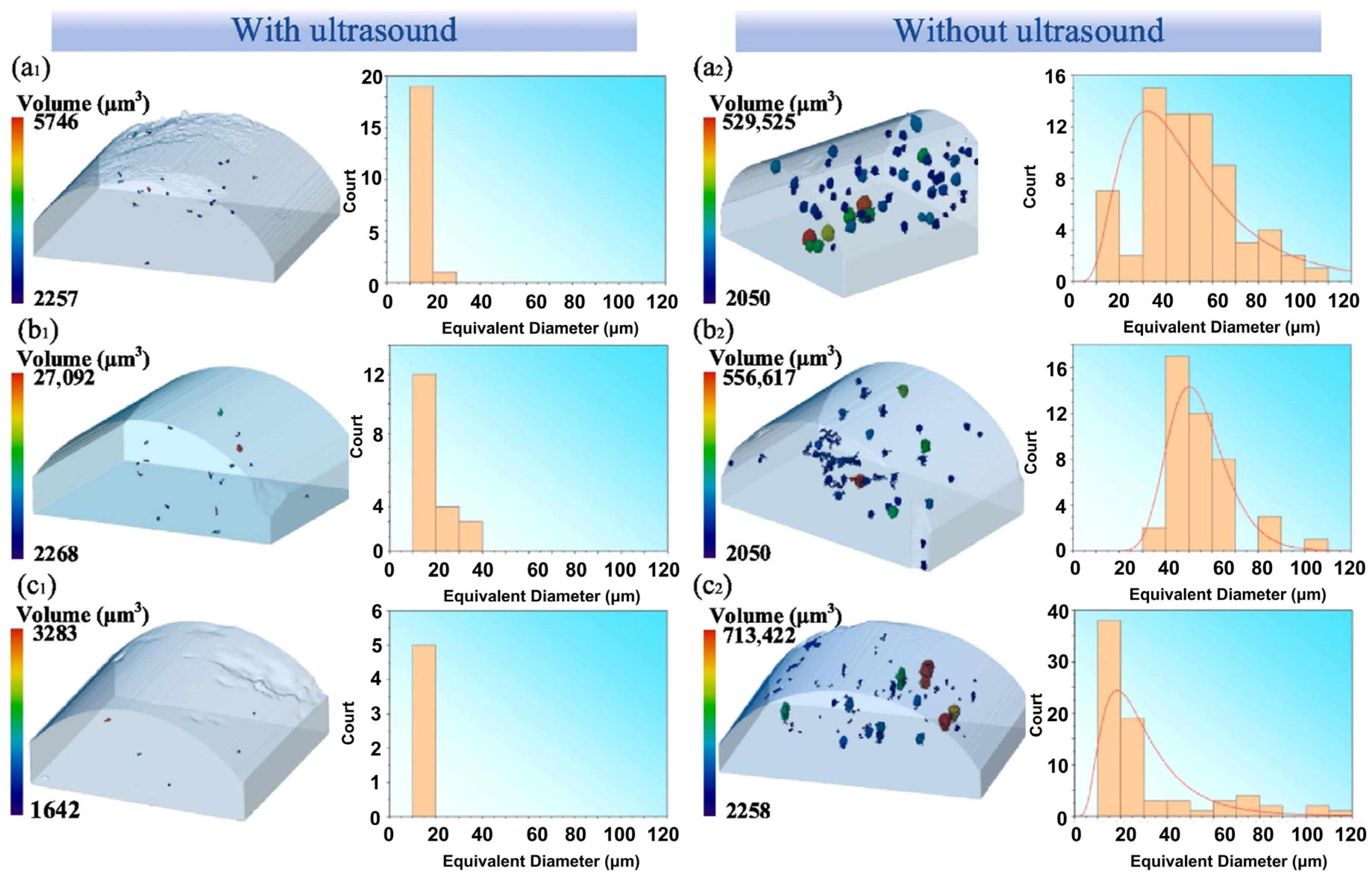
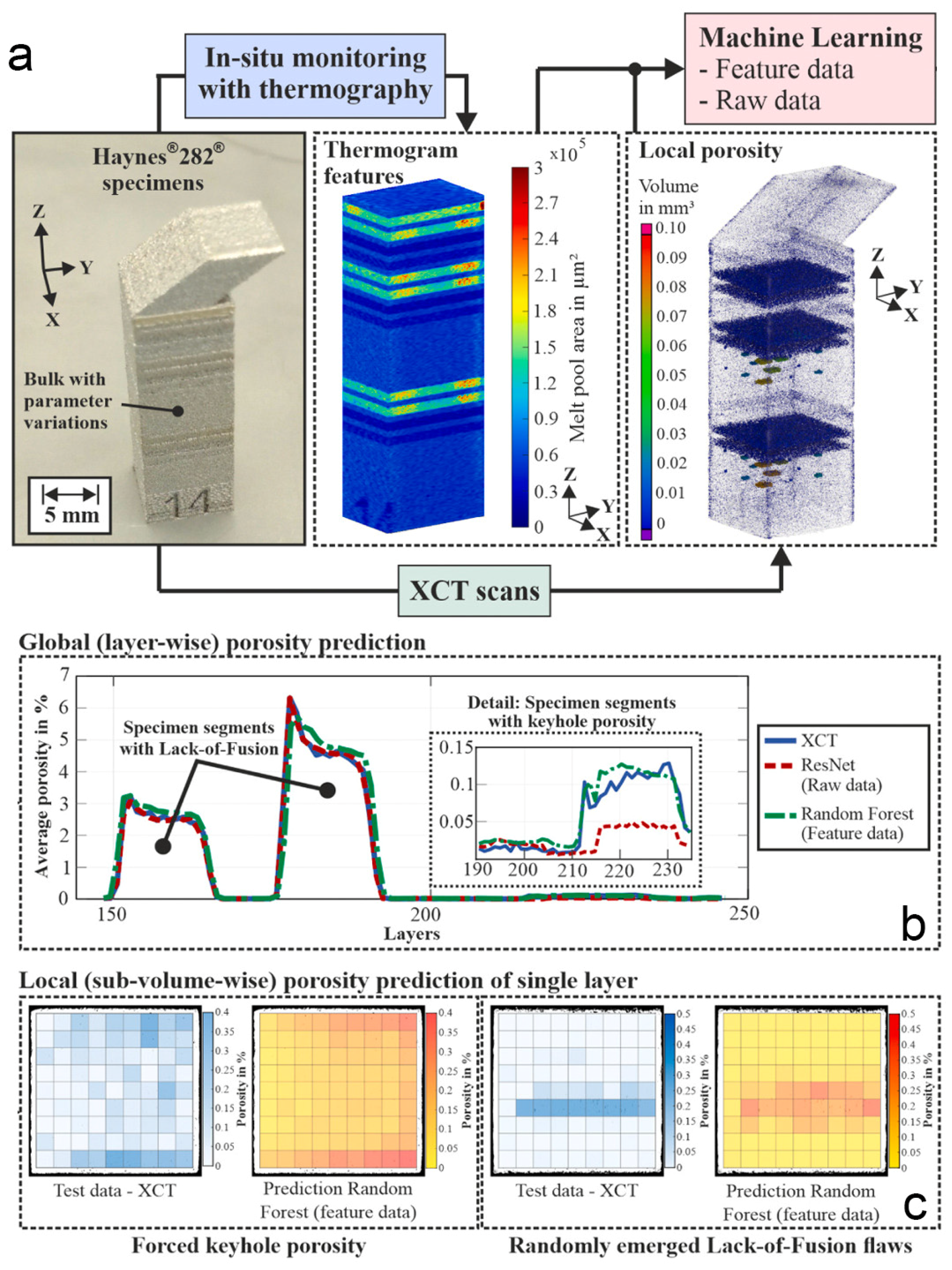
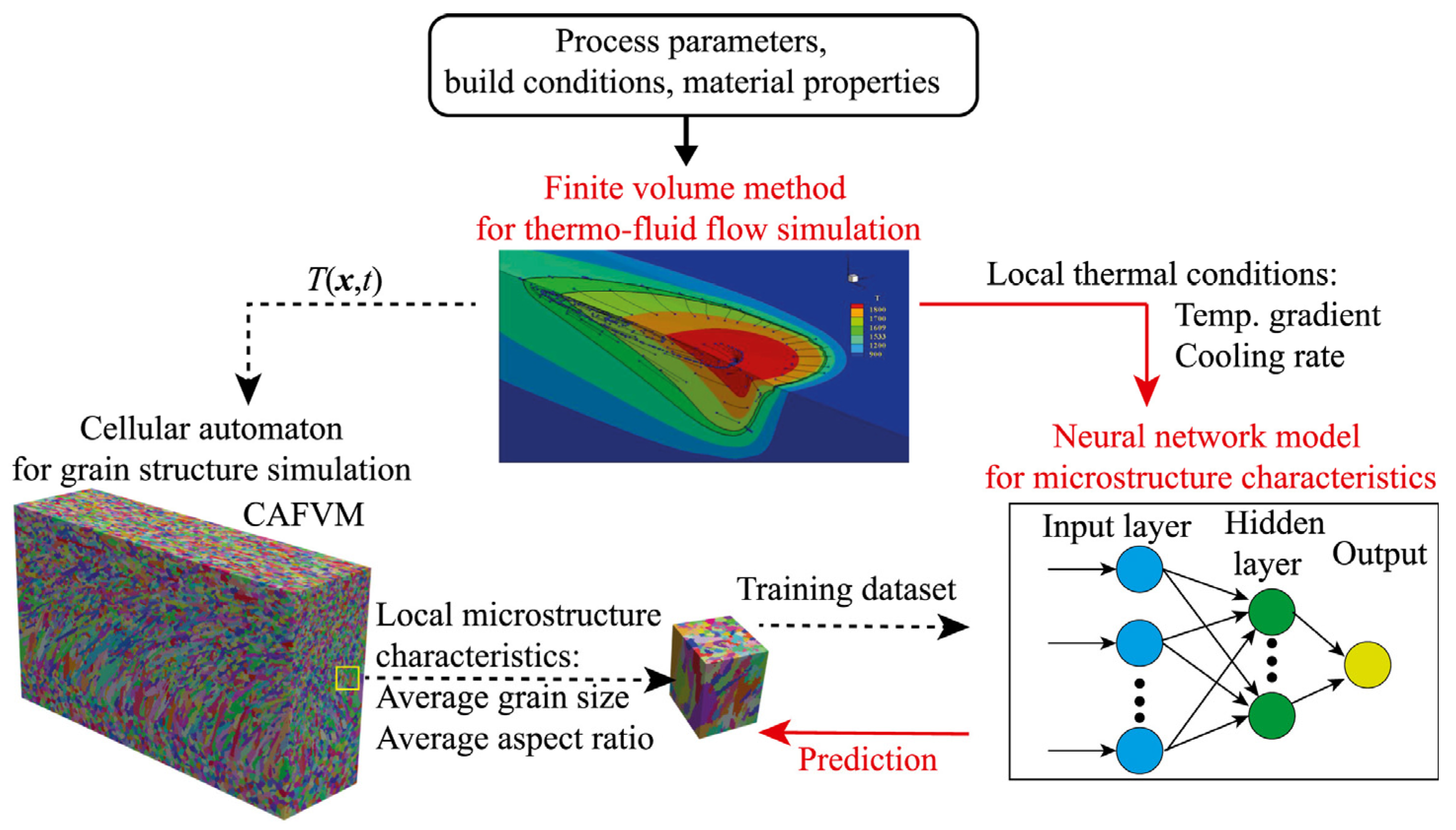
| Phenomenon | Observation Description | Synchrotron X-Ray Parameters | Alloy Systems |
|---|---|---|---|
| Keyhole | Transition threshold from conduction to keyhole mode (power density ≈ 0.4 MW/cm2); radial/axial fluctuations (frequency 2.5–10 kHz); rear-wall bulge, collapse and bubble pinch-off; keyhole depth/morphology changes linearly with laser power–speed | Frame rate 50 kHz~MHz, Spatial resolution 1.96 μm | Ti-6Al-4V, Al7075, Copper |
| Melt Flow | Marangoni convection drives melt-pool circulation (velocity 0.4–2.4 m/s); bubble/porosity migration with flow; melt-pool oscillation and surface waves; competition between acoustic streaming and thermocapillary forces | Frame rate 50 kHz, Spatial resolution 1.96 μm | Invar 36 (Fe-Ni), Al7075, Ti-6Al-4V |
| Cavitation bubble dynamics | Ultrasound-induced cavitation bubble nucleation, growth, oscillation and collapse (20.2 kHz source); increased bubble density and migration to surface for degassing; suppresses keyhole depth fluctuation and eliminates tip pinch-off porosity | Frame rate 271.6 kHz, Spatial resolution 1.96 μm | Bi-8% Zn alloy, Al6061 |
| Solidification Front | Bubbles/porosity captured, deformed and twisted by advancing solidification front; hydrogen diffusion + solidification shrinkage forms stable pores; bubble–dendrite/cellular front interaction leads to “frozen” defects. | Frame rate 10~20 kHz, Spatial resolution 1.96 μm | Al7075, Ti-6Al-4V |
Disclaimer/Publisher’s Note: The statements, opinions and data contained in all publications are solely those of the individual author(s) and contributor(s) and not of MDPI and/or the editor(s). MDPI and/or the editor(s) disclaim responsibility for any injury to people or property resulting from any ideas, methods, instructions or products referred to in the content. |
© 2026 by the authors. Licensee MDPI, Basel, Switzerland. This article is an open access article distributed under the terms and conditions of the Creative Commons Attribution (CC BY) license.
Share and Cite
Fu, Z.; Weng, Y.; Deng, Z.; Pan, J.; Li, A.; Qin, L.; Wu, G. In Situ X-Ray Imaging and Machine Learning in Ultrasonic Field-Assisted Laser-Based Additive Manufacturing: A Review. Materials 2026, 19, 1227. https://doi.org/10.3390/ma19061227
Fu Z, Weng Y, Deng Z, Pan J, Li A, Qin L, Wu G. In Situ X-Ray Imaging and Machine Learning in Ultrasonic Field-Assisted Laser-Based Additive Manufacturing: A Review. Materials. 2026; 19(6):1227. https://doi.org/10.3390/ma19061227
Chicago/Turabian StyleFu, Zhihao, Yu Weng, Zhian Deng, Jie Pan, Ao Li, Ling Qin, and Gang Wu. 2026. "In Situ X-Ray Imaging and Machine Learning in Ultrasonic Field-Assisted Laser-Based Additive Manufacturing: A Review" Materials 19, no. 6: 1227. https://doi.org/10.3390/ma19061227
APA StyleFu, Z., Weng, Y., Deng, Z., Pan, J., Li, A., Qin, L., & Wu, G. (2026). In Situ X-Ray Imaging and Machine Learning in Ultrasonic Field-Assisted Laser-Based Additive Manufacturing: A Review. Materials, 19(6), 1227. https://doi.org/10.3390/ma19061227