Recycled Polyurethane Glycolysate and Glycerolysate as Sustainable Plasticizers for Lignin-Filled NBR Composites

 ,
,  , ,
, ,
Abstract
1. Introduction
2. Materials and Experiments
2.1. Materials
2.2. Preparation of Plasticizers
2.3. Fabrication of Rubber Composites
2.4. Testing Methods
2.4.1. Testing of GLE and GCR Samples
2.4.2. Testing of Composites
- νch is the cross-link density (mol·cm−3)
- Vr0 is the volume fraction of rubber in the equilibrium swollen sample of vulcanizate in the absence of filler
- Vr is the volume fraction of rubber in the equilibrium swollen sample of filled vulcanizate
- VS is the molar volume of the solvent (for toluene = 106.3 cm3·mol−1)
- χ is the Flory–Huggins interaction parameter (for NBR-toluene χ = 0.4253)
3. Results and Discussion
3.1. Characterization of GLE and GCR
3.2. Characterization of Rubber Composites
3.2.1. Predicted Mechanism of GLE and GCR in Rubber Compounds
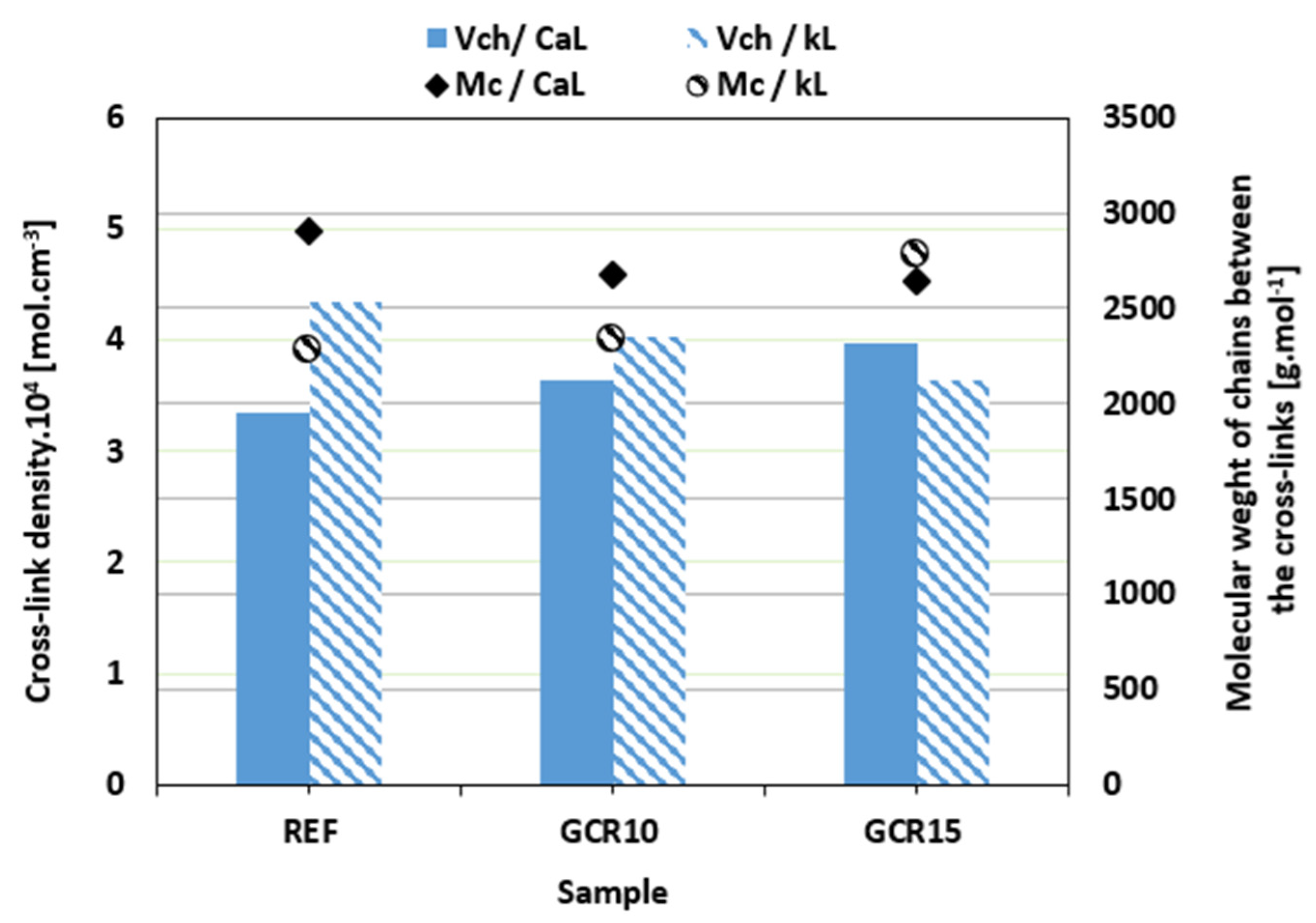
3.2.2. Curing Process and Cross-Link Density
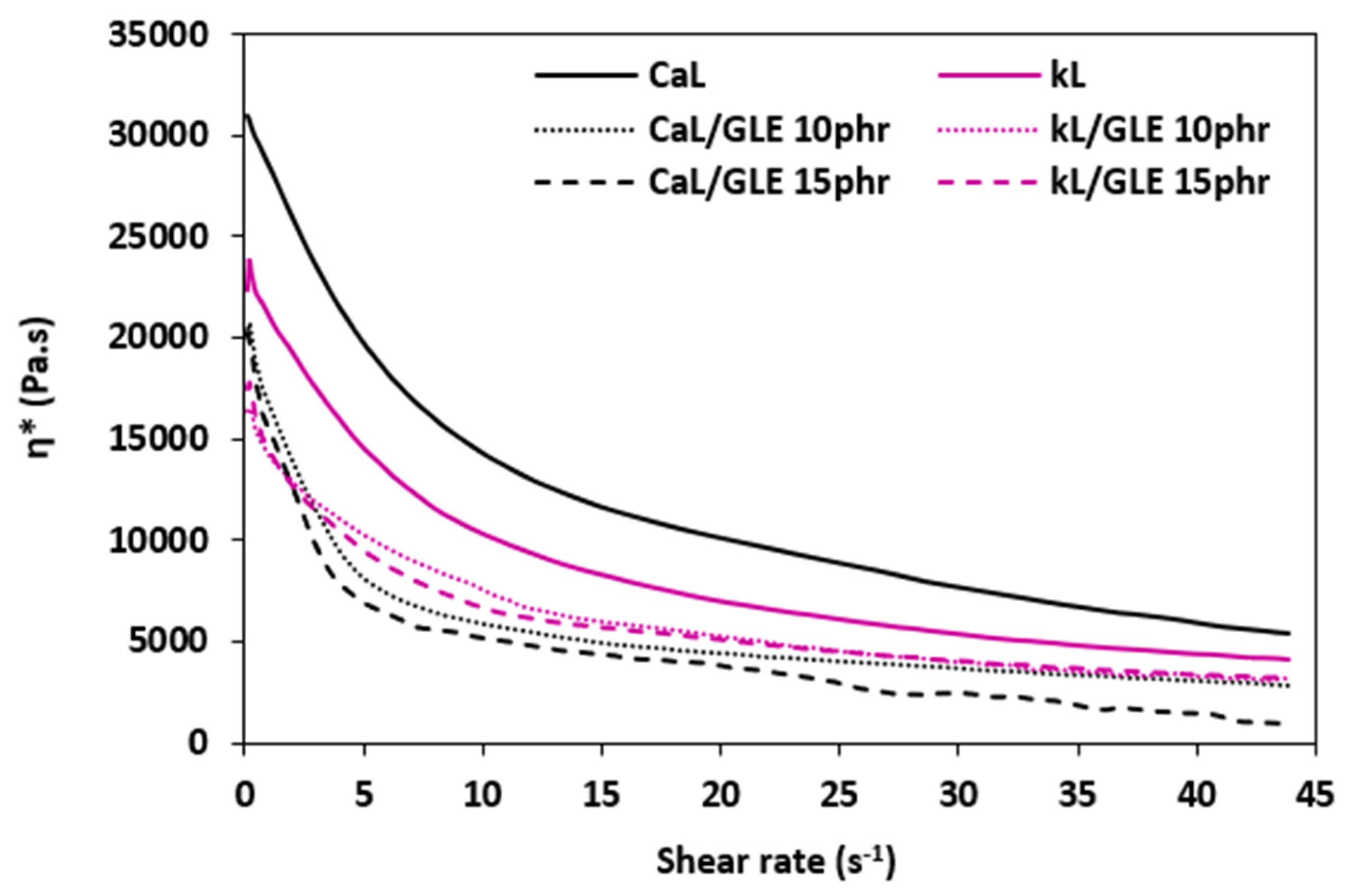
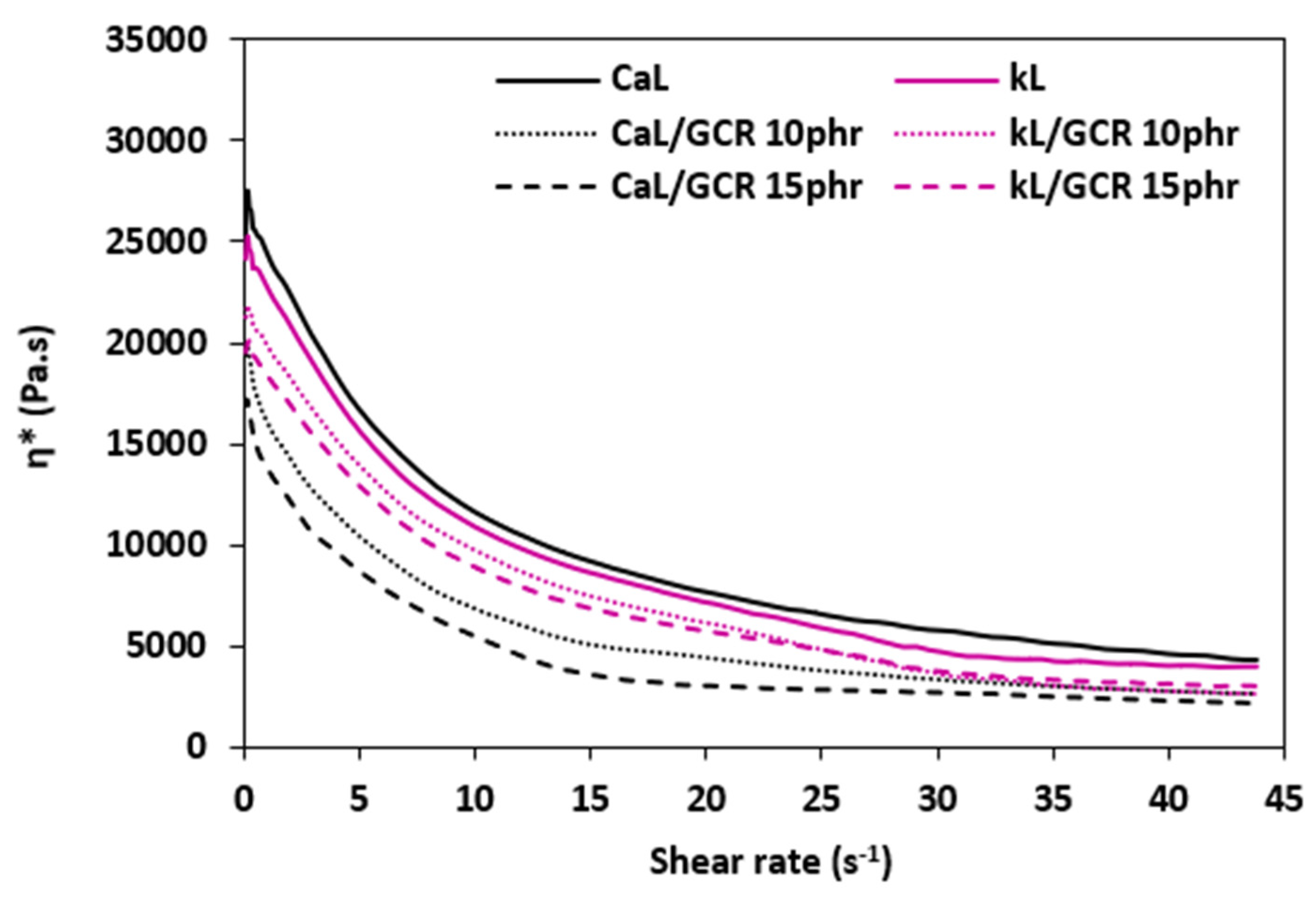
3.2.3. Rheology
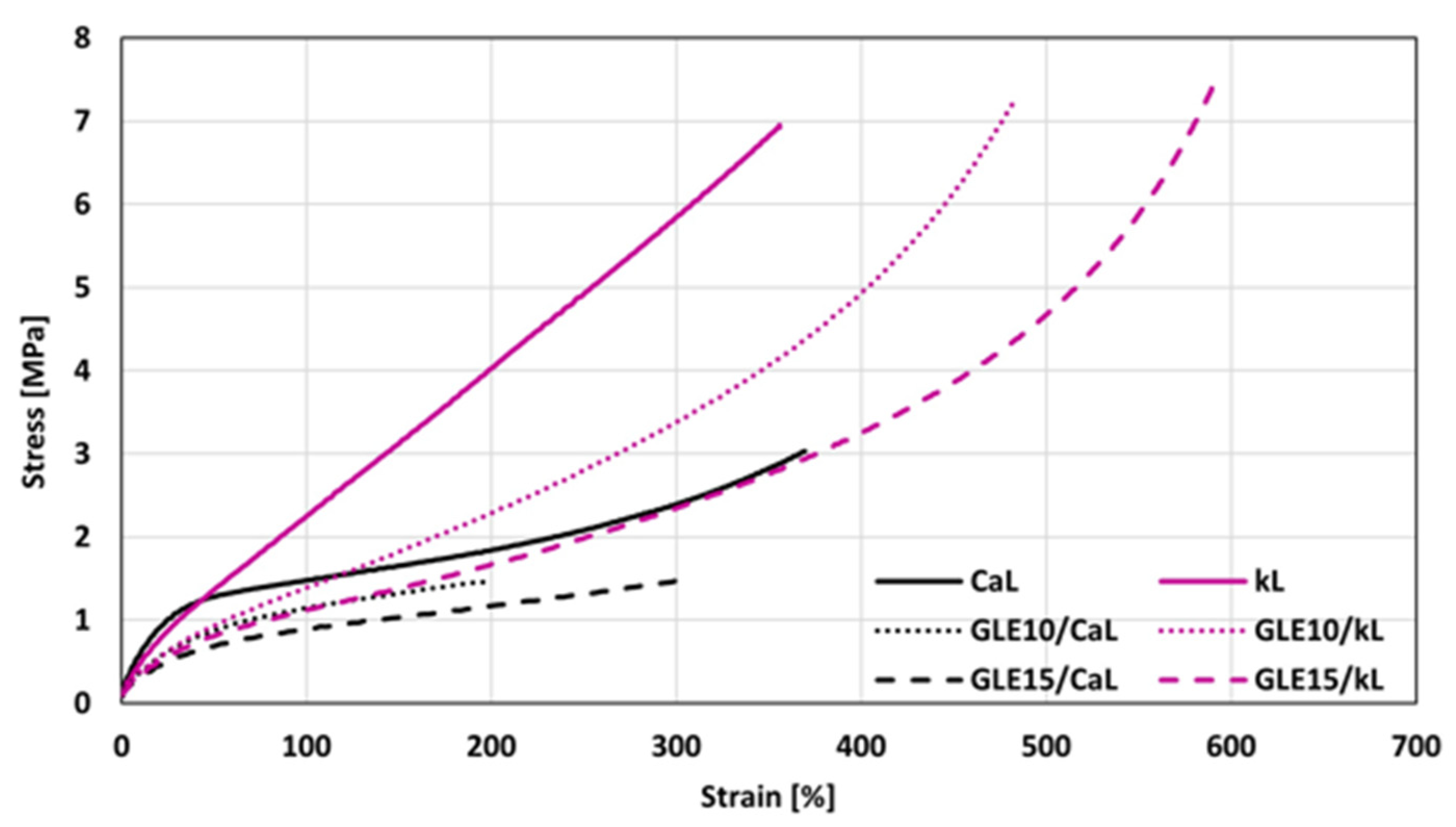
3.2.4. Mechanical Properties
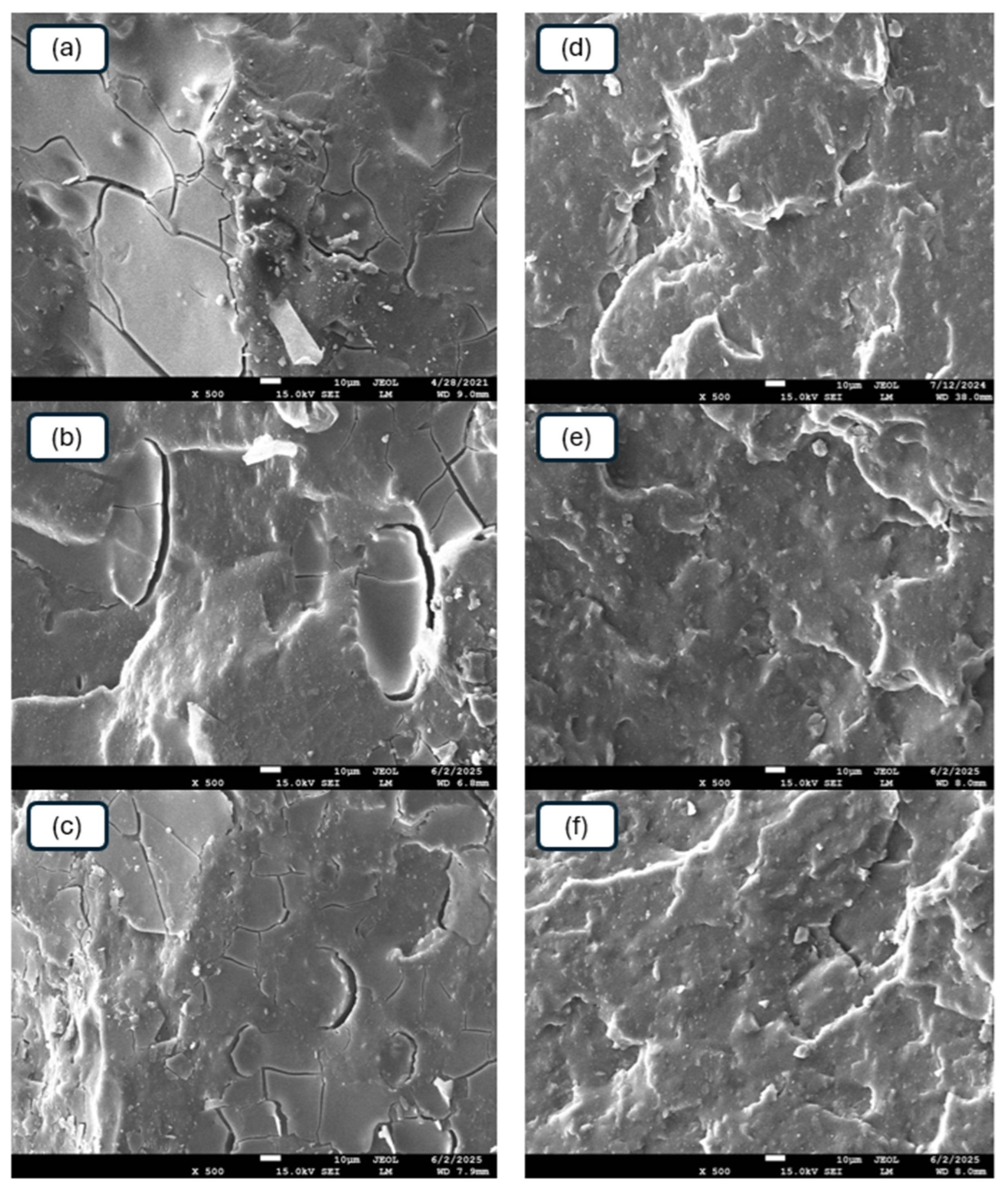
3.2.5. Morphology
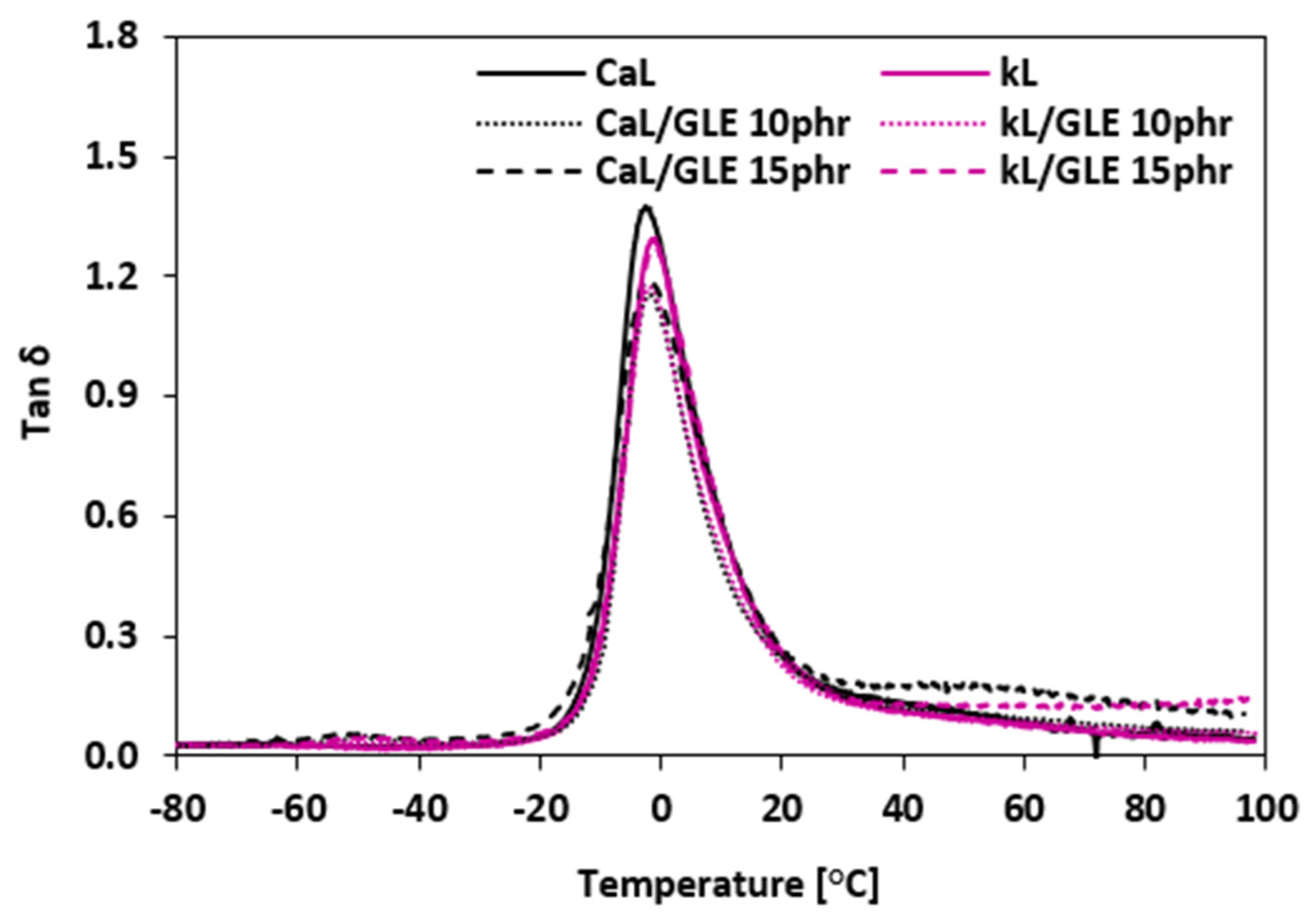
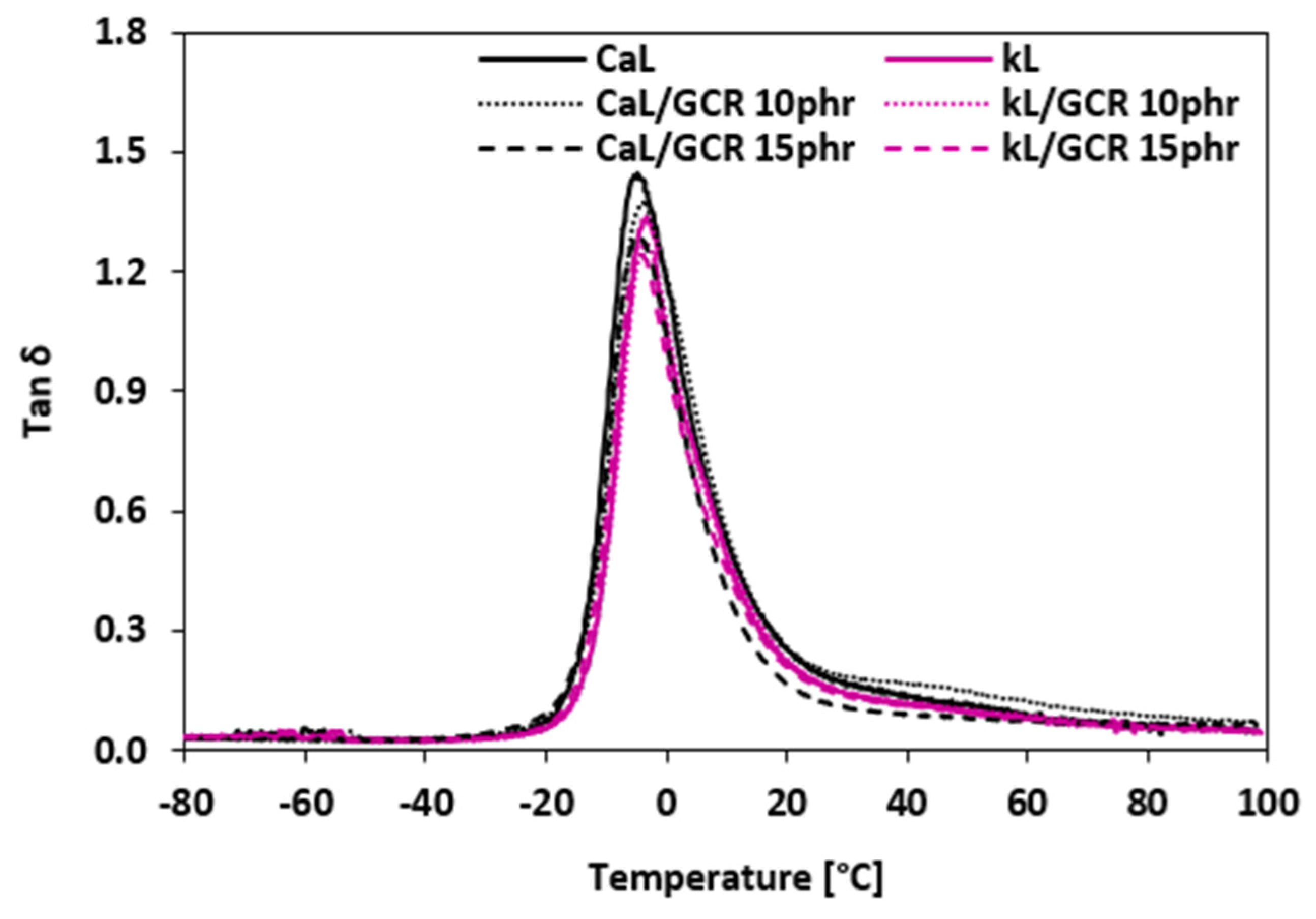
3.2.6. Dynamic Mechanical Analysis
3.2.7. Sustainability and Application Potential
4. Conclusions
Author Contributions
Funding
Data Availability Statement
Conflicts of Interest
References
- Hemmilä, V.; Hosseinpourpia, R.; Adamopoulos, S.; Eceiza, A. Characterization of wood-based industrial biorefinery lignosulfonates and supercritical water hydrolysis lignin. Waste Biomass Valori. 2020, 11, 5835–5845. [Google Scholar] [CrossRef]
- Sethupathy, S.; Morales, G.M.; Gao, L.; Wang, H.; Yang, B.; Jiang, J.; Sun, J.; Zhu, D. Lignin valorization: Status, challenges and opportunities. Bioresour. Technol. 2022, 347, 126696. [Google Scholar] [CrossRef]
- Zhao, J.; Zhu, M.; Jin, W.; Zhang, J.; Fan, G.; Feng, Y.; Li, Z.; Wang, S.; Lee, J.S.; Luan, G.; et al. A comprehensive review of unlocking the potential of lignin-derived biomaterials: From lignin structure to biomedical application. J. Nanobiotechnol. 2025, 23, 538. [Google Scholar] [CrossRef] [PubMed]
- Vasile, C.; Baican, M. Lignins as promising renewable biopolymers and bioactive compounds for high-performance materials. Polymers 2023, 15, 3177. [Google Scholar] [CrossRef] [PubMed]
- Gonçalves, S.; Paiva, N.T.; Martins, J.; Magalhães, F.D.; Carvalho, L.H. Effect of lignosulphonates on the moisture resistance of phenol–formaldehyde resins for exterior plywood. Materials 2024, 17, 3715. [Google Scholar] [CrossRef] [PubMed]
- Libretti, C.; Correa, L.S.; Meier, M.A.R. From waste to resource: Advancements in sustainable lignin modification. Green Chem. 2024, 26, 4358. [Google Scholar] [CrossRef]
- Li, X.; Meng, Y.; Cheng, Z.; Li, B. Research progress and prospect of stimuli-responsive lignin functional materials. Polymers 2023, 15, 3372. [Google Scholar] [CrossRef]
- Sadeghifar, H.; Ragauskas, A.J. Lignin as a natural antioxidant: Chemistry and applications. Macromol 2025, 5, 5. [Google Scholar] [CrossRef]
- Zheng, H.; Yue, D. Lignin/epoxidized natural rubber compounds based on wet mixing: Impact of epoxidation degree on the interface of compounds. Materials 2025, 18, 3736. [Google Scholar] [CrossRef] [PubMed]
- Fazeli, M.; Mukherjee, S.; Baniasadi, H.; Abidnejad, R.; Mujtaba, M.; Lipponen, J.; Seppälä, J.; Rojas, O.J. Lignin beyond the status quo: Recent and emerging composite applications. Green Chem. 2024, 26, 593–630. [Google Scholar] [CrossRef]
- Rizg, W.Y.; Alahmadi, A.A.; Baradwan, M.; Bairwan, R.D.; Marwan, M.; Mohamed, A.K.; El Saadany, S.; Abdullah, C.K.; Abdul Khalil, H.P.S. Lignin and biodegradable polymer blends with chemically treated biofiller for green thermoplastic composites. Express Polym. Lett. 2025, 19, 294–310. [Google Scholar] [CrossRef]
- Komisarz, K.; Majka, T.M.; Pielichowski, K. Chemical and Physical Modification of Lignin for Green Polymeric Composite Materials. Materials 2023, 16, 16. [Google Scholar] [CrossRef]
- Shorey, R.; Salaghi, A.; Fatehi, P.; Mekonnen, T.H. Valorization of lignin for advanced material applications: A review. RSC Sustain. 2024, 2, 804–831. [Google Scholar] [CrossRef]
- Shao, L.; Liu, N.; Wang, Z.; Zhan, P.; Zhang, L.; Wu, Z. Functional lignin-based polymers: Isolation, synthetic methods and high-valued applications. ChemistrySelect 2023, 8, e202301633. [Google Scholar] [CrossRef]
- Wei, X.; Cui, S.; Xie, Y. Synthesis and antibacterial properties of oligomeric dehydrogenation polymer from lignin precursors. Molecules 2022, 27, 1466. [Google Scholar] [CrossRef]
- Coroabă, A.; Apostol, I.; Dascălu, I.A.; Bele, A.; Marangoci, N.L.; Doroftei, F.; Uritu, C.M.; Spiridon, I. Exploring the characteristics of carbon structures obtained from LignoBoost lignin. Polymers 2025, 17, 1221. [Google Scholar] [CrossRef]
- Saadan, R.; Hachimi Alaoui, C.; Ihammi, A.; Chigr, M.; Fatimi, A. A brief overview of Lignin extraction and isolation processes: From lignocellulosic biomass to added-value biomaterials. Environ. Earth Sci. Proc. 2024, 31, 3. [Google Scholar] [CrossRef]
- Alam, M.M.; Greco, A.; Rajabimashhadi, Z.; Corcione, C.E. Efficient and environmentally friendly techniques for extracting lignin from lignocellulose biomass and subsequent uses: A review. Clean. Mater. 2024, 13, 100253. [Google Scholar] [CrossRef]
- Lisý, A.; Ház, A.; Nadányi, R.; Jablonský, M.; Šurina, I. About hydrophobicity of lignin: A review of selected chemical methods for lignin valorisation in biopolymer production. Energies 2022, 15, 6213. [Google Scholar] [CrossRef]
- Ramos, M.M.M.; Pappa, C.P.; Manoudis, P.N.; Kamperidou, V.; Pavlidou, E.; Tsiridis, V.; Petala, M.; Triantafyllidis, K.S.; Spathis, P.K.; Karapanagiotis, I. A highly hydrophobic silox-ane-nanolignin coating for the protection of wood. Coatings 2025, 15, 293. [Google Scholar] [CrossRef]
- Casimiro, F.M.; Costa, C.A.E.; Vega-Aguilar, C.; Rodrigues, A.E. Hardwood and softwood lignins from sulfite liquors: Structural characterization and valorization through depolymerization. Int. J. Biol. Macromol. 2022, 215, 272–279. [Google Scholar] [CrossRef] [PubMed]
- Pregi, E.; Blasius, J.; Kun, D.; Hollóczki, O.; Pukánszky, B. Effect of competitive interactions on the structure and properties of blends prepared from an industrial lignosulfonate polymer. Int. J. Biol. Macromol. 2023, 254, 127694. [Google Scholar] [CrossRef] [PubMed]
- Aro, T.; Fatehi, P. Production and application of lignosulfonates and sulfonated lignin. ChemSusChem 2017, 10, 1861–1877. [Google Scholar] [CrossRef] [PubMed]
- Mili, M.; Hashmi, S.A.R.; Ather, M.; Hada, V.; Markandeya, N.; Kamble, S.; Mohapatra, M.; Rathore, S.K.S.; Srivastava, A.K.; Verma, S. Novel lignin as natural-biodegradable binder for various sectors—A review. J. Appl. Polym. Sci. 2022, 139, e51951. [Google Scholar] [CrossRef]
- Sheridan, E.; Filonenko, S.; Volikov, A.; Sirviö, J.A.; Antonietti, M. A systematic study on the processes of lignin extraction and nanodispersion to control properties and functionality. Green Chem. 2024, 26, 2967. [Google Scholar] [CrossRef]
- Henriksson, G.; Germgård, U.; Lindström, M.E. A review on chemical mechanisms of kraft pulping. Nord. Pulp Paper Res. J. 2024, 39, 297–311. [Google Scholar] [CrossRef]
- Li, Y.; Li, J.; Ren, B.; Cheng, H. Conversion of lignin to nitrogenous chemicals and functional materials. Materials 2024, 17, 5110. [Google Scholar] [CrossRef]
- Sjöström, J.; Brandt, L.; Henriksson, G.; Sevastyanova, O. Oxlignin: A novel type of technical lignin from kraft pulp mills. ACS Omega 2025, 10, 18784–18792. [Google Scholar] [CrossRef]
- Roy, K.; Debnath, S.C.; Potiyaraj, P. A review on recent trends and future prospects of lignin based green rubber composites. J. Polym. Environ. 2020, 28, 367–387. [Google Scholar] [CrossRef]
- Kassaun, B.B.; Fatehi, P. Superhydrophobic lignin reinforced rubber film as oil water separator. Sustain. Mater. Technol. 2025, 45, e01444. [Google Scholar] [CrossRef]
- Intapun, J.; Rungruang, T.; Suchat, S.; Cherdchim, B.; Hiziroglu, S. The Characteristics of natural rubber composites with Klason lignin as a green reinforcing filler: Thermal stability, mechanical and dynamical Properties. Polymers 2021, 13, 1109. [Google Scholar] [CrossRef]
- Hait, S.; Kumar, L.; Ijaradar, J.; Ghosh, A.K.; De, D.; Chanda, J.; Ghosh, P.; Gupta, S.D.; Mukhopadhyay, R.; Wießner, S.; et al. Unlocking the potential of lignin: Towards a sustainable solution for tire rubber compound reinforcement. J. Clean. Prod. 2024, 470, 143274. [Google Scholar] [CrossRef]
- Zheng, H.; Yue, D. Effect of carboxyl content on mechanical properties of lignin/carboxylated nitrile rubber compounds. Polymers 2025, 17, 2332. [Google Scholar] [CrossRef]
- Koskinen, J.; Kemppainen, N.; Sarlin, E. Lignin dispersion in polybutadiene rubber (BR) with different mixing parameters. Prog. Rubber Plast. Technol. 2024, 41, 468–482. [Google Scholar] [CrossRef]
- Pichaiyut, S.; Panyapinyopol, B.; Chukaew, P.; Thongpanich, Y.; Utrarachkij, F.; Kuboon, S.; Kraithong, W.; Khemthong, P.; Riewklang, K.; Nakason, K.; et al. Natural rubber composites incorporating alkali lignin: Property characterization and functional evaluation. Resour. Chem. Mater. 2025, 4, 100126. [Google Scholar] [CrossRef]
- Henrik-Klemens, Å.; Sparrman, T.; Björn, L.; Matic, A.; Larsson, A. Morphology and molecular mobility of plasticized lignins studied with polarization transfer solid-state NMR and SAXS. Polym. Test. 2025, 151, 108942. [Google Scholar] [CrossRef]
- Henrik-Klemens, Å.; Edlund, U.; Westman, G.; Larsson, A. Dynamic mechanical analysis of plasticized and esterified native, residual, and technical lignins: Compatibility and glass transition. ACS Sustain. Chem. Eng. 2025, 13, 1648–1656. [Google Scholar] [CrossRef]
- Kruželák, J.; Džuganová, M.; Kvasničáková, A.; Pret’o, J.; Hronkovič, J.; Hudec, I. Influence of plasticizers on cross-Linking process, morphology, and properties of lignosulfonate-filled rubber compounds. Polymers 2025, 17, 393. [Google Scholar] [CrossRef] [PubMed]
- Włoch, M.; Toruńczak, M.; Datta, J. Polyurethane glycerolysate as a modifier of the properties of natural rubber mixtures and vulcanizates. Materials 2024, 17, 62. [Google Scholar] [CrossRef]
- Włoch, M.; Ostaszewska, U.; Datta, J. The effect of polyurethane glycolysate on the structure and properties of natural rubber/carbon black composites. J. Polym. Environ. 2019, 27, 1367–1378. [Google Scholar] [CrossRef]
- Yang, L.; Du, Y.; Wang, H.; Yang, Y. Multifunctional adsorbable chitosan-based hydrogels: Towards efficient and multifunctional green solutions for pollution management. J. Clean. Prod. 2025, 522, 146351. [Google Scholar] [CrossRef]
- Wang, H.; Yang, L. A sustainable solution for environmental purification: A review of high-performance hydrogels based on chitosan. Int. J. Biol. Macromol. 2025, 309, 142834. [Google Scholar] [CrossRef]
- Wieczorek, K.; Bukowski, P.; Stawiński, K.; Ryłko, I. Recycling of polyurethane foams via glycolysis: A review. Materials 2024, 17, 4617. [Google Scholar] [CrossRef] [PubMed]
- He, H.; Su, H.; Yu, H.; Du, K.; Yang, F.; Zhu, Y.; Ma, M.; Shi, Y.; Zhang, X.; Chen, S.; et al. Chemical recycling of waste polyurethane foams: Efficient acidolysis under the catalysis of zinc acetate. ACS Sustain. Chem. Eng. 2023, 11, 5515–5523. [Google Scholar] [CrossRef]
- Datta, J.; Kopczyńska, P. From polymer waste to potential raw material: Recycling of polyurethane foams by glycerolysis. Crit. Rev. Environ. Sci. Technol. 2016, 46, 905–946. [Google Scholar] [CrossRef]
- Datta, J.; Kopczyńska, P.; Simón, D.; Rodríguez, J.F. Thermo-chemical decomposition study of polyurethane elastomer through glycerolysis route with using crude and refined glycerine as a transesterification agent. J. Polym. Environ. 2018, 26, 166–174. [Google Scholar] [CrossRef]
- Rossignolo, G.; Malucelli, G.; Lorenzetti, A. Recycling of polyurethanes: Where we are and where we are going. Green Chem. 2024, 26, 1132–1152. [Google Scholar] [CrossRef]
- Beneš, H.; Rösner, J.; Holler, P.; Synková, H.; Kotek, J.; Horák, Z. Glycolysis of flexible polyurethane foam in recycling of car seats. Polym. Adv. Technol. 2007, 18, 149–156. [Google Scholar] [CrossRef]
- Simón, D.; Borreguero, A.M.; De Lucas, A.; Rodríguez, J.F. Glycolysis of flexible polyurethane wastes containing polymeric polyols. Polym. Degrad. Stab. 2014, 109, 115–121. [Google Scholar] [CrossRef]
- Paciorek-Sadowska, J.; Czupryłski, B.; Liszkowska, J. Glycolysis of rigid polyurethane-polyisocyanurate foams with reduced flammability. J. Elastom. Plast. 2016, 48, 340–353. [Google Scholar] [CrossRef]
- Den Heeten, R.; Termorshuizen, P.A. Process for the Production of Polyether Polyols. Patent WO2013178410A1, 5 December 2013. [Google Scholar]
- Kraus, G. Swelling of filler-reinforced vulcanizates. J. Appl. Polym. Sci. 1963, 7, 861–871. [Google Scholar] [CrossRef]
- Kruželák, J.; Džuganová, M.; Kvasničáková, A.; Hronkovič, J.; Preťo, J.; Chodák, I.; Hudec, I. Carbon black and calcium lignosulphonate reinforced rubber composites with applied plasticiser glycerol. Plast. Rubber Compos. 2025, 54, 228–245. [Google Scholar] [CrossRef]
- Kruželák, J.; Džuganová, M.; Hložeková, K.; Kvasničáková, A.; Ház, A.; Nadányi, R.; Krump, H.; Hudec, I. Sulfur and peroxide curing of NBR based rubber compounds filled with kraft lignin and calcium lignosulfonate. J. Appl. Polym. Sci. 2024, 141, e55593. [Google Scholar] [CrossRef]
- Kruželák, J.; Hložeková, K.; Kvasničáková, A.; Džuganová, M.; Chodák, I.; Hudec, I. Application of plasticizer glycerol in lignosulfonate-filled rubber compounds based on SBR and NBR. Materials 2023, 16, 635. [Google Scholar] [CrossRef]
- Dick, J.S. Rubber Technology: Compounding and Testing for Performance, 3rd ed.; Hanser Publications: Munich, Germany, 2020. [Google Scholar]
- Mark, J.E.; Erman, B.; Roland, C.M. The Science and Technology of Rubber, 4th ed.; Academic Press: Boston, MA, USA, 2013. [Google Scholar]
- Han, B.; Xing, Y.; Li, C. Investigation on dynamic and static modulus and creep of bio-based polyurethane-modified asphalt mixture. Polymers 2025, 17, 359. [Google Scholar] [CrossRef]
- Jeswani, H.K.; Krüger, C.; Russ, M.; Horlacher, M.; Antony, F.; Hann, S.; Azapagic, A. Life cycle environmental impacts of chemical recycling via pyrolysis of mixed plastic waste in comparison with mechanical recycling and energy recovery. Sci. Total Environ. 2021, 769, 144483. [Google Scholar] [CrossRef] [PubMed]
- Jeswani, H.K.; Perry, M.R.; Shaver, M.P.; Azapagic, A. Biodegradable and conventional plastic packaging: Comparison of life cycle environmental impacts of poly(mandelic acid) and polystyrene. Sci. Total Environ. 2023, 903, 166311. [Google Scholar] [CrossRef] [PubMed]
- Chatzipanagiotou, K.R.; Antypa, D.; Petrakli, F.; Karatza, A.; Pikoń, K.; Bogacka, M.; Poranek, N.; Werle, S.; Amanatides, E.; Mataras, D.; et al. Life cycle assessment of composites additive manufacturing using recycled materials. Sustainability 2023, 15, 12843. [Google Scholar] [CrossRef]



| Characteristic | CaL (Borrement CA120) | kL (BioPiva 100) |
|---|---|---|
| Molecular weight (Mw) | ~24,000 g·mol−1 | ~5000 g·mol−1 |
| Phenolic hydroxyl groups | 1.56% | 2.9% |
| Aliphatic hydroxyl groups | - | 1.02% |
| Methoxy groups | - | 2.4% |
| Carboxy groups | - | 0.31% |
| Calcium content | 5% | - |
| Sulfur content | 7% | - |
| Ash content | - | <2% |
| Specific surface area | 3.9 m2/g | - |
| Peak | Retention Time (Min) | Mw (g·mol−1) |
|---|---|---|
| 1 | 13.1 | 1721 |
| 2 | 14.2 | 777 |
| 3 | 14.8 | 518 |
| 4 | 15.9 | 385 |
| 5 | 16.8 | 282 |
| 6 | 17.4 | 108 |
| Sample Designation | NBR | CaL | kL | GLE | GCR | Mixing Temperature |
|---|---|---|---|---|---|---|
| CaL ref. | 100 | 30 | 90/110 °C | |||
| kL ref. | 30 | 90/110 °C | ||||
| CaL/GLE10 | 30 | 10 | 90 °C | |||
| CaL/GLE15 | 30 | 15 | 90 °C | |||
| kL/GLE10 | 30 | 10 | 90 °C | |||
| kL/GLE15 | 30 | 15 | 90 °C | |||
| CaL/GCR10 | 30 | 10 | 110 °C | |||
| CaL/GCR15 | 30 | 15 | 110 °C | |||
| kL/GCR10 | 30 | 10 | 110 °C | |||
| kL/GCR15 | 30 | 15 | 110 °C |
| Density [g·cm−3] | Viscosity @ 45 °C [Pa·s] | Viscosity @ 50 °C [Pa·s] | Hydroxyl Number [mg KOH·g−1] | |
|---|---|---|---|---|
| GLE | 1.040 | 10.4 | 3.00 | 148 |
| GCR | 1.174 | 3.46 | 2.96 | 114 |
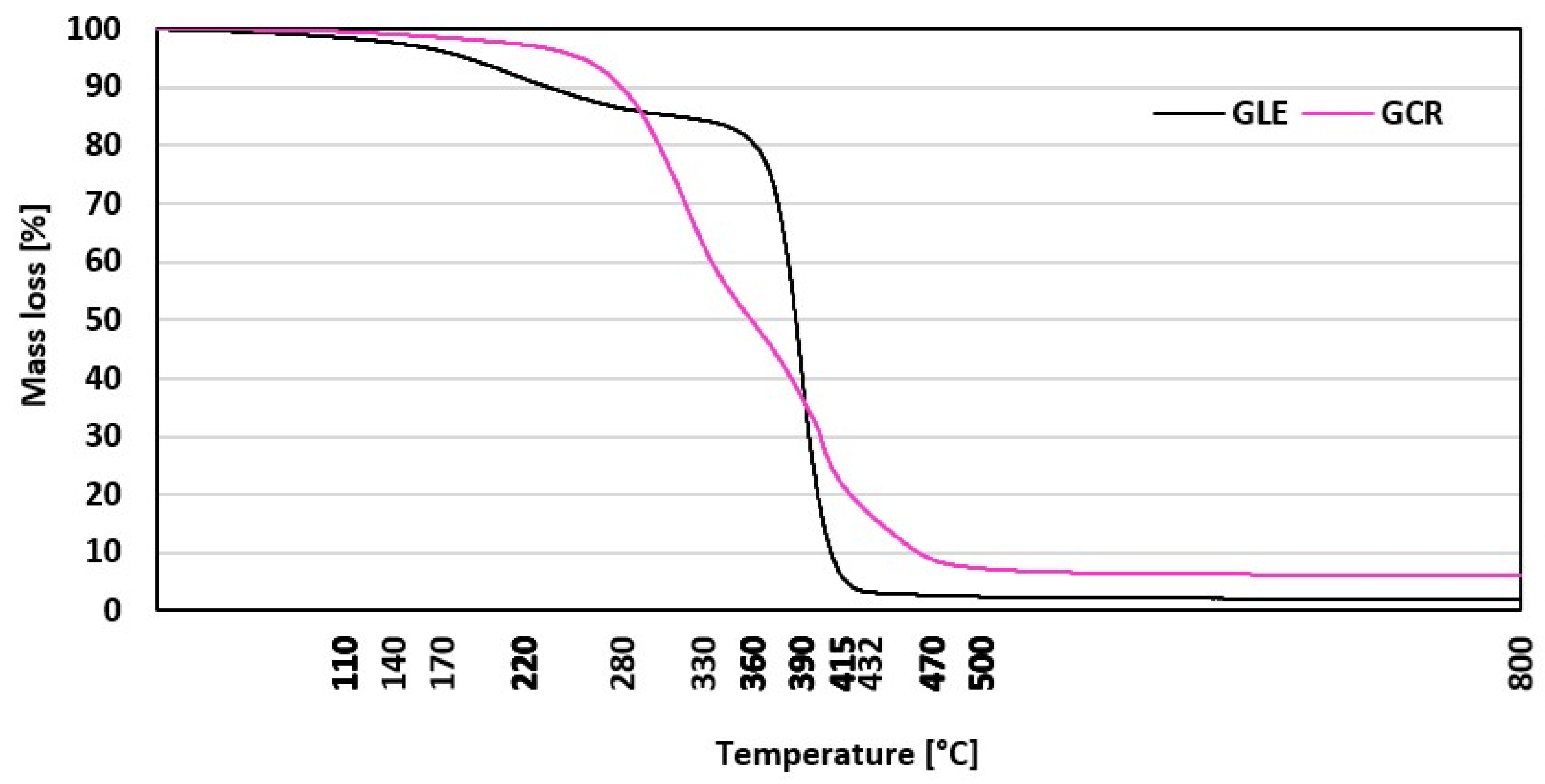
| Sample | T5% [°C] | T10% [°C] | T50% [°C] | Residual Mass at 800 °C [%] |
|---|---|---|---|---|
| GLE | 338 | 355 | 390 | 1.8 |
| GCR | 255 | 290 | 365 | 4.2 |
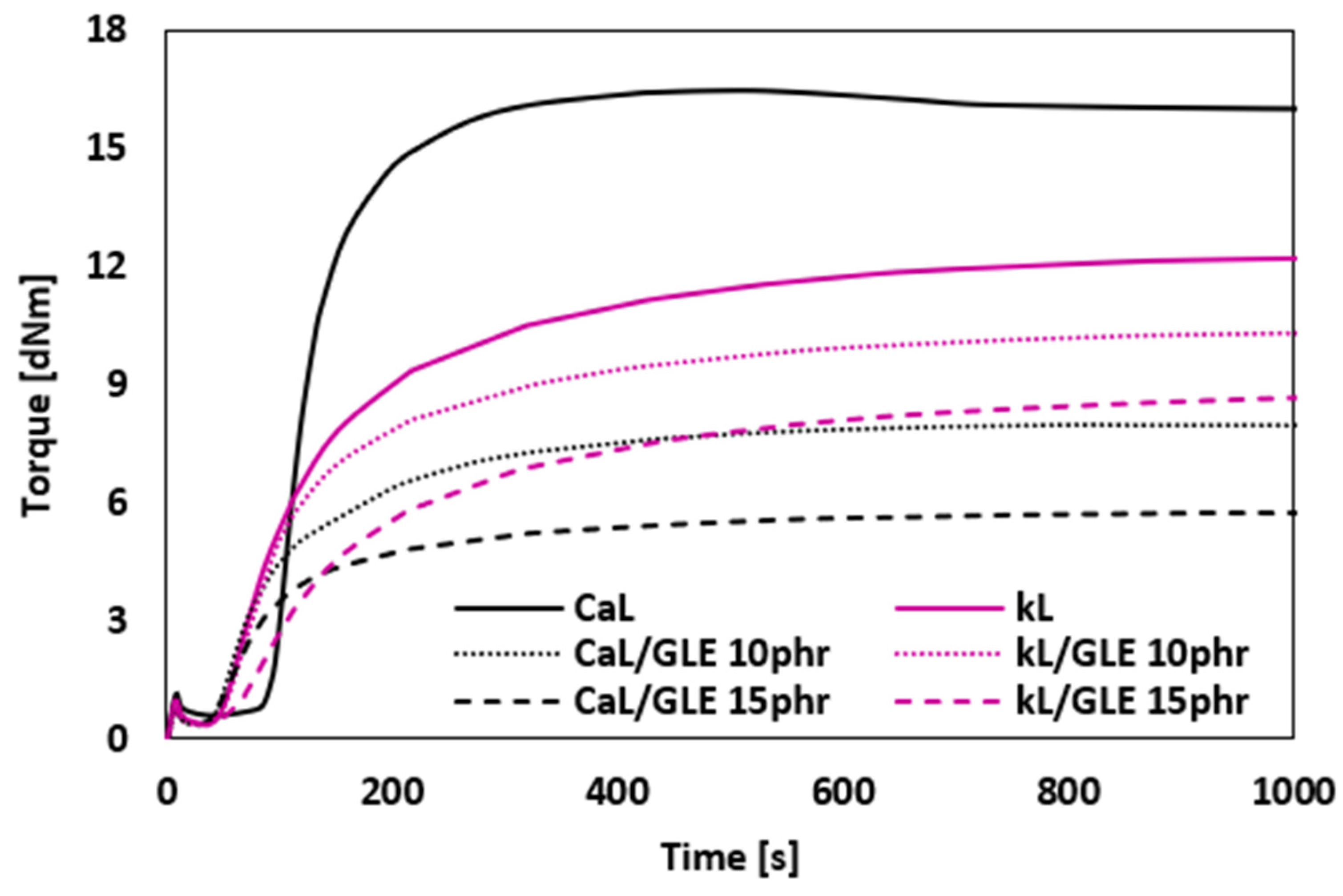
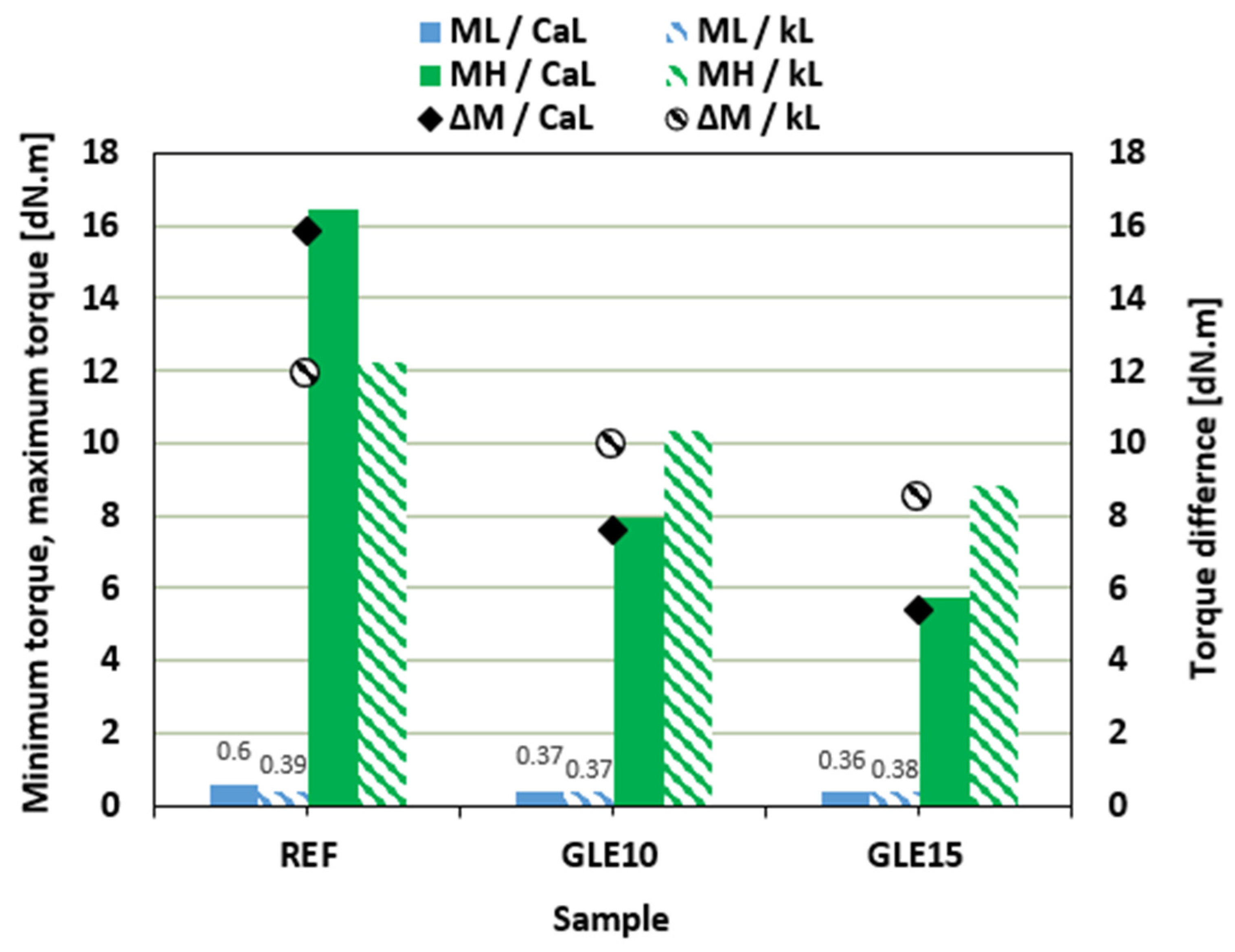
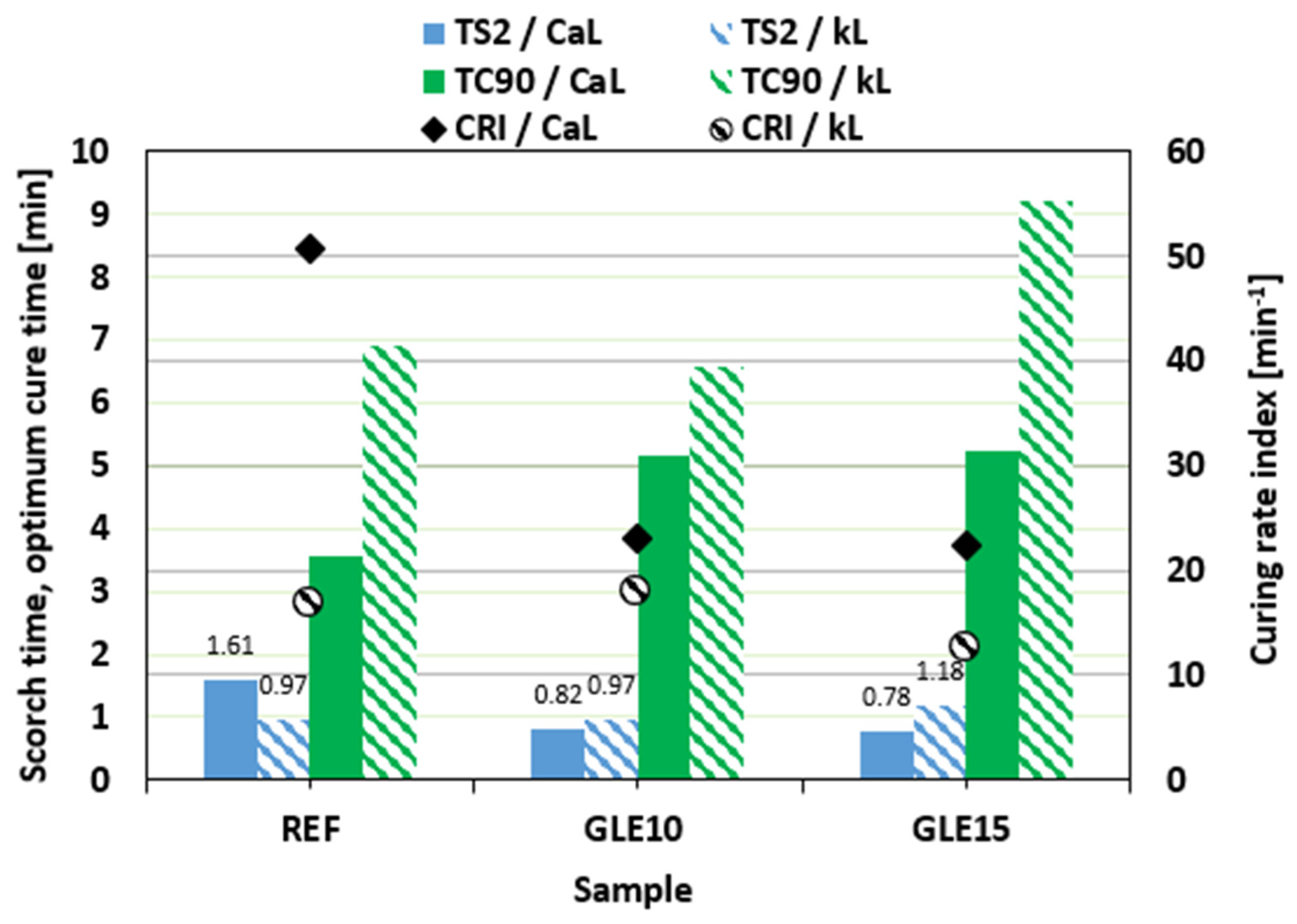
| Sample | ML [dN·m] | MH [dN·m] | ΔM [dN·m] | ts2 [min] | tc90 [min] | CRI [min−1] | νch·104 [mol·cm−3] | Mc [g·mol−1] |
|---|---|---|---|---|---|---|---|---|
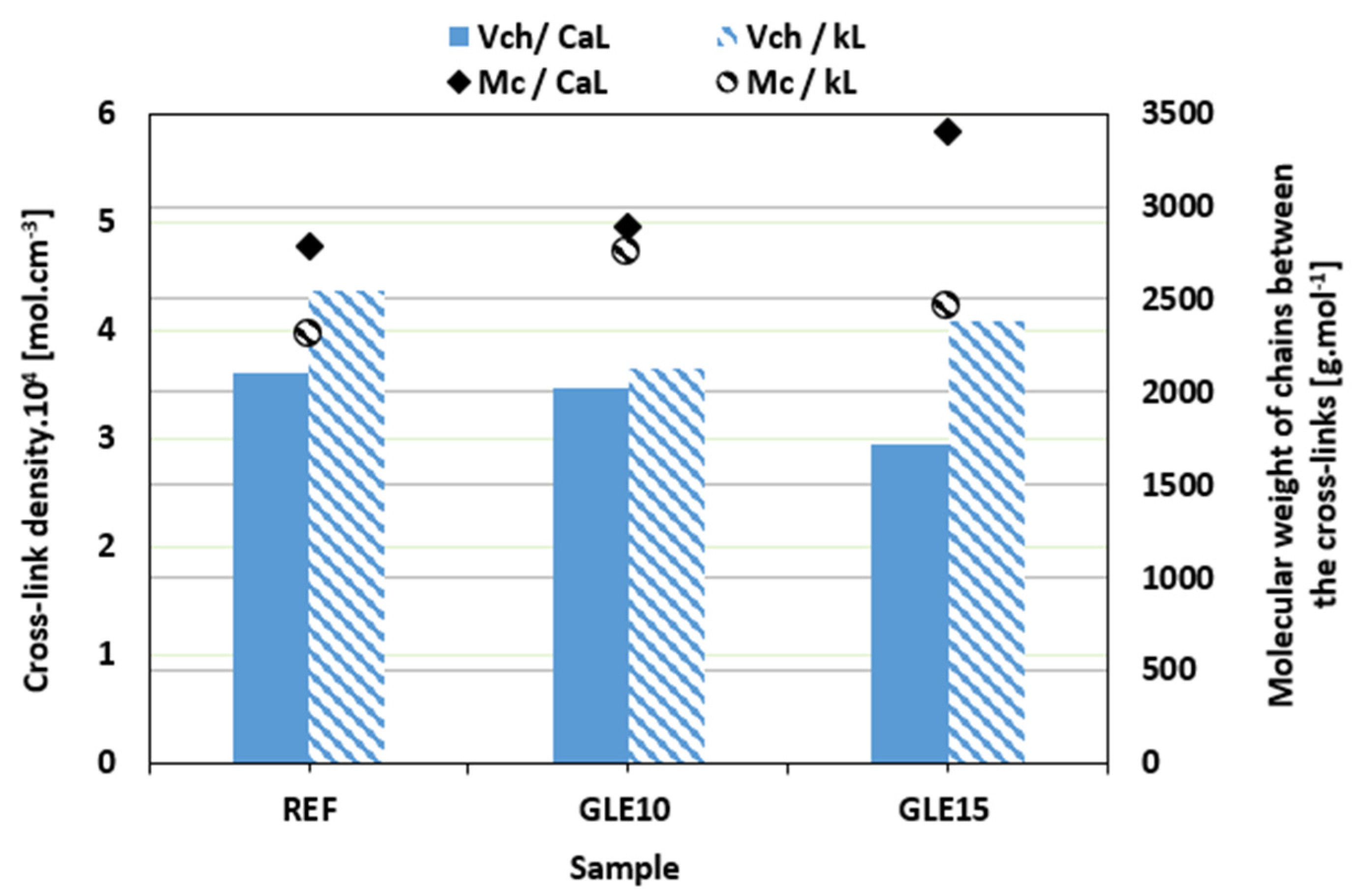
| CaL ref. (90 °C) | 0.6 | 16.45 | 15.85 | 1.61 | 3.58 | 50.76 | 3.609 | 2782 |
| kL ref. (90 °C) | 0.39 | 12.25 | 11.86 | 0.97 | 6.9 | 16.86 | 4.367 | 2302 |
| CaL/GLE10 | 0.37 | 7.97 | 7.6 | 0.82 | 5.17 | 22.99 | 3.465 | 2887 |
| CaL/GLE15 | 0.36 | 5.74 | 5.38 | 0.78 | 5.25 | 22.37 | 2.945 | 3401 |
| kL/GLE10 | 0.37 | 10.31 | 9.94 | 0.97 | 6.58 | 17.83 | 3.643 | 2745 |
| kL/GLE15 | 0.38 | 8.83 | 8.45 | 1.18 | 9.21 | 12.45 | 4.078 | 2455 |
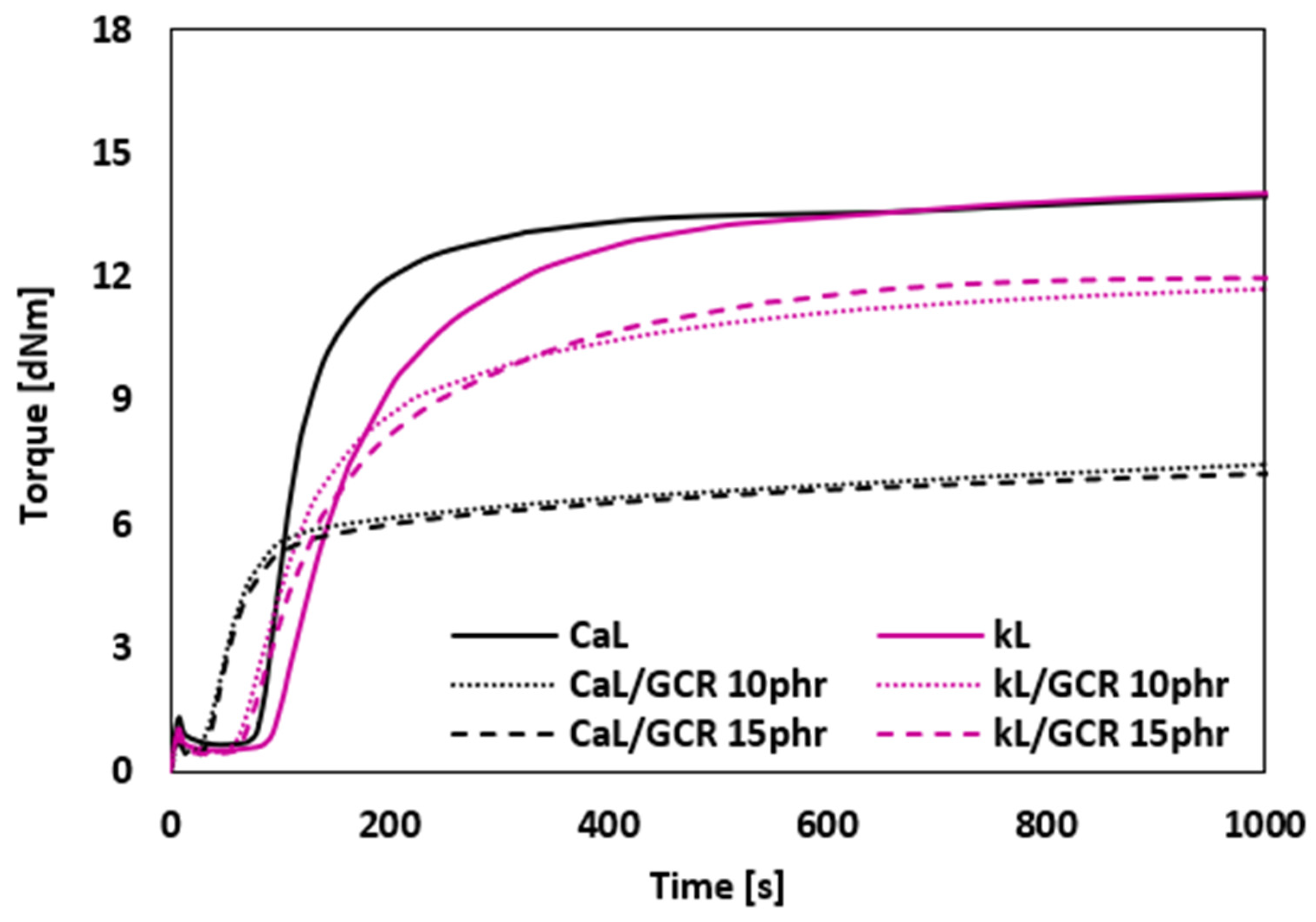
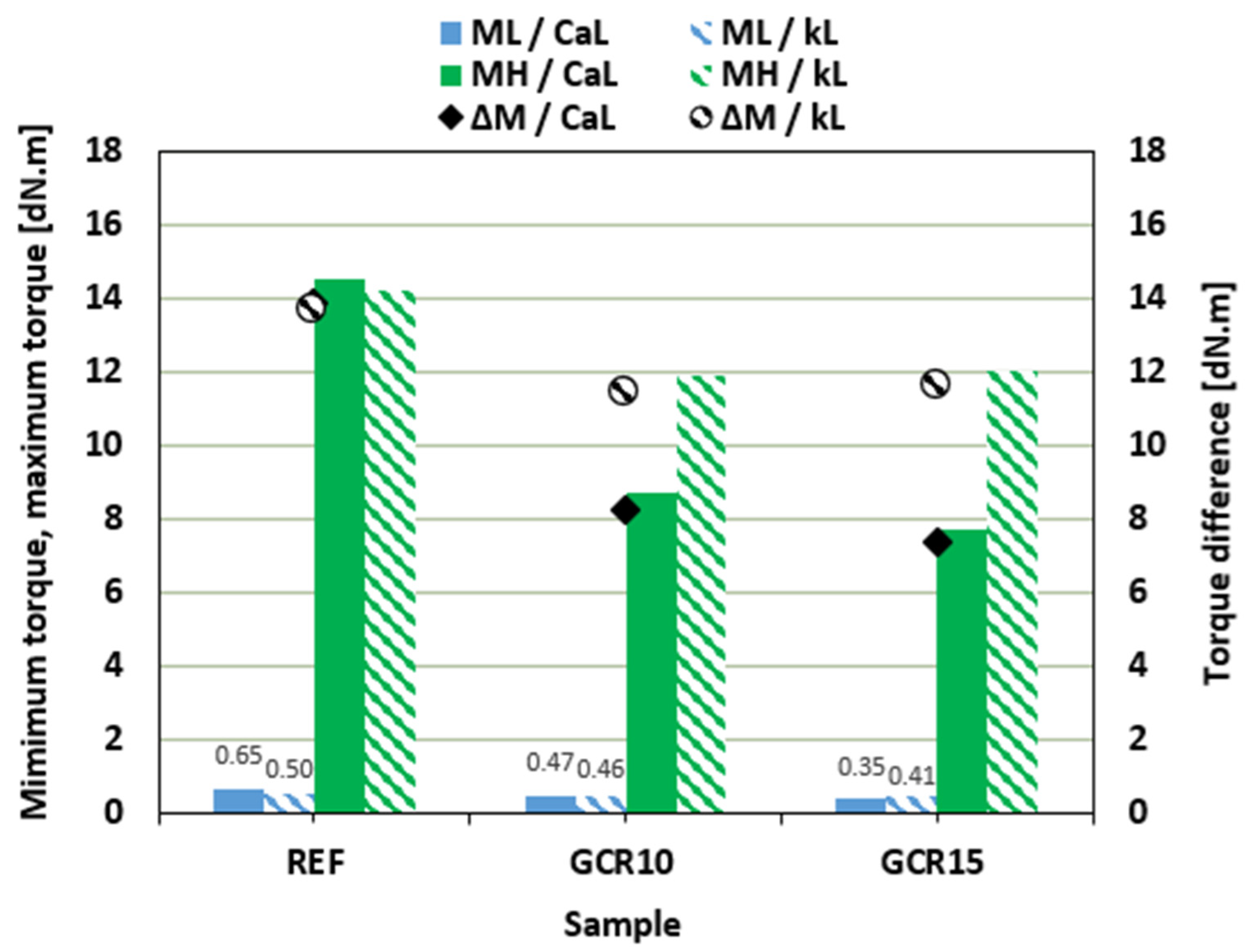
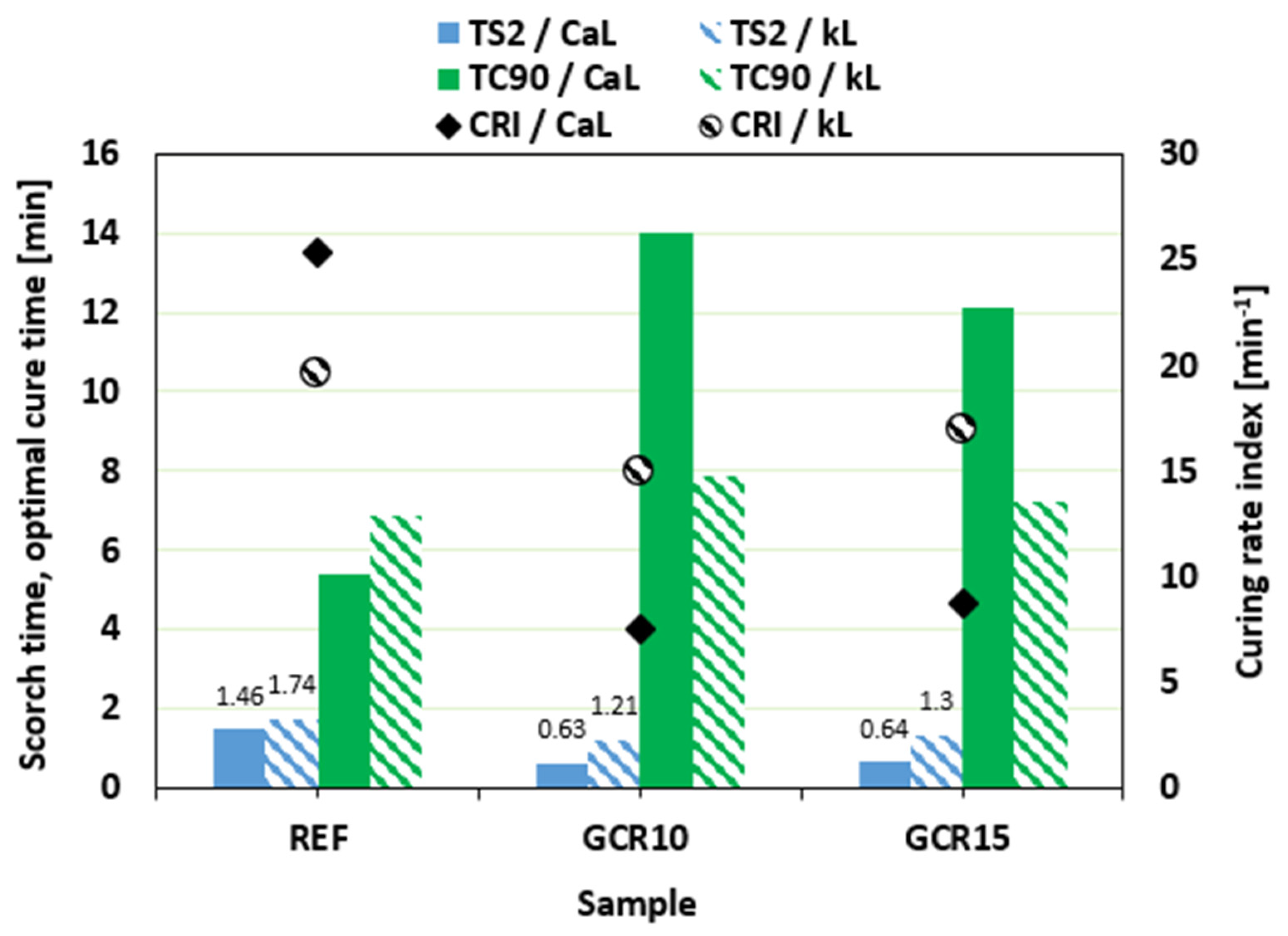
| CaL ref. (110 °C) | 0.65 | 14.49 | 13.84 | 1.46 | 5.40 | 25.38 | 3.353 | 2905 |
| kL ref. (110 °C) | 0.50 | 14.19 | 13.69 | 1.74 | 6.86 | 19.53 | 4.352 | 2272 |
| CaL/GCR10 | 0.47 | 8.7 | 8.23 | 0.63 | 14.00 | 7.48 | 3.632 | 2677 |
| CaL/GCR15 | 0.35 | 7.7 | 7.35 | 0.64 | 12.13 | 8.70 | 3.967 | 2640 |
| kL/GCR10 | 0.46 | 11.87 | 11.41 | 1.21 | 7.89 | 14.97 | 4.034 | 2329 |
| kL/GCR15 | 0.41 | 11.99 | 11.58 | 1.3 | 7.21 | 16.92 | 3.637 | 2776 |
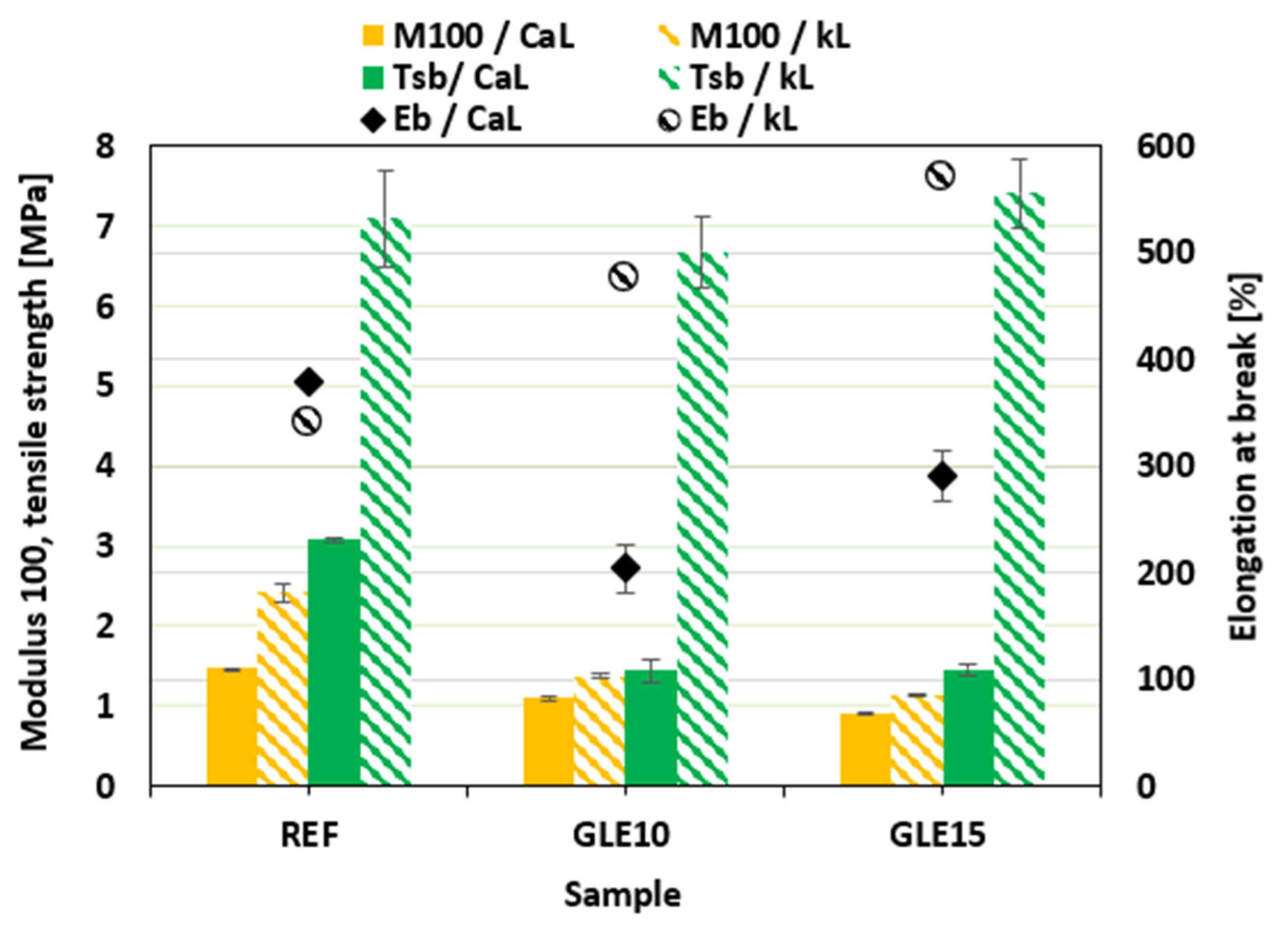
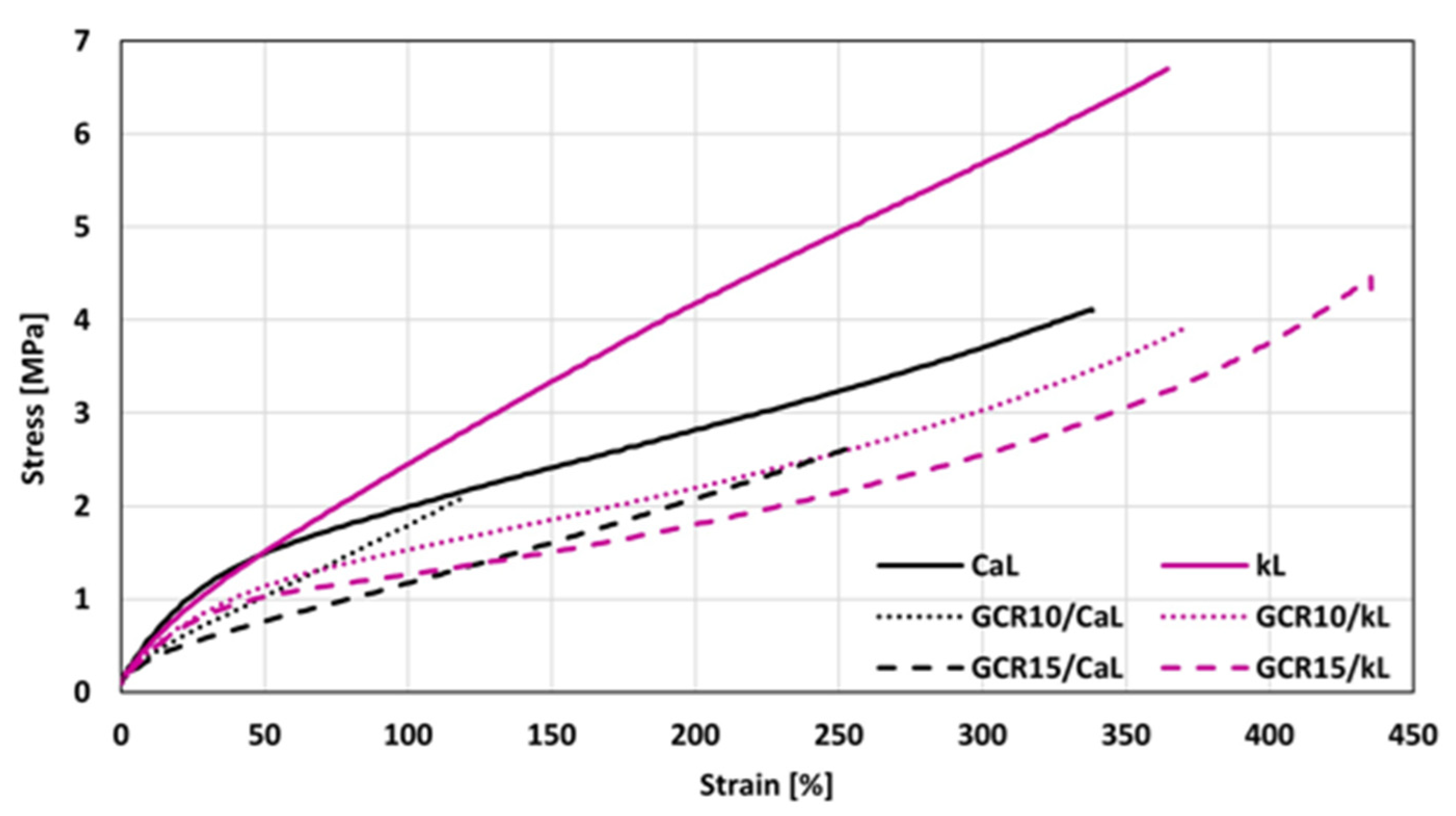
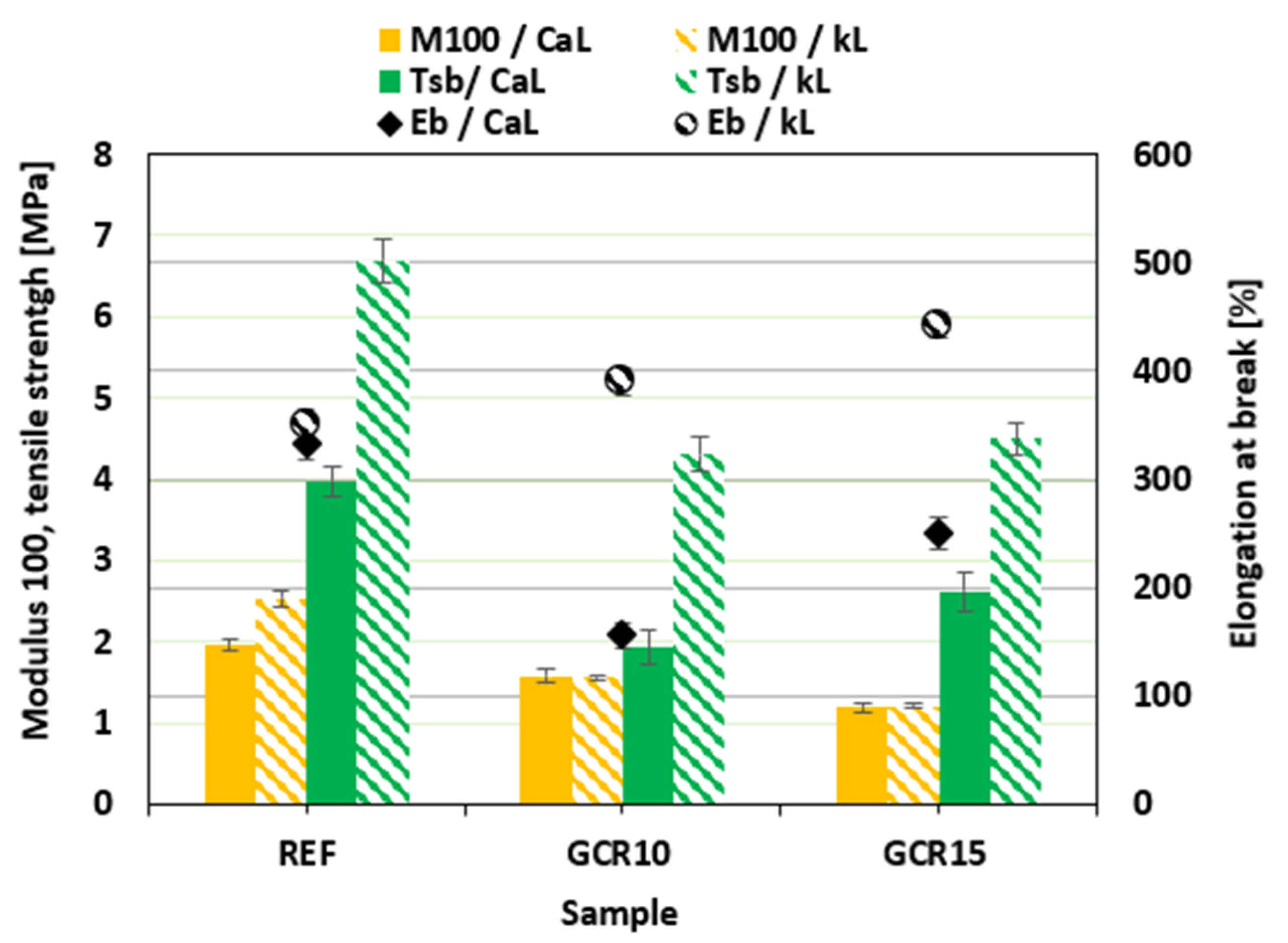
| Sample | Tsb [MPa] | Eb [%] |
|---|---|---|
| CaL ref. (90 °C) | 3.09 ± 0.03 | 379.57 ± 3.38 |
| kL ref. (90 °C) | 7.10 ± 0.59 | 340.89 ± 34.06 |
| CaL/GLE10 | 1.44 ± 0.14 | 203.74 ± 22.25 |
| CaL/GLE15 | 1.46 ± 0.07 | 291.58 ± 23.92 |
| kL/GLE10 | 6.68 ± 0.44 | 475.71 ± 17.77 |
| kL/GLE15 | 7.41 ± 0.44 | 571.27 ± 13.86 |
| CaL ref. (110 °C) | 3.98 ± 0.19 | 332.97 ± 14.15 |
| kL ref. (110 °C) | 6.70 ± 0.27 | 350.94 ± 14.43 |
| CaL/GCR10 | 1.94 ± 0.21 | 156.14 ± 11.51 |
| CaL/GCR15 | 2.62 ± 0.25 | 249.90 ± 15.53 |
| kL/GCR10 | 4.31 ± 0.21 | 390.58 ± 13.16 |
| kL/GCR15 | 4.50 ± 0.20 | 441.59 ± 11.47 |
| Sample | Tg (°C) | tan δ at Tg | tan δ (−50 °C) | tan δ (−20 °C) | tan δ (0 °C) | tan δ (20 °C) | tan δ (50 °C) |
|---|---|---|---|---|---|---|---|
| CaL | −2.5 | 1.37 | 0.03 | 0.05 | 1.27 | 0.25 | 0.11 |
| CaL/GLE 10 phr | −1.6 | 1.15 | 0.05 | 0.05 | 1.10 | 0.24 | 0.11 |
| CaL/GLE 15 phr | −2.1 | 1.19 | 0.05 | 0.08 | 1.13 | 0.27 | 0.17 |
| kL | −1.1 | 1.29 | 0.02 | 0.05 | 1.26 | 0.26 | 0.10 |
| kL/GLE 10 phr | −1.5 | 1.17 | 0.03 | 0.05 | 1.12 | 0.23 | 0.10 |
| kL/GLE 15 phr | −1.0 | 1.28 | 0.05 | 0.06 | 1.25 | 0.24 | 0.13 |
| Sample | E′ at Tg | E′ (−50 °C) | E′ (−20 °C) | E′ (0 °C) | E′ (20 °C) | E′ (50 °C) | M100 |
|---|---|---|---|---|---|---|---|
| CaL | 103 | 2984 | 2475 | 52.1 | 7.5 | 6.5 | 1.47 |
| CaL/GLE 10 phr | 107 | 2713 | 2044 | 68.5 | 10.6 | 10.0 | 1.10 |
| CaL/GLE 15 phr | 68 | 2136 | 1511 | 38.6 | 5.4 | 3.5 | 0.91 |
| kL | 130 | 3344 | 2829 | 96.4 | 13.9 | 12.6 | 2.42 |
| kL/GLE 10 phr | 144 | 3189 | 2509 | 94.9 | 15.5 | 14.9 | 1.38 |
| kL/GLE 15 phr | 94 | 3057 | 2184 | 67.7 | 8.0 | 4.7 | 1.15 |
| Sample | Tg (°C) | tan δ at Tg | tan δ (−50 °C) | tan δ (−20 °C) | tan δ (0 °C) | tan δ (20 °C) | tan δ (50 °C) |
|---|---|---|---|---|---|---|---|
| CaL | −4.6 | 1.44 | 0.02 | 0.07 | 1.18 | 0.25 | 0.11 |
| CaL/GCR 10 phr | −3.6 | 1.38 | 0.03 | 0.08 | 1.18 | 0.26 | 0.15 |
| CaL/GCR 15 phr | −4.6 | 1.29 | 0.02 | 0.10 | 1.15 | 0.27 | 0.18 |
| kL | −3.1 | 1.33 | 0.02 | 0.05 | 1.04 | 0.22 | 0.09 |
| kL/GCR 10 phr | −3.2 | 1.28 | 0.02 | 0.06 | 1.08 | 0.23 | 0.10 |
| kL/GCR 15 phr | −4.6 | 1.25 | 0.02 | 0.06 | 0.98 | 0.21 | 0.09 |
| Sample | E′ at Tg | E′ (−50 °C) | E′ (−20 °C) | E′ (0 °C) | E′ (20 °C) | E′ (50 °C) | M100 |
|---|---|---|---|---|---|---|---|
| CaL | 87 | 3263 | 2650 | 33.3 | 7.5 | 6.5 | 1.96 |
| CaL/GCR 10 phr | 89 | 2952 | 2173 | 36.1 | 7.3 | 5.7 | 1.58 |
| CaL/GCR 15 phr | 95 | 2673 | 1932 | 35.5 | 7.6 | 5.9 | 1.19 |
| kL | 125 | 3253 | 2747 | 43.7 | 12.1 | 12.5 | 2.54 |
| kL/GCR 10 phr | 115 | 2824 | 2293 | 53.0 | 10.7 | 10.0 | 1.56 |
| kL/GCR 15 phr | 140 | 2958 | 2381 | 46.6 | 11.6 | 11 | 1.21 |
Disclaimer/Publisher’s Note: The statements, opinions and data contained in all publications are solely those of the individual author(s) and contributor(s) and not of MDPI and/or the editor(s). MDPI and/or the editor(s) disclaim responsibility for any injury to people or property resulting from any ideas, methods, instructions or products referred to in the content. |
© 2026 by the authors. Licensee MDPI, Basel, Switzerland. This article is an open access article distributed under the terms and conditions of the Creative Commons Attribution (CC BY) license.
Share and Cite
Kruželák, J.; Džuganová, M.; Tomanová, K.; Plavec, R.; Parcheta-Szwindowska, P.; Włoch, M.; Bąk, M.; Datta, J. Recycled Polyurethane Glycolysate and Glycerolysate as Sustainable Plasticizers for Lignin-Filled NBR Composites. Materials 2026, 19, 1204. https://doi.org/10.3390/ma19061204
Kruželák J, Džuganová M, Tomanová K, Plavec R, Parcheta-Szwindowska P, Włoch M, Bąk M, Datta J. Recycled Polyurethane Glycolysate and Glycerolysate as Sustainable Plasticizers for Lignin-Filled NBR Composites. Materials. 2026; 19(6):1204. https://doi.org/10.3390/ma19061204
Chicago/Turabian StyleKruželák, Ján, Michaela Džuganová, Katarína Tomanová, Roderik Plavec, Paulina Parcheta-Szwindowska, Marcin Włoch, Magdalena Bąk, and Janusz Datta. 2026. "Recycled Polyurethane Glycolysate and Glycerolysate as Sustainable Plasticizers for Lignin-Filled NBR Composites" Materials 19, no. 6: 1204. https://doi.org/10.3390/ma19061204
APA StyleKruželák, J., Džuganová, M., Tomanová, K., Plavec, R., Parcheta-Szwindowska, P., Włoch, M., Bąk, M., & Datta, J. (2026). Recycled Polyurethane Glycolysate and Glycerolysate as Sustainable Plasticizers for Lignin-Filled NBR Composites. Materials, 19(6), 1204. https://doi.org/10.3390/ma19061204