ASME-Based Structural Assessment of Head–Shell Junctions in Pressurized Railway Tank Wagons

 ,
,  ,
,  ,
,  ,
,  ,
,  , ,
, ,
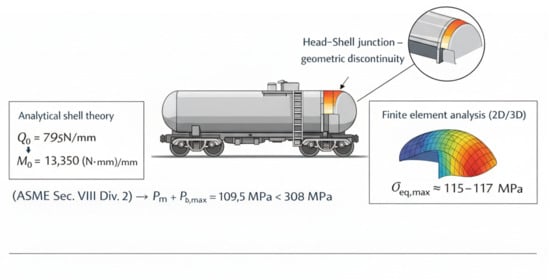
Abstract
1. Introduction
2. Theoretical Framework
2.1. Stress Categorization and Decomposition According to ASME VIII Division 2
- -
- Mechanical, caused by external stresses such as pressure, dead weight and occasional loads (“p”, “SUS”, “OCC”);
- -
- Thermo-mechanical, resulting from the constraint of free expansion, which leads to additional stress in the material (“EXP”, “OPE”).
- -
- Thermal, specific to thick-walled structures, where temperature variations create a thermal gradient along the wall thickness (“EXP”).
2.2. Allowable Stress and Strength Verification Criteria
- Yield-controlled criterion:
- Tensile-controlled criterion:
2.3. Stress Linearization and Structural Discontinuities
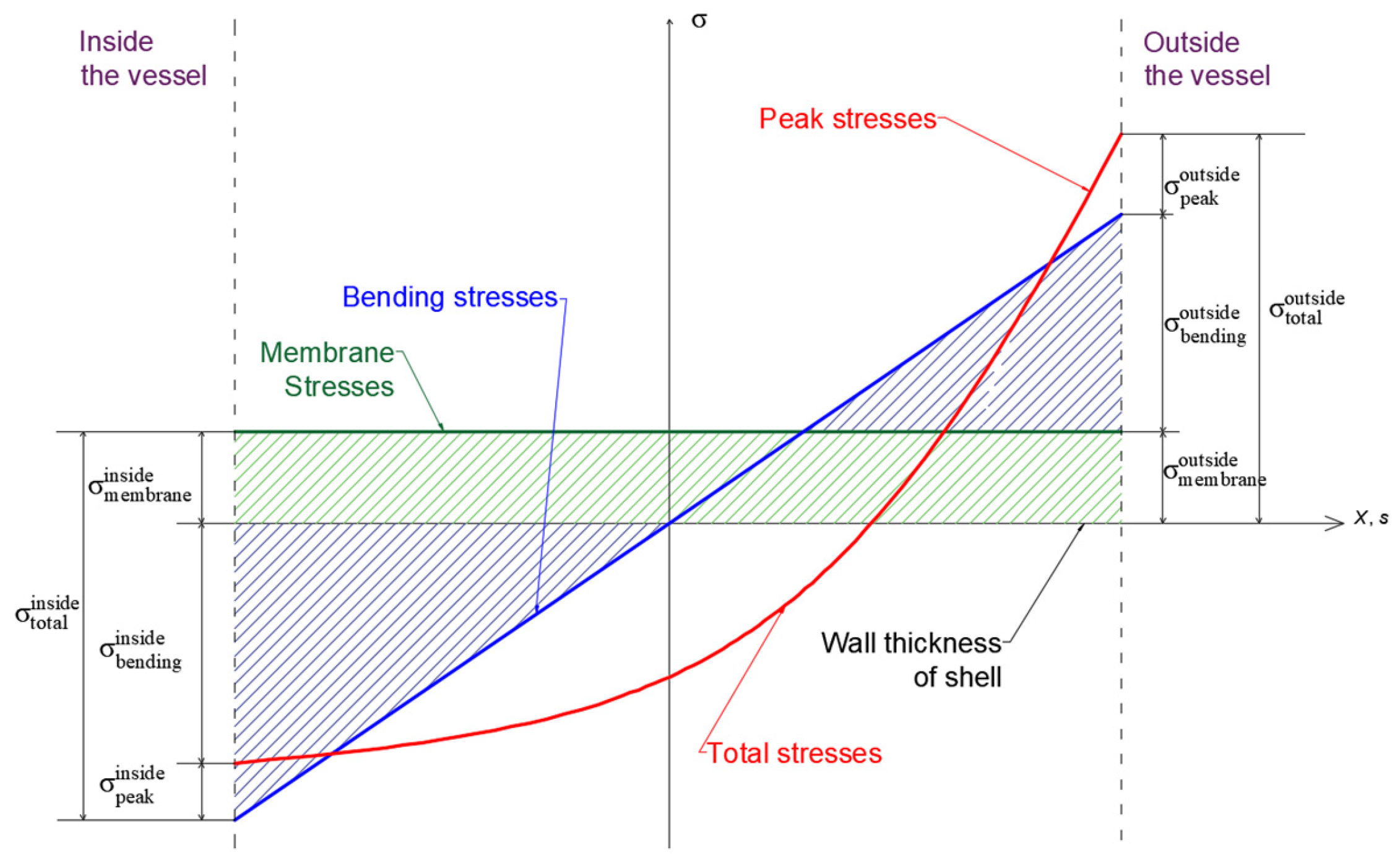
- Membrane component (uniform across thickness),
- Bending component (linearly varying),
- Peak component (localized nonlinear excess).
3. Materials and Methods
3.1. Structural Configuration and Material Properties
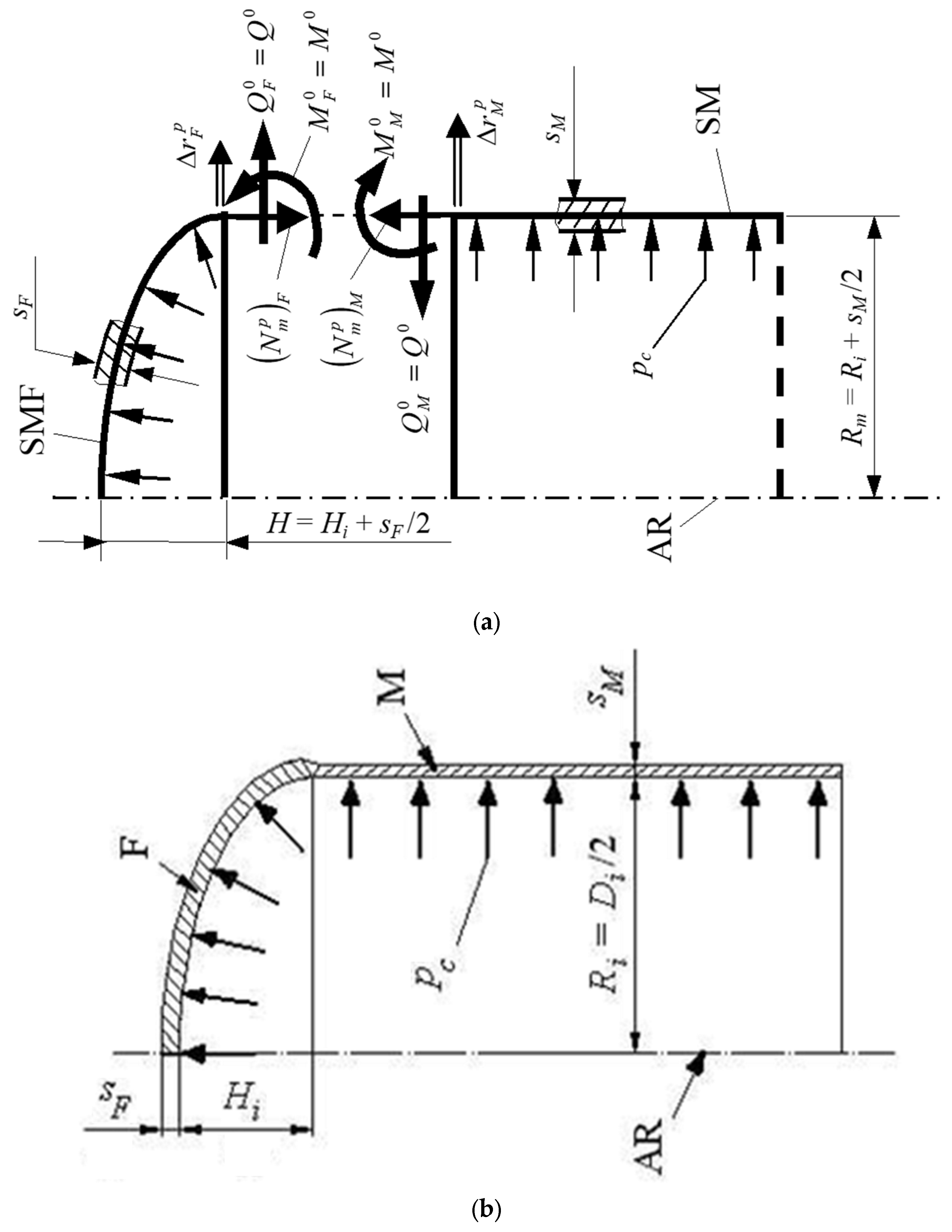
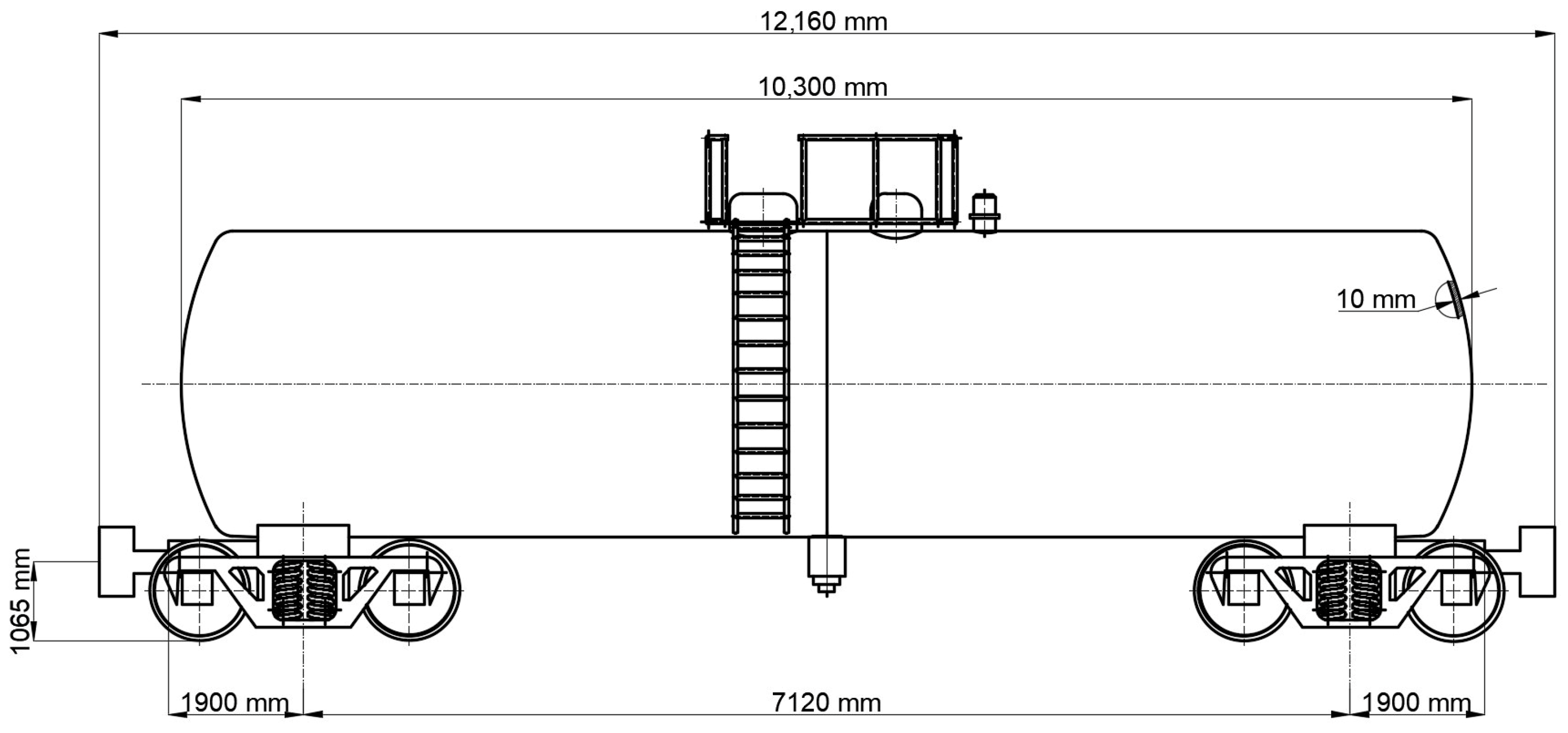
3.2. Analytical Formulation of the Head–Shell Junction
3.3. Finite Element Modeling of the Railway Tank Wagon Discontinuity Zone
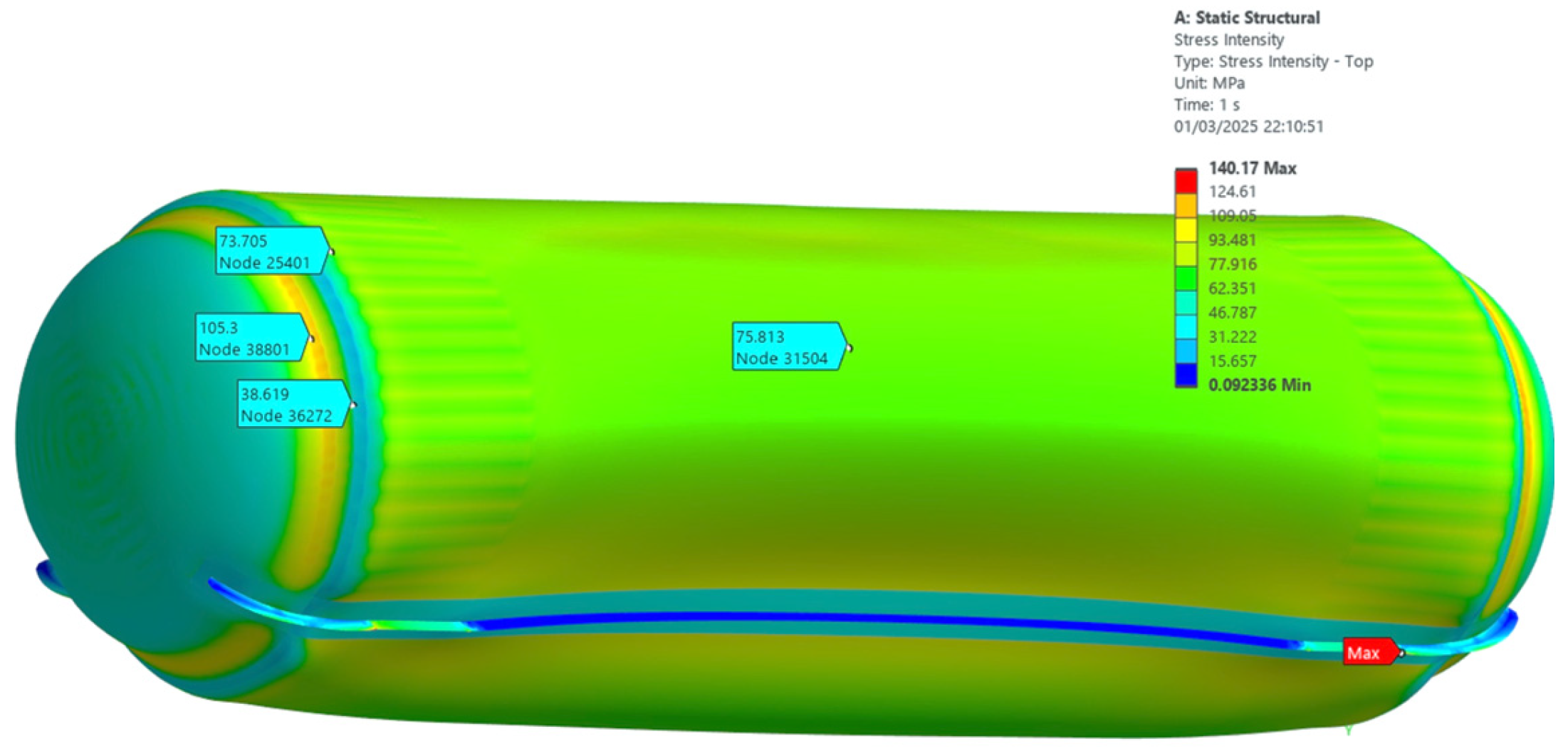
- The 3D modeling in shell theory (Figure 3): This approach was used to obtain a global view of the behavior of the structure under external stresses. The 3D model was designed to analyze the distribution of stresses and strains throughout the entire structure, considering the influences of specific constraint conditions, such as those in the studied zones.
- 2.
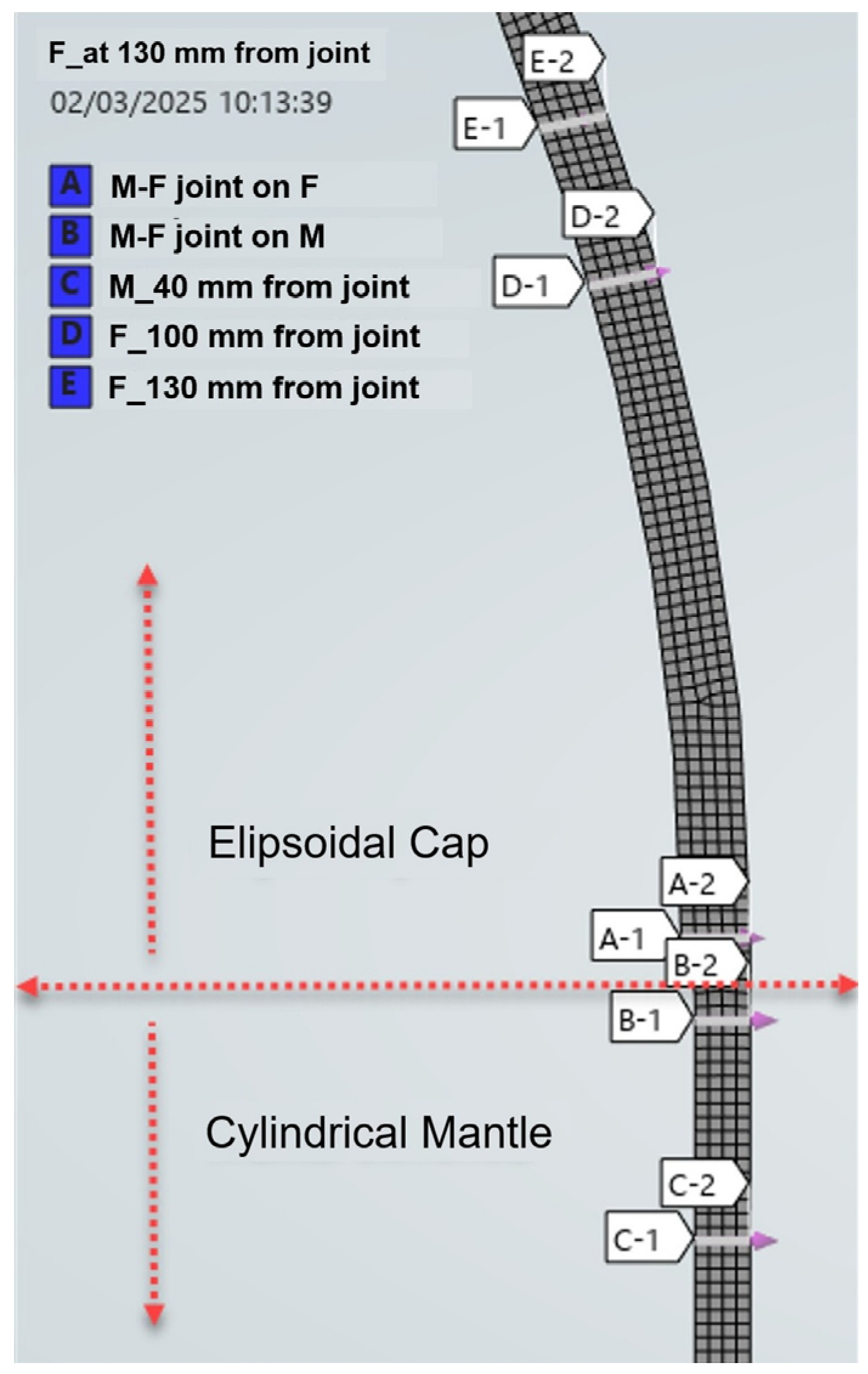
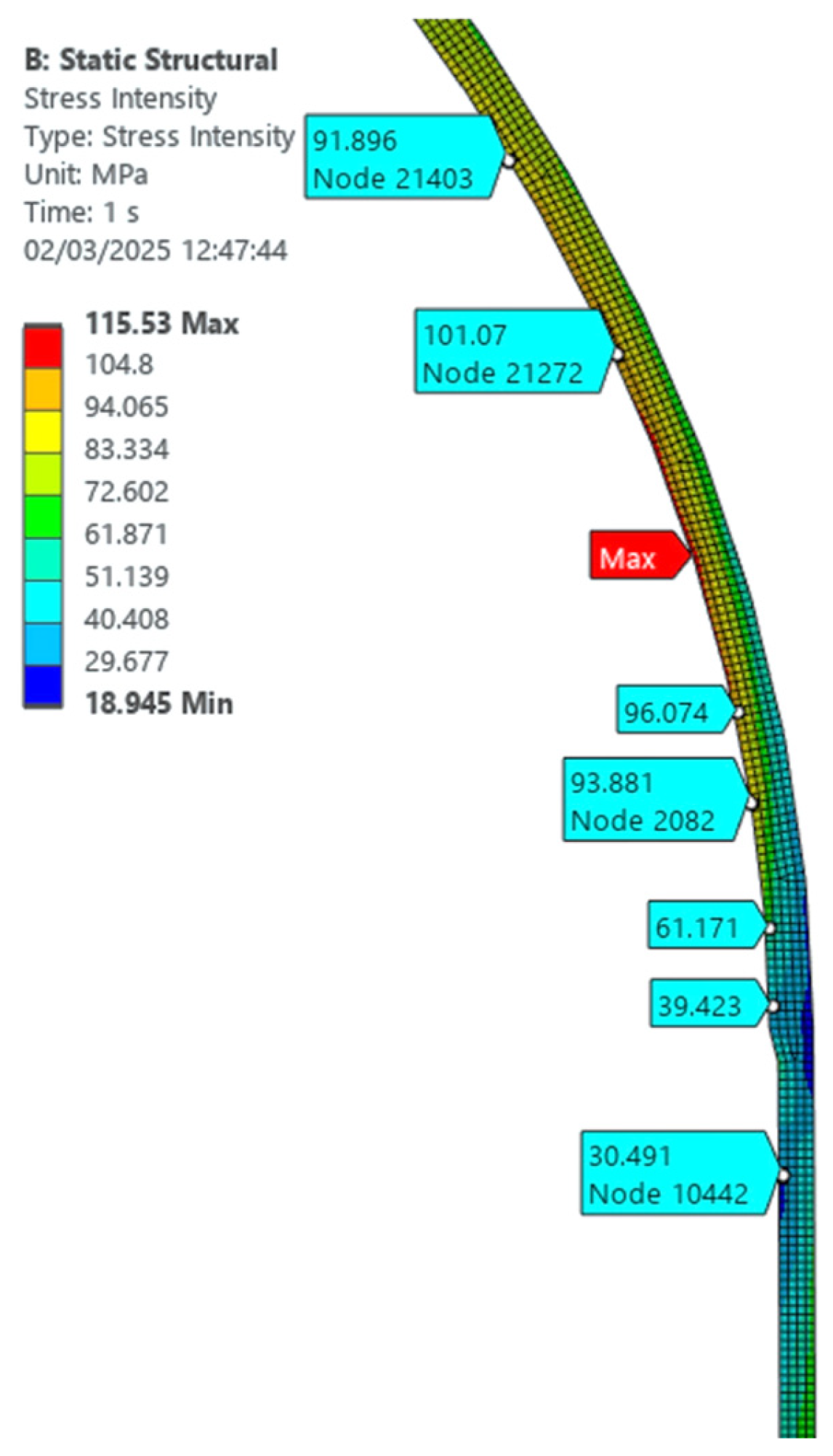
- Planar analysis model (2D-Figure 4): In this variant of analysis, a more simplified approach was used, which allowed a detailed examination of the local behavior of the structure.
4. Results and Discussion
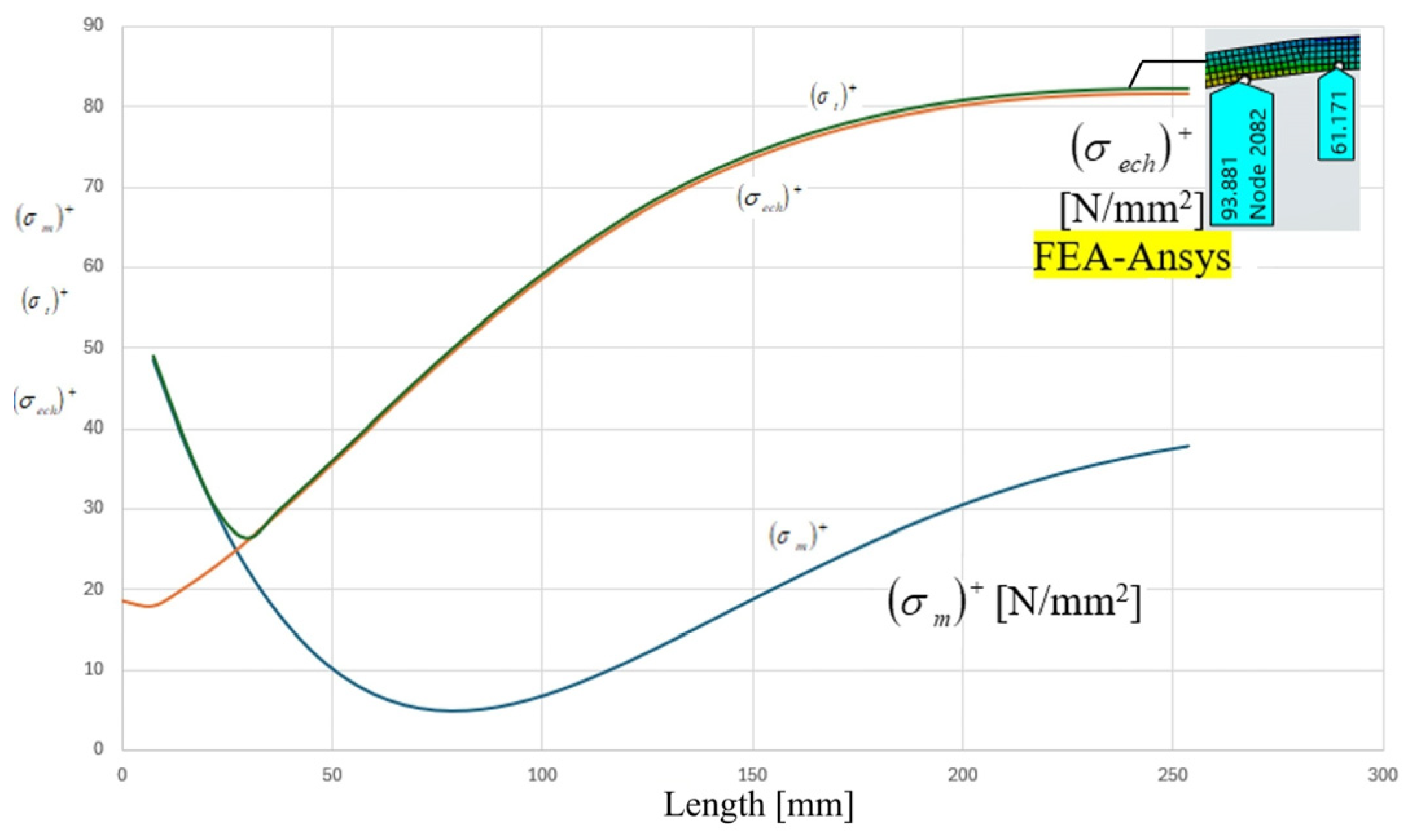
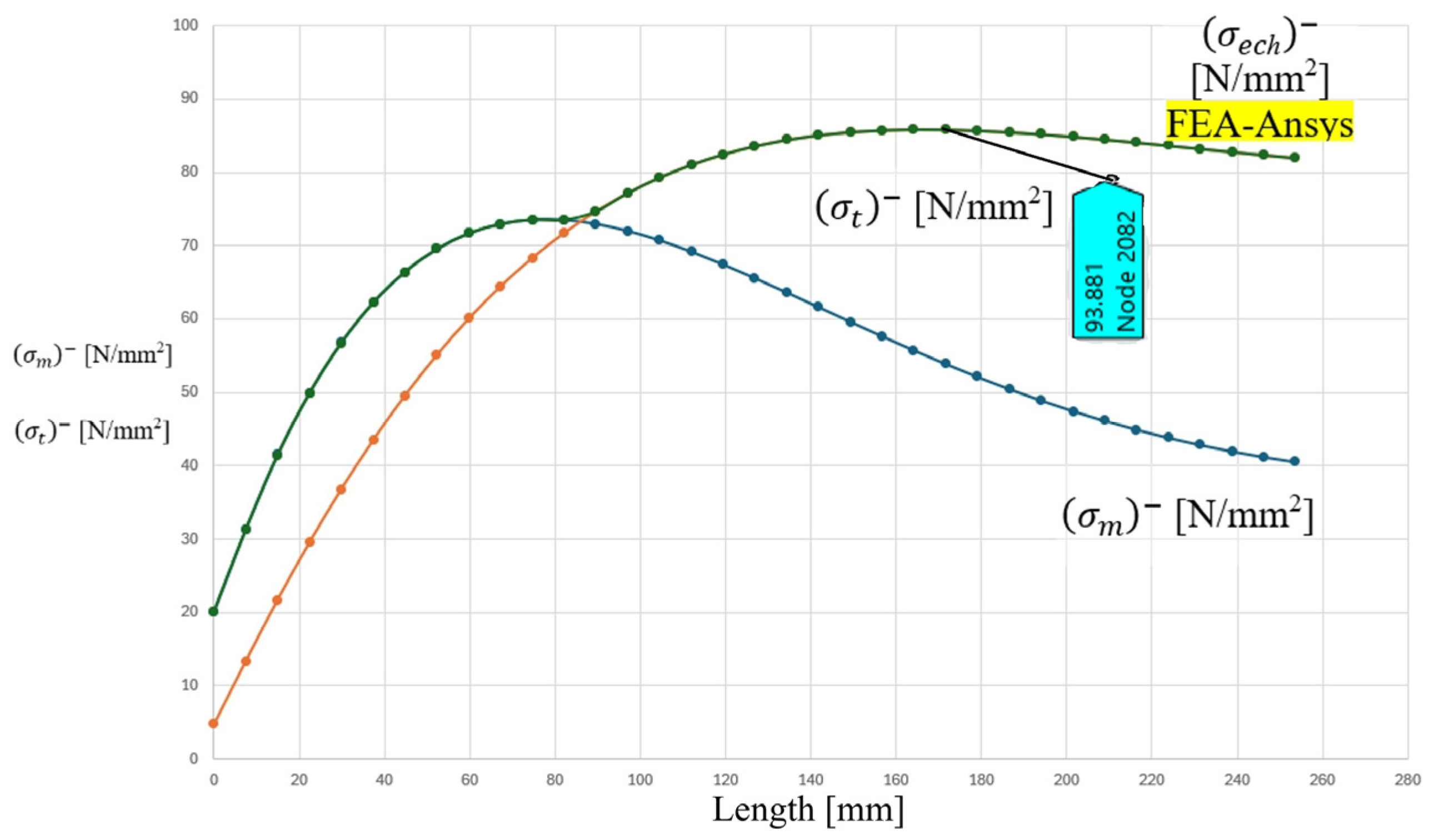
4.1. Analytical Results
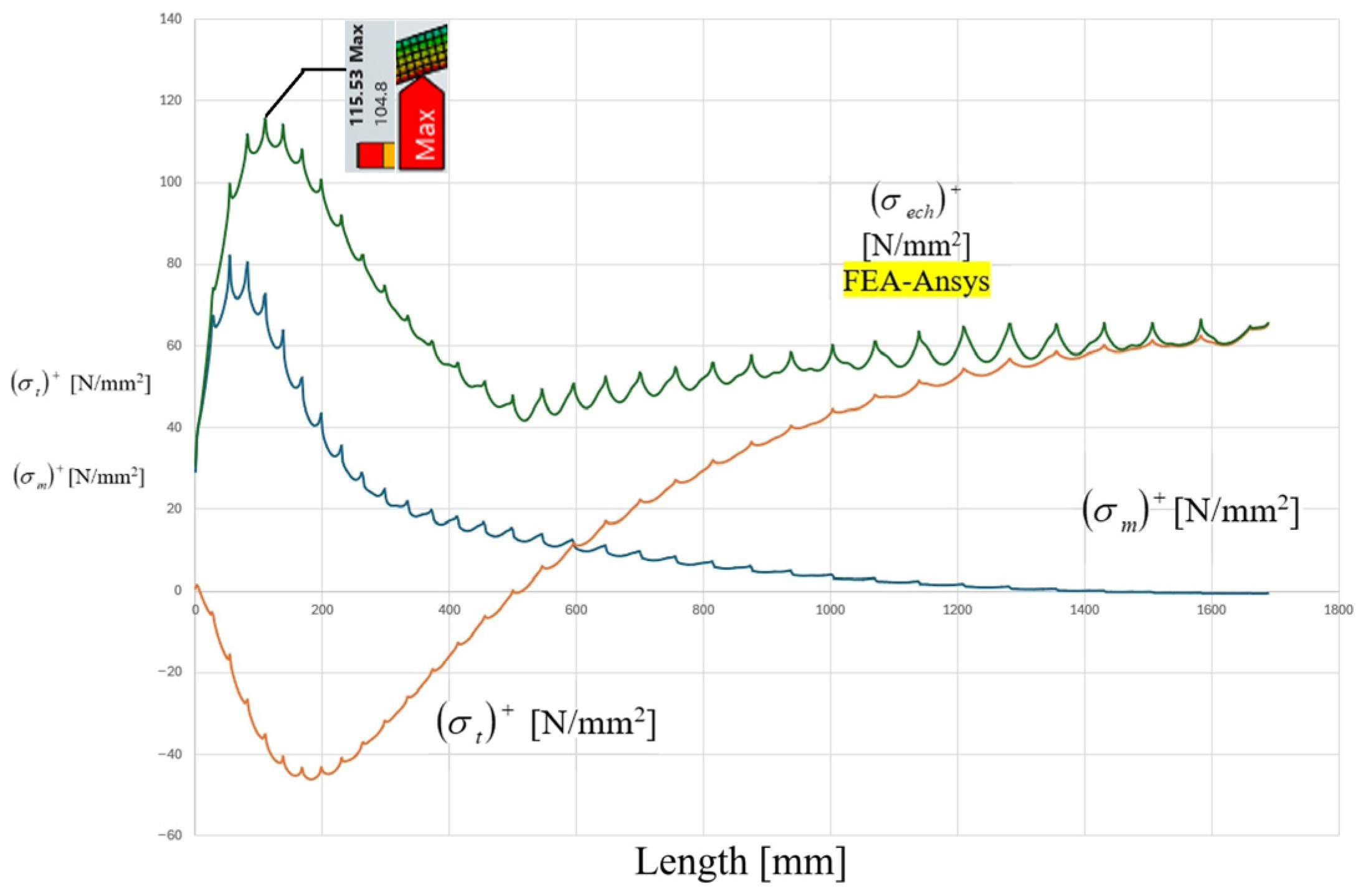
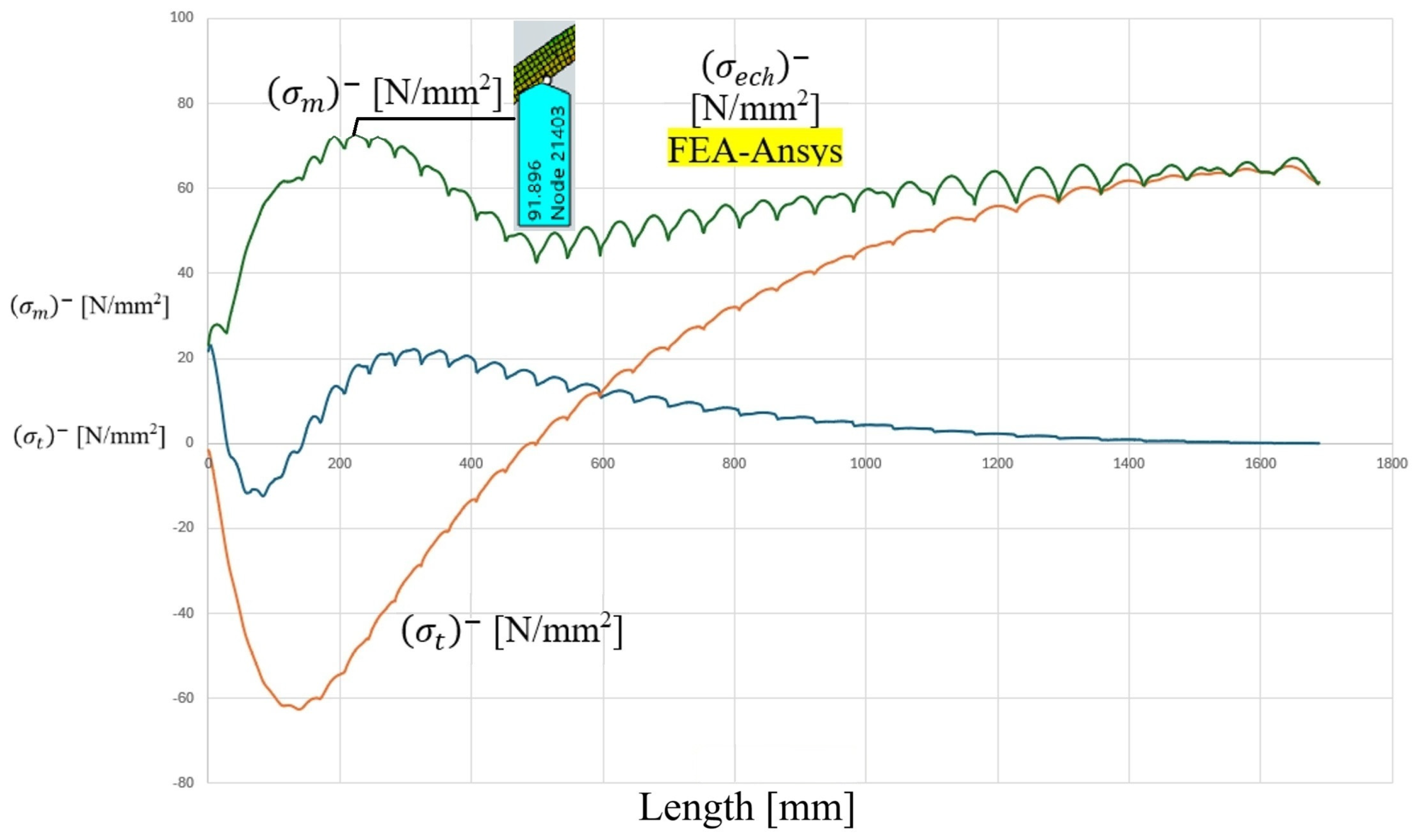
4.2. Numerical Results (Finite Element Analysis)
4.3. Comparative Assessment (Analytical vs. FEA)
5. Conclusions
Author Contributions
Funding
Data Availability Statement
Conflicts of Interest
Nomenclature
| Symbol | Description | Unit |
| (Di) | Internal diameter of the cylindrical shell | mm |
| (Rm) | Mean radius of the cylindrical shell | mm |
| (SM) | Wall thickness of the cylindrical shell | mm |
| (SF) | Wall thickness of the ellipsoidal head | mm |
| (Hi) | Internal height of the ellipsoidal head | mm |
| (H) | Mean height of the ellipsoidal head | mm |
| (ke) | Ellipticity coefficient of the ellipsoidal head | – |
| (L) | Characteristic calculation length | mm |
| (E) | Young’s modulus | MPa |
| (ν) | Poisson’s ratio | – |
| (Sy) | Yield strength of the material | MPa |
| (Su) | Ultimate tensile strength of the material | MPa |
| (Sa) | Allowable stress according to ASME Section VIII Division 2 | MPa |
| (pc) | Internal design pressure | MPa |
| (σ) | Total stress | MPa |
| (σp) | Stress due to internal pressure | MPa |
| (σSUS) | Stress due to sustained loads | MPa |
| (σEXP) | Stress due to thermal expansion | MPa |
| (σOCC) | Stress due to occasional loads | MPa |
| (σm) | Meridional stress | MPa |
| (σt) | Circumferential (hoop) stress | MPa |
| (σeq) | Equivalent stress | MPa |
| (σech) | Equivalent stress according to the maximum shear stress criterion | MPa |
| (σmemb) | Membrane stress component | MPa |
| (σbend) | Bending stress component | MPa |
| (Pm) | Primary membrane stress intensity | MPa |
| (Pb) | Primary bending stress intensity | MPa |
| (Q) | Secondary stress intensity | MPa |
| (Nt) | Circumferential membrane force per unit length | N/mm |
| (Mt) | Circumferential bending moment per unit length | (N·mm)/mm |
| (M0) | Bending moment per unit length at the head–shell junction | (N·mm)/mm |
| (Q0) | Transverse shear force per unit length at the junction | N/mm |
| (Δr) | Radial displacement | mm |
| (ΔrF) | Radial displacement of the ellipsoidal head at the junction | mm |
| (ΔrM) | Radial displacement of the cylindrical shell at the junction | mm |
| () | Radial displacement of the head produced by internal pressure | mm |
| () | Radial displacement of the shell produced by internal pressure | mm |
| (θF) | Rotation of the ellipsoidal head at the junction | rad |
| (θM) | Rotation of the cylindrical shell at the junction | rad |
| () | Rotation of the head produced by internal pressure | rad |
| () | Rotation of the shell produced by internal pressure | rad |
| (δ) | Displacement influence coefficient | – |
| (η) | Rotation influence coefficient | – |
| (φ) | Angular coordinate along the ellipsoidal head meridian | rad |
| (x) | Meridional coordinate along the cylindrical shell measured from the junction | mm |
| (F) | Ellipsoidal head component | – |
| (M) | Cylindrical shell component | – |
| (+) | Inner surface of the shell | – |
| (−) | Outer surface of the shell | – |
| SCL | Stress Classification Line used for stress linearization | – |
| FEA | Finite Element Analysis | – |
| ASME | American Society of Mechanical Engineers | – |
References
- Khalifa, M.; Khan, F.; Thorp, J. Risk-based maintenance and remaining life assessment for gas turbines. J. Qual. Maint. Eng. 2015, 21, 100–111. [Google Scholar] [CrossRef]
- Vukelic, G.; Vizentin, G.; Bakhtiari, R. Failure analysis of a steel pressure vessel with a composite wrap repair proposal. Int. J. Press. Vessel. Pip. 2021, 193, 104476. [Google Scholar] [CrossRef]
- Vukelic, G.; Vizentin, G.; Bozic, Z.; Rukavina, L. Failure analysis of a ruptured compressor pressure vessel. Procedia Struct. Integr. 2021, 31, 28–32. [Google Scholar] [CrossRef]
- Ji, J.; Tong, Q.; Khan, F.; Dadashzadeh, M.; Abbassi, R. Risk-Based Domino Effect Analysis for Fire and Explosion Accidents Considering Uncertainty in Processing Facilities. Ind. Eng. Chem. Res. 2018, 57, 3990–4006. [Google Scholar] [CrossRef]
- ASME. ASME Boiler and Pressure Vessel Code, Section VIII, Division 2: Rules for Construction of Pressure Vessels, 8th ed.; American Society of Mechanical Engineers: New York, NY, USA, 2023. [Google Scholar]
- AS 1210:2010; Pressure Vessels. Standards Australia: Sydney, NSW, Australia, 2010.
- Li, K.; Zheng, J.; Liu, S.; Ge, H.; Sun, G.; Zhang, Z.; Gu, C.; Xu, P. Buckling behavior of large-scale thin-walled ellipsoidal head under internal pressure. Thin-Walled Struct. 2019, 141, 260–274. [Google Scholar] [CrossRef]
- Lotsberg, I. Stress concentration factors at welds in pipelines and tanks subjected to internal pressure and axial force. Mar. Struct. 2008, 21, 138–159. [Google Scholar] [CrossRef]
- Devatakonda, V.R.G. Finite element analysis (FEA) for stress evaluation of pressure vessel nozzles. Int. J. Core Eng. Manag. 2023, 7. [Google Scholar]
- Hondekyn, M.; Ali, N.; Van Paepegem, W. Closed-form analytical model for the cylinder region of thick-walled composite pressure vessels for hydrogen storage. Int. J. Hydrogen Energy 2024, 87, 457–468. [Google Scholar] [CrossRef]
- Rajendra Bahadur, V.K.M.; Surjit, A. Stress Analysis of Pressure Vessel Nozzle using FEA. Int. J. Eng. Res. Technol. 2018, 6, 1–6. [Google Scholar]
- Juarez de Jesus Rocha Pinto, M.M.N. Pressure Vessels Structural Integrity Assessment Using Failure Analysis Diagrams. Braz. J. Radiat. Sci. 2025, 13, 19. [Google Scholar] [CrossRef]
- Kalnins, A.; Dowling, N.E. Design Criterion of Fatigue Analysis on Plastic Basis by ASME B&PV Code; ASME: New York, NY, USA, 2003; pp. 11–18. [Google Scholar]
- Hazizi, K.; Ghaleeh, M. Design and Analysis of a Typical Vertical Pressure Vessel Using ASME Code and FEA Technique. Designs 2023, 7, 78. [Google Scholar] [CrossRef]
- Li, H.; Huang, X.; Yang, P.; Yang, H. A new pressure vessel design by analysis method avoiding stress categorization. Int. J. Press. Vessel. Pip. 2017, 152, 38–45. [Google Scholar] [CrossRef]
- Belardi, V.G.; Ottaviano, M.; Vivio, F. Bending theory of composite pressure vessels: A closed-form analytical approach. Compos. Struct. 2024, 329, 117799. [Google Scholar] [CrossRef]
- Sowiński, K. Application and accuracy of shell theory in the analysis of stress and deformations in cylindrical pressure vessels. Thin Walled Struct. 2023, 188, 110826. [Google Scholar] [CrossRef]
- Patel, D.V.; Daftary, J.; Talekar, P.; Bhojawala, V.M. Analysis of discontinuity stress at shell and elliptical head juncture using theory of beam on elastic foundation. Mater. Today Proc. [CrossRef]
- Sowiński, K. Stress distribution optimization in dished ends of cylindrical pressure vessels. Thin Walled Struct. 2022, 171, 108808. [Google Scholar] [CrossRef]
- Hieu, P.Q.; Namgung, I. An Investigation of Structural Integrity and Dynamic Response of CSB in Case of Slanted Contact with RV Outlet Nozzle. Energies 2024, 17, 6070. [Google Scholar] [CrossRef]
- Chapai, S. Local stress analysis of tailing lugs in a vertical pressure vessel. Int. J. Press. Vessel. Pip. 2023, 203, 104945. [Google Scholar] [CrossRef]
- Neacșa, A.; Ramadan, I.N.; Diniță, A.; Iacob, Ș.V.; Ilincă, C.N.; Laudacescu, E.V. Can Non-Phase-Transformation Heat Treatments Improve the Strength Properties of Materials? Materials 2025, 18, 1599. [Google Scholar] [CrossRef] [PubMed]
- STAS 2883/2-80; Hot Rolled Steel—Steel Grades for Pressure Vessel Plates for Ambient and Low Temperature Service. Romanian Standards Institute: Bucharest, Romania, 1980.
- DIN 17135; Flat Products Made of Steel for Pressure Purposes—Quality Specifications. Deutsches Institut für Normung: Berlin, Germany, 1989.
- SEW 089-70; Guidelines for Weldable Fine-Grain Structural Steels. Verein Deutscher Eisenhüttenleute (VDEh): Düsseldorf, Germany, 1970.
- SEW 680-70; Technical Delivery Conditions for Tubes Made of Weldable Fine-Grain Structural Steels. Verein Deutscher Eisenhüttenleute (VDEh): Düsseldorf, Germany, 1970.
- Timoshenko, S.; Woinowsky-Krieger, S. Theory of Plates and Shells; McGraw-Hill: New York, NY, USA, 1959. [Google Scholar]
- Flügge, W. Direct Stresses in Shells of Revolution. In Stresses in Shells; Flügge, W., Ed.; Springer: Berlin/Heidelberg, Germany, 1973; pp. 19–102. [Google Scholar]
- Flügge, W. Bending of Circular Cylindrical Shells. In Stresses in Shells; Flügge, W., Ed.; Springer: Berlin/Heidelberg, Germany, 1973; pp. 204–316. [Google Scholar]






| Parameter | Symbol | Value |
|---|---|---|
| Internal diameter of cylindrical shell | Di | 2800 mm |
| Mean radius of cylindrical shell | Rm | 1404 mm |
| Wall thickness of shell | SM | 8 mm |
| Wall thickness of head | SF | 10 mm |
| Internal height of head | Hi | 700 mm |
| Mean head height | H | 702 mm |
| Ellipticity coefficient | ke = a/b | 2 |
| Calculation length | L | 2100 mm |
| Young’s modulus | E | 190,000 MPa |
| Poisson’s ratio | ν | 0.30 |
| Yield strength | Sy | 308 MPa |
| Ultimate tensile strength | Su | 577 MPa |
| Internal design pressure | pc | 0.45 MPa |
| SCL | Primary Membrane Stress Pm (MPa) | Primary Bending Stress Pb (MPa) | Primary Stress Intensity from Linearized (Pm + Pb) Tensor (MPa) | Allowable Limit [1.5f, Sy] (MPa) | Stress Intensity from Linearized (Pm + Pb + Q) Tensor (MPa) | Allowable Limit Max [3f, 2Sy] (MPa) |
|---|---|---|---|---|---|---|
| SCL1 (A1–A2) | 33.06 | 8.70 | 40.81 | 308 | — | 616 |
| SCL2 (B1–B2) | 39.52 | 16.08 | 56.27 | 308 | — | 616 |
| SCL3 (E1–E2) | 83.70 | 36.80 | 109.50 | 308 | 109.50 | 616 |
| SCL4 (C1–C2) | 39.52 | 20.49 | 28.85 | 308 | 28.85 | 616 |
Disclaimer/Publisher’s Note: The statements, opinions and data contained in all publications are solely those of the individual author(s) and contributor(s) and not of MDPI and/or the editor(s). MDPI and/or the editor(s) disclaim responsibility for any injury to people or property resulting from any ideas, methods, instructions or products referred to in the content. |
© 2026 by the authors. Licensee MDPI, Basel, Switzerland. This article is an open access article distributed under the terms and conditions of the Creative Commons Attribution (CC BY) license.
Share and Cite
Ilincă, C.N.; Doukeh, R.; Ramadan, I.N.; Neacsa, A.; Diniță, A.; Laudacescu, E.V.; Petrescu, M.G.; Ilie, B.; Sîrbu, A.C. ASME-Based Structural Assessment of Head–Shell Junctions in Pressurized Railway Tank Wagons. Materials 2026, 19, 1125. https://doi.org/10.3390/ma19061125
Ilincă CN, Doukeh R, Ramadan IN, Neacsa A, Diniță A, Laudacescu EV, Petrescu MG, Ilie B, Sîrbu AC. ASME-Based Structural Assessment of Head–Shell Junctions in Pressurized Railway Tank Wagons. Materials. 2026; 19(6):1125. https://doi.org/10.3390/ma19061125
Chicago/Turabian StyleIlincă, Costin Nicolae, Rami Doukeh, Ibrahim Naim Ramadan, Adrian Neacsa, Alin Diniță, Eugen Victor Laudacescu, Marius Gabriel Petrescu, Bogdan Ilie, and Andrei Cosmin Sîrbu. 2026. "ASME-Based Structural Assessment of Head–Shell Junctions in Pressurized Railway Tank Wagons" Materials 19, no. 6: 1125. https://doi.org/10.3390/ma19061125
APA StyleIlincă, C. N., Doukeh, R., Ramadan, I. N., Neacsa, A., Diniță, A., Laudacescu, E. V., Petrescu, M. G., Ilie, B., & Sîrbu, A. C. (2026). ASME-Based Structural Assessment of Head–Shell Junctions in Pressurized Railway Tank Wagons. Materials, 19(6), 1125. https://doi.org/10.3390/ma19061125