Article

Modified Formulations of Silicate-Based Cements: Comparative Study of Physicochemical Properties


by
Mirlyn de Souza Dias
1,
Raimundo Sales de Oliveira Neto
2,
Marcelo Antônio Santos da Silva
3,
Suyane Maria Luna-Cruz
1,4,
Murilo Priori Alcalde
2,
Rodrigo Ricci Vivan
2,
Antônio Sérgio Bezerra Sombra
3,
Marco Antônio Húngaro Duarte
2,
Pierre Basilio Almeida Fechine
5 and
Bruno Carvalho de Vasconcelos
1,*
1
Postgraduate Program in Dentistry, Federal University of Ceará, 1273 Monsenhor Furtado St., Rodolfo Teófilo, Fortaleza 60455-730, CE, Brazil
2
Department of Operative Dentistry, Endodontics, and Dental Materials, Bauru School of Dentistry, University of São Paulo, Bauru 17012-191, SP, Brazil
3
Telecommunications and Materials Science & Engineering Laboratory, Federal University of Ceará, Fortaleza 60440-900, CE, Brazil
4
Dentistry Course, UniFametro, Fortaleza 60010-280, CE, Brazil
5
Group of Chemistry of Advanced Materials (GQMat), Department of Analytical Chemistry and Physical-Chemistry, Federal University of Ceará, Fortaleza 60440-900, CE, Brazil
*
Author to whom correspondence should be addressed.
Materials 2026, 19(6), 1083; https://doi.org/10.3390/ma19061083
Submission received: 4 February 2026 / Revised: 25 February 2026 / Accepted: 10 March 2026 / Published: 11 March 2026
(This article belongs to the Special Issue Dental Biomaterials: Synthesis, Characterization, and Applications)

Highlights

What are the main findings?
  • The experimental cements exhibited adequate physicochemical performance.
  • The radiopacity exceeded the ISO requirements without the need for radiopacifiers.
  • The setting time improved compared with previous formulations.
  • The solubility remained within acceptable limits.
  • An alkaline pH and sustained calcium/strontium ion release were observed.
What are the implications of the main findings?
  • Calcium silicate-based cements with zirconium or strontium phosphate may reduce the need for radiopacifiers.
  • Formulations show potential as alternatives to commercial materials.
  • The results support future biological and clinical investigations.

Abstract

This study aimed to prepare experimental calcium silicate repair cements (ERCs) incorporating zirconium (Ca3ZrSi2O9; CZS) or strontium substitution (Sr5(PO4)2SiO4; SPS), and to compare their physicochemical properties with white MTA-Angelus (WMTA), grey MTA-Angelus (GMTA), and Biodentine (BD). After synthesizing the CZS and SPS phases, powder–liquid cements were formulated. The setting time and radiopacity were assessed according to ISO 6876/12 and ASTM C266, the volumetric solubility by micro-CT, the pH by a pH meter, and the calcium/strontium ion release by FAAS/ICP-OES. Data were analyzed using ANOVA and Tukey’s tests (5%). The initial setting time was 11 min for SPS and 6 min for CZS (p < 0.05), while the final setting was significantly longer for SPS (49 min). Both ERCs showed radiopacity above the 3.0 mm Al minimum, with higher values for CZS (4.58 mm Al). The solubility remained controlled, with CZS presenting the highest value (3.09%). Both materials exhibited an alkaline pH, peaking at 24 h (CZS: 9.70; SPS: 10.04) and decreasing until 168 h (CZS: 7.80; SPS: 8.31). Sustained ionic release was observed: CZS showed intermediate calcium release (25.96 mg/L at 3 h), whereas SPS displayed lower values (10.95 mg/L at 168 h), without significant difference from WMTA (p > 0.05). Under these conditions, the experimental ERCs demonstrated adequate physicochemical performance comparable with commercial materials.

1. Introduction

Endodontics is one of the dental specialties that most benefits from the development of new biomaterials. Procedures such as pulp capping, sealing of perforations and root resorptions, revascularization, apexification, and retrofilling in periradicular surgery depend on the selection of repair materials with adequate physicochemical and biological properties [1]. Clinical success is related not only to the sealing ability but also to biocompatibility, antimicrobial activity, and stimulation of mineralized tissue formation [2].
Mineral Trioxide Aggregate (MTA), introduced in 1993, became a reference material due to its bioactivity and ability to induce cell differentiation and mineral deposition [3]. However, limitations such as difficult manipulation, prolonged setting time, low radiopacity, risk of tooth discoloration, and the presence of toxic components encouraged the search for new materials [1,4]. To overcome these limitations, new calcium silicate-based cements were developed, including Biodentine (BD; Septodont, Saint-Maur-des-Fossés, Cedex, France), which is composed of tricalcium silicate, zirconium oxide, and calcium carbonate. This material offers improved handling [5] and reduced setting time [6] without compromising biocompatibility [7]. Nevertheless, no cement exhibits all ideal properties, justifying the search for alternative formulations.
Calcium silicate cements stand out for their favorable interaction with periradicular tissues, mainly due to the release of calcium and silicon ions capable of stimulating cell differentiation and mineral deposition [8]. Additionally, incorporating new elements into bioceramic cement formulations has proven a promising strategy. Zirconium enhances the mechanical strength and chemical stability and shows satisfactory biocompatibility [9]. Strontium, a physiologically calcium-like element, exerts multiple beneficial effects on bone metabolism, including stimulation of bone formation, reinforcement of bone structure, and both anabolic and anticatabolic effects, resulting in increased bone mass [10,11,12]. Moreover, Sr2+ ion release promotes apatite precipitation and increases the material’s bioactivity, biocompatibility, and mechanical strength [11,13]. In this context, experimental cements based on calcium zirconium silicate (Ca3ZrSi2O9; CZS) and strontium phosphate silicate (Sr5(PO4)2SiO4; SPS) have been investigated, demonstrating promising biocompatibility and physicochemical performance, although with limitations related to the setting time and solubility [11]. These formulations were selected because they are reproducible and not overly complex to synthesize, contain known biocompatible components, and are capable of acting as a source of the desired ions.
Thus, since the previous study performed by the same research group obtained favorable results when testing experimental repair cements (ERCs) based on CZS and SPS [11], this study aimed to synthesize these silicates once again; incorporate them into experimental repair cement with modified formulations; and evaluate the physicochemical properties of setting time, radiopacity, volumetric solubility, pH, and calcium/strontium ion release. Additionally, these properties were compared with those of the commercial cements MTA Angelus Grey (GMTA; Angelus Indústria de Produtos Odontológicos S/A, Londrina, Paraná, Brazil), MTA Angelus White (WMTA; Angelus Indústria de Produtos Odontológicos S/A), and Biodentine. The null hypothesis was that no statistically significant differences would be found between the experimental cements or between them and the commercial materials.

2. Materials and Methods

The study involved the synthesis of two silicates, namely, calcium zirconium silicate (CZS) and strontium phosphate silicate (SPS), obtained via a solid-state route as described below; both syntheses followed the protocol described by Aguiar et al. [11].

2.1. Synthesis of Calcium Zirconium Silicate (CZS)

CZS was obtained by mixing stoichiometric amounts of calcium oxide (CaO), zirconium oxide (ZrO2), and silicon oxide (SiO2) (Êxodo Científica Química Fina Indústria e Comércio Ltda., Sumaré, São Paulo, Brazil) and mechanically homogenized using a mortar and pestle before being transferred to ceramic crucibles. The reaction occurred in an oxidative atmosphere at 1350 °C in a resistive furnace for 8 h with a heating rate of 5 °C/min. The resulting sample was then ground and characterized.

2.2. Synthesis of Strontium Phosphate Silicate (SPS)

SrCO3 (Êxodo Científica), SiO2 (Êxodo Científica), and ammonium dihydrogen phosphate (NH4H2PO4, Neon Comercial, Sumaré, São Paulo, Brazil) were used as precursors. The oxides were mechanically homogenized using a mortar and pestle and transferred to ceramic crucibles. The reaction was conducted in an oxidative atmosphere at 1350 °C for 8 h with a 5 °C/min heating rate. The sample was then ground and characterized.

2.3. X-Ray Diffraction (XRD) Characterization

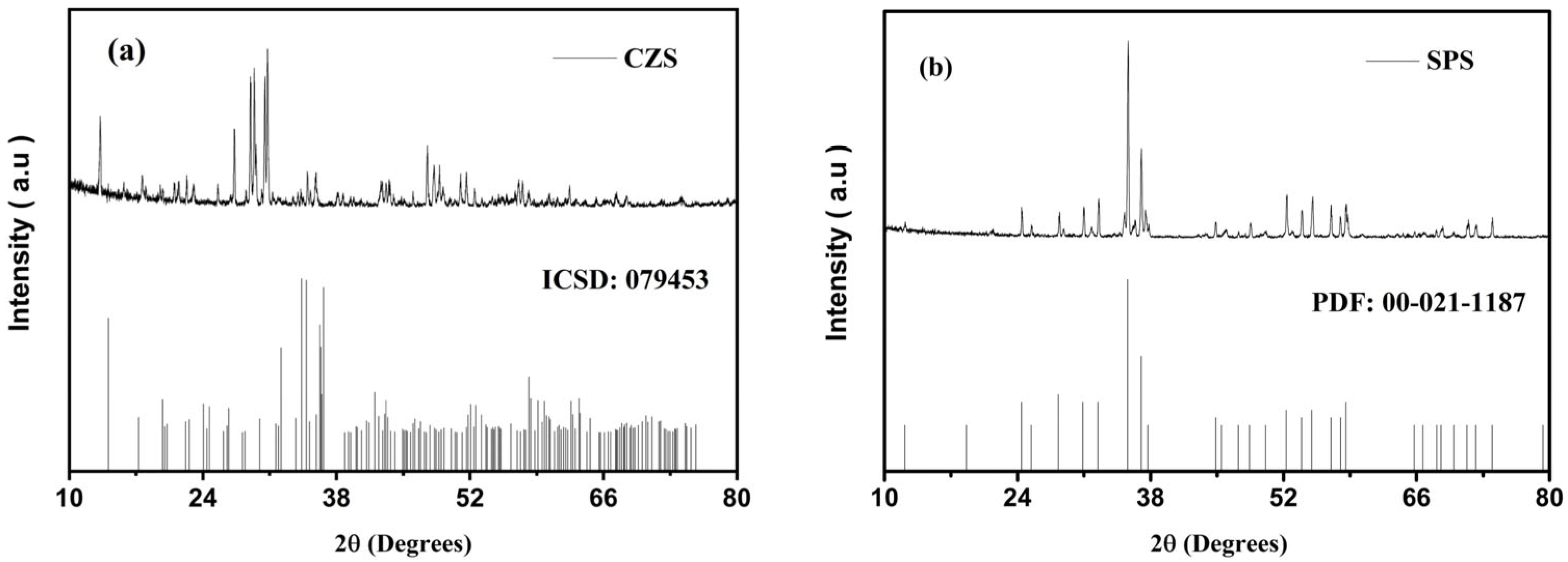
XRD analyses were performed at room temperature using a Bruker diffractometer (D8 Advance; Bruker do Brasil Ltda, Atibaia, SP, Brazil) with a CuKα tube (λ = 1.5418 Å) and LynxEye linear detector: 40 kV, 40 mA, and 2θ range 10–80° with 0.02° step. The crystalline phases of CZS and SPS after calcination were compared with patterns in the Inorganic Crystal Structure Database (ICSD).

2.4. Physicochemical Tests

SPS and CZS were used as the main components of experimental powder–liquid repair cements. Other substances were added to confer different physicochemical characteristics. Powders were manually mixed on a glass plate for 1 min at a 3:1 ratio (g/g) with a liquid primarily composed of distilled water. Commercial cements GMTA, WMTA, and BD were prepared according to manufacturer instructions. Their compositions are shown in Table 1. The physicochemical properties of both experimental and commercial cements were evaluated as follows.

2.4.1. Setting Time

The setting time was determined according to ISO 6876/2012 [14] using ASTM C266-20 [15] as a reference for Gilmore needles. Type IV gypsum rings (10 mm inner diameter, 2 mm height) were immersed in deionized water for 24 h. Prepared cements (n = 3) were inserted into the rings and stored at 37 °C and 95 ± 5% humidity. After 180 s, measurements were taken using Gilmore needles: 113.4 g with a 2.0 mm tip for initial setting and 453.6 g with a 1.0 mm tip for final setting.

2.4.2. Radiopacity

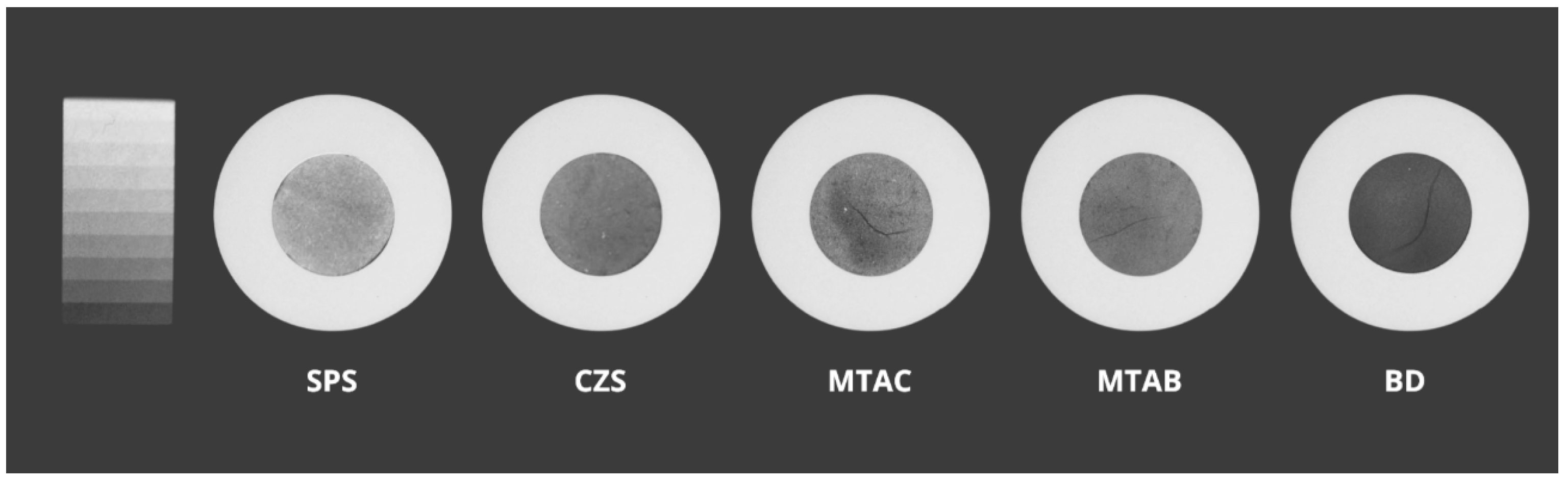
The radiopacity was assessed according to ISO 6876/2012 [14]. Metallic rings (n = 3, 10 mm diameter, 1 mm height) were filled with cements and incubated at 37 °C and 95 ± 5% humidity for three times the setting period. Specimens were radiographed alongside an aluminum step wedge (1–10 mm Al) on occlusal film (60 kV, 10 mA, 0.3 s, 30 cm). Images were digitized and analyzed in ImageJ 8.0, converting the radiographic density to mm Al [16].

2.4.3. Volumetric Solubility

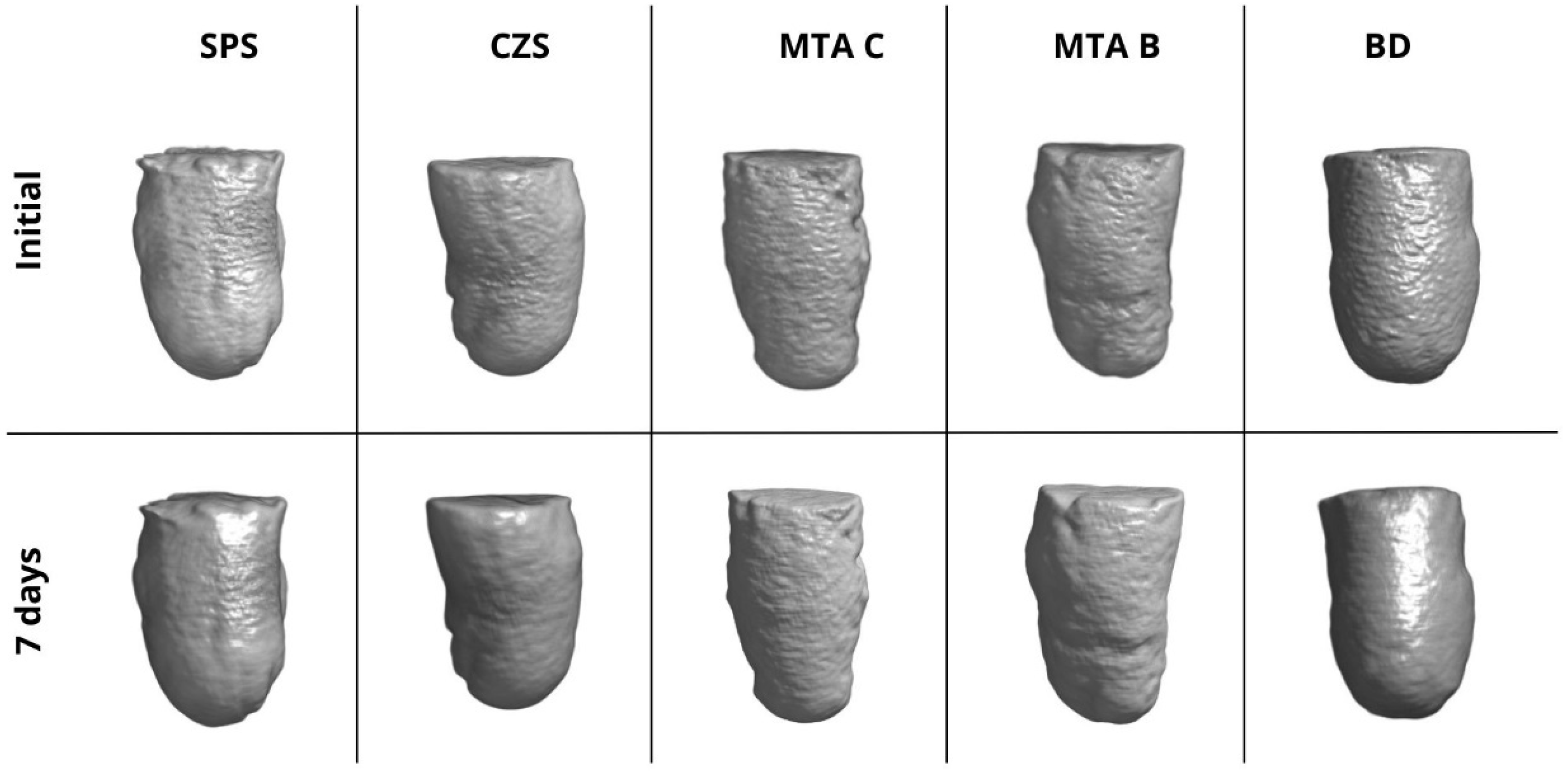
Considering the lack of a specific standardization norm, sample size calculation was performed for this analysis. For this purpose, the G*Power v3.1 for Mac software (Heinrich Heine University Düsseldorf) was used, selecting one-way ANOVA, employing the values available on Cavenago et al. [17] (SD = 0.77 for MTA Angelus, 3:1 ratio), and adopting a minimum detectable difference of 1.5, which yielded six specimens per group (power = 80%, α = 0.05). The solubility was evaluated by micro-computed tomography (SkyScan 1174v2; SkyScan, Kontich, Belgium). Acrylic blocks with standardized cavities (n = 6, 2 mm diameter, 3 mm depth) were filled, scanned after final setting (50 kV, 800 μA, voxel 14.1 μm, 1.1° step), and analyzed in CTan software (v.1.14.4; Bruker microCT, Kontich, Belgium) for the total volume. Samples were immersed in 15 mL deionized water at 37 °C for 168 h, dried, and rescanned. Solubility was expressed as the percentage of volume lost.

2.4.4. pH and Calcium/Strontium Release

As same as for volumetric solubility, for pH and Ca2+/Sr2+ analysis was calculated using one-way ANOVA, using the G*Power v3.1 for Mac software and Vivan et al.’s [18] method (SD = 1.03 at 3 h), and adopting a detectable difference of 1.5, which resulted in ten specimens per group (power = 80%, α = 0.05). Freshly mixed cements were placed in polyethylene tubes (n = 10, 1 mm diameter, 10 mm length, one end sealed) and immersed in 10 mL deionized water (initial pH 7.11) at 37 °C and 95 ± 5% humidity. The tubes remained in water for 3, 24, 72, and 168 h, and were transferred to fresh water at each interval; tubes in water only and empty tubes were the controls. The pH was measured after 5 s of mechanical agitation using a calibrated digital pH meter (Micronal #371, São Paulo, Brazil). The calcium release was quantified by flame atomic absorption spectrometry (SpectraAA 220 FS; VARIAN, NJ, USA) with La(NO3)3 10 g/L to remove alkali metal interferences (422.7 nm, 0.2 mm slit, 10 mA, 2.0 L/min acetylene). Strontium release was evaluated by inductively coupled plasma optical emission spectrometry (ICP-OES) (Optima 2100 DV, Perkin Elmer, Waltham, MA, USA) at Sr 407.771 nm.

2.5. Statistical Analysis

Data were tabulated and tested for normality using the Kolmogorov–Smirnov test, which indicated a normal distribution. Considering this, the statistical software GraphPad Prism 9.0 (GraphPad Software Inc., San Diego, CA, USA) was used to analyze the parametric data employing the one-way ANOVA and Tukey post hoc tests, with significance set at 5%.

3. Results

3.1. X-Ray Diffraction (XRD) Characterization Values

Figure 1 shows the XRD patterns of the CZS (1a) and SPS (1b) samples. In Figure 1a, the diffractogram obtained from the CZS synthesis (line graph) is compared with the ICSD standard pattern. All diffraction peaks of CZS were observed, confirming the formation of CZS through the calcination process used. In Figure 1b, the diffractogram for SPS synthesis is presented similarly. Two graphs are shown: the line graph represents the experimental measurement of SPS, and the other represents the standard SPS pattern from ICSD. All diffraction peaks corresponding to the SPS phases are present in the synthesized sample diffractogram.

3.2. Physicochemical Properties

Table 2 presents the results for the setting time, radiopacity, and solubility of the experimental (SPS and CZS) and commercial cements included in this study.
Regarding the initial setting time, the order observed was CZS < WMTA < GMTA < BD < SPS, with SPS (11.33 min), GMTA, and BD significantly higher than CZS (6 min) and WMTA (p < 0.05); CZS was the fastest-setting material. For the final setting time, the order was BD < WMTA < GMTA < CZS < SPS, with significant differences between SPS (49 min) and the other groups, and between BD (18 min) and the others (p < 0.05); BD had the fastest final setting.
For the radiopacity, the order was SPS > CZS > GMTA = WMTA > BD, with SPS (4.58 mm Al) and BD (1.64 mm Al) differing significantly as the highest and lowest values, respectively (p < 0.05). Only SPS and CZS (3.18 mm Al) exceeded the ISO 6876/2012 minimum of 3.0 mm Al. Figure 2 allows visual comparison of the radiopacity differences between the materials.
Regarding the volumetric solubility measured by micro-CT, the order was GMTA < WMTA < SPS < BD < CZS. SPS (2.28%) did not differ significantly from the other groups, while CZS (3.09%) had higher values, differing statistically from GMTA (1.21%) and WMTA (1.31%) (p < 0.05). Figure 3 shows 3D reconstructions of the samples before immersion and after 7 days.
The pH values are shown in Table 3. Both SPS and CZS showed a slight increase from 3 to 24 h followed by a decline, whereas commercial cements decreased progressively. At 3 h, the order was BD > GMTA > CZS > WMTA > SPS, with significant differences between SPS (9.01) and BD (10.52) and GMTA (10.11), and between CZS (9.59) and BD (p < 0.05). At 168 h, the order was WMTA > GMTA > SPS > BD > CZS, with CZS (7.80) differing significantly from the MTAs (p < 0.05).
For the ion release (Table 4), the overall order was BD > CZS > GMTA > WMTA > SPS, with BD showing the highest release at all time points (p < 0.05). Conversely, SPS showed the lowest release at all time points, significantly lower than GMTA, CZS, and BD at 3 h and 168 h (p <0.05). CZS had an intermediate pattern, differing only from GMTA at 3 h, 24 h, and 168 h. The within-group analysis showed no significant differences over time for CZS and WMTA; SPS differed at 24 h compared with the other time points (p < 0.05).

4. Discussion

Materials such as MTA-Angelus and Biodentine have become references due to their physicochemical properties, biocompatibility, bioactivity, and ability to induce mineralized tissue formation, but they still present limitations [19,20]. In this context, this study aimed to advance in the development of experimental cements using other types of silicates, with zirconium or strontium, along with the addition of auxiliary substances, aiming to overcome weaknesses of commercial cements and provide effective alternatives for clinical practice. The findings show that the modified ERCs prepared with the developed silicates exhibited properties close to those of commercial cements, with superior radiopacity and lower ion release; since some of these differences were significant, the null hypothesis was rejected.
Using the expected peaks after synthesis (ICSD) as the reference, it can be stated that the preparation of the silicates was successful; considering that the syntheses performed here respected all the parameters of the previous study [11], other analyses related to characterization were not necessary. Regarding this point, the previous study of the same research group, which tested materials similar to the ERCs evaluated here, suggested the need for modifications in their composition [11]. In this sense, calcium oxide and calcium carbonate were added to the powder. Calcium oxide was added as a setting accelerator and expansion inducer, promoting the formation of calcium hydroxide, which would facilitate the transition from the initial pasty consistency to a solid and stable structure over time [21,22]. Calcium carbonate, in turn, improved handling, flow, and facilitated material insertion, in addition to contributing to cement hydration [23,24]. In the liquid, water-soluble polymers and a setting accelerator were added to enhance the particle dispersion, suspension stability, reaction kinetics control, and flow, and to promote the initiation of the hydration reaction [25].
Regarding the findings, the setting times of the formulations tested showed a reduction when compared with those reported in the literature (SPS 11/49 min vs. 21/50 min; CZS 6/36 min vs. 31/68 min) [11], suggesting that the inclusions were favorable. Regarding the commercial cements, they showed values consistent with the literature [26,27,28], with both types of MTA characterized by a final setting time of approximately 30 min, while BD had a final setting time of about 18 min. Clinically, very short setting times can hinder material insertion; conversely, very long times may compromise material stability after insertion, promote dissolution of components by blood or tissue fluids, or cause tissue irritation with some degree of toxicity [29,30,31].
Concerning the radiopacity, the ERCs showed values above the ISO 6876/2012 minimum of 3.0 mm Al, even without adding any additional radiopacifier. This finding corroborates a previous study [11] and is due to the intrinsic presence of zirconium or strontium in the silicates, which increases radiographic density due to their high atomic mass (91.22 and 87.62, respectively). This result eliminates the need for adding radiopacifiers, such as bismuth oxide, which can cause tooth discoloration and interfere with the physicochemical properties of materials [32]. In the case of commercial cements, values below the minimum required by the standard were observed, namely, 2.94 mm Al for GMTA and WMTA and 1.64 mm Al for Biodentine, which are consistent with literature reports [28,33,34].
Regarding the volumetric solubility, micro-CT analysis was chosen, which is a methodology that provides greater precision in quantifying structural material loss compared with traditional gravimetric testing by avoiding misinterpretations associated with fluid absorption, which is a common phenomenon in hydraulic cements [17,35,36]. Clinically, low solubility ensures maintenance of sealing and cement stability, but it tends to be inversely proportional to ion release [29,37]. The ERCs tested here maintained solubility within the 3% limit, differing from previous findings where higher values were reported [11]. This can be attributed both to the presence of setting accelerators in the liquid and powder, which resulted in a shorter initial setting time, and to the presence of calcium oxide, which may have provided some expansion [21,22,38]. Another factor may be associated with the water-soluble polymers present in the liquid, which, due to their plasticizing and humidifying action, may have resulted in greater homogeneity, reducing porosity and increasing matrix cohesion [25,39].
It is natural for silicate reactions to form a fraction of calcium hydroxide, consequently releasing hydroxyl ions, raising the pH, and creating an alkaline environment with antimicrobial effects and favoring mineralized tissue deposition [40]. The results showed that BD exhibited a higher pH than the others during the first 3 h, consistent with the literature, which reports similar behavior for this material due to its high hydration rate and initial solubilization [11,29,41]. In the experimental cements, the pH increase observed at 24 h was largely due to the period of material solubilization; subsequently, there was a slight decline, remaining mildly alkaline, as described in previous studies [29,42]. It should be noted that the pH of tissue formation is only slightly alkaline, and cell growth is impaired at pH levels above 7.8 [43].
Additionally, the sustained release of calcium and strontium ions contributes specifically to the bioactivity of the material [10,43]. Calcium stimulates differentiation of osteoblasts, cementoblasts, and pulp cells, and induces the expression of signaling proteins such as osteocalcin and alkaline phosphatase, promoting deposition of mineralized matrix [8,44]. Strontium, in turn, has a dual effect, stimulating adhesion, proliferation, and differentiation of osteoblasts, while inhibiting osteoclastic activity, favoring mineralized tissue formation and reducing bone resorption [10].
Regarding calcium release, BD was also the material showing the highest ionic release compared with the experimental cements and the other commercial cements tested, which corroborates previous studies highlighting its capacity for more intense and sustained calcium release [29,45]. Among the experimental cements, SPS showed a calcium release pattern similar to MTA Angelus White (WMTA), whereas CZS showed behavior closer to MTA Angelus Gray (GMTA), indicating that the ERC formulations satisfactorily replicated the characteristics of the reference commercial cements.
When compared with results obtained by Aguiar [11], the proposed modifications reduced the solubility, accelerated the setting, and maintained an adequate pH and ionic release. These attributes highlight the potential of modified cements as innovative alternatives for endodontic use. Undoubtedly, there are still aspects to improve in the material composition; however, it is important to note that statistical differences may not always reflect clinical relevance.
From a future perspective, the developed experimental cements present promising and improved characteristics when compared with those introduced previously [11]. Nevertheless, despite encouraging in vitro results, further studies, including biological analyses and clinical trials, are recommended to validate the safety and efficacy of these newly tested formulations.

5. Conclusions

Under the conditions of this study, it can be concluded that the developed experimental reparative cements demonstrated physicochemical performance close to that of the commercial cements tested, although additional adjustments and biological investigations are necessary to consolidate their use in clinical practice.

Author Contributions

Conceptualization, M.d.S.D., B.C.d.V., and P.B.A.F.; Methodology, M.d.S.D., S.M.L.-C., and B.C.d.V.; Validation, R.R.V., M.A.H.D., A.S.B.S., and M.P.A.; Formal Analysis, M.A.H.D. and M.P.A.; Investigation, M.d.S.D., R.S.d.O.N., and M.A.S.d.S.; Resources, M.d.S.D. and B.C.d.V.; Data Curation, M.d.S.D.; Writing—Original Draft Preparation, M.d.S.D.; Writing—Review & Editing, B.C.d.V., M.A.H.D., P.B.A.F., and A.S.B.S.; Visualization, M.d.S.D.; Supervision, B.C.d.V.; Project Administration, B.C.d.V.; Funding Acquisition, B.C.d.V. All authors have read and agreed to the published version of the manuscript.

Funding

This study was funded by FUNCAP—Ceará Foundation to Support Scientific and Technological Development (UNI-0210-00671.01.00/23), CNPq—Brazilian National Council for Scientific and Technological Development (443991/2024-3) and by Coordination for the Improvement of Higher Education Personnel of the Ministry of Education of Brazil.

Institutional Review Board Statement

Not applicable.

Informed Consent Statement

Not applicable.

Data Availability Statement

The original contributions presented in this study are included in the article. Further inquiries can be directed to the corresponding author.

Acknowledgments

The authors would like to thank Angelus Ind. Com. LTDA for the donation of materials used in this research. During the preparation of this manuscript, the authors used ChatGPT (GPT-5 mini) to assist with language revision. The authors have reviewed and edited the generated content and take full responsibility for the content of this publication.

Conflicts of Interest

The authors declare no conflicts of interest.

Abbreviations

The following abbreviations are used in this manuscript:
MTAMineral Trioxide Agreggate
BDBiodentine
CZSCalcium zirconium silicate
SPSStrontium phosphate silicate
WMTAWhite MTA-Angelus
GMTAGray MTA-Angelus
XRDX-Ray diffraction
ICSDInorganic Crystal Structure Database
ISOInternational Organization for Standardization
ASTMAmerican Society for Testing Materials
SDStandard deviation
ICP-OESInductively coupled plasma optical emission spectrometry

References

  1. Dawood, A.E.; Parashos, P.; Wong, R.H.K.; Reynolds, E.C.; Manton, D.J. Calcium silicate-based cements: Composition, properties, and clinical applications. J. Investig. Clin. Dent. 2017, 8, e12195. [Google Scholar] [CrossRef] [PubMed]
  2. Alshehri, M.M.; Alhawsawi, B.F.; Alghamdi, A.; Aldobaikhi, S.O.; Alanazi, M.H.; Alahmad, F.A. The Management of Root Perforation: A Review of the Literature. Cureus 2024, 16, e72296. [Google Scholar] [CrossRef] [PubMed]
  3. Shahi, S.; Fakhri, E.; Yavari, H.; Maleki Dizaj, S.; Salatin, S.; Khezri, K. Portland Cement: An Overview as a Root Repair Material. BioMed Res. Int. 2022, 2022, 3314912. [Google Scholar] [CrossRef] [PubMed]
  4. Torabinejad, M.; Parirokh, M.; Dummer, P.M.H. Mineral trioxide aggregate and other bioactive endodontic cements: An updated overview—Part II: Other clinical applications and complications. Int. Endod. J. 2018, 51, 284–317. [Google Scholar] [CrossRef]
  5. Camilleri, J.; Sorrentino, F.; Damidot, D. Investigation of the hydration and bioactivity of radiopacified tricalcium silicate cement, Biodentine and MTA Angelus. Dent. Mater. 2013, 29, 580–593. [Google Scholar] [CrossRef]
  6. Aguiar, B.A.; Frota, L.M.A.; Taguatinga, D.T.; Vivan, R.R.; Camilleri, J.; Duarte, M.A.H.; de Vasconcelos, B.C. Influence of ultrasonic agitation on bond strength, marginal adaptation, and tooth discoloration provided by three coronary barrier endodontic materials. Clin. Oral Investig. 2019, 23, 4113–4122. [Google Scholar] [CrossRef]
  7. Arandi, N.Z.; Thabet, M. Minimal Intervention in Dentistry: A Literature Review on Biodentine as a Bioactive Pulp Capping Material. BioMed Res. Int. 2021, 2021, 5569313. [Google Scholar] [CrossRef]
  8. Wannakajeepiboon, M.; Sathorn, C.; Kornsuthisopon, C.; Santiwong, B.; Wasanapiarnpong, T.; Linsuwanont, P. Evaluation of the chemical, physical, and biological properties of a newly developed bioceramic cement derived from cockle shells: An in vitro study. BMC Oral Health 2023, 23, 354. [Google Scholar] [CrossRef]
  9. Cesar, P.F.; Miranda, R.B.P.; Santos, K.F.; Scherrer, S.S.; Zhang, Y. Recent advances in dental zirconia: 15 years of material and processing evolution. Dent. Mater. 2024, 40, 824–836. [Google Scholar] [CrossRef]
  10. Silingardi, F.; Salamanna, F.; Español, M.; Maglio, M.; Sartori, M.; Giavaresi, G.; Bigi, A.; Ginebra, M.P.; Boanini, E. Regulation of osteogenesis and angiogenesis by cobalt, manganese and strontium doped apatitic materials for functional bone tissue regeneration. Biomater. Adv. 2024, 163, 213968. [Google Scholar] [CrossRef]
  11. Aguiar, B.A.; Chaves, A.V.; Silva, M.A.S.; Silva, L.T.V.; Nascimento, R.F.; Sombra, A.S.B.; Silva, P.G.B.; Fechine, P.B.A.; Duarte, M.A.H.; Vasconcelos, B.C. Development and evaluation of the physico-chemical and biological properties of new experimental hydraulic silicates. J. Biomed. Mater. Res. Part B Appl. Biomater. 2026, 114, e70043. [Google Scholar] [CrossRef] [PubMed]
  12. Ataie, M.; Nourmohammadi, J.; Seyedjafari, E. Carboxymethyl carrageenan immobilized on 3D-printed polycaprolactone scaffold for the adsorption of calcium phosphate/strontium phosphate adapted to bone regeneration. Int. J. Biol. Macromol. 2022, 206, 861–874. [Google Scholar] [CrossRef] [PubMed]
  13. Ni, G.X.; Lu, W.W.; Chiu, K.Y.; Li, Z.Y.; Fong, D.Y.; Luk, K.D. Strontium-containing hydroxyapatite (Sr-HA) bioactive cement for primary hip replacement: An in vivo study. J. Biomed. Mater. Res. Part B Appl. Biomater. 2006, 77, 409–415. [Google Scholar] [CrossRef] [PubMed]
  14. ISO 6876; Dental Root Canal Sealing Materials. International Organization for Standardization: Geneva, Switzerland, 2012.
  15. ASTM C266-20; Standard Test Method for Time of Setting of Hydraulic-Cement Paste by Gillmore Needles. ASTM International: West Conshohocken, PA, USA, 2020. [CrossRef]
  16. Húngaro Duarte, M.A.; de Oliveira El Kadre, G.D.; Vivan, R.R.; Guerreiro Tanomaru, J.M.; Tanomaru-Filho, M.; de Moraes, I.G. Radiopacity of Portland cement associated with different radiopacifying agents. J. Endod. 2009, 35, 737–740. [Google Scholar] [CrossRef]
  17. Cavenago, B.C.; Pereira, T.C.; Duarte, M.A.; Ordinola-Zapata, R.; Marciano, M.A.; Bramante, C.M.; Bernardineli, N. Influence of powder-to-water ratio on radiopacity, setting time, pH, calcium ion release and a micro-CT volumetric solubility of white mineral trioxide aggregate. Int. Endod. J. 2014, 47, 120–126. [Google Scholar] [CrossRef]
  18. Vivan, R.R.; Zapata, R.O.; Zeferino, M.A.; Bramante, C.M.; Bernardineli, N.; Garcia, R.B.; Hungaro Duarte, M.A.; Tanomaru Filho, M.; Gomes de Moraes, I. Evaluation of the physical and chemical properties of two commercial and three experimental root-end filling materials. Oral Surg. Oral Med. Oral Pathol. Oral Radiol. Endod. 2010, 110, 250–256. [Google Scholar] [CrossRef]
  19. Kaur, M.; Singh, H.; Dhillon, J.S.; Batra, M.; Saini, M. MTA versus Biodentine: Review of Literature with a Comparative Analysis. J. Clin. Diagn. Res. JCDR 2017, 11, ZG01–ZG05. [Google Scholar] [CrossRef]
  20. Alazrag, M.A.; Abu-Seida, A.M.; El-Batouty, K.M.; El Ashry, S.H. Marginal adaptation, solubility and biocompatibility of TheraCal LC compared with MTA-angelus and biodentine as a furcation perforation repair material. BMC Oral Health 2020, 20, 298. [Google Scholar] [CrossRef]
  21. Tanomaru-Filho, M.; Garcia, A.C.; Bosso-Martelo, R.; Berbert, F.L.; Nunes Reis, J.M.; Guerreiro-Tanomaru, J.M. Influence of addition of calcium oxide on physicochemical properties of Portland cement with zirconium or niobium oxide. J. Conserv. Dent. JCD 2015, 18, 105–108. [Google Scholar] [CrossRef]
  22. Jamali Zavare, F.; Nojehdehian, H.; Moezizadeh, M.; Daneshpooy, M. Chemical modification of MTA and CEM cement to decrease setting time and improve bioactivity properties by adding alkaline salts. J. Dent. Res. Dent. Clin. Dent. Prospect. 2020, 14, 1–11. [Google Scholar] [CrossRef]
  23. Bernardi, A.; Bortoluzzi, E.A.; Felippe, W.T.; Felippe, M.C.; Wan, W.S.; Teixeira, C.S. Effects of the addition of nanoparticulate calcium carbonate on setting time, dimensional change, compressive strength, solubility and pH of MTA. Int. Endod. J. 2017, 50, 97–105. [Google Scholar] [CrossRef]
  24. Vo, Q.C.; Son, G.; Seon, G.M.; Um, S.W.; Choi, S.H.; Yang, H.C. Effect of nanoparticulate CaCO3 on the biological properties of calcium silicate cement. Sci. Rep. 2025, 15, 478. [Google Scholar] [CrossRef]
  25. Baba, T.; Tsujimoto, Y. Examination of Calcium Silicate Cements with Low-Viscosity Methyl Cellulose or Hydroxypropyl Cellulose Additive. BioMed Res. Int. 2016, 2016, 4583854. [Google Scholar] [CrossRef] [PubMed]
  26. Coaguila-Llerena, H.; Ochoa-Rodriguez, V.M.; Castro-Núñez, G.M.; Faria, G.; Guerreiro-Tanomaru, J.M.; Tanomaru-Filho, M. Physicochemical Properties of a Bioceramic Repair Material—BioMTA. Braz. Dent. J. 2020, 31, 511–515. [Google Scholar] [CrossRef] [PubMed]
  27. Nashibi, S.; Amdjadi, P.; Ahmadi, S.; Hekmatian, S.; Torshabi, M. Physical, chemical and biological properties of MTA Angelus and novel AGM MTA: An in vitro analysis. BMC Oral Health 2025, 25, 145. [Google Scholar] [CrossRef] [PubMed]
  28. Campi, L.B.; Rodrigues, E.M.; Torres, F.F.E.; Reis, J.M.D.S.N.; Guerreiro-Tanomaru, J.M.; Tanomaru-Filho, M. Physicochemical properties, cytotoxicity and bioactivity of a ready-to-use bioceramic repair material. Braz. Dent. J. 2023, 34, 29–38. [Google Scholar] [CrossRef]
  29. Rabello, C.Z.; Kopper, P.M.P.; Ferri, L.J.M.; Signor, B.; Hashizumi, L.N.; Fontanella, V.R.C.; Grecca, F.S.; Scarparo, R.K. Physicochemical properties of three bioceramic cements. Braz. Oral Res. 2022, 36, e069. [Google Scholar] [CrossRef]
  30. Baldawa, H.; Ravindran, V.; Jeevanandan, G.; Arthanari, A.; Teja, K.V.; Spagnuolo, G.; Rengo, C.; Iaculli, F.; Cernera, M. Histopathological Assessment of Tricalcium Aluminate-free Mineral Trioxide Aggregate and Two Antibacterial Enhanced Mineral Trioxide Aggregates As Pulpotomy Agents in Rat Model. Eur. Endod. J. 2024, 9, 344–351. [Google Scholar] [CrossRef]
  31. Juntha, S.; Tungsawat, P.; Wongwatanasanti, N.; Suksaphar, W.; Lertnantapanya, S. Evaluation of Setting Time, Flowability, Film Thickness, and Radiopacity of Experimental Monocalcium Silicate-Based Root Canal Sealers. Int. J. Dent. 2024, 2024, 8541653. [Google Scholar] [CrossRef]
  32. Camilleri, J.; Borg, J.; Damidot, D.; Salvadori, E.; Pilecki, P.; Zaslansky, P.; Darvell, B.W. Colour and chemical stability of bismuth oxide in dental materials with solutions used in routine clinical practice. PLoS ONE 2020, 15, e0240634. [Google Scholar] [CrossRef]
  33. Tanomaru-Filho, M.; da Silva, G.F.; Duarte, M.A.; Gonçalves, M.; Tanomaru, J.M. Radiopacity evaluation of root-end filling materials by digitization of images. J. Appl. Oral Sci. 2008, 16, 376–379. [Google Scholar] [CrossRef]
  34. Sen, H.G.; Helvacioglu-Yigit, D.; Yilmaz, A. Radiopacity evaluation of calcium silicate cements. BMC Oral Health 2023, 23, 491. [Google Scholar] [CrossRef] [PubMed]
  35. Parirokh, M.; Torabinejad, M. Mineral trioxide aggregate: A comprehensive literature review—Part I: Chemical, physical, and antibacterial properties. J. Endod. 2010, 36, 16–27. [Google Scholar] [CrossRef] [PubMed]
  36. Janini, A.C.P.; Alves, D.L.B.L.; Dos Santos, V.A.B.; Moraes, B.F.; da Silva, N.A.; Barros-Costa, M.; Martins, L.A.C.; Haiter Neto, F.; Marciano, M.A. Evaluation of volumetric and surface stability of calcium silicate-based repair cements at different pHs. Clin. Oral Investig. 2025, 29, 160. [Google Scholar] [CrossRef]
  37. Abu Zeid, S.T.; Alnoury, A. Characterisation of the Bioactivity and the Solubility of a New Root Canal Sealer. Int. Dent. J. 2023, 73, 760–769. [Google Scholar] [CrossRef] [PubMed]
  38. Ding, Y.; Mao, Z.; Wang, Y.; Deng, M.; Tang, M. Micro-Change Process of Calcium-Magnesium Double Expansive Agent and Its Performance Characterization in Cement-Based Materials. Materials 2021, 14, 3269. [Google Scholar] [CrossRef]
  39. Brito-Júnior, M.; Viana, F.A.; Pereira, R.D.; Nobre, S.A.; Soares, J.A.; Camilo, C.C.; Faria-e-Silva, A.L. Sealing ability of MTA-Angelus with propyleneglycol in furcal perforations. Acta Odontol. Latinoam. AOL 2010, 23, 124–128. [Google Scholar]
  40. Giraud, T.; Jeanneau, C.; Rombouts, C.; Bakhtiar, H.; Laurent, P.; About, I. Pulp capping materials modulate the balance between inflammation and regeneration. Dent. Mater. 2019, 35, 24–35. [Google Scholar] [CrossRef]
  41. Luna-Cruz, S.M.; Aguiar, B.A.; Fechine, P.B.A.; Duarte, M.A.H.; Vasconcelos, B.C.; Mendonça, J.S. Physicochemical properties of silicate tricalcium-based cement for use as pulp capping or repair material. Braz. Oral Res. 2024, 38, e136. [Google Scholar] [CrossRef]
  42. Herrera-Trinidad, R.; Molinero-Mourelle, P.; Fonseca, M.; Weber, A.R.; Vera, V.; Mena, M.L.; Vera-González, V. Assessment of pH Value and Release of Calcium Ions in Calcium Silicate Cements: An In Vitro Comparative Study. Materials 2023, 16, 6213. [Google Scholar] [CrossRef]
  43. Lengheden, A. Influence of pH and calcium on growth and attachment of human fibroblasts in vitro. Scand. J. Dent. Res. 1994, 102, 130–136. [Google Scholar] [CrossRef]
  44. Kim, B.; Lee, Y.H.; Kim, I.H.; Lee, K.E.; Kang, C.M.; Lee, H.S.; Choi, H.J.; Cheon, K.; Song, J.S.; Shin, Y. Biocompatibility and mineralization potential of new calcium silicate cements. J. Dent. Sci. 2023, 18, 1189–1198. [Google Scholar] [CrossRef]
  45. Gupta, R.; Prasad, A.B.; Raisingani, D.; Srivastava, H.; Mital, P.; Moryani, V. Evaluation of calcium ion release from apical plugs formed by Biodentine and MTA with and without incorporation of triple antibiotic powder and modified triple antibiotic powder (cefaclor) using atomic absorption spectrophotometry—An in vitro study. J. Conserv. Dent. Endod. 2023, 26, 519–524. [Google Scholar] [CrossRef]
Figure 1. XRD pattern of the powder after sintering at 1350 °C for the CZS (a) and SPS (b) samples.
Materials 19 01083 g001
Figure 2. Visual comparison of the radiopacity of the tested cements in relation to the aluminum step wedge.
Materials 19 01083 g002
Figure 3. Three-dimensional reconstructions obtained by micro-computed tomography of the samples before immersion and after 7 days.
Materials 19 01083 g003
Table 1. Chemical composition of the cements used.
MaterialPowderLiquid
Experimental Strontium Phosphate Silicate Cement (SPS)Strontium phosphate silicateUltrapure water
Calcium oxideWater-soluble polymers
Calcium carbonate Setting accelerator
Experimental Calcium Zirconium Silicate Cement (CZS)Calcium zirconium silicateUltrapure water
Calcium oxideWater-soluble polymers
Calcium carbonate Setting accelerator
MTA-Angelus Cinza
(GMTA; Angelus Ind. Com. LTDA)
#79141
Tricalcium silicateDistilled water
Dicalcium silicate
Tricalcium aluminate
Calcium oxide
Tetracalcium aluminoferrite
Bismuth oxide
MTA-Angelus Branco (WMTA; Angelus Ind. Com. LTDA)
#66086
Tricalcium silicateDistilled water
Dicalcium silicate
Tricalcium aluminate
Calcium oxide
Calcium tungstate
Biodentine
(BD; Septdont)
#B33283
Tricalcium silicateDihydrated calcium chloride
Zirconium oxideAerosil
Calcium oxidePurified water
Calcium carbonate
Yellow pigment
Red pigment
Brown iron oxide
Table 2. Values (mean and standard deviation) of the cements for setting time (minutes), radiopacity (mm Al), and solubility (%).
GroupsSetting TimeRadiopacitySolubility
InitialFinal
MeanSDMeanSDMeanSDMeanSD
SPS11.33 b0.5849.00 c1.004.58 a0.172.28 abc0.85
CZS6.00 a1.0036.33 b2.313.18 b0.153.09 c0.95
GMTA9.33 b0.5830.33 b4.042.94 b0.201.21 a0.61
WMTA6.33 a0.5829.67 b2.082.94 b0.341.31 ab0.35
BD10.33 b1.5318.00 a2.651.64 c0.352.80 bc1.07
Different lowercase superscript letters indicate significant differences between the experimental groups.
Table 3. Values (mean and standard deviation) of the pH of the evaluated cements at different time points.
Groups3 h24 h72 h168 h
MeanSDMeanSDMeanSDMeanSD
SPS9.01 c,B0.55810.04 a,A0.2919.71 a,A0.4308.31 abc,C0.427
CZS9.59 bc,A0.5279.70 ab,A0.1818.44 c,B0.3757.80 c,C0.249
GMTA10.11 ab,A0.7149.99 a,A0.5419.22 ab,B0.5818.42 ab,C0.636
WMTA9.54 bc,A0.5089.17 b,AB0.6268.83 bc,B0.6858.69 a,B0.469
BD10.52 a,A0.5799.68 ab,B0.6398.38 c,C0.4248.07 bc,C0.351
a,b,c Different lowercase superscript letters indicate significant differences between the experimental groups according to ANOVA and Tukey’s tests (p < 0.05). A,B,C Different uppercase superscript letters indicate significant differences within each group across the different time points according to ANOVA and Tukey’s tests (p < 0.05).
Table 4. Values (mean and standard deviation) of the ion release (mg/L) of the evaluated cements at different time points.
Groups3 h24 h72 h168 h
MeanSDMeanSDMeanSDMeanSD
SPS7.28 d,B2.43010.95 c,A1.7178.37 c,B1.3667.19 c,B0.367
CZS25.96 b,A11.86021.37 b,A4.29721.63 b,A4.62517.43 b,A4.835
MTA C18.77 bc,A6.39016.59 bc,AB4.96112.52 c,B3.45713.17 b,AB5.020
MTA B9.64 cd,A3.36312.56 c,A6.2399.95 c,A6.0767.56 c,A1.314
BD49.53 a,A9.54430.30 a,C6.20132.53 a,BC4.95340.11 a,B6.635
a,b,c,d Different lowercase superscript letters indicate significant differences between the experimental groups according to ANOVA and Tukey’s tests (p < 0.05). A,B,C Different uppercase superscript letters indicate significant differences within each group across the different time points according to ANOVA and Tukey’s tests (p < 0.05).
Disclaimer/Publisher’s Note: The statements, opinions and data contained in all publications are solely those of the individual author(s) and contributor(s) and not of MDPI and/or the editor(s). MDPI and/or the editor(s) disclaim responsibility for any injury to people or property resulting from any ideas, methods, instructions or products referred to in the content.