Experimental Evaluation of a Concealed Anchoring System for Large-Format Thin Ceramic Panels Under Wind Loading in Ventilated Façades


Abstract
1. Introduction to Fastening Systems
2. Materials and Methods
2.1. Cladding System and Specimen Configuration
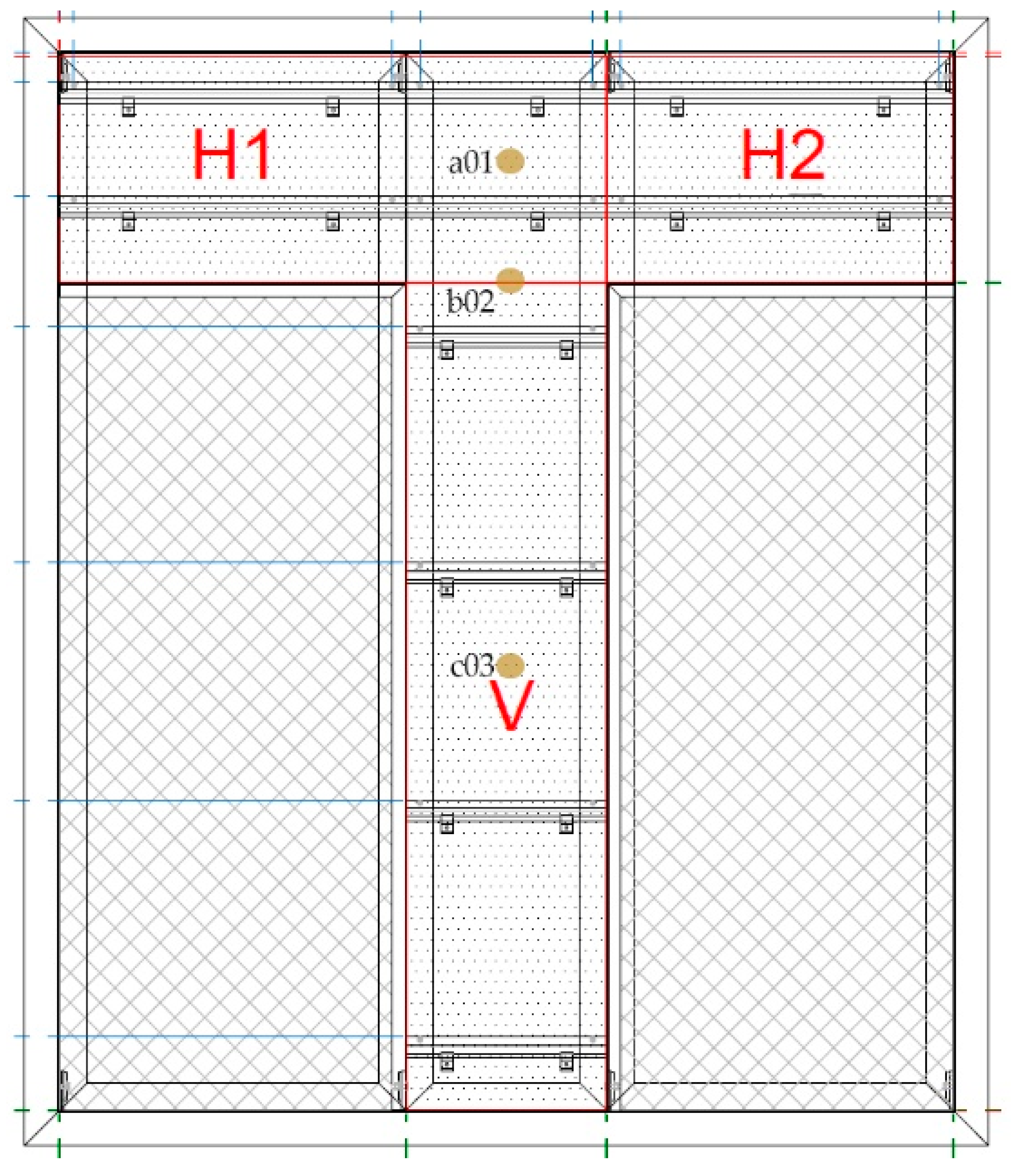
- H1 (horizontal panel): 6 anchorage points (61.3 cm horizontal spacing; 34.2 cm vertical spacing).
- H2 (horizontal panel): 4 anchorage points (62.1 cm horizontal spacing; 34.2 cm vertical spacing).
- V (vertical panel): 8 anchorage points (35.91 cm horizontal spacing; 61.1 cm vertical spacing).
- Steel backing plates welded to the structural frame.
- Acoustic membrane layer (5 mm thickness).
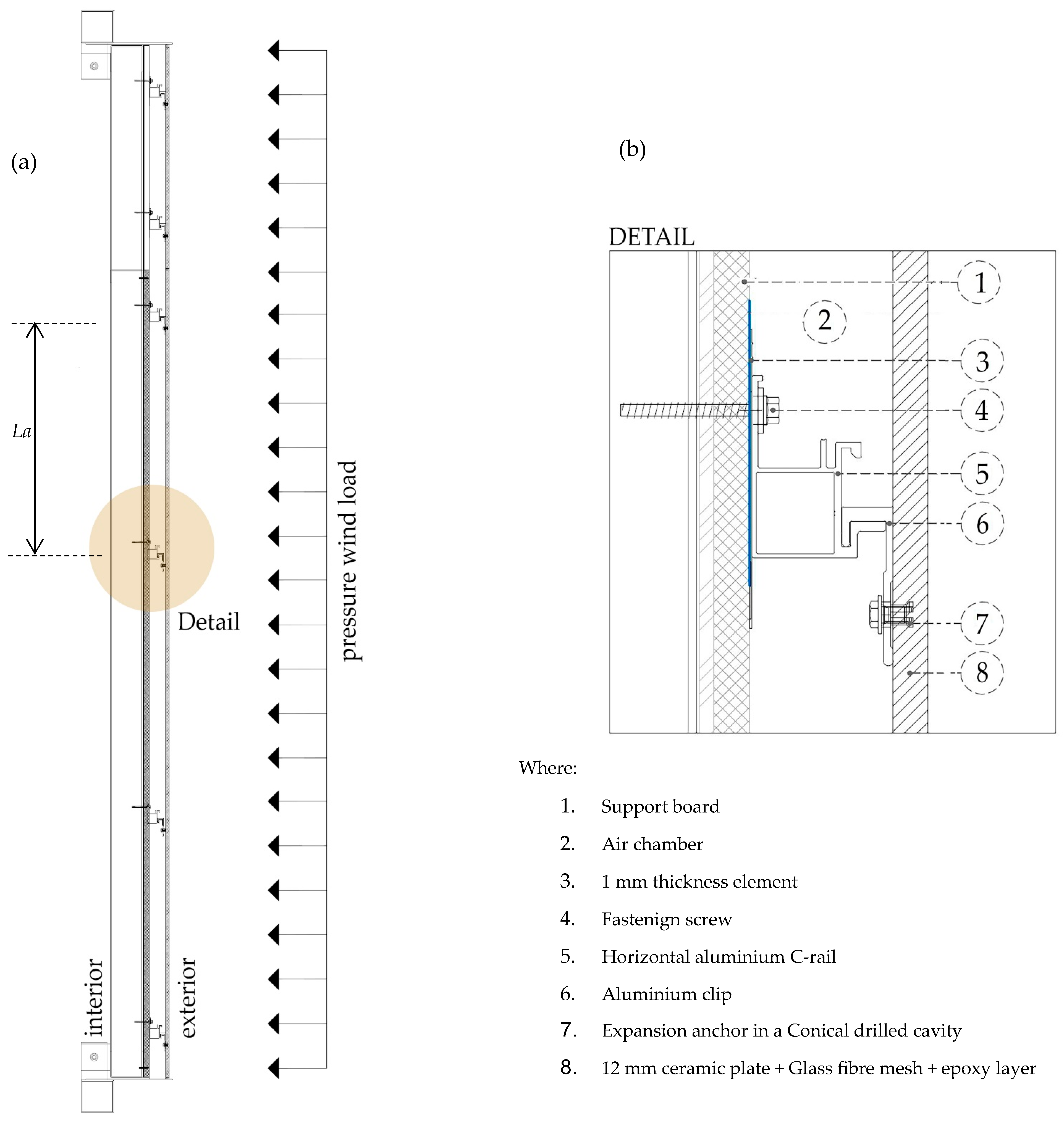
- Cement-based support board (12.5 mm thickness).
- Aluminium substructure system.
2.2. Design Wind Actions and Regulatory Framework
- Wind zone: C;
- Basic wind pressure: 0.52 kN/m2;
- Terrain category: IV (dense urban environment);
- Exposure coefficient (ce): 2.05;
- External pressure coefficients (cp): +0.8 (pressure) and −1.2 (suction, corner condition).
- Service pressure (P1): 1300 Pa;
- Safety pressure (P3): 1950 Pa;
- Partial safety factor: 1.5.
- Serviceability Limit State (SLS):
- Ultimate Limit State (ULS):
2.3. Full-Scale Experimental Setup and Instrumentation
2.3.1. Test Chamber and Boundary Conditions
- Temperature: 20 °C;
- Relative humidity: 75%;
- Atmospheric pressure: 101.3 kPa.
2.3.2. Pressure Generation and Control System
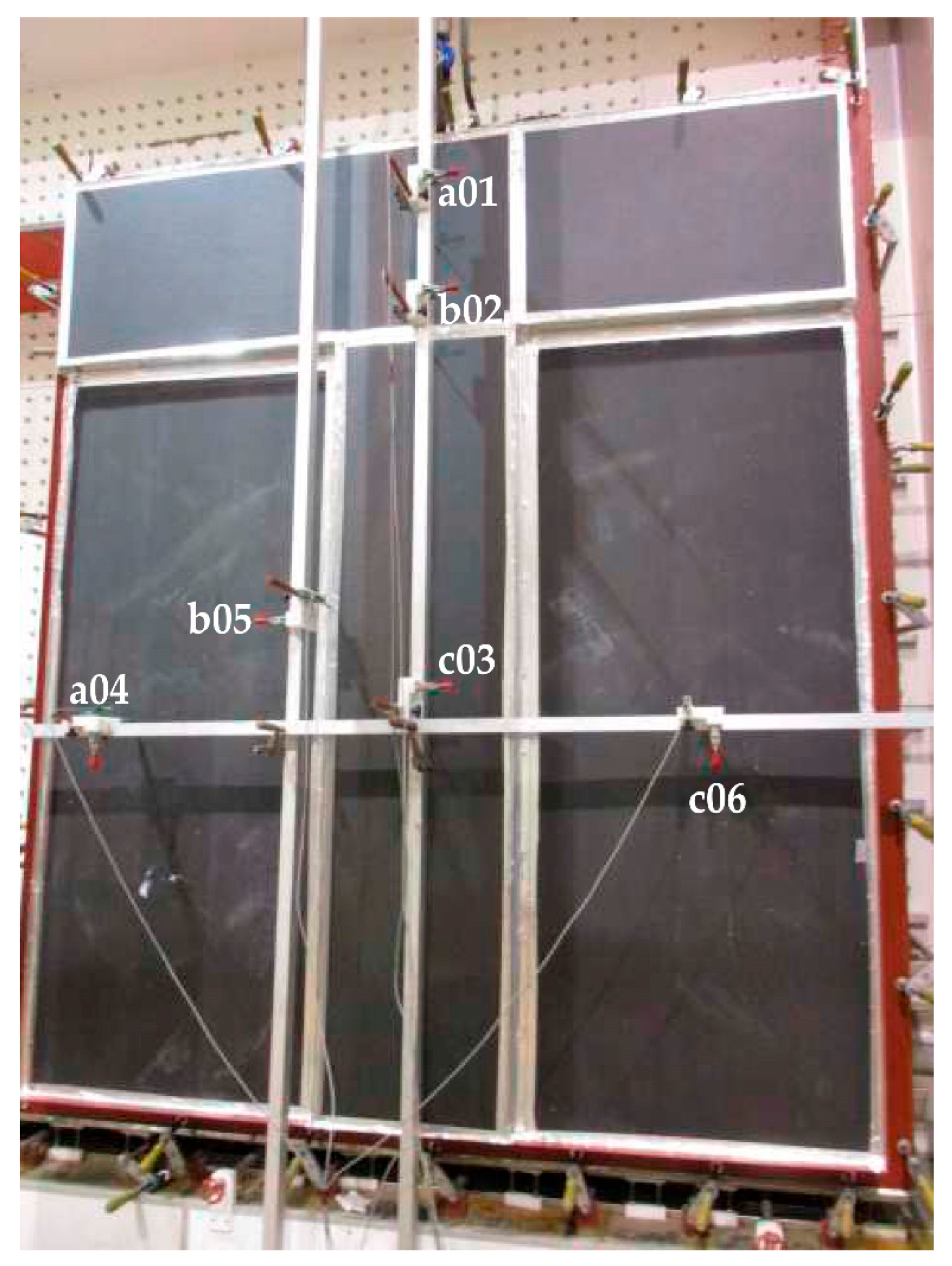
2.3.3. Displacement Measurement and Data Acquisition
- a01, b02, c03: positioned on ceramic panels to measure panel deflection.
- a04 and c06: positioned on the cement-based support board layer.
- b05: positioned on the vertical aluminium profile.
2.3.4. Loading Protocol
- Two initial pulses at 300 Pa;
- One pulse at 500 Pa;
- One pulse at 1000 Pa;
- Subsequent increments of 200 Pa.
- Pressure test up to 2000 Pa;
- Suction test up to 2400 Pa;
- Repetition of pressure test up to 3000 Pa;
- Repetition of suction test up to failure condition.
3. Results and Structural Assessment
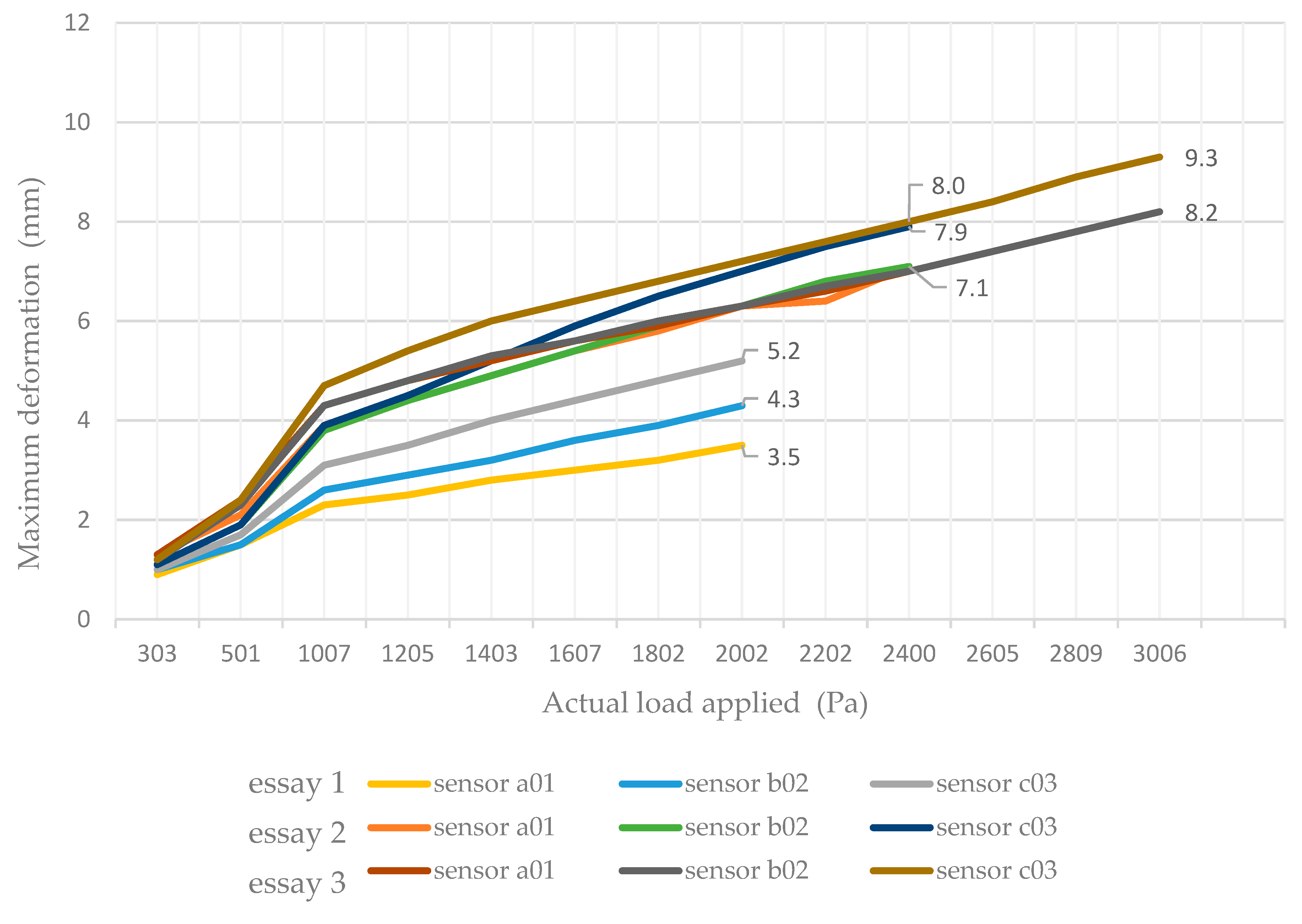
3.1. Experimental Load-Deflection Behaviour
3.2. Structural Behaviour Under Pressure and Suction
3.3. Serviceability Limit State (SLS) Verification
3.4. Simplified Mechanical Modelling
3.4.1. Structural Idealisation
3.4.2. Simplified Bending Stress Check
3.4.3. Analytical–Experimental Consistency
- Semi-rigid behaviour of concealed anchors;
- Local rotational flexibility at anchorage points;
- Deformation of the aluminium substructure;
- Interaction between the ceramic panel and the backing support layers.
3.5. Ultimate Limit State (ULS) Assessment
4. Conclusions
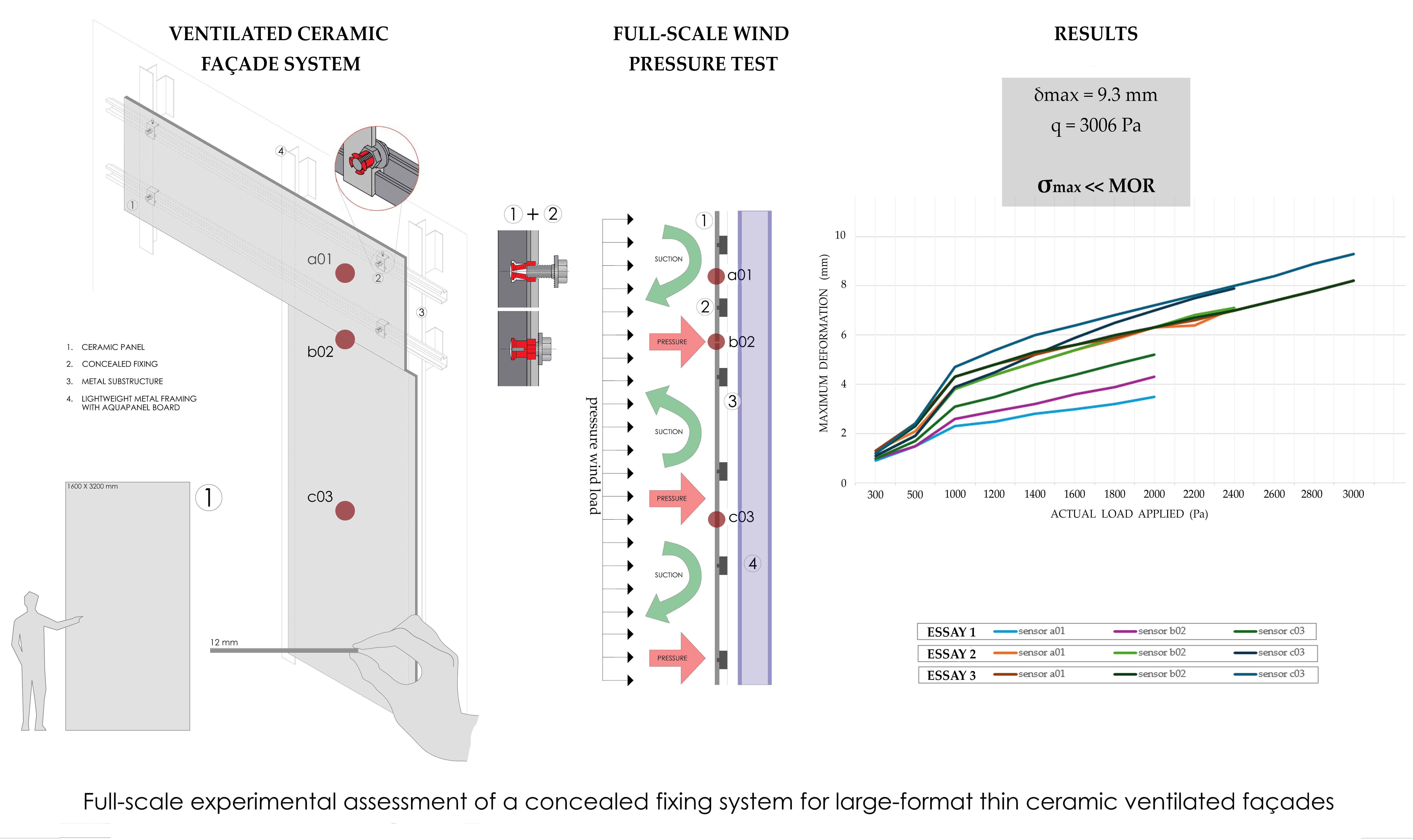
- Structural response under wind loading. The ceramic panels exhibited stable and progressive deformation under incremental pressure loading up to 3006 Pa. The maximum mid-span displacement recorded at the central sensor was 9.3 mm, without cracking, anchor pull-out or brittle fracture of the ceramic material.
- Serviceability Limit State (SLS) compliance. Under the design service pressure of 1300 Pa, the estimated mid-span deflection was approximately 5.7 mm. This value represents only 38% of the admissible serviceability limit defined by L/200 (15 mm for a 3000 mm span), demonstrating that the façade system satisfies serviceability requirements with a significant safety margin.
- Mechanical consistency of experimental results. A simplified analytical verification based on classical beam theory was performed to estimate the bending stresses in the ceramic panels under wind loading. The comparison between calculated stress levels and the flexural strength of the porcelain stoneware material establishes a direct relationship between global panel deformation and intrinsic material resistance, providing a mechanical interpretation of the experimental behaviour. The estimated maximum bending stress under the highest applied pressure was approximately 6 MPa, which remains well below the average flexural strength of the porcelain stoneware material (MOR > 35 MPa). This confirms that the experimental load levels are theoretically consistent with the absence of global panel fracture.
- Ultimate limit state (ULS) behaviour. At the defined safety pressure of 1950 Pa, no structural damage was observed in the ceramic panel, anchoring system or aluminium substructure. Even at the maximum applied pressure (3006 Pa), corresponding to more than twice the service pressure, structural integrity of the ceramic component was maintained. The governing instability was associated with the backing support layer under suction rather than with the ceramic cladding itself.
- Contribution to façade engineering practice. The results provide experimental evidence supporting the structural viability of concealed mechanical anchoring systems for large-format thin ceramic panels. The combination of full-scale testing and analytical verification contributes to bridging the gap between laboratory evaluation and real façade design practice.
Author Contributions
Funding
Data Availability Statement
Acknowledgments
Conflicts of Interest
References
- Zanelli, C.; Raimondo, M.; Guarini, G.; Dondi, M. The Vitreous Phase of Porcelain Stoneware: Composition, Evolution during Sintering and Physical Properties. J. Non-Cryst. Solids 2011, 357, 3251–3260. [Google Scholar] [CrossRef] [Scilit]
- Berto, A.M. Ceramic Tiles: Above and Beyond Traditional Applications. J. Eur. Ceram. Soc. 2007, 27, 1607–1613. [Google Scholar] [CrossRef] [Scilit]
- Momčilović-Petronijević, A.; Topličić-Ćurčić, G.; Ćurčić, A. Architecture and Ceramic Materials, Development through Time: Adobe and Brick. Archit. Civ. Eng. 2018, 16, 387–400. [Google Scholar]
- Sánchez, E.; García-Ten, J.; Sanz, V.; Moreno, A. Porcelain Tile: Almost 30 Years of Steady Scientific-Technological Evolution. Ceram. Int. 2010, 36, 831–845. [Google Scholar] [CrossRef] [Scilit]
- dos Santos Pizzatto, S.M.; Pizzatto, F.; Raupp-Pereira, F.; Arcaro, S.; Angioletto, E.; Montedo, O.R.K. Ventilated Facade System: A Review. Boletín Soc. Española Cerámica Vidr. 2025, 643, 100443. [Google Scholar]
- Roviras Miñana, J.; Moreno, V.S. The Role of Ceramics in the Configuration of a New Solar Thermal Collection System for Domestic Hot Water and Heating. Materials 2025, 18, 1907. [Google Scholar] [CrossRef] [Scilit]
- Cuce, P.M.; Cuce, E. Ventilated Facades for Low-Carbon Buildings: A Review. Processes 2025, 13, 2275. [Google Scholar] [CrossRef] [Scilit]
- Davidovic, D.; Piñon, J.; Burnett, E.F.; Srebric, J. Analytical Procedures for Estimating Airflow Rates in Ventilated, Screened Wall Systems (VSWS). Build. Environ. 2012, 47, 126–137. [Google Scholar] [CrossRef] [Scilit]
- Sarrablo, V. Cortezas cerámicas; Caleidoscópio—Edição e Artes Gráficas, S.A.: Casal de Cambra, Portugal, 2008. [Google Scholar]
- Martinez, A.; Patterson, M.; Carlson, A.; Noble, D. Fundamentals in Façade Retrofit Practice. Procedia Eng. 2015, 118, 934–941. [Google Scholar] [CrossRef] [Scilit]
- Rahiminejad, M.; Khovalyg, D. Review on Ventilation Rates in the Ventilated Air-Spaces Behind Common Wall Assemblies with External Cladding. Build. Environ. 2021, 190, 107538. [Google Scholar] [CrossRef] [Scilit]
- Dondi, M.; Ercolani, G.; Melandri, C.; Mingazzini, C.; Marsigli, M. The Chemical Composition of Porcelain Stoneware Tiles and its Influence on Microstructural and Mechanical Properties. Interceram 1999, 48, 75–83. [Google Scholar]
- ISO 13006; Revestimientos Cerámicos—Definición, Clasificación y Características. ISO: Geneva, Switzerland, 2006.
- Bazzocchi, F.; Bertagni, S.; Ciacci, C.; Colonna, E.; Di Naso, V. Mechanical Characterisation of a Low-Thickness Ceramic Tile Cladding Subject to Ageing Phenomena. J. Build. Eng. 2020, 29, 101–105. [Google Scholar] [CrossRef] [Scilit]
- Dondi, M.; Ercolani, G.; Guarini, G.; Melandri, C.; Raimondo, M.; e Almendra, E.R.; Cavalcante, P.T. The Role of Surface Microstructure on the Resistance to Stains of Porcelain Stoneware Tiles. J. Eur. Ceram. Soc. 2005, 25, 357–365. [Google Scholar] [CrossRef] [Scilit]
- Bechthold, M.; Kane, A.; King, N. Ceramic Material Systems: In Architecture and Interior Design; Editorial Birkhäuser: Basel, Switzerland, 2015. [Google Scholar]
- Martín-Márquez, J.; Rincón, J.M.; Romero, M. Effect of Microstructure on Mechanical Properties of Porcelain Stoneware. J. Eur. Ceram. Soc. 2010, 30, 3063–3069. [Google Scholar] [CrossRef] [Scilit]
- Romero, M.; Pérez, J.M. Relation between the Microstructure and Technological Properties of Porcelain Stoneware. A Review. In Materiales de Construcción; Editorial CSIC: Madrid, Spain, 2015; Volume 65, p. 65320. [Google Scholar]
- Raimondo, M.; Dondi, M.; Zanelli, C.; Guarini, G.; Gozzi, A.; Marani, F.; Fossa, L. Processing and Properties of Large-Sized Ceramic Slabs. Bol. Soc. Española Cerámica Vidr. 2010, 49, 289–295. [Google Scholar]
- Venturelli, M. Lamina Revolution: An Innovative, Eco-Friendly Process. Ceram. World Rev. 2000, 10, 86–88. [Google Scholar]
- da Silva, A.L.; Bernardin, A.M.; Hotza, D. Forming of Thin Porcelain Tiles: A Comparison between Tape Casting and Dry Pressing. Ceram. Int. 2014, 40, 3761–3767. [Google Scholar] [CrossRef] [Scilit]
- Laminam, S.p.A. The Surfaces Book; Laminam: Fiorano Modenese, Italy, 2024; Available online: https://www.laminam.com (accessed on 10 February 2026).
- Mahdi, O.S. Study the Influence of Sintering on the Properties of Porcelain Stoneware Tiles. Int. J. App. Eng. Res. 2018, 13, 3248–3254. [Google Scholar]
- Soldati, R.; Zanelli, C.; Cavani, G.; Battaglioli, L.; Guarini, G.; Dondi, M. Improving the Sustainability of Ceramic Tile-Making by Mixing Spray-Dried and Dry-Granulated Powders. Boletín Soc. Española Cerámica Vidr. 2022, 61, 325–335. [Google Scholar] [CrossRef] [Scilit]
- UNE-EN 14411:2016; Baldosas Cerámicas—Definiciones, Clasificación, Características, Evaluación y Verificación de la Constancia de las Prestaciones. Asociación Española de Normalización (AENOR): Madrid, Spain, 2016.
- UNE-EN ISO 10545; Ceramic Tiles—Test Methods. Asociación Española de Normalización (AENOR): Madrid, Spain, 1995.
- Conte, S.; Molinari, C.; Ardit, M.; Giordano, D.; Dondi, M.; Zanelli, C. Vitrification Paths in Porcelain Stoneware: Dependence on Bulk Chemical Composition and Effect on Sintering Behaviour. Ceram. Int. 2025, 51, 36777–36789. [Google Scholar] [CrossRef] [Scilit]
- Dondi, M.; Guarini, G.; Melandri, C.; Raimondo, M.; Zanelli, C. Resistance to Impact of Porcelain Stoneware Tiles. Ceram. Int. 2016, 42, 5731–5736. [Google Scholar] [CrossRef] [Scilit]
- EOTA—Organizacão Europeia de Aprovacões Técnicas. ETAG (arcuivo)|EOTA. 2022. Available online: https://www.eota.eu/etags-archive (accessed on 5 January 2026).
- da Silva, A.L.; Feltrin, J.; Bó, M.D.; Bernardin, A.M.; Hotza, D. Effect of Reduction of Thickness on Microstructure and Properties of Porcelain Stoneware Tiles. Ceram. Int. 2014, 40, 14693–14699. [Google Scholar] [CrossRef] [Scilit]
- Ingrao, C.; Scrucca, F.; Tricase, C.; Asdrubali, F. A Comparative Life Cycle Assessment of External Wall-Compositions for Cleaner Construction Solutions in Buildings. J. Clean. Prod. 2016, 124, 283–298. [Google Scholar] [CrossRef] [Scilit]
- Toplicic-Curcic, G.; Grdic, D.; Ristic, N.; Grdic, Z. Ceramic Facade Cladding as an Element of Sustainable Development. Archit. Civ. Eng. 2015, 13, 219–231. [Google Scholar] [CrossRef] [Scilit]
- Han, B.; Wang, R.; Yao, L.; Liu, H.; Wang, Z. Life Cycle Assessment of Ceramic Façade Material and its Comparative Analysis with Three Other Common Façade Materials. J. Clean. Prod. 2015, 99, 86–93. [Google Scholar] [CrossRef] [Scilit]
- Echarri-Iribarren, V.; Echarri-Iribarren, F.; Rizo-Maestre, C. Ceramic Panels Versus Aluminium in Buildings: Energy Consumption and Environmental Impact Assessment with a New Methodology. Appl. Energy 2019, 233–234, 959–974. [Google Scholar] [CrossRef] [Scilit]
- Beltrán, A.; Boix, E.; Escrig, I.; Soriano, M.L.; Silva, G. Optimización de los elementos de refuerzo en la lámina cerámica. In Proceedings of the 15th Global Forum on Advanced Materials and Technologies for Ceramic Tiles (Qualicer 2024); Qualicer: Castellón, Spain, 2024; Available online: https://www.qualicer.org/programa/2024/ESP/Ponencias/B/06%20pon%20esp.pdf (accessed on 10 November 2025).
- Pérez-Fenoy, J.; Rivera-Gómez, C.; Roa-Fernández, J.; Galán-Marín, C. Full-Scale Assessment of Seismic and Wind Load Performance in the Design of a Flexible Solar-Shading Double-Skin Façade. Buildings 2023, 13, 2945. [Google Scholar] [CrossRef] [Scilit]
- Ivorra, S.; Bairán, J.M.; Esteve, F.; Hurtado, J.A. Partial collapse of a ventilated stone façade: Diagnosis and analysis of the anchorage system. Eng. Fail. Anal. 2013, 31, 290–303. [Google Scholar] [CrossRef] [Scilit]
- EN 13116:2012; Curtain Walling—Resistance to Wind Load—Performance Requirements. European Committee for Standardization: Brussels, Belgium, 2012.
- European Commission. European Assessment Document (EAD) 090062-00-0404: Kits for External Wall Claddings Mechanically Fixed; Official Journal of the European Union: Brussels, Belgium, 2018; Available online: https://en.itec.cat/infoitec/certification/publication-of-the-ead-090062-00-0404-kits-for-ventilated-and-non-ventilated-facades/ (accessed on 18 December 2025).
- Neolith Gallery. Ceramic Manufacturer. 2025. Available online: https://a.storyblok.com/f/150360/x/dcb0591c8e/neolith_gallery.pdf (accessed on 25 November 2025).
- Keil. Fixing System Manufacturer. 2025. Available online: https://www.keil.pro (accessed on 5 January 2026).
- Ministerio de Fomento. Código Técnico de la Edificación DB-SE-AE: Acciones en la Edificación; Gobierno de España: Madrid, España, 2019.
- EN 12179:2000; Curtain Walling—Resistance to Wind Load—Test Method. European Committee for Standardization (CEN): Brussels, Belgium, 2000.
- ETAG 034; Guideline for European Technical Approval of Kits for External Wall Claddings. EOTA: Brussels, Belgium, 2012. Available online: https://www.eota.eu/sites/default/files/uploads/ETAGs/etag-034-1-ec-version-april-2012.pdf (accessed on 5 January 2026).
- Gere, J.M.; Timoshenko, S.P. Mechanics of Materials, 5th ed.; PWS Publishing Company: Boston, MA, USA, 1997. [Google Scholar]



| Property | Standard | Declared Value | Unit |
|---|---|---|---|
| Water absorption | ISO 13006 [13] | <0.1 | % |
| Flexural strength (MOR) | ISO 10545-4 [26] | >35 | MPa |
| Breaking load | ISO 10545-4 [26] | >1300 | N |
| Thickness | - | 12 | mm |
| Density | ISO 10545-3 [26] | ~2400 | kg/m3 |
| Parameter Measured | Instrumentation | Measurement Uncertainty |
|---|---|---|
| Displacement | Linear displacement transducers (LVDT) | Resolution 0.1 mm |
| Differential pressure | Pressure control system of the wind test chamber | ±5% |
| Temperature | Laboratory environmental sensor | ±3 °C |
| Relative humidity | Laboratory environmental sensor | ±5% |
| Atmospheric pressure | Barometric pressure sensor | ±1 kPa |
| Linear measurements (installation) | Calibrated measuring tape | ±1 mm |
| Test 1 (Maximum real load = 2002 Pa) | ||
| Element | Sensor | Maximum deflection (mm) |
| Ceramic plate | a01 | 3.5 |
| b02 | 4.3 | |
| c03 | 5.2 | |
| Support panel (Aquapanel) | a04 | 20.6 |
| c06 | 30.4 | |
| Substructure (profile) | b05 | 13.1 |
| Test 2 (Maximum real load = 2400 Pa) | ||
| Element | Sensor | Maximum deflection (mm) |
| Ceramic plate | a01 | 7.1 |
| b02 | 7.1 | |
| c03 | 7.9 | |
| Support panel (Aquapanel) | a04 | 40.4 |
| c06 | 60.1 | |
| Substructure (profile) | b05 | 24.6 |
| Test 3–4 (Maximum real load = 3006 Pa) | ||
| Element | Sensor | Maximum deflection (mm) |
| Ceramic plate | a01 | 8.2 |
| b02 | 8.2 | |
| c03 | 9.3 | |
| Support panel (Aquapanel) | a04 | 54.1 |
| c06 | 73.9 | |
Disclaimer/Publisher’s Note: The statements, opinions and data contained in all publications are solely those of the individual author(s) and contributor(s) and not of MDPI and/or the editor(s). MDPI and/or the editor(s) disclaim responsibility for any injury to people or property resulting from any ideas, methods, instructions or products referred to in the content. |
© 2026 by the authors. Licensee MDPI, Basel, Switzerland. This article is an open access article distributed under the terms and conditions of the Creative Commons Attribution (CC BY) license.
Share and Cite
Roviras Miñana, J.; Sarrablo Moreno, V.; Casariego Vales, P. Experimental Evaluation of a Concealed Anchoring System for Large-Format Thin Ceramic Panels Under Wind Loading in Ventilated Façades. Materials 2026, 19, 1062. https://doi.org/10.3390/ma19061062
Roviras Miñana J, Sarrablo Moreno V, Casariego Vales P. Experimental Evaluation of a Concealed Anchoring System for Large-Format Thin Ceramic Panels Under Wind Loading in Ventilated Façades. Materials. 2026; 19(6):1062. https://doi.org/10.3390/ma19061062
Chicago/Turabian StyleRoviras Miñana, Jordi, Vicente Sarrablo Moreno, and Pedro Casariego Vales. 2026. "Experimental Evaluation of a Concealed Anchoring System for Large-Format Thin Ceramic Panels Under Wind Loading in Ventilated Façades" Materials 19, no. 6: 1062. https://doi.org/10.3390/ma19061062
APA StyleRoviras Miñana, J., Sarrablo Moreno, V., & Casariego Vales, P. (2026). Experimental Evaluation of a Concealed Anchoring System for Large-Format Thin Ceramic Panels Under Wind Loading in Ventilated Façades. Materials, 19(6), 1062. https://doi.org/10.3390/ma19061062