Communication

Evaluation of the Residual Stress in ZrO2 Coatings Deposited on Different Substrates Through Image Relative Method

1
China Testing & Certification International Group Co., Ltd., Beijing 100024, China
2
China Building Materials Academy, Beijing 100024, China
3
School of Civil and Transportation Engineering, Beijing University of Civil Engineering and Architecture, Beijing 102616, China
*
Author to whom correspondence should be addressed.
Materials 2026, 19(6), 1063; https://doi.org/10.3390/ma19061063
Submission received: 16 January 2026 / Revised: 7 March 2026 / Accepted: 9 March 2026 / Published: 11 March 2026

Highlights

What are the main findings?
  • Substrate characteristics determine residual stresses and deformations of the coated specimens.
  • Temperature dependence of the residual stresses can be analysed via image relative method.
  • The deformations of a single-side coated sample represent the form of residual stress.
What are the implications of the main findings?
  • The relationship among substrate characteristics, deformations and residual stresses is established.
  • The challenge of evaluating residual stress at different temperatures is addressed.
  • Promote the development of coated components used in high-temperature applications.

Abstract

In this work, the influences of substrate characteristics on the deformation and residual stress in ZrO2 coatings deposited on one side carbon steel, 316 stainless steel and 304 stainless steel are analysed via the image relative method. Based on the changes in bending deflection at different temperatures, temperature dependence of the residual stresses in the above three specimens was achieved through Stoney’s formula. Results show that a compressive residual stress is generated during the cooling process because the ZrO2 coating has a lower coefficient of thermal expansion (CTE) than that of the substrates. Additionally, by comparing the images of specimens under different temperatures, it can be found that the difference in CTE (∆α) between coating and substrate, as well as the temperature difference (∆T) between zero-stress temperature and testing temperature, determine the residual stresses in the coated specimens. And the higher the ∆α and ∆T, the higher the residual compressive stress and bending deflection. Moreover, temperature dependence of the residual stress could also be found through the image relative method.

1. Introduction

Due to the mismatch of CTE between the coating and the substrate, residual stresses are usually generated in coated composites [1,2,3]. They affect the mechanical properties and the service life of coatings [4,5,6,7]; therefore, the evaluation of residual stress is very important to the coated components for its practical applications.
According to the preparation methods of coatings, residual stresses can be divided into two categories: (1) residual stresses in isothermal coatings in which the coating and the substrate are prepared at the same temperature, such as CVD coatings; (2) residual stresses in anisothermal coatings, such as the coatings fabricated by thermal spraying. To measure the residual stresses, various methods were used, such as x-ray diffraction (XRD) [8,9], in situ curvature measurements [10,11], neutron diffraction [12,13], incremental hole-drilling methods [14,15], and so on. Among those methods, curvature measurements are more suitable for the evaluation of residual stresses in engineering components. As for isothermal coatings, the residual stress calculation formula is deduced by in situ curvature measurements based on the uniform strain model, geometric compatibility analysis and internal stress equilibrium [16,17]. From the formulas (7–9) in reference [16], it could be concluded that the elasticity modulus, the shrinkage rate, the ratio of the sectional coating area to substrate area and the temperature during the preparation process determine the residual stresses and the deformations of unsymmetrical laminated ceramics with isothermal coatings. As for the most widely used coatings in the aerospace field, anisothermal coatings are usually deposited on the high temperature alloys by using plasma-spraying technology. Based on in situ curvature measurements, the residual stresses in anisothermal coatings can be calculated through Stoney’s formula [18]. According to Stoney’s formula, the characteristics of substrates play an important role in determining the magnitude of residual stresses. Above all, most of the research focuses on the evaluation methods for residual stresses; however, few works focus on the effects of substrate characteristics on the deformations and the residual stresses of anisothermal coatings at high temperature. Therefore, we compared the deformations and the residual stresses of three different substrates (namely, carbon steel, 316 stainless steel and 304 stainless steel) single-side coated with a ZrO2 coating by the image relative method which is based on the comparation of the photos of a specimen under different conditions [16]. It is well-known that the residual stresses in a beam specimen with one side coating may lead to bending deformation. Hence, changes in the curvature of bent samples could be used to estimate the residual stresses [19,20]. With the intention of achieving changes in bending curvature radius of the beam sample at different temperatures, a visual in situ tester equipped with photography technology is used in this work. Based on variations in the bending curvature radius, the relationship among temperature, residual stress, deformation and substrate characteristics was established.

2. Materials and Methods

2.1. Preparation

In this work, carbon steel, 316 stainless steel and 304 stainless steel (Xinghua Tianzhu Stainless Steel Products Co., Ltd., Wuxi, China) were chosen as the substrates. All substrate materials were polished and cleaned by alcohol. By using DH-2080 plasma-spraying equipment (Shanghai Dahao Ruifa Thermal Spray Machinery Co., Ltd., Shanghai, China) under the same process parameters, ZrO2 coatings of 0.5 mm thickness were deposited on one face (5.0 mm × 70.0 mm) of three different substrates with the size of 5.0 mm × 70.0 mm × 1.0 mm, respectively. Three single-side coated samples with different substrates are processed with the same processing parameters. And the corresponding specimens were noted as S1, S2 and S3, respectively.

2.2. Characterisation

VHX digital microscope (VH-ZST, Keyence, Osaka, Japan) was used to measure the thickness of all specimens in this work. The image relative method, which is based on the photos of specimens at ambient temperature by using a visual in situ tester (TianJin ZhongHuan Electric Furnace Co., LTD, Tianjin, China), was carried out to record the deformations of samples. By using the visual in situ tester equipped with an optical microscope, the photos of specimens under different experimental conditions could be obtained. In the process of visual in situ testing, samples were heat-treated with a heating rate of 8 °C/min. And then, they were cooled to room temperature (RT) with the rate of 8 °C/min. Stoney’s formula is one of the most well-known formulas for thermo-mechanical stress analysis. Although the residual stress could not be precisely calculated by Stoney’s formula because of the assumption terms for the equation [21], it could reflect the variation tendency of substrate characteristics on the deformation and the residual stress in this work. As for the specimens with single-side coating, the bending deflection reflects the magnitude of residual stresses [22,23,24,25]. Thus, the residual stresses in ZrO2 coatings of the three coated specimens could be evaluated according to Stoney’s formula as follows:
σ c = E s H 2 6 R ( 1 V S ) h
where Es is the elastic modulus of the substrate; H and h are the thicknesses of the substrate and coating; R is the curvature radius of the coated samples; and VS is the Poisson’s ratio of the substrate.
Here, Young’s modulus (Es) and Poisson’s ratio (VS) can be measured by the pulse excitation method through a testing machine RFDA-HT 1600 (IMCE, Genk, Belgium), while dilatometry investigation (Linseis, L75 Platinum Series, Selb, Germany) was used to evaluate the thermal expansion of the substrate (αs).

3. Results

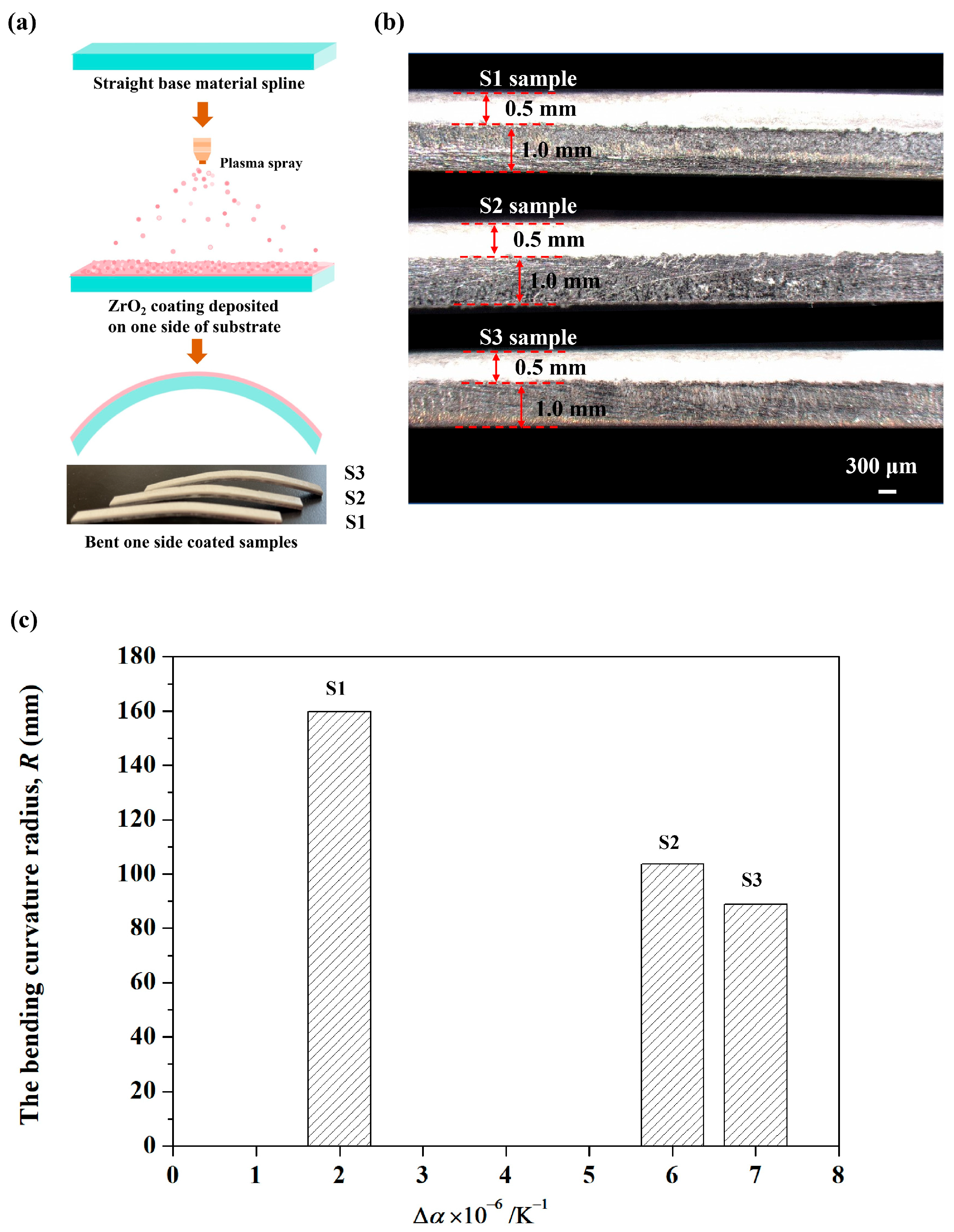
Figure 1a shows the preparation process of single-face coated specimens obtained through plasma-spraying technology. This way, ZrO2 coatings (XRD patterns of the ZrO2 coating could be found in Figure S1)were deposited on one side of each substrate, such as carbon steel, 316 stainless steel and 304 stainless steel, under the same process parameters. Due to the mismatch of CTE between the substrates and the ZrO2 coatings, the flat-shaped beam specimens bent toward the matrix side with different bending degrees. As illustrated in Figure 1b, the thicknesses of substrates and coatings in the above three specimens were 1.0 mm and 0.5 mm. The elastic modulus of substrate (Es) and Poisson’s ratio ( V S ) were measured through a pulse excitation method by using a testing machine RFDA-HT 1600 (IMCE, Belgium). Dilatometry investigation (Linseis, L75 Platinum Series, Germany) was used to evaluate the thermal expansion of the substrate (αs). Comparing the pictures of single-sided samples and the related parameters in Table 1, it is clear that the flexural deflection increased with the increasing difference in CTE (∆α) between the substrate and the coating, as illustrated in Figure 1c. Owing to the lower CTE of ZrO2 coatings (10 × 10−6 K−1), the difference in CTE between the substrate and the coating of each sample (S1→S2→S3) becomes increasingly obvious. Thus, as ∆α increases, the flexural deflection increases.
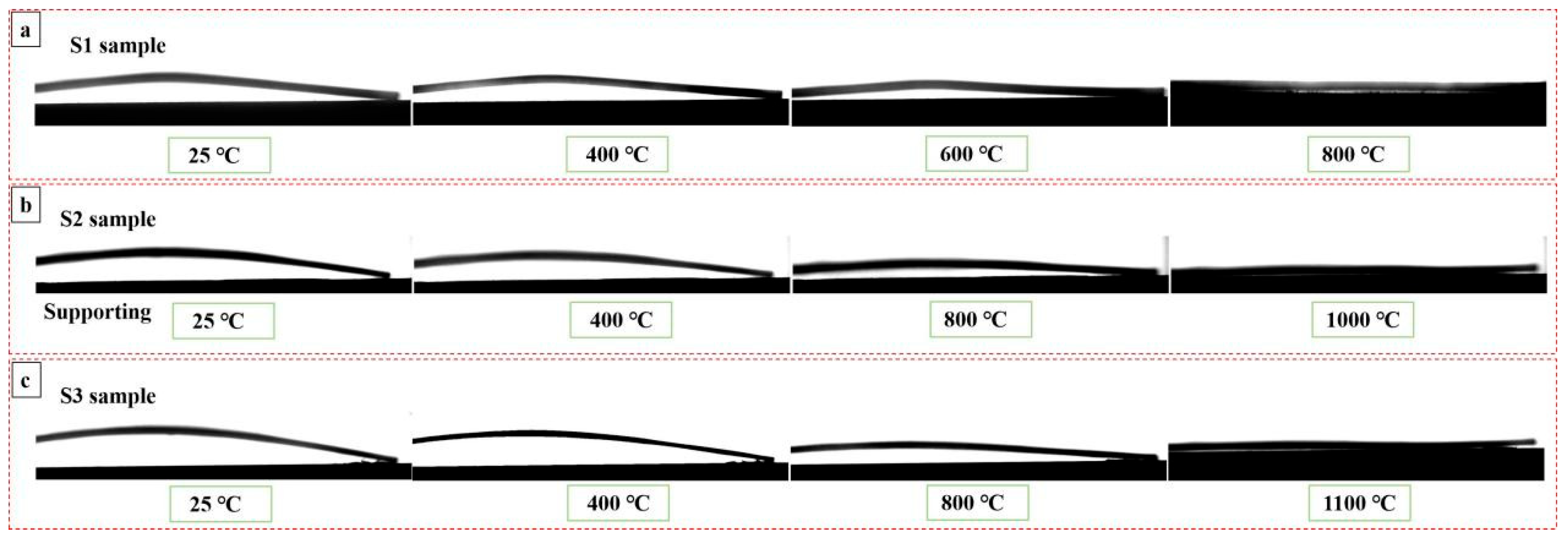
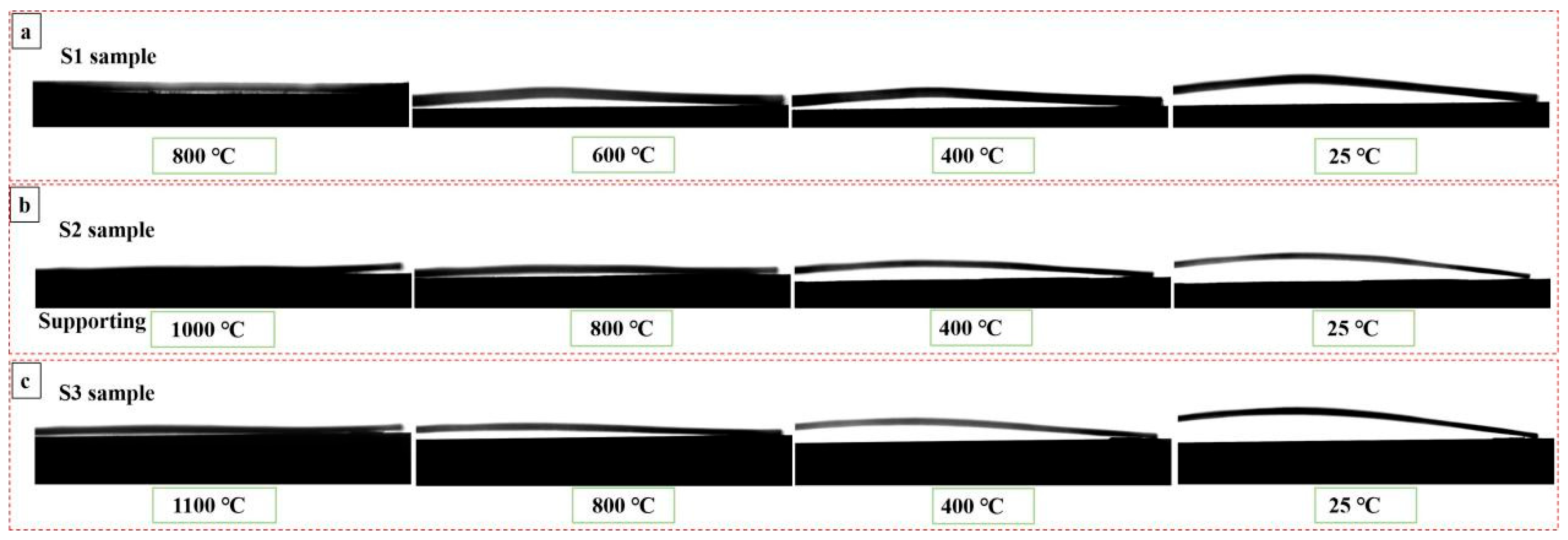
Figure 2 represents the deformations of three single-sided specimens as a function of temperature. As obtained by in situ recorded images, the bending curvature radius of bent specimens gradually increased with the increased temperature. The zero-stress temperature (Tzero, at this temperature the bent specimens turn into the straight shape because residual stress in the coating is near zero) of S1 (Figure 2a), S2 (Figure 2b) and S3 (Figure 2c) is 800 °C, 1000 °C and 1100 °C, respectively. Generally, because of the stress relaxation caused by the progressive weakening of interatomic bonds at a high temperature, the bending degree of three specimens decreased.
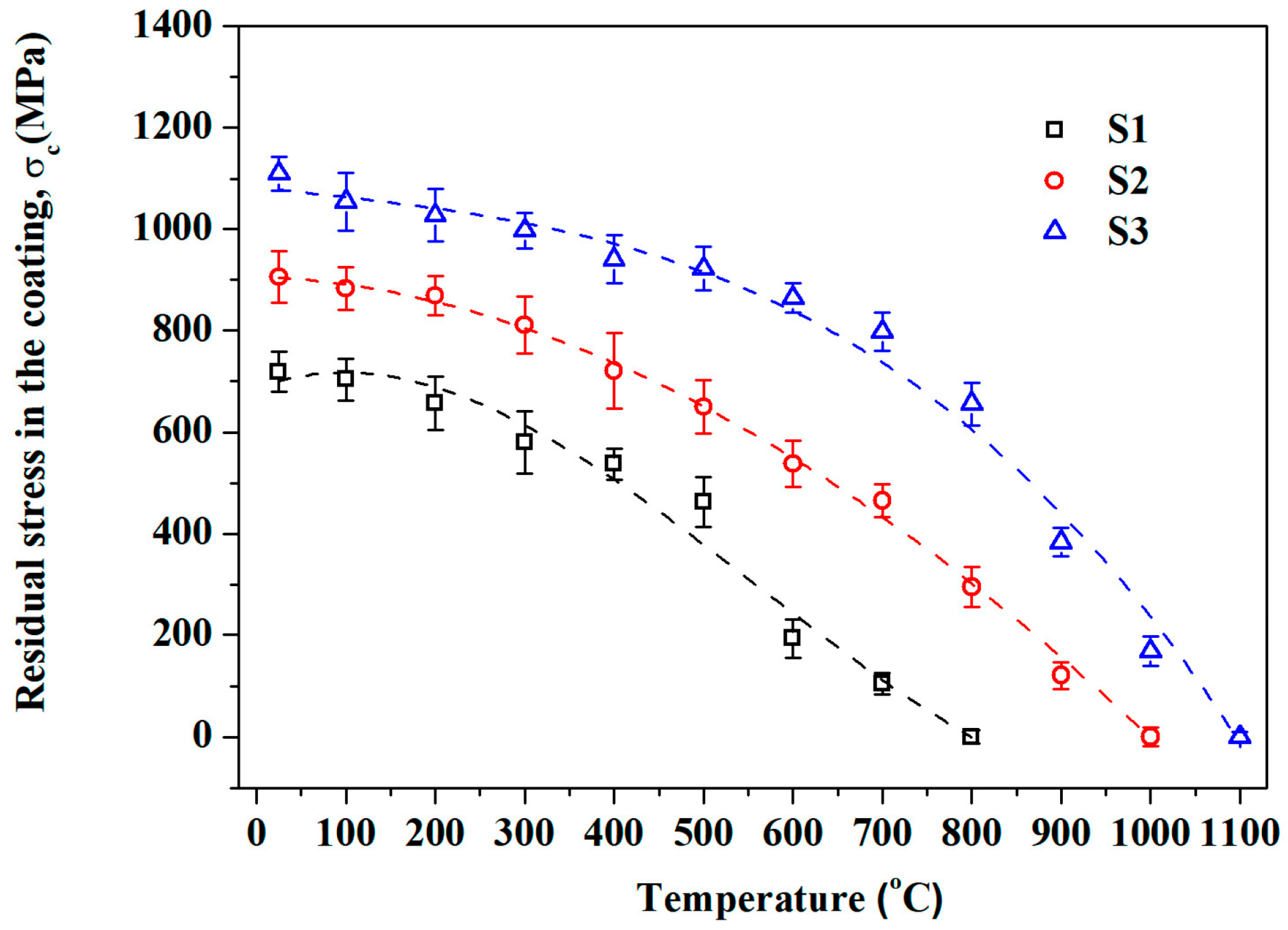
To clarify the temperature dependence of residual stresses in single-sided coating samples in this work, Stoney’s formula was used to calculate the residual stresses in the coating at different temperatures. Based on the flexural deflection obtained by the image relative method (shown in Figure 2) and related parameters (shown in Table 1), residual stresses in the coatings are calculated and plotted in Figure 3. As shown in Figure 3, residual stresses in the coatings of three specimens decrease as a function of increased temperature, and they disappeared completely as the temperature approached or exceeded Tzero. This phenomenon is a result of the stress relaxation caused by the weakening of interatomic bonds or the relaxation of dislocation movement at high temperature. In addition, owing to the maximum differences in CTE (∆α) between the 304 stainless steel substrate and the ZrO2 coating, S3 possesses the biggest residual stress among the three specimens at room temperature. The higher the ∆α, the higher the residual compressive stresses.
Figure 4 summarises the deformations of three specimens during the cooling process. As seen in Figure 4, bending deformations generated in three specimens again because of the shrinkage distortion and stresses balanced as the temperature fell from Tzero to RT. This can be explained by the difference in CTE between the coating and the substrate, residual stresses generated during the cooling process. It agrees with the works of Bao [26]—that the direction of bending deformation represents the form of residual stresses. When the coating is located on the convex surface of the bent sample with one side coating, the residual stress within the coating is compressive stress; while, when the coating is located on the concave surface of the one side coated sample, the residual stress within the coating represents tensile stress. Thus, from Figure 4, it is confirmed that compressive residual stress is generated during the cooling process because the ZrO2 coating has a lower CTE than that of the substrates.
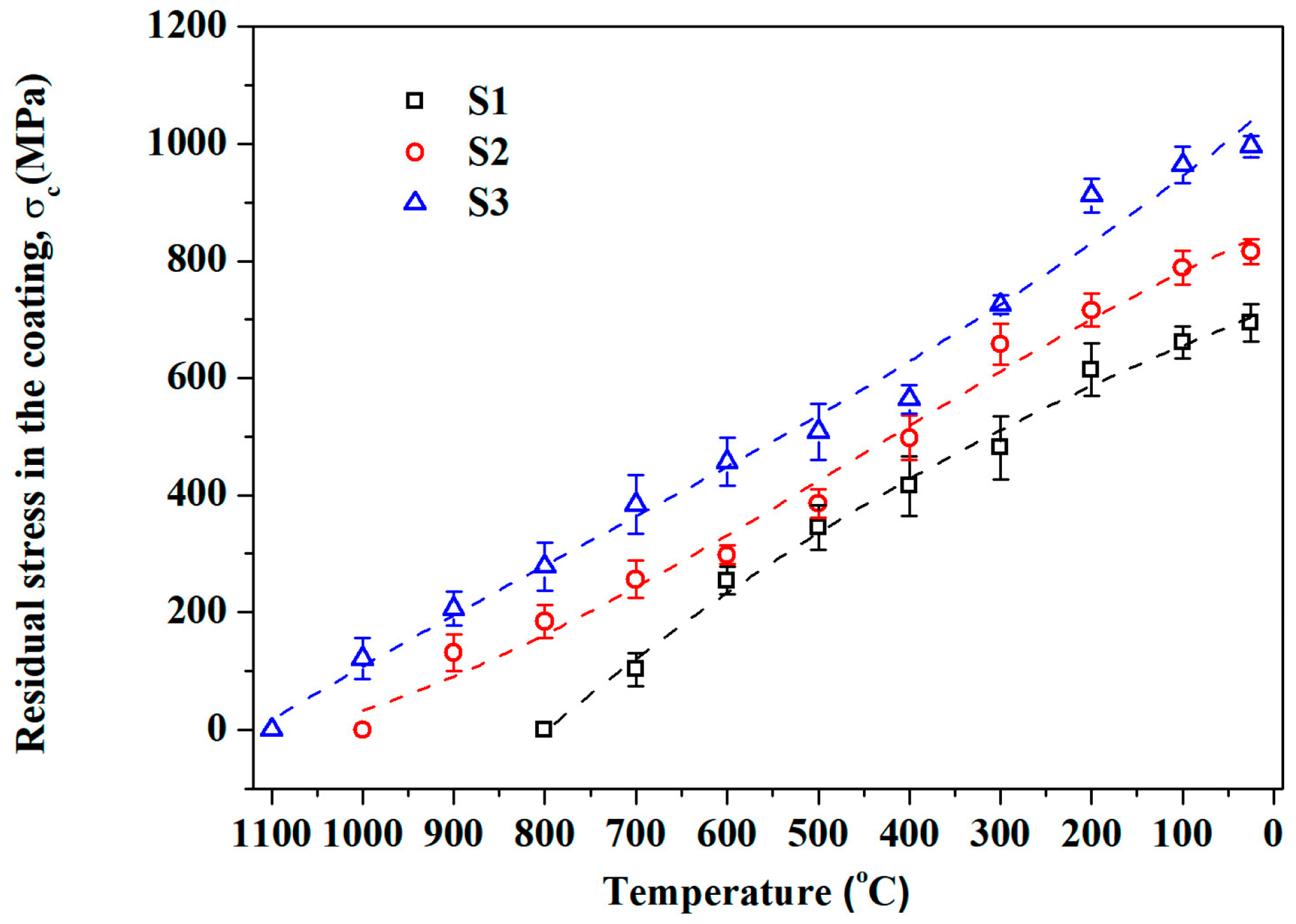
As shown in Figure 5, the variation tendency of residual stresses in the cooling process were calculated by Stoney’s formula. A clear increase in residual stress is observed for all samples as the temperature decreases during the cooling process. And the higher the ∆T (∆T = TzeroTtesting), the higher the residual compressive stresses and the curvature of bent samples. Moreover, due to the defect and interfacial failure caused by the alternate cooling and heating, a loss of 2.9%, 10.4% and 12.7% of residual prestress in S1, S2 and S3 could be found, respectively.

4. Conclusions

In this work, carbon steel, 316 stainless steel and 304 stainless steel beams were single-side coated with ZrO2 coating under the same plasma-spraying process. The effects of substrate characteristics on residual stresses and deformations were analysed by the image relative method. Based on the curvature radius obtained through visual in situ testing, the residual stresses can be calculated by using Stoney’s formula. Results show that the difference in CTE (∆α) between the coatings and the substrates, as well as the temperature difference (∆T) between Tzero and Ttesting, determine the residual stresses in the coated specimens. Tzero of S1, S2 and S3 is 800 °C, 1000 °C and 1100 °C, respectively. And the higher the ∆α and ∆T, the higher the residual compressive stresses and the bending deflection. Additionally, stress relaxation caused by high temperature could also be found by comparing the images of specimens at different temperatures.

Supplementary Materials

The following supporting information can be downloaded at: https://www.mdpi.com/article/10.3390/ma19061063/s1, Figure S1: XRD patterns of the ZrO2 coating fabricated in this work.

Author Contributions

Conceptualization, H.L. and Y.B.; methodology, H.Y.; validation, H.Z. and Y.M.; investigation, X.Z.; data curation, H.Z.; writing—original draft preparation, H.L.; writing—review and editing, H.L. All authors have read and agreed to the published version of the manuscript.

Funding

This research was funded by the Beijing Natural Science Foundation (No. 2254097).

Institutional Review Board Statement

Not applicable.

Informed Consent Statement

Not applicable.

Data Availability Statement

The original contributions presented in this study are included in the article. Further inquiries can be directed to the corresponding author.

Acknowledgments

The authors have reviewed and edited the output and take full responsibility for the content of this publication.

Conflicts of Interest

Authors Haiyan Li, Han Yan, Haiyang Zhao, Yudi Mao and Yiwang Bao were employed by China Testing & Certification International Group Co., Ltd. and China Building Materials Academy. The remaining author declare that the research was conducted in the absence of any commercial or financial relationships that could be construed as a potential conflict of interest.

Abbreviations

The following abbreviations are used in this manuscript:
CTECoefficient of thermal expansion
RCurvature radius
SEMScanning electron microscopy
TzeroZero-stress temperature
RTRoom temperature
EsElastic modulus
VSPoisson’s ratio
TtestingTesting temperature

References

  1. Zhang, X.C.; Xu, B.S.; Wang, H.D.; Wu, Y.X. Modeling of the residual stresses in plasma-spraying functionally graded ZrO2/NiCoCrAlY coatings using finite element method. Mater. Des. 2006, 27, 308–315. [Google Scholar] [CrossRef]
  2. Hou, P.; Basu, S.N.; Sarin, V.K. Structure and high-temperature stability of compositionally graded CVD mullite coatings. Int. J. Refract. Met. Hard Mater. 2001, 19, 467–477. [Google Scholar] [CrossRef]
  3. Bao, Y.W.; Kuang, F.H.; Sun, Y.; Li, Y.; Wan, D.; Shen, Z.; Ma, D.; He, L. A simple way to make pre-stressed ceramics with high strength. J. Mater. 2019, 5, 657–662. [Google Scholar] [CrossRef]
  4. Khor, K.; Gu, Y. Effects of Residual Stress on the Performance of Plasma Sprayed Functionally Graded ZrO2/NiCoCrAlY Coatings. Mater. Sci. Eng. A 2000, 277, 64–76. [Google Scholar] [CrossRef]
  5. Teixeira, V.; Andritschky, M.; Fischer, W.; Buchkremer, H.P.; Stover, D. Effects of Deposition Temperature and Thermal Cycling on Residual Stress State in Zirconia-Based Thermal Barrier Coatings. Surf. Coat. Technol. 1999, 120, 103–111. [Google Scholar] [CrossRef]
  6. Araujo, P.; Chicot, D.; Staia, M.; Lesage, J. Residual Stresses and Adhesion of Thermal Spray Coatings. Surf. Eng. 2005, 21, 35–40. [Google Scholar] [CrossRef]
  7. Clyne, T.W.; Gill, S.C. Residual Stresses in Thermal Spray Coatings and Their Effect on Interfacial Adhesion: A Review of Recent Work. J. Therm. Spray Technol. 1996, 5, 401. [Google Scholar] [CrossRef]
  8. Bobzin, K.; Wietheger, W.; Knoch, M.A.; Schacht, A.; Reisgen, U.; Sharma, R.; Oster, L. Comparison of Residual Stress Measurements Conducted by X-ray Stress Analysis and Incremental Hole Drilling Method. J. Therm. Spray Technol. 2020, 29, 1218–1228. [Google Scholar] [CrossRef]
  9. Maledi, N.B.; Oladijo, O.P.; Botef, I.; Ntsoane, T.; Madiseng, A.; Moloisane, L. Influence of cold spray parameters on the microstructures and residual stress of Zn coatings sprayed on mild steel. Surf. Coat. Technol. 2017, 318, 106–113. [Google Scholar] [CrossRef]
  10. Vargas-Uscategui, A.; King, P.C.; Styles, M.J.; Saleh, M.; Luzin, V.; Thorogood, K. Residual Stresses in Cold Spray Additively Manufactured Hollow Titanium Cylinders. J. Therm. Spray Technol. 2020, 29, 1508–1524. [Google Scholar] [CrossRef]
  11. Boruah, D.; Ahmad, B.; Lee, T.L.; Kabra, S.; Syed, A.K.; McNutt, P.; Doré, M.; Zhang, X. Evaluation of residual stresses induced by cold spraying of Ti-6Al-4V on Ti-6Al-4V substrates. Surf. Coat. Technol. 2019, 374, 591–602. [Google Scholar] [CrossRef]
  12. Wang, X.Y.; Li, X.H.; Kong, X.; Jia, Q.; Yang, L.; Zhang, J.; Ding, C.; Wang, Y.; Yang, R. Residual lattice strain evolution in SiC fiber reinforced Ti65 composites via neutron diffraction. J. Mater. Res. Technol. 2025, 38, 2435–2445. [Google Scholar] [CrossRef]
  13. Luzin, V.; Valarezo, A.; Sampath, S. Through-thickness residual stress measurement in metal and ceramic spray coatings by neutron diffraction. Mater. Sci. Forum 2008, 571–572, 315–320. [Google Scholar] [CrossRef]
  14. Singh, R.; Schruefer, S.; Wilson, S.; Gibmeier, J.; Vassen, R. Influence of coating thickness on residual stress and adhesion-strength of cold-sprayed Inconel 718 coatings. Surf. Coat. Technol. 2018, 350, 64–73. [Google Scholar] [CrossRef]
  15. Abubakar, A.A.; Adesina, A.Y.; Arif, A.F.M.; Albinmousa, J.; Al-Athel, K.S.; Akhtar, S.S. Evaluation of residual stress in thick metallic coatings using the combination of hole drilling and micro-indentation methods. J. Mater. Res. Technol. 2022, 20, 867–881. [Google Scholar] [CrossRef]
  16. Li, H.Y.; Zhang, X.Y.; Liu, X.G.; Wan, D.; Bao, Y. A way to control sintering deformation of Al2O3 components by gradient shrinkage. Ceram. Int. 2024, 50, 44716–44721. [Google Scholar] [CrossRef]
  17. Bao, Y.W.; Su, S.B.; Yang, J.J.; Huang, Z.R. Residual stress analysis in unsymmetrical laminated ceramics by non-uniform strain model. J. Chin. Ceram. Soc. 2002, 30, 579–585. [Google Scholar]
  18. Stoney, G. The tensions of metalic films deposited by electroplating. Proc. R. Soc. 1909, 82, 172–177. [Google Scholar]
  19. Andrew, V. In-Situ Substrate Curvature Measurement of BaTiO3 Films Deposited by Aerosol Deposition. J. Therm. Spray Technol. 2021, 30, 584–590. [Google Scholar]
  20. Liao, H.; Vaslin, P.; Yang, Y.; Coddet, C. Determination of residual stress distribution from in-situ curvature measurements for thermally sprayed WC/Co coatings. J. Therm. Spray Technol. 1997, 6, 235–241. [Google Scholar] [CrossRef]
  21. Bao, Y.W.; Ma, D.L. Evaluation of Residual Stress in Ceramic Coatings and Its Size Effects. J. Chin. Ceram. Soc. 2019, 47, 1033–1038. [Google Scholar]
  22. Dean, J.; Gu, T.; Clyne, T.W. Evaluation of residual stress levels in plasma electrolytic oxidation coatings using a curvature method. Surf. Coat. Technol. 2015, 269, 47–53. [Google Scholar] [CrossRef]
  23. Sun, K.J.; Sun, C.; Chen, J.B. Modeling and Characterization of Residual Stress Distribution of Thin Film/Substrate Structure with Non-negligible Film Thickness from Morphology. Acta Mech. Solida Sin. 2024. [Google Scholar] [CrossRef]
  24. André, M. Coating internal stress measurement through the curvature method: A geometry-based criterion delimiting the relevance of Stoney’s formula. Surf. Coat. Technol. 2006, 200, 5259–5267. [Google Scholar]
  25. André, M.; Audrey, H. Measuring coating internal stresses by the curvature method applied to a beveled sample. Surf. Coat. Technol. 2014, 258, 1128–1136. [Google Scholar]
  26. Bao, Y.W.; Hao, H.J.; Wan, D.T.; Li, H.Y.; Tian, Y.; Qiu, Y.; Liu, X.T. A Way to Select Optimized Coating Materials for Prestressed Composite Ceramics. ZL202111544773.2, 20 February 2024. [Google Scholar]
Figure 1. Preparation process (a) and the optical photographs of three samples (b); (c) the bending curvature radius (R) changes with the difference in CTE (∆α).
Materials 19 01063 g001
Figure 2. Images of three single-sided coating samples during the heating process: (a) S1 sample; (b) S2 sample; (c) S3 sample. The ZrO2 coating is located on the concave surface of each sample.
Materials 19 01063 g002
Figure 3. Temperature dependence of the residual stresses in the coatings of three samples during the heating process.
Materials 19 01063 g003
Figure 4. Deformations of samples during the cooling process: (a) S1 sample; (b) S2 sample; (c) S3 sample. The ZrO2 coating is located on the concave surface of each sample.
Materials 19 01063 g004
Figure 5. The variation tendency of residual stresses in the coatings (σc) of three samples during the cooling process.
Materials 19 01063 g005
Table 1. Material properties of related materials used in this work.
SampleSubstrateES (GPa) V S CTE of Substrate, αS (K−1)
S1carbon steel2060.3012 × 10−6
S23161950.2816 × 10−6
S33042000.2917 × 10−6
Disclaimer/Publisher’s Note: The statements, opinions and data contained in all publications are solely those of the individual author(s) and contributor(s) and not of MDPI and/or the editor(s). MDPI and/or the editor(s) disclaim responsibility for any injury to people or property resulting from any ideas, methods, instructions or products referred to in the content.