Communication

Prediction of Bending Mechanical Behaviors of SiCf/SiC 2.5D Woven Composites with Random Pore Defects

1
AVIC Composite Technology Center, AVIC Manufacturing Technology Institute, Beijing 101300, China
2
Department of Astronautic Science and Mechanics, Harbin Institute of Technology, Harbin 150001, China
3
Key Laboratory of Special Protective Textiles, Ministry of Education, College of Textile Science and Engineering, Jiangnan University, Wuxi 214122, China
*
Authors to whom correspondence should be addressed.
Materials 2026, 19(5), 934; https://doi.org/10.3390/ma19050934
Submission received: 19 January 2026 / Revised: 10 February 2026 / Accepted: 14 February 2026 / Published: 28 February 2026
(This article belongs to the Topic Advanced Composite Materials)

Abstract

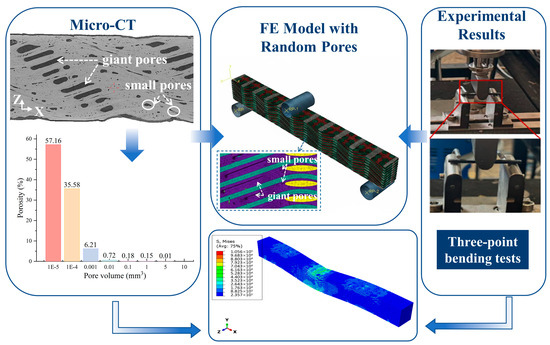
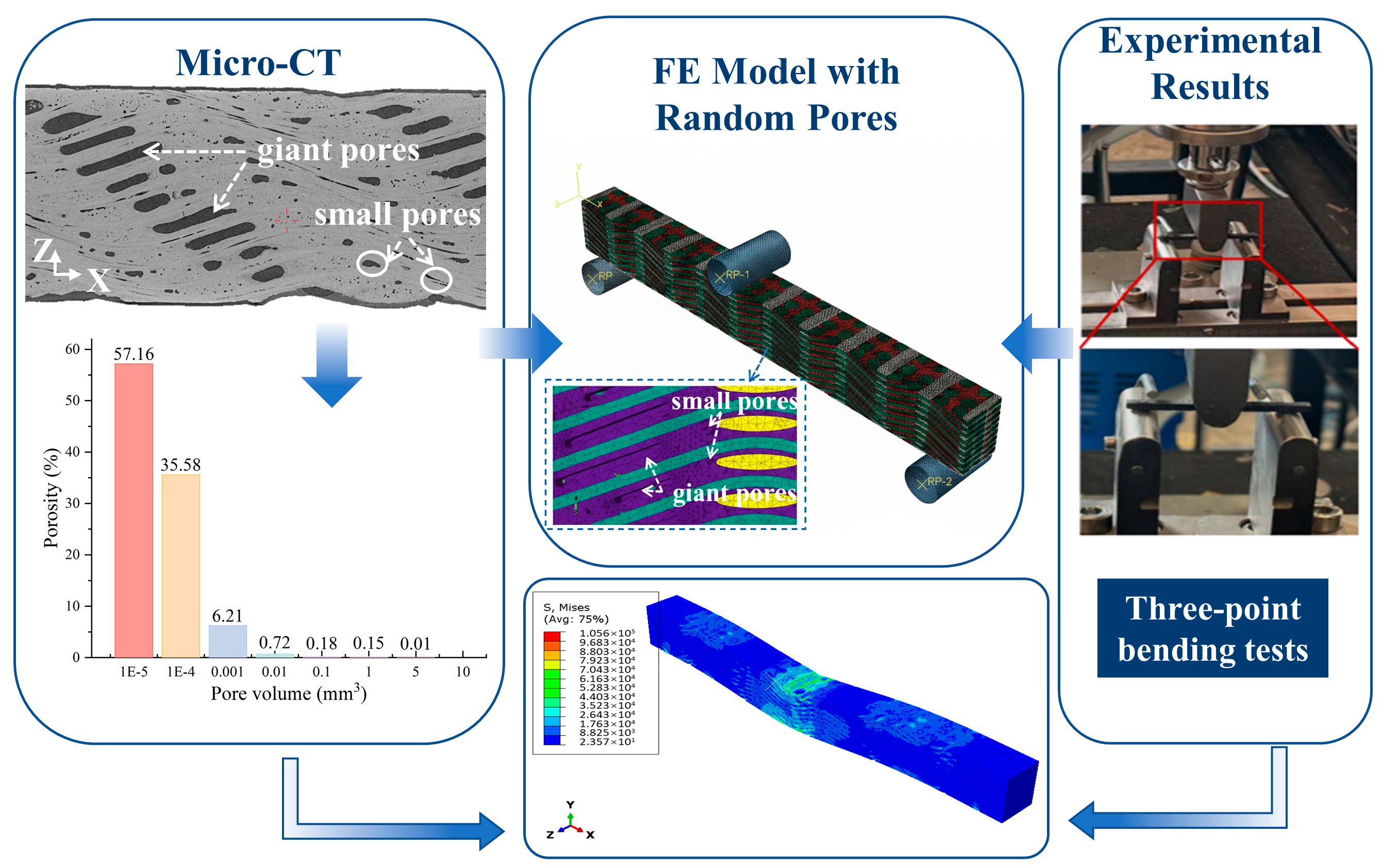
The inevitable pore defects generated in the preparation process have a great impact on the mechanical properties of the ceramic matrix composites. However, the pore defects on the composites were ignored to a large extent in models established in the previous research. In this study, in order to investigate the bending damage behaviors of SiCf/SiC (SiC fiber-reinforced SiC matrix) angle-interlock (2.5D) woven composites prepared by the precursor immersion pyrolysis (PIP) method, a more precise full-scale model of composites was established by finite element (FE) method with taking into account of random pore defects generated by Monte Carlo algorithm. Micro-computed tomography (Micro-CT) was employed to acquire the statistical data of the yarns and pores of SiCf/SiC 2.5D woven composites. A bending test was conducted to study the damage behaviors of the composite and compared with the prediction of the FE model. The result shows that the proposed model with random pores can predict the mechanical damage behavior of SiCf/SiC 2.5D woven composites effectively under three-point bending. The simulated bending strength shows a good agreement with the experimental data, with a relative error of approximately 4.6%.

Graphical Abstract

1. Introduction

Silicon carbide (SiC)-based materials exhibit immense potential across various high-tech fields. For instance, Huczko et al. [1] highlighted the synthesis and cathodoluminescence properties of SiC nanowires, suggesting applications in optoelectronics. Furthermore, SiC ceramics are crucial for radiation-resistant nuclear applications; Tynyshbayeva and Tynyshbayeva [2] recently investigated the structural disordering of SiC ceramics under heavy ion irradiation. Additionally, Lebedev et al. [3] explored the carbothermal synthesis of ultrafine SiC fibers, which is vital for developing advanced sensors and multifunctional composites. Among these diverse forms, SiCf/SiC angle-interlock (2.5D) woven composites are widely used as structural/functional components in aero-engine thermal components due to their high temperature resistance (up to 1450 °C), high out-of-plane performance, and excellent near-net-shape forming capability [4,5,6].
However, the full-scale internal spatial structure of SiCf/SiC (SiC fiber-reinforced SiC matrix) 2.5D woven composites is highly anisotropic and complex. It is worth noting that the pore defects are an inevitable characteristic of SiCf/SiC ceramic matrix composites, which can affect the prediction of the final mechanical properties and failure mechanism significantly [7,8,9]. Hence, an improved reconstructed model of SiCf/SiC 2.5D woven composites with pore defects is necessary for the design and construction of high-performance materials.
In a previous study, the resin matrix composites were assumed to be without pore defects [10,11,12,13]. However, the increasing demands for the refined reconstruction of composites have driven scientists to study the effects of natural defects of composites on their mechanical properties and build a precise mesoscale model with pore defects [14,15,16,17,18]. For example, Gao et al. [19] predicted the influence of pores on the mechanical properties of resin-based three-dimensional (3D) braided composites. The Mori–Tanaka method was employed to establish the constitutive model and finite element model of the 3D braided composite with pores, and simulate the evolution of the mechanical properties of the 3D braided composite with defects. A representative volume cell with pore defects of 3D five-directional braided carbon/epoxy composites was built by Ge et al. [20]. A multi-scale analysis method was established to predict the mechanical properties. The result shows that the elastic constants of 3D braided composites are significantly influenced by pores. In Chao’s study [21], a spatially random representative volume element of the microstructure carbon/carbon composite was obtained with a regular pore distribution. This method is based on an improved stochastic sequential adsorption algorithm. However, it is not hard to find that these works are aimed at the fiber reinforced resin composites where the pore volume fractions are usually less than 3%. It is worth noting that the pore defects of fiber reinforced resin composites are unnecessary meso-scale elements, while they are a crucial element for the SiCf/SiC textile composite due to the differences in their preparation process.
Shen et al. [22] established the representative volume element (RVE) of a 3D SiCf/SiC composite prepared by chemical vapor infiltration (CVI) with pores by using a scanning electron microscope. However, these pores only exist in the cross-section of the composites in the research, and the mechanical behavior of the model containing pores has not been evaluated. Few studies have taken into account the influence of pores on the mechanical properties of composites. Chateau et al. [23] investigated the influence of porosity on the mechanical properties of SiCf/SiC composites and the result showed that the lateral stiffness decreased to about 50% with the porosity of the composites increased from 4% to 9%. To sum up, pore defects, an important engineering defect, have a great impact on the mechanical properties of ceramic matrix composites. The current research failed to analyze the mechanical behavior based on the physical defect model of pore-containing SiCf/SiC 2.5D woven composites. Recent image-based and stochastic modeling studies have also incorporated pore defects in SiC/SiC composites using X-ray tomography and mesoscale FE frameworks [24,25,26,27].
In this paper, the objective is to develop and experimentally validate a full-scale finite element (FE) model that explicitly incorporates physically measured random pore defects, so as to accurately predict the bending response and damage evolution of SiCf/SiC 2.5D woven composites. Specifically, the statistical data of the yarns and pores of SiCf/SiC 2.5D woven composites are acquired by a Micro-CT experiment. Then Monte Carlo random algorithm is adopted to establish the full-scale model of SiCf/SiC 2.5D woven composite with pores. Furthermore, the predicted stress–deflection response, stress distribution, and damage characteristics are compared with three-point bending experiments to assess model fidelity and to demonstrate the role of pores in bending failure.

2. Experimental Detail

2.1. Materials and Specimen Preparation

The three-dimensional weave reinforcements with a layer-to-layer angle interlocking structure (2.5D) for the composites were fabricated by SiC fiber (second-generation Cansas-3201, 200 tex). A precursor immersion pyrolysis (PIP) method was conducted to prepare the SiCf/SiC 2.5D woven composite with two significant steps as shown in Figure 1: (1) The PyC interface layer on the surface of SiC fiber was prepared through a chemical vapor deposition (CVD) process; (2) The PIP process was employed to prepare the SiCf/SiC composites with precursor of the liquid polycarbosilane; (3) The immersion-cracking cycle was set as 8–10 times until the cracking weight gain rate is less than 2%. A composite material with a porosity of 9.36% was obtained eventually.

2.2. Three-Point Bending Tests

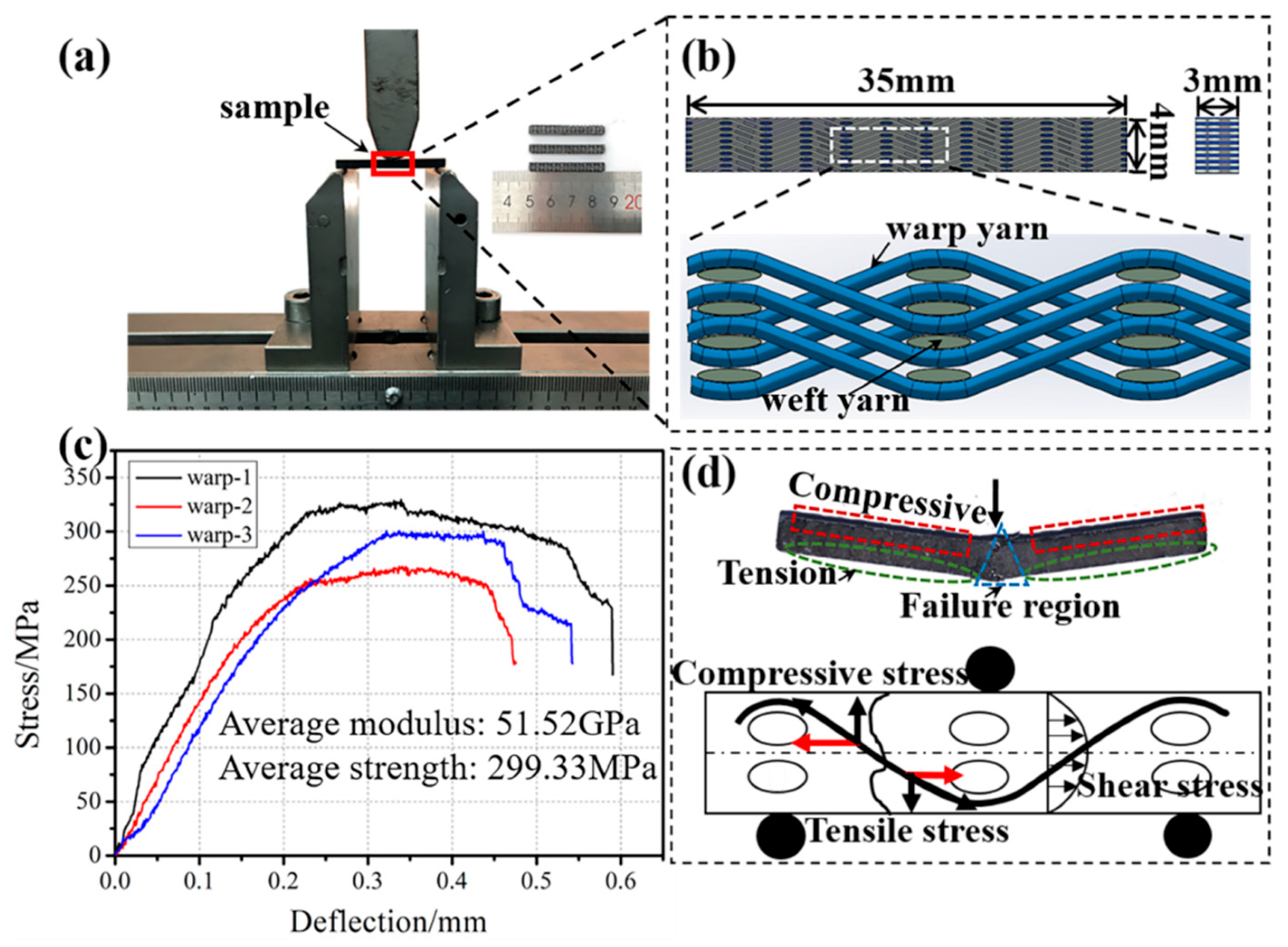
It is well known that for 2.5D woven reinforced ceramic matrix, a relatively complex stress state with tensile, compressive and shear stresses is experienced when subjecting to bending loadings [28,29]. A number of three-point bending tests were conducted by an Instron machine (3385H load frame) at room temperature, which was equipped with a 10 kN load cell in accordance with ASTM C1341 (see Figure 2a). The three-point bending tests for all samples were performed at a crosshead speed of 0.5 mm∙min−1 at room temperature with a span of 30 mm. The dimensions of all specimens were 35 × 4 × 3 mm (see Figure 2b).
The stress–deflection curve obtained from the bending tests is presented in Figure 2c. It can be seen that the average bending strength of the sample is 299.33 MPa, while the average bending modulus of the sample is 51.52 GPa. Figure 2d shows the schematic diagram for the bending failure of the sample. In the bending stage, the specimen appears as compressive stress on the upper side and tensile stress on the lower side and includes in-plane shear. Here, Micro-CT (Diondo d2, diondo GmbH, Hattingen, Germany) and a super-depth three-dimensional microscope (VHX-5000, Keyence Corporation, Osaka, Japan) were adopted to observe and analyze the morphology of bending failure. A voltage of 90 kV and an accelerating current of 120 μA were used to penetrate the sample and irradiate it with attenuated intensity X-rays. Subsequently, it was received and processed on a flat panel detector with a size of 3072 × 3072 pixels with 2228 two-dimensional projection images until the sample rotated 360°. The resolution for all of the two-dimensional projections is 139 μm (22.1 μm/pixel). The three stress–deflection curves correspond to three specimens cut and tested along the warp direction (warp-1, warp-2, and warp-3), showing the experimental scatter between samples. These measured curves and the observed failure morphologies (Micro-CT and 3D microscopy) are used as the primary benchmarks to validate the proposed pore-containing FE model in Section 3 and the predictions reported in Section 4.

3. Establishment of Full-Scale Model of Porous 2.5D SiCf/SiC Composite

3.1. Modeling Framework

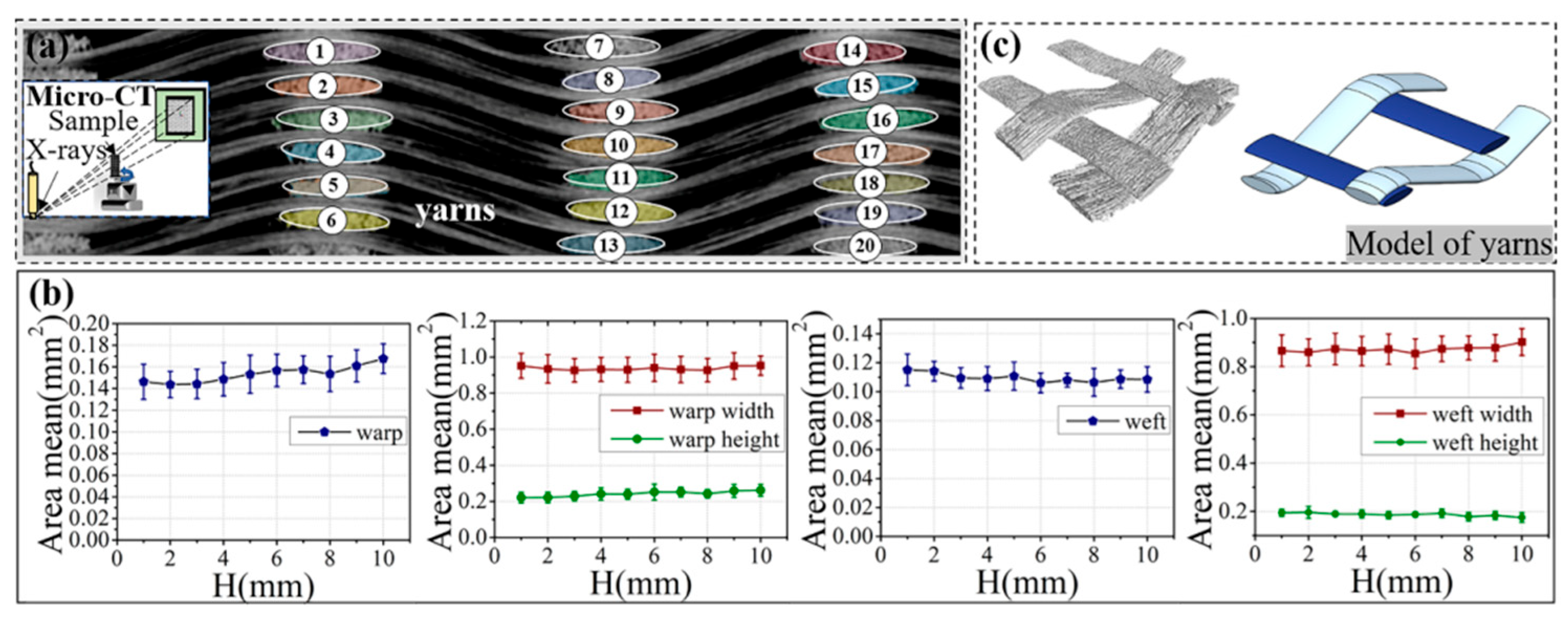
The geometric parameters and tomographic images were obtained from Micro-CT by following steps: (1) the VG software (VGSTUDIO MAX 3.1) was exploited to render the surface of the sample scanned by Micro-CT to make the outline of the fiber bundle clearer; (2) the cross-sectional shape of the target yarn bundles in different regions were extracted through the Image-J software (version 1.51J8) as shown in Figure 3a; (3) the statistical yarn results were numerically analyzed and exhibited in Figure 3b. Interestingly, it is found that the warp and weft cross-section parameters of the SiCf/SiC 2.5D woven composite exhibited good uniformity, which can provide a reliable numerical value for the assumed warp and weft parameters in the simulation model.
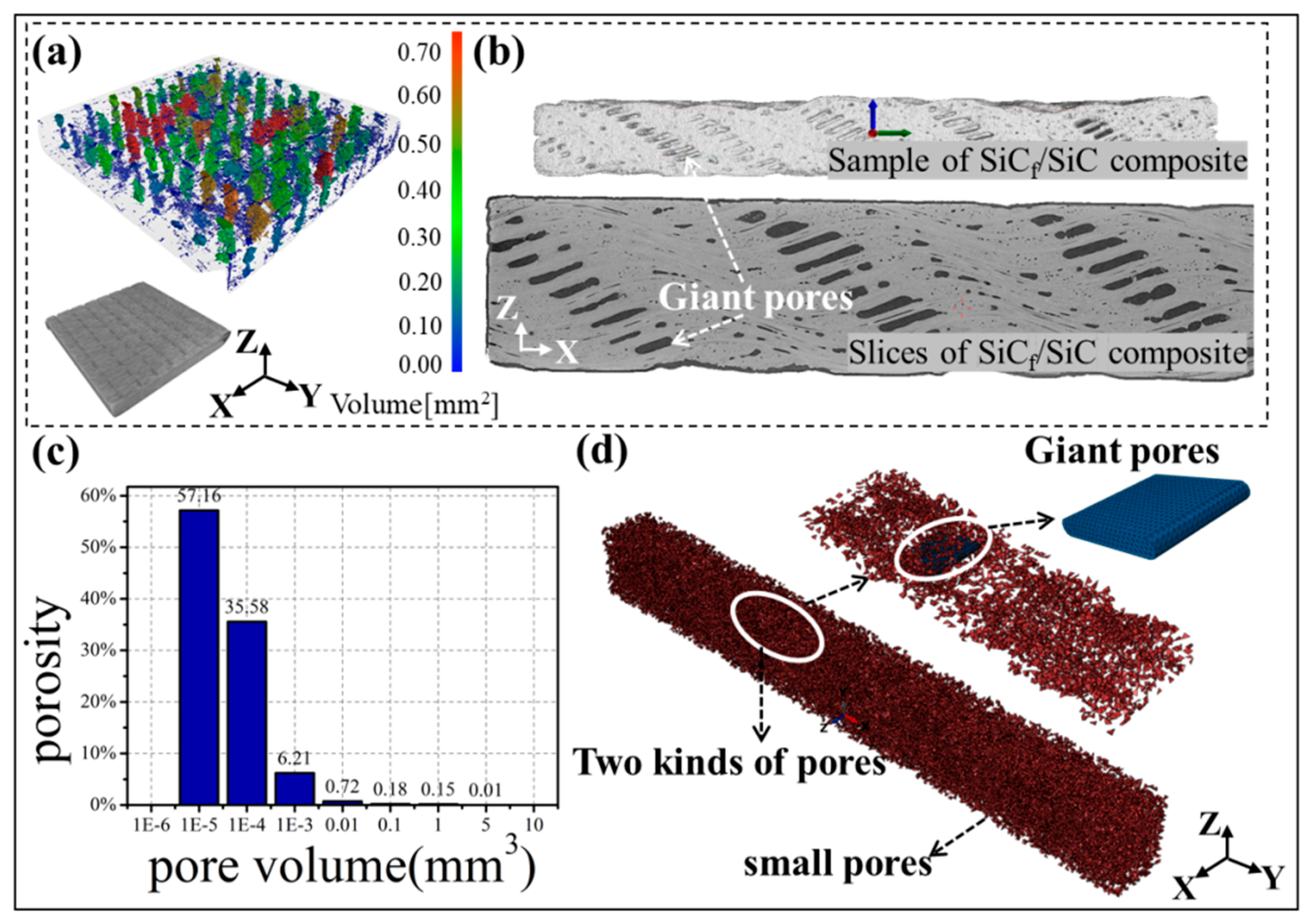
As mentioned above, pores will be generated in the SiCf/SiC composites during the preparation process, inevitably due to the restrictions of the process (Figure 4a,b). The occurrence and distribution of pore defects are closely related to the microstructure of ceramic matrix composites. In this work, we aimed at investigating the influence of pore defects on the mechanical properties of SiCf/SiC 2.5D woven composites. In detail, (1) The volume fraction and size of the pores in the matrix greatly exceed the pores in the fiber bundle; (2) Two main types of pores (Figure 4d) were taken into account in the model construction. Namely, giant pores under the warp yarn, and the small pores are randomly distributed. It is worth noting that the giant pores located under the warp yarns change with the position of the warp yarns; that is, the width of the giant pores is almost the same as the width of the warp yarns, which was proven by a previous study [30,31].

3.2. Generation of Random Pore Model

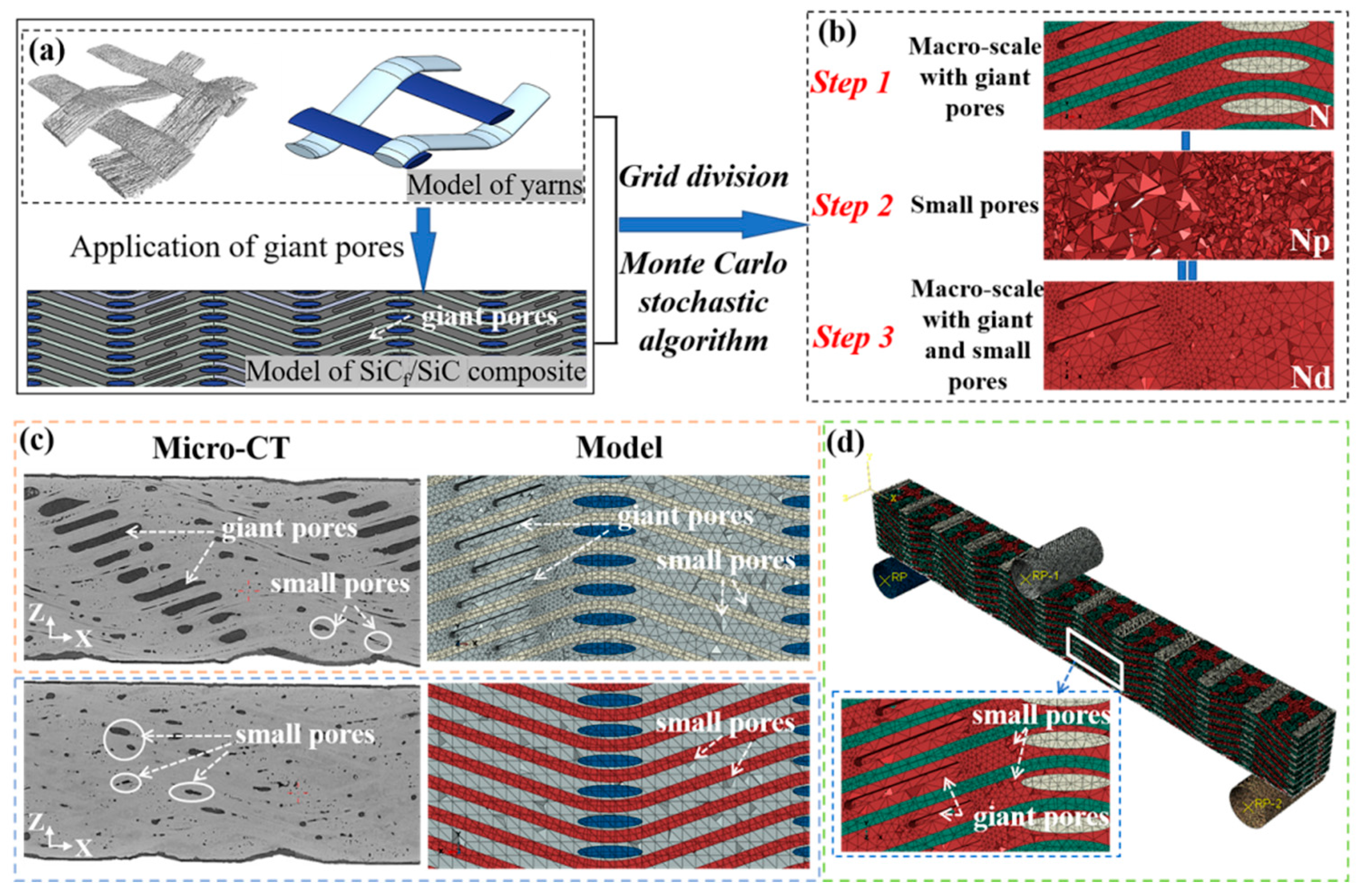
In this work, a novel method was proposed to develop relative precise SiCf/SiC 2.5D woven composite model with random pores. Pore defects in the model can be divided into two groups: “giant pores under the warp yarns” and “small pores distributed randomly in the composite”. The steps for establishing a model for the composite are shown as follows: (1) A group of giant pore models was established under the warp yarns while building the yarn model according to the statistics of the “giant pores” parameters in the VG software. Those “giant pores” were eliminated then by the method of Boolean operation (Figure 5a); (2) For the group of small pores distributed randomly in the matrix, it was found that more than 80% of them had a volume of 10−4~10−5 mm3 based on statistical results. Hence, a Monte Carlo algorithm based on Matlab subroutines was conducted in this paper to generate small pores in the matrix randomly and to fabricate the full-scale SiCf/SiC 2.5D woven composite model that contains both giant pores and random small pores (Figure 5d).
The details for the novel method can be described as follows:
  • Import and discretization: Full-size SiCf/SiC 2.5D woven composite without giant pores created in SolidWorks is imported into ABAQUS software first, followed by grouping and meshing the yarn and the matrix. At this time, the total number of grids of the matrix is N (Figure 5b).
  • Stochastic pore assignment: A Matlab subroutine is employed to embed a random module and generate small pores in the matrix with a random distribution according to the pore content and the total number of grids. Here, the number of pores is Np (see Figure 4b).
  • Pore embedding: Generating a new matrix by deleting the number of small-pore grids in the matrix grids, and the number of grids in the matrix is noted as Nd.
Figure 5c exhibited the comparison between the partial cross-section of the composite scanned by Micro-CT and the cross-section of the established model. Which verified the accuracy of the establishment of the pore-containing model. The final 2.5D full-scale model of the SiCf/SiC composite with different pores can be seen in Figure 5d.

4. Results and Discussion

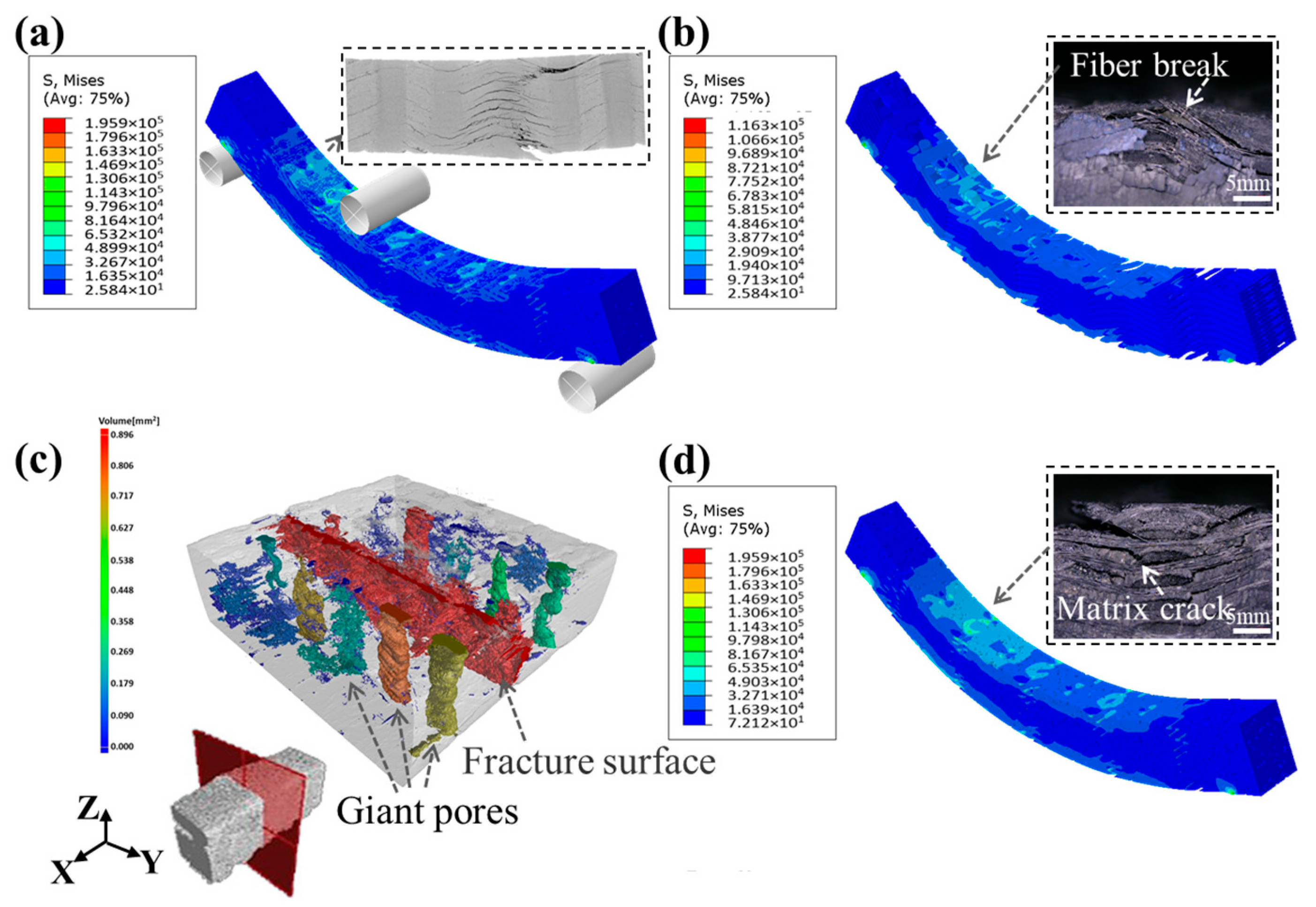
Figure 6 presents the comparison between the final damage appearance of the sample and the simulation results. It was observed that the final damage area of the sample (Figure 6c) was consistent with the simulation result (Figure 6a) and occurred at the place with “giant pores”. This is because the specimen appears as compressive stress on the upper side, tensile stress on the lower side and in-plane shear during the three-point bending test. However, the existence of pores with different sizes in the matrix has a great influence on the mechanical properties of SiCf/SiC composites. Resulting in the final failure of the composites expanded along the contact surface of the weft yarn and the adjacent warp yarn. And the catastrophic damage will occur around the “giant pore”, which leads to the final failure of the material.
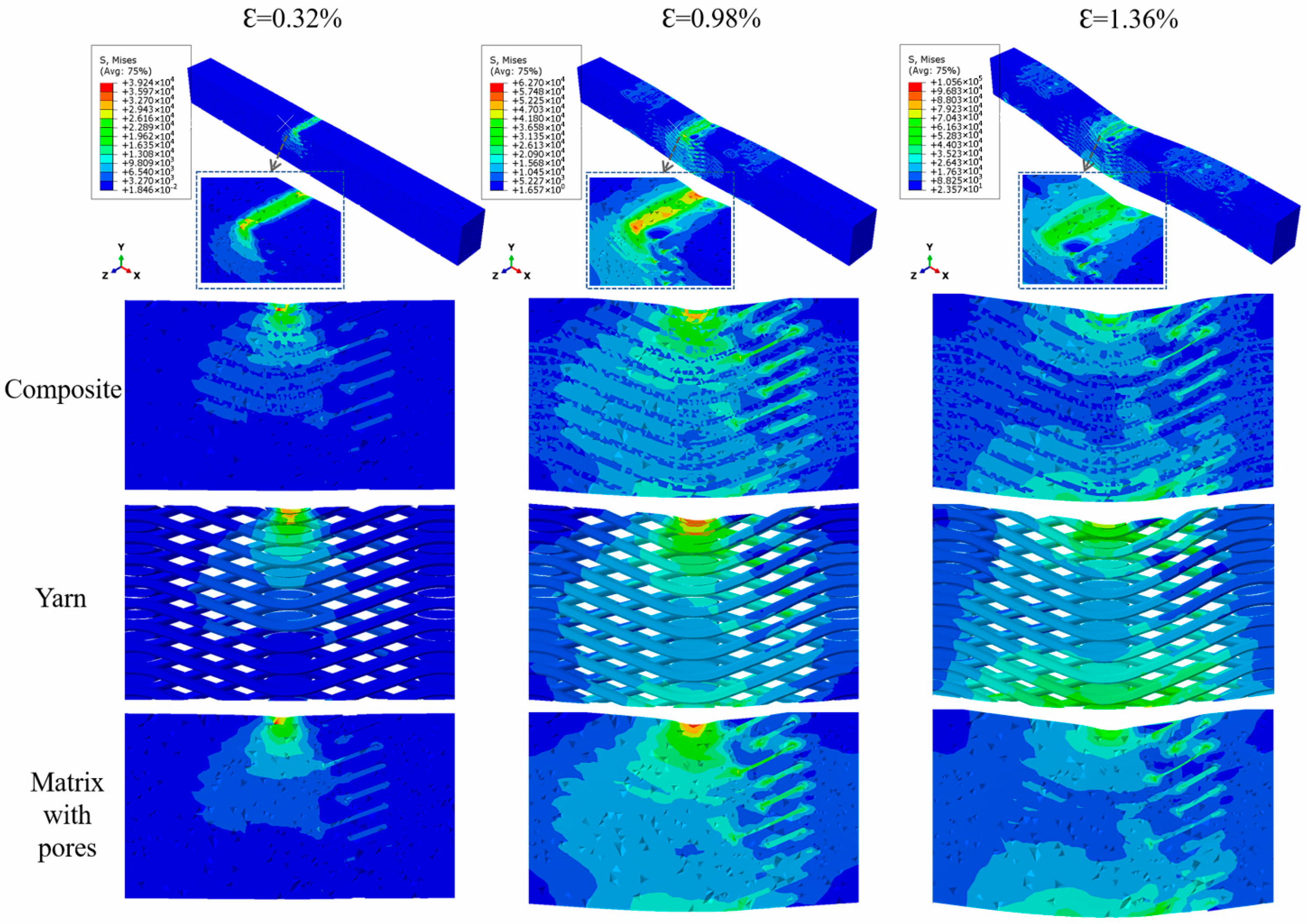
The damage distribution stress nephogram of the SiCf/SiC 2.5D woven composite with pores under three-point bending load with different strains was displayed in Figure 7 to verify the accuracy of the model. At the low strain level (elastic regime), the highest compressive stress appears beneath the upper indenter and the stress is mainly carried by the yarn architecture, with no obvious matrix cracking. At the intermediate strain level (damage initiation), local stress concentrations develop around pores and at yarn/matrix interfaces, leading to the onset of matrix cracking near the loading line and the tensile-side surface. At the high strain level (damage propagation and final failure), cracks deflect and propagate along the yarn–matrix interfaces and around the pore clusters, and the damaged zone extends toward the indenter while tensile-side cracking becomes more pronounced. The progressive crack deflection/bridging and frictional sliding at the PyC interphase contribute to the observed pseudo-plastic bending response in the experiments (Figure 2c).

5. Conclusions

In this work, we originally propose a full-scale model for the mechanical behavior in bend stages for the SiCf/SiC 2.5D woven composites with random pore defects. The three-point bending experiment is conducted to validate the proposed model. The main conclusions can be summarized as follows:
  • The 2.5D woven SiCf/SiC composite model constructed based on statistical analysis and Monte Carlo random function is in good agreement with the mechanical damage and failure behaviors in the experiment.
  • The existence and size of the pores have a great impact on the mechanical properties of SiCf/SiC 2.5D woven composites. It was observed that the final failure of the SiCf/SiC 2.5D woven composite is to expand along the contact surface of the weft yarn and the adjacent warp yarn, and catastrophic damage occurs in the “giant pores”, which leads to the final failure of the material.
The results demonstrate that the proposed defect model with random pores can describe the mechanical damage behavior of SiCf/SiC 2.5D woven composites effectively. The simulation results yielded a bending strength that deviates by less than 5% from the experimental average (299.33 MPa), validating the accuracy of the random pore model. It may provide an idea and guidance for developing a precise model for simulating the damage process of the SiCf/SiC 2.5D woven composites.

Author Contributions

Conceptualization, M.C., W.X.; methodology, L.W., K.Q., M.C.; validation, X.W., T.Y.; formal analysis, X.W.; investigation, X.W.; resources, H.Q., D.Z.; data curation, T.Y.; writing—original draft preparation, X.W.; writing—review and editing, W.X.; visualization, X.W.; supervision, H.Q., D.Z.; project administration, K.Q.; funding acquisition, D.Z. All authors have read and agreed to the published version of the manuscript.

Funding

This research was funded by the Fundamental Research Funds for the Central Universities (JUSRP202504014).

Institutional Review Board Statement

Not applicable.

Informed Consent Statement

Not applicable.

Data Availability Statement

The original contributions presented in this study are included in the article. Further inquiries can be directed to the corresponding authors.

Conflicts of Interest

The authors declare no conflicts of interest.

Abbreviations

The following abbreviations are used in this manuscript:
SiCf/SiCSiC fiber-reinforced SiC matrix
2.5DAngle-interlock
PIPPrecursor immersion pyrolysis
FEFinite element
Micro-CTMicro-computed tomography
CVDchemical vapor deposition

References

  1. Huczko, A.; Dąbrowska, A.; Savchyn, V.; Popov, A.I.; Karbovnyk, I. Silicon carbide nanowires: Synthesis and cathodoluminescence. Phys. Status Solidi B 2009, 246, 2806–2808. [Google Scholar] [CrossRef] [Scilit]
  2. Tynyshbayeva, K.M.; Kozlovskiy, A.L. The effect of temperature factor during heavy ion irradiation on structural disordering of SiC ceramics. Opt. Mater. X 2025, 25, 100383. [Google Scholar] [CrossRef] [Scilit]
  3. Lebedev, A.S.; Suzdal’tsev, A.V.; Anfilogov, V.N.; Farlenkov, A.S.; Porotnikova, N.M.; Vovkotrub, E.G.; Akashev, L.A. Carbothermal synthesis, properties, and structure of ultrafine SiC fibers. Inorg. Mater. 2020, 56, 20–27. [Google Scholar] [CrossRef] [Scilit]
  4. Katoh, Y.; Snead, L.L.; Henager, C.H., Jr.; Nozawa, T.; Hinoki, T.; Iveković, A.; Novak, S.; de Vicente, S.M.G. Current status and recent research achievements in SiC/SiC composites. J. Nucl. Mater. 2014, 455, 387–397. [Google Scholar] [CrossRef] [Scilit]
  5. Schmidt, S.; Beyer, S.; Knabe, H.; Immich, H.; Meistring, R.; Gessler, A. Advanced ceramic matrix composite materials for current and future propulsion technology applications. Acta Astronaut. 2004, 55, 409–420. [Google Scholar] [CrossRef] [Scilit]
  6. Wang, P.R.; Liu, F.Q.; Wang, H.; Li, H.; Gou, Y.Z. A review of third generation SiC fibers and SiCf/SiC composites. J. Mater. Sci. Technol. 2019, 35, 2743–2750. [Google Scholar] [CrossRef] [Scilit]
  7. Del Puglia, P.; Sheikh, M.A.; Hayhurst, D.R. Classification and quantification of initial porosity in a CMC laminate. Compos. Part A Appl. Sci. Manuf. 2004, 35, 223–230. [Google Scholar] [CrossRef] [Scilit]
  8. Santhosh, U.; Ahmad, J.; Ojard, G.; Smyth, I.; Gowayed, Y.; Jefferson, G. Effect of porosity on the nonlinear and time-dependent behavior of Ceramic Matrix Composites. Compos. Part B Eng. 2020, 184, 107658. [Google Scholar] [CrossRef] [Scilit]
  9. Wang, J.; Chen, Y.S.; Feng, Y.J.; Zhao, G.; Jian, X.G.; Huang, Q.; Yang, L.W.; Xu, J. Influence of porosity on anisotropic thermal conductivity of SiC fiber reinforced SiC matrix composite: A microscopic modeling study. Ceram. Int. 2020, 46, 28693–28770. [Google Scholar] [CrossRef] [Scilit]
  10. Hao, W.F.; Liu, Y.; Huang, X.R.; Liu, Y.H.; Zhu, J.G. A unit-cell model for predicting the elastic constants of 3D four directional cylindrical braided composite shafts. Appl. Compos. Mater. 2018, 25, 619–633. [Google Scholar] [CrossRef] [Scilit]
  11. Zhang, D.T.; Sun, Y.; Wang, X.M.; Chen, L. Prediction of macro-mechanical properties of 3D braided composites based on fiber embedded matrix method. Compos. Struct. 2015, 134, 393–408. [Google Scholar] [CrossRef] [Scilit]
  12. El Said, B.; Ivanov, D.; Long, A.C.; Hallett, S.R. Multi-scale modelling of strongly heterogeneous 3D composite structures using spatial Voronoi tessellation. J. Mech. Phys. Solids 2016, 88, 50–71. [Google Scholar] [CrossRef] [Scilit]
  13. Blacklock, M.; Shaw, J.H.; Zok, F.W.; Cox, B.N. Virtual specimens for analyzing strain distributions in textile ceramic composites. Compos. Part A Appl. Sci. Manuf. 2016, 85, 40–51. [Google Scholar] [CrossRef] [Scilit]
  14. Huang, W.; Causse, P.; Brailovski, V.; Hu, H.; Trochu, F. Reconstruction of mesostructural material twin models of engineering textiles based on Micro-CT Aided Geometric Modeling. Compos. Part A Appl. Sci. Manuf. 2019, 124, 105481. [Google Scholar] [CrossRef] [Scilit]
  15. Liu, X.D.; Zhang, D.T.; Sun, J.; Yu, S.; Dai, Y.F.; Zhang, Z.W.; Sun, J.; Li, G.; Qian, K. Refine reconstruction and verification of meso-scale modeling of three-dimensional five-directional braided composites from X-ray computed tomography data. Compos. Struct. 2020, 245, 112347. [Google Scholar] [CrossRef] [Scilit]
  16. Wijaya, W.; Ali, M.A.; Umer, R.; Khan, K.A.; Kelly, P.A.; Bickerton, S. An Automatic Methodology to CT-scans of 2D Woven Textile Fabrics to Structured Finite Element and Voxel Meshes. Compos. Part A Appl. Sci. Manuf. 2019, 39, 115561. [Google Scholar] [CrossRef] [Scilit]
  17. Sevenois, R.D.B.; Garoz, D.; Gilabert, F.A.; Spronk, S.W.F.; Fonteyn, S.; Heyndrickx, M.; Pyl, L.; Van Hemelrijck, D.; Degrieck, J.; Paepegema, W.V. Avoiding interpenetrations and the importance of nesting in analytic geometry construction for Representative Unit Cells of woven composite laminates. Compos. Sci. Technol. 2016, 196, 119–132. [Google Scholar] [CrossRef] [Scilit]
  18. Pazmino, J.; Carvelli, V.; Lomov, S.V. Micro-CT analysis of the internal deformed geometry of a non-crimp 3D orthogonal weave E-glass composite reinforcement. Compos. Part B Eng. 2014, 65, 147–157. [Google Scholar] [CrossRef] [Scilit]
  19. Gao, X.H.; Yuan, L.; Fu, Y.T.; Yao, X.F.; Yang, H. Prediction of mechanical properties on 3D braided composites with void defects. Compos. Part B Eng. 2020, 197, 108164. [Google Scholar] [CrossRef] [Scilit]
  20. Ge, L.; Li, H.M.; Liu, B.S.; Fang, D.N. Multi-scale elastic property prediction of 3D five-directional braided composites considering pore defects. Compos. Struct. 2020, 244, 112287. [Google Scholar] [CrossRef] [Scilit]
  21. Chao, X.J.; Qi, L.H.; Cheng, J.; Tian, W.L.; Zhang, S.Y.; Li, H.J. Numerical evaluation of the effect of pores on effective elastic properties of Carbon/Carbon composites. Compos. Struct. 2018, 196, 108–116. [Google Scholar] [CrossRef] [Scilit]
  22. Shen, X.L.; Liu, X.; Dong, S.J.; Gong, L.D. RVE model with shape and position defects for predicting mechanical properties of 3D braided CVI SiCf/SiC composites. Compos. Struct. 2018, 195, 325–334. [Google Scholar] [CrossRef] [Scilit]
  23. Chateau, C.; Gélébart, L.; Bornert, M.; Crépin, J. Micromechanical modeling of the elastic behavior of unidirectional CVI SiC/SiC composites. Int. J. Solids Struct. 2015, 58, 322–334. [Google Scholar] [CrossRef] [Scilit]
  24. Duan, Y.; Qiu, H.; Yang, T.; Wang, L.; Wang, X.; Xie, W.; Qian, K.; Zhang, D. Flexural failure mechanism of 2.5D woven SiCf/SiC composites: Combination of acoustic emission, digital image correlation and X-ray tomography. Compos. Commun. 2021, 28, 100921. [Google Scholar] [CrossRef] [Scilit]
  25. Li, Y.; Ma, Y.; Guan, T.; Wang, Z.; Zhang, C.; Suo, T. A meso-scale stochastic model for tensile behavior of 2D woven ceramic composites considering void defects and stacking mode. Compos. Part A Appl. Sci. Manuf. 2024, 176, 107838. [Google Scholar] [CrossRef] [Scilit]
  26. Wang, Z.; Yuan, Q.; Wang, X.; Zhang, D. Real meso-scale model reconstruction and tensile failure prediction of 3D braided PIP-SiCf/SiC composites considering pore defects. Compos. Struct. 2023, 305, 116478. [Google Scholar] [CrossRef] [Scilit]
  27. Yan, W.; Ren, Z.; Fan, X.; Yan, Z.; Shen, L.; Xu, J. Multi-scale pore model construction and damage behavior analysis of SiCf/SiC composite tubes. Mater. Charact. 2024, 214, 114083. [Google Scholar] [CrossRef] [Scilit]
  28. Li, Z.C.; Yin, X.G.; Ma, T.; Miao, W.; Zhang, Z.J. Bending and Thermal Expansion Properties of 2.5D C/SiC Composites. Mater. Trans. 2011, 52, 2165–2167. [Google Scholar]
  29. Zhang, H.J.; Guo, J.H.; Wen, W.D.; Cui, H.T.; He, S.; Xu, Y. Bending/tensile tests and simulations of the 2.5D woven T-shaped hooking composite structure. Compos. Struct. 2018, 206, 155–163. [Google Scholar] [CrossRef] [Scilit]
  30. Cheng, L.F.; Zhang, L.T.; Mei, H. Strengthening and Application Basis of Ceramic Matrix Composites; Chemical Industry Press: Beijing, China, 2018; pp. 338–350. [Google Scholar]
  31. Ma, J.Q.; Xu, Y.D.; Zhang, L.T.; Cheng, L.F.; Nie, J.J.; Dong, N. Microstructure characterization and tensile behavior of 2.5D C/SiC composites fabricated by chemical vapor infiltration. Scr. Mater. 2006, 54, 1967–1971. [Google Scholar] [CrossRef] [Scilit]

Figure 1. The preparation process of 2.5D woven SiCf/SiC composite.
Materials 19 00934 g001
Figure 2. Three-point flexure setup (a), flexure test samples (b), flexure stress–deflection curves (c) and failure of composite (d). Note: Solid arrows indicate the direction of compressive/tensile stress, and hollow curved arrows represent the shear stress direction during failure.
Materials 19 00934 g002
Figure 3. 2.5D reconstruction structure of yarns: the fiber orientation of SiCf/SiC composite scanned by Micro-CT (a), the actual statistical parameters of fiber bundles (b), and part of yarn extraction and reconstruction (c). Note: Different colors and numbers in (a) represent the individual yarns in the 2.5D woven structure.
Materials 19 00934 g003
Figure 4. Geometrical model of SiCf/SiC 2.5D woven composite with pore defects: the pores of the composite extracted by Micro-CT (a), the distribution of giant pores in the composite (b), the pore distribution based on statistical results (c) and the classification of pores (d).
Materials 19 00934 g004
Figure 5. Macro structural of SiCf/SiC 2.5D woven composite model with pores: First, a yarn model and a giant pore model are established based on the statistical results (a). Then mesh the model with giant pores. Subsequently, the Monte Carlo stochastic algorithm is employed to delete the small pore units to form a finite element model (b). Ultimately, compare the Micro-CT scan sample with the established model (c). A SiCf/SiC 2.5D woven composite model with pores is obtained (d). Note: Different colors represent the yarns (red and light blue color ), matrix (gray color) in (a,c) as well as the yarns (green and light green color), matrix (red color) in (b,d), respectively.
Materials 19 00934 g005
Figure 6. Stress nephogram of the model (a) and the final macroscopic failure Micro-CT diagram of the specimen (c) in the three-point bending test: stress nephogram of yarn (b), stress nephogram of matrix (d).
Materials 19 00934 g006
Figure 7. Stress nephogram of bending damage distribution of 2.5D SiCf/SiC composite, yarn and matrix with pores under different strains.
Materials 19 00934 g007
Disclaimer/Publisher’s Note: The statements, opinions and data contained in all publications are solely those of the individual author(s) and contributor(s) and not of MDPI and/or the editor(s). MDPI and/or the editor(s) disclaim responsibility for any injury to people or property resulting from any ideas, methods, instructions or products referred to in the content.