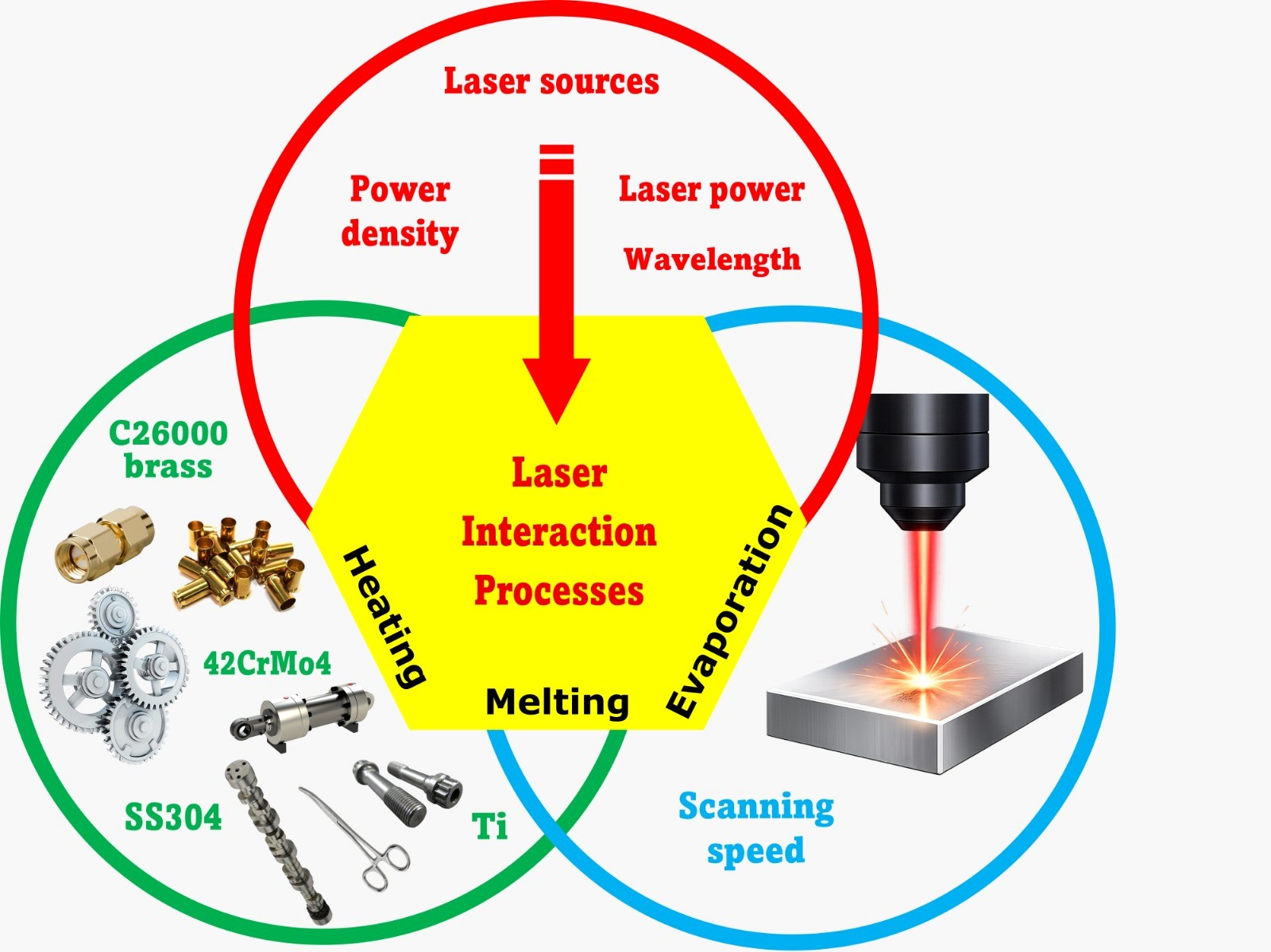
A Predictive Model and Comparative Analysis of Laser-Induced Phase Transition Thresholds for Four Key Engineering Alloys




Abstract
1. Introduction
2. Materials and Methods
3. Results
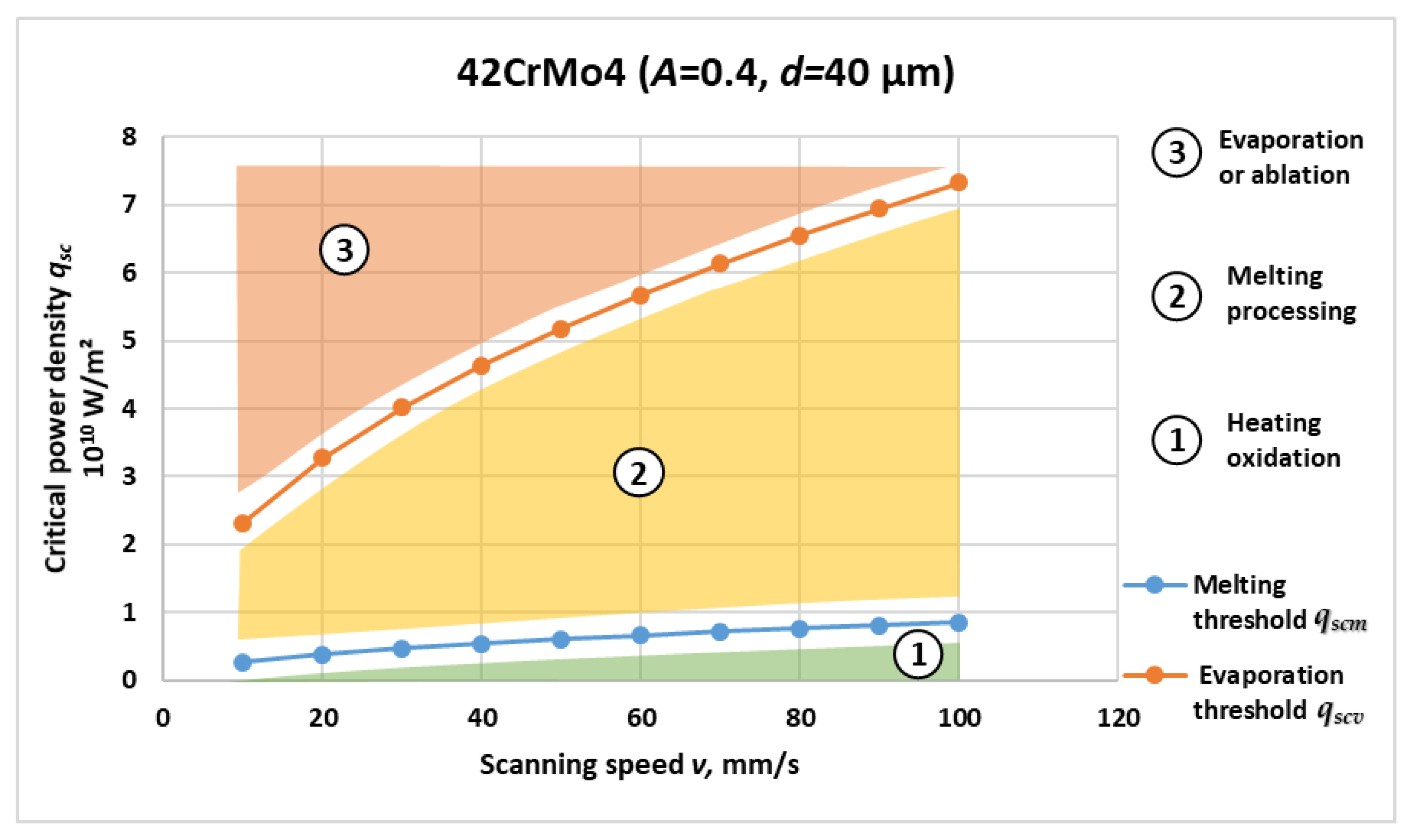
3.1. Individual Threshold Curves per Material
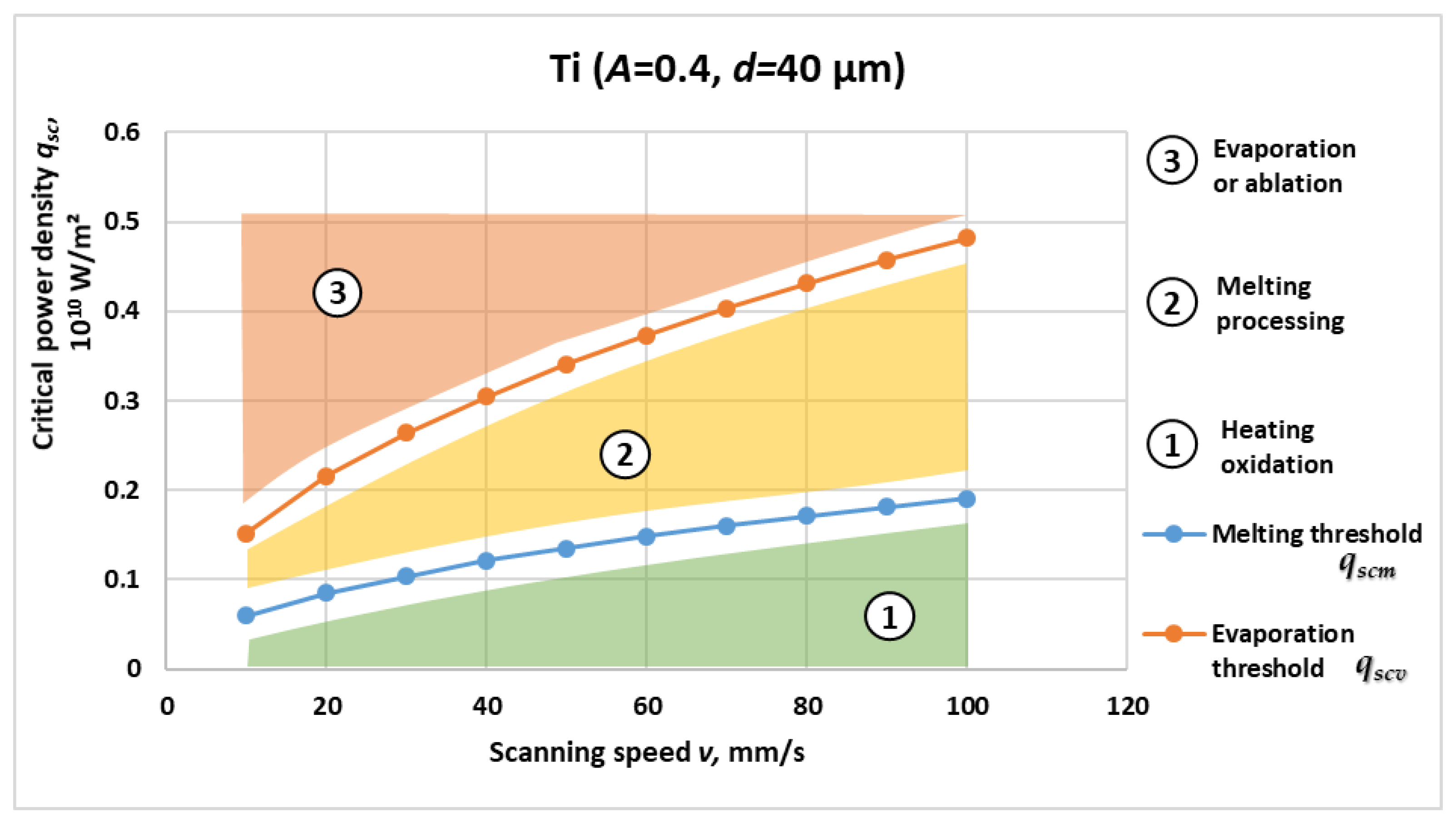
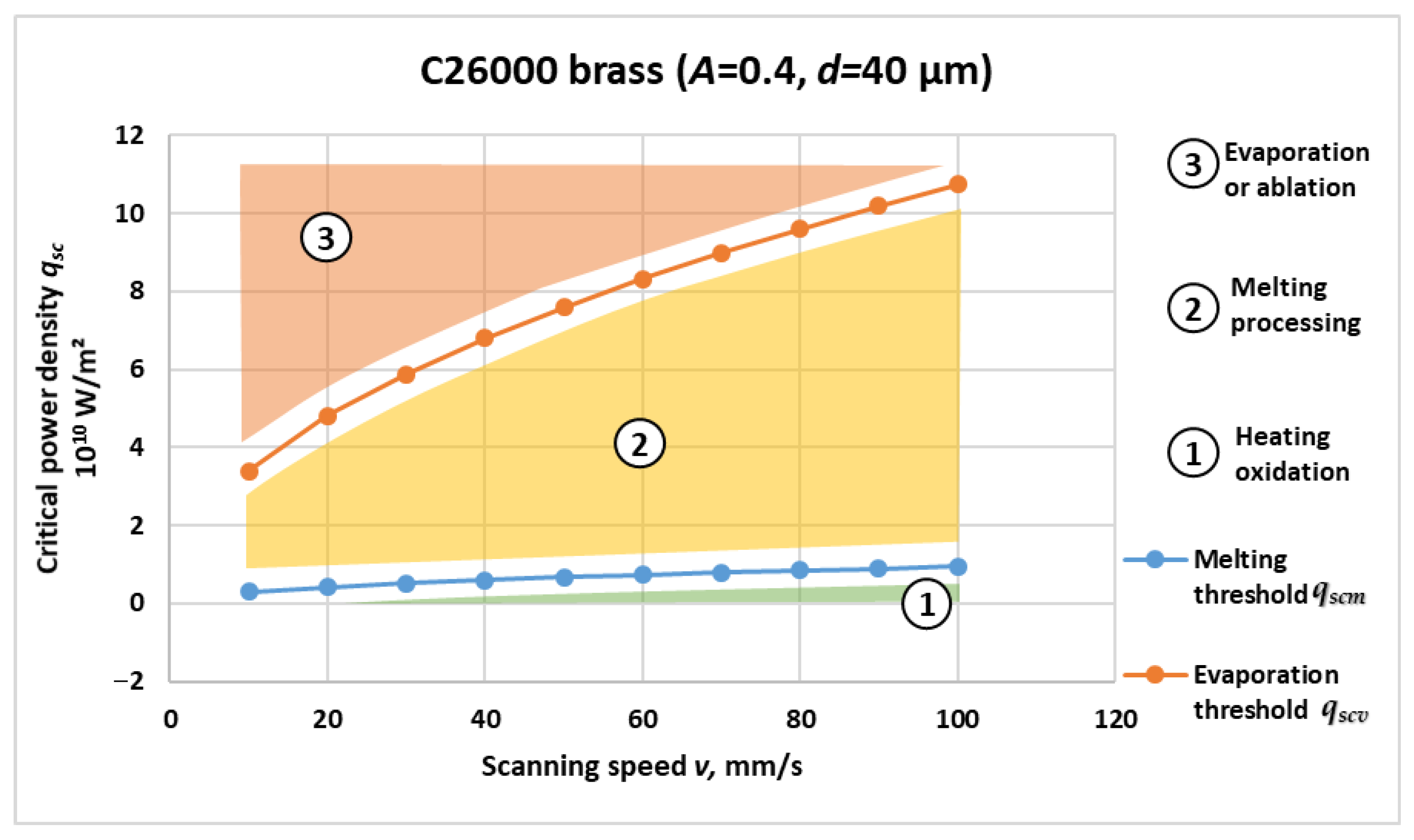
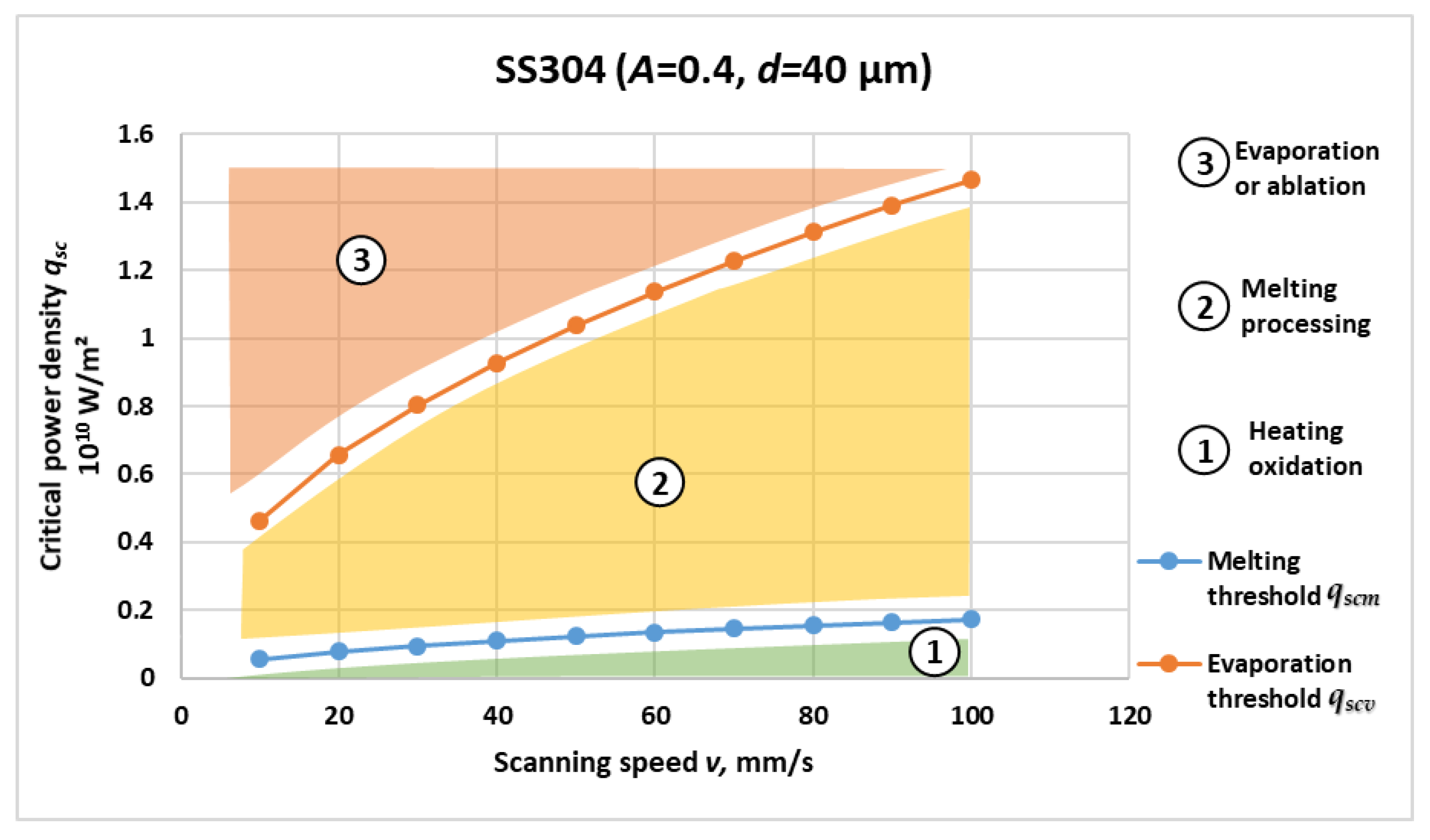
- Area 1: Located below the critical power density for melting versus speed graph. In this region, laser marking is performed by oxidation, and the temperature is lower than the melting temperature of the material.
- Area 2: Located between the critical power density for melting and the critical power density for evaporation. The laser marking process by melting is implemented here. The material temperature in this region is higher than the melting temperature and lower than the evaporation temperature.
- Area 3: Located above the critical power density for evaporation versus speed graph. The laser marking process by evaporation is implemented here. The material temperature in this area is higher than the evaporation temperature.
3.2. Combined Comparison Across Materials
3.3. Preliminary Operating Ranges of Power Density
- Area 1
- Area 2
- Area 3
4. Discussion
4.1. Comparison with the Literature and Model Validation
4.2. Model Limitations and Pathways for Refinement
- Primary Enhancement: Implement temperature-dependent absorptivity A(T) using empirical relations or data from ellipsometry studies. This is the most critical upgrade, as A can increase by a factor of 2–3 from room temperature to the melting point for metals at 1064 nm.
- Secondary Enhancement: Incorporate temperature-dependent thermophysical properties, such as k(T) and c(T), into the energy balance, potentially using an iterative numerical solution.
- Advanced Modeling: For high-fidelity prediction of melt pool geometry and thresholds in the evaporation regime, transitioning to a 3D computational fluid dynamics (CFD) model that includes fluid flow, vapor recoil pressure, and latent heat effects is necessary.
4.3. Practical Application Example: Laser Hardening of 42CrMo4
4.4. Practical Implications for Industrial Laser Processing
5. Conclusions
- (1)
- A directly comparable dataset of qscm (v) and qscv (v) that fills a reference gap for SS304 and 42CrMo4;
- (2)
- A quantitative process-window interpretation that translates fundamental thermophysics into clear guidelines for selecting laser parameters for surface modification, marking, or ablation.
Author Contributions
Funding
Institutional Review Board Statement
Informed Consent Statement
Data Availability Statement
Conflicts of Interest
References
- Liu, J.; Wei, B.; Chang, H.; Li, J.; Yang, G. Review of Visual Measurement Methods for Metal Vaporization Processes in Laser Powder Bed Fusion. Micromachines 2023, 14, 1351. [Google Scholar] [CrossRef] [Scilit]
- Yang, Z.; Feng, Z.; Di, Y. Impact of Scanning Speed on Microstructure and Mechanical and Thermal Expansion Properties of Fe-36Ni Alloy Fabricated by Selective Laser Melting. Coatings 2025, 15, 572. [Google Scholar] [CrossRef] [Scilit]
- Zhang, T.; Huang, B. Application of Pre-Wetted High Titanium Heavy Slag Aggregate in Cement Concrete. Materials 2022, 15, 831. [Google Scholar] [CrossRef] [Scilit] [PubMed]
- Mahdavi, H.; Kepçeoğlu, A.; Asghari Alamdari, A.; Ünal, U.; Jahangiri, H. Mixing Enthalpy-Driven Variations in Ablation Thresholds and Laser-Induced Crater Morphologies of CoCuFeNiMnMo_x (x = 0.5, 1.0, 1.5) High-Entropy Alloys under UV Nanosecond Laser Pulses. Results Surf. Interfaces 2025, 18, 100415. [Google Scholar] [CrossRef] [Scilit]
- Xu, X.; Xie, Z.; Wu, M.; Ma, C. Effects of Laser Process Parameters on Melt Pool Thermodynamics, Surface Morphology and Residual Stress of Laser Powder Bed-Fused TiAl-Based Composites. Metals 2025, 15, 1234. [Google Scholar] [CrossRef] [Scilit]
- Pimenov, D.Y.; Berti, L.F.; Pintaude, G.; Peres, G.X.; Chaurasia, Y.; Khanna, N.; Giasin, K. Influence of Selective Laser Melting Process Parameters on the Surface Integrity of Difficult-to-Cut Alloys: Comprehensive Review and Future Prospects. Int. J. Adv. Manuf. Technol. 2023, 127, 1071–1102. [Google Scholar] [CrossRef] [Scilit]
- He, Z.; Lei, L.; Lin, S.; Tian, S.; Tian, W.; Yu, Z.; Li, F. Metal Material Processing Using Femtosecond Lasers: Theories, Principles, and Applications. Materials 2024, 17, 3386. [Google Scholar] [CrossRef] [Scilit]
- Lazov, L.; Angelov, N.; Teirumnieks, E. Method for Preliminary Estimation of the Critical Power Density in Laser Technological Processes. Environ. Technol. Resour. 2019, 3, 129–133. [Google Scholar] [CrossRef] [Scilit]
- Beránek, J.; Bulgakov, A.V.; Bulgakova, N.M. On the Melting Thresholds of Semiconductors under Nanosecond Pulse Laser Irradiation. Appl. Sci. 2023, 13, 3818. [Google Scholar] [CrossRef] [Scilit]
- Bitharas, I.; Parab, N.; Zhao, C.; Sun, T.; Rollett, A.D.; Moore, A.J. The Interplay between Vapour, Liquid, and Solid Phases in Laser Powder Bed Fusion. Nat. Commun. 2022, 13, 2959. [Google Scholar] [CrossRef] [Scilit]
- Steen, W.M.; Mazumder, J. Laser Material Processing, 4th ed.; Springer: London, UK, 2010. [Google Scholar] [CrossRef] [Scilit]
- Mirza, I.; Bulgakova, N.M.; Tomáštík, J.; Michálek, V.; Haderka, O.; Fekete, L.; Mocek, T. Ultrashort Pulse Laser Ablation of Dielectrics: Thresholds, Mechanisms, Role of Breakdown. Sci. Rep. 2016, 6, 39133. [Google Scholar] [CrossRef] [Scilit]
- Ghadiri Zahrani, E.; Soltani, B.; Azarhoushang, B. Investigation of Laser–Material Interaction in Picosecond Single-Pulse Ablation. Int. J. Adv. Manuf. Technol. 2024, 123, 11245–11258. [Google Scholar] [CrossRef] [Scilit]
- Sabuj, M.R.; Afshari, S.S.; Liang, X. Selective LASER Melting Part Quality Prediction and Energy Consumption Optimization. Meas. Sci. Technol. 2023, 34, 075902. [Google Scholar] [CrossRef] [Scilit]
- Dar, J.; Ponsot, A.G.; Jolma, C.J.; Lin, D. A Review on Scan Strategies in Laser-Based Metal Additive Manufacturing. J. Mater. Res. Technol. 2025, 36, 5425–5467. [Google Scholar] [CrossRef] [Scilit]
- Hazzan, K.E.; Pacella, M.; See, T.L. Laser Processing of Hard and Ultra-Hard Materials for Micro-Machining and Surface Engineering Applications. Micromachines 2021, 12, 895. [Google Scholar] [CrossRef] [Scilit]
- Hagenlocher, C.; Stoll, A.; Zaeh, M.F. Analytical Modelling of Heat Accumulation in Laser-Based Additive Manufacturing Processes of Metals. Addit. Manuf. 2022, 60, 103263. [Google Scholar] [CrossRef] [Scilit]
- Sassmannshausen, A.; Brenner, A.; Finger, J. Ultrashort Pulse Laser Polishing by Continuous Surface Melting. J. Mater. Process. Technol. 2021, 293, 117058. [Google Scholar] [CrossRef] [Scilit]
- Kim, M.; Oh, W.; Baek, G.; Jo, Y.; Lee, K.; Park, S.; Shim, D. Ultrasonic Nanocrystal Surface Modification of High-Speed Tool Steel (AISI M4) Layered via Direct Energy Deposition. J. Mater. Process. Technol. 2020, 277, 116420. [Google Scholar] [CrossRef] [Scilit]
- Pang, J.; Huang, L.; Liu, H.; Yi, X. Melt Pool Dynamics and Pore Formation in Selective Laser Melting: Mechanisms and Microstructural Insights. Mater. Des. 2025, 230, 114043. [Google Scholar] [CrossRef] [Scilit]
- Shi, G.; Zhang, R.; Cao, Y.; Yang, G. A Review of the Vaporization Behavior of Some Metal Elements in the LPBF Process. Micromachines 2024, 15, 846. [Google Scholar] [CrossRef] [Scilit] [PubMed]
- Mills, K.C. Recommended Values of Thermophysical Properties for Selected Commercial Alloys; Woodhead Publishing: Cambridge, UK, 2002. [Google Scholar] [CrossRef] [Scilit]
- Touloukian, Y.S.; Powell, R.W.; Ho, C.Y.; Klemens, P.G. Thermal Conductivity: Metallic Elements and Alloys; Thermophysical Properties of Matter: The TPRC Data Series; IFI/Plenum: New York, NY, USA, 1970; Volume 1, ISBN 978-0306670213. [Google Scholar]
- Tritt, T.M. (Ed.) Thermal Conductivity: Theory, Properties, and Applications; Springer: New York, NY, USA, 2004. [Google Scholar] [CrossRef] [Scilit]
- Linstrom, P.J.; Mallard, W.G. (Eds.) NIST Chemistry WebBook; NIST Standard Reference Database Number 69; National Institute of Standards and Technology: Gaithersburg, MD, USA. Available online: https://webbook.nist.gov (accessed on 1 June 2025).
- Iida, T.; Guthrie, R.I.L. The Thermophysical Properties of Metallic Liquids: Volume 1—Fundamentals; Oxford University Press: Oxford, UK, 2015. [Google Scholar]
- MatWeb, LLC. MatWeb Material Property Data. Available online: http://www.matweb.com (accessed on 1 June 2025).
- Chen, W.-W.; Liu, Z.-D.; Li, J.-F.; Sun, J.-J.; Sang, F.-T.; Li, G.-Q. Numerical Simulation of the Temperature Field of a Molten Pool of Copper-Zinc Alloy Irradiated by a Chemical Laser. Mater. Mech. Eng. 2009, 33, 90–93. [Google Scholar]
- Cheung, N.; Larosa, M.A.; Osório, W.R.; Lima, M.S.F.; Lerardi, M.C.F.; Garcia, A. Numerical Simulation and Experimental Analysis of Laser Surface Remelting of AISI 304 Stainless Steel Samples. Mater. Sci. Forum 2010, 636–637, 1119–1124. [Google Scholar] [CrossRef] [Scilit]



| Parameter | Ti | C26000 Brass | SS304 | 42CrMo4 |
|---|---|---|---|---|
| Thermal conductivity k, W/m·K | 22 | 120 | 17 | 42.5 |
| Density ρ, kg/m3 | 4507 | 8580 | 7850 | 7815 |
| Specific heat c, J/(kg·K) | 520 | 377 | 504 | 470 |
| Thermal diffusivity a, m2/s | 9.39 × 10⁻⁶ | 3.71 × 10⁻⁵ | 4.30 × 10⁻⁶ | 1.157 × 10⁻⁵ |
| Melting temperature Tm, K | 1941 | 1183 | 1723 | 1716 |
| Vaporization temperature Tv, K | 3560 | 2835 | 3375 | 3195 |
| Latent heat of melting Lm, J/kg | 3.90 × 10⁵ | 1.80 × 10⁵ | 2.47 × 10⁵ | 2.514 × 10⁵ |
| Latent heat of evaporation Lv, J/kg | 1.063 × 10⁷ | 4.73 × 10⁶ | 6.34 × 10⁶ | 6.25 × 10⁶ |
| Spot diameter d, m | 4.0 × 10⁻⁵ | 4.0 × 10⁻⁵ | 4.0 × 10⁻⁵ | 4.0 × 10⁻⁵ |
| Initial temperature T0, K | 293 | 293 | 293 | 293 |
| v, mm/s | Ti qscm | C26000 qscm | SS304 qscm | 42CrMo4 qscm | Ti qscv | C26000 qscv | SS304 qscv | 42CrMo4 qscv |
|---|---|---|---|---|---|---|---|---|
| 10 | 0.060 | 0.298 | 0.055 | 0.271 | 0.152 | 3.396 | 0.464 | 2.316 |
| 20 | 0.085 | 0.422 | 0.078 | 0.383 | 0.216 | 4.803 | 0.656 | 3.275 |
| 30 | 0.104 | 0.517 | 0.095 | 0.469 | 0.264 | 5.883 | 0.803 | 4.011 |
| 40 | 0.121 | 0.597 | 0.110 | 0.542 | 0.305 | 6.793 | 0.927 | 4.631 |
| 50 | 0.135 | 0.667 | 0.123 | 0.606 | 0.341 | 7.594 | 1.037 | 5.178 |
| 60 | 0.148 | 0.731 | 0.135 | 0.664 | 0.373 | 8.319 | 1.136 | 5.672 |
| 70 | 0.160 | 0.789 | 0.146 | 0.717 | 0.403 | 8.986 | 1.227 | 6.127 |
| 80 | 0.171 | 0.844 | 0.156 | 0.766 | 0.431 | 9.606 | 1.312 | 6.550 |
| 90 | 0.181 | 0.895 | 0.165 | 0.813 | 0.457 | 10.189 | 1.391 | 6.947 |
| 100 | 0.191 | 0.944 | 0.174 | 0.857 | 0.482 | 10.740 | 1.466 | 7.323 |
| v, mm/s | By Oxidation | By Melting | By Evaporation |
|---|---|---|---|
| 10 | <0.060 | 0.060–0.464 | 0.464–1.592 |
| 20 | <0.085 | 0.085–0.656 | 0.656–1.592 |
| 30 | <0.104 | 0.104–0.803 | 0.803–1.592 |
| 40 | <0.121 | 0.121–0.927 | 0.927–1.592 |
| 50 | <0.135 | 0.135–1.037 | 1.037–1.592 |
| 60 | <0.148 | 0.148–1.136 | 1.136–1.592 |
| 70 | <0.160 | 0.160–1.227 | 1.227–1.592 |
| 80 | <0.171 | 0.171–1.312 | 1.312–1.592 |
| 90 | <0.181 | 0.181–1.391 | 1.391–1.592 |
| 100 | <0.191 | 0.191–1.466 | 1.466–1.592 |
| Laser Parameters | v, mm/s | Expmetal qscm × 1010 W/m2 | Predicted qscm (This Work) (×1010 W/m2) | Discrepancy |
|---|---|---|---|---|
| CW Nd:YAG, d ≈ 50 µm | 2 | 0.10–0.15 | 0.78 | ~30% |
| CW Fiber, d = 55 µm | 50 | ~0.13 | 0.123 | ~5% |
| CW Fiber, λ = 1064 nm, d = 40 µm, A = 0.4 | 50 | - | 0.123 | - |
Disclaimer/Publisher’s Note: The statements, opinions and data contained in all publications are solely those of the individual author(s) and contributor(s) and not of MDPI and/or the editor(s). MDPI and/or the editor(s) disclaim responsibility for any injury to people or property resulting from any ideas, methods, instructions or products referred to in the content. |
© 2026 by the authors. Licensee MDPI, Basel, Switzerland. This article is an open access article distributed under the terms and conditions of the Creative Commons Attribution (CC BY) license.
Share and Cite
Lazov, L.; Linkov, L.; Angelov, N.; Sprudzs, E.; Abolins, A. A Predictive Model and Comparative Analysis of Laser-Induced Phase Transition Thresholds for Four Key Engineering Alloys. Materials 2026, 19, 927. https://doi.org/10.3390/ma19050927
Lazov L, Linkov L, Angelov N, Sprudzs E, Abolins A. A Predictive Model and Comparative Analysis of Laser-Induced Phase Transition Thresholds for Four Key Engineering Alloys. Materials. 2026; 19(5):927. https://doi.org/10.3390/ma19050927
Chicago/Turabian StyleLazov, Lyubomir, Lyubomir Linkov, Nikolay Angelov, Edmunds Sprudzs, and Arturs Abolins. 2026. "A Predictive Model and Comparative Analysis of Laser-Induced Phase Transition Thresholds for Four Key Engineering Alloys" Materials 19, no. 5: 927. https://doi.org/10.3390/ma19050927
APA StyleLazov, L., Linkov, L., Angelov, N., Sprudzs, E., & Abolins, A. (2026). A Predictive Model and Comparative Analysis of Laser-Induced Phase Transition Thresholds for Four Key Engineering Alloys. Materials, 19(5), 927. https://doi.org/10.3390/ma19050927