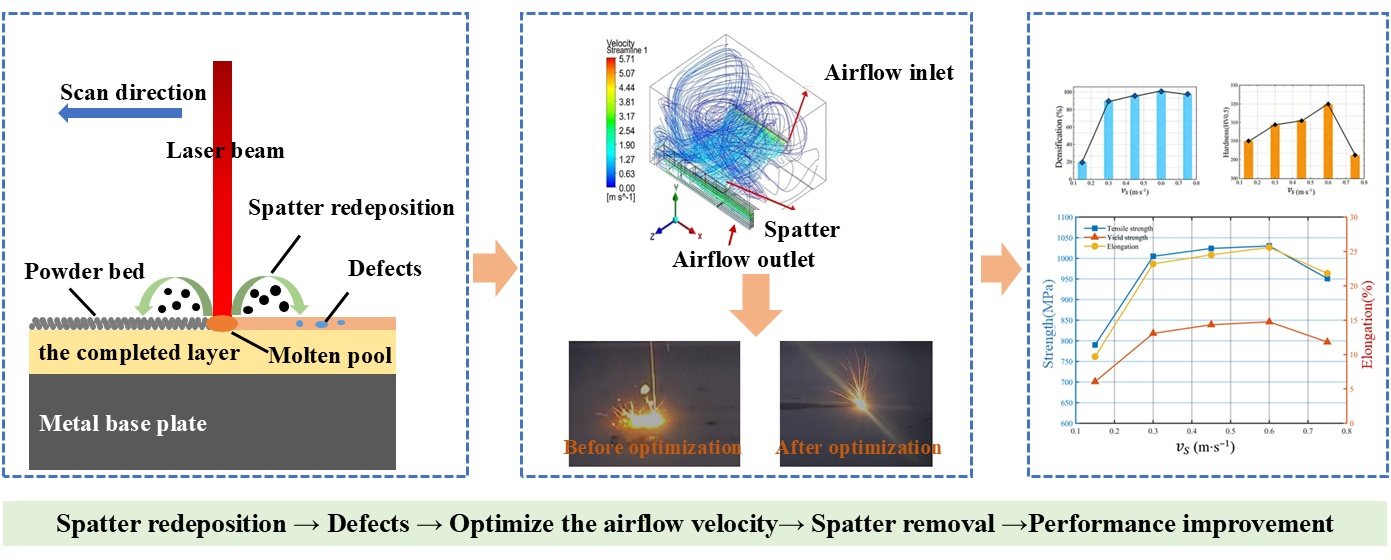
Enhancing the Performance of Laser Powder Bed-Fused Inconel 718 Through Effective Spatter Removal via Atmosphere Protection System Optimization



Abstract
Share and Cite
Jiang, Y.; Wang, Y.; Chen, Y.; Lu, Y.; Wen, C.; Han, B.; Zhang, Q. Enhancing the Performance of Laser Powder Bed-Fused Inconel 718 Through Effective Spatter Removal via Atmosphere Protection System Optimization. Materials 2026, 19, 917. https://doi.org/10.3390/ma19050917
Jiang Y, Wang Y, Chen Y, Lu Y, Wen C, Han B, Zhang Q. Enhancing the Performance of Laser Powder Bed-Fused Inconel 718 Through Effective Spatter Removal via Atmosphere Protection System Optimization. Materials. 2026; 19(5):917. https://doi.org/10.3390/ma19050917
Chicago/Turabian StyleJiang, Yuxuan, Yin Wang, Yukai Chen, Yu Lu, Chuyue Wen, Bin Han, and Qi Zhang. 2026. "Enhancing the Performance of Laser Powder Bed-Fused Inconel 718 Through Effective Spatter Removal via Atmosphere Protection System Optimization" Materials 19, no. 5: 917. https://doi.org/10.3390/ma19050917
APA StyleJiang, Y., Wang, Y., Chen, Y., Lu, Y., Wen, C., Han, B., & Zhang, Q. (2026). Enhancing the Performance of Laser Powder Bed-Fused Inconel 718 Through Effective Spatter Removal via Atmosphere Protection System Optimization. Materials, 19(5), 917. https://doi.org/10.3390/ma19050917