1. Introduction
Fiber-Reinforced Flexible (FRF) pipes are composite structures composed of polymer matrices and reinforcing fibers. Polymer matrices function not only as an adhesive that immobilizes reinforcing fibers but also contribute critically to load transfer, resistance to physical damage, and protection against chemical corrosion. Reinforcing fibers, serving as the primary load-bearing elements, significantly enhance the pipe’s overall mechanical performance due to their high specific strength and high modulus [
1,
2,
3]. The flexibility in selecting both matrix and fiber materials, along with structural design adaptability, enables tailored performance of FRF pipes, allowing them to meet diverse application requirements in fields such as marine and civil engineering [
4,
5,
6].
FRF pipes can be installed as expansion joints at connection points between equipment and pipelines or between different pipeline segments [
7]. Compared with traditional metal pipes in pipeline systems, FRF pipes, with their low stiffness and high flexibility, not only function as elastic buffer elements [
8], but also allow effective displacement compensation under large deformations and complex loading conditions [
9]. Furthermore, by optimizing the fiber winding angle, FRF pipes can achieve balanced performance. Self-balanced FRF pipes possess the capability to autonomously regulate axial deformation induced by internal pressure, enabling the pipes to actively counteract axial strain during pressurized media transport. This characteristic prevents the generation of additional thrust forces or constrained displacements on connected equipment and pipelines [
10].
As established in the theory of thin-walled cylinders, the ratio of hoop stress to axial stress is 2:1 for a cylinder with closed ends. According to grid analysis theory [
11,
12], if reinforcing fibers in an FRF pipe carry tensile loads exclusively along their axial direction, material efficiency can be maximized and deformation in the non-fiber directions can be effectively suppressed. Consequently, when the fiber winding angle is set to
, the fiber orientation aligns with the principal stress direction of the pipe. Under this condition, the axial strain induced by internal pressure can be counteracted, enabling the thin-walled pipe to achieve a self-balanced state. Therefore, in Gao et al.’s study [
13] on the structural design of self-balanced FRF pipes, their theoretical model accounted only for the mechanical contribution of reinforcing fibers. However, this theory relies on the assumption that reinforcing fibers dominate the structural behavior. In reality, the mechanical performance of the reinforcement layer arises from the combined contributions of both reinforcing fibers and polymer matrices within the layer.
The mechanical properties of the reinforcement layer essentially depend on the distribution, orientation, geometric morphology and volume fraction of the reinforcing fibers and matrix, as well as the interface characteristics and bonding state formed during the manufacturing process [
14]. To characterize the mechanical properties of such composites, homogenization techniques are commonly adopted [
15]. For short-fiber-reinforced composites, Chao et al. [
16] proposed an asymptotic homogenization strategy based on local–global representative volume elements, which can effectively predict the elastic properties of random fiber-reinforced composites with high fiber volume fractions. In multi-scale homogenization research, the interface debonding effect between fibers and the matrix has been gradually considered. For instance, Heide-Jorgensen et al. [
17] established a three-dimensional multi-scale homogenization method for hybrid woven composites, which can be used to calculate the orthotropic material parameters considering interface damage. In addition, for fiber-reinforced composites under large deformation conditions, Li et al. [
18] constructed a large-deformation mean-field homogenization model, which can be embedded into ABAQUS through a user material interface and accurately characterize the hyperelastic and elastoplastic homogenized mechanical responses of materials. Within the framework of variational principles and a virtual work statement, Islam et al. [
19] proposed an energy-based reduced-order model for hyperelastic materials reinforced with unidirectional and bidirectional fibers, and refined continuum-based prediction models to characterize the nonlinear responses of the matrix and fibers. The governing equations and boundary conditions were derived through variational principles and verified by experiments, which can predict the strain-stiffening behavior of elastomer-polyester fiber composites.
In the theoretical study on the mechanical behavior of filament-wound pipes, the linear equivalent elastic constants of the reinforcement layer are usually first obtained through homogenization, and the stiffness matrix in the principal coordinate system is established, and then transformed into the cylindrical coordinate system for analysis. For example, Rosenow [
20] employed micromechanics theory to predict the equivalent mechanical properties of the reinforcement layer and further integrated classical laminated plate theory to analyze the influence of the fiber winding angle on the stress–strain behavior of glass fiber–reinforced polyester filament-wound pipes under internal pressure. Xia et al. [
21,
22] also adopted micromechanics theory and coupled it with three-dimensional anisotropic elasticity theory based on the generalized Hooke’s law to derive an exact elastic solution for the stress and deformation of multi-layered filament-wound composite pipes under internal pressure. Their results demonstrate that the stress state and deformation behavior of the pipe are highly sensitive to the fiber winding angle. Based on these studies, Zhou et al. [
4] developed a systematic programming approach that enables parametric analysis of multi-layered reinforced pipes through iterative loops and conditional control logic, performing failure analysis on a fourteen-layer FRF pipe.
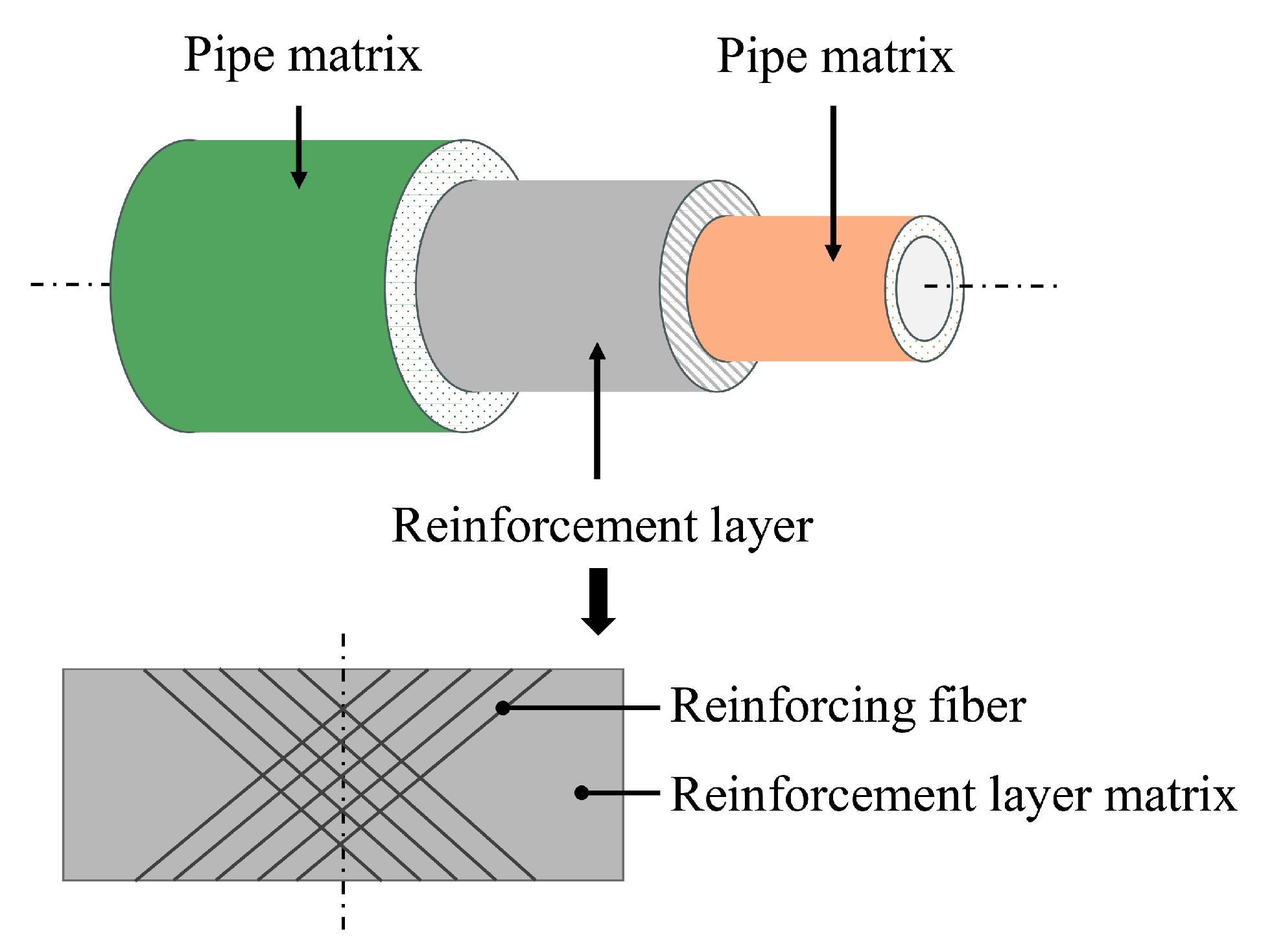
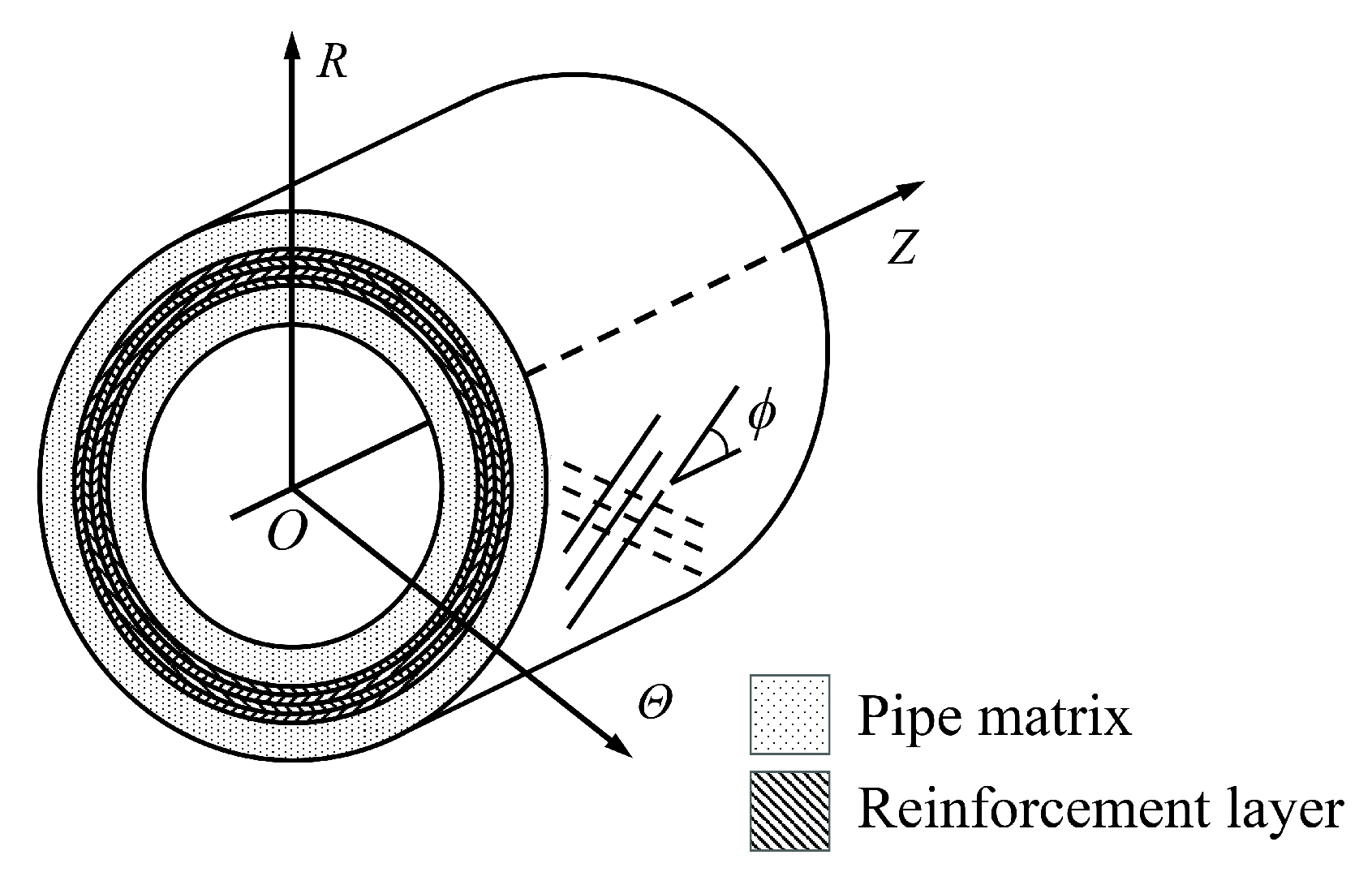
The above studies, while accounting for the composite effect of fibers and matrices within the reinforcement layer, have overlooked the mechanical contribution of the independent pipe matrix (as shown in
Figure 1). Reference [
12] indicates that the approximation of neglecting the pipe matrix’s contribution is valid only when its stiffness is significantly lower than that of the reinforcing fiber. However, there is currently no established criterion specifying the stiffness ratio between the pipe matrix and the reinforcing fiber across different material combinations, and the threshold range of stiffness ratios beyond which the pipe matrix influence becomes negligible remains undefined. Furthermore, to meet the increasing demand for transporting fluids under higher working pressures, FRF pipes are often designed with higher thickness-to-diameter ratios [
23]. This thick-walled configuration results in non-uniform stress distribution and complex interlayer coupling effects, thereby necessitating the inclusion of the pipe matrix in mechanical modeling.
To more comprehensively account for the influence of the pipe matrix, Gu et al. [
24] incorporated the rubber material constituting the pipe matrix into the model based on the theories in References [
21,
22], and investigated the response of an infinitely long FRF pipe under internal pressure. Through experimental validation, they demonstrated that the discrepancy between theoretical predictions and measurements mainly originated from the simplification of rubber as a linear elastic material. Clearly, to accurately describe the mechanical behavior of polymer pipe matrices such as rubber, the material nonlinearity must be taken into account [
25]. However, existing theoretical approaches face inherent limitations when modeling nonlinear stress–strain relationships of materials. For example, the method reported in Reference [
26] requires iterative updating of the Young’s modulus at each incremental step, which not only increases computational complexity but also restricts the simulation to nonlinear responses under single-mode deformation. Consequently, such methods are generally inadequate for predicting the behavior of hyperelastic materials exhibiting multiaxial stress coupling under complex loading conditions.
Meanwhile, the finite element method has been widely employed to address material nonlinearity issues in the analysis of FRF pipes [
27,
28,
29]. However, numerical methods generally entail high computational costs and are not well suited for directly elucidating the parametric influence mechanisms. Moreover, during the early stages of self-balanced pipes’ design, the finite element method is inconvenient for efficiently identifying the optimal fiber winding angle that enables pipes to achieve the self-balanced state.
Assessing the balanced performance of thick-walled FRF pipes under the maximum working internal pressure requires accurate calculation of the axial deformation. If the axial deformation falls within the engineering allowable range (typically mm), the pipe is considered to exhibit balanced performance. However, existing theoretical studies generally adopt the assumption of an infinitely long pipe to facilitate closed-form solutions, under which condition the axial strain is treated as constant, thereby precluding the prediction of actual axial deformation. Meanwhile, the thick-walled design commonly implemented in engineering to enhance pressure resistance further amplifies the influence of end constraint effects and the mechanical contribution of the pipe matrix. Furthermore, accurately characterizing the nonlinear stress–strain behavior of the polymer matrix is critical to achieving high prediction accuracy in mechanical models. These limitations hinder the precise description of the mechanical response of thick-walled FRF pipes, resulting in the determination of the balanced fiber winding angle still relying on engineering experience.
In summary, this work formulates the total potential energy using the strain energy density function, employs parameterized displacement trial functions to approximate the actual displacement field, and converts the original boundary value problem into a multivariate extremum problem within the framework of energy principles and reduced-order modeling. By integrating the Newton–Raphson method, the coefficients of the displacement trial functions are iteratively determined. The present approach is established as a semi-analytical reduced-order model based on energy principles and parametric displacement field approximation, aiming to reveal the intrinsic mechanism underlying the balanced performance of thick-walled FRF pipes and to provide a theoretical basis for determining their balanced fiber winding angle.
3. Results and Discussion
This section first clarifies the benchmarks used to verify the reliability of the semi-analytical method, then analyzes the completeness of the displacement trial function and the robustness of the Newton–Raphson solution method. By comparing the calculation results of the semi-analytical method with the verification benchmarks, the deformation mechanism of the thick-walled FRF pipe is analyzed, and the influence of the fiber winding angle on its balanced performance is discussed.
3.1. Verification Benchmarks
To verify the reliability of the semi-analytical method proposed in this work, the finite element model and its corresponding experimental results from Reference [
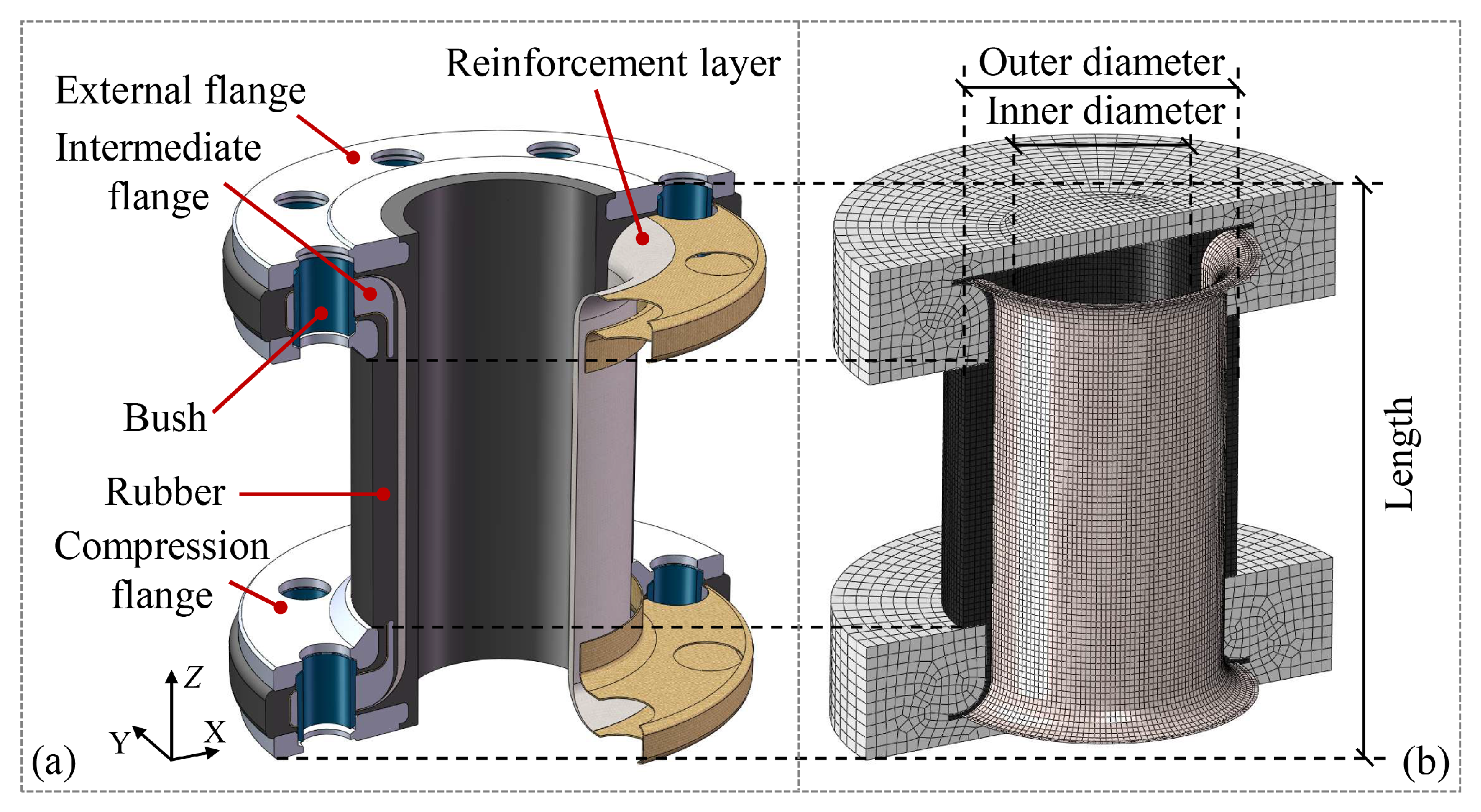
32] are adopted as the benchmark for validation. In that study, the research object is an aramid fiber-reinforced rubber thick-walled pipe with a three-flange structure, as illustrated in
Figure 5a. The manufacturing parameters of the pipe are shown in
Table 1. In the finite element modeling, the rubber matrix and reinforcement layers are simulated using C3D8R and M3D4R elements, respectively, and the embedded element technique is used to embed the reinforcement layer into the rubber matrix. The boundary conditions of the model are set as one end fixed and the other end free to deform axially, and the internal pressure is applied as a uniformly distributed load on the inner surfaces of the pipe and end plates.
The finite element model, as shown in
Figure 5b, is consistent with the finite element model in the above-mentioned literature. It should be noted that the geometric simplification adopted in the referenced finite element model omits the region where the reinforcement layer wraps around the intermediate flange and is bolted in place, as shown in the yellow part of
Figure 5a. The structural dimensions and boundary conditions used in the semi-analytical method in this paper are the same as those of the finite element model, but only the straight section of the pipe (length of 88.8 mm) is modeled.
In terms of material modeling, the semi-analytical method treats the rubber matrix within the reinforcement layer as a linear elastic material. The corresponding elastic parameters are derived from the Neo-Hookean hyperelastic model calibrated using experiments from Reference [
32]:
where
is the parameter governing the shear response of the material, and
controls its volumetric compressibility. Here,
and
J denote the first deviatoric invariant and the determinant of the deformation gradient (i.e., the volume change ratio), respectively.
Based on this hyperelastic model,
and
required for linear elastic approximation can be determined as:
From these,
and
can then be calculated:
3.2. Selection and Verification of Displacement Trial Functions
The core of the semi-analytical method lies in approximating the displacement field through predefined displacement trial functions. Consequently, the completeness of displacement trial functions and the robustness of the Newton–Raphson method solution process are two key factors ensuring the reliability of the method.
To determine the optimal number of undetermined coefficients that ensures both accuracy and computational efficiency of displacement trial functions, an extended series model is constructed by incrementally increasing the number of coefficients. If the axial deformation quantity tends to stabilize and the overall deformation behavior converges, then the corresponding displacement trial functions are deemed complete. Based on Equation (
40), displacement trial functions with different parameter quantities are constructed, as shown in
Table 2. The primary distinction among these functions lies in the degree to which higher-order terms and coupling terms between radial and axial coordinates are retained.
The axial deformation results computed using these different trial functions are presented in
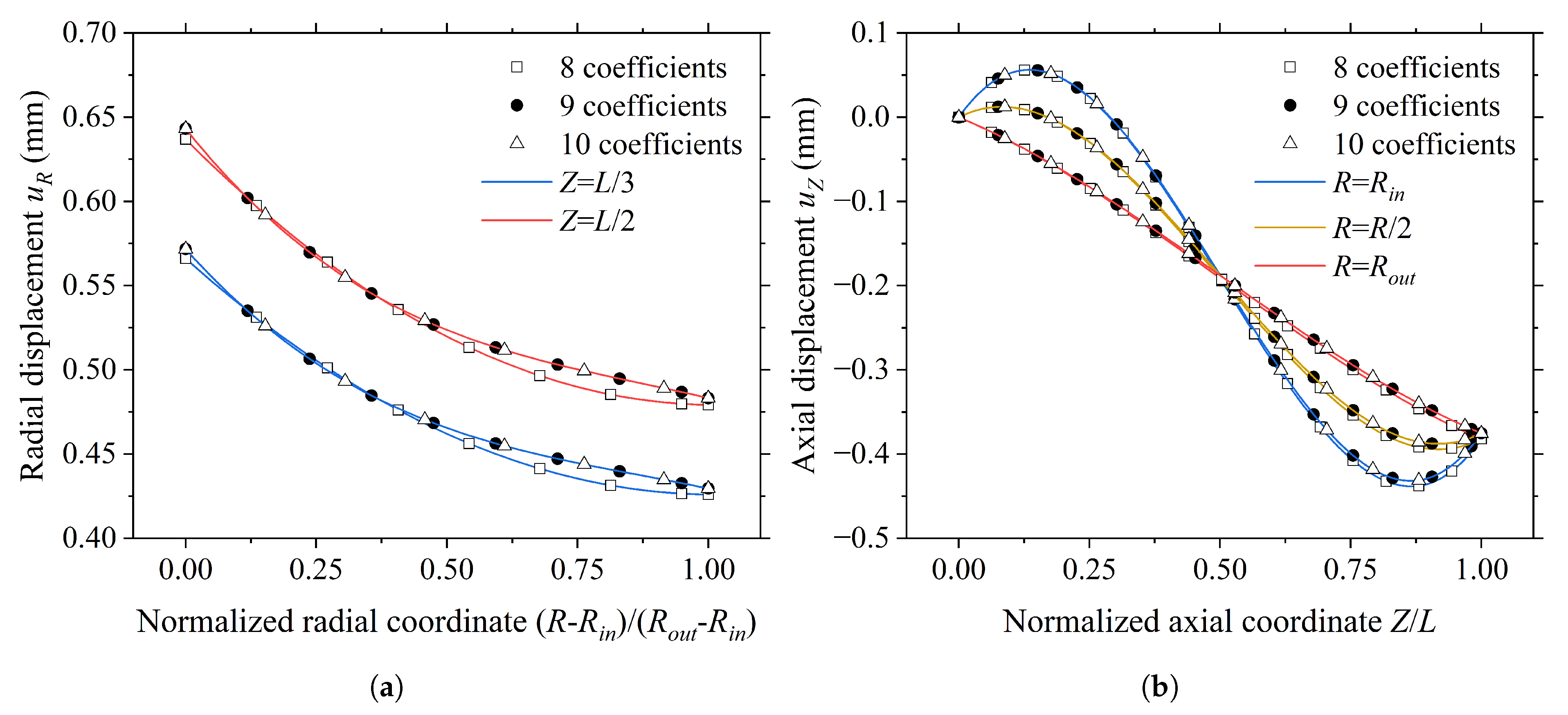
Table 3. It can be observed that when the number of coefficients increases from six to seven, the axial deformation shifts from positive to negative, indicating that the trial functions have captured the dominant mechanism responsible for axial contraction of the pipe. As the number of coefficients further increases to nine and ten, the axial deformation stabilizes at
mm, confirming convergence of the solution.
To further verify the completeness of the displacement trial function,
Figure 6 compares the axial and radial displacement fields computed using the eight-, nine-, and ten-coefficient functions. The results show that the displacement curves obtained from the nine- and ten-coefficient functions nearly overlap completely along the key path, while the deviation of the eight-coefficient functions relative to the latter two is negligible. This indicates that the numerical solution of the displacement field has fully converged when the number of coefficients exceeds eight. Additionally, as shown in
Table 4, the eight-coefficient function maintains a comparable level of accuracy while offering improved computational efficiency.
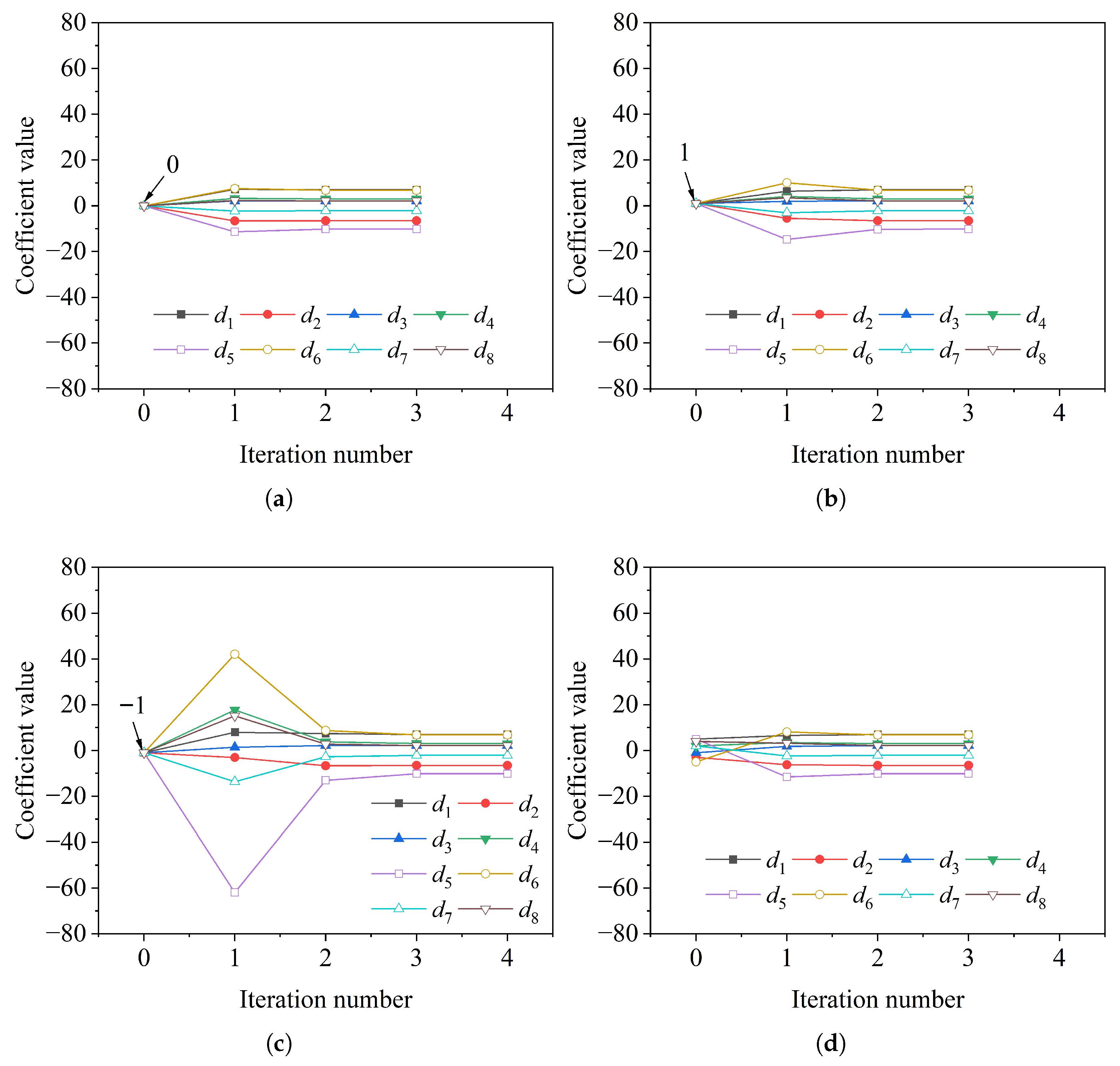
Since the numerical solution obtained by the Newton–Raphson method can be sensitive to the initial guess, multiple initial coefficient vectors are tested for the eight-coefficient displacement trial function, including the zero vector, an all-positive vector, an all-negative vector, and a random vector. The iterative convergence process is shown in
Figure 7. Despite significant differences in the initial values, all cases converge rapidly within three to four iterations, yielding identical final values of the undetermined coefficients. These converged coefficient values are listed in
Table 5. Notably, the coefficients already approach their final convergence values after the first or second iteration, demonstrating a high initial convergence rate. The results indicate that the potential energy functional, constructed based on the principle of minimum potential energy, exhibits convexity, and the numerical iteration process is insensitive to the choice of initial guess.
3.3. Deformation Mechanism
When the reinforcing fiber is wound at the experience-based engineering balanced angle of
, the axial deformation calculated by the semi-analytical method is −0.38 mm, as shown in
Table 3. This value is below the commonly adopted engineering tolerance standard of
mm, indicating effective suppression of axial deformation in the pipe under maximum working pressure and confirming its self-balanced state.
To validate the reliability of the semi-analytical method’s predictions, results are compared against experimental data reported in Reference [
32]. The measured axial deformations of the four thick-walled FRF pipe specimens are −0.05 mm, 0.25 mm, 0.35 mm, and −0.05 mm, with an average value of 0.125 mm. The scattered distribution and average value of the experimental results both fall within the engineering tolerance standard, indicating that all specimens still satisfy the self-balancing requirement under actual process fluctuations. Although the prediction from the semi-analytical method differs from the experimental mean, it shares the same sign as the measured value (−0.05 mm) and is close in absolute value to the other measured value (+0.35 mm). Meanwhile, the prediction satisfies the balancing evaluation criterion that the absolute value of axial deformation is less than 1 mm. This demonstrates that the method can reliably predict the macroscopic balancing performance indicators and validates the engineering applicability of the selected eight-coefficient displacement trial function.
To further examine the accuracy of the deformation mechanism revealed by the semi-analytical method, the displacement field contour plots obtained from the semi-analytical method are compared with those computed using the finite element method. The deformation contour plots of the thick-walled FRF pipe under identical loading conditions are generated through the finite element modeling procedure described in Reference [
32].
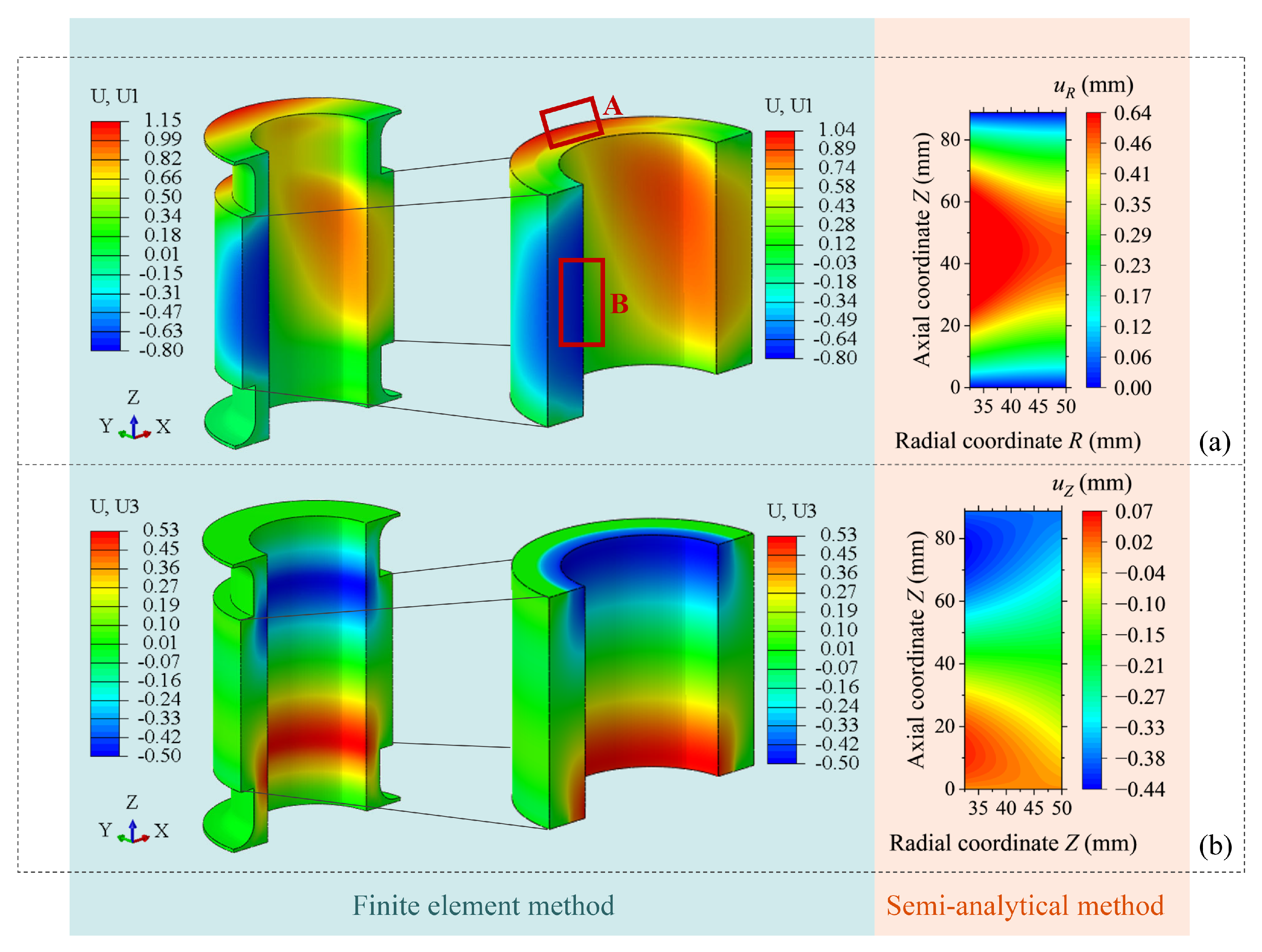
By comparing the displacement fields calculated by the two methods, as shown in
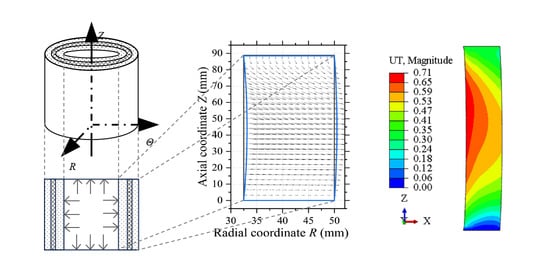
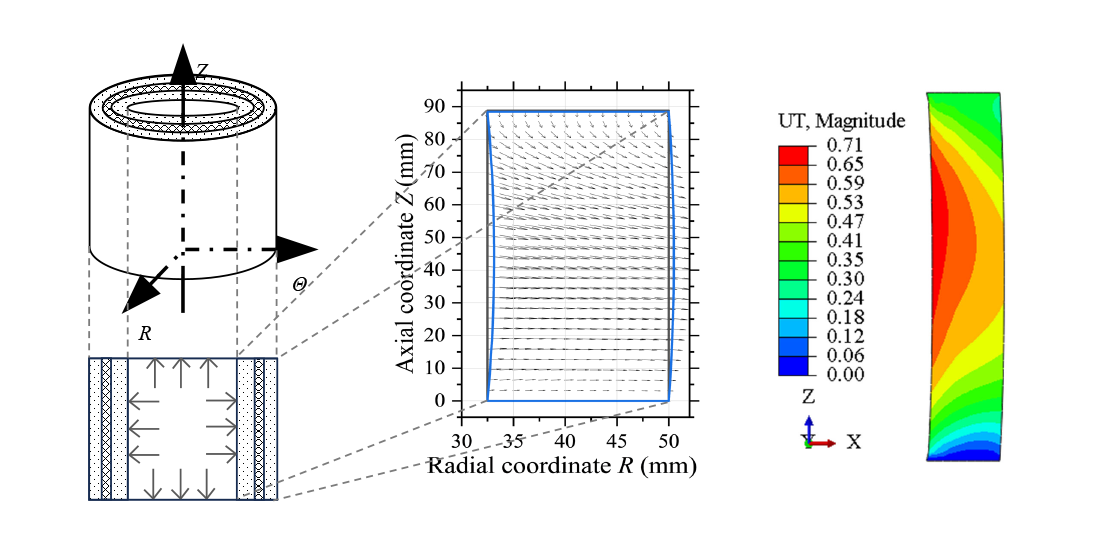
Figure 8, it can be seen that for the radial displacement, the radial displacement range of the straight pipe section in the finite element model (with flange section) is −0.8 mm to 1.04 mm, with the maximum value located in Region A on the upper surface of the straight pipe section and the minimum value in Region B at the axial middle of the pipe inner surface. The range obtained by the semi-analytical method is 0 mm to 0.64 mm, with the maximum value appearing at the axial middle of the inner surface and the minimum value at the fixed end and free end. For the axial displacement, although the contour distribution trends obtained by the two methods are generally consistent, there are still certain differences in the calculated values.
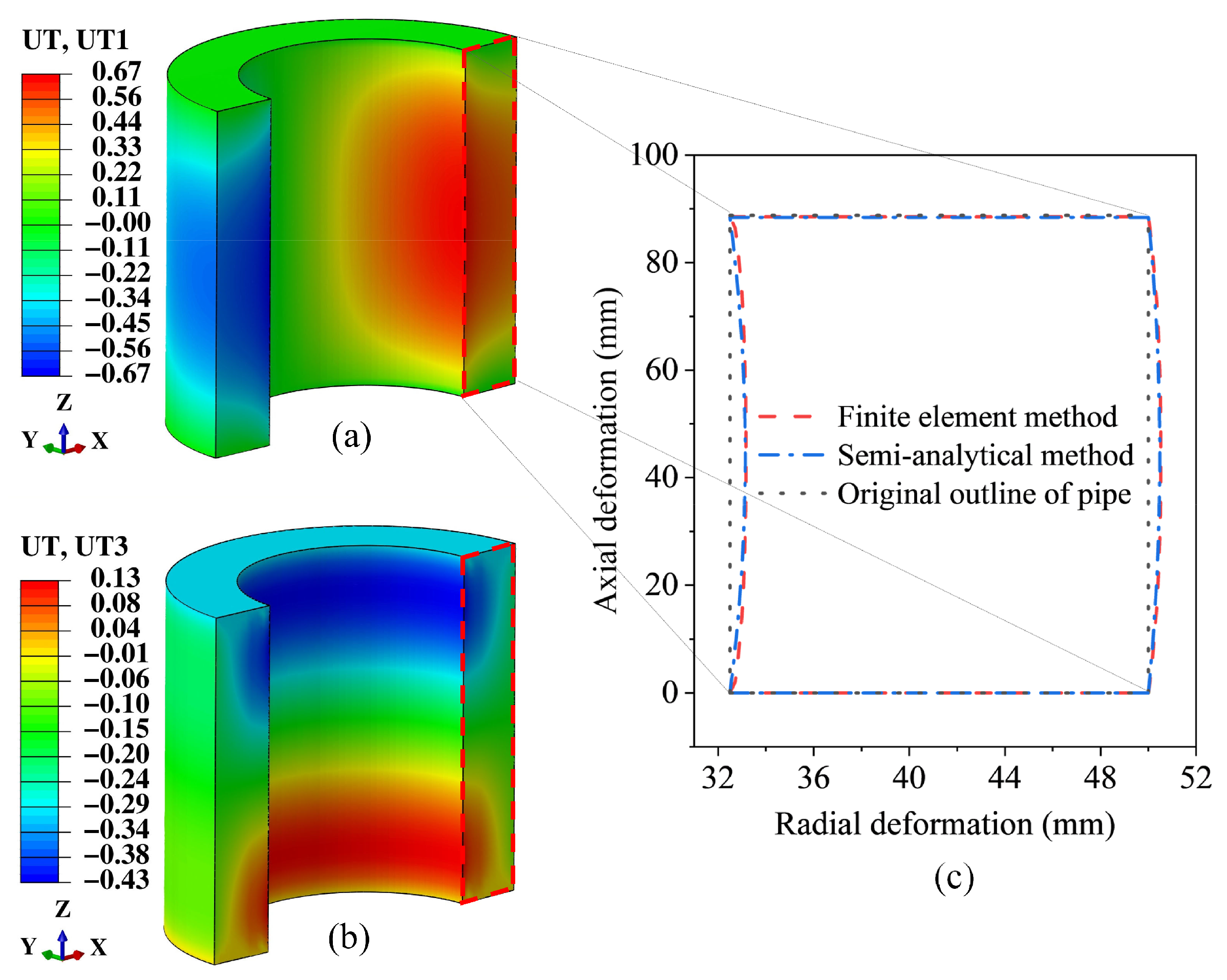
To clarify the source of the above differences, a finite element model containing only the straight pipe section is established, and its calculation results are shown in
Figure 9a,b. In addition,
Figure 9c extracts and compares the outer contour deformation of the pipe predicted by the semi-analytical method and the finite element method for the straight pipe section. The results show that under the same boundary conditions and loads, the two methods have minor differences in the overall distribution of the predicted displacement fields of the straight pipe section. This indicates that the discrepancies observed in
Figure 8 are mainly caused by the local constraint effect of the flange connection region.
Furthermore, the overall axial deformation of the pipe obtained by the finite element model of the straight pipe section is −0.3 mm, which differs by 0.08 mm from the result of the semi-analytical method (−0.38 mm). The difference is small and both are within the engineering allowable range of mm, indicating that the semi-analytical method can reliably predict the balanced performance of the thick-walled FRF pipe.
Compared with the finite element method, the semi-analytical method proposed in this work expresses the displacement field as an explicit function, which parameterizes the deformation distribution of the thick-walled pipe and enables a direct mapping between mathematical parameters and physical mechanisms. Based on the eight-coefficient displacement trial function, the deformation mechanism of the thick-walled FRF pipe in the balanced state can be clearly understood.
The eight coefficients, as shown in
Table 5, quantitatively characterize the dominant deformations shown in
Figure 8 and
Figure 9. For radial deformation, coefficient
represents the overall expansion trend caused by internal pressure. Coefficient
with opposite sign and similar absolute value quantifies the rapid constraint effect of the reinforcement layer as the radius increases, revealing the physical transition from matrix-dominated expansion near the inner wall to fiber-dominated anti-expansion within the reinforcement layer region. The relatively small magnitude of
results in a smoother displacement profile in the outer wall region, reflects both the continuity of the outermost pipe layer and its gradient-smoothing effect on the radial deformation. Collectively, these three coefficients constitute a quadratic function about the radial coordinate, and physically lead to the “inner expansion and outer suppression” non-uniform radial deformation gradient.
For axial deformation, coefficients , and jointly determine the axial displacement distribution along the pipe length, with their alternating signs indicating a complex nonlinear deformation pattern rather than simple uniform elongation or shortening. The most significant coefficients, and , exhibit equal magnitudes but opposite signs and together represent a locally warped displacement distribution that is antisymmetric about the mid-section of the pipe, induced by the rigid constraint at the end flange. Coefficient dominates the deformation near the fixed end (), while coefficient governs the deformation near the free end (). These two coefficients serve as the mathematical representation of the end effect in the axial displacement field.
In summary, when investigating the balanced performance of the thick-walled FRF pipe, the semi-analytical method proposed in this study, in comparison with the finite element method that yields discrete numerical solutions adopted in Reference [
32], is capable of transforming the complex nonlinear boundary-value problem into a low-dimensional parametric model, while simultaneously accounting for material nonlinearity and the end constraint effect of the finite-length laminated thick-walled pipe. The obtained coefficients of the displacement trial function possess distinct physical significance, which can directly quantify and reveal the dominant deformation mechanisms and thereby deepen the understanding of the deformation behavior of the thick-walled FRF pipe under the self-balanced state. In addition, the semi-analytical method characterizes the mechanical behavior of the pipe as a function of key design variables, including fiber winding angle, material properties, and geometric dimensions. The established parametric analysis can lay a theoretical foundation for the design analysis and optimization of the self-balancing thick-walled FRF pipe.
3.4. Effect of the Fiber Winding Angle
The fiber winding angle of the reinforcing fiber is one of the key design parameters that determine the mechanical properties of FRF pipes [
33]. For thick-walled FRF pipes, the dependence of axial deformation under the maximum working internal pressure on the fiber winding angle is an issue worthy of in-depth investigation. Analyzing this dependence not only reveals the influence of the fiber winding angle on balanced performance but also verifies the universality of the eight-coefficient displacement trial function across different design parameters.
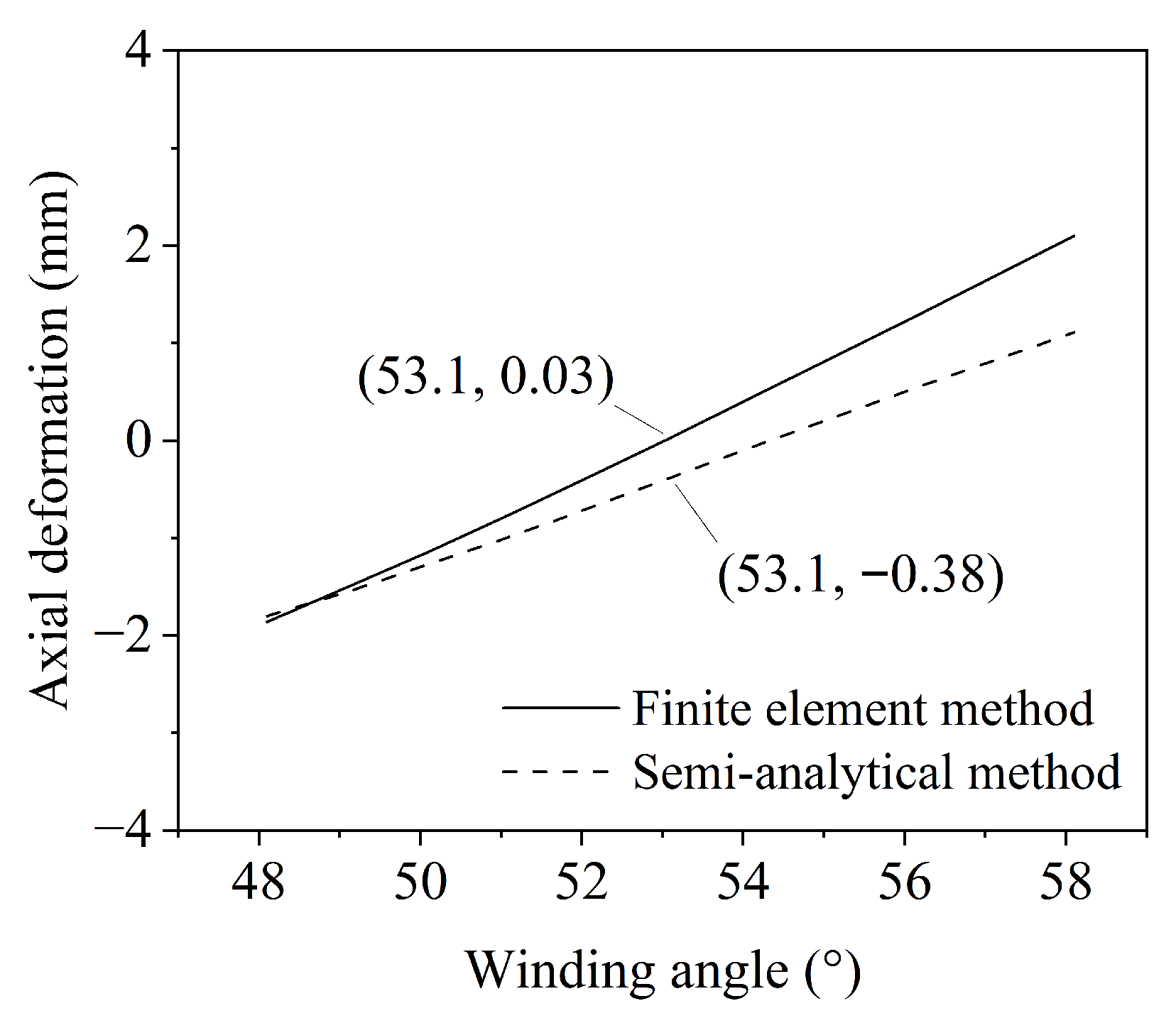
The axial deformation versus the fiber winding angle curves predicted by the two methods are shown in
Figure 10. The results show that the predicted curves from both methods exhibit the same trend. As the fiber winding angle increases, the axial deformation shifts from negative (contraction) to positive (extension), with the minimum deformation occurring near the empirically determined balanced angle.
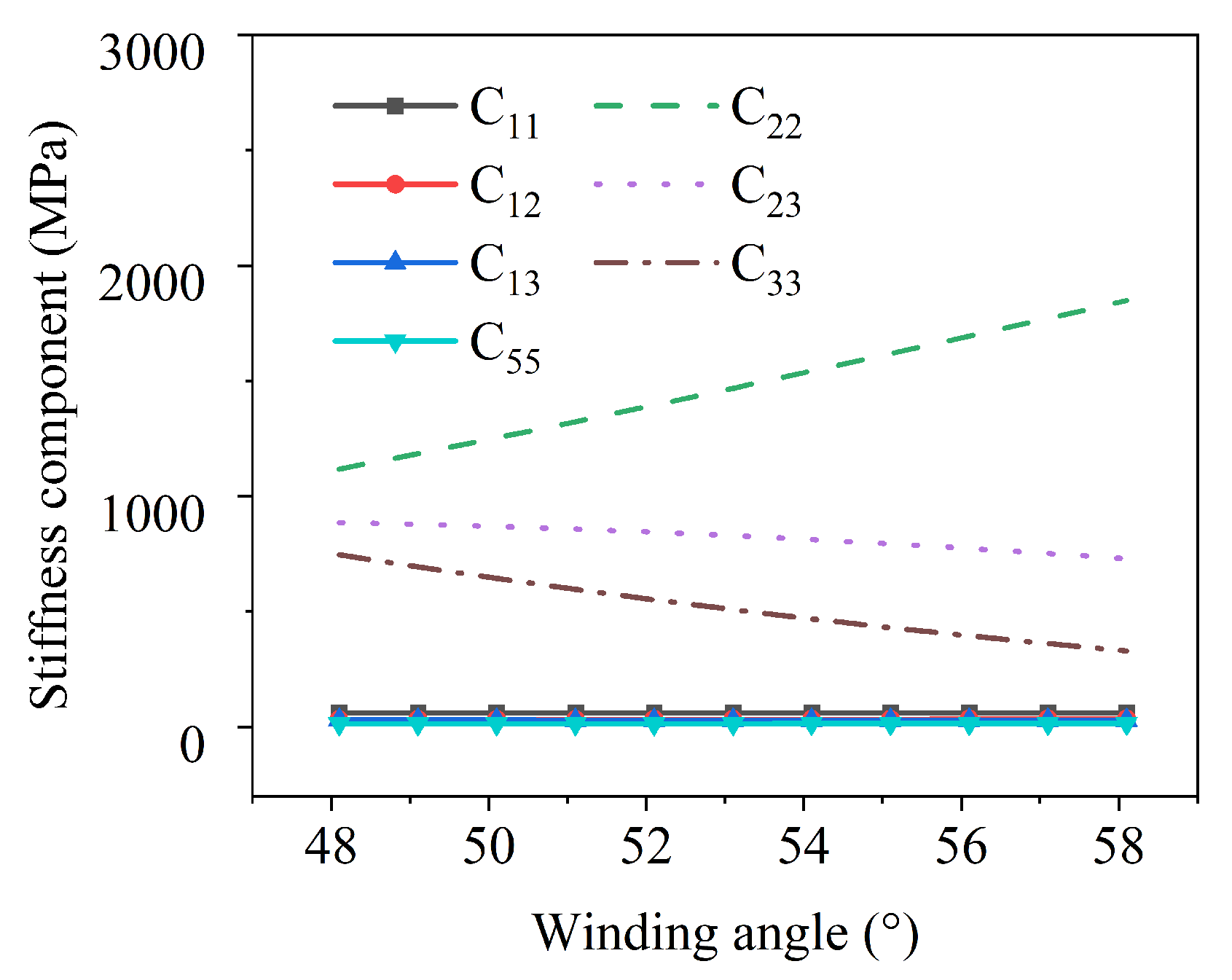
According to Formulas (24) and (29) together with the axisymmetric condition, the stiffness components (
,
,
,
,
, and
) in the strain energy density function of the reinforcement layer do not contribute to the deformation. The stiffness components contributing to the axial deformation of the pipe change with the winding angle as shown in
Figure 11. Among them, the circumferential stiffness
, the circumferential–axial coupling stiffness
, and the axial stiffness
change most significantly. As the fiber winding angle increases,
monotonically increases, while
and
monotonically decrease. From a physical perspective,
can inhibit the circumferential deformation of the pipe,
constrains the axial deformation of the pipe, and
regulates the influence of the circumferential strain of the pipe on the axial stress.
The changes in these stiffness components, through interaction with the rubber matrix, dominate the macroscopic axial deformation behavior of the pipe. Based on the characteristic that rubber materials are approximately incompressible, without the reinforcement layer, the radial expansion caused by the internal pressure forces the pipe to undergo axial contraction to meet the requirement of approximately constant rubber volume. Considering the contribution of the reinforcement layer, the fiber winding angle, by changing the equivalent stiffness of the reinforcement layer, modulates the deformation mode of the rubber matrix, thereby determining the macroscopic axial response of the pipe. Near the balanced winding angle, the Poisson effect of the rubber matrix and the reinforcement layer work together, causing the contraction and elongation of the pipe to reach macroscopic balance.