Research Progress on Interfacial Design and Mechanical Optimization of Graphene-Reinforced Titanium Matrix Composites

 , ,
, ,
Abstract
1. Introduction
2. Fabrication Methods of Graphene-Reinforced Titanium Matrix Composites
2.1. Powder Metallurgy
2.2. Spark Plasma Sintering
2.3. Other Processing Techniques
2.4. Data-Driven and Machine Learning-Assisted Process Design and Optimization
3. Processing Control Strategies for Uniform Dispersion of Graphene
3.1. Powder Homogenization
3.2. Powder Densification
3.3. Interface Architecture Design
4. Inhibition and Engineering of Graphene–Titanium Interface Reactions
4.1. Mechanisms and Challenges of Interface Reactions in Graphene/Titanium Composites
4.2. Interface Reaction Inhibition Strategies in Graphene-Reinforced Titanium Matrix Composites
4.3. Interface Architecture Engineering Toward Efficient Load Transfer in Graphene-Reinforced Titanium Matrix Composites
5. Conclusions and Prospects
- Targeted Selection of Reinforcement Phase: The choice of graphene type must be rigorously matched to specific performance objectives. GNPs are the preferred choice when pursuing high-strength, high-modulus, and three-dimensional network reinforcement effects. GNSs or GNFs are more suitable when the focus is on inhibiting crack propagation through their lamellar morphology and enhancing interfacial mechanical interlocking. For systems requiring a balance between reinforcement and plastic accommodation in environments prone to strong interfacial reactions, MLG or even FLG can be selected. In systems with poor dispersion or requiring low-temperature interface regulation, GO, leveraging its surface functional groups, can effectively improve process feasibility and provide potential for subsequent in situ functionalization. Despite their diversity, all types rely on their ultra-high intrinsic mechanical properties and unique two-dimensional topology to provide the core functions of load transfer, crack deflection, and interface strengthening in composites.
- Strategies for Improving Dispersion Uniformity: To enhance dispersion uniformity, various techniques such as ball milling, ultrasonic dispersion, surface modification, and thermal processing have been widely applied in research. Furthermore, interface design strategies combined with multiscale simulations provide a theoretical foundation for effective dispersion. Cross-scale models reveal the thermodynamic and kinetic mechanisms during the dispersion process, thereby guiding the optimization of dispersion parameters and facilitating the design of structurally stable, homogeneous composites. However, their effectiveness is always constrained by three key factors: dispersion uniformity, interfacial bonding state, and structural integrity.
- Regulation and Optimization of Interfacial Reactions: Studies have shown that rapid sintering at low temperatures under high pressures can effectively suppress the formation of excessive TiC. When combined with surface modification techniques and the addition of alloying elements, this strategy can further inhibit carbon atom diffusion. Simultaneously, constructing dual-scale layered or 3D network architectures that promote graphene alignment along grain boundaries can synergistically optimize load transfer and crack deflection effects. These strategies collectively enhance the mechanical properties of graphene-reinforced TMCs by concurrently optimizing interfacial integrity and composite toughness.
- Toward a Materials Genomics Approach for Composite Design. Future efforts must move beyond trial-and-error selection of graphene types (GNPs, GNSs, FLG, etc.) and matrix compositions. A more rational approach involves establishing quantitative “interface property maps” that link graphene characteristics (layer number, defect density, functionalization), matrix chemistry, and processing windows to final interfacial structure and mechanical performance. This requires integrating high-throughput computational screening with targeted experimental validation. The goal is to identify forbidden zones in the design space and pinpoint promising compositional niches that promote the formation of thin, discontinuous TiC or other beneficial interphases for enhanced load transfer. The critical challenge lies in accurately modeling and predicting the behavior of multi-component interfaces under non-equilibrium processing conditions.
- Active Design and Real-time Control of Interface Architecture. The prevailing strategy has been to suppress interfacial reactions. A more ambitious goal is to actively design and control them in situ. This involves pioneering novel interfacial engineering strategies, such as the pre-placement of nanoscale diffusion barriers or catalytic layers with atomic precision, potentially via advanced deposition techniques on powder surfaces. Furthermore, exploring in situ diagnostic tools coupled with rapid process control (adaptive SPS, laser processing) could enable real-time monitoring and feedback during sintering to freeze the interface at a desired state. The key scientific question is whether we can dynamically steer the reaction pathway (Ti + C → TiC) to favor nucleation of isolated nanoparticles over continuous film growth, leveraging insights from non-equilibrium thermodynamics and reaction kinetics.
- Manufacturing of Architected Composites with Cross-Scale Synergy. The true potential of graphene reinforcement may only be unlocked through deliberate spatial design at multiple scales. Future work should focus on developing hybrid manufacturing routes that combine the microstructural control of PM/SPS with the geometric freedom of additive manufacturing or severe plastic deformation. This would enable the fabrication of functionally graded or topologically optimized components where graphene reinforcements are placed strategically—for instance, concentrated in high-stress regions or aligned along specific load paths. The major hurdles are ensuring graphene survival during high-energy AM processes and achieving robust interfacial bonding in such heterogeneous structures. The vision is to progress from homogeneous composites to composite systems with tailored property profiles.
- AI and Machine Learning in Material Optimization. Machine learning and artificial intelligence demonstrate tremendous potential to revolutionize traditional materials development processes, but their application must be grounded in an understanding of the limitations of current models and the unique challenges of TMCs. Future research should focus on the following key areas: First, current literature is highly fragmented, and key descriptions are often missing; efforts should be made to establish a comprehensive, rigorously curated open-source database that includes process parameters, microstructural features, and mechanical properties. Second, the development of hybrid intelligent models that integrate physical laws is crucial. Pure data-driven models function like a “black box” and have limited extrapolation capabilities. The next generation of models must incorporate physical principles and domain knowledge (e.g., Hall–Petch effect) to enhance interpretability and improve prediction accuracy for unknown components or processes. Finally, advancing active learning and autonomous laboratories is essential. Beyond prediction, machine learning can guide experimental design. By establishing a Bayesian optimization loop, it will efficiently explore the vast process parameter space (e.g., graphene content, ball-milling time, sintering temperature/time) and automatically recommend the next set of experiments with the most informative potential, approaching multi-objective optimization.
Author Contributions
Funding
Data Availability Statement
Conflicts of Interest
Appendix A
| Abbreviation | Full Name | Description |
| Ti | Titanium | It is the chemical symbol for titanium. |
| TMCs | Titanium Matrix Composites | Composites made of a titanium alloy matrix and reinforcing phase(s), typically in the micrometer to nanometer range. |
| TC4/Ti64 | Ti-6Al-4V | A titanium alloy matrix consisting of titanium (90%), aluminum (6%), and vanadium (4%), on the micrometer scale. |
| GNPs | Graphene Nanoplatelets | Thin graphene sheets consisting of a few layers (typically 1–10 layers, 1–10 nm thick). |
| GNSs | Graphene Nanosheet | Single or few-layered graphene with 1 nm thickness for single-layer graphene. |
| GR | Graphene | In this paper, the term is used as a general reference to graphene-based materials. |
| GNFs | Graphene Nanoflakes | Flake-like graphene with multiple layers (typically 2–10 layers, 1–10 nm thick). |
| CP-Ti | Commercially Pure Titanium | Titanium with minimal alloying elements, typically over 99% pure titanium, often in the micrometer scale. |
| MLG | Multi-Layer Graphene | Graphene made up of multiple stacked layers (typically 2–10 layers, 1–3 nm thick per layer). Properties are between single-layer graphene and bulk graphite. |
| FLG | Few-Layered Graphene | Graphene consisting of a few layers, typically 2–10 layers, with thickness between 1–10 nm. |
| GO | Graphene Oxide | Oxidized graphene, typically with functional groups (e.g., hydroxyl, carboxyl) attached to the surface, typically on a nanometer scale (~1–2 nm thickness). |
| CNTs | Carbon Nanotubes | One-dimensional tubular carbon nanomaterials, referring to cylindrical carbon nanostructures with a tubular atomic arrangement of carbon atoms, typically with a diameter of 1–100 nm and a length ranging from micrometers to centimeters. |
| HCP | Hexagonal Close-Packed | A crystalline structure with atoms arranged in a hexagonal pattern. |
| BCC | Body-Centered Cubic | A crystal structure where atoms are arranged in a body-centered cubic lattice. |
| BN | Boron Nitride | - |
| PM | Powder Metallurgy | - |
| MA | Mechanical Alloying | - |
| SPS | Spark Plasma Sintering | - |
| BPR | Ball-to-Powder Ratio | - |
| PCA | Process Control Agent | - |
| HIP | Hot Isostatic Pressing | - |
| SLM | Selective Laser Melting | - |
| RHR | Reactive Hot Rolling | - |
| BGBM | Built-In Grooved Ball Milling | - |
References
- Hayat, M.D.; Singh, H.; He, Z.; Cao, P. Titanium metal matrix composites: An overview. Compos. Part A Appl. Sci. Manuf. 2019, 121, 418–438. [Google Scholar] [CrossRef]
- Md Ali, A.; Omar, M.Z.; Hashim, H.; Salleh, M.S.; Mohamed, I.F. Recent development in graphene-reinforced aluminium matrix composite: A review. Rev. Adv. Mater. Sci. 2021, 60, 801–817. [Google Scholar] [CrossRef]
- Wang, S.; Wang, J.; Xu, Z.; Wang, J.; Li, R. Numerical calculation of overlapping line heating for marine titanium alloy curved plate. Ocean Eng. 2024, 296, 117021. [Google Scholar] [CrossRef]
- Dubey, S.; Soboyejo, W.O.; Srivatsan, T.S. Deformation and Fracture Properties of Damage Tolerant In-situ Titanium Matrix Composites. Appl. Compos. Mater. 1997, 4, 361–374. [Google Scholar] [CrossRef]
- Xue, N.P.; Wu, Q.; Zhang, Y.; Li, B.H.; Zhang, Y.D.; Yang, S.; Zhu, Y.; Guo, J.; Gao, H.J. Review on research progress and comparison of different residual stress strengthening methods for titanium alloys. Eng. Fail. Anal. 2022, 144, 106937. [Google Scholar] [CrossRef]
- Papageorgiou, D.G.; Kinloch, I.A.; Young, R.J. Mechanical properties of graphene and graphene-based nanocomposites. Prog. Mater. Sci. 2017, 90, 75–127. [Google Scholar] [CrossRef]
- Razaq, A.; Bibi, F.; Zheng, X.; Papadakis, R.; Jafri, S.H.M.; Li, H. Review on graphene-, graphene oxide-, reduced graphene oxide-based flexible composites: From fabrication to applications. Materials 2022, 15, 1012. [Google Scholar] [CrossRef]
- Shchegolkov, A.V.; Shchegolkov, A.V.; Kaminskii, V.V. Carbon Nanotubes and Graphene in Polymer Composites for Strain Sensors: Synthesis, Functionalization, and Application. J. Compos. Sci. 2026, 10, 43. [Google Scholar] [CrossRef]
- Lee, C.; Wei, X.; Kysar, J.W.; Hone, J. Measurement of the Elastic Properties and Intrinsic Strength of Monolayer Graphene. Science 2008, 321, 385–388. [Google Scholar] [CrossRef] [PubMed]
- Han, X.; Wang, R.; Kang, P.; Li, W.; Wu, G. First-Principles Study on the Influence of Crystal Structures on the Interface Properties of Graphene/Titanium Composites. Coatings 2024, 14, 1293. [Google Scholar] [CrossRef]
- Lee, H.; Lordejani, A.A.; van Goor, L.; Jurov, A.; Koutsioukis, A.; Ruan, S.; Santhosh, N.M.; Zarei, F.; Barreneche, C.; Cvelbar, U.; et al. Review on properties; physics, and fabrication of two-dimensional material-based metal-matrix composites (2DMMCs) for heat transfer systems. Renew. Sustain. Energy Rev. 2025, 217, 115700. [Google Scholar] [CrossRef]
- Wen, X.; Joshi, R. 2D materials-based metal matrix composites. J. Phys. D Appl. Phys. 2020, 53, 423001. [Google Scholar] [CrossRef]
- Yan, Q.; Chen, B.; Li, J.S. Super-high-strength graphene/titanium composites fabricated by selective laser melting. Carbon 2021, 174, 451–462. [Google Scholar] [CrossRef]
- Mutuk, T.; Gürbüz, M. Si3N4/Graphene binary particles reinforced hybrid titanium composites and their characterization. Int. J. Mater. Res. 2021, 112, 717–725. [Google Scholar] [CrossRef]
- Cao, H.-C.; Liang, Y.-L. The microstructures and mechanical properties of graphene-reinforced titanium matrix composites. J. Alloys Compd. 2020, 815, 152057. [Google Scholar] [CrossRef]
- Gürbüz, M.; Mutuk, T.; Uyan, P. Mechanical, Wear and Thermal Behaviors of Graphene Reinforced Titanium Composites. Met. Mater. Int. 2020, 27, 744–752. [Google Scholar] [CrossRef]
- Chen, D.; Li, J.; Sun, K.; Fan, J. Graphene-reinforced metal matrix composites: Fabrication, properties, and challenges. Int. J. Adv. Manuf. Technol. 2023, 125, 2925–2965. [Google Scholar] [CrossRef]
- Yoganandam, K.; Mohanavel, V.; Vairamuthu, J.; Kannadhasan, V. Mechanical properties of titanium matrix composites fabricated via powder metallurgy method. Mater. Today Proc. 2020, 33, 3243–3247. [Google Scholar] [CrossRef]
- Gao, Y.; Zou, J.; Wang, H.; Han, Y. Interfacial reaction and interfacial strengthening mechanism of graphene nanosheets reinforced powder metallurgy nickel-based superalloy composite. Mater. Charact. 2023, 205, 113282. [Google Scholar] [CrossRef]
- Suryanarayana, C. Mechanical Alloying: A Novel Technique to Synthesize Advanced Materials. Research 2019, 2019, 4219812. [Google Scholar] [CrossRef]
- Sharma, D.; Singla, V.K.; Singh, S. Effect of multi-layer graphene on microstructure and mechanical properties of titanium-based composites. Proc. Inst. Mech. Eng. Part C J. Mech. Eng. Sci. 2022, 236, 8542–8551. [Google Scholar] [CrossRef]
- Alsalama, M.; Hamoudi, H.; Youssef, K.M. The effect of graphene structural integrity on the power factor of tin selenide nanocomposite. J. Alloys Compd. 2021, 872, 159584. [Google Scholar] [CrossRef]
- Wang, H.; Zhang, H.M.; Cheng, X.W.; Chang, S.; Mu, X.N. Effect of ball milling time on microstructure and mechanical properties of graphene nanoplates and TiBw reinforced Ti–6Al–4V alloy composites. Mater. Sci. Eng. A 2022, 861, 144240. [Google Scholar] [CrossRef]
- Zhou, Y.; Dong, L.; Yang, Q.; Huo, W.; Fu, Y.; Yu, J.; Liu, Y.; Zhang, Y. Controlled Interfacial Reactions and Superior Mechanical Properties of High Energy Ball Milled/Spark Plasma Sintered Ti–6Al–4V–Graphene Composite. Adv. Eng. Mater. 2021, 23, 2001411. [Google Scholar] [CrossRef]
- Haghighi, M.; Shaeri, M.H.; Sedghi, A.; Djavanroodi, F. Effect of Graphene Nanosheets Content on Microstructure and Mechanical Properties of Titanium Matrix Composite Produced by Cold Pressing and Sintering. Nanomaterials 2018, 8, 1024. [Google Scholar] [CrossRef]
- Zhang, J.; Min, B.W.; Gu, H.; Wu, G.Q.; Dai, G.Q.; Sun, Z.G. Grain Refinement and Mechanical Enhancement of Titanium Matrix Composites with Nickel-Coated Graphene Nanoflakes: Influence of Particle-Size Mismatch. Crystals 2024, 6, 516. [Google Scholar] [CrossRef]
- Gürbüz, M.; Mutuk, T. Effect of process parameters on hardness and microstructure of graphene reinforced titanium composites. J. Compos. Mater. 2017, 52, 543–551. [Google Scholar] [CrossRef]
- Dong, L.; Zhang, W.; Fu, Y.; Lu, J.; Liu, X.; Tian, N.; Zhang, Y. Reduced Graphene Oxide Nanosheets Decorated with Copper and Silver Nanoparticles for Achieving Superior Strength and Ductility in Titanium Composites. ACS Appl. Mater. Interfaces 2021, 13, 43197–43208. [Google Scholar] [CrossRef] [PubMed]
- Pekok, M.; Setchi, R.; Ryan, M.; Han, Q. Effect of Milling Speed and Time on Graphene-Reinforced AA2024 Powder. In Sustainable Design and Manufacturing 2020; Springer: Singapore, 2021. [Google Scholar]
- Zhu, J.; Yuan, M.; Pei, X.; Zhou, X.; Li, M. The Effect of Stearic Acid on Microstructure and Properties of (Ti2AlC + Al2O3)p/TiAl Composites. Metals 2024, 14, 392. [Google Scholar] [CrossRef]
- Hou, J.; Chi, F.; Chi, L.; Cui, G.; Chen, W.; Zhang, W. Effects of the interface and mechanical properties of GNPs/TA15 composites through adding B powders. J. Alloys Compd. 2021, 902, 162538. [Google Scholar] [CrossRef]
- Kozlík, J.; Stráský, J.; Harcuba, P.; Ibragimov, I.; Chráska, T.; Janeček, M. Cryogenic Milling of Titanium Powder. Metals 2018, 8, 31. [Google Scholar] [CrossRef]
- Ge, Y.X.; Zhang, H.M.; Cheng, X.W.; Fan, Q.B.; Zhang, Z.H.; Mu, X.N.; Liu, L. Towards high performance in Ti-based composite through manipulating nickel coatings on graphene reinforcement. J. Alloys Compd. 2021, 893, 162240. [Google Scholar] [CrossRef]
- Lin, K.; Fang, Y.; Gu, D.; Ge, Q.; Zhuang, J.; Xi, L. Selective laser melting of graphene reinforced titanium matrix composites: Powder preparation and its formability. Adv. Powder Technol. 2021, 32, 1426–1437. [Google Scholar] [CrossRef]
- Yu, J.; Zhao, Y.; Zhao, Q.; Zhang, W.; Huo, W.; Zhang, Y. Microstructure and Properties of Titanium Matrix Composites Synergistically Reinforced by Graphene Oxide and Alloying Elements. Adv. Eng. Mater. 2022, 25, 2101778. [Google Scholar] [CrossRef]
- Wang, W.; Zhou, H.; Wang, Q.; Wei, B.; Xin, S.; Gao, Y. Microstructural Evolution and Mechanical Properties of Graphene-Reinforced Ti-6Al-4V Composites Synthesized via Spark Plasma Sintering. Metals 2020, 10, 737. [Google Scholar] [CrossRef]
- Yu, J.; Zhao, Q.; Huang, S.; Zhao, Y.; Zhou, Y.; Lu, J.; Dong, L.; Zhang, Y. Effect of sintering temperature on microstructure and properties of graphene nanoplatelets reinforced TC21 composites prepared by spark plasma sintering. J. Alloys Compd. 2021, 879, 160346. [Google Scholar] [CrossRef]
- Zhang, Z.Y.; Liang, Y.L.; Cao, H.C.; Zhu, Y. The Preparation and Mechanical Properties of a Pure Titanium-Based Matrix Composite Reinforced with Graphene Nanoplatelets. Sci. Adv. Mater. 2019, 12, 296–303. [Google Scholar] [CrossRef]
- Liu, J.; Hu, N.; Liu, X.; Liu, Y.; Lv, X.; Wei, L.; Zheng, S. Microstructure and Mechanical Properties of Graphene Oxide-Reinforced Titanium Matrix Composites Synthesized by Hot-Pressed Sintering. Nanoscale Res. Lett. 2019, 14, 114. [Google Scholar] [CrossRef]
- Mu, X.N.; Cai, H.N.; Zhang, H.M.; Fan, Q.B.; Wang, F.C.; Zhang, Z.H.; Ge, Y.X.; Shi, R.; Wu, Y.; Wang, Z.; et al. Uniform dispersion and interface analysis of nickel coated graphene nanoflakes/ pure titanium matrix composites. Carbon 2018, 137, 146–155. [Google Scholar] [CrossRef]
- Ge, Y.X.; Zhang, H.M.; Cheng, X.W.; Fan, Q.B.; Zhang, Z.H.; Mu, X.N.; Liu, L.; Liu, Y.N.; Wang, B. Interface evolution and mechanical properties of nickel coated graphene nanoflakes/pure titanium matrix composites. J. Alloys Compd. 2021, 853, 157157. [Google Scholar] [CrossRef]
- Zhang, B.; Zhang, F.; Saba, F.; Shang, C. Graphene-TiC hybrid reinforced titanium matrix composites with 3D network architecture: Fabrication, microstructure and mechanical properties. J. Alloys Compd. 2021, 859, 157777. [Google Scholar] [CrossRef]
- Shang, C.; Zhang, F.; Zhang, B.; Chen, F. Interface microstructure and strengthening mechanisms of multilayer graphene reinforced titanium alloy matrix nanocomposites with network architectures. Mater. Des. 2020, 196, 109119. [Google Scholar] [CrossRef]
- Li, Z.; Xing, S.; Wu, S.; Hou, J.; Wu, S. A Review on the Interface Structure and Control Between Graphene Nanoplatelets (GNPs) and Ti Matrix of GNPs/Ti Matrix Composites. Metals 2024, 14, 1316. [Google Scholar] [CrossRef]
- Yan, Q.; Chen, B.; Ye, W.; Zhang, T.; Wan, J.; Zhou, Q.; Shen, J.; Li, J.; Lu, W.F.; Wang, H. Simultaneously improving mechanical; thermal, and anti-wear properties of Ti alloys using 3D-networked graphene as reinforcement. Carbon 2023, 213, 118152. [Google Scholar] [CrossRef]
- Liu, J.; Wu, M.; Yang, Y.; Yang, G.; Yan, H.; Jiang, K. Preparation and mechanical performance of graphene platelet reinforced titanium nanocomposites for high temperature applications. J. Alloys Compd. 2018, 765, 1111–1118. [Google Scholar] [CrossRef]
- Yang, Y.; Feng, C.; Zhou, Y.; Zha, X.; Bao, R.; Ke, K.; Yang, M.; Tan, C.; Yang, W. Achieving improved electromagnetic interference shielding performance and balanced mechanical properties in polyketone nanocomposites via a composite MWCNTs carrier. Compos. Part A Appl. Sci. Manuf. 2020, 136, 105967. [Google Scholar] [CrossRef]
- Suryanarayana, C. Mechanical alloying: A critical review. Mater. Res. Lett. 2022, 10, 619–647. [Google Scholar] [CrossRef]
- Duan, H.; Li, X.; Zhang, H.; Cheng, X.; Mu, X.; Zheng, K. The High-Strain-Rate Impacts Behaviors of Bilayer TC4-(GNPs/TC4) Composites with a Hierarchical Microstructure. Materials 2024, 17, 5589. [Google Scholar] [CrossRef]
- Huang, L.J.; Geng, L.; Peng, H.X. Microstructurally inhomogeneous composites: Is a homogeneous reinforcement distribution optimal? Prog. Mater. Sci. 2015, 71, 93–168. [Google Scholar] [CrossRef]
- Oguntuyi, S.D.; Johnson, O.T.; Shongwe, M.B. Spark plasma sintering of ceramic matrix composite of TiC: Microstructure, densification, and mechanical properties: A review. Int. J. Adv. Manuf. Technol. 2021, 116, 69–82. [Google Scholar] [CrossRef]
- Rominiyi, A.L.; Shongwe, M.B.; Maledi, N.; Babalola, B.J.; Olubambi, P.A. Synthesis, microstructural and phase evolution in Ti–2Ni and Ti–10Ni binary alloys consolidated by spark plasma sintering technique. Int. J. Adv. Manuf. Technol. 2019, 104, 1041–1049. [Google Scholar] [CrossRef]
- Falodun, O.E.; Oke, S.R.; Obadele, B.A.; Okoro, A.M.; Olubambi, P.A. Influence of SiAlON Ceramic Reinforcement on Ti6Al4V Alloy Matrix via Spark Plasma Sintering Technique. Met. Mater. Int. 2019, 27, 1769–1778. [Google Scholar] [CrossRef]
- Singh, N.; Ummethala, R.; Karamched, P.S.; Sokkalingam, R.; Gopal, V.; Manivasagam, G.; Prashanth, K.G. Spark plasma sintering of Ti6Al4V metal matrix composites: Microstructure, mechanical and corrosion properties. J. Alloys Compd. 2021, 865, 158875. [Google Scholar] [CrossRef]
- Wang, Q.; Zhang, Z.H.; Liu, L.J.; Jia, X.T.; He, Y.Y.; Sun, Y.H.; Cheng, X.W. Fabrication of TiB-reinforced titanium matrix composite via spark plasma sintering and vertical bidirectional reactive hot rolling. Mater. Charact. 2023, 206, 113450. [Google Scholar] [CrossRef]
- Yu, J.; Zhao, Y.; Zhang, W.; Zhao, Q.; Lu, J.; Huo, W.; Zhang, Y. A novel heterogeneous network structure titanium matrix composite with a combination of strength and ductility. Mater. Sci. Eng. A 2022, 840, 142954. [Google Scholar] [CrossRef]
- Zhang, X.; Alduma, A.I.A.; Zhan, F.; Zhang, W.; Ren, J.; Lu, X. Effect of Grain Size on Mechanical Properties and Deformation Mechanism of Nano-Polycrystalline Pure Ti Simulated by Molecular Dynamics. Metals 2025, 15, 271. [Google Scholar] [CrossRef]
- El-Hadad, S.; Elsayed, A.; Shi, B.; Attia, H. Experimental Investigation on Machinability of α/β Titanium Alloys with Different Microstructures. Materials 2023, 16, 7157. [Google Scholar] [CrossRef]
- Lei, C.; Du, Y.; Zhu, M.; Huo, W.; Wu, H.; Zhang, Y. Microstructure and mechanical properties of in situ TiC/Ti composites with a laminated structure synthesized by spark plasma sintering. Mater. Sci. Eng. A 2021, 812, 141136. [Google Scholar] [CrossRef]
- Smetanina, K.E.; Andreev, P.V.; Nokhrin, A.V.; Lantsev, E.A.; Chuvildeev, V.N. Carbon contamination during spark plasma sintering of powder materials: A brief overview. J. Alloys Compd. 2023, 973, 172823. [Google Scholar] [CrossRef]
- Cao, X.; Ma, H.; Jia, G.; Dai, G.; Guo, Y.; Sun, Z.; Liu, H.; Chang, H. Role of Powder Metallurgical Processing on Mechanical Response of Nickel–Phosphorus-Coated Graphene Nanoflakes/Titanium Matrix Composites. Adv. Eng. Mater. 2023, 25, 2201002. [Google Scholar] [CrossRef]
- Cai, C.; Gao, X.; Teng, Q.; Kiran, R.; Liu, J.; Wei, Q.; Shi, Y. Hot isostatic pressing of a near α-Ti alloy: Temperature optimization, microstructural evolution and mechanical performance evaluation. Mater. Sci. Eng. A 2020, 802, 140426. [Google Scholar] [CrossRef]
- Liu, L.; Li, Y.; Zhang, H.; Cheng, X.; Mu, X.; Ge, Y. Breaking through the dynamic strength-ductility trade-off in TiB reinforced Ti composites by incorporation of graphene nanoplatelets. Compos. Part B Eng. 2021, 230, 109499. [Google Scholar] [CrossRef]
- Otte, J.A.; Zou, J.; Dargusch, M.S. High strength and ductility of titanium matrix composites by nanoscale design in selective laser melting. J. Mater. Sci. Technol. 2022, 118, 114–127. [Google Scholar] [CrossRef]
- Akhil, U.V.; Radhika, N.; Ramkumar, T.; Pramanik, A. Effect of graphene on the tribological behavior of Ti6Al6V2Sn/Gn composite produced via microwave sintering. Int. J. Lightweight Mater. Manuf. 2024, 7, 1–13. [Google Scholar] [CrossRef]
- Zhou, H.; Su, Y.; Liu, N.; Kong, F.; Wang, X.; Zhang, X.; Chen, Y. Modification of microstructure and properties of Ti-47Al-2Cr-4Nb-0.3W alloys fabricated by SPS with trace multilayer graphene addition. Mater. Charact. 2018, 138, 1–10. [Google Scholar] [CrossRef]
- Yan, Q.; Chen, B.; Cao, L.; Liu, K.Y.; Li, S.; Jia, L.; Kondoh, K.; Li, J.S. Improved mechanical properties in titanium matrix composites reinforced with quasi-continuously networked graphene nanosheets and in-situ formed carbides. J. Mater. Sci. Technol. 2021, 96, 85–93. [Google Scholar] [CrossRef]
- Chen, H.; Mi, G.; Li, P.; Cao, C. Excellent high-temperature strength and ductility of graphene oxide reinforced high-temperature titanium alloy matrix composite fabricated by hot isostatic pressing and heat treatment. Compos. Commun. 2022, 30, 101077. [Google Scholar] [CrossRef]
- Yang, W.Z.; Huang, W.M.; Wang, Z.F.; Shang, F.J.; Huang, W.; Zhang, B.Y. Thermal and Mechanical Properties of Graphene–Titanium Composites Synthesized by Microwave Sintering. Acta Metall. Sin. Engl. Lett. 2016, 29, 707–713. [Google Scholar] [CrossRef]
- Sharma, H.; Arora, G.; Singh, M.K.; Ayyappan, V.; Bhowmik, P.; Rangappa, S.M.; Siengchin, S. Review of machine learning approaches for predicting mechanical behavior of composite materials. Discov. Appl. Sci. 2025, 7, 1238. [Google Scholar] [CrossRef]
- Dev, B.; Rahman, M.A.; Islam, M.J.; Rahman, M.Z.; Zhu, D. Properties prediction of composites based on machine learning models: A focus on statistical index approaches. Mater. Today Commun. 2023, 38, 107659. [Google Scholar] [CrossRef]
- Wu, X.; Zhou, Y.; Zhang, J.; Liang, J. Data driven performance prediction of titanium-based matrix composites. Alex. Eng. J. 2023, 85, 300–306. [Google Scholar] [CrossRef]
- Nasr, M.M.; Anwar, S.M.; Al-Samhan, A.; Ghaleb, M.; Dabwan, A. Milling of Graphene Reinforced Ti6Al4V Nanocomposites: An Artificial Intelligence Based Industry 4.0 Approach. Materials 2020, 13, 5707. [Google Scholar] [CrossRef]
- Pashmforoush, F. Mechanical properties prediction of various graphene reinforced nanocomposites using transfer learning-based deep neural network. Proc. Inst. Mech. Eng. Part E J. Process Mech. Eng. 2022, 237, 1214–1223. [Google Scholar] [CrossRef]
- Malashin, I.P.; Martysyuk, D.; Nelyub, V.; Borodulin, A.; Gantimurov, A.; Tynchenko, V. A review of physics-informed and data-driven approaches for manufacturing process optimization in polymer matrix composites. Adv. Manuf. Polym. Compos. Sci. 2025, 11, 2547335. [Google Scholar] [CrossRef]
- Ribeiro, D.S.; Santos, J.C.; Grieger, S.; Campos, J.L.E.; Machado, L.R.; Pacheco, F.G.; Fernandes, T.F.; Haase, C.C.; Silva, D.L.; Guterres, M.; et al. Measuring the Surface Area Concentration and Specific Surface Area of Mass-Produced Graphene Nanoflakes via Fluorescence Quenching. ACS Appl. Nano Mater. 2023, 6, 11198–11210. [Google Scholar] [CrossRef]
- Mazaheri, M.; Payandehpeyman, J.; Hedayatian, M. Agglomeration and interphase-influenced effective elastic properties of Metal/Graphene nanocomposites: A developed mean-field model. Compos. Struct. 2023, 329, 117762. [Google Scholar] [CrossRef]
- Munir, K.S.; Zheng, Y.; Zhang, D.; Lin, J.; Li, Y.; Wen, C. Microstructure and mechanical properties of carbon nanotubes reinforced titanium matrix composites fabricated via spark plasma sintering. Mater. Sci. Eng. A 2017, 688, 505–523. [Google Scholar] [CrossRef]
- Mahmood, S.; Iqbal, A.; Wadood, A.; Mateen, A.; Amin, M.; Yahia, I.S.; Zahran, H.Y. Influence of Homogenizing Methodology on Mechanical and Tribological Performance of Powder Metallurgy Processed Titanium Composites Reinforced by Graphene Nanoplatelets. Molecules 2022, 27, 2666. [Google Scholar] [CrossRef]
- Mu, X.N.; Cai, H.N.; Zhang, H.M.; Fan, Q.B.; Wang, F.C.; Zhang, Z.H.; Wu, Y.; Ge, Y.X.; Chang, S.; Shi, R.; et al. Uniform dispersion of multi-layer graphene reinforced pure titanium matrix composites via flake powder metallurgy. Mater. Sci. Eng. A 2018, 725, 541–548. [Google Scholar] [CrossRef]
- Zhang, W.; Zhou, S.; Ren, W.; Yang, Y.; Shi, L.; Zhou, Q.; Liu, M. Uniformly dispersing GNPs for fabricating graphene-reinforced pure Ti matrix composites with enhanced strength and ductility. J. Alloys Compd. 2021, 888, 161527. [Google Scholar] [CrossRef]
- Zhou, Q.; Liu, M.; Zhang, W.; Zhang, Z.; Sun, Y.; Ren, W.; Wei, J.; Wu, P.; Ma, S. The distribution of reinforcements in titanium matrix composites enhanced with graphene: From dispersed to networked. Carbon 2024, 226, 119204. [Google Scholar] [CrossRef]
- Zhang, W.; Wu, P.; Wei, J.; Zhou, Q.; Liu, M. Simple, low-cost and high-quality fabrication of GNPs@Ti6Al4V powders for high-performance composites Inspired by pearl polishing. Mater. Lett. 2024, 367, 136646. [Google Scholar] [CrossRef]
- Mu, X.N.; Zhang, H.M.; Cai, H.N.; Fan, Q.B.; Zhang, Z.H.; Wu, Y.; Fu, Z.J.; Yu, D.H. Microstructure evolution and superior tensile properties of low content graphene nanoplatelets reinforced pure Ti matrix composites. Mater. Sci. Eng. A 2017, 687, 164–174. [Google Scholar] [CrossRef]
- Cao, Z.; Li, J.L.; Zhang, H.P.; Li, W.B.; Wang, X.D. Mechanical and tribological properties of graphene nanoplatelets-reinforced titanium composites fabricated by powder metallurgy. J. Iron Steel Res. Int. 2020, 27, 1357–1362. [Google Scholar] [CrossRef]
- Wei, L.; Liu, X.; Gao, Y.; Lv, X.; Hu, N.; Chen, M. Synergistic strengthening effect of titanium matrix composites reinforced by graphene oxide and carbon nanotubes. Mater. Des. 2021, 197, 109261. [Google Scholar] [CrossRef]
- Hu, Z.; Tong, G.; Nian, Q.; Xu, R.; Saei, M.; Chen, F.; Chen, C.; Zhang, M.; Guo, H.; Xu, J. Laser sintered single layer graphene oxide reinforced titanium matrix nanocomposites. Compos. Part B Eng. 2016, 93, 352–359. [Google Scholar] [CrossRef]
- Jeje, S.O.; Shongwe, M.B.; Rominiyi, A.L.; Olubambi, P.A. Spark plasma sintering of titanium matrix composite—A review. Int. J. Adv. Manuf. Technol. 2021, 117, 2529–2544. [Google Scholar] [CrossRef]
- Song, Y.; Liu, W.; Sun, Y.; Guan, S.; Chen, Y. Microstructural Evolution and Mechanical Properties of Graphene Oxide-Reinforced Ti6Al4V Matrix Composite Fabricated Using Spark Plasma Sintering. Nanomaterials 2021, 11, 1440. [Google Scholar] [CrossRef]
- Liu, L.; Li, Y.; Zhang, H.; Cheng, X.; Fan, Q.; Mu, X.; Guo, S. Good strength-plasticity compatibility in graphene nanoplatelets/Ti composites by strengthening the interface bonding via in-situ formed TiB whisker. Ceram. Int. 2021, 47, 4338–4343. [Google Scholar] [CrossRef]
- Hu, Z.; Chen, F.; Xu, J.; Ma, Z.; Guo, H.; Chen, C.; Nian, Q.; Wang, X.; Zhang, M. Fabricating graphene-titanium composites by laser sintering PVA bonding graphene titanium coating: Microstructure and mechanical properties. Compos. Part B Eng. 2018, 134, 133–140. [Google Scholar] [CrossRef]
- Akhil, U.V.; Radhika, N.; Ramkumar, T. Corrosion behavior of microwave-sintered Ti6Al6V2Sn reinforced with graphene nanoparticles. J. Bio TriboCorros. 2024, 10, 91. [Google Scholar] [CrossRef]
- Liang, A.; Jiang, X.; Hong, X.; Jiang, Y.; Shao, Z.; Zhu, D. Recent Developments Concerning the Dispersion Methods and Mechanisms of Graphene. Coatings 2018, 8, 33. [Google Scholar] [CrossRef]
- Skrypnychuk, V.; Boulanger, N.; Nordenstrom, A.; Talyzin, A. Aqueous Activated Graphene Dispersions for Deposition of High-Surface Area Supercapacitor Electrodes. J. Phys. Chem. Lett. 2020, 11, 3032–3038. [Google Scholar] [CrossRef]
- Sainz-Urruela, C.; Vera-López, S.; San Andrés, M.P.; Díez-Pascual, A.M. Surface functionalization of graphene oxide with tannic acid: Covalent vs non-covalent approaches. J. Mol. Liq. 2022, 357, 119104. [Google Scholar] [CrossRef]
- Yan, Q.; Chen, B.; Ye, W.; Wan, J.; Zhang, T.; Kou, H.; Zhou, Q.; Lu, W.; Wang, H.; Shen, J.; et al. Extraordinary Antiwear Properties of Graphene-Reinforced Ti Composites Induced by Interfacial Decoration. ACS Appl. Mater. Interfaces 2022, 14, 27118–27129. [Google Scholar] [CrossRef] [PubMed]
- Feng, K.; Zhang, H.; Cheng, X.; Fan, Q.; Mu, X.; Xiong, N.; Wang, H.; Duan, H. Breaking through the strength-ductility trade-off in graphene nanoplatelets reinforced titanium matrix composites via two-scale laminated architecture design. Mater. Charact. 2023, 205, 113290. [Google Scholar] [CrossRef]
- Liu, L.; Zhang, H.; Cheng, X.; Mu, X.; Fan, Q. Graphene nanoplatelets induced laminated heterogeneous structural titanium matrix composites with superior mechanical properties. Ceram. Int. 2022, 48, 37470–37475. [Google Scholar] [CrossRef]
- Zhang, Z.; Liang, Y. Interfacial mechanical properties of graphene/titanium in composites based on beam search algorithm. Asia Pac. J. Chem. Eng. 2020, 15, e2495. [Google Scholar] [CrossRef]
- Gao, T.; He, H.; Liu, Y.; Bian, Z.; Chen, Q.; Xie, Q.; Liang, Y.; Xiao, Q. Molecular dynamics simulation of dislocation network formation and tensile properties of graphene/TiAl-layered composites. Surf. Interfaces 2023, 39, 102983. [Google Scholar] [CrossRef]
- Fonseca, A.F.; Liang, T.; Zhang, D.; Choudhary, K.; Phillpot, S.R.; Sinnott, S.B. Titanium-Carbide Formation at Defective Curved Graphene-Titanium Interfaces. MRS Adv. 2018, 3, 457–462. [Google Scholar] [CrossRef]
- Hou, J.; Zhang, W.; Cui, G.; Chen, W.; Ma, Q.; Wu, S. The graphene nanoplatelets evolution and interface reaction of graphene nanoplatelets/TA15 composites by pre-sintering and hot extrusion. Vacuum 2022, 209, 111783. [Google Scholar] [CrossRef]
- Kvashina, T.; Uvarov, N.; Ukhina, A. Synthesis of Titanium Carbide by Means of Pressureless Sintering. Ceramics 2020, 3, 306–311. [Google Scholar] [CrossRef]
- Pašti, I.A.; Jovanović, A.; Dobrota, A.S.; Mentus, S.V.; Johansson, B.; Skorodumova, N.V. Atomic adsorption on graphene with a single vacancy: Systematic DFT study through the periodic table of elements. Phys. Chem. Chem. Phys. 2018, 20, 858–865. [Google Scholar] [CrossRef]
- Sharma, R.; Baik, J.H.; Perera, C.J.; Strano, M.S. Anomalously large reactivity of single graphene layers and edges toward electron transfer chemistries. Nano Lett. 2010, 10, 398–405. [Google Scholar] [CrossRef]
- Mu, X.N.; Chen, P.W.; Zhang, H.M.; Cheng, X.W.; Liu, L.; Ge, Y.X. Interface-dependent failure behaviors in graphene nanoflakes reinforced Ti matrix composites. Mater. Lett. 2021, 289, 129422. [Google Scholar] [CrossRef]
- Liu, J.; Jiang, W.; Liu, J.; Long, D.; Wang, J. Atomic-Level Understanding Layer-by-Layer Formation Process of TiCx on Carbon Film. Electrochim. Acta 2020, 367, 137514. [Google Scholar] [CrossRef]
- Mu, X.N.; Zhang, H.M.; Chen, P.W.; Cheng, X.W.; Wang, B.; Liu, L.; Ge, Y.X.; Duan, H.Q. Towards high performance GNFs/Ti composite through simultaneously manipulating laminated microstructure and interface reaction. Mater. Sci. Eng. A 2021, 814, 141230. [Google Scholar] [CrossRef]
- Markovsky, P.E.; Janiszewski, J.; Stasyuk, O.O.; Bondarchuk, V.I.; Savvakin, D.G.; Cieplak, K.; Goran, D.; Soni, P.; Prikhodko, S.V. Mechanical Behavior of Titanium Based Metal Matrix Composites Reinforced with TiC or TiB Particles under Quasi-Static and High Strain-Rate Compression. Materials 2021, 14, 6837. [Google Scholar] [CrossRef] [PubMed]
- Chang, S.; Du, W.; Zhao, Z.; Bai, P. Microstructure and high temperature-mechanical properties of TiC/graphene/Ti6Al4V composite formed by laser powder bed fusion. Metals 2023, 13, 163. [Google Scholar] [CrossRef]
- Yan, Q.; Chen, B.; Zhang, B.; Zhang, T.; Wan, J.; Shen, J.; Kou, H.C.; Li, J.S. Inhibiting the interfacial reaction between few-layered graphene and titanium via SiC nanoparticle decoration. J. Alloys Compd. 2022, 893, 162183. [Google Scholar] [CrossRef]
- Mao, Z.; Farkoosh, A.R.; Seidman, D.N. Effects of alloying elements on carbon diffusion in the austenite (f.c.c.) and ferrite (b.c.c.) phases. arXiv 2024, arXiv:2405.18736. [Google Scholar] [CrossRef]
- Taheridoustabad, I.; Khosravi, M.; Yaghoubinezhad, Y. Fabrication of GO/RGO/TiC/TiB2 nanocomposite coating on Ti–6Al–4V alloy using electrical discharge coating and exploring its tribological properties. Tribol. Int. 2021, 156, 106860. [Google Scholar] [CrossRef]
- Ren, W.; Zhang, W.; Zhou, S.; Zhou, Q.; Wei, J.; Wu, P.; Liu, M.; Wang, X. Achieving high strength-ductility in TiBw-GNPs/Ti6Al4V composites via 3D interface configuration. J. Alloys Compd. 2023, 971, 172809. [Google Scholar] [CrossRef]
- Huang, L.J.; Wang, S.; Dong, Y.S.; Zhang, Y.Z.; Pan, F.; Geng, L.; Peng, H.X. Tailoring a novel network reinforcement architecture exploiting superior tensile properties of in situ TiBw/Ti composites. Mater. Sci. Eng. A 2012, 545, 187–193. [Google Scholar] [CrossRef]
- Wang, S.; Huang, L.; An, Q.; Jiang, S.; Zhang, R.; Geng, L.; Qu, S.; Peng, H. Regulating crack propagation in laminated metal matrix composites through architectural control. Compos. Part B Eng. 2019, 178, 107503. [Google Scholar] [CrossRef]




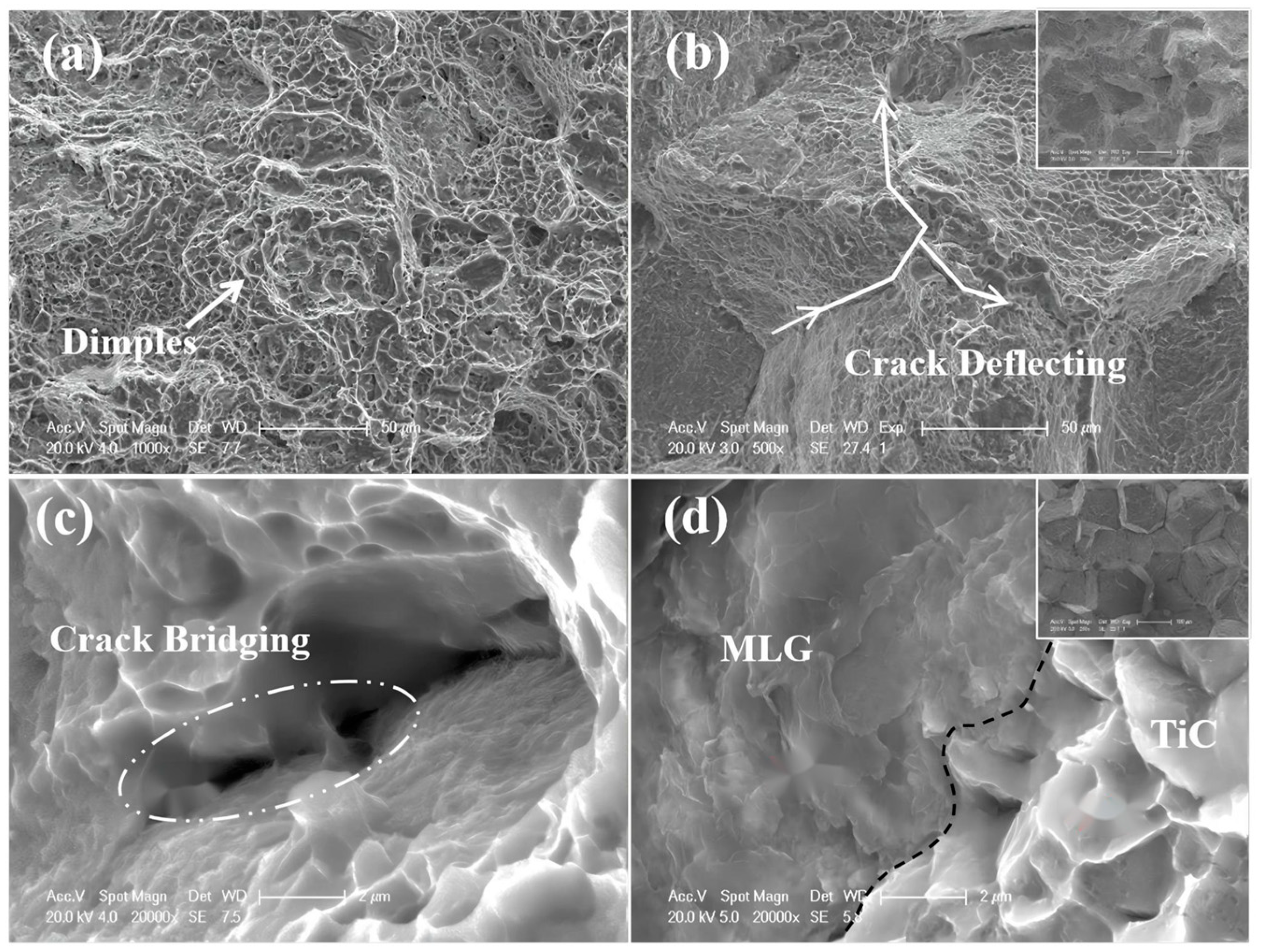



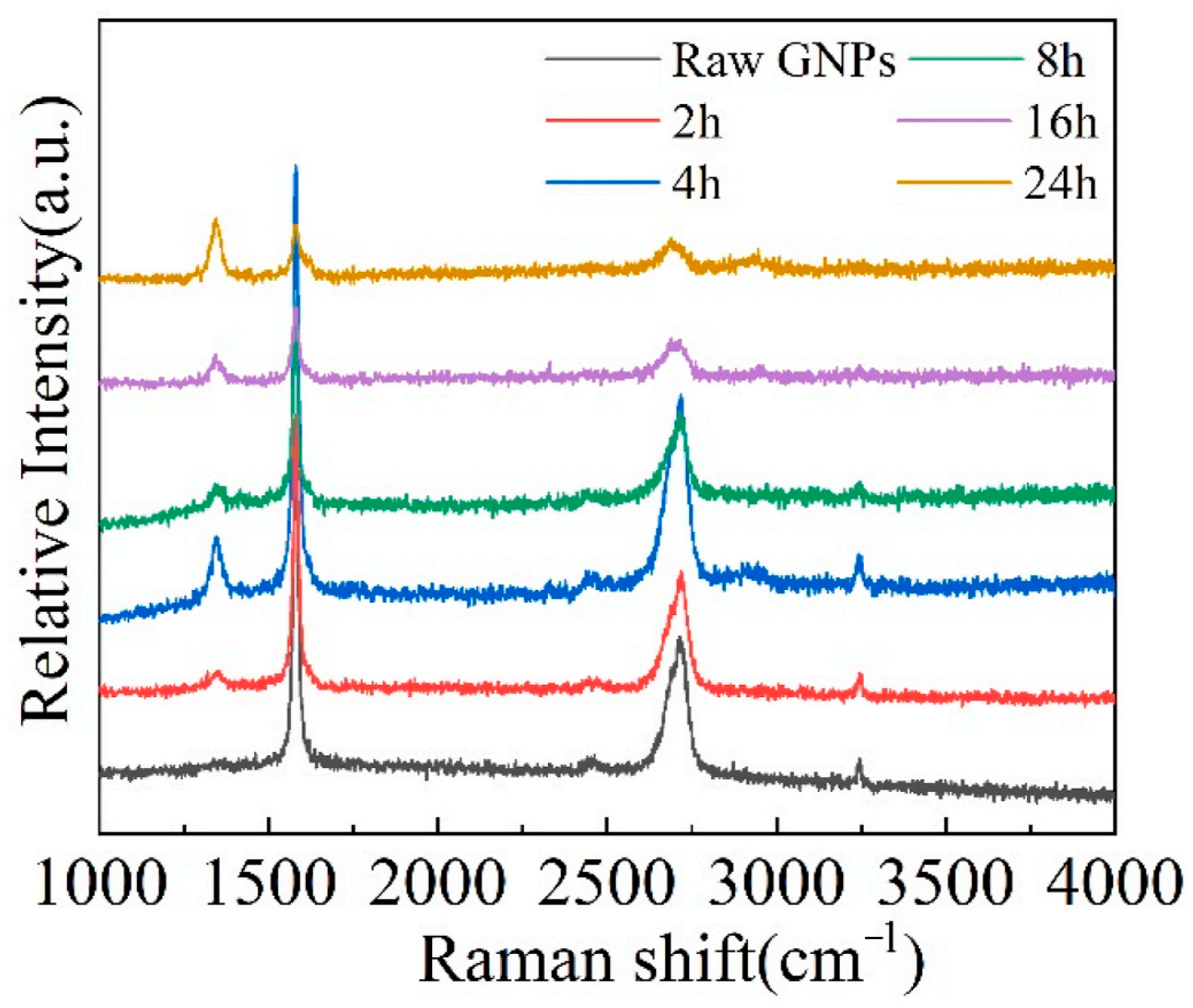
| Ball-Milling Time | D Band | G Band | 2D Band | ID/IG |
|---|---|---|---|---|
| GNPs | 1362.69 | 1586.29 | 2723.45 | 0.26 |
| 2h | 1350.62 | 1582.31 | 2702.70 | 0.56 |
| 5h | 1347.44 | 1583.86 | 2693.27 | 1.26 |
| 10h | 1350.62 | 1590.03 | 2682.48 | 1.52 |
| 15h | 1331.54 | 1577.68 | 2677.08 | 1.67 |
| Process Link | Process Parameters | Influence Mechanism | Reference |
|---|---|---|---|
| Raw Material Pretreatment | Graphene Content | Excessive graphene content promotes agglomeration and elevates material porosity, wherein interconnected agglomerates and pores nucleate structural defects. | [25,26,27] |
| Powder Mixing | Ball-Milling Time | Increasing ball-milling time facilitates the dispersion of graphene, while simultaneously inducing cold welding between graphene and titanium powder and elevating oxygen content. | [23,26,28,29] |
| Rotational Speed | Low-Energy Ball Milling: Only achieves physical adhesion of graphene, which easily forms micron-sized agglomerates on the surface of titanium powder. High-Energy Ball Milling: Graphene can be dispersed into nanoscale particles, but strict control of processing time and the addition of stearic acid as a protective agent are required. Otherwise, excessive shear will damage the sp2 structure of graphene. | [24,30,31,32] | |
| Process Control Agent | To prevent powder over-cold welding, minimize grinding jar/ball contamination, suppress temperature rise, and facilitate homogeneous graphene dispersion. | [33,34] | |
| Compaction | Compaction Pressure | Higher compaction pressure significantly increases green density and reduces porosity. | [35] |
| Sintering Process | Sintering Temperature | Elevated sintering temperatures enhance material densification, but simultaneously intensify interfacial reactions, leading to excessive TiC formation. | [27,31,36,37] |
| Holding Time | Prolonged holding time enhances material densification and promotes grain growth but inevitably causes significant coarsening of pre-existing TiC particulates. | [27,38] | |
| Sintering Atmosphere | Excessive air exposure promotes significant material oxidation, whereas ultra-high-purity inert gas shielding coupled with a moderate vacuum represents the optimal sintering atmosphere strategy. | [25,39] |
| Base Matrix | Type of Filler | Its Concentration | Mixing Method | Composite Fabrication Method | Results Obtained | Reference |
|---|---|---|---|---|---|---|
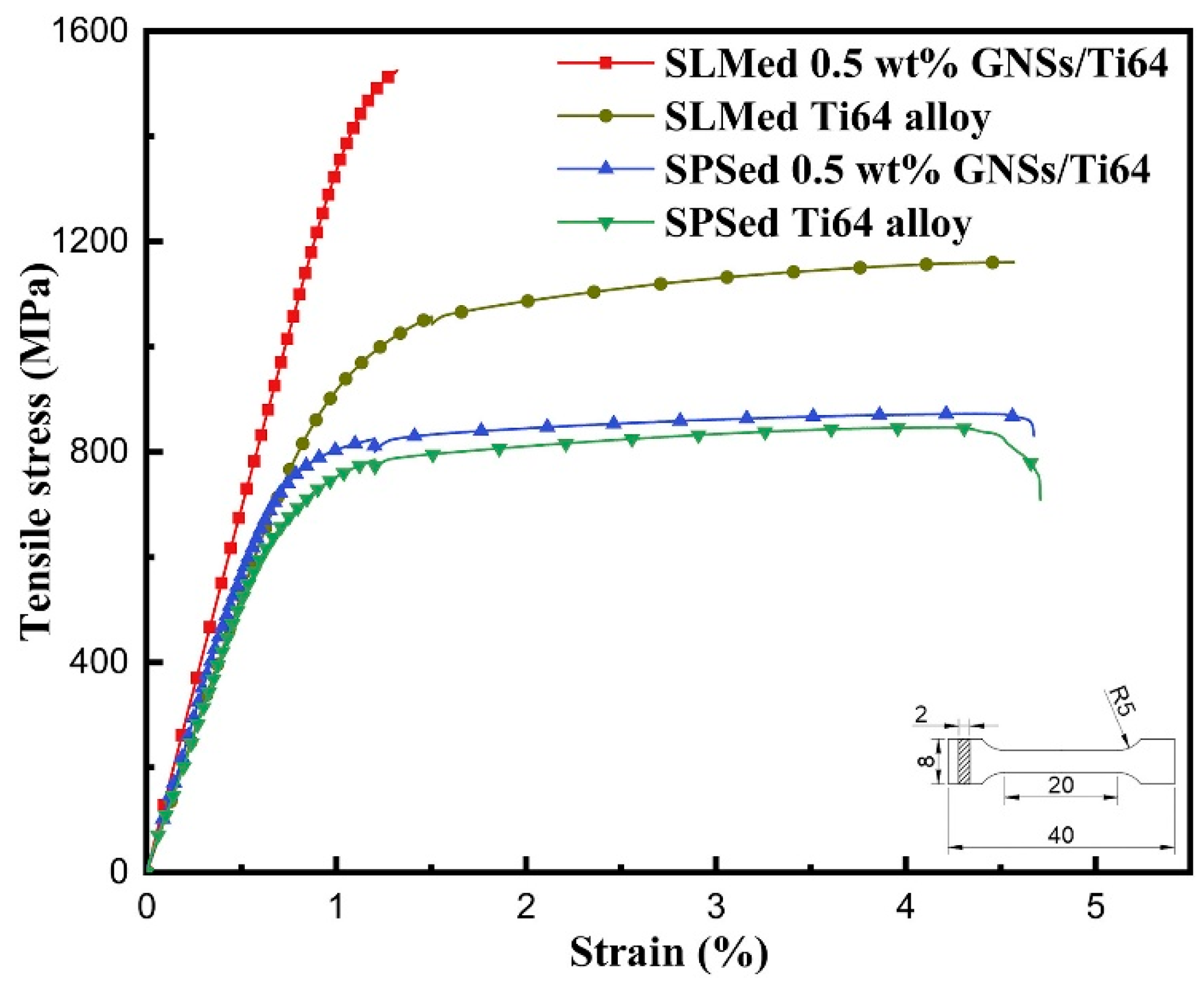
| Ti64 | GNSs | 0.5 wt.% | Mechanical rocking mixing | SLM | Tensile Strength: 1526 MPa; Young’s Modulus: 145 GPa | [13] |
| TC4 | GNPs + TiB2 | 0.1wt.% GNPs 0.05 wt.% TiB2 | Ball milling | Fast Hot-Press Sintering | Tensile strength: 1207 MPa Elongation: 2.3% | [23] |
| TC4 | GNPs | 0.3 wt.% | High-energy ball milling | SPS | Yield strength: 1482 MPa Compressive strength: 1929 MPa Hardness: 539 HV | [24] |
| CP-Ti | GNSs | 1 wt.% | Ball milling | - | Shear yield strength: 728 MPa Ultimate shear strength: 754 MPa Microhardness: 613 HV | [25] |
| TC21 | GNPs | 0.3 wt.% | Ball milling | SPS | Tensile strength: 1167 MPa Yield strength: 1041 MPa Elongation: 4.4% | [37] |
| TC4 | Ni-P@GNFs | 1 wt.% | Ball milling | HIP | Yield strength: 1299.59 MPa Microhardness: 410.10 HV Elongation: 25.76% | [61] |
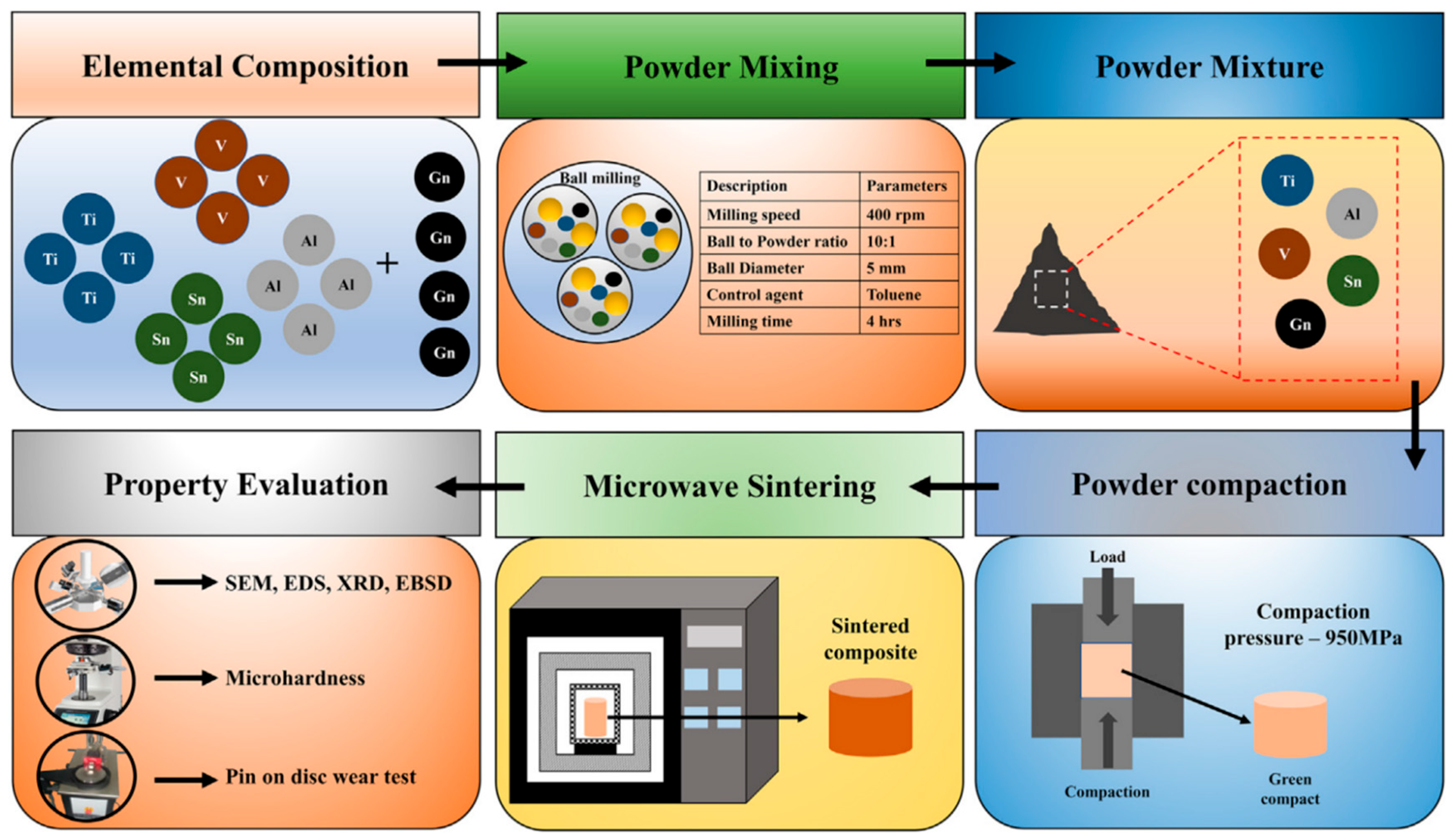
| Ti662 | Gn | 0.5% | Ball milling | Microwave sintering | Microhardness: 514.32 HV | [65] |
| Fabrication Method | Advantages | Disadvantages | Typical Performance Outcomes | References |
|---|---|---|---|---|
| Powder Metallurgy | 1. High material utilization, near-net shape forming and good microstructural homogeneity. 2. Scalable for bulk production, supports custom composite powder design. | 1. Prolonged milling time may lead to excessive graphene damage. 2. High-energy input can cause contamination and oxidation. | Enhanced strength and hardness, but ductility can be compromised by poor dispersion or thick TiC layers. | [40] |
| Spark Plasma Sintering | 1. Achieves high-density sintering in a short time. 2. Minimizes porosity and ensures high material densification. 3 Effectively inhibits grain growth via short-time sintering. | 1. Limited scalability for mass production. 2. Difficulty in controlling TiC formation at higher sintering temperatures. | Excellent strength and hardness due to fine grains and high density; balance with ductility possible with optimal parameters. | [66,67] |
| Selective Laser Melting | 1. Rapid manufacturing of complex geometries. 2. High precision and fine microstructure. 3 Achieves near-net shaping with minimal waste | 1. Limited material compatibility. 2. High cost and slow production speed for large components. 3. Prone to residual stresses | Very high tensile strength reported, but ductility often low due to defects and microstructure. | [13] |
| Hot Isostatic Pressing | 1. Excellent defect closure effect, enhancing material densification and uniformity. 2. Suitable for large-scale production. | 1. Long sintering time and high energy consumption. 2. May agglomerate during the high-temperature process. | High fatigue strength and creep resistance, but may have lower room-temperature toughness due to TiC coarsening. | [68] |
| Microwave Sintering | 1. Lower sintering temperature, energy-efficient and short processing time. 2. Ensures temp uniformity, prevents local overheating damage | 1. Immature technology, only for small-scale experiments 2. Only suitable for specific materials (e.g., small-sized particles, thin-film materials). | Good enhancement in hardness and wear resistance; reported densities > 98%. | [69] |
| Sample Batch | Composite Constituents Mixing | Consolidation | ||||||||
|---|---|---|---|---|---|---|---|---|---|---|
| Method | Medium | Charge Ratio | Speed | Time | Compaction Pressure | Sintering Temperature | Sintering Time | Heating and Cooling Rate | Sintering Environment | |
| 1 | Dry ball milling | Tungsten carbide balls | Balls to powder ratio 6:1 | 225 rpm | 3 h | 400 MPa | 1100 °C | 2 h | 10 °C/min | 10−3 vacuum |
| 2 | Wet ball milling | Tungsten carbide balls | Balls to powder ratio 6:1 | 225 rpm | 3 h | |||||
| 3 | Rotator mixing | Stainless steel blade | Volume filled 1/3 | 300 rpm | 3 h | |||||
| Method | Advantages | Disadvantages |
|---|---|---|
| SPS | 1. Achieves rapid densification and high density in a short time; 2. Prevents grain coarsening through pulsed current and isostatic pressure; 3. Can complete sintering at relatively lower temperatures. | 1. Requires advanced equipment and is relatively costly; 2. Sensitive temperature control may lead to excessive TiC formation; 3. Limited capability for processing components with complex geometries. |
| HIP | 1. Provides excellent densification, effectively eliminating pores and defects; 2. Suitable for large-scale production and capable of processing components with complex shapes; 3. Contributes to improved high-temperature performance. | 1. Longer sintering times and higher temperatures are required; 2. May lead to excessive TiC formation, affecting the mechanical properties of the material. |
| Microwave Sintering | 1. Significantly reduces sintering temperature and time; 2. Suppresses excessive TiC formation and mitigates over-reaction; 3. Enhances material hardness and wear resistance. | 1. Control over graphene dispersion and excessive reaction is relatively complex; 2. Requires specialized equipment and has limited applicability. |
| SLM | 1. Enables rapid solidification, reducing excessive TiC formation; 2. Creates refined microstructures, enhancing mechanical properties; 3. Suitable for producing components with complex geometries. | 1. May cause partial structural damage to graphene due to material overheating; 2. Challenges in controlling reinforcement size may lead to non-uniform mechanical properties. |
Disclaimer/Publisher’s Note: The statements, opinions and data contained in all publications are solely those of the individual author(s) and contributor(s) and not of MDPI and/or the editor(s). MDPI and/or the editor(s) disclaim responsibility for any injury to people or property resulting from any ideas, methods, instructions or products referred to in the content. |
© 2026 by the authors. Licensee MDPI, Basel, Switzerland. This article is an open access article distributed under the terms and conditions of the Creative Commons Attribution (CC BY) license.
Share and Cite
Fu, Y.; Xing, S.; Li, Z.; Wu, S.; Sun, L.; Yang, X.; Shen, W.; Li, Z.; Li, X. Research Progress on Interfacial Design and Mechanical Optimization of Graphene-Reinforced Titanium Matrix Composites. Materials 2026, 19, 822. https://doi.org/10.3390/ma19040822
Fu Y, Xing S, Li Z, Wu S, Sun L, Yang X, Shen W, Li Z, Li X. Research Progress on Interfacial Design and Mechanical Optimization of Graphene-Reinforced Titanium Matrix Composites. Materials. 2026; 19(4):822. https://doi.org/10.3390/ma19040822
Chicago/Turabian StyleFu, Yongkang, Shilong Xing, Zongan Li, Shuo Wu, Liran Sun, Xiaohua Yang, Wei Shen, Zhikun Li, and Xiaocong Li. 2026. "Research Progress on Interfacial Design and Mechanical Optimization of Graphene-Reinforced Titanium Matrix Composites" Materials 19, no. 4: 822. https://doi.org/10.3390/ma19040822
APA StyleFu, Y., Xing, S., Li, Z., Wu, S., Sun, L., Yang, X., Shen, W., Li, Z., & Li, X. (2026). Research Progress on Interfacial Design and Mechanical Optimization of Graphene-Reinforced Titanium Matrix Composites. Materials, 19(4), 822. https://doi.org/10.3390/ma19040822