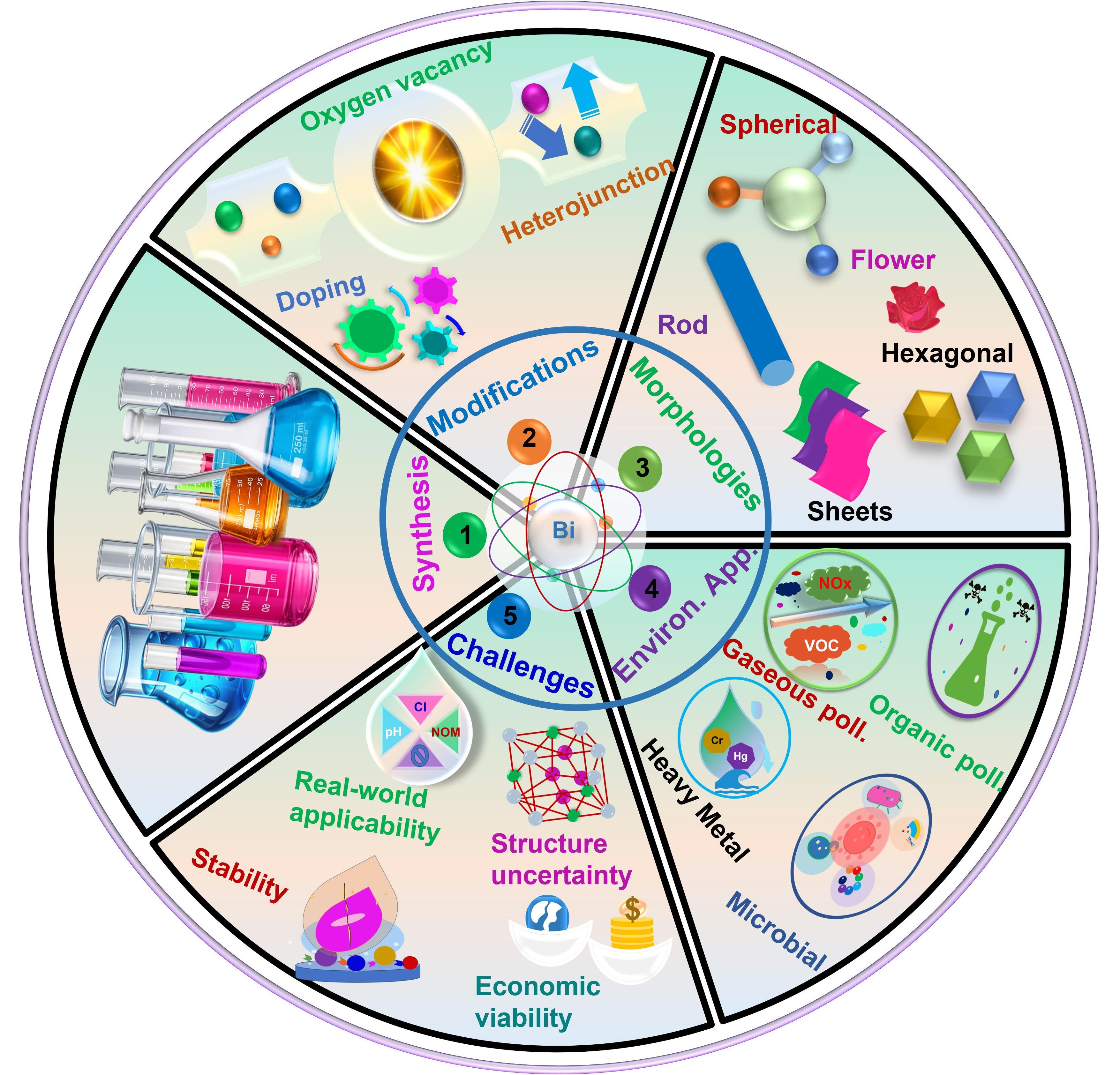
Bismuth-Based Materials as Solar-Driven Photo(Electro)Catalysts for Environmental Remediation


Abstract
1. Introduction
2. Classification of Bismuth-Based Materials
2.1. Bismuth Oxide
2.2. Bismuth Chalcogenides
2.3. Bismuth Oxychalcogenides (Bi2O2X)
2.4. Bismuth Oxyhalides (BiOX)
2.5. Bismuth-Based Perovskite-like Oxides
2.6. Complex Bismuth-Based Metal Oxides
3. Synthesis Strategies of Bi-Based Materials
3.1. Solid-State Method
3.2. Co-Precipitation
3.3. Sol–Gel Method
3.4. Hydro/Solvothermal Method
3.5. Microwave-Assisted Method

3.6. Thin Film Formation Strategies
3.6.1. Spray Pyrolysis
3.6.2. Electrodeposition Method

4. Photocatalytic Activities of Bismuth-Based Materials
5. Performance-Enhancing Modifications
5.1. Heterojunction Engineering
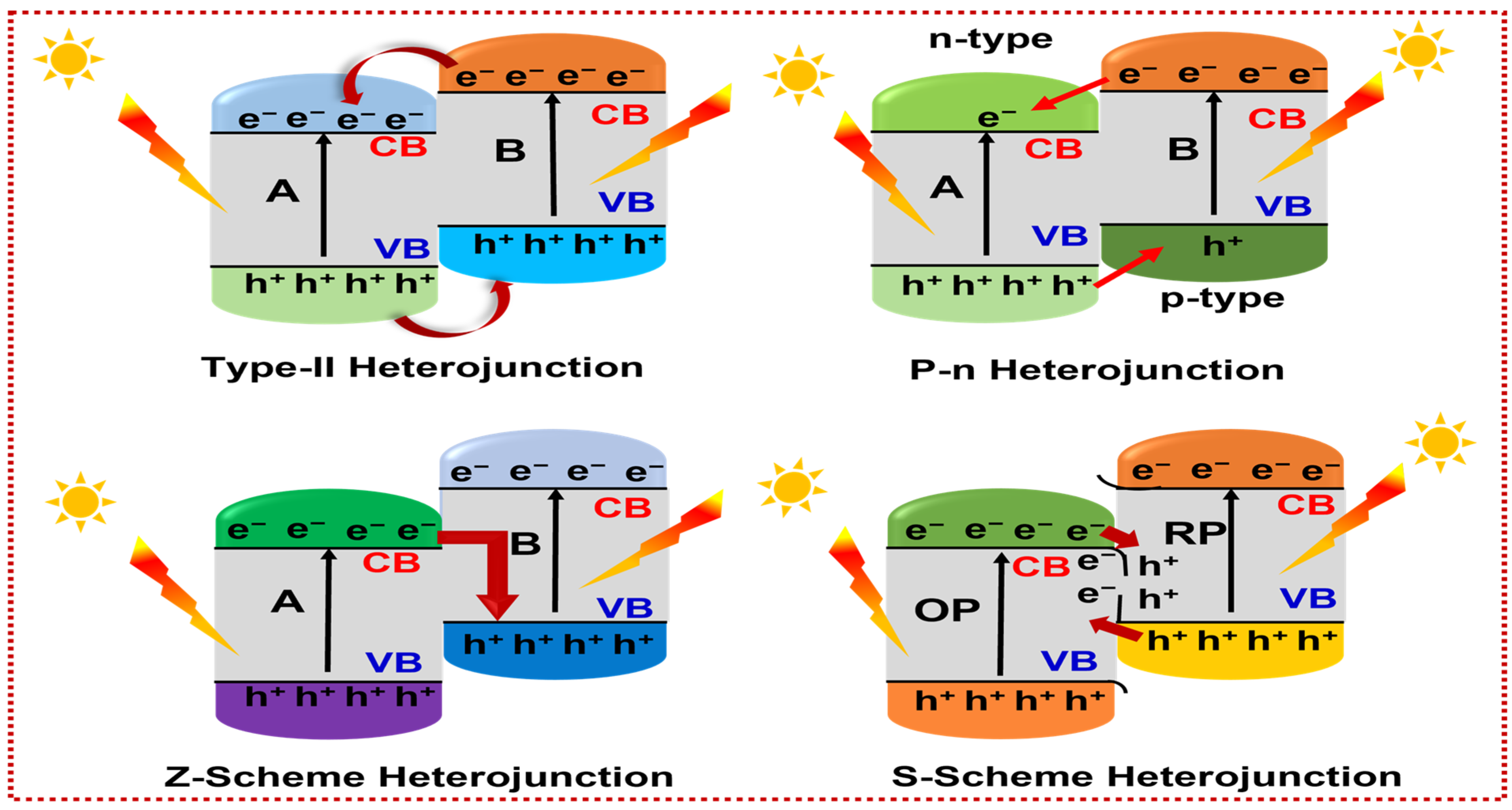
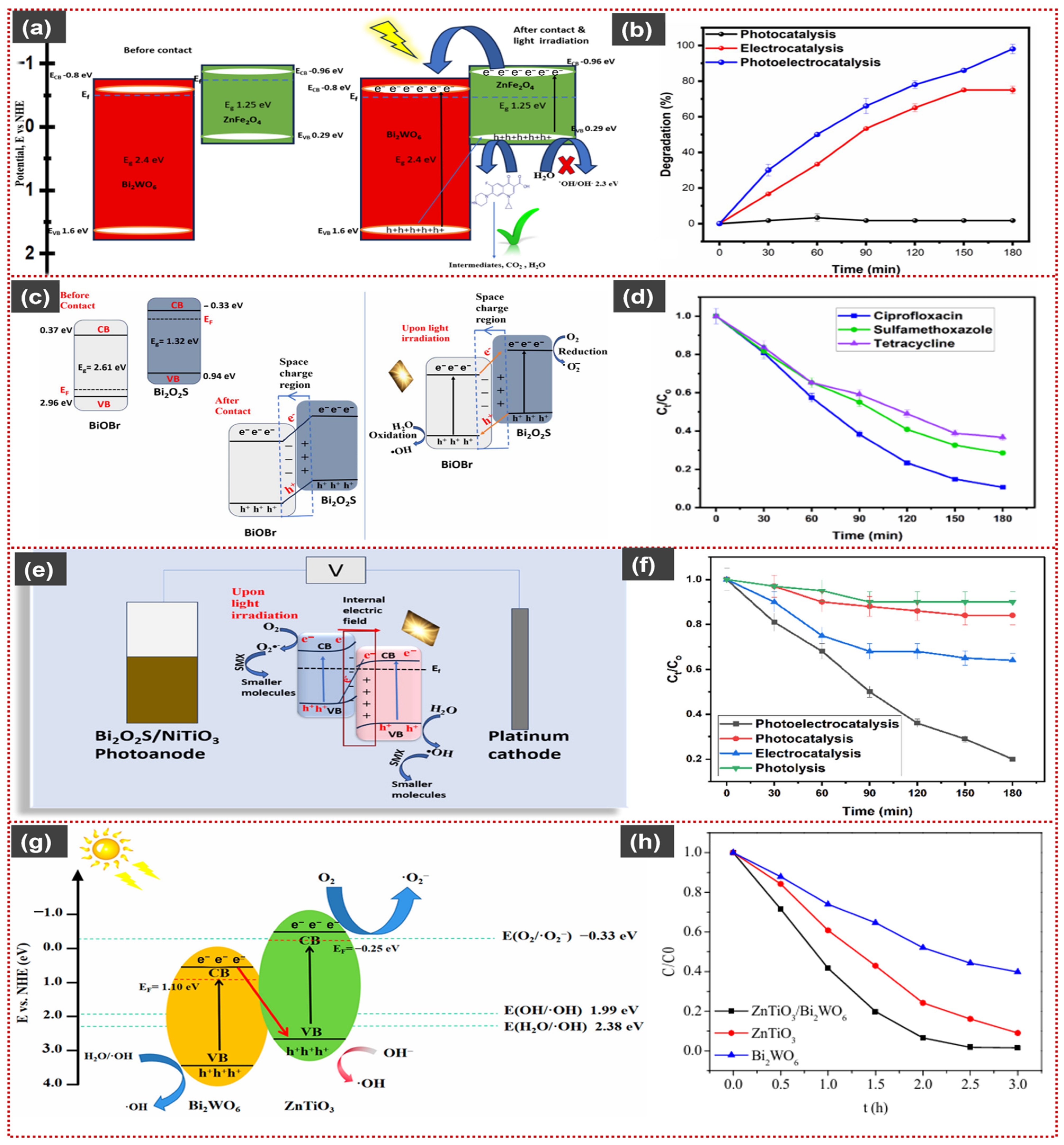
5.1.1. Type-II Heterojunction Systems
5.1.2. p–n Heterojunctions
5.1.3. Z-Scheme Heterojunction Systems
5.1.4. S-Scheme Heterojunction Systems

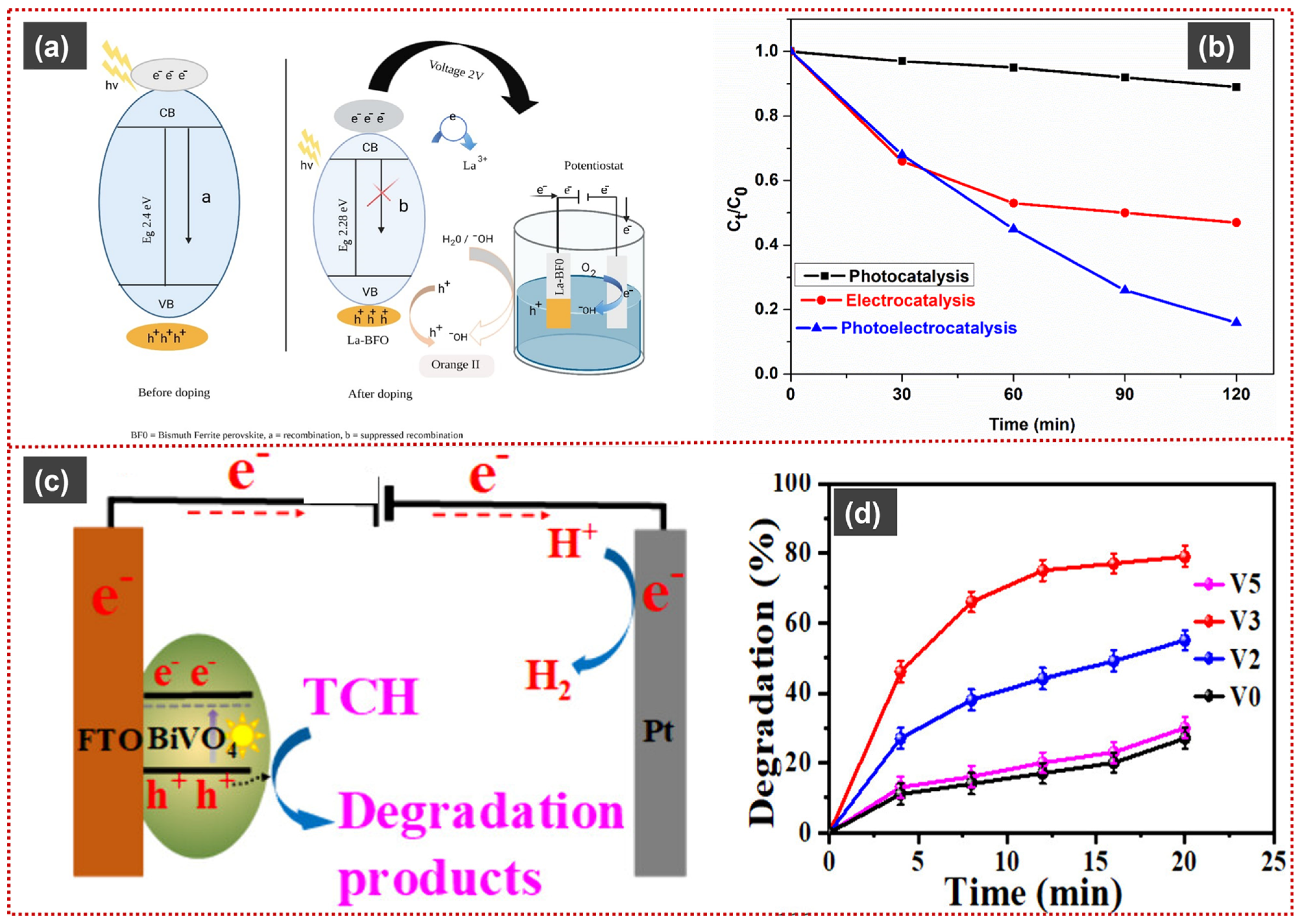
5.2. Doping
5.3. Defect Engineering

6. Practical Considerations and Translation Challenges
6.1. Long-Term Stability, Durability, and Recyclability
6.2. Scalability and Techno-Economic Constraints of PEC Systems
7. Critical Assessment of Strategy Effectiveness
8. Environmental Applications of Bi-Based Photo(Electro)Catalysts
8.1. Performance for Model-Pollutant
8.1.1. Degradation of Organic Pollutants in Water
8.1.2. Disinfection of Algal/Bacterial Toxins
8.1.3. Heavy-Metal Ion Reduction
8.1.4. Gas-Phase Pollutant Removal and Broader Environmental Remediation
8.2. Performance in Real and Complex Matrices
9. Summary and Future Perspective
- A central knowledge gap remained, the incomplete mechanistic understanding of structure–activity relationships, particularly the dynamic roles of Ov, dopants, and heterojunction interfaces under operating conditions. Although these features are widely recognized as key performance regulators, their real-time evolution during PEC operation, such as vacancy migration, interfacial band bending, and charge recombination, remains poorly resolved. Addressing this challenge will require the systematic integration of operando and ultrafast characterization techniques with theoretical modeling to correlate dynamic structural changes with catalytic function directly.
- Material stability constitutes another major bottleneck. Many Bi-based systems, especially Bi2O3 and bismuth chalcogenides, suffer from photocorrosion, phase transformation, and defect annihilation during prolonged operation, with degradation further accelerated in complex water matrices containing inorganic ions, natural organic matter, and radical scavengers. Future material design strategies should therefore prioritize stability-oriented approaches, including defect-stabilizing cocatalysts, corrosion-resistant heterostructures, protective surface coatings, and dynamically reconstructed or self-healing interfaces that can sustain long-term operation.
- PEC enhancement strategies should be developed based on a clear identification of material-specific failure mechanisms rather than empirical photocurrent improvement alone. Aligning modification approaches, such as heterojunction construction, cocatalyst loading, protective layers, or hole-transport layers with the dominant degradation pathways (e.g., carrier accumulation, photocorrosion, or lattice dissolution) is essential to improve charge management and long-term stability simultaneously.
- From a manufacturing perspective, reproducible and scalable synthesis of bismuth-based photo(electro)catalysts remained unresolved. While hydrothermal, sol–gel, and microwave-assisted methods offer excellent laboratory-level control over morphology and defects, their industrial translation is constrained by batch variability, energy intensity, and limited yield consistency. Progress toward practical deployment will depend on scalable synthesis platforms, such as continuous-flow hydrothermal processing, spray pyrolysis, plasma-assisted methods, and green precursor chemistries, that enable reliable defect and interface engineering.
- At the device and system level, challenges including poor film adhesion, non-uniform thickness, unstable semiconductor substrate interfaces, and limited durability continue to restrict PEC performance. Promising future directions include the development of three-dimensional nanostructured photoelectrodes, conductive scaffold-supported catalysts, membrane electrode assemblies, and tandem PEC–advanced oxidation process (AOP) configurations. Integration of PEC systems with complementary treatment technologies, such as peroxymonosulfate activation, ozonation, or biological post-treatment, also represents a viable pathway for enhancing treatment efficiency in complex wastewater.
- From an application standpoint, most studies remain focused on model pollutants at unrealistically high concentrations. In contrast, real environmental systems involve complex mixtures of trace-level contaminants, microorganisms, and resistance genes that can severely suppress PEC performance. Future research should therefore prioritize testing under environmentally relevant conditions, including real wastewater matrices and long-term operation. Beyond pollutant degradation, functional expansion, such as photocatalytic antimicrobial inactivation, remains underdeveloped and requires improved control over band energetics, electron-transport pathways, and selective cocatalyst design to enable efficient multi-electron reactions.
- Finally, environmental safety, techno-economic feasibility, and life-cycle impacts must be integrated early in materials development. Comprehensive life-cycle assessments, ecotoxicological evaluations, catalyst regeneration studies, and cost-per-treatment analyses are essential for identifying scalable, safe, and economically viable PEC remediation strategies.
Author Contributions
Funding
Data Availability Statement
Conflicts of Interest
References
- Saxena, V. Water quality, air pollution, and climate change: Investigating the environmental impacts of industrialization and urbanization. Water Air Soil Pollut. 2025, 236, 73. [Google Scholar] [CrossRef]
- Oriji, A.; Isaac, G.O.; Ojo, R.F. Emerging Contaminants in Drinking Water: Global Perspective. In Emerging Contaminants in Food and Food Products; CRC Press: Boca Raton, FL, USA, 2024; pp. 44–60. [Google Scholar]
- Rab, S.O.; Altalbawy, F.M.; Baldaniya, L.; Kumar, A.; MM, R.; Kundlas, M.; Sharma, G.C.; Joshi, K.K.; Saydaxmetova, S.; Abosaoda, M.K. A comprehensive review of bismuth-based photocatalysts and antibiotic pollution degradation: Recent trends and challenges. Inorg. Chem. Commun. 2025, 174, 114067. [Google Scholar] [CrossRef]
- Qadir, M.; Drechsel, P.; Jones, E.R. Domestic wastewater treatment and agricultural reuse progress and reporting challenges. Discov. Water 2025, 5, 74. [Google Scholar] [CrossRef]
- Liu, J.; Qin, J.; Li, S.; Yan, K.; Zhang, J. Horseradish Peroxidase-Coupled Ag3PO4/BiVO4 Photoanode for Biophotoelectrocatalytic Degradation of Organic Contaminants. ChemSusChem 2023, 16, e202202212. [Google Scholar] [CrossRef]
- Dong, T.; Cheung, H.Y.; Man, J.H.; Zheng, Z.; Lo, I.M. Recent advances in oxidant-involved photoelectrochemical systems for sustainable wastewater treatment: Mechanisms, applications, and perspectives. npj Mater. Sustain. 2025, 3, 41. [Google Scholar] [CrossRef]
- McMichael, S.; Fernández-Ibáñez, P.; Byrne, J.A. A review of photoelectrocatalytic reactors for water and wastewater treatment. Water 2021, 13, 1198. [Google Scholar] [CrossRef]
- Ding, J.; Zhao, P.; Chen, H.; Fu, H. Ultraviolet photodetectors based on wide bandgap semiconductor: A review. Appl. Phys. A 2024, 130, 350. [Google Scholar] [CrossRef]
- Orimolade, B.O.; Idris, A.O.; Akanji, S.P.; Adekola, F.A.; Azizi, S.; Maaza, M.; Mamba, B. Solar-light-responsive nanomaterials for the photoelectrocatalytic degradation of stubborn pollutants. Coatings 2023, 13, 159. [Google Scholar] [CrossRef]
- Sivasubramanian, P.; Chang, J.H.; Nagendran, S.; Dong, C.D.; Shkir, M.; Kumar, M. A review on bismuth-based nanocomposites for energy and environmental applications. Chemosphere 2022, 307, 135652. [Google Scholar] [CrossRef]
- Ma, S.; Yu, X.; Li, W.; Kong, J.; Long, D.; Bai, X. Bismuth-based photocatalysts for pollutant degradation and bacterial disinfection in sewage system: Classification, modification and mechanism. Environ. Res. 2025, 264, 120297. [Google Scholar] [CrossRef] [PubMed]
- Hu, Y.; Xu, L.; Liu, G.; Yuan, X.; Zhou, W.; Guo, X.; Wang, Y.; Zeng, H.; Zhang, S. High-Dielectric 2D Bismuth Oxides with Large Bandgaps: The Role of 6s2 Lone Pair Hybridization. J. Phys. Chem. Lett. 2025, 16, 1440–1446. [Google Scholar] [CrossRef] [PubMed]
- Liao, Y.; Tang, Y.; Yu, M.; Wang, J.; Chong, M.; Teng, Y.; Zhou, S.; Li, J.; Zhu, Y. Enhanced built-in electric field by asymmetric Mo-doped BiVO4 for photoelectrocatalytic detoxification of ofloxacin in hyposaline wastewater. Sci. China Mater. 2025, 69, 127–138. [Google Scholar] [CrossRef]
- Wang, S.; Wang, L.; Huang, W. Bismuth-based photocatalysts for solar energy conversion. J. Mater. Chem. A 2020, 8, 24307–24352. [Google Scholar] [CrossRef]
- Siedlecka, E.M. Application of bismuth-based photocatalysts in environmental protection. In Nanophotocatalysis and Environmental Applications: Detoxification and Disinfection; Springer: Cham, Switzerland, 2019; pp. 87–118. [Google Scholar]
- Wu, X.; Toe, C.Y.; Su, C.; Ng, Y.H.; Amal, R.; Scott, J. Preparation of Bi-based photocatalysts in the form of powdered particles and thin films: A review. J. Mater. Chem. A 2020, 8, 15302–15318. [Google Scholar] [CrossRef]
- He, Y.; Sun, S.; Zhang, B.; Cao, M.; Bai, Y.; Mei, Q.; She, H.; Wang, Q. Recent Progress of BiVO4-based Photoanode for Photoelectrochemical Water Splitting. Nanoscale, 2026; accepted manuscript. [CrossRef]
- Hussain, A.; Hou, J.; Tahir, M.; Ali, S.; Rehman, Z.U.; Bilal, M.; Zhang, T.; Dou, Q.; Wang, X. Recent advances in BiOX-based photocatalysts to enhanced efficiency for energy and environment applications. Catal. Rev. 2024, 66, 119–173. [Google Scholar] [CrossRef]
- Jiang, S.; Zhang, Y.; Gong, J. Applications of bismuth-based nanoparticles for the removal of pollutants in wastewater: A review. Environ. Sci. Nano 2024, 11, 1332–1367. [Google Scholar] [CrossRef]
- Zhang, J.; Mei, B.; Chen, H.; Sun, Z. Review on synthetic approaches and PEC activity performance of bismuth binary and mixed-anion compounds for potential applications in marine engineering. Dalton Trans. 2024, 53, 10376–10402. [Google Scholar] [CrossRef]
- Xia, P.; Song, Y.J.; Liu, Y.Z.; Long, M.X.; Yang, C.; Zhang, X.Y.; Zhang, T. Advances in the optical and electronic properties and applications of bismuth-based semiconductor materials. J. Mater. Chem. C 2024, 12, 1609–1624. [Google Scholar] [CrossRef]
- Khan, S.; Sohail, M.; Will, G.; O’Mullane, A.; Abdala, A.; Wahab, M.A. Enhanced Photoelectrochemical Water Splitting Using Bismuth/Bismuth Selenide Nanocomposites. Chem. Asian J. 2025, 20, e202400858. [Google Scholar] [CrossRef] [PubMed]
- Akintayo, D.C.; Yusuf, T.L.; Mabuba, N. Chalcogenide Materials in Water Purification: Advances in Adsorptive and Photocatalytic Removal of Organic Pollutants. Small 2025, 21, 2501378. [Google Scholar] [CrossRef]
- Santos, D.R.; Shukla, S.; Vermang, B. Prospects of copper–bismuth chalcogenide absorbers for photovoltaics and photoelectrocatalysis. J. Mater. Chem. A 2023, 11, 22087–22104. [Google Scholar] [CrossRef]
- Liu, Y.; Wan, H.; Mia, R.; Habib, S.; Liu, H.; Mahmud, S. Bismuth dichalcogenide-exfoliated Bi2Se3 nanosheets: A novel approach for hexavalent chromium and azo compound photocatalysis. Colloids Surf. A Physicochem. Eng. Asp. 2024, 680, 132722. [Google Scholar] [CrossRef]
- Han, M.; Nagaura, T.; Nam, H.N.; Yang, Z.; Alowasheeir, A.; Phung, Q.M.; Yanai, T.; Kim, J.; Alshehri, S.M.; Ahamad, T.; et al. Selective Design of Mesoporous Bi2Se3 Films with Orthorhombic and Rhombohedral Crystals. Small 2025, 21, 2501534. [Google Scholar] [CrossRef] [PubMed]
- Adhikari, S.; Mandal, S.; Kim, D.H. Recent development strategies for bismuth-driven materials in sustainable energy systems and environmental restoration. Small 2023, 19, 2206003. [Google Scholar] [CrossRef] [PubMed]
- Wang, F.; Yang, S.; Wu, J.; Hu, X.; Li, Y.; Li, H.; Liu, X.; Luo, J.; Zhai, T. Emerging two-dimensional bismuth oxychalcogenides for electronics and optoelectronics. InfoMat 2021, 3, 1251–1271. [Google Scholar] [CrossRef]
- Hu, X.; He, W.; Wang, D.; Chen, L.; Fan, X.; Ling, D.; Bi, Y.; Wu, W.; Ren, S.; Rong, P.; et al. Recent progress in two-dimensional Bi2O2Se and its heterostructures. Nanoscale 2025, 17, 661–686. [Google Scholar] [CrossRef]
- Wang, Y.J.; Chuang, C.; Chung, C.-C.; Chu, P.C.; Lin, W.C.; Zhang, J.W.; Chueh, Y.L.; Yang, Z.; Huang, R.; Chang, K.H.; et al. Epitaxial Antiferroelectric Bi2O2S Films with Superior Photoresponse. ACS Appl. Mater. Interfaces 2025, 17, 21392–21400. [Google Scholar] [CrossRef]
- Wang, Y.J.; Chu, L.L.; Tu, Y.H.; Tsao, L.H.; Fan, M.K.; Chen, W.T.; Chen, C.W.; Chang, C.Y.; Chang, Y.C.; Chueh, Y.L.; et al. Semiconductor Performance Optimization on Quasi-Two-Dimensional Bi2O2 (SxSe1−x) through Monotonous Alloying. Nano Lett. 2025, 25, 8186–8193. [Google Scholar] [CrossRef]
- Zhou, S.; Sun, Z.; Zhuang, Z.; Wen, S.; Chen, H.; Yin, Q.; Pan, J.; Chen, X.; Xu, J.; Zhang, Q. Facile and scalable synthesis of bismuth oxyhalide nanosheets anodes for fast and durable sodium-ion storage. Sci. China Mater. 2025, 68, 868–878. [Google Scholar] [CrossRef]
- Morgade, C.I.; Schvval, A.B.; Fuente, S.A.; Duran-Alvarez, J.C.; Buono, C.; Desimone, P.M.; Aldao, C.M.; Cabeza, G.F. Synthesis and theoretical–experimental characterization of BiOBr: The role of oxygen and halide vacancies on the optoelectric properties of this bismuth oxyhalide. Top. Catal. 2022, 65, 824–838. [Google Scholar] [CrossRef]
- Wei, X.; Akbar, M.U.; Raza, A.; Li, G. A review on bismuth oxyhalide-based materials for photocatalysis. Nanoscale Adv. 2021, 3, 3353–3372. [Google Scholar] [CrossRef] [PubMed]
- Castillo-Cabrera, G.X.; Espinoza-Montero, P.J.; Alulema-Pullupaxi, P.; Mora, J.R.; Villacís-García, M.H. Bismuth oxyhalide-based materials (BiOX: X = Cl, Br, I) and their application in photoelectrocatalytic degradation of organic pollutants in water: A review. Front. Chem. 2022, 10, 900622. [Google Scholar] [CrossRef]
- Lv, X.; Lam, F.L.Y.; Hu, X. A review on bismuth oxyhalide (BiOX, X = Cl, Br, I) based photocatalysts for wastewater remediation. Front. Catal. 2022, 2, 839072. [Google Scholar] [CrossRef]
- Zhang, Y.; Di, J. Layered Bismuth-Based Photocatalysts 1: BiOX (X = Cl, Br, I). In Layered Materials in Photocatalysis: Environmental Purification and Energy Conversion; John Wiley & Sons, Inc.: Hoboken, NJ, USA, 2025; pp. 59–116. [Google Scholar]
- Zhang, Y.; Wang, H.; Huang, L.; Chen, J.; Wu, C.; Nie, K.; Liang, Y.; Wang, Z.; Zhang, Q. Orbital hybridization-guided BiOX (X = F, Cl, Br, I) photocatalysts: Halogen-induced bandgap engineering and performance optimization. Mater. Lett. 2025, 405, 139824. [Google Scholar] [CrossRef]
- Sun, Z.; Amrillah, T. Potential application of bismuth oxyiodide (BiOI) when it meets light. Nanoscale 2024, 16, 5079–5106. [Google Scholar] [CrossRef]
- Gulati, S.; Goyal, K.; Arora, A.; Kumar, S.; Trivedi, M.; Jain, S. Bismuth ferrite (BiFeO3) perovskite-based advanced nanomaterials with state-of-the-art photocatalytic performance in water clean-up. Environ. Sci. Water Res. Technol. 2022, 8, 1590–1618. [Google Scholar] [CrossRef]
- Nkwachukwu, O.V.; Muzenda, C.; Jayeola, K.D.; Sebokolodi, T.I.; Sipuka, D.S.; Cretin, M.; Zhou, M.; Nkosi, D.; Arotiba, O.A. Photoelectrocatalytic degradation of methylene blue on electrodeposited bismuth ferrite perovskite films. Materials 2023, 16, 2769. [Google Scholar] [CrossRef]
- Patel, S.K.S.; Kumar, A.; Chauhan, S.K. Structural and functional enhancements in BiFeO3 nanorods: The effect of Nd3+ doping on R3c–Pnma phase transition, magnetism, and photocatalysis. Dalton Trans. 2025, 54, 16924–16938. [Google Scholar] [CrossRef]
- Nassereddine, Y.; Benyoussef, M.; Asbani, B.; El Marssi, M.; Jouiad, M. Recent advances toward enhanced photocatalytic proprieties of BiFeO3-based materials. Nanomaterials 2023, 14, 51. [Google Scholar] [CrossRef]
- Mandal, G.; Goswami, M.; Mahapatra, P. Efficient photocatalytic degradation of wastewater solution through Mn-doped BiFeO3 nanomaterials. Phys. B Condens. Matter 2024, 695, 416475. [Google Scholar] [CrossRef]
- Nkwachukwu, O.V.; Muzenda, C.; Ojo, B.O.; Zwane, B.N.; Koiki, B.A.; Orimolade, B.O.; Nkosi, D.; Mabuba, N.; Arotiba, O.A. Photoelectrochemical degradation of organic pollutants on a La3+ doped BiFeO3 perovskite. Catalysts 2021, 11, 1069. [Google Scholar] [CrossRef]
- Saroar, S.; Sultana, S.; Nishat, S.S.; Hossain, Q.S.; Khan, M.; Islam, D.; Akhtar, U.S.; Shahriar Bashar, M.; Jahan, S.; Hossain, K.S.; et al. First-Principles Calculations on Electronic, Optical, and Phonon Properties of γ-Bi2MoO6. ACS Omega 2024, 9, 36314–36325. [Google Scholar] [CrossRef] [PubMed]
- Rashmi; Gyanprakash, M.D.; Gadhewal, M.; Pala, R.G.S.; Sivakumar, S. Deconvoluting photoelectrochemical activity in monoclinic–scheelite BiVO4 facet selected thin films. J. Phys. Chem. C 2022, 126, 16477–16491. [Google Scholar] [CrossRef]
- Khan, N.; Stelo, F.; Santos, G.H.; Rossi, L.M.; Gonçalves, R.V.; Wender, H. Recent advances on Z-scheme engineered BiVO4-based semiconductor photocatalysts for CO2 reduction: A review. Appl. Surf. Sci. Adv. 2022, 11, 100289. [Google Scholar] [CrossRef]
- Elaouni, A.; El Ouardi, M.; BaQais, A.; Arab, M.; Saadi, M.; Ait Ahsaine, H. Bismuth tungstate Bi2WO6: A review on structural, photophysical and photocatalytic properties. RSC Adv. 2023, 13, 17476–17494. [Google Scholar] [CrossRef]
- Jiang, Z.; Tan, X.; Xu, J.; Huang, Y. Piezoelectric-induced internal electric field in Bi2WO6 nanoplates for boosting the photocatalytic degradation of organic pollutants. ACS Appl. Nano Mater. 2022, 5, 7588–7597. [Google Scholar] [CrossRef]
- Neto, A.R.S.; Andrade, T.S.; Rodriguez, M.; Santos, A.F.; dos Santos, J.C.; de Souza, R.R.; dos Santos, W.S.; Monteiro, D.S.; Nogueira, F.G.; de Mesquita, J.P.; et al. Solid-state magic: How Bi2O3 and V2O5 combine to create a high-performance photoanode for water oxidation. Int. J. Hydrogen Energy 2024, 51, 300–314. [Google Scholar] [CrossRef]
- Kayhan, E. Temperature-controlled synthesis of bismuth tungstate with enhanced photochromic properties. Int. J. Appl. Ceram. Technol. 2025, 22, e15079. [Google Scholar] [CrossRef]
- Vu, T.T.; Le, L.T.; Le, H.V.; Nguyen, D.N.; Tran, P.D. Solid State Synthesis of BiVO4 and Its Use as a Photocatalyst for Solar Water Splitting. Eur. J. Inorg. Chem. 2025, 28, e202500100. [Google Scholar] [CrossRef]
- Urooj, A.; Rani, M.; Shah, A.A.; Aslam, S.; Siddiqui, R.; Siddiqa, A.; Neffati, R.; Chandio, A.D. Morphological and optical investigation of 2D material-based ternary nanocomposite: Bi2O3/MgO/GO synthesized by a co-precipitation technique. RSC Adv. 2022, 12, 32986–32993. [Google Scholar] [CrossRef]
- Wu, X.; Ng, Y.H.; Wang, L.; Du, Y.; Dou, S.X.; Amal, R.; Scott, J. Improving the photo-oxidative capability of BiOBr via crystal facet engineering. J. Mater. Chem. A 2017, 5, 8117–8124. [Google Scholar] [CrossRef]
- Taha, G.; Rashed, M.; Abd El-Sadek, M.; Moghazy, M. Comparative Study on Three Different Methods for Synthesis of a Pure Nano Multiferroic BiFeO3. Adv. Sci. Eng. Med. 2017, 9, 461–468. [Google Scholar] [CrossRef]
- Fatima, A.; Khan, M.S.; Ayoub, R.; Jabeen, T.; Zeng, Y.; Azeem, W.; Javaid, S.; Motola, M. Comparative study of sol-gel and co-precipitation techniques for synthesizing Calotropis Procera-mediated bismuth ferrite for biomedical and environmental applications. Results Chem. 2025, 15, 102149. [Google Scholar] [CrossRef]
- Eledath, M.; Vishwanathan, S.; Chandran, M. In Sol-gel synthesis of multifunctional bismuth ferrite nanostructures: Effect of heating conditions on their photocatalytic activity. IOP Conf. Ser. Mater. Sci. Eng. 2022, 1221, 012044. [Google Scholar] [CrossRef]
- Santiago, D.; Velasco, A.; Pérez, C.E.; Nava, R.; De Moure, F.J.; Santos, J.; Mayén, S.A. Novel sol-gel synthesis of bismuth molybdate decorated with Au nanoparticles for solar CO2 photoreduction. J. Sol-Gel Sci. Technol. 2025, 115, 498–508. [Google Scholar] [CrossRef]
- Akşit, D.; Sayil, C.; Soylu, G.S.P. Synthesize and characterization of a novel sol–gel-driven Bi2O3 semiconductor: Complete degradation and fast photocatalytic activity for paracetamol. J. Sol-Gel Sci. Technol. 2025, 113, 868–884. [Google Scholar] [CrossRef]
- Yapa, P.; Munaweera, I. Functionalized nanoporous architectures derived from sol–gel processes for advanced biomedical applications. J. Mater. Chem. B 2025, 13, 10715–10742. [Google Scholar] [CrossRef]
- Kamble, G.S.; Ling, Y.-C. Solvothermal synthesis of facet-dependent BiVO4 photocatalyst with enhanced visible-light-driven photocatalytic degradation of organic pollutant: Assessment of toxicity by zebrafish embryo. Sci. Rep. 2020, 10, 12993. [Google Scholar] [CrossRef]
- Kiran, K.; Shashanka, R.; Lokesh, S. Enhanced photocatalytic activity of hydrothermally synthesized perovskite Strontium titanate nanocubes. Top. Catal. 2025, 68, 1584–1593. [Google Scholar] [CrossRef]
- Reszczyńska, J.; Grzyb, T.; Wei, Z.; Klein, M.; Kowalska, E.; Ohtani, B.; Zaleska-Medynska, A. Photocatalytic activity and luminescence properties of RE3+–TiO2 nanocrystals prepared by sol–gel and hydrothermal methods. Appl. Catal. B Environ. 2016, 181, 825–837. [Google Scholar] [CrossRef]
- Pookmanee, P.; Narong, K.; Sangsrichan, S.; Kitikul, J.; Thanomwat, M.; Chaiwoot, P.; Kruefu, V.; Kuimalee, S.; Laorodphan, N.; Ubolsook, P.; et al. Optimized Hydrothermal Synthesis of Highly Crystalline Sheet-Like BiOCl Powders for Enhanced Photocatalytic Degradation of Organic Pollutants. Catal. Lett. 2025, 155, 204. [Google Scholar] [CrossRef]
- Wang, J.; Yang, S.; Chang, J.; Pang, S.; Fu, H.; Jiang, F.; Liao, Y.; Gao, H. Effects of Hydrothermal Temperature on the Photocatalytic Degradation Performance of Bismuth Oxide Formate: Wang, Yang, Chang, Pang, Fu, Jiang, Liao, and Gao. J. Electron. Mater. 2021, 50, 2444–2453. [Google Scholar] [CrossRef]
- Sayed, M.A.; El-Gamal, S.; Ramadan, M.; Helmy, F.M.; Mohsen, A. Hydrothermal synthesis and structural optimization of Bi2O3/Bi2WO6 nanocomposites for synergistic photodegradation of Indigo Carmine dye. Sci. Rep. 2025, 15, 17260. [Google Scholar] [CrossRef]
- Wang, L.; Guo, C.; Chen, F.; Ning, J.; Zhong, Y.; Hu, Y. pH-induced hydrothermal synthesis of Bi2WO6 nanoplates with controlled crystal facets for switching bifunctional photocatalytic water oxidation/reduction activity. J. Colloid Interface Sci. 2021, 602, 868–879. [Google Scholar] [CrossRef] [PubMed]
- Abid, H.N.; Al-Keisy, A.; Ahmed, D.S.; Salih, A.T.; Khammas, A. pH-dependent synthesis and characterization of bismuth molybdate nanostructure for photocatalysis degradation of organic pollutants. Environ. Sci. Pollut. Res. 2022, 29, 37633–37643. [Google Scholar] [CrossRef] [PubMed]
- Marinho, J.Z.; Nascimento, L.L.; Santos, A.L.; Faria, A.M.; Machado, A.E.H.; Patrocinio, A.O. On the influence of hydrothermal treatment pH on the performance of Bi2WO6 as photocatalyst in the glycerol photoreforming. Photochem. Photobiol. Sci. 2022, 21, 1659–1675. [Google Scholar] [CrossRef]
- Saiduzzaman, M.; Takei, T.; Kumada, N. Hydrothermal magic for the synthesis of new bismuth oxides. Inorg. Chem. Front. 2021, 8, 2918–2938. [Google Scholar] [CrossRef]
- Liu, Y.; Yu, Y.; Xu, L.; Hao, R.; Yang, T.; Huang, H.; Hu, J. Rod-like BiVO4 with two-phase structure to boost photoelectrocatalytic degradation activity for tetracycline via the pn junction. Appl. Surf. Sci. 2024, 656, 159719. [Google Scholar] [CrossRef]
- Zai, J.; Cao, F.; Liang, N.; Yu, K.; Tian, Y.; Sun, H.; Qian, X. Rose-like I-doped Bi2O2CO3 microspheres with enhanced visible light response: DFT calculation, synthesis and photocatalytic performance. J. Hazard. Mater. 2017, 321, 464–472. [Google Scholar] [CrossRef]
- Yadav, S.; Sharma, A. Importance and challenges of hydrothermal technique for synthesis of transition metal oxides and composites as supercapacitor electrode materials. J. Energy Storage 2021, 44, 103295. [Google Scholar] [CrossRef]
- Sajini, T.; Joseph, J. Microwave-assisted synthesis of nanomaterials: A green chemistry perspective and sustainability assessment. RSC Sustain. 2025, 3, 4911–4935. [Google Scholar] [CrossRef]
- Zhang, C.; Tao, X.; Jiang, W.; Guo, J.; Zhang, P.; Li, C.; Li, R. Microwave-assisted synthesis of bismuth chromate crystals for photogenerated charge separation. Acta Phys.-Chim. Sin. 2024, 40, 2303034. [Google Scholar] [CrossRef]
- Motaung, M.; Onwudiwe, D.; Lei, W. Microwave-Assisted Synthesis of Bi2S3 and Sb2S3 Nanoparticles and Their Photoelectrochemical Properties. ACS Omega 2021, 6, 18975–18987. [Google Scholar] [CrossRef]
- Rodríguez-Girón, J.; Hernández-Uresti, D.; Obregón, S.; Juárez-Ramírez, I.; Sánchez-Martínez, D. One-step microwave-assisted hydrothermal synthesis of α-Bi2Mo3O12 without surfactants at low temperature for their application in tetracycline photodegradation. Mater. Today Commun. 2022, 33, 104695. [Google Scholar] [CrossRef]
- Dabodiya, T.S.; Selvarasu, P.; Murugan, A.V. Tetragonal to monoclinic crystalline phases change of BiVO4 via microwave-hydrothermal reaction: In correlation with visible-light-driven photocatalytic performance. Inorg. Chem. 2019, 58, 5096–5110. [Google Scholar] [CrossRef]
- Pattnaik, A.; Poonia, A.K.; Ghosh, P. Preparation of bismuth ferric oxide nanoparticles for the microwave-induced photo-degradation of organic pollutants in greywater. Environ. Res. 2024, 262, 119814. [Google Scholar] [CrossRef]
- Simon, Z.J.H.; Lopez, J.A.L.; De La, J.A.D.H.; Conde, G.O.M.; Leyva, K.M.; Herrera, O.R.; Moreno, M.M.; Hernández, H.P.M.; Flores, E. Outstanding photoelectrical response in BiFeO3 hollow microspheres deposited by ultrasonic spray pyrolysis technique. J. Alloys Compd. 2023, 955, 170215. [Google Scholar] [CrossRef]
- Somdee, A.; Kansaard, T.; Singha, T. Experimental study of CuBi2O4 photocathode synthesized by spray pyrolysis and electrochemical deposition methods for visible light harvesting in photoelectrochemical cells. Dig. J. Nanomater. Biostructures (DJNB) 2025, 20, 113–119. [Google Scholar] [CrossRef]
- Wakishima, K.; Higashi, T.; Nagaoka, A.; Yoshino, K. Photoelectrochemical properties of p-type CuBi2O4 prepared by spray pyrolysis of carbon-free precursor aqueous solution combined with post-annealing treatment. New J. Chem. 2024, 48, 131–143. [Google Scholar] [CrossRef]
- Li, C.; Lei, J.; Gu, X.; Ju, J.; Jiang, H.; Li, C.; Hu, Y. Preparation of Bi4Ti3O12/TiO2 by flame spray pyrolysis for photoelectrocatalytic degradation of tetracycline. J. Clean. Prod. 2024, 460, 142557. [Google Scholar] [CrossRef]
- Sydorenko, J.; Krunks, M.; Katerski, A.; Grzibovskis, R.; Vembris, A.; Mere, A.; Spalatu, N.; Acik, I.O. Development of spray pyrolysis-synthesised Bi2O3 thin films for photocatalytic applications. RSC Adv. 2024, 14, 19648–19657. [Google Scholar] [CrossRef]
- Sankapal, B.R.; Gupta, R.B.; Ennaoui, A.; Lokhande, C.D. (Eds.) Simple Chemical Methods for Thin Film Deposition; Springer: Singapore, 2023. [Google Scholar]
- Saha, S.; Johnson, M.; Altayaran, F.; Wang, Y.; Wang, D.; Zhang, Q. Electrodeposition fabrication of chalcogenide thin films for photovoltaic applications. Electrochem 2020, 1, 286–321. [Google Scholar] [CrossRef]
- Momeni, M.M.; Tahmasebi, Z. Effect of electrodeposition time on morphology and photoelecrochemical performance of bismuth vanadate films. Inorg. Chem. Commun. 2021, 125, 108445. [Google Scholar] [CrossRef]
- Li, J.; Ding, Y.; Gao, J.; Yan, K.; Zhang, J. Laccase-coupled photoelectrocatalytic system for highly efficient degradation of bisphenol A. Chemosphere 2022, 308, 136245. [Google Scholar] [CrossRef]
- Shao, L.; Zhelev, N.; Zhang, W.; Reid, G.; Huang, R.; Bartlett, P.N.; Hector, A.L. Electrodeposition of bismuth, tellurium and bismuth telluride through sub-10 nm mesoporous silica thin films. Electrochim. Acta 2024, 505, 144989. [Google Scholar] [CrossRef]
- Mohamed, N.A.; Arzaee, N.A.; Noh, M.F.M.; Ismail, A.F.; Safaei, J.; Sagu, J.S.; Johan, M.R.; Teridi, M.A.M. Electrodeposition of BiVO4 with needle-like flower architecture for high performance photoelectrochemical splitting of water. Ceram. Int. 2021, 47, 24227–24239. [Google Scholar] [CrossRef]
- Kaur, J.P.; Yaw, C.S.; Chang, W.S.; Chong, M.N. Revolutionary bismuth vanadate nanowires: Enhanced water oxidation with exposed (0 0 1) facets. J. Alloys Compd. 2025, 1014, 178772. [Google Scholar] [CrossRef]
- Zheng, Z.; Lo, I.M. Fabrication of MoS2@ BL-BiVO4 photoanode with promoted charge separation for photoelectrochemical sewage treatment to simultaneously degrade PPCPs, disinfect E. coli, and produce H2: Performance, mechanisms, and influence factors. Appl. Catal. B Environ. 2021, 299, 120636. [Google Scholar] [CrossRef]
- Ikram, M.; Bari, M.A. Bismuth Oxyhalides: Synthesis and Photocatalytic Applications; IOP Publishing: Bristol, UK, 2024. [Google Scholar]
- Adepu, A.K.; Katta, V.; Narayanan, V. Synthesis, characterization, and photocatalytic degradation of Rhodamine B dye under sunlight irradiation of porous titanosilicate (TS)/bismuth vanadate (BiVO4) nanocomposite hybrid catalyst. New J. Chem. 2017, 41, 2498–2504. [Google Scholar] [CrossRef]
- Ke, J.; Liu, J.; Sun, H.; Zhang, H.; Duan, X.; Liang, P.; Li, X.; Tade, M.O.; Liu, S.; Wang, S. Facile assembly of Bi2O3/Bi2S3/MoS2 np heterojunction with layered n-Bi2O3 and p-MoS2 for enhanced photocatalytic water oxidation and pollutant degradation. Appl. Catal. B Environ. 2017, 200, 47–55. [Google Scholar] [CrossRef]
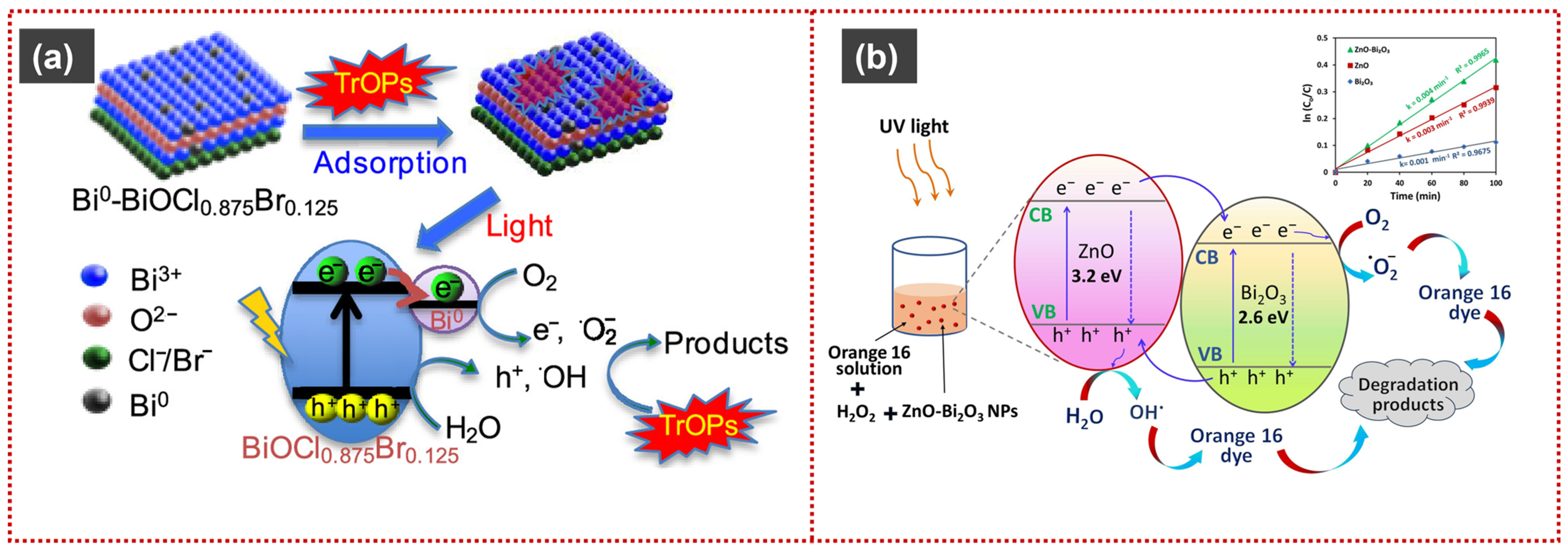
- Dandapat, A.; Horovitz, I.; Gnayem, H.; Sasson, Y.; Avisar, D.; Luxbacher, T.; Mamane, H. Solar photocatalytic degradation of trace organic pollutants in water by Bi (0)-doped bismuth oxyhalide thin films. ACS Omega 2018, 3, 10858–10865. [Google Scholar] [CrossRef] [PubMed]
- Shahzad, R.; Muneer, M.; Khalid, R.; Amin, H.M. ZnO-Bi2O3 heterostructured composite for the photocatalytic degradation of orange 16 reactive dye: Synergistic effect of UV irradiation and hydrogen peroxide. Catalysts 2023, 13, 1328. [Google Scholar] [CrossRef]
- Zhou, J.; Yu, M.; Peng, J.; Lin, R.; Li, Z.; Yu, C. Photocatalytic degradation characteristics of tetracycline and structural transformation on bismuth silver oxide perovskite nano-catalysts. Appl. Nanosci. 2020, 10, 2329–2338. [Google Scholar] [CrossRef]
- Kumar, R.; Raizada, P.; Verma, N.; Hosseini-Bandegharaei, A.; Thakur, V.K.; Van Le, Q.; Nguyen, V.-H.; Selvasembian, R.; Singh, P. Recent advances on water disinfection using bismuth-based modified photocatalysts: Strategies and challenges. J. Clean. Prod. 2021, 297, 126617. [Google Scholar] [CrossRef]
- Chen, P.; Liu, H.; Cui, W.; Lee, S.C.; Wang, L.; Dong, F. Bi-based photocatalysts for light-driven environmental and energy applications: Structural tuning, reaction mechanisms, and challenges. EcoMat 2020, 2, e12047. [Google Scholar] [CrossRef]
- Li, H.; Zhou, Y.; Tu, W.; Ye, J.; Zou, Z. State-of-the-art progress in diverse heterostructured photocatalysts toward promoting photocatalytic performance. Adv. Funct. Mater. 2015, 25, 998–1013. [Google Scholar] [CrossRef]
- Hernández-Ramírez, A.; Medina-Ramírez, I. Photocatalytic Semiconductors; Springer International Publishing: Cham, Switzerland, 2015. [Google Scholar]
- Yang, H. A short review on heterojunction photocatalysts: Carrier transfer behavior and photocatalytic mechanisms. Mater. Res. Bull. 2021, 142, 111406. [Google Scholar] [CrossRef]
- Balapure, A.; Dutta, J.R.; Ganesan, R. Recent advances in semiconductor heterojunctions: A detailed review of the fundamentals of photocatalysis, charge transfer mechanism and materials. RSC Appl. Interfaces 2024, 1, 43–69. [Google Scholar] [CrossRef]
- Han, Z.; Song, Y.; Jia, Y.; Wang, Y.; Shi, J.; Liu, X.; Yu, L.; Li, Z.; Cheng, Y.; Zhang, H.; et al. Classification and Characterization Methods for Heterojunctions. Adv. Mater. Interfaces 2025, 12, 2500191. [Google Scholar] [CrossRef]
- Sharma, B.L.; Purohit, R.K. Semiconductor Heterojunctions; Elsevier: Amsterdam, The Netherlands, 2015; Volume 5. [Google Scholar]
- Yang, L.; Zhou, J.-P.; Chen, Q.-W.; Yang, H.-D. Direct observation of carrier migration in heterojunctions to discuss the p–n and direct Z-scheme heterojunctions. Nanotechnology 2022, 33, 425201. [Google Scholar] [CrossRef]
- Mohammad, A.; Baig, M.T.; Tauqeer, M.; Kim, H.-J.; Park, C.-H.; Choi, C.-H. Bismuth-based heterojunction photocatalysts for antibiotic remediation: A review of tetracycline degradation and mechanistic insights. J. Environ. Manag. 2025, 393, 127010. [Google Scholar] [CrossRef]
- Zeng, Q.; Li, J.; Li, L.; Bai, J.; Xia, L.; Zhou, B. Synthesis of WO3/BiVO4 photoanode using a reaction of bismuth nitrate with peroxovanadate on WO3 film for efficient photoelectrocatalytic water splitting and organic pollutant degradation. Appl. Catal. B Environ. 2017, 217, 21–29. [Google Scholar] [CrossRef]
- Sebokolodi, T.I.; Sipuka, D.S.; Jayeola, K.D.; Arotiba, O.A. Preparation and characterisation of a Bi2WO6/ZnFe2O4 heterojunction photoanode for photoelectrocatalytic degradation of ciprofloxacin in water. J. Solid State Electrochem. 2025, 29, 2169–2188. [Google Scholar] [CrossRef]
- Fan, H.; Yi, G.; Zhang, Z.; Zhao, Y.; Hou, Q.; Zhang, C.; Chen, L.; Zhang, Y.; Sun, Q. Construction of a type-II BiVO4/BiOI heterojunction for efficient photoelectrocatalytic degradation of β-naphthol and coal gasification wastewater under visible-light irradiation. Phys. Chem. Chem. Phys. 2023, 25, 15219–15236. [Google Scholar] [CrossRef] [PubMed]
- Chen, H.; Peng, Y.P.; Chen, T.Y.; Chen, K.F.; Chang, K.L.; Dang, Z.; Lu, G.N.; He, H. Enhanced photoelectrochemical degradation of Ibuprofen and generation of hydrogen via BiOI-deposited TiO2 nanotube arrays. Sci. Total Environ. 2018, 633, 1198–1205. [Google Scholar] [CrossRef]
- Mafa, P.J.; Kuvarega, A.T.; Mamba, B.B.; Ntsendwana, B. Photoelectrocatalytic degradation of sulfamethoxazole on g-C3N4/BiOI/EG pn heterojunction photoanode under visible light irradiation. Appl. Surf. Sci. 2019, 483, 506–520. [Google Scholar] [CrossRef]
- Jayeola, K.D.; Sipuka, D.S.; Sebokolodi, T.I.; Babalola, J.O.; Zhao, Y.; Arotiba, O.A. Redistribution of charge in a 2D/1D BiOBr/Bi2O2S heterojunction for the photoelectrocatalytic oxidation of organic pollutants in water. RSC Adv. 2025, 15, 29680–29691. [Google Scholar] [CrossRef]
- Qin, J.; Ye, S.; Yan, K.; Zhang, J. Visible light-driven photoelectrocatalysis for simultaneous removal of oxytetracycline and Cu (II) based on plasmonic Bi/Bi2O3/TiO2 nanotubes. J. Colloid Interface Sci. 2022, 607, 1936–1943. [Google Scholar] [CrossRef] [PubMed]
- Che, L.; Pan, J.; Cai, K.; Cong, Y.; Lv, S.-W. The construction of pn heterojunction for enhancing photocatalytic performance in environmental application: A review. Sep. Purif. Technol. 2023, 315, 123708. [Google Scholar] [CrossRef]
- Tan, M.; Fu, Y.; Zhang, K.; Liu, Y.; Zhang, C.; Hao, D.; Wang, Q.; Du, H. Visible-light-responsive BiVO4/NH2-MIL-125 (Ti) Z-scheme heterojunctions with enhanced photoelectrocatalytic degradation of phenol. J. Alloys Compd. 2023, 936, 168345. [Google Scholar] [CrossRef]
- Jayeola, K.D.; Sipuka, D.S.; Sebokolodi, T.I.; Babalola, J.O.; Zhou, M.; Marken, F.; Arotiba, O.A. Interfacial Engineering of a Z-Scheme Bi2O2S/NiTiO3 Heterojunction Photoanode for the Degradation of Sulfamethoxazole in Water. ACS Appl. Mater. Interfaces 2024, 17, 1385–1398. [Google Scholar] [CrossRef]
- Feng, J.; Jiang, T.; Han, Y.; Okoth, O.K.; Cheng, L.; Zhang, J. Construction of dual Z-scheme Bi2S3/Bi2O3/WO3 ternary film with enhanced visible light photoelectrocatalytic performance. Appl. Surf. Sci. 2020, 505, 144632. [Google Scholar] [CrossRef]
- Sayed, M.; Qi, K.; Wu, X.; Zhang, L.; García, H.; Yu, J. Cu-based S-scheme photocatalysts. Chem. Soc. Rev. 2025, 54, 4874–4921. [Google Scholar] [CrossRef]
- Jayeola, K.D.; Sipuka, D.S.; Sebokolodi, T.I.; Nkwachukwu, O.V.; Muzenda, C.; Koiki, B.A.; Babalola, J.O.; Zhou, M.; Arotiba, O.A. An S-Scheme CeO2/Bi2O2S heterojunction photoanode for the photoelectrocatalytic degradation of sulfamethoxazole in synthetic and real wastewater. Electrochim. Acta 2024, 507, 145160. [Google Scholar] [CrossRef]
- Sipuka, D.S.; Sebokolodi, T.I.; Jayeola, K.D.; Bechelany, M.; Cretin, M.; Arotiba, O.A. A ZnO/Bi3TaO7 S-scheme heterojunction for photoelectrocatalytic degradation of ciprofloxacin in synthetic and real wastewater. J. Water Process Eng. 2025, 69, 106771. [Google Scholar] [CrossRef]
- Zuo, C.; Tai, X.; Jiang, Z.; Liu, M.; Jiang, J.; Su, Q.; Yan, X. S-Scheme 2D/2D Heterojunction of ZnTiO3 Nanosheets/Bi2WO6 Nanosheets with Enhanced Photoelectrocatalytic Activity for Phenol Wastewater under Visible Light. Molecules 2023, 28, 3495. [Google Scholar] [CrossRef] [PubMed]
- Wu, H.; Hu, Z.; Liang, R.; Nkwachukwu, O.V.; Arotiba, O.A.; Zhou, M. Novel Bi2Sn2O7 quantum dots/TiO2 nanotube arrays S-scheme heterojunction for enhanced photoelectrocatalytic degradation of sulfamethazine. Appl. Catal. B Environ. 2023, 321, 122053. [Google Scholar] [CrossRef]
- Li, Y.J.; Mu, B.H.; Li, H.B.; Tang, S.C.; Tian, J.; Li, Y.; Ji, Z.Y.; Wang, Y.J.; He, T.; Emeline, A.V.; et al. Bi-Based Metal Halide Perovskites and Their Photocatalytic Properties: A Review. Energy Fuels 2025, 39, 2986–3007. [Google Scholar] [CrossRef]
- Wang, Y.; Shen, S. Progress and prospects of non-metal doped graphitic carbon nitride for improved photocatalytic performances. Acta Phys. Chim. Sin 2020, 36, 1905080. [Google Scholar] [CrossRef]
- Medhi, R.; Marquez, M.D.; Lee, T.R. Visible-light-active doped metal oxide nanoparticles: Review of their synthesis, properties, and applications. ACS Appl. Nano Mater. 2020, 3, 6156–6185. [Google Scholar] [CrossRef]
- Tsay, C.Y.; Chung, C.Y.; Chen, C.Y.; Chang, Y.C.; Chang, C.J.; Wu, J.J. Enhanced photocatalytic performance of visible-light-driven BiVO4 nanoparticles through W and Mo substituting. Catalysts 2023, 13, 475. [Google Scholar] [CrossRef]
- Lv, S.; Wang, Y.; Wang, D.; Song, C. Defect Engineering in Bi-Based Photo/Electrocatalysts for Nitrogen Reduction to Ammonia. Chem. Eur. J. 2024, 30, e202400342. [Google Scholar] [CrossRef]
- Zheng, H.; Guo, W.; Li, S.; Yin, R.; Wu, Q.; Feng, X.; Ren, N.; Chang, J.S. Surfactant (CTAB) assisted flower-like Bi2WO6 through hydrothermal method: Unintentional bromide ion doping and photocatalytic activity. Catal. Commun. 2017, 88, 68–72. [Google Scholar] [CrossRef]
- Wu, D.; Yue, S.; Wang, W.; An, T.; Li, G.; Yip, H.Y.; Zhao, H.; Wong, P.K. Boron-doped BiOBr nanosheets with enhanced photocatalytic inactivation of Escherichia coli. Appl. Catal. B Environ. 2016, 192, 35–45. [Google Scholar] [CrossRef]
- Jha, B.K.; Jang, J.H. Beyond Single Dopants: The Chemistry of Multi-Atom Doping in Hematite Photoanodes for Water Splitting. ACS Appl. Mater. Interfaces 2025, 17, 49079–49091. [Google Scholar] [CrossRef]
- Zhang, W.; Xiao, Y.; Li, L.; Yu, Z.; Feng, J.; Zhong, C.; Ip, W.F.; Pan, H. Dynamic Mo leaching and vacancy engineering synergize HER and OER kinetics in NiFe-based catalysts for overall water electrolysis. Mater. Horiz. 2025, 12, 10901–10910. [Google Scholar] [CrossRef]
- Pan, J.B.; Wang, B.H.; Wang, J.B.; Ding, H.Z.; Zhou, W.; Liu, X.; Zhang, J.R.; Shen, S.; Guo, J.K.; Chen, L.; et al. Activity and stability boosting of an oxygen-vacancy-rich BiVO4 photoanode by NiFe-MOFs thin layer for water oxidation. Angew. Chem. Int. Ed. 2021, 60, 1433–1440. [Google Scholar] [CrossRef] [PubMed]
- Ma, M.; Ruan, M.; Lei, E. Feooh Nanolayers Decorated on oxygen-vacancy-containing BiVO4 for efficient photoelectrochemical degradation of rhodamine B. SSRN 2022, 4156311. [Google Scholar] [CrossRef]
- Xin, Y.; Tian, J.; Xiong, X.; Wu, C.; Carabineiro, S.A.; Yang, X.; Chen, Z.; Xia, Y.; Jin, Y. Enhanced Photocatalytic Efficiency Through Oxygen Vacancy-Driven Molecular Epitaxial Growth of Metal–Organic Frameworks on BiVO4. Adv. Mater. 2025, 37, 2417589. [Google Scholar] [CrossRef] [PubMed]
- Wu, H.; Hu, Z.; Liang, R.; Zhang, X.; Zhou, M.; Arotiba, O.A. B-doping mediated formation of oxygen vacancies in Bi2Sn2O7 quantum dots with a unique electronic structure for efficient and stable photoelectrocatalytic sulfamethazine degradation. J. Hazard. Mater. 2023, 456, 131696. [Google Scholar] [CrossRef]
- Huang, J.; Lin, T.; Lin, L.; Ma, G.; Zhang, Z.; Handschuh-Wang, S.; Meng, A.; Han, P.; He, B. Boosted Charge Transport Efficiency for Bismuth and Oxygen Dual Vacancy-Engineered BiVO4 Photoanodes. ACS Appl. Energy Mater. 2024, 7, 10710–10720. [Google Scholar] [CrossRef]
- Tian, J.; Li, J.; Guo, Y.; Liu, Z.; Liu, B.; Li, J. Oxygen vacancy mediated bismuth-based photocatalysts. Adv. Powder Mater. 2024, 3, 100201. [Google Scholar] [CrossRef]
- Zhan, F.; Wen, G.; Li, R.; Feng, C.; Liu, Y.; Liu, Y.; Zhu, M.; Zheng, Y.; Zhao, Y.; La, P. A comprehensive review of oxygen vacancy modified photocatalysts: Synthesis, characterization, and applications. Phys. Chem. Chem. Phys. 2024, 26, 11182–11207. [Google Scholar] [CrossRef] [PubMed]
- Zeng, C.; Tsui, L.S.; Lam, F.L.; Wu, T.; Yip, A.C. Revisiting the crucial roles of oxygen vacancies in photo/electro-catalytic degradation of aqueous organic pollutants. Appl. Catal. O Open 2024, 190, 206930. [Google Scholar] [CrossRef]
- Kaushik, R.; Gandhi, S.; Halder, A. Photoelectrochemical degradation of organic pollutants coupled with molecular hydrogen generation using Bi2O3/TiO2 nanoparticle arrays. ACS Appl. Nano Mater. 2023, 6, 4297–4308. [Google Scholar] [CrossRef]
- Orimolade, B.O.; Arotiba, O.A. Enhanced photoelectrocatalytic degradation of diclofenac sodium using a system of Ag-BiVO4/BiOI anode and Ag-BiOI cathode. Sci. Rep. 2022, 12, 4214. [Google Scholar] [CrossRef]
- Wang, Y.; Lu, N.; Quan, X. Surface-surface contacted direct Z-scheme TiO2-BiVO4-PI heterostructure for enhanced photoelectrocatalytic degradation of bisphenols under solar driven. Chemosphere 2024, 351, 141210. [Google Scholar] [CrossRef] [PubMed]
- Jia, L.; Yang, C.; Jin, X.; Wang, D.; Li, F. Direct Z-scheme heterojunction Bi/Bi2S3/α-MoO3 photoelectrocatalytic degradation of tetracycline under visible light. Chemosphere 2023, 315, 137777. [Google Scholar] [CrossRef]
- Jia, L.; Li, F.; Yang, C.; Yang, X.; Kou, B.; Xing, Y.; Peng, J.; Ni, G.; Cao, Z.; Zhang, S.; et al. Direct Z-scheme heterojunction α-MnO2/BiOI with oxygen-rich vacancies enhanced photoelectrocatalytic degradation of organic pollutants under visible light. Catalysts 2022, 12, 1596. [Google Scholar] [CrossRef]
- Liu, M.; Wan, Y.; Wang, Y.; Xu, J.; Li, X. Robust photoelectrocatalytic degradation of antibiotics by organic-inorganic PDISA/Bi2WO6 S-scheme heterojunction membrane. J. Environ. Chem. Eng. 2024, 12, 112328. [Google Scholar] [CrossRef]
- Nkwachukwu, O.V.; Muzenda, C.; Jayeola, K.D.; Sebokolodi, T.I.; Sipuka, D.S.; Wu, H.; Koiki, B.A.; Zhou, M.; Arotiba, O.A. Characterisation and application of bismuth ferrite-bismuth vanadate pn heterojunction in the photoelectrocatalytic degradation of ciprofloxacin in water. Electrochim. Acta 2023, 454, 142385. [Google Scholar] [CrossRef]
- Zheng, W.; Lian, Y.; Shao, S.; Chen, A.; Chen, C.; Cao, J. The effect of Bi2S3/Bi2MoO6/TiO2 photoanode microstructure on solar PEC degradation on several typical dyes. Sol. Energy 2025, 288, 113298. [Google Scholar] [CrossRef]
- Arunachalam, P.; Shaddad, M.N.; Amer, M.S.; Alsalman, A.M.; Madhavan, J. Cooperative catalytic behavior of CoS and Bi2S3 nanoparticles on Zr: BiVO4 photoanodes for enhanced photoelectrochemical sulfite oxidation coupled with pharmaceutical pollution degradation. Environ. Sci. Nano 2024, 11, 2668–2682. [Google Scholar] [CrossRef]
- Zheng, Z.; He, J.; Dong, C.; Lo, I.M. Photoelectrochemical sewage treatment by sulfite activation over an optimized BiVO4 photoanode to simultaneously promote PPCPs degradation, H2 evolution and E. coli disinfection. Chem. Eng. J. 2021, 419, 129418. [Google Scholar] [CrossRef]
- Zhang, J.; Guo, Z.; Duan, Y.; Wang, T.; Zhang, H.N. Tetragonal/orthorhombic phase Bi2WO6 homojunction for photoelectrochemical degradation of rhodamine B with high efficiency. J. Alloys Compd. 2024, 1003, 175655. [Google Scholar] [CrossRef]
- Wang, X.; Liu, G.; Liu, J.; Ren, G.; Wang, P. Ultrathin SDS-Ni-Bi2O2CO3 modified graphite felt photoanode for enhancing the photoelectrocatalytic degradation of bisphenol pollutants: Importance of high utilization efficiency of hydroxyl radical. Chem. Eng. J. 2024, 495, 153170. [Google Scholar] [CrossRef]
- Cao, D.; Wang, Y.; Qiao, M.; Zhao, X. Enhanced photoelectrocatalytic degradation of norfloxacin by an Ag3PO4/BiVO4 electrode with low bias. J. Catal. 2018, 360, 240–249. [Google Scholar] [CrossRef]
- Song, S.; Xing, Z.; Zhao, H.; Li, Z.; Zhou, W. Recent advances in bismuth-based photocatalysts: Environment and energy applications. Green Energy Environ. 2023, 8, 1232–1264. [Google Scholar] [CrossRef]
- Nguyen, B.D.; Choi, I.-H.; Kim, J.-Y. Strategies for enhancing BiVO4 photoanodes for PEC water splitting: A state-of-the-art review. Nanomaterials 2025, 15, 1494. [Google Scholar] [CrossRef] [PubMed]
- Bai, W.; Li, H.; Hu, Y.; Wang, J.; Li, A.; Corvini, P.F.X. Achieving long-term stable BiVO4 photoanodes for solar water splitting via carbon-layer protecting combined with active centers dynamic repairing. Chem. Eng. J. 2024, 479, 147713. [Google Scholar] [CrossRef]
- Wu, H.; Tan, H.L.; Toe, C.Y.; Scott, J.; Wang, L.; Amal, R.; Ng, Y.H. Photocatalytic and photoelectrochemical systems: Similarities and differences. Adv. Mater. 2020, 32, 1904717. [Google Scholar] [CrossRef]
- Nandjou, F.; Haussener, S. Degradation in photoelectrochemical devices: Review with an illustrative case study. J. Phys. D Appl. Phys. 2017, 50, 124002. [Google Scholar] [CrossRef]
- Zhang, Y.; Liu, B.; Xu, L.; Ding, Z.; Yang, R.; Wang, S. Failure mechanism analysis and emerging strategies for enhancing the photoelectrochemical stability of photoanodes. ChemSusChem 2025, 18, e202401420. [Google Scholar] [CrossRef] [PubMed]
- Li, H.; Cheng, B.; Zhang, J.; Zhou, X.; Shi, C.; Zeng, L.; Wang, C. Recent advances in the application of bismuth-based catalysts for degrading environmental emerging organic contaminants through photocatalysis: A review. J. Environ. Chem. Eng. 2023, 11, 110371. [Google Scholar] [CrossRef]
- Zhang, Y.; Yu, H.; Zhai, R.; Zhang, J.; Gao, C.; Qi, K.; Yang, L.; Ma, Q. Recent progress in photocatalytic degradation of water pollution by bismuth tungstate. Molecules 2023, 28, 8011. [Google Scholar] [CrossRef]
- Wang, C.Y.; Zhang, X.; Yu, H.Q. Bismuth oxyhalide photocatalysts for water purification: Progress and challenges. Coord. Chem. Rev. 2023, 493, 215339. [Google Scholar] [CrossRef]
- Qin, K.; Zhao, Q.; Yu, H.; Xia, X.; Li, J.; He, S.; Wei, L.; An, T. A review of bismuth-based photocatalysts for antibiotic degradation: Insight into the photocatalytic degradation performance, pathways and relevant mechanisms. Environ. Res. 2021, 199, 111360. [Google Scholar] [CrossRef]
- Oladipo, A.A.; Mustafa, F.S. Bismuth-based nanostructured photocatalysts for the remediation of antibiotics and organic dyes. Beilstein J. Nanotechnol. 2023, 14, 291–321. [Google Scholar] [CrossRef] [PubMed]
- Chahkandi, M.; Zargazi, M. New water based EPD thin BiVO4 film: Effective photocatalytic degradation of Amoxicillin antibiotic. J. Hazard. Mater. 2020, 389, 121850. [Google Scholar] [CrossRef]
- Bulut, D.T. Exploring the dual role of BiVO4 nanoparticles: Unveiling enhanced antimicrobial efficacy and photocatalytic performance. J. Sol-Gel Sci. Technol. 2025, 114, 198–222. [Google Scholar] [CrossRef]
- Petruleviciene, M.; Savickaja, I.; Kovger-Jarosevic, J.; Juodkazyte, J.; Padarauskas, A.; Griguceviciene, A.; Ramanavicius, A. Photoelectrochemical Degradation of Diclofenac, Tetracycline, and Amoxicillin in an Aqueous Sulfate Medium: Analysis of Reactive Species. ACS Omega 2025, 10, 8538–8550. [Google Scholar] [CrossRef]
- Li, Y.; Bai, B.; Zhu, M.; Li, J.; Mei, Q.; Wang, Q. BiVO4 photoanode modified with FeOOH cocatalyst for visible-light-driven photoelectrocatalytic degradation of organic pollutants. J. Environ. Chem. Eng. 2024, 12, 113079. [Google Scholar] [CrossRef]
- Ni, L.x.; Du, C.h.; Wu, H.q.; Li, Y.; Li, X.L.; Xu, C. Preparation and characterization of Fe2O3/Bi2WO6 composite and photocatalytic degradation mechanism of microcystin-LR. Water Sci. Eng. 2021, 14, 109–118. [Google Scholar] [CrossRef]
- Rather, R.A.; Lo, I.M. Photoelectrochemical sewage treatment by a multifunctional g-C3N4/Ag/AgCl/BiVO4 photoanode for the simultaneous degradation of emerging pollutants and hydrogen production, and the disinfection of E. coli. Water Res. 2020, 168, 115166. [Google Scholar] [CrossRef] [PubMed]
- Verma, M.K.; Sharma, M.; Dudi, M.; Pandey, S.K.; Kumar, R. Quercetin-supported Bi2S3 nanoparticles: A versatile photocatalyst for treatment of harmful bacteria and mixture of toxic cationic dyes in water. J. Water Process Eng. 2023, 56, 104384. [Google Scholar] [CrossRef]
- An, S.; Wang, Y.; Qiao, H.; Xiu, H.; Liu, D.; Kuang, Y. Photoelectrocatalytic reduction of Cr (VI) in wastewater with a CuBi2O4 thin film photocathode. Catalysts 2024, 14, 289. [Google Scholar] [CrossRef]
- Liu, Y.; Yang, B.; He, H.; Yang, S.; Duan, X.; Wang, S. Bismuth-based complex oxides for photocatalytic applications in environmental remediation and water splitting: A review. Sci. Total Environ. 2022, 804, 150215. [Google Scholar] [CrossRef]
- Zhu, T.; Gao, Y.; Sun, J.; Jin, Y.; Li, M.; Zhang, Y.N. An Efficient CuBi2O4/nZVI-PEC/PMS System for Simultaneous Removal of OFL and Cr (VI): Synergistic Role of S-Scheme/Ohmic Dual Junctions and Cu/Fe Double Active Centers. Adv. Funct. Mater. 2025, e22611. [Google Scholar] [CrossRef]
- Zhang, F.; Cai, Y.; Sheng, H.; Chang, G.; Fu, J.; Chen, S.; Hao, S. Photocatalytic Reduction of Cu2+ over Bi2O3/C/TiO2 Constructed by a Facile Method. Ceram. Int. 2025, 51, 20083–20093. [Google Scholar] [CrossRef]
- Chang, G.; Zhou, Y.; Wang, H.; Chen, S.; Fu, J.; Sun, J.; Hao, S. Efficient Photocatalytic Reduction of Hg (II) Enabled by S-Scheme Bi2O3/Bi/g-C3N4 Heterojunctions with N, O Dual Vacancies. J. Environ. Chem. Eng. 2025, 13, 120157. [Google Scholar] [CrossRef]
- Li, R.; Chen, H.; Xiong, J.; Xu, X.; Cheng, J.; Liu, X.; Liu, G. A mini review on bismuth-based Z-scheme photocatalysts. Materials 2020, 13, 5057. [Google Scholar] [CrossRef] [PubMed]
- Zhu, G.; Li, S.; Gao, J.; Zhang, F.; Liu, C.; Wang, Q.; Hojamberdiev, M. Constructing a 2D/2D Bi2O2CO3/Bi4O5Br2 heterostructure as a direct Z-scheme photocatalyst with enhanced photocatalytic activity for NOx removal. Appl. Surf. Sci. 2019, 493, 913–925. [Google Scholar] [CrossRef]
- Sun, R.; Shi, Q.; Zhang, M.; Xie, L.; Chen, J.; Yang, X.; Chen, M.; Zhao, W. Enhanced photocatalytic oxidation of toluene with a coral-like direct Z-scheme BiVO4/g-C3N4 photocatalyst. J. Alloys Compd. 2017, 714, 619–626. [Google Scholar] [CrossRef]
- Alulema-Pullupaxi, P.; Espinoza-Montero, P.J.; Sigcha-Pallo, C.; Vargas, R.; Fernández, L.; Peralta-Hernandez, J.M.; Paz, J.L. Fundamentals and applications of photoelectrocatalysis as an efficient process to remove pollutants from water: A review. Chemosphere 2021, 281, 130821. [Google Scholar] [CrossRef]
- Zhou, G.; Aletsee, C.C.; Lemperle, A.; Rieth, T.; Mengel, L.; Gao, J.; Tschurl, M.; Heiz, U.; Sharp, I.D. Water Oxidation and Degradation Mechanisms of BiVO4 Photoanodes in Bicarbonate Electrolytes. ACS Catal. 2025, 15, 13048–13058. [Google Scholar] [CrossRef] [PubMed]
- Ribeiro, A.R.L.; Moreira, N.F.; Puma, G.L.; Silva, A.M. Impact of water matrix on the removal of micropollutants by advanced oxidation technologies. Chem. Eng. J. 2019, 363, 155–173. [Google Scholar] [CrossRef]
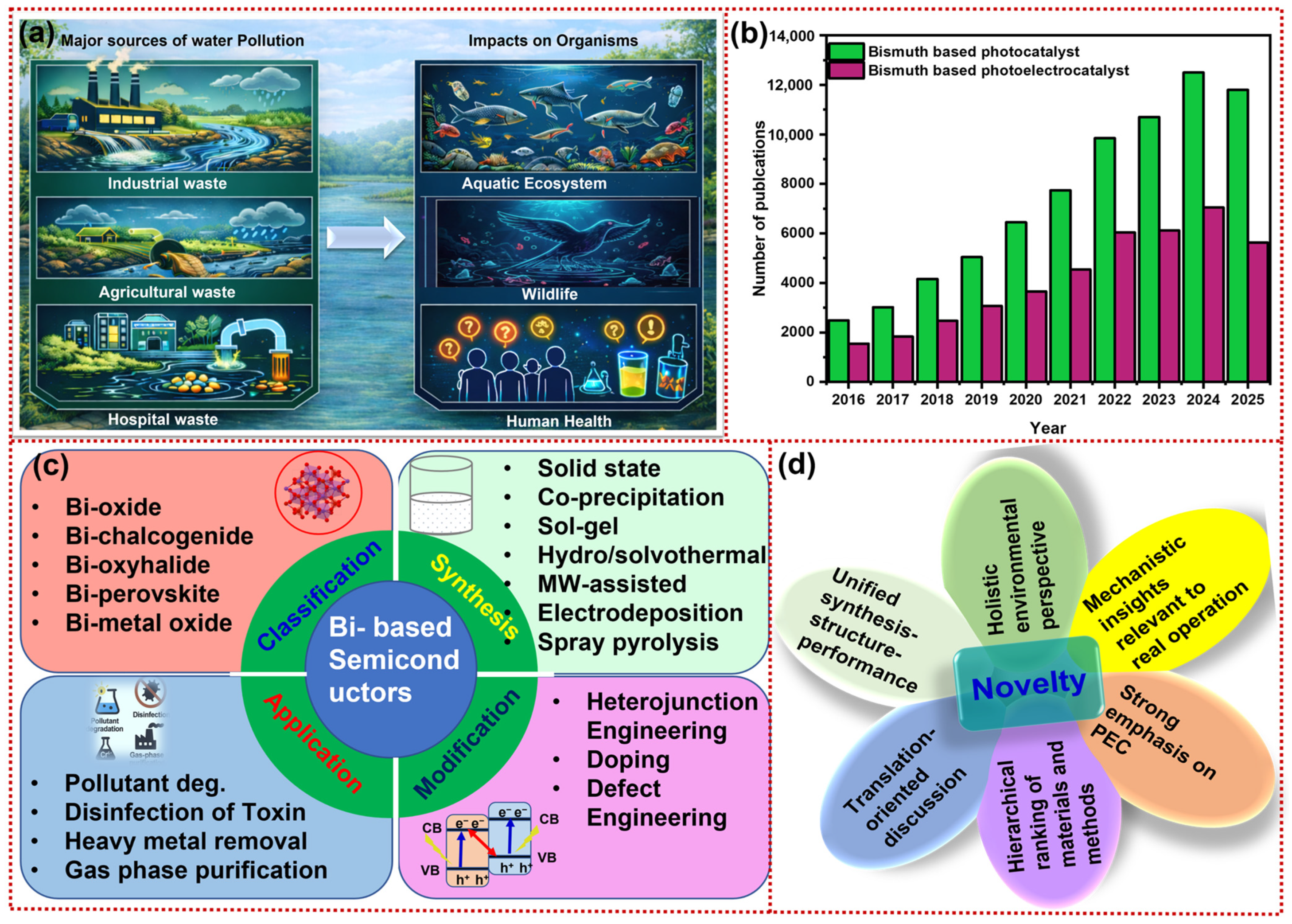



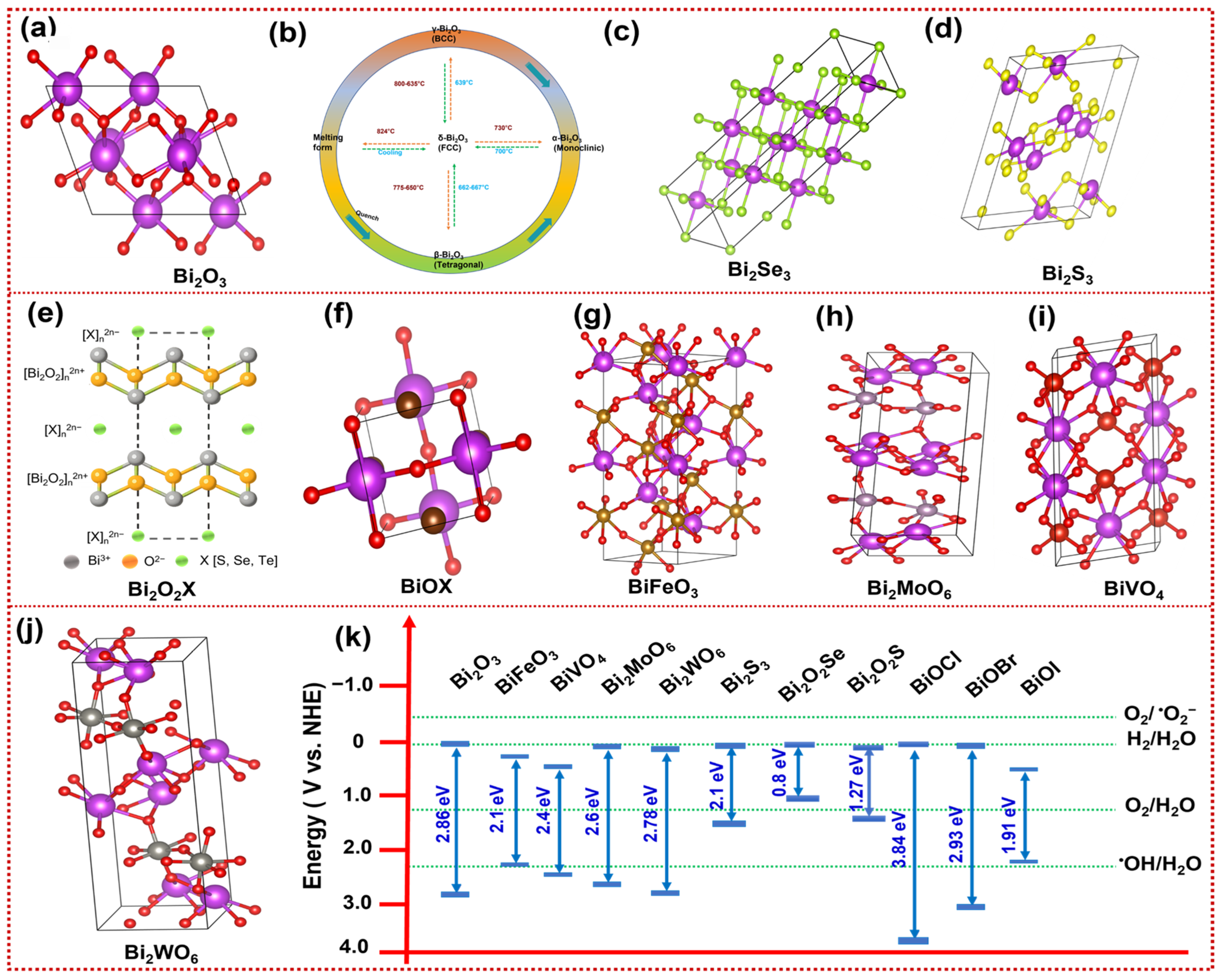
| Class | Band Gap (eV) | Carrier Type | Stability | Typical Applications |
|---|---|---|---|---|
| Bismuth Oxides | 2–3.9 | p-type | Polymorph-dependent; α-Bi2O3 stable at ambient conditions, while β- and γ-phases are metastable; δ-Bi2O3 stabilized at high temperature or via defect/dopant engineering. | Photocatalytic degradation of organic pollutants (ROS-mediated). |
| Bismuth Chalcogenides | 0.3–1.2 | n-type | Phase-dependent; narrow band gaps enable strong visible-light absorption but are prone to photocorrosion under prolonged operation. | Visible-light-driven photo(electro)catalysis; pollutant degradation; charge-dynamics tuning via doping, surface modification, and heterojunctions. |
| Bismuth Oxychalcogenides | ~0.8–1.27 | n-type | High environmental stability due to layered structures and robust Bi–O frameworks. | Visible-light PEC applications; heterojunction and defect engineering to enhance performance. |
| Bismuth Oxyhalides | 1.9–3.9 | n/p-type | Layered structure prolongs carrier lifetime; BiOI shows improved PEC stability, though recombination remains a limiting factor. | Photocatalytic pollutant degradation; PEC oxidation; performance enhancement via doping and heterojunctions. |
| Bismuth-Based Perovskite-like Oxides | 2.0–2.2 | n/p-type | Structurally stable; intrinsic ferroelectric polarization promotes charge separation and suppresses recombination. | Visible-light PEC applications; enhanced via doping (e.g., La, Mn), heterojunctions, and nanostructuring. |
| Bismuth-Based Metal Oxides | ~2.4–2.8 | n-type | Generally stable; BiVO4 exhibits high PEC stability, Bi2MoO6 and Bi2WO6 suffer from charge recombination. | PC pollutant degradation; PEC photoanodes, including water splitting and CO2 reduction. |
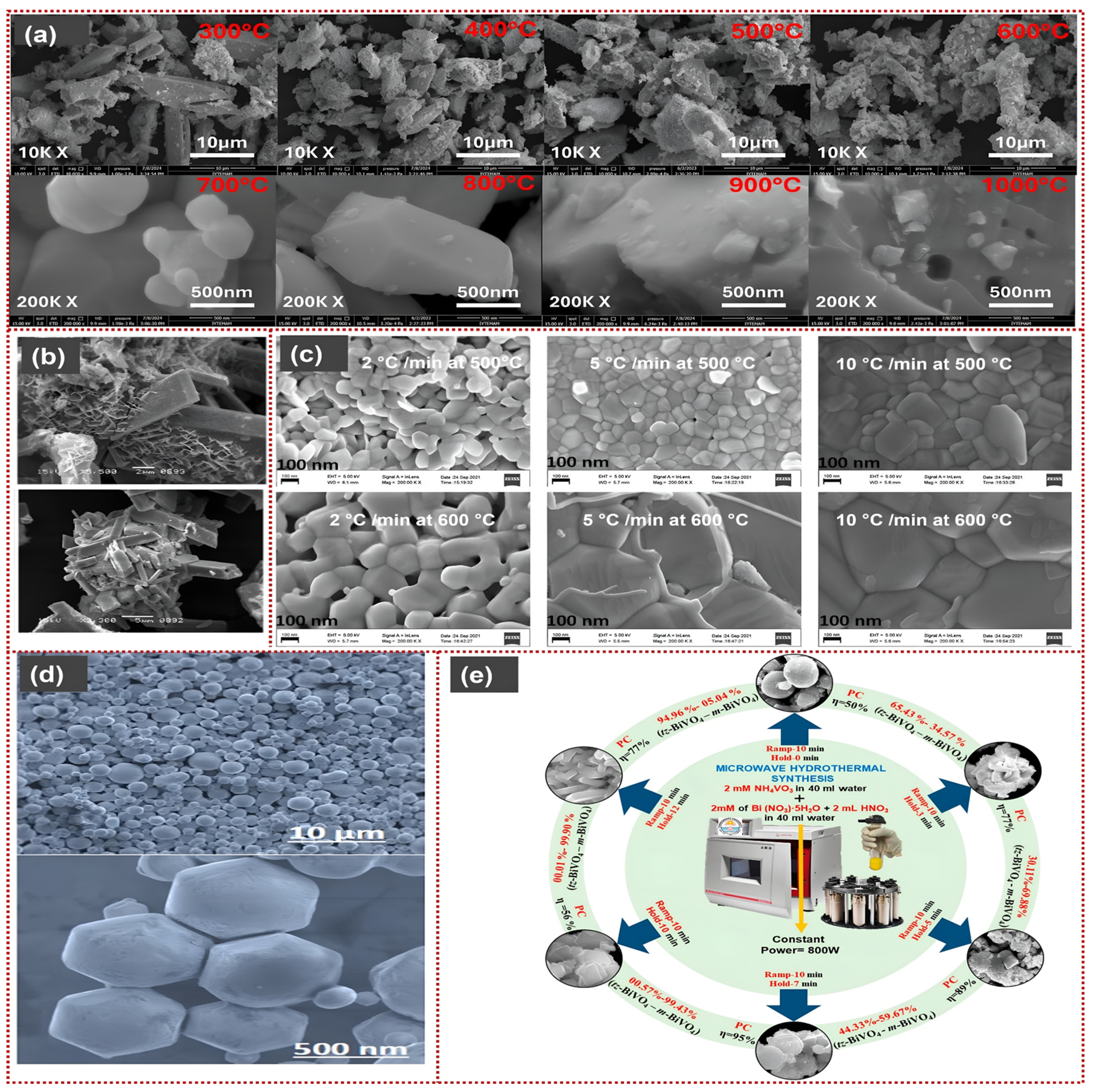
| Method | Advantages | Limitations | Scalability | Typical Features | Outcome |
|---|---|---|---|---|---|
| Solid-state reaction | Simple, solvent-free, low cost; high crystallinity; bulk synthesis | High temperature (≈400–800 °C); grain growth; poor morphology/defect control | High | Micron-sized, dense polycrystalline particles | Phase-pure oxides; low surface area; generally unsuitable for high-performance PEC |
| Co-precipitation | Low-temperature, simple, good composition control | Particle aggregation, limited facet/defect control, pH-sensitive | Moderate–High | Aggregated nanoparticles, plate-like particles, BiOX nanosheets | Suitable for PC, PEC requires further structuring or film fabrication |
| Sol–gel | High homogeneity, tunable size and defects, band-structure control | Multi-step, long gelation/drying, cracking; scale-up challenges | Moderate | Nanoparticles, porous xerogels, networked or flower-like structures | Good visible-light PC, moderate PEC relevance after film processing |
| Hydro/solvothermal | Excellent phase, facet, and morphology control, high crystallinity at moderate temperature | Long reaction times, batch process, limited reactor volume | Moderate | Nanosheets, nanoplates, nanorods, hierarchical architectures | Highly effective PC and PEC with enhanced charge separation |
| Microwave-assisted hydro/solvothermal | Ultrafast, energy-efficient, rapid crystallization, defect-rich products | Limited reactor size, equipment cost, and uniformity control | Low–Moderate | Fine nanoparticles, mixed phases, quantum dots | Strong photocurrent response, promising for advanced PEC systems |
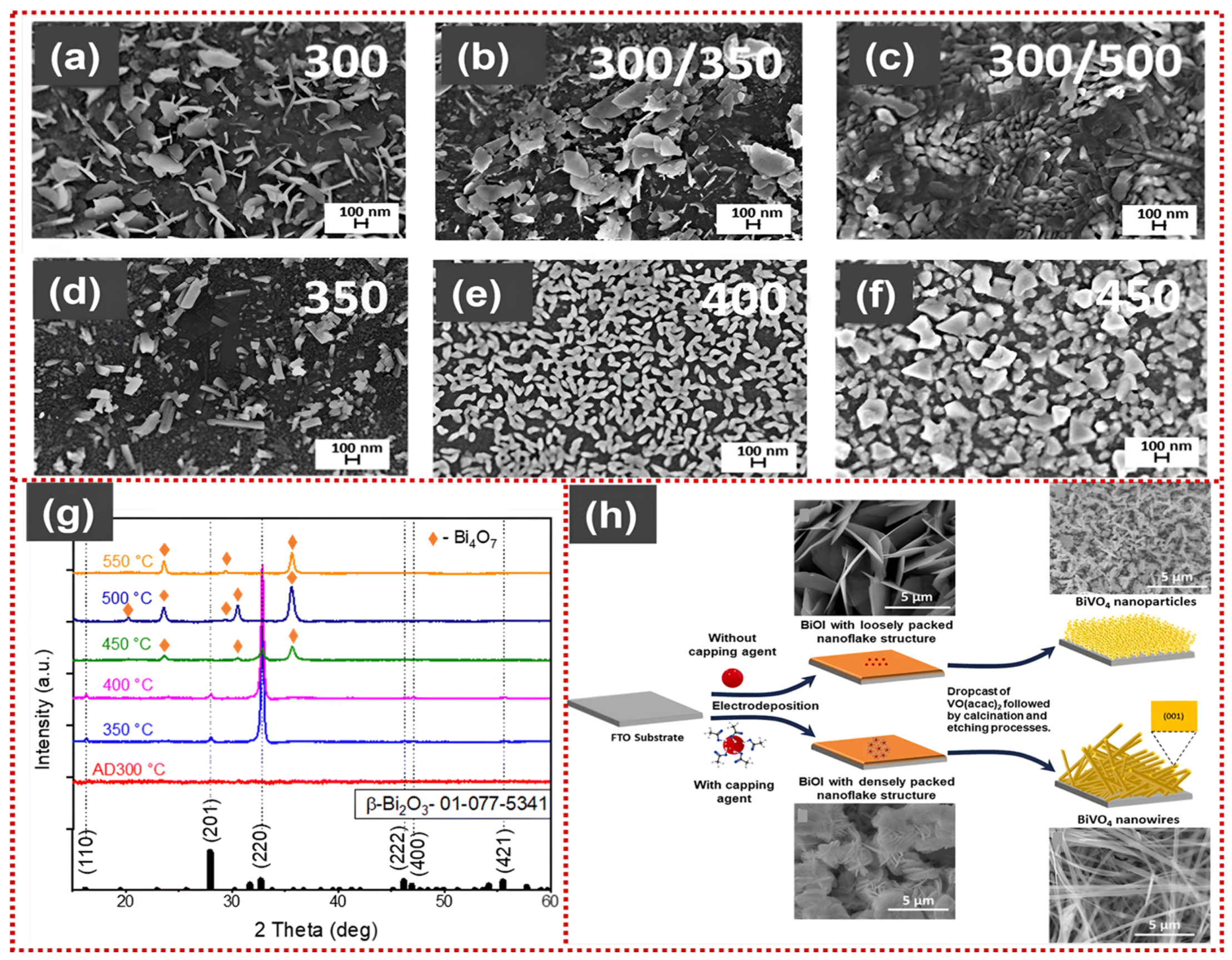
| Spray pyrolysis | Continuous deposition, thickness and stoichiometry control, industrial relevance | Low material utilization, narrow temperature window, and post-annealing are often required. | High | Dense or porous thin films; granular grains; hollow microspheres | Robust PEC photoelectrodes with good adhesion and stability |
| Electrodeposition | Low temperature, precise thickness/morphology control, direct substrate growth | Requires conductive substrates, parameter-sensitive, and post-conversion is often needed | High | Nanowires, nanoflakes, flower-like films on FTO/ITO | Excellent charge transport, ideal for PEC degradation |
| Materials | Light Source | Pollutant | Key Performance | Main Active Species |
|---|---|---|---|---|
| TS/BiVO4 | Natural sunlight | RhB | Nearly complete RhB degradation within 60 min; superior activity vs. TS and BiVO4 | •O2−, •OH, and h+ |
| Bi2O3/Bi2S3/MoS2 | Simulated solar light | MB | O2 evolution rate of 529.1 μmol h−1 g−1; ~90% MB degradation | •O2− and •OH |
| Bi(0)-doped BiOCl0.875Br0.125 | Solar irradiation | SMX, CBZ, VLX, BZF | Highest degradation performance among tested films; outperformed TiO2 | ion-exchange-assisted adsorption followed by oxidation |
| Bi2Se3 | Visible light | MO and Cr(VI) | 81.2% MO degradation in 240 min (k = 0.0038 min−1); 88.4% Cr(VI) reduction in 60 min (k = 0.007 min−1) | •OH and •O2− for MO degradation; electrons reduce Cr(VI) |
| BSO | Ultraviolet light | TC | 95.79% degradation in 80 min; k = 0.0361 min−1; >80% efficiency after four cycles | Photocatalytic oxidation with structural transformation to Bi2O2CO3 |
| Material | Pollutant | Bias (V) | Light Source | Conc. (ppm) | Electrolyte | Deg. (%) | Time (min) | Ref. |
|---|---|---|---|---|---|---|---|---|
| Bi2O3/TiO2 | RhB | 0.5 vs. Ag/AgCl | 150 W lamp | 20 | 0.1 M Na2SO4 | 100 | 40 | [143] |
| Ag-BiVO4/BiOI | DFS | 1.0 vs. Ag/AgCl | 100 W Xe lamp | 10 | 0.1 M Na2SO4 | 92 | 120 | [144] |
| TiO2-BiVO4-PI | BPA | 1.0 vs. SCE | 300 W Xe lamp | 5 | H2O | 93.5 | 120 | [145] |
| Bi/Bi2S3/α-MoO3 | TC | 1.0 vs. Ag/AgCl | 300 W Xe lamp | 30 | 0.1 M NaCl | 85.8 | 60 | [146] |
| n-MnO2/BiOI | TC | 1.0 vs. Ag/AgCl | 300 W Xe lamp | 30 | 0.1 M NaCl | 95.8 | 120 | [147] |
| PDISA/Bi2WO6 | TC | 1.2 vs. RHE | 300 W Xe lamp | 20 | 0.5 M Na2SO4 | 98.4 | 90 | [148] |
| ZnO/Bi3TaO7 | Cip | N/A- | 100 W Xe lamp | 5 | 0.1 M Na2SO4 | 98 | 180 | [123] |
| BFO/BVO | Cip | 2.0 vs. Ag/AgCl | 100 W Xenon lamp | 5 | 0.1 M Na2SO4 | 80.3 | 240 | [149] |
| Bi4Ti3O12/TiO2 | TC | 1.0 external cell volt. | 300 W Xe lamp | 20 | 0.05 M Na2SO4 | 99.7 | 75 | [84] |
| Bi2S3/Bi2MoO6/TiO2 | MG | 0.6 vs. Ag/AgCl | 100 mW/cm2 Xe lamp | 10 | 0.5 M Na2SO4 | 86.69 | 120 | [150] |
| Zr:BiVO4@Bi2S3/CoS | TCH | 0.5 vs. SCE | 100 mW/cm2 Xe lamp | 20 | 0.1 M Na2SO4 | 94 | 60 | [151] |
| BiVO4 | BZP | 1.0 vs. Ag/AgCl | 300 W Xe lamp | 2 | 1.5 mM Na2SO3 | 92.3 | 90 | [152] |
| Bi2WO6 | RhB | 10 external cell volt. | 300 W Xe lamp | 30 | 0.5 M Na2SO4 | 100 | 30 | [153] |
| (SDS-Ni-BOC/MGF) | BPA | 2.0 two-electrode | 300 W Xe lamp | 5 | 0.01 M Na2SO4 | 100 | 30 | [154] |
| Ag3PO4/BiVO4 | NOR | 0.5 vs. SCE | 300 W Xe lamp | 5 | 10 mM NaClO4 | 100 | 90 | [155] |
Disclaimer/Publisher’s Note: The statements, opinions and data contained in all publications are solely those of the individual author(s) and contributor(s) and not of MDPI and/or the editor(s). MDPI and/or the editor(s) disclaim responsibility for any injury to people or property resulting from any ideas, methods, instructions or products referred to in the content. |
© 2026 by the authors. Licensee MDPI, Basel, Switzerland. This article is an open access article distributed under the terms and conditions of the Creative Commons Attribution (CC BY) license.
Share and Cite
Ashraf, M.; Guo, J.; Yan, K.; Zhang, J. Bismuth-Based Materials as Solar-Driven Photo(Electro)Catalysts for Environmental Remediation. Materials 2026, 19, 728. https://doi.org/10.3390/ma19040728
Ashraf M, Guo J, Yan K, Zhang J. Bismuth-Based Materials as Solar-Driven Photo(Electro)Catalysts for Environmental Remediation. Materials. 2026; 19(4):728. https://doi.org/10.3390/ma19040728
Chicago/Turabian StyleAshraf, Muhammad, Jiang Guo, Kai Yan, and Jingdong Zhang. 2026. "Bismuth-Based Materials as Solar-Driven Photo(Electro)Catalysts for Environmental Remediation" Materials 19, no. 4: 728. https://doi.org/10.3390/ma19040728
APA StyleAshraf, M., Guo, J., Yan, K., & Zhang, J. (2026). Bismuth-Based Materials as Solar-Driven Photo(Electro)Catalysts for Environmental Remediation. Materials, 19(4), 728. https://doi.org/10.3390/ma19040728