Materials and Techniques for Splinting Scan Bodies: A Scoping Review

 ,
, 

Abstract
1. Introduction
2. Materials and Methods
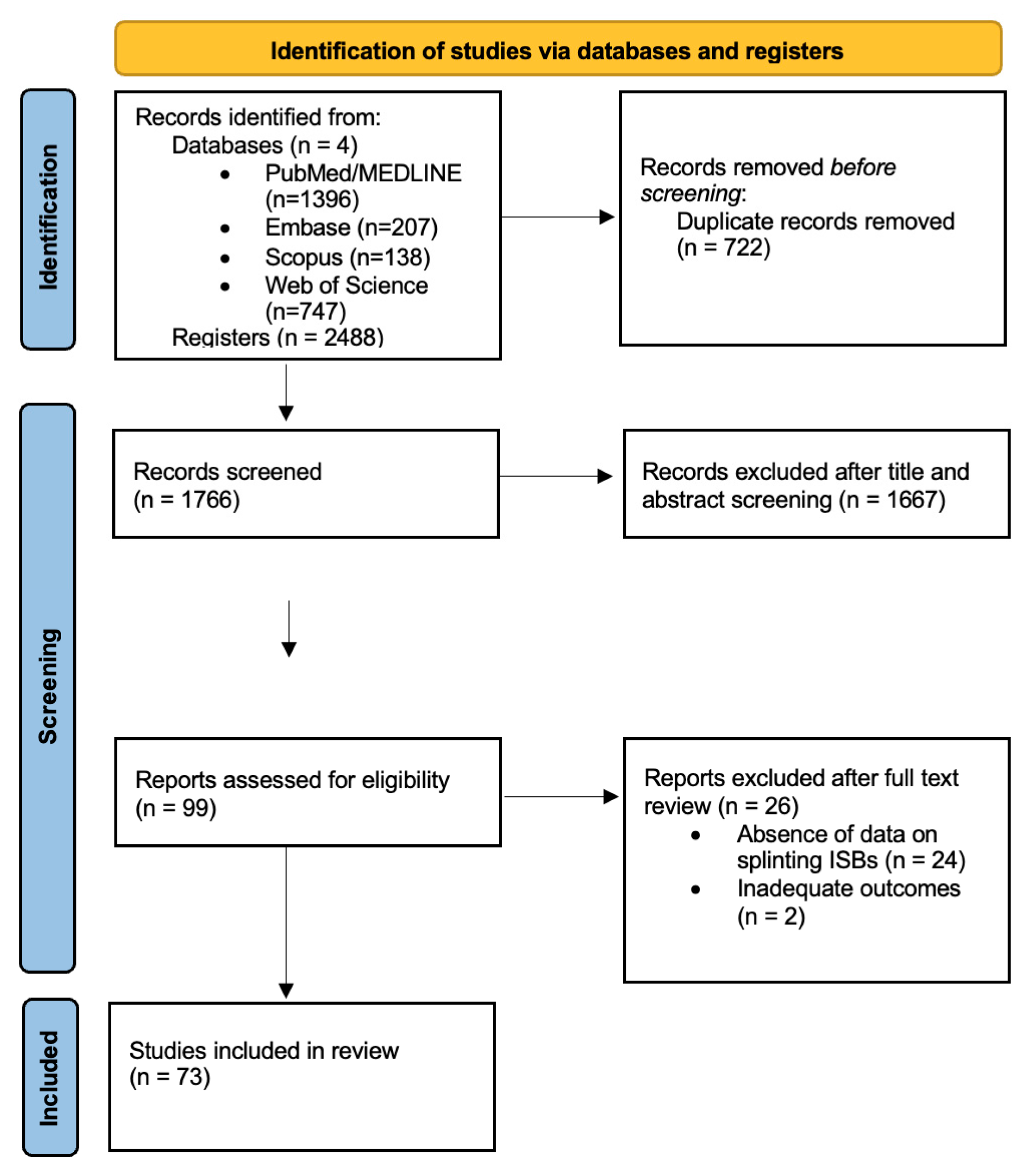
2.1. Protocol and Reporting
- Population: Edentulous or partially edentulous patients, or in vitro models with implant-supported restorations.
- Concept: Any technique, material, device, modification, or scan-body geometry intended to enhance the accuracy of intraoral scan body–based digital impressions (Splinting materials and assemblies, auxiliary geometric devices (AGDs), calibration frameworks, Artificial markers/reference landmarks, Horizontal or modified scan bodies, custom 3D-printed attachments or scan-body enhancements and modular, prefabricated, or denture-like stabilizing structures.
- Context: Digital implant workflows in clinical and laboratory settings, including in vitro, in vivo, and clinical studies.
2.2. Eligibility Criteria
- Studies evaluating any splinting method, auxiliary device, geometric attachment, artificial marker or landmark, horizontal or modified scan body, or any material or technique designed to stabilize, augment, or enhance the geometric referencing of intraoral scan bodies during digital scanning.
- Accepted study types: in vitro studies, clinical trials, observational studies, case series with quantitative assessment, and technical reports containing measurable outcomes.
- Studies using either direct-to-implant ISBs or multi-unit abutment ISBs.
- Full-arch or partial-arch implant scenarios.
- Articles published in English in peer-reviewed journals.
- Studies evaluating ISBs without any splinting or stabilizing method, unless serving as a control.
- Review articles, conference abstracts, expert opinions, case reports/techniques without measurable outcomes.
- Studies that solely assessed conventional impression splinting without digital comparison.
- Animal studies.
2.3. Information Sources and Search Strategy
- intraoral scan bodies and scanning abutments,
- splinting techniques (e.g., floss-resin splints, auxiliary geometric devices, verification frameworks),
- digital implant impressions, and
- CAD/CAM workflows.
2.4. Study Selection
- Title and abstract screening were performed independently by two reviewers (A.P., I.R.) to exclude clearly irrelevant articles.
- Full-text assessment was carried out for potentially eligible studies, applying the predefined inclusion and exclusion criteria.
2.5. Data Extraction
- Author(s)
- Publication year
- Study design (in vitro or clinical)
- Jaw or model type
- Edentulism pattern
- Number of implants
- ISB type
- Splinting material or device used (e.g., floss/resin, custom geometric aids, prefabricated bars, modular frameworks, dental floss with resin, 3D-printed attachments)
- Configuration of splinting (full-arch vs. non-continuous)
- Scanner type
- Control groups (e.g., non-splinted IOS, conventional impressions, laboratory scans)
- Key quantitative outcomes for trueness, precision, angular deviation, scanning time, and misfit values.
2.6. Data Synthesis
- type of splinting strategy or auxiliary scanning aid (direct splinting, auxiliary geometric devices, modified scan bodies, artificial landmarks);
- material and fabrication method (resin-based, metallic, 3D-printed, prefabricated);
- configuration (full-arch versus non-continuous or segmental connections); and
- reported effects on digital impression accuracy (trueness, precision, angular deviation, scanning time, and fit outcomes).
3. Results
- Rigid or semi-rigid auxiliary geometric devices (AGDs) fabricated via 3D printing, milling, or modular resin assembly;
- Direct splinting of standard scan bodies using floss, pattern resin, injectable or light-cured composites, or prefabricated bars; and
- Modification of scan bodies themselves, including horizontal geometries, wings, CAD/CAM extensional structures, artificial landmarks, or geometric attachments that increased surface heterogeneity.
4. Discussion
5. Conclusions
Supplementary Materials
Author Contributions
Funding
Institutional Review Board Statement
Informed Consent Statement
Data Availability Statement
Conflicts of Interest
Abbreviations
| ISB | Intraoral Scan Body |
Appendix A. Detailed Search Strategies
- PubMed (MEDLINE):Population: (((((((((dental implant[MeSH Terms]) OR (dental implant*)) OR (impression technique*)) OR (edentulous)) OR (edentulism)) OR (edentulous jaw[MeSH Terms]))OR (dental prosthesis, implant supported[MeSH Terms])) OR (dental prostheses,implant supported[MeSH Terms])) OR (implant supported restoration*)) OR (fixedimplant denture*)Concept: (((((((((digital scan*) OR (intraoral scan*)) OR (optical impression*)) OR(digital impression*)) OR (dental impression technique[MeSH Terms])) OR (dentalimpression technique*)) OR (dental impression material[MeSH Terms])) OR (dentalimpression materials[MeSH Terms])) OR (dental impression*)) OR (implant impression*)AND(((((((((((((((((scanbod*) OR (implant scan body)) OR (implant scan bodies)) OR(intraoral scanbod*)) OR (scan abutment*)) OR (scan post*)) OR (scan flag*)) OR(scanning device*)) OR (auxiliary device*)) OR (scan aid)) OR (scan aids)) OR(prefabricated aid)) OR (splinting)) OR (splinting technique*)) OR (splinting material*))OR (digital impression coping*)) OR (splint* scanbod*)) NOT (pet scan)Context: (((((digital workflow) OR (digital dentistry)) OR (accuracy)) OR (precision)) OR(trueness)) OR (implant position)
- Embase:(‘dental implant’/exp OR ‘dental implant*’:ti,ab,kw OR ‘impression technique*’:ti,ab,kw OR edentulous:ti,ab,kw OR edentulism:ti,ab,kw OR ‘edentulous jaw’/exp OR ‘implant supported dental prosthesis’/exp OR ‘implant supported restoration*’:ti,ab,kw OR ‘fixed implant denture*’:ti,ab,kw) AND (‘digital scan*’:ti,ab,kw OR ‘intraoral scan*’:ti,ab,kw OR ‘optical impression*’:ti,ab,kw OR ‘digital impression*’:ti,ab,kw OR ‘dental impression’/exp OR ‘dental impression technique*’:ti,ab,kw OR ‘dental impression material’/exp OR ‘dental impression material*’:ti,ab,kw OR ‘implant impression*’:ti,ab,kw) AND (scanbod*:ti,ab,kw OR ‘implant scan body’:ti,ab,kw OR ‘implant scan bodies’:ti,ab,kw OR ‘intraoral scanbod*’:ti,ab,kw OR ‘scan abutment*’:ti,ab,kw OR ‘scan post*’:ti,ab,kw OR ‘scan flag*’:ti,ab,kw OR ‘scanning device*’:ti,ab,kw OR ‘auxiliary device*’:ti,ab,kw OR ‘scan aid’:ti,ab,kw OR ‘scan aids’:ti,ab,kw OR ‘prefabricated aid’:ti,ab,kw OR splinting:ti,ab,kw OR ‘splinting technique*’:ti,ab,kw OR ‘splinting material*’:ti,ab,kw OR ‘digital impression coping*’:ti,ab,kw OR ‘splint* scanbod*’:ti,ab,kw) NOT (‘positron emission tomography’/exp OR ‘pet scan’:ti,ab,kw) AND (‘digital workflow’:ti,ab,kw OR ‘digital dentistry’:ti,ab,kw OR accuracy:ti,ab,kw OR precision:ti,ab,kw OR trueness:ti,ab,kw OR ‘implant position’:ti,ab,kw)
- Scopus:(dental implant OR implant dentistry OR dental prosthesis OR edentulous)AND(digital impression OR intraoral scan OR optical impression OR digital scan)AND(scan body OR scan bodies OR scan abutment OR scan post OR splinting ORscanning device)
- Web of Science:TS = (dental implant OR implant dentistry OR dental prosthesis OR edentulous)AND TS = (digital impression OR intraoral scan OR optical impression OR digital scan)AND TS = (scan body OR scan bodies OR scan abutment OR scan post OR splinting)AND TS = (accuracy OR precision OR trueness)
References
- Elani, H.W.; Starr, J.R.; Da Silva, J.D.; Gallucci, G.O. Trends in Dental Implant Use in the U.S., 1999–2016, and Projections to 2026. J. Dent. Res. 2018, 97, 1424–1430. [Google Scholar] [CrossRef] [PubMed]
- Flügge, T.; van der Meer, W.J.; Gonzalez, B.G.; Vach, K.; Wismeijer, D.; Wang, P. The accuracy of different dental impression techniques for implant-supported dental prostheses: A systematic review and meta-analysis. Clin. Oral. Implant. Res. 2018, 29, 374–392. [Google Scholar] [CrossRef]
- Sahin, S.; Cehreli, M.C.; Yalçin, E. The influence of functional forces on the biomechanics of implant-supported prostheses—A review. J. Dent. 2002, 30, 271–282. [Google Scholar] [CrossRef] [PubMed]
- Kunavisarut, C.; Lang, L.A.; Stoner, B.R.; Felton, D.A. Finite element analysis on dental implant-supported prostheses without passive fit. J. Prosthodont. 2002, 11, 30–40. [Google Scholar] [CrossRef] [PubMed]
- Papaspyridakos, P.; Chen, C.J.; Chuang, S.K.; Weber, H.P. Implant loading protocols for edentulous patients with fixed prostheses: A systematic review and meta-analysis. Int. J. Oral. Maxillofac. Implant. 2014, 29, 256–270. [Google Scholar] [CrossRef]
- Gaddale, R.; Mishra, S.K.; Chowdhary, R. Complications of screw- and cement-retained implant-supported full-arch restorations: A systematic review and meta-analysis. Int. J. Oral Implantol. 2020, 13, 11–40. [Google Scholar]
- Lin, W.S.; Eckert, S.E. Clinical performance of intentionally tilted implants versus axially positioned implants: A systematic review. Clin. Oral Implant. Res. 2018, 29, 78–105. [Google Scholar] [CrossRef]
- Mangano, F.; Gandolfi, A.; Luongo, G.; Logozzo, S. Intraoral scanners in dentistry: A review of the current literature. BMC Oral Health 2017, 17, 149. [Google Scholar] [CrossRef]
- Joda, T.; Brägger, U. Digital vs. conventional implant prosthetic workflows: A cost/time analysis. Clin. Oral Implant. Res. 2015, 26, 1430–1435. [Google Scholar] [CrossRef]
- Del Corso, M.; Abà, G.; Vazquez, L.; Dargaud, J.; Dohan Ehrenfest, D.M. Optical three-dimensional scanning acquisition of the position of osseointegrated implants: An in vitro study to determine method accuracy and operational feasibility. Clin. Implant. Dent. Relat. Res. 2009, 11, 214–221. [Google Scholar] [CrossRef]
- Mizumoto, R.M.; Yilmaz, B. Intraoral scan bodies in implant dentistry: A systematic review. J. Prosthet. Dent. 2018, 120, 343–352. [Google Scholar] [CrossRef] [PubMed]
- Vandenberghe, B. The digital patient—Imaging science in dentistry. J. Dent. 2018, 74, S21–S26. [Google Scholar] [CrossRef]
- Yilmaz, B.; Gouveia, D.; Marques, V.R.; Diker, E.; Schimmel, M.; Abou-Ayash, S. The accuracy of single implant scans with a healing abutment-scanpeg system compared with the scans of a scanbody and conventional impressions: An in vitro study. J. Dent. 2021, 110, 103684. [Google Scholar] [CrossRef]
- Karl, M.; Graef, F.; Schubinski, P.; Taylor, T. Effect of intraoral scanning on the passivity of fit of implant-supported fixed dental prostheses. Quintessence Int. 2012, 43, 555–562. [Google Scholar]
- Di Fiore, A.; Meneghello, R.; Graiff, L.; Savio, G.; Vigolo, P.; Monaco, C.; Stellini, E. Full arch digital scanning systems performances for implant-supported fixed dental prostheses: A comparative study of 8 intraoral scanners. J. Prosthodont. Res. 2019, 63, 396–403. [Google Scholar] [CrossRef]
- Yuzbasioglu, E.; Kurt, H.; Turunc, R.; Bilir, H. Comparison of digital and conventional impression techniques: Evaluation of patients’ perception, treatment comfort, effectiveness and clinical outcomes. BMC Oral Health 2014, 14, 10. [Google Scholar] [CrossRef]
- Rhee, Y.K.; Huh, Y.H.; Cho, L.R.; Park, C.J. Comparison of intraoral scanning and conventional impression techniques using 3-dimensional superimposition. J. Adv. Prosthodont. 2015, 7, 460–467. [Google Scholar] [CrossRef] [PubMed]
- Pan, Y.; Tsoi, J.K.H.; Lam, W.Y.H.; Zhao, K.; Pow, E.H.N. The cumulative effect of error in the digital workflow for complete-arch implant-supported frameworks: An in vitro study. Clin. Oral Implant. Res. 2022, 33, 886–899. [Google Scholar] [CrossRef]
- Gimenez-Gonzalez, B.; Hassan, B.; Özcan, M.; Pradíes, G. An In Vitro Study of Factors Influencing the Performance of Digital Intraoral Impressions Operating on Active Wavefront Sampling Technology with Multiple Implants in the Edentulous Maxilla. J. Prosthodont. 2017, 26, 650–655. [Google Scholar] [CrossRef] [PubMed]
- Gómez-Polo, M.; Sallorenzo, A.; Cascos, R.; Ballesteros, J.; Barmak, A.B.; Revilla-León, M. Conventional and digital complete arch implant impression techniques: An in vitro study comparing accuracy. J. Prosthet. Dent. 2024, 132, 809–818. [Google Scholar] [CrossRef]
- Cervino, G.; Fiorillo, L.; Herford, A.S.; Laino, L.; Troiano, G.; Amoroso, G.; Crimi, S.; Matarese, M.; D’Amico, C.; Nastro Siniscalchi, E.; et al. Alginate Materials and Dental Impression Technique: A Current State of the Art and Application to Dental Practice. Mar. Drugs 2018, 17, 18. [Google Scholar] [CrossRef]
- Anwar, H.; Azer, A.; AboElHassan, R.G. Influence of a specially designed geometric device and modified scan bodies on the accuracy of a maxillary complete arch digital implant scan: An in vitro study. J. Prosthet. Dent. 2024, 131, 683.e1–683.e7. [Google Scholar] [CrossRef] [PubMed]
- Iturrate, M.; Eguiraun, H.; Solaberrieta, E. Accuracy of digital impressions for implant-supported complete-arch prosthesis, using an auxiliary geometry part-An in vitro study. Clin. Oral Implant. Res. 2019, 30, 1250–1258. [Google Scholar] [CrossRef] [PubMed]
- Azevedo, L.; Laureti, A.; Marques, T.; Pitta, J.; Fehmer, V.; Pozzi, A.; Sailer, I. Effect of Horizontal and Vertical Intraoral Scan Bodies on the Trueness of Complete-Arch Digital Implant Impressions: A Comparative In Vitro Study With Six Implants. Clin. Oral Implant. Res. 2025, 36, 1136–1145. [Google Scholar] [CrossRef]
- Gianfreda, F.; Raffone, C.; Martelli, M.; Pitino, A.; Caponio, V.C.A.; Bollero, P. Conventional scan body vs. scan bodies with auxiliary geometric devices: An in vitro study for edentulous full-arch implant impressions. Front. Oral Health 2025, 6, 1574149. [Google Scholar] [CrossRef]
- Llansana, F.; Guirao, S.; Kois, J.C.; Revilla-León, M. Calibrated splinting framework for complete arch intraoral implant digital scans manufactured by combining milled and additively manufacturing technologies: A dental technique. J. Prosthet. Dent. 2024, 132, 680–686. [Google Scholar] [CrossRef] [PubMed]
- Roig, E.; Roig, M.; Garza, L.C.; Costa, S.; Maia, P.; Espona, J. Fit of complete-arch implant-supported prostheses produced from an intraoral scan by using an auxiliary device and from an elastomeric impression: A pilot clinical trial. J. Prosthet. Dent. 2022, 128, 404–414. [Google Scholar] [CrossRef]
- Page, M.J.; Moher, D.; Bossuyt, P.M.; Boutron, I.; Hoffmann, T.C.; Mulrow, C.D.; Shamseer, L.; Tetzlaff, J.M.; Akl, E.A.; Brennan, S.E.; et al. PRISMA 2020 explanation and elaboration: Updated guidance and exemplars for reporting systematic reviews. BMJ 2021, 372, n160. [Google Scholar] [CrossRef]
- Abdelrehim, A.; Bin Sulaiman, E.; Sofian, H.; Salleh, N.M. Time efficiency and precision of splinted complete arch implant scanning. J. Prosthet. Dent. 2025, 134, 223.e1–223.e7. [Google Scholar] [CrossRef]
- Abdelrehim, A.; Sulaiman, E.; Sofian, H.; Salleh, N.M. Effect of geometric heterogeneity using an auxiliary device on the accuracy of complete arch implant scanning: An in vitro study of different clinical simulations. J. Prosthet. Dent. 2025, 134, 765–773. [Google Scholar] [CrossRef]
- Ali, K.; Alzaid, A.A.; Suprono, M.S.; Garbacea, A.; Savignano, R.; Kattadiyil, M.T. Evaluating the effects of splinting implant scan bodies intraorally on the trueness of complete arch digital scans: A clinical study. J. Prosthet. Dent. 2024, 132, 781.e1–781.e7. [Google Scholar] [CrossRef]
- Almalki, A.; Akl, M.A.; Robaian, A.; Althubaitiy, R.; Alnasser, A.; Anadioti, E. Comparative accuracy of digital impressions using universal dual-purpose scan jigs for maxillary implant full arch impressions: An in vitro study. J. Prosthodont. 2025, 34, 520–526. [Google Scholar] [CrossRef] [PubMed]
- Arikan, H.; Muhtarogullari, M.; Uzel, S.M.; Guncu, M.B.; Aktas, G.; Marshall, L.S.; Turkyilmaz, I. Accuracy of digital impressions for implant-supported complete-arch prosthesis when using an auxiliary geometry device. J. Dent. Sci. 2023, 18, 808–813. [Google Scholar] [CrossRef]
- Asavanant, N.; Yang, C.C.; AlQallaf, H.; Zandinejad, A.; Morton, D.; Nagai, T.; Lin, W.S. Effects of complete-arch digital scanning techniques on the passive fit of CAD-CAM verification devices. J. Prosthodont. 2025, 34, 741–748. [Google Scholar] [CrossRef] [PubMed]
- Ashida, K.; Sanda, M.; Tanaka, S.; Baba, K. Effect of assistive devices on the precision of digital implant impressions for fully edentulous maxilla: An in vivo study. J. Prosthodont. Res. 2025, 69, 526–532. [Google Scholar] [CrossRef] [PubMed]
- Ashraf, Y.; Abo El Fadl, A.; Hamdy, A.; Ebeid, K. Effect of different intraoral scanners and scanbody splinting on accuracy of scanning implant-supported full arch fixed prosthesis. J. Esthet. Restor. Dent. 2023, 35, 1257–1263. [Google Scholar] [CrossRef]
- Ashry, A.; Abdelhamid, A.M.; Ezzelarab, S.; Khamis, M.M. Effect of using scan body accessories and inter-implant distances on the accuracy of complete arch implant digital impressions: An in vitro study. J. Prosthodont. 2025, 34, 827–835. [Google Scholar] [CrossRef]
- Azevedo, L.; Marques, T.; Karasan, D.; Fehmer, V.; Sailer, I.; Correia, A.; Gómez-Polo, M. Effect of splinting scan bodies on the trueness of complete arch digital implant scans with 5 different intraoral scanners. J. Prosthet. Dent. 2024, 132, 204–210. [Google Scholar] [CrossRef] [PubMed]
- Campana, V.; Papa, A.; Silvetti, M.A.; Del Fabbro, M.; Testori, T. Use of the universal scan template to achieve a predictable optical impression: Preliminary data of a case series study in complete edentulous patients. Clin. Implant Dent. Relat. Res. 2024, 26, 237–244. [Google Scholar] [CrossRef]
- Canullo, L.; Pesce, P.; Caponio, V.C.A.; Iacono, R.; Luciani, F.S.; Raffone, C.; Menini, M. Effect of auxiliary geometric devices on the accuracy of intraoral scans in full-arch implant-supported rehabilitations: An in vitro study. J. Dent. 2024, 145, 104979. [Google Scholar] [CrossRef]
- Chen, Z.; Yu, J.; Lu, J.; Wang, H.L.; Li, J. Influence of scan aid surface color on accuracy of calibrated intraoral scan protocol in complete arch implant digital scans. J. Prosthet. Dent. 2025, 135, 118.e1–118.e9. [Google Scholar] [CrossRef]
- Cheng, J.; Zhang, H.; Liu, H.; Li, J.; Wang, H.L.; Tao, X. Accuracy of edentulous full-arch implant impression: An in vitro comparison between conventional impression, intraoral scan with and without splinting, and photogrammetry. Clin. Oral Implant. Res. 2024, 35, 560–572. [Google Scholar] [CrossRef]
- Denneulin, T.; Rignon-Bret, C.; Ravalec, G.; Tapie, L.; Bouter, D.; Wulfman, C. Accuracy of Complete-Arch Implant Digital Scans: Effect of Scanning Protocol, Number of Implants, and Scan Body Splinting. Int. J. Prosthodont. 2023, 36, 219–227. [Google Scholar] [CrossRef]
- Eddin, M.; Önöral, Ö. Influence of splinting scan bodies or incorporating three-dimensionally printed scan aids on the trueness of complete arch digital scans. J. Prosthet. Dent. 2024, 132, 1–9. [Google Scholar] [CrossRef]
- Eid, H.S.; Zohdy, M.M.; Nour, M.; Salah, T. A comparative analysis of the passivity of fit of complete arch implant-supported frameworks fabricated using different acquisition techniques. J. Prosthet. Dent. 2024, 131, 477.e1–477.e8. [Google Scholar] [CrossRef]
- Eldabe, A.K.; Adel-Khattab, D.; Botros, K.H. Trueness of tooth modified scan bodies as a novel technique for edentulous full arch implant supported dental prosthesis: An in vivo prospective comparative study. BMC Oral Health 2025, 25, 29. [Google Scholar] [CrossRef] [PubMed]
- Farah, R.I.; Alresheedi, B.; Alazmi, S.; Al-Haj Ali, S.N. Evaluating the impact of scan body angulation and geometric attachments on the accuracy of complete-arch digital implant impressions: A comparison of two intraoral scanners. J. Prosthodont. 2025, 34, 174–181. [Google Scholar] [CrossRef] [PubMed]
- Farahat, A. Assessment of the effect of scan body splinting on the trueness of digital impression in complete-arch implant-supported prosthesis: A comparative in vitro study. Ain Shams Dent. J. 2025, 37, 441–449. [Google Scholar] [CrossRef]
- Ferrini, F.; Mazzoleni, F.; Barbini, M.; Coppo, C.; Di Domenico, G.L.; Gherlone, E.F. Comparative Analysis of Intraoral Scanner Accuracy in a Six-Implant Complete-Arch Model: An In Vitro Study. Prosthesis 2024, 6, 401–412. [Google Scholar] [CrossRef]
- Fu, X.J.; Liu, M.; Liu, B.L.; Tonetti, M.S.; Shi, J.Y.; Lai, H.C. Accuracy of intraoral scan with prefabricated aids and stereophotogrammetry compared with open tray impressions for complete-arch implant-supported prosthesis: A clinical study. Clin. Oral Implant. Res. 2024, 35, 830–840. [Google Scholar] [CrossRef]
- Fu, X.J.; Liu, M.; Shi, J.Y.; Deng, K.; Lai, H.C.; Gu, W.; Zhang, X.M. Comparison of Different Intraoral Scanners With Prefabricated Aid on Accuracy and Framework Passive Fit of Digital Complete-Arch Implant Impression: An In Vitro Study. Clin. Oral Implant. Res. 2025, 36, 17–27. [Google Scholar] [CrossRef]
- Garbacea, A.; Alqahtani, A.F.; Goodacre, B.; Alhelal, A.; Lozada, J.; Kattadiyil, M.T. Scanning accuracy with splinted and unsplinted implant scan bodies for the edentulous arch at implant level: An in vitro study. J. Oral Implantol. 2022, 51. [Google Scholar] [CrossRef]
- García-Martínez, I.; Zarauz, C.; Morejón, B.; Ferreiroa, A.; Pradíes, G. Influence of customized over-scan body rings on the intraoral scanning effectiveness of a multiple implant edentulous mandibular model. J. Dent. 2022, 122, 104095. [Google Scholar] [CrossRef] [PubMed]
- Huang, R.; Liu, Y.; Huang, B.; Zhang, C.; Chen, Z.; Li, Z. Improved scanning accuracy with newly designed scan bodies: An in vitro study comparing digital versus conventional impression techniques for complete-arch implant rehabilitation. Clin. Oral Implant. Res. 2020, 31, 625–633. [Google Scholar] [CrossRef]
- Ateşalp İleri, S.; Büyükerkmen, E.B. In vitro evaluation of the effect of auxiliary geometric device on measurement trueness and scanning time in full-arch implant impressions. J. Adv. Prosthodont. 2025, 17, 197–209. [Google Scholar] [CrossRef]
- Iturrate, M.; Eguiraun, H.; Etxaniz, O.; Solaberrieta, E. Accuracy analysis of complete-arch digital scans in edentulous arches when using an auxiliary geometric device. J. Prosthet. Dent. 2019, 121, 447–454. [Google Scholar] [CrossRef]
- Kalayci, H.A.; Uzel, S.M.; Turkyilmaz, I.; Hunt, M.; Guncu, M.B. Impact of scan body splinting on the accuracy of complete-arch digital implant impressions. J. Dent. Sci. 2025, 20, 2189–2194. [Google Scholar] [CrossRef]
- Kanjanasavitree, P.; Thammajaruk, P.; Guazzato, M. Comparison of different artificial landmarks and scanning patterns on the complete-arch implant intraoral digital scans. J. Dent. 2022, 125, 104266. [Google Scholar] [CrossRef] [PubMed]
- Kao, T.Y.; Hsieh, M.C.; Hsu, C.P.; Liao, C.C.; Chang, C.L. Accuracy of digital impressions for three-unit and four-unit implant supported fixed dental prostheses using a novel device. J. Dent. Sci. 2023, 18, 702–708. [Google Scholar] [CrossRef] [PubMed]
- Ke, Y.; Zhang, Y.; Wang, Y.; Chen, H.; Sun, Y. Comparing the accuracy of full-arch implant impressions using the conventional technique and digital scans with and without prefabricated landmarks in the mandible: An in vitro study. J. Dent. 2023, 135, 104561. [Google Scholar] [CrossRef]
- Kernen, F.R.; Recca, M.; Vach, K.; Nahles, S.; Nelson, K.; Flügge, T.V. In vitro scanning accuracy using different aids for multiple implants in the edentulous arch. Clin. Oral Implant. Res. 2022, 33, 1010–1020. [Google Scholar] [CrossRef]
- Tran, T.; Lam, H.; Nguyen, D.P.; Lam, H.; Vo, H.; Viet, V. Comparison of accuracy between digital and conventional impression techniques in full-arch edentulous implant patients: An in vitro study. Dent. Hypotheses 2025, 16, 53–55. [Google Scholar] [CrossRef]
- Laureti, A.; Marques, T.; Pitta, J.; Fehmer, V.; Sailer, I.; Pozzi, A.; Azevedo, L. Influence of Horizontal Intraoral Scan Bodies on the Trueness of Digital Impressions for Complete-Arch Prostheses on Four Implants: An In Vitro Evaluation. Clin. Oral Implant. Res. 2025, 36, 1287–1295. [Google Scholar] [CrossRef]
- Li, Y.; Fang, H.; Yan, Y.; Geng, W. Accuracy of intraoral scanning using modified scan bodies for complete arch implant-supported fixed prostheses. J. Prosthet. Dent. 2024, 132, 994.e1–994.e8. [Google Scholar] [CrossRef] [PubMed]
- Li, J.; Chen, Z.; Nava, P.; Yang, S.; Calatrava, J.; Wang, H.L. Calibrated intraoral scan protocol (CISP) for full-arch implant impressions: An in vitro comparison to conventional impression, intraoral scan, and intraoral scan with scan-aid. Clin. Implant Dent. Relat. Res. 2024, 26, 879–888. [Google Scholar] [CrossRef] [PubMed]
- Liu, H.; Zhang, X.; Gao, Y.; Li, M.; Qu, Z.; Zhao, J. Effect of Auxiliary Devices on the Accuracy of Complete-Arch Implant Digital Impressions: An in Vitro Study. Int. Dent. J. 2025, 75, 103950. [Google Scholar] [CrossRef]
- Liu, M.; Fu, X.J.; Lai, H.C.; Shi, J.Y.; Liu, B.L. Accuracy of traditional open-tray impression, stereophotogrammetry, and intraoral scanning with prefabricated aids for implant-supported complete arch prostheses with different implant distributions: An in vitro study. J. Prosthet. Dent. 2024, 132, 602.e1–602.e9. [Google Scholar] [CrossRef]
- Lu, Q.; Zhu, Y.; Chen, Y.; Xu, P.; Liang, Y.; Chen, T. Accuracy of a 3D printed custom resin crossbar for complete arch implant scanning: An in vitro and in vivo study. J. Prosthet. Dent. 2025, 133, 1078.e1–1078.e10. [Google Scholar] [CrossRef]
- Lyu, M.; Xu, D.; Li, Y.; Zhang, S.; Zhao, H.; Yuan, Q. Effect of an auxiliary device on scanning accuracy for multiple implants: An in vitro comparative study. Head Face Med. 2025, 21, 32. [Google Scholar] [CrossRef]
- Masu, R.; Tanaka, S.; Sanda, M.; Miyoshi, K.; Baba, K. Effect of assistive devices on the precision of digital impressions for implants placed in edentulous maxilla: An in vitro study. Int. J. Implant Dent. 2021, 7, 116. [Google Scholar] [CrossRef]
- Mizumoto, R.M.; Yilmaz, B.; McGlumphy, E.A., Jr.; Seidt, J.; Johnston, W.M. Accuracy of different digital scanning techniques and scan bodies for complete-arch implant-supported prostheses. J. Prosthet. Dent. 2020, 123, 96–104. [Google Scholar] [CrossRef]
- Nedelcu, R.; Olsson, P.; Thulin, M.; Nyström, I.; Thor, A. In vivo trueness and precision of full-arch implant scans using intraoral scanners with three different acquisition protocols. J. Dent. 2023, 128, 104308. [Google Scholar] [CrossRef]
- Nulty, A.B. An In Vivo Comparison of Trueness and Precision of Two Novel Methods for Improving Edentulous Full Arch Implant Scanning Accuracy: A Pilot Study. Dent. J. 2024, 12, 367. [Google Scholar] [CrossRef]
- Önöral, Ö.; Çakır, S. Influence of the color of 3D-printed scan aids on the trueness of complete arch digital scans. J. Prosthodont. 2024, 1–13. [Google Scholar] [CrossRef]
- Önöral, Ö.; Çakır, S.; Kurtulmus-Yilmaz, S. Influence of prefabricated auxiliary device design and intraoral scanner type on the 3D trueness of intraoral scans. Cyprus J. Med. Sci. 2025, 12–15. [Google Scholar] [CrossRef]
- Pan, Y.; Tsoi, J.K.H.; Lam, W.Y.; Zhao, K.; Pow, E.H. Improving intraoral implant scanning with a novel auxiliary device: An in-vitro study. Clin. Oral Implant. Res. 2021, 32, 1466–1473. [Google Scholar] [CrossRef] [PubMed]
- Carneiro Pereira, A.L.; Medeiros, V.R.; Campos, M.F.T.P.; de Medeiros, A.K.B.; Yilmaz, B.; Carreiro, A.D.F.P. Conventional and digital impressions for complete-arch implant-supported fixed prostheses: Time, implant quantity effect and patient satisfaction. J. Adv. Prosthodont. 2022, 14, 212–222. [Google Scholar] [CrossRef]
- Carneiro Pereira, A.L.; Carvalho Porto de Freitas, R.F.; de Fátima Trindade Pinto Campos, M.; Soares Paiva Tôrres, A.C.; Bezerra de Medeiros, A.K.; da Fonte Porto Carreiro, A. Trueness of a device for intraoral scanning to capture the angle and distance between implants in edentulous mandibular arches. J. Prosthet. Dent. 2022, 128, 1310–1317. [Google Scholar] [CrossRef] [PubMed]
- Pereira, A.L.C.; Segundo, H.V.M.; Júnior, L.C.A.; Germano, A.R.; Carreiro, A.D.F.P. Accuracy between intraoral and extraoral scanning: Three-dimensional deviation and effect of distance between implants from two scanning methods. J. Indian Prosthodont. Soc. 2022, 22, 279–287. [Google Scholar] [CrossRef]
- Pol, B.S.; Sabane, A.V.; Jadhav, R.D.; Kadam, P.P.; Gachake, A.R.; Kalsekar, B.G. Evaluation and Comparison of Accuracy of Complete Arch Digital and Conventional Implant Impression as Influenced by the Use of a 3D Printed Modular Splint—An In-Vitro Study. J. Pharm. Bioallied Sci. 2024, 16, S3764–S3767. [Google Scholar] [CrossRef]
- Pozzi, A.; Arcuri, L.; Lio, F.; Papa, A.; Nardi, A.; Londono, J. Accuracy of complete-arch digital implant impression with or without scanbody splinting: An in vitro study. J. Dent. 2022, 119, 104072. [Google Scholar] [CrossRef] [PubMed]
- Retana, L.; Nejat, A.H.; Pozzi, A. Effect of splinting scan bodies on trueness of complete-arch implant impression using different intraoral scanners: An in vitro study. Int. J. Comput. Dent. 2023, 26, 19–28. [Google Scholar] [CrossRef]
- Revilla-León, M.; Cascos, R.; Lawand, G.; Barmak, A.B.; Kois, J.C.; Gómez-Polo, M. Accuracy of complete arch nonsplinting and noncalibrated splinting implant scanning techniques recorded by using five intraoral scanners. J. Prosthet. Dent. 2025, 133, 1581.e1–1581.e10. [Google Scholar] [CrossRef]
- Revilla-León, M.; Cascos, R.; Barmak, A.B.; Kois, J.C.; Gómez-Polo, M. Accuracy of a complete arch noncalibrated splinting implant scanning technique with a palatal orientation recorded by using different intraoral scanners. J. Prosthet. Dent. 2025, 135, 109–117. [Google Scholar] [CrossRef] [PubMed]
- Revilla-León, M.; Barmak, A.B.; Lanis, A.; Kois, J.C. Influence of connected and nonconnected calibrated frameworks on the accuracy of complete arch implant scans obtained by using four intraoral scanners, a desktop scanner, and a photogrammetry system. J. Prosthet. Dent. 2025, 134, 800–808. [Google Scholar] [CrossRef]
- Revilla-León, M.; Cascos, R.; Barmak, A.B.; Drone, M.; Kois, J.C.; Gómez-Polo, M. Clinical accuracy of complete arch implant scans recorded by using a noncalibrated splinting technique, intraoral photogrammetry, and extraoral photogrammetry with snap-on markers. J. Prosthet. Dent. 2025, 135, 108.e1–108.e7. [Google Scholar] [CrossRef]
- Rustichini, F.; Romolini, R.; Salmi, M.C.; Gennai, L.; Vermigli, F.; Mangano, F.G. Implant-supported full-arch fixed dental prostheses manufactured through a direct digital workflow using a calibrated splinting framework: A retrospective clinical study. J. Dent. 2025, 154, 105605. [Google Scholar] [CrossRef]
- Rutkunas, V.; Bilius, V.; Simonaitis, T.; Auskalnis, L.; Jurgilevicius, J.; Akulauskas, M. The effect of different implant impression splinting techniques and time on the dimensional accuracy: An in vitro study. J. Dent. 2022, 126, 104267. [Google Scholar] [CrossRef]
- Tallarico, M.; Lumbau, A.I.; Scrascia, R.; Demelas, G.; Sanseverino, F.; Amarena, R.; Meloni, S.M. Feasibility of Using a Prosthetic-Based Impression Template to Improve the Trueness and Precision of a Complete Arch Digital Impression on Four and Six Implants: An In Vitro Study. Materials 2020, 13, 3543. [Google Scholar] [CrossRef]
- Wu, H.K.; Leung, S.; Chen, H.; Kong, Q.; Huang, X.; Lin, X.; Zhang, Z.; Deng, F. Effect of prefabricated auxiliary devices in different optical properties and shapes on the accuracy of intraoral scanning of the edentulous arch with multiple implants: An in-vitro study. J. Dent. 2024, 151, 105430. [Google Scholar] [CrossRef] [PubMed]
- Wu, H.K.; Chen, G.; Zhang, Z.; Lin, X.; Huang, X.; Deng, F.; Li, Y. Effect of artificial landmarks of the prefabricated auxiliary devices located at different arch positions on the accuracy of complete-arch edentulous digital implant scanning: An in-vitro study. J. Dent. 2024, 140, 104802. [Google Scholar] [CrossRef]
- Wu, H.K.; Chen, G.; Wang, J.; Zhang, Z.; Huang, X.; Lin, X.; Deng, F.; Li, Y. Effect of prefabricated auxiliary devices and scanning patterns on the accuracy of complete-arch implant digital impressions. J. Dent. 2024, 140, 104788. [Google Scholar] [CrossRef] [PubMed]
- Wu, H.K.; Wang, J.; Chen, G.; Huang, X.; Deng, F.; Li, Y. Effect of novel prefabricated auxiliary devices attaching to scan bodies on the accuracy of intraoral scanning of complete-arch with multiple implants: An in-vitro study. J. Dent. 2023, 138, 104702. [Google Scholar] [CrossRef]
- Kurtulmus-Yilmaz, S.; Muslu, T.; Önöral, Ö. Does scan aid use improve the 3D trueness of digital implant impressions with different inter-implant distances? Cyprus J. Med. Sci. 2025, 10, 42–45. [Google Scholar] [CrossRef]
- Zhang, T.; Yang, B.; Ge, R.; Zhang, C.; Zhang, H.; Wang, Y. Effect of a Novel ‘Scan Body’ on the In Vitro Scanning Accuracy of Full-Arch Implant Impressions. Int. Dent. J. 2024, 74, 847–854. [Google Scholar] [CrossRef]
- Revilla-León, M.; Ghunaim, D.; Barmak, A.B.; Afshari, F.S.; Fang, Q.; Prasad, S. A systematic review of the accuracy of complete arch implant scans recorded by using noncalibrated splinting or implant scan body techniques. Report of the Committee on Research in Fixed Prosthodontics of the American Academy of Fixed Prosthodontics. J. Prosthet. Dent. 2025, 3. [Google Scholar] [CrossRef]
- Wan, Q.; Limpuangthip, N.; Hlaing, N.H.M.M.; Hahn, S.; Lee, J.H.; Lee, S.J. Enhancing scanning accuracy of digital implant scans: A systematic review on application methods of scan bodies. J. Prosthet. Dent. 2024, 132, 898.e1–898.e9. [Google Scholar] [CrossRef]
- Pachiou, A.; Zervou, E.; Tsirogiannis, P.; Sykaras, N.; Tortopidis, D.; Kourtis, S. Characteristics of intraoral scan bodies and their influence on impression accuracy: A systematic review. J. Esthet. Restor. Dent. 2023, 35, 1205–1217. [Google Scholar] [CrossRef] [PubMed]
- Nulty, A.B.; Kelly, C.; Ambridge, O.; Ambridge, M.; Ferguson, R.; Hoffer, A. In Vitro Comparison of Trueness and Precision of an AI-Driven Real-Time Library Matching Protocol with Irregular Geometry Scan Bodies for Full-Arch Implant Scanning. Dent. J. 2025, 13, 533. [Google Scholar] [CrossRef] [PubMed]
- Arcuri, L.; Pozzi, A.; Lio, F.; Rompen, E.; Zechner, W.; Nardi, A. Influence of implant scanbody material, position and operator on the accuracy of digital impression for complete-arch: A randomized in vitro trial. J. Prosthodont. Res. 2020, 64, 128–136. [Google Scholar] [CrossRef]
- Biadsee, A.; Yusef, R.; Melamed, G.; Ormianer, Z. Scan Body Discrepancies in Bone- and Tissue-Level Implants: In Vitro Study. Int. J. Oral Maxillofac Implant. 2025, 1–16. [Google Scholar] [CrossRef] [PubMed]
- Sun, X.; Li, L.; Wen, C. Effects of inter-implant tooth loss and scan body material on digital impression accuracy: An in vitro study. BMC Oral Health 2025, 25, 1502. [Google Scholar] [CrossRef] [PubMed]
- Gavounelis, N.A.; Gogola, C.C.; Halazonetis, D.J. The Effect of Scanning Strategy on Intraoral Scanner’s Accuracy. Dent. J. 2022, 10, 123. [Google Scholar] [CrossRef]
- Grande, F.; Mosca Balma, A.; Mussano, F.; Catapano, S. Effect of Implant Scan Body type, Intraoral scanner and Scan Strategy on the accuracy and scanning time of a maxillary complete arch implant scans: An in vitro study. J. Dent. 2025, 159, 105782. [Google Scholar] [CrossRef] [PubMed]


| Author | Study Type | Sample/Jaw | No of Implants | Splinting Material/Scan Aid | Key Findings |
|---|---|---|---|---|---|
| Abdelrehim, et al., 2025 [29] | In vitro | 3 mandibular casts | 10 implants, Groups: 3 | Custom rigid scan-aid apparatus (auxiliary geometric device, 3D printed) | Splinting with the apparatus significantly improved precision in all groups. Total scanning time was reduced for 4-implant groups. Time lost due to errors was reduced for all groups. Geometric heterogeneity and added reference points improved image stitching stability. |
| Abdelrehim, et al., 2025 [30] | In vitro | 3 mandibular models | 10 implants, Groups: (2IP, 4IP, 4IA) | Custom rigid auxiliary geometric device (3D printed) | Auxiliary geometric device improved 3D, linear, and angular accuracy. All non-splinted groups exceeded both linear and angular deviation limits. Posterior implants showed the highest errors in non-splinted scans |
| Ali, et al., 2024 [31] | Nonrandomized clinical trial | 19 arches (4 Maxilla, 15 Mandible) | 4 to 6 implants per arch | Floss and pattern resin | Conventional impressions were more accurate than splinted and unsplinted digital scans. No significant difference in positional or angular trueness between splinted and unsplinted. Splinting significantly reduced scan time. Maxillary scans faster than mandibular. Conventional impressions were more accurate than digital scans. |
| Almalki, et al., 2025 [32] | In vitro | 1 maxillary typodont | 6 implants (multiunit abutment analogs) | Dual-purpose scan jigs | No significant differences in accuracy between the two groups at any location. Both ISB types produced deviations within clinically acceptable ranges (<150 μm). |
| Anwar, et al., 2024 [22] | In vitro | 1 maxillary model | 4 implants (2 parallel anterior, 2 tilted posterior) | Specially designed geometric device (3D printed gray resin) | Both the geometric device and ISB modifications significantly improved trueness and precision compared to the control group. The geometric device had a greater positive impact on accuracy than the ISB modifications alone. The highest accuracy was achieved when using the geometric device and modified scan bodies simultaneously. |
| Arikan, et al., 2023 [33] | In vitro | 1 maxillary epoxy resin model | 4 implants (Canine and First Molar positions) | Custom 3D-printed auxiliary geometric appliance (AGA) fixed with light-polymerizing resin | Digital impressions without the auxiliary device had the worst accuracy. Use of the auxiliary geometric appliance significantly improved accuracy. Digital impressions were significantly less accurate than conventional splinted open-tray impressions or lab scan. All groups stayed within clinically acceptable misfit thresholds (<150 µm). |
| Asavanant, et al., 2025 [34] | In vitro | 1 mandibular master cast | 4 implants (Multiunit abutment analogs) | Group 2: Metal mesh and light-polymerizing acrylic resin (Bulk Fill Flowable Composite)/Group 3: Passively fitting interim prosthesis (Reverse scanbody protocol) | Conventional splinted open-tray: 0% misfit—best performance. Reverse scanbody: 20% misfit. OPTISPLINT splinted ISBs: 60% misfit. Conventional splinted open-tray impression + milled devices produced superior passive fit. Reverse ISB protocol outperformed splinted ISBs with auxiliary features. |
| Ashida, et al., 2025 [35] | In vivo clinical study | 8 participants (Maxilla) | 4 implants per patient | Custom assistive device: Milled Polymethyl methacrylate (PMMA) fixed with self-curing resin | Digital impressions with the assistive device showed significantly higher precision compared to the non-splinted digital group and the conventional verification cast method. The device’s design, which crossed the palate to connect posterior implants, significantly reduced the scanning path length and accumulated errors. Precision was in vivo lower than in vitro, but still improved with assistive device. |
| Ashraf, et al., 2023 [36] | In vitro | 2 maxillary models | 4 implants each | Custom modular chain device: 3D printed resin elements assembled to form a chain | Splinting ISBs with the modular chain device significantly improved trueness and precision compared to the non-splinted. Primescan showed the highest trueness and precision, followed by Trios 4. Medit i600 showed significantly lower accuracy. The distal implant angulation (30° vs. 45°) had no significant effect on trueness or precision. |
| Ashry, et al., 2025 [37] | In vitro | 1 Maxillary PMMA model with soft tissue replica | 4 implants | Custom PEEK scan body accessories (milled 8-mm arms friction-fitted to the scan bodies) | Accessories significantly improved the overall scanning precision. They also significantly reduced 3D deviation at the most distal ISB, where errors were highest, though the overall difference was not statistically significant. Significant improvement in linear trueness was found for specific inter-implant distances. No difference in angular deviation between groups. |
| Azevedo et al., 2025 [24] | In vitro | 1 mandibular definitive cast | 6 implants | Not applicable | All factors significantly affected trueness (operator, ISB, IOS). Horizontal ISBs were more accurate than the vertical ISB. Primescan delivered the best trueness. iTero Element 5D + vertical ISBs had worst accuracy and strong operator variability. |
| Azevedo, et al., 2024 [38] | In vitro | 1 mandibular definitive cast | 6 implants | Group splinted: Orthodontic wire and pattern resin/Artificial landmarks group: made of light-polymerized resin placed on mucosa | No statistically significant differences in trueness between the conventional, splinted and artificial landmark techniques. Scanner significantly influenced trueness. Primescan showed higher trueness than iTero 5D and TRIOS 4. While splinting generally did not improve trueness for most scanners, it improved trueness specifically for the TRIOS 4. |
| Campana, et al., 2024 [39] | Case Series clinical study | 12 patients (6 Maxilla, 6 Mandible) | 4 to 6 implants per arch | Universal Scan Template (UST®): Modular 3D printed Rigid Gray Resin stabilized with orthodontic elastics | The use of the UST resulted in 100% passive fit for the manufactured titanium bars clinically, compared to only 20% passive fit without UST. Scan time was significantly reduced with the use of UST. Significant distortion was measured between the STL files acquired with and without UST. |
| Canullo, et al., 2024 [40] | In vitro | 1 maxillary model | 4 implant replicas | Auxiliary Geometric Device (AGD): Milled Polymethylmethacrylate (PMMA) fixed with cyanoacrylate adhesive | AGD worsened angular deviation overall. AGD did not improve accuracy for TRIOS or CS. Full-arch scans can still be clinically acceptable without AGD. |
| Chen, et al., 2025 [41] | In vitro | 1 maxillary model | 6 implants | Calibration Device (Scan Aid—SA): 3D printed resin in Gray, Tan, or White. Fixed with occlusal registration polyvinyl siloxane (PVS). | The CISP method provided significantly improved trueness and precision over IOS alone or IOS with the scan aid only. CISP achieved superior accuracy at distal sites. At the most distal site, CISP trueness was significantly lower than IOS. |
| Cheng, et al., 2024 [42] | In vitro | Maxillary model made from an aerospace-grade aluminum block | 6 implants | Commercially available splinting attached directly to the scan body’s cross-hole | Stereophotogrammetry (SPG) exhibited superior trueness and precision. The splinted ISBs showed no statistically significant difference in trueness or precision when compared to the non-splinted IOS or the conventional impression. Intraoral scanning displayed a tendency for angular and linear deviations in the cross-arch region. |
| Denneulin, et al., 2023 [43] | In vitro | 1 mandibular model | Configurations tested: 6 implants, 4 implants (short arch), 4 implants (long arch). | Blue suture thread | Splinting with suture thread negatively affected accuracy with Trios 3 and had no significant effect with Primescan. Trueness and precision were significantly better with 6 implants compared to 4 implants for both scanners. |
| Eddin and Önöral, 2024 [44] | In vitro | 1 mandibular cast | 4 implants | PR: Dental floss and pattern resin/CR: Dental floss and composite resin/AA: 3D printed auxiliary apparatus (PLA)/CSB: Custom scan bodies with extensions (PLA). | The conventional splinted impression showed the lowest distortion values (best trueness) overall. The 3D printed auxiliary apparatus group had distortion levels comparable to the conventional method and significantly better than the non-splinted group. All splinting/modification methods significantly improved trueness compared to the non-splinted SB group. |
| Eid, et al., 2024 [45] | In vitro | 1 maxillary model | 4 implants | Group Aux: Custom geometric auxiliary device (3D printed resin) with tooth-like landmarks. | Both digital groups (with and without the device) resulted in a more accurate fit (smaller gaps) than the conventional impression group. The auxiliary device improved the passivity of the fit compared to the standard digital scan, though both were within clinically acceptable limits. |
| Eldabe, et al., 2025 [46] | In vivo prospective comparative study | 7 arches (2 Maxillae, 5 Mandibles) in 6 patients | 4 to 5 implants per arch (Total 34 implants) | A novel scan body modified with directly connected tooth-shaped objects acting as stable artificial landmarks to fill the gaps between scan bodies. | The Tooth-Modified Scan Body (TMSB) group showed significantly lower Euclidean deviation compared to the Conventional Scan Body (CSB) group. TMSB showed significantly lower angular deviation and reduced scanning time compared to CSB. |
| Farah, et al., 2025 [47] | In vitro | 1 maxillary cast | 4 implants | Custom 3D-printed Geometric Attachments (GAs) (acrylate-based resin) | The use of GAs significantly reduced deviations (improved accuracy) for both scanners. iTero exhibited significantly lower mean 3D surface and linear deviations (better accuracy) than Omnicam. ISB angulation (0° vs. 30°) did not significantly impact scan deviations. |
| Farahat and El Saaedi, 2025 [48] | In vitro | 1 mandibular resin model | 4 implants | Group III (Digital Splinted): Dental floss and injectable hard-liner resin material | Conventional impression showed the highest trueness. Splinting ISBs improved trueness compared to the non-splinted digital group. |
| Ferrini, et al., 2024 [49] | In vitro | 1 titanium master model | 6 implants | Dental floss and light-curing resin, sectioned and reconnected to reduce shrinkage. | Significant differences in trueness among the tested scanners, with TRIOS and Medit i700 wireless yielding the worst trueness values for long distances. No significant differences were found in precision. Increasing the measuring distance led to a decrease in both trueness and precision for all scanners. |
| Fu, et al., 2024 [50] | In vivo clinical study | 15 patients, 22 arches (9 upper, 13 lower) | 4 to 6 implants per arch (Total 115 implants) | IOS group: Prefabricated bar splints selected according to distance and screwed into the scan bodies. | IOS showed significantly greater angle deviation and RMS error than SPG. IOS with prefabricated aids was the most efficient workflow. |
| Fu, et al., 2025 [51] | In vitro | 4 maxillary master models | 4 and 6 implants | IOS-T/M/A with aid: Titanium-prefabricated bar splints (scan aids) screwed into the scan bodies | Scanning with prefabricated aids improved both trueness and precision for all three IOSs compared to without aids. With aids, IOS-A (Aoralscan 3) and IOS-M (Medit i700) showed better trueness than IOS-T (TRIOS 5). IOS-M achieved the most improvement with aids. A significant correlation was found between virtual RMS errors and physical framework misfit. |
| Garbacea, et al., 2021 [52] | In vitro | 1 maxillary master cast | 6 implants | Complete arch splint: 3D printed resin with minimal irregularities like natural teeth geometry landmarks added to the periphery. | Splinting ISBs did not improve scan accuracy. Trios and Atos scanners recorded lower deviations than True Definition (TD) and Dental Wings (DDW), especially in splinted groups. |
| García-Martínez, et al., 2022 [53] | In vitro | 1 mandibular master model | 6 implants | Customized over-scan body rings (COR): 3D printed (Dental Model resin) rings with irregular patterns snapped on ISBs | The COR system reduced the number of rescans required and total scanning time. No differences were found in terms of linear or angular trueness and precision. The use of COR improved efficiency without impacting accuracy. |
| Gianfreda, et al., 2025 [25] | In vitro | 1 maxillary model (gypsum) | 4 implants | Auxiliary Geometric Device (AGD): A screwable extension that creates an L-shaped scan body. | The AGD significantly enhanced trueness and precision of full-arch implant impressions when compared with conventional ISBs, reducing stitching errors and enhancing ISB stability during full-arch digital impressions. |
| Gómez-Polo, et al., 2024 [20] | In vitro | 2 maxillary casts | 8 implants (4 implants each) | Splinted Digital: Splinting framework attached to Ti abutments with autopolymerizing acrylic resin | Conventional impression showed the best trueness and precision. The splinted digital method had better trueness and precision than the non-splinted group, which had the worst accuracy. Parallel implants had better trueness and precision than nonparallel implants (up to 30°). |
| Huang et al., 2020 [54] | In vitro | 1 mandibular acrylic model with soft tissue replica | 4 implants | Custom CAD/CAM titanium alloy scan bodies | Conventional splinted open-tray impressions were more accurate than all digital impression groups. The design of the extensional structure significantly improved precision compared to original and non-extended ISBs. Trueness of the extended ISBs was comparable to the conventional impression and better than the other digital groups. |
| Ileri, et al., 2024 [55] | In vitro | 2 maxillary model | 8 implants (4 implants each) | Group 1: Artificial acrylic tooth used as a reference landmark. Group 2: Custom 3D printed Thermoplastic Polyurethane auxiliary geometric device. | The use of the custom auxiliary device improved trueness for all scanners compared to standard scanning, even in angulated cases. Primescan showed the highest trueness overall. Trios 3 showed the most significant improvement with the AGD, reducing deviations from unacceptable to acceptable levels. Primescan was the fastest scanner overall. |
| Iturrate, et al., 2019 [56] | In vitro | 1 stainless-steel maxilla model | 4 machined cylinders simulating scan bodies | Custom Auxiliary Geometric Device (AGD): A 3D-printed device shaped like a conventional complete-arch dentureand fixed with light-polymerizing resin | AGD improved trueness in all reference distances compared to scanning without it. The AGD improved precision in 4 out of 5 reference distances. Accuracy decreased as the length of the measured distance increased for both groups, but the AGD group maintained better accuracy over longer spans. |
| Iturrate, et al., 2019 [23] | In vitro | 1 stainless-steel maxilla model | 4 machined cylinders simulating scan bodies | Auxiliary Geometric Device (AGD): A custom 3D-printed device made of Acrylonitrile Butadiene Styrene simulating jaw with teeth. | The AGD significantly improved trueness for all reference distances. Precision was significantly improved with the AGD. Accuracy worsened as the scanning distance increased, but the AGD mitigated this effect. |
| Kalayci, et al., 2025 [57] | In vitro | 1 mandibular master model | 4 implants | Group C (Two-stage with markers): Buccal rubber reference markers placed between scan bodies during the second stage of scanning. Flexible auxiliary marker | Single-stage scanning (Group A) yielded the highest accuracy (lowest linear deviation) compared to two-stage methods. The addition of flexible rubber markers (Group C) significantly decreased accuracy. The flexible nature and lack of structural integrity of the markers were cited as reasons for the failure to improve stitching. |
| Kanjanasavitree, et al., 2022 [58] | In vitro | 1 edentulous model | 4 implants | FL Group: Dental floss tied between scan bodies and fixed with pattern resin. LD Group: Liquid Dam markers placed on the edentulous ridge (not a splint). PIP Group: Pressure-Indicating Paste brushed over the ridge (not a splint). | The markers group with the Quadrant scanning pattern showed the highest accuracy. The Floss/Resin splinting group did not improve accuracy and, in some combinations showed lower trueness compared to the LD group. |
| Kao, et al., 2023 [59] | In vitro | 1 maxillary stone model | 4 implants | An elastic orthodontic power chain stretched between scan bodies and covered with flowable resin | Splinting did not significantly improve accuracy for the short span. Splinting significantly improved: Angular trueness and linear precision for 4-unit span. The benefit becomes significant at >22.93 mm inter-implant distance. |
| Ke, et al., 2023 [60] | In vitro | 1 mandibular stone cast | 4 implants | Prefabricated landmarks: Custom 3D printed resin (collar + plate with letter patterns) attached to scan bodies with resin | Digital scans were more accurate than the splinted open-tray impression method. Prefabricated landmarks significantly improved the trueness and precision of full-arch scans. Landmarks enriched curvature variations in edentulous areas, improving image stitching |
| Kernen, et al., 2022 [61] | In vitro | 1 maxillary gypsum cast | 6 implants | Universal scan aid: Custom 3D printed device (brace + connector + bridge) Tested 3 designs (circular, square, irregular) and 3 resin colors (beige, gray, white) | The use of the universal scan aid improved trueness. The irregular design in beige color showed the highest trueness, but the material was brittle (high fracture rate). Precision was generally lower (worse) or equal when using the scan aid compared to unsplinted scans. The gray irregular scan aid was concluded to be the best overall option due to good trueness and superior fracture resistance (clinical applicability). |
| Lam, et al., 2025 [62] | In vitro | 1 mandibular stone cast | 4 implants | Auxiliary Geometry Part (AGP): Custom 3D printed denture-like framework | AGP showed significantly superior precision (for distance measurements compared to both non-splinted IOS and conventional impressions. The AGP acted as a reference structure, reducing misalignment and enhancing scanner precision for full-arch cases |
| Laureti, et al., 2025 [63] | In vitro | 1 mandibular definitive cast | 4 implants | Not applicable | Horizontal ISBs did not perform better than vertical ones in all scenarios. Significant interactions among ISB design, scanner type, and operator affected trueness. All discrepancies were within clinically acceptable limits (<150 µm). |
| Li, et al., 2024 [64] | In vitro | 1 standard maxillary cast (printed resin) | Tested 4 and 6 implants (Subgroups: 6 implants, 4 implants short span, 4 implants long span) | Modified ISBs—Titanium alloy with anodized coatings and wing-like extensions | Modified ISBs showed significantly better trueness and precision than conventional ISBs. The accuracy of the modified scan bodies was not significantly affected by the number of implants (4 vs. 6) or the scan distance. |
| Li, et al., 2024 [65] | In vitro | 1 maxillary model | 6 implants | Group IOS-SA/CISP: Custom 3D-printed Calibration Jig (Model resin) with unique 3D pattern, secured around ISBs with polyvinylsiloxane | The Calibrated Intraoral Scan Protocol (CISP) showed comparable overall trueness and precision to the Conventional group. CISP significantly outperformed both IOS and IOS-SA in the Overall Fit Test. CISP achieved superior precision compared to all other groups in the Virtual Sheffield Fit Test. |
| Liu, et al., 2025 [66] | In vitro | 3 maxillary models | 14 implants (4, 4 and 6 implants) | Customized 3D printed auxiliary devices (photopolymerizable resin). Tested various designs, notably cube-like and hemisphere-like markers | The use of auxiliary devices significantly enhanced the trueness and precision. The cubic and hemisphere marker designs were the most effective, particularly over the longest spans. The 2.5 mm wide devices significantly outperformed the 5 mm wide devices. |
| Liu, et al., 2024 [67] | In vitro | 3 3D-printed maxillary casts | 14 implants | Prefabricated aid: Prefabricated bar | IOS (with prefabricated aids) had the lowest accuracy. Tilted implants significantly increased distance deviation compared to parallel implants. An increased number of implants was associated with improved precision. |
| Lu, et al., 2025 [68] | In vitro and In vivo | In vitro: 1 edentulous maxillary model./In vivo: 12 patients (maxilla/mandible) | 4 implants (in vitro) 4 or more implants (in vivo) | DMC = cylindrical + metal crossbar DW = cylindrical + digital wings crossbar DRC = cylindrical + 3D-CRC (custom resin crossbar) | The use of DRC mitigated the negative impact of factors like implant number/parallelism on accuracy. |
| Lyu, et al., 2025 [69] | In vitro | 1 acrylic resin mandibular model | 4, 5, and 6 implants (tested in varying spans) | Consumable auxiliary device: O-I buckle (3D printed Model Resin/acrylates). Consists of a clamp (“O”) and a connecting rod (“I”) with an uneven surface | The O-I buckle significantly improved the trueness and precision of intraoral scanning compared to non-aided IOS, especially for long spans. For 4 and 5 implants, the accuracy of IOS with the O-I buckle was comparable to the Conventional Impression (CI). For 6 implants, IOS with the O-I buckle was slightly less accurate than CI. |
| Masu, et al., 2021 [70] | In vitro | 1 maxillary model | 4 implants | Custom-designed milled PMMA assistive devices (fixed with self-curing acrylic resin)/Type 1: bar connecting neighboring ISBs only/Type 2: Same neighboring connections as Type 1/PLUS: Posterior crossbar. Two perpendicular branches extending from this crossbar toward anterior implants | The Type 2 assistive device significantly improved impression precision compared to Type 0 (no aid). The Type 2 cross-arch design, which added a shorter scanning path over the palate, was the most effective configuration. |
| Mizumoto, et al., 2020 [71] | In vitro | 5 polyurethane maxillary models | 20 implants (4 implants each) | GB: Glass fiduciary markers on ridge/PP: Pressure-indicating paste on ridge/palate/FL: Floss tied between ISBs | The ZI ISB had significantly less distance deviation than AF. Splinting with floss resulted in significantly more distance deviation. Surface modifications did not improve accuracy. ISB type significantly affected scan time. |
| Nedelcu, et al., 2023 [72] | In vivo clinical study | 5 participants (Maxilla) | 30 implants (6 implants each) | Group DF: Dental floss tied around ISBs. Group SP: Bis-acrylic composite splint (Protemp 4) applied around ISBs | The non-splinted group showed the best trueness and precision. Splinting with floss (DF) or acrylic (SP) did not improve accuracy; the SP group had the worst trueness. |
| Nulty, et al., 2024 [73] | In vivo retrospective pilot study | 10 patients (arch not specified) | 24 implants | Scan Ladder (novel device): 1. Indirect variant (attached to conventional ISB). 2. Direct variant (titanium reusable matte surface ISB) | The Scan Ladder significantly improved the accuracy of Primescan and Medit i900 compared to scanning without aids. Traditional scanning without aids showed significantly higher deviations. The Elite IPG scanner demonstrated the highest trueness. |
| Önöral and Çakır, 2024 [74] | In vitro | 1 mandibular master cast | 5 implants | Custom 3D printed scan aids (PLA plus) in 5 different colors: Beige, Grey, White, Red, Blue. | Color significantly influenced trueness. The Grey scan aid group outperformed all other colors, exhibiting the lowest Angular and Linear deviations. Blue scan aids showed the highest distortion/lowest accuracy. Beige and White aids were better than Red and Blue but generally worse than Grey. |
| Önöral, et al., 2025 [75] | In vitro | 1 maxillary master cast | 2 implants | Prefabricated Auxiliary Device (PAD): 3D printed PLA+ scan aids (indented and plain versions) fitting on ISBs | All linear Deviations were clinically acceptable (<100 μm), but angular deviations for No-PAD and Plain-PAD groups exceeded 0.5 degrees in some locations (clinically unacceptable). |
| Pan, et al., 2021 [76] | In vitro | 1 maxillary model | 6 implants | Custom 3D printed auxiliary devices (Resin): Group 1 (Base only), Group 2 (Base + Spheres), Group 3 (Base + Artificial Teeth). | All three auxiliary device designs significantly improved the accuracy of complete-arch scanning compared to the control. Group 1 (Base only) showed the best linear trueness in a single quadrant. Group 3 (Base + Teeth) demonstrated the best accuracy for cross-arch scanning (second quadrant). Group 2 (Spheres) showed the least angular precision. |
| Pereira, et al., 2022 [77] | In vivo clinical study | 17 participants (Mandible) | 3 or 4 implants each | Device: Custom device consisting of ball attachment, fixation support, and cylindrical connection | Digital impressions required significantly less time than conventional. Arches with 3 implants required shorter scanning time than with 4 implants. Patients reported higher satisfaction, comfort, and less pain with digital impressions. |
| Pereira, et al., 2022 [78] | In vivo clinical study | 10 participants (Mandible) | 40 implants (4 implants each) | Custom scanning device consisting of ball-shaped attachment + fixation support + cylindrical connection | The group using the scanning device showed significantly better trueness for linear displacements. The device effectively improved the trueness of capturing implant positions in edentulous arches. |
| Pereira, et al., 2022 [79] | In vitro | 1 mandibular master model | 4 implants | Device: Device consisted of ball-shaped fixation, fixation support, and cylindrical union bar. | 3D Deviations: No statistically significant difference was found between intraoral and extraoral scanning for either method. Distance Measurements: Intraoral scanning with the device showed better trueness for capturing inter-implant distances compared to scanning with ISBs only. Scanning with the device accurately captured all tested inter-implant distances. |
| Pol, et al., 2024 [80] | In vitro | 1 mandibular Resin model | 4 implants | 3D printed Modular Chain splint (Rigid splint designed in CAD, printed in resin) | No significant difference in accuracy between intraoral digital impression and traditional impression, with or without the use of the 3D printed modular splint. The use of the 3D printed modular splint might enhance accuracy compared to non-splinted methods. |
| Pozzi, et al., 2022 [81] | In vitro | 1 mandibular PMMA model | 4 implants | ISB Splinting (ISS): 3D printed modular chain secured to ISBs with light-curable flow composite | ISS significantly improved the overall accuracy of the complete-arch digital impression. The splinting technique mitigated deviations caused by implant angulation, depth, and inter-implant distance. |
| Retana, et al., 2023 [82] | In vitro | 1 mandibular polyurethane cast | 4 implants | Splinting bars: Custom 3D printed resin bars (square cross-section, random textures) secured to ISBs with clear polyvinyl siloxane material | Splinting ISBs significantly improved the trueness of complete-arch digital scans for all tested IOSs. Increasing the inter-implant distance significantly decreased the trueness of the digital scans. Splinting helped compensate for the lack of anatomical landmarks in the edentulous jaw by providing a better scanning route. |
| Revilla-León, et al., 2025 [83] | In vitro | 1 maxillary stone cast | 6 implants | Horizontal ISBs | The Apollo group (Horizontal ISBs) obtained significantly better angular trueness and precision compared to the Standard ISB group. The scanning technique (Standard vs. Horizontal ISB) and choice of IOS impacted the accuracy of complete arch implant scans |
| Revilla-León, et al., 2025 [84] | In vitro | 1 maxillary stone cast | 6 implants | Horizontal ISBs | The noncalibrated splinting technique had significantly better linear trueness than the non-splinting technique. iTero demonstrated the worst linear trueness, while TRIOS 5 had the worst linear precision. The novel horizontal ISB design (connecting in the center of the palate) provided clinically acceptable accuracy. |
| Revilla-León, et al., 2025 [85] | In vitro | 1 maxillary stone cast | 6 implants | Splinted ISBs (SSB): 3D printed framework connected with Pattern Resin/Calibrated Framework (CF): Calibrated metal framework connected with Pattern Resin. | SPG and the CF technique obtained the best linear and angular trueness and precision. The CF technique was 50% more accurate than the non-calibrated polymeric splinting framework. The non-connected ISB technique demonstrated the lowest linear trueness values. |
| Revilla-León, et al., 2025 [86] | In vivo clinical study | 1 patient (Mandibular arch) | 4 implants | IOConnect: Noncalibrated horizontal splinting ISB | All tested techniques recorded implant positions within clinically acceptable discrepancies. |
| Roig, et al., 2022 [27] | In vivo clinical study | 12 participants (maxillary arch) | 78 implants (5 to 6 implants each) | Auxiliary device: a prefabricated device with anatomic forms, luted to interim copings | The digitally processed prosthesis (using the auxiliary device) was preferred over the conventionally processed one. Its clinical fit was better than those from the conventional workflow. Sheffield test results were significantly better for the digital framework. |
| Rustichini, et al., 2025 [87] | In vivo Retrospective clinical study | 37 patients (44 arches: 25 maxillae, 19 mandibles) | 198 implants (4 to 6 implants each arch) | Calibrated Splinting Framework (CSF): A rigid, dimensionally stable framework used to splint scan bodies. | The full-digital workflow using the CSF resulted in a 100% prosthesis survival rate after 1 year. Optimal passive fit was achieved in 97.7% of cases. The CSF technique proved to be a clinically reliable and precise method for fabricating implant-supported full-arch fixed dental prostheses. |
| Rutkunas, et al., 2022 [88] | In vitro | 10 pairs of implant analogs fixed to stainless steel bars | 20 implants (2 implants per bar) | Splinting strategies: PLA: Impression plaster. PTR: Autopolymerizing acrylic resin, cut and rejoined. ILN: Light-cured tray material ILC: Light-cured tray material, cut and rejoined. SBR: VPS bite registration LXB: Bis-acryl bite registration PTP: Bis-acryl composite 3DP: 3D printed bar attached with autopolymerizing acrylic resin. | Splinting techniques with rigid materials, proper polymerization, and compensating for shrinkage (cut and rejoin) produced the best results. 3D printed splints showed good stability over time. |
| Tallarico, et al., 2020 [89] | In vitro | 2 mandibular titanium models | 10 implants (4 and 6) | Custom prosthetic-based impression template (3D printed) | The prosthetic template significantly improved trueness and precision for both 4 and 6 implant scenarios. The control group had significantly higher angular deviations and stitching errors (13 retakes required in control vs. 0 in test). |
| Wu, et al., 2024 [90] | In vitro | 1 maxillary master model | 4 implants | Prefabricated auxiliary devices (PADs) 3D-printed in different resins (Grey, Translucent, White, Yellow) and shapes (Cuboid, Cylinder, Sphere) | PADs significantly influenced accuracy based on optical property and shape. Translucent PADs performed worse (more deviations). Cylinder shapes showed lower angular trueness on the YZ plane. Optimal trueness found with White-Cuboid, Grey-Sphere, and Yellow-Sphere combinations. |
| Wu, et al., 2024 [91] | In vitro | 1 maxillary model | 4 implants | Prefabricated auxiliary devices (PADs) 3D-printed in resin/Group II: With artificial landmarks at the anterior region provided by 2 short PAD/Group III: With artificial landmarks at the posterior region provided by 2 long PAD/Group IV: With artificial landmarks at both anterior and posterior regions provided by 2 short and 2 long PAD | Group IV (landmarks at both anterior and posterior) achieved the highest accuracy and was comparable to conventional open-tray impressions (Group V). Posterior landmarks (Group III) were found to be more pivotal for accuracy than anterior ones. All PAD groups significantly outperformed the control. |
| Wu, et al., 2024 [92] | In vitro | 1 maxillary model | 4 implants | Prefabricated auxiliary devices (PAD) 3D-printed in resin; designs included long and short variations with cuboid extensions | The test group (with PAD) demonstrated significantly higher linear trueness and precision than the control group across all scanning patterns. |
| Wu, et al., 2023 [93] | In vitro | 1 maxillary model | 4 implants | Scan Body Clasp (SBC): A novel prefabricated auxiliary device 3D-printed in resin. Tested in Flat vs. Curved morphologies and Low (near mucosa) vs. High levels 5 study groups: CO (Control)—No SBC LC (Low Curved) HC (High Curved) LF (Low Flat) HF (High Flat) | Attaching SBCs significantly improved accuracy. SBCs located near the mucosa (Low level) resulted in superior trueness. Flat morphology resulted in better precision. The Low-Flat (LF) group achieved the best overall accuracy |
| Kurtulmus-Yilmaz, et al., 2025 [94] | In vitro | 3 mandibular models (acrylic resin) | 12 implants (4 implants each) | Custom scan aids fabricated via Fused Deposition Modelling (FDM) using a 3D printer | Scan aids significantly improved trueness in most sites, particularly for longer inter-implant distances. Without scan aids, deviations increased as inter-implant distance increased. AD values without scan aids were often above the clinical threshold, whereas deviations with scan aids were clinically acceptable. |
| Zhang, et al., 2024 [95] | In vitro | 1 mandibular stone model | 4 implants | Custom-designed ISBs with integral extensions: Group CSS (Straight extension) and Group CSA (Arcuate extension simulating arch shape) | The arcuate extension (CSA) significantly improved precision compared to original, straight extension, and no extension. CSA precision was comparable to conventional impressions (CIs). |
Disclaimer/Publisher’s Note: The statements, opinions and data contained in all publications are solely those of the individual author(s) and contributor(s) and not of MDPI and/or the editor(s). MDPI and/or the editor(s) disclaim responsibility for any injury to people or property resulting from any ideas, methods, instructions or products referred to in the content. |
© 2026 by the authors. Licensee MDPI, Basel, Switzerland. This article is an open access article distributed under the terms and conditions of the Creative Commons Attribution (CC BY) license.
Share and Cite
Pachiou, A.; Rachiotis, I.; Ioannidis, A.; Paqué, P.N.; Jung, R.E.; Rahiotis, C. Materials and Techniques for Splinting Scan Bodies: A Scoping Review. Materials 2026, 19, 664. https://doi.org/10.3390/ma19040664
Pachiou A, Rachiotis I, Ioannidis A, Paqué PN, Jung RE, Rahiotis C. Materials and Techniques for Splinting Scan Bodies: A Scoping Review. Materials. 2026; 19(4):664. https://doi.org/10.3390/ma19040664
Chicago/Turabian StylePachiou, Aspasia, Ioulianos Rachiotis, Alexis Ioannidis, Pune N. Paqué, Ronald E. Jung, and Christos Rahiotis. 2026. "Materials and Techniques for Splinting Scan Bodies: A Scoping Review" Materials 19, no. 4: 664. https://doi.org/10.3390/ma19040664
APA StylePachiou, A., Rachiotis, I., Ioannidis, A., Paqué, P. N., Jung, R. E., & Rahiotis, C. (2026). Materials and Techniques for Splinting Scan Bodies: A Scoping Review. Materials, 19(4), 664. https://doi.org/10.3390/ma19040664