Recrystallization Texture Evolution in Fe–3.0 wt.% Si Hot-Rolled Silicon Steel Sheet by Quasi In Situ EBSD Analysis
 , ,
, ,
Abstract
1. Introduction
2. Materials and Methods
3. Results
3.1. Microstructure and Texture of the Hot-Rolled Sheet
3.2. Microstructural Evolution of the Hot-Rolled Sheet During Annealing
3.3. Texture Evolution During Annealing
4. Discussion
4.1. The Deformed Matrix Consumed at the Early Stage of Recrystallization
4.2. Deformed Matrix Consumed During the Later Stage of Recrystallization
4.3. Recrystallized Grain Growth Behavior
5. Conclusions
- (1)
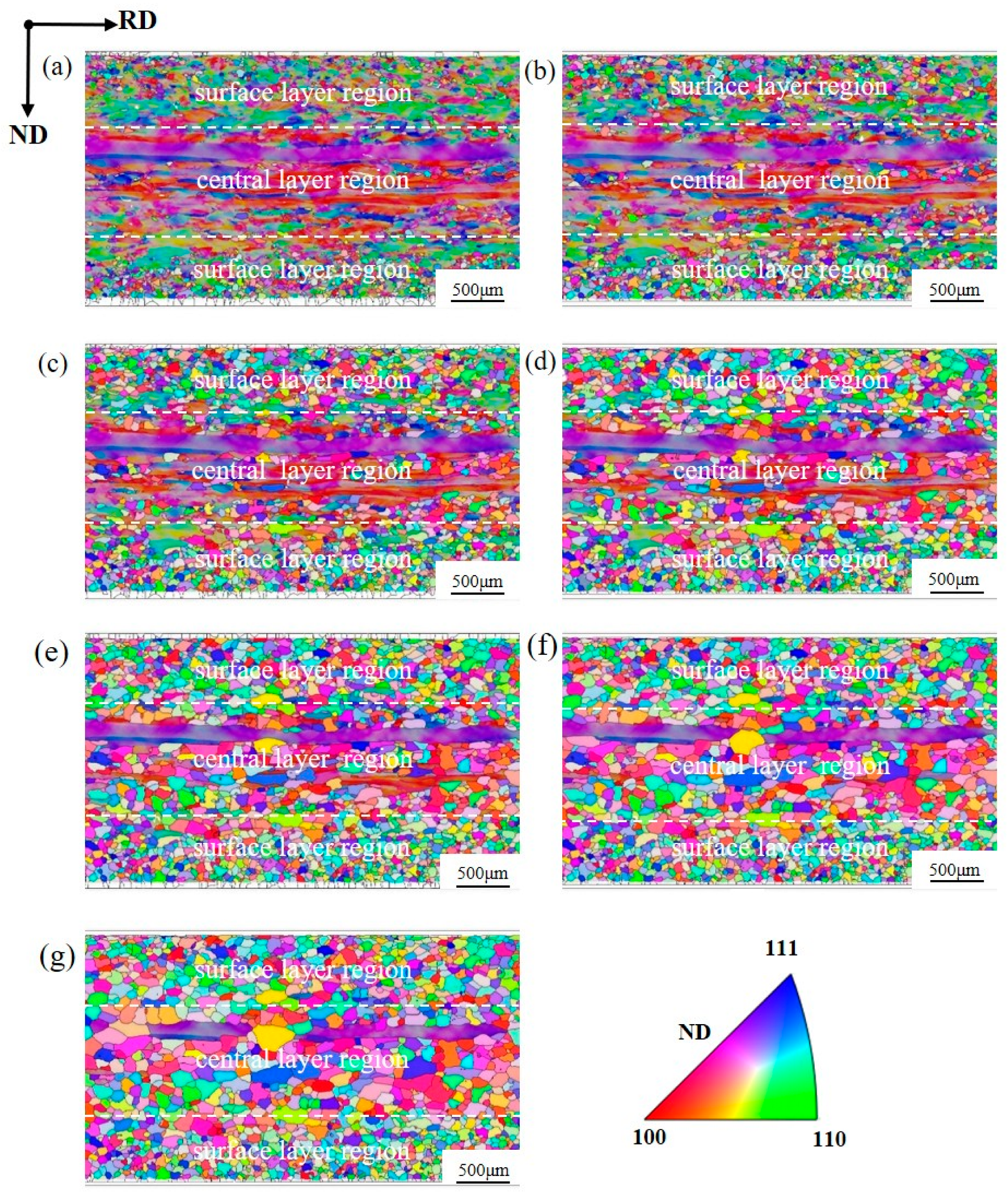
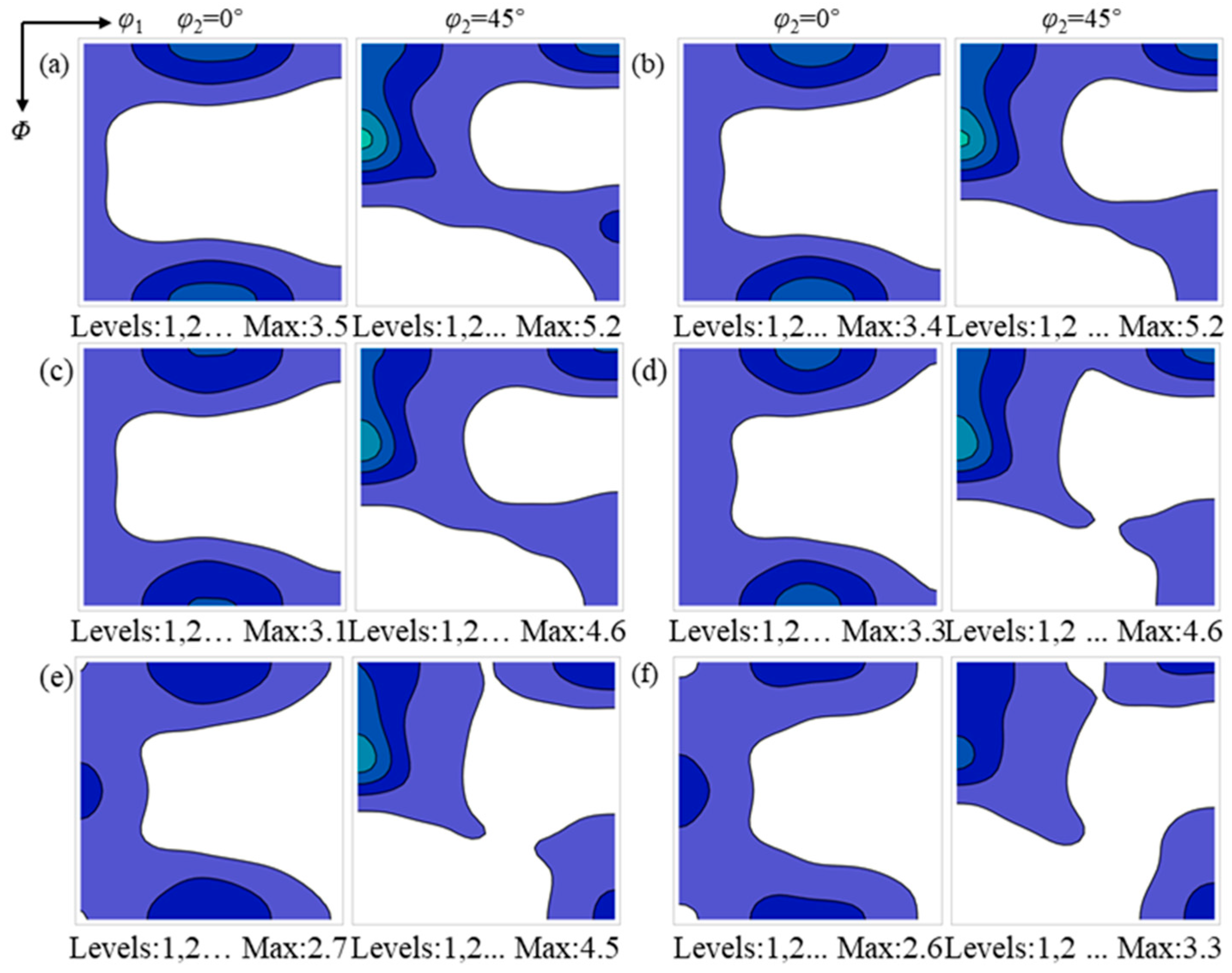
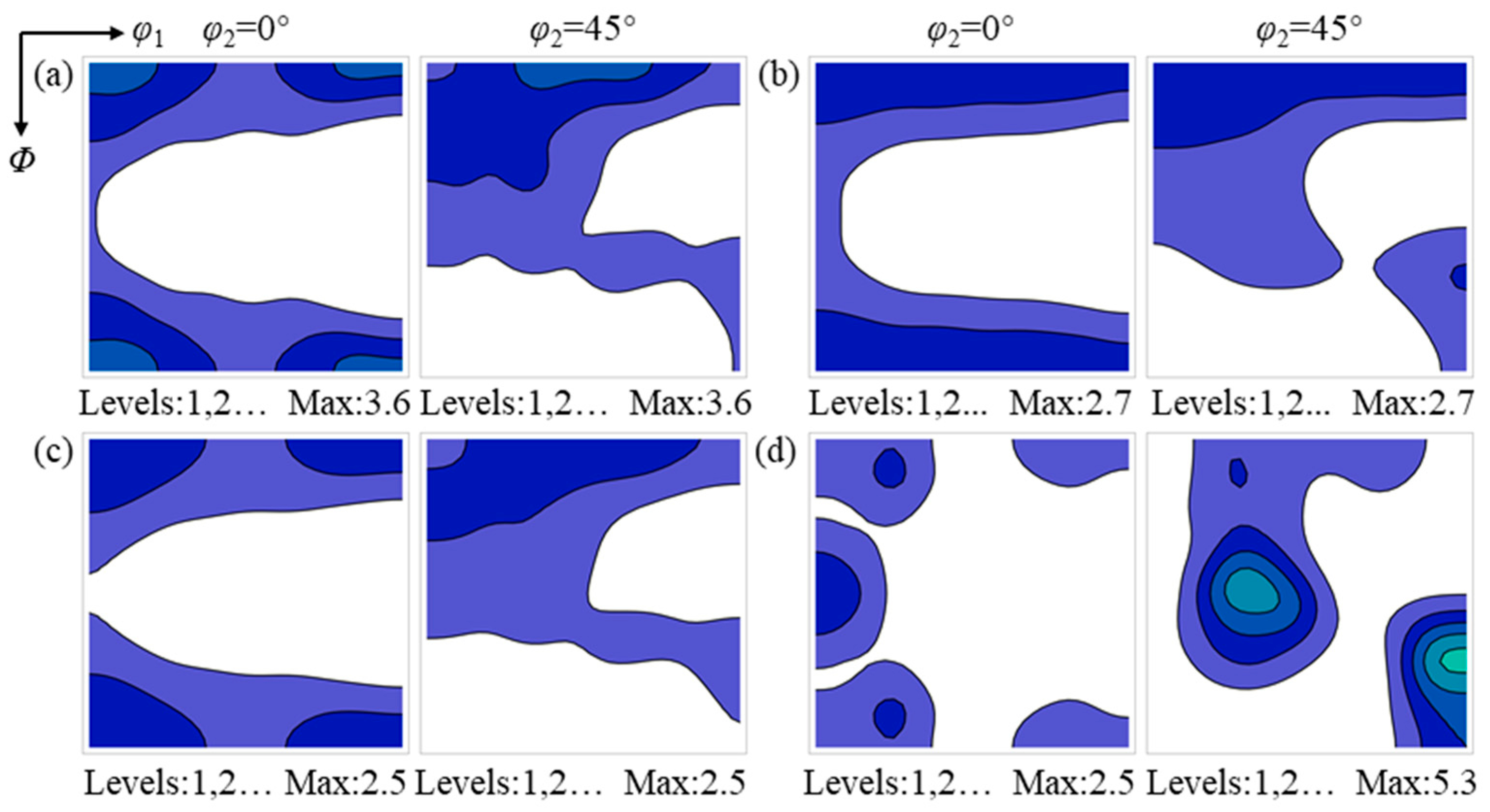
- The formation of the recrystallization texture in the hot-rolled sheet is governed primarily by the oriented nucleation mechanism. During recrystallization, the Goss texture intensity in the surface region remains nearly unchanged, whereas the α and α* textures are strengthened. In the center region, the α texture is weakened, the α* texture shows little variation, and the Goss texture becomes enhanced.
- (2)
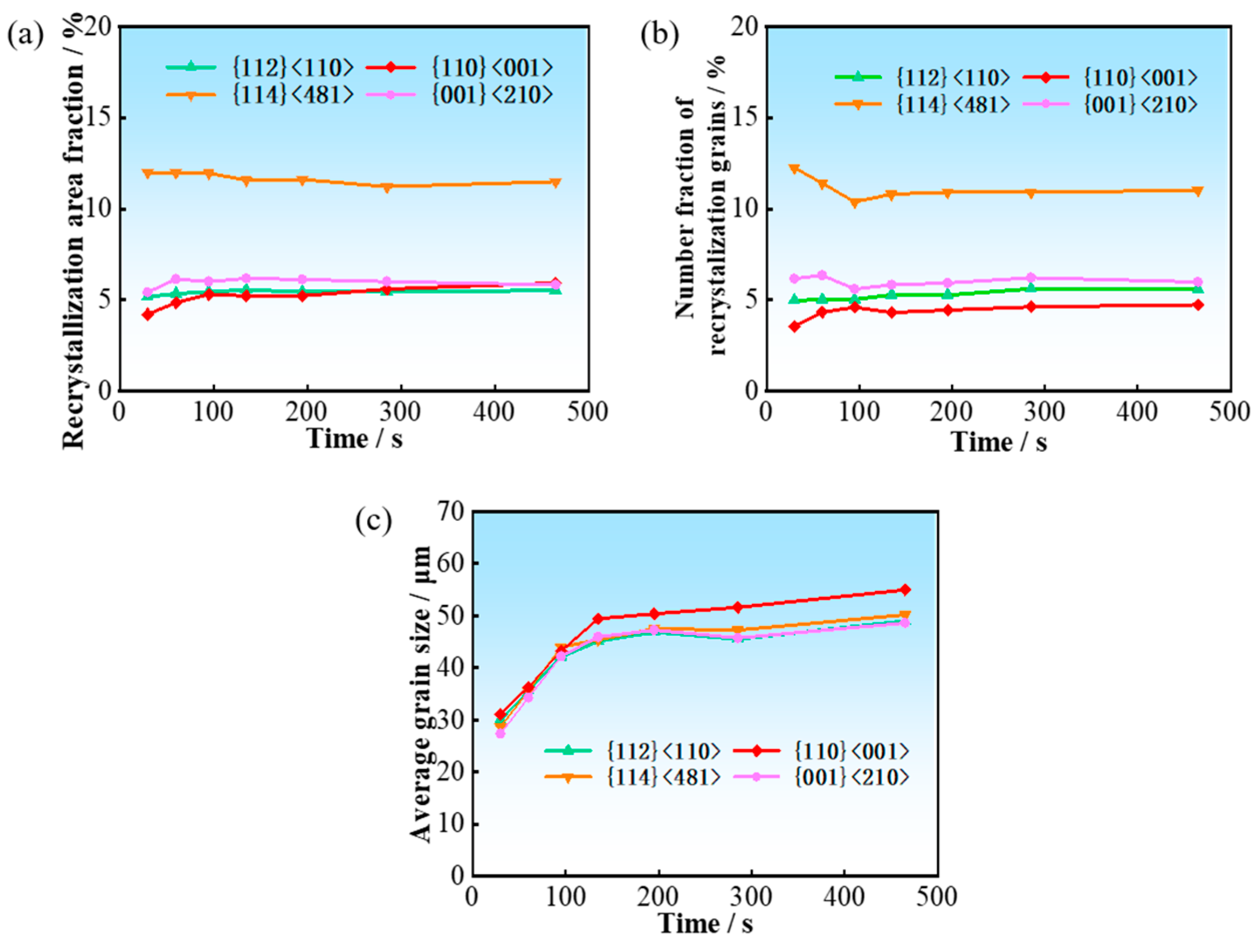
- Recrystallized grains with different orientations nucleate by consuming deformed matrices with different orientations. In the surface region, {112}<110> recrystallized grains nucleate by consuming deformed matrices near {114}<221> and {110}<112>, while {114}<481> and {001}<210> recrystallized grains consume deformed matrices near {114}<221> and Goss orientations. Goss-oriented recrystallized grains mainly consume Goss-oriented deformed matrices. In the center region, {112}<110>, {114}<481>, and {001}<210> recrystallized grains nucleate by consuming α- and λ-type deformed matrices, whereas Goss recrystallized grains consume deformed matrices with orientations near {111}<112>.
- (3)
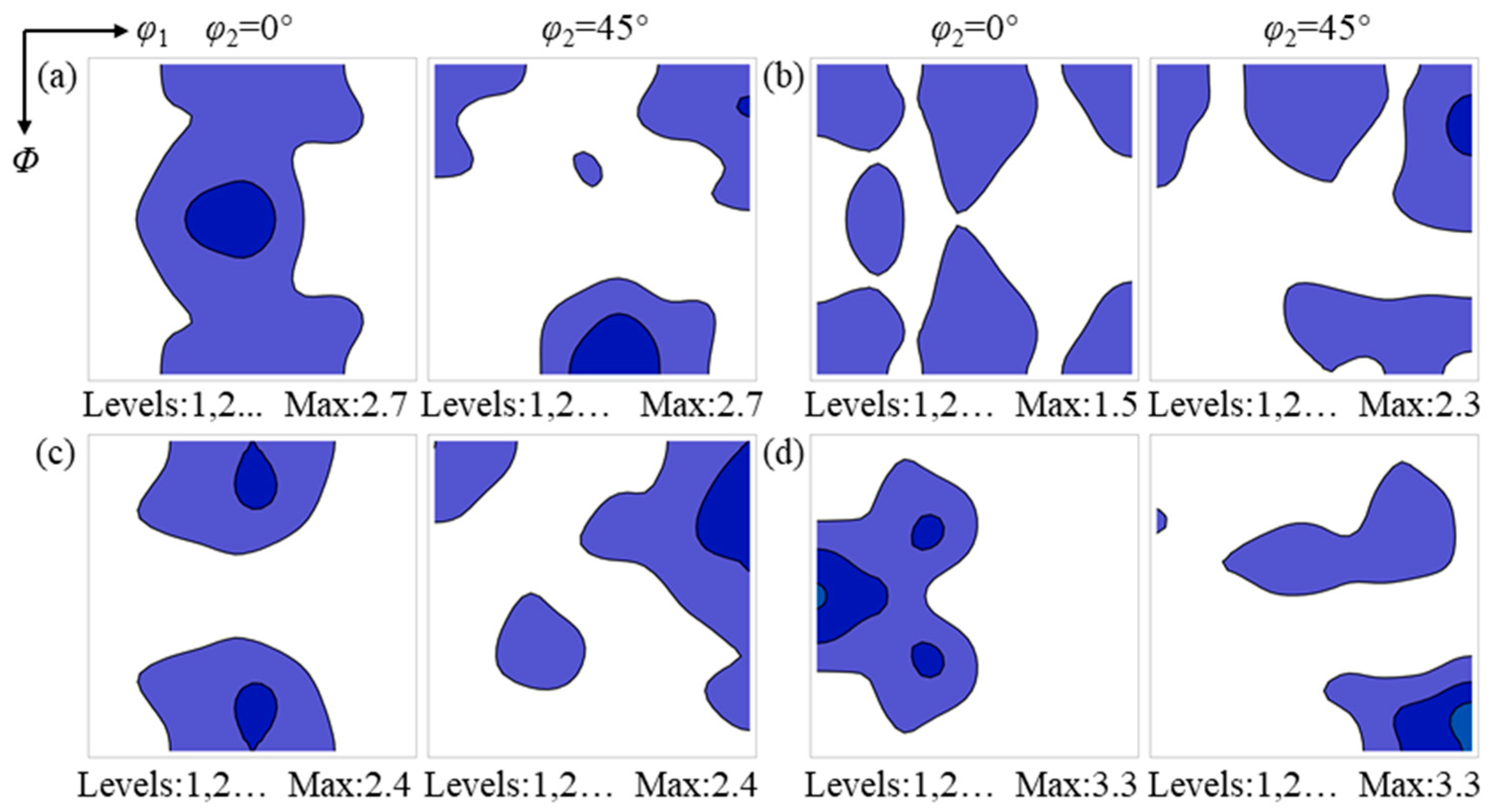
- In the center region, the deformed matrices consumed by recrystallized grains during the late stage of recrystallization depend strongly on the orientation of the recrystallized grains. The {112}<110>, {114}<481>, {001}<210>, and Goss recrystallized grains preferentially consume deformed matrices with orientations near {001}<210>, {001}<110>, {113}<110>, and {111}<112>, respectively.
- (4)
- The selective growth of recrystallized grains in the center region may be related to the presence of special grain boundaries. The involvement of Σ9 grain boundaries, which exhibit relatively high mobility in silicon steel, offers a reasonable interpretation of the observed preferential growth behavior. Moreover, Σ7 grain boundaries may also play a role in orientation-dependent recrystallized grain growth during annealing.
Author Contributions
Funding
Data Availability Statement
Acknowledgments
Conflicts of Interest
References
- Chu, S.; Xiang, L.; Guo, F.; Qiu, S. Effect of Annealing Temperature on Microstructure, Texture, and Magnetic Properties of Non-Oriented Silicon Steel for Electric Vehicle Traction Motors. Metals 2025, 15, 1235. [Google Scholar] [CrossRef] [Scilit]
- Jiao, H.; Wu, W.; Hou, Z.; Xie, X.; Tang, Y.; Misra, R.D.K.; Liu, D.; Hu, Y.; Zhao, L. Ultrastrong {100} Texture in Twin-Roll Strip Cast Non-Oriented Electrical Steel through Two-Step Annealing. Scr. Mater. 2024, 243, 115998. [Google Scholar] [CrossRef] [Scilit]
- Da Costa Paolinelli, S.; Da Cunha, M.A.; Cota, A.B. The Influence of Hot Rolling Finishing Temperature on the Structure and Magnetic Properties of 2.0% Si Non-Oriented Silicon Steel. Mater. Sci. Forum 2007, 558–559, 787–792. [Google Scholar] [CrossRef] [Scilit]
- Gao, L.; Zeng, L.; Yang, J.; Pei, R. Application of Grain-Oriented Electrical Steel Used in Super-High Speed Electric Machines. AIP Adv. 2020, 10, 015127. [Google Scholar] [CrossRef] [Scilit]
- da Cunha, M.; Paolinelli, S. Effect of Hot Rolling Temperature on the Structure and Magnetic Properties of High Permeability Non-Oriented Silicon Steel. Steel Res. Int. 2005, 76, 421–425. [Google Scholar] [CrossRef] [Scilit]
- Fan, L.; Wang, X.; Xiao, L.; Yue, E. Investigation on the Microstructure and Texture Changes of 2% Si Non-Oriented Silicon Steel under Different Processes. J. Mater. Eng. Perform. 2025, 1–10. [Google Scholar] [CrossRef] [Scilit]
- Leuning, N.; Jaeger, M.; Schauerte, B.; Stoecker, A.; Kawalla, R.; Wei, X.; Hirt, G.; Heller, M.; Korte-Kerzel, S.; Boehm, L.; et al. Material Design for Low-Loss Non-Oriented Electrical Steel for Energy Efficient Drives. Materials 2021, 14, 6588. [Google Scholar] [CrossRef] [Scilit]
- Xu, C.; Xu, H.; Shu, X.; Lu, X.; Jiang, L.; Li, Z.; Zhang, Y. Effect of Normalizing Treatment on Microstructure and Mechanical Properties of Non-Oriented Fe-3.0% Si Steel. J. Mater. Eng. Perform. 2024, 34, 10184–10192. [Google Scholar] [CrossRef] [Scilit]
- Zhou, C.; Luan, S.; Qiao, J.; Wang, H. Effect of Normalizing Temperature on Microstructure, Texture and Magnetic Properties of Non-Oriented Silicon Steel. Metals 2025, 15, 217. [Google Scholar] [CrossRef] [Scilit]
- Lei, W.; Fan, L.; Fu, Y.; Xiao, L.; Yue, E. Microstructure and Texture Evolution during Normalization of High-Grade 3%Si Non-Oriented Electrical Steel. Metall. Res. Technol. 2025, 122, 618. [Google Scholar] [CrossRef] [Scilit]
- Sistaninia, M.; Raninger, P.; Kreuzer, H.; Prevedel, P.; Antretter, T. Designing Deformation Texture in Non-Oriented Electrical Steel for Enhanced Magnetic Properties. Int. J. Mech. Sci. 2025, 290, 110090. [Google Scholar] [CrossRef] [Scilit]
- Wang, S.J.; Li, M.; Wang, H.X.; Xu, C.X.; Lin, Y.; Wei, H.; Zhang, W.K.; Qiu, S.Y.; Wang, Y.D. Effect of Grain Size before Cold Rolling on Microstructure, Texture and Magnetic Properties of Ultra-Thin Low-Si Non-Oriented Silicon Steel. JOM 2023, 75, 1824–1838. [Google Scholar] [CrossRef] [Scilit]
- Zhong, B.; Cheng, Z.; Wendler, M.; Volkova, O.; Liu, J. Optimized Rolling Processes to Balance Magnetic and Mechanical Properties of High-Strength Non-Oriented Silicon Steels. Mater. Des. 2023, 232, 112096. [Google Scholar] [CrossRef] [Scilit]
- Mehdi, M.; He, Y.; Hilinski, E.J.; Kestens, L.A.I.; Edrisy, A. The Origins of the Goss Orientation in Non-Oriented Electrical Steel and the Evolution of the Goss Texture during Thermomechanical Processing. Steel Res. Int. 2019, 90, 1800582. [Google Scholar] [CrossRef] [Scilit]
- Dorner, D.; Zaefferer, S.; Raabe, D. Retention of the Goss Orientation between Microbands during Cold Rolling of an Fe3% Si Single Crystal. Acta Mater. 2007, 55, 2519–2530. [Google Scholar] [CrossRef] [Scilit]
- Lin, Y.; Wang, H.; Wang, S.; Zhang, W.; Wang, L.; Feng, Z.; Wang, Y. Roles of Silicon Content and Normalization Temperature on Cold Workability and Recrystallization of High-Grade Non-Oriented Silicon Steel. Crystals 2022, 12, 593–601. [Google Scholar] [CrossRef] [Scilit]
- Mehdi, M.; He, Y.; Hilinski, E.J.; Kar, N.C.; Edrisy, A. Non-Oriented Electrical Steel with Core Losses Comparable to Grain-Oriented Electrical Steel. J. Magn. Magn. Mater. 2019, 491, 165597. [Google Scholar] [CrossRef] [Scilit]
- Fukagawa, T.; Yashiki, H. Effect of Hot-Band Annealing Condition on Secondary Recrystallization in Grain-Oriented 2.3% Si-1.7% Mn Steel. ISIJ Int. 2000, 40, 402–408. [Google Scholar] [CrossRef] [Scilit]
- Park, N.J.; Lee, E.J.; Joo, H.-D.; Park, J.T. Evolution of Goss Orientation during Rapid Heating for Primary Recrystallization in Grain-Oriented Electrical Steel. ISIJ Int. 2011, 51, 975–981. [Google Scholar] [CrossRef] [Scilit]
- Shin, S.M.; Birosca, S.; Chang, S.K.; De Cooman, B.C. Texture Evolution in Grain-Oriented Electrical Steel during Hot Band Annealing and Cold Rolling. J. Microsc. 2008, 230, 414–423. [Google Scholar] [CrossRef] [Scilit] [PubMed]
- Tang, Y.; Yang, P.; Li, Z.; Zhang, Z.; Gu, X. Recrystallization Behavior of Hot-Rolled Microstructure with Texture Gradient and Texture of Final Sheet in Thin-Gauge Electrical Steel. Steel Res. Int. 2022, 93, 2200325. [Google Scholar] [CrossRef] [Scilit]
- Wu, X.; Yang, P.; Gu, X.; Pei, W.; Leng, Y. The Influence of Normalization Temperatures on Different Texture Components and Magnetic Properties of Nonoriented Electrical Steels. Steel Res. Int. 2021, 92, 2000361. [Google Scholar] [CrossRef] [Scilit]
- Hu, C.; Song, R.; Wang, Y.; Zhao, Z.; Zhang, Y. Comprehensive Influence of the Normalized and Final Annealing Process on High-Strength Nonoriented Silicon Steel. Steel Res. Int. 2022, 93, 2100641. [Google Scholar] [CrossRef] [Scilit]
- Jain, V.; Kumar, P.; Bagui, S.; Halder, C.; Patra, S.; Ghosh, A. Comprehensive Study on the Through-Process Goss Texture Evolution in Fe-3.78 Wt.%Si Grain Oriented Electrical Steel. Mater. Chem. Phys. 2023, 309, 128428. [Google Scholar] [CrossRef] [Scilit]
- Sidor, J.J.; Verbeken, K.; Gomes, E.; Schneider, J.; Calvillo, P.R.; Kestens, L.A.I. Through Process Texture Evolution and Magnetic Properties of High Si Non-Oriented Electrical Steels. Mater. Charact. 2012, 71, 49–57. [Google Scholar] [CrossRef] [Scilit]
- Guan, D.; Rainforth, W.M.; Gao, J.; Ma, L.; Wynne, B. Individual Effect of Recrystallisation Nucleation Sites on Texture Weakening in a Magnesium Alloy: Part 2- Shear Bands. Acta Mater. 2018, 145, 399–412. [Google Scholar] [CrossRef] [Scilit]
- Hayakawa, Y. Mechanism of Secondary Recrystallization of Goss Grains in Grain-Oriented Electrical Steel. Sci. Technol. Adv. Mater. 2017, 18, 480–497. [Google Scholar] [CrossRef] [Scilit]
- Zhang, Y.B.; Ludwig, W. Selective Growth of Recrystallizing Grains into Well-Characterized Deformed Aluminum at Hardness Indentation. Acta Mater. 2024, 270, 119862. [Google Scholar] [CrossRef] [Scilit]
- Ning, X.; Liang, Y.; Wang, Y.; Ye, F.; Lin, J. A Comprehensive Study on Texture Evolution and Recrystallization Mechanism of Fe-4.5 wt% Si with Strong {114}<481>. J. Mater. Res. Technol. 2023, 27, 7506–7520. [Google Scholar] [CrossRef] [Scilit]
- Hayakawa, Y.; Szpunar, J.A.; Palumbo, G.; Lin, P. The Role of Grain Boundary Character Distribution in Goss Texture Development in Electrical Steels. J. Magn. Magn. Mater. 1996, 160, 143–144. [Google Scholar] [CrossRef] [Scilit]
- Fan, G.H.; Zhang, Y.B.; Driver, J.H.; Juul Jensen, D. Oriented Growth during Recrystallization Revisited in Three Dimensions. Scr. Mater. 2014, 72–73, 9–12. [Google Scholar] [CrossRef] [Scilit]
- Tsurekawa, S.; Ueda, T.; Ichikawa, K.; Nakashima, H.; Yoshitomi, Y.; Yoshinaga, H. Grain Boundary Migration in Fe-3%Si Bicrystal. Mater. Sci. Forum 1996, 204–206, 221–226. [Google Scholar] [CrossRef] [Scilit]
- Sheikh-Ali, A.D.; Molodov, D.A.; Garmestani, H. Magnetically Induced Texture Development in Zinc Alloy Sheet. Scr. Mater. 2002, 46, 857–862. [Google Scholar] [CrossRef] [Scilit]
- Gervas’eva, I.V.; Milyutin, V.A.; Beaugnon, E.; Volkova, E.G.; Shishkin, D.A. Effect of Heat Treatment in an Ultra-High Magnetic Field on the Formation of Structure and Texture in Fe-Si Alloys. Phys. Met. Metall. 2015, 116, 162–169. [Google Scholar] [CrossRef] [Scilit]
- Kestens, L.; Jonas, J.J.; Van Houtte, P.; Aernoudt, E. Orientation Selection during Static Recrystallization of Cross Rolled Non-Oriented Electrical Steels. Texture Stress Microstruct. 1996, 26, 321–335. [Google Scholar] [CrossRef] [Scilit]
- Sanjari, M.; He, Y.; Hilinski, E.J.; Yue, S.; Kestens, L.A.I. Texture evolution during skew cold rolling and annealing of a non-oriented electrical steel containing 0.9 wt.% silicon. J. Mater. Sci. 2016, 52, 3281–3300. [Google Scholar] [CrossRef] [Scilit]
- Sanjari, M.; He, Y.; Hilinski, E.J.; Yue, S.; Kestens, L.A.I. Development of the {113}<uvw> texture during the annealing of a skew cold-rolled non-oriented electrical steel. Scr. Mater. 2016, 124, 179–183. [Google Scholar] [CrossRef] [Scilit]






| C | Si | Mn | P | S | Fe |
|---|---|---|---|---|---|
| 0.003 | 3.02 | 0.27 | 0.009 | 0.0007 | Bal. |
| Recrystallized Grain | Deformed Matrix | Grain Boundary | Misorientation Angle (°) |
|---|---|---|---|
| {112}<110> | {001}<210> | Σ7 | 7.4 |
| {114}<481> | {001}<110> | Σ13b | 5.6 |
| {001}<210> | {113}<110> | Σ7 | 8.1 |
| Goss | {111}<112> | Σ9 | 3.9 |
Disclaimer/Publisher’s Note: The statements, opinions and data contained in all publications are solely those of the individual author(s) and contributor(s) and not of MDPI and/or the editor(s). MDPI and/or the editor(s) disclaim responsibility for any injury to people or property resulting from any ideas, methods, instructions or products referred to in the content. |
© 2026 by the authors. Licensee MDPI, Basel, Switzerland. This article is an open access article distributed under the terms and conditions of the Creative Commons Attribution (CC BY) license.
Share and Cite
Zhang, F.; Zhang, H.; Chang, S.; Cao, G.; Sha, Y.; Zuo, L. Recrystallization Texture Evolution in Fe–3.0 wt.% Si Hot-Rolled Silicon Steel Sheet by Quasi In Situ EBSD Analysis. Materials 2026, 19, 650. https://doi.org/10.3390/ma19040650
Zhang F, Zhang H, Chang S, Cao G, Sha Y, Zuo L. Recrystallization Texture Evolution in Fe–3.0 wt.% Si Hot-Rolled Silicon Steel Sheet by Quasi In Situ EBSD Analysis. Materials. 2026; 19(4):650. https://doi.org/10.3390/ma19040650
Chicago/Turabian StyleZhang, Fang, Huabing Zhang, Songtao Chang, Gengsheng Cao, Yuhui Sha, and Liang Zuo. 2026. "Recrystallization Texture Evolution in Fe–3.0 wt.% Si Hot-Rolled Silicon Steel Sheet by Quasi In Situ EBSD Analysis" Materials 19, no. 4: 650. https://doi.org/10.3390/ma19040650
APA StyleZhang, F., Zhang, H., Chang, S., Cao, G., Sha, Y., & Zuo, L. (2026). Recrystallization Texture Evolution in Fe–3.0 wt.% Si Hot-Rolled Silicon Steel Sheet by Quasi In Situ EBSD Analysis. Materials, 19(4), 650. https://doi.org/10.3390/ma19040650