Effect of Mixed Reduction Approach on the Oil Absorption Capacity of Graphene Oxide Aerogels

 , and
, and 
Abstract
1. Introduction
2. Materials and Methods
2.1. Chemicals and Reagents
2.2. Preparation of Graphene Oxide Aerogels
2.2.1. Synthesis of GO Hydrogels
2.2.2. Freeze-Casting of GO Hydrogels
2.2.3. Thermal Annealing of the Aerogel
2.3. Characterization
2.4. Absorption Measurements
3. Results
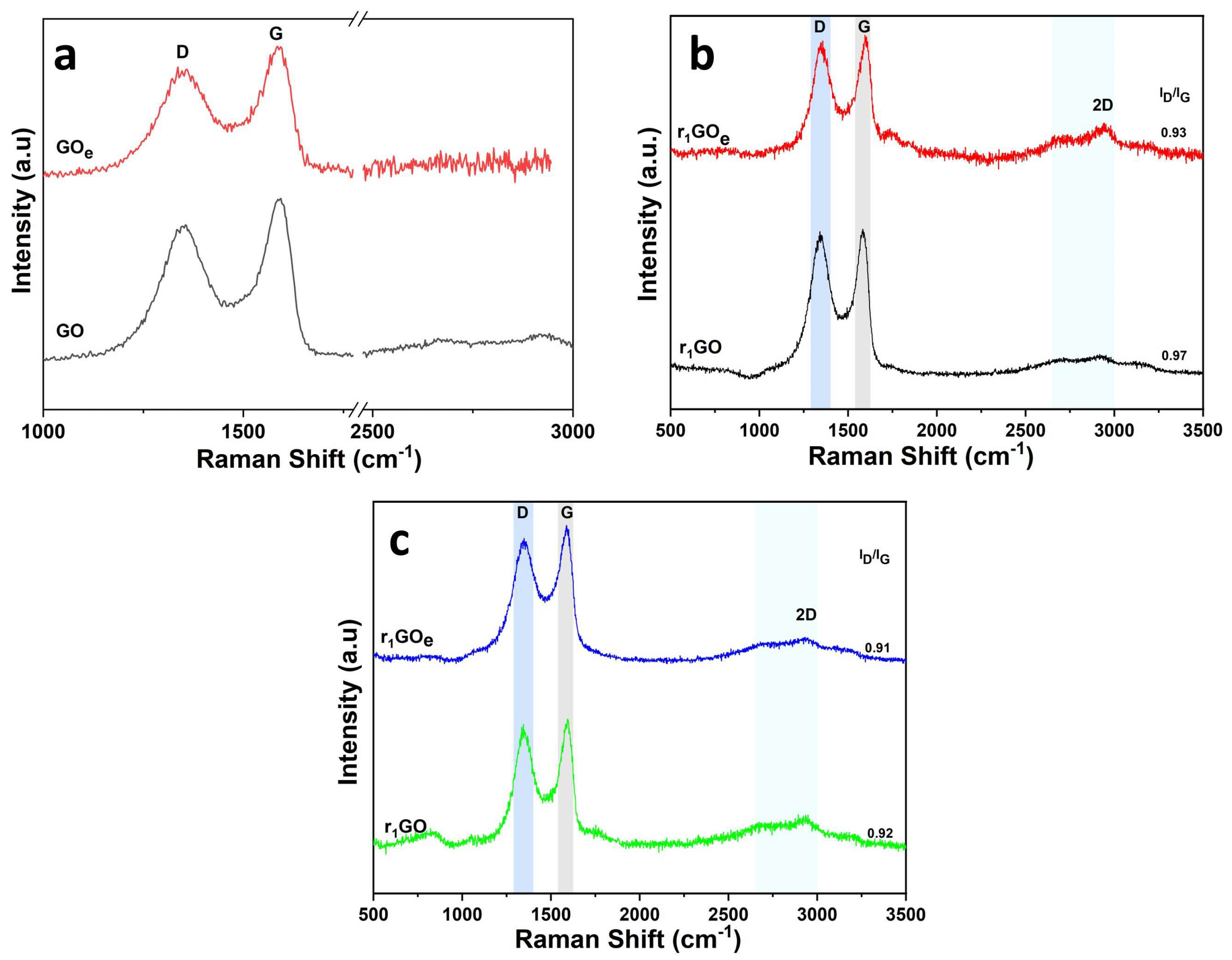
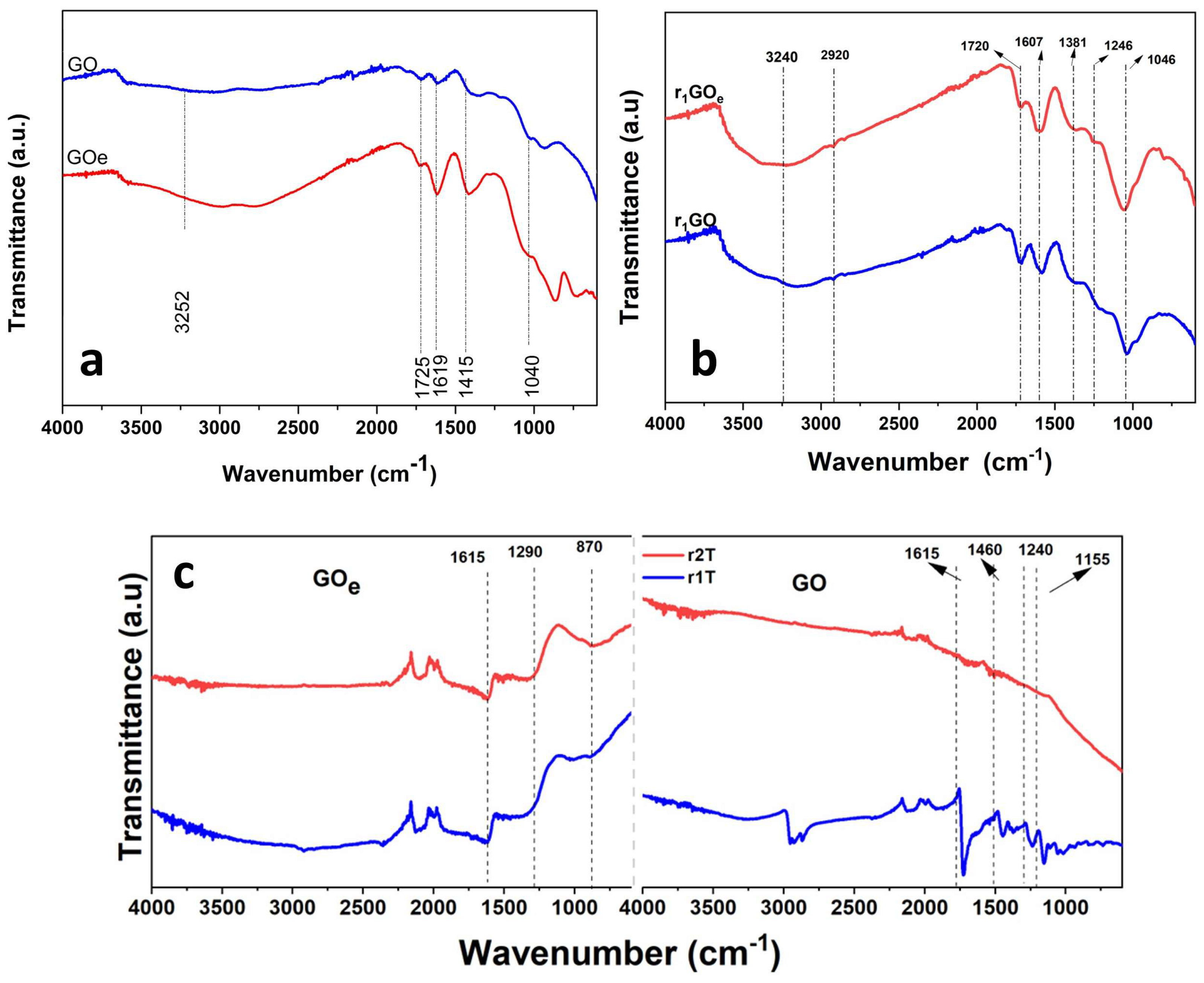
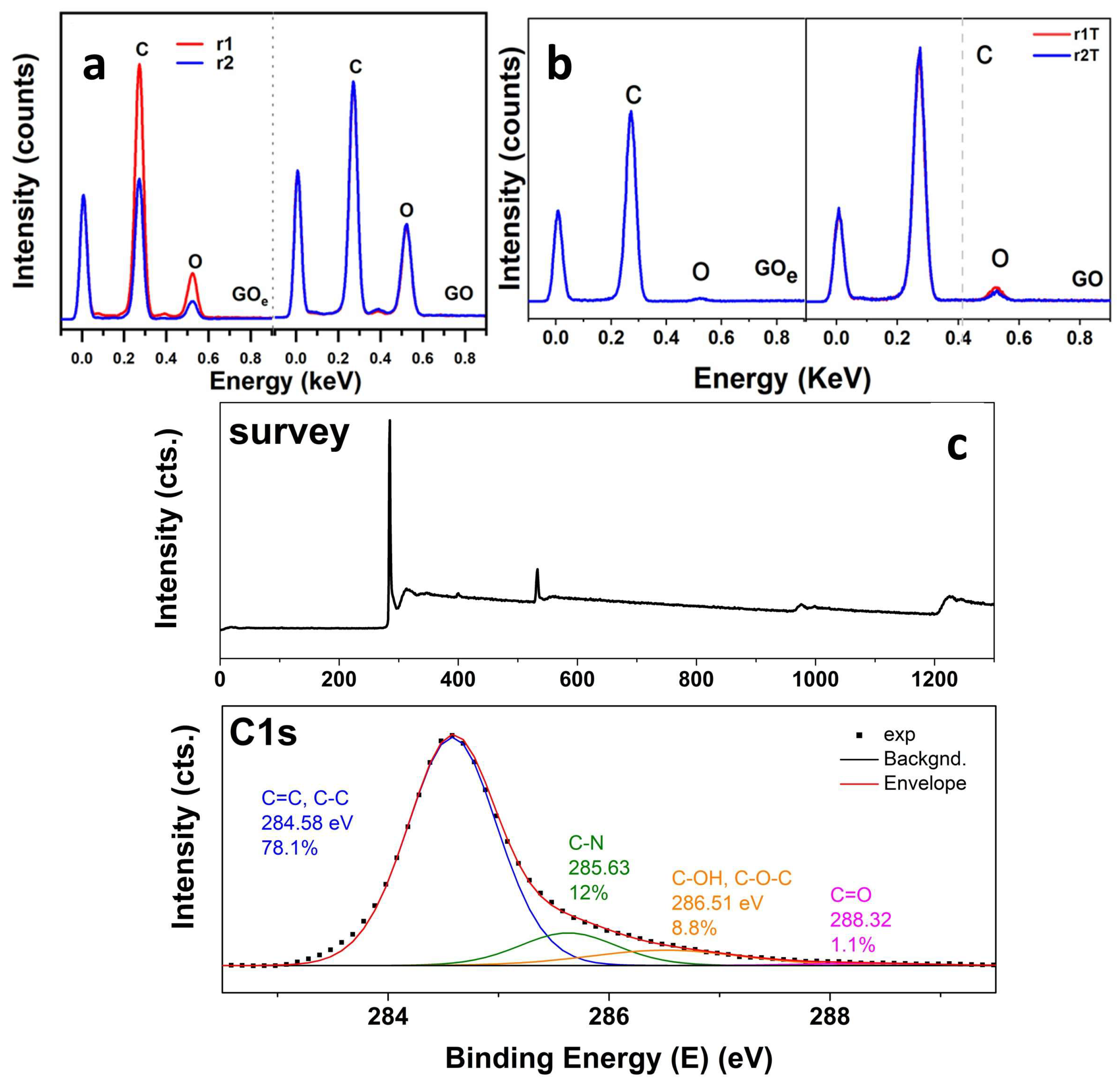
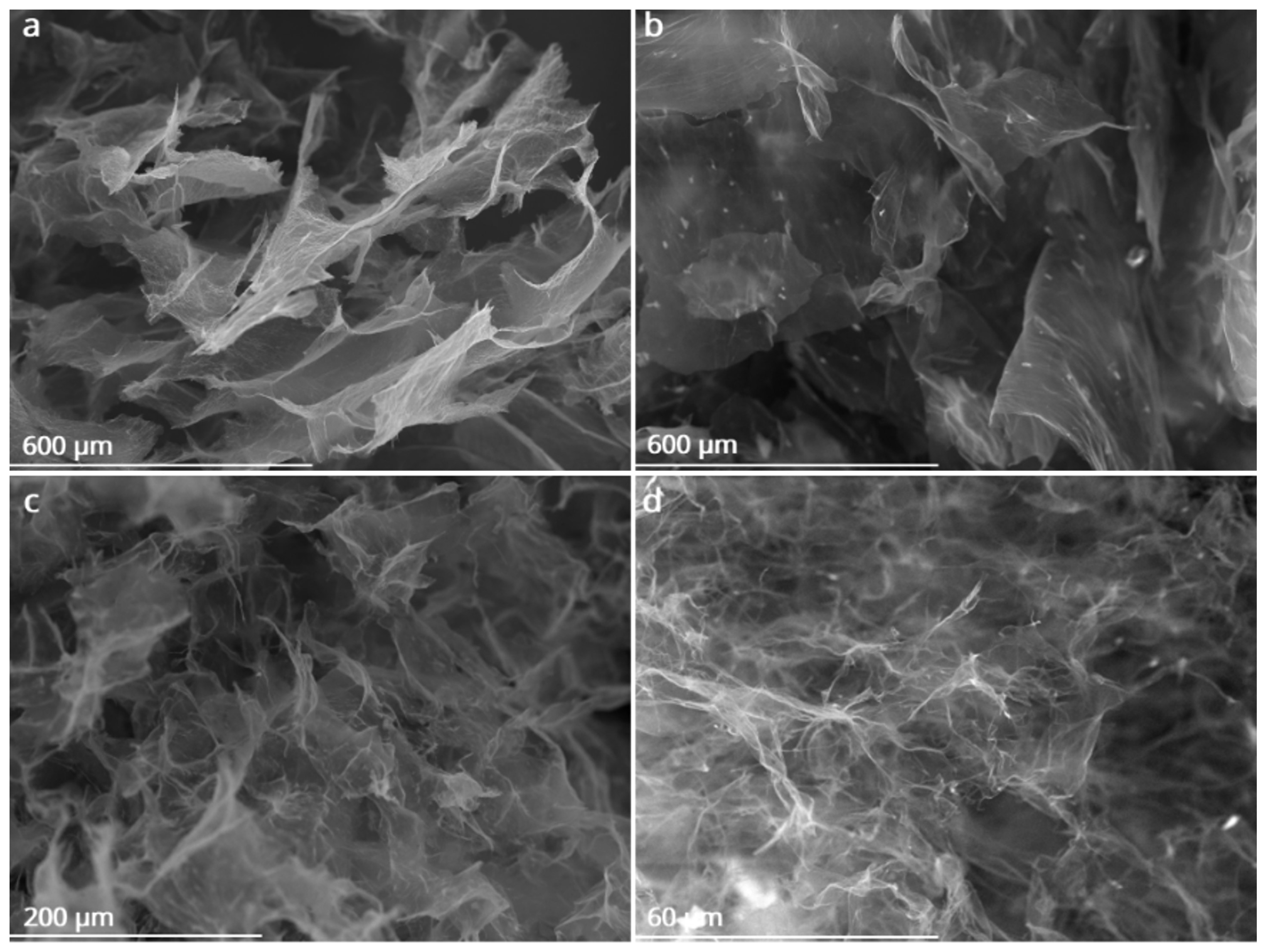
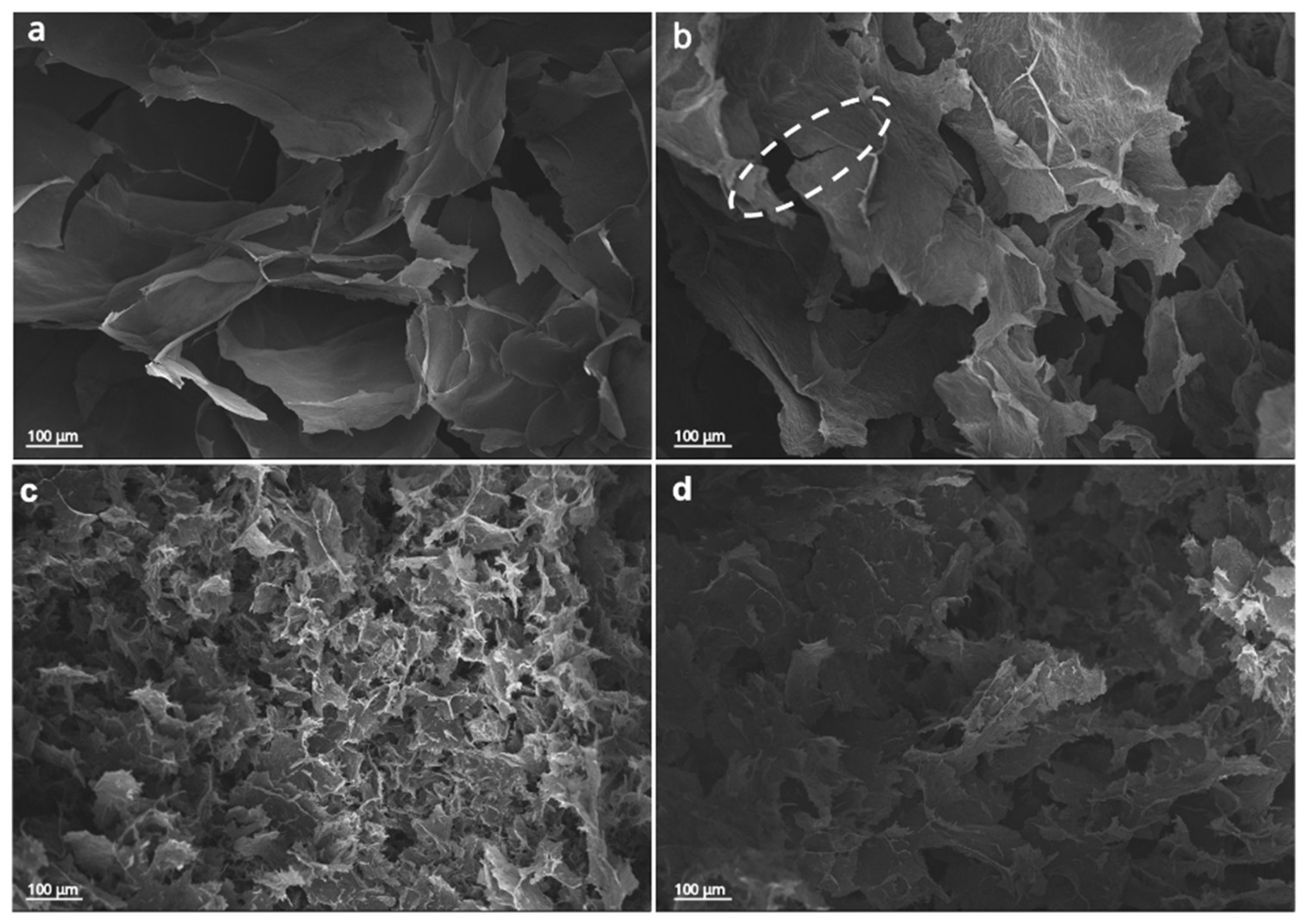
3.1. Synthesis and Characterization of Aerogels
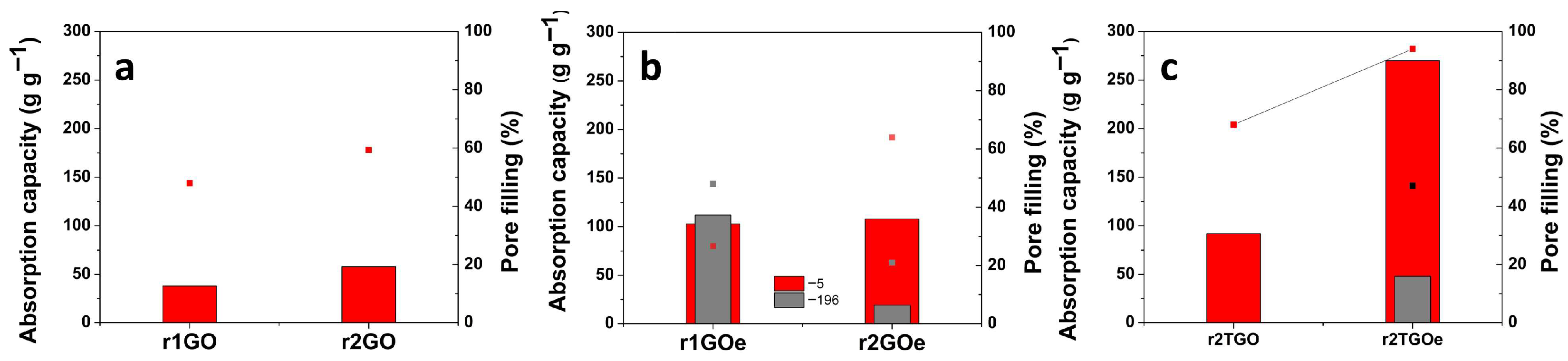
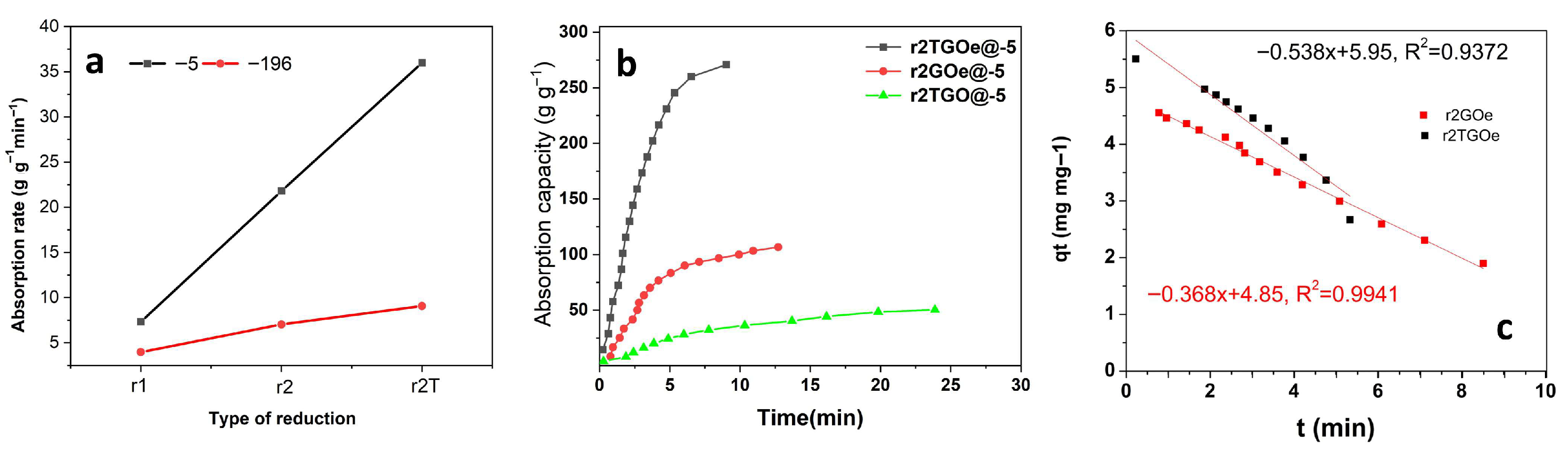
3.2. Performance of the Engine Oil Sorbent
4. Discussion
5. Conclusions
Author Contributions
Funding
Institutional Review Board Statement
Informed Consent Statement
Data Availability Statement
Conflicts of Interest
Abbreviations
| GO | Graphene oxide |
| GOb | Highly oxidized graphene oxide obtained from expanded graphite |
| rGO | Reduced graphene oxide |
| r1GO | Aerogel obtained by hydrothermal reduction from GO only |
| r1GOe | Aerogel obtained by hydrothermal reduction from GOb only |
| r2GO | Aerogel obtained by combined hydrothermal–chemical reduction from GO |
| r2GOe | Aerogel obtained by combined hydrothermal–chemical reduction from GOb |
| r2TGO | r3GO aerogel after post-synthesis thermal annealing |
| r2TGOe | r3GOb aerogel after post-synthesis thermal annealing |
| FT-IR | Fourier transform infrared spectroscopy |
| SEM | Scanning electron microscopy |
| EDS | Energy-dispersive X-ray spectroscopy |
References
- Wong, L.Y.; Lau, S.Y.; Pan, S.; Lam, M.K. 3D graphene-based adsorbents: Synthesis, proportional analysis and potential applications in oil elimination. Chemosphere 2022, 287, 132129. [Google Scholar] [CrossRef]
- Mei, J.Y.; Qi, P.; Wei, X.N.; Zheng, X.C.; Wang, Q.; Guan, X.X. Assembly and enhanced elimination performance of 3D graphene aerogel-zinc oxide hybrids for methylene blue dye in water. Mater. Res. Bull. 2019, 109, 141–148. [Google Scholar] [CrossRef]
- Eltaweil, A.S.; Abdelfatah, A.M.; Hosny, M.; Fawzy, M. Novel Biogenic Synthesis of a Ag@Biochar Nanocomposite as an Antimicrobial Agent and Photocatalyst for Methylene Blue Degradation. ACS Omega 2022, 7, 8046–8059. [Google Scholar] [CrossRef]
- Aouan, B.; Alehyen, S.; Fadil, M.; El Alouani, M.; Saufi, H.; El Herradi, E.H.; El Makhoukhi, F.; Taibi, M. Development and optimization of geopolymer adsorbent for water treatment: Application of mixture design approach. J. Environ. Manag. 2023, 338, 117853. [Google Scholar] [CrossRef]
- Wei, X.; Xu, X.; Liu, Z.; Zhao, X.; Zhang, L. Versatile superhydrophobic magnetic biomass aerogel for oil/water separation and removal of multi-class emerging pollutants. Sep. Purif. Technol. 2024, 345, 127371. [Google Scholar] [CrossRef]
- Li, Z.; Wang, B.; Qin, X.; Wang, Y.; Liu, C.; Shao, Q.; Wang, N.; Zhang, J.; Wang, Z.; Shen, C.; et al. Superhydrophobic/Superoleophilic Polycarbonate/Carbon Nanotubes Porous Monolith for Selective Oil Adsorption from Water. ACS Sustain. Chem. Eng. 2018, 6, 13747–13755. [Google Scholar] [CrossRef]
- Pruna, A.; Cárcel, A.C.; Barjola, A.; Benedito, A.; Giménez, E. Tailoring the Performance of Graphene Aerogels for Oil/Organic Solvent Separation by 1-Step Solvothermal Approach. Nanomaterials 2019, 9, 1077. [Google Scholar] [CrossRef]
- Burachevskaya, M.; Minkina, T.; Bauer, T.; Lobzenko, I.; Fedorenko, A.; Mazarji, M.; Sushkova, S.; Mandzhieva, S.; Nazarenko, A.; Butova, V.; et al. Fabrication of biochar derived from different types of feedstocks as an efficient adsorbent for soil heavy metal removal. Sci. Rep. 2023, 13, 2020. [Google Scholar] [CrossRef] [PubMed]
- Abadi, P.G.S.; Irani, M.; Rad, L.R. Mechanisms of the removal of the metal ions, dyes, and drugs from wastewaters by the electrospun nanofiber membranes. J. Taiwan Inst. Chem. Eng. 2023, 143, 104625. [Google Scholar] [CrossRef]
- Xiao, W.; Jiang, X.; Liu, X.; Zhou, W.; Garba, Z.N.; Lawan, I.; Wang, L.; Yuan, Z. Adsorption of organic dyes from wastewater by metal-doped porous carbon materials. J. Clean. Prod. 2021, 284, 124773. [Google Scholar] [CrossRef]
- Xiang, C.; Wang, C.; Guo, R.; Lan, J.; Lin, S.; Jiang, S.; Lai, X.; Zhang, Y.; Xiao, H. Synthesis of carboxymethyl cellulose-reduced graphene oxide aerogel for efficient removal of organic liquids and dyes. J. Mater. Sci. 2019, 54, 1872–1883. [Google Scholar] [CrossRef]
- Hu, Z.; Srinivasan, M. Mesoporous high-surface-area activated carbon. Microporous Mesoporous Mater. 2001, 43, 267–275. [Google Scholar] [CrossRef]
- Adebajo, M.; Frost, R.; Kloprogge, J.; Carmody, O.; Kokot, S. Porous Materials for Oil Spill Cleanup: A Review of Synthesis and Absorbing Properties. J. Porous Mater. 2003, 10, 159–170. [Google Scholar] [CrossRef]
- Rahmani, Z.; Rashidi, A.M.; Kazemi, A.; Samadi, M.T.; Rahmani, A.R. N-doped reduced graphene oxide aerogel for the selective adsorption of oil pollutants from water: Isotherm and kinetic study. J. Ind. Eng. Chem. 2018, 61, 416–426. [Google Scholar] [CrossRef]
- Ji, K.; Gao, Y.; Zhang, L.; Wang, S.; Yue, Q.; Xu, X.; Kong, W.; Gao, B.; Cai, Z.; Chen, Y. A tunable amphiphilic Enteromorpha-modified graphene aerogel for oil/water separation. Sci. Total Environ. 2021, 763, 142958. [Google Scholar] [CrossRef] [PubMed]
- Kabiri, S.; Tran, D.N.; Altalhi, T.; Losic, D. Outstanding adsorption performance of graphene–carbon nanotube aerogels for continuous oil removal. Carbon 2014, 80, 523–533. [Google Scholar] [CrossRef]
- Allgayer, R.; Yousefi, N.; Tufenkji, N. Graphene oxide sponge as adsorbent for organic contaminants: Comparison with granular activated carbon and influence of water chemistry. Environ. Sci. Nano 2020, 7, 2669–2680. [Google Scholar] [CrossRef]
- Liu, H.; Qiu, H. Recent advances of 3D graphene-based adsorbents for sample preparation of water pollutants: A review. Chem. Eng. J. 2020, 393, 124691. [Google Scholar] [CrossRef]
- Li, H.; Liu, L.; Yang, F. Covalent assembly of 3D graphene/polypyrrole foams for oil spill cleanup. J. Mater. Chem. A 2013, 1, 3446–3453. [Google Scholar] [CrossRef]
- Hong, J.Y.; Sohn, E.H.; Park, S.; Park, H.S. Highly-efficient and recyclable oil absorbing performance of functionalized graphene aerogel. Chem. Eng. J. 2015, 269, 229–235. [Google Scholar] [CrossRef]
- Li, D.; Huang, J.; Huang, L.; Tan, S.; Liu, T. High-Performance Three-Dimensional Aerogel Based on Hydrothermal Pomelo Peel and Reduced Graphene Oxide as an Efficient Adsorbent for Water/Oil Separation. Langmuir 2021, 37, 1521–1530. [Google Scholar] [CrossRef]
- Wan, W.; Zhang, F.; Yu, S.; Zhang, R.; Zhou, Y. Hydrothermal formation of graphene aerogel for oil sorption: The role of reducing agent, reaction time and temperature. New J. Chem. 2016, 40, 3040–3046. [Google Scholar] [CrossRef]
- Liao, W.; Zhao, H.B.; Liu, Z.; Xu, S.; Wang, Y.Z. On controlling aerogel microstructure by freeze casting. Compos. Part B Eng. 2019, 173, 107036. [Google Scholar] [CrossRef]
- Rodríguez-Mata, V.; González-Domínguez, J.M.; Benito, A.M.; Maser, W.K.; García-Bordejé, E. Reduced Graphene Oxide Aerogels with Controlled Continuous Microchannels for Environmental Remediation. ACS Appl. Nano Mater. 2019, 2, 1210–1222. [Google Scholar] [CrossRef]
- Jung, S.M.; Mafra, D.L.; Lin, C.T.; Jung, H.Y.; Kong, J. Controlled porous structures of graphene aerogels and their effect on supercapacitor performance. Nanoscale 2015, 7, 4386–4393. [Google Scholar] [CrossRef] [PubMed]
- Ha, H.; Shanmuganathan, K.; Ellison, C.J. Mechanically Stable Thermally Crosslinked Poly(acrylic acid)/Reduced Graphene Oxide Aerogels. ACS Appl. Mater. Interfaces 2015, 7, 6220–6229. [Google Scholar] [CrossRef] [PubMed]
- Zhou, L.; Zhai, S.; Chen, Y.; Xu, Z. Anisotropic Cellulose Nanofibers/Polyvinyl Alcohol/Graphene Aerogels Fabricated by Directional Freeze-drying as Effective Oil Adsorbents. Polymers 2019, 11, 712. [Google Scholar] [CrossRef] [PubMed]
- Zheng, Y.; Hou, X.; Ma, X.; Hao, Z.; Ma, Z. Vitamin C-Assisted Fabrication of Aerogels from Industrial Graphene Oxide for Gaseous Hexamethyldisiloxane Adsorption. Appl. Sci. 2021, 11, 8486. [Google Scholar] [CrossRef]
- Xu, L.; Xiao, G.; Chen, C.; Li, R.; Mai, Y.; Sun, G.; Yan, D. Superhydrophobic and superoleophilic graphene aerogel prepared by facile chemical reduction. J. Mater. Chem. A 2015, 3, 7498–7504. [Google Scholar] [CrossRef]
- Yang, P.; Tontini, G.; Wang, J.; Kinloch, I.A.; Barg, S. Ice-templated hybrid graphene oxide—Graphene nanoplatelet lamellar architectures: Tuning mechanical and electrical properties. Nanotechnology 2021, 32, 205601. [Google Scholar] [CrossRef]
- Zhang, Y.; Wang, B.; Wang, B.; Yang, X.; Ma, S.; Feng, Y.; Liu, C.; Shen, C. Super-hydrophobic graphene-coated thermoplastic polyurethane porous monolith with superior photothermal effect for solar-assisted efficient cleanup of crude oil spill. Appl. Surf. Sci. 2022, 605, 154701. [Google Scholar] [CrossRef]
- Peng, L.; Xu, Z.; Liu, Z.; Guo, Y.; Li, P.; Gao, C. Ultrahigh Thermal Conductive yet Super flexible Graphene Films. Adv. Mater. 2017, 29, 1700589. [Google Scholar] [CrossRef]
- Jiříčková, A.; Jankovský, O.; Sofer, Z.; Sedmidubský, D. Synthesis and Applications of Graphene Oxide. Materials 2022, 15, 920. [Google Scholar] [CrossRef]
- Wang, J.; Duan, X.; Dong, Q.; Meng, F.; Tan, X.; Liu, S.; Wang, S. Facile synthesis of N-doped 3D graphene aerogel and its excellent performance in catalytic degradation of antibiotic contaminants in water. Carbon 2019, 144, 781–790. [Google Scholar] [CrossRef]
- Pruna, A.; Cárcel, A.C.; Barjola, A.; Benedito, A.; Giménez, E. Effect of synthesis conditions on CO2 capture of ethylenedia-mine-modified graphene aerogels. Appl. Surf. Sci. 2019, 487, 228–235. [Google Scholar] [CrossRef]
- López-Díaz, D.; Holgado, M.L.; García-Fierro, J.L.; Velázquez, M.M. Evolution of the Raman Spectrum with the Chemical Composition of Graphene Oxide. J. Phys. Chem. C 2017, 121, 20489–20497. [Google Scholar] [CrossRef]
- Liu, Y.; Ma, J.; Wu, T.; Wang, X.; Huang, G.; Qiu, H.; Li, Y.; Wang, W.; Gao, J. Cost-Effective Reduced Graphene Oxide-Coated Polyurethane Sponge As a Highly Efficient and Reusable Oil-Absorbent. ACS Appl. Mater. Interfaces 2013, 5, 10018–10026. [Google Scholar] [CrossRef] [PubMed]
- Daud, N.A.; Chieng, B.W.; Ibrahim, N.A.; Talib, Z.A.; Muhamad, E.N.; Abidin, Z.Z. Functionalizing Graphene Oxide with Alkylamine by Gamma-ray Irradiation Method. Nanomaterials 2017, 7, 135. [Google Scholar] [CrossRef]
- Thakkar, S.V.; Pinna, A.; Carbonaro, C.M.; Malfatti, L.; Guardia, P.; Cabot, A.; Casula, M.F. Performance of oil sorbents based on reduced graphene oxide–silica composite aerogels. J. Environ. Chem. Eng. 2020, 8, 103632. [Google Scholar] [CrossRef]
- Shao, L.; Bai, Y.; Huang, X.; Gao, Z.; Meng, L.; Huang, Y.; Ma, J. Multi-walled carbon nanotubes (MWCNTs) functionalized with amino groups by reacting with supercritical ammonia fluids. Mater. Chem. Phys. 2009, 116, 323–326. [Google Scholar] [CrossRef]
- Huong, L.M.; Thinh, D.B.; Tu, T.H.; Dat, N.M.; Hong, T.T.; Cam, P.T.N.; Trinh, D.N.; Nam, H.M.; Phong, M.T.; Hieu, N.H. Ice segregation induced self-assembly of graphene oxide into graphene-based aerogel for enhanced adsorption of heavy metal ions and phenolic compounds in aqueous media. Surfaces Interfaces 2021, 26, 101309. [Google Scholar] [CrossRef]
- Chen, L.; Liu, S.; Guo, X.; Wang, S.; He, Z.; Xu, Q.; Zhang, Q.; Zhu, J.; Zhao, P.; Yang, S.; et al. Ultralight, superhydrophobic and fire-resistant nitrogen-doped graphene aerogel for oil/water separation. Sep. Purif. Technol. 2024, 330, 125192. [Google Scholar] [CrossRef]
- Wang, J.; Zhang, W.; Zhang, C. Versatile fabrication of anisotropic and superhydrophobic aerogels for highly selective oil absorption. Carbon 2019, 155, 16–24. [Google Scholar] [CrossRef]
- Ren, W.; Cao, L.; Zhang, D. Composite phase change material based on reduced graphene oxide/expanded graphite aerogel with improved thermal properties and shape-stability. Int. J. Energy Res. 2020, 44, 242–256. [Google Scholar] [CrossRef]
- Saleem, J.; Baig, M.Z.K.; Bin Shahid, U.; Mansour, S.; McKay, G. Reduced graphene aerogels as energy efficient selective oil sorbents. Energy Rep. 2022, 8, 117–123. [Google Scholar] [CrossRef]
- Xu, Y.; Sheng, K.; Li, C.; Shi, G. Self-Assembled Graphene Hydrogel via a One-Step Hydrothermal Process. ACS Nano 2010, 4, 4324–4330. [Google Scholar] [CrossRef] [PubMed]
- Hidayah, N.M.S.; Liu, W.W.; Lai, C.W.; Noriman, N.Z.; Khe, C.S.; Hashim, U.; Lee, H.C. Comparison on graphite, graphene oxide and reduced graphene oxide: Synthesis and characterization. AIP Conf. Proc. 2017, 1892, 150002. [Google Scholar] [CrossRef]
- Cheng, Y.; Xu, P.; Zeng, W.; Ling, C.; Zhao, S.; Liao, K.; Sun, Y.; Zhou, A. Highly hydrophobic and ultralight graphene aerogel as high efficiency oil absorbent material. J. Environ. Chem. Eng. 2017, 5, 1957–1963. [Google Scholar] [CrossRef]
- Wang, X.; Nie, S.; Zhang, P.; Song, L.; Hu, Y. Superhydrophobic and superoleophilic graphene aerogel for ultrafast removal of hazardous organics from water. J. Mater. Res. Technol. 2020, 9, 667–674. [Google Scholar] [CrossRef]
- Yan, H.; Wu, H.; Li, K.; Wang, Y.; Tao, X.; Yang, H.; Li, A.; Cheng, R. Influence of the Surface Structure of Graphene Oxide on the Adsorption of Aromatic Organic Compounds from Water. ACS Appl. Mater. Interfaces 2015, 7, 6690–6697. [Google Scholar] [CrossRef] [PubMed]
- Luo, Z.; Li, D.; Tan, S.; Huang, L. Preparation and oil–water separation of 3D kapok fiber-reduced graphene oxide aerogel. J. Chem. Technol. Biotechnol. 2020, 95, 639–648. [Google Scholar] [CrossRef]
- Luo, Y.; Jiang, S.; Xiao, Q.; Chen, C.; Li, B. Highly reusable and superhydrophobic spongy graphene aerogels for efficient oil/water separation. Sci. Rep. 2017, 7, 7162. [Google Scholar] [CrossRef] [PubMed]
- Mahakul, P.C.; Gayathri, P.; Remyamol, T.; Sreemoolanadhan, H.; Ajith, M.R.; Jaiswal, M. Stable thermal transport in reduced graphene-oxide aerogel at elevated temperatures. Mater. Res. Express 2020, 7, 105603. [Google Scholar] [CrossRef]
- Chen, M.; Zhang, C.; Li, X.; Zhang, L.; Ma, Y.; Zhang, L.; Xu, X.; Xia, F.; Wang, W.; Gao, J. A one-step method for reduction and self-assembling of graphene oxide into reduced graphene oxide aerogels. J. Mater. Chem. A 2013, 1, 2869–2877. [Google Scholar] [CrossRef]
- Yan, Y.; Lu, L.; Li, Y.; Han, W.; Gao, A.; Zhao, S.; Cui, J.; Zhang, G. Robust and Multifunctional 3D Graphene-Based Aerogels Reinforced by Hydroxyapatite Nanowires for Highly Efficient Organic Solvent Adsorption and Fluoride Removal. ACS Appl. Mater. Interfaces 2022, 14, 25385–25396. [Google Scholar] [CrossRef]
- Ma, X.; Kong, Z.; Gao, Y.; Bai, Y.; Wang, W.; Tan, H.; Cai, X.; Cai, J. Anisotropic Free-Standing Aerogels Based on Graphene/Silk for Pressure Sensing and Efficient Adsorption. ACS Appl. Mater. Interfaces 2023, 15, 30630–30642. [Google Scholar] [CrossRef] [PubMed]
- Yang, S.; Shen, C.; Chen, L.; Wang, C.; Rana, M.; Lv, P. Vapor–Liquid Deposition Strategy To Prepare Superhydrophobic and Superoleophilic Graphene Aerogel for Oil–Water Separation. ACS Appl. Nano Mater. 2018, 1, 531–540. [Google Scholar] [CrossRef]
- Qin, Z.; Wang, Z.; Li, D.; Zhao, B.; Lv, Y.; Pan, K. Lightweight Nanofiber-Reinforced Pyrrole-Reduced Graphene Oxide Aerogel for Pressure Sensor and Oil/Water Separation Material. Adv. Mater. Technol. 2023, 8, 2300739. [Google Scholar] [CrossRef]
- Zhang, Q.X.; Tu, J.X.; Li, F.H.; Zhou, X.Y.; Sun, Y.Y. Green synthesis of graphene aerogel and its application in oil adsorption and phase change material. J. Porous Mater. 2025, 32, 497–506. [Google Scholar] [CrossRef]
- Liu, T.; Huang, M.; Li, X.; Wang, C.; Gui, C.X.; Yu, Z.Z. Highly compressible anisotropic graphene aerogels fabricated by directional freezing for efficient absorption of organic liquids. Carbon 2016, 100, 456–464. [Google Scholar] [CrossRef]
- Ren, R.P.; Li, W.; Lv, Y.K. A robust, superhydrophobic graphene aerogel as a recyclable sorbent for oils and organic solvents at various temperatures. J. Colloid Interface Sci. 2017, 500, 63–68. [Google Scholar] [CrossRef] [PubMed]



| Aerogel | Sorbate | Synthesis | Absorption Capacity | Ref. |
|---|---|---|---|---|
| rGO/Hydroxyapatite Nanowire (HAPNWs) aerogel | Oils, organic solvents | Chemical reduction | 100–191 g g−1 | [55] |
| Carbonized rGO/silk fibroin aerogel | Organic solvents, silicone oil, pump oil, gasoline, diesel | Chemical + hydrothermal reduction + heat treatment (Carbonized) | 146.7–278.8 g g−1 | [56] |
| Superhydrophobic graphene aerogel | Gasoline, diesel oil, engine oil, peanut oil, crude oil, organic solvents | Chemical reduction | 109–236 g g−1 | [57] |
| Enteromorpha-modified graphene aerogel | Engine oil, peanut oil, organic solvents | Hydrothermal reduction | 68–200 g g−1 | [15] |
| rGO composite aerogel | Organic solvents, soybean oil | Chemical + hydrothermal reduction | 56.9–115.2 g g−1 | [58] |
| Graphene aerogel (GA) | Organic solvents | Chemical reduction | 240 g g−1 | [59] |
| Anisotropic graphene aerogel | Organic solvents, vegetable oil, pump oil | Chemical reduction | 120–200 g g−1 | [60] |
| Graphene aerogels | Organic solvents | Chemical + hydrothermal reduction | 105–160 g g−1 | [22] |
| Functionalized graphene aerogels | Organic solvents | Chemical + hydrothermal reduction | 48–96 g g−1 | [49] |
| Robust reduced graphene aerogel | Engine oil | Hydrothermal reduction + heat treatment (calcined) | 26 g g−1 | [61] |
| rGO aerogel | Engine oil | Chemical + hydrothermal reduction + heat treatment | 270.8 g g−1 | This work |
Disclaimer/Publisher’s Note: The statements, opinions and data contained in all publications are solely those of the individual author(s) and contributor(s) and not of MDPI and/or the editor(s). MDPI and/or the editor(s) disclaim responsibility for any injury to people or property resulting from any ideas, methods, instructions or products referred to in the content. |
© 2026 by the authors. Licensee MDPI, Basel, Switzerland. This article is an open access article distributed under the terms and conditions of the Creative Commons Attribution (CC BY) license.
Share and Cite
Cargua, C.; Rosas-Laverde, N.M.; Barjola, A.; Giménez, E.; Pruna, A.I. Effect of Mixed Reduction Approach on the Oil Absorption Capacity of Graphene Oxide Aerogels. Materials 2026, 19, 632. https://doi.org/10.3390/ma19030632
Cargua C, Rosas-Laverde NM, Barjola A, Giménez E, Pruna AI. Effect of Mixed Reduction Approach on the Oil Absorption Capacity of Graphene Oxide Aerogels. Materials. 2026; 19(3):632. https://doi.org/10.3390/ma19030632
Chicago/Turabian StyleCargua, Carlos, Nelly Maria Rosas-Laverde, Arturo Barjola, Enrique Giménez, and Alina Iuliana Pruna. 2026. "Effect of Mixed Reduction Approach on the Oil Absorption Capacity of Graphene Oxide Aerogels" Materials 19, no. 3: 632. https://doi.org/10.3390/ma19030632
APA StyleCargua, C., Rosas-Laverde, N. M., Barjola, A., Giménez, E., & Pruna, A. I. (2026). Effect of Mixed Reduction Approach on the Oil Absorption Capacity of Graphene Oxide Aerogels. Materials, 19(3), 632. https://doi.org/10.3390/ma19030632