Article

Inverse Gas Chromatography for Characterization of Adsorption Ability of Carbon–Mineral Composites for Removal of Antibiotics from Water


by
Piotr Słomkiewicz
*,
Katarzyna Piekacz
and
Sabina Dołęgowska
Institute of Chemistry, Jan Kochanowski University, 25-406 Kielce, Poland
*
Author to whom correspondence should be addressed.
Materials 2026, 19(2), 419; https://doi.org/10.3390/ma19020419
Submission received: 16 December 2025 / Revised: 13 January 2026 / Accepted: 19 January 2026 / Published: 21 January 2026
(This article belongs to the Section Porous Materials)

Abstract

In this study, inverse gas chromatography (IGC) was applied to characterize the key surface physicochemical properties of carbon–mineral composites and to clarify how these properties relate to removal efficiencies of selected antibiotics, with particular emphasis on surface energetic and acid–base characteristics rather than bulk structural parameters. The dispersive component of surface free energy and the acid–base characteristics (Ka/Kb ratio) were determined, alongside measurements of carbon content, while specific surface areas were compared with data reported previously. We found that there is no clear correlation between bulk structural characteristics and the removal efficiency of ciprofloxacin, doxycycline, sulfamethoxazole, and tetracycline. In contrast, the removal of all investigated antibiotics was found to be correlated with the dispersive component of surface free energy and the Ka/Kb ratio. The results suggest that surface energetic parameters and acid–base properties are more closely associated with antibiotic adsorption behavior than basic structural characteristics alone. These findings demonstrate that IGC provides valuable insight into adsorption processes and highlight the importance of surface physicochemical properties for interpreting and predicting the adsorption properties of carbon–mineral composites.

Graphical Abstract

1. Introduction

Antibiotics have been recognized as a new class of emerging contaminants (micropollutants) that have been detected worldwide in various environmental matrices, including surface water, groundwater, soil, and sediment. In the environment, antibiotics may occur in parent form or as bioactive metabolites, affecting aquatic and terrestrial organisms even at low concentrations. They may also alter the structure and function of microbial communities and disturb nutrient cycles. One of the most serious concerns is the development and spread of antibiotic-resistant organisms, which leads to a gradual decrease in the effectiveness of clinically important antibiotics. The widespread occurrence of antibiotics is largely due to their incomplete removal by conventional wastewater treatment processes, including activated sludge and standard biological, chemical, and physical processes [1,2,3,4,5,6,7,8,9].
Various methods have been proposed for removing antibiotics from water, such as membrane filtration, advanced oxidation processes, algae-based treatments, and hybrid technologies. Increasing interest has been directed towards novel carbon-based materials, such as carbon–mineral composites. These composites can be produced from a variety of materials, including organic waste and minerals. This reduces processing costs and enables waste streams to be reused, in line with the principles of the circular economy [10,11,12,13,14,15]. However, the effective application of such materials requires well-defined composite preparation procedures, comprehensive structural characterization to allow prediction of their adsorption properties, and an understanding of which parameters actually drive adsorption processes.
In our previous studies, we took adsorption measurements of selected antibiotics: ciprofloxacin, doxycycline, sulfamethoxazole, and tetracycline were reported on raw halloysite minerals, halloysite nanotubes, kaolinite, and carbon–mineral composites [16,17,18]. These compounds are extensively used to treat a broad range of infections and are therefore frequently detected in the environment. A brief characterization of the investigated antibiotics and their environmental relevance is compiled in Table 1. The carbon–mineral composites were obtained by carbonization under a nitrogen atmosphere, using halloysite and kaolinite as mineral carriers and fruit pomace as the carbon precursor, and characterized using several methods [16,17,18]. However, the structural parameters obtained did not fully account for the observed differences in antibiotic removal. This suggests that a more complete interpretation requires evaluation of adsorption thermodynamics. Accordingly, in the present work, we determine the thermodynamic functions of adsorption for all tested materials.
Considering this, in the present study, raw minerals and carbon–mineral composites were characterized by inverse gas chromatography (IGC). We examined how adsorption thermodynamic parameters (surface free energy) and acid–base properties, determined by ICG, influence the adsorption of ciprofloxacin, doxycycline, sulfamethoxazole, and tetracycline onto these materials. In addition, the carbon content of the carbon–mineral composites was determined, and the specific surface areas were compared with values reported in our previous studies [16,17,18]. A better understanding of the impact of these parameters on the adsorption process can help to explain the adsorption abilities of mineral and carbon–mineral composites.

2. Background Information

The synthesis conditions of carbon–mineral adsorbents are summarized in Table 2. The porous structure parameters of the obtained composites were determined using low-temperature nitrogen adsorption isotherms (−196 °C), measured with a volumetric adsorption analyzer (ASAP 2020, Micromeritics, Norcross, GA, USA). Basic structural parameters of the obtained composites are summarized in Table 3.
A summary of the removal efficiencies of ciprofloxacin, doxycycline, sulfamethoxazole, and tetracycline on raw halloysite minerals (HSs), halloysite nanotubes (HNTs), kaolinite (KT), and carbon–mineral composites, determined in batch experiments at 25 °C, is presented in Table 4 [16,17,18]. In all cases, the initial pH of the antibiotic solution resulted in the antibiotic being predominantly in a neutral and/or zwitterionic form, which is typically associated with the highest adsorption affinity.
The results indicate that there is no clear correlation between the structural parameters (Table 3) and the efficiencies of antibiotic removal (Table 4). Therefore, it is not possible to establish a direct relationship between these quantities, nor demonstrate that the degree of antibiotic removal depends on the adsorbent structure. To address this limitation, inverse gas chromatography (IGC) could be used. IGC is a versatile and powerful technique for characterizing the physicochemical properties of adsorbents. In the adsorption process, two main types of interaction can be distinguished between the adsorbent surface and the adsorbate in the adsorption process, namely, London dispersion interactions (interactions between instantaneous dipoles and induced dipoles) and specific interactions (resulting from the interactions of polarized functional groups). These interactions can be quantified through the dispersive component of the surface free energy. Additionally, adsorption depends on the acid–base properties of the adsorbent surface, which can be acidic (electron-accepting), basic (electron-donating), or amphoteric. The IGC method can be used to determine both the dispersive component of surface free energy and the acid–base properties of materials, providing valuable insight into adsorption processes [23].
Determination of the solid–vapor surface free energy of adsorption using the Schultz [24,25] and Dorris–Gray approaches [26,27] has been extensively described in the literature related to IGC methods. Therefore, Table 5 provides a concise summary of their theoretical assumptions and the method used to calculate the acid/base properties of the adsorbent surface.

3. Materials and Methods

3.1. Characterization of Adsorbents by the IGC Method

Chromatographic measurements were performed using the IGC SEA—Inverse Gas Chromatography and Surface Energy Analyzer (Surface Measurement Systems, Ltd. Alperton, United Kingdom)—equipped with a flame ionization detector. Helium was used as a carrier gas at a constant flow rate of 20 cm3·min−1 through the column. Retention measurements were carried out at 140 °C, while the detector and dispenser temperatures were maintained at 180 °C. Glass columns measuring 30 cm in length and 4 mm in internal diameter were used. Each adsorbent bed was isolated on both sides by approximately 2 cm of glass wool. The following materials were used as the stationary phase: HS, HNT, KT, CHS1a, CHNT1a, CKT1a, CHS1b, CHNT1b, and CKT1b (Table 2). The mass of the adsorbents ranged from 18 to 71 mg.
Test substances were divided into two groups: non-polar substances (hexane, heptane, octane, nonane) and polar substances (acetone, acetonitrile, ethyl acetate, dichloromethane). Methane was used as the calibration substance. The test substances were dosed onto the columns filled with the proper adsorbent using an autosampler. The surface coverage of the adsorbents ranged from 0.0063 to 0.7. Adsorption parameters of the adsorbents were calculated using the Cirrus Plus operational program.

3.2. Carbon Content Determination of Carbon–Mineral Composites

To determine the carbon content, the crucibles were first calcined at 800 °C to a constant mass. The tested adsorbents were dried for 24 h at 105 °C to remove moisture. Next, 1 g of each adsorbent was weighed in a pre-calcinated crucible and placed in a furnace preheated to 800 °C. The samples were heated for 90 min at this temperature, removed from the furnace, cooled to room temperature, and weighed. They were then re-calcined at 800 °C for an additional 15 min. The process of repeated roasting was continued until a constant mass was achieved (∆m = 0.001 g). The carbon concentrations determined in the carbon–mineral adsorbent samples are presented in Table 6.

4. Results and Discussion

The measured values of the dispersive component of the surface free energy and the acidic and basic characteristics of the minerals HS, HNT, and KT, as well as the carbon–mineral composites CHS1a, CHNT1a, CKT1a, CHS1b, CHNT1b, and CKT1b, are summarized in Table 7.
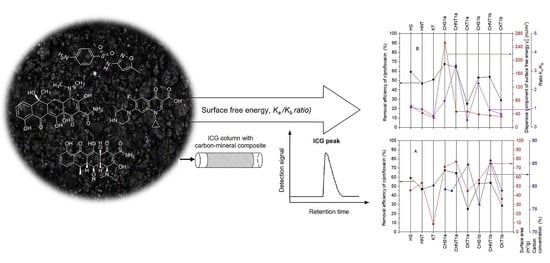
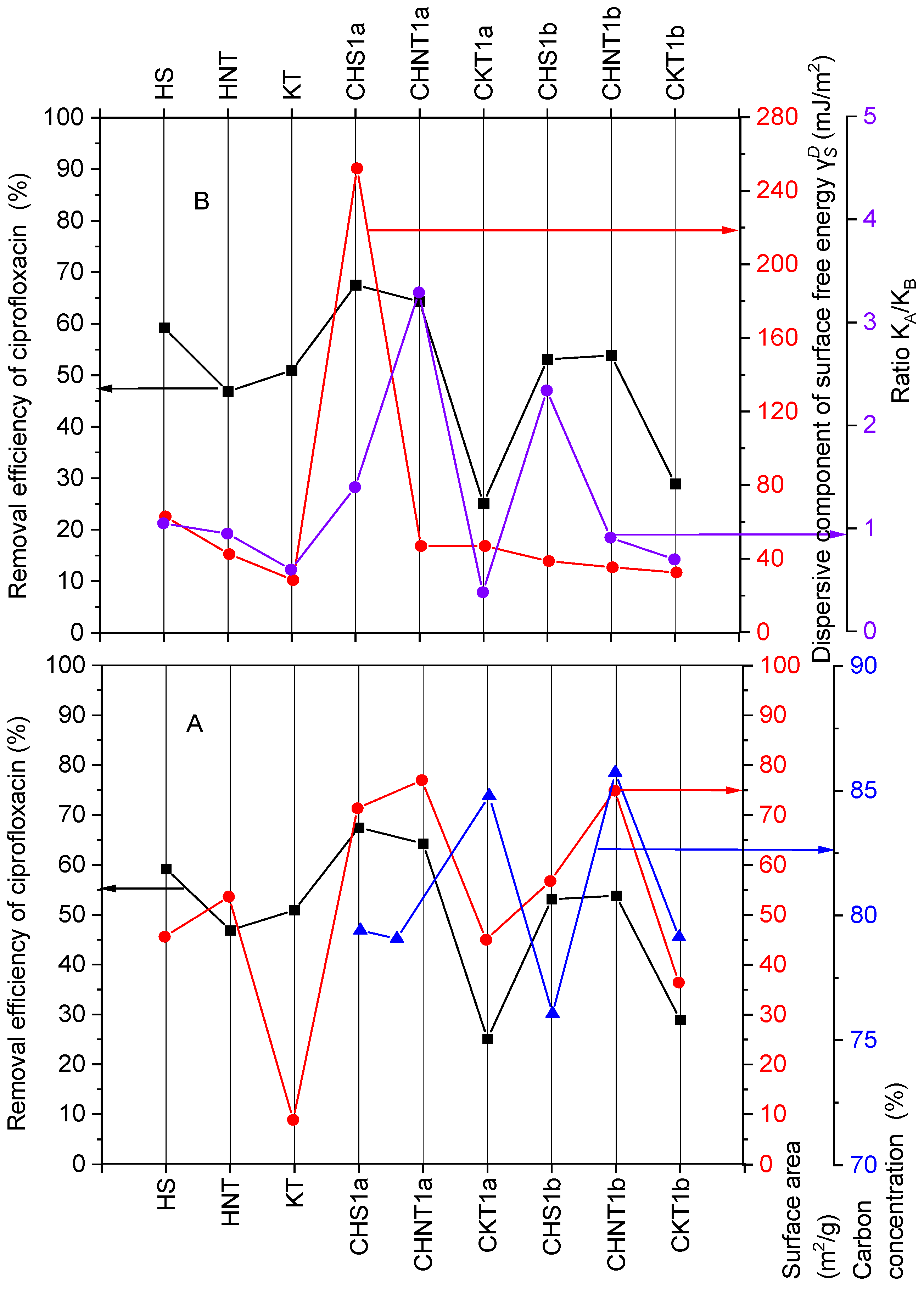
The specific surface areas of HS, HNT, KT, and the carbon–mineral composites ranged from 8.93 m2·g−1 to 77.01 m2·g−1 in the following order: KT < CKT1b < CKT1a < HS < HNT < CHS1b < CHS1a < CHNT1b < CHNT1a (Table 3). The carbon content of the carbon–mineral composites ranged from 76.1% to 85.7% in the increasing order CHNT1b < CHS1b < CKT1b < CHS1a < CHNT1a < CKT1a (Table 6), and was relatively similar across the samples. The degree of ciprofloxacin removal by mineral and carbon–mineral composites ranged from 25.1% to 67.5% in the direction CKT1a < CKT1b < HNT < KT < CHS1b < CHNT1b < HS < CHNT1a < CHS1a. The initial pH of the antibiotic solution was 6.5, at which ciprofloxacin was present in its zwitterionic form (Table 4). This speciation is generally favorable for adsorption, as it promotes hydrophobic and π–π interactions with the adsorbent surface [28].
The dependence of the ciprofloxacin removal efficiency on specific surface area cannot be determined based on these two parameters (Figure 1A), as the observed trend is ambiguous. For example, the removal efficiency was higher for CHS1a (67.5%) than for CHNT1a (64.3%), despite the fact that the specific surface area of CHS1a (71.38 m2·g−1) was lower than that of CHNT1a (77.01 m2·g−1). As the carbon contents of CHS1a and CHNT1a are similar, they probably do not significantly contribute to this difference. Instead, the explanation may lie in differences in thermodynamic surface properties, particularly the surface free energy and the Ka/Kb ratio. These properties describe the thermodynamic strength of adsorption, and the acid–base characteristics that contribute to the driving force [29].
The values of the dispersive component of the surface free energy of HS, HNT, and KT, as well as of the carbon–mineral composites, ranged from 28.4 mJ·m−2 to 252 mJ·m−2 in the following order: KT < CKT1b < CHNT1b < CHS1b < HNT < CHNT1a < CKT1a < HS < CHS1a (Table 7). Meanwhile, the ratio of the acidic to basic characteristics of the solid surface Ka/Kb varied in the range from 0.38 to 3.59 and increased in the sequence: CKT1a < KT < CKT1b < CHNT1b < HNT < HS < CHS1a < CHS1b < CHNT1a (Table 7).
Comparison of ciprofloxacin removal efficiencies for the mineral and carbon–mineral composites (Table 4) with the dispersive component of surface free energy and the Ka/Kb ratio (Figure 1B) indicates that the highest removal efficiency (67.5%) observed for CHS1a corresponds to the highest surface free energy value (252 mJ·m−2). Similarly, materials exhibiting relatively high Ka/Kb ratios, CHNT1a (3.29), and CHS1b (2.34), showed ciprofloxacin removal efficiencies of 64.3% and 53.1%, respectively. These observations suggest that the dispersive component of surface free energy and the Ka/Kb ratio play an important role in ciprofloxacin adsorption, rather than bulk structural parameters alone.
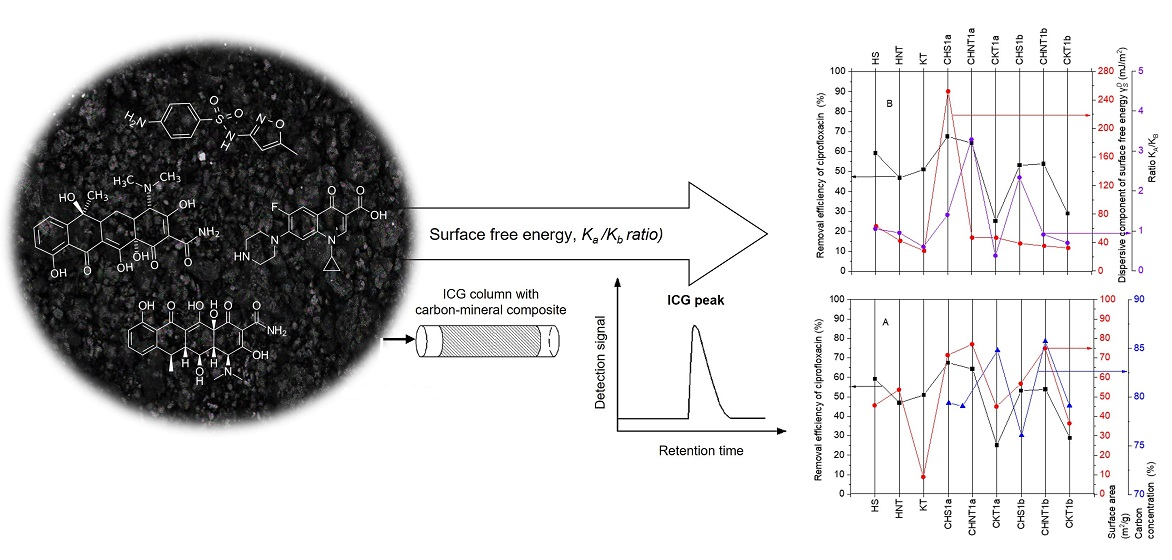
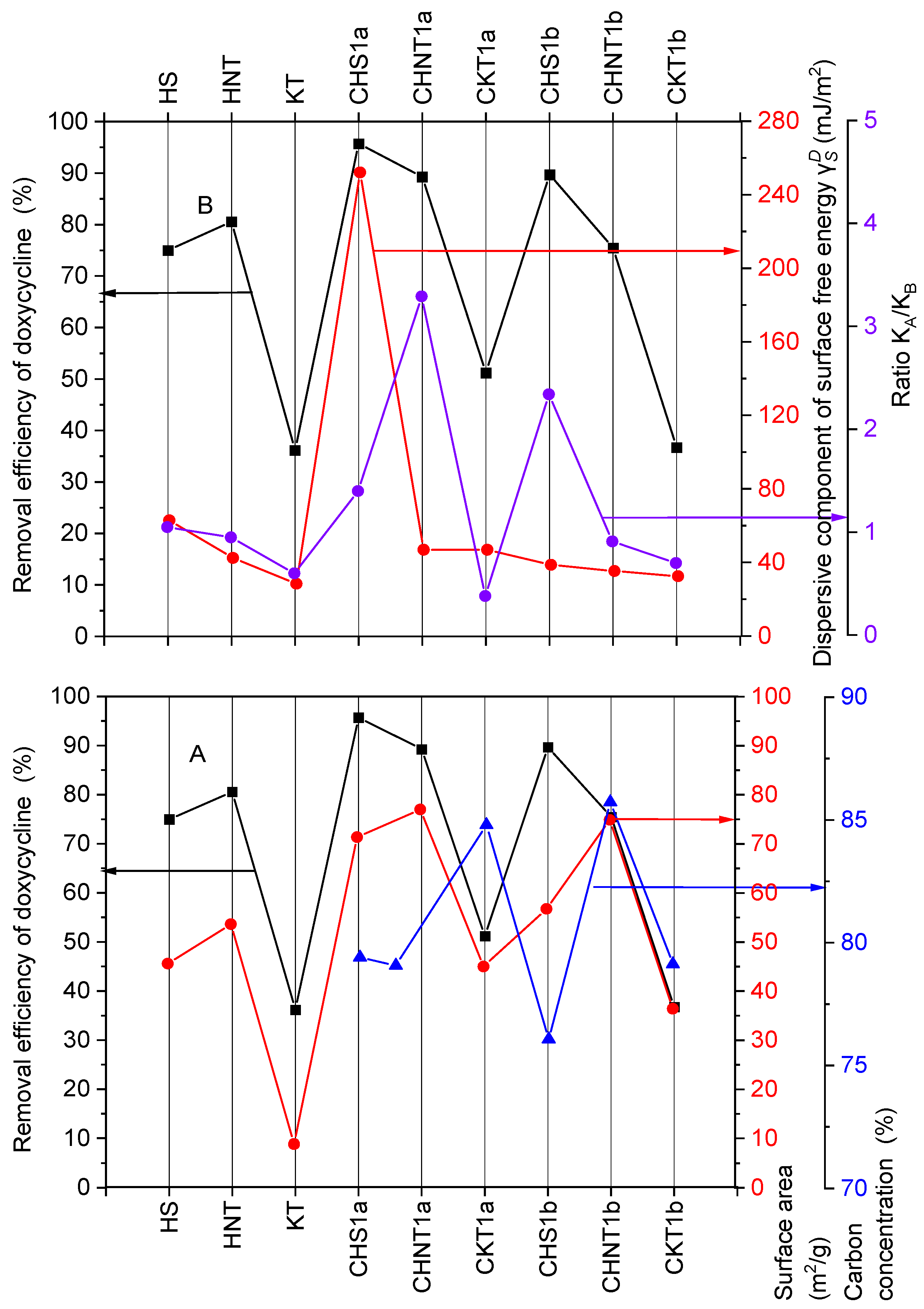
The degree of doxycycline removal by the mineral and carbon–mineral composites ranged from 36.7% to 95.7% in the order KT < CKT1b < CKT1a < HS < CHNT1b < HNT < CHNT1a < CHS1b < CHS1a. The initial pH of the antibiotic solution was 4.3, at which doxycycline was predominantly present in its zwitterionic form (Table 4). Under these conditions, adsorption may be promoted by π–π electron donor–acceptor interactions between the aromatic rings of doxycycline and the carbon phase, as well as by hydrogen bonding involving phenolic, amide, and hydroxyl groups [30,31].
The dependence of doxycycline removal on specific surface area (Figure 2A) is also ambiguous. For example, CHS1a had a higher removal efficiency (95.7%) than CHNT1a (89.3%), although its specific surface area (71.38 m2·g−1) was lower than the specific surface area of CHNT1a (77.01 m2·g−1). The carbon content of CHS1a and CHNT1a is similar, so it is unlikely to have a significant impact on this difference.
The removal efficiency of doxycycline (95.7%) corresponds to the surface free energy component of the CHS1a composite (252 mJ·m−2) (Figure 2B). It can also be observed that the high Ka/Kb ratios for CHNT1a (3.29) and CHS1b (2.34) are associated with increased doxycycline removal efficiencies of 89.3% and 89.7%, respectively, compared to the results obtained for the other adsorbents.
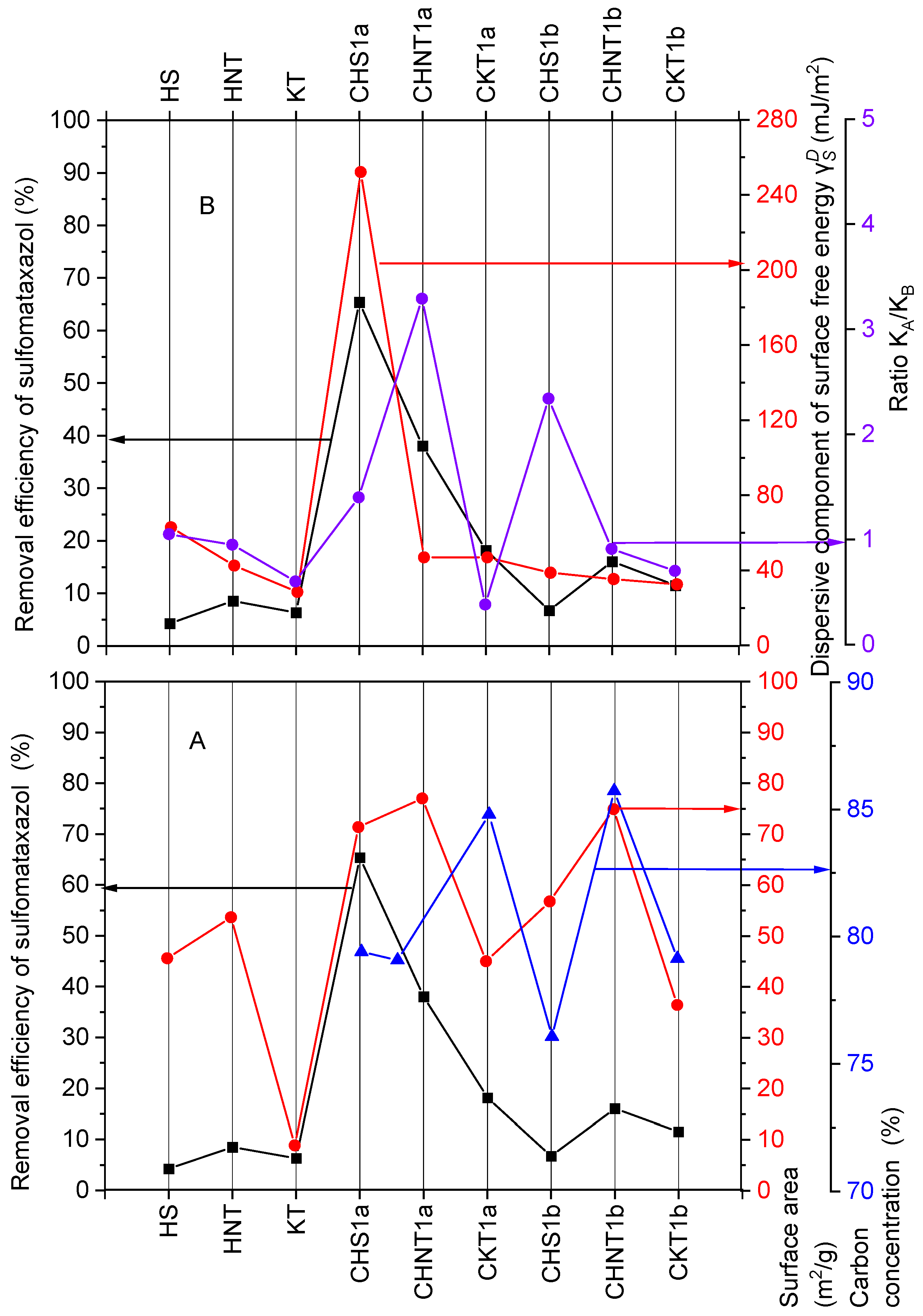
The degree of sulfometaxazole removal by the mineral and carbon–mineral composites ranged from 4.25% to 65.4% in the order HS < KT < CHS1 < HNT < CKT1b < CHNT1b < CKT1a < CHNT1a < CHS1a (Table 4). The degree of sulfamethoxazole removal by the mineral and carbon–mineral composites ranged from 4.25% to 65.4% in the following order: HS < KT < CHS1b < HNT < CKT1b < CHNT1b < CKT1a < CHNT1a < CHS1a. The initial pH of the solution was 5.5, at which sulfamethoxazole was predominantly present in its neutral form (Table 4). Adsorption of sulfamethoxazole depends strongly on its neutral fraction, which favors the formation of hydrophobic interactions, π–π interactions, and hydrogen bonding. Its adsorption decreases when sulfamethoxazole is predominantly in cationic or anionic form [32,33].
For the materials HS, KT, CHS1, HNT, CKT1b, CHNT1b, and CKT1a, the degree of sulfometaxazole removal does not exceed 20% (Figure 3A). A contradictory relationship is also observed: for CHS1a the degree of sulfometaxazole removal was 65.4% at the specific surface area of 71.38 m2·g−1, whereas for CHNT1a the degree of removal was 38.0% at a higher specific surface area of 77.01 m2·g−1, despite similar carbon contents (Table 6).
The influence of specific surface area and carbon content on sulfometaxazole removal cannot be determined for the other adsorbents. For CHS1a only, there is a dependence of sulfometaxazole removal on the component of surface free energy and the Ka/Kb ratio (Figure 3B). For this composite, a degree of removal of 65.4% corresponds to a value of the component of surface free energy of 252 mJ·m−2. In all other cases, the curves representing these relationships are random.
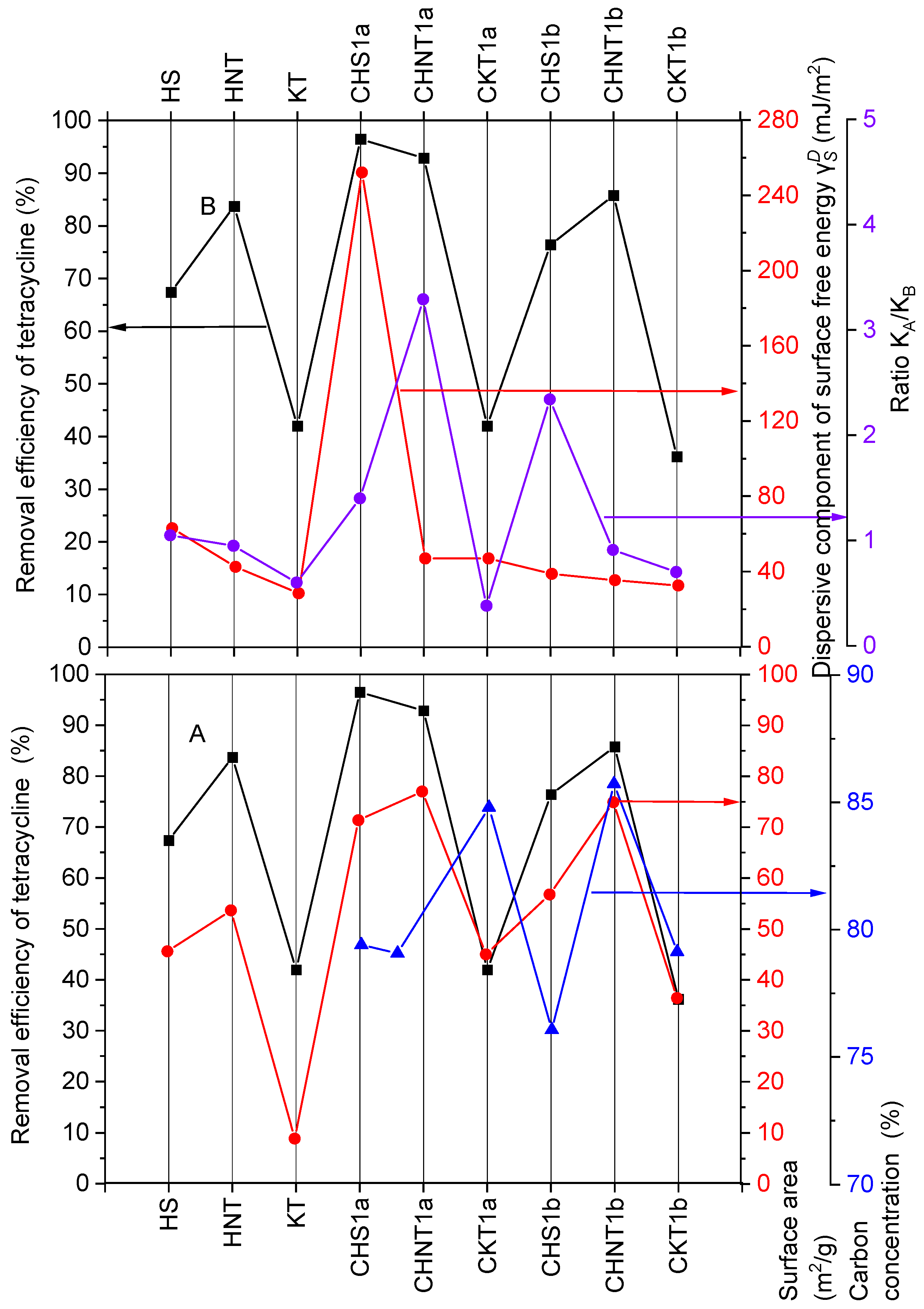
For the last antibiotic, tetracycline, the removal efficiency ranged from 36.2% to 96.5% in the following order: CKT1b < KT < CKT1a < HS < CHS1b < HNT < CHNT1b < CHNT1a < CHS1a. The initial pH of the solution was 4.5, at which tetracycline was predominantly present in its zwitterionic form (Table 4). Tetracycline adsorption is typically highest when the zwitterionic or neutral species predominates and generally decreases at higher pH when tetracycline becomes anionic. These forms enable strong π–π interactions and hydrogen bonding [34,35].
Figure 4A shows that a direct relationship was found between the degree of tetracycline removal by mineral and mineral–carbon composites, and the specific surface area for HS, HNT, CHS1b, and CKT1b. In two cases, CHS1a and CHNT1a, such a relationship was not observed. For CHS1a the removal efficiency was 96.5% and was higher than the removal efficiency for CHNT1a (92.9%). At the same time, the specific surface area of CHS1a was lower (71.38 m2·g−1) than the specific surface area of CHNT1a (77.01 m2·g−1).
This effect can be explained only by comparing the values of the dispersive component of the surface free energy, which was much higher for CHS1a (252 mJ·m−2) than for CHNT1a (46.8 mJ·m−2) (Figure 4B).
For the remaining adsorbents (HS, HNT, KT, CHNT1a, CHS1b, CHNT1b, and CKT1b), the values of the dispersive surface free energy were at a similar level and probably have a smaller impact on the degree of tetracycline removal. It can also be assumed that the carbon content does not significantly contribute to the tetracycline removal efficiency.

5. Conclusions

Previous studies on the adsorption of ciprofloxacin, doxycycline, sulfamethoxazole, and tetracycline on mineral and mineral–carbon composites focused on structural characterization of these adsorbents. These studies showed that establishing a clear relationship between antibiotic removal efficiencies and either carbon content or specific surface area is difficult.
Therefore, we used inverse gas chromatography to determine components of the surface free energy and donor–acceptor (acid–base) properties of mineral and mineral–carbon composite surfaces. To the best of our knowledge, no previous attempts have been made to relate the degree of antibiotic removal to the thermodynamic surface parameters of the adsorbents. The obtained parameters allowed us to explain differences in the adsorption of structurally and chemically distinct antibiotics (ciprofloxacin, doxycycline, sulfamethoxazole, and tetracycline) on the investigated materials.
The results confirmed that the surfaces of mineral and mineral–carbon composites have electron-acceptor properties. Moreover, the values of the dispersive component of surface free energy and the acid–base properties of HS, HNT, KT, and mineral–carbon composites showed that CHS1a has an extremely high surface energy compared with the other adsorbents, which is consistent with the highest removal efficiencies observed for all four antibiotics on CHS1a.
Overall, IGC enabled a more detailed interpretation of the adsorption process, linking the removal efficiencies of different antibiotics to the thermodynamic properties of the absorbent surfaces and the properties of antibiotics.

Author Contributions

Conceptualization, P.S.; Validation, P.S.; Formal analysis, K.P.; Investigation, K.P.; Data curation, K.P.; Writing—original draft, P.S. and S.D.; Writing—review and editing, P.S. and S.D. All authors have read and agreed to the published version of the manuscript.

Funding

This study was co-financed by the Minister of Science (Poland) under the “Regional Excellence Initiative” program (project no.: RID/SP/0015/2024/01).

Data Availability Statement

The original contributions presented in this study are included in the article. Further inquiries can be directed to the corresponding author.

Conflicts of Interest

The authors declare no conflicts of interest.

References

  1. Barathe, P.; Kaur, K.; Reddy, S.; Shriram, V.; Kumar, V. Antibiotic pollution and associated antimicrobial resistance in the environment. J. Hazard. Mater. Lett. 2024, 5, 100105. [Google Scholar] [CrossRef]
  2. Zhu, L.; Lin, X.; Di, Z.; Cheng, F.; Xu, J. Occurrence, risks, and removal methods of antibiotics in urban wastewater treatment systems: A review. Water 2024, 16, 3428. [Google Scholar] [CrossRef]
  3. Ahmad, F.; Zhu, D.; Sun, J. Environmental fate of tetracycline antibiotics: Degradation pathways, mechanisms, challenges, and perspectives. Environ. Sci. Eur. 2021, 33, 105. [Google Scholar] [CrossRef]
  4. Rodriguez-Mozaz, S.; Vaz-Moreira, I.; Della Giustina, S.V.; Llorca, M.; Barceló, D.; Schubert, S.; Berendonk, T.U.; Michael-Kordatou, I.; Fatta-Kassinos, D.; Martinez, J.L.; et al. Antibiotic residues in final effluents of European wastewater treatment plants and their impact on the aquatic environment. Environ. Int. 2020, 140, 105733. [Google Scholar] [CrossRef]
  5. Zhang, X.; Zhang, J.; Han, Q.; Wang, X.; Wang, S.; Yuan, X.; Zhang, B.; Zhao, S. Antibiotics in mariculture organisms of different growth stages: Tissue-specific bioaccumulation and influencing factors. Environ. Pollut. 2021, 288, 117715. [Google Scholar] [CrossRef]
  6. Pareek, S.; Mathur, N.; Singh, A.; Nepalia, A. Antibiotics in the environment: A review. Int. J. Curr. Microbiol. Appl. Sci. 2015, 4, 278–285. [Google Scholar]
  7. Polianciuc, S.I.; Gurzău, A.E.; Kiss, B.; Ștefan, M.G.; Loghin, F. Antibiotics in the environment: Causes and consequences. Med. Pharm. Rep. 2020, 93, 231–240. [Google Scholar] [CrossRef] [PubMed]
  8. Albarano, L.; Guadalupe, E.; Suarez, P.; Maggio, C.; Iovine, R.; Lofrano, G.; Guida, M.; Vaiano, V.; Carotenuto, M.; Libralato, G. Assessment of ecological risks posed by veterinary antibiotics in European aquatic environments: A comprehensive review and analysis. Sci. Total Environ. 2024, 954, 176280. [Google Scholar] [CrossRef] [PubMed]
  9. Klein, E.Y.; Impalli, I.; Poleon, S.; Denoel, P. Global trends in antibiotic consumption during 2016–2023 and future projections through 2030. Proc. Natl. Acad. Sci. USA 2024, 121, e2411919121. [Google Scholar] [CrossRef] [PubMed]
  10. Samrot, A.V.; Wilson, S.; Singh, R.; Preeth, S.; Prakash, P.; Sathiyasree, M.; Saigeetha, S.; Shobana, N.; Pachiyappan, S.; Rajesh, V.V. Sources of antibiotic contamination in wastewater and approaches to their removal: An overview. Sustainability 2023, 15, 12639. [Google Scholar] [CrossRef]
  11. Kortesmäki, E.; Östman, J.R.; Meierjohann, A.; Brozinski, J.M.; Eklund, P.; Kronberg, L. Occurrence of antibiotics in influent and effluent from three major wastewater treatment plants in Finland. Environ. Toxicol. Chem. 2020, 39, 1774–1789. [Google Scholar] [CrossRef]
  12. Sen, U.; Esteves, B.; Aguiar, T. Removal of antibiotics by biochars: A critical review. Appl. Sci. 2023, 13, 11963. [Google Scholar] [CrossRef]
  13. Krasucka, P.; Pan, B.; Sik, Y.; Mohan, D.; Sarkar, B.; Oleszczuk, P. Engineered biochar-A sustainable solution for the removal of antibiotics from water. Chem. Eng. J. 2021, 405, 126926. [Google Scholar] [CrossRef]
  14. Ahmed, M.B.; Zhou, J.L.; Ngo, H.H.; Guo, W. Adsorptive removal of antibiotics from water and wastewater: Progress and challenges. Sci. Total Environ. 2015, 532, 112–126. [Google Scholar] [CrossRef]
  15. Teo, C.Y.; Jong, J.S.J.; Chan, Y.Q. Carbon-based materials as effective adsorbents for the removal of pharmaceutical compounds from aqueous solution. Adsorpt. Sci. Technol. 2022, 2022, 3079663. [Google Scholar] [CrossRef]
  16. Słomkiewicz, P.; Szczepanik, B.; Piekacz, K.; Gołombek, K.; Włodarczyk-Makuła, M. Adsorptive removal of sulfamethoxazole from water using carbon–mineral composites. Arch. Environ. Prot. 2025, 51, 40–53. [Google Scholar] [CrossRef]
  17. Słomkiewicz, P.M.; Dołęgowska, S.; Wideł, D.; Piekacz, K. Adsorption isotherms for tetracycline removal from water using carbon–mineral composites determined by inverse liquid chromatography. Desalin. Water Treat. 2025, 322, 101104. [Google Scholar] [CrossRef]
  18. Słomkiewicz, P.; Dołęgowska, S.; Piekacz, K. Adsorptive removal of doxycycline from water using carbon–mineral composites. In Proceedings of the 12th International Symposium on Effects of Surface Heterogeneity in Adsorption, Catalysis and Related Phenomena, Lublin, Poland, 7–11 September 2025. [Google Scholar]
  19. Mesallati, H.; Umerska, A.; Paluch, K.J.; Tajber, L. Amorphous polymeric drug salts as ionic solid dispersion forms of ciprofloxacin. Mol. Pharm. 2017, 14, 2209–2223. [Google Scholar] [CrossRef]
  20. Li, Z.; Hong, H.; Liao, L.; Ackley, C.J.; Schulz, L.A.; MacDonald, R.A.; Mihelich, A.L.; Emard, S.M. A mechanistic study of ciprofloxacin removal by kaolinite. Colloids Surf B Biointerfaces 2011, 88, 339–344. [Google Scholar] [CrossRef]
  21. Sierra, R.S.C.; Zúñiga-Benítez, H.; Penuela, G.A. Elimination of cephalexin and doxycycline under low frequency ultrasound. Ultrason. Sonochem. 2021, 79, 105777. [Google Scholar] [CrossRef] [PubMed]
  22. Xu, L.; Zhang, H.; Xiong, P.; Zhu, Q.; Liao, C.; Jiang, G. Occurrence, fate, and risk assessment of typical tetracycline antibiotics in the aquatic environment: A review. Sci. Total Environ. 2021, 753, 141975. [Google Scholar] [CrossRef]
  23. Witkiewicz, Z.; Słomkiewicz, P. Inverse gas chromatography. In Encyclopedia of Analytical Science, 3rd ed.; Elsevier: Amsterdam, The Netherlands, 2019; pp. 193–201. [Google Scholar] [CrossRef]
  24. Schultz, J.; Lavielle, L.; Martin, C. The role of the interface in carbon fibre–epoxy composites. J. Adhes. 1987, 23, 45–60. [Google Scholar] [CrossRef]
  25. Schultz, J.; Lavielle, L. Interfacial properties of carbon fiber–epoxy matrix composites. ACS Symp. Ser. 1989, 391, 185–202. [Google Scholar] [CrossRef]
  26. Dorris, G.M.; Gray, D.G. Adsorption of n-alkanes at zero surface coverage on cellulose paper and wood fibers. J. Colloid Interface Sci. 1980, 77, 353–362. [Google Scholar] [CrossRef]
  27. Vukov, A.J. A Study of Carbon Fiber Surfaces by Inverse Gas Chromatography. Master’s Thesis, McGill University, Montreal, QC, Canada, 1992. [Google Scholar]
  28. Peng, X.; Hu, F.; Dai, H.; Xiong, Q.; Xu, C. Study of the adsorption mechanisms of ciprofloxacin antibiotics onto graphitic ordered mesoporous carbons. J. Taiwan Inst. Chem. Eng. 2016, 65, 472–481. [Google Scholar] [CrossRef]
  29. Hamieh, T.; Jrad, A.; Roques-Carmes, T.; Hmadeh, M.; Toufaily, J. Surface thermodynamics and Lewis acid–base properties of metal–organic framework Crystals by Inverse gas chromatography at infinite dilution. J. Chromatogr. A 2022, 1666, 462849. [Google Scholar] [CrossRef] [PubMed]
  30. Liang, L.; Niu, X.; Han, X.; Chang, C.; Chen, J. Salt sealing induced in situ N-doped porous carbon derived from wheat bran for the removal of doxycycline from aqueous solution. Environ. Sci. Pollut. Res. 2022, 29, 49346–49360. [Google Scholar] [CrossRef]
  31. Kaur, G.; Singh, N.; Rajor, A. Adsorption of doxycycline hydrochloride onto powdered activated carbon synthesized from pumpkin seed shell by microwave-assisted pyrolysis. Environ. Technol. Innov. 2021, 23, 101601. [Google Scholar] [CrossRef]
  32. Zhang, D.; Pan, B.; Zhang, H.; Ning, P.; Xing, B. Contribution of different sulfamethoxazole species to their overall adsorption on functionalized carbon nanotubes. Environ. Sci. Technol. 2010, 44, 3806–3811. [Google Scholar] [CrossRef]
  33. Zheng, W.; Shi, Y.; Liu, G.; Zhao, B.; Wang, L. Heteroatom-doped highly porous carbons prepared by in situ activation for efficient adsorptive removal of sulfamethoxazole. RSC Adv. 2020, 10, 1595–1602. [Google Scholar] [CrossRef]
  34. Ngoc, D.M.; Hieu, N.C.; Trung, N.H.; Chien, H.H.; Thi, N.Q.; Hai, N.D.; Chao, H.P. Tetracycline removal from water by adsorption on hydrochar and hydrochar-derived activated carbon: Performance, mechanism, and cost calculation. Sustainability 2023, 15, 4412. [Google Scholar] [CrossRef]
  35. Zhang, L.; Yang, W.; Chen, Y.; Yang, L. Removal of Tetracycline from Water by Biochar: Mechanisms, Challenges, and Future Perspectives. Water 2025, 17, 1960. [Google Scholar] [CrossRef]
Figure 1. Dependence of ciprofloxacin removal efficiency by mineral and carbon–mineral composites on (A) specific surface area and carbon content after pyrolysis, and (B) K a K b ratio and dispersive component of the surface free energy γ S D .
Materials 19 00419 g001
Figure 2. Dependence of doxycycline removal efficiency by mineral and carbon–mineral composites on (A) specific surface area and carbon content after pyrolysis, (B) K a K b ratio and values of components of surface free energy γ S D .
Materials 19 00419 g002
Figure 3. Dependence of sulfometaxazole removal efficiency by mineral and carbon–mineral composites on (A) specific surface area and carbon content after pyrolysis, (B) K a K b ratio and values of components of surface free energy γ S D .
Materials 19 00419 g003
Figure 4. Dependence of tetracycline removal efficiency by mineral and mineral–carbon composites on (A) specific surface area and carbon content after pyrolysis, (B) K a K b ratio and values of components of surface free energy γ S D .
Materials 19 00419 g004
Table 1. Physicochemical properties and environmental impact of antibiotics [14,16,17,18,19,20,21,22].
AntibioticDoxycyclineTetracyclineSulfametaxazoleCyprofloxacin
Structure and IUPAC nameMaterials 19 00419 i001
(4S,4aR,5S,5aR,6R,12aS)-4-(dimethylamino)-3,5,10,12,12a-pentahydroxy-6-methyl-1,11-dioxo-1,4,4a,5,5a,6,11,12a-octahydrotetracene-2-carboxamide
Materials 19 00419 i002
(4S,4aS,5aS,6S,12aS)-4-(dimethyloamino)-3,6,10,12,12a-pentahydroxy-6-methylo-1,11-dioxo-1,4,4a,5,5a,6,11,12a-oktahydrotetraceno-2-karboxyamid
Materials 19 00419 i003
4-amino-N-(5-methyl-1,2-oxazol-3-yl) benzenesulfonamide
Materials 19 00419 i004
1-cyclopropyl-6-fluoro-4-oxo-7-piperazin-1-ylquinoline-3-carboxylic acid
Molecular weight (g·mol−1)444.44444.44253.28331.34
Water solubility at 25 °C (mg·L−1)31323128060
log Kow *−0.02−1.250.890.28
pKa3.0, 7.9, 9.23.3, 7.7, 9.71.7, 5.66.1, 8.7
* Kow—octanol–water partition coefficient.
Table 2. Synthesis parameters of mineral–carbon composites [16].
CompositesMineral CarrierCarbon PrecursorFruit Pomace to Mineral Carrier RatioPyrolysis Temperature in Nitrogen Atmosphere (°C)
CHS1aHS (raw halloysite)—
obtained from the “Dunino” strip mine in Legnica, Poland
raw fruit pomace9:1800
CHNT1aHNT (halloysite nanotubes)—
purchased from Merck KGaA, Darmstadt, Germany
raw fruit pomace9:1800
CKT1aKT (kaolinite)—
purchased from Sigma-Aldrich, Saint Louis, MO, USA
raw fruit pomace9:1800
CHS1bHS—raw halloysite obtained from the “Dunino” strip mine in Legnica, Polandraw fruit pomace9:1500
CHNT1bHNT (halloysite nanotubes)—
purchased from Merck KGaA, Darmstadt, Germany
raw fruit pomace9:1500
CKT1bKT (kaolinite)—
purchased from Sigma-Aldrich, Saint Louis, MO, USA
raw fruit pomace9:1500
Table 3. Structural parameters of HS, HNT, KT, and carbon–mineral composites [16].
CompositesSBET
m2/g
Vt
cm3/g
Vmi
cm3/g
Vme
cm3/g
Mesoporosity
%
HS45.600.19250.00190.190699
HNT53.650.22020.00160.218699
KT8.930.0294-0.0294100
CHS1a71.380.15340.01340.140091
CHNT1a77.010.19080.01490.175992
CKT1a45.020.04340.01400.029468
CHS1b56.780.13930.00920.130193
CHNT1b74.890.18820.01030.177995
CKT1b36.420.04020.00780.032481
SBET—specific surface area; Vt—single-point total pore volume, calculated at p/po = 0.99; Vme—mesopore volume, calculated by subtracting Vmi from Vt; Vmi—volume of micropores obtained with the αs-method; mesoporosity—the percentage of the volume of mesopores to the total pore volume.
Table 4. Removal efficiencies of selected antibiotics by HS, HNT, KT, and carbon–mineral composites [16,17,18].
CompositesRemoval Efficiency (%)
CiprofloxacinDoxycyclineSulfamethoxazoleTetracycline
Initial pH
6.54.35.54.5
Dominant form of the antibiotic
zwitterion formzwitterion formneutral formzwitterion form
HS59.2 ± 2.175.0 ± 0.74.3 ± 0.567.4 ± 1.1
HNT46.8 ± 0.680.6 ± 5.88.5 ± 0.283.7 ± 1.6
KT50.9 ± 8.036.2 ± 2.26.3 ± 0.642.0 ± 0.4
CHS1a67.5 ± 7.095.7 ± 0.165.4 ± 5.196.5 ± 0.4
CHNT1a64.3 ± 5.289.3 ± 1.338.0 ± 2.192.9 ± 1.8
CKT1a25.1 ± 0.451.2 ± 3.518.2 ± 1.642.0 ± 4.1
CHS1b53.1 ± 2.389.7 ± 2.26.8 ± 1.976.4 ± 1.3
CHNT1b53.8 ± 2.275.5 ± 4.016.1 ± 0.785.8 ± 2.5
CKT1b28.9 ± 3.836.7 ± 3.311.5 ± 0.836.2 ± 0.5
Table 5. Equation of the London dispersion interactions and specific interactions using free adsorption energy ( G a ), free surface energy ( γ s ) , and adhesion work ( W a ) in the Dorris, Gray, and Schultz methods and acidic–basic properties of solids [23,24,25,26,27].
EquationDescriptionInterpretation
G a = G a d R T · l n ( V N , n ) + C
G a d —dispersive component of adsorption free energy [J·mol−1],
R—universal gas constant [J mol−1 K−1],
T—column temperature [K],
V N , n —adjusted retention volume of n-alkane [cm3],
C—constant value.
Free adsorption energyDefines the free energy of adsorption G a which comprises only the dispersive part
W a = 2 γ s d · γ l d
W a —dispersive component of work of adhesion [mJ],
γ s d —dispersive component of surface energy [mJ·m−2],
γ l d —dispersive energy of test molecule [mJ·m−2],
G C H 2 = N · a C H 2 · W a ,
where a C H 2 = 1.09 · 10 14 M ρ · N A 2 3
G C H 2 —dispersive component of methylene group of adsorption free energy [J·mol−1],
aCH2—cross-section area of a CH2 group [m2],
M—molar mass [g],
N A —Avogadro number,
ρ —density [cm3 g−1].
Adhesion work
Free adsorption energy of the methylene group and the cross-section area a C H 2 of the alkane molecule
Describe the mutual interaction of the examined substance (adsorbent) with the test one [23]
R T · l n V N , n = 2 N · a C H 2 · γ s d · γ l d + C Transformed equationLinear form of the equation enables determination of γ s d value
R T · l n V N , n = f a C H 2 · γ l d Linear dependence diagramThe line slope enables quantitative determination of the stationary phase dispersive surface free energy, γ s d .
The vertical distance on the axis R T · l n V N , n from the n-alkane line to the point of polar substance is a component of specific adsorption energy G a s p [23]
G a = D N · K a + A N · K b
DN—donor number [J·mol−1],
A N —acceptor number [%],
K a —acidic characteristic of solid
K b —basic characteristic of solid
Modified Gutmann equationDonor number DN, given in kJ/mol is described as negative enthalpy of forming an addition compound of a given base (donor) with Lewis acid SbCl5 (acceptor) in a 10−3 M solution of 1,2-dichloroethane.
Acceptor number AN is, in turn, defined as a non-dimensional number corresponding to spectrum diffraction NMR3I for triethylphosphine oxide (standard donor) diluted in the tested acceptor. It is the number given in non-dimensional conventional units (hexane = 0; 1,2-dichloroethane = 100).
G a A N = D N A N · K a + K b Transformed equationThe ratio K a K b facilitates specifying the character of the test surface.
If the ratio is K a K b < 1 , then the surface is basic (donor properties prevail over the acceptor ones). If the ratio is K a K b > 1 , then the surface is acidic. (acceptor properties prevail over donor the ones).
If K a K a 1 , then the surface is amphotheric
Table 6. Carbon concentration of carbon–mineral composites.
CompositesCarbon Concentration
(%)
CHS1a79.4 ± 0.0
CHNT1a84.8 ± 0.4
CKT1a85.7 ± 0.1
CHS1b79.0 ± 0.2
CHNT1b76.1 ± 0.4
CKT1b79.1 ± 0.2
Table 7. Dispersive component of surface free energy and acid–base properties of HS, HNT, KT, and carbon–mineral composites.
CompositesDispersive Component of Surface Energy
γ s d (mJ·m−2)
R2Acidic Characteristic of Solid
Ka
Basic Characteristic of Solid
Kb
Ratio
Ka/Kb
R2
HS62.90.98210.1790.1701.050.9404
HNT42.40.99920.2110.2220.950.8981
KT28.40.99950.2510.4180.600.9629
CHS1a2520.99980.1770.1261.400.9703
CHNT1a46.80.99710.1160.0353.290.9259
CKT1a46.90.99940.3981.0290.380.8547
CHS1b38.70.98970.2000.0852.340.9916
CHNT1b35.30.99670.0930.1010.910.9784
CKT1b32.50.99240.2810.4010.700.9857
Disclaimer/Publisher’s Note: The statements, opinions and data contained in all publications are solely those of the individual author(s) and contributor(s) and not of MDPI and/or the editor(s). MDPI and/or the editor(s) disclaim responsibility for any injury to people or property resulting from any ideas, methods, instructions or products referred to in the content.