
Effect of Crystal Orientation on Dislocation Loop Evolution Under Electron Radiation in Pure Aluminum
 , , ,
, , ,
Abstract
1. Introduction
2. Materials and Methods
3. Results
3.1. Fraction, Density, and Average Size of Dislocation Loops Under Different Irradiation Directions
3.2. IAD in Dislocation Loops Generated by Irradiation in Different Directions
4. Discussion
4.1. Effect of Direction-Dependent Ed on Evolution of Dislocation Loops
4.2. Effect of 1D Migration of <110> Dislocation Loops
5. Conclusions
- (1)
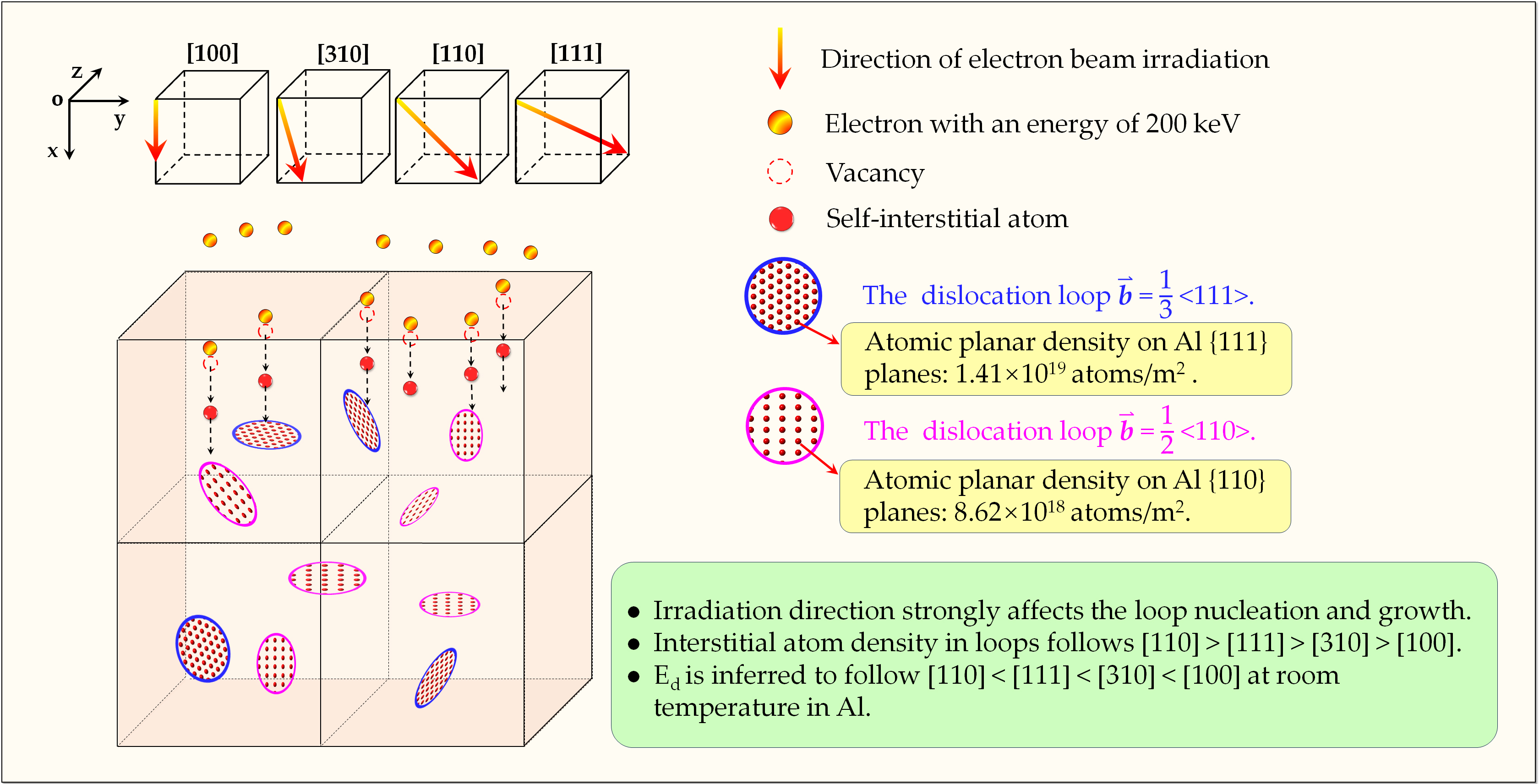
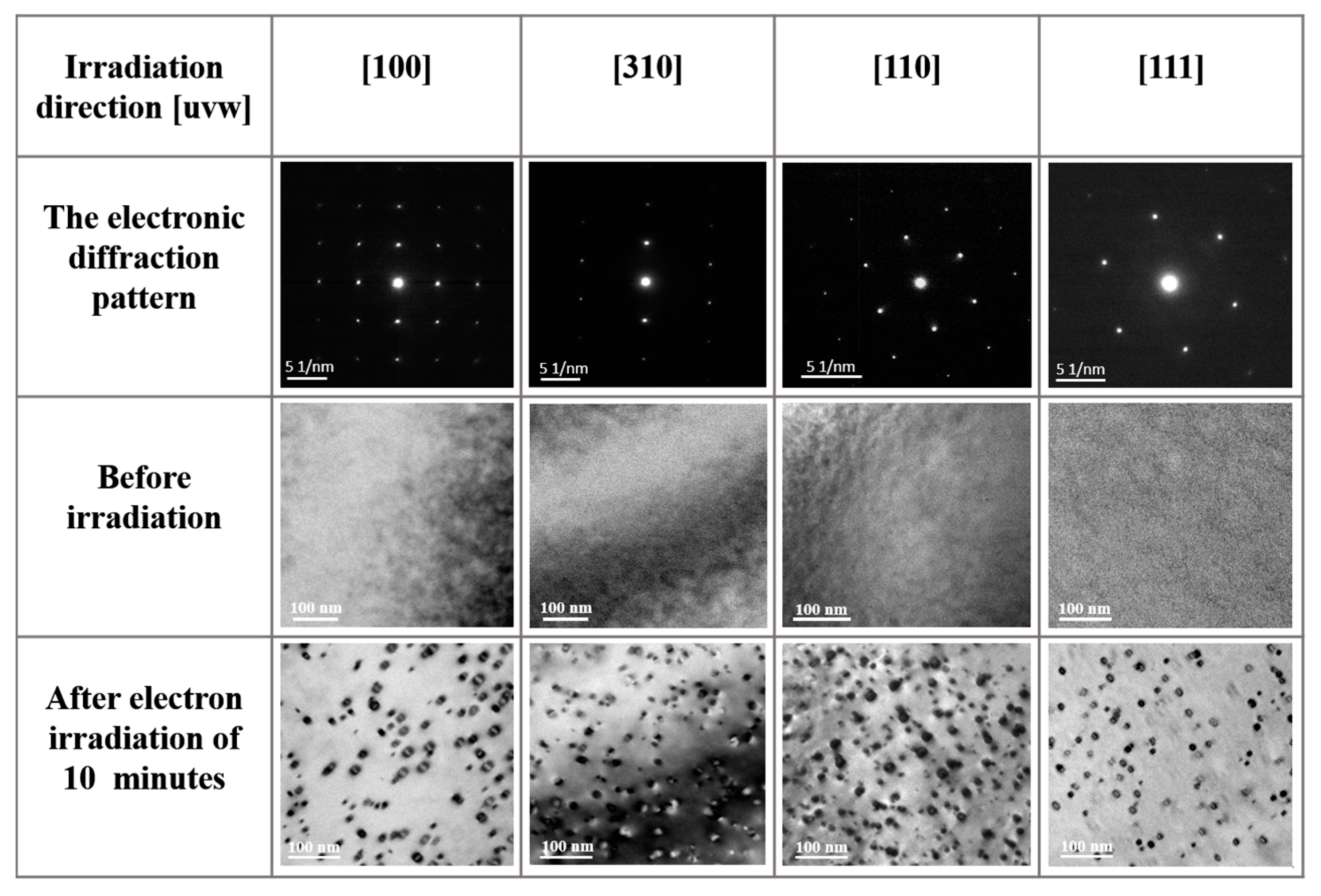
- The total density of dislocation loops formed under the four irradiation directions decreases in the order [111] > [110] > [310] > [100]. Among them, the loop densities produced under [111] and [110] irradiation are similar, both approximately twice those under [100] irradiation. The average loop sizes are relatively close, with the following order from largest to smallest: [100] > [310] > [110] > [111].
- (2)
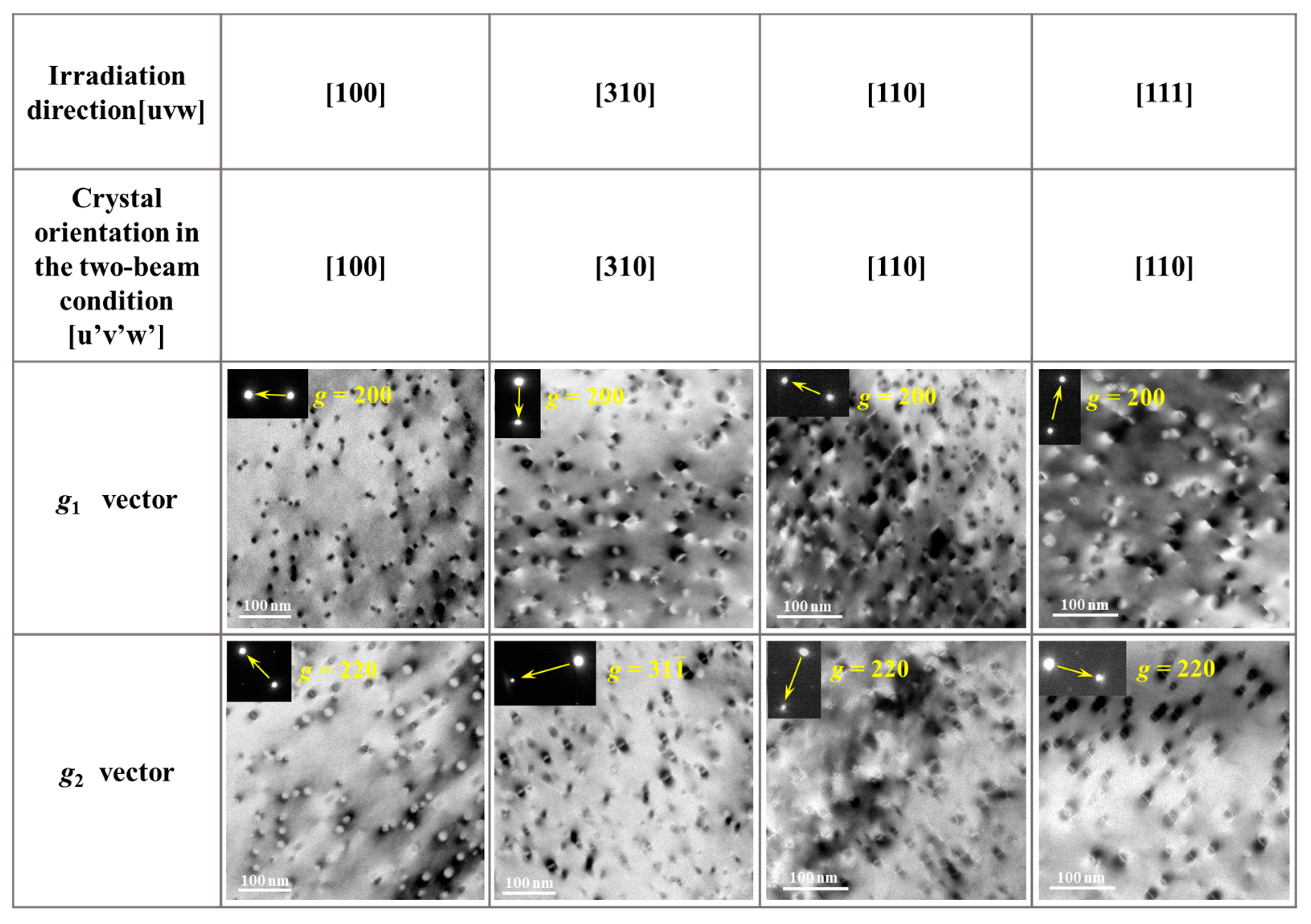
- A comparison between the two Burgers vector types, <111> and <110> dislocation loops, shows that for all irradiation directions, the <110> loops exhibit smaller diameters than the <111> loops. Under [100] and [310] irradiation, the density of <111> loops is lower than that of <110> loops, whereas the opposite trend is observed under [110] and [111] irradiation. In particular, under [110] irradiation, the density of <111> loops is nine times that of <110> loops. This behavior is attributed to the fact that <111> loops in aluminum are difficult to migrate, whereas <110> loops can undergo long-range one-dimensional migration, resulting in a lower retained density.
- (3)
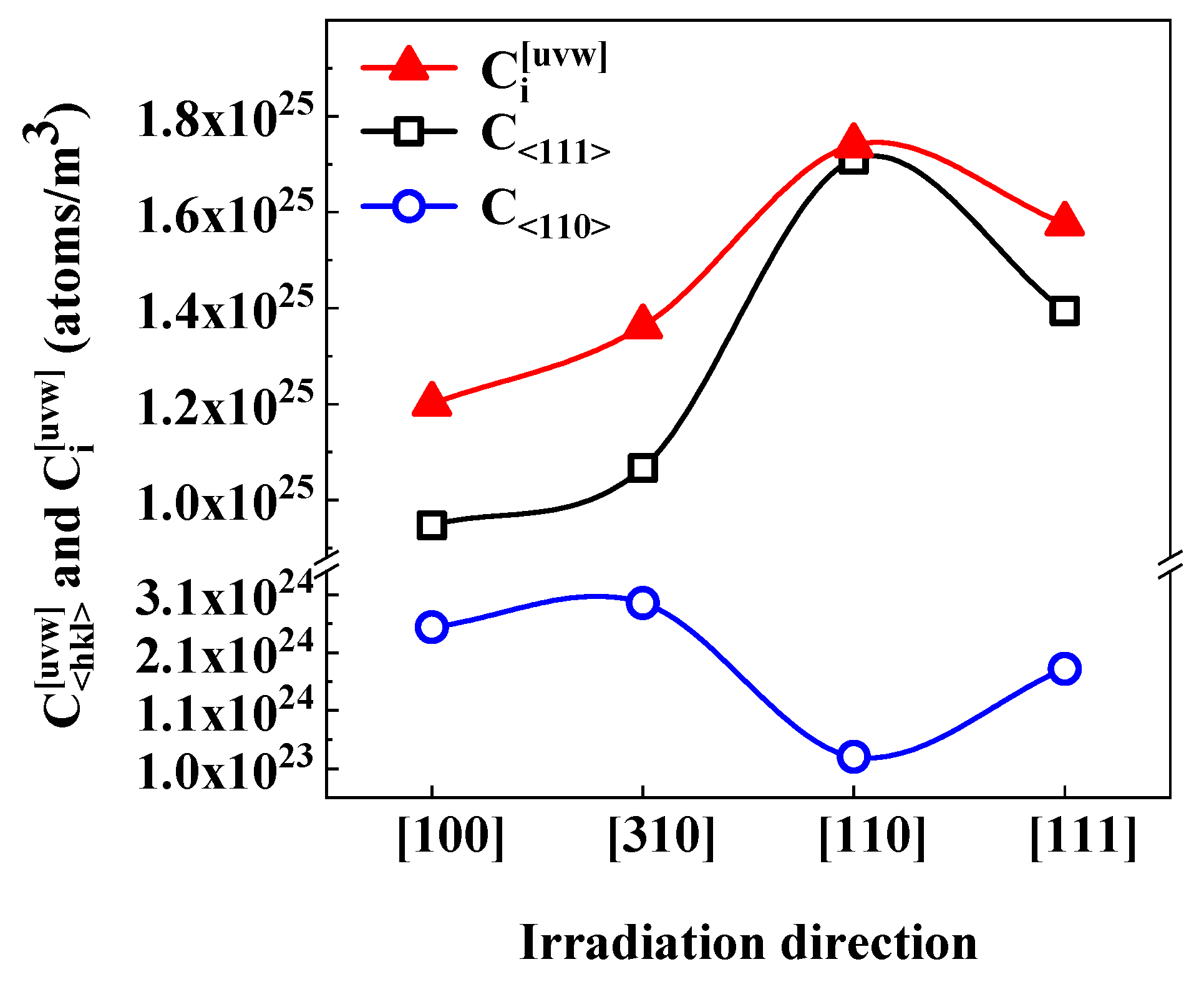
- The calculated interstitial atom density contained within the loops shows that, for different irradiation directions, the interstitial density decreases in the order [110] > [111] > [310] > [100]. Based on these results, the threshold displacement energy, Ed, of pure aluminum under electron irradiation at room temperature is inferred to follow the crystallographic orientation dependence: .
Author Contributions
Funding
Institutional Review Board Statement
Informed Consent Statement
Data Availability Statement
Conflicts of Interest
References
- Aamir, M.; Giasin, K.; Tolouei-Rad, M.; Vafadar, A. A review: Drilling performance and hole quality of aluminium alloys for aerospace applications. J. Mater. Res. Technol. 2020, 9, 12484–12500. [Google Scholar] [CrossRef]
- Santos, M.C.; Machado, A.R.; Sales, W.F.; Barrozo, M.A.S.; Ezugwu, E.O. Machining of aluminum alloys: A review. Int. J. Adv. Manuf. Technol. 2016, 86, 3067–3080. [Google Scholar] [CrossRef]
- Yost, B.; Weston, S. Structures, Materials, and Mechanisms; NASA Ames Research Center, Small Spacecraft Systems Virtual Institute: Moffett Field, CA, USA, 2025. Available online: https://www.nasa.gov/wp-content/uploads/2025/02/soa-2024.pdf (accessed on 20 December 2025).
- Li, S.S.; Yue, X.; Li, Q.Y.; Peng, H.L.; Dong, B.X.; Liu, T.S.; Yang, H.Y.; Fan, J.; Shu, S.L.; Qiu, F.; et al. Development and applications of aluminum alloys for aerospace industry. J. Mater. Res. Technol. 2023, 27, 944–983. [Google Scholar] [CrossRef]
- Ghidini, T. Materials for space exploration and settlement. Nat. Mater. 2018, 17, 846–850. [Google Scholar] [CrossRef]
- Nwankwo, V.U.; Jibiri, N.N.; Kio, M.T. The Impact of Space Radiation Environment on Satellites Operation in Near-Earth Space. In Satellites Missions and Technologies for Geosciences; IntechOpen: London, UK, 2020. [Google Scholar] [CrossRef]
- Xapsos, M.A.; O’Neill, P.M.; O’Brien, T.P. Near-Earth Space Radiation Models. IEEE Trans. Nucl. Sci. 2013, 60, 1691–1705. [Google Scholar] [CrossRef]
- Feynman, J.; Gabriel, S.B. High-Energy Charged Particles in Space at One Astronomical Unit. IEEE Trans. Nucl. Sci. 1996, 43, 344–352. [Google Scholar] [CrossRef]
- Jin, M.; Lee, B.; Yoo, J.; Jo, Y.; Lee, S. Cryogenic Deformation Behaviour of Aluminium Alloy 6061-T6. Met. Mater. Int. 2024, 30, 1492–1504. [Google Scholar] [CrossRef]
- Noh, Y.; Lee, M.-S.; Chaudry, U.M.; Jun, T.-S. Effect of strain rate on the deformation of 6061-T6 aluminum alloy at cryogenic temperature. Mater. Charact. 2023, 206, 113403. [Google Scholar] [CrossRef]
- Farrell, K. Microstructure and tensile properties of heavily irradiated 5052-0 aluminum alloy. J. Nucl. Mater. 1981, 97, 33–43. [Google Scholar] [CrossRef]
- Gussev, M.N.; Sridharan, N.; Babu, S.S.; Terrani, K.A. Influence of neutron irradiation on Al-6061 alloy produced via ultrasonic additive manufacturing. J. Nucl. Mater. 2021, 550, 152939. [Google Scholar] [CrossRef]
- Gillemot, F.; Kolluri, M.; Szenthe, I.; Naziris, F.; Berzy, L. Review of Radiation Embrittlement of Aluminum Alloys Used in Research Reactors. Materials 2025, 18, 5236. [Google Scholar] [CrossRef] [PubMed]
- Munitz, A. Neutron irradiation effects on commercial purity type A5 aluminum. J. Nucl. Mater. 1989, 165, 305–312. [Google Scholar] [CrossRef]
- Was, G.S. Fundamentals of Radiation Materials Science; Springer Nature: Durham, NC, USA, 2016. [Google Scholar] [CrossRef]
- Farong, W. Radiation Damage in Metallic Materials; University of Science and Technology of China Press: Hefei, China, 2025. [Google Scholar]
- Klecker, B. Energetic particle environment in near-Earth orbit. Adv. Space Res. 1996, 17, 37–45. [Google Scholar] [CrossRef] [PubMed]
- Li, W.; Hudson, M.K. Earth’s Van Allen Radiation Belts: From Discovery to the Van Allen Probes Era. J. Geophys. Res. Space Phys. 2019, 124, 8319–8351. [Google Scholar] [CrossRef]
- Stassinopoulos, E.G.; Raymond, J.P. The space radiation environment for electronics. Proc. IEEE 1988, 76, 1423–1442. [Google Scholar] [CrossRef]
- Pham, K.D.; Cox, J.L.; Johnston, W.R.; O’Brien, T.P.; Ginet, G.P.; Huston, S.L.; Guild, T.B.; Fennelly, J.A. AE9/AP9/SPM: New models for radiation belt and space plasma specification. In Proceedings of the Sensors and Systems for Space Applications VII; SPIE: Bellingham, WA, USA, 2014. [Google Scholar] [CrossRef]
- Abel, B.; Thorne, R.M.; Vampola, A.L. Energetic electron precipitation from the inner zone. Geophys. Res. Lett. 1997, 24, 1983–1986. [Google Scholar] [CrossRef]
- Van Allen, J.A.; Frannk, L.A. Radiation around the Earth to a radial distance of 107,400 km. Nature 1959, 183, 430–434. [Google Scholar] [CrossRef]
- Zhang, Y.; Hong, S.; Xie, X.; Jia, Y.; Diao, S.; Wang, J.; Xu, C. Selective evolution of <111> and <110> and dislocation loops in pure aluminum governed by grain boundaries during in situ irradiation. Phys. Scr. 2025, 100, 125940. [Google Scholar] [CrossRef]
- Wang, T.; Liu, P.; Jiang, S.; Wang, S.; Wang, S.; Fu, Y.; Chen, F.; Yi, X.; Han, W.; Zhan, Q.; et al. Experimental measurement of threshold displacement energy in beryllium. Scr. Mater. 2025, 268, 116891. [Google Scholar] [CrossRef]
- Dong, S.; Liu, H.; Yi, X.; Liu, P.; Ohkubo, K.; Han, W.; Ohnuki, S.; Hashimoto, N.; Wan, F. On the formation and evolution dynamics of electron irradiation defects in magnesium using high-voltage electron microscopy. J. Alloys Compd. 2025, 1044, 184501. [Google Scholar] [CrossRef]
- Yu, H.; Yi, X.; Chen, Q.; Fang, H.; Dong, S.; Li, S.; Han, W.; Liu, P.; Ohnuki, S.; Wan, F. Low-dose damage evolution in pure magnesium under electron irradiation: Effect of foil orientation and pre-existing dislocations. Nucl. Mater. Energy 2025, 42, 101845. [Google Scholar] [CrossRef]
- Simpson, H.M.; Chaplin, R.L. Damage and Recovery of Aluminum for Low-Energy Electron Irradiations. Phys. Rev. J. Arch. 1969, 185, 958–961. [Google Scholar] [CrossRef]
- Neely, H.H.; Bauer, W. Electron-Irradiation Damage-Rate Measurements in Aluminum. Phys. Rev. 1966, 149, 535–539. [Google Scholar] [CrossRef]
- Li, R.; Yi, X.; Han, W.; Liu, P.; Zhan, Q.; Matsukawa, Y.; Watanabe, H.; Wan, F. Micron-scale 1D migration of interstitial-type dislocation loops in aluminum. Mater. Charact. 2023, 203, 113149. [Google Scholar] [CrossRef]
- Yin, Y.; Zhan, R.; Du, Y.; Xu, C.; Ohnuki, S.; Wan, F.; Han, W. Evaluation of electron threshold energy for predicting radiation damage in transmission electron microscopy. Ultramicroscopy 2025, 280, 114279. [Google Scholar] [CrossRef]
- Mingler, B.; Karnthaler, H.P. Radiation damage during HRTEM studies in pure Al and Al alloys. Int. J. Mater. Res. 2022, 97, 1041–1045. [Google Scholar] [CrossRef]
- Du, Y.-F.; Cui, L.-J.; Li, J.-S.; Li, R.-R.; Wan, F.-R. Anomalous heat-releasing phenomenon from bubbles in aluminum induced by electron beam irradiation. Acta Phys. Sin. 2018, 67, 216101. [Google Scholar] [CrossRef]
- Li, J.; Gao, J.; Wan, F.-R. The change of microstructure in deuteron-implanted aluminum under electron irradiation. Acta Phys. Sin. 2016, 65, 026102. [Google Scholar] [CrossRef]
- Chen, Q.; Yin, Y.; Han, W.; Yi, X.; Liu, P.; Zhan, Q.; Ohnuki, S.; Wan, F. A review on the anomalous exothermic behavior of bubbles in aluminum induced by electron irradiation. J. Mater. Res. Technol. 2025, 35, 1283–1295. [Google Scholar] [CrossRef]
- Tanaka, K.; Shimomura, Y. Dependence of the Growth Rate of Interstitial Loops on Irradiated Crystallographic Directions in Electron Irradiated Pure Aluminum. Jpn. J. Appl. Phys. 1981, 20, 1393–1399. [Google Scholar] [CrossRef]
- Yoshida, N.; Urban, K. Direct evidence for a very low atom displacement threshold energy around the <110> directions in copper. Phys. Lett. A 1977, 63, 381–383. [Google Scholar] [CrossRef]
- Kenik, E.A.; Mitchell, T.E. Orientation dependence of the threshold displacement energy in copper and vanadium. Philos. Mag. 1975, 32, 815–831. [Google Scholar] [CrossRef]
- Jung, P.; Schilling, W. Anisotropy of the Threshold Energy for the Production of Frenkel Pairs in Tantalum. Phys. Rev. B 1972, 5, 2046–2056. [Google Scholar] [CrossRef]
- Figgins, B.F.; Jones, G.O.; Riley, D.P. LXXVII.The thermal expansion of aluminium at low temperatures as measured by an X-ray diffraction method. Philos. Mag. 1956, 1, 747–758. [Google Scholar] [CrossRef]
- Norgett, M.J.; Robinson, M.T.; Torrens, I.M. A proposed method of calculating displacement dose rates. Nucl. Eng. Des. 1975, 33, 50–54. [Google Scholar] [CrossRef]
- Urban, K.; Yoshida, N. The threshold energy for atom displacement in irradiated copper studied by high-voltage electron microscopy. Philos. Mag. A 1981, 44, 1193–1212. [Google Scholar] [CrossRef]
- Bourret, A. Irradiation damage in nickel and iron in a high-voltage electron microscope and threshold energy determination. Phys. Status Solidi A 1971, 4, 813–825. [Google Scholar] [CrossRef]
- Jan, R.V.; Seeger, A. Zur Deutung der Tieftemperatur-Elektronenbestrahlung von Metallen. Phys. Status Solidi B 1963, 3, 465–472. [Google Scholar] [CrossRef]
- Hohenstein, M.; Seeger, A.; Sigle, W. The anisotropy and temperature dependence of the threshold for radiation damage in gold-comparison with other FCC metals. J. Nucl. Mater. 1989, 169, 33–46. [Google Scholar] [CrossRef]
- Sigle, W.; Seeger, A. Temperature Dependence of the Threshold Energy for Atom Displacements in Cu. Phys. Status Solidi A 1994, 146, 57–69. [Google Scholar] [CrossRef]
- Kamada, K.; Kazumata, Y.; Suda, S. Displacement Threshold Energy and Focuson-Impurity Interaction in Copper near 10 °K. Phys. Status Solidi B 1964, 7, 231–239. [Google Scholar] [CrossRef]
- Hayashi, T.; Fukmuto, K.; Matsui, H. In situ observation of glide motions of SIA-type loops in vanadium and V–5Ti under HVEM irradiation. J. Nucl. Mater. 2002, 307–311, 993–997. [Google Scholar] [CrossRef]
- Satoh, Y.; Abe, H.; Matsukawa, Y.; Matsunaga, T.; Kano, S.; Arai, S.; Yamamoto, Y.; Tanaka, N. One-dimensional migration of interstitial clusters in SUS316L and its model alloys at elevated temperatures. Philos. Mag. 2015, 95, 1587–1606. [Google Scholar] [CrossRef]
- Satoh, Y.; Matsui, H. Obstacles for one-dimensional migration of interstitial clusters in iron. Philos. Mag. 2009, 89, 1489–1504. [Google Scholar] [CrossRef]
- Ono, K.; Miyamoto, M.; Yamahaku, K. In-Situ observation of the dynamic behavior of cascade defect clusters formed by irradiation with high-energy self-ions at 50 K in Cu. J. Nucl. Mater. 2018, 511, 122–127. [Google Scholar] [CrossRef]
- Arakawa, K.; Marinica, M.C.; Fitzgerald, S.; Proville, L.; Nguyen-Manh, D.; Dudarev, S.L.; Ma, P.W.; Swinburne, T.D.; Goryaeva, A.M.; Yamada, T.; et al. Quantum de-trapping and transport of heavy defects in tungsten. Nat. Mater. 2020, 19, 508–511. [Google Scholar] [CrossRef]
- Matsukawa, Y.; Zinkle, S.J. One-Dimensional Fast Migration of Vacancy Clusters in Metals. Science 2007, 318, 959–962. [Google Scholar] [CrossRef]
- Wan, F. Clusters of point defects and one-dimensional motion of clusters during irradiation damage in materials. Chin. J. Eng. 2020, 42, 1535–1541. [Google Scholar] [CrossRef]
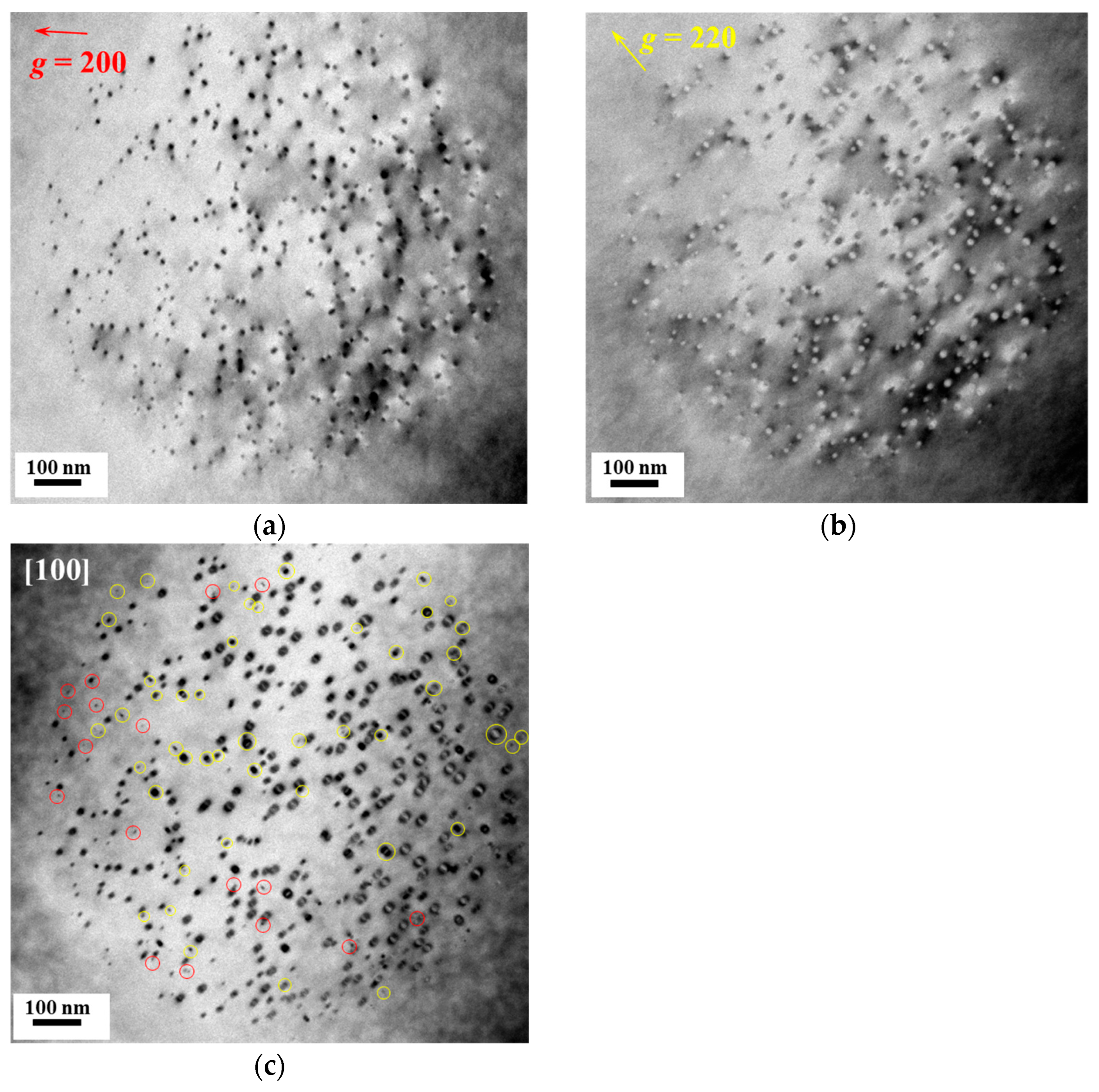

| Irradiation Direction [uvw] | [100] | [310] | [110] | [111] | |||||
|---|---|---|---|---|---|---|---|---|---|
| Two-Beam Conditions Along Crystallographic Direction [u’v’w’] | [100] | [310] | [110] | [110] | |||||
| g | (200) | (220) | (200) | () | (200) | (220) | (200) | (220) | |
| 1/2 [110] | √ | √ | √ | √ | √ | √ | √ | √ | |
| 1/2 [101] | √ | √ | √ | √ | √ | √ | √ | √ | |
| 1/2 [011] | × | √ | × | × | × | √ | × | √ | |
| 0] | √ | × | √ | √ | √ | × | √ | × | |
| 01] | √ | √ | √ | √ | √ | √ | √ | √ | |
| 1] | × | √ | × | √ | × | √ | × | √ | |
| 1/3 [111] | √ | √ | √ | √ | √ | √ | √ | √ | |
| 1] | √ | × | √ | × | √ | × | √ | × | |
| ] | √ | √ | √ | √ | √ | √ | √ | √ | |
| 11] | √ | × | √ | √ | √ | × | √ | × | |
| Irradiation Direction [uvw] | ||||
|---|---|---|---|---|
| [100] | [310] | [110] | [111] | |
| Total dislocation loop density ρ[uvw] (/m3) | 5.1 × 10²¹ | 7.8 × 10²¹ | 1.0 × 10²² | 1.2 × 10²² |
| Average dislocation loops size d[uvw] (nm) | 14.4 | 12.5 | 12.4 | 11.3 |
| Fraction of <111> loops (%) | 33 | 43 | 90 | 78 |
| Fraction of <110> loops (%) | 67 | 57 | 10 | 22 |
| Density of <111> loops ρ<111> (/m3) | 1.7 × 10²¹ | 3.4 × 10²¹ | 9.0 × 10²¹ | 9.4 × 10²¹ |
| Density of <111> loops ρ<110> (/m3) | 3.4 × 10²¹ | 4.5 × 10²¹ | 1.0 × 10²¹ | 2.6 × 10²¹ |
| Average size of <111> loops d<111> (nm) | 22.5 | 17.5 | 13.1 | 11.6 |
| Average size of <110> loops d<110> (nm) | 10.4 | 8.7 | 6.7 | 10.1 |
| Irradiation Direction [uvw] | Dislocation Loop Type <hkl> | C<111> and C<110> (atoms/m3) | (atoms/m3) | (%) |
|---|---|---|---|---|
| [100] | <111> | 9.4 × 1024 | 1.2 × 1025 | 79.0 |
| <110> | 2.5 × 1024 | 21.0 | ||
| [310] | <111> | 1.1 × 1025 | 1.4 × 1025 | 83.4 |
| <110> | 2.3 × 1024 | 16.6 | ||
| [110] | <111> | 1.7 × 1025 | 1.7 × 1025 | 98.3 |
| <110> | 3.0 × 10²³ | 1.7 | ||
| [111] | <111> | 1.4 × 1025 | 1.6 × 1025 | 88.4 |
| <110> | 1.8 × 1024 | 11.6 |
Disclaimer/Publisher’s Note: The statements, opinions and data contained in all publications are solely those of the individual author(s) and contributor(s) and not of MDPI and/or the editor(s). MDPI and/or the editor(s) disclaim responsibility for any injury to people or property resulting from any ideas, methods, instructions or products referred to in the content. |
© 2026 by the authors. Licensee MDPI, Basel, Switzerland. This article is an open access article distributed under the terms and conditions of the Creative Commons Attribution (CC BY) license.
Share and Cite
Yin, Y.; Feng, Q.; Han, W.; Yi, X.; Liu, P.; Yoshida, K.; Inoue, K.; Zhan, Q.; Ohnuki, S.; Wan, F. Effect of Crystal Orientation on Dislocation Loop Evolution Under Electron Radiation in Pure Aluminum. Materials 2026, 19, 350. https://doi.org/10.3390/ma19020350
Yin Y, Feng Q, Han W, Yi X, Liu P, Yoshida K, Inoue K, Zhan Q, Ohnuki S, Wan F. Effect of Crystal Orientation on Dislocation Loop Evolution Under Electron Radiation in Pure Aluminum. Materials. 2026; 19(2):350. https://doi.org/10.3390/ma19020350
Chicago/Turabian StyleYin, Yupeng, Qianfei Feng, Wentuo Han, Xiaoou Yi, Pingping Liu, Kenta Yoshida, Koji Inoue, Qian Zhan, Somei Ohnuki, and Farong Wan. 2026. "Effect of Crystal Orientation on Dislocation Loop Evolution Under Electron Radiation in Pure Aluminum" Materials 19, no. 2: 350. https://doi.org/10.3390/ma19020350
APA StyleYin, Y., Feng, Q., Han, W., Yi, X., Liu, P., Yoshida, K., Inoue, K., Zhan, Q., Ohnuki, S., & Wan, F. (2026). Effect of Crystal Orientation on Dislocation Loop Evolution Under Electron Radiation in Pure Aluminum. Materials, 19(2), 350. https://doi.org/10.3390/ma19020350