Effect of Collar Diameter and Simulated Aging on the Orthogonal Load Resistance of Orthodontic Miniscrews

 ,
,  , , , , and
Abstract
1. Introduction
2. Materials and Methods
3. Results
4. Discussion
5. Conclusions
Author Contributions
Funding
Institutional Review Board Statement
Informed Consent Statement
Data Availability Statement
Acknowledgments
Conflicts of Interest
References
- Shetty, P.; Nayak, U.K.; Hegde, A.M.; Jacob, M. Temporary Anchorage Device: An Epitome of Anchorage in Orthodontic Treatment. Int. J. Clin. Pediatr. Dent. 2011, 4, 143–146. [Google Scholar] [CrossRef]
- Ly, T.K.; Le, L.N.; Do, T.T.; Le, K.P.V. Early Treatment of Skeletal Class III Malocclusion with Facemask Therapy in Vietnam. J. Clin. Pediatr. Dent. 2024, 48, 187–196. [Google Scholar] [CrossRef] [PubMed]
- Li, Y.; Alifu, A.; Peng, Y. Is Maxillary Protraction the Earlier the Better? A Retrospective Study on Early Orthodontic Treatment of Class III Malocclusion with Maxillary Deficiency. J. Clin. Pediatr. Dent. 2024, 48, 133–143. [Google Scholar] [CrossRef] [PubMed]
- Alhasyimi, A.A.; Syahfik, I. Growth Modification of Developing Class II Division 1 Malocclusion Using Myofunctional Appliances. Case Rep. Dent. 2023, 2023, 8201195. [Google Scholar] [CrossRef] [PubMed]
- He, J.; Hu, L.; Yuan, Y.; Wang, P.; Zheng, F.; Jiang, H.; Li, W. Comparison between Clear Aligners and Twin-Block in Treating Class II Malocclusion in Children: A Retrospective Study. J. Clin. Pediatr. Dent. 2024, 48, 125–130. [Google Scholar]
- Le, L.N.; Do, T.T.; Le, K.P.V. Correcting Class III Malocclusion Using Multiloop Edgewise Archwire (MEAW) Combined with Temporary Anchorage Devices (TADs) and Modified Class III Elastics for Camouflage Treatment in an Adolescent: A Case Report. Case Rep. Dent. 2024, 2024, 5546633. [Google Scholar] [CrossRef]
- La Rosa, S.; Leonardi, R.; Ronsivalle, V.; Cicciù, M.; Lo Giudice, A. Radiographic and Diagnostic Approaches for Mandibular Asymmetries in Orthodontic Practice: A Narrative Review. J. Clin. Pediatr. Dent. 2024, 48, 1–15. [Google Scholar] [CrossRef]
- Popov, M.; Marinkovic, N.; Arsic, I.; Janosevic, P.; Nedeljkovic, N. Treatment of Open Bite Based on Skeletal Anchorage Using Extrusion Lever Arms and Class III Elastics. Case Rep. Dent. 2024, 2024, 7768109. [Google Scholar] [CrossRef]
- Sfondrini, M.F.; Gallo, S.; Pascadopoli, M.; Licari, A.; Marseglia, G.L.; Gandini, P.; Turcato, B.; Nardi, M.G.; Scribante, A. The Knowledge of Orthodontic and Craniofacial Growth amongst Italian Pediatric Medical Residents for Early Diagnosis in Growing Patients: A Cross-Sectional Study. J. Clin. Pediatr. Dent. 2023, 47, 64–73. [Google Scholar] [CrossRef]
- Bishara, S.E.; Staley, R.N. Maxillary Expansion: Clinical Implications. Am. J. Orthod. Dentofac. Orthop. 1987, 91, 3–14. [Google Scholar] [CrossRef]
- Jia, H.; Zhuang, L.; Zhang, N.; Bian, Y.; Li, S. Age-Dependent Effects of Transverse Maxillary Deficiency Treated by Microimplant-Assisted Rapid Palatal Expansion: A Prospective Cone-Beam Computed Tomography Study. Am. J. Orthod. Dentofac. Orthop. 2022, 161, 557–573. [Google Scholar] [CrossRef] [PubMed]
- Bell, R.A. A Review of Maxillary Expansion in Relation to Rate of Expansion and Patient’s Age. Am. J. Orthod. 1982, 81, 32–37. [Google Scholar] [CrossRef] [PubMed]
- Baccetti, T.; Franchi, L.; Cameron, C.G.; McNamara, J.A. Treatment Timing for Rapid Maxillary Expansion. Angle Orthod. 2001, 71, 343–350. [Google Scholar] [PubMed]
- Kapetanović, A.; Theodorou, C.I.; Bergé, S.J.; Schols, J.G.J.H.; Xi, T. Efficacy of Miniscrew-Assisted Rapid Palatal Expansion (MARPE) in Late Adolescents and Adults: A Systematic Review and Meta-Analysis. Eur. J. Orthod. 2021, 43, 313–323. [Google Scholar] [CrossRef]
- Lee, K.J.; Park, Y.C.; Park, J.Y.; Hwang, W.S. Miniscrew-Assisted Nonsurgical Palatal Expansion before Orthognathic Surgery for a Patient with Severe Mandibular Prognathism. Am. J. Orthod. Dentofac. Orthop. 2010, 137, 830–839. [Google Scholar] [CrossRef]
- Moon, W. An Interview with Won Moon. Dent. Press J. Orthod. 2013, 18, 12–28. [Google Scholar] [CrossRef]
- Akyalcin, S.; Alev, Y. Clinical Advances in Maxillary Skeletal Expansion and Introduction of a New MARPE Concept. J. Esthet. Restor. Dent. 2023, 35, 291–298. [Google Scholar] [CrossRef]
- Andraws Yalda, F.; Chawshli, O.F.; Al-Talabani, S.Z.; Ali, S.H.; Shihab, O.I. Evaluation of Palatal Thickness for the Placement of MARPE Device among a Cohort of Iraqi-Kurdish Population: A Retrospective CBCT Study. Int. J. Dent. 2024, 2024, 6741187. [Google Scholar] [CrossRef]
- Anéris, F.F.; El Haje, O.; Rosário, H.D.; de Menezes, C.C.; Franzini, C.M.; Custodio, W. The Effects of Miniscrew-Assisted Rapid Palatal Expansion on the Upper Airway of Adults with Midpalatal Suture in the Last Two Degrees of Ossification. J. World Fed. Orthod. 2023, 12, 150–155. [Google Scholar] [CrossRef]
- Hanai, U.; Muramatsu, H.; Akamatsu, T. Maxillary Bone Fracture Due to a Miniscrew-Assisted Rapid Maxillary Expansion: A Case Report. J. Clin. Med. 2025, 14, 1928. [Google Scholar] [CrossRef]
- Jones, J.P.; Elnagar, M.H.; Perez, D.E. Temporary Skeletal Anchorage Techniques. Oral Maxillofac. Surg. Clin. N. Am. 2020, 32, 27–37. [Google Scholar] [CrossRef] [PubMed]
- Cope, J.B. Temporary Anchorage Devices in Orthodontics: A Paradigm Shift. Semin. Orthod. 2005, 11, 3–9. [Google Scholar] [CrossRef]
- Hou, Z.; Qu, X.; Hou, L.; Ren, F. Comparison between Effects of Mini-Implant Anchorage and Face-Bow Anchorage in Orthodontics for Children. J. Clin. Pediatr. Dent. 2024, 48, 198–203. [Google Scholar] [PubMed]
- Lee, Y.; Choi, S.H.; Yu, H.S.; Erenebat, T.; Liu, J.; Cha, J.Y. Stability and Success Rate of Dual-Thread Miniscrews: A Retrospective Study Using the Buccal Alveolar Region as the Insertion Site. Angle Orthod. 2021, 91, 509–514. [Google Scholar] [CrossRef]
- Rismanchian, M.; Raji, S.H.; Rik, D.T.; Razavi, S.M.; Khalighinejad, N.; Goroohi, H.; Badrian, H. Effects of Immediate Orthodontic and Orthopedic Forces on Peri-Miniscrew Bones: Histomorphologic and Histomorphometric Assessment in Dogs. Int. J. Dent. 2012, 2012, 851740. [Google Scholar] [CrossRef]
- Melsen, B.; Dalstra, M. Tissue Reaction to Loading of Mini Implants. In Temporary Anchorage Devices in Orthodontics; Cope, J.B., Ed.; Under Dog Media: Santa Barbara, CA, USA, 2005; pp. C47-1–C47-21. [Google Scholar]
- Pinho, T.; Rocha, D.; Gonçalves, S.; Martins, M.L. Clear Aligners and Miniscrews in a Scissor Bite Adult Treatment. Case Rep. Dent. 2024, 2024, 8841829. [Google Scholar] [CrossRef]
- Liang, W. The Use of the Surgical Guide for Placing Miniscrew in Treatment of Class II Subdivision: A Case Report with 2-Year Follow-Up. Case Rep. Dent. 2025, 2025, 3082753. [Google Scholar] [CrossRef]
- Bayani, S.; Masoomi, F.; Aghaabbasi, S.; Farsinejad, A. Evaluation of the Effect of Platelet-Released Growth Factor and Immediate Orthodontic Loading on the Removal Torque of Miniscrews. Int. J. Oral Maxillofac. Implant. 2016, 31, 471–477. [Google Scholar] [CrossRef]
- Reicheneder, C.; Rottner, K.; Bokan, I.; Mai, R.; Lauer, G.; Richter, G.; Gedrange, T.; Proff, P. Mechanical Loading of Orthodontic Miniscrews—Significance and Problems: An Experimental Study. Biomed. Tech. 2008, 53, 242–245. [Google Scholar] [CrossRef]
- Mohammed, H.; Wafaie, K.; Rizk, M.Z.; Almuzian, M.; Sosly, R.; Bearn, D.R. Role of Anatomical Sites and Correlated Risk Factors on the Survival of Orthodontic Miniscrew Implants: A Systematic Review and Meta-Analysis. Prog. Orthod. 2018, 19, 36. [Google Scholar] [CrossRef]
- Montasser, M.A.; Scribante, A. Root Injury during Interradicular Insertion Is the Most Common Complication Associated with Orthodontic Miniscrews. J. Evid. Based Dent. Pract. 2022, 22, 101688. [Google Scholar] [CrossRef]
- Szmukler-Moncler, S.; Salama, H.; Reingewirtz, Y.; Dubruille, J.H. Timing of Loading and Effect of Micromotion on Bone–Dental Implant Interface: Review of Experimental Literature. J. Biomed. Mater. Res. 1998, 43, 192–203. [Google Scholar] [CrossRef]
- Suzuki, E.Y.; Suzuki, B. Placement and Removal Torque Values of Orthodontic Miniscrew Implants. Am. J. Orthod. Dentofac. Orthop. 2011, 139, 669–678. [Google Scholar] [CrossRef] [PubMed]
- Kuroda, S.; Tanaka, E. Risks and Complications of Miniscrew Anchorage in Clinical Orthodontics. Jpn. Dent. Sci. Rev. 2014, 50, 79–85. [Google Scholar] [CrossRef]
- Smith, A.; Hosein, Y.K.; Dunning, C.E.; Tassi, A. Fracture Resistance of Commonly Used Self-Drilling Orthodontic Mini-Implants. Angle Orthod. 2015, 85, 26–32. [Google Scholar] [CrossRef]
- Sfondrini, M.F.; Gandini, P.; Alcozer, R.; Vallittu, P.K.; Scribante, A. Failure Load and Stress Analysis of Orthodontic Miniscrews with Different Transmucosal Collar Diameter. J. Mech. Behav. Biomed. Mater. 2018, 87, 132–137. [Google Scholar] [CrossRef]
- Scribante, A.; Montasser, M.A.; Radwan, E.S.; Bernardinelli, L.; Alcozer, R.; Gandini, P.; Sfondrini, M.F. Reliability of Orthodontic Miniscrews: Bending and Maximum Load of Different Ti-6Al-4V Titanium and Stainless-Steel Temporary Anchorage Devices (TADs). Materials 2018, 11, 1138. [Google Scholar] [CrossRef]
- Baik, H.; Kang, Y.; Choi, Y. Miniscrew-Assisted Rapid Palatal Expansion: A Review of Recent Reports. J. World Fed. Orthod. 2020, 9, S54–S58. [Google Scholar] [CrossRef]
- Manni, A.; Migliorati, M.; Calzolari, C.; Silvestrini-Biavati, A. Herbst Appliance Anchored to Miniscrews in the Upper and Lower Arches vs. Standard Herbst: A Pilot Study. Am. J. Orthod. Dentofac. Orthop. 2019, 156, 617–625. [Google Scholar] [CrossRef]
- ISO/TR 11405; Dentistry—Testing of Adhesion to Tooth Structure. International Standards Organization: Geneva, Switzerland, 2015; pp. 1–14.
- Helvatjoglu-Antoniades, M.; Koliniotou-Kubia, E.; Dionyssopoulos, P. The Effect of Thermal Cycling on the Bovine Dentine Shear Bond Strength of Current Adhesive Systems. J. Oral Rehabil. 2004, 31, 911–917. [Google Scholar] [CrossRef]
- Gale, M.S.; Darvell, B.W. Thermal Cycling Procedures for Laboratory Testing of Dental Restorations. J. Dent. 1999, 27, 89–99. [Google Scholar] [CrossRef] [PubMed]
- European Medicines Agency. Guideline on the Sterilization of the Medical Product, Active Substance, Excipient and Primary Container; European Medicines Agency (EMA): Amsterdam, The Netherlands, 2019. [Google Scholar]
- Tredici, I.G.; Sebastiani, M.; Massimi, F.; Bemporad, E.; Resmini, A.; Merlati, G.; Anselmi-Tamburini, U. Low Temperature Degradation Resistant Nanostructured Yttria-Stabilized Zirconia for Dental Applications. Ceram. Int. 2016, 42, 8190–8197. [Google Scholar] [CrossRef]
- Noorollahian, S.; Alavi, S.; Monirifard, M. A Processing Method for Orthodontic Mini-Screw Reuse. Dent. Res. J. 2012, 9, 447–451. [Google Scholar]
- Noorollahian, S.; Alavi, S.; Rafiei, E. The Effect of Multiple Processing and Reuse Orthodontic Mini-Screw Torque Values. Dent. Res. J. 2015, 12, 243–247. [Google Scholar]
- Hergel, C.A.; Acar, Y.B.; Ates, M.; Kucukkeles, N. In Vitro Evaluation of the Effect of Insertion and Sterilization Procedures on the Mechanical and Surface Characteristics of Miniscrew. Eur. Oral Res. 2019, 53, 25–31. [Google Scholar] [CrossRef]
- Karch, M.; Alt, E.; Schmitt, C.; Schöming, A. Reimplantation of an Infected, Abdominally Implanted Defibrillator in the Subpectoral Region. J. Cardiovasc. Surg. 1996, 37, 67–70. [Google Scholar]
- Yadav, A.; Jayaprakash, P.K.; Singh, R.; Dawer, M.; Modi, P.; Sehdev, B.; Ganji, K.K. Impact of Recycling on the Mechanical Properties of Nickel-Titanium Alloy Wires and the Efficacy of Their Reuse after Cold Sterilization. J. Orthod. Sci. 2020, 9, 10. [Google Scholar] [CrossRef]
- Oshagh, M.; Hematiyan, M.R.; Mohandes, Y.; Oshagh, M.R.; Pishbin, L. Autoclaving and Clinical Recycling: Effects on Mechanical Properties of Orthodontic Wires. Indian J. Dent. Res. 2012, 23, 638–642. [Google Scholar] [CrossRef]
- Ishida, K.; Endo, T.; Shinkai, K.; Katoh, Y. Shear Bond Strength of Rebonded Brackets after Removal of Adhesives with Er,Cr:YSGG Laser. Odontology 2011, 99, 129–134. [Google Scholar] [CrossRef]
- Aarash, V.; Abdollahi, F.; Ghorbanipour, R.; Mehdi, M. Effect of Insertion Angles and Reusing Procedure on Mini Screws’ Mechanical Properties. J. Res. Med. Dent. Sci. 2017, 5, 638. [Google Scholar]
- Sousa-Santos, C.; Sousa-Santos, S.; Mendes, J.; Coelho, C.; Aroso, C.; Sousa-Santos, P.; Mendes, J.M. The Influence of the Diameter of Orthodontic Mini-Implants on Primary Stability: Bending Tests—An In Vitro Study. Materials 2024, 17, 3149. [Google Scholar] [CrossRef]
- Mattos, C.T.; Ruellas, A.C.; Sant’Anna, E.F. Effect of Autoclaving on the Fracture Torque of Mini Implants Used for Orthodontic Anchorage. J. Orthod. 2011, 38, 15–20. [Google Scholar] [CrossRef]
- Alavi, S.; Asadi, F.; Raji, S.A.H.; Samie, S. Effect of Steam and Dry Heat Sterilization on the Insertion and Fracture Torque of Orthodontic Miniscrews. Dent. Res. J. 2020, 17, 219–224. [Google Scholar] [CrossRef]
- Alharbi, F.; Almuzian, M.; Bearn, D. Miniscrews Failure Rate in Orthodontics: Systematic Review and Meta-Analysis. Eur. J. Orthod. 2018, 40, 519–530. [Google Scholar] [CrossRef]
- Jahanbin, A.; Ziya, F.; Bardideh, E.; Hafez, S.; Abtahi, M. In vitro physical properties and clinical stability of reused orthodontic miniscrews: A systematic review and meta-analysis. J. World Fed. Orthod. 2025, 14, 97–110. [Google Scholar] [CrossRef]
- Baser, B.; Ozel, M.B. Comparison of primary stability of used and unused self-tapping and self-drilling orthodontic mini-implants. Adv. Clin. Exp. Med. 2024, 33, 483–489. [Google Scholar] [CrossRef]




| Group | Name | Manufacturer | Location | Diameter | Length | Composition |
|---|---|---|---|---|---|---|
| 1 | Medicon Aarheus Screw | Medicon EG | Tuttlingen, Germany | 1.3 mm | 12.3 mm | Titanium Grade 5 (Ti-6Al-4V) |
| 2 | HDC Spider Screw | HDC Srl | Thiene, Italy | 1.5 mm | 10.0 mm | Titanium Grade 5 (Ti-6Al-4V) |
| 3 | Medicon Aarheus Screw | Medicon EG | Tuttlingen, Germany | 1.6 mm | 10.2 mm | Titanium Grade 5 (Ti-6Al-4V) |
| 4 | Ortho Easy Forestadent | Forestadent | Pioltello, Italy | 1.7 mm | 10.0 mm | Titanium Grade 5 (Ti-6Al-4V) |
| 5 | 3M OrthoImplant | 3M Italia Spa | Pforzheim, Germany | 1.8 mm | 10.0 mm | Titanium Grade 5 (Ti-6Al-4V) |
| 6 | HDC Spider Screw | HDC Srl | Thiene, Italy | 1.9 mm | 10.0 mm | Titanium Grade 5 (Ti-6Al-4V) |
| 7 | Kristal Storm | Kristal Srl | Trezzano sul Naviglio, Italy | 2.0 mm | 10.0 mm | Titanium Grade 5 (Ti-6Al-4V) |
| Group | Miniscrew Name and Diameter | Subgroup | Thermocycling 1 | Autoclaving 2 | Thermocycling 1 | Autoclaving 2 | Instron Test 3 |
|---|---|---|---|---|---|---|---|
| Control | X | ||||||
| 1 | Medicon Aarheus Screw (1.3 mm) | 3 months ageing | X | X | X | ||
| 6 months ageing | X | X | X | X | X | ||
| Control | X | ||||||
| 2 | HDC Spider Screw (1.5 mm) | 3 months ageing | X | X | X | ||
| 6 months ageing | X | X | X | X | X | ||
| Control | X | ||||||
| 3 | Medicon Aarheus Screw (1.6 mm) | 3 months ageing | X | X | X | ||
| 6 months ageing | X | X | X | X | X | ||
| Control | X | ||||||
| 4 | Ortho Easy Forestadent (1.7 mm) | 3 months ageing | X | X | X | ||
| 6 months ageing | X | X | X | X | X | ||
| Control | X | ||||||
| 5 | 3M OrthoImplant (1.8 mm) | 3 months ageing | X | X | X | ||
| 6 months ageing | X | X | X | X | X | ||
| Control | X | ||||||
| 6 | HDC Spider Screw (1.9 mm) | 3 months ageing | X | X | X | ||
| 6 months ageing | X | X | X | X | X | ||
| Control | X | ||||||
| 7 | Kristal Storm (2.0 mm) | 3 months ageing | X | X | X | ||
| 6 months ageing | X | X | X | X | X |
| Diameter | Type | Mean | SD | Min | Mdn | Max | Intragroup Significance 1 | Intergroup Significance 1 |
|---|---|---|---|---|---|---|---|---|
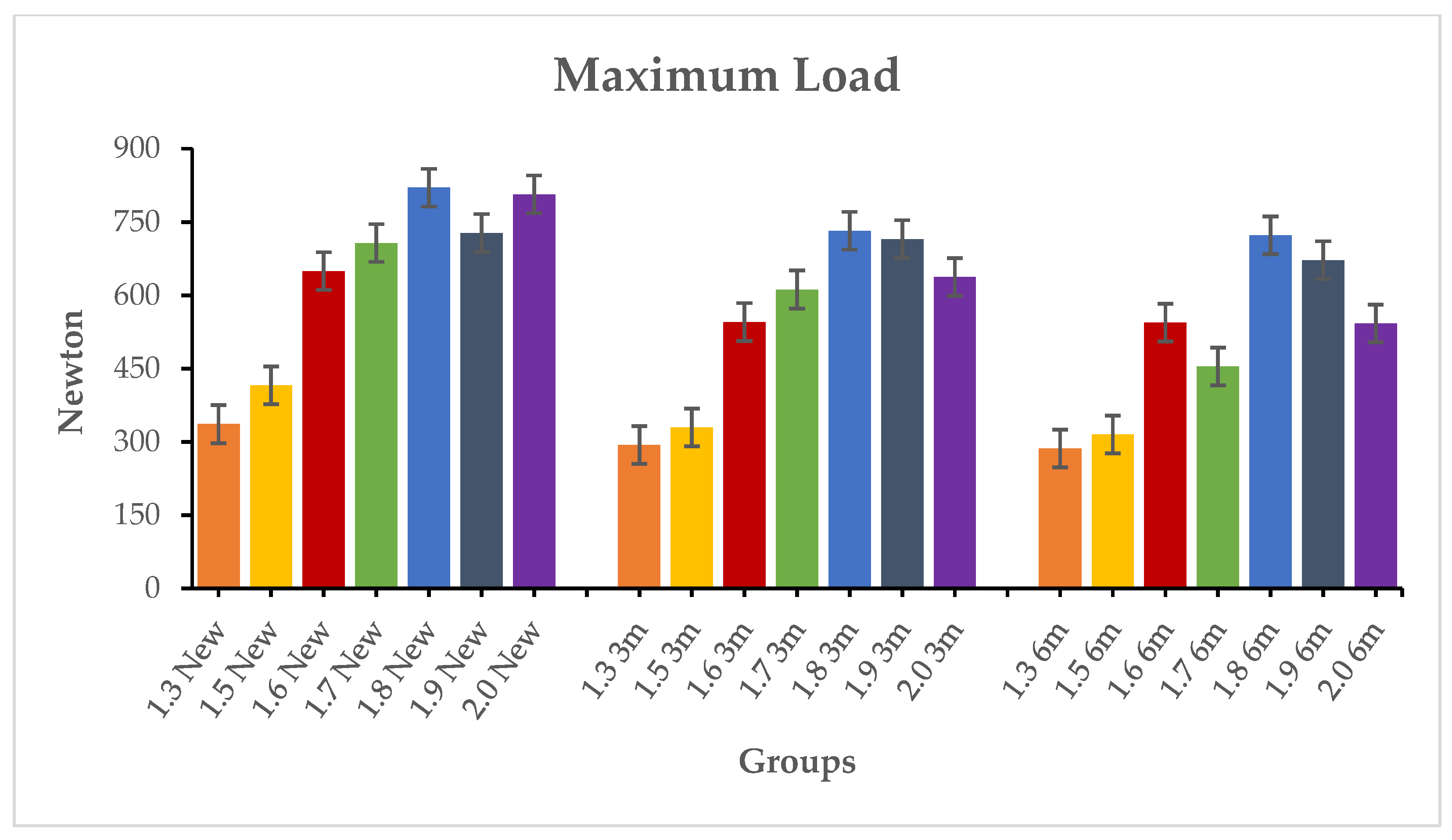
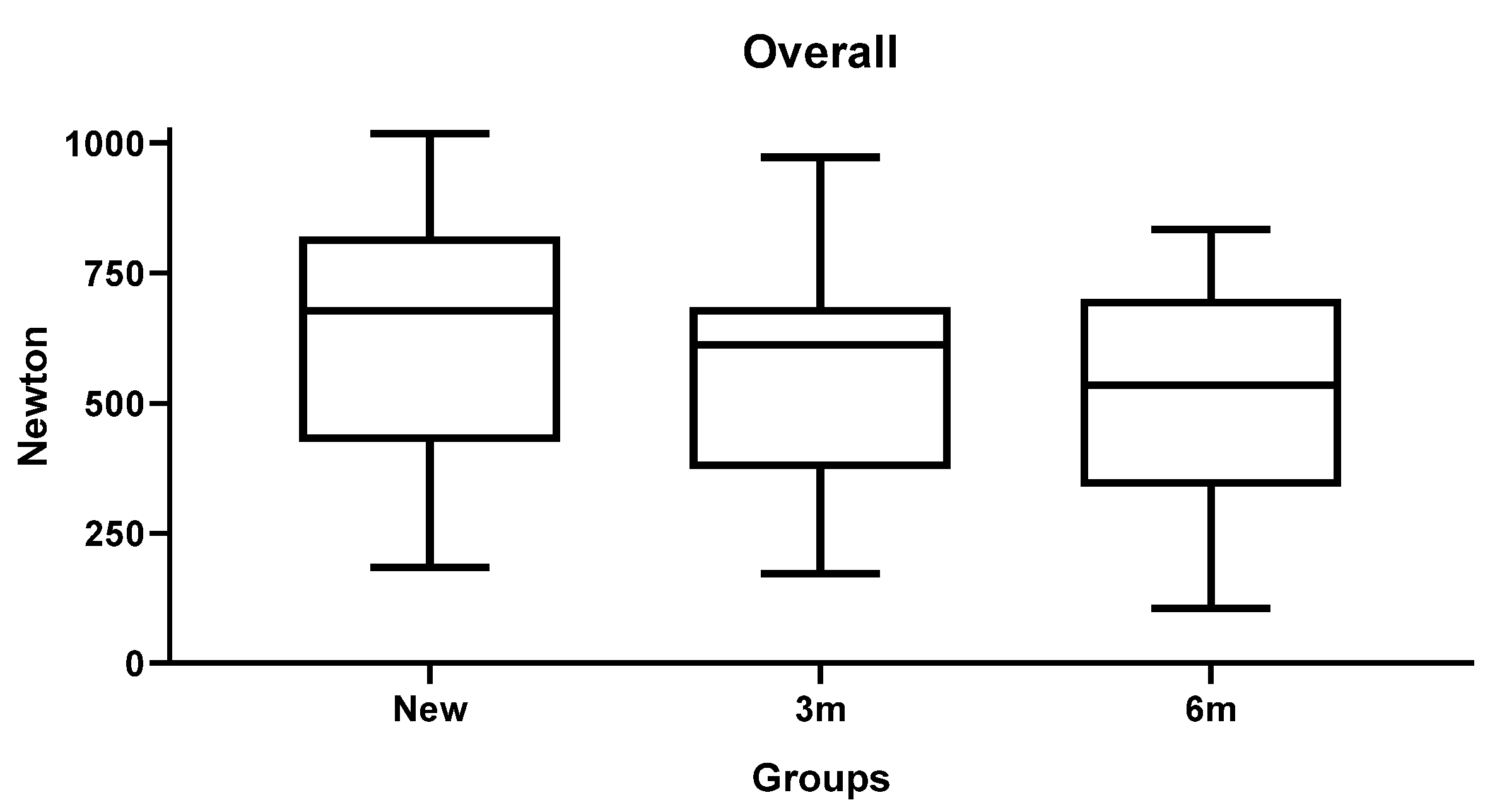
| 1.3 | 336.36 | 123.18 | 184.56 | 318.97 | 525.62 | A | A | |
| 1.5 | 415.56 | 22.93 | 393.61 | 406.09 | 452.47 | A, B | A | |
| 1.6 | 649.35 | 48.80 | 570.41 | 650.89 | 699.23 | B, C, D | A | |
| 1.7 | new | 706.86 | 184.84 | 425.39 | 822.42 | 849.79 | B, C, D | A |
| 1.8 | 820.29 | 78.66 | 695.57 | 868.92 | 876.08 | D | A | |
| 1.9 | 727.42 | 168.72 | 584.07 | 684.95 | 1018.45 | D | A | |
| 2.0 | 806.81 | 25.95 | 765.23 | 815.18 | 832.91 | D | A | |
| 1.3 | 293.65 | 77.19 | 186.12 | 314.71 | 373.22 | A | A | |
| 1.5 | 329.61 | 156.53 | 171.62 | 268.51 | 572.70 | A, B | A | |
| 1.6 | 545.46 | 203.40 | 373.20 | 456.99 | 840.02 | A, B, C | A | |
| 1.7 | 3 months | 611.96 | 64.66 | 508.26 | 619.60 | 685.62 | B, C | A |
| 1.8 | 731.98 | 137.62 | 624.47 | 684.74 | 973.01 | C | A | |
| 1.9 | 715.19 | 180.13 | 466.15 | 721.19 | 934.45 | C | A | |
| 2.0 | 637.26 | 46.74 | 588.95 | 633.63 | 703.71 | C | A | |
| 1.3 | 286.83 | 147.15 | 105.57 | 295.17 | 442.49 | A | A | |
| 1.5 | 315.50 | 156.21 | 183.54 | 292.90 | 572.33 | A, B | A | |
| 1.6 | 544.13 | 126.21 | 340.06 | 580.94 | 682.72 | A, B, C | A | |
| 1.7 | 6 months | 454.61 | 219.68 | 289.50 | 360.08 | 833.64 | A, B, C | A |
| 1.8 | 722.68 | 21.29 | 700.67 | 725.08 | 745.77 | C | A | |
| 1.9 | 671.98 | 122.46 | 500.43 | 704.24 | 791.27 | C | A | |
| 2.0 | 542.24 | 15.46 | 524.79 | 539.80 | 559.10 | A | A |
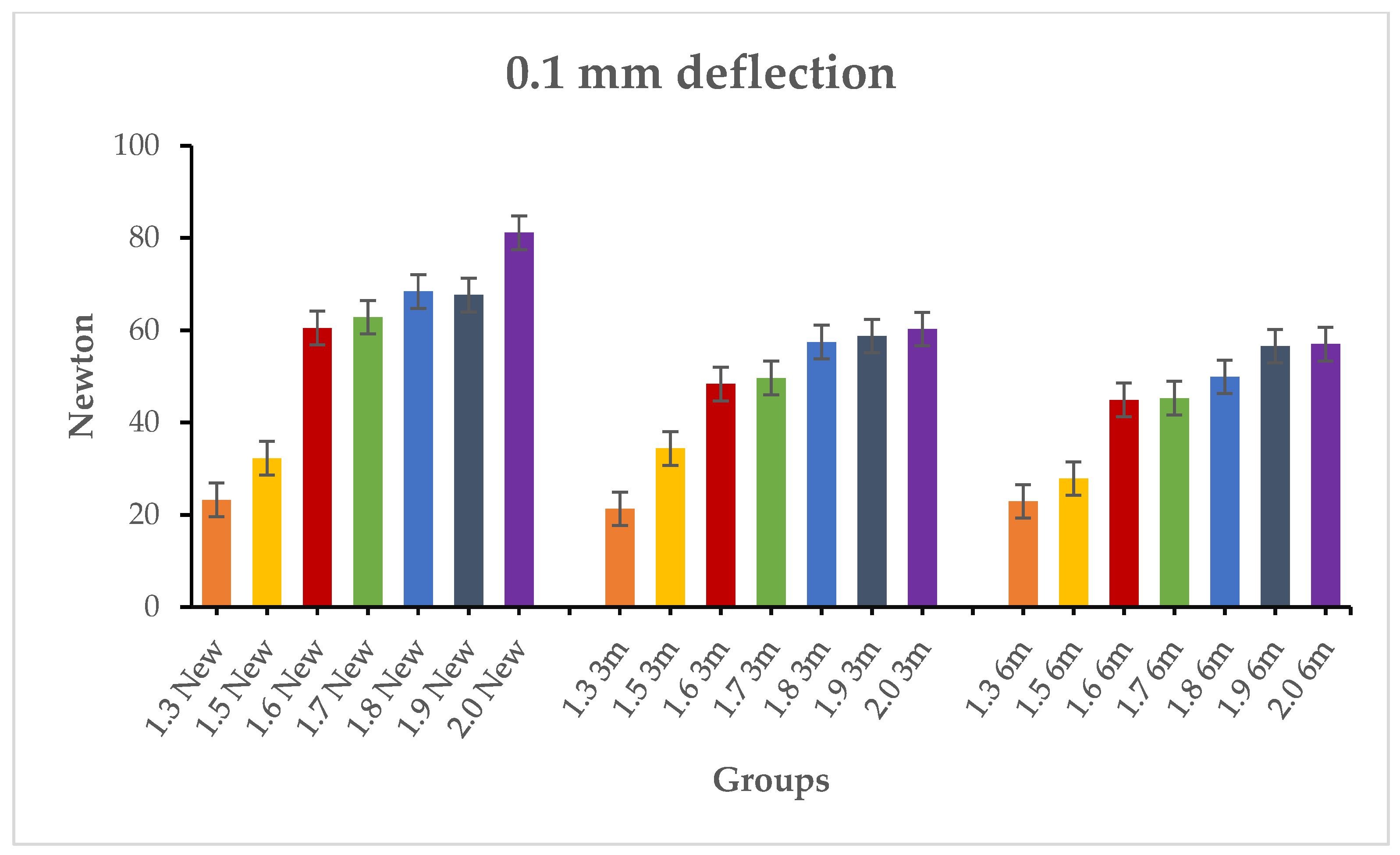
| Diameter | Type | Mean | SD | Min | Mdn | Max | Intragroup Significance 1 | Intergroup Significance 1 |
|---|---|---|---|---|---|---|---|---|
| 1.3 | 23.23 | 16.09 | 10.00 | 18.40 | 50.92 | A | A | |
| 1.5 | 32.26 | 4.38 | 28.76 | 30.79 | 39.77 | A, B | A | |
| 1.6 | 60.50 | 5.30 | 51.85 | 61.72 | 64.89 | B, C | A | |
| 1.7 | new | 62.82 | 24.80 | 24.65 | 76.23 | 84.07 | B, C | A |
| 1.8 | 68.41 | 6.48 | 57.39 | 70.08 | 74.63 | C | A | |
| 1.9 | 67.64 | 21.82 | 51.04 | 61.00 | 105.45 | C | A | |
| 2.0 | 81.15 | 1.88 | 78.39 | 81.72 | 83.17 | C | A | |
| 1.3 | 21.28 | 9.40 | 10.39 | 18.73 | 32.04 | A | A | |
| 1.5 | 34.38 | 17.15 | 17.36 | 27.65 | 58.85 | A, B | A | |
| 1.6 | 48.37 | 6.60 | 37.60 | 50.04 | 55.53 | A, B | A | |
| 1.7 | 3 months | 49.66 | 13.08 | 38.60 | 41.94 | 67.47 | A, B | A |
| 1.8 | 57.44 | 17.29 | 28.79 | 59.65 | 71.15 | B | A | |
| 1.9 | 58.74 | 17.27 | 34.37 | 61.70 | 79.70 | B | A | |
| 2.0 | 60.28 | 5.74 | 54.57 | 59.16 | 69.50 | B | A | |
| 1.3 | 22.90 | 6.97 | 14.67 | 25.11 | 29.81 | A | A | |
| 1.5 | 27.85 | 6.15 | 21.32 | 28.51 | 35.81 | A, B | A | |
| 1.6 | 44.91 | 19.30 | 16.26 | 49.37 | 62.66 | A, B | A | |
| 1.7 | 6 months | 45.28 | 14.95 | 27.28 | 47.96 | 61.46 | A, B | A |
| 1.8 | 49.91 | 12.77 | 32.16 | 47.65 | 64.50 | A, B | A | |
| 1.9 | 56.54 | 7.73 | 48.98 | 56.54 | 68.71 | B | A | |
| 2.0 | 57.00 | 8.90 | 46.10 | 54.74 | 68.28 | B | A |
| Diameter | Type | Mean | SD | Min | Mdn | Max | Intragroup Significance 1 | Intergroup Significance 1 |
|---|---|---|---|---|---|---|---|---|
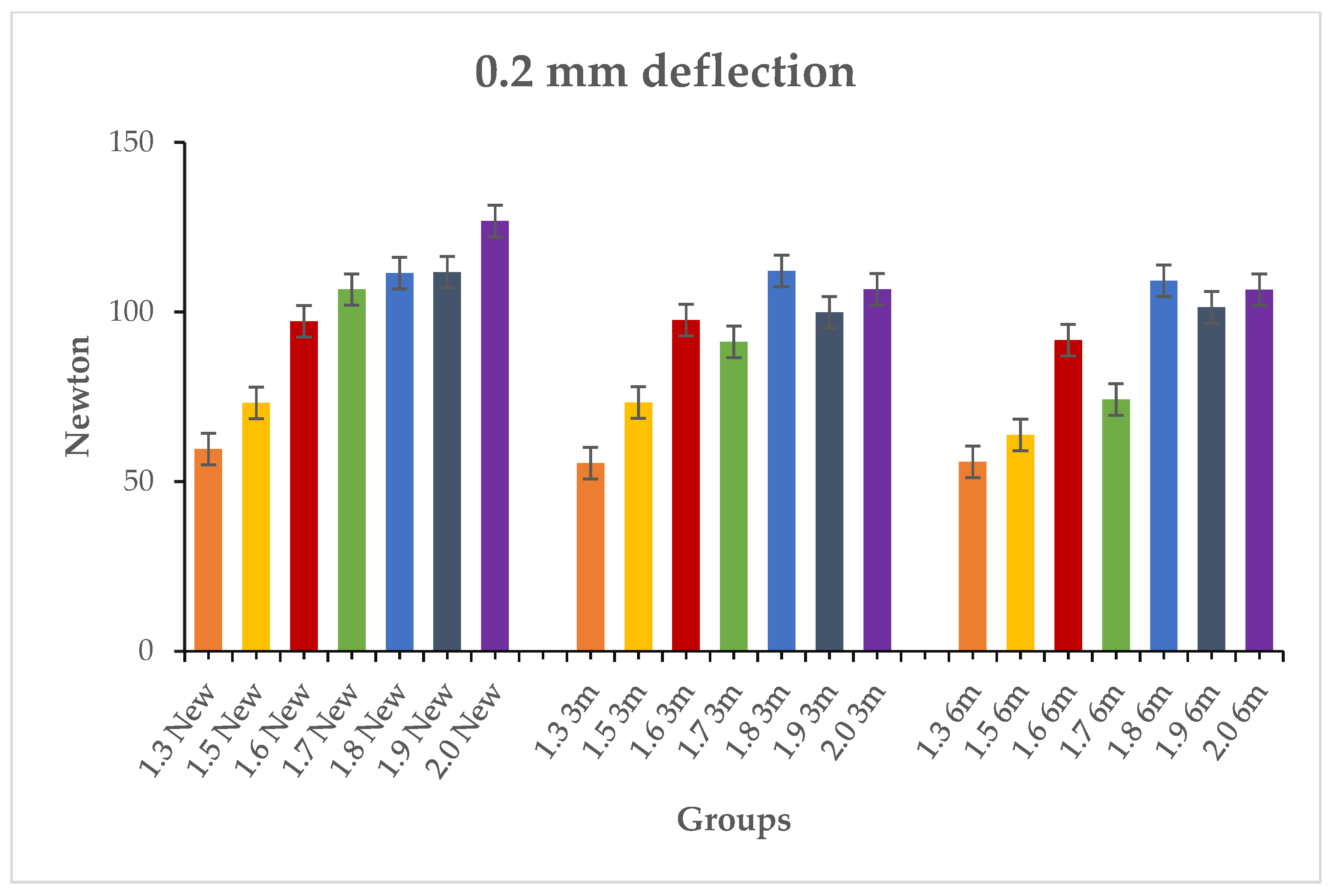
| 1.3 | 59.53 | 23.17 | 31.38 | 57.03 | 95.63 | A | A | |
| 1.5 | 73.17 | 5.39 | 68.68 | 71.42 | 82.43 | A, B | A | |
| 1.6 | 97.22 | 5.59 | 88.12 | 98.64 | 101.74 | B, C | A | |
| 1.7 | new | 106.61 | 28.66 | 62.45 | 121.73 | 131.50 | B, C | A |
| 1.8 | 111.41 | 7.09 | 99.49 | 112.99 | 118.37 | C | A | |
| 1.9 | 111.74 | 25.07 | 93.02 | 103.92 | 155.19 | C | A | |
| 2.0 | 126.79 | 2.02 | 124.09 | 127.68 | 128.88 | C | A | |
| 1.3 | 55.39 | 13.25 | 40.11 | 56.52 | 74.32 | A | A | |
| 1.5 | 73.32 | 28.32 | 38.98 | 65.91 | 112.98 | A, B | A | |
| 1.6 | 97.56 | 6.26 | 90.29 | 96.93 | 106.50 | B, C | A | |
| 1.7 | 3 months | 91.18 | 11.11 | 80.27 | 92.68 | 107.97 | B, C | A |
| 1.8 | 112.10 | 16.31 | 96.19 | 107.24 | 131.66 | C | A | |
| 1.9 | 99.86 | 12.65 | 80.38 | 99.03 | 112.26 | C | A | |
| 2.0 | 106.62 | 7.66 | 97.59 | 105.42 | 117.85 | C | A | |
| 1.3 | 55.82 | 12.11 | 45.52 | 49.35 | 73.88 | A | A | |
| 1.5 | 63.77 | 10.01 | 52.91 | 64.84 | 75.15 | A, B | A | |
| 1.6 | 91.65 | 23.42 | 53.30 | 99.60 | 111.67 | A, B, C | A | |
| 1.7 | 6 months | 74.15 | 12.01 | 59.08 | 79.97 | 84.37 | A, B, C | A |
| 1.8 | 109.18 | 13.20 | 92.51 | 109.07 | 122.32 | C | A | |
| 1.9 | 101.38 | 8.91 | 88.93 | 100.10 | 110.66 | C | A | |
| 2.0 | 106.52 | 11.09 | 97.80 | 99.68 | 121.29 | C | A |
| Dependent Variable | Independent Variable | Significance |
|---|---|---|
| Maximum load | Diameter | p < 0.0001 * |
| Thermocycling | p = 0.007 * | |
| 0.1 mm deflection load | Diameter | p < 0.001 * |
| Thermocycling | p = 0.006 * | |
| 0.2 mm deflection load | Diameter | p < 0.001 * |
| Thermocycling | p < 0.045 * |
Disclaimer/Publisher’s Note: The statements, opinions and data contained in all publications are solely those of the individual author(s) and contributor(s) and not of MDPI and/or the editor(s). MDPI and/or the editor(s) disclaim responsibility for any injury to people or property resulting from any ideas, methods, instructions or products referred to in the content. |
© 2026 by the authors. Licensee MDPI, Basel, Switzerland. This article is an open access article distributed under the terms and conditions of the Creative Commons Attribution (CC BY) license.
Share and Cite
Sfondrini, M.F.; Merlati, G.; Pascadopoli, M.; Valceschini, L.; Ricchio, S.; Torchia, M.M.; Del Corso, L.; Scribante, A. Effect of Collar Diameter and Simulated Aging on the Orthogonal Load Resistance of Orthodontic Miniscrews. Materials 2026, 19, 262. https://doi.org/10.3390/ma19020262
Sfondrini MF, Merlati G, Pascadopoli M, Valceschini L, Ricchio S, Torchia MM, Del Corso L, Scribante A. Effect of Collar Diameter and Simulated Aging on the Orthogonal Load Resistance of Orthodontic Miniscrews. Materials. 2026; 19(2):262. https://doi.org/10.3390/ma19020262
Chicago/Turabian StyleSfondrini, Maria Francesca, Giuseppe Merlati, Maurizio Pascadopoli, Letizia Valceschini, Simone Ricchio, Mattia Maria Torchia, Leonardo Del Corso, and Andrea Scribante. 2026. "Effect of Collar Diameter and Simulated Aging on the Orthogonal Load Resistance of Orthodontic Miniscrews" Materials 19, no. 2: 262. https://doi.org/10.3390/ma19020262
APA StyleSfondrini, M. F., Merlati, G., Pascadopoli, M., Valceschini, L., Ricchio, S., Torchia, M. M., Del Corso, L., & Scribante, A. (2026). Effect of Collar Diameter and Simulated Aging on the Orthogonal Load Resistance of Orthodontic Miniscrews. Materials, 19(2), 262. https://doi.org/10.3390/ma19020262