Article

Prediction of Radiation-Shielding Performance of Boron-Doped Glasses Using Artificial Neural Networks and Statistical Analysis


1
Physics Department, Science and Art Faculty, Afyon Kocatepe University, Afyonkarahisar 03200, Turkey
2
Department of Industrial Engineering, Faculty of Engineering, Sakarya University, Sakarya 54187, Turkey
3
Bucak Emin Gülmez Vocational School of Technical Sciences, Burdur Mehmet Akif Ersoy University, Burdur 15300, Turkey
4
Department of Biotechnology, Faculty of Science, Necmettin Erbakan University, Konya 42090, Turkey
5
Application and Research Center for Medicinal and Cosmetic Plants, Necmettin Erbakan University, Konya 42090, Turkey
*
Author to whom correspondence should be addressed.
Materials 2026, 19(18), 3988; https://doi.org/10.3390/ma19183988 (registering DOI)
Submission received: 29 June 2026 / Revised: 23 August 2026 / Accepted: 26 August 2026 / Published: 19 September 2026
(This article belongs to the Section Electronic Materials)

Abstract

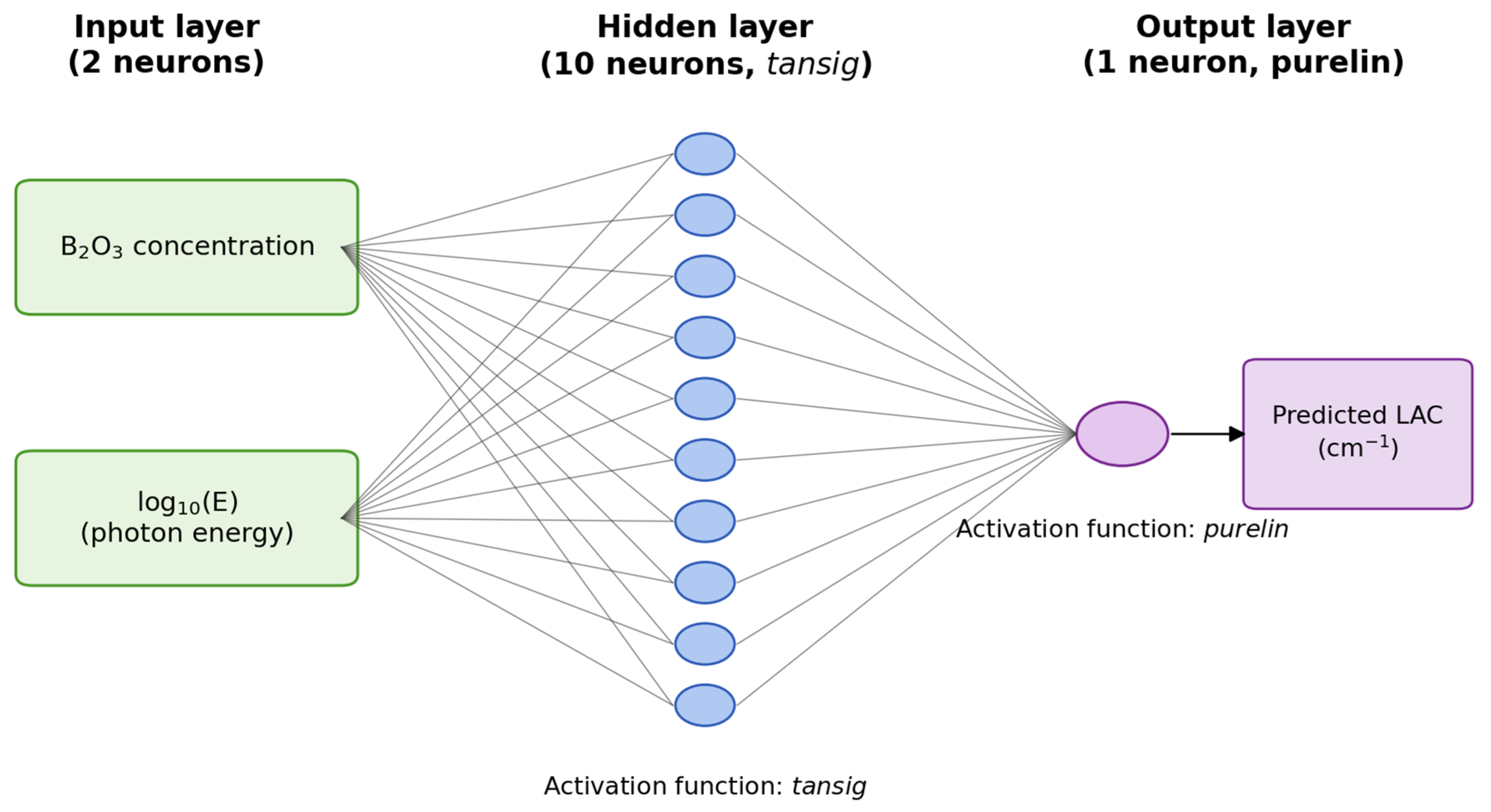
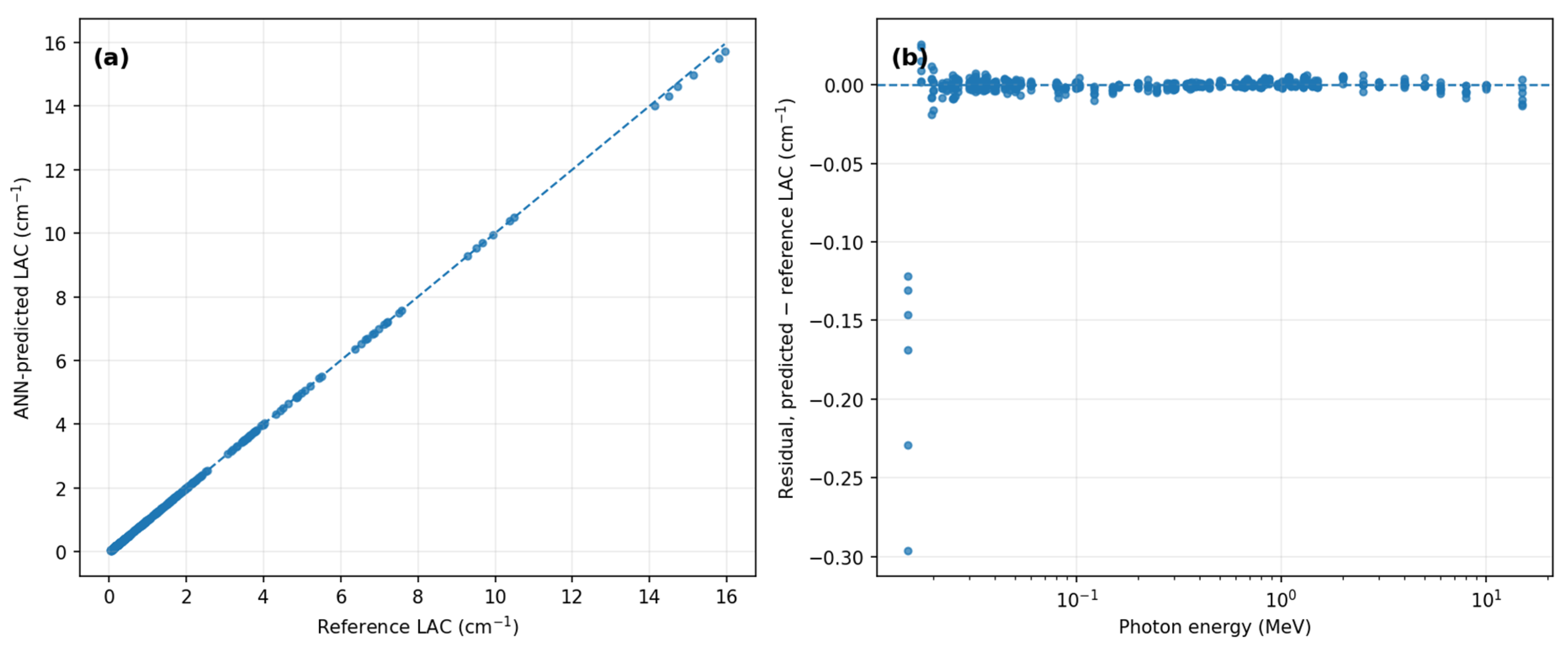
Radiation-shielding materials are critically important for protecting human health in nuclear energy, medical imaging, and radiotherapy applications. Due to the toxicity and environmental disadvantages of traditional lead-based materials, boron-doped glasses represent a promising alternative because of their radiation-shielding characteristics, optical transparency, and relatively low toxicity. This study evaluated whether a systematically selected artificial neural network (ANN) provides a meaningful predictive advantage over multiple linear regression (MLR) and support vector regression (SVR) for broad-spectrum linear attenuation coefficient (LAC) estimation while quantifying energy-dependent prediction error, input-importance uncertainty, and transferability limits. After removing one duplicated 0.0221 MeV record per glass, the final Phy-X/PSD-derived computational dataset comprised 546 observations from six glass compositions evaluated at 91 unique photon-energy points over 0.015–15 MeV. The 2–10–1/tansig ANN was selected using photon-energy-grouped cross-validation and the one-standard-error rule with parsimony. It achieved pooled out-of-fold RMSE = 0.020453 cm−1, MAE = 0.004061 cm−1, R2 = 0.999915, and MAPE = 0.854%, outperforming MLR and RBF-SVR under the common validation protocol. Perturbation analysis identified photon energy as the dominant predictive input (95.75%), while B2O3 concentration, interpreted as a compositional descriptor of the S1–S6 series, contributed 4.25% model-specific importance. Repeated-split analysis supported strong within-domain interpolation for most partitions, whereas leave-one-energy-interval-out testing showed poor boundary-energy extrapolation and leave-one-composition-out testing revealed strongly nonuniform composition transferability. The ANN should therefore be used only as a preliminary computational screening and decision-support tool within the represented domain, with independent experimental validation required before engineering or safety-critical use.
Keywords: boron-doped glasses; radiation shielding; artificial neural networks; linear attenuation coefficient; grouped cross-validation; predictive modeling boron-doped glasses; radiation shielding; artificial neural networks; linear attenuation coefficient; grouped cross-validation; predictive modeling
Graphical Abstract