Multi-Source Fatigue Fracture of 2Cr13 Martensitic Stainless Steel Compressor Blades: The Critical Role of Surface Integrity in Marine Engineering Reliability

Abstract
1. Introduction
2. Experimental Details
3. Results and Discussion
3.1. Microstructure Morphology
3.2. Fracture Morphologies
3.3. EDS Analysis
3.4. Hardness Testing
3.5. Room-Temperature Mechanical Properties
4. Conclusions
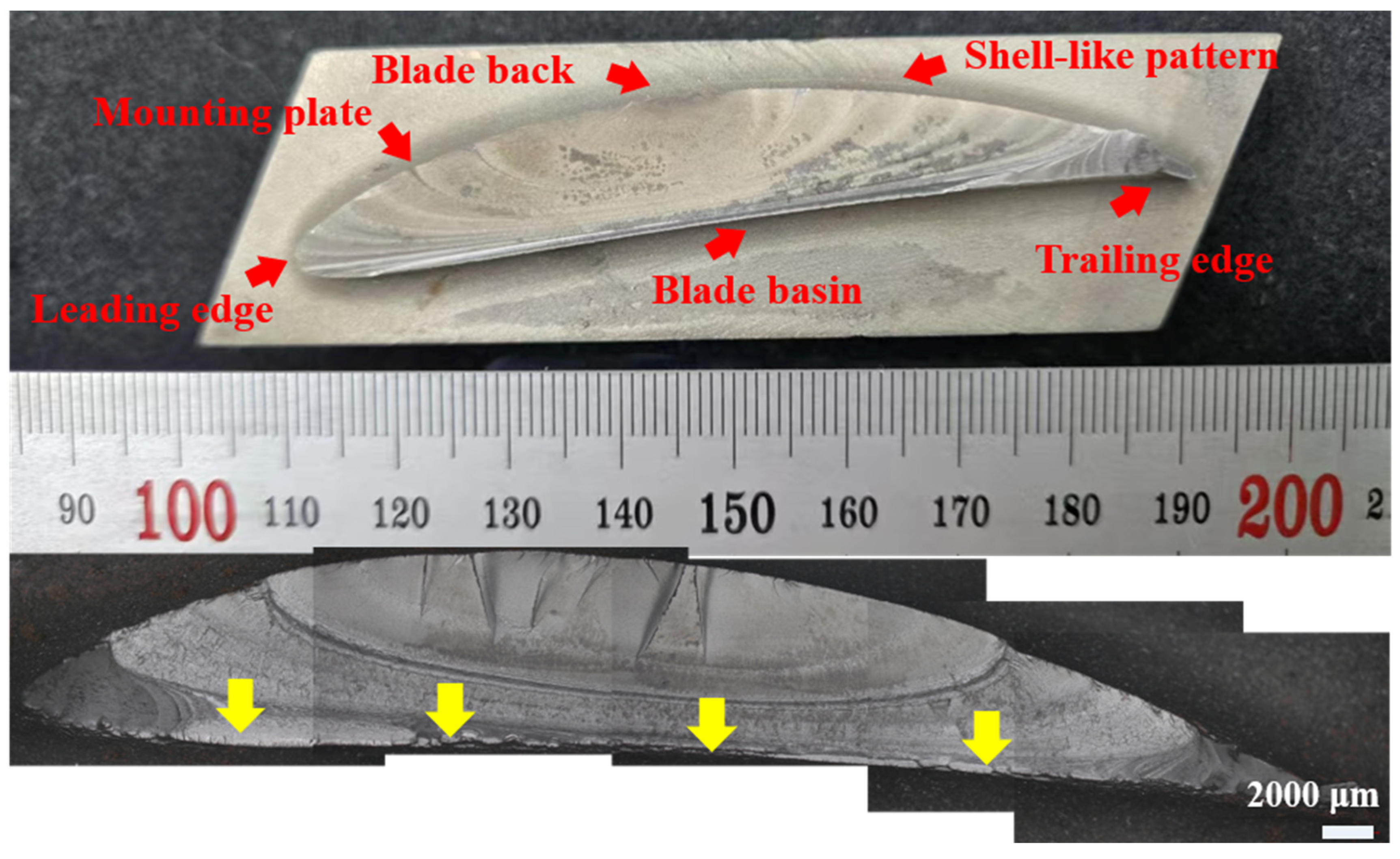
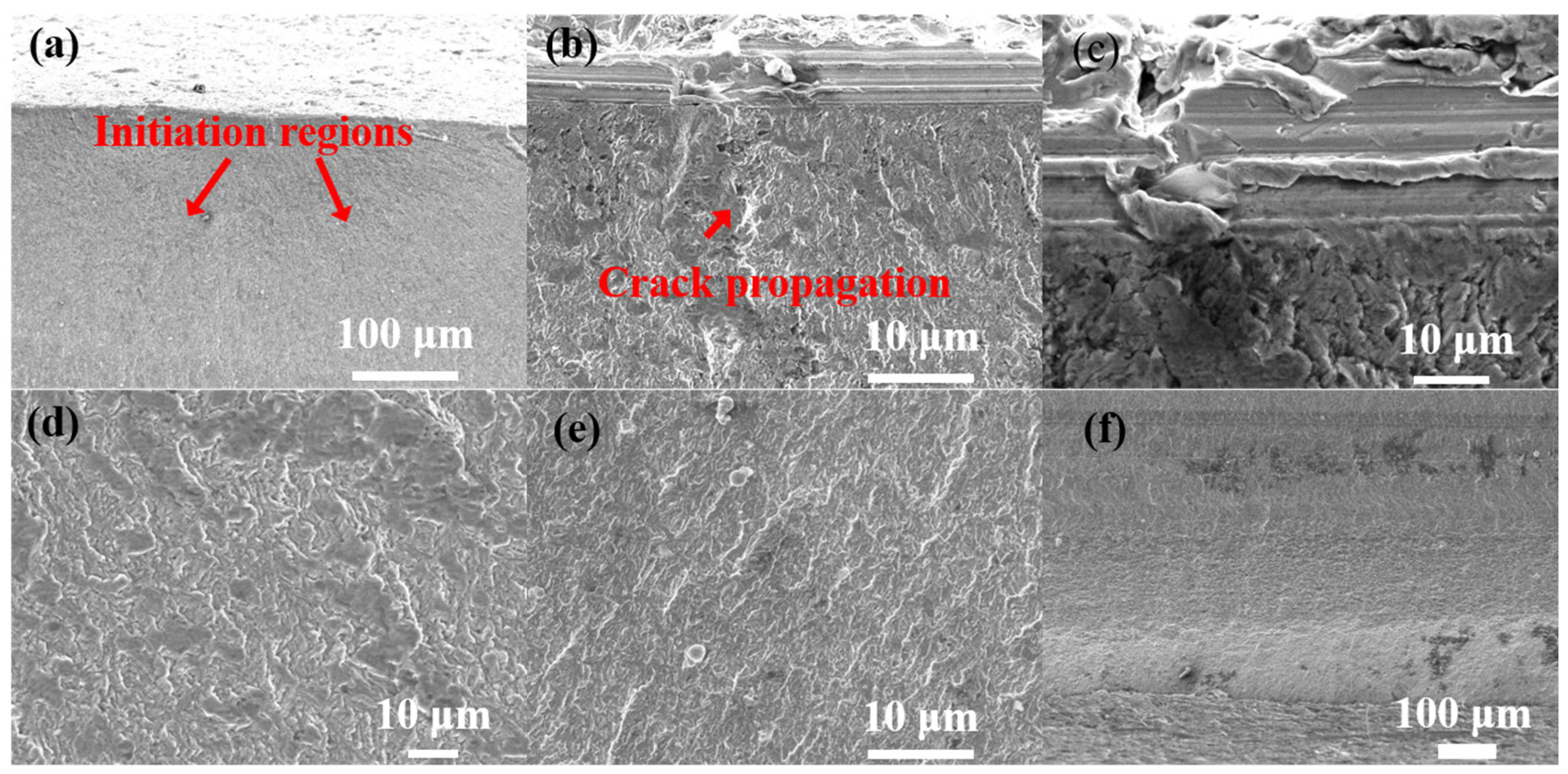
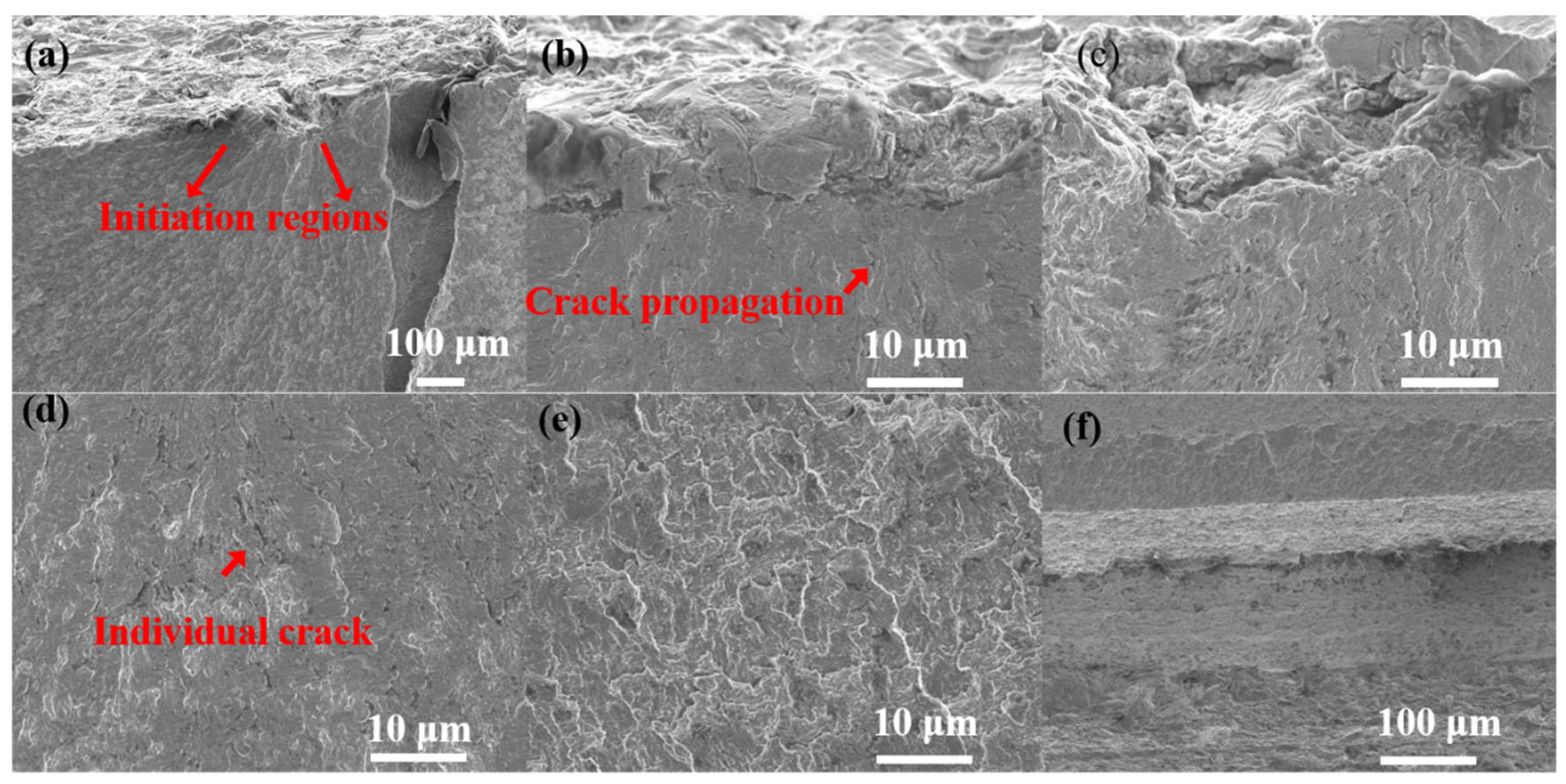
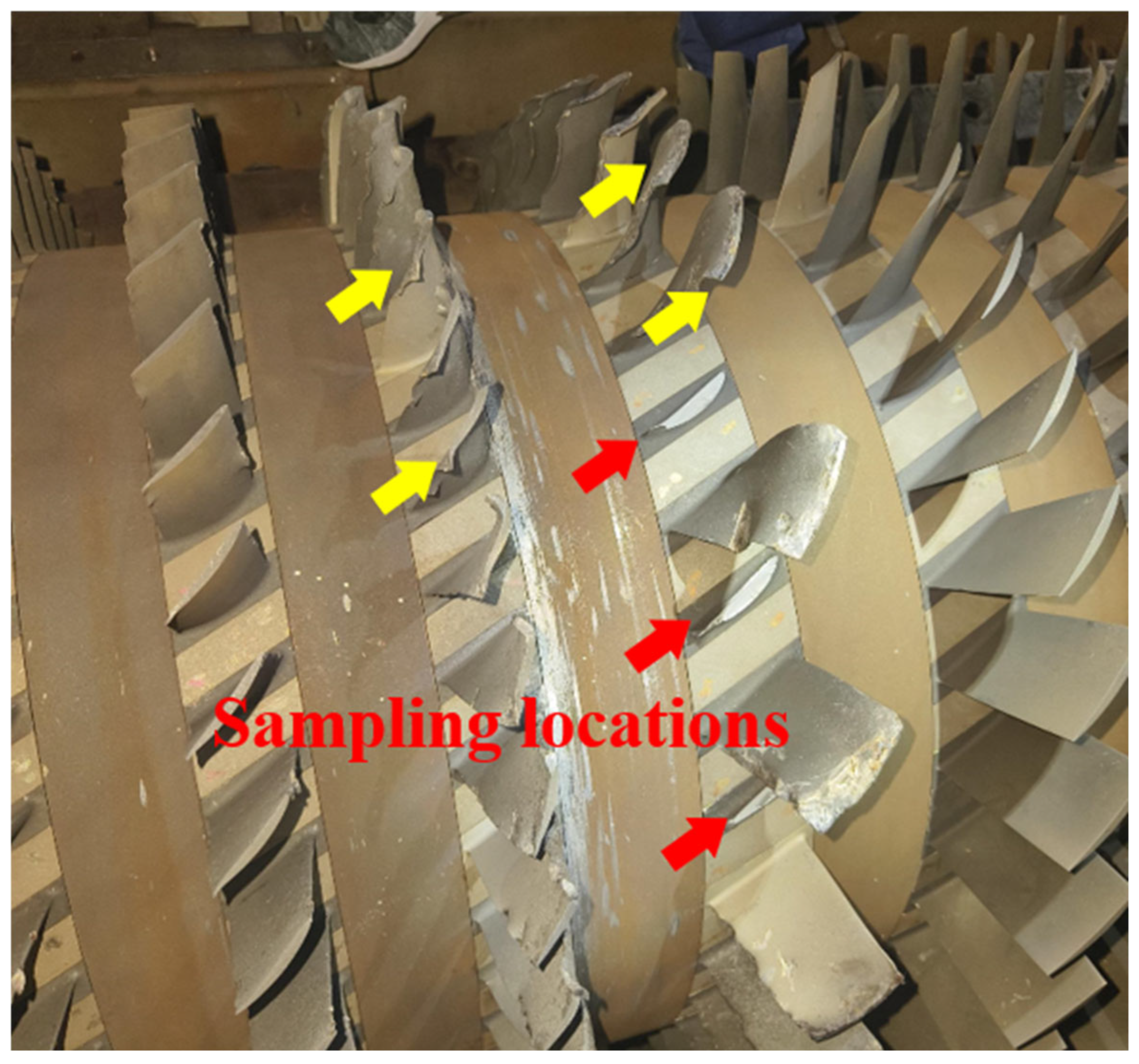
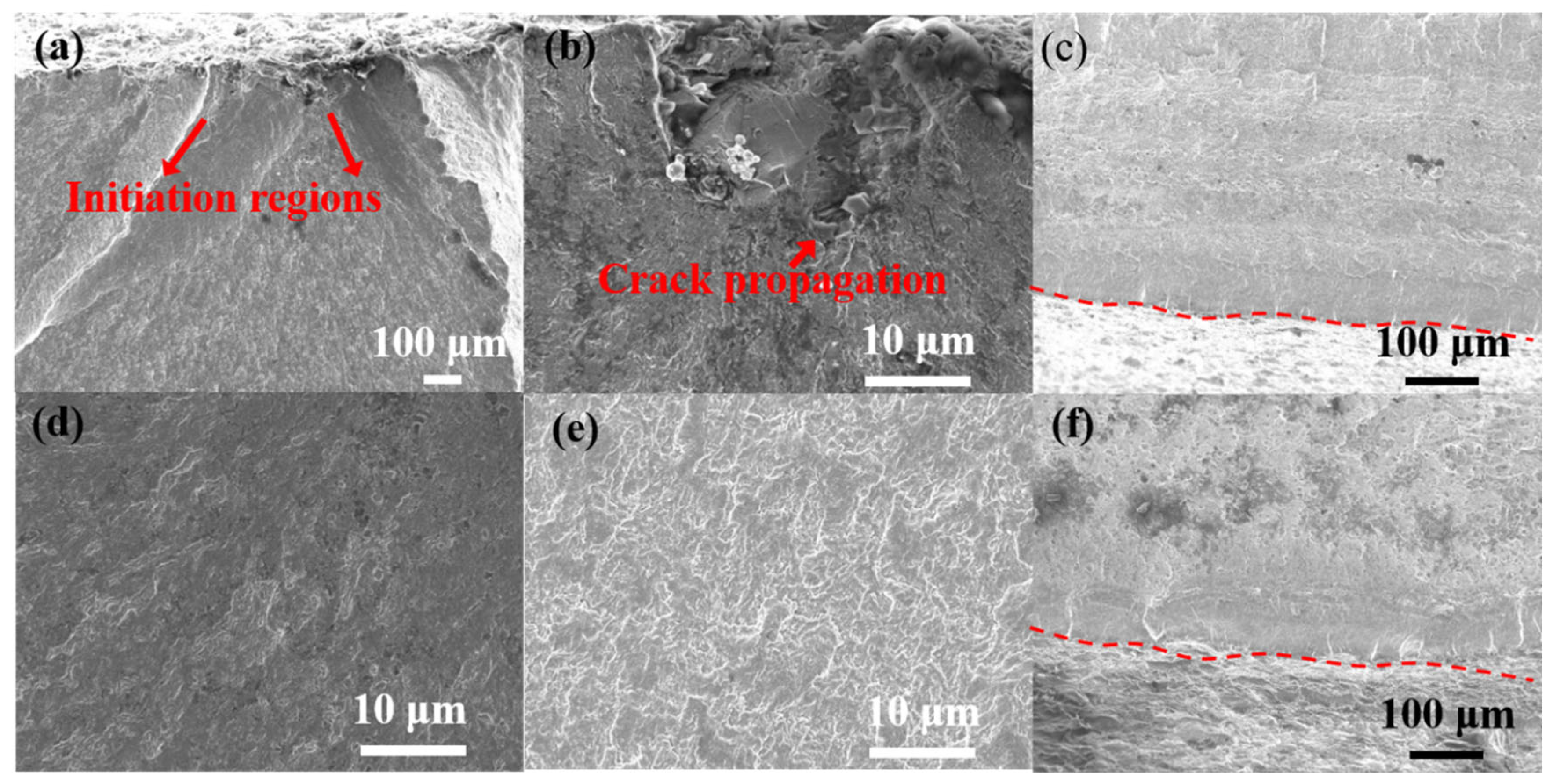
- The blade fracture is characterized as a multi-source fatigue fracture. Fractographic examination revealed that the crack initiation region of the new blade is located at the bottom of the transverse mechanical damage on the blade body, while that of the old blade originates at the bottom of surface pits and at the stress concentration region on the blade’s basin side. Multiple initiation sites were observed in both cases, consistent with multi-source fatigue characteristics.
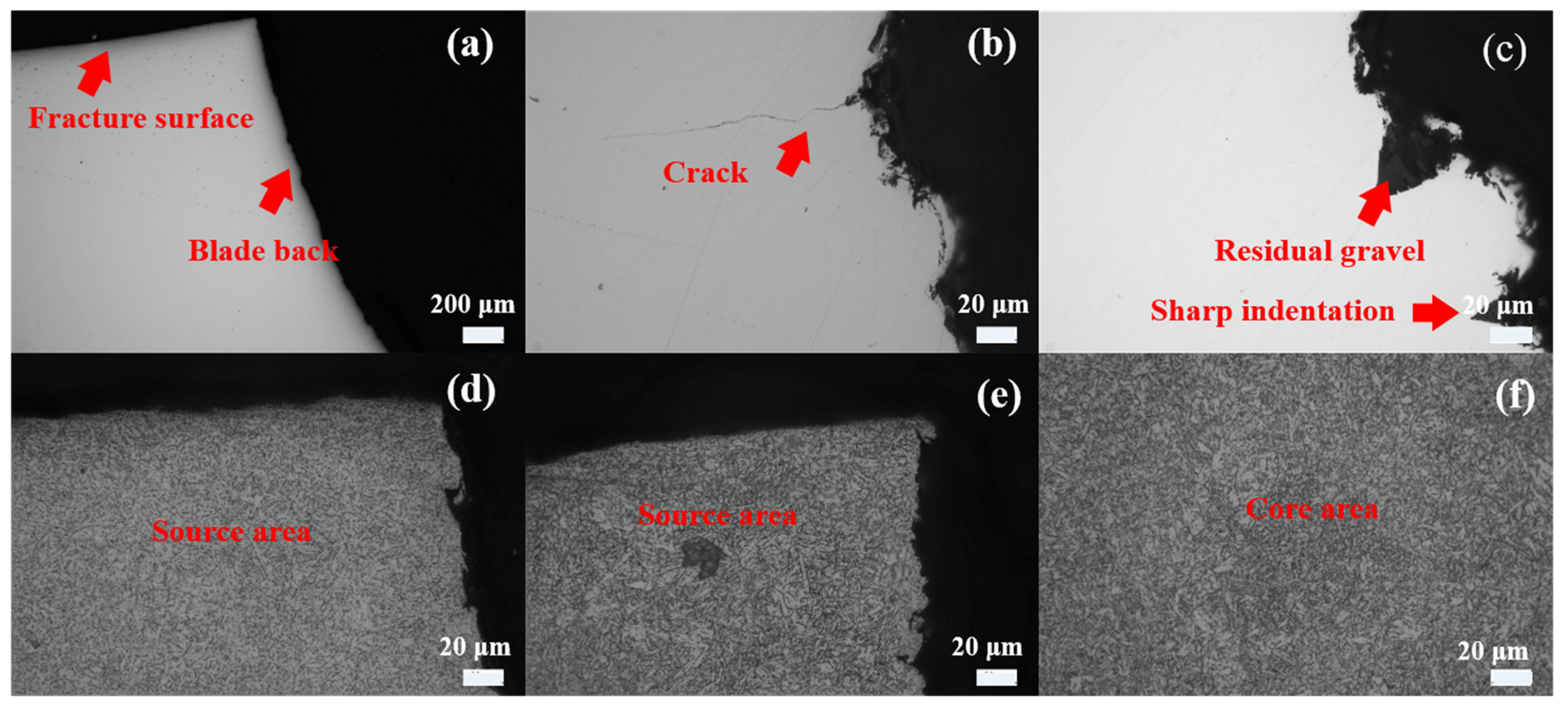
- Surface integrity differs between the new and old blades examined. The blade back surface of the new blade showed no observable microcracks or sharp pits after sandblasting treatment, whereas the blade back surface of the old blade exhibited residual blasting grit, sharp pits, and microcracks. These features were identified as potential stress concentrators and preferential initiation sites for fatigue cracks in the old blade.
- The fracture morphology of the old blade exhibits two distinct fatigue initiation zones, located on the blade’s back and basin sides. The propagation zone on the blade’s backside occupies a larger area than that on the blade’s basin side. The final fracture zone displays a dimple morphology, consistent with overload ductile failure. These observations support a failure process involving multiple crack initiations, propagation, and eventual coalescence leading to final fracture.
Author Contributions
Funding
Data Availability Statement
Conflicts of Interest
References
- Day, W.D.; Fiebiger, S.W.; Patel, H.N. Parametric evaluation of compressor blade blending. In Turbo Expo: Power for Land, Sea, and Air; American Society of Mechanical Engineers: New York, NY, USA, 2012; pp. 1099–1110. [Google Scholar]
- Infante, V.; Silva, J.; De Freitas, M.; Reis, L. Failures analysis of compressor blades of aeroengines due to service. Eng. Fail. Anal. 2009, 16, 1118–1125. [Google Scholar] [CrossRef] [Scilit]
- Liu, C.; Cao, Y.; Ding, S.; Zhang, W.; Cai, Y.; Lin, A. Effects of blade surface roughness on compressor performance and tonal noise emission in a marine diesel engine turbocharger, Proceedings of the Institution of Mechanical Engineers. Part D J. Automob. Eng. 2020, 234, 3476–3490. [Google Scholar] [CrossRef] [Scilit]
- Shanyavskiy, A. Very-High-Cycle-Fatigue of in-service air-engine blades, compressor and turbine, Science China Physics. Mech. Astron. 2014, 57, 19–29. [Google Scholar] [CrossRef] [Scilit]
- Gao, H.; Fei, C.; Bai, G.; Ding, L. Reliability-based low-cycle fatigue damage analysis for turbine blade with thermo-structural interaction. Aerosp. Sci. Technol. 2016, 49, 289–300. [Google Scholar] [CrossRef] [Scilit]
- Poursaeidi, E.; Bakhtiari, H. Fatigue crack growth simulation in a first stage of compressor blade. Eng. Fail. Anal. 2014, 45, 314–325. [Google Scholar] [CrossRef] [Scilit]
- Sun, S.; Liu, S.; He, W.; Zhang, X.; Tang, W.; Zhou, L.; Yi, M. Predicting high-cycle fatigue strength and three-dimensional fatigue crack growth in simulated compressor blade by phase-field model. Aerosp. Sci. Technol. 2025, 159, 110009. [Google Scholar] [CrossRef] [Scilit]
- Chaharlang, R.; Hajjari, E.; Baghal, S.L.; Siahpoosh, M. Premature damage of the second stage nozzle guide vanes of a gas turbine made of Inconel 738LC. Eng. Fail. Anal. 2019, 105, 803–816. [Google Scholar] [CrossRef] [Scilit]
- Masoumi Khalil Abad, E.; Farrahi, G.H.; Masoumi Khalil Abad, M.; Zare, A.A.; Parsa, S. Failure analysis of a gas turbine compressor in a thermal power plant. J. Fail. Anal. Prev. 2013, 13, 313–319. [Google Scholar] [CrossRef] [Scilit]
- Mirhosseini, A.M.; Nazari, S.A.; Pour, A.M.; Haghighi, S.E.; Zareh, M. Failure analysis of first stage nozzle in a heavy-duty gas turbine. Eng. Fail. Anal. 2020, 109, 104303. [Google Scholar] [CrossRef] [Scilit]
- Maktouf, W.; Sai, K. An investigation of premature fatigue failures of gas turbine blade. Eng. Fail. Anal. 2015, 47, 89–101. [Google Scholar] [CrossRef] [Scilit]
- Kwon, H.-J.; Lee, D.; Lee, Y.-K. Failure analysis of blades and vanes of a compressor for a gas turbine engine. Eng. Fail. Anal. 2021, 124, 105386. [Google Scholar] [CrossRef] [Scilit]
- Haskell, R. Gas Turbine Compressor Operating Environment and Material Evaluation; American Society of Mechanical Engineers: New York, NY, USA, 1989. [Google Scholar]
- Mollapour, Y.; Poursaeidi, E. Pedram, Study of pitting corrosion under actual operating conditions of a first stage compressor blade. Eng. Fail. Anal. 2022, 131, 105822. [Google Scholar] [CrossRef] [Scilit]
- Poursaeidi, E.; Arablu, M. Humidity effects on corrosion-assisted fatigue fracture of heavy-duty gas turbine compressor blades. J. Propuls. Power 2013, 29, 1009–1016. [Google Scholar] [CrossRef] [Scilit]
- Mishra, R. Fouling and corrosion in an aero gas turbine compressor. J. Fail. Anal. Prev. 2015, 15, 837–845. [Google Scholar] [CrossRef] [Scilit]
- Mostafavi, H.; Moghanaki, S.K. Environmentally-assisted fatigue in compressor blades of a power plant gas turbine. Eng. Fail. Anal. 2025, 183, 110277. [Google Scholar] [CrossRef] [Scilit]
- Poursaeidi, E.; Babaei, A.; Behrouzshad, F.; Arhani, M.M. Failure analysis of an axial compressor first row rotating blades. Eng. Fail. Anal. 2013, 28, 25–33. [Google Scholar] [CrossRef] [Scilit]
- ASTM E8/E8M-25; Standard Test Methods for Tension Testing of Metallic Materials. ASTM International: West Conshohocken, PA, USA, 2025.
- Bar-Yosef, O.; Kuhn, S.L. The big deal about blades: Laminar technologies and human evolution. Am. Anthropol. 1999, 101, 322–338. [Google Scholar] [CrossRef] [Scilit]
- Denkena, B.; Boess, V.; Nespor, D.; Floeter, F.; Rust, F. Engine blade regeneration: A literature review on common technologies in terms of machining. Int. J. Adv. Manuf. Technol. 2015, 81, 917–924. [Google Scholar] [CrossRef] [Scilit]
- Veers, P.S.; Ashwill, T.D.; Sutherland, H.J.; Laird, D.L.; Lobitz, D.W.; Griffin, D.A.; Mandell, J.F.; Musial, W.D.; Jackson, K.; Zuteck, M. Trends in the design, manufacture and evaluation of wind turbine blades. Wind Energy Int. J. Prog. Appl. Wind Power Convers. Technol. 2003, 6, 245–259. [Google Scholar] [CrossRef] [Scilit]
- Chen, Z.-Y.; Li, Z.-Q.; Meng, X.-H. Structure, hardness and corrosion behavior of a gradient CrNx thick coating applied to turbine blades. Appl. Surf. Sci. 2009, 255, 7408–7413. [Google Scholar] [CrossRef] [Scilit]
- Park, K.; Withey, P. Formation mechanisms and oxidation behaviour of gold-coloured surface scales in Ni-based single crystal superalloy turbine blades. J. Alloys Compd. 2025, 1049, 185391. [Google Scholar] [CrossRef] [Scilit]



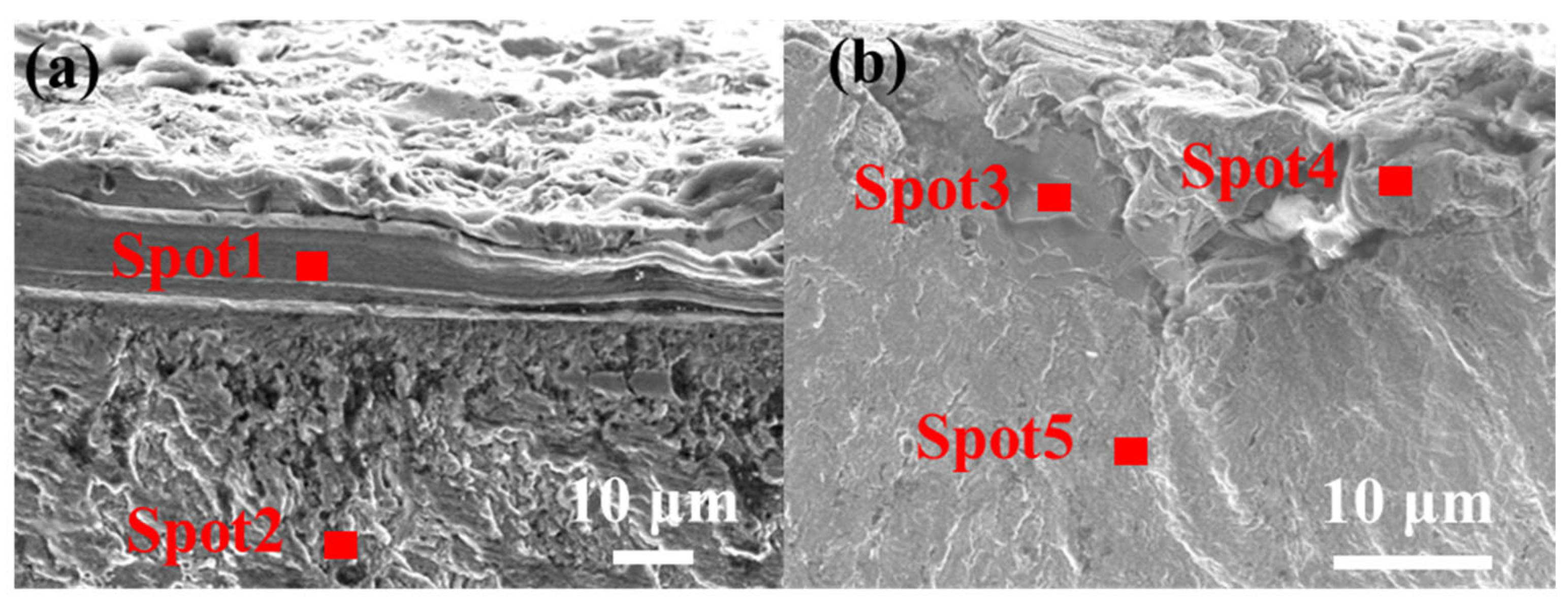

| Position/Element | Fe | Cr | C | O | Si | Mn | Al | |
|---|---|---|---|---|---|---|---|---|
| New Blade | Spot1 | 74.9 | 11.9 | 11.1 | 1.6 | 0.4 | / | / |
| Spot2 | 74.8 | 11.5 | 9.0 | 4.3 | 0.3 | / | / | |
| Old Blade | Spot3 | 64.7 | 10.8 | 12.8 | 8.6 | 2.2 | / | 0.3 |
| Spot4 | 77.3 | 12.6 | 6.2 | 3.2 | 0.6 | / | / | |
| Spot5 | 72.3 | 11.1 | 11.6 | 4.4 | 0.6 | / | / | |
| Blade | New Blade | Old Blade | ||||||
|---|---|---|---|---|---|---|---|---|
| Position | Initiation Zone | Core | Near Fracture Surface | Near Blade Back Surface | Initiation Zone | Core | Near Fracture Surface | Near Blade Back Surface |
| HV0.1 | 212 ± 5.6 | 217 ± 8.5 | 208 ± 3.6 | 219 ± 2.3 | 223 ± 6.2 | 220 ± 5.9 | 215 ± 5.4 | 225 ± 5.7 |
| HBW | 205 ± 4.5 | 210 ± 7.3 | 205 ± 4.2 | 215 ± 5.7 | 220 ± 6.5 | 215 ± 6.2 | 217 ± 4.9 | 220 ± 4.6 |
| Sample | Rm (MPa) | Rp0.2 (MPa) | Percentage Elongation After Fracture (%) |
|---|---|---|---|
| New Blade | 689 ± 13 | 457 ± 8.5 | 27 ± 2.2 |
| Old Blade | 683 ± 12 | 476 ± 6.9 | 29 ± 1.3 |
Disclaimer/Publisher’s Note: The statements, opinions and data contained in all publications are solely those of the individual author(s) and contributor(s) and not of MDPI and/or the editor(s). MDPI and/or the editor(s) disclaim responsibility for any injury to people or property resulting from any ideas, methods, instructions or products referred to in the content. |
© 2026 by the authors. Licensee MDPI, Basel, Switzerland. This article is an open access article distributed under the terms and conditions of the Creative Commons Attribution (CC BY) license.
Share and Cite
Gao, Y.; Dong, H.; Lv, C.; Li, Y.; Zhou, L.; Song, Y. Multi-Source Fatigue Fracture of 2Cr13 Martensitic Stainless Steel Compressor Blades: The Critical Role of Surface Integrity in Marine Engineering Reliability. Materials 2026, 19, 3965. https://doi.org/10.3390/ma19183965
Gao Y, Dong H, Lv C, Li Y, Zhou L, Song Y. Multi-Source Fatigue Fracture of 2Cr13 Martensitic Stainless Steel Compressor Blades: The Critical Role of Surface Integrity in Marine Engineering Reliability. Materials. 2026; 19(18):3965. https://doi.org/10.3390/ma19183965
Chicago/Turabian StyleGao, Yingwei, Haoxian Dong, Chuan Lv, Yan Li, Lvjun Zhou, and Yuze Song. 2026. "Multi-Source Fatigue Fracture of 2Cr13 Martensitic Stainless Steel Compressor Blades: The Critical Role of Surface Integrity in Marine Engineering Reliability" Materials 19, no. 18: 3965. https://doi.org/10.3390/ma19183965
APA StyleGao, Y., Dong, H., Lv, C., Li, Y., Zhou, L., & Song, Y. (2026). Multi-Source Fatigue Fracture of 2Cr13 Martensitic Stainless Steel Compressor Blades: The Critical Role of Surface Integrity in Marine Engineering Reliability. Materials, 19(18), 3965. https://doi.org/10.3390/ma19183965