This is an early access version, the complete PDF, HTML, and XML versions will be available soon.
Open AccessArticle
Mechanically Referenced Early Acoustic Emission Indicators of Thermally Modified Deformation in S235 Structural Steel
by
Anna Adamczak-Bugno
 Anna Adamczak-Bugno
Faculty of Civil Engineering and Architecture, Kielce University of Technology, Av. 1000-An. of Polish State 7, 25-314 Kielce, Poland
Materials 2026, 19(18), 3958; https://doi.org/10.3390/ma19183958 (registering DOI)
Submission received: 17 August 2026
/
Revised: 11 September 2026
/
Accepted: 14 September 2026
/
Published: 17 September 2026
Abstract
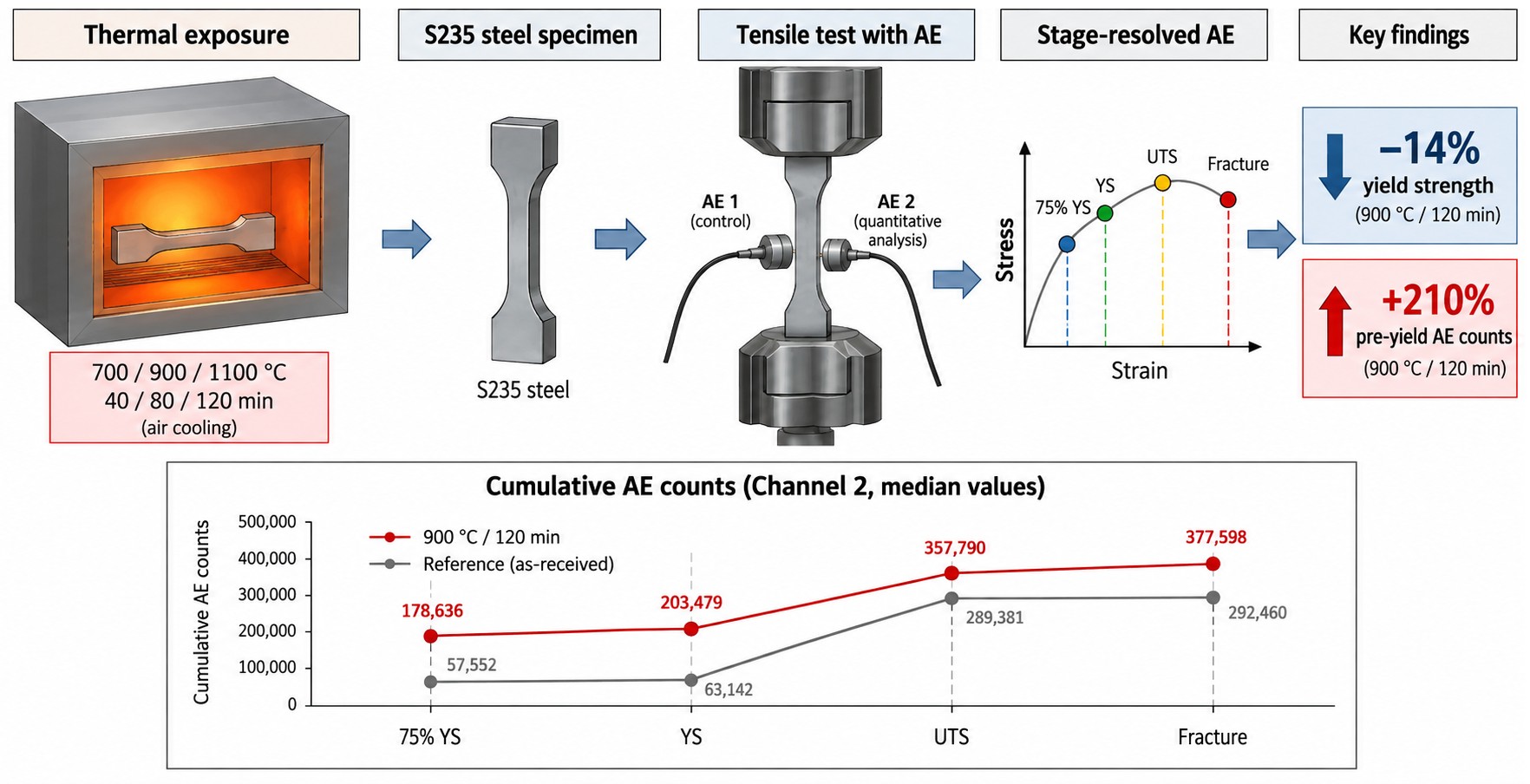
Post-fire assessment of structural steel typically relies on residual mechanical properties, although thermally induced changes in deformation behaviour may emerge before conventional strength parameters are clearly affected. This study examines whether mechanically referenced acoustic emission (AE) descriptors can reveal such changes in S235 steel after exposure to 700, 900, and 1100 °C for 40, 80, and 120 min, followed by air cooling. Thirty specimens were subjected to tensile testing with two-channel AE monitoring. The two channels were recorded independently and were not combined. Channel 2 was used consistently for quantitative comparisons, whereas channel 1 served as a control of signal transmission and sensor coupling. Median cumulative AE counts were evaluated at 75% of the lower yield load, the lower yield point, ultimate tensile strength, and fracture. Thermal exposure altered both the magnitude and distribution of AE activity, with the greatest differences occurring before or near yielding. After exposure to 900 °C for 120 min, the mean lower yield strength decreased by approximately 14%, while pre-yield AE counts increased by approximately 210% relative to the reference condition. Specimens exposed to 1100 °C for 40 min showed similar final AE counts to the reference specimens but markedly different distributions across the loading stages. Stage-resolved AE analysis therefore provides information complementary to residual mechanical properties and final AE counts. Although the proposed pre-yield descriptor is retrospective and cannot be applied directly as a field-diagnostic threshold, it provides a sensitive experimental basis for comparing thermally modified deformation histories and for future development of independently defined AE-based assessment criteria.
Share and Cite
MDPI and ACS Style
Adamczak-Bugno, A.
Mechanically Referenced Early Acoustic Emission Indicators of Thermally Modified Deformation in S235 Structural Steel. Materials 2026, 19, 3958.
https://doi.org/10.3390/ma19183958
AMA Style
Adamczak-Bugno A.
Mechanically Referenced Early Acoustic Emission Indicators of Thermally Modified Deformation in S235 Structural Steel. Materials. 2026; 19(18):3958.
https://doi.org/10.3390/ma19183958
Chicago/Turabian Style
Adamczak-Bugno, Anna.
2026. "Mechanically Referenced Early Acoustic Emission Indicators of Thermally Modified Deformation in S235 Structural Steel" Materials 19, no. 18: 3958.
https://doi.org/10.3390/ma19183958
APA Style
Adamczak-Bugno, A.
(2026). Mechanically Referenced Early Acoustic Emission Indicators of Thermally Modified Deformation in S235 Structural Steel. Materials, 19(18), 3958.
https://doi.org/10.3390/ma19183958
Note that from the first issue of 2016, this journal uses article numbers instead of page numbers. See further details
here.
Article Metrics
Article Access Statistics
For more information on the journal statistics, click
here.
Multiple requests from the same IP address are counted as one view.