Annealing-Controlled Recrystallization, Grain Growth, and Tensile Properties of Cold-Rolled L-605 Cobalt-Based Alloy



Highlights
- Cold-rolled L-605 evolves from partial to near-full recrystallization at 800–950 °C.
- Fine recrystallized grains remain relatively stable at 1000 °C; fine second-phase particles may contribute to restricted grain-boundary migration.
- Annealing tunes yield strength from 1245 to 442–455 MPa and elongation from 12.6% to 80.8%.
Abstract
1. Introduction
2. Materials and Methods
3. Results and Discussion
3.1. Microstructural Characterization
3.2. Mechanical Properties
4. Conclusions
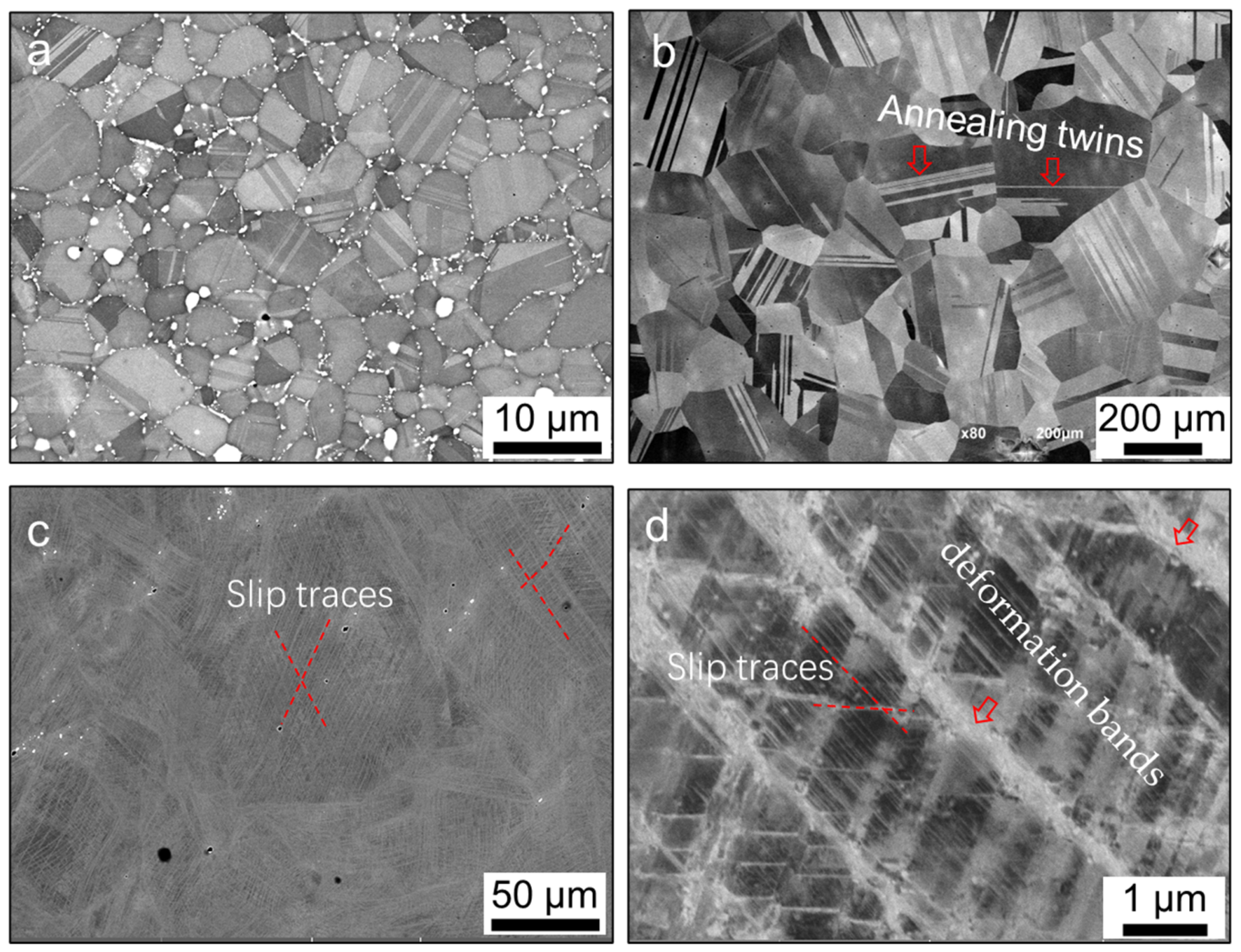
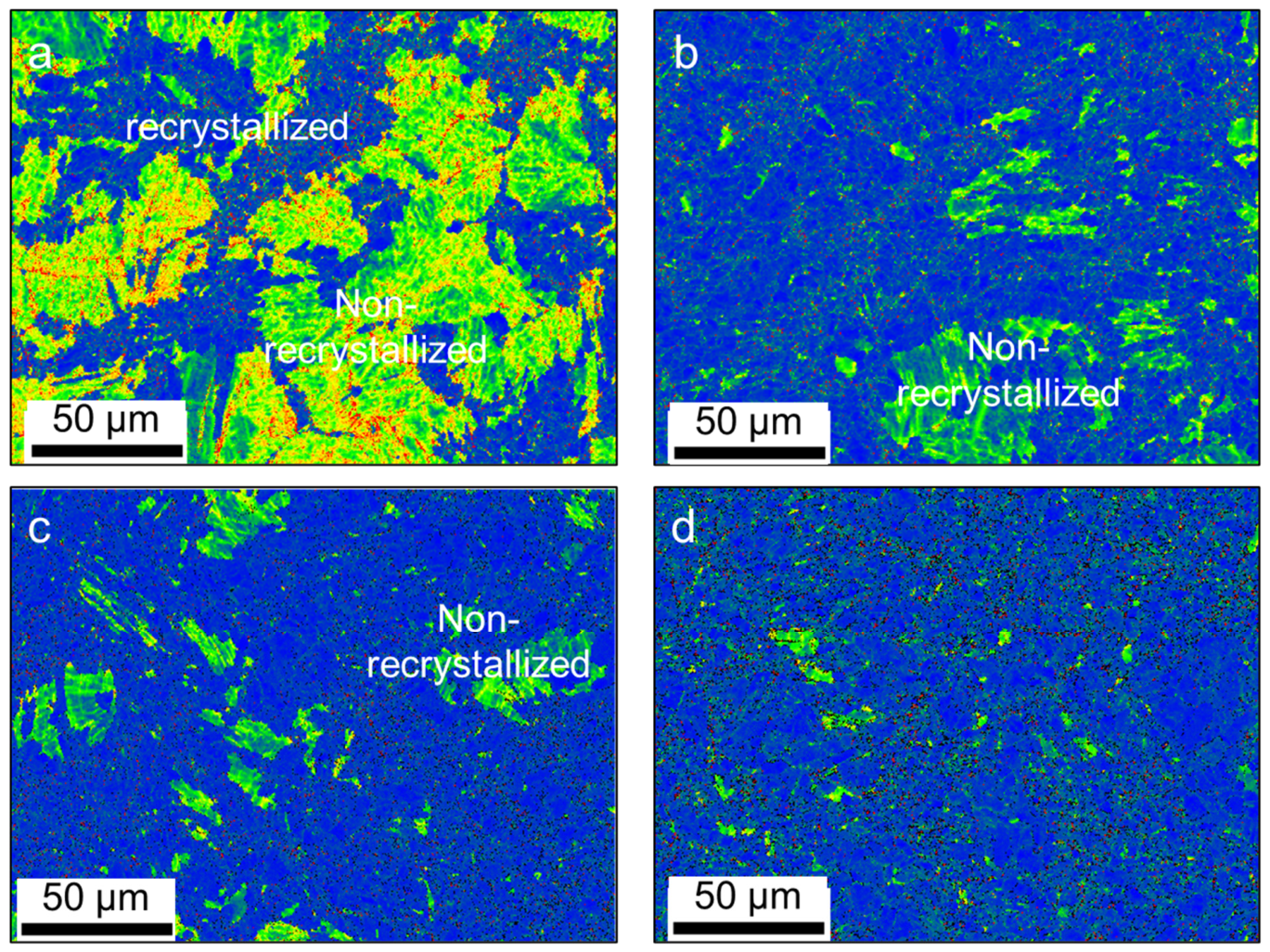
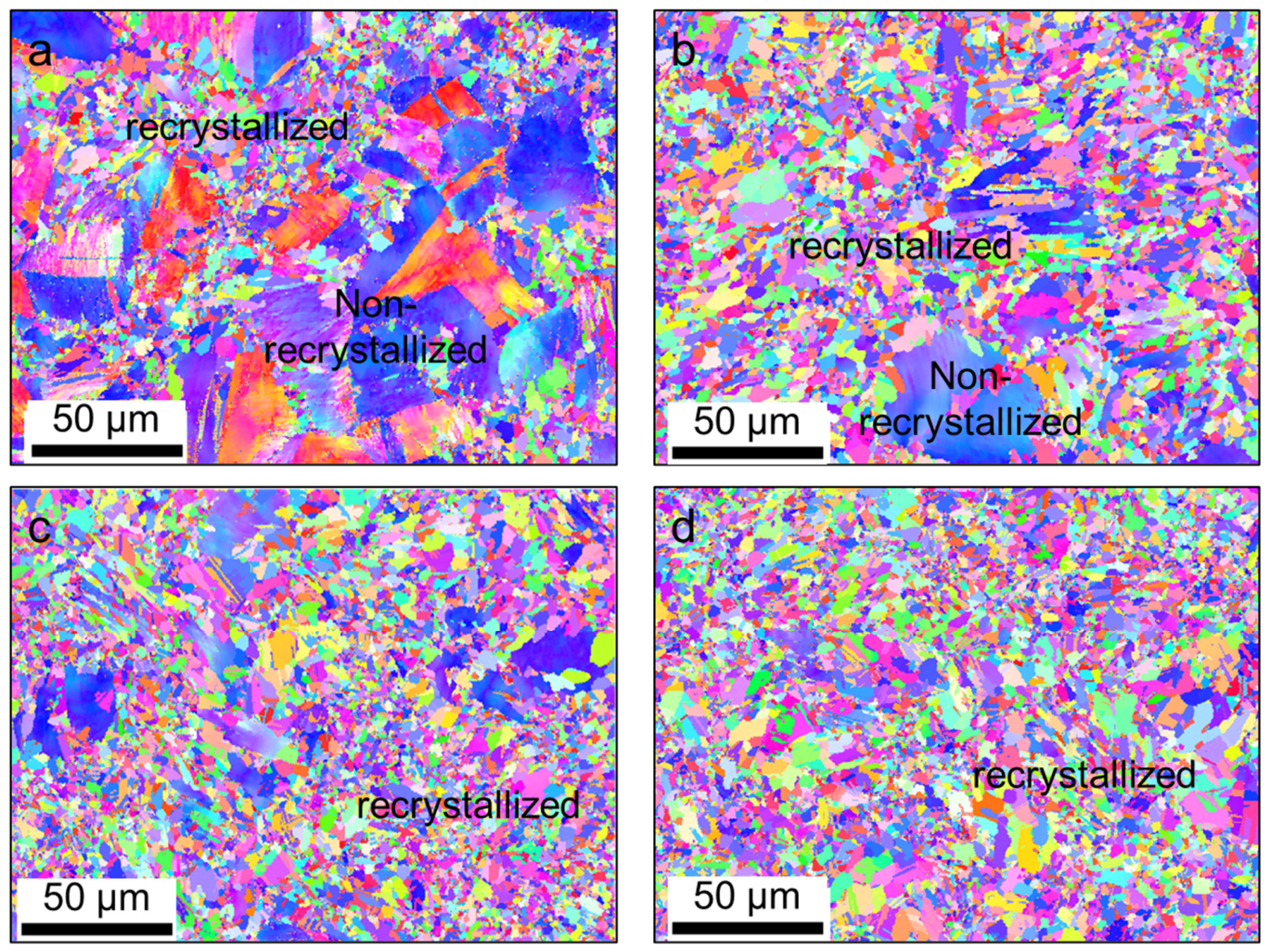
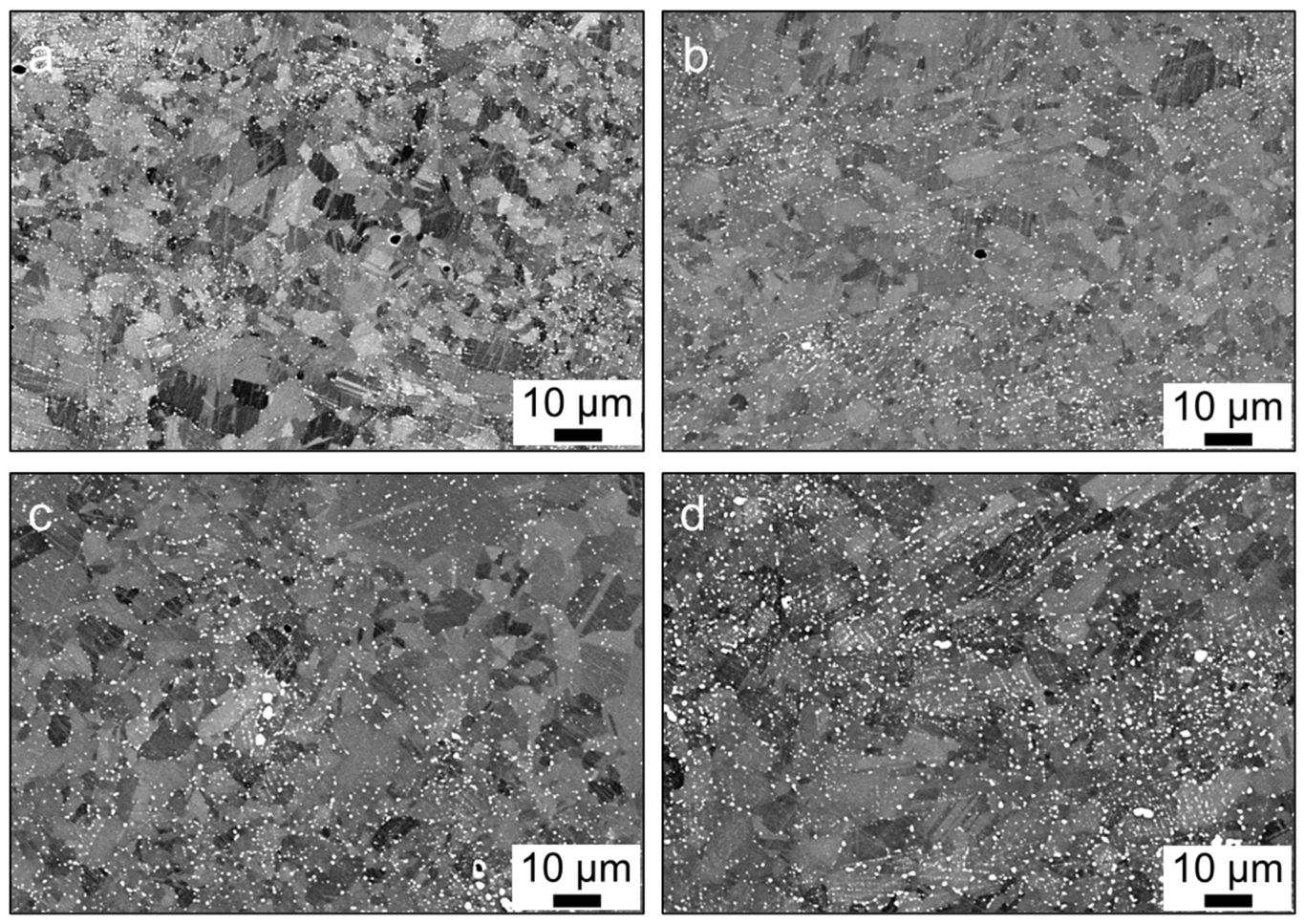
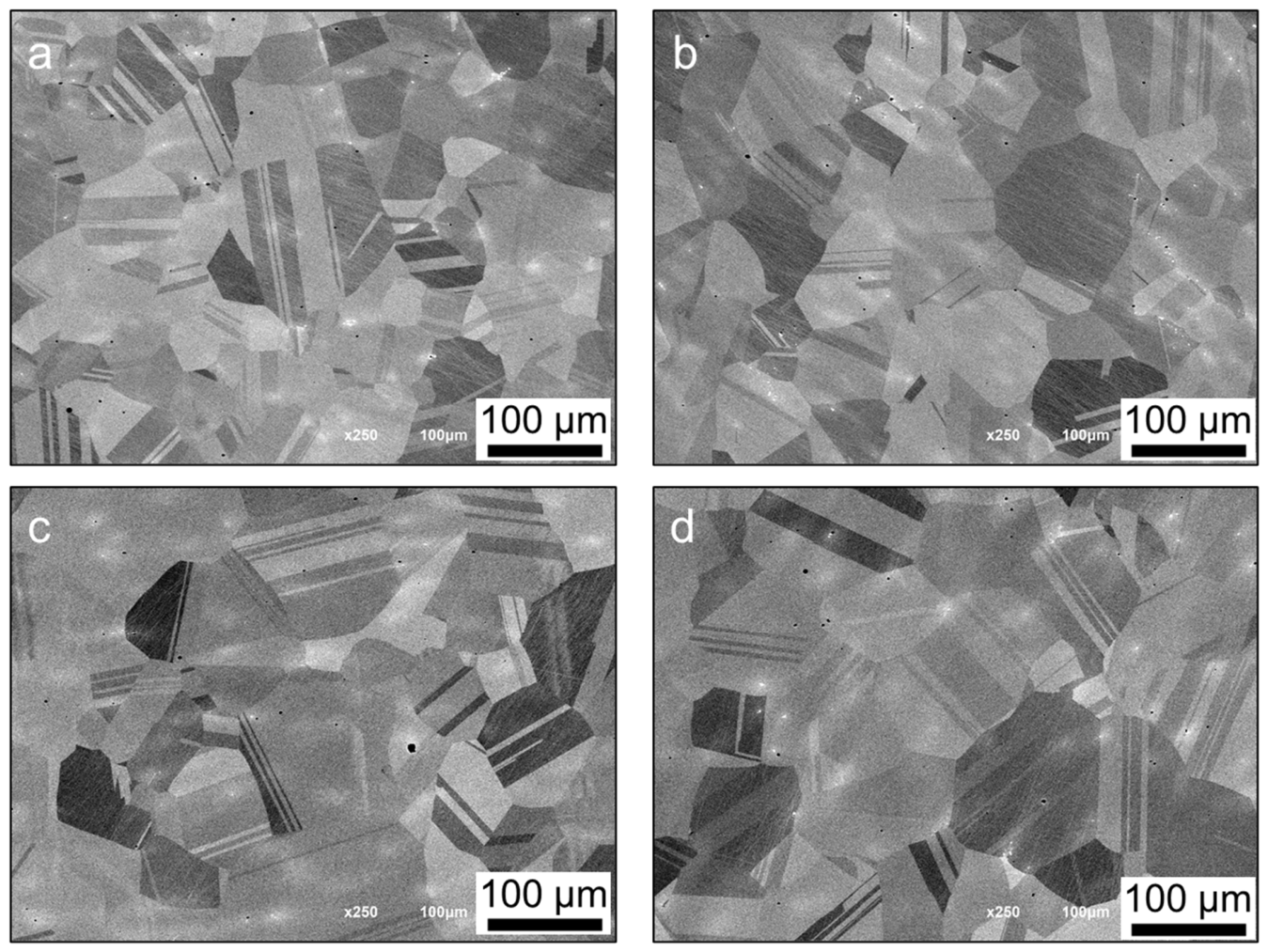
- Annealing at 800–900 °C for 15 min obtained partially recrystallized microstructures consisting of new recrystallized grains and retained recovered/deformed regions. Annealing at 950 °C achieved nearly complete recrystallized fine-grained structure, with an average grain size of ~3.4 μm. EBSD KAM analysis showed local misorientation and lattice distortion decreased gradually as annealing temperature rose from 800 °C to 950 °C, which matches the progressive development of recovery and SRX. KAM was not used as a direct indicator of total dislocation density. Annealing at 1000 °C for 5–60 min obtained fully recrystallized microstructures, with average grain size stable at ~5 μm. Fine second-phase particles may restrict grain boundary migration, but their phase composition and quantitative pinning effect were not determined. Annealing at 1200 °C for 5–60 min caused significant grain growth to ~90 μm. The coarsening is attributed to enhanced grain boundary mobility at higher temperature; reduced effective particle pinning may contribute additionally, but particle dissolution was not directly verified.
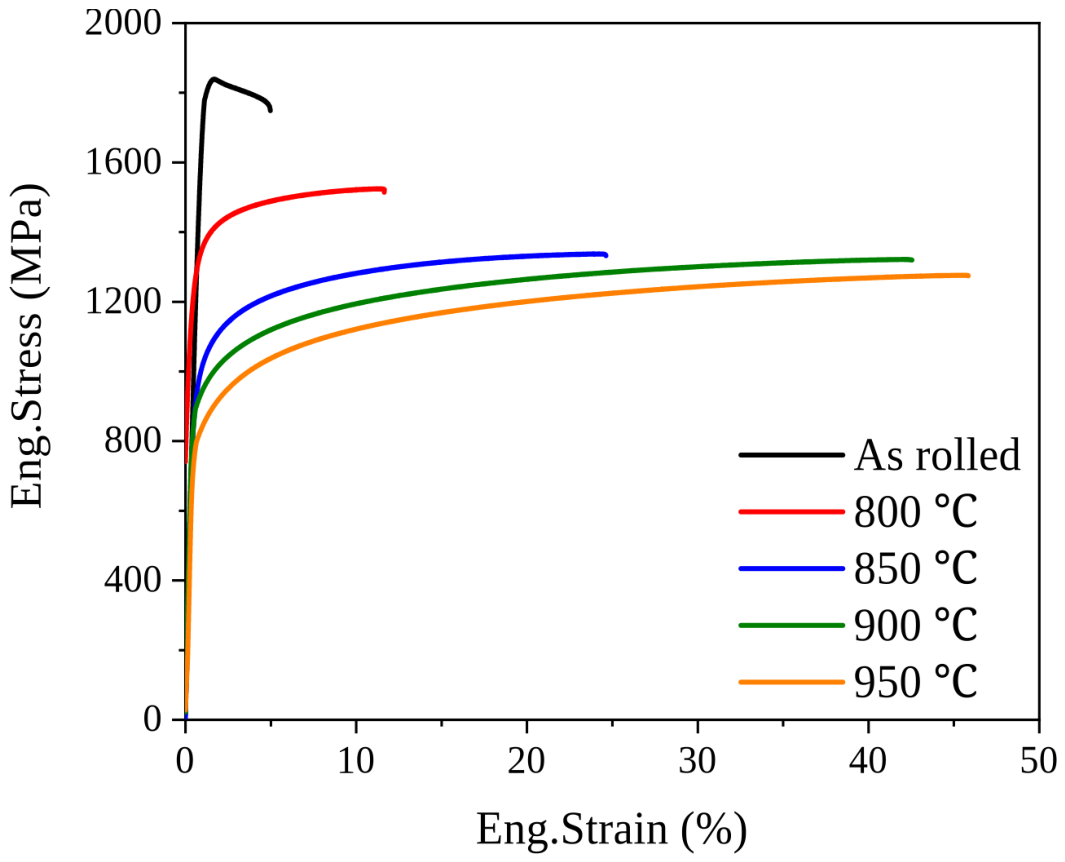
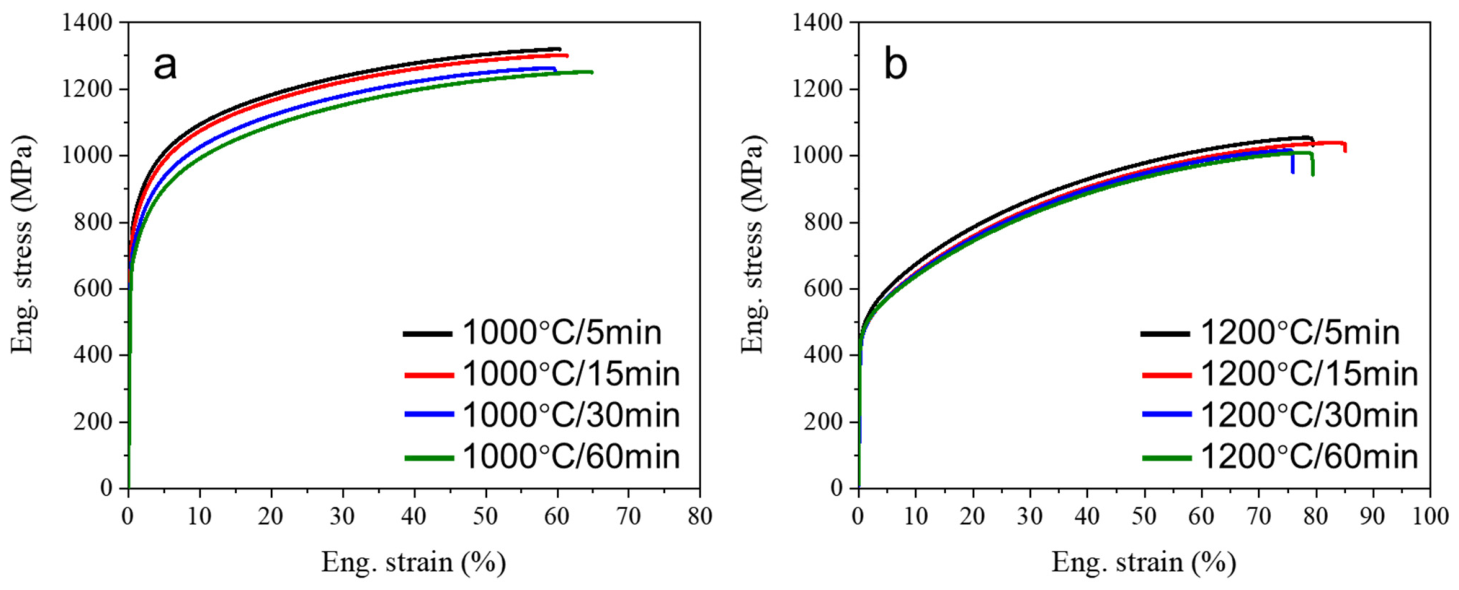
- As the annealing temperature increased from 800 °C to 950 °C, the tensile strength of the experimental alloy decreased gradually, while the elongation exhibited an increasing trend. Specifically, the yield strength (YS) decreased from approximately 1245 MPa at 800 °C to approximately 800 MPa at 950 °C, and the elongation increased from 12.6% to 45.9%. This mechanical property evolution is consistent with the gradual elimination of deformation-induced strengthening effects during the recovery and static recrystallization (SRX) processes, as well as the formation of a more homogeneous recrystallized microstructure. When annealed at 1000 °C, the YS decreased from approximately 785 MPa after 5 min of holding to approximately 668 MPa after 60 min of holding, while high ductility was still maintained. Given that significant grain growth was restricted at this temperature, the gradual softening of the alloy can be qualitatively attributed to the continuous relaxation of residual deformation-induced orientation gradients, as well as potential changes in the state of second-phase particles and grain boundaries. When annealed at 1200 °C, the alloy exhibited a YS in the range of approximately 442–455 MPa and an elongation in the range of approximately 73.5–80.8%. This low strength and high ductility characteristic matches well with the coarse fully recrystallized microstructure obtained at this temperature: in this microstructure, deformation-related strengthening effects have been completely eliminated, and the grain boundary strengthening contribution is reduced due to grain coarsening.
- The strength–ductility balance is therefore associated with the evolution from retained deformation substructures to a fine recrystallized grain structure and, at higher temperature, to a coarse recrystallized structure. Annealing near 950–1000 °C provides a balanced combination of strength and ductility under the present processing conditions, whereas annealing at 1200 °C provides very high ductility at the expense of YS.
Author Contributions
Funding
Institutional Review Board Statement
Informed Consent Statement
Data Availability Statement
Conflicts of Interest
References
- Ueki, K.; Ueda, K.; Narushima, T. Microstructure and mechanical properties of heat-treated Co–20Cr–15W–10Ni alloy for biomedical application. Metall. Mater. Trans. A 2016, 47, 2773–2782. [Google Scholar] [CrossRef] [Scilit]
- Ueki, K.; Ueda, K.; Nakai, M.; Nakano, T.; Narushima, T. Microstructural changes during plastic deformation and corrosion properties of biomedical Co–20Cr–15W–10Ni alloy heat-treated at 873 K. Metall. Mater. Trans. A 2018, 49, 2393–2404. [Google Scholar] [CrossRef] [Scilit]
- Mani, G.; Porter, D.; Collins, S.; Schatz, T.; Ornberg, A.; Shulfer, R. A review on manufacturing processes of cobalt-chromium alloy implants and its impact on corrosion resistance and biocompatibility. J. Biomed. Mater. Res. B Appl. Biomater. 2024, 112, e35431. [Google Scholar] [CrossRef] [Scilit] [PubMed]
- Ueki, K.; Yanagihara, S.; Ueda, K.; Nakai, M.; Nakano, T.; Narushima, T. Overcoming the strength–ductility trade-off by the combination of static recrystallization and low-temperature heat-treatment in Co–Cr–W–Ni alloy for stent application. Mater. Sci. Eng. A 2019, 766, 138400. [Google Scholar] [CrossRef] [Scilit]
- Takeda, S.; Ueki, K.; Ueda, K.; Nakai, M.; Nakano, T.; Narushima, T. Improvement of mechanical properties of Co–Cr–W–Ni alloy tube suitable for balloon-expandable stent applications through heat treatment. Mater. Sci. Eng. A 2023, 862, 144505. [Google Scholar] [CrossRef] [Scilit]
- ASTM F90-23; Standard Specification for Wrought Cobalt-20Chromium-15Tungsten-10Nickel Alloy for Surgical Implant Applications (UNS R30605). ASTM International: West Conshohocken, PA, USA, 2024.
- Teague, J.; Cerreta, E.; Stout, M. Tensile properties and microstructure of Haynes 25 alloy after aging at elevated temperatures for extended times. Metall. Mater. Trans. A 2004, 35, 2767–2781. [Google Scholar] [CrossRef] [Scilit]
- Favre, J.; Fabrègue, D.; Maire, E.; Chiba, A. Grain growth and static recrystallization kinetics in Co–20Cr–15W–10Ni (L-605) cobalt-base superalloy. Philos. Mag. 2014, 94, 1992–2008. [Google Scholar] [CrossRef] [Scilit]
- Doherty, R.D.; Hughes, D.A.; Humphreys, F.J.; Jonas, J.J.; Juul Jensen, D.; Kassner, M.E.; King, W.E.; McNelley, T.R.; McQueen, H.J.; Rollett, A.D. Current issues in recrystallization: A review. Mater. Sci. Eng. A 1997, 238, 219–274. [Google Scholar] [CrossRef] [Scilit]
- Yanagihara, S.; Ueki, K.; Ueda, K.; Nakai, M.; Nakano, T.; Narushima, T. Development of low-yield stress Co–Cr–W–Ni alloy by adding 6 mass pct Mn for balloon-expandable stents. Metall. Mater. Trans. A 2021, 52, 4137–4145. [Google Scholar] [CrossRef] [Scilit]
- Favre, J.; Koizumi, Y.; Chiba, A.; Fabrègue, D.; Maire, E. Deformation behavior and dynamic recrystallization of biomedical Co–Cr–W–Ni (L-605) alloy. Metall. Mater. Trans. A 2013, 44, 2819–2830. [Google Scholar] [CrossRef] [Scilit]
- Favre, J.; Fabrègue, D.; Yamanaka, K.; Chiba, A. Modeling dynamic recrystallization of L-605 cobalt superalloy. Mater. Sci. Eng. A 2016, 653, 84–92. [Google Scholar] [CrossRef] [Scilit]
- Kumar, V.A.; Gupta, R.K.; Murty, S.V.S.N.; Prasad, M.J.N.V. Hot workability and microstructure control in Co–20Cr–15W–10Ni cobalt-based superalloy. J. Alloys Compd. 2016, 676, 527–541. [Google Scholar] [CrossRef] [Scilit]
- Gupta, R.K.; Karthikeyan, M.K.; Bhalia, D.N.; Ghosh, B.R.; Sinha, P.P. Effect of microstructure on mechanical properties of refractory Co–Cr–W–Ni alloy. Met. Sci. Heat Treat. 2008, 50, 175–179. [Google Scholar] [CrossRef] [Scilit]
- Zhu, Z.; Chen, L. Effect of annealing on microstructure and mechanical properties of biomedical hot-rolled Co–Cr–W–Ni alloy. Mater. Res. Express 2019, 6, 126511. [Google Scholar] [CrossRef] [Scilit]
- Zhu, Z.Y.; Meng, L.; Chen, L. Strain-induced martensitic transformation in biomedical Co–Cr–W–Ni alloys. Rare Met. 2020, 39, 241–249. [Google Scholar] [CrossRef] [Scilit]
- Keyvani, M.; Garcin, T.; Fabrègue, D.; Militzer, M.; Yamanaka, K.; Chiba, A. Continuous measurements of recrystallization and grain growth in cobalt super alloys. Metall. Mater. Trans. A 2017, 48, 2363–2374. [Google Scholar] [CrossRef] [Scilit]
- Li, C.L.; Park, C.H.; Choi, S.W.; Lee, S.W.; Hong, J.K.; Yeom, J.T. High strength and high ductility in the Co–20Cr–15W–10Ni alloy having a bimodal grain structure achieved by static recrystallization. Mater. Sci. Eng. A 2018, 732, 70–77. [Google Scholar] [CrossRef] [Scilit]
- Li, C.L.; Oh, J.M.; Yeom, J.T.; Park, C.H. Bimodal grain-structure formation in a Co–Cr-based superalloy during ultrahigh-homologous-temperature annealing without severe plastic deformation. J. Alloys Compd. 2019, 783, 173–178. [Google Scholar] [CrossRef] [Scilit]
- Li, C.L.; Choi, S.W.; Oh, J.M.; Hong, J.K.; Yeom, J.T.; Kang, J.H.; Mei, Q.S.; Park, C.H. Bimodal grain structures and tensile properties of a biomedical Co–20Cr–15W–10Ni alloy with different pre-strains. Rare Met. 2021, 40, 20–30. [Google Scholar] [CrossRef] [Scilit]
- Li, C.L.; Oh, J.M.; Choi, S.W.; Hong, J.K.; Yeom, J.T.; Mei, X.M.; Mei, Q.S.; Yu, Z.T.; Park, C.H. Study on microstructure and mechanical property of a biomedical Co–20Cr–15W–10Ni alloy during multi-pass thermomechanical processing. Mater. Sci. Eng. A 2020, 785, 139388. [Google Scholar] [CrossRef] [Scilit]
- Li, C.L.; Oh, J.M.; Choi, S.W.; Hong, J.K.; Yeom, J.T.; Mei, X.M.; Mei, Q.S.; Yu, Z.T.; Park, C.H. Thermal stability of bimodal grain structure in a cobalt-based superalloy subjected to high-temperature exposure. Rare Met. 2021, 40, 877–884. [Google Scholar] [CrossRef] [Scilit]
- Lei, Y.; Li, C.; Wan, L. High-temperature tensile properties of a cobalt-based Co–20Cr–15W–10Ni superalloy with a bimodal grain structure. Crystals 2023, 13, 232. [Google Scholar] [CrossRef] [Scilit]
- Narushima, T.; Mineta, S.; Kurihara, Y.; Ueda, K. Precipitates in biomedical Co–Cr alloys. JOM 2013, 65, 489–504. [Google Scholar] [CrossRef] [Scilit]
- Ueki, K.; Ueda, K.; Narushima, T. Precipitate phases and mechanical properties of heat-treated ASTM F90 Co–Cr–W–Ni alloy. Key Eng. Mater. 2014, 616, 258–262. [Google Scholar] [CrossRef] [Scilit]
- Sun, S.H.; Mantovani, D.; Prima, F. Carbides and their role in advanced mechanical properties of L605 alloy: Implications for medical devices. Mater. Sci. Forum 2014, 783–786, 1354–1359. [Google Scholar] [CrossRef] [Scilit]
- Friandani, S.S.; Ueda, K.; Narushima, T. Systematic study on the microstructures of biomedical Co–20Cr–15W–10Ni alloys with carbon contents ranging from 0 to 0.2 mass pct. Metall. Mater. Trans. A 2024, 55, 1011–1024. [Google Scholar] [CrossRef] [Scilit]
- Friandani, S.S.; Hiyama, K.; Ueki, K.; Ueda, K.; Narushima, T. Exceptional balance of strength and ductility in biomedical Co–Cr–W–Ni alloy with added carbon. Mater. Sci. Eng. A 2024, 908, 146722. [Google Scholar] [CrossRef] [Scilit]
- Smith, C.S. Grains, phases, and interfaces: An interpretation of microstructure. Trans. AIME 1948, 175, 15–51. [Google Scholar]
- Manohar, P.A.; Ferry, M.; Chandra, T. Five decades of the Zener equation. ISIJ Int. 1998, 38, 913–924. [Google Scholar] [CrossRef] [Scilit]
- Field, D.P. Quantification of partially recrystallized polycrystals using electron backscatter diffraction. Mater. Sci. Eng. A 1995, 190, 241–246. [Google Scholar] [CrossRef] [Scilit]
- Pantleon, W. Resolving the geometrically necessary dislocation content by conventional electron backscattering diffraction. Scr. Mater. 2008, 58, 994–997. [Google Scholar] [CrossRef] [Scilit]
- Field, D.P.; Trivedi, P.B.; Wright, S.I.; Kumar, M. Analysis of local orientation gradients in deformed single crystals. Ultramicroscopy 2005, 103, 33–39. [Google Scholar] [CrossRef] [Scilit] [PubMed]
- Kamaya, M.; Wilkinson, A.J.; Titchmarsh, J.M. Quantification of plastic strain of stainless steel and nickel alloy by electron backscatter diffraction. Acta Mater. 2006, 54, 539–548. [Google Scholar] [CrossRef] [Scilit]
- Hansen, N. Hall-Petch relation and boundary strengthening. Scr. Mater. 2004, 51, 801–806. [Google Scholar] [CrossRef] [Scilit]
- Hall, E.O. The deformation and ageing of mild steel: III. Discussion of results. Proc. Phys. Soc. B 1951, 64, 747–753. [Google Scholar] [CrossRef] [Scilit]
- Petch, N.J. The cleavage strength of polycrystals. J. Iron Steel Inst. 1953, 174, 25–28. [Google Scholar]



| Annealing Temperature | UTS (MPa) | YS (MPa) | EL (%) |
|---|---|---|---|
| 800 °C | 1550 | 1245 | 12.6 |
| 850 °C | 1344 | 926 | 26.1 |
| 900 °C | 1322 | 883 | 42.6 |
| 950 °C | 1276 | 800 | 45.9 |
| Annealing Time | 1000 °C | 1200 °C | ||||
|---|---|---|---|---|---|---|
| UTS (MPa) | YS (MPa) | EL (%) | UTS (MPa) | YS (MPa) | EL (%) | |
| 5 min | 1320 | 785 | 60.3 | 1052 | 455 | 78.5 |
| 15 min | 1302 | 765 | 59.5 | 1031 | 452 | 80.8 |
| 30 min | 1252 | 698 | 56.7 | 1002 | 442 | 73.5 |
| 60 min | 1248 | 668 | 63.6 | 1004 | 448 | 78.4 |
Disclaimer/Publisher’s Note: The statements, opinions and data contained in all publications are solely those of the individual author(s) and contributor(s) and not of MDPI and/or the editor(s). MDPI and/or the editor(s) disclaim responsibility for any injury to people or property resulting from any ideas, methods, instructions or products referred to in the content. |
© 2026 by the authors. Licensee MDPI, Basel, Switzerland. This article is an open access article distributed under the terms and conditions of the Creative Commons Attribution (CC BY) license.
Share and Cite
Seong-Woo, C.; Li, C. Annealing-Controlled Recrystallization, Grain Growth, and Tensile Properties of Cold-Rolled L-605 Cobalt-Based Alloy. Materials 2026, 19, 3820. https://doi.org/10.3390/ma19183820
Seong-Woo C, Li C. Annealing-Controlled Recrystallization, Grain Growth, and Tensile Properties of Cold-Rolled L-605 Cobalt-Based Alloy. Materials. 2026; 19(18):3820. https://doi.org/10.3390/ma19183820
Chicago/Turabian StyleSeong-Woo, Choi, and Chenglin Li. 2026. "Annealing-Controlled Recrystallization, Grain Growth, and Tensile Properties of Cold-Rolled L-605 Cobalt-Based Alloy" Materials 19, no. 18: 3820. https://doi.org/10.3390/ma19183820
APA StyleSeong-Woo, C., & Li, C. (2026). Annealing-Controlled Recrystallization, Grain Growth, and Tensile Properties of Cold-Rolled L-605 Cobalt-Based Alloy. Materials, 19(18), 3820. https://doi.org/10.3390/ma19183820