A Review of Advancements in Metal Oxide Semiconductor Gas Sensors for Methane and Carbon Monoxide Towards Coal Mine Safety

Abstract
1. Introduction
1.1. Scope, Novelty, and Literature-Search Methodology
1.2. Literature-Search Methodology

| Parameter | Mine-Safety Implication | Interpretation for MOS Sensors |
|---|---|---|
| CH4 concentration | Warning must precede the flammability/explosion regime; the manuscript cites 1% for warning, 1.5% for mandatory evacuation, and 5–15% as the flammable range. | ppm-level laboratory detection is useful for early warning, but sensitivity alone is not sufficient; the sensor must remain reliable over the relevant %–ppm transition range and under changing humidity/oxygen. |
| CO concentration | The manuscript cites 24 ppm for warning (spontaneous combustion) and 50 ppm for mandatory evacuation action thresholds. | A sensor demonstrating a low ppm or sub-ppm LOD is not automatically better if selectivity, drift, humidity tolerance, or calibration stability is poor. |
| Selectivity | CH4 and CO can coexist, and other mine gases can interfere. | A practical system should report discrimination capability, not only single-gas sensitivity. |
| Response/recovery | Rapid warning is essential during transient gas accumulation or fire development. | Short response is valuable, but must be evaluated together with recovery, baseline drift, and repeated-cycle stability. |
| Operating temperature/power | Heated sensors may increase power demand and introduce a safety concern in methane-containing atmospheres. | Low-temperature, light-activated, or microheater/MEMS approaches are attractive when they preserve sensitivity and stability. |
| Environmental robustness | Humidity, oxygen concentration, dust, condensation, pressure, ventilation, and vibration vary underground. | Performance reported only under dry laboratory air should not be treated as equivalent to field readiness. |
2. Sensing Mechanism and Improvement Methods
2.1. MO Reduction Gas-Sensing Mechanism
- (1)
- CH4 Detection
- (2)
- CO Detection
2.2. MO Sensing Improvement Methods
- (1)
- Metal Modification and Doping
- (2)
- Morphological and Structural Engineering
- (3)
- Surface Defect Engineering
2.3. Critical Design Factors for Coal-Mine Deployment
3. MO Methane Gas Sensors
3.1. n-Type MO
- (1)
- Indium oxide (In2O3)
- (2)
- Tin oxide (SnO2)
- (3)
- Zinc oxide (ZnO)
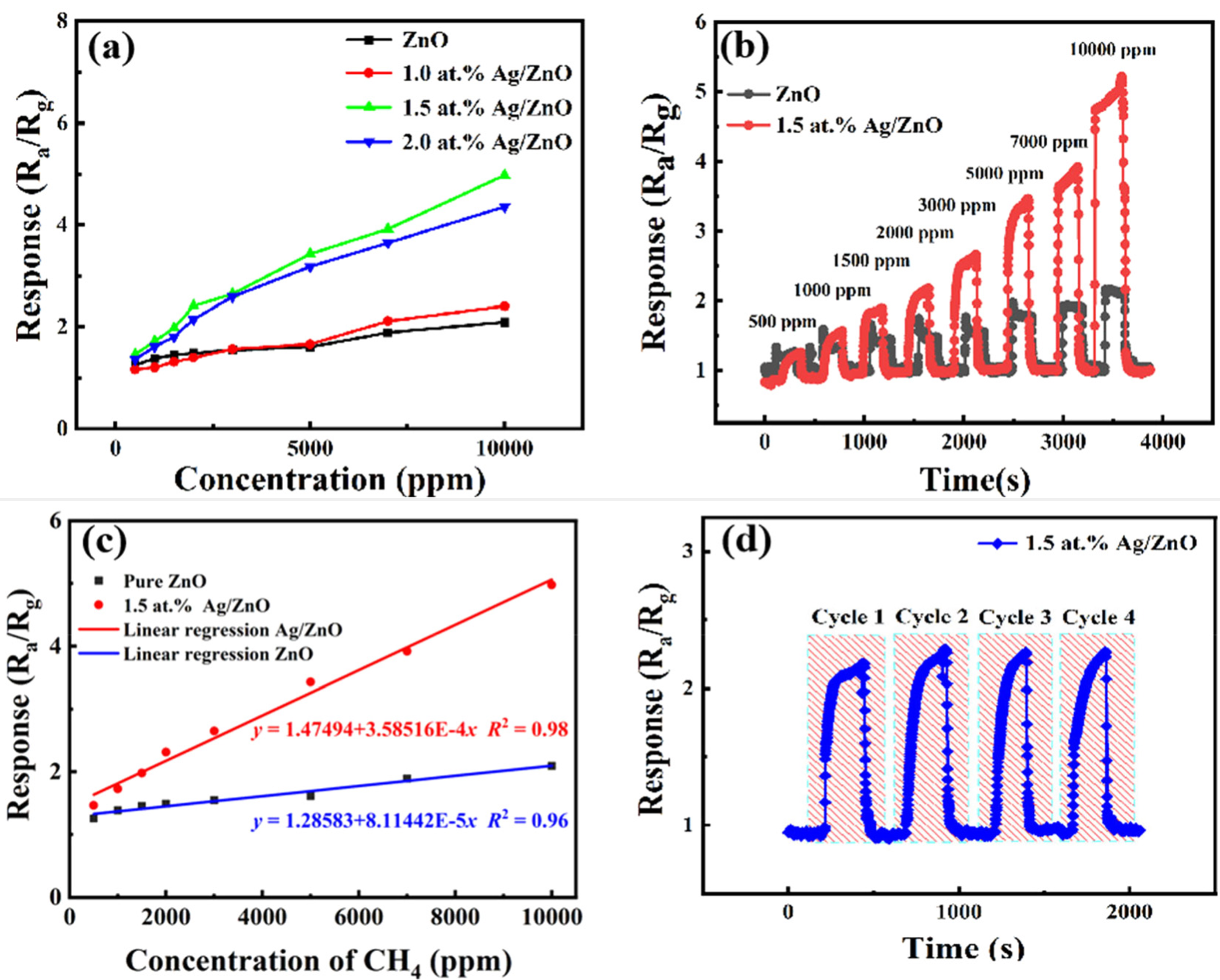
- (4)
- Tungsten Oxide (WO3)
- (5)
- Vanadium Oxide (V2O5)
3.2. p-Type MO
- (1)
- Nickel Oxide (NiO)
- (2)
- Cupper Oxide (Cu2O, CuO)
- (3)
- Cobalt Oxide (Co3O4)
3.3. Quantitative Comparison of Representative CH4 Sensors
4. MO Carbon Monoxide Gas Sensors
4.1. n-Type MO
- (1)
- Indium oxide (In2O3)
- (2)
- Tin oxide (SnO2)
- (3)
- Zinc oxide (ZnO)

- (4)
- Tungsten Oxide (WO3)
- (5)
- Vanadium Oxide (V2O5)
4.2. p-Type MO
- (1)
- Nickel Oxide (NiO)
- (2)
- Copper Oxide (Cu2O, CuO)

- (3)
- Cobalt Oxide (Co3O4)
4.3. Quantitative Comparison of Representative CO Sensors
| Material/Architecture | CO Test Concentration | Operating T | Reported Response (and Definition) | LOD | Response/Recovery | Practical Observation | Reference |
|---|---|---|---|---|---|---|---|
| Nanocrystalline In2O3 thin film | 50 ppm | 350 °C | S = Ra/Rg = 589 | --- | 7/8 s | High response and fast kinetics; reported selectivity | [99] |
| Au/In2O3 | 10 ppm | 50 °C | S = Ra/Rg = 5.59 | --- | --- | Low-temperature noble-metal modification | [102] |
| SnO2/PANI/Pd | 100 ppm | Room T | S = Ra/Rg = 4.19 | --- | 52/41 s | Ambient operation; methane and CO2 interference tests reported | [105] |
| ZnO nanoparticles | 80 ppm | 250 °C | S (%) = 74% (Ra/Rg) | --- | 21/70 s | One-month stability reported | [109] |
| Ag-ZnO/MoS2 | 1–1500 ppm | Room T | S = Ra/Rg (high sensitivity) | --- | 45–60/40–50 s | Broad range; selectivity tests reported | [110] |
| WO3−x 2D nanosheets | 10 ppm | --- | S (%) = 94% (resistance increase) | --- | --- | Unconventional response; phase-separated oxide | [111] |
| V2O5 thin film | 10–500 ppm | 100 °C | Resistance modulation (~25.5 MΩ) | --- | --- | Low-temperature detection | [114] |
| NiSb2O6 | 1–300 ppm | 300 °C | S = Ra/Rg (~0.35 at 300 ppm) | --- | --- | Alarm circuit demonstrated at 50 ppm | [116] |
| NiO/activated carbon | up to 100 ppm | 100 °C | S (%) = improved vs. NiO | --- | Faster than pristine NiO | Composite lowers operating temperature | [117] |
| NiO/Co3O4 heterocomposite | CO | 150 °C | S (%) = ~150% | --- | --- | p-p heterojunction and porous architecture | [119] |
| CuO nanotubes | 50–1000 ppm | 175 °C | S = 2.73 × 10⁻³ ppm−1 | 0.6 ppm | <1 min | Better than CuO nanocubes; morphology/facet effect | [121] |
| Mo-doped Co3O4 | 100 ppm | 200 °C | S = Rg/Ra = 136 | --- | 78.5/55.3 s | 50.4× pristine Co3O4; anti-humidity performance reported | [127] |
5. Approaches for Key Problems of Metal Oxide Sensors
5.1. Approaches to Reduce Operating Temperature of Metal Oxide Sensors
5.1.1. Morphological Engineering and Nanostructuring
5.1.2. Noble Metal Catalytic Modification
5.1.3. Heterostructure Formation and Interface Engineering
5.1.4. Light-Assisted Sensing
5.1.5. UV and Plasma-Assisted Synthesis
5.2. Approaches to Enhance Selectivity of Metal Oxide Sensors in Complex Coal Mine Environments
5.2.1. Catalytic Filters and Chemical Selectivity Layers
5.2.2. Temperature Modulation and Pulsed Heating
5.2.3. Sensor Arrays and Electronic Nose Systems
5.2.4. Machine Learning and Pattern Recognition
5.2.5. Multi-Modal Sensing Approaches
5.2.6. Selectivity Challenges for Specific Mine Interferents
5.2.7. Practical Implementation Considerations
5.3. Oxygen Compensation Strategies for Mine Deployment
5.3.1. Hardware-Based Compensation
5.3.2. Software-Based Compensation
5.3.3. Operational Protocols
5.4. How to Select a Sensor for Mine Use
5.5. Future Perspectives: From Materials to Intelligent Mine-Safety Systems
6. Conclusions and Perspectives
Author Contributions
Funding
Data Availability Statement
Conflicts of Interest
Abbreviations
| Abbreviation | Full Form |
| AC | Activated Carbon |
| AFM | Atomic Force Microscopy |
| ANN | Artificial Neural Network |
| BET | Brunauer–Emmett–Teller |
| CFD | Computational Fluid Dynamics |
| CMOS | Complementary Metal-Oxide Semiconductor |
| CNC | Coral-like Nanochain |
| CO | Carbon Monoxide |
| CVD | Chemical Vapor Deposition |
| DFT | Density Functional Theory |
| DOS | Density of States |
| DRIFTS | Diffuse Reflectance Infrared Fourier Transform Spectroscopy |
| EDL | Electron Depletion Layer |
| EDS | Energy-Dispersive X-ray Spectroscopy |
| FESEM | Field Emission Scanning Electron Microscopy |
| GIXRD | Grazing Incidence X-ray Diffraction |
| HAL | Hole Accumulation Layer |
| HOMO-LUMO | Highest Occupied Molecular Orbital–Lowest Unoccupied Molecular Orbital |
| HRTEM | High-Resolution Transmission Electron Microscopy |
| IoT | Internet of Things |
| LOD | Limit of Detection |
| MEMS | Microelectromechanical System |
| MO | Metal Oxide |
| MOF | Metal–Organic Framework |
| MOS | Metal Oxide Semiconductor |
| PANI | Polyaniline |
| PCA | Principal Component Analysis |
| PLAL | Pulsed Laser Ablation in Liquid |
| PNR | Porous Nanorod |
| rf | Radio Frequency |
| RH | Relative Humidity |
| SCS | Solution Combustion Synthesis |
| SEM | Scanning Electron Microscopy |
| SMT | Semiconductor-to-Metal Transition |
| SPR | Surface Plasmon Resonance |
| SVM | Support Vector Machine |
| TEM | Transmission Electron Microscopy |
| TPD | Temperature-Programmed Desorption |
| TPS | Temperature-Programmed Sensing |
| TVO | Titanium-Vanadium Oxide |
| UV | Ultraviolet |
| VOC | Volatile Organic Compound |
| XPS | X-ray Photoelectron Spectroscopy |
| XRD | X-ray Diffraction |
References
- Mousavi, S.; Ghasemi, E. Integrating Safety and Sustainability in Coal, Gold, and Surface Mining: A Review of Risks, Technologies, and Management Practices. J. Environ. Prot. 2024, 15, 1045–1064. [Google Scholar] [CrossRef]
- Nieto, A.; Al-Ashaab, A.; Dogru, S. Computational risk modeling of underground coal mines based on NIOSH employment demographics. Saf. Sci. 2023, 165, 106199. [Google Scholar] [CrossRef] [Scilit]
- Karamati, M.; Ardejani, F.D.; Asadi, A. Assessing environmental health impacts of coal mining exploitation in Iran. Environ. Monit. Assess. 2023, 195, 1482. [Google Scholar] [CrossRef]
- Li, X.; Wang, J.; Zhang, J. A Dynamic Safety Risk Assessment Model for Underground Coal Mines Considering Complex Environment and Coupling Effects. Process Saf. Environ. Prot. 2022, 164, 412–426. [Google Scholar] [CrossRef] [Scilit]
- Ma, D.; Qin, B.; Zhong, X.; Sheng, P.; Yin, C. Effect of flammable gases produced from spontaneous smoldering combustion of coal on methane explosion in coal mines. Energy 2023, 279, 128125. [Google Scholar] [CrossRef] [Scilit]
- Beamish, B.B.; Arisoy, A. Effect of coal properties on the generation of carbon monoxide during low-temperature oxidation. Int. J. Coal Geol. 2010, 84, 167–173. [Google Scholar] [CrossRef] [Scilit]
- Li, J.; Liang, Y.; Zhang, J.; Wang, L. Experimental study on the structural destruction and toxic gas generation from coupled methane-coal dust explosions. J. Hazard. Mater. 2020, 384, 121390. [Google Scholar] [CrossRef] [Scilit] [PubMed]
- Yuan, L.; Smith, A.C. Experimental study on CO and CO2 emissions from spontaneous heating of coals at varying temperatures and O2 concentrations. J. Loss Prev. Process Ind. 2013, 26, 1321–1327. [Google Scholar] [CrossRef] [Scilit] [PubMed]
- Karacan, C.Ö.; Ruiz, F.A.; Cotè, M.; Schwoebel, S. Coal mine methane: A review of capture and utilization technologies with focus on mine ventilation air safety. Int. J. Coal Geol. 2011, 86, 121–138. [Google Scholar] [CrossRef] [Scilit]
- Cao, Y.; Zhang, B.; Wang, G. Methane gas outburst and explosion hazard classification using a fusion safety model in Chinese coal fields. Nat. Hazards 2015, 79, 1125–1142. [Google Scholar] [CrossRef]
- Kundu, S.; Zanganeh, J.; Moghtaderi, B. Review of explosion suppression systems for preventing methane flame propagation in underground networks. Process Saf. Prog. 2016, 35, 378–390. [Google Scholar] [CrossRef] [Scilit]
- Saidu, L.; Ajayi, O. Computational fluid dynamics (CFD) modeling of hazardous methane accumulation in blind headings of deep mines. Process Saf. Environ. Prot. 2022, 159, 812–825. [Google Scholar] [CrossRef] [Scilit]
- Available online: https://www.news.cn/local/20260526/15ad6314e5ce4f61acc1b507121a7db8/c.html (accessed on 18 August 2026).
- Wang, F.; Ji, Z.; Wang, H.; Chen, Y.; Wang, T.; Tao, R.; Su, C.; Niu, G. Analysis of the Current Status and Hot Technologies of Coal Spontaneous Combustion Warning. Processes 2023, 11, 2480. [Google Scholar] [CrossRef] [Scilit]
- Deng, J.; Wang, X.; Xiao, Y.; Shu, C.M. Determination of the critical temperature and index gases of coal spontaneous combustion through step-wise oxidation experiments. Energy Fuels 2017, 31, 3611–3619. [Google Scholar] [CrossRef]
- Song, Z.; Kuenzer, C. Coal fires in China: Overviews and monitoring updates using early warning indicator gases like carbon monoxide. Environ. Earth Sci. 2014, 71, 1345–1361. [Google Scholar] [CrossRef]
- Cevik, B.; Unver, B. The prediction of the risks of spontaneous combustion in underground coal mines using a fault tree analysis method. Sci. Rep. 2024, 14, 18520. [Google Scholar] [CrossRef]
- Wang, J.; Xuan, C.; Feng, Y. Historical data analysis and disaster patterns of large-scale gas explosions in China’s mining sector. J. Loss Prev. Process Ind. 2022, 76, 104746. [Google Scholar] [CrossRef] [Scilit] [PubMed]
- Zhai, X.; Wang, K.; Khan, F. Numerical simulation of the interaction between methane emission and spontaneous coal combustion in longwall gobs. Combust. Sci. Technol. 2021, 193, 1544–1565. [Google Scholar] [CrossRef]
- Li, Z.; Chu, T.; Wang, J. Assessment of Graham’s ratio and alternative gas indicators for monitoring early-stage spontaneous oxidation of low-rank coal. Fuel 2019, 254, 115610. [Google Scholar] [CrossRef] [Scilit]
- Li, Y.; Ma, Y.; Zheng, C.; Yu, D.; Hu, L.; Yang, S.; Song, F.; Li, Y.; Liu, S.; Zhang, Z.; et al. Near-infrared wide-range dual-gas sensor system for simultaneous detection of methane and carbon monoxide in coal mine environment. Spectrochim. Acta Part A Mol. Biomol. Spectrosc. 2023, 309, 123581. [Google Scholar] [CrossRef] [Scilit] [PubMed]
- Muduli, L.; Mishra, D.P.; Pal, P.K. Airborne hazardous gas monitoring in underground coal mines using wireless sensor networks: A review. Process Saf. Environ. Prot. 2018, 116, 1–14. [Google Scholar] [CrossRef] [Scilit]
- Cheng, J.; Yang, S.; Luo, Y. Analysis of methane risk accumulation and the dual-threat mechanics of fire-gas coupling in deep underground coal mines. Saf. Sci. 2018, 108, 99–109. [Google Scholar] [CrossRef] [Scilit]
- Cheng, B.; Zhao, S.; Wang, S.; Chen, J. Lightweight Mashup Middleware for Coal Mine Safety Monitoring and Control Automation. IEEE Trans. Autom. Sci. Eng. 2017, 14, 1245–1255. [Google Scholar] [CrossRef]
- Qiang, Y.; Yang, W. Application of optical fiber sensors for methane and carbon monoxide gas monitoring in smart coal mines. IEEE Sens. J. 2021, 21, 15522–15531. [Google Scholar] [CrossRef]
- Wang, J.; Cheng, J.; Feng, Y. Early-warning monitoring system of toxic and explosive gases in gob areas based on transient tube-bundle data. Saf. Sci. 2020, 123, 104562. [Google Scholar] [CrossRef] [Scilit]
- Zhou, F.; Sun, Y.; Li, M. Multi-gas indicator models for forecasting coupled hazards of gas explosions and inner-gob structural fires. Fire Saf. J. 2021, 121, 103289. [Google Scholar] [CrossRef] [Scilit]
- Giri, S.; Shanker, U.; Kumar, A. IoT-enabled real-time warning framework for CH4 and CO accumulation at the coal face. Int. J. Min. Sci. Technol. 2023, 33, 489–501. [Google Scholar] [CrossRef] [Scilit]
- Li, Y.; Liu, L.; Zhao, L.; Zhang, X.; Zhang, L.; Sun, J.; Huan, H.; Liang, Y.; Zhang, J.; Shao, X.; et al. Compact and full-range carbon dioxide sensor using photoacoustic and resonance dependent modes. Photoacoustics 2024, 41, 100669. [Google Scholar] [CrossRef] [Scilit] [PubMed]
- Shaalan, N.M.; Rashad, M.; Abdel-Rahim, M.A. Repeatability of indium oxide gas sensors for detecting methane at low temperature. Mater. Sci. Semicond. Process. 2016, 56, 260–264. [Google Scholar] [CrossRef] [Scilit]
- Sun, Z.; Liu, X.; Wang, Q.; Zhang, J. Research progress of temperature and pressure compensation method of industrial environment gas sensor. Phys. Fluids 2025, 37, 051301. [Google Scholar] [CrossRef] [Scilit]
- Spinelle, L.; Gerboles, M.; Kok, G.; Bryant, S.; Aleixandre, M. Review of Portable and Low-Cost Sensors for the Ambient Monitoring of Air Pollutants. Sensors 2015, 15, 15618–15647. [Google Scholar] [CrossRef]
- Xue, Y.; Wang, J.; Liang, Y. Research on Methane Measurement and Interference Factors in Coal Mines. Sensors 2022, 22, 5702. [Google Scholar] [CrossRef] [Scilit] [PubMed]
- Zhang, L.; Wang, Y.; Khan, F.; Zhou, F. Recent advances in laser gas sensors for applications to safety monitoring in intelligent coal mines. Front. Phys. 2022, 10, 1058475. [Google Scholar] [CrossRef] [Scilit]
- Patil, A.G.; Pramanick, B.; Madhukar, A. MOS Based Gas Sensors for Monitoring of Air Pollution: A Review. IEEE Sens. J. 2025, 25, 9250–9262. [Google Scholar] [CrossRef] [Scilit]
- Ding, Y. Semiconductor-based combustible gas sensors for the petrochemical industry: A review. Nanoscale 2026, 18, 3412–3430. [Google Scholar] [CrossRef] [Scilit] [PubMed]
- Ponzoni, A.; Baratto, C.; Cattabiani, N.; Falasconi, M.; Galstyan, V.; Nunez-Carmona, E.; Rigoni, F.; Sberveglieri, V.; Zambotti, G.; Zappa, D. Metal Oxide Gas Sensors, a Survey of Selectivity Issues Addressed at the SENSOR Lab, Brescia (Italy). Sensors 2017, 17, 714. [Google Scholar] [CrossRef] [Scilit] [PubMed]
- Capone, S.; Forleo, A.; Francioso, L.; Rella, R.; Siciliano, P.; Spadavecchia, J.; Presicce, D.S.; Taurino, A.M. Solid State Gas Sensors: State of The Art and Future Activities. J. Optoelectron. Adv. Mater. 2003, 5, 1335–1348. [Google Scholar]
- Wang, Q. Review of semiconductor metal oxide-based CO sensor technology. J. Adv. Mater. 2025, 42, 112–128. [Google Scholar] [CrossRef]
- Zhang, Y. Recent progress in low-power-consumption metal oxide semiconductor gas sensors for hazardous environments. Materials 2024, 17, 4864. [Google Scholar] [CrossRef]
- Goel, N.; Kunal, K.; Kushwaha, A.; Kumar, M. Metal oxide semiconductors for gas sensing. Eng. Rep. 2022, 5, e12604. [Google Scholar] [CrossRef] [Scilit]
- Sarf, F. Metal Oxide Gas Sensors by Nanostructures. In Gas Sensors; IntechOpen: London, UK, 2020. [Google Scholar] [CrossRef] [Scilit]
- Chen, R.; Lin, S.; Wang, Z.; Xia, Y.; Xiang, L. Metal oxide semiconductor-based methane sensing. Carbon Future 2025, 3, 9200037. [Google Scholar] [CrossRef] [Scilit]
- Wang, Q.; Ren, X.; Li, S.; Cai, H.; Chen, X.; Wang, J. Semiconductor metal oxide-based methane sensors. J. Mater. Sci. 2026, 61, 9146–9171. [Google Scholar] [CrossRef] [Scilit]
- Li, J.; Na, E.; Liang, X.; Liang, Q.; Fan, M.; Chen, H.; Li, G.-D.; Zou, X. Surface oxygen chemistry of metal oxide semiconductors for gas-sensing applications. Inorg. Chem. Front. 2024, 11, 8602–8626. [Google Scholar] [CrossRef]
- Jiang, Y.; Fan, Y.; Li, S.; Tang, Z. Photocatalytic Methane Conversion: Insight into the Mechanism of C(sp3)–H Bond Activation. CCS Chem. 2023, 5, 30–54. [Google Scholar] [CrossRef] [Scilit]
- Xie, C.; Sun, E.; Wan, G.; Zheng, J.; Gupta, R.; Majumdar, A. Transport Mediating Core–Shell Photocatalyst Architecture for Selective Alkane Oxidation. Nano Lett. 2023, 23, 2039–2045. [Google Scholar] [CrossRef] [Scilit] [PubMed]
- Dadkhah, M.; Tulliani, J.M. Nanostructured Metal Oxide Semiconductors towards Greenhouse Gas Detection. Chemosensors 2022, 10, 57. [Google Scholar] [CrossRef] [Scilit]
- Franke, M.E.; Koplin, T.J.; Simon, U. Metal oxide semiconductor-based methane sensing. Small 2005, 2, 36–50. [Google Scholar] [CrossRef] [Scilit] [PubMed]
- Zhang, J.; Qin, Z.; Zeng, D.; Xie, C. Metal-oxide-semiconductor based gas sensors: Screening, preparation, and integration. Phys. Chem. Chem. Phys. 2017, 19, 6313–6329. [Google Scholar] [CrossRef] [Scilit] [PubMed]
- Majhi, S.M.; Mirzaei, A.; Kim, H.W.; Kim, S.S. Reduced Graphene Oxide (rGO)-Loaded Metal-Oxide Nanofiber Gas Sensors: An Overview. Sensors 2021, 21, 1352. [Google Scholar] [CrossRef] [Scilit] [PubMed]
- Zhang, S.; Zhang, H.; Yao, H.; Wang, P.; Zhu, M.; Shi, X.; Xu, S. Recent Advances in Metal Oxide Semiconductor Heterojunctions for the Detection of Volatile Organic Compounds. Chemosensors 2024, 12, 244. [Google Scholar] [CrossRef] [Scilit]
- Li, J.; Zhao, H.; Wang, Y.; Zhou, Y. Approaches for selectivity improvement of conductometric gas sensors: An overview. Sens. Diagn. 2024, 3, 336–353. [Google Scholar] [CrossRef] [Scilit]
- Chizhov, A.S.; Rumyantseva, M.N.; Gaskov, A.M. Light-activated semiconductor gas sensors: Pathways to improve sensitivity and reduce energy consumption. Front. Chem. 2025, 13, 1538217. [Google Scholar] [CrossRef] [Scilit] [PubMed]
- Fu, L.; You, S.; Li, G.; Li, X.; Fan, Z. Application of Semiconductor Metal Oxide in Chemiresistive Methane Gas Sensor: Recent Developments and Future Perspectives. Molecules 2023, 28, 6710. [Google Scholar] [CrossRef] [Scilit] [PubMed]
- Hübner, M.; Simion, C.E.; Tomescu-Stănoiu, A.; Pokhrel, S.; Mädler, L.; Barsan, N.; Weimar, U. Influence of morphology on the sensing performance of p-type CuO thick film gas sensors. Sens. Actuators B Chem. 2011, 153, 347–353. [Google Scholar] [CrossRef] [Scilit]
- Saboor, S.; Umar, M.; Hassan, S. Growth Processing and Strategies: A Way to Improve the Gas Sensing Performance of Nickel Oxide-Based Devices. Chemosensors 2024, 12, 45. [Google Scholar] [CrossRef] [Scilit]
- Yao, R.; Xia, Y.; Yang, L.; Xiang, J.; Zhao, Q.; Guo, S. Noble Metal Functionalized Metal Oxide Semiconductors for Enhanced Gas Sensing. Molecules 2025, 30, 4683. [Google Scholar] [CrossRef] [Scilit] [PubMed]
- Kato, H.; Shin, W.; Nishibori, M. Low-Concentration Methane Detection in Air Using Pt- and Pd-Modified SnO2 Nanocrystals: Role of Lattice Oxygen and Distinct Sensitization Mechanisms. ACS Appl. Electron. Mater. 2026, 8, 1422–1434. [Google Scholar] [CrossRef] [Scilit]
- Rahman, M.H.; Rahaman, M.Z.; Chowdhury, E.H.; Motalab, M.; Hossain, A.K.M.A.; Roknuzzaman, M. Understanding the role of rare-earth metal doping on the electronic structure and optical characteristics of ZnO. Mol. Syst. Des. Eng. 2022, 7, 1516–1528. [Google Scholar] [CrossRef] [Scilit]
- Gartner, M. Towards Advanced Materials: Functional Perspectives of Co-Doped ZnO Thin Films. Micromachines 2025, 12, 1033. [Google Scholar] [CrossRef] [Scilit] [PubMed]
- Vázquez-López, A.; Bartolomé, J.; Cremades, A.; Maestre, D. High-Performance Room-Temperature Conductometric Gas Sensors: Materials and Strategies. Chemosensors 2022, 10, 227. [Google Scholar] [CrossRef] [Scilit]
- Quan, W.; Hu, X.; Min, X.; Qiu, J.; Tian, R.; Ji, P.; Qin, W.; Wang, H.; Pan, T.; Cheng, S.; et al. A highly sensitive and selective ppb-level acetone sensor based on a Pt-doped 3D porous SnO2 hierarchical structure. Sensors 2020, 20, 1150. [Google Scholar] [CrossRef] [Scilit] [PubMed]
- Imran, M.; Motta, N.; Shafiei, M. Electrospun one-dimensional nanostructures: A new horizon for gas sensing materials. Beilstein J. Nanotechnol. 2018, 9, 2128–2170. [Google Scholar] [CrossRef] [Scilit] [PubMed]
- Choi, K.J.; Jang, H.W. One-Dimensional oxide nanostructures as gas-sensing materials: Review and issues. Sensors 2010, 10, 4083–4099. [Google Scholar] [CrossRef] [Scilit] [PubMed]
- Zhang, H.; Chen, W.G.; Li, Y.Q.; Jin, L.F.; Cui, F.; Song, Z.H. 3D flower-like NiO hierarchical structures assembled with size-controllable 1D blocking units: Gas sensing performances towards acetylene. Front. Chem. 2018, 6, 472. [Google Scholar] [CrossRef] [Scilit] [PubMed]
- Ji, H.; Zeng, W.; Li, Y. Gas sensing mechanisms of metal oxide semiconductors: A focus review. Nanoscale 2019, 11, 22664–22684. [Google Scholar] [CrossRef] [Scilit] [PubMed]
- Shooshtari, M.; Salehi, A. An electronic nose based on carbon nanotube–titanium dioxide hybrid nanostructures for detection and discrimination of volatile organic compounds. Sens. Actuators B Chem. 2022, 357, 131418. [Google Scholar] [CrossRef] [Scilit]
- Korotcenkov, G. Practical aspects in design of conductometric metal oxide gas sensors: A review. Sens. Actuators B Chem. 2007, 121, 664–678. [Google Scholar] [CrossRef] [Scilit]
- Shooshtari, M.; Salehi, A.; Vollebregt, S. Effect of temperature and humidity on the sensing performance of TiO2 nanowire-based ethanol vapor sensors. Nanotechnology 2021, 32, 325501. [Google Scholar] [CrossRef] [Scilit] [PubMed]
- Xue, D.P.; Zhang, S.S.; Zhan, Z.Y. Hydrothermal synthesis of methane sensitive porous In2O3 nanosheets. Mater. Lett. 2019, 252, 169–172. [Google Scholar] [CrossRef] [Scilit]
- Zuo, X.; Yang, Z.; Kong, J.; Han, Z.; Zhang, J.; Meng, X.; Hao, S.; Wu, L.; Wu, S.; Liu, J.; et al. Imbedding Pd Nanoparticles into Porous In2O3 Structure for Enhanced Low-Concentration Methane Sensing. Sensors 2023, 23, 1163. [Google Scholar] [CrossRef] [Scilit] [PubMed]
- Kgomo, M.B.; Shingange, K.; Nemufulwi, M.I.; Swart, H.; Mhlongo, G. Belt-like In2O3 based sensor for methane detection: Influence of morphological, surface defects and textural behavior. Mater. Res. Bull. 2023, 158, 112076. [Google Scholar] [CrossRef] [Scilit]
- Zhang, Y.J.; Cao, J.L.; Wang, Y. Ultrahigh methane sensing properties based on Ni-doped hierarchical porous In2O3 microspheres at low temperature. Vacuum 2022, 202, 111149. [Google Scholar] [CrossRef] [Scilit]
- Wang, Y.; Sun, X.Y.; Cao, J.L. Enhanced methane sensing performance of Ag modified In2O3 microspheres. J. Alloys Compd. 2022, 895, 162557. [Google Scholar] [CrossRef] [Scilit]
- Haridas, D.; Gupta, V. Enhanced response characteristics of Pd clusters loaded SnO2 thin film based sensors for methane detection. Sens. Actuators B Chem. 2012, 166–167, 156–164. [Google Scholar] [CrossRef] [Scilit]
- Xue, D.P.; Wang, Y.; Cao, J.L.; Sun, G.; Zhang, Z. Improving methane gas sensing performance of flower-like SnO2 decorated by WO3 nanoplates. Talanta 2019, 199, 603–611. [Google Scholar] [CrossRef] [Scilit] [PubMed]
- Jiao, M.Z.; Dong, H.J.; Qiao, Y.T.; Guo, R.Q.; Hung, C.M.; Duy, N.V.; Hoa, N.D.; Wen, C.Y. Accurate Methane Detection in Combustible Gas Mixtures by Using SnO2-Ag-ZnO Gas Sensors with Rapid Responses. ACS Sens. 2026, 11, 290–298. [Google Scholar] [CrossRef] [Scilit] [PubMed]
- Sun, X.Y.; Zhu, L.H.; Qin, C.; Cao, J.; Wang, Y. Room-temperature methane sensors based on ZnO with different exposed facets: A combined experimental and first-principle study. Surf. Interfaces 2023, 38, 102823. [Google Scholar] [CrossRef] [Scilit]
- Sen, T.; Mishra, S.; Sonawane, S.S.; Shimpi, N.G. Polyaniline/zinc oxide nanocomposite as room-temperature sensing layer for methane. Polym. Eng. Sci. 2018, 58, 1438–1445. [Google Scholar] [CrossRef] [Scilit]
- Li, M.W.; Sun, X.Y.; Wang, Y.H.; Qin, C.; Cao, J.L.; Wang, Y. Light-driven room temperature methane gas sensor based on Ag modified flower-like ZnO microsphere. Sens. Diagn. 2023, 2, 878. [Google Scholar] [CrossRef]
- Gul, M.; Amin, M.; Abbas, M.; Ilyas, S.Z.; Shah, N.A. Synthesis and characterization of magnesium doped ZnO nanostructures: Methane (CH4) detection. J. Mater. Sci. Mater. Electron. 2019, 30, 5257–5265. [Google Scholar] [CrossRef] [Scilit]
- Bhattacharyya, P.; Basu, P.K.; Mondal, B.; Saha, H. A low power MEMS gas sensor based on nanocrystalline ZnO thin films for sensing methane. Microelectron. Reliab. 2008, 48, 1772–1779. [Google Scholar] [CrossRef] [Scilit]
- Jaroenapibal, P.; Sukbua, W.; Triroj, N. Impedance Spectroscopic Analysis of Methane Sensing Characteristics in Electrospun Tungsten Oxide Nanofibers with Particle Size Heterogeneity. ACS Omega 2025, 10, 4927–4939. [Google Scholar] [CrossRef] [Scilit] [PubMed]
- Feng-Chen, S.; Aldalbahi, A.; Feng, P.X. Nanostructured Tungsten Oxide Composite for High-Performance Gas Sensors. Sensors 2015, 15, 27035–27046. [Google Scholar] [CrossRef] [Scilit] [PubMed]
- Mounasamy, V.; Mani, G.K.; Ponnusamy, D.; Tsuchiya, K.; Reshma, P.; Prasad, A.K.; Madanagurusamy, S. Investigation on CH4 sensing characteristics of hierarchical V2O5 nanoflowers operated at relatively low temperature using chemiresistive approach. Anal. Chim. Acta 2020, 1106, 148–160. [Google Scholar] [CrossRef] [Scilit] [PubMed]
- Baladeh, S.A.; Haratizadeh, H. Selective Methane gas sensing at low temperatures using hydrothermally synthesized V2O5 nanorods. Mater. Sci. Eng. B 2025, 321, 118554. [Google Scholar] [CrossRef] [Scilit]
- Liang, J.; Liu, J.; Li, N.; Li, W. Magnetron sputtered Au-decorated vanadium oxides composite thin films for methane-sensing properties at room temperature. J. Alloys Compd. 2016, 671, 283–290. [Google Scholar] [CrossRef] [Scilit]
- Liang, J.; Liu, J.; Li, W.; Hu, M. Preparation and room temperature methane sensing properties of platinum-decorated vanadium oxide films. Mater. Res. Bull. 2016, 84, 332–339. [Google Scholar] [CrossRef] [Scilit]
- Prasad, A.K.; Amirthapandian, S.; Dhara, S.; Murali, N.; Tyagi, A. Novel single phase vanadium dioxide nanostructured films for methane sensing near room temperature. Sens. Actuators B Chem. 2014, 191, 252–256. [Google Scholar] [CrossRef] [Scilit]
- Chellamuthu, P.; Savarimuthu, K.; Krishnamoorthy, R.; Yuvaraj, T.; Bajaj, M.; Rubanenko, O. Performance comparison of CTAB-modified NiO, ZnO, and SnO sensors for CO and CH detection in environmental and health applications. Sci. Rep. 2025, 16, 3989. [Google Scholar] [CrossRef] [Scilit] [PubMed]
- Gagaoudakis, E.; Michail, G.; Katerinopoulou, D.; Moschovis, K.; Iliopoulos, E.; Kiriakidis, G.; Binas, V.; Aperathitis, E. Transparent p-type Ni:Al thin films as room temperature hydrogen and methane gas sensors. Mater. Sci. Semicond. Process. 2020, 109, 104922. [Google Scholar] [CrossRef] [Scilit]
- Zhang, S.S.; Zhang, B.W.; Zhang, B.; Wang, Y.; Bala, H.; Zhang, Z. Structural evolution of NiO from porous nanorods to coral-like nanochains with enhanced methane sensing performance. Sens. Actuators B Chem. 2021, 334, 129645. [Google Scholar] [CrossRef] [Scilit]
- Jayatissa, A.H.; Samarasekara, P.; Kun, G. Methane gas sensor application of cuprous oxide synthesized by thermal oxidation. Phys. Status Solidi 2009, 206, 332–337. [Google Scholar] [CrossRef] [Scilit]
- Shaalan, N.M.; Rashad, M.; Abdel-Rahim, M.A. CuO nanoparticles synthesized by microwave-assisted method for methane sensing. Opt. Quantum Electron. 2016, 48, 531. [Google Scholar] [CrossRef] [Scilit]
- Chesler, P.; Anastasescu, M.; Calderon-Moreno, J.M.; Gheorghe, M.; Gartner, M. Methane Sensing Properties of CoO and CuO Based Chemiresistors with Low Working Temperature. Gels 2022, 8, 721. [Google Scholar] [CrossRef] [Scilit] [PubMed]
- Smagulova, G.T.; Imash, A.A.; Mukatayeva, Z.S.; Zhumabayev, M.; Efremov, V.; Mansurov, Z. PANI/Co3O4 nanocomposite for room-temperature CH4 and CO sensing. FirePhysChem 2026. [Google Scholar] [CrossRef] [Scilit]
- Mehrabadi, Z.S.; Ahmadpour, A.; Shahtahmasebi, N.; Mohagheghi, M.M.B. Synthesis and characterization of Cu doped cobalt oxide nanocrystals as methane gas sensors. Phys. Scr. 2011, 84, 015801. [Google Scholar] [CrossRef] [Scilit]
- Patil, S.B.; More, M.A.; Patil, D.Y.; Ezema, F.I.; Patil, G.E. Studies on a chemiresistive gas sensor based on sol–gel grown nanocrystalline In2O3 thin film for fast carbon monoxide detection. Mater. Lett. 2025, 382, 137882. [Google Scholar] [CrossRef] [Scilit]
- Sun, Y.J.; Suematsu, K.; Watanabe, K.; Nishibori, M.; Hu, J.; Zhang, W.; Shimanoe, K. Determination of effective oxygen adsorption species for CO sensing based on electric properties of indium oxide. J. Electrochem. Soc. 2018, 165, B275–B280. [Google Scholar] [CrossRef] [Scilit]
- Zhang, D.Z.; Wu, J.F.; Cao, Y.H. Cobalt-doped indium oxide/molybdenum disulfide ternary nanocomposite toward carbon monoxide gas sensing. J. Alloys Compd. 2019, 777, 443–453. [Google Scholar] [CrossRef] [Scilit]
- Malara, A.; Donato, A.; Leonardis, S.G.; Neri, G.; Bonaccorsi, L.; Donato, N. UV Light Enhanced CO Sensing Performance of In2O3 at Low Temperature. Sensors 2019, 19, 2367. [Google Scholar] [CrossRef] [Scilit] [PubMed]
- Kolmakov, A.; Zhang, Y.; Cheng, G.; Moskovits, M. Detection of CO and O2 using tin oxide nanowire sensors. Adv. Mater. 2003, 15, 997–1000. [Google Scholar] [CrossRef] [Scilit]
- Ambardekar, V.; Bhowmick, T.; Bandyopadhyay, P.P.; Majumder, S. Understanding on the effect of morphology towards the hydrogen and carbon monoxide sensing characteristics of tin oxide sensing elements. Int. J. Hydrogen Energy 2021, 46, 23113–23123. [Google Scholar] [CrossRef] [Scilit]
- Kishnani, V.; Verma, G.; Pippara, R.K.; Yadav, A.; Chauhan, P.S.; Gupta, A. Highly sensitive, ambient temperature CO sensor using tin oxide based composites. Sens. Actuators A Phys. 2021, 332, 113111. [Google Scholar] [CrossRef] [Scilit]
- Long, H.; Harley-Trochimczyk, A.; He, T.; Pham, T.; Tang, Z.; Shi, T.; Zettl, A.; Mickelson, W.; Carraro, C.; Maboudian, R. In Situ Localized Growth of Porous Tin Oxide Films on Low Power Microheater Platform for Low Temperature CO Detection. ACS Sens. 2016, 1, 318–324. [Google Scholar] [CrossRef] [Scilit]
- Schipani, F.; Villegas, E.A.; Ramajo, L.A.; Parra, R. Zinc oxide thin films for a room temperature dual carbon dioxide and carbon monoxide sensor. J. Mater. Sci. Mater. Electron. 2023, 34, 1092. [Google Scholar] [CrossRef] [Scilit]
- Utari, L.; Septiani, N.L.W.; Suyatman; Nugraha; Nur, L.O.; Wasisto, H.S.; Yuliarto, B. Wearable Carbon Monoxide Sensors Based on Hybrid Graphene/ZnO Nanocomposites. IEEE Access 2020, 8, 49169–49179. [Google Scholar] [CrossRef] [Scilit]
- Munguia-Martin, M.P.; Sanchez-Campos, D.; Mendoza-Anaya, D.; Karthik, T.V.K.; Villasenor-Ceron, L.S.; Reyes-Valderrama, M.I.; Rodriguez-Lugo, V. Zinc oxide behavior in CO detection as a function of thermal treatment time. J. Phys. Commun. 2024, 8, 095002. [Google Scholar] [CrossRef]
- Zhang, D.Z.; Sun, Y.E.; Jiang, C.X.; Yao, Y.; Wang, D.; Zhang, Y. Room-temperature highly sensitive CO gas sensor based on Ag-loaded zinc oxide/molybdenum disulfide ternary nanocomposite and its sensing properties. Sens. Actuators B Chem. 2017, 253, 1120–1128. [Google Scholar] [CrossRef] [Scilit]
- Hossain, M.; Chatterjee, K.; Mohanty, K.; Tarafder, K.; Sen, S.; Kundu, S.; Varrla, E.; Satpati, B.; Pal, P. Unconventional Gas Sensing Mechanism in Phase-Separated n-Type Mixed Tungsten Oxide 2D-Nanosheets Compared against Tungsten (VI) Oxide. Small 2026, 22, e2513074. [Google Scholar] [CrossRef] [Scilit] [PubMed]
- Syaahiran, M.A.; Mahadi, A.H.; Lim, C.M.; Kooh, M.R.R.; Chau, Y.-F.C.; Chiang, H.-P.; Thotagamuge, R. Theoretical Study of CO Adsorption Interactions with Cr-Doped Tungsten Oxide/Graphene Composites for Gas Sensor Application. ACS Omega 2022, 7, 528–539. [Google Scholar] [CrossRef] [Scilit] [PubMed]
- Marikutsa, A.; Yang, L.; Rumyantseva, M.; Batuk, M.; Hadermann, J.; Gaskov, A. Sensitivity of nanocrystalline tungsten oxide to CO and ammonia gas determined by surface catalysts. Sens. Actuators B Chem. 2018, 277, 336–346. [Google Scholar] [CrossRef] [Scilit]
- Yepuri, V.; Kumar, A.R.; Gopichand, A. Sol–gel spin-coated vanadium oxide thin films for carbon monoxide gas sensing. J. Mater. Sci. Mater. Electron. 2026, 37, 835. [Google Scholar] [CrossRef] [Scilit]
- Ashok, A.; Acosta, D.; Fragoso-Medina, A.J.; Camarillo, E.; Olvera, M. Synthesis of titanium-vanadium oxide thin films through thermal oxidation process for their use in CO gas sensing application. Opt. Mater. 2024, 157, 116246. [Google Scholar] [CrossRef] [Scilit]
- Li, M.; Tang, J.; Luo, Y.; Yang, J.; Liu, K.; Liu, Z.; Fang, Y. Controllable preparation of imine-based nanofilms towards ozone detection and removal. Sens. Actuators B Chem. 2023, 390, 133947. [Google Scholar] [CrossRef] [Scilit]
- Khaleed, A.A.; Bello, A.; Dangbegnon, J.K.; Momodu, D.; Madito, M.; Ugbo, F.; Akande, A.; Dhonge, B.; Barzegar, F.; Olaniyan, O.; et al. Effect of activated carbon on the enhancement of CO sensing performance of NiO. J. Alloys Compd. 2017, 694, 155–162. [Google Scholar] [CrossRef] [Scilit]
- Nagarajan, V.; Chandiramouli, R. NiO nanocone as a CO sensor: DFT investigation. Struct. Chem. 2014, 25, 1765–1771. [Google Scholar] [CrossRef] [Scilit]
- Ivan, A.S.; Georgina, G.P.; Norberto, H.C.; Mayahuel, O.-A. Synthesis, characterization, and CO sensing properties of NiO thin film for commercial aircraft applications. J. Phys. Conf. Ser. 2024, 2804, 012003. [Google Scholar] [CrossRef] [Scilit]
- Wei, W.; Zhang, H.H.; Tao, T.Y.; Xia, X.H.; Bao, Y.W.; Lourenço, M.; Homewood, K.; Huang, Z.B.; Gao, Y. A CuO/TiO2 Heterojunction Based CO Sensor with High Response and Selectivity. Energy Environ. Mater. 2023, 6, e12570. [Google Scholar] [CrossRef] [Scilit]
- Hou, L.; Zhang, C.M.; Li, L.; Du, C.; Li, X.; Kang, X.-F.; Chen, W. CO gas sensors based on p-type CuO nanotubes and CuO nanocubes: Morphology and surface structure effects on the sensing performance. Talanta 2018, 188, 41–49. [Google Scholar] [CrossRef] [Scilit] [PubMed]
- Steinhauer, S.; Brunet, E.; Maier, T.; Mutinati, G.; Köck, A.; Freudenberg, O.; Gspan, C.; Grogger, W.; Neuhold, A.; Resel, R. Gas sensing properties of novel CuO nanowire devices. Sens. Actuators B Chem. 2013, 187, 50–57. [Google Scholar] [CrossRef] [Scilit]
- Oosthuizen, D.N.; Motaung, D.E.; Swart, H.C. Selective detection of CO at room temperature with CuO nanoplatelets sensor for indoor air quality monitoring manifested by crystallinity. Appl. Surf. Sci. 2019, 466, 545–553. [Google Scholar] [CrossRef] [Scilit]
- Nguyen, T.D.; Nguyen, C.D.; Van Hieu, N.; MacLachlan, M.J. Mesoporous cobalt tungsten oxide heterostructured nanotoroids. Adv. Mater. Interfaces 2018, 5, 1800269. [Google Scholar] [CrossRef] [Scilit]
- Vladimirova, S.; Krivetskiy, V.; Rumyantseva, M.; Gaskov, A.; Mordvinova, N.; Lebedev, O.; Martyshov, M.; Forsh, P. Co3O4 as p-Type Material for CO Sensing in Humid Air. Sensors 2017, 17, 2216. [Google Scholar] [CrossRef] [Scilit] [PubMed]
- Alheshibri, M.; Shaalan, N.M.; Drmosh, Q.A.; Al Baroot, A.; Akhtar, S.; Aljaafari, A.; Al Qahtani, H.S.; Elsayed, K. Tailoring the surface morphology of nanostructured cobalt oxide for high-sensitivity CO sensor. J. Mater. Sci. 2022, 57, 12865–12874. [Google Scholar] [CrossRef] [Scilit]
- Hussain, S.; Begi, A.N.; Amu-Darko, J.N.O.; Yusuf, K.; Manavalan, R.K.; Iqbal, A.; Zhang, X.; Qiao, G.; Liu, G. MOF-derived Mo-doped Co3O4, A hierarchical yeast-like structure for superior carbon monoxide sensing. Sens. Actuators B Chem. 2024, 420, 136489. [Google Scholar] [CrossRef] [Scilit]
- Wang, J.; Zhang, L.; Chen, X. Nanostructured metal oxide semiconductors for low-temperature gas sensing: A review. Sens. Actuators B Chem. 2023, 394, 134456. [Google Scholar] [CrossRef] [Scilit]
- Kim, H.J.; Lee, J.H. Highly sensitive and selective gas sensors using p-type oxide semiconductors: Overview. Sens. Actuators B Chem. 2020, 305, 127495. [Google Scholar] [CrossRef] [Scilit]
- Qiao, L.; Liu, Y.; Zhang, Y. Plasma-enhanced metal oxide gas sensors: Recent advances and perspectives. ACS Appl. Mater. Interfaces 2025, 17, 18456–18475. [Google Scholar] [CrossRef]
- Yoon, J.W.; Kim, J.S.; Kim, T.H.; Hong, Y.J.; Kang, Y.C.; Lee, J.H. A new strategy for humidity independent oxide chemiresistors: Dynamic self-refreshing of In2O3 sensing surface assisted by layer-by-layer coated CeO2. Nano Lett. 2020, 20, 8723–8730. [Google Scholar] [CrossRef]
- Zhang, Y.; Zhang, H.; Wang, Y. Plasma treatment for enhanced gas sensing performance of metal oxide nanostructures. J. Mater. Chem. A 2024, 12, 4734–4748. [Google Scholar] [CrossRef]
- Zhang, J.; Liu, X. Challenges and opportunities in low-temperature metal oxide gas sensors. Nat. Rev. Mater. 2022, 7, 245–257. [Google Scholar] [CrossRef]
- Wang, C.; Yin, L.; Zhang, L.; Xiang, D.; Gao, R. Metal oxide gas sensors: Sensitivity and influencing factors. Sensors 2020, 10, 2088–2106. [Google Scholar] [CrossRef] [Scilit] [PubMed]
- Wang, S.; Liu, Z.; Li, X. Catalytic filters for gas sensor selectivity enhancement: A review. Chem. Rev. 2023, 123, 9385–9432. [Google Scholar] [CrossRef]
- Liu, Y.; Chen, J.; Gao, F. Platinum-based catalytic filters for selective gas detection. ACS Catal. 2022, 12, 3021–3035. [Google Scholar] [CrossRef] [Scilit]
- Lee, J.S.; Kang, D. Zeolite-based gas sensors: Selectivity enhancement through molecular sieving. Sens. Actuators B Chem. 2021, 348, 130685. [Google Scholar] [CrossRef] [Scilit]
- Kida, T.; Shimanoe, K.; Yamazoe, N. Temperature-programmed sensing for gas discrimination in metal oxide sensors. ACS Sens. 2020, 5, 2345–2353. [Google Scholar] [CrossRef]
- Zhang, Y.; Li, J. Pulse heating mode for enhanced selectivity in metal oxide gas sensors. IEEE Sens. J. 2023, 23, 5678–5689. [Google Scholar] [CrossRef]
- Barsan, N.; Weimar, U. Metal oxide gas sensors: From fundamentals to applications. Chem. Rev. 2021, 121, 5789–5832. [Google Scholar] [CrossRef]
- Shooshtari, M.; Salehi, A. Electronic nose for gas discrimination: Principal component analysis and machine learning approaches. Sens. Actuators B Chem. 2022, 62, 131798. [Google Scholar] [CrossRef] [Scilit]
- Wang, C.; Chen, X.; Zhang, Y. Deep learning for gas sensor array pattern recognition: A review. IEEE Trans. Neural Netw. Learn. Syst. 2024, 35, 4678–4695. [Google Scholar] [CrossRef]
- Shooshtari, M.; Salehi, A. Feature extraction for machine learning in gas sensing applications. Sens. Actuators B Chem. 2023, 389, 133987. [Google Scholar] [CrossRef] [Scilit]
- Mirzaei, A.; Kim, H.W.; Kim, S.S. Dual-parameter sensing for enhanced gas discrimination in metal oxide sensors. ACS Sens. 2021, 6, 2467–2478. [Google Scholar] [CrossRef]
- Korotcenkov, G.; Cho, B.K. Selectivity of metal oxide semiconductor gas sensors: Strategies for improvement. Sens. Actuators B Chem. 2020, 321, 128525. [Google Scholar] [CrossRef] [Scilit]
- Zhang, L.; Gao, R. Selectivity enhancement of metal oxide sensors for NH3 detection: A comprehensive review. Sens. Actuators B Chem. 2022, 367, 132045. [Google Scholar] [CrossRef] [Scilit]
- Wang, Y.; Lee, J.H. H2S gas sensing with metal oxide semiconductors: Selectivity challenges and solutions. J. Mater. Chem. C 2023, 11, 2145–2163. [Google Scholar] [CrossRef]
- Zhang, S.; Liu, Y. VOC discrimination with metal oxide sensors: Temperature-programmed approaches. ACS Appl. Electron. Mater. 2024, 6, 1456–1468. [Google Scholar] [CrossRef]
- Chen, X.; Wang, J. NOx and SO2 interference in metal oxide gas sensors: Mechanisms and mitigation strategies. Environ. Sci. Technol. 2023, 57, 4892–4906. [Google Scholar] [CrossRef] [Scilit] [PubMed]
- Krivetskiy, V.; Rumyantseva, M. Gas sensor baseline drift: Mechanisms and compensation strategies for long-term stability. Sens. Actuators B Chem. 2022, 352, 131067. [Google Scholar] [CrossRef] [Scilit]
- Huang, J.; Wan, Q. Stability and reliability of metal oxide gas sensors: A comprehensive review. Chem. Rev. 2023, 123, 3789–3845. [Google Scholar] [CrossRef]
- Zou, Y.; Zhou, X. Digital twins for coal mine safety monitoring: Integration of gas sensors and mine models. IEEE Trans. Ind. Inform. 2024, 20, 1245–1256. [Google Scholar] [CrossRef]





| Technology | Strengths for Mine Monitoring | Main Limitations/Trade-Off |
|---|---|---|
| MOS chemiresistive | Low cost, compact, simple electrical readout, strong material tunability, compatible with arrays and MEMS/CMOS. | Cross-sensitivity, oxygen/humidity dependence, drift, and often elevated operating temperatures. |
| Electrochemical | Mature technology and useful selectivity for some gases; low-temperature operation. | Humidity/temperature sensitivity, finite electrolyte lifetime, and calibration/maintenance requirements. |
| Catalytic combustion/pellistor | Established methane-detection principle and direct relation to catalytic oxidation heat. | Catalyst poisoning/inhibition and heater-related power and safety considerations. |
| Optical/SPR | Fast optical response and potential high selectivity; can operate near room temperature. | More complex optical interrogation and packaging; not equivalent to a chemiresistive MOS device. |
| Photoacoustic | Strong spectroscopic selectivity and multi-gas capability. | Higher system complexity, optical/acoustic components, and power/cost considerations. |
| Material/Architecture | CH4 Test Concentration | Operating T | Reported Response (and Definition) | LOD | Response/Recovery | Practical Observation | Reference |
|---|---|---|---|---|---|---|---|
| Porous In2O3 nanosheets | 500 ppm | 190 °C | S = Ra/Rg (high, study-specific) | --- | --- | 30-day stability; porous structure | [71] |
| Porous In2O3 nanospheres | CH4 (study range) | 30 °C | S = Ra/Rg (normal response) | --- | --- | Response retained at 90% RH | [72] |
| Belt-like In2O3 | 90 ppm | 100 °C | S = Ra/Rg = 1.1 | --- | 36/44 s | Low-temperature operation | [73] |
| Ni-doped In2O3 | 200 ppm | 140 °C | S = Ra/Rg = 72.727 | --- | --- | Strong response enhancement vs. pristine In2O3 | [74] |
| Ag-doped In2O3 | 500 ppm | 120 °C | S = Ra/Rg = 27.5 | --- | --- | Lower operating temperature; >100% improvement vs. pristine In2O3 | [75] |
| WO3/SnO2 nanoflowers | 500 ppm | 110 °C | S = Ra/Rg (2.3× pristine SnO2) | 38 ppb | --- | Low LOD and heterojunction enhancement | [77] |
| ZnO sphere + UV | CH4 (reported concentrations) | Room T + UV | S = Ra/Rg (highest among tested ZnO morphologies) | --- | --- | Light-assisted sensing avoids continuous high-temperature heating | [79] |
| PANI/ZnO | 500 ppm | Room T | S = Ra/Rg (high response) | --- | 20 s response | Room-temperature hybrid sensor | [80] |
| V2O5 nanoflowers | 50 ppm | 100 °C | S (%) = 8% (Ra/Rg) | --- | --- | Low-temperature CH4 activation without noble metal | [86] |
| V2O5 nanorods | 4000 ppm | 50 °C | S (%) = 23% (Ra/Rg) | --- | Rapid | Low-temperature operation; reported selectivity | [87] |
| PANI/Co3O4 core–shell | 500 ppm | Room T | S (%) = 8.73% (Rg/Ra) | --- | --- | Room-temperature operation | [97] |
| NiO nanoflakes | 30 ppm | 225 °C | S = Rg/Ra = 46.53 | --- | 15/20 s | Linear response reported from 0.2 to 50 ppm | [91] |
Disclaimer/Publisher’s Note: The statements, opinions and data contained in all publications are solely those of the individual author(s) and contributor(s) and not of MDPI and/or the editor(s). MDPI and/or the editor(s) disclaim responsibility for any injury to people or property resulting from any ideas, methods, instructions or products referred to in the content. |
© 2026 by the authors. Licensee MDPI, Basel, Switzerland. This article is an open access article distributed under the terms and conditions of the Creative Commons Attribution (CC BY) license.
Share and Cite
Zhang, Q.; Fu, E.-S.; Yang, Z.; Tian, L.-X. A Review of Advancements in Metal Oxide Semiconductor Gas Sensors for Methane and Carbon Monoxide Towards Coal Mine Safety. Materials 2026, 19, 3808. https://doi.org/10.3390/ma19173808
Zhang Q, Fu E-S, Yang Z, Tian L-X. A Review of Advancements in Metal Oxide Semiconductor Gas Sensors for Methane and Carbon Monoxide Towards Coal Mine Safety. Materials. 2026; 19(17):3808. https://doi.org/10.3390/ma19173808
Chicago/Turabian StyleZhang, Qian, En-San Fu, Ze Yang, and Le-Xiao Tian. 2026. "A Review of Advancements in Metal Oxide Semiconductor Gas Sensors for Methane and Carbon Monoxide Towards Coal Mine Safety" Materials 19, no. 17: 3808. https://doi.org/10.3390/ma19173808
APA StyleZhang, Q., Fu, E.-S., Yang, Z., & Tian, L.-X. (2026). A Review of Advancements in Metal Oxide Semiconductor Gas Sensors for Methane and Carbon Monoxide Towards Coal Mine Safety. Materials, 19(17), 3808. https://doi.org/10.3390/ma19173808