Performance of Recycled Concrete Aggregate and Reclaimed Asphalt Pavement in Concrete: A Systematic Review of Mechanical, Physical, and Durability Characteristics
 ,
,  , and
, and
Abstract
1. Introduction
2. Research Significance
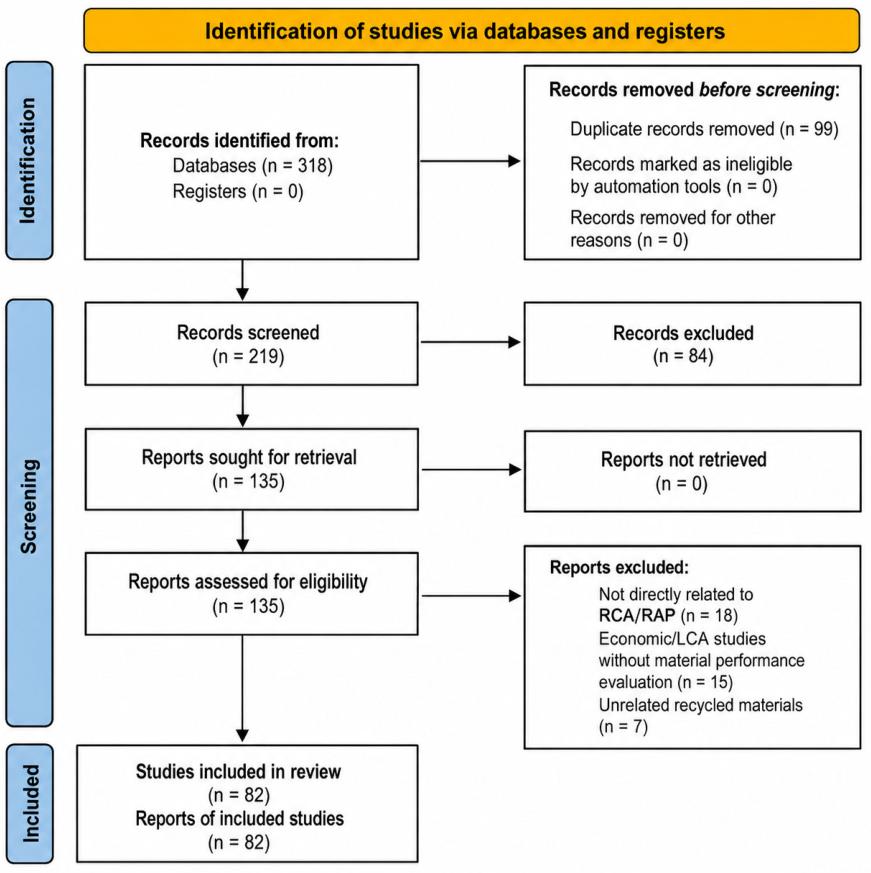
3. Methodology
4. Study Selection and Characteristics of the Included Studies
5. Properties of Recycled Concrete Aggregate (RCA) and Reclaimed Asphalt Pavement (RAP)
6. Effect of RCA and RAP on Concrete’s Mechanical and Structural Behavior
6.1. Compressive Strength
6.2. Tensile Strength
6.3. Flexural Strength
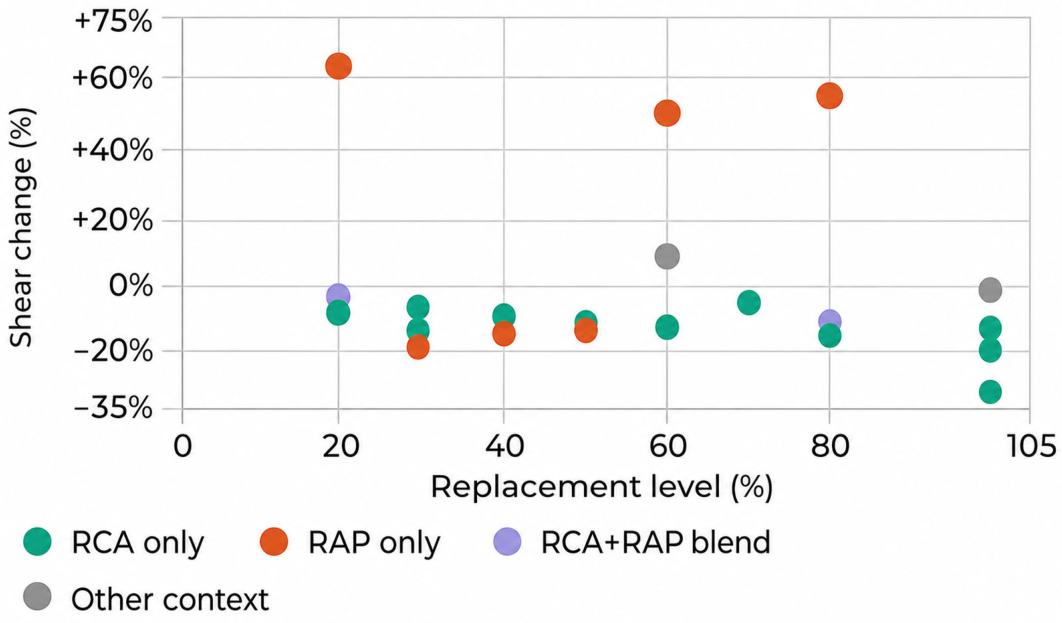
6.4. Shear Strength
6.5. Bond Strength
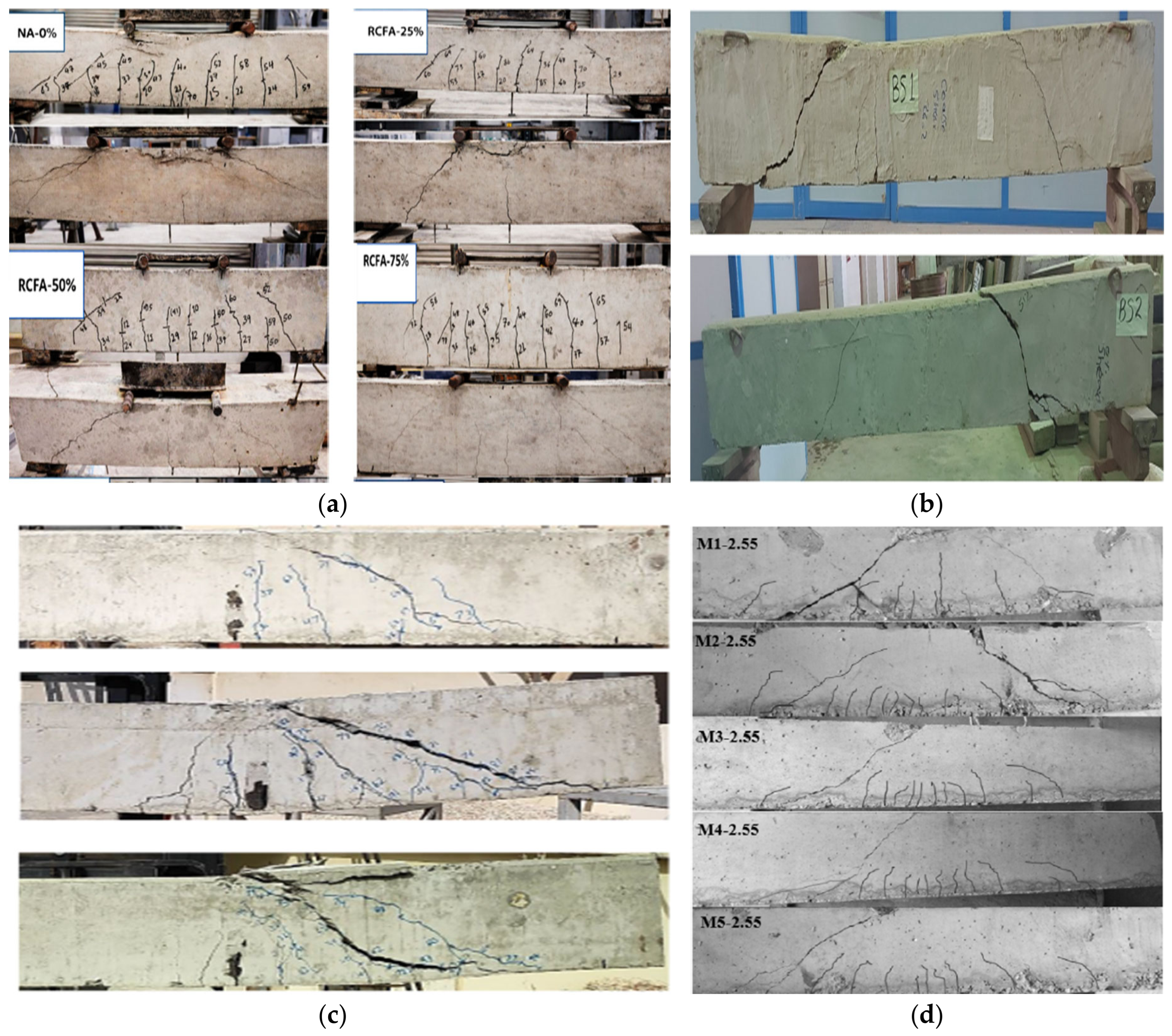
6.6. Failure Mode
6.7. Elastic Modulus
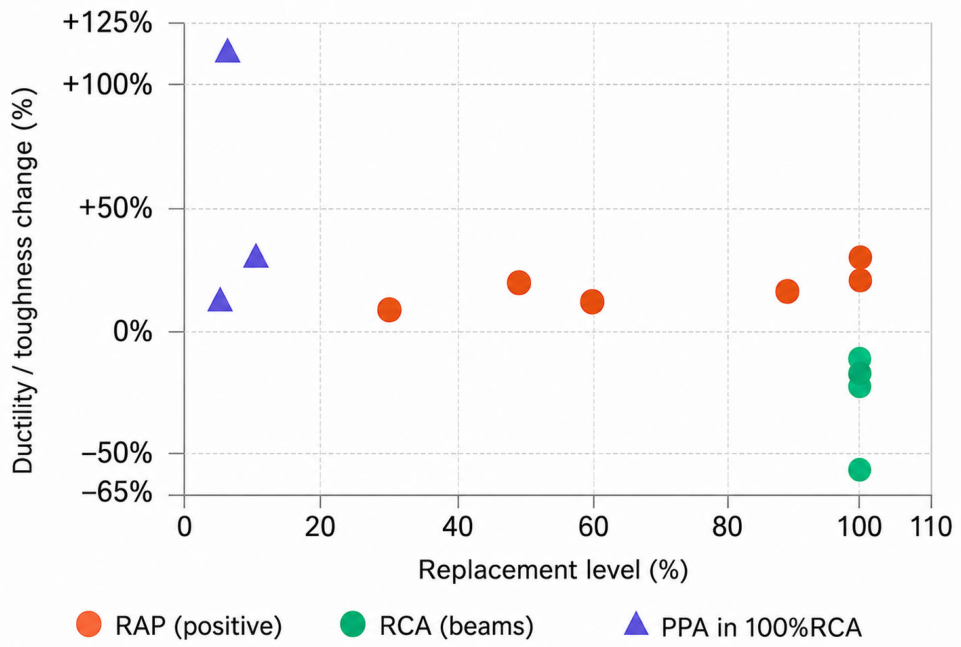
6.8. Ductility and Energy Absorption
7. Effect of RCA and RAP on Concrete’s Physical and Durability Properties
7.1. Workability
7.2. Water Absorption
7.3. Porosity
7.4. Freezing and Thawing Resistance
8. Mechanism-Targeted Effectiveness of Enhancement Strategies
9. Sustainability and Environmental Impact
9.1. CO2 Reduction and Environmental Impact
9.2. Life Cycle Assessment (LCA)
9.3. Cost-Effectiveness and Economic Savings
9.4. Statistical Heterogeneity and Synthesis Limitations
10. Conclusions
- Full RCA replacement can reduce compressive strength by up to 26%, while splitting tensile strength reductions range from 3 to 14% at 20% replacement and reach 26% (CRAP) to higher magnitudes for full FRAP substitution; the magnitude scales consistently with replacement ratio and is governed by ITZ degradation rather than aggregate strength loss alone.
- Combined RCA–RAP beams incurred 55–65% flexural capacity loss relative to conventional concrete, substantially exceeding the loss observed for either material individually, indicating a non-additive interaction between the two ITZ degradation mechanisms rather than a simple superposition of effects.
- 100% RCA replacement reduced shear cracking strength by 14.5% and ultimate shear capacity by comparable margins across independent studies (12–17.3%), while 100% RAP–RCA combinations produced shear-axial interactions not observed in either single-material system.
- Fiber reinforcement reversed these losses at specific dosages: hooked-end steel fibers at 0.60% Vf restored and exceeded baseline shear capacity by 156% (3D fibers) and 136.7% (4D fibers), while CFRP U-wraps increased shear capacity by 36% in RCA-deficient beams—demonstrating that mechanical penalties from recycled aggregate are recoverable through targeted, quantifiable interventions rather than requiring replacement-ratio limits alone.
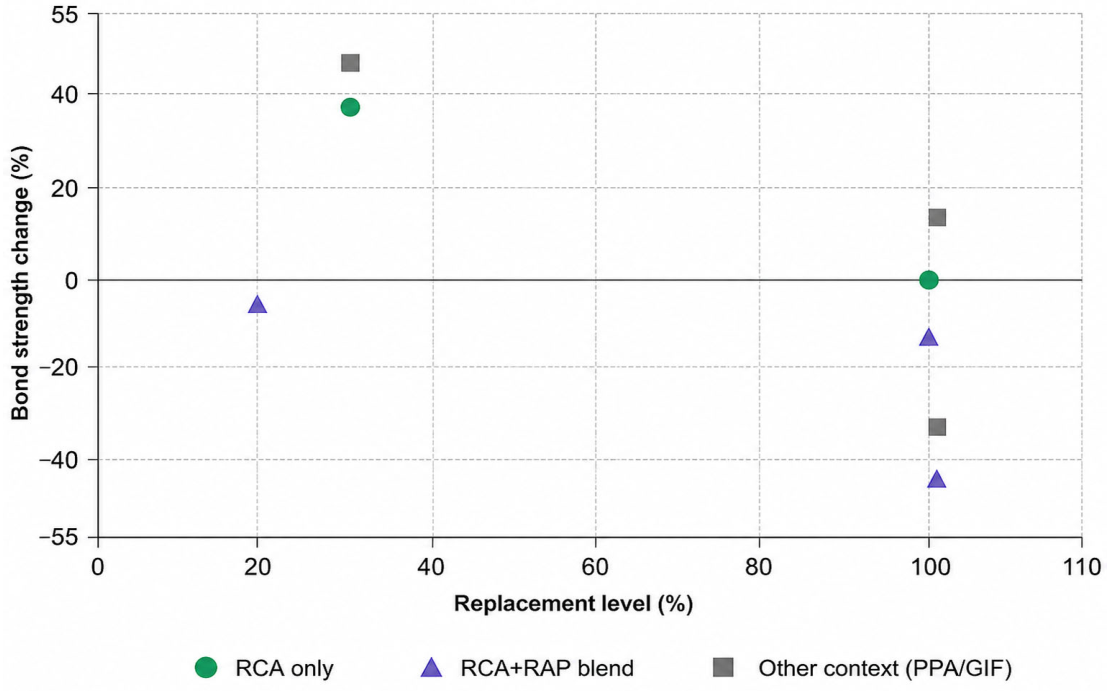
- Bond strength with reinforcement is replacement-ratio non-monotonic: 30% RCA mixes exceeded both 0% and 50% RCA bond strength by up to 37.3%, indicating an optimum RCA fraction exists rather than a uniform degradation trend, a finding with direct design-code implications for minimum cover and development length provisions.
- Environmental benefits are substantial but application-dependent: RCP substitution for cement reduced carbon footprint by up to 61.7% at 75% replacement, while RAP–PCC pavement systems achieved 10.90% lower total economic impact and human health non-cancer impact reductions of 37.87% versus plain PCC—benefits that are structurally distinct from, and should not be conflated with, the mechanical performance trade-offs above.
- Machine learning models (XGBoost, gradient boosting) predicted shear and bond strength of RAC beams with accuracies exceeding 95%, suggesting these tools are approaching design-ready reliability for recycled aggregate systems where empirical formulas remain limited.
11. Research Gaps and Future Directions
- The long-term durability performance of structural elements made with high-content RCA or RAP under real service conditions remains insufficiently characterized. Most experimental studies are limited to short-term mechanical testing under controlled laboratory conditions, with few investigations examining multi-decade performance, creep, shrinkage evolution, and fatigue under cyclic loading.
- The behavior of combined RCA and RAP in concrete mixes is an emerging area that has received limited systematic study. The interaction between asphalt-coated particles and mortar-coated aggregates within the same matrix may introduce complex ITZ configurations that differ fundamentally from those observed in single-material replacement scenarios.
- The influence of source variability on material consistency presents a major challenge to standardization. RCA quality varies significantly depending on the source concrete strength, demolition method, and degree of mortar removal. Similarly, RAP characteristics are highly influenced by pavement age, traffic loading, binder grade, and milling technique. Developing robust quality control protocols and standardized characterization methods for both materials is critical for broader adoption in structural applications.
- The development of treatment and enhancement methods such as accelerated carbonation, surface washing, polymer impregnation, and silane treatment tailored specifically for use with RCA and RAP in combination offers fertile ground for future research. Such methods, if optimized, could unlock the potential of these recycled materials for structural applications while meeting sustainability targets.
Supplementary Materials
Author Contributions
Funding
Data Availability Statement
Acknowledgments
Conflicts of Interest
Abbreviations
| RCA | Recycled Concrete Aggregate |
| RAP | Reclaimed Asphalt Pavement |
| SF | Steel Fiber |
| CNF | Carbon Nano-Fibers |
| ITZ | Interfacial Transition Zone |
| UHPC | Ultra-High-Performance Concrete |
| NA | Natural Aggregate |
| UCRCA | Uncarbonated Recycled Concrete Aggregate |
| CRCA | Carbonated Recycled Concrete Aggregate |
| ACRCA | Accelerated Carbonation Recycled Concrete Aggregate |
| RAC | Recycled Aggregate Concrete |
| NAC | Natural Aggregate Concrete |
| LCA | Life Cycle Assessment |
| GHG | Greenhouse Gas |
| RCCP | Roller-Compacted Concrete Pavement |
| GFRP | Glass Fiber-Reinforced Polymer |
| CFRP | Carbon Fiber-Reinforced Polymer |
| SEM | Scanning Electron Microscopy |
| DIC | Digital Image Correlation |
Appendix A

| Ref. No. | Author (s) (Year) | Variables | Tested Parameter | Investigation | Output |
|---|---|---|---|---|---|
| [1] | Abdel-Jaber et al. (2026) | Recycled coarse and fine aggregate (RCFA) replacement ratio; exposure temperature. | RCFA replacement ratio: 0%, 25%, 50%, 75%, 100%. Temperature: 23 °C, 400 °C, 600 °C. | Experimental and finite element investigation of the shear performance of reinforced concrete beams incorporating simultaneous recycled coarse and fine aggregates after fire exposure. | Ultimate shear capacity decreased by 6–10% with increasing RCFA content at room temperature and by up to ~22% after exposure to 600 °C. Moderate RCFA replacement (25–50%) preserved acceptable residual shear performance while improving ductility and energy absorption. |
| [2] | Soltanabadi and Behfarnia (2022) | RCA/RAP content (50–100%), deep beam shear strength, cracking patterns. | Shear capacity, energy absorption, cracking pattern. | Shear strength of deep beams containing natural coarse aggregates (NCAs), recycled concrete aggregates (RCAs), and recycled asphalt pavements (RAPs). | 100% RCA/RAP mix achieved equivalent shear strength to natural aggregate beams after mix design modifications. |
| [3] | Al Mahmoud et al. (2020) | Coarse and fine aggregate replacement ratio, crack propagation, shear load capacity. | Shear capacity, crack distribution, modulus of elasticity. | Shear behavior of reinforced concrete beams made from recycled coarse and fine aggregates. | Shear capacity reduced by 10–20% with higher RCA/RFA content. Crack widths were wider in recycled concrete beams. |
| [4] | Shi et al. (2018) | RAP content in PCC (0–100%), cost assessment, environmental footprint (CO2 emissions), social benefits (employment impact). | Economic savings, CO2 reduction, environmental benefits, material life cycle. | Performing a sustainability assessment of Portland cement concrete (PCC) pavement containing RAP aggregates using life cycle inventory analysis and economic input–output analysis. | RAP–PCC offers highest economic savings and CO2 reduction, making it a viable alternative to traditional pavement materials. |
| [5] | Rout et al. (2023) | Effects of RAP content on pavement mechanical strength, durability, microstructural stability, and its role in sustainable construction. | Strength, durability, microstructure properties. | Comprehensive and insightful evaluation of the utilization of RAP aggregates based on characterization, strength, durability, and microstructure properties along with life cycle analysis (LCA). | RAP shows potential for sustainable pavement applications, though strength reductions must be mitigated with additives or design adjustments. |
| [6] | Lu et al. (2024) | Bond-slip performance, concrete–rebar interface behavior, cyclic loading response. | Pull-out strength, bond stress, interfacial transition zone strength. | Dynamic performance of components constructed from recycled concrete incorporating aggregates modified by accelerated carbonation. | Accelerated carbonation improved bond-slip performance by 7.6% compared to untreated recycled concrete. |
| [7] | Huang et al. (2023) | Carbonated vs. uncarbonated RFA, hydration, mechanical properties, sustainability impact. | Pore refinement, shrinkage, cost-effectiveness, hydration kinetics. | Influence of carbonated recycled fine aggregate (RFA) on mechanical and microstructural performance of ultra-high-performance concrete (UHPC). This includes the changes in strength, hydration kinetics, RFA-to-paste interfacial microstructure, and pore structure with the use of carbonated RFA. | Carbonated RFA reduced autogenous shrinkage by 45% and enabled 5% reduction in global warming potential. |
| [8] | Zhou et al. (2024) | Carbonation modification levels, RCA replacement ratio (30–100%), shear strength, shear deflection. | Shear strength, shear deflection, diagonal crack width. | Examining the effects of carbonation modification on the shear performance of recycled aggregate concrete beams. | Carbonation modification improved RCA shear performance, but replacement ratios above 70% led to strength reduction. |
| [9] | Zhao et al. (2023) | Polypropylene fiber content, crack formation, peak load, drying shrinkage. | Peak load, crack width, drying shrinkage strain, mechanical properties. | Assessment of flexural response of RC beams and unrestrained shrinkage of fiber-reinforced high-volume fly ash-based no-aggregate concrete and self-compacting concrete. | Polypropylene fibers delayed first crack formation and improved peak load in no-aggregate concrete beams. |
| [10] | Luo et al. (2023) | Water-glass concentration, ITZ structure, durability, compressive strength. | ITZ bond strength, water absorption, flexural strength, fracture toughness. | The use of water glass to immerse silicomanganese slag (SS) was investigated as a method for optimizing the interfacial transition zone (ITZ) in ultra-high-performance concrete (UHPC). | Water glass treatment optimized ITZ, increasing mechanical strength and durability. |
| [11] | Sun et al. (2024) | RA treatment method, workability, strength, porosity, ITZ quality. | Compressive strength, flowability, flexural strength, nano-silica interaction. | the influence of modified RA on the workability, mechanical properties, and microstructure of ultra-high-performance concrete (UHPC). | Chemical treatment improved ITZ and enhanced UHPC performance with treated recycled aggregates. |
| [12] | Bhardwaj and Singh (2024) | Mineralogical characteristics of aggregates, asphalt binder aging, interfacial bond strength in cement–mortar systems. | Surface energy, bond strength, asphalt adhesion. | Analyzes the failure mechanisms of RAP-based concrete through surface-free energy concepts and interfacial bond strength testing. | Failure mechanisms in RAP–concrete varied with asphalt binder aging and aggregate mineralogy, influencing overall durability. |
| [13] | Abedalqader et al. (2021) | RAP/RCA replacement ratios, compressive strength, modulus of elasticity, stress–strain behavior. | Compressive strength, stress–strain curve, tensile strength, modulus of elasticity. | Influence of temperature on mechanical properties of recycled asphalt pavement aggregate and recycled coarse aggregate concrete. | RAP and RCA decreased mechanical properties at elevated temperatures, but performance remained acceptable for high-temp applications. |
| [14] | Alrajfi et al. (2021) | Shear capacity, temperature exposure, RCA/RAP content, crack propagation. | Shear strength, failure mode, deflection, residual strength at elevated temperatures. | The structural performance of RC beams made with natural aggregate (NA), recycled aggregate concrete (RAC), and reclaimed asphalt pavement concrete (RAP) under normal and elevated temperature. | Shear capacity of RCA beams was slightly lower than NAC beams, but RAP inclusion further reduced strength at elevated temperatures. |
| [15] | Arshad and Ahmed (2017) | RAP content (50% and 75%), RCA presence, resilient modulus variation, constrained modulus effects, cyclic strain response. | Resilient modulus, constrained modulus, accumulated strain, stress levels. | Investigating the feasibility of characterization of blended materials containing RAP with fresh granular materials and RCA to evaluate whether they are suitable for granular base/subbase layers of flexible pavements. | Higher RAP content increased resilient modulus but also led to greater residual strain accumulation. |
| [16] | Naser et al. (2022) | RAP/RCA content, asphalt mix stability, flow, volumetric properties, and optimum asphalt content. | Marshall stability, flow, volumetric properties. | The performance of hot mix asphalts (HMA) with RAP and RCA, in terms of their Marshall stability, flow, and volumetric properties, to verify their applicability as a replacement for the natural aggregate in the flexible pavement surface layers of HMA mixtures. | 75% RAP in asphalt improved stability; however, RCA content increased optimal asphalt content, affecting volumetric performance. |
| [17] | Peduzzi et al. (2023) | Bond strength, RCA percentage, galvanized iron fiber volume. | Bond strength, machine learning accuracy, mix optimization. | Improve the mechanical properties and bond behavior of natural aggregate concrete (NAC) and recycled aggregate concrete (RAC) by incorporating locally available galvanized iron fiber (GIF). | Machine learning models predicted bond strength with >95% accuracy. 0.5% GIF increased bond strength by 46.5%. |
| [18] | Debbarma et al. (2019) | RAP fraction type (coarse, fine, mixed), mechanical strength, water absorption, sulfate and chloride resistance. | Strength, porosity, sulfate/chloride resistance. | The optimum fraction of RAP (coarse, fine, and total) along with its optimum proportion (50% and 100%) for roller compacted concrete pavement (RCCP) mixes, based upon various fresh, mechanical, and durability properties. | 50% RAP maintained RCCP strength while reducing costs by 46%, but durability concerns in sulfate-rich environments remain. |
| [19] | Albidah (2023) | RAP percentage, compressive/flexural strength, strain at peak strength, temperature resistance at elevated exposure levels. | Compressive/flexural strength, strain at peak strength, temperature resistance. | The potential of producing metakaolin-based geopolymer concrete incorporating reclaimed asphalt pavement (RAP) aggregate of five concrete mixes with 0%, 25%, 50%, and 100% coarse RAP aggregate replacing the natural aggregate. | 25% RAP reduced strength by 42.8% but enhanced strain at peak strength, indicating improved ductility. |
| [20] | Karthikeyan et al. (2023) | Concrete durability, mechanical properties, sustainability aspects, feasibility of RAP substitution, environmental impacts. | Strength and durability metrics, cost-effectiveness of RAP in pavement. | Analyzing the potential, benefits, and limitations of using RAP in concrete pavement construction and assessing strength and durability parameters in comparison to conventional concrete. | Identified need for improving RAP concrete strength and durability. Further research required for optimizing mix designs. |
| [21] | Masi et al. (2022) | RAP particle size distribution, porosity, water absorption, durability under freezing–thawing cycles. | Water absorption, porosity, microstructure, freeze–thaw durability. | Physical properties, microstructure by microscopy, dimensional stability, and durability of reclaimed asphalt pavement (RAP) sourced from 5 different Italian collections. | RAP aggregates exhibited higher porosity but can be modified to meet concrete performance requirements. |
| [22] | Andrew et al. (2022) | RAP replacement ratio (0–60%), steel fiber content (0.5–2%), curing time (7–28 days), concrete workability, compressive strength. | Compressive strength, split tensile strength, workability, cost savings. | The mechanical performance of reclaimed asphalt pavement (RAP) along with steel fibers in concrete and the variation of mechanical behavior concerning different curing times with the optimal RAP aggregate substitute ratio. | Maximum RAP replacement ratio of 60% achieved 6.13% cost savings. Higher RAP content reduced workability due to asphalt coating effects. |
| [23] | Jaawani et al. (2021) | RAP content in structural concrete, compressive strength, flexural strength, Young’s modulus. | Compressive strength, durability, flexural strength. | Evaluating the limitations on the use of recycled asphalt pavement in structural concrete. | RAP concrete met structural standards but exhibited lower strength and durability limitations. |
| [24] | Abushanab and Alnahhal (2022) | Mixing water type, RCA ratio, fly ash content, flexural strength. | Flexural capacity, crack pattern, load-deflection behavior. | Flexural behavior of reinforced concrete beams prepared with treated wastewater, recycled concrete aggregates, and fly ash. | TWW and RCA decreased flexural capacity by 13.7% and 15.9%, respectively, while fly ash increased ductility and load capacity. |
| [25] | Shatarat et al. (2019) | Axial capacity, crack propagation, RCA/RAP ratio, theoretical vs. experimental results. | Axial load capacity, crack width, strain distribution, concrete mix properties. | The axial compressive behavior of fifteen reinforced concrete columns that were constructed from four types of aggregates: natural aggregate (NA), recycled asphalt pavement (RAP), recycled coarse aggregate (RCA), and RAP–RCA. | Columns with higher RAP and RCA content showed reduced axial capacity, but experimental values exceeded theoretical predictions. |
| [26] | Arabiyat et al. (2021) | Shear force, deflection, cracking pattern, RAP/RCA content. | Shear capacity, crack width, shear span-to-depth ratio. | Shear behavior of thirteen reinforced concrete (RC) beams made of recycled asphalt pavement (RAP) and recycled coarse aggregate (RCA). | RAP replacement reduced shear capacity, but RCA showed improved performance at lower replacement levels. |
| [27] | Rahardjo et al. (2013) | Particle size distribution, permeability, water-entry value, shear strength, porosity, compaction level. | Permeability, water retention, shear strength in saturated and unsaturated states. | Studying the unsaturated properties of RAP and RCA, including permeability, water characteristic curves, and shear strength, for potential geotechnical applications. | RAP has lower permeability and higher suction retention than natural aggregates, making it suitable for landfill covers and drainage layers. |
| [28] | Singh et al. (2018) | RAP content (50–100%), bagasse ash (10–15%), compressive strength, cost reduction, workability, durability improvement. | Workability, compressive and tensile strength, cement reduction efficiency. | Evaluating the feasibility of utilizing RAP aggregates mixed with sugarcane bagasse ash (BGA) for producing concrete, assessing mechanical and durability properties. | 10% bagasse ash in RAP concrete improved strength and reduced cost by 40% compared to conventional concrete. |
| [29] | Aldmour et al. (2023) | Load inclination angles, RCA percentage (60% vs. 100%), shear force-deflection behavior. | Biaxial shear capacity, load inclination impact, failure mode. | Examining the biaxial shear behavior of recycled concrete aggregate reinforced concrete beams. | 60% RCA and 40% NCA mix had higher shear capacity than 100% RCA under all load inclinations. |
| [30] | Hung et al. (2024) | pH range (3–11), DOC levels (low to high), liquid-to-solid (L/S) ratio (2–10), metal concentrations (Pb, Zn, Cu, Ni), compaction level. | Metal concentration in leachates, effect of pH and DOC on leaching behavior. | Metals leaching characteristics from RCA and RAP due to the variations in key influential factors of pH, dissolved organic carbon (DOC), compaction, and liquid to solid ratio (L/S). | Acidic conditions (pH < 5) increased metal leachability. Higher compaction reduced metal mobility in leachates. |
| [31] | Jayasinghe et al. (2023) | Shear strength, RCA replacement ratio, reinforcement type, beam geometry. | Shear capacity, machine learning prediction accuracy, SHAP analysis. | Using machine learning to predict the shear strength of recycled aggregate concrete beams with and without shear reinforcement. | XGBoost achieved 95% accuracy for slender beams and identified RCA replacement ratio as a minor factor in shear strength. |
| [32] | Elsayed et al. (2023) | RCA ratio (0–100%), aluminum fiber content (0–3%), WGP replacement (20%). | Load capacity, toughness, stiffness, ductility. | Structural performance of recycled coarse aggregate concrete beams containing waste glass powder and waste aluminum fibers. | Adding waste aluminum fibers improved ductility and load capacity. The optimal fiber content was 1%. |
| [33] | Imjai et al. (2023) | RCA replacement ratio, shear stress distribution, fracture mode. | Shear strength, push-off failure mode, FEM validation. | The shear behavior of recycled aggregate concrete (RAC) Z push-off specimens with different replacement levels of recycled concrete aggregate. | New equation predicted shear strength with 5% accuracy compared to experimental data. |
| [34] | Wang et al. (2023) | ECC layer height, shear-span ratio, interfacial bond strength, flexural performance. | Load-bearing capacity, failure mode, ECC contribution to flexural strength. | Flexural performance of 3D-printed composite beams with engineered cementitious composites (ECC) and recycled fine aggregate concrete. | ECC layer improved flexural strength, but bond strength of printed interfaces limited further improvements. |
| [35] | Sharaky et al. (2023) | Recycled aggregate replacement, steel fiber content, flexural strength, ductility. | Maximum displacement, flexural strength, strengthening efficiency. | the effect of steel fiber-reinforced concrete (SFRC) jacketing on the flexural performance of coarse recycled aggregate-reinforced concrete (CRARC) beams. | Strengthening with SFRC jackets significantly increased flexural capacity and ductility. |
| [36] | Shahjalal et al. (2023) | PPA percentage, bond strength, shear span-to-depth ratio, flexural toughness. | Ultimate moment capacity, ductility, bond strength, toughness. | Flexural and bond-slip responses of reinforced concrete beams containing recycled coarse aggregate and polypropylene plastic. | 5% PPA improved ultimate moment capacity by 28.6% and bond strength by 16.6%, but 10% PPA reduced performance. |
| [37] | Ferreira et al. (2024) | Slab–column connection type, RCA percentage, punching strength, flexural response. | Punching resistance, modulus of elasticity, tensile strength. | Investigating the punching strength of slab–column connections without shear reinforcement using recycled concrete aggregates. | RCA reduced modulus of elasticity and tensile strength but had little impact on punching resistance. |
| [38] | Xiamuxi et al. (2024) | RAP percentage, concrete production cost, sustainability factors. | RAP aggregate cost, structural viability, sustainability impact. | economic aspect of RAP aggregate, evaluating the costs associated with its production and comparing them with the ones necessary to produce A and recycled concrete aggregate (RCA). | RAP production cost was 155% higher than natural aggregate but could be reduced by up to 39.64% with optimized processing. |
| [39] | Imjai et al. (2024) | Beam reinforcement type (steel vs. GFRP), steel fiber content (0–1%), crack width, shear-induced deflection. | Load at first cracking, crack width, deflection, flexural capacity. | Analyzing deflections in high-content recycled aggregate concrete beams reinforced with GFRP bars and steel fibers. | Steel fibers increased first-crack load by 15–17%, and a new Eurocode-based equation improved deflection prediction accuracy. |
| [40] | Liu et al. (2022) | RAP content, stress–strain behavior, crack propagation, peak stress, peak strain, elastic modulus, energy absorption, and damage variable. | Workability, compressive strength, stress–strain behavior, elastic modulus, crack propagation, toughness index, and constitutive damage model parameters. | The mechanical properties of self-compacting concrete (SCC) with reclaimed asphalt pavement (RAP), SCC samples with RAP content of 0%, 30%, 60%, 90%, and 100% by weight. | Increase in RAP content resulted in reduced compressive strength and workability but improved crack resistance and energy absorption. The damage variable decreased with higher RAP content, improving flexibility. |
| [41] | Imjai et al. (2023) | Slab RCA content, deflections, crack width, shear-induced deformations. | Deflection, crack width, load-carrying capacity. | Serviceability behavior of FRP-reinforced slatted slabs made of high-content recycled aggregate concrete. | 100% RAC slabs exhibited 30% higher deflections than predicted by ACI 440.1R. The FEA model accurately simulated deformations. |
| [42] | Zheng et al. (2021) | Temperature exposure (200 °C–600 °C), RCA ratio (0–100%), shear strength. | Residual shear capacity, failure mode, stiffness loss. | Assessing the shear behavior of reinforced recycled aggregate concrete beams after exposure to temperatures up to 600 °C. | Shear capacity reduced by up to 40% at 600 °C. Existing design codes underestimated shear strength above 500 °C. |
| [43] | Costa et al. (2025) | Steel fiber content, recycled aggregate ratio, flexural behavior, ductility. | Flexural strength, crack width, post-cracking behavior. | Studying steel fiber-reinforced recycled aggregate concrete, using SFRRAC as a structural material, and its effect on post-cracking behavior and beam design. | Steel fiber reinforcement improved ductility and reduced crack widths. FEM-based model accurately predicted beam behavior. |
| [44] | Ashteyat et al. (2024) | Bond strength, load-slip behavior, steel bar diameter, RAP/RCA content. | Bond-slip response, pull-out force, steel bar diameter influence. | The bond strength behavior between steel and concrete made with recycled concrete aggregates (RCAs) and/or recycled asphalt pavement aggregates (RAPs). | Higher RAP content reduced bond stress, with reductions of 6–45% depending on steel bar diameter. |
| [45] | Abdalla et al. (2022) | Shear capacity, crack pattern, CFRP wrap efficiency, failure mode. | Shear strength, failure load, crack width, deflection. | Comparison of shear behavior of normal and recycled aggregate beams strengthened with CFRP U-wraps. | RAC beams exhibited similar shear capacity to NAC beams. CFRP increased shear strength by up to 60%. ACI code predictions aligned with experimental values. |
| [46] | Leng et al. (2023) | Carbonation treatment, RCA incorporation, compressive strength, chloride penetration resistance. | UHPC workability, compressive strength, durability, carbonation depth. | Development of ultra-high-performance concrete (UHPC) by carbonated recycled coarse aggregate (CRCA). | Carbonation improved RCA properties, leading to enhanced UHPC strength and durability. |
| [47] | Fakhri and Amoosoltani (2017) | Crumb rubber content (5–25%), RAP percentage (25–100%), energy absorption, toughness, flexural and compressive strength. | Flexural strength, compressive strength, absorbed energy, toughness index. | Analyzing the effects of incorporating RAP and crumb rubber on the mechanical properties of roller-compacted concrete pavement (RCCP) using regression and ANOVA approaches. | Optimal RAP–rubber mix (10% rubber, 50% RAP) improved toughness and energy absorbency. Higher RAP reduced compressive strength. |
| [48] | Sheikh et al. (2025) | Steel fiber type (3D, 4D, 5D), volume fraction (0.25–0.75%), shear span-to-depth ratio. | Shear strength, crack propagation, stiffness, ductility. | Studying the effect of 3D, 4D, and 5D steel fibers on the shear behavior of reinforced concrete beams made of recycled coarse aggregate. | 100% RCA reduced shear capacity, but steel fibers improved strength by up to 156% with optimal volume fraction of 0.75%. |
| [49] | Zhang et al. (2018) | Curing condition, recycled fine aggregate content, microstructure parameters. | ITZ thickness, porosity, compressive strength, fracture toughness. | Mechanical behavior of ultra-high-performance concrete (UHPC) using recycled fine aggregate (RFA). | Autoclaved curing improved UHPC strength despite high recycled aggregate content. |
| [50] | Abdulla (2024) | CRA replacement ratio, beam shear resistance, effect of adhered mortar. | Shear capacity, maximum CRA replacement ratio. | Assessing the role of coarse recycled aggregate in concrete beams and its impact on shear resistance. | 30% CRA replacement showed minimal impact on beam shear strength, while adhered mortar reduced performance. |
| [51] | Lei et al. (2023) | Recycling cycles (1–3), normal stress ratio, mechanical strength, aggregate interlock. | Shear strength, stress–displacement curve, failure mode. | Fracture behaviors of sustainable multi-recycled aggregate concrete under combined compression-shear loading. | Shear strength decreased with recycling cycles but increased with normal stress. Aggregate interlock was a key parameter. |
| [52] | Li et al. (2024) | Steel tube thickness, RCA replacement ratio, reinforcement ratio. | Flexural capacity, moment-curvature response, reinforcement effect. | The influence mechanism of reinforcement on the flexural behavior of recycled aggregate concrete-filled square steel tube (R-RACFST). | Reinforcement improved the flexural performance of RAC-filled steel tubes. The proposed equation accurately predicted flexural capacity. |
| [53] | Cheng et al. (2024) | Graphene oxide percentage, permeability, autogenous shrinkage, ITZ properties. | Permeability, pore size distribution, autogenous shrinkage, mechanical strength. | Influence of industrial-grade graphene oxide on macro- and micro-properties of ultra-high-performance concrete incorporating recycled fine aggregate. | Graphene oxide improved ITZ and reduced shrinkage, enhancing durability of UHPC with recycled fine aggregates. |
| [54] | Guo et al. (2023) | LC3 dosage, RFA content, hydration products, microstructural characteristics, mechanical resistance, and environmental impact. | Compressive, tensile strength, pore structure, nanoindentation, life cycle impact. | The mechanical properties and microstructural characteristics of ultra-high- performance concrete (UHPC) using different dosages of limestone calcined clay cement (LC3) and recycled fine aggregate (RFA). | Using 30% LC3 maintained tensile strength, improved pore structure, and reduced environmental impact via carbon footprint reduction. |
| [55] | Younis et al. (2022) | RCA replacement ratio (0–100%), shear reinforcement type (GFRP vs. steel), load-carrying capacity. | Shear strength, failure mode, deformation characteristics. | Studying the shear strength of recycled-aggregate concrete beams with glass-FRP stirrups. | Using RCA reduced shear strength by 12%, while GFRP stirrups showed minor differences compared to steel reinforcement. |
| [56] | Ke et al. (2022) | RCA replacement ratio, shear span-to-depth ratio, section steel type. | Shear strength, stress flow, ultimate load. | Shear bearing capacity of steel-reinforced recycled aggregate concrete short beams based on modified compression field theory. | Shear bearing capacity increased by up to 78.1% as span-to-depth ratio decreased. RCA had little effect on shear strength. |
| [57] | Chen et al. (2024) | RFA particle size (0–0.6mm, 0.6–1.18mm, 1.18–2.36mm), internal relative humidity, autogenous shrinkage, mechanical properties, and resistance to chloride penetration. | Autogenous shrinkage, internal humidity, compressive strength, chloride penetration resistance. | Feasibility of utilizing recycled fine aggregate (RFA) in ultra-high-performance concrete (UHPC) to alleviate autogenous shrinkage, mitigate environmental effects, and further improve mechanical strengths. | 20% RFA (1.18–2.36mm) significantly reduced autogenous shrinkage by 78.5% while increasing compressive strength by 7.1% at 28 days. |
| [58] | Lin and Wu (2025) | Shear span-to-depth ratio, stirrup type, DCL replacement ratio, crack width. | Shear capacity, diagonal crack width, shear ductility. | Studying the shear behavior of precast recycled lump-aggregate concrete laminated beams using inclined-crossed stirrups. | Inclined-crossed stirrups enhanced shear capacity and reduced crack width compared to traditional stirrups. |
| [59] | Liang et al. (2023) | Freeze–thaw resistance, compressive strength, microstructure, fiber–matrix bond. | Compressive strength, freeze–thaw cycles, interfacial transition zone structure. | A green ultra-high-performance geopolymer concrete (UHPGC) containing recycled fine aggregate (RFA) was prepared to assess the feasibility of RFA and reveal the reaction mechanism of UHPGC, the reaction process, mechanical properties, freeze–thaw resistance, and microstructure. | Geopolymer concrete with recycled fine aggregate exhibited excellent freeze–thaw resistance and mechanical performance. |
| [60] | Hossain et al. (2023) | RCA and crumb rubber content, shear strength, crack pattern, toughness. | Shear strength, post-diagonal cracking, deformation behavior. | Examining the shear behavior of polypropylene fiber-reinforced concrete beams containing recycled aggregate and crumb rubber. | Optimal mix of 30% RCA, 5% crumb rubber, and 1% PP fiber improved shear resistance. 50% RCA reduced shear strength. |
| [61] | Yuan et al. (2024) | Microwave carbonation, RCF incorporation, compressive strength, interface transition zone properties. | Carbonation reaction rate, compressive strength improvement, CO2 sequestration efficiency. | Development of ultra-high-performance concrete (UHPC) matrix based on recycled concrete fines subjected to coupling curing of microwave and wet carbonation. | Microwave carbonation enhanced UHPC properties while reducing energy consumption by 26.6%. |
| [62] | Wu et al. (2024) | Hydration heat, microstructure, mechanical strength, shrinkage, porosity. | Compressive strength, hydration kinetics, porosity, shrinkage resistance. | The multi-performance evaluation of low-carbon UHPC containing recycled powder as a substitution of cement and silica fume. | Recycled powder substitution reduced mechanical strength but improved cement efficiency and environmental sustainability. |
| [63] | Amin et al. (2022) | Temperature exposure, carbon nanofiber percentage, mechanical properties. | Compressive strength, flexural strength, mass loss, modulus of elasticity. | Influence of recycled aggregates and carbon nanofibers on properties of ultra-high-performance concrete under elevated temperatures. | CNFs enhanced residual strength but increased brittleness at high temperatures. |
| [64] | Yu and Wu (2020) | GO content, mechanical properties (compressive, tensile, flexural strength), volume stability, durability, and pore structure. | Compressive, tensile, flexural strength, elastic modulus, chloride penetration resistance, freezing–thawing resistance. | The use of graphene oxide (GO) to enhance the properties of ultra-high-performance concrete (UHPC) with fine RA. | GO at 0.06 wt% optimally enhanced UHPC properties, increasing compressive strength by 2.04–16.04%, tensile strength by 7.36–30.50%, and flexural strength by 5.83–23.40%. |
| [65] | Ashteyat et al. (2024) | RAP/RCA ratio, flexural strength, load-deflection behavior, temperature-induced degradation. | Flexural capacity, load-deflection, temperature effects. | The strength and flexural performance of reinforced concrete (RC) beams incorporating natural aggregate (NA), recycled concrete aggregate (RCA), and reclaimed asphalt pavement concrete (RAP) at normal and elevated temperatures. | RAP + RCA concrete beams showed 55–65% loss in flexural load capacity when exposed to 600 °C. |
| [66] | Luo et al. (2024) | RA content, nano-silica content, steel fiber amount, flexural response. | Load-deflection response, flexural strength, residual strength. | The feasibility of applying defect-containing recycled aggregates (RAs) in ultra-high-performance concrete (UHPC); studied the effect of nano-silica (NS) and steel fiber (SF) together on its modification. | Steel fibers improved ductility, but nano-silica had a minor negative effect on flexural strength. |
| [67] | Ahmad et al. (2023) | RCA and RCG percentages, SCC workability, beam stiffness, deflection behavior. | Shear span-to-depth ratio, SCC workability, stiffness. | Effect of recycled crushed glass and recycled coarse aggregate on the properties of self-compacting concrete. | Replacing 20% fine aggregate with RCG improved SCC shear performance. ACI 318-19 provided the best shear capacity estimates. |
| [68] | Li et al. (2024) | Shear capacity, beam width, hoop reinforcement ratio, compressive strength. | Prediction accuracy, feature importance, sensitivity analysis. | Applying tree-based machine learning models to interpret the shear capacity of reinforced recycled aggregate concrete beams. | Extreme gradient boosting model achieved 96% accuracy, showing hoop reinforcement ratio and beam width as dominant factors. |
| [69] | Ataria and Wang (2019) | Concrete layer composition, shear resistance, bending capacity. | Shear strength, bending resistance, crack width. | Bending and shear behavior of two layers of different grades of concrete. The top layer (1/3rd) concrete, mainly in compression, is higher grade, and the bottom (2/3rd) layer, in tension, is lower grade using rubber recycled aggregate concrete. | Two-layer beams achieved the same bending resistance as control beams but lower shear resistance due to unzipping effect. |
| [70] | Fahmy and Idriss (2019) | Basalt fiber length, geopolymer composition, flexural strength. | Flexural strength, tensile strength, crack propagation, deformation. | The effect of hybrid basalt fibers on the mechanical and structural characteristics of geopolymer concrete containing geopolymer-coated recycled concrete aggregates. | Basalt fibers enhanced flexural strength and limited shrinkage cracks in geopolymer-coated RCA concrete. |
| [71] | Gao et al. (2022) | Steel fiber volume, RCA/RFA replacement ratio, stirrup spacing, mid-span deflection. | Shear strength, mid-span deflection, crack propagation. | Shear behavior analysis and capacity prediction of steel fiber-reinforced concrete beams with recycled fine and coarse aggregates. | Steel fiber content offset shear strength loss due to 100% RCA/RFA replacement. A new shear prediction model was proposed. |
| [72] | Daniel et al. (2024) | RPET and SCBA content, flexural and shear strength, ductility. | Flexural and shear strength, ductility, energy absorption. | Structural behavior of reinforced concrete beams containing recycled polyethylene terephthalate and sugarcane bagasse ash. | SCBA–RPET beams had 11% lower flexural capacity but 17.38% higher shear capacity than conventional beams. |
| [73] | Abdalla et al. (2024) | CFRP strengthening configuration, RAC vs. NAC beam performance, failure modes. | Shear force-deflection behavior, CFRP strengthening effect. | Investigating the behavior of normal and recycled aggregate beams strengthened with different types of externally bonded shear reinforcement. | CFRP strengthening was more effective in RAC than NAC beams, improving shear capacity by up to 40%. |
| [74] | Obaidat et al. (2024) | Precast vs. cast-in-place filler, flexural strength, shear capacity. | Load-deflection response, shear strength, crack width. | Flexural behavior of large-scale semi-precast reinforced concrete T-beams made of natural and recycled aggregate concrete. | Precast RAC blocks improved crack control and deformability in semi-precast T-beams. |
| [75] | Islam et al. (2025) | Load inclination angle, RCA replacement ratio, shear strength. | Biaxial shear capacity, deformation, failure mode. | Capacity of reinforced concrete beams that include recycled coarse aggregates (RCAs) subjected to biaxial shear loading. | 60% RCA and 40% NCA mix had higher biaxial shear capacity than 100% RCA. Load inclination had a quadratic effect on shear strength. |
| [76] | Mansour et al. (2024) | CFRP strengthening configuration, recycled aggregate ratio, ultimate load, failure pattern. | Load-deflection response, ultimate load, stiffness, FEM validation. | Experimental and numerical evaluation of the shear performance of RAC beams strengthened with CFRP sheets. | Beams with 20% RCA and 4-layer CFRP showed the highest shear capacity (84.8 kN). FEM results confirmed experimental findings. |
| [77] | Vinod Kumar et al. (2022) | RCA replacement ratio, critical anchorage length, bond strength. | Bond strength, anchorage length, rebar pull-out resistance. | Flexural bond evaluation of deformed steel rebars in recycled aggregate concrete. | RCA weakened bond strength compared to NAC. A new anchorage length modifier proposed for safer designs. |
| [78] | Mathew et al. (2023) | Steel fiber volume, RCA treatment method, first crack load, ultimate load. | First crack load, failure mode, mid-span deflection. | Investigate the shear behavior of reinforced concrete beams made of treated recycled coarse aggregate (RCA) experimentally after adding three different volume fractions of hook end steel fibers. | 1.5% steel fiber shifted failure mode from shear to flexure, enhancing shear resistance in RCA beams. |
| [79] | Ghalehnovi et al. (2021) | Basalt fiber modification, nano-silica content, flexural resistance, crack propagation. | Peak load, deflection, ductility, strain behavior. | Flexural performance of recycled concrete beams reinforced with modified basalt fiber and nano-silica. | Modified basalt fiber improved bonding properties. Combined with nano-silica, flexural resistance and ductility were significantly enhanced. |
| [80] | Zhou et al. (2021) | Particle size range, compressive strength, interfacial transition zone properties. | Nanoindentation hardness, strength, pore structure, tensile capacity. | The influence of the particle size range of recycled fine aggregate (RFA) on the microstructural characteristics and mechanical properties of ultra-high-performance concrete (UHPC) was thoroughly investigated by conducting the nano-, micro-, and macro-scale characterization tests. | UHPC incorporating 0–1 mm RFA exhibited superior compressive strength and denser microstructure. |
| [81] | Liu et al. (2024) | RCP replacement ratio, cement replacement, flexural strength, environmental impact. | Flexural strength, environmental impact, mechanical degradation. | The mechanical properties and environmental benefit of low-carbon UHP–ECC containing high-volume RCP as the replacement of cement, ground granulated blast furnace slag (GGBS), and silica sand. | RCP replacement reduced strength but improved sustainability; optimal balance achieved at 25–50% replacement. |
| [82] | Visintin et al. (2022) | Basalt fiber volume fraction, prestressing steel strand stress, ultimate bending moment. | Crack width, flexural strength, stress increment in prestressing strands. | Flexural behavior of post-tensioned precast beams manufactured with basalt-fiber-reinforced recycled concrete–conventional concrete. | Basalt fiber reinforcement improved crack resistance and stiffness. Numerical model predicted flexural behavior within 6% accuracy. |
References
- Abdel-Jaber, M.; Shhabat, M.; Ashteyat, A.; Al-Khreisat, A.; Shehabat, O. Shear Performance of Reinforced Concrete Beams with Varying Recycled Coarse and Fine Aggregate Contents Under Fire Exposure. Constr. Mater. 2026, 6, 21. [Google Scholar] [CrossRef] [Scilit]
- Soltanabadi, R.; Behfarnia, K. Shear strength of reinforced concrete deep beams containing recycled concrete aggregate and recycled asphalt pavement. Constr. Build. Mater. 2022, 314, 125597. [Google Scholar] [CrossRef] [Scilit]
- Al Mahmoud, F.; Boissiere, R.; Mercier, C.; Khelil, A. Shear behavior of reinforced concrete beams made from recycled coarse and fine aggregates. Structures 2020, 25, 660–669. [Google Scholar] [CrossRef] [Scilit]
- Shi, X.; Mukhopadhyay, A.; Zollinger, D. Sustainability assessment for portland cement concrete pavement containing reclaimed asphalt pavement aggregates. J. Clean. Prod. 2018, 192, 569–581. [Google Scholar] [CrossRef] [Scilit]
- Rout, M.D.; Biswas, S.; Shubham, K.; Sinha, A.K. A systematic review on performance of reclaimed asphalt pavement (RAP) as sustainable material in rigid pavement construction: Current status to future perspective. J. Build. Eng. 2023, 76, 107253. [Google Scholar] [CrossRef] [Scilit]
- Lu, Z.; Tan, Q.; Wang, D.; Zhang, F.; Lin, J. Dynamic performance of components constructed from recycled concrete incorporating aggregates modified by accelerated carbonation. J. Build. Eng. 2024, 95, 110273. [Google Scholar] [CrossRef] [Scilit]
- Huang, H.; Ren, X.; Liu, Z.; Wang, F. Development of low-carbon and cost-effective ultra-high performance concrete using carbonated recycled fine aggregate. Constr. Build. Mater. 2023, 399, 132575. [Google Scholar] [CrossRef] [Scilit]
- Zhou, Y.; Xu, W.; Zhuang, J.; Lin, W.; Xing, F.; Hu, R. Effects of carbonation modification on shear performance of recycled aggregate concrete beams: Test and mechanism analysis. Eng. Struct. 2024, 315, 118385. [Google Scholar] [CrossRef] [Scilit]
- Zhao, X.Y.; Kou, Y.W.; Xie, T.Y.; Yu, Y. Flexural bond evaluation of deformed steel rebars in recycled aggregate concrete. J. Build. Eng. 2023, 76, 107171. [Google Scholar] [CrossRef] [Scilit]
- Luo, B.; Wang, D.; Mohamed, E. The process of optimizing the interfacial transition zone in ultra-high performance recycled aggregate concrete through immersion in a water glass solution. Mater. Lett. 2023, 338, 134056. [Google Scholar] [CrossRef] [Scilit]
- Sun, H.; Luo, L.; Li, X.; Yuan, H. The treated recycled aggregates effects on workability, mechanical properties and microstructure of ultra-high performance concrete Co-reinforced with nano-silica and steel fibers. J. Build. Eng. 2024, 86, 108804. [Google Scholar] [CrossRef] [Scilit]
- Bhardwaj, B.B.; Singh, S. Evaluation of the failure planes in concrete containing reclaimed asphalt pavement (RAP) aggregates. Cem. Concr. Compos. 2024, 145, 105334. [Google Scholar] [CrossRef] [Scilit]
- Abedalqader, A.; Shatarat, N.; Ashteyat, A.; Katkhuda, H. Influence of temperature on mechanical properties of recycled asphalt pavement aggregate and recycled coarse aggregate concrete. Constr. Build. Mater. 2021, 269, 121285. [Google Scholar] [CrossRef] [Scilit]
- Alrajfi, E.; Ashteyat, A.M.; Murad, Y.Z. Shear behaviour of RC beams made with natural, recycled aggregate concrete and reclaimed asphalt aggregates under normal and elevated temperature. J. Build. Eng. 2021, 40, 102681. [Google Scholar] [CrossRef] [Scilit]
- Arshad, M.; Ahmed, M.F. Potential use of reclaimed asphalt pavement and recycled concrete aggregate in base/subbase layers of flexible pavements. Constr. Build. Mater. 2017, 151, 83–97. [Google Scholar] [CrossRef] [Scilit]
- Naser, M.; Tasim Abdel-Jaber, M.; Al-shamayleh, R.; Louzi, N.; Ibrahim, R. Evaluating the effects of using reclaimed asphalt pavement and recycled concrete aggregate on the behavior of hot mix asphalts. Transp. Eng. 2022, 10, 100140. [Google Scholar] [CrossRef] [Scilit]
- Peduzzi, A.; Franco, A.; De Luca, G.; Coppola, O.; Bonati, A. Economical Assessment of Recycled Asphalt Pavement (RAP) Aggregate for Structural Concrete Production in Italy. Buildings 2023, 13, 2191. [Google Scholar] [CrossRef] [Scilit]
- Debbarma, S.; Ransinchung, G.D.; Singh, S. Feasibility of roller compacted concrete pavement containing different fractions of reclaimed asphalt pavement. Constr. Build. Mater. 2019, 199, 508–525. [Google Scholar] [CrossRef] [Scilit]
- Albidah, A.S. Influence of reclaimed asphalt pavement aggregate on the performance of metakaolin-based geopolymer concrete at ambient and elevated temperatures. Constr. Build. Mater. 2023, 402, 132945. [Google Scholar] [CrossRef] [Scilit]
- Karthikeyan, K.; Kothandaraman, S.; Sarang, G. Perspectives on the utilization of reclaimed asphalt pavement in concrete pavement construction: A critical review. Case Stud. Constr. Mater. 2023, 19, e02242. [Google Scholar] [CrossRef] [Scilit]
- Page, M.J.; McKenzie, J.E.; Bossuyt, P.M.; Boutron, I.; Hoffmann, T.C.; Mulrow, C.D.; Shamseer, L.; Tetzlaff, J.M.; Akl, E.A.; Brennan, S.E.; et al. The PRISMA 2020 statement: An updated guideline for reporting systematic reviews. BMJ 2021, 372, n71. [Google Scholar] [CrossRef] [Scilit]
- Masi, G.; Michelacci, A.; Manzi, S.; Bignozzi, M.C. Assessment of reclaimed asphalt pavement (RAP) as recycled aggregate for concrete. Constr. Build. Mater. 2022, 341, 127745. [Google Scholar] [CrossRef] [Scilit]
- Andrew, B.; Buyondo, K.A.; Kasedde, H.; Kirabira, J.B.; Olupot, P.W.; Yusuf, A.A. Investigation on the use of reclaimed asphalt pavement along with steel fibers in concrete. Case Stud. Constr. Mater. 2022, 17, e01356. [Google Scholar] [CrossRef] [Scilit]
- Jaawani, S.; Franco, A.; De Luca, G.; Coppola, O.; Bonati, A. Limitations on the use of recycled asphalt pavement in structural concrete. Appl. Sci. 2021, 11, 10901. [Google Scholar] [CrossRef] [Scilit]
- Abushanab, A.; Alnahhal, W. Flexural behavior of reinforced concrete beams prepared with treated Wastewater, recycled concrete Aggregates, and fly ash. Structures 2022, 45, 2067–2079. [Google Scholar] [CrossRef] [Scilit]
- Shatarat, N.; Alhaq, A.A.; Katkhuda, H.; Jaber, M.A. Investigation of axial compressive behavior of reinforced concrete columns using Recycled Coarse Aggregate and Recycled Asphalt Pavement aggregate. Constr. Build. Mater. 2019, 217, 384–393. [Google Scholar] [CrossRef] [Scilit]
- Arabiyat, S.; Abdel Jaber, M.; Katkhuda, H.; Shatarat, N. Influence of using two types of recycled aggregates on shear behavior of concrete beams. Constr. Build. Mater. 2021, 279, 122475. [Google Scholar] [CrossRef] [Scilit]
- Rahardjo, H.; Satyanaga, A.; Leong, E.C.; Wang, J.Y. Unsaturated properties of recycled concrete aggregate and reclaimed asphalt pavement. Eng. Geol. 2013, 161, 44–54. [Google Scholar] [CrossRef] [Scilit]
- Singh, S.; Ransinchung, G.D.; Debbarma, S.; Kumar, P. Utilization of reclaimed asphalt pavement aggregates containing waste from Sugarcane Mill for production of concrete mixes. J. Clean. Prod. 2018, 174, 42–52. [Google Scholar] [CrossRef] [Scilit]
- Aldmour, R.; Shatarat, N.; Abdel-Jaber, M. Biaxial shear behavior of recycled concrete aggregate reinforced concrete beams. Case Stud. Constr. Mater. 2023, 18, e02127. [Google Scholar] [CrossRef] [Scilit]
- Hung, V.Q.; Jayarathne, A.; Gallage, C.; Dawes, L.; Egodawatta, P.; Jayakody, S. Leaching characteristics of metals from recycled concrete aggregates (RCA) and reclaimed asphalt pavements (RAP). Heliyon 2024, 10, e30407. [Google Scholar] [CrossRef] [Scilit] [PubMed]
- Jayasinghe, T.; Chen, B.W.; Zhang, Z.; Meng, X.; Li, Y.; Gunawardena, T.; Mangalathu, S.; Mendis, P. Data-driven shear strength predictions of recycled aggregate concrete beams with /without shear reinforcement by applying machine learning approaches. Constr. Build. Mater. 2023, 387, 131604. [Google Scholar] [CrossRef] [Scilit]
- Elsayed, M.; Abd-Allah, S.R.; Said, M.; El-Azim, A.A. Structural performance of recycled coarse aggregate concrete beams containing waste glass powder and waste aluminum fibers. Case Stud. Constr. Mater. 2023, 18, e01751. [Google Scholar] [CrossRef] [Scilit]
- Imjai, T.; Kefyalew, F.; Aosai, P.; Garcia, R.; Kim, B.; Abdalla, H.M.; Raman, S.N. A new equation to predict the shear strength of recycled aggregate concrete Z push-off specimens. Cem. Concr. Res. 2023, 169, 107181. [Google Scholar] [CrossRef] [Scilit]
- Wang, Y.; Cheng, J.; Wang, J. Flexural performance of recycled concrete beam reinforced with modified basalt fiber and nano-silica. Case Stud. Constr. Mater. 2023, 18, e02022. [Google Scholar] [CrossRef] [Scilit]
- Sharaky, I.A.; Seleem, M.H.; Elamary, A.S. Minimizing the crumb rubber effects on the flexural behaviour of the layered RC beams cast using rubberized concrete with or without recycled tire steel fibers. Constr. Build. Mater. 2023, 400, 132503. [Google Scholar] [CrossRef] [Scilit]
- Shahjalal, M.; Islam, M.J.; Mouri, M.M.; Fahim, M.R.A.; Shuvo, M.R.J.S.; Islam, K. Flexural and bond-slip responses of reinforced concrete beams containing recycled coarse aggregate and polypropylene plastic. J. Build. Eng. 2023, 79, 107776. [Google Scholar] [CrossRef] [Scilit]
- Ferreira, M.P.; Damasceno, I.I.R.; Pereira Filho, M.J.M.; Lima Neto, A.F.; Oliveira, M.H.; Ribeiro Júnior, J.A. Effect of recycled concrete aggregates on the punching strength of slab-column connections without shear reinforcement. J. Build. Eng. 2024, 95, 110174. [Google Scholar] [CrossRef] [Scilit]
- Xiamuxi, A.; Chen, H.; Liu, C. Flexural behavior of reinforced and recycled aggregate concrete-filled square steel tubes. J. Constr. Steel Res. 2024, 221, 108891. [Google Scholar] [CrossRef] [Scilit]
- Imjai, T.; Aosai, P.; Garcia, R.; Raman, S.N.; Chaudhary, S. Deflections of high-content recycled aggregate concrete beams reinforced with GFRP bars and steel fibres. Eng. Struct. 2024, 312, 118247. [Google Scholar] [CrossRef] [Scilit]
- Liu, H.; Duan, G.; Wang, F.; Zhang, J.; Zhou, Y.; Feng, Y.; Zhang, K. Investigation on mechanical behaviors of Self-compacting concrete containing reclaimed asphalt pavement. Constr. Build. Mater. 2022, 346, 128421. [Google Scholar] [CrossRef] [Scilit]
- Imjai, T.; Garcia, R.; Kim, B.; Hansapinyo, C.; Sukontasukkul, P. Serviceability behaviour of FRP-reinforced slatted slabs made of high-content recycled aggregate concrete. Structures 2023, 51, 1071–1082. [Google Scholar] [CrossRef] [Scilit]
- Zheng, W.; Pan, Z.; Chen, Z.; Xu, J.; Xiao, J.; Chen, W. Shear behavior of reinforced recycled aggregate concrete beams after exposure to temperatures up to 600 °C. Eng. Struct. 2021, 244, 112756. [Google Scholar] [CrossRef] [Scilit]
- Costa, A.T.; de Figueiredo, A.D.; Monte, R.; Bitencourt, L.A.G. Steel fiber reinforced recycled aggregate concrete as structural material: From predicting post-cracking parameters to designing beams aided by FEM-based model. Structures 2025, 71, 108068. [Google Scholar] [CrossRef] [Scilit]
- Ashteyat, A.M.; Al-Tarawneh, R.; Shatarat, N. Bond Strength between Steel and Recycled Asphalt Pavement Aggregate and Recycled Concrete Aggregate. Civ. Eng. Archit. 2024, 12, 1190–1203. [Google Scholar] [CrossRef] [Scilit]
- Abdalla, J.A.; Mhanna, H.H.; Hawileh, R.A.; Ahmed, S.S.; Omer, A.; Abdulkadeer, O. Comparison of shear behavior of normal and recycled aggregates beams strengthened with CFRP U-Wraps. Procedia Struct. Integr. 2022, 42, 1231–1238. [Google Scholar] [CrossRef] [Scilit]
- Leng, Y.; Rui, Y.; Zhonghe, S.; Dingqiang, F.; Jinnan, W.; Yonghuan, Y.; Qiqing, L.; Xiang, H. Development of an environmental Ultra-High Performance Concrete (UHPC) incorporating carbonated recycled coarse aggregate. Constr. Build. Mater. 2023, 362, 129657. [Google Scholar] [CrossRef] [Scilit]
- Fakhri, M.; Amoosoltani, E. The effect of Reclaimed Asphalt Pavement and crumb rubber on mechanical properties of Roller Compacted Concrete Pavement. Constr. Build. Mater. 2017, 137, 470–484. [Google Scholar] [CrossRef] [Scilit]
- Sheikh, N.A.; Katkhuda, H.; Shatarat, N. Effect of 3D, 4D, 5D steel fibers on the shear behavior of reinforced concrete beams made of recycled coarse aggregate. Constr. Build. Mater. 2025, 460, 139842. [Google Scholar] [CrossRef] [Scilit]
- Zhang, H.; Ji, T.; Zeng, X.; Yang, Z.; Lin, X.; Liang, Y. Mechanical behavior of ultra-high performance concrete (UHPC) using recycled fine aggregate cured under different conditions and the mechanism based on integrated microstructural parameters. Constr. Build. Mater. 2018, 192, 489–507. [Google Scholar] [CrossRef] [Scilit]
- Abdulla, N.A. Role of coarse recycled aggregate in concrete beams. Next Mater. 2024, 4, 100216. [Google Scholar] [CrossRef] [Scilit]
- Lei, B.; Yu, H.; Guo, Y.; Dong, W.; Liang, R.; Wang, X.; Lin, X.; Wang, K.; Li, W. Fracture behaviours of sustainable multi-recycled aggregate concrete under combined compression-shear loading. J. Build. Eng. 2023, 72, 106382. [Google Scholar] [CrossRef] [Scilit]
- Li, S.; Sun, Y.; Qian, Y.; Chen, W.; Hu, J. Flexural behaviour of post-tensioned precast beams manufactured with basalt-fibre-reinforced recycled concrete–conventional concrete. J. Build. Eng. 2024, 89, 109154. [Google Scholar] [CrossRef] [Scilit]
- Cheng, S.; Chen, K.; Wu, Q.; Chen, X.; Zhao, C.; Wu, Z. Influence of industrial-grade graphene oxide on macro and micro properties of ultra-high performance concrete incorporating recycled fine aggregate. Constr. Build. Mater. 2024, 417, 135427. [Google Scholar] [CrossRef] [Scilit]
- Guo, D.; Guo, M.; Xing, F.; Zhou, Y.; Huang, Z.; Cao, W. Using limestone calcined clay cement and recycled fine aggregate to make ultra-high-performance concrete: Properties and environmental impact. Constr. Build. Mater. 2023, 394, 132026. [Google Scholar] [CrossRef] [Scilit]
- Younis, A.; El-Sherif, H.E.; Ebead, U. Shear strength of recycled-aggregate concrete beams with glass-FRP stirrups. Compos. Part C Open Access 2022, 8, 100257. [Google Scholar] [CrossRef] [Scilit]
- Ke, X.J.; Tang, Z.K.; Yang, C.H. Shear bearing capacity of steel-reinforced recycled aggregate concrete short beams based on modified compression field theory. Structures 2022, 45, 645–658. [Google Scholar] [CrossRef] [Scilit]
- Chen, K.; Cheng, S.; Wu, Q.; Chen, X.; Zhao, C.; Li, S.; Lu, J. Utilization of recycled fine aggregate in ultra-high performance concrete: Mechanical strength, microstructure and environment impacts. Constr. Build. Mater. 2024, 439, 137364. [Google Scholar] [CrossRef] [Scilit]
- Lin, L.; Wu, B. Shear behavior of precast recycled lump-aggregate concrete laminated beams using inclined-crossed stirrups. Eng. Struct. 2025, 326, 119502. [Google Scholar] [CrossRef] [Scilit]
- Liang, G.; Yao, W.; Wei, Y. A green ultra-high performance geopolymer concrete containing recycled fine aggregate: Mechanical properties, freeze-thaw resistance and microstructure. Sci. Total Environ. 2023, 895, 165090. [Google Scholar] [CrossRef] [Scilit] [PubMed]
- Hossain, F.M.Z.; Pal, A.; Ahmed, K.S.; Bediwy, A.; Alam, M.S. Shear behavior of polypropylene fiber-reinforced concrete beams containing recycled aggregate and crumb rubber. J. Clean. Prod. 2023, 412, 137370. [Google Scholar] [CrossRef] [Scilit]
- Yuan, C.; Yong, L.; Ziao, C.; Tianyi, Y.; Rui, Y. Development of Ultra-High Performance Concrete (UHPC) matrix based on recycled concrete fines subjected to coupling curing of microwave and wet carbonation. J. Build. Eng. 2024, 95, 110038. [Google Scholar] [CrossRef] [Scilit]
- Wu, H.; Liu, C.; Zhao, Y.; Chen, G.; Gao, J. Elucidating the role of recycled concrete powder in low-carbon ultra-high performance concrete (UHPC): Multi-performance evaluation. Constr. Build. Mater. 2024, 441, 137520. [Google Scholar] [CrossRef] [Scilit]
- Amin, M.; Hakeem, I.Y.; Zeyad, A.M.; Tayeh, B.A.; Maglad, A.M.; Agwa, I.S. Influence of recycled aggregates and carbon nanofibres on properties of ultra-high-performance concrete under elevated temperatures. Case Stud. Constr. Mater. 2022, 16, e01063. [Google Scholar] [CrossRef] [Scilit]
- Yu, L.; Wu, R. Using graphene oxide to improve the properties of ultra-high-performance concrete with fine recycled aggregate. Constr. Build. Mater. 2020, 259, 120657. [Google Scholar] [CrossRef] [Scilit]
- Ashteyat, A.; Obaidat, A.; Nabhan, M.; Kharabsheh, T. Flexural behavior of RC beams incorporating recycled concrete aggregate and reclaimed asphalt pavement exposed to elevated temperatures. Results Eng. 2024, 22, 102309. [Google Scholar] [CrossRef] [Scilit]
- Luo, L.; Shi, J.; Wang, J.; Qu, Y.; Dai, B. Experimental study on flexural performance of ultra-high-performance concrete with recycled aggregate co-modified by nano-silica and steel fiber. Constr. Build. Mater. 2024, 411, 134417. [Google Scholar] [CrossRef] [Scilit]
- Ahmad, S.; Upadhyay, S.; Umar, A.; Al-Osta, M.A. Effect of recycled crushed glass and recycled coarse aggregate on the properties of self-compacting concrete. Case Stud. Constr. Mater. 2023, 19, e02532. [Google Scholar] [CrossRef] [Scilit]
- Li, L.; Qin, Y.; Zhang, Y.; Xu, K.; Yang, X.M. Interpretability Analysis of Shear Capacity in Reinforced Recycled Aggregate Concrete Beams Using Tree Models. KSCE J. Civ. Eng. 2024, 28, 3430–3443. [Google Scholar] [CrossRef] [Scilit]
- Ataria, R.B.; Wang, Y.C. Bending and shear behaviour of two layer beams with one layer of rubber recycled aggregate concrete in tension. Structures 2019, 20, 214–225. [Google Scholar] [CrossRef] [Scilit]
- Fahmy, M.F.M.; Idriss, L.K. Flexural behavior of large scale semi-precast reinforced concrete T-beams made of natural and recycled aggregate concrete. Eng. Struct. 2019, 198, 109525. [Google Scholar] [CrossRef] [Scilit]
- Gao, D.; Zhu, W.; Fang, D.; Tang, J.; Zhu, H. Shear behavior analysis and capacity prediction for the steel fiber reinforced concrete beam with recycled fine aggregate and recycled coarse aggregate. Structures 2022, 37, 44–55. [Google Scholar] [CrossRef] [Scilit]
- Daniel, C.; Onchiri, R.O.; Omondi, B.O. Structural behaviour of reinforced concrete beams containing recycled polyethylene terephthalate and sugarcane bagasse ash. Appl. Eng. Sci. 2024, 18, 100178. [Google Scholar] [CrossRef] [Scilit]
- Abdalla, J.A.; Hawileh, R.A.; Ass’ad, M.; Ahmed, S.S.; Omer, A.; Abdulkadeer, O. Behavior of normal and recycled aggregates beams strengthened with different types of externally bonded shear reinforcement. Procedia Struct. Integr. 2024, 54, 609–616. [Google Scholar] [CrossRef] [Scilit]
- Obaidat, Y.T.; Al-Kofahi, Z.; Baker, B.R.B. The behavior of the bond between thermally shocked recycled asphalt pavement concrete and steel bars. Constr. Build. Mater. 2024, 456, 139322. [Google Scholar] [CrossRef] [Scilit]
- Islam, M.J.; Labiba, U.W.; Chowdhury, T.F.; Shahjalal, M.; Mustafy, T.; Tusher, T.H. Bond behavior of galvanized iron fiber reinforced concrete with recycled coarse aggregate and model prediction using machine learning. Results Eng. 2025, 25, 104087. [Google Scholar] [CrossRef] [Scilit]
- Mansour, W.; Li, W.; Wang, P.; Badawi, M. Experimental and numerical evaluations of the shear performance of recycled aggregate RC beams strengthened using CFRP sheets. Eng. Struct. 2024, 301, 117368. [Google Scholar] [CrossRef] [Scilit]
- Kumar, M.V.; Siddaramaiah, Y.M.; Raj, S.J. Shear behaviour of GFRP retrofitted spiral transverse reinforced concrete beams with partially replaced recycled aggregates. Mater. Today Proc. 2022, 65, 1642–1650. [Google Scholar] [CrossRef] [Scilit]
- Mathew, M.; Girija, K.; Sreedevi, A.R. Shear behaviour of reinforced concrete beams using treated recycled coarse aggregates and steel fibres. Mater. Today Proc. 2023; in press. [CrossRef] [Scilit]
- Ghalehnovi, M.; Karimipour, A.; Anvari, A.; de Brito, J. Flexural strength enhancement of recycled aggregate concrete beams with steel fibre-reinforced concrete jacket. Eng. Struct. 2021, 240, 112325. [Google Scholar] [CrossRef] [Scilit]
- GB/T 50082-2009; Standard for Test Methods of Long-Term Performance and Durability of Ordinary Concrete. China Architecture & Building Press: Beijing, China, 2009.
- Zhou, Y.; Guo, D.; Xing, F.; Guo, M. Multiscale mechanical characteristics of ultra-high-performance concrete incorporating different particle size ranges of recycled fine aggregate. Constr. Build. Mater. 2021, 307, 125131. [Google Scholar] [CrossRef] [Scilit]
- Liu, X.; Liang, C.; Zhang, Z.; Zhang, Y.; Xu, J.; Ma, Z. Mechanical performance of low-carbon ultra-high performance engineered cementitious composites (UHP-ECC) with high-volume recycled concrete powder. J. Build. Eng. 2024, 88, 109153. [Google Scholar] [CrossRef] [Scilit]
- Visintin, P.; Dadd, L.; Ul Alam, M.; Xie, T.; Bennett, B. Flexural performance and life-cycle assessment of multi-generation recycled aggregate concrete beams. J. Clean. Prod. 2022, 360, 132214. [Google Scholar] [CrossRef] [Scilit]
- Russo, N.; Filippi, A.; Carsana, M.; Lollini, F.; Redaelli, E. Impact of RAP as recycled aggregate on durability-related parameters of structural concrete. Mater. Struct. 2025, 58, 53. [Google Scholar] [CrossRef] [Scilit]
- Peduzzi, A.; Franco, A.; De Luca, G.; Coppola, O.; Bonati, A. Enhancing Concrete Sustainability: A Critical Review of the Performance of Recycled Concrete Aggregates (RCAs) in Structural Concrete. Buildings 2025, 15, 1361. [Google Scholar] [CrossRef] [Scilit]
- Ji, J.; Chen, H.; Zheng, W.; Wen, L.; Suo, Z.; Jin, S.; Zhou, W. Performance characterization, reinforcement, and application of recycled concrete aggregates in cement concrete and asphalt mixture: A state-of-the-art review. J. Traffic Transp. Eng. (Engl. Ed.) 2026, 13, 15–40. [Google Scholar] [CrossRef] [Scilit]



| References | Property | Natural Aggregate (NA) | RCA (Typical Range) | RAP (Typical Range) | RCA vs. NA (Change) | RAP vs. NA (Change) |
|---|---|---|---|---|---|---|
| [2,13,14,20,26,27,28,29,30] | Specific Gravity (SSD) | 2.55–2.70 | 2.16–2.53 | 2.20–2.49 | ↓ 2–15% due to porous mortar | ↓ 5–17% due to lower-density bitumen-coated particles |
| [25,31,32,33,34,35,36,37] | Apparent Specific Gravity | 2.60–2.75 | 2.43–2.71 | 2.21–2.59 | ↓ 3–8% | ↓ 6–18% |
| [29,35,38,39] | Bulk Density—Loose (kg/m3) | 1450–1650 | 1297–1500 | 1365–1428 | ↓ 5–15% mortar lowers unit weight | ↓ 3–12% bitumen reduces particle mass |
| [24,28,31,34,40] | Bulk Density—Compacted (kg/m3) | 1600–1750 | 1397–1600 | 1820–2300 (Mg/m3 range: 1.94–2.30) | ↓ 5–12% | ±similar to ↑ slightly bitumen acts as lubricant improving compaction |
| [2,6,8,9,13,14,20,26,27,28,29,30,34,35,40,41,42] | Water Absorption (%) | 0.28–2.00 | 1.50–9.00 | 0.20–3.50 | ↑ 3–5× NA porous adhered mortar | ↑ slight–2× NA bitumen seals pores but impedes saturation |
| [8,18,19,22,24,43,44] | Total Open Porosity (%) | 1.5–4.0 | 3.0–15.0 | 2.0–8.0 | ↑ high microcracks in residual mortar | ↑ moderate porosity sealed by bitumen in standard tests |
| [13,14,16,20,25,26,27,30,32,45,46,47] | Los Angeles Abrasion Loss (%) | 15–30 | 28–45 | 23–35 | ↑ 5–50% weak mortar contributes to breakage | ↑ slight bitumen cushions aggregate during impact |
| [20,34,40,42] | Aggregate Crushing Value (%) | 9.3–22.0 | 15.5–30.0 | 15.0–25.0 | ↑ moderate mortar fracture under load | ↑ slight bitumen absorbs compressive energy |
| [20,37,45,48,49] | Aggregate Impact Value (%) | 10–20 | 16–25 | 16–22 | ↑ slight–moderate | ↑ slight |
| [12,15,24] | Aggregate Abrasion Value (%) | 19–24 | 28–45 | 23–36 | ↑ higher poor surface hardness due to mortar | ↑ moderate bitumen softens under friction at elevated temp. |
| [22,24,26,29,45] | Particle Shape | Angular to sub-angular (crushed) | Angular; rough, irregular old mortar exposed on surface | Angular to sub-angular smooth bitumen-coated surface | More irregular surface texture; higher angularity | Smooth, hydrophobic surface; lower surface roughness |
| [7,9,34,50,51,52,53] | Asphalt/Bitumen Content (%) | None | None (trace cement dust only); | CRAP: 2.17–3.04% FRAP: 3.04–5.60% | N/A | FRAP has 2–3× more binder than CRAP; binder aging reduces ductility and bonding |
| [2,12,22,24] | Adhered (Residual) Mortar Content (%) | None | 20–45% by mass (depends on crushing degree and parent w/c) | None | Primary cause of elevated porosity, absorption, and ITZ weakness in RCA | N/A |
| [6,8,10,12,27,37,50,54,55,56,57] | Surface Texture/Wettability | Hydrophilic; rough surface promotes bond | Hydrophilic; rough, porous; strong mechanical interlocking | Hydrophobic bitumen repels water and cement paste; contact angle > 90° | Better mechanical interlocking but weak ITZ from mortar microcracks | Poor chemical bonding; bitumen layer inhibits C-S-H formation at interface |
| [6,10,11,50,55,57] | ITZ Configuration | Single ITZ (paste–aggregate) | Double ITZ: ① new paste → old mortar ② old mortar → original aggregate | Single but pervasive weak zone: cement paste → hydrophobic bitumen coating | Double ITZ creates two planes of weakness; ITZ width increases with RCA content | Single hydrophobic interface limits C-S-H bond; failure mode depends on mortar grade and binder aging |
| [6,8,12,52] | ITZ Thickness & Quality | Thin, dense ~5–20 µm | Thicker, porous ~20–50 µm; microcracks from crushing | Thick, discontinuous bitumen layer up to several µm | ITZ thickens proportionally with RCA replacement; w1, w2 parameters increase | Bitumen layer impedes hydration product formation; thicker void-rich zone than NA |
| [7,11,43,44,50,52,56] | Failure Mechanism at Aggregate Interface | Cohesive fracture through paste or aggregate | Fracture through old mortar or at ITZ1/ITZ2 planes; microcracking dominant | Cohesive (within cement mortar) for M10–M20; adhesive (at mortar–asphalt interface) for M30–M40; aging asphalt → cohesion failure | Mechanical interlocking governs; surface treatment can heal ITZ | Failure mode is a function of mineralogy, binder aging, and mortar grade |
| [7,19,22,47,54,58,59] | Microcracking | Minimal | Pre-existing microcracks from crushing and original hydration | None intrinsic; but bitumen may develop thermal cracking at low temperature | ↑ higher crack density; governs stiffness loss and permeability | Low crack density; bitumen seals any microfractures |
| [22,24,60] | Drying/Autogenous Shrinkage | Low (reference) | Moderate–high; higher if RCA used dry (not pre-wetted); pre-wetted RCA can reduce autogenous shrinkage by 45–78% | Low–moderate; bitumen restrains volumetric change; RAP shows less shrinkage than RCA in concrete | ↑ higher if not pre-saturated; can become ↓ if pre-wetted (internal curing effect) | ↓ lower; bitumen binder restricts free shrinkage |
| [18,48,54,61] | Freeze–Thaw Durability | Good | Moderate; depends on parent concrete quality and ITZ density | Good; bitumen acts as flexible sealant protecting aggregate | ↓ reduced with high RCA; carbonation or surface treatment improves | RAP–concrete shows good resistance; UHPGC with RFA demonstrates good freeze–thaw resistance |
| [20,34,40,42] | Sulfate and Chloride Resistance | Good | Moderate; higher permeability from mortar porosity | Poor in sulfate-rich environments (dramatic losses in RAP–RCCP in SO42−/Cl−) | ↓ reduced; microcracks allow ion ingress | ↓ significantly reduced for RAP–RCCP; high risk in aggressive chemical environments |
| Ref. | Study/Material | Replacement (%) | CS (Mpa) | Change vs. Control |
|---|---|---|---|---|
| [47] | RCA → CRCA (UHPC) | Varied (A&A model) | 122.66 | +9.1% vs. natural aggregate |
| [7] | RFA carbonated (UHPC) | 0–30% | ~same as control at 20% | −12 to +5% (1d, 7d, 28d) |
| [62] | MCRCF (UHPC) | ~50% | 118 MPa (28d A2 group) | +3.9% |
| [63] | RCP as cement sub. (UHPC) | 10–70% | 129.9–164.5 Mpa | −17.6% to +4.4% |
| [64] | RCA 50% (UHPC) | 50% | 146.9 MPa (base) | ~−3% at 28d |
| [50] | RFA (UHPC) | 0–100% | Decreases with RFA% | −13.3% at 100% RFA |
| [65] | Fine RA (UHPC) | 100% | 159.34 → 184.91 Mpa | −3.1% (no GO); +16% with GO |
| [58] | RFA particle sizes (UHPC) | 20% | 160.6 MPa at UCR3-20 | +7.1% at 28d |
| [13] | RAP concrete | 10–30% | ~25 MPa max at 28d | Decreases with RAP% |
| [26] | RAP & RCA columns | 20–100% | RAP: ~25 MPa; RCA: ~28.1 Mpa | Decreases with replacement |
| [18] | RAP in RCCP | 50–100% | ≥27.6 MPa (all except 100% total RAP) | ~5% reduction |
| [19] | RAP geopolymer | 25–100% | 56.7 MPa (control); 32.5 MPa at 25% RAP | −42.8% at 25% |
| [41] | RAP in SCC | 0–100% | Decreases proportionally | −19.6 to −45.9% |
| [23] | RAP + steel fibers | 20–60% | Increases then decreases | Optimal ~20–40% RAP |
| [29] | RAP + bagasse ash | 50–100% | 27.2–35.3 MPa at 28d | −13 to −43% at 90d |
| [24] | RAP structural concrete | Varied | Decreased with RAP% | Consistent reductions |
| [14] | RAC + RAP RC beams | 20–40% RAC; 10–40% RAP | 21–23 MPa | Decreases with recycled content |
| Ref. | Replacement Level | Tensile Strength Effect | Improvement Method |
|---|---|---|---|
| [13] | 10%, 20%, 30% RAP; 20%, 40%, 60%, 100% RCA; RAP–RCA blends | Splitting tensile strength decreased progressively with increasing RAP and RCA replacement at all temperatures (20–500 °C). At 20 °C, RAP reduced tensile strength by 8%, 18%, and 28% for 10%, 20%, and 30% replacement. RCA reduced tensile strength by 3–14% at 20 °C and by 16–44% at 500 °C. | None evaluated |
| [65] | 100% fine RA replacing natural river sand | 100% fine RA replacement reduced direct tensile strength of UHPC by 8.43% (from 7.95 to 7.28 MPa) relative to natural sand control. | Graphene oxide (GO) addition at 0.02–0.08 wt% |
| [23] | 20%, 40%, 60% RAP | Split tensile strength decreased progressively as RAP percentage increased at both 7 and 28 days; maximum split strength was 3.3 MPa at 0% RAP (28-day, no fibers). | Steel fibers (hooked end) at varying fractions |
| [29] | 50% and 100% CRAP or FRAP | Splitting tensile strength reduced linearly with RAP content (R2 > 0.9). At 28 days, 100% CRAP and 100% FRAP reduced tensile strength by 26% and 44%, respectively, compared to control. 50% CRAP and 50% FRAP produced equivalent tensile strength. | Sugarcane bagasse ash (BGA) replacing 10% or 15% OPC |
| [38] | 30%, 50%, 100% RCA | Tensile strength (fct,sp) was the concrete property most significantly affected by RCA replacement. Slabs with ρ = 0.7% showed approximately 8% reduction; slabs with ρ = 1.2% showed approximately 30% reduction. Reduction linked to inherent quality variability of RCA, not directly to replacement ratio. | None evaluated |
| Ref. | Replacement Level | Flexural Strength Effect | Improvement Method |
|---|---|---|---|
| [67] | 0%, 50%, 100% RA | Flexural strength (fp) decreased as RA substitution rate increased: peak load fp decreased most significantly at 100% RA. Increasing NS content further reduced flexural strength (e.g., from 7.02 to 4.67 MPa at 50% RA, 1% SF, as NS rose from 0 to 5%). | Steel fibers (SFs) 1–2%; nano-silica (NS) 1–5% |
| [64] | 100% RCA replacing NCA | UHPC-RCA exhibited lower flexural strength than UHPC-NCA. The RCA’s old mortar created uneven stress distribution in the tension zone, promoting stress concentration and early crack propagation. | Carbon nanofibers (CNFs) 0.25–1%; steel fibers (SFs) 0.5–2% (single and hybrid) |
| [11] | 25%, 50%, 100% RA (untreated URA) | Untreated RA reduced flexural strength by 11.9%, 14.7%, and 20% at 25%, 50%, and 100% replacement, respectively, relative to natural aggregate control (21.8 MPa). | Physical/chemical surface treatment of RA (T1RA, T2RA, T3RA); straight and hooked steel fibers (SSF, HSF) |
| [65] | 100% fine RA replacing natural river sand | 100% fine RA reduced flexural strength from 17.14 MPa (natural sand) to 15.94 MPa (−7.0%), attributed to numerous RA interfacial transition zones and weakened properties of adhered old mortar. | Graphene oxide (GO) 0.02–0.08 wt% |
| [66] | 40%, 60%, 80% RAP; 80% RCA–20% RAP, 60% RCA–40% RAP, 40% RCA–60% RAP, 20% RCA–80% RAP | Unheated RAP beams: flexural load reduced by 6.7–13.4% vs. control (139.1 kN). RCA–RAP beams at normal temperature: 20% RAP and 60% RAP mixes showed ~20% reduction; 40% RAP and 80% RAP mixes up to 42% reduction. At 600 °C, RCA–RAP beams lost 55–65% of flexural capacity. | None evaluated |
| [19] | 25%, 50%, 100% RAP | 25% RAP: flexural strength reduced by 26.2% (6.17 MPa → ~4.55 MPa). 50% RAP: 40.2% reduction. 100% RAP: 42.2% reduction. Rate of flexural strength loss was less severe than compressive strength loss (72.3% at 100% RAP). | None evaluated |
| [19] | 25–100% RAP (with 5–25% crumb rubber) | Increasing RAP content significantly reduced flexural strength of RCCP. Regression: ft = 3.39 + 11.98C − 3.20RAP − 35.13R2 (R2 = 0.90). Weak adhesion between RAP particles and cement mortar was the principal cause; unlike compressive loading, tension offered no compensating alignment benefit. | Crumb rubber at 5% (marginal strength benefit) |
| [40] | 100% RCA | 100% RCA concrete (RAC): modulus of rupture fct,fl = 4.2 MPa vs. 4.5 MPa for NC (mean values). RAC beams exhibited crack widths up to 5% wider and deflections up to 30% larger than NC beams due to high RCA porosity weakening concrete-bar bond. | Steel fibers 1% by volume |
| [24] | Up to 40% RAP | Flexural strength decreases as RAP content increases. A 40% RAP mix with w/c = 0.53 showed 37% reduction in flexural strength vs. 52% reduction in compressive strength at 28 days. 20% RAP: flexural strength 14% lower than control, but flexural toughness 48% higher. | None evaluated |
| [44] | 20% and 50% RCA | Without fibers: 20% RCA concrete fL ≈ 65% and 50% RCA concrete fL ≈ 60% of reference fL. The presence of recycled aggregate reduced the limit of proportionality fL compared to natural aggregate concrete. | Steel fibers 20, 35, 50 kg/m3 |
| Ref. | Replacement Level | Direct Effect on Shear Strength | Improvement Method |
|---|---|---|---|
| [14] | RAC: 20–100%; RAP: 10–30%; RAP–RAC blends | RAC beams: increasing RCA content reduced load-carrying capacity; RAC-only beams lost ~15% capacity at 400 °C vs. control. RAP mixes: increasing RAP content increased load capacity due to rough RAP surface enhancing aggregate–paste bond. RAP + RAC under 400 °C: significant combined capacity loss. | None |
| [27] | RAP: 20–100%; RAP–RCA: 80% RAP–20% RCA → 20% RAP–80% RCA; RCA: 20–80% | RAP group: shear capacity increased as RAP decreased—154.2 kN (100%), 231.5 kN (60%), 252.1 kN (20%); 55–63% gain vs. RAP100. RCA group: capacity fell from 140.2 kN (20%) to 128 kN (80%) due to weak ITZ, old mortar, microcracks, and high absorption. RAP–RCA group: RCA content was dominant—higher RCA decreased shear. | None |
| [49] | 100% RCA | 100% RCA reduced shear cracking strength by 14.5% and ultimate shear capacity by 15.6% vs. NA; pre-cracking stiffness fell 13.68%. RCA accelerated crack formation and widened cracks (49.7% wider at ultimate load). | 3D, 4D, 5D hooked SF at Vf = 0.25–0.75% |
| [24] | CRA: 30%, 50%, 70%, 100% | CRAC beams showed enhanced shear strength vs. untreated RAC beams. Shear strength decreased significantly only near 50% CRA replacement, then change slowed above 70%. Concrete shear contribution (Vc) increased with CRA rate. | CO2 carbonation surface treatment of RCA |
| [51] | 5–100% CRA | Contradictory results due to adhered mortar. 30% CRA had a reasonably less detrimental impact on shear strength. fcRA/fcNA ratio stayed within ±10% up to 30% CRA. High-strength concrete beams more sensitive to CRA replacement. | Various (review scope) |
| [56] | 100% RCA | 100% RCA reduced shear strength by 12% on average. RAC beams showed less ductile failure than NA counterparts due to weaker aggregate–paste bond. | GFRP vs. steel stirrups |
| [74] | RAC (recycled aggregate concrete) | Unstrengthened NAC and RAC control beams had comparable shear force values. CFRP strengthening produced a higher % increase in shear for RAC than NAC beams. | CFRP laminates (various configurations) |
| [30] | 100% RCA; 60% RCA + 40% NCA | 60% RCA + 40% NCA uniaxial shear capacity was ~8% higher than both 100% NCA and 100% RCA. 60% RCA blend outperformed 100% RCA under all load inclinations. Biaxial capacity had a quadratic relationship with load inclination angle. | Partial replacement (60% RCA blend) |
| [32] | RCA up to 100% (database) | Increasing RCA content drastically decreased shear strength across the 401-beam database. Fracturing through RCA preferred over NA due to two ITZs, reducing aggregate interlock via smoother fracture surfaces. | None (predictive study) |
| [69] | RCA 0–100% (database) | 30% RCA reduced SBC by 11–19%. 100% RCA: 11% reduction. 100% fine + coarse RCA: 30% reduction. Code DBJ61/T88-2014 underestimated capacity more severely at higher RCA ratios. | None (predictive study) |
| [72] | RCA: 0%, 50%, 100%; RFA: 100% | At 1.0% SF and 100% RFA, shear capacity fell by 10.43% (50% RCA) and 15.52% (100% RCA) vs. 0% RCA baseline. Both RFA and RCA increases reduced shear capacity. | Steel fibers (Vf = 1.0%) |
| [61] | RCA: 0%, 30%, 50%; CR: 0%, 5%, 10% | Above 30% RCA, adding PP fiber decreased ultimate shear strength. CR reduced ultimate shear capacity. 50% RCA with or without additives adversely affected shear. | Polypropylene (PP) fiber 1% by volume |
| [43] | RCA: 0%, 30%, 70%, 100%; T: 20–600 °C | Elevated temperature reduced shear capacity and stiffness. Within ≤600 °C, increasing RCA (via equivalent total water method) initially raised capacity; above 600 °C, ITZ was destroyed, eliminating this benefit. Increasing stirrup spacing from 100 → 200 mm reduced shear by ~24.5%, 22.9%, and 20.7% at 20 °C, 400 °C, 600 °C, respectively. | None |
| [70] | Rubber recycled aggregate concrete (lower tension zone grade: 22 or 30 MPa vs. 40 MPa control) | FE simulations showed the top higher-grade concrete layer plays no role in shear resistance. Shear resistance of two-layer beam must be calculated using the lower concrete grade. Lower shear resistance of rubber recycled aggregate concrete had minimal implication on beam shear, as shear is mainly resisted by shear links. | Two-layer beam configuration (structural strategy) |
| [46] | 100% RAC | Unstrengthened NAC and 100% RAC beams showed virtually identical shear capacity—maximum 5% difference. RAC beams are viable shear alternatives to NAC. | CFRP U-wraps |
| [52] | Multi-RAC: 1, 2, 3 recycling cycles (n) | Shear strength degraded with increasing recycling cycles (n) when normal stress was present (σ/fc ≠ 0). At σ/fc = 0, shear strength was limitedly varied with n. Failure mode shifted from typical shear to combined shear-axial collapse as σ/fc rose to 0.8. Reduced contact friction and aggregate interlock were primary degradation mechanisms. | None |
| [3] | Coarse RA: 30–100%; fine RA: various | Shear strength decreased by 11–19% at 30% coarse + fine RA replacement. At 100% coarse RA replacement, shear decreased by 11%. Using both fine and coarse RA at 100%: 30% reduction—most severe outcome. No significant difference in deflection or ultimate shear between RA and NA beams at low replacement ratios. | None |
| [2] | RCA and RAP: 50% and 100% | 50% RCA reduced shear by 9% (G1.6) and 4.66% (G2.7); 50% RAP by 11.7% (G1.6) and 7.52% (G2.7) vs. NCA. RAP caused larger shear reductions than RCA at same replacement. At 100% replacement with modified mix design (higher cement), shear capacity of RCA and RAP beams equaled NCA. RCA beams more brittle; RAP beams more ductile. | Modified mix design (increased cement content for 100% replacement) |
| [34] | RCA: 0%, 25%, 50%, 75%, 100% | 100% RCA replacement level reduced shear strength (push-off) by 17.3%. Shear strength decreased progressively with rising RCA content due to reduced fracture toughness and aggregate interlock of RCA. FEA and DIC agreed within 5%. | None |
| [68] | RCA: 0–100%; RCG: 0–20% | Shear capacity of RC beams decreased as RCA content increased, except for 50% RCA + 20% RCG mix, which showed a 5% improvement. Beam with 100% RCA + 20% RCG had shear capacity nearly equal to the control mix. | Recycled crushed glass (RCG) as fine aggregate partial substitute |
| [57] | RCA: 0%, 50%, 100% | RCA replacement ratio had minimal effect on shear performance of SRRAC short beams. Shear-span ratio was the dominant factor: decreasing λ from 1.52 to 1.14, and 0.76 increased shear bearing capacity by 32.1% and 78.1%, respectively. | Section steel (I14/I16)—structural reinforcement strategy |
| [73] | RPET–SCBA combined (no direct variation of RCA level) | SCBA–RPET beams showed a shear capacity 17.38% higher than conventional beams, despite 11% lower flexural capacity. Crack patterns during shear and flexural tests were similar and comparable between SCBA–RPET and conventional beams. | 5% SCBA (cement substitution) + 10% RPET (sand substitution) |
| [30] | 100% RCA; 60% RCA + 40% NCA | 60% RCA + 40 %NCA uniaxial shear capacity was ~8% higher than both 100% NCA and 100% RCA. 60% RCA blend outperformed 100% RCA under all load inclinations. Biaxial shear capacity had a quadratic relationship with load inclination angle. | Partial replacement blend (60% RCA) |
| [71] | RAC web core (100% in tension zone); NAC flange/outer shell | Shear resistance of two-layer semi-precast beams must be calculated using the lower concrete grade. Shear links dominate shear resistance; lower shear resistance of RAC in the tension zone had minimal implication on total shear capacity. Precast RAC blocks were highly effective at controlling flexural-shear crack development. | Precast RAC block construction approach |
| Ref. | Replacement Level (%) | Failure Mode (Unstrengthened/Baseline) | Improvement Strategy |
|---|---|---|---|
| [15] | 20–100% RAC; 10–30% RAP | All beams failed in brittle manner via dominant diagonal shear crack—identical failure pattern for RAC, RAP, and NA beams regardless of replacement ratio. Failure initiated at mid-span flexural crack then propagated to diagonal shear crack. | None |
| [64] | 50% RCA | 50% RCA in UHPC produced slightly lower compressive strength (−2.8%) and marginally inferior post-peak behavior vs. NCA–UHPC. RCA had a positive effect on reducing compressive strength loss at elevated temperatures. | Carbon nanofibers (CNF) 0.25–1 wt%; steel fibers (SF) 0.5–2 wt%; hybrid CNF + SF |
| [13] | N/A (failure mechanism study) | Failure mode in RAP concrete governed by aggregate mineralogy and asphalt aging. Granite: adhesive failure at aggregate–asphalt interface. Limestone/sandstone at ≤M20: cohesive failure in asphalt layer; at >M20: adhesive at mortar–asphalt interface. Aged asphalt: predominantly cohesive failure. Physical bonding mainly via Van der Waals interactions. | Higher asphalt grade/aging (material characteristic) |
| [9] | 30%, 50%, 70%, 100% | All beams failed by shear compression failure; main diagonal crack connected loading point to support. Wider cracks near loading point narrowing toward support. Failure pattern consistent across all CRA replacement ratios. | CO2 carbonation treatment of RCA |
| [56] | 100% RCA | Two failure modes observed: (1) shear failure—vertical cracks at soffit propagating diagonally to loading point; (2) combined shear/flexural failure with major diagonal crack. NA beams more ductile than RCA beams due to stronger aggregate–rebar bond. | GFRP stirrups vs. steel stirrups |
| [74] | 100% RAC | Unstrengthened NAC and RAC beams: critical diagonal shear crack at 45°. Failure modes of NAC and RAC control beams were comparable. | CFRP laminates (U-wraps, side-bonded, continuous wrapping) |
| [31] | 100% RCA; 60% RCA blend | All specimens failed by diagonal tension failure in shear span. Failure mode consistent across NCA, RCA, and 60% RCA + 40% NCA groups under all load inclinations. Flexural-diagonal cracks formed at mid-shear-span then propagated to critical diagonal crack. | Partial RCA blend (60% RCA + 40% NCA) |
| [77] | 20%, 60%, 100% | Unstrengthened beams with 20% RCA: shear-flexural failure. Shear crack width increased with RCA content—5.6 mm (20%), 6.5 mm (60%), 6.9 mm (100%) vs. 4.9 mm (NA control). RAC beams experienced more brittle shear behavior. | CFRP sheets (2 or 4 continuous layers) |
| [61] | 0%, 30%, 50% RCA | Beams without PP fiber (with CR) failed in brittle mode along wider shear crack at ultimate load. Beams with 50% RCA (with or without additives) showed brittle failure. Higher crumb rubber content increased number of cracks and promoted brittle failure. | PP fiber (1% by volume) |
| [44] | 0%, 30%, 70%, 100% | RRAC beam failure modes similar to RNAC beams at all tested temperatures—no explosive spalling during heating. Elevated temperature degraded shear capacity and stiffness but did not alter the fundamental failure type. | None (elevated temp. study) |
| [79] | 60% treated RCA | Beams without fibers (RASF0) and with 0.5% fibers (RASF0.5): shear failure. First crack load for RASF0: 49.05 kN; ultimate load: 166.7 kN. | Steel fibers at 0.5%, 1.0%, 1.5% Vf; pozzolan slurry surface treatment of RCA |
| [47] | 100% RAC | Unstrengthened NAC and RAC beams: diagonal shear crack failure at 45° from horizontal (from support to loading point). NAC and RAC had virtually identical failure modes and shear capacity (≤5% difference). | CFRP U-wraps |
| [52] | Multi-cycle recycling (n = 1,2,3) | At low σ/fc: typical shear failure. As σ/fc increased to 0.8: failure shifted to complex combined shear-axial collapse. σ/fc = 0.8 dominated by axial collapse regardless of concrete type or n. Increasing n (recycling cycles) flattened post-peak softening curve—failure became more gradual. | None |
| [35] | 0%, 25%, 50%, 75%, 100% | All specimens: Mode II (shear) fracture failure. During initial loading, crack width barely changed; at higher loads, shear crack opened rapidly with slip after inflection point. For RCA > 30%, shear transfer strength reduced by ≥15%. 100% RCA reduced shear strength by 17.3%. | None; new fracture mechanics equation proposed |
| [26] | 100% RCA | Failure mode not affected by aggregate type (GA vs. RCA)—all beams failed in tension-controlled flexure (steel yielding). RCA beams had a higher number of closely spaced cracks and 14.3% lower cracking load vs. GA beams. | 20% fly ash (FA) replacement of OPC |
| [78] | 30% RCA | 30% RCA concrete had 24% higher compressive strength than conventional aggregate. Unretrofitted RCA beams reached 57% higher load capacity than conventional RC beams. Load-deflection behavior of unretrofitted RCA beams outperformed conventional beams. | GFRP laminates (Scheme 1: full zone; Scheme 2: X-shaped strips) + spiral transverse reinforcement |
| Ref. | Study Context | Replacement Level | Workability Effect |
|---|---|---|---|
| [48] | UHPC with RCA (particle size 2.36–4.75 mm) and CO2 carbonation treatment; slump flow and setting time tested | RCA partial replacement of NA in UHPC | Direct addition of RCA reduced flowability and setting time of UHPC, attributed to higher water absorption and surface roughness of RCA particles. |
| [12] | UHPC with untreated RA (URA) and three surface modification treatments (acid washing T1, cement slurry coating T2, chemical strengthening T3); slump and flowability tested | 25%, 50%, 100% RA | Untreated RA (URA): irregular cracks and voids on aggregate surface absorbed free water, and frictional resistance between irregularly shaped particles further hindered flowability, reducing workability of concrete. |
| [42] | SCC with RAP at 0–100% replacing NCA; slump flow and T500 tests; DIC crack analysis | RAP 0%, 30%, 60%, 90%, 100% | RAP had a clear detrimental impact on SCC workability. Slump flow ranged between 680 mm and 510 mm across all RAP contents; T500 time ranged from 3.2 s to 7.6 s with increasing RAP content, indicating longer flow time (reduced flowability) at higher RAP levels. |
| [24] | RAP at 0–100% + steel fibers (SFs) at 0–1.5% in conventional RC concrete; BS EN slump test | RAP 0%, 20%, 40%, 60%, 80%, 100% | Workability of fresh concrete decreased as RAP percentage increased, caused by asphalt mortar coating on RAP aggregates, dirt particles, and irregular shape of RAP aggregates. At 20% RAP, workability further reduced as steel fiber content increased, reaching minimum at 1.5% SF. |
| [30] | RAP concrete with coarse RAP (CRAP) at 50–100% and fine RAP (FRAP) at 50–100%; BGA at 10–15% replacing cement; ASTM C143 slump tests | CRAP: 50%, 100%; FRAP: 50%, 100% | RAP reduced workability significantly. NA control: 15.5 mm slump. 100% CRAP: 11 mm (−29% vs. NA). 100% FRAP: 0 mm (−100% workability). FRAP had a far greater negative effect than CRAP. The high viscosity of asphalt film coating on RAP aggregates and hygroscopic BGA particles further increased water demand. |
| [68] | SCC with RCA (0–100%) and recycled crushed glass (RCG) as fine aggregate substitute (0–20%); slump flow, T500, L-box, and V-funnel tests | RCA: 0–100%; RCG: 10–20% | Control SCC mix: slump flow 695 mm (T500 = 2.4 s). 50% RCA + 10% RCG (M-G10-R50): 640 mm; 50% RCA + 20% RCG (M-G20-R50): 655 mm; 100% RCA + 10% RCG (M-G10-R100): 600 mm; 100% RCA + 20% RCG (M-G20-R100): 625 mm. RCA consistently decreased slump flow due to old mortar absorbing free water. V-funnel time slightly increased with RCA; L-box blocking ratio reduction was insignificant. |
| Ref. | Study Context | Replacement (%) | Effect on Porosity |
|---|---|---|---|
| [63] | UHPC with recycled concrete powder (RCP) and recycled paste powder (RPP) replacing cement or silica fume (SF); water-permeable porosity (vacuum saturation) and MIP paste porosity measured | RCP (recycled concrete powder); RPP (recycled paste powder) 10%, 30%, 50%, 70% replacing cement or SF | Cement replacement: RCP at 10–70% raised water-permeable porosity by 27.1%, 68.8%, 92.0%, and 148.2%, respectively; RPP caused larger increases of 37.6%, 100.1%, 181.0%, and 286.4%. SF replacement: RCP at 10–70% increased water-permeable porosity by 12.0%, 31.7%, 41.9%, and 73.4%; RPP by 27.8%, 50.9%, 69.3%, and 99.4%. MIP paste porosity: Control-CEM + SF = 1.88%, SF-70RCP = 9.52%, SF-70RPP = 13.40%; average pore diameter: 11.26 nm, 13.90 nm, 22.57 nm, respectively. RCP produced finer pore structure than RPP at equal replacement. |
| [50] | UHPC with recycled fine aggregate (RFA) at 0–100% replacing NFA; ITZ parameters (w1, w2, w3) and pore microstructure quantified; standard curing (SC) and autoclaved curing (AC) compared | Recycled fine aggregate (RFA) 0%, 25%, 50%, 75%, 100% | RFA has inherently higher porosity than NFA due to the old cement matrix. Introduction of RFA directly weakened overall UHPC density. More RFA → more total ITZ length and area (w1 and w2 increased); comprehensive microstructural parameter w3 decreased, confirming progressive weakening of the average microhardness of all material phases. The mechanical properties degraded almost linearly with increasing w1 and w2. |
| [23] | Characterization of 5 Italian RAP types (AN, AR, BO, MA, PI) as concrete aggregate: open porosity by MIP (10 mm coarse particles), contact angle, freeze–thaw resistance | 100% RAP aggregate characterization | MIP open porosity: AN = 5.4%, AR = 3.3%, BO = 6.5%, MA = 5.3%, PI = 6.1%—all exceeding the natural aggregate (NA) average of 2.7%. Pore size distributions showed noteworthy microporosity contribution. Hydrophobic bituminous coating (contact angle 130–135° vs. ~40° for NA granite) impeded water penetration, requiring 48 h for SSD. Most porous RAP (BO, PI): lowest frost resistance (F2/FEC4); AN, AR, MA: F1/FEC2. Post-freeze–thaw WA increased with progressive bituminous layer removal. |
| [19] | RCCP with coarse RAP (RC), fine RAP (RF), and combined RAP at 50% and 100% replacement; total permeable voids (TPV) at 28 and 91 days; durability in sulfate and chloride environments | Coarse RAP, fine RAP, combined RAP 50% and 100% of each fraction | All RAP fractions (coarse, fine, combined) reduced total permeable voids of RCCP relative to NA control at both 28 and 91 days—the same trend as water absorption. At 28 days: 100% coarse RAP −29%, 100% fine RAP −6%, 100% combined RAP −38% vs. control. Mechanism: asphalt film on coarse RAP melted during boiling test, infiltrating capillary voids within the concrete matrix and reducing porosity. Existing methods for porosity and water absorption determination are not valid for RAP-inclusive specimens. |
| Ref. | Study Context | Aggregate | Direct Effect on Freeze–Thaw Resistance |
|---|---|---|---|
| [60] | UHPGC with 100% RFA (metallurgical slag, 905 kg/m3); steel fiber at 0–3 vol%; precursor component adjusted (GGBS/FA/RHA ratio); 300 rapid F–T cycles (−20 °C to +20 °C, GB/T 50082-2009) | RFA (metallurgical slag, 100% replacing natural sand) | All UHPGC specimens (100% RFA) showed good freeze–thaw resistance after 300 cycles. Compressive strength loss and mass loss both remained low. Strength loss decreased as steel fiber content increased: UHPGC-S3 (3 vol% SF) had 10.69% lower strength loss than UHPGC-S0 (0 SF) after 300 cycles. Optimal precursor (RHA-enriched, UHPGC-R2) achieved lowest compressive strength loss of 5.82% among all mixes after 300 cycles. Mass loss was relatively marginal, suggesting inner microstructure damage is more serious than surface exfoliation. |
| [65] | UHPC with 100% fine RA replacing NFA + GO (0–0.08 wt%); 300 F–T cycles; remaining mass and relative dynamic elastic modulus measured (GB/T 50082-2009) [81] | Fine recycled aggregate (100% replacing NFA) | 100% fine RA (U0) slightly reduced F–T resistance vs. natural sand control (UR): remaining mass of U0 after 300 cycles = 99.22% vs. UR = 99.37%; relative dynamic elastic modulus of U0 = 95.93% vs. UR = 96.54%. Both metrics ranked U0 below UR, confirming fine RA marginally deteriorates F–T resistance due to higher porosity and weaker old mortar at ITZs. |
| [23] | Five Italian RAP types (AN, AR, BO, MA, PI) subjected to 10 F–T cycles in water (EN 1367-1) and NaCl solution (EN 1367-6); mass loss and classification per EN 12620 | RAP aggregate (5 Italian sources) | F–T mass loss varied with RAP source porosity. AN, AR, MA: F = 0.89–0.96%, classified F1 (≤1%) in water and FEC2 in NaCl—good frost resistance. BO: F = 1.63%, FEC = 2.25%—class F2/FEC4 (poor). PI: F = 1.96%, FEC = 3.27%—class F2/FEC4. BO and PI were the most porous (6.5% and 6.1% MIP open porosity), confirming porosity as the primary F–T durability risk factor. Post-F–T water absorption increased progressively as the bituminous layer was partially removed. |
| Ref. | Study Context | Material | CO2/Environmental Impact Finding |
|---|---|---|---|
| [8] | UHPC with 20% carbonated RFA; LCA-based GWP evaluation compared to UHPC without RFA | Carbonated RFA (20% of sand mass) | Use of 20% carbonated RFA in UHPC enabled a 5% decrease in Global Warming Potential (GWP) relative to UHPC without RFA, evaluated by life cycle assessment. The carbonation pre-treatment absorbs CO2 into the RFA matrix, and the replacement of cement-intensive mixes with RFA further reduces embodied carbon. The same 20% carbonated RFA also reduced UHPC cost by more than 15%. |
| [83] | UHP–ECC with RCP replacing cement (C), GGBS (G), and silica sand (S) at 0–100%; carbon footprint (kg CO2-eq/m3) and unit cost quantified | Recycled concrete powder (RCP) in UHP–ECC | Carbon footprint of RCP = 0.001 kg CO2/kg vs. 0.83 kg CO2/kg for cement. C75 (75% cement replaced by RCP) reduced carbon footprint by 61.7% vs. reference. C50G100S100 (50% cement + 100% GGBS + 100% silica sand replaced by RCP) reduced carbon footprint by 48.3%. RCP cost = $0.03/kg vs. cement $0.048/kg. |
| [5] | EIO-LCA sustainability assessment of three RAP–PCC pavement types vs. plain PCC; GHG, energy, water, air pollutants quantified | RAP as coarse aggregate in PCC pavement (single-lift and two-lift) | Single-lift RAP–PCC: petroleum-based fuel use −13.86%; CO2 fossil −0.72%; NOx −3.13%; PM10 −11.52%; water withdrawals −6.70%; human health non-cancer −37.87% vs. plain PCC. Two-lift RAP–PCC (RAP in bottom lift): CO2 fossil −3.97%; greater social and environmental benefits. Aggregate cost comprises 20–30% of concrete pavement material cost; use of RAP reduces virgin aggregate extraction. |
| [18] | Economic assessment of RAP aggregate production chain in Italy; cost compared to natural aggregate (NA) and recycled concrete aggregate (RCA) | RAP as structural concrete aggregate (Italy) | Current RAP aggregate production cost is +155.39% higher than NA, driven by acquisition (milling + recycling fees) and transport distance. Transformation and assessment phases of RAP are 41.91% and 31.80% cheaper than NA equivalents. Simultaneously acting on all three critical operations (acquisition, end-of-waste process, and transport) could reduce RAP cost by 39.64% vs. NA, and by 45.13–67.30% vs. RCA. |
| Ref. | Study Context | Material | LCA Findings (Own Data) |
|---|---|---|---|
| [6] | Systematic review: RAP in rigid concrete pavements; LCA context; sustainability gaps identified; optimal RAP proportions recommended | RAP as natural aggregate substitute in PCC | The study identifies that RAP use reduces waste product volume and disposal burden on landfills and favors cost-effectiveness and environmental preservation over virgin materials. Research gaps are highlighted on LCA of RAP pavement systems—specifically the lack of comprehensive LCA data for RAP in rigid concrete and the need to integrate circular economy principles. The optimum RAP proportion is recommended based on sustainability balance with strength retention. |
| [5] | Economic Input-Output LCA (EIO-LCA) of single-lift RAP–PCC, two-lift RAP–PCC, and plain PCC pavement; full life cycle inventory; TRACI impact assessment | RAP in Portland cement concrete (PCC) pavement | EIO-LCA showed single-lift RAP–PCC yielded highest economic benefit (−10.90% total economic impact vs. plain PCC) and two-lift RAP–PCC (RAP in bottom lift) yielded highest social and environmental benefit. Energy use: −1.25% (single-lift), −4.13% (two-lift). Water withdrawals: −6.70% and −9.20%, respectively. Smog: −3.05% and −6.21%. Total greenhouse gases: +3.00% (single-lift), −1.30% (two-lift)—with the two-lift design achieving net GHG reduction. |
| [84] | LCA of multi-generation recycled aggregate concrete (MGRAC) beams up to 3 recycling generations; GWP per m3 quantified; virgin aggregate savings calculated | RCA through 1, 2, and 3 recycling generations (MGRAC) | GWP (kg CO2-eq/m3): VA = 358.65, RA-1 = 353.82, RA-2 = 353.75, RA-3 = 353.67—all three MGRAC generations showed minor GWP reduction vs. virgin aggregate concrete. The reduction in GWP is small because the variation is driven by processing emissions differences only. However, each recycling generation saves 1060 kg/m3 of virgin aggregate, and waste concrete is diverted from landfill for at least 3 generations—representing a significant ongoing material savings benefit not fully captured by GWP alone. |
| Ref. | Study Context | Material | Cost-Effectiveness/Economic Savings Finding |
|---|---|---|---|
| [24] | RAP at 0–100% in RC concrete + steel fibers; cost savings calculated per m3 vs. NA control (Uganda scenario) | RAP (0–100% replacing NA) | Maximum cost savings of 6.13% was achieved at 60% RAP replacement vs. the natural aggregate control mix. At 20% RAP replacement, cost reduction was 1.64%. Higher RAP content reduced material cost because RAP is available as a waste product at near-zero material cost (transportation cost only). RAP provides a long-term solution for reducing construction material costs and end-of-life disposal burden in landfill. |
| [5] | EIO-LCA cost analysis of RAP–PCC pavement; aggregate cost as % of material cost; full economic activity quantified | RAP as coarse aggregate in PCC pavement | Aggregate cost comprises 20–30% of concrete pavement material cost. Single-lift RAP–PCC reduced total economic impact by 10.90% vs. plain PCC. RAP haul cost ($155,171) was lower than virgin aggregate haul ($379,333 for plain PCC, $318,472 for two-lift RAP–PCC) due to shorter transport distance and local availability. Landfill diversion further reduced waste management costs ($17,734 saved for single-lift). |
| [30] | RAP (CRAP + FRAP) concrete with 10–15% BGA as cement substitute; economic analysis of 1 m3 concrete cost vs. conventional concrete (Indian market) | RAP (coarse + fine) + BGA (10–15% cement replacement) | Incorporating RAP aggregates blended with 10% BGA reduced the total cost of 1 m3 concrete by more than 40% compared to conventional concrete. RAP and BGA are both locally available waste materials at negligible raw material cost (transport cost only assumed). Higher RAP proportions progressively reduced concrete cost. The 10% BGA recommendation also improved mechanical and durability properties. |
| [18] | Four-step cost evaluation of RAP aggregate production chain (Italy); comparison vs. NA and RCA per m3 of structural concrete | RAP as structural concrete aggregate (Italy) | RAP aggregate unit cost is currently +155.39% higher than NA due to acquisition (asphalt milling + recycling fees) and transport costs. However, transformation (−41.91%) and assessment (−31.80%) phases of RAP are cheaper than NA equivalents. Acting simultaneously on all three critical operations (acquisition, end-of-waste process, and transport) reduces RAP cost by 39.64% vs. NA—making RAP competitive—and 45.13–67.30% cheaper than RCA. |
Disclaimer/Publisher’s Note: The statements, opinions and data contained in all publications are solely those of the individual author(s) and contributor(s) and not of MDPI and/or the editor(s). MDPI and/or the editor(s) disclaim responsibility for any injury to people or property resulting from any ideas, methods, instructions or products referred to in the content. |
© 2026 by the authors. Licensee MDPI, Basel, Switzerland. This article is an open access article distributed under the terms and conditions of the Creative Commons Attribution (CC BY) license.
Share and Cite
Ashteyat, A.; Alkhalaileh, A.; Shhabat, M.; Al-zu’bi, H.; Almuaythir, S.; Nawasreh, M. Performance of Recycled Concrete Aggregate and Reclaimed Asphalt Pavement in Concrete: A Systematic Review of Mechanical, Physical, and Durability Characteristics. Materials 2026, 19, 3601. https://doi.org/10.3390/ma19173601
Ashteyat A, Alkhalaileh A, Shhabat M, Al-zu’bi H, Almuaythir S, Nawasreh M. Performance of Recycled Concrete Aggregate and Reclaimed Asphalt Pavement in Concrete: A Systematic Review of Mechanical, Physical, and Durability Characteristics. Materials. 2026; 19(17):3601. https://doi.org/10.3390/ma19173601
Chicago/Turabian StyleAshteyat, Ahmed, Aye Alkhalaileh, Mousa Shhabat, Hebah Al-zu’bi, Sultan Almuaythir, and Mahmoud Nawasreh. 2026. "Performance of Recycled Concrete Aggregate and Reclaimed Asphalt Pavement in Concrete: A Systematic Review of Mechanical, Physical, and Durability Characteristics" Materials 19, no. 17: 3601. https://doi.org/10.3390/ma19173601
APA StyleAshteyat, A., Alkhalaileh, A., Shhabat, M., Al-zu’bi, H., Almuaythir, S., & Nawasreh, M. (2026). Performance of Recycled Concrete Aggregate and Reclaimed Asphalt Pavement in Concrete: A Systematic Review of Mechanical, Physical, and Durability Characteristics. Materials, 19(17), 3601. https://doi.org/10.3390/ma19173601