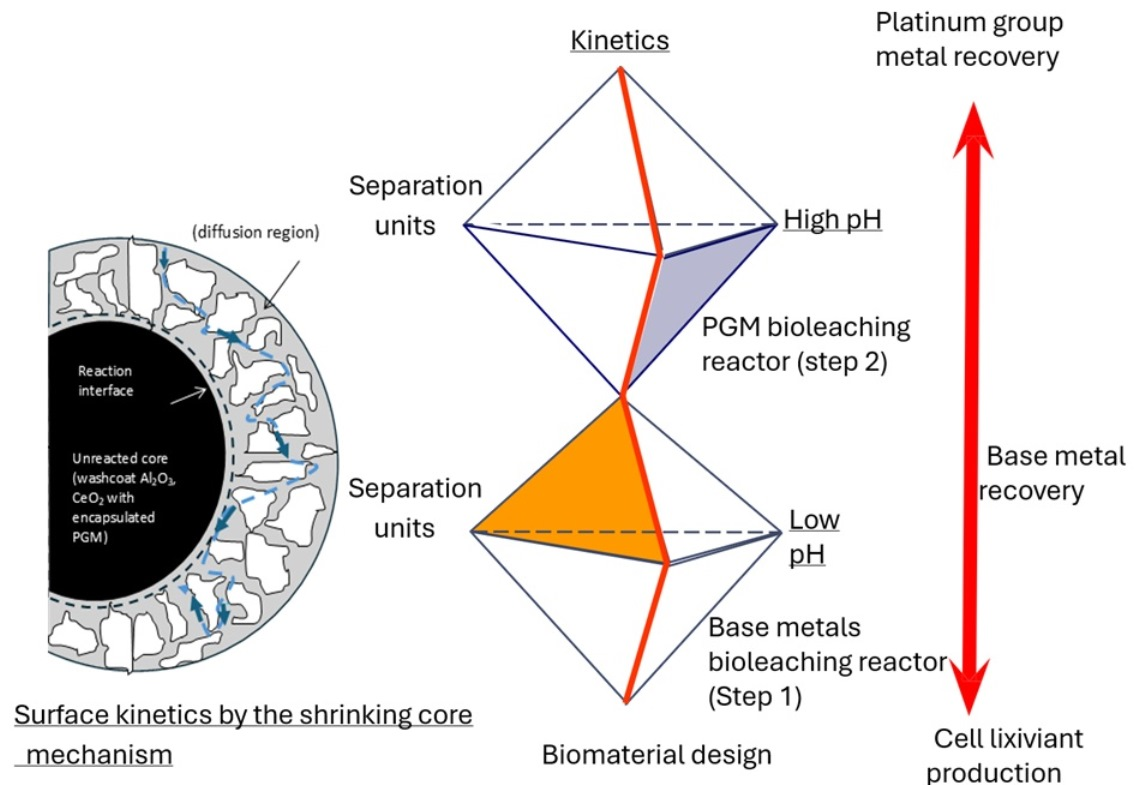
Towards Sustainable Bioleaching of Platinum Group Metals from Spent Automotive Catalysts




Abstract
1. Introduction
2. Pretreatment Strategies
3. Cyanogenic Bacterial Strains
4. Acidophilic Chemolithotrophs
5. Mechanisms of Bacteria in PGM Liberation
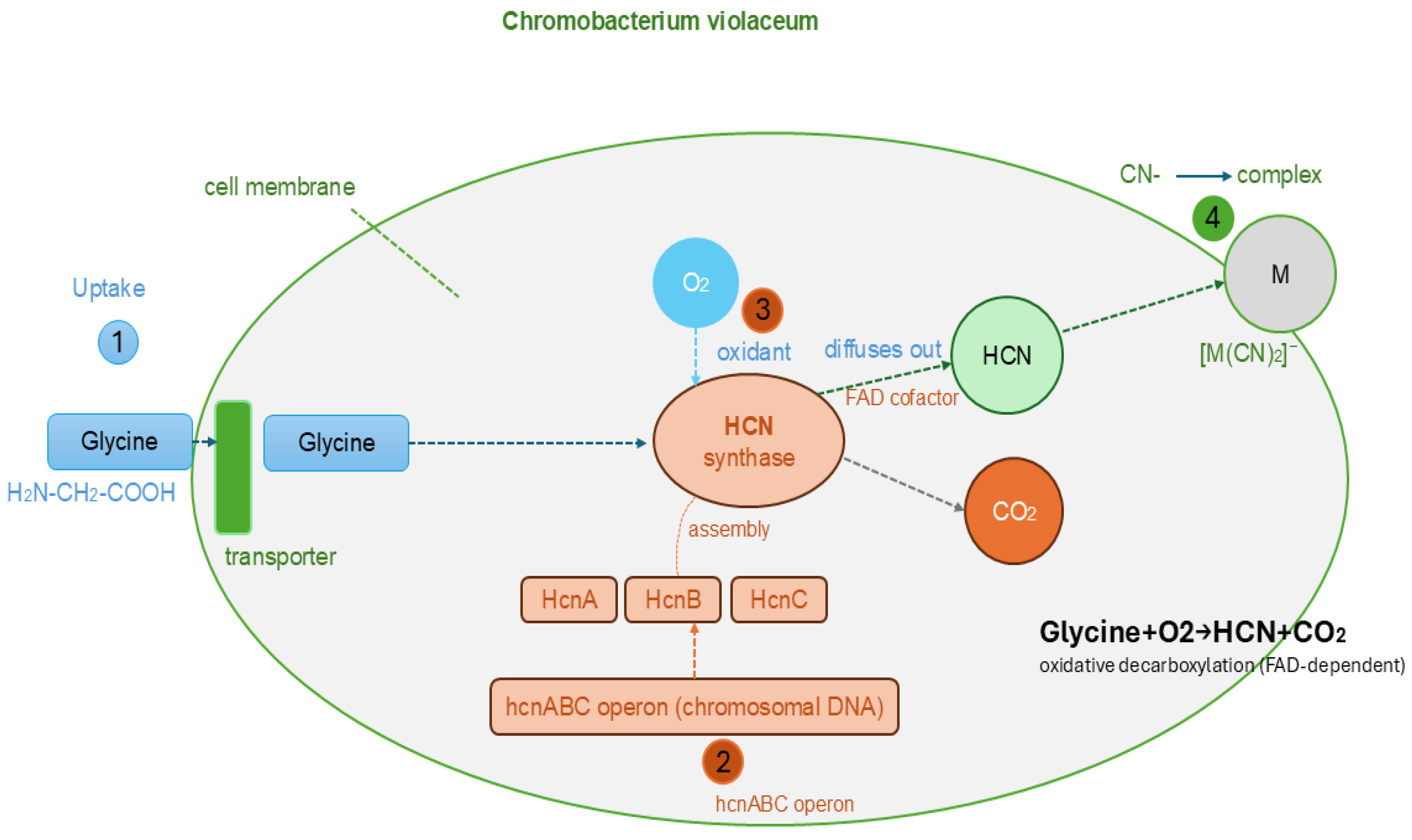
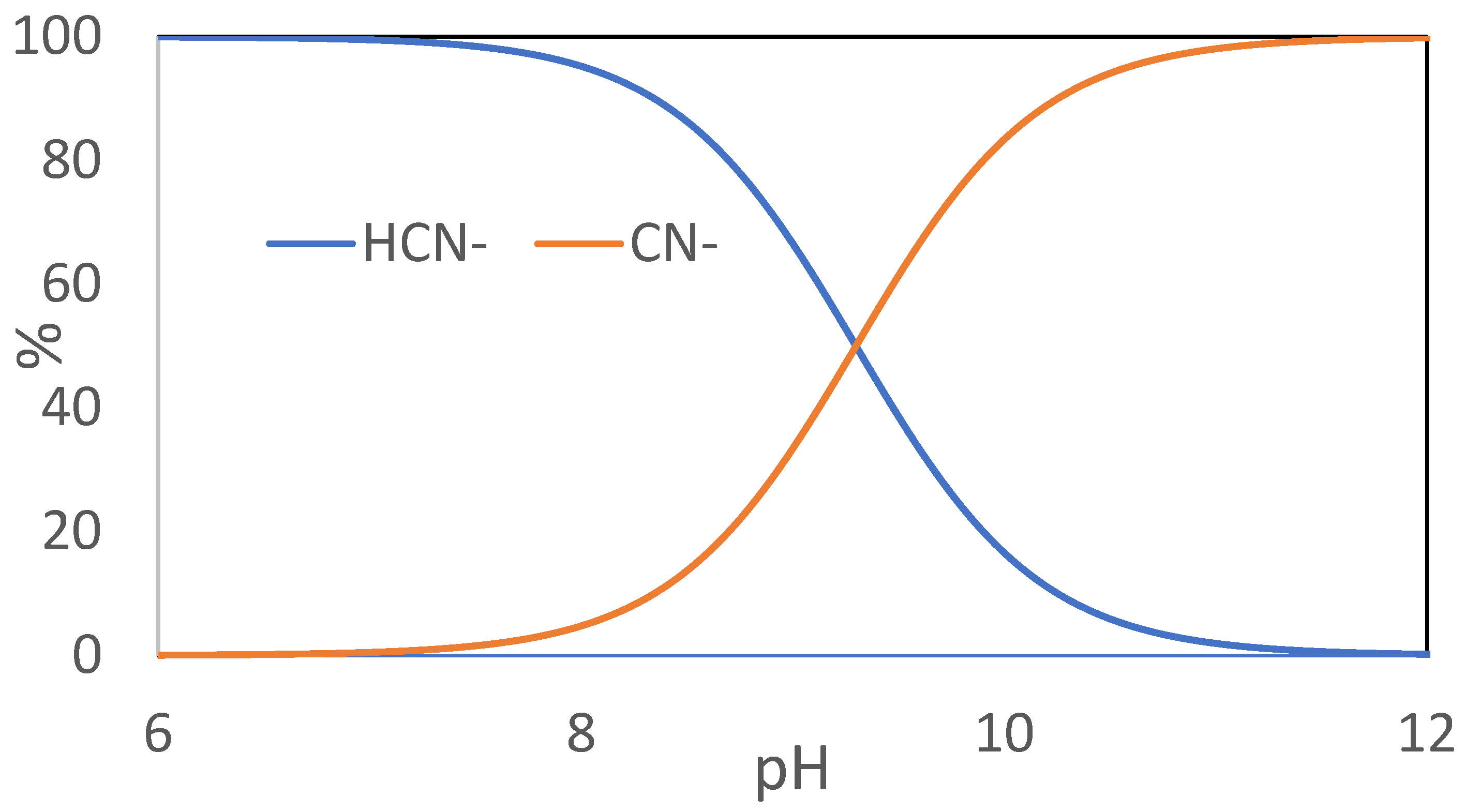
5.1. Cyanogenic Mechanisms and PGM Complexation
5.2. Acidophilic Mechanisms and Matrix Degradation
5.3. Kinetics of PGM Leaching
5.3.1. Mass-Transfer Constraints
5.3.2. Rate-Determining Steps and Modelling
6. Bioleaching Strategies Analysis
7. Pulp Density and Metal Toxicity
8. Sustainability
9. Conclusions
Author Contributions
Funding
Data Availability Statement
Conflicts of Interest
References
- Thunder Said Energy. Global PGM Demand: Breakdown by Metal and Use? Available online: https://thundersaidenergy.com/downloads/global-pgm-demand-breakdown-by-metal-and-by-use/ (accessed on 30 June 2026).
- Tang, H.; Peng, Z.; Tian, R.; Ye, L.; Zhang, J.; Rao, M.; Li, G. Platinum-group metals: Demand, supply, applications and their recycling from spent automotive catalysts. J. Environ. Chem. Eng. 2023, 11, 110237. [Google Scholar] [CrossRef] [Scilit]
- Xv, B.; Li, Z.; Zha, G.; Liu, D.; Yang, B.; Jiang, W. Recovery of platinum group metals from spent automotive catalysts: Review of conventional techniques and vacuum metallurgy. Resour. Conserv. Recycl. 2025, 214, 108103. [Google Scholar] [CrossRef] [Scilit]
- Karim, S.; Ting, Y.-P. Recycling pathways for platinum group metals from spent automotive catalyst: A review on conventional approaches and bio-processes. Resour. Conserv. Recycl. 2021, 170, 105588. [Google Scholar] [CrossRef] [Scilit]
- Yakoumis, I.; Panou, M.; Moschovi, A.; Panias, D. Recovery of platinum group metals from spent automotive catalysts: A review. Clean. Eng. Technol. 2021, 3, 100112. [Google Scholar] [CrossRef] [Scilit]
- Matthey, J. PGM Market Report May 2025; Johnson Matthey: London, UK, 2025. [Google Scholar]
- Grilli, M.L.; Slobozeanu, A.E.; Larosa, C.; Paneva, D.; Yakoumis, I.; Cherkezova-Zheleva, Z. Platinum group metals: Green recovery from spent auto-catalysts and reuse in new catalysts—A review. Crystals 2023, 13, 550. [Google Scholar] [CrossRef] [Scilit]
- Karim, S.; Ting, Y.-P. A novel sequential pretreatment coupled with statistically optimized bioleaching for highly effective biorecovery of platinum group metals from spent catalyst waste. J. Environ. Chem. Eng. 2023, 11, 110987. [Google Scholar] [CrossRef] [Scilit]
- Karim, S.; Ting, Y.-P. Bioleaching of platinum, palladium, and rhodium from spent automotive catalyst using bacterial cyanogenesis. Bioresour. Technol. Rep. 2022, 18, 101069. [Google Scholar] [CrossRef] [Scilit]
- Compagnone, M.; González-Cortés, J.J.; Yeste, M.D.P.; Cantero, D.; Ramírez, M. Bioleaching of the α-alumina layer of spent three-way catalysts as a pretreatment for the recovery of platinum group metals. J. Environ. Manag. 2023, 345, 118825. [Google Scholar] [CrossRef] [Scilit] [PubMed]
- Nuss, P.; Eckelman, M.J. Life cycle assessment of metals: A scientific synthesis. PLoS ONE 2014, 9, e101298. [Google Scholar] [CrossRef] [Scilit] [PubMed]
- Abo Atia, T.; Spooren, J. Fast microwave leaching of platinum, rhodium and cerium from spent non-milled autocatalyst monolith. Chem. Eng. Process. Process Intensif. 2021, 164, 108378. [Google Scholar] [CrossRef] [Scilit]
- López-Martínez, A.; Martínez-Prado, M.A.; Núñez-Ramírez, D.M.; Medina-Torres, L.; Rojas-Contreras, J.A.; Anguiano-Vega, G.A.; Soto-Cruz, N.O. Acidophilic bacteria for metal extraction: Biotechnological characteristics and applications. Braz. J. Chem. Eng. 2024, 42, 31–52. [Google Scholar] [CrossRef] [Scilit]
- Faramarzi, M.A.; Mogharabi-Manzari, M.; Brandl, H. Bioleaching of metals from wastes and low-grade sources by HCN-forming microorganisms. Hydrometallurgy 2020, 191, 105228. [Google Scholar] [CrossRef] [Scilit]
- Karim, S.; Saw, H.M.; Ting, Y.-P. Evaluation of green chemistry metrics for sustainable recycling of platinum group metals from spent automotive catalysts via bioleaching. Green Chem. 2024, 26, 4112–4126. [Google Scholar] [CrossRef] [Scilit]
- Chipise, L.; Ndlovu, S.; Shemi, A.; Moodley, S.S.; Kumar, A.; Simate, G.S.; Yah, C.S. Towards bioleaching of PGMS. Miner. Eng. 2023, 202, 108291. [Google Scholar] [CrossRef] [Scilit]
- Pakostova, E.; Rowson, N. Bioleaching of Metals from Automotive Catalysts: Focus on Magnetic Separation and Base Metal Removal Using Acidophilic Bacteria. In Proceedings of the 11th International Symposium on Biomining (Biomining ‘23), Falmouth, UK, 5–6 June 2023; Available online: https://www.min-eng.com/biomining23/drafts/session3/pakostova.pdf (accessed on 30 June 2026).
- Karim, S.; Ting, Y.-P. Ultrasound-assisted nitric acid pretreatment for enhanced biorecovery of platinum group metals from spent automotive catalyst. J. Clean. Prod. 2020, 255, 120199. [Google Scholar] [CrossRef] [Scilit]
- Karim, S.; Ting, Y.-P. Reducing oxidative stress in bacteria and suppressing microbial-metal interaction enhance bioleaching of platinum group metals at a high pulp density. Sustain. Mater. Technol. 2025, 45, e01522. [Google Scholar] [CrossRef] [Scilit]
- Brandl, H.; Lehmann, S.; Faramarzi, M.A.; Martinelli, D. Biomobilization of silver, gold, and platinum from solid waste materials by HCN-forming microorganisms. Hydrometallurgy 2008, 94, 14–17. [Google Scholar] [CrossRef] [Scilit]
- Wei, X.; Liu, C.; Cao, H.; Ning, P.; Jin, W.; Yang, Z.; Wang, H.; Sun, Z. Understanding the features of PGMs in spent ternary automobile catalysts for development of cleaner recovery technology. J. Clean. Prod. 2019, 239, 118031. [Google Scholar] [CrossRef] [Scilit]
- Argyle, M.; Bartholomew, C. Heterogeneous catalyst deactivation and regeneration: A review. Catalysts 2015, 5, 145–269. [Google Scholar] [CrossRef] [Scilit]
- Pakhomov, R.A.; Fokina, S.B.; Mushikhin, E.A.; Shcherbakov, S.V. Use of multicomponent phase diagrams of slag systems for recycling of spent automotive catalysts. Tsvetnye Met. 2023, 2, 49–59. [Google Scholar] [CrossRef] [Scilit]
- Izatt, R.M.; Christensen, J.J.; Hansen, J.W.; Watt, G.D. Thermodynamics of Metal Cyanide Coordination. IV. Log Βi°, ΔHi°, and ΔSi°, Values for the Zinc(II)-Cyanide System at 25°. Inorg. Chem. 1965, 4, 718–721. [Google Scholar] [CrossRef] [Scilit]
- Hancock, R.D.; Finkelstein, N.P.; Evers, A. Stabilities of the Cyanide Complexes of the Monovalent Group IB Metal Ions in Aqueous Solution. J. Inorg. Nucl. Chem. 1972, 34, 3747–3751. [Google Scholar] [CrossRef] [Scilit]
- Hosseinzadeh, F.; Rastegar, S.O.; Ashengroph, M. Bioleaching of rare earth elements from spent automobile catalyst as pretreatment method to improve Pt and Pd recovery: Process optimization and kinetic study. Process Biochem. 2021, 105, 1–7. [Google Scholar] [CrossRef] [Scilit]
- Bahaloo-Horeh, N.; Mousavi, S.M. A novel green strategy for biorecovery of valuable elements along with enrichment of rare earth elements from activated spent automotive catalysts using fungal metabolites. J. Hazard. Mater. 2022, 430, 128509. [Google Scholar] [CrossRef] [Scilit] [PubMed]
- Shin, D.; Park, J.; Jeong, J.; Kim, B. A biological cyanide production and accumulation system and the recovery of platinum-group metals from spent automotive catalysts by biogenic cyanide. Hydrometallurgy 2015, 158, 10–18. [Google Scholar] [CrossRef] [Scilit]
- Vitale, L.; Tedesco, P.; Galasso, C.; Vitale, G.A.; Varola, G.; Della Sala, G.; Palma Esposito, F.; Balzano, S.; Ghani, J.; De Pascale, D.; et al. Biotechnological valorisation of spent automotive catalytic converters: Marine microorganisms in PGE leaching and recovery. J. Environ. Chem. Eng. 2025, 13, 118729, Correction in J. Environ. Chem. Eng. 2026, 14, 122796. https://doi.org/10.1016/j.jece.2026.122796. [Google Scholar] [CrossRef] [Scilit]
- Blumer, C.; Haas, D. Mechanism, regulation, and ecological role of bacterial cyanide biosynthesis. Arch. Microbiol. 2000, 173, 170–177. [Google Scholar] [CrossRef] [Scilit] [PubMed]
- Pathak, A.; Al-Sheeha, H.; Navvamani, R.; Kothari, R.; Marafi, M.; Rana, M.S. Recycling of platinum group metals from exhausted petroleum and automobile catalysts using bioleaching approach: A critical review on potential, challenges, and outlook. Rev. Environ. Sci. Bio/Technol. 2022, 21, 1035–1059. [Google Scholar] [CrossRef] [Scilit]
- Ilyas, S.; Srivastava, R.R.; Kim, H. Mobilization of platinum and palladium from exhausted catalytic converters using bio-cyanide and an ionic-liquid as mass transport carriers. Green. Chem. 2022, 24, 5204–5218. [Google Scholar] [CrossRef] [Scilit]
- Castric, P.A. Hydrogen cyanide, a secondary metabolite of Pseudomonas aeruginosa. Can. J. Microbiol. 1975, 21, 613–618. [Google Scholar] [CrossRef] [Scilit] [PubMed]
- Faraji, F.; Mahandra, H.; Ghahreman, A. Evaluation of different amino acids on growth and cyanide production by Bacillus megaterium for gold recovery. Sustainability 2022, 14, 9639. [Google Scholar] [CrossRef] [Scilit]
- Valdés, J.; Pedroso, I.; Quatrini, R.; Dodson, R.J.; Tettelin, H.; Blake, R.; Eisen, J.A.; Holmes, D.S. Acidithiobacillus ferrooxidans metabolism: From genome sequence to industrial applications. BMC Genom. 2008, 9, 597. [Google Scholar] [CrossRef] [Scilit] [PubMed]
- Tonietti, L.; Esposito, M.; Cascone, M.; Barosa, B.; Fiscale, S.; Muscari Tomajoli, M.T.; Sbaffi, T.; Santomartino, R.; Covone, G.; Cordone, A.; et al. Unveiling the bioleaching versatility of Acidithiobacillus ferrooxidans. Microorganisms 2024, 12, 2407. [Google Scholar] [CrossRef] [Scilit] [PubMed]
- Willner, J.; Kaduková, J.; Fornalczyk, A.; Mrážiková, A.; Marcinčáková, R.; Velgosová, O. Possibilities of metals extraction from spent metallic automotive catalytic converters by using biometallurgical method. Arch. Metall. Mater. 2015, 60, 1877–1880. [Google Scholar] [CrossRef] [Scilit]
- Bobadilla-Fazzini, R.A.; Poblete-Castro, I. Establishing a green biodesulfurization process for iron ore concentrates in stirred tank and leaching column bioreactors using Acidithiobacillus thiooxidans. Front. Bioeng. Biotechnol. 2023, 11, 1324417. [Google Scholar] [CrossRef] [Scilit] [PubMed]
- Sarkodie, E.K.; Jiang, L.; Li, K.; Yang, J.; Guo, Z.; Shi, J.; Deng, Y.; Liu, H.; Jiang, H.; Liang, Y.; et al. A review on the bioleaching of toxic metal(loid)s from contaminated soil: Insight into the mechanism of action and the role of influencing factors. Front. Microbiol. 2022, 13, 1049277. [Google Scholar] [CrossRef] [Scilit] [PubMed]
- Ramírez-Aldaba, H.; Ruiz-Baca, E.; Escobedo-Bretado, M.Á.; García-Montiel, E.; Adame-Soto, P.J.; Lara, R.H. Synergistic mechanisms in the Acidithiobacillus ferrooxidans and thiooxidans consortium: A comprehensive review. Environments 2026, 13, 216. [Google Scholar] [CrossRef] [Scilit]
- Haynes, W.M. (Ed.) CRC Handbook of Chemistry and Physics, 97th ed.; CRC Press: Boca Raton, FL, USA, 2014; ISBN 978-0-429-17019-5. [Google Scholar]
- Vakilchap, F.; Mousavi, S.M.; Baniasadi, M.; Farnaud, S. Development and evolution of biocyanidation in metal recovery from solid waste: A review. Rev. Environ. Sci. Bio/Technol. 2020, 19, 509–530. [Google Scholar] [CrossRef] [Scilit]
- Ni H’ng, Y.; Almeida, M.I.G.S.; Lamb, R.N.; Kolev, S.D.; Duan, X. A comparative evaluation of leaching reagents of platinum group metals from spent catalytic converters using microwave heating. Chem. Asian J. 2025, 20, e202400895. [Google Scholar] [CrossRef] [Scilit] [PubMed]
- Natarajan, G.; Ting, Y.-P. Pretreatment of e-waste and mutation of alkali-tolerant cyanogenic bacteria promote gold biorecovery. Bioresour. Technol. 2014, 152, 80–85. [Google Scholar] [CrossRef] [Scilit] [PubMed]
- Kim, H.-J. Cyanide Sensors through Metal Coordination. In Comprehensive Supramolecular Chemistry II; Atwood, J.L., Gokel, G.W., Barbour, L., Eds.; Elsevier: Amsterdam, The Netherlands, 2017; Volume 8, pp. 387–404. [Google Scholar] [CrossRef] [Scilit]
- Harrington, J.M.; Jones, S.B.; Hancock, R.D. Determination of formation constants for complexes of very high stability: Logβ4 for the [Pd(CN)4]2− ion. Inorg. Chim. Acta 2005, 358, 4473–4480. [Google Scholar] [CrossRef] [Scilit]
- Read, M.C.; Glaser, J.; Persson, I.; Sandström, M. Rhodium(III) Complexes with Cyanide and Sulfur-Donor Ligands: Rhodium-103 Nuclear Magnetic Resonance Chemical Shift Correlations. J. Chem. Soc. Dalton Trans. 1994, 23, 3243–3248. [Google Scholar] [CrossRef] [Scilit]
- Perera, W.N.; Hefter, G. Mononuclear Cyano- and Hydroxo-Complexes of Iron(III). Inorg. Chem. 2003, 42, 5917–5923. [Google Scholar] [CrossRef] [Scilit] [PubMed]
- Srivastava, R.R.; Ilyas, N.; Chaerun, S.K.; Engström, F.; Lennartsson, A.; Öqvist, L.S.; Ilyas, S. Biological recycling of critical metals from spent hydrodesulfurization catalysts: A review. Environ. Chem. Lett. 2025, 23, 1381–1402. [Google Scholar] [CrossRef] [Scilit]
- Zhang, J.; Yang, C.; Chen, Y.; Wang, C. Efficient Phase Transformation of γ-Al2O3 to α-Al2O3 in Spent Hydrodesulphurization Catalyst by Microwave Roasting Method. Ind. Eng. Chem. Res. 2019, 58, 1495–1501. [Google Scholar] [CrossRef] [Scilit]
- Kreve, S.; Dos Reis, A.C. Effect of surface properties of ceramic materials on bacterial adhesion: A systematic review. J. Esthet. Restor. Dent. 2022, 34, 461–472. [Google Scholar] [CrossRef] [Scilit] [PubMed]
- Ilyas, S.; Kim, H. Recovery of platinum-group metals from an unconventional source of catalytic converter using pressure cyanide leaching and ionic liquid extraction. JOM 2022, 74, 1020–1026. [Google Scholar] [CrossRef] [Scilit] [PubMed]
- Oulego, P.; Laca, A.; Diaz, M. Kinetics and pathways of cyanide degradation at high temperatures and pressures. Environ. Sci. Technol. 2013, 47, 1299–1307. [Google Scholar] [CrossRef] [Scilit] [PubMed]
- Mishra, D.; Kim, D.J.; Ralph, D.E.; Ahn, J.G.; Rhee, Y.H. Bioleaching of spent hydro-processing catalyst using acidophilic bacteria and its kinetics aspect. J. Hazard. Mater. 2008, 152, 1082–1091. [Google Scholar] [CrossRef] [Scilit] [PubMed]
- Liddell, K.C. Shrinking core models in hydrometallurgy: What students are not being told about the pseudo-steady approximation. Hydrometallurgy 2005, 79, 62–68. [Google Scholar] [CrossRef] [Scilit]
- Pradhan, D.; Mishra, D.; Kim, D.J.; Chaudhury, G.R.; Lee, S.W. Dissolution kinetics of spent petroleum catalyst using two different acidophiles. Hydrometallurgy 2009, 99, 157–162. [Google Scholar] [CrossRef] [Scilit]
- Pradhan, D.; Mishra, D.; Kim, D.J.; Ahn, J.G.; Chaudhury, G.R.; Lee, S.W. Bioleaching kinetics and multivariate analysis of spent petroleum catalyst dissolution using two acidophiles. J. Hazard. Mater. 2010, 175, 267–273. [Google Scholar] [CrossRef] [Scilit] [PubMed]
- Chen, J.; Huang, K. A new technique for extraction of platinum group metals by pressure cyanidation. Hydrometallurgy 2006, 82, 164–171. [Google Scholar] [CrossRef] [Scilit]
- Xin, B.; Jiang, W.; Li, X.; Zhang, K.; Liu, C.; Wang, R.; Wang, Y. Analysis of reasons for decline of bioleaching efficiency of spent Zn–Mn batteries at high pulp densities and exploration measure for improving performance. Bioresour. Technol. 2012, 112, 186–192. [Google Scholar] [CrossRef] [Scilit] [PubMed]
- Inaba, Y.; West, A.C.; Banta, S. Glutathione synthetase overexpression in Acidithiobacillus ferrooxidans improves halotolerance of iron oxidation. Appl. Environ. Microbiol. 2021, 87, e01518-21. [Google Scholar] [CrossRef] [Scilit] [PubMed]
- Tezyapar Kara, I.; Wagland, S.T.; Coulon, F. Techno-economic assessment of bioleaching for metallurgical by-products. J. Environ. Manag. 2024, 358, 120904. [Google Scholar] [CrossRef] [Scilit] [PubMed]
- Hwang, H.; Kweon, T.; Kang, H.; Hwang, Y. Resource and greenhouse gas reduction effects through recycling of platinum-containing waste. Sustainability 2023, 16, 80. [Google Scholar] [CrossRef] [Scilit]
- Deravian, B.; Mulligan, C.N. Sustainable recovery of critical minerals from wastes by green biosurfactants: A review. Molecules 2025, 30, 2461. [Google Scholar] [CrossRef] [Scilit] [PubMed]
- Sheldon, R.A. Metrics of green chemistry and sustainability: Past, present, and future. ACS Sustain. Chem. Eng. 2018, 6, 32–48. [Google Scholar] [CrossRef] [Scilit]
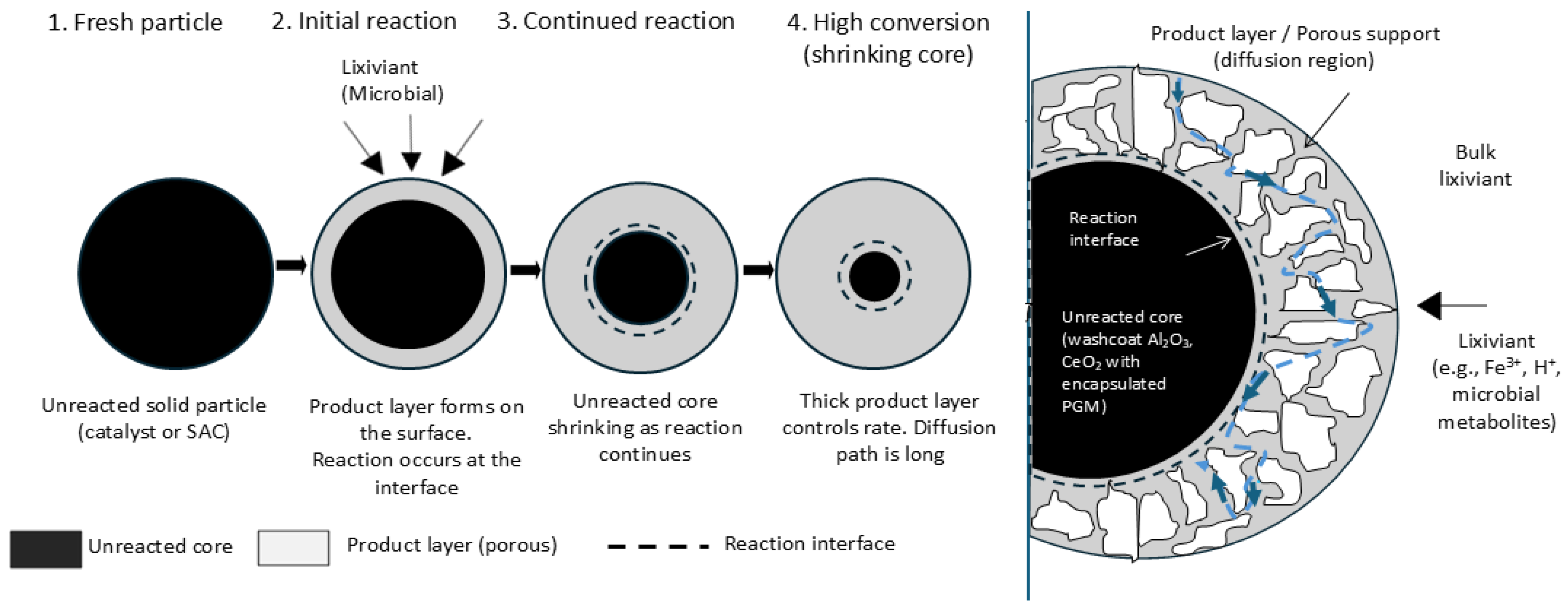
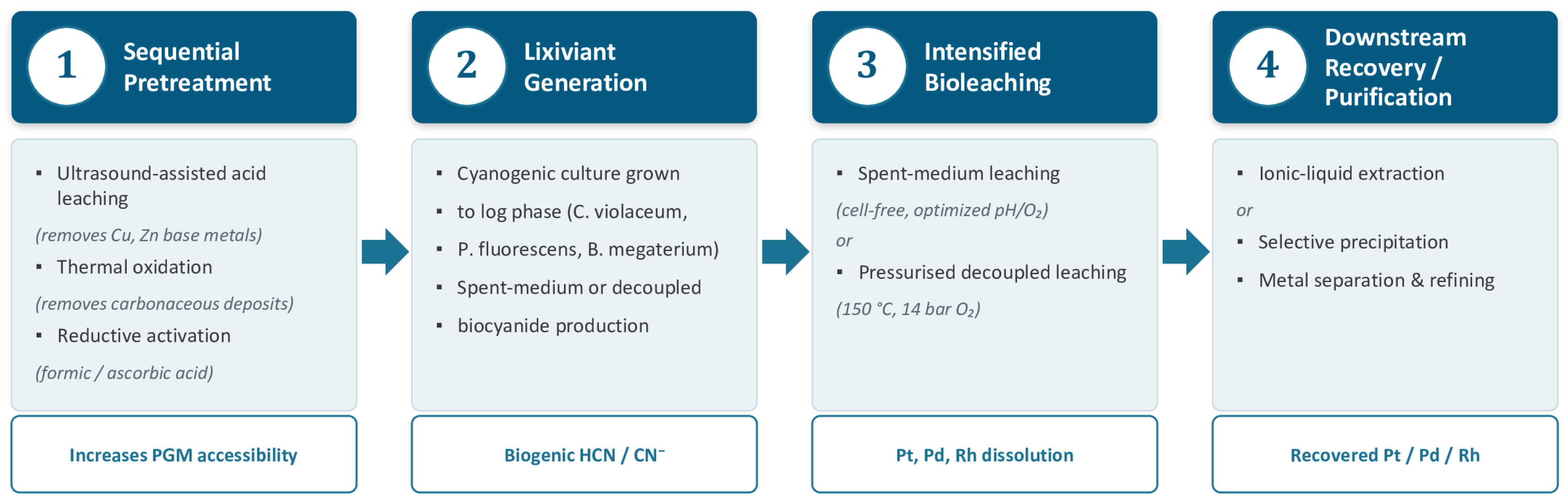

| Method | Conditions | PGM Recovery | Energy Demand | Advantages | Disadvantages | References |
|---|---|---|---|---|---|---|
| 1. Pyrometallurgy Smelting, roasting, plasma treatment | 1200–1600 °C Large-scale electric arc or plasma furnaces; air/O2 atmosphere | 80–99% Pt, Pd, Rh simultaneously | Very high, 1400–3400 MJ per kg Pt dominates operating cost |
|
| [2,5,7,11] |
| 2. Hydrometallurgy Acid/alkaline leaching, solvent extraction, precipitation, electrodeposition | 20–200 °C Aqua regia, HCl/Cl2, NaCN or KCN salts; atmospheric to mild pressure | 85–99 High selectivity achievable via solvent extraction | Moderate-high Lower than pyro; significant reagent manufacture energy |
|
| [2,5,7,12] |
| 3. Biohydrometallurgy Cyanogenic bioleaching; acidophilic chemolithotrophs; microbial-assisted leaching | 20–80 °C pH 9–11 (cyanogenic) or pH 1–3 (acidophilic); ambient pressure; biogenic lixiviants |
| Low Ambient conditions; no smelting energy; dominated by water use (high PMI) |
|
| [7,13,14,15,16] |
| Step | Objective | Pt Recovery (%) | Pd Recovery (%) | Rh Recovery (%) | Microorganism | References |
|---|---|---|---|---|---|---|
| 1. Ultrasound-assisted nitric acid | Remove base metals (Cu, Zn, Fe) | 38 | 44 | 91 | Pseudomonas fluorescens | [18] |
| 35 | 41 | 82 | Bacillus megaterium | |||
| 2. Sequential pretreatment (Heat oxidation 850 °C + Sonication + Formic acid reduction) | Remove base metals (Cu/Zn) | 91 | 95 | 100 | Chromobacterium violaceum | [8] |
| 3. Bioleaching + aqua regia | Remove REEs; surface activation | 100 | 100 | Not reported | Aspergillus niger ZRS14 | [26] |
| 4. Bioleaching (pre-treatment) | Dissolve the alumina washcoat layer | Not reported | Not reported | Not reported | Acidithiobacillus thiooxidans | [10] |
| 5. Bioleaching (oxalic acid-rich spent medium) | Biorecovery of metals and enrichment of REEs | 60.9 | 73.7 | Not reported | Aspergillus niger | [27] |
| 6. Accumulation + Pressure leaching | Decouple biological growth from harsh leaching conditions | 92.1 | 99.5 | 96.5 | Chromobacterium violaceum | [28] |
| 7. Ultrasound-assisted | Removal of soot & increased surface area | 27.3 | 8.0 | 6.6 | Microbacterium sp. T2 Microbacterium sp. AG | [29] |
| Substrate Type | Key Microorganisms | Mechanism | Outcome | Reference |
|---|---|---|---|---|
| Metallic substrate converter FeCrAl metallic carrier PGM-coated | A. ferrooxidans + A. thiooxidans (mixed culture) | Fe3+ mediated oxidation destabilises FeCrAl matrix under strongly acidic conditions | Metallic carrier weakened; biological Fe dissolution exceeds abiotic controls; downstream PGM liberation improved | [37] |
| Iron ore concentrate Sulfide-bearing | A. thiooxidans | Sulfur oxidation produces H2SO4; green biodesulfurisation removes sulfide phases | Effective sulfide removal; improved ore purity | [38] |
| Contaminated soil Toxic metal(loid)-bearing matrix | Acidithiobacillus dominated consortia | Acid + Fe3+ attack dissolves metal-bearing mineral phases; mobilises toxic metals. | Effective extraction of toxic metal(loid)s; mechanisms characterised | [39] |
| Refractory sulfide ore Industrial bioleaching | A. ferrooxidans | Genome-informed sulfur and iron oxidation pathways; | Metabolic pathways characterised; benchmark organism for acidic bioleaching | [35] |
| Various metal-bearing substrates Broad acidophilic bioleaching | Acidithiobacillus spp. and related acidophiles | H2SO4 + Fe3+ attack on silicate and sulfide matrices; biotechnological characteristics reviewed | Broad metal extraction; base metal removal reduces downstream competition | [12] |
| Sulfide/mixed mineral substrates Potential relevance to refractory PGMs | A. ferrooxidans + A. thiooxidans (synergistic consortium) | Synergistic Fe and S oxidation; combined acid + oxidant generation accelerates matrix dissolution | Enhanced dissolution efficiency; encapsulating phases broken down | [40] |
| α-Alumina layer of spent three-way catalysts | A. thiooxidans | Acid bioleaching of Al by biogenic sulfuric acid; bacteria-free biogenic acid vs. stationary-phase bacteria vs. commercial H2SO4 | Max. Al leaching 54.5% at three-way catalyst (TWC) pulp density 5% w/v using biogenic acids with stationary-phase bacteria; superior to commercial H2SO4 (24.7%) and bacteria-free biogenic acid (23.4%) | [10] |
| Spent automotive catalysts (focus on magnetic separation and base metal removal) | Acidophilic bacteria | Bioleaching for base metal removal; magnetic separation as complementary step | Base metals (Fe, Cr, Al) were solubilised; magnetic separation led to conflicting performance in PGM recovery by removing magnetic base-metal particles. | [17] |
| Metal | Role | Dominant Cyano-Complex | log β (Stability) | CN− Affinity | Competitive Effect on PGMs | References |
|---|---|---|---|---|---|---|
| Pt | Catalyst | [Pt(CN)4]2− | ~40–41 | Very high | Blocked by competing base metals | [45] |
| Pd | Catalyst | [Pd(CN)4]2− | 62.3 | Exceptionally high | Strongly competes with base metals; extreme thermodynamic preference for CN− | [46] |
| Ni | Substrate alloy | [Ni(CN)4]2− | 30.5 | High | Strong competition; consumes 4 CN− per Ni | [45] |
| Rh | Catalyst | [Rh(CN)6]3− | ~47 | High | Slower dissolution; requires free CN− | [47] |
| Cu(I) | Contaminant | [Cu(CN)3]2− | ~27 | High | Consumes 3 CN− per Cu2+; major competitor | [25] |
| Zn | Minor contaminant | [Zn(CN)4]2− | ~19 | Moderate | Moderate consumption (4 CN− per Zn); complex weakly stable | [24] |
| Fe(II) | Dissolved iron from Fe-bearing phases | [Fe(CN)6]4− | 31.8 | High | Oxidation to Fe(III) followed by hydrolysis produces ferric hydroxide precipitates; consumes 6 CN− per Fe | [48] |
| Fe(III) | Oxidised surface | [Fe(CN)6]3− | ~39 | Extremely high | Ferricyanide formation; severe CN− loss | [48] |
| Parameter | Primary Production (per kg Pt) | Secondary Recovery (per kg Pt) | Reduction | References |
|---|---|---|---|---|
| Ore/waste processed | 150 Mg ore | 2 Mg SAC | ~98% | [7] |
| GHG emissions | ~13,500 kg CO2-eq | ~694 kg CO2-eq | ~95% | [62] |
| Water consumption | 100–1200 m3/kg PGM | 3–6 evalum3/kg PGM | Significant reduction | [2] |
| Energy consumption | 18.9–254.9 GJ/kg PGM | 1.4–3.4 GJ/kg PGM | - | [2] |
| Solid waste generation | ~400 Mg/kg Pt | Not reported | - | [7] |
| Chemical consumption | High (acids, cyanide) | Low (biogenic cyanide) | ~90% (estimated) | [15] |
Disclaimer/Publisher’s Note: The statements, opinions and data contained in all publications are solely those of the individual author(s) and contributor(s) and not of MDPI and/or the editor(s). MDPI and/or the editor(s) disclaim responsibility for any injury to people or property resulting from any ideas, methods, instructions or products referred to in the content. |
© 2026 by the authors. Licensee MDPI, Basel, Switzerland. This article is an open access article distributed under the terms and conditions of the Creative Commons Attribution (CC BY) license.
Share and Cite
Kuralay, Y.; Ilkhani, Z.; Hardy, J.; Capozzi, L.; Aiouache, F. Towards Sustainable Bioleaching of Platinum Group Metals from Spent Automotive Catalysts. Materials 2026, 19, 3495. https://doi.org/10.3390/ma19163495
Kuralay Y, Ilkhani Z, Hardy J, Capozzi L, Aiouache F. Towards Sustainable Bioleaching of Platinum Group Metals from Spent Automotive Catalysts. Materials. 2026; 19(16):3495. https://doi.org/10.3390/ma19163495
Chicago/Turabian StyleKuralay, Yeskalina, Zahra Ilkhani, John Hardy, Luigi Capozzi, and Farid Aiouache. 2026. "Towards Sustainable Bioleaching of Platinum Group Metals from Spent Automotive Catalysts" Materials 19, no. 16: 3495. https://doi.org/10.3390/ma19163495
APA StyleKuralay, Y., Ilkhani, Z., Hardy, J., Capozzi, L., & Aiouache, F. (2026). Towards Sustainable Bioleaching of Platinum Group Metals from Spent Automotive Catalysts. Materials, 19(16), 3495. https://doi.org/10.3390/ma19163495