Environmental Impact Assessment of Using Waste Tires as an Alternative Fuel in a Cement Clinker Production Plant in China: A Case Study
Abstract
1. Introduction
2. Materials and Methods
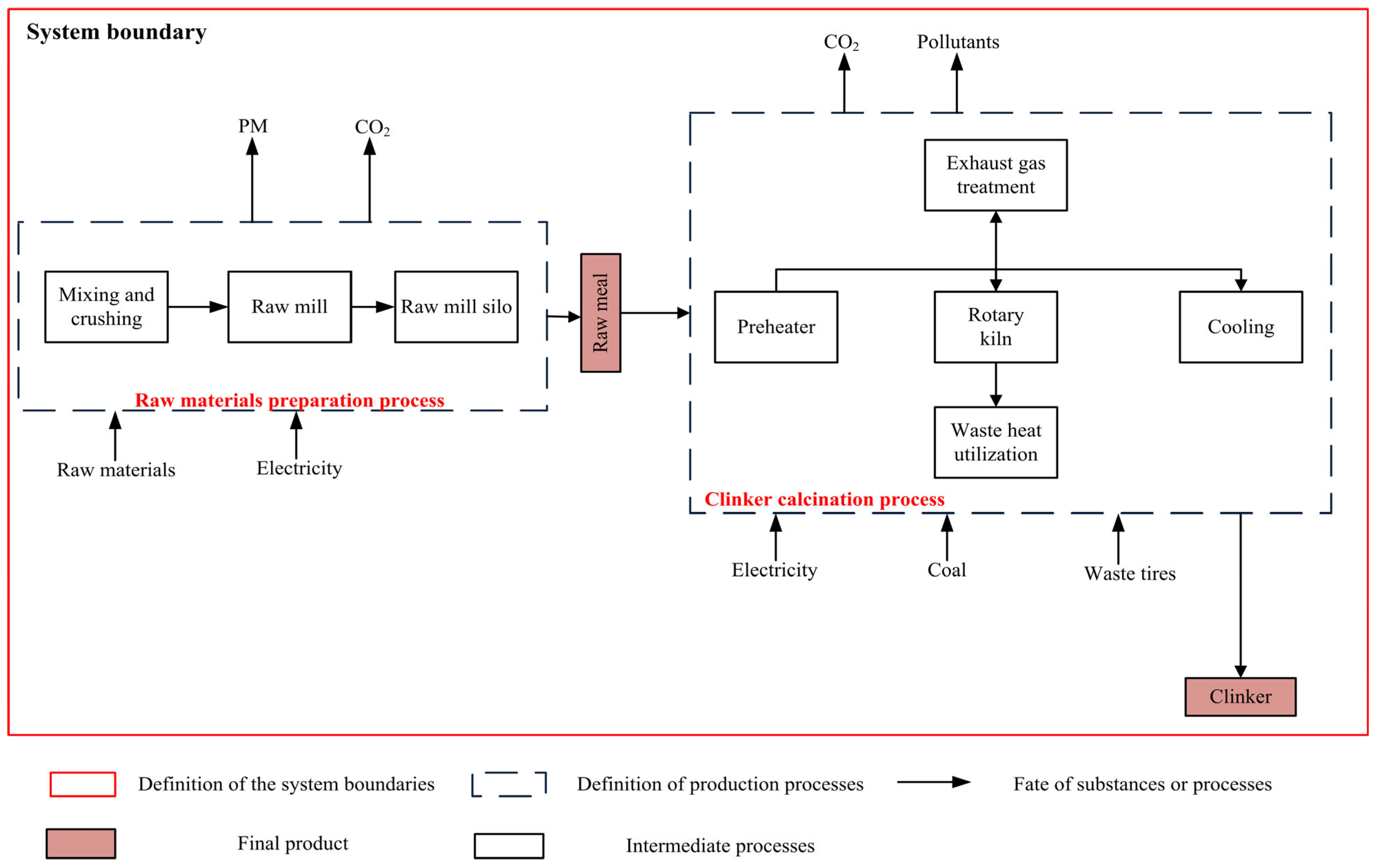
2.1. Goal and Scope Definition
2.2. Life Cycle Inventory Analysis
2.3. Life Cycle Impact Assessment Method
2.4. Sensitivity Analysis Method
3. Results and Discussion
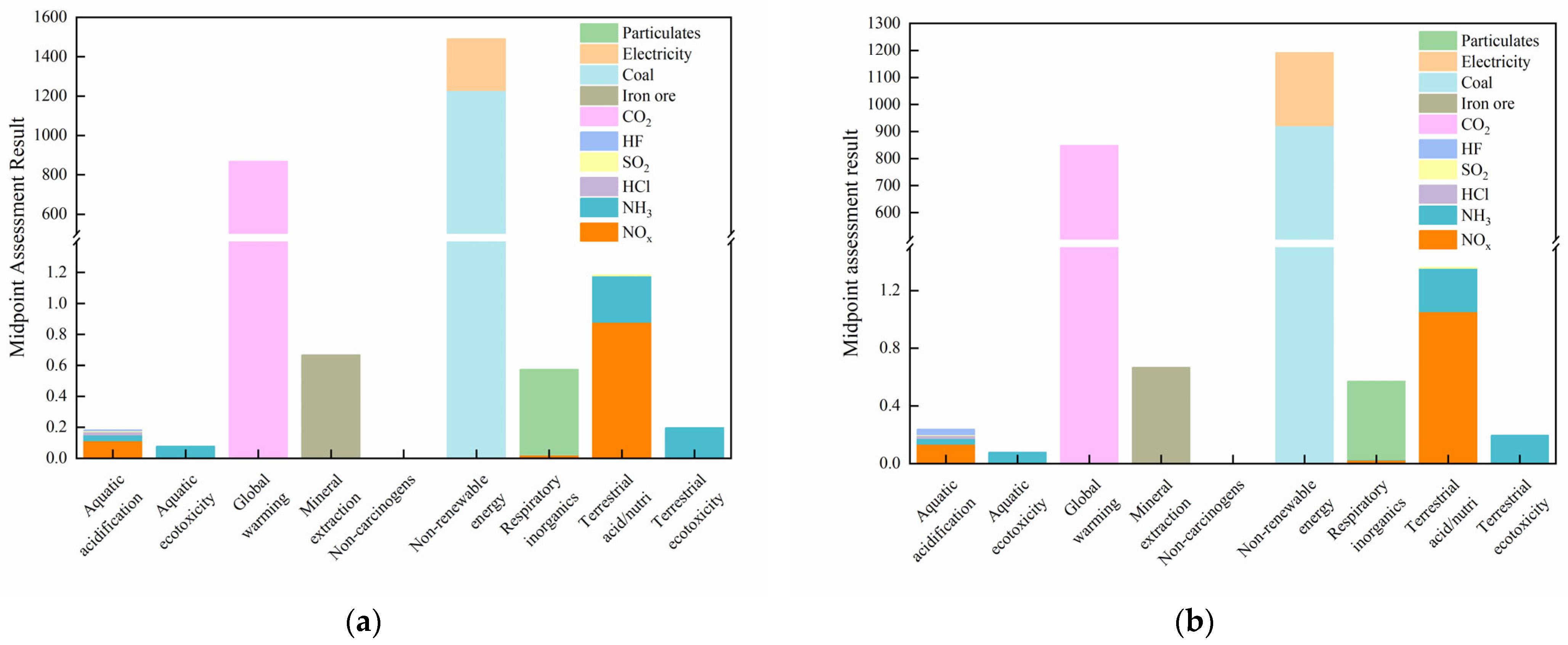
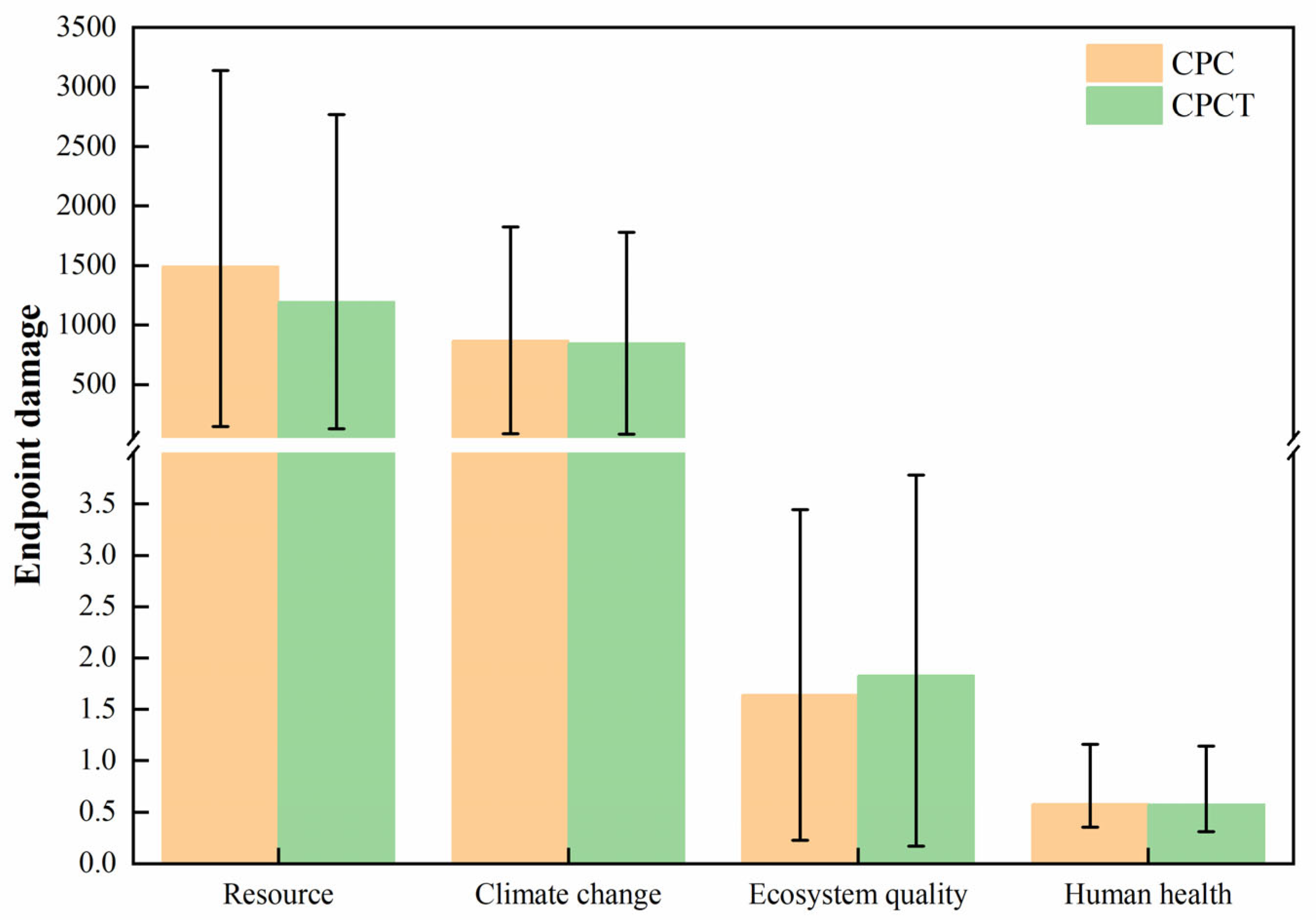
3.1. Comparison of Environment Impact of CPC and CPCT Scenarios
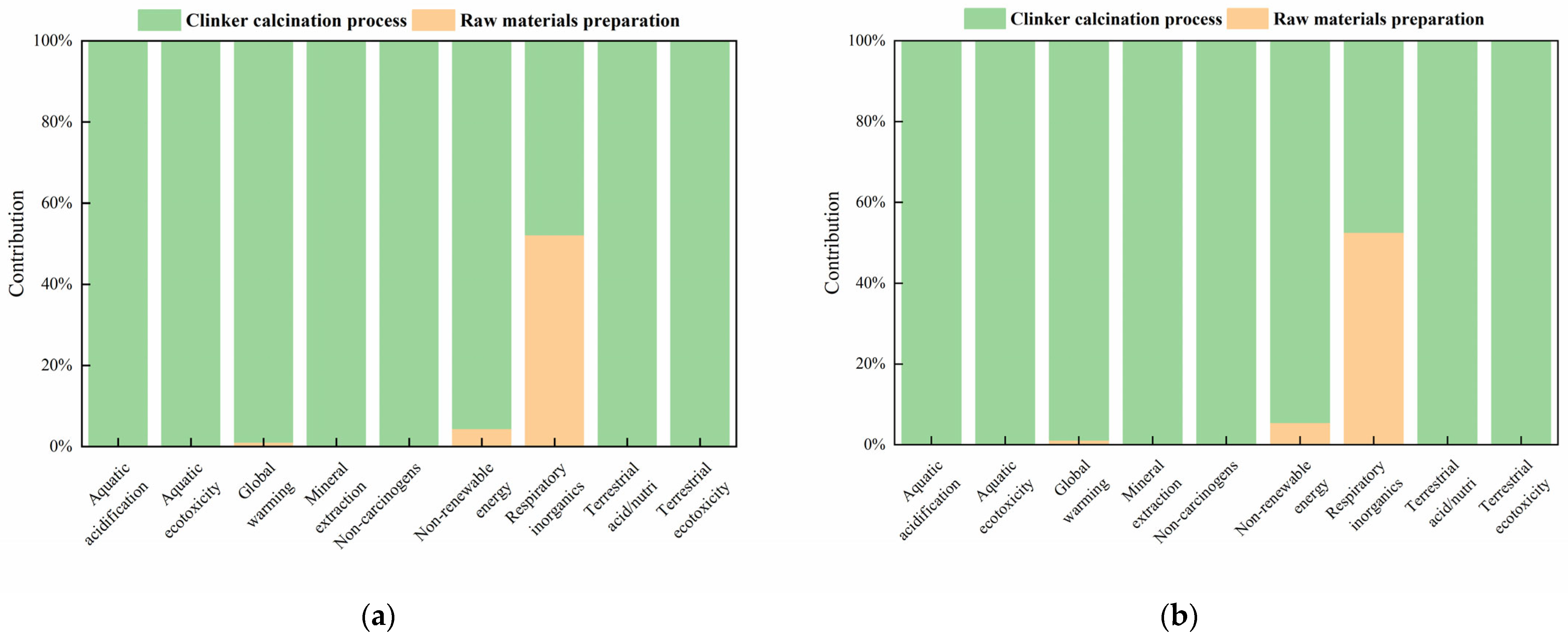
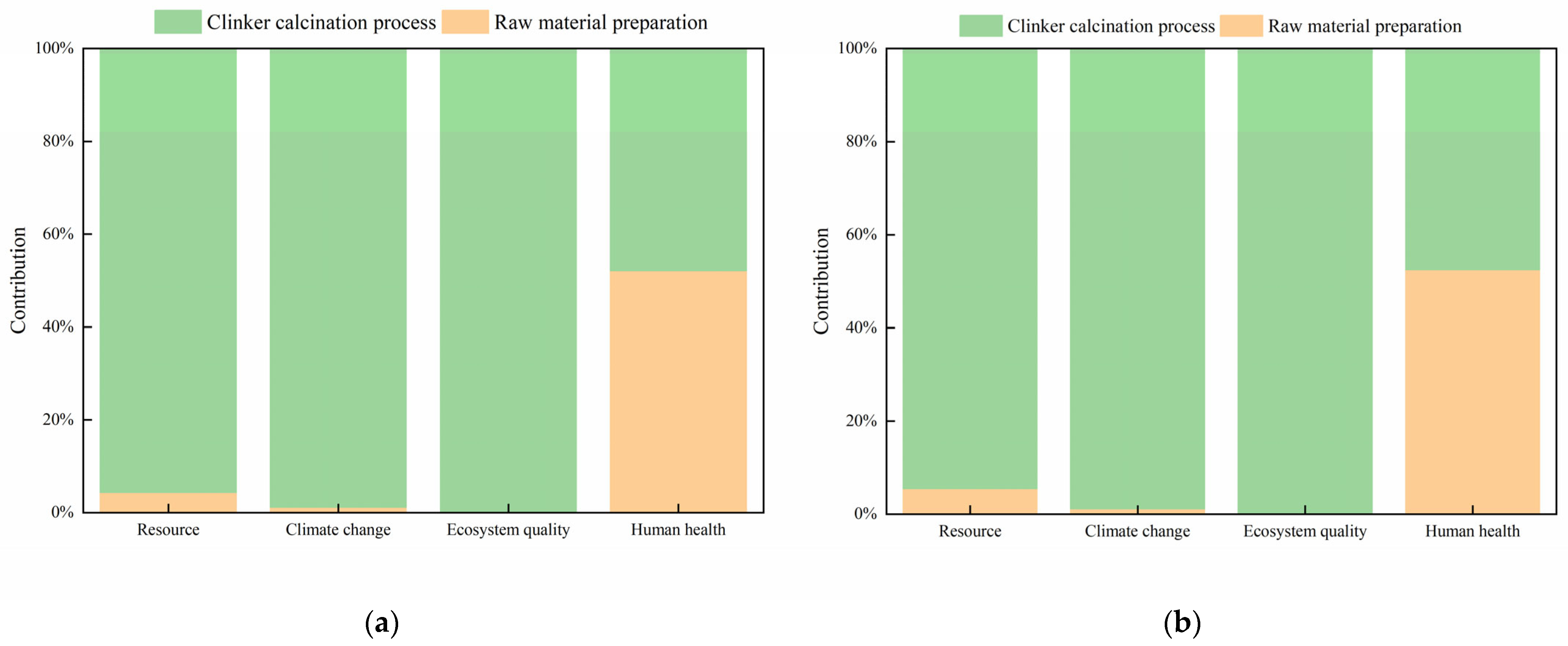
3.2. Contribution Analysis of Environmental Impacts by Production Processes
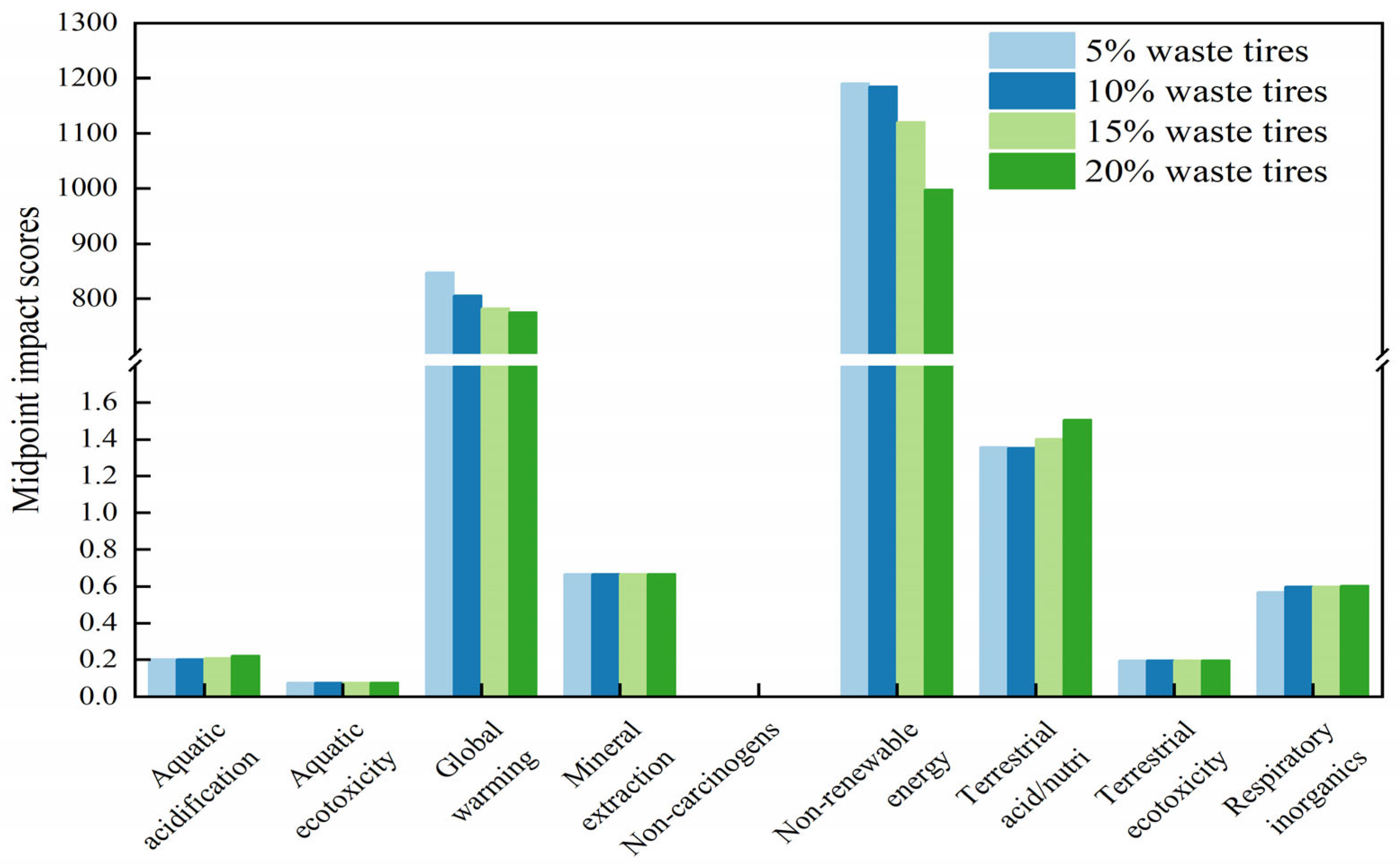
3.3. Impact Analysis of Different Substitution Ratios of Waste Tires
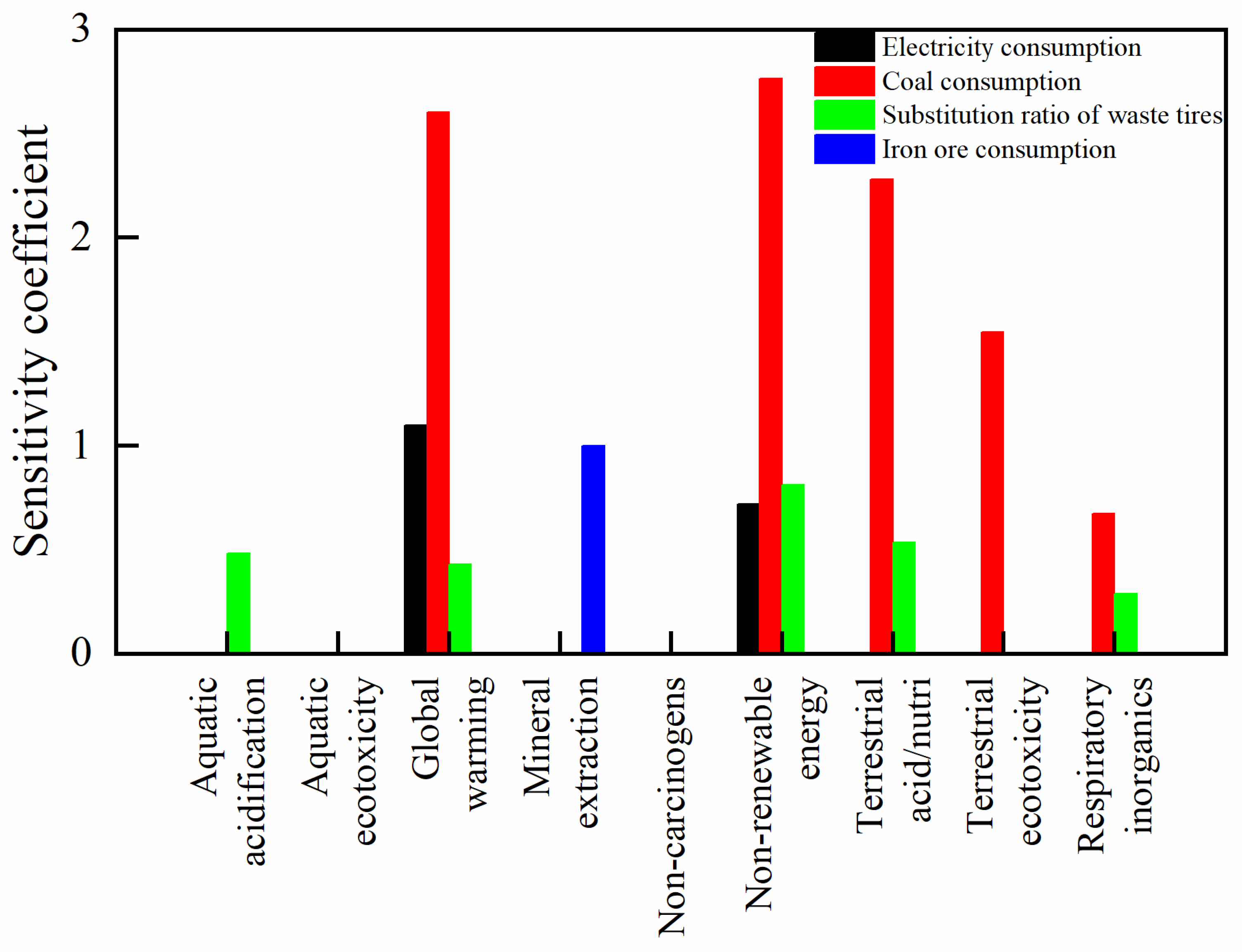
3.4. Sensitivity Analysis
4. Conclusions
Author Contributions
Funding
Data Availability Statement
Conflicts of Interest
Abbreviations
| LCA | Life cycle assessment. |
| PM | Particulate matter. |
| GWP | Global warming potential. |
| CPC | Clinker production with coal. |
| CPCT | Clinker production with waste tires. |
| LHV | Lower heating value. |
| RDF | Refuse-derived fuel. |
| WHR | Waste heat recovery. |
References
- Wang, Y.C. Study on the Synergistic Path and Cost-Benefit of Pollution and Carbon Reduction in China’s Cement Industry. Ph.D. Thesis, Jilin University, Changchun, China, 6 March 2025. (In Chinese) [Google Scholar]
- Ministry of Ecology and Environment of China. 2020 Annual Report on China’s Ecological Environment Statistics, 1st ed.; China Environment Publishing Group: Beijing, China, 2022. (In Chinese)
- International Energy Agency. CO2 Emissions from Fuel Combustion; OECD Publishing: Paris, France, 2011. [Google Scholar]
- Wei, J.X.; Cen, K. Empirical assessing cement CO2 emissions based on China’s economic and social development during 2001–2030. Sci. Total Environ. 2019, 653, 200–211. [Google Scholar] [CrossRef] [PubMed]
- Yang, N.; Li, Y.X.; Zhao, M.; Lv, C.; Liu, Z.L.; Chen, S. Establishment of a CO2 direct emission accounting model for cement clinker manufacturers. Clim. Change Res. 2021, 17, 79–87. (In Chinese) [Google Scholar]
- Zheng, C.Y.; Zhang, H.R.; Cai, X.R.; Chen, L.; Liu, M.D.; Lin, H.M.; Wang, X.J. Characteristics of CO2 and atmospheric pollutant emissions from China’s cement industry: A life-cycle perspective. J. Clean. Prod. 2021, 282, 124533. [Google Scholar] [CrossRef]
- He, J.Y.; He, J.; Wang, Y.T.; Fan, Y.B.; Cai, B.F.; Yan, G. Pathway of carbon emissions peak for cement industry in China. Res. Environ. Sci. 2022, 35, 347–355. (In Chinese) [Google Scholar]
- Wang, Y.L.; Wang, X.Y.; Liu, Y.; Wang, H.; Hao, L.W. Environmental impact analysis of preparing carbonated steel slag brick products using carbon dioxide captured from cement kiln. China Cem. 2025, 42–46. (In Chinese) [Google Scholar] [CrossRef]
- Zhang, K.; Zhou, R.; Yan, Y. Collaborative pathway of pollution reduction and carbon emission reduction in the cement industry. Cement 2023, 18–20. (In Chinese) [Google Scholar] [CrossRef]
- Guo, X.L.; Li, Y.X.; Yuan, S.T. Life cycle assessment of cement and its research progress in low environmental load. J. Build. Mater. 2023, 26, 660–669+677. (In Chinese) [Google Scholar]
- Ji, D.Q.; Peng, J.; Wang, Y.Y.; Yuan, D.D.; Li, Z.D.; Ji, D.B.; Sun, Q.Y.; Wu, H.J. Research progress in pyrolysis theory and technology of waste tires. J. Mater. Eng. 2026, 54, 176–190. (In Chinese) [Google Scholar]
- Xu, J.Q.; Yu, J.X.; He, W.Z.; Huang, J.W.; Xu, J.S.; Li, G.M. Recovery of carbon black from waste tire in continuous commercial rotary kiln pyrolysis reactor. Sci. Total Environ. 2021, 772, 145507. [Google Scholar] [CrossRef] [PubMed]
- Kishan, G.S.; Kumar, Y.H.; Sakthivel, M.; Vijayakumar, R.; Lingeshwaran, N. Life cycle assessment on tire derived fuel as alternative fuel in cement industry. Mater. Today Proc. 2021, 47, 5483–5488. [Google Scholar] [CrossRef]
- Vasiliu, L.; Gencel, O.; Damian, I.; Harja, M. Capitalization of tires waste as derived fuel for sustainable cement production. Sustain. Energy Technol. Assess. 2023, 56, 103104. [Google Scholar] [CrossRef]
- Reza, B.; Soltani, A.; Ruparathna, R.; Sadiq, R.; Hewage, K. Environmental and economic aspects of production and utilization of RDF as alternative fuel in cement plants: A case study of metro Vancouver waste management. Resour. Conserv. Recycl. 2013, 81, 105–114. [Google Scholar] [CrossRef]
- Cankaya, S. Investigating the environmental impacts of alternative fuel usage in cement production: A life cycle approach. Environ. Dev. Sustain. 2020, 22, 7495–7514. [Google Scholar]
- Wu, S.Y.; Chen, L.H.; Qin, Q.L.; Yu, M.J. Application practice of tire powder as alternative fuel. Cement 2024, 5–7. (In Chinese) [Google Scholar] [CrossRef]
- Ye, C.L.; Che, M.; Chang, L. Application of waste tire replacement fuel in cement clinker production. Heilongjiang Sci. 2024, 15, 16–19. (In Chinese) [Google Scholar]
- Fiksel, J.; Bakshi, B.R.; Baral, A.; Guerra, E.; Quervain, B.D. Comparative life cycle assessment of beneficial applications for scrap tires. Clean Technol. Environ. Policy 2011, 13, 19–35. [Google Scholar]
- Oscar, O.O.; William, O.D.; Laura, I.D. Environmental impact of end-of-life tires: Life cycle assessment comparison of three scenarios from a case study in Valle Del Cauca, Colombia. Energies 2017, 10, 2117. [Google Scholar] [CrossRef]
- Georgiopoulou, M.; Lyberatos, G. Life cycle assessment of the use of alternative fuels in cement kilns: A case study. J. Environ. Manag. 2018, 216, 224–234. [Google Scholar] [CrossRef]
- Tang, Z.H.; Liu, Y.; Zheng, Y.; Li, X.Q. Analysis of the pollution and carbon emissions reduction potential of using coal gangue as a substitute for raw materials/fuel in cement clinker manufacturing. China Build. Mater. Sci. Technol. 2025, 34, 34–37. (In Chinese) [Google Scholar]
- Shang, Y.Q.; Li, M.; Cui, S.P.; Li, Y.M.; Cui, H.Y. Life cycle assessment of cement production using waste alternative fuel. China Cem. 2024, 40–43. (In Chinese) [Google Scholar]
- Ministry of Housing and Urban-Rural Development of China; Ministry of Ecology and Environment of China; National Development and Reform Commission of China; Ministry of Industry and Information Technology of China. Notice from Four Departments on Issuing the Implementation Plan for Carbon Peaking in the Building Materials Industry. 2022. Available online: https://www.gov.cn/zhengce/zhengceku/2022-11/08/content_5725353.htm (accessed on 2 July 2026).
- ISO 14040:2006; Environmental Management—Life Cycle Assessment—Principles and Framework. ISO: Geneva, Switzerland, 2006.
- ISO 14044:2006; Environmental Management—Life Cycle Assessment—Requirements and Guidelines. ISO: Geneva, Switzerland, 2006.
- Çankaya, S.; Pekey, B. A comparative life cycle assessment for sustainable cement production in Turkey. J. Environ. Manag. 2019, 249, 109364. [Google Scholar] [CrossRef]
- Zhu, T.L.; He, W.; Zeng, X.L.; Huang, X.; Ma, B.G. Environment load from China’ s cement production. Environ. Sci. 2006, 27, 2135–2138. (In Chinese) [Google Scholar]
- Gong, Z.Q.; Zhang, Z.H. A study on embodied environmental profile during the life cycle of cement. China Civ. Eng. J. 2004, 37, 86–91. (In Chinese) [Google Scholar]
- Ministry of Ecology and Environment of China. Notice on the Issuance of “Opinions on Promoting the Implementation of Ultra-Low Emissions in the Cement Industry” and “Opinions on Promoting the Implementation of Ultra-Low Emissions in the Coking Industry”. 2024. Available online: https://www.mee.gov.cn/xxgk2018/xxgk/xxgk03/202401/t20240119_1064243.html (accessed on 2 July 2026). (In Chinese)
- Li, C.; Nie, Z.R.; Cui, S.P.; Gong, X.Z.; Wang, Z.H.; Meng, X.C. The life cycle inventory study of cement manufacture in China. J. Clean. Prod. 2014, 72, 204–211. [Google Scholar] [CrossRef]
- Ismaeel, W.S.E. Midpoint and endpoint impact categories in green building rating systems. J. Clean. Prod. 2018, 182, 783–793. [Google Scholar] [CrossRef]
- Chen, W.; Hong, J.L.; Xu, C.Q. Pollutants generated by cement production in China, their impacts, and the potential for environmental improvement. J. Clean. Prod. 2015, 103, 61–69. [Google Scholar] [CrossRef]
- Huijbregts, M.A.J. Application of uncertainty and variability in LCA. Int. J. Life Cycle Assess. 1998, 3, 273–280. [Google Scholar] [CrossRef]
- Sečkár, M.; Schwarz, M.; Golej, J.; Veverková, D. Life cycle assessment and software tools comparison. Int. J. Environ. Sustain. Dev. 2025, 24, 145–162. [Google Scholar] [CrossRef]
- Groen, E.A.; Bokkers, E.A.M.; Heijungs, R.; Boer, I.J.M.D. Methods for global sensitivity analysis in life cycle assessment. Int. J. Life Cycle Assess. 2017, 22, 1125–1137. [Google Scholar]
- Lea, F.M. The Chemistry of Cement and Concrete, 3rd ed.; Edward Arnold: London, UK, 1970. [Google Scholar]
- Gong, X.M.; Liu, Y.; Sun, C.W.; Zhou, C.C.; He, P.T.; Shen, W.G. Quantitative analysis of CO2 emissions in China’s cement industry. Cem. Guide New Epoch 2016, 1–7. (In Chinese) [Google Scholar] [CrossRef]
- Ige, O.E.; Kabeya, M. Fuel substitution in cement production: A comparative life cycle assessment of refuse-derived fuel and coal. Sci 2025, 7, 184. [Google Scholar] [CrossRef]
- Conesa, J.A.; Gálvez, A.; Mateos, F.; Martín-Gullón, I.; Front, R. Organic and inorganic pollutants from cement kiln stack feeding alternative fuels. J. Hazard. Mater. 2008, 158, 585–592. [Google Scholar] [CrossRef] [PubMed]
- Stafford, F.N.; Dias, A.C.; Arroja, L.; Labrincha, J.A.; Hotza, D. Life cycle assessment of the production of Portland cement: A Southern Europe case study. J. Clean. Prod. 2016, 126, 159–165. [Google Scholar] [CrossRef]
- Narra, M.M.; Beguedou, E.; Narra, S.; Nelles, M. Maximizing energy recovery from waste tires through cement production optimization in Togo—A case study. Waste 2025, 3, 19. [Google Scholar] [CrossRef]
- Arfala, Y.; Douch, J.; Assabbane, A.; Kaaouachi, K.; Tian, H.Z.; Hamdani, M. Assessment of heavy metals released into the air from the cement kilns co-burning waste: Case of Oujda cement manufacturing (Northeast Morocco). Sustain. Environ. Res. 2018, 28, 363–373. [Google Scholar] [CrossRef]



| Type | Substance | Unit | CPCT | CPC |
|---|---|---|---|---|
| Input | Limestone | t t−1 clinker | 1.249 | 1.249 |
| Shale | t t−1 clinker | 0.121 | 0.121 | |
| Sand stone | t t−1 clinker | 0.17 | 0.17 | |
| Iron ore | t t−1 clinker | 0.023 | 0.023 | |
| Gypsum | t t−1 clinker | 0.073 | 0.073 | |
| Coal | t t−1 clinker | 0.118 | 0.124 | |
| Electricity | kWh t−1 clinker | 72.780 | 75.070 | |
| Waste tires | t t−1 clinker | 0.0062 | - | |
| Output | Clinker | t t−1 clinker | 1 | 1 |
| CO2 | t t−1 clinker | 0.848 | 0.868 | |
| PM | t t−1 clinker | 11 | 10 | |
| SO2 | g t−1 clinker | 6 | 7 | |
| NOx | g t−1 clinker | 182 | 160 | |
| NH3 | g t−1 clinker | 20 | 20 | |
| HCl | g t−1 clinker | 24 | 24 | |
| HF | g t−1 clinker | 2.4 | 2.4 | |
| Heavy metals (Be + Cr + Sn + Sb + Cu + Co + Mn + Ni + V) | g t−1 clinker | 0.83 | 0.83 |
| C | H | O | N | F | S | Fe | Zn | Cl | LHV (MJ kg−1) |
|---|---|---|---|---|---|---|---|---|---|
| 69.00 | 6.20 | 3.50 | 0.35 | 0.50 | 0.80 | 11.50 | 1.40 | 0.04 | 21.76 |
| Midpoint Category | Equivalent Unit | Endpoint Category |
|---|---|---|
| Non-renewable energy | MJ primary resource | Resource |
| Mineral extracting | MJ surplus | |
| Global warming | kg CO2 eq | Climate Change |
| Ozone layer depletion | kg CFC-11 eq | Ecosystem quality |
| Aquatic ecotoxicity | kg TEG water | |
| Terrestrial ecotoxicity | kg TEG soil | |
| Aquatic acidification | kg SO2 eq | |
| Terrestrial acid/nutri | kg SO2 eq | |
| Land occupation | m2 | |
| Aquatic eutrophication | kg PO4 P-lim | |
| Respiratory inorganics | kg PM2.5 eq | Human health |
| Carcinogens | kg C2H3Cl eq | |
| Ionizing radiation | Bq C-14 eq | |
| Non-carcinogens | kg C2H3Cl eq | |
| Respiratory organics | kg C2H4 eq |
| Midpoint Impact | CPC | CPCT |
|---|---|---|
| Aquatic acidification | 0.182 (0.160–0.200) | 0.196 (0.183–0.216) |
| Aquatic ecotoxicity | 0.078 (0.062–0.086) | 0.078 (0.070–0.086) |
| Aquatic eutrophication | 0 | 0 |
| Carcinogens | 0 | 0 |
| Global warming | 868 (781.2–954.8) | 848 (763.2–932.8) |
| Ionizing radiation | 0 | 0 |
| Land occupation | 0 | 0 |
| Mineral extraction | 0.667 (0.600–0.734) | 0.667 (0.600–0.734) |
| Non-carcinogens | 0.001 (0.0008–0.0011) | 0.001 (0.0009–0.0011) |
| Non-renewable energy | 1489.608 (1340.647–1647.637) | 1192.952 (1064.437–1573.228) |
| Ozone layer depletion | 0 | 0 |
| Respiratory inorganics | 0.575 (0.222–0.585) | 0.571 (0.262–0.575) |
| Respiratory organics | 0 | 0 |
| Terrestrial acid/nutri | 1.184 (1.036–1.303) | 1.304 (1.223–1.434) |
| Terrestrial ecotoxicity | 0.196 (0.157–0.216) | 0.196 (0.176–0.216) |
Disclaimer/Publisher’s Note: The statements, opinions and data contained in all publications are solely those of the individual author(s) and contributor(s) and not of MDPI and/or the editor(s). MDPI and/or the editor(s) disclaim responsibility for any injury to people or property resulting from any ideas, methods, instructions or products referred to in the content. |
© 2026 by the authors. Licensee MDPI, Basel, Switzerland. This article is an open access article distributed under the terms and conditions of the Creative Commons Attribution (CC BY) license.
Share and Cite
Li, W.; Wu, J.; Mao, Q.; Xu, C. Environmental Impact Assessment of Using Waste Tires as an Alternative Fuel in a Cement Clinker Production Plant in China: A Case Study. Materials 2026, 19, 3086. https://doi.org/10.3390/ma19143086
Li W, Wu J, Mao Q, Xu C. Environmental Impact Assessment of Using Waste Tires as an Alternative Fuel in a Cement Clinker Production Plant in China: A Case Study. Materials. 2026; 19(14):3086. https://doi.org/10.3390/ma19143086
Chicago/Turabian StyleLi, Wenjuan, Jian Wu, Qiongjing Mao, and Chengcheng Xu. 2026. "Environmental Impact Assessment of Using Waste Tires as an Alternative Fuel in a Cement Clinker Production Plant in China: A Case Study" Materials 19, no. 14: 3086. https://doi.org/10.3390/ma19143086
APA StyleLi, W., Wu, J., Mao, Q., & Xu, C. (2026). Environmental Impact Assessment of Using Waste Tires as an Alternative Fuel in a Cement Clinker Production Plant in China: A Case Study. Materials, 19(14), 3086. https://doi.org/10.3390/ma19143086