Composition Design and Solidification Mechanism Analysis of Controlled Low-Strength Materials Using Stabilized Stainless Steel Mud

Abstract
1. Introduction
2. Materials and Methods
2.1. Materials
2.2. Test Scheme Design
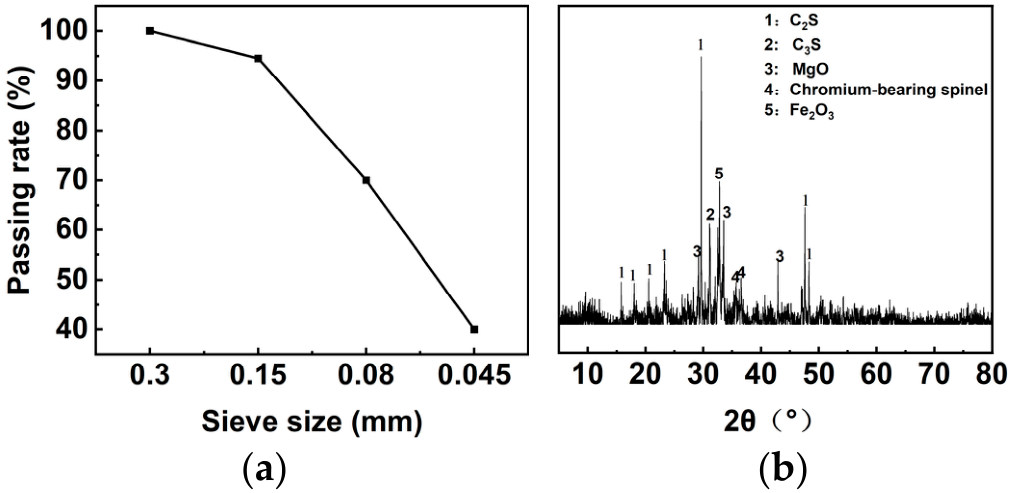
2.2.1. Raw Material Characterization
2.2.2. Performance Test Methods
- w is the water-to-solid ratio (%);
- m1 is the water fraction carried by SSSM (g);
- m2 is the added water (g);
- m3 is the total mass of dry materials (g).
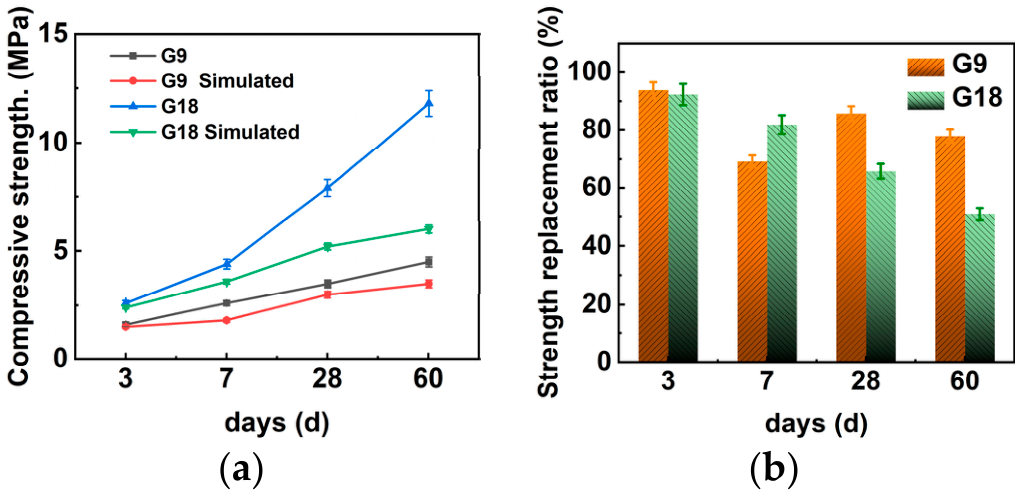
2.2.3. Simulated Control Test
- Ri is the ratio of the simulated control strength to the actual strength at curing age *i* (%);
- fsi is the compressive strength of the simulated control group at curing age *i* (MPa);
- fai is the compressive strength of the actual SSSM–GGBS group at curing age *i* (MPa);
- *i* is the curing age, taken as 3 d, 7 d, 28 d, and 60 d.

| Sample No. | Mass Fraction (wt.%) | ||||
|---|---|---|---|---|---|
| GGBS | SSSM | CaSO4 | Ca(OH)2 | LP | |
| G9 | 9 | 91 | 0 | 0 | 0 |
| G9 | 9 | 0 | 1.48 | 0.99 | 88.53 |
| G18 | 18 | 82 | 0 | 0 | 0 |
| G18 | 18 | 0 | 1.32 | 0.89 | 79.79 |
2.2.4. Sample Preparation for Microstructural Analysis
3. Results and Discussion
3.1. Study on the Influence of GGBS Fraction on the Properties of CLSM
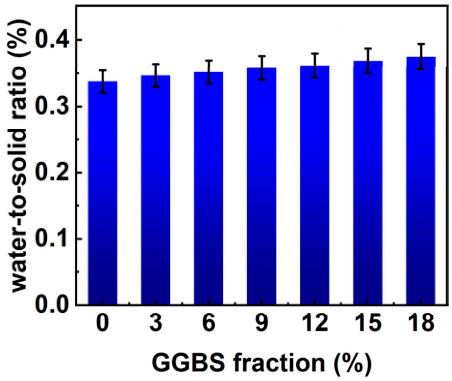
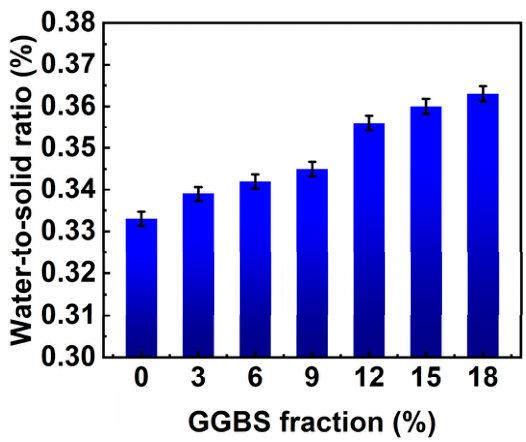
3.1.1. Effect of GGBS Fraction on Water-to-Solid Ratio
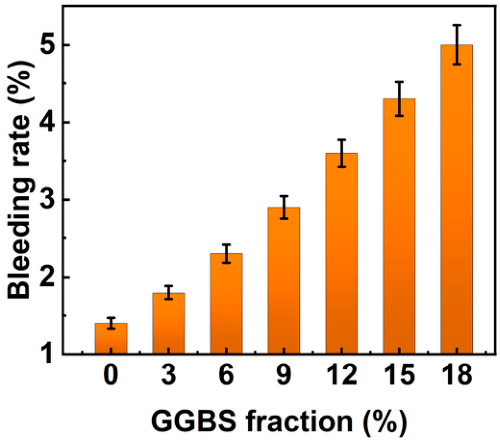
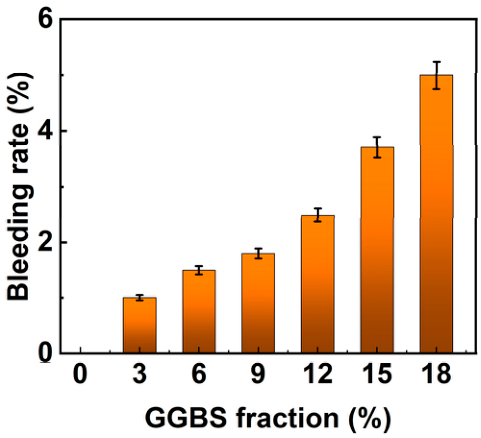
3.1.2. Effect of GGBS Fraction on Bleeding Rate
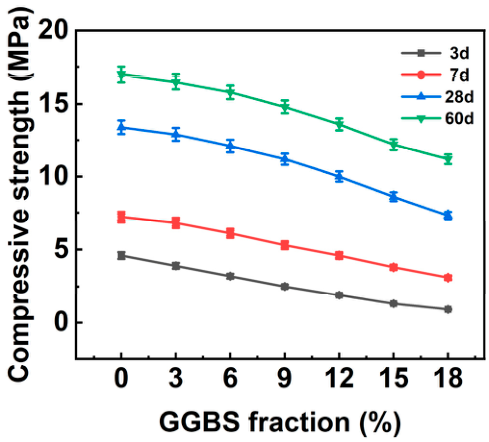
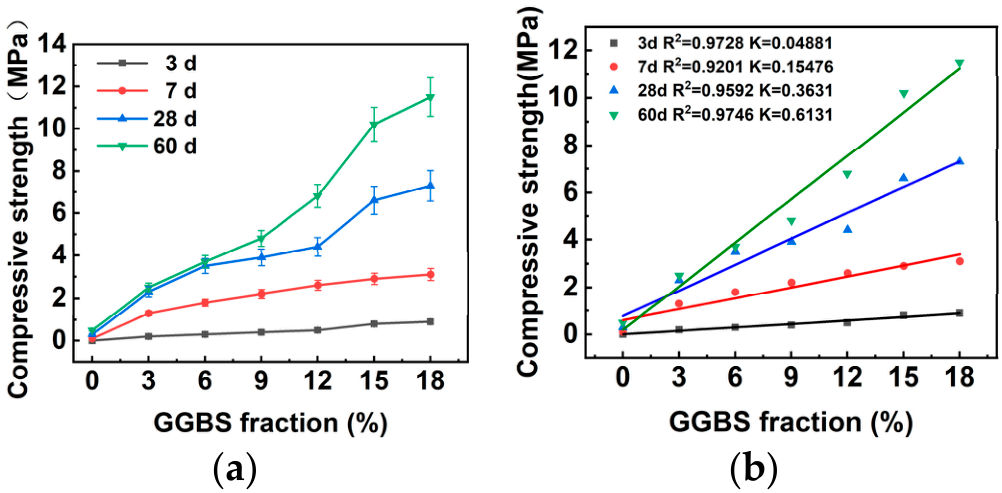
3.1.3. Effect of GGBS Fraction on the Compressive Strength
3.2. Study on the Effect of GGBS Fraction on the Performance of SSSM-CLSM
3.2.1. Effect of GGBS Fraction on the Water-to-Solid Ratio of SSSM-CLSM
3.2.2. Effect of GGBS Fraction on Bleeding Rate of SSSM-CLSM
3.2.3. Effect of GGBS Fraction on the Compressive Strength of SSSM-CLSM
3.3. Solidification Mechanism Analysis of SSSM-CLSM
4. Conclusions
- Increasing the GGBS fraction increased the water-to-solid ratio and bleeding rate but decreased compressive strength. When cement was completely replaced by GGBS, the 28 d compressive strength still reached 7.3 MPa, meeting CLSM requirements. The linear fitting of strength–GGBS fraction showed R2 > 0.90, with higher slopes at later ages, indicating more pronounced strength enhancement over time.
- The simulated control test showed that the actual SSSM–GGBS system outperformed the simulated control at all ages. For the G18 group, the actual-to-control strength ratios decreased from 92.31% (3 d) to 50.85% (60 d), meaning the actual system exceeded the control by 49.15% at 60 d. The observation suggests that SSSM contributes not only through alkali–sulfate activation but also via fine particle filling and secondary reactions of its potentially reactive components.
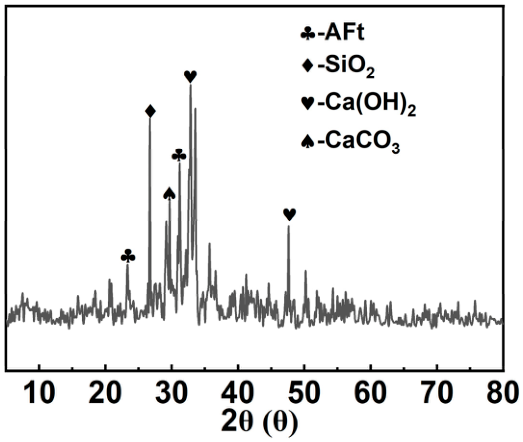
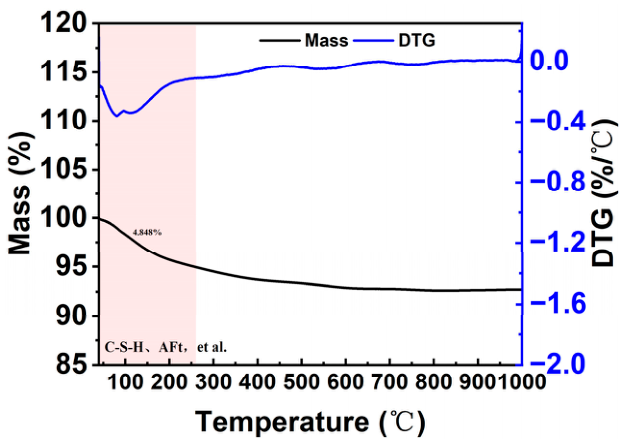
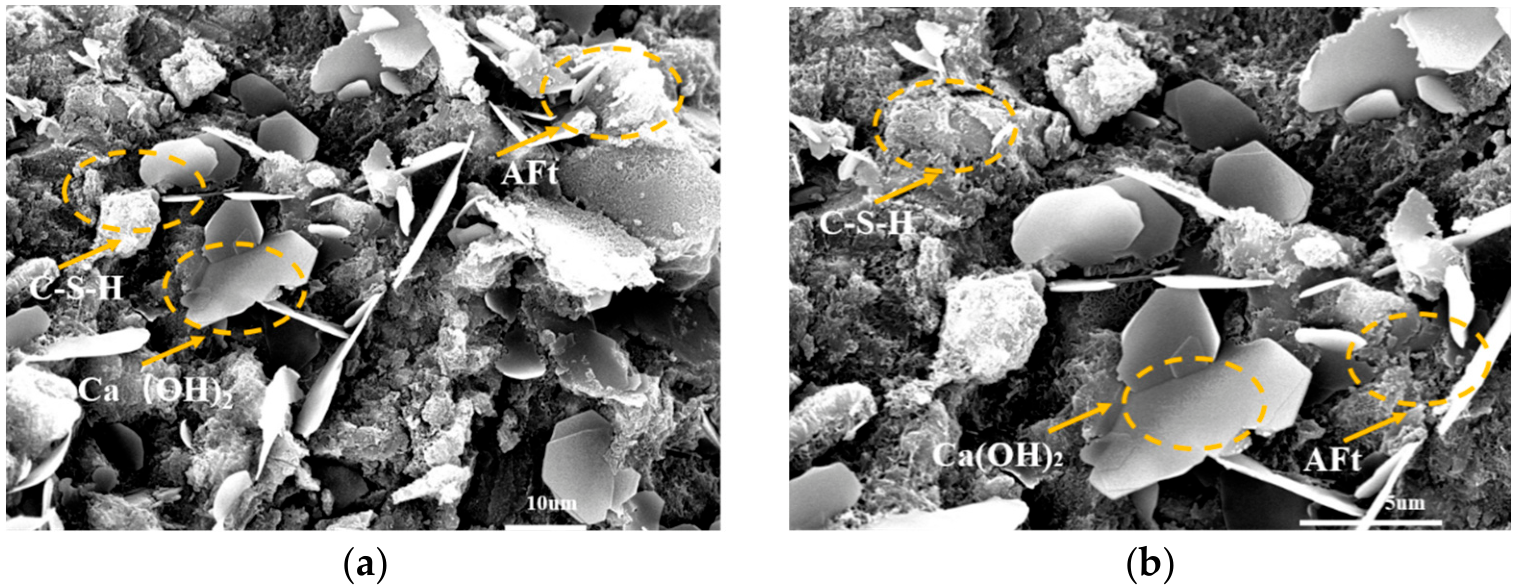
- Microstructural analyses (XRD, TG-DTG, SEM) indicated the formation of AFt and C-S-H gel as the primary products. TG-DTG showed a mass loss of 4.848% at 50–250 °C, higher than the theoretical AFt crystalline water loss (2.84%), indicating substantial C-S-H formation. AFt formation required calcium sources beyond f-CaO, suggesting the occurrence of synergistic reactions between GGBS and SSSM. SEM revealed a dense cementitious network with flocculent C-S-H gel and needle-like AFt, supporting the 7.3 MPa strength.
Author Contributions
Funding
Data Availability Statement
Conflicts of Interest
References
- Chen, M.Z.; Chen, T.; Chen, D.Y.; Wu, Y.W. Effects of dry and wet processing on the cementitious activity and environmental impact of stainless steel slag. Bull. Chin. Ceram. Soc. 2026, 5, 1650–1662. [Google Scholar]
- Ghorbani, S.; Stefanini, L.; Sun, Y.; Walkley, B.; Provis, J.L.; De Schutter, G.; Matthys, S. Characterisation of alkali-activated stainless steel slag and blast-furnace slag cements. Cem. Concr. Compos. 2023, 143, 105230. [Google Scholar] [CrossRef]
- GB 175-2023; General Purpose Portland Cement. Standardization Administration of China: Beijing, China, 2023.
- Rosales, J.; Agrela, F.; Díaz-López, J.L.; Cabrera, M. Alkali-Activated Stainless Steel Slag as a Cementitious Material in the Manufacture of Self-Compacting Concrete. Materials 2021, 14, 3945. [Google Scholar] [CrossRef] [PubMed]
- Wei, X.L.; Sun, X.S.; Du, H.H.; Ni, W.; Kong, X.; Ren, C. Recycle of steel slag as cementitious material and fine aggregate in concrete: Mechanical, durability property and environmental impact. Environ. Sci. Pollut. Res. 2024, 31, 56194–56209. [Google Scholar] [CrossRef] [PubMed]
- Zheng, Z.Y.; Deng, P. Mechanical and fracture properties of slag/steel slag-based geopolymer fully recycled aggregate concrete. Constr. Build. Mater. 2024, 413, 134533. [Google Scholar] [CrossRef]
- Huang, L.; Chen, S.; Lan, Z.; Chen, Y.; Li, T. Research on the Hydration Mechanism and Mechanical Properties of Stainless Steel Slag–Fly Ash Recycled Concrete in Pavements. Materials 2025, 18, 4906. [Google Scholar] [CrossRef] [PubMed]
- Liu, H.J.; Gao, P.; Zhang, M.X.; Wei, C.; Li, D.Y.; Xie, Z.T. Experimental study on physicochemical characteristics of stainless steel slag mud and its application in cement-stabilized base materials. Shanxi Archit. 2026, 52. [Google Scholar] [CrossRef]
- Yao, S.Z.; Yao, X.L.; Li, J.W.; Wang, X.; Zhang, C.; Wu, S.; Wang, K.; Wang, W. Preparation and properties of ready-to-use low-density foamed concrete derived from industrial solid wastes. Constr. Build. Mater. 2021, 287, 122946. [Google Scholar] [CrossRef]
- ACI-Committee 229. Report on Controlled Low-Strength Materials; ACI: Farmington Hills, MI, USA, 2013. [Google Scholar]
- Zhang, T.S.; Yuan, J.M.; Wang, W.; Chen, P.; Chen, C.; Wu, Z.; Wei, J.; Yu, Q. Efficient utilization of waste shield slurry and CDW fines to prepare eco-friendly controlled low-strength material. J. Clean. Prod. 2024, 444, 141343. [Google Scholar] [CrossRef]
- Parhi, S.K.; Dwibedy, S.; Panda, S.; Panigrahi, S.K. A comprehensive study on Controlled Low Strength Material. J. Build. Eng. 2023, 76, 107086. [Google Scholar] [CrossRef]
- Zhao, G.J.; Pan, X.Q.; Yan, H.; Tian, J.; Han, Y.; Guan, H.; Ruan, Y.; Liu, B.; Chen, F. Recycling shield discharged soil to produce sustainable controlled low-strength material: Performance, microscale characteristics, and environmental life cycle assessment. Sustain. Mater. Technol. 2025, 46, e01717. [Google Scholar] [CrossRef]
- Li, Y.C.; Liu, L.; Deng, Y.F.; Chen, Y.; Li, Y.; Wu, J. Unlocking the potential of iron ore tailings in controlled low-strength material: Feasibility, performance, and evaluation. J. Clean. Prod. 2023, 423, 138772. [Google Scholar] [CrossRef]
- Xie, Z.M.; Chen, H.; Zhang, L. Preparation and properties of CLSM using soda residue and fly ash. Constr. Build. Mater. 2025, 458, 139488. [Google Scholar] [CrossRef]
- Zhang, T.S.; Jian, Y.M.; Wang, W. Development of a cement-free controlled low-strength material using multiple industrial solid wastes. J. Mater. Civ. Eng. 2026, 38, 04026012. [Google Scholar] [CrossRef]
- Liu, R.; Liu, Z.; Zhao, L.J.; Zhang, S.; Wang, D.M. Mix proportion optimization of lithium slag-based controlled low-strength material based on orthogonal test. Bull. Chin. Ceram. Soc. 2024, 43, 2548–2555. [Google Scholar]
- Zhou, Z.B.; Li, X.L.; Su, Z.P.; Zhang, K.; Wang, K.; Deng, X.J. Preparation and properties of recycled controlled low-strength material prepared by multiple solid wastes. New Build. Mater. 2024, 4, 52–56. [Google Scholar]
- Gao, Y.; Zhou, L.B.; Wang, S.C.; Liu, Z.; Zhang, J. Sustainable utilization of industrial byproducts: Coal gangue aggregate and lithium slag-based binder in low-carbon controlled low-strength materials. J. Build. Eng. 2025, 112, 113975. [Google Scholar] [CrossRef]
- Liu, Y.; Su, Y.; Xu, G.; Chen, Y.; You, G. Research Progress on Controlled Low-Strength Materials: Metallurgical Waste Slag as Cementitious Materials. Materials 2022, 15, 727. [Google Scholar] [CrossRef] [PubMed]
- Li, X.L.; Zhang, Y.; Wang, H.; Ren, C.; Deng, Q.; Lyu, H.; Wu, J. Mechanical properties and microscopic mechanism of slag-carbide slag geopolymer solidified soil. J. Henan Univ. Sci. Technol. Nat. Sci. 2024, 45, 56–63. [Google Scholar]
- GB/T 20491-2017; Slag Powder Used for Cement and Concrete. Standardization Administration of China: Beijing, China, 2017.
- GB 5085.3-2007; Identification Standards for Hazardous Wastes—Identification of Leaching Toxicity. Ministry of Environmental Protection of China: Beijing, China, 2007.
- GB/T 18046-2017; Ground Granulated Blast Furnace Slag Used for Cement, Mortar and Concrete. Standardization Administration of China: Beijing, China, 2017.
- DBJ51-T188-2022; Technical Standard for Application of Pre-mixed Fluidized Solidified Soil Engineering. Sichuan Provincial Department of Housing and Urban-Rural Development: Chengdu, China, 2022.
- T0518-2020; Test Method for Free Bleeding Rate and Free Expansion Rate of Cement Paste. China Communications Press Co., Ltd.: Beijing, China, 2020.
- JGJ/T 70-2009; Standard for Test Method of Basic Properties of Building Mortar. Ministry of Housing and Urban-Rural Development of China: Beijing, China, 2009.
- Ting, L.; Qiang, W.; Shiyu, Z. Effects of ultra-fine ground granulated blast-furnace slag on initial setting time, fluidity and rheological properties of cement pastes. Powder Technol. 2019, 345, 54–63. [Google Scholar] [CrossRef]
- Zeng, L.; Hu, B.; Shi, Q. Preparation and hydration properties of low-carbon gypsum-slag-based cementitious materials incorporating multiple solid wastes. Nonferrous Met. Extr. Metall. 2024, 76, 154–163. [Google Scholar]
- Yang, H. Research on the Performance and Application of Decarbonized Gasification Slag-Based Composite Cementitious Materials. Ph.D. Thesis, Inner Mongolia Agricultural University, Hohhot, China, 2025. [Google Scholar]
- Matalkah, F.; Ababneh, A.; Aqel, R. Enhancement of the mechanical properties of mortar with low-quality steel slag through sodium sulfate activation: A path towards sustainable concrete. Eur. J. Environ. Civ. Eng. 2025, 29, 2099–2117. [Google Scholar] [CrossRef]
- Gao, M.; Li, M.; Jing, H.; Sha, W.; Wang, J. Physicochemical performance and hydration mechanism of alkali activated GGBS-steel slag-stockpiled CFB fly ash cementitious composites. Constr. Build. Mater. 2024, 458, 139635. [Google Scholar]


| Material | Mass Fraction/% | ||||||||||
|---|---|---|---|---|---|---|---|---|---|---|---|
| LOI | CaO | SiO2 | Fe2O3 | MgO | Al2O3 | MnO | Cr2O3 | Na2O | SO3 | Σ | |
| SSSM | 1.90 | 45.98 | 28.09 | 7.22 | 4.74 | 3.39 | 1.08 | 3.04 | 0.18 | 0.99 | 98.50 |
| GGBS | 1.04 | 40.00 | 30.04 | 0.29 | 10.66 | 14.92 | - | - | 0.41 | 2.07 | 99.43 |
| Cement | 0.38 | 65.49 | 21.21 | 3.50 | 1.64 | 5.84 | - | - | - | - | 98.06 |
| Element | As | Hg | Be | Cd | Cr | Ni | Pb | Cr(VI) | Ag |
|---|---|---|---|---|---|---|---|---|---|
| Leaching concentration (mg/L) | 0.5 | 0.05 | 0.005 | 0.1 | 1.5 | 1.0 | 1.0 | 0.5 | 0.5 |
| Limit value (mg/L) | 0.0015 | 0.0002 | <0.0007 | <0.0012 | 0.388 | 0.404 | <0.0042 | 0.2 | <0.0029 |
| Sample No. | Mass Fraction (wt.%) | ||
|---|---|---|---|
| Cement | GGBS | SSSM | |
| C18 | 18 | 0 | 82 |
| C15G3 | 15 | 3 | 82 |
| C12G6 | 12 | 6 | 82 |
| C9G9 | 9 | 9 | 82 |
| C6G12 | 6 | 12 | 82 |
| C3G15 | 3 | 15 | 82 |
| G18 | 0 | 18 | 82 |
| G0 | 0 | 0 | 100 |
| G3 | 0 | 3 | 97 |
| G6 | 0 | 6 | 94 |
| G9 | 0 | 9 | 91 |
| G12 | 0 | 12 | 88 |
| G15 | 0 | 15 | 85 |
Disclaimer/Publisher’s Note: The statements, opinions and data contained in all publications are solely those of the individual author(s) and contributor(s) and not of MDPI and/or the editor(s). MDPI and/or the editor(s) disclaim responsibility for any injury to people or property resulting from any ideas, methods, instructions or products referred to in the content. |
© 2026 by the authors. Licensee MDPI, Basel, Switzerland. This article is an open access article distributed under the terms and conditions of the Creative Commons Attribution (CC BY) license.
Share and Cite
Xie, Z.; Zhou, M.; Gao, P.; Wang, Y.; Zhou, Y. Composition Design and Solidification Mechanism Analysis of Controlled Low-Strength Materials Using Stabilized Stainless Steel Mud. Materials 2026, 19, 3083. https://doi.org/10.3390/ma19143083
Xie Z, Zhou M, Gao P, Wang Y, Zhou Y. Composition Design and Solidification Mechanism Analysis of Controlled Low-Strength Materials Using Stabilized Stainless Steel Mud. Materials. 2026; 19(14):3083. https://doi.org/10.3390/ma19143083
Chicago/Turabian StyleXie, Zongting, Mingkai Zhou, Peng Gao, Yuqiang Wang, and Yuhao Zhou. 2026. "Composition Design and Solidification Mechanism Analysis of Controlled Low-Strength Materials Using Stabilized Stainless Steel Mud" Materials 19, no. 14: 3083. https://doi.org/10.3390/ma19143083
APA StyleXie, Z., Zhou, M., Gao, P., Wang, Y., & Zhou, Y. (2026). Composition Design and Solidification Mechanism Analysis of Controlled Low-Strength Materials Using Stabilized Stainless Steel Mud. Materials, 19(14), 3083. https://doi.org/10.3390/ma19143083