3.1. Structural and Morphological Characterization
To verify whether the PS sacrificial template introduced during fabrication could be completely removed during the subsequent sintering process, and to examine the influence of thermal decomposition during sintering on the crystal structure of WO
3, XRD measurements were first performed on the sintered samples containing different amounts of PS. As shown in
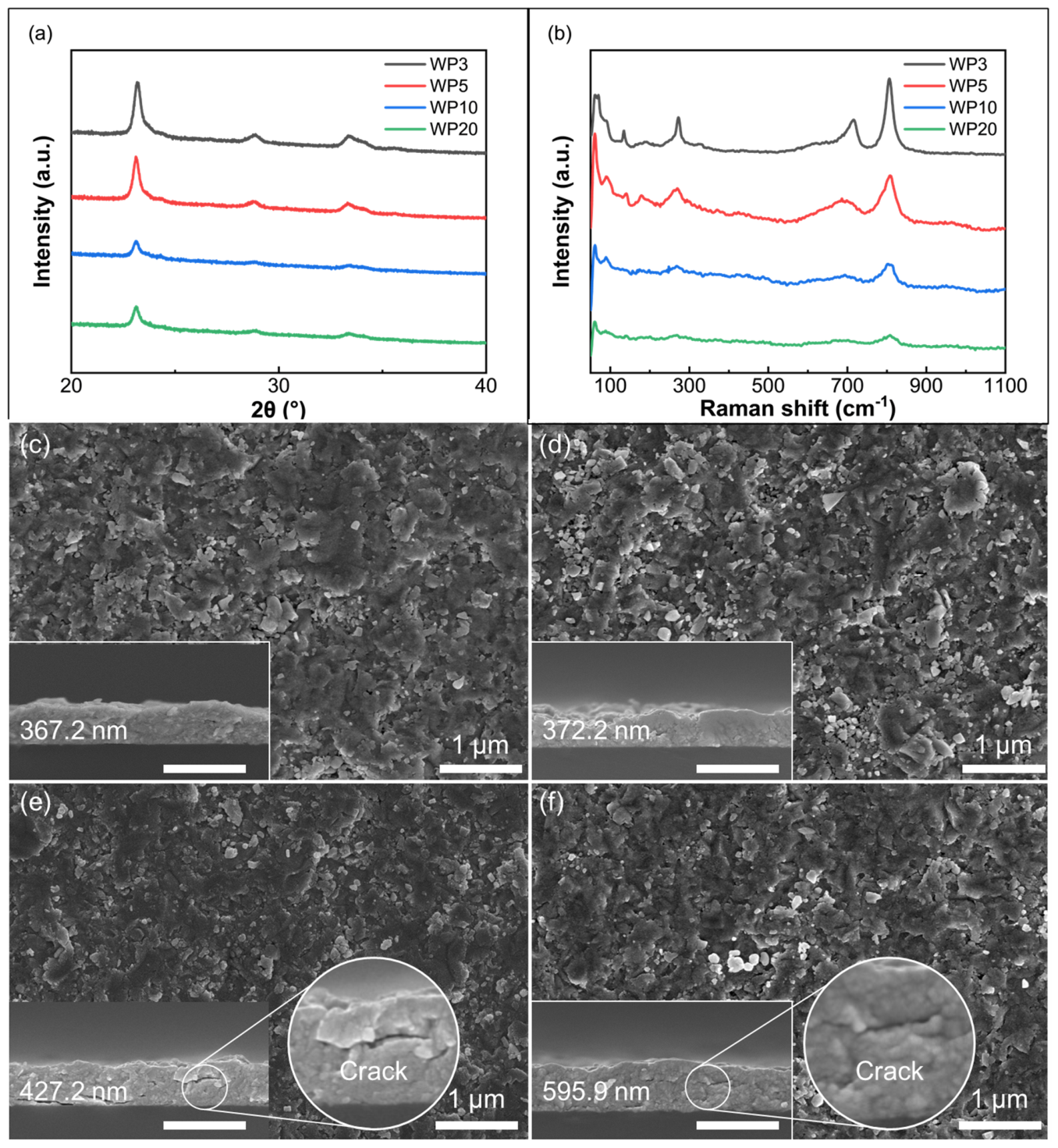
Figure 1a, no broad diffuse amorphous scattering peak attributable to PS was observed in any of the diffraction patterns, and all detectable reflections could be indexed exclusively to WO
3, indicating that polystyrene had been essentially fully decomposed and volatilized under air at 500 °C, leaving no ordered or disordered organic residue in the final films. Further comparison reveals that the diffraction peak positions of all samples agree well with the standard PDF# No. 97-001-7003 and can be assigned to monoclinic γ-WO
3, demonstrating that the introduction of PS and its subsequent thermal decomposition did not alter the primary crystal phase of WO
3. Compared with the starting powder, the film samples retained a relatively strong diffraction peak near 2θ ≈ 23.147°, corresponding to the (002) plane, whereas the reflections from other crystallographic planes were markedly weakened or nearly absent, indicating a pronounced preferred orientation. This behavior is closely associated with the PAD process, in which high-energy particles impact the substrate along the normal direction and undergo selective lattice “survival”. In γ-WO
3, the (002) plane is parallel to the c-axis and can be regarded as a W–O layered plane (d ≈ 0.37 nm), with adjacent layers connected by relatively weak van der Waals interactions. Under high-strain-rate impact, this structure is more prone to interlayer sliding for energy dissipation rather than complete fragmentation, thereby favoring its retention during deposition and ultimately resulting in a strongly (002)-oriented film structure [
22].
Building on the XRD identification of phase composition and preferred orientation, Raman spectroscopy was further employed to probe, from the perspective of local bonding structure, the effects of PS removal by thermal decomposition and sintering on the bond length, bond angle, and defect state of WO
3. The results are presented in
Figure 1b. First, no characteristic vibrational features associated with PS were observed in the Raman spectra of any sample. In particular, the strong and sharp peak near 1001 cm
−1, which is assigned to the “breathing” mode of the benzene ring and is regarded as the most representative Raman fingerprint of PS, was absent. Meanwhile, the characteristic band around 620 cm
−1, typically attributed to skeletal benzene ring bending/deformation vibrations, also completely disappeared. The absence of these two characteristic PS-related bands is consistent with the lack of PS-derived amorphous scattering in the XRD patterns, further confirming that the PS was fully pyrolyzed and removed from the films during sintering, and therefore did not interfere with the final Raman response of WO
3.
For near-stoichiometric monoclinic WO
3-x, the vibrational mode of the lattice at low frequency (~135 cm
−1) is a characteristic fingerprint of this phase, reflecting its low-symmetry framework structure. The band near 270 cm
−1 is assigned to the O–W–O bending vibration, while the peaks at approximately 714 and 808 cm
−1 correspond to the stretching vibrations of bridging O–W–O and terminal W–O bonds, respectively. With increasing PS content in the starting powder, the Raman features of the sintered samples exhibited a systematic evolution. Specifically, the low-frequency fingerprint peak at 135 cm
−1 gradually weakened and nearly disappeared in the sample containing 20 vol% PS, indicating that the overall structural order of the WO
3 framework and the characteristic monoclinic distortion were partially suppressed, while lattice disorder and local structural distortion became significantly enhanced. This observation is consistent with the more severe bulk reduction and possible partial amorphization under high-PS conditions. Meanwhile, the intensities of the W–O–W and terminal W–O stretching bands at 714 and 808 cm
−1 decreased overall, and the full width at half maximum of the 714 cm
−1 peak broadened markedly, suggesting a wider distribution of W–O bond lengths and O–W–O bond angles, as well as a more heterogeneous local coordination environment. Such changes are commonly associated with the introduction of oxygen vacancies and the increased distortion of WO
6 octahedra. In the WP5 sample, a new and relatively strong band emerged at ~950 cm
−1 [
23,
24]. This high-frequency vibration is generally associated with highly shortened terminal W=O bonds or local vibrational modes related to W
5+ species in tungsten bronze/non-stoichiometric WO
3-x, indicating that the reducing atmosphere generated during PS pyrolysis significantly increased the reduction degree of WO
3 not only at the surface but also in the bulk, thereby inducing the formation of more defect structures containing short W=O bonds and highly distorted WO
6 octahedra [
24]. Taken together, the XRD and Raman results suggest that, while the PS sacrificial phase was effectively removed, its pyrolysis-induced reduction effect further modulated the bulk redox state and local structure of the WO
3 films, thereby providing a structural basis for the subsequent enhancement of the hydrogen-sensing response.
In terms of morphology, the SEM characterization results of samples with different PS contents are shown in
Figure 1c–f, with the insets presenting the cross-sectional morphology and corresponding film thickness information. It can be seen that the WO
3 films prepared by the PAD process and subsequently sintered exhibit uniform macroscopic coverage and continuous film formation, while their surfaces display a relatively rough granular texture. This feature is closely associated with the “hammering–fracturing–rearrangement” behavior of aerosol particles during high-velocity impact consolidation at room temperature. The cross-sectional images further show that, under identical processing parameters, the film thickness falls within the submicrometer-to-micrometer range, and the interface between the film and the quartz substrate is compact and well bonded, with no obvious delamination observed, demonstrating that the PAD process can achieve strong film–substrate adhesion under ambient conditions. With the introduction and gradual increase in PS in the starting powder, local micropores and microcracks with characteristic sizes in the order of hundreds of nanometers become clearly visible both on the film surface and within the cross-section after sintering, indicating that PS was effectively co-deposited as a space-occupying phase during deposition and was subsequently completely removed through pyrolysis and oxidation during heat treatment, thereby leaving voids at its original locations [
25]. Notably, under the same carrier gas flow rate and scanning parameters, the cross-sectional SEM results reveal that the film thickness increases significantly with increasing PS content. This can be attributed to the additional buffering and damping effect introduced by the polymer–ceramic mixed powder during PAD, which alleviates excessive erosion of the precursor layer and secondary sputtering caused by inorganic particles, thereby improving the effective deposition efficiency [
25]. Meanwhile, after PS removal during sintering, more abundant pores and interconnected channels are formed throughout both the film interior and surface. The simultaneous increase in film thickness and pore population expands the effective reaction volume and the three-dimensional scale of gas diffusion pathways, reflecting a progressive development of the porous architecture with increasing PS content. However, when the PS volume fraction exceeds approximately 10%, the excessively high organic content within the film leads to rapid gas release from the interior during sintering at 500 °C. Because the resulting local stress cannot be dissipated in time, some samples develop horizontally extended cracks within the WO
3 layer, as highlighted in the enlarged images in
Figure 1e,f.
It should be noted that the active sensing layers are substrate-supported thin films with very small mass; conventional BET measurements are not suitable for accurately quantifying their surface area or pore-size distribution. Therefore, in this work, the pore evolution was evaluated mainly from SEM and cross-sectional SEM observations. The enhanced sensing performance is discussed as a coupled result of pore formation, modified gas diffusion, oxygen-vacancy enrichment, and preserved charge-transport pathways, rather than being attributed solely to an increase in specific surface area.
Because the sensing activity of gas-sensitive materials is closely related to their surface chemical composition and elemental valence states, it is necessary to systematically analyze the chemical states of the WO
3-x films sintered from samples with different PS contents. XPS measurements were therefore carried out on all sintered samples, and the results are shown in
Figure S4. The XPS survey spectra indicate that, apart from the unavoidable signal from adventitious surface carbon, only the characteristic peaks of tungsten and oxygen were detected in all samples, with no evidence of other impurity elements. This confirms that, after complete removal of the PS sacrificial phase, the films remained chemically composed of WO
3 without introducing any additional interfering species. The survey spectra of samples with different PS contents exhibit essentially identical peak positions, indicating that the elemental constituents of the films did not change with PS addition; however, variations in peak intensity and relative peak area suggest systematic differences in their internal redox state and defect concentration.
To further quantify the influence of PS content on the redox state of WO
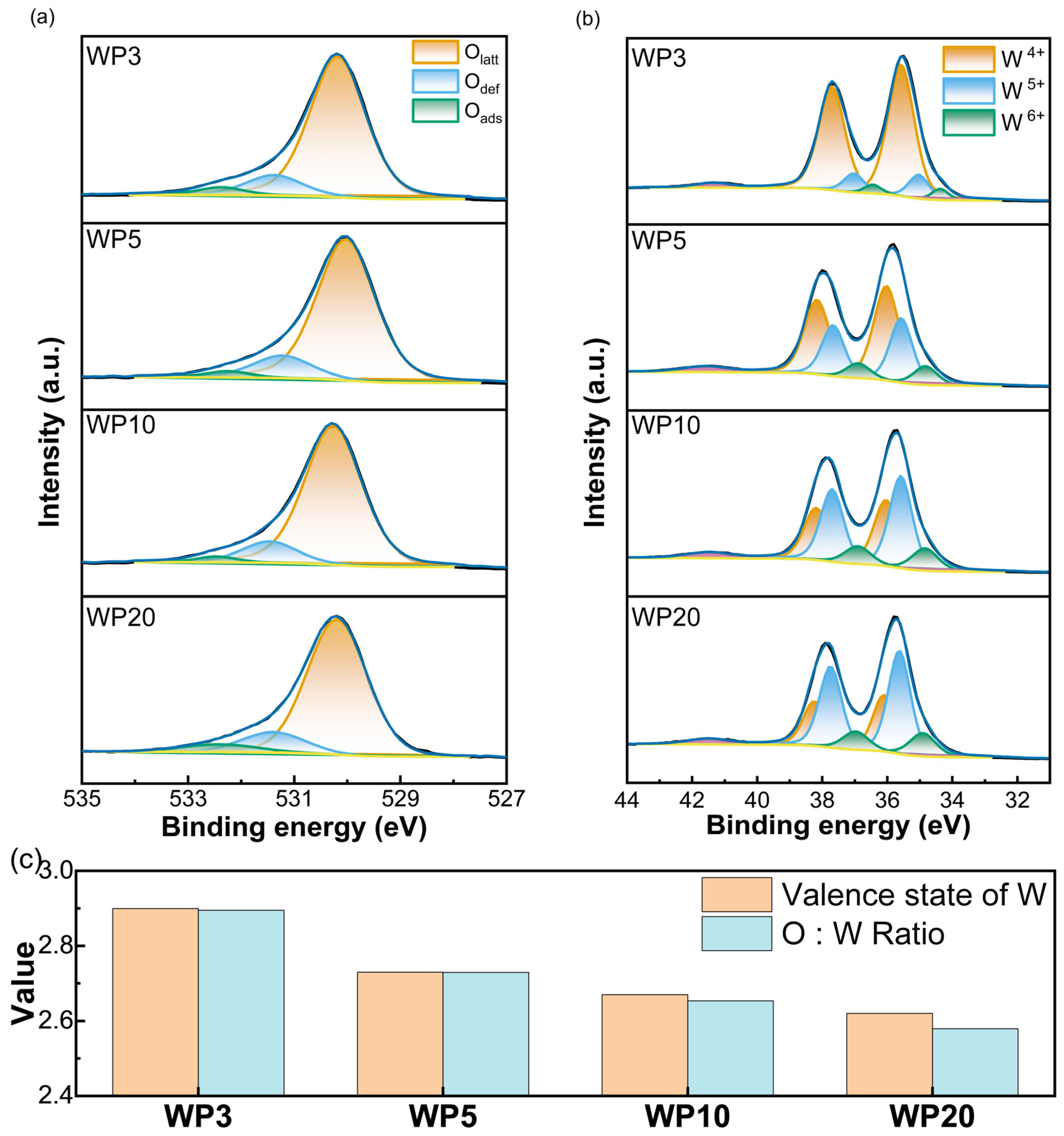
3 and the concentration of oxygen vacancies, high-resolution spectra of the W 4f and O 1s regions were collected and deconvoluted, as shown in
Figure 2. These results reveal the evolution of the bulk reduction degree and tungsten valence-state distribution with increasing PS content.
Figure 2a presents the high-resolution W 4f spectra and their fitting results. The characteristic spin–orbit doublet of W 4f7/2 and W 4f5/2 can be deconvoluted into multiple components assigned to W
6+ and lower-valence tungsten species (W
5+/W
4+) [
26,
27]. The relative area ratios of these fitted components can therefore be used to evaluate the reduction degree of WO
3 and the evolution of tungsten valence-state distribution with varying PS content.
Figure 2b shows the deconvoluted high-resolution O 1s spectra. The O 1s signal can be resolved into three components, namely lattice oxygen (O
latt), defect-related oxygen (O
def), and surface chemisorbed oxygen (O
ads). Among them, O
latt corresponds to O
2− in the WO
3 lattice, O
def reflects oxygen-deficient environments associated with oxygen vacancies and non-stoichiometric WO
3-x, and O
ads is related to surface-adsorbed species such as hydroxyl groups and carbonates. The XPS-derived O/W ratios of WP3, WP5, WP10, and WP20 are approximately 2.90, 2.73, 2.65, and 2.58, respectively, corresponding to an increasing degree of oxygen deficiency with increasing PS content. However, the best sensing performance is obtained by WP5, indicating that an intermediate oxygen-deficiency level is more favorable than excessive reduction. By comparing the relative area fractions of these components in samples with different PS contents, the combined regulatory effect of PS-sacrificial-phase pyrolysis on bulk reduction, oxygen-vacancy generation, and surface adsorbates in WO
3 can be elucidated from the perspective of chemical states, thereby providing an important basis for understanding the subsequent differences in hydrogen-sensing performance.
Based on the qualitative analysis, semi-quantitative fitting of the high-resolution XPS spectra was further performed for different samples to clarify the regulatory effect of PS-sacrificial-phase pyrolysis on the bulk oxygen content and tungsten valence state of WO
3. The O/W atomic ratio, calculated from the area ratio between the lattice-oxygen component and the W-related spectral peaks, shows that the WP3 sample has an O/W value of approximately 2.90, which is very close to the theoretical stoichiometric value of 3 for WO
3. This indicates that, when the PS volume fraction is only 3%, the sintered film remains nearly stoichiometric overall, in good agreement with the XRD and Raman results. As the PS content in the starting powder increases from 5% to 10% and 20%, the O/W ratio decreases progressively to 2.73, 2.65, and 2.58, respectively, indicating a gradual depletion of lattice oxygen, a continuous increase in the non-stoichiometric WO
3-x component, and a monotonic rise in oxygen-vacancy concentration with increasing PS content. This trend is consistent with the mechanism in which PS undergoes pyrolysis during heat treatment to generate gaseous products such as CO
2, thereby creating a locally reducing atmosphere that promotes oxygen loss from bulk WO
3. These results suggest that PS acts not only as a geometric sacrificial template for pore formation, but also as an effective bulk reducing agent within the film. In parallel, peak deconvolution of the high-resolution W 4f spectra was used to extract the area fractions of tungsten species with different valence states, from which an apparent average valence-state descriptor was established. As concluded in
Figure 2c, the results show that this parameter is about 2.90 for WP3 and then decreases successively to 2.73 for WP5, 2.67 for WP10, and 2.62 for WP20, indicating a progressive decrease in the fraction of W
6+ accompanied by a continuous increase in the proportion of W
5+/W4+ species. Combined with the systematic decline in the O/W atomic ratio, it can be concluded that a higher PS content leads to a stronger reducing effect of pyrolysis-generated gases within the film, which facilitates the migration of lattice oxygen and the reduction in W centers, thereby driving the evolution of WO
3 toward WO
3-x on the bulk scale. Overall, the quantitative XPS results clearly verify the chain process of “PS pyrolysis → local reducing atmosphere → bulk oxygen loss → reduction in W valence state”, providing solid chemical evidence for the role of oxygen vacancies and bulk reduction in the enhanced hydrogen-sensing performance discussed later.
3.2. Sensing Performance
The operating temperature of metal-oxide gas sensors not only directly governs charge-carrier transport and the kinetics of surface adsorption–reaction–desorption processes, but also serves as an important tuning parameter for adapting to variations in ambient temperature and humidity and buffering external operating fluctuations in practical lithium-ion battery applications. For hydrogen sensors intended for the early warning of thermal runaway, it is necessary to achieve sufficiently high response and fast kinetics at a moderate operating temperature, while also avoiding the increased power consumption and accelerated device aging associated with excessively high temperatures. Therefore, it is essential to systematically investigate the temperature-dependent behavior of samples with different PS contents over a certain temperature range in order to identify an optimized operating window that balances sensitivity and practical applicability. Based on these considerations, the temperature-dependent hydrogen-sensing performances of four samples with different PS contents (WP3, WP5, WP10, and WP20) were evaluated under identical catalytic conditions in this section. A Pd catalytic layer with a nominal thickness of approximately 3 nm was uniformly deposited on the surface of all samples by magnetron sputtering. The operating temperature was then varied from 40 to 200 °C, and the dynamic response curves of the devices toward 2 vol% H
2 in air were recorded at each temperature point, as shown in
Figure S5.
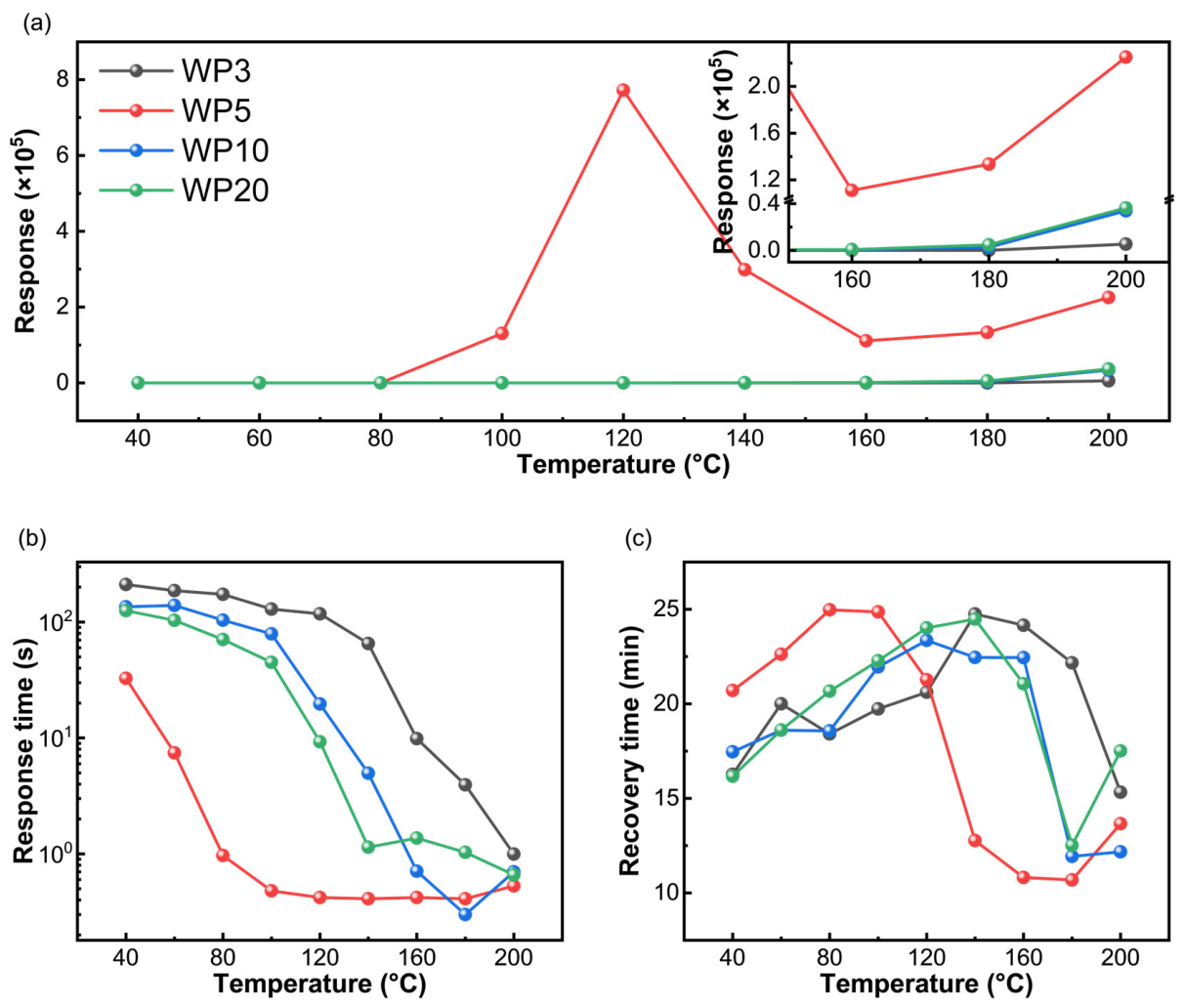
By comparing the response magnitude as well as the response/recovery characteristics of different samples at each temperature, the effects of PS-sacrificial-phase-induced bulk reduction and pore-structure evolution on the optimal operating temperature and high-concentration hydrogen-sensing behavior can be systematically analyzed. The steady-state response values calculated from the dynamic response curves are presented in
Figure 3. It can be seen that the Pd/PS–WO
3-x devices treated with the PS sacrificial phase also exhibit a typical volcano-shaped temperature dependence over the range of 40–200 °C. In the low-temperature region, the response increases markedly with increasing operating temperature, reaches a maximum at around 120 °C (approximately 8.1 × 10
5), and then gradually decreases upon further heating. Correspondingly, both the response and recovery times become shorter overall as the temperature rises, and a favorable compromise between high response magnitude and rapid kinetics is achieved near 120 °C, indicating that the adsorption/reaction and desorption processes are in a relatively optimal dynamic balance at this temperature. The decrease in the optimal operating temperature is likely associated with the combined effects of PS-induced oxygen-vacancy enrichment and porous-structure formation. Oxygen vacancies can promote oxygen activation and charge transfer, whereas the porous architecture can improve gas accessibility and reduce diffusion limitations. However, the present data do not allow a complete quantitative separation of these two contributions. Further impedance spectroscopy and activation-energy analysis will be required to determine the relative importance of defect-mediated surface reactivity and diffusion enhancement.
It should be noted that the optimum operating temperature of the samples in this work is clearly lower than that of the WO
3 films directly prepared by PAD in previous research [
18] (≈160 °C). This difference can be attributed to the bulk reduction and porous-structure construction induced by PS sacrificial-phase pyrolysis. On the one hand, PS pyrolysis creates a locally reducing environment within the film, significantly increasing the concentration of oxygen vacancies and the proportion of W
5+ in WO
3-x, thereby lowering the activation energy for the reaction between surface-adsorbed oxygen species and hydrogen and enabling sufficiently rapid surface reactions at lower temperatures. On the other hand, the interconnected channels and rough porous surface formed after PS removal shorten the diffusion path of hydrogen within the film and alleviate mass-transfer limitations, thus shifting the response maximum toward lower temperatures. Therefore, the synergistic effects of PS-sacrificial-phase-induced bulk reduction and pore-structure optimization allow the Pd/PS–WO
3-x devices to achieve hydrogen-sensing performance at around 120 °C that is comparable to, or even better than, that of untreated WO
3 at higher temperatures, making them more suitable for the practical requirements of lithium-ion battery safety monitoring in terms of moderate operating temperature and reduced power consumption.
Taken together, the quantitative XPS results, SEM morphology, and temperature-dependent sensing behavior indicate that the superior hydrogen response of WP5 originates from an optimal balance among the degree of bulk reduction, the integrity of the pore structure, and the semiconductor transport characteristics at this composition. On the one hand, when the PS content increases from 3% to 5%, the reductive species released during PS pyrolysis lower the O/W ratio from 2.90 to 2.73, indicating that WP5 contains significantly more oxygen vacancies than WP3. This not only increases the intrinsic carrier concentration, but also introduces more active defect sites at and near the surface, thereby markedly enhancing charge transfer and interfacial reactions between adsorbed oxygen species and H2, which amplifies the resistance change. However, when the PS content in the starting powder is further increased to 10% and 20%, the O/W ratio decreases further to 2.65 and 2.58, respectively, suggesting that the system becomes excessively reduced. Under this condition, the baseline conductivity is altered and the depletion layer becomes too thin, so the overall resistance can no longer be effectively modulated by surface reactions, leading to a decline in response magnitude. On the other hand, the SEM results show that WP5 develops a uniform and interconnected porous structure while still maintaining a continuous film and good apparent film–substrate adhesion, as suggested by the absence of obvious delamination in cross-sectional SEM images. Nevertheless, quantitative adhesion evaluation, such as scratch testing or tape testing, was not performed in this study and should be included in future device-level reliability assessments. This microstructure not only increases the specific surface area and effective reaction volume, but also shortens the diffusion path of hydrogen within the film, which is beneficial for achieving both high response and rapid kinetics at moderate temperatures. By contrast, in WP10, the rapid release of large amounts of gas during PS pyrolysis gives rise to horizontal cracks and structurally nonuniform regions in the WO3 layer. As a result, the current tends to bypass the sensing-active regions through highly reduced domains or crack-related pathways, thereby weakening the control of surface chemical processes over the total resistance. Combined with the temperature-dependent results, WP5 reaches its maximum response at around 120 °C while still exhibiting relatively fast response and recovery, indicating that its oxygen-vacancy concentration, pore architecture, and carrier-transport properties are well matched to the adsorption–reaction–desorption kinetics at this operating temperature. In contrast, WP3 suffers from insufficient reaction activity at the same temperature, whereas in WP10 and WP20 the response amplification effect is partially offset by excessive reduction and structural damage. The superior response of WP5 should be understood as an optimized balance rather than a monotonic consequence of increasing PS content. Moderate PS addition increases the oxygen-vacancy concentration and creates gas-accessible porous structures, thereby enhancing hydrogen activation and charge transfer. However, excessive PS loading leads to over-reduction, stronger local lattice disorder, crack formation, and possible disruption of continuous conduction pathways. These adverse effects offset the benefits of increased porosity and defect density in WP10 and WP20. Therefore, WP5 can be regarded as lying within an optimal window in which the defect population is sufficiently active but not oversaturated, and the porous structure is well developed without compromising film continuity, ultimately giving rise to the best hydrogen-sensing performance in this work. Because PS addition also changes the film thickness, the WP5 optimum may include a thickness-related contribution. A future fixed-thickness sample series will be required to quantitatively separate thickness, porosity, and defect effects. It should be noted that the variation in PS content also changes the final film thickness, which may influence the baseline resistance, gas-diffusion length, and effective reaction volume. Therefore, the sensing performance trend cannot be assigned solely to porosity or defect concentration.
3.3. Feasibility Assessment for LIB Safety Monitoring
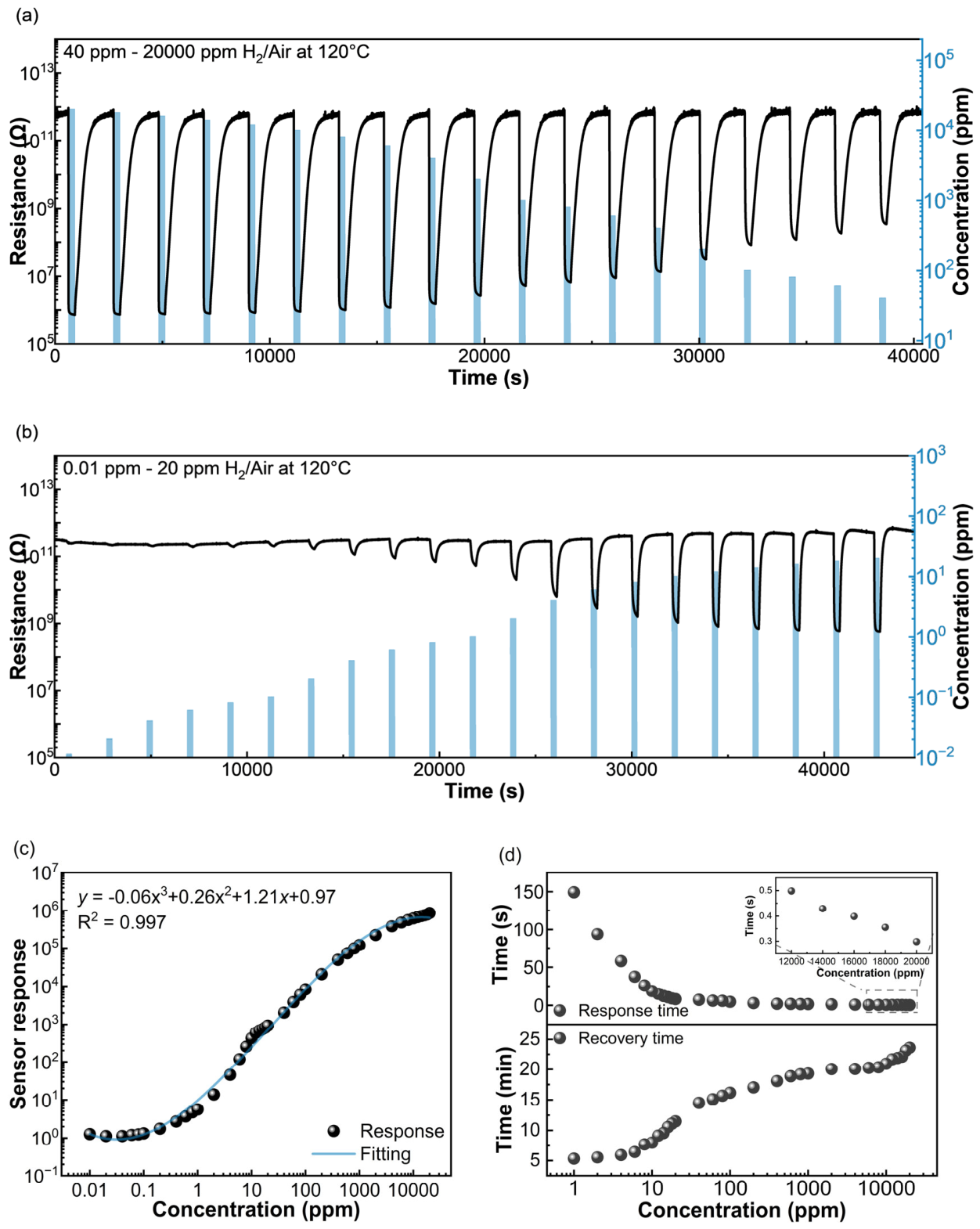
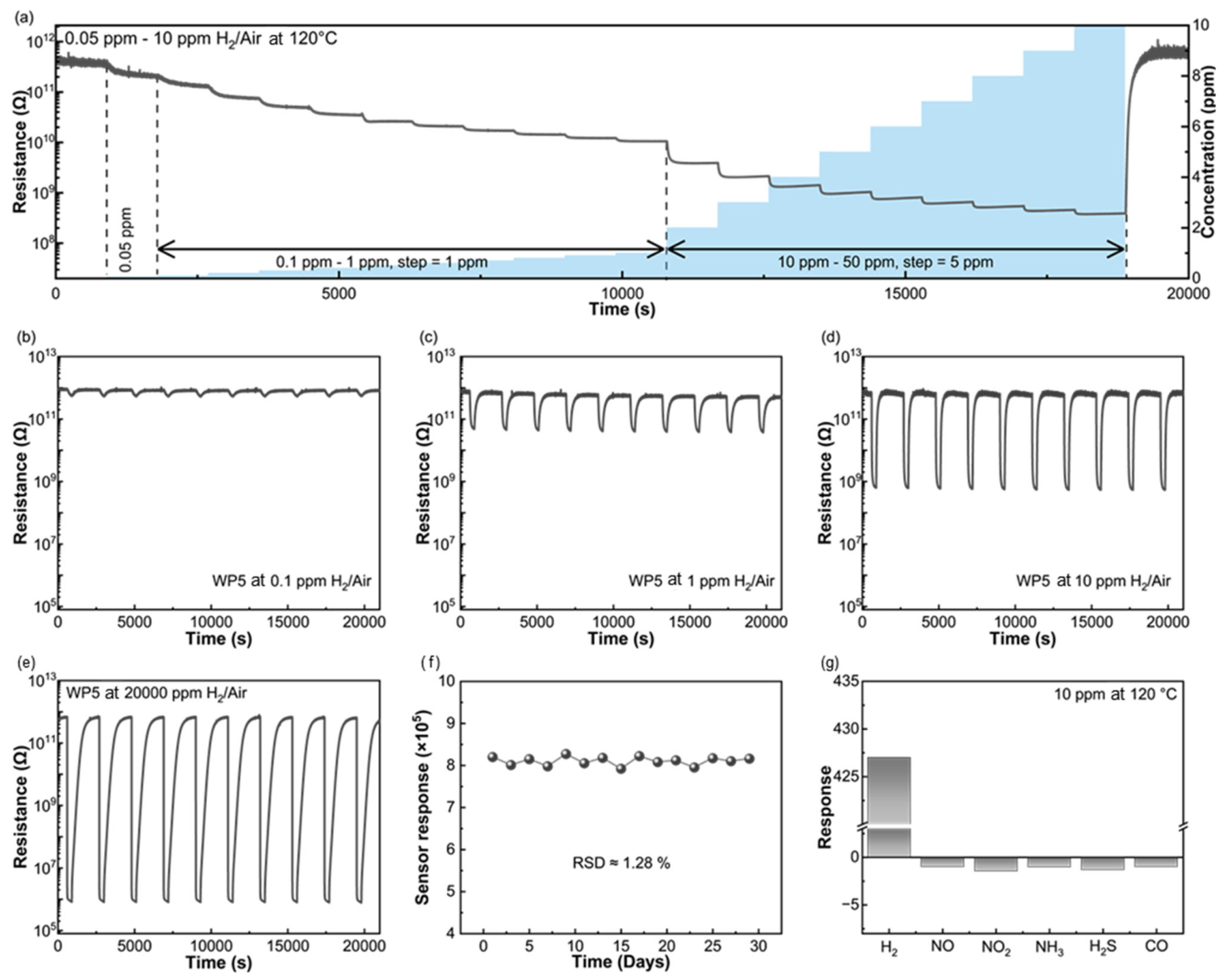
After identifying WP5 as the composition with the best overall performance in this system, its dynamic resistance response/recovery behavior toward different hydrogen concentrations was further systematically investigated at the optimal operating temperature of 120 °C. The H
2 concentration was gradually increased from the ppb level to 2 vol% (20,000 ppm), and the results are shown in
Figure 4a,b.
The device exhibited clearly distinguishable resistance transitions during each hydrogen exposure and purge cycle. As the hydrogen concentration increased, the resistance change rose monotonically, and a stable and reproducible response signal could already be obtained at 0.01 ppm (10 ppb), indicating that the WP5 sensor possesses effective ppb-level detection capability and a wide operating concentration range spanning from trace levels to high-concentration shock conditions. Even slight increases in concentration were able to induce stable and reproducible resistance variations, demonstrating that the sensor maintained high concentration resolution and a favorable signal-to-noise ratio even in the ultralow-concentration region. Throughout the entire stepwise test, the response curves remained smooth and continuous, with no obvious noise amplification or baseline drift. Moreover, after completion of the full concentration cycle, the resistance largely returned to its initial value, confirming the good dynamic stability and reversibility of WP5 under continuously varying concentration conditions. More importantly, the observation of reproducible and clearly identifiable stepwise responses even at the ppb level experimentally verifies that the device achieves a detection limit below the ppm range, thereby providing a reliable basis for the subsequent quantitative estimation of the limit of detection from the calibration curve. These results further confirm that the PS-sacrificial-phase-induced bulk reduction and pore-structure optimization significantly enhance the low-concentration hydrogen-sensing capability.
The steady-state response values extracted at different hydrogen concentrations are summarized in
Figure 4c,d. It can be seen that the response–concentration relationship exhibits typical nonlinear behavior. An empirical power-law model provides an excellent fit to the experimental data, with a coefficient of determination of R
2 ≈ 0.997, indicating that the response of the WP5 sample is highly regular and well describable over a wide concentration range, which is advantageous for subsequent quantitative concentration readout through calibration. The response and recovery times at different hydrogen concentrations were further extracted, as shown in
Figure 4d. The response time gradually decreases with increasing concentration, which can be attributed to the fact that, under identical gas-flow and delivery conditions, a higher hydrogen partial pressure corresponds to a larger molecular flux, enabling surface active sites to be occupied more rapidly and charge-transfer reactions to proceed more quickly, thereby establishing a new adsorption/reaction dynamic equilibrium in a shorter time. In the low-concentration region, by contrast, the lower collision frequency of hydrogen molecules leads to a longer accumulation time to achieve a comparable modulation of the depletion layer, while the recovery process is simultaneously limited by the slower desorption kinetics and the re-adsorption of background oxygen.
Overall, owing to the synergistic regulation of bulk reduction and porous-structure engineering induced by the PS sacrificial phase, the WP5 sample exhibits not only a high response magnitude and favorable response/recovery kinetics at a moderate operating temperature, but also a well-fit response–concentration relationship and clear dynamic features over a wide concentration range from low ppm levels to percent-level volume fractions. These characteristics provide a solid basis for subsequent evaluation of its selectivity and long-term stability, as well as for its engineering application in the early warning of lithium-ion battery thermal runaway.
To quantitatively evaluate the concentration-discrimination capability and near-linear response behavior of the WP5 device in the ultralow-concentration regime, stepwise H
2 sensing measurements were conducted at 120 °C over the ppb-to-ppm range, as shown in
Figure 5a. During the test, while maintaining a constant operating temperature and total gas flow, the hydrogen concentration was increased stepwise from the ppb level to 10 ppm. In the figure, the step profile represents the programmed variation in the target-gas concentration with time, whereas the solid line corresponds to the real-time resistance response of the sensor. As the ambient H
2 concentration gradually increased, the sensor resistance decreased monotonically throughout the measurement and exhibited relatively stable resistance plateaus at each target concentration, corresponding to the steady-state response levels. The resistance differences between adjacent steps were clearly distinguishable; even in the ppb regime, slight increases in concentration produced readily resolvable resistance changes, indicating excellent concentration resolution and a high signal-to-noise ratio in the ultralow-concentration range. As the concentration entered the ppm regime, the resistance drop became more pronounced while maintaining a well-defined stepwise pattern, demonstrating that WP5 can effectively resolve and stably track hydrogen variations over a broad concentration window under continuously increasing concentration conditions without full recovery to the baseline between steps. Overall, these step-response results dynamically confirm that PS-sacrificial-phase-induced bulk reduction and porous-structure optimization significantly enhance the low-concentration hydrogen-sensing capability.
To systematically evaluate the repeatability of the Pd/PS–WO
3-x sensor at different concentrations, multi-concentration, multi-cycle dynamic H
2 response/recovery tests were carried out at the optimal operating temperature of 120 °C. Specifically, four representative concentrations, namely 0.1 ppm, 1 ppm, 10 ppm, and 20,000 ppm, were sequentially selected, and ten on–off cycles were performed at each concentration under identical test conditions. During these measurements, the sensor was repeatedly switched between the corresponding hydrogen atmosphere and air, and the representative dynamic response curves are shown in
Figure 5b–e. It can be seen that, over the wide concentration range from the ultralow level of 0.1 ppm to the high concentration of 20,000 ppm, both the response magnitude and the response/recovery processes are highly reproducible in each cycle. The response values fluctuate only within a narrow range from cycle to cycle, and no obvious response attenuation, baseline drift, or significant slowing of the response/recovery kinetics is observed with increasing cycle number. In particular, in the low-concentration regime of 0.1, 1, and 10 ppm, each exposure generates a clearly distinguishable and highly consistent resistance-transient profile, indicating that the device maintains excellent signal stability and concentration repeatability even at trace levels. At the high concentration of 20,000 ppm, the response magnitude and recovery level remain essentially unchanged after repeated cycling, suggesting that neither the WO
3 film nor the Pd catalytic layer undergo noticeable degradation during repeated hydrogen adsorption/desorption processes. Overall, the Pd/PS–WO
3-x sensor exhibits outstanding cycling stability and repeatability across a broad concentration range from sub-ppm levels to tens of thousands of ppm, providing strong support for its long-term reliable operation in the early warning of lithium-ion battery thermal runaway and in high-concentration hydrogen leak monitoring. Furthermore, to evaluate the durability of the Pd/PS–WO
3-x sensor, a 30-day stability test was performed at 120 °C toward 2 vol% H
2, and the results are shown in
Figure 5f. The response remained nearly constant at around 8.1 × 10
5 throughout the test, with an RSD of about 1.28%, and no obvious response decay, baseline drift, or kinetic deterioration was observed. These results confirm the excellent long-term reliability of the sensor for practical hydrogen monitoring. The 30-day test demonstrates the good laboratory operating stability of the WP5 sensor under a constant working temperature of 120 °C. However, this test does not fully reproduce practical battery-system conditions, where the sensor may experience thermal cycling, vibration, humidity, and complex vent-gas exposure. Further work will focus on device-level reliability tests, including cyclic heating/cooling, vibration resistance, electrical-contact stability, and operation under realistic battery vent-gas environments.
Selectivity is a key criterion for evaluating the ability of a gas sensor to distinguish the target gas from interfering species. To assess the anti-interference performance of WP5 under practical conditions, comparative tests were carried out toward H
2, CO, H
2S, NH
3, NO, and NO
2 under identical conditions, and the results are shown in
Figure 5g. At 120 °C and the same gas concentration, the response to H
2 exceeds 400, whereas those to CO, H
2S, NH
3, NO, and NO
2 are all below 1.5, more than two orders of magnitude lower than that toward H
2. In addition, the resistance change induced by these interfering gases is opposite in direction to that caused by H
2, further highlighting the distinct sensing behavior of the device. This high selectivity can be mainly attributed to the Pd catalytic layer, which promotes the dissociation of H
2 and the subsequent spillover of atomic hydrogen onto WO
3-x, thereby strongly modulating the depletion layer and carrier concentration. It is also closely related to the intrinsic hydrogen-sensitive nature of WO
3, since hydrogen insertion induces coupled changes in conductivity and local structure, whereas other interfering gases cannot trigger similarly pronounced reactions under the same conditions. Moreover, the relatively low operating temperature suppresses side reactions of interfering gases, enabling WP5 to achieve highly selective H
2 detection suitable for lithium-ion battery safety monitoring. Long-term stability is another important indicator for practical applications.
3.4. Sensing Mechanism
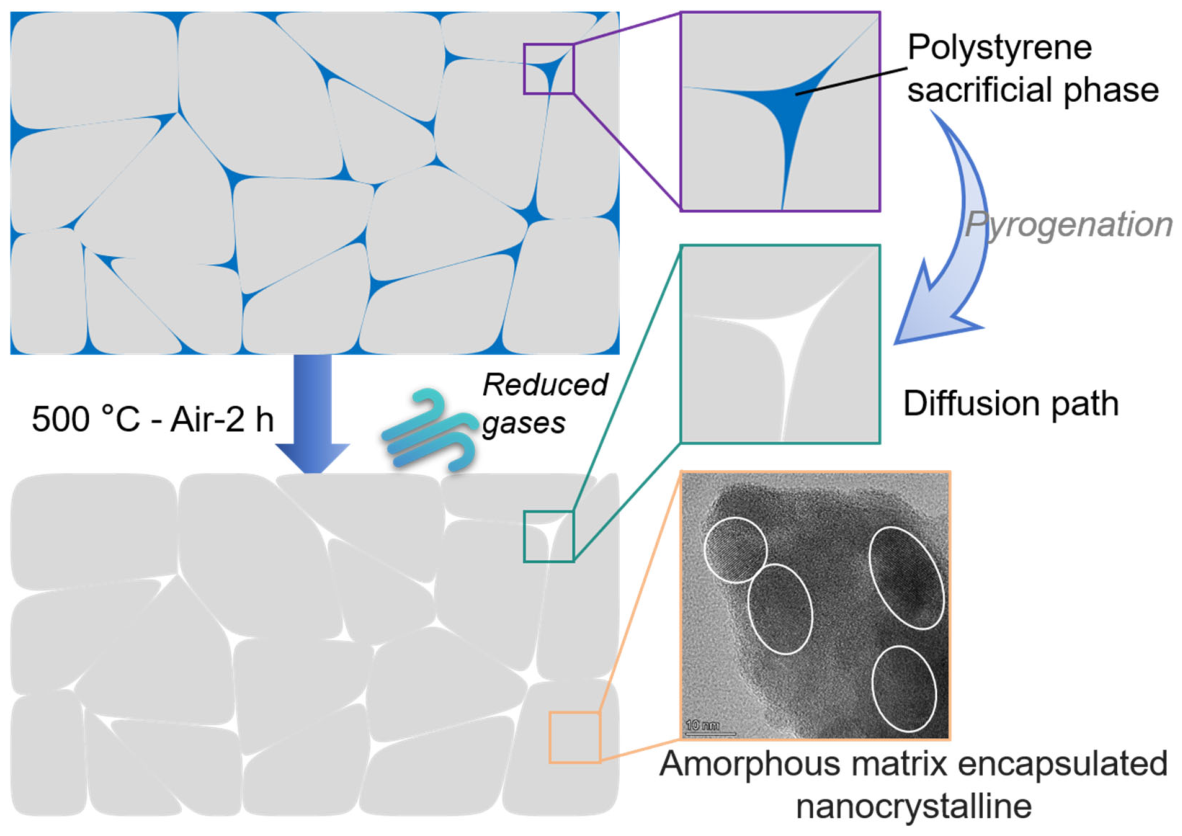
From the perspective of the hydrogen-sensing mechanism, the results of this work indicate that the introduction of the PS sacrificial phase provides two key structural advantages to the WO
3 films, which further act synergistically with the amorphous matrix encapsulated nanocrystalline structure formed by PAD, ultimately leading to enhanced sensing performance, as illustrated in
Figure 6. First, PS is co-deposited as a space-occupying phase during deposition and is completely removed after sintering in air, thereby generating interconnected pores and a rough porous interface throughout the film interior and surface. This structure markedly increases the effective reaction area and shortens the diffusion path of hydrogen within the film, resulting in an enhanced response magnitude and accelerated response/recovery kinetics [
28]. Second, the reducing species released during PS pyrolysis create a localized reducing atmosphere inside the film, promoting bulk oxygen loss in WO
3 and increasing the concentrations of oxygen vacancies and W
5+ species. As a result, the material evolves from a near-stoichiometric state toward WO
3-x, which enhances the activation of adsorbed oxygen species and strengthens hydrogen-induced charge transfer, while also shifting the optimum operating temperature to a lower range. In addition to creating voids, the removal of PS may locally modify the WO
3 structure near the pore walls. Although XRD confirms that the main γ-WO
3 phase is retained, the weakening of the low-frequency monoclinic Raman mode and the broadening of W–O vibrational bands indicate increased local disorder and WO
6-octahedra distortion with increasing PS content. Therefore, the PS-derived pores are likely surrounded by oxygen-deficient and locally distorted WO
3-x regions, which can provide additional active sites for hydrogen interaction. However, excessive PS loading may induce over-reduction and structural damage, explaining the degraded performance of highly PS-loaded samples.
Notably, the sintering temperature and holding time adopted in this work are relatively mild. Thus, while enabling PS removal and defect regulation, they do not significantly disrupt the PAD-derived microstructure composed of nanocrystals embedded in an amorphous matrix. This preserved composite framework maintains continuous charge-transport pathways and structural integrity, while simultaneously benefiting from the dual effects of porous diffusion channels and bulk defect activation. Overall, the pore-structure construction and bulk oxygen-vacancy modulation induced by the PS sacrificial phase, together with the retention of the PAD amorphous matrix encapsulated nanocrystalline structure, are the main reasons why the samples in this work exhibit higher response, faster kinetics, and a lower optimum operating temperature compared to other hydrogen sensors, as shown in
Table 1. It should be noted that the present measurements were conducted using certified laboratory gas mixtures under controlled humidity-free conditions. Real lithium-ion battery vent gas contains multiple components, such as CO, CO
2, CH
4, C
2H
4, electrolyte vapors, aerosols, and water vapor. Therefore, the present results demonstrate the material-level feasibility of Pd/PS–WO
3-x sensors for early H
2 warning, while further validation under real battery vent-gas conditions is required before practical deployment.