This is an early access version, the complete PDF, HTML, and XML versions will be available soon.
Article

Transient Damped Response of a 3D-Printed Composite Cantilever Beam

by
Miroslaw Wesolowski
1,*,
Naftal Kaleb Ngughu
1 and
Jon Aurrekoetxea Narbarte
2
1
Faculty of Civil Engineering, Environmental and Geodetic Sciences, Koszalin University of Technology, 75-453 Koszalin, Poland
2
Mechanical and Industrial Production Department, Mondragon Unibertsitatea, 20500 Mondragón, Spain
*
Author to whom correspondence should be addressed.
Materials 2026, 19(14), 3074; https://doi.org/10.3390/ma19143074
Submission received: 27 May 2026 / Revised: 5 July 2026 / Accepted: 9 July 2026 / Published: 16 July 2026
(This article belongs to the Section Advanced Composites)

Abstract

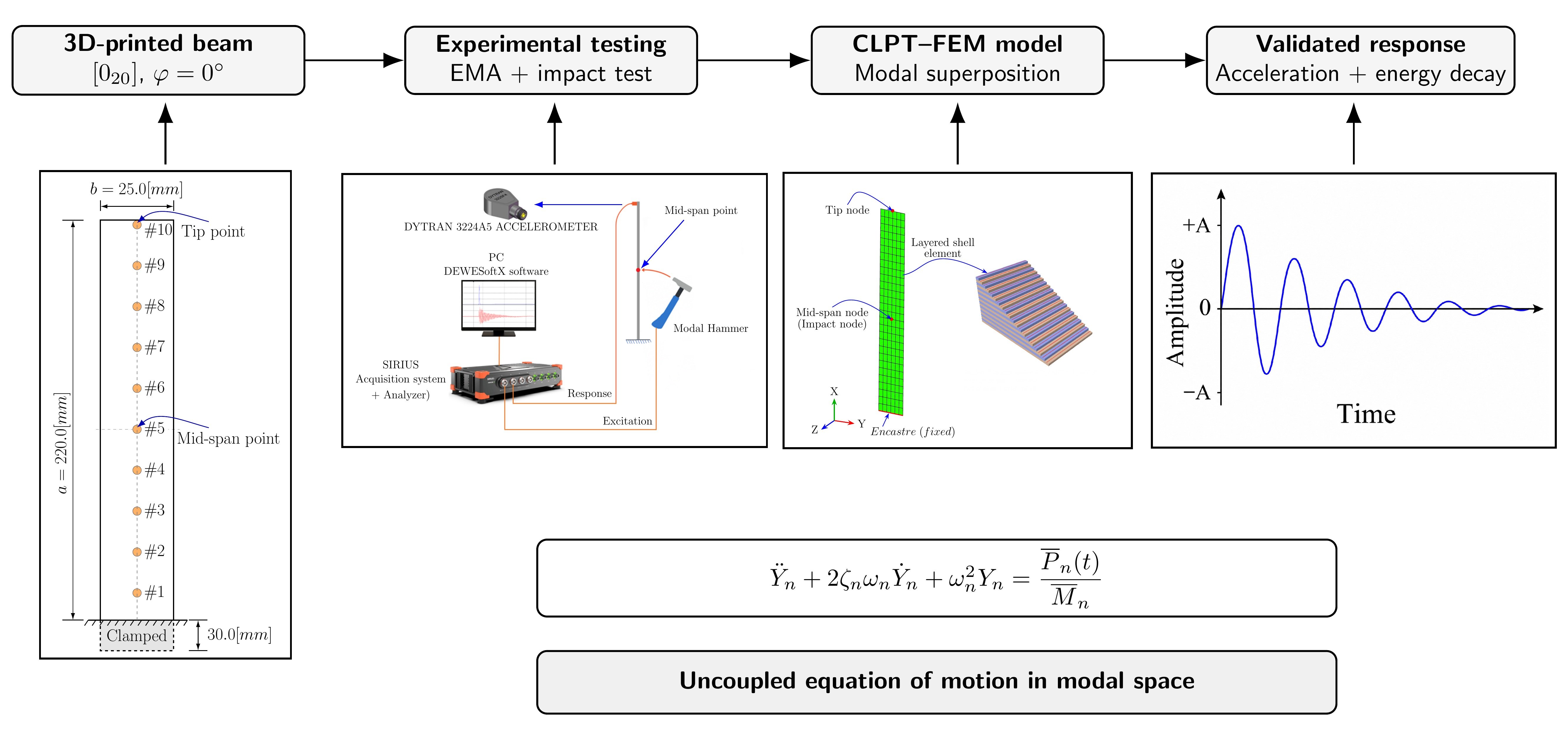
This study presents a transient dynamic analysis of a 3D-printed composite cantilever beam fabricated from short carbon fibre-reinforced polyamide (CF-PA-12). Particular attention is given to acceleration response, vibration damping, and energy dissipation, which govern the transient behaviour and dynamic stability of lightweight composite structures under impulsive loading. The research combines experimental modal analysis (EMA) and transient impact testing with numerical simulations based on classical laminated plate theory (CLPT). A finite element model was developed in Simulia/Abaqus and used within a modal-superposition-based transient framework incorporating experimentally identified damping ratios and measured impact forces. The proposed approach enables realistic prediction of vibration decay and time-dependent acceleration response. Good agreement between experimental and numerical results confirms the capability of the method to reproduce the dynamic behaviour of additively manufactured composite beams subjected to impact excitation.
Keywords: 3D printing; composite beam; transient analysis; modal damping; finite element analysis; CLPT 3D printing; composite beam; transient analysis; modal damping; finite element analysis; CLPT
Graphical Abstract