This is an early access version, the complete PDF, HTML, and XML versions will be available soon.
Review

Carbon Nanotubes as Multifunctional Supports for Phthalocyanine-Based Electrocatalysts: Advancing Sustainable Energy Conversion and Environmental Applications


1
Guangdong Provincial Key Laboratory of Green Chemical Product Technology, School of Chemistry & Chemical Engineering, South China University of Technology, No. 381 Wushan Road, Guangzhou 510640, China
2
Guangdong Provincial Key Laboratory of Quantum Engineering and Quantum Materials, Guangdong Engineering Technology Research Center of Efficient Green Energy and Environment Protection Materials, School of Electronic Science and Engineering (School of Microelectronics), South China Normal University, Foshan, 528225, China
3
Department of Materials Physics, ELTE Eötvös Loránd University, P.O. Box 32, H-1518 Budapest, Hungary
*
Authors to whom correspondence should be addressed.
Materials 2026, 19(14), 2991; https://doi.org/10.3390/ma19142991
Submission received: 22 May 2026 / Revised: 2 July 2026 / Accepted: 7 July 2026 / Published: 10 July 2026
(This article belongs to the Special Issue Carbon Nanomaterials for Diverse Applications—Second Edition)

Abstract

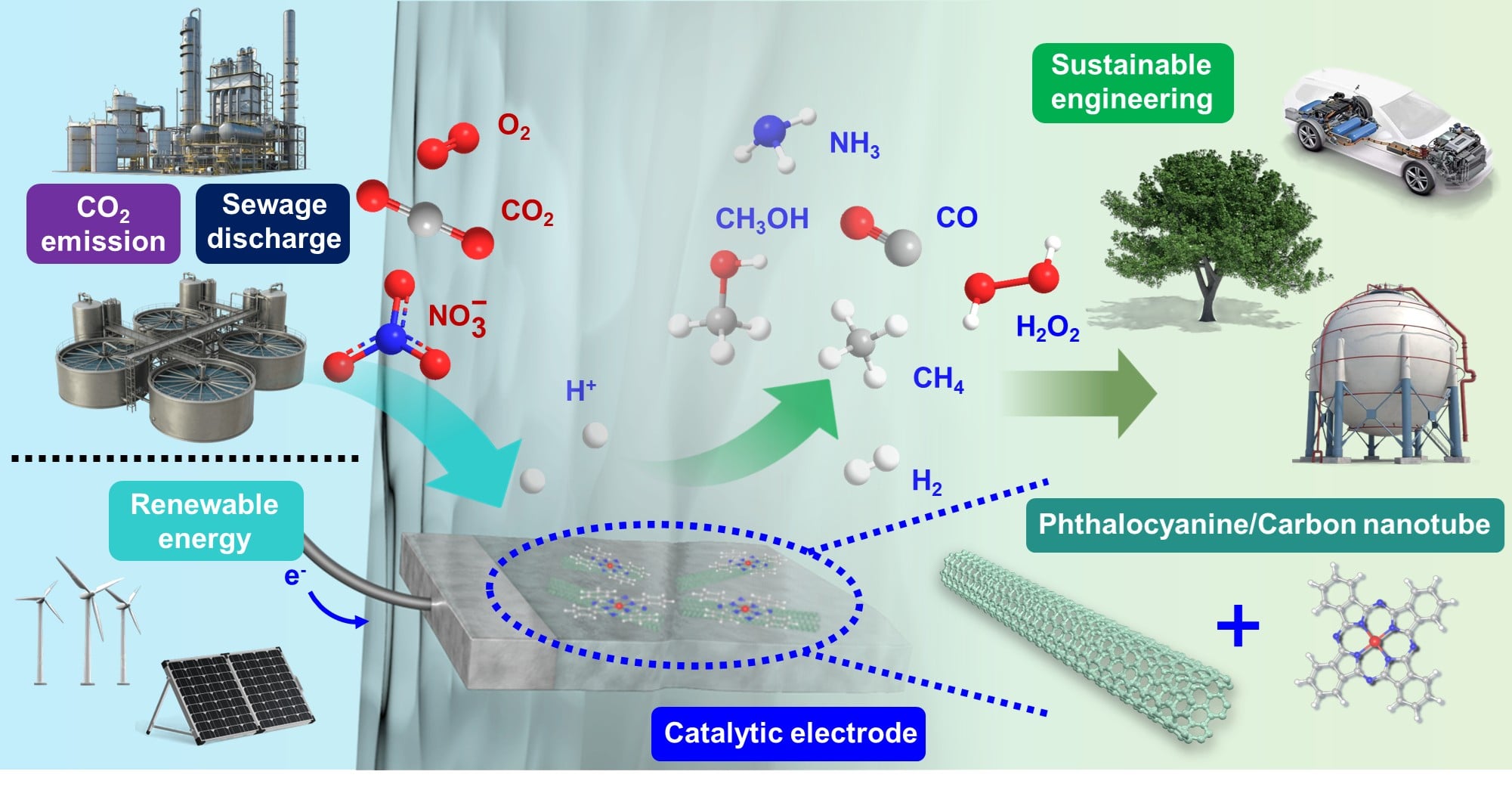
Carbon nanotubes (CNTs) serve as exceptional multifunctional supports for metal phthalocyanine (MPc)-based electrocatalysts, effectively addressing the inherent limitations of molecular catalysts such as poor conductivity and aggregation. This review systematically summarizes the recent advances in engineering the interface between MPcs and CNTs to optimize performance in sustainable energy conversion and environmental remediation. We categorize the engineering strategies into three synergistic dimensions: (1) dispersion and modification engineering, introducing the most direct physical anchoring dispersion strategy via non-covalent interactions and targeted modifications to yield highly active catalysts; (2) chemical bonding engineering, in which robust axial coordination or covalent grafting creates stable, well-defined active sites and prevents leaching; and (3) geometric and spatial engineering, which exploits CNTs’ unique curvature, atomic defects, inner cavities and one-dimensional architecture to induce strain, symmetry breaking, and nanoconfinement, thereby steering reaction pathways or to construct conductive nanocomposites. These strategies highlight that CNTs are not merely passive scaffolds but active regulators that geometrically and electronically modulate MPcs. By balancing molecular dispersion, charge transfer, and mass transport, CNT-supported MPcs exhibit superior activity, selectivity, and stability for critical electrochemical reactions, including the oxygen reduction reaction (ORR), CO2 reduction reaction (CO2RR), and nitrate reduction reaction (NO3RR), demonstrating substantial potential for advancing sustainable energy technologies and environmental applications.
Keywords: carbon nanotubes; metal phthalocyanines; electrocatalysis carbon nanotubes; metal phthalocyanines; electrocatalysis
Graphical Abstract