Effect of Manual Tungsten Inert Gas Welding on the Microstructure and Mechanical Properties of Welded Joints in Thick SIMP Steel Plates
Abstract
1. Introduction
2. Materials and Experimental Methods
2.1. Materials
2.1.1. Base Material (SIMP Steel)
2.1.2. Welding Consumables
2.2. Welding Procedure
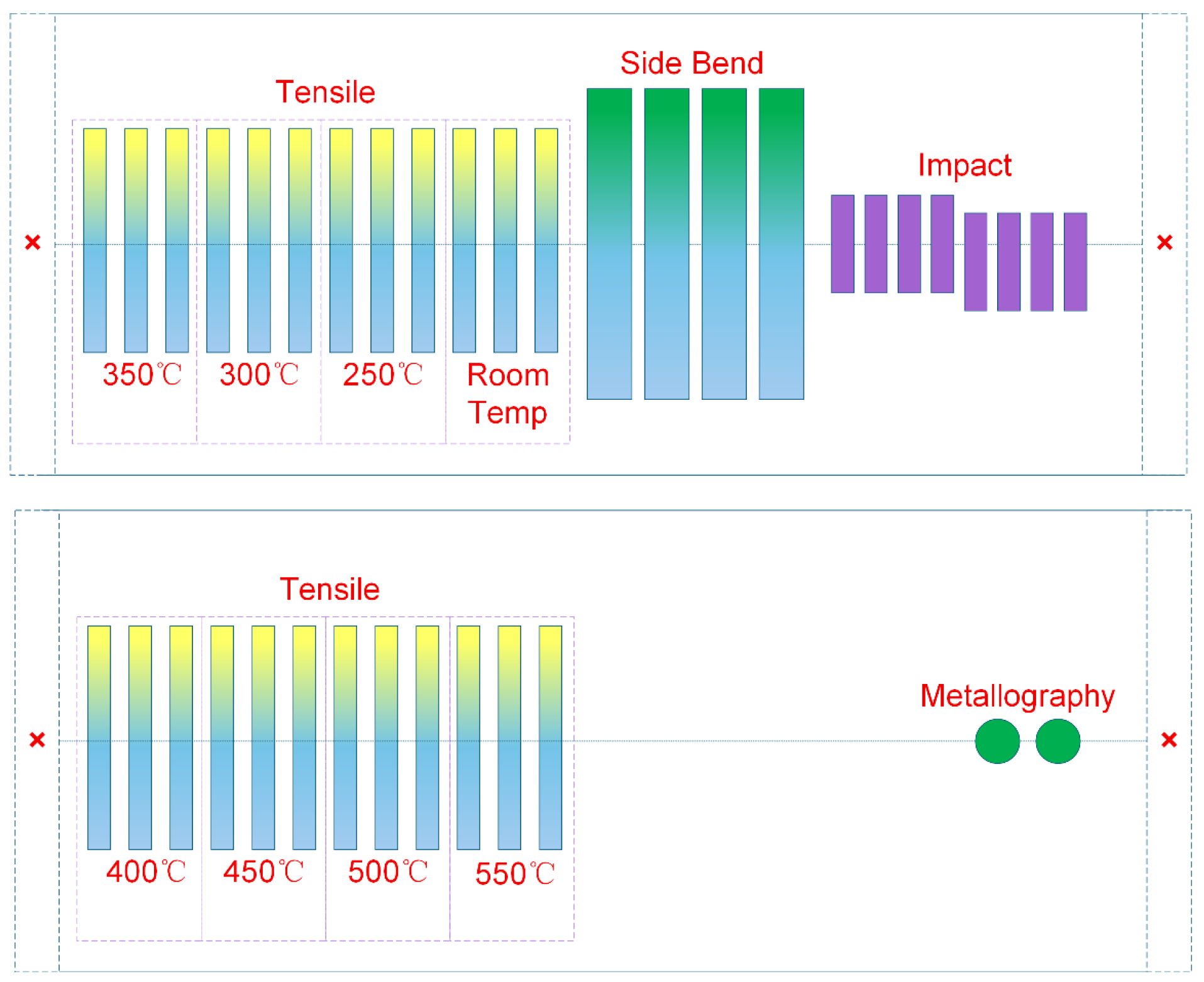
2.3. Experimental Methods

| Test Item | Test Temperature | No. of Samples/Location | Test Method |
|---|---|---|---|
| Joint Tensile | Room Temp. | 3, Perpendicular to welding direction | AWS B4.0M [21] |
| 250 °C | 3, Perpendicular to welding direction | ASTM E21 [22] | |
| 300 °C | 3, Perpendicular to welding direction | ASTM E21 | |
| 350 °C | 3, Perpendicular to welding direction | ASTM E21 | |
| 400 °C | 3, Perpendicular to welding direction | ASTM E21 | |
| 450 °C | 3, Perpendicular to welding direction | ASTM E21 | |
| 500 °C | 3, Perpendicular to welding direction | ASTM E21 | |
| 550 °C | 3, Perpendicular to welding direction | ASTM E21 | |
| Weld Metal Impact | Room Temp. | 1 group of 4, Notch axis at weld center | AWS B4.0M |
| HAZ Impact | Room Temp. | 1 group of 4, Notch axis 2 mm from fusion line | AWS B4.0M |
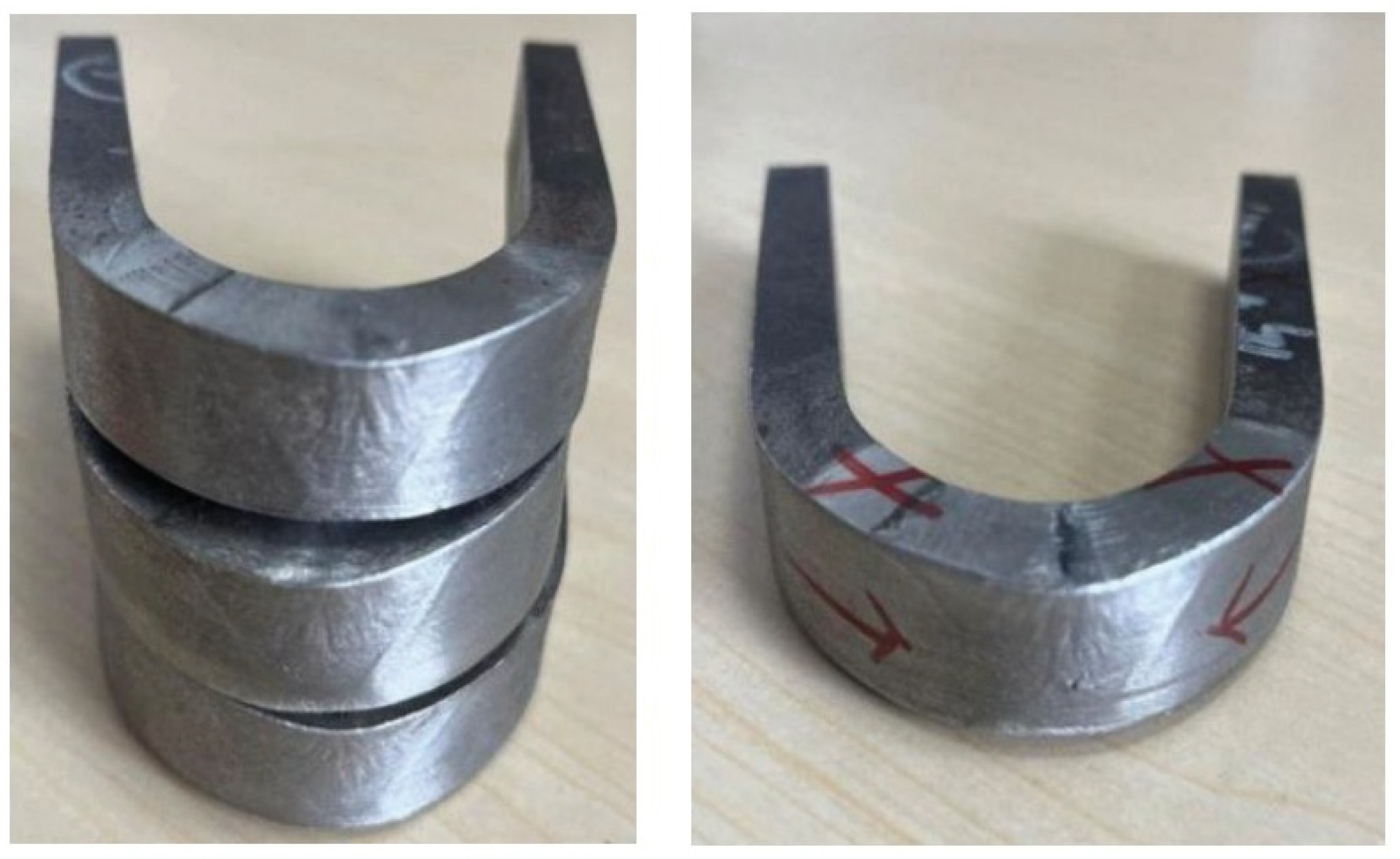
| Side Bend | Room Temp. | 4, Perpendicular to welding direction | AWS B4.0M |
| UT Standard Block | / | 1 | / |
| Macro Metallography | Room Temp. | 1, Full cross-section specimen | ASTM E3, E340 |
| Micro Metallography | Room Temp. | 1, Full cross-section specimen | ASTM E3, E407 |
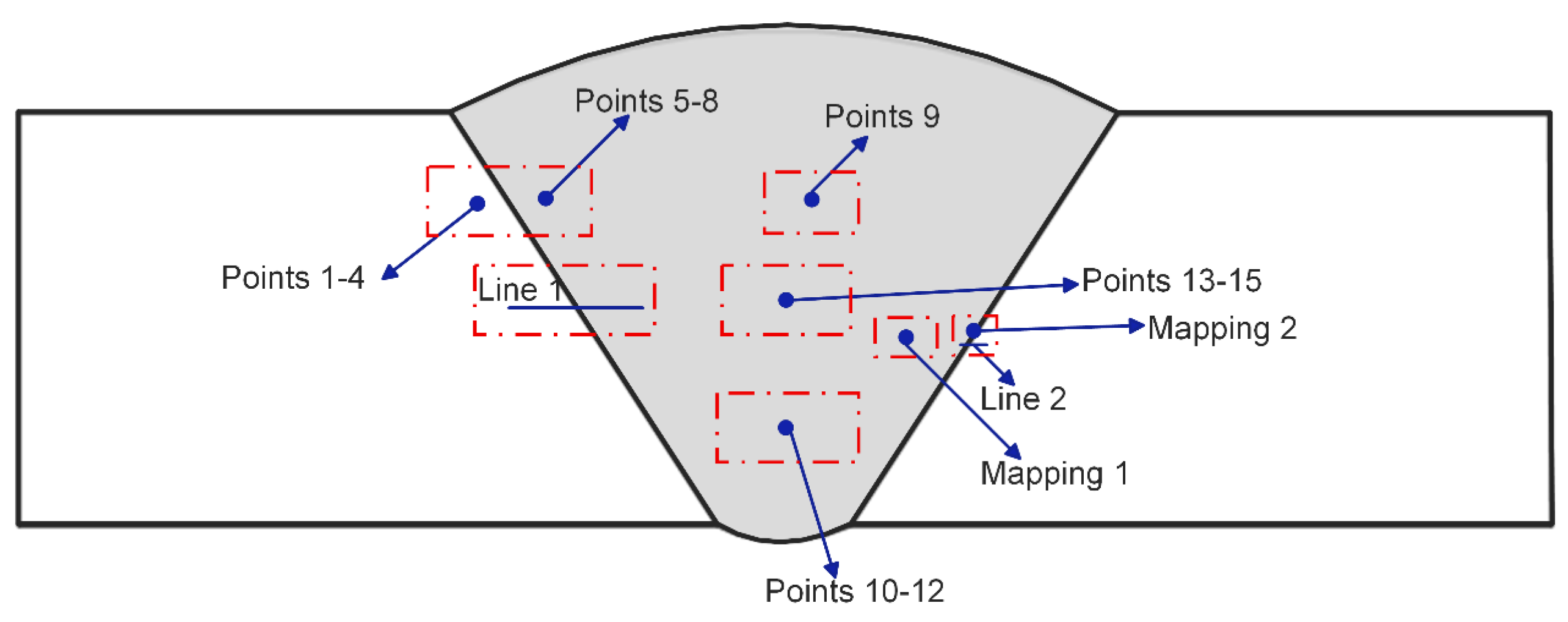
| Hardness | Room Temp. | 1, Full cross-section specimen | AWS B4.0M |
3. Results and Discussion
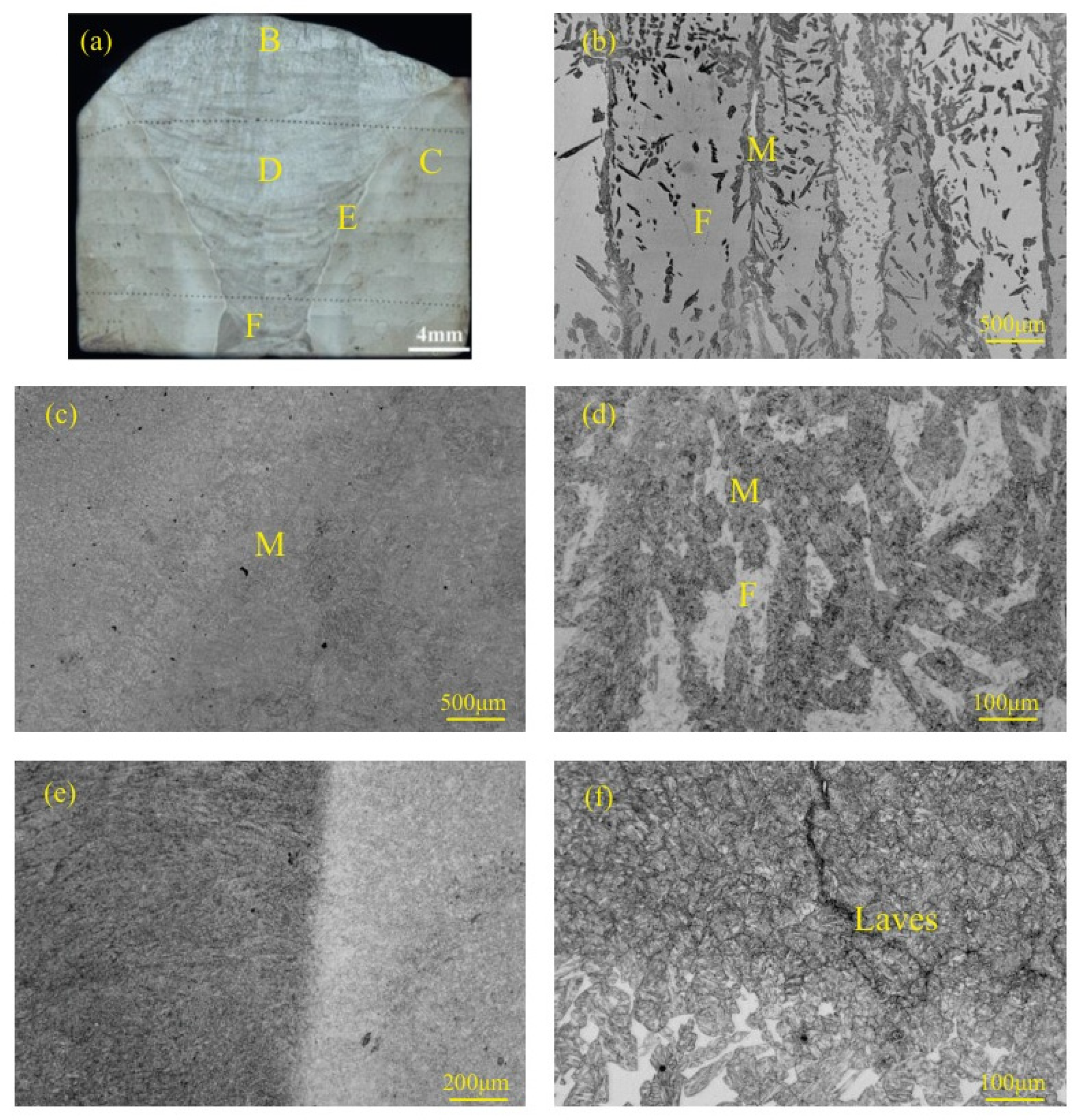
3.1. Microstructure of the Welded Joint
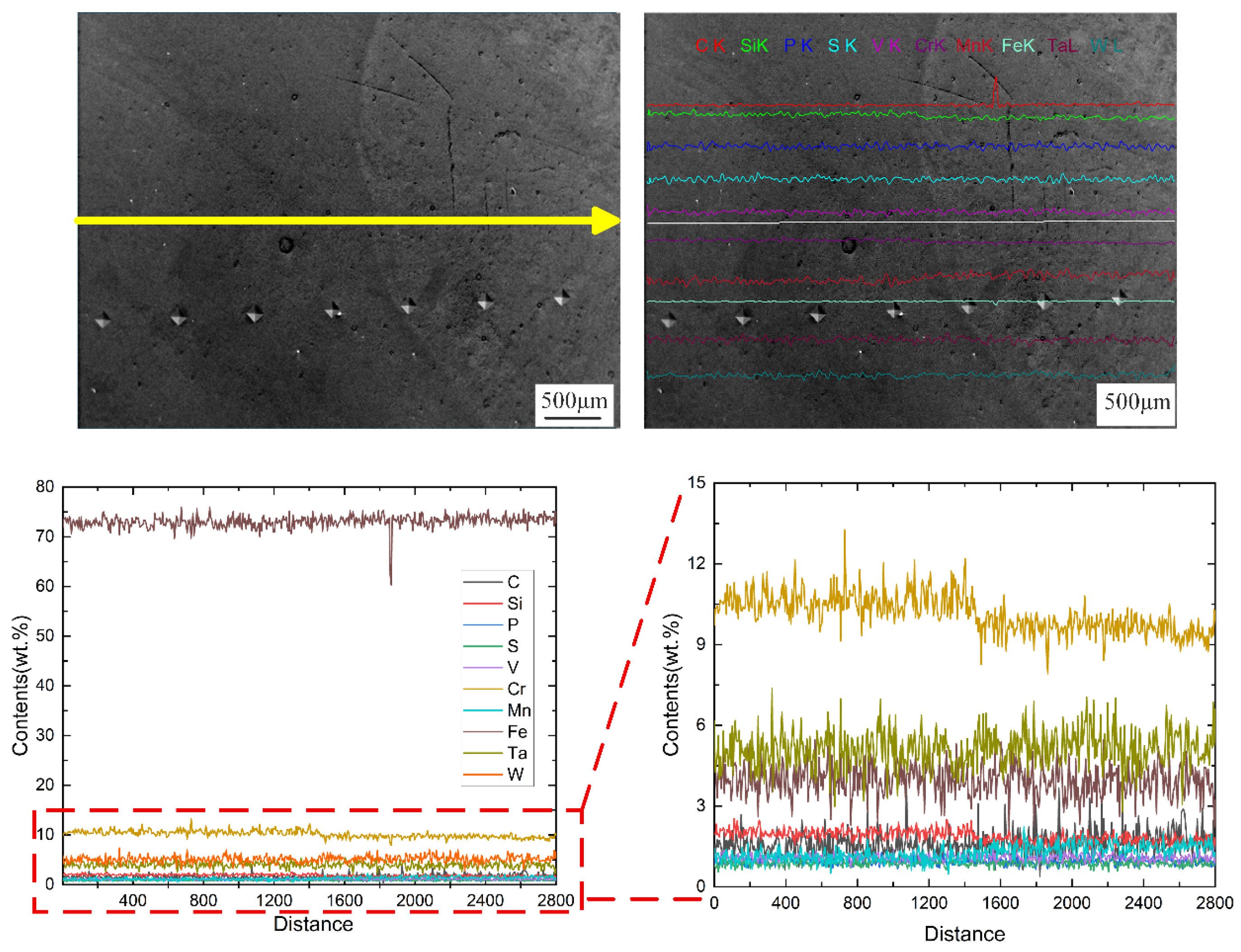
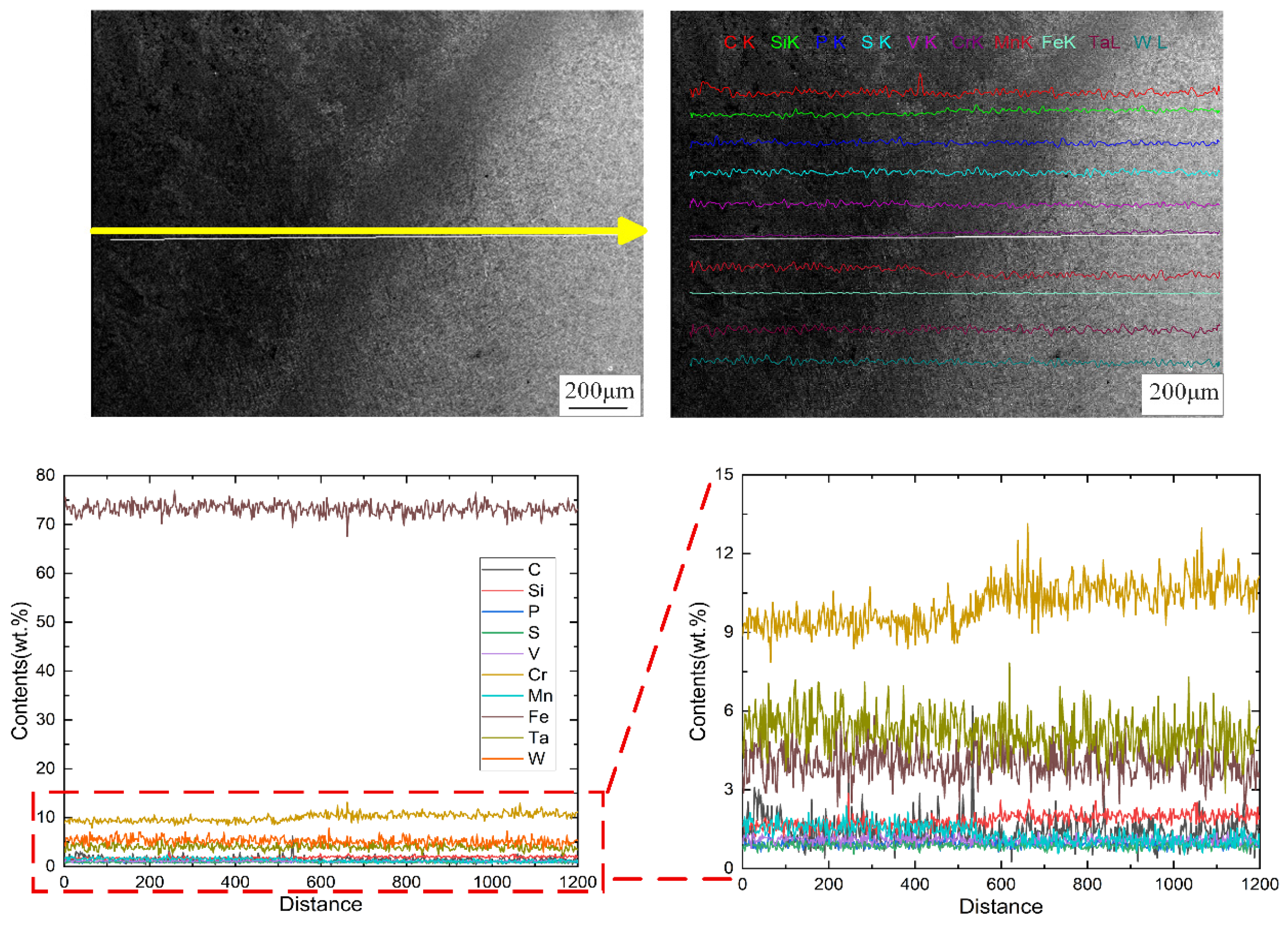
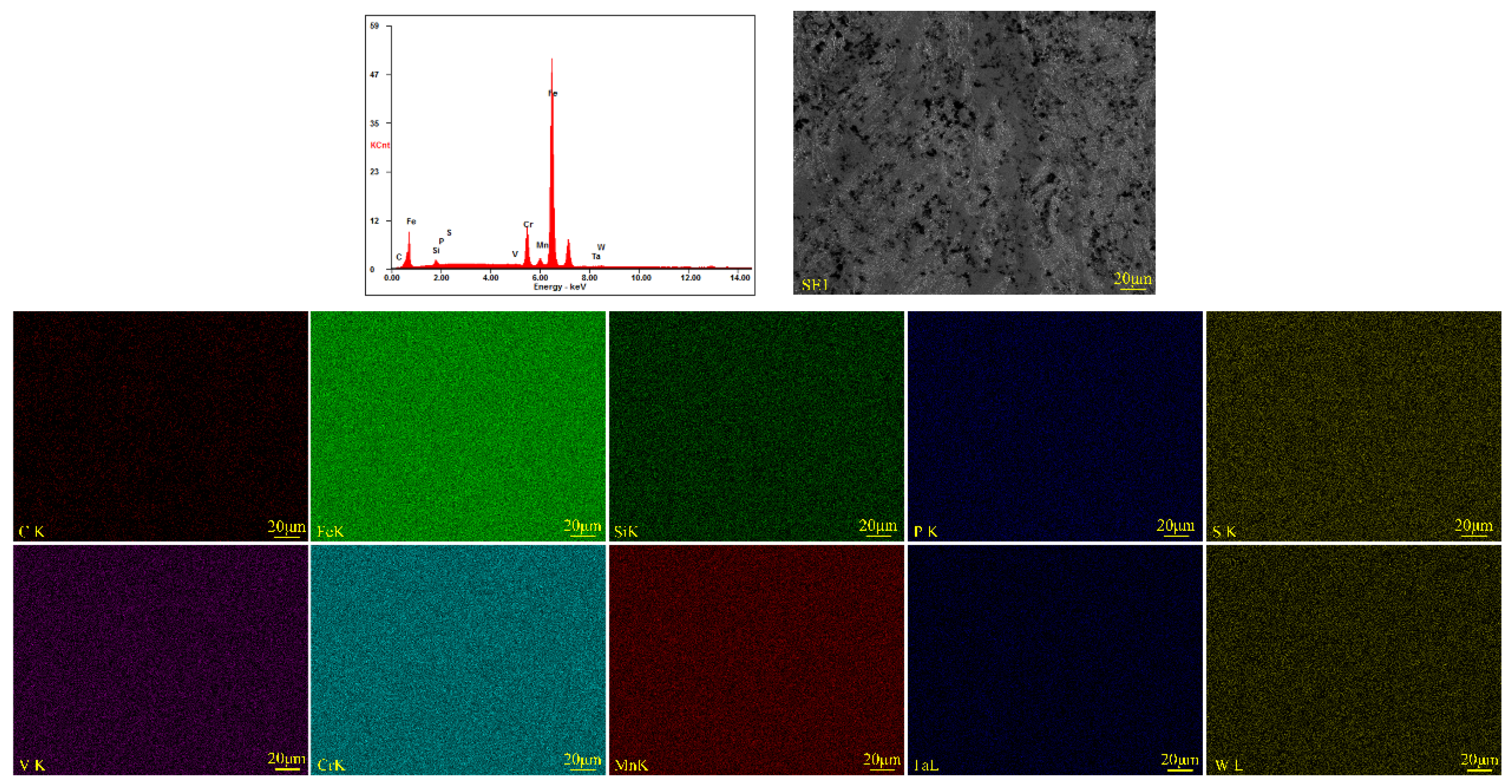
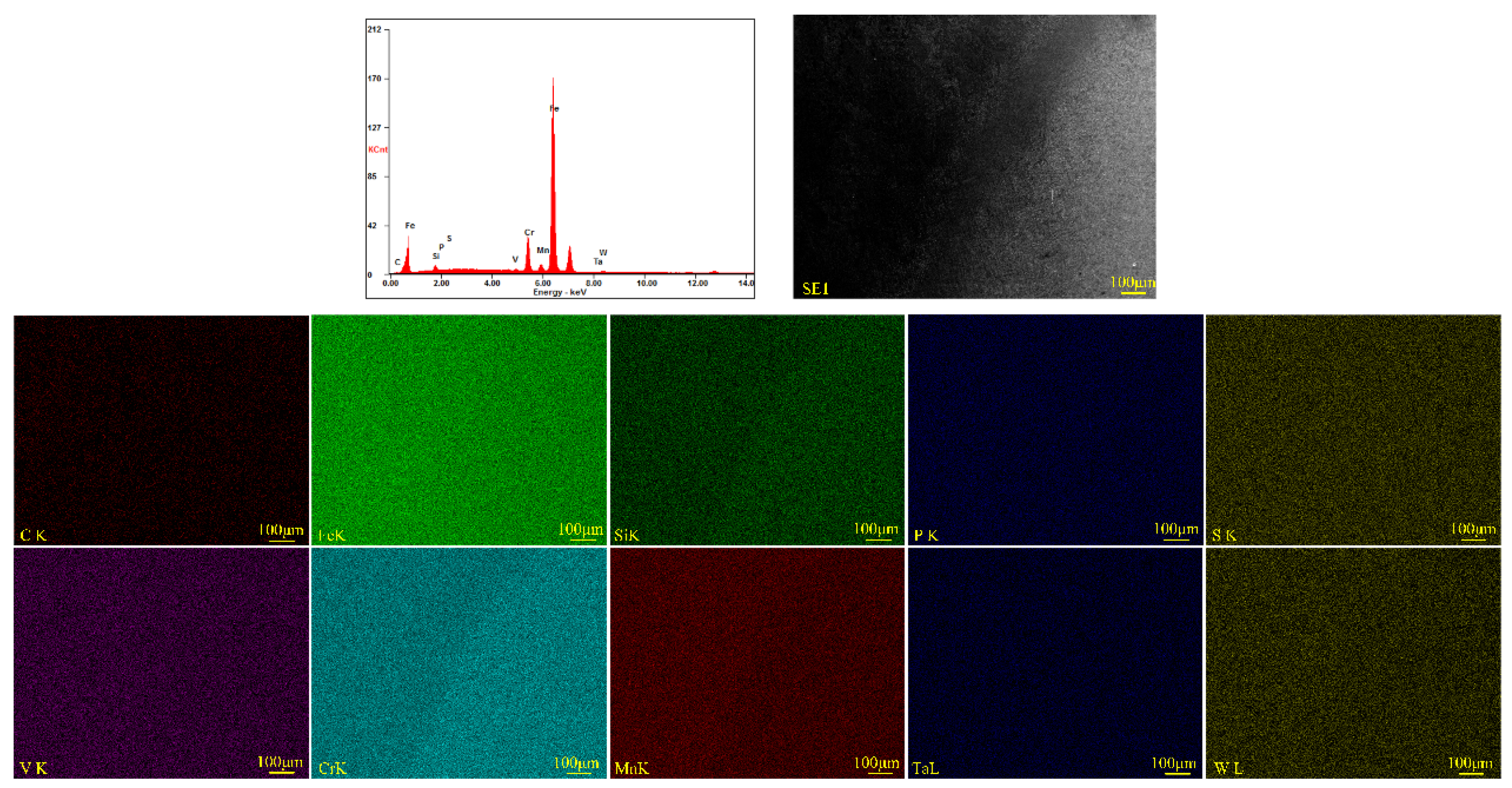
3.2. EDS Analysis of the Welded Joint
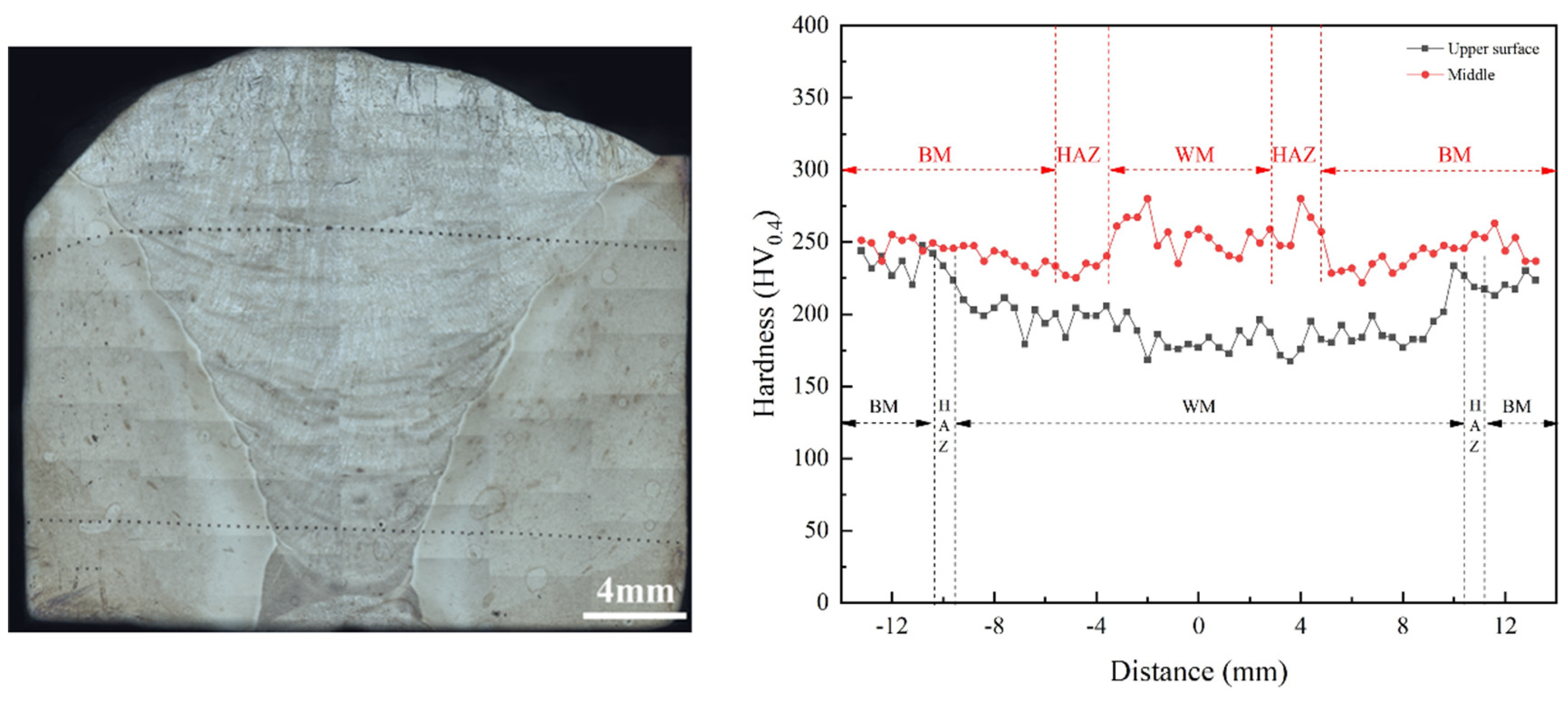
3.3. Microhardness of the Welded Joint
3.4. Tensile Properties of the Welded Joint
3.4.1. Tensile Test Results
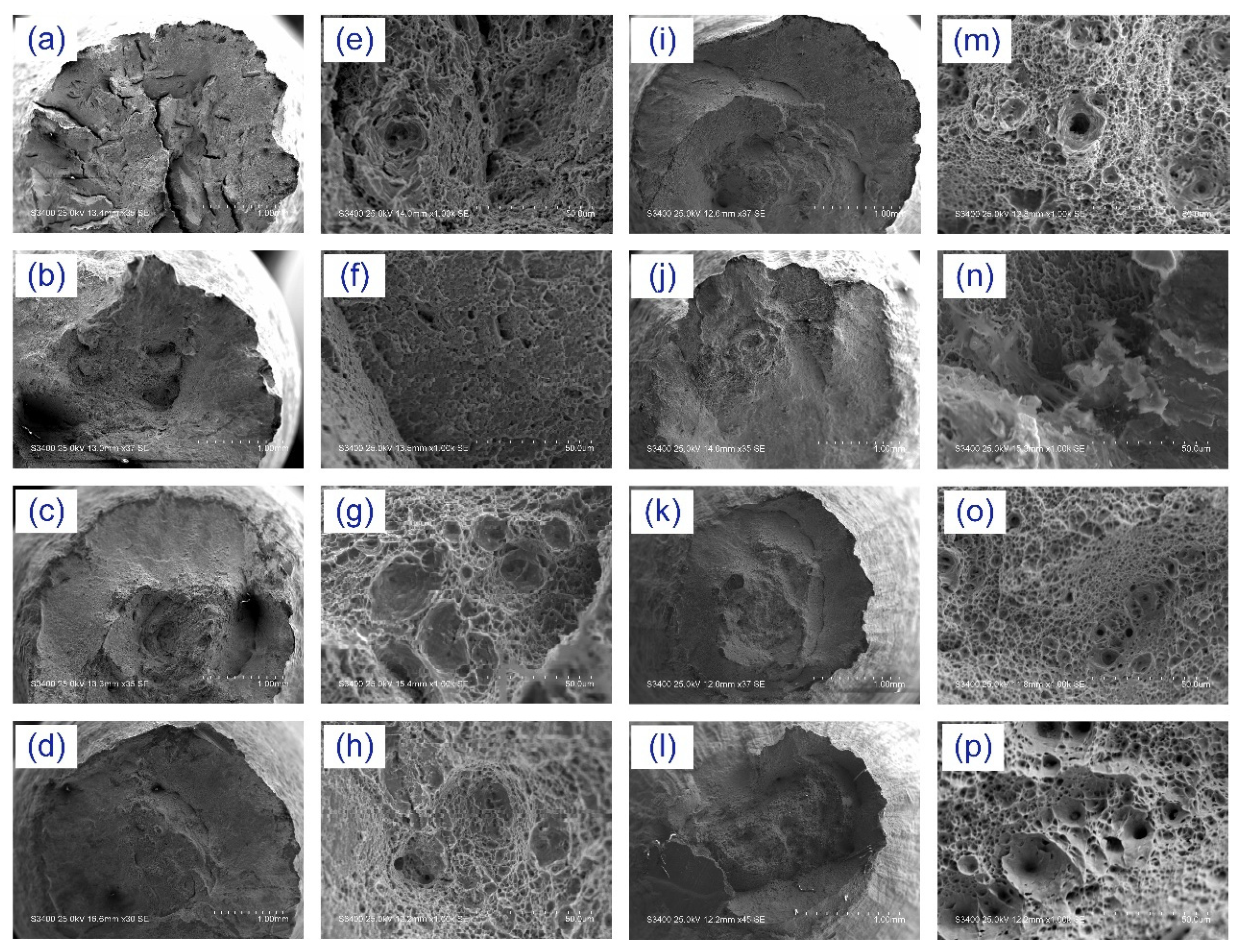
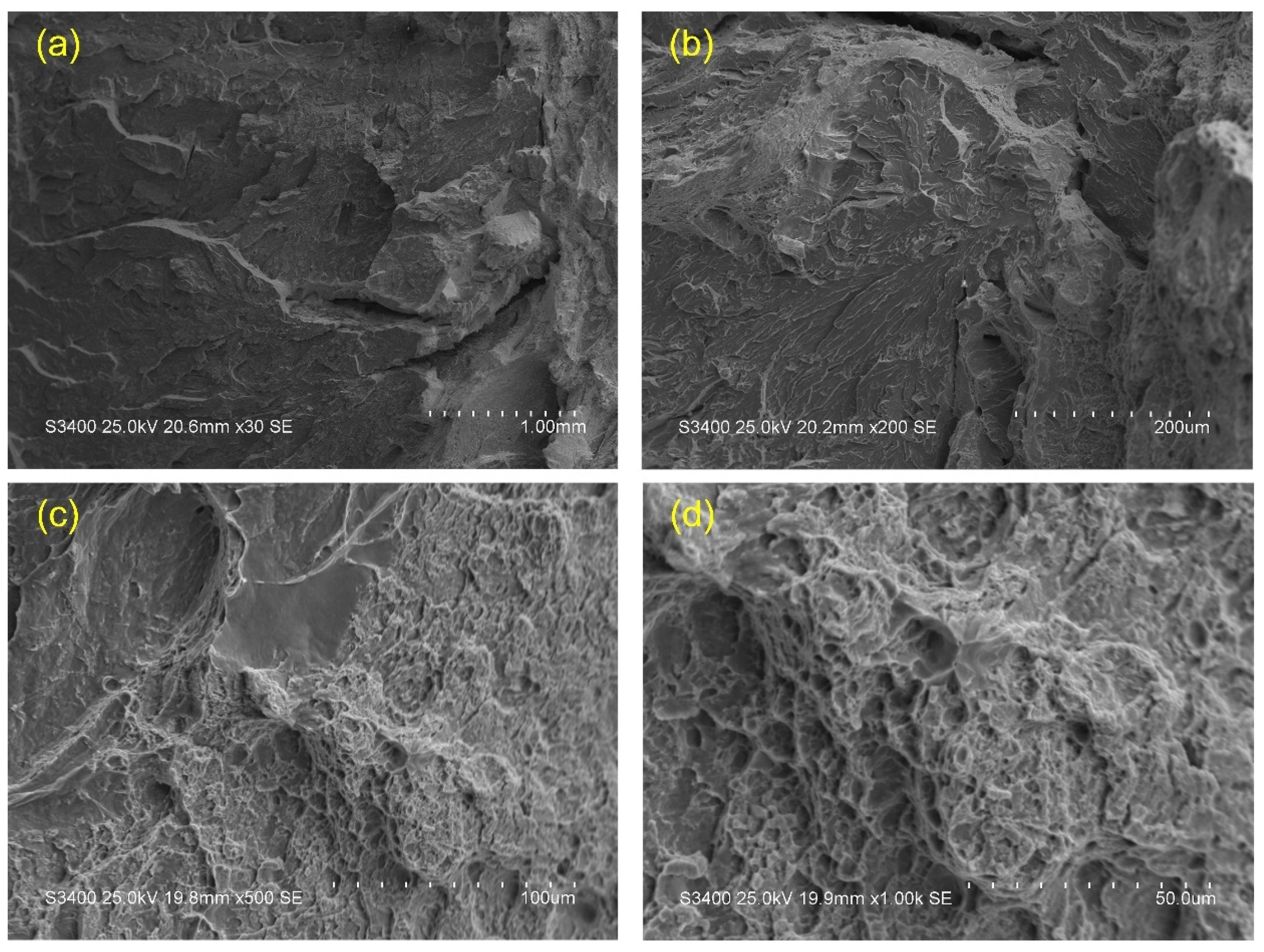
3.4.2. Fractography Analysis of Tensile Specimens
3.5. Room Temperature Impact Toughness
3.5.1. Impact Test Results
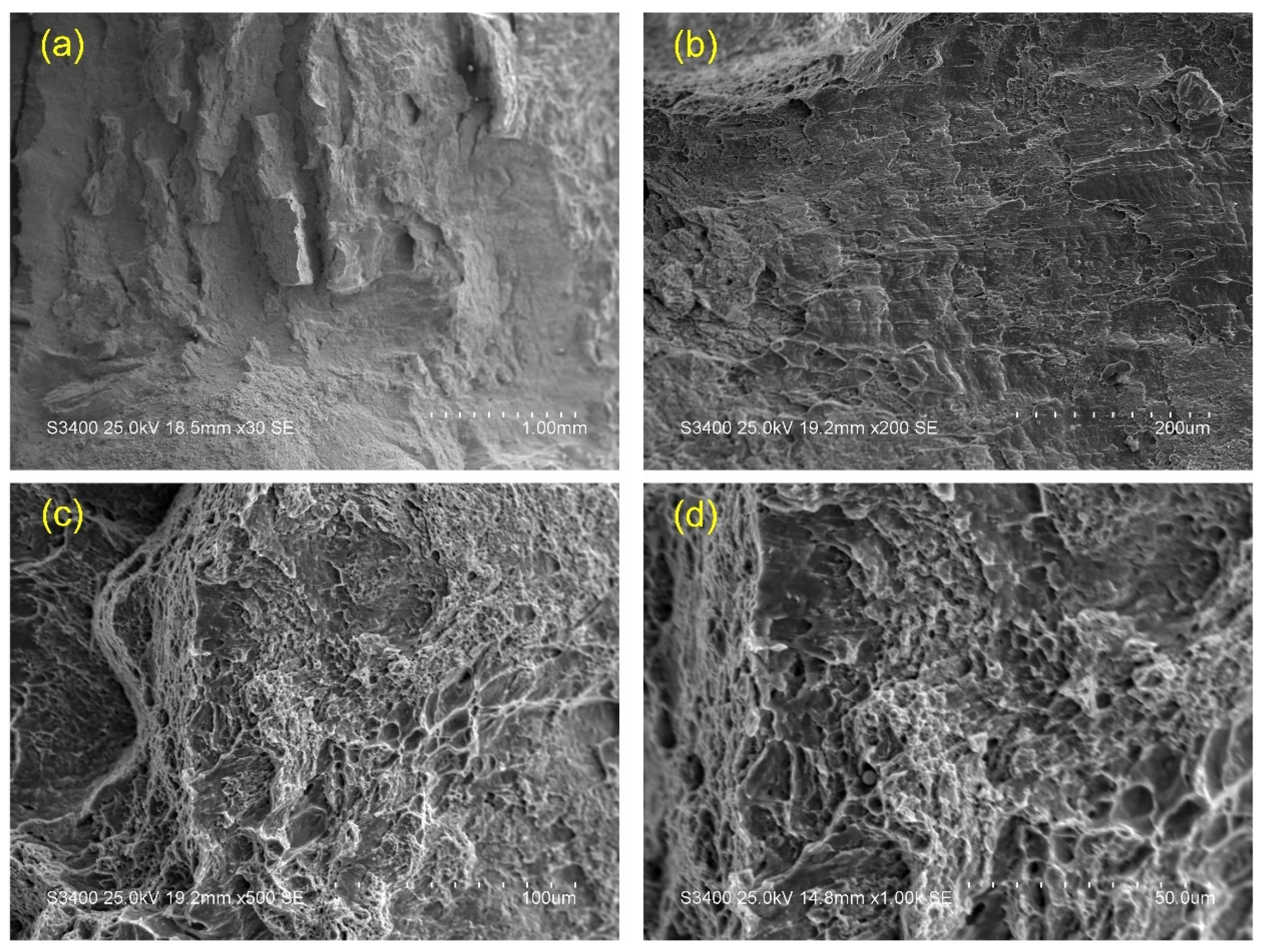
3.5.2. Impact Fractography Analysis
3.6. Bend Test of the Welded Joint
4. Conclusions
Author Contributions
Funding
Institutional Review Board Statement
Informed Consent Statement
Data Availability Statement
Conflicts of Interest
References
- Zhan, W.; Xu, H. Future advanced nuclear fission energy-ADS transmutation system. Bull. Chin. Acad. Sci. 2012, 27, 375–381. [Google Scholar]
- Xu, Y.; Kang, F.; Sheng, X. Study on the development of accelerator driven system (ADS) and its spallation target. Nucl. Sci. Tech. 2016, 4, 88–97. [Google Scholar]
- Ye, Z. Theoretical Simulation Study on Oxidation and Corrosion of Iron-Based Structural Materials Under ADS Irradiation Environment. Ph.D. Thesis, University of Science and Technology of China, Hefei, China, 2022. [Google Scholar]
- Yang, K.; Yan, W.; Wang, Z.; Shan, Y.; Shi, Q.; Shi, X.; Wang, W. Development of a novel structural material (SIMP steel) for nuclear equipment with balanced resistances to high temperature, radiation and liquid metal corrosion. Acta Metall. Sin. 2016, 52, 1207–1221. [Google Scholar]
- Ke, Y.; Yang, W.; Huang, C. Research progress in high-performance cladding materials for liquid metal cooling reactors. Mater. Rep. 2023, 37, 312–319. [Google Scholar]
- Klueh, R.L.; Nelson, A.T. Ferritic/martensitic steels for next-generation reactors. J. Nucl. Mater. 2007, 371, 37–52. [Google Scholar]
- Zinkle, S.J.; Was, G.S. Materials challenges in nuclear energy. Acta Mater. 2013, 61, 735–758. [Google Scholar] [CrossRef]
- Sun, G.; Xiong, R.; Tang, R. Research progress on the regulation of reinforcing phase precipitation and creep properties of aluminum-containing austenitic stainless steels. Mater. Rep. 2023, 37, 160–166. [Google Scholar]
- Bao, F.; Li, Y.; Wang, G. Corrosion behavior and mechanism of ODS steel in static Pb-Bi eutectic at 600 and 700 °C. Acta Metall. Sin. 2020, 56, 1366–1376. [Google Scholar]
- Zhu, C. Effect of Matrix Microstructure and Ti Content on Nano-Oxides in FeCr ODS Steels for Advanced Nuclear Energy Systems. Ph.D. Thesis, Chongqing University, Chongqing, China, 2023. [Google Scholar]
- GB/T 38875-2020; Reduced Activation Martensitic Steel Plates with Heat-Resistance and Corrosion-Resistance for Nuclear Facilities. Standardization Administration of the People’s Republic of China: Beijing, China, 2020.
- Q/GT/GC-534-01; Forging Process Specification. Nanjing Puzhen High Speed Rail Vehicle Forging Co., Ltd.: Nanjing, China, 2021.
- Guo, D.P.; Xie, F.; Zhao, J. Research and comparison of solid spallation targets in accelerator driven system (ADS). In Proceedings of the 2nd 2016 International Conference on Sustainable Development (ICSD 2016), Xi’an, China, 2–4 December 2016; Atlantis Press: Dordrecht, The Netherlands, 2016; pp. 573–575. [Google Scholar]
- Luo, R.; Revankar, S.T.; Zhao, F. Comparative safety analysis of accelerator driven subcritical systems and critical nuclear energy systems. Appl. Sci. 2021, 11, 8179. [Google Scholar] [CrossRef]
- Zhang, X.; Pu, N.; Cai, H.; Chen, J.; Lu, Y.; Feng, K.; Chen, H.; Shen, T.; Chen, H. Strategies of eliminating nuclear waste using accelerator-driven system in the transition stage for sustainable and clean nuclear energy in China. Ann. Nucl. Energy 2023, 185, 109713. [Google Scholar] [CrossRef]
- ASME BPVC Section V; Nondestructive Examination. American Society of Mechanical Engineers (ASME): New York, NY, USA, 2004.
- ASTM E3; Standard Guide for Preparation of Metallographic Specimens. ASTM International: West Conshohocken, PA, USA, 2026.
- ASTM E340; Standard Practice for Macroetching Metals and Alloys. ASTM International: West Conshohocken, PA, USA, 2023.
- ASTM E407; Standard Practice for Microetching Metals and Alloys. ASTM International: West Conshohocken, PA, USA, 2023.
- Lucia, U.; Grisolia, G. Energy amplifier systems as sustainable nuclear reactors: An overview. Sustainability 2024, 16, 2743. [Google Scholar] [CrossRef]
- AWS B4.0M; Standards Methods for Mechanical Testing of Welds (Metric Customary Units). AWS: Miami, FL, USA, 2000.
- ASTM E21; Standard Test Methods for Elevated Temperature Tension Tests of Metallic Materials. ASTM International: West Conshohocken, PA, USA, 2021.
- Liu, P.; Ma, J.; Fang, Y.; Xu, B.; Qiu, L. Effect of repeated weld repairs on microstructure and mechanical properties of heat-affected zone in CA6NM stainless steel. Adv. Mater. Sci. Eng. 2022, 2022, 4527917. [Google Scholar]
- Liu, C.; Zhao, M.-C.; Unenbayar, T.; Zhao, Y.-C.; Xie, B.; Tian, Y.; Shan, Y.-Y.; Yang, K. Hot deformation behavior of a new nuclear use reduced activation ferritic/martensitic steel. Acta Metall. Sin. Engl. Lett. 2019, 32, 825–834. [Google Scholar]
- Kim, J.; Kim, J.-H.; Park, J.; Baek, S.; Ma, N.; Lee, S.-J.; Kim, D. Continuous tempering effect induced PWHT alternative technology using wire arc additive manufacturing for application in replacing nuclear pressurized water reactor system repairing: Calphad, FEM simulation, and EBSD investigation. J. Mater. Res. Technol. 2023, 25, 2961–2988. [Google Scholar] [CrossRef]
- Vega, D.A. Evaluation of an Additively Manufactured Ferritic-Martensitic Steel for Advanced Nuclear Applications. Ph.D. Thesis, University of Maryland, College Park, MD, USA, 2018. [Google Scholar]
- Sravan Sashank, S.; Rajakumar, S.; Karthikeyan, R. Influence of electrode current on mechanical and metallurgical characteristics of hot wire TIG welded SS304HCu austenitic stainless steel and P91 ferritic steel dissimilar joints. Int. J. Interact. Des. Manuf. 2024, 18, 5261–5270. [Google Scholar] [CrossRef]
- Hussein, K.M.; Akbari, H.; Noorossana, R.; Yadegari, R.; Ashiri, R. Microhardness and microstructure correlations to the mechanical performance for dissimilar third generation AHSS resistance spot welding. J. Mater. Res. Technol. 2024, 30, 7938–7945. [Google Scholar] [CrossRef]
- Park, M.; Lee, G.H.; Jang, G.; Kim, H.-C.; Kim, B.; Kim, B.J. The effects of post weld heat treatment on microstructure and mechanical properties of API X70 linepipe using submerged arc welding. Arch. Metall. Mater. 2024, 69, 99–102. [Google Scholar] [CrossRef]
- Fozilov, T.; Yakovlev, M.; Babaytsev, A. The effect of thermal treatment on weld structure of the VZh178P alloy after rotational friction welding. J. Mach. Manuf. Reliab. 2023, 52, 236–240. [Google Scholar] [CrossRef]
- Vasileiou, A.N.; Smith, M.C.; Francis, J.A.; Balakrishnan, J.; Wang, Y.L.; Obasi, G.; Burke, M.G.; Pickering, E.J.; Gandy, D.W.; Irvine, N.M. Development of microstructure and residual stress in electron beam welds in low alloy pressure vessel steels. Mater. Des. 2021, 209, 109924. [Google Scholar] [CrossRef]
- Sakkaeo, A.; Chantaramanee, S.; Muangjunburee, P.; Sungkhaphaitoon, P. Tensile deformation behavior of 6082-T6 aluminum alloy after repair welding by metal inert gas process. J. Mater. Eng. Perform. 2023, 32, 10204–10213. [Google Scholar] [CrossRef]
- Jia, Y.-L.; Huang, Z.-C.; Jiang, Y.-Q. Low-speed impact and residual mechanical performance of the BR1200HS/AA6082 self-piercing riveted joints. Metals 2023, 13, 1800. [Google Scholar]
- Zhang, S.; Yang, F.; Jia, H.; Chen, C.; Feng, Q.; Dai, L.; Zhang, Z. Study on the effect of microstructure on toughness dispersion of X70 steel girth weld. Eng. Fail. Anal. 2024, 164, 108671. [Google Scholar] [CrossRef]
- Gao, F.; Liao, Z.; Li, W.; Cui, Y.; Yu, W.; Lv, Y. Investigating the impact toughness properties and influential factors of titanium alloy joints. Mater. Charact. 2024, 218, 114465. [Google Scholar] [CrossRef]







| Element | Content (wt.%) | Element | Content (wt.%) |
|---|---|---|---|
| C | 0.14–0.25 | Co | ≤0.01 |
| Cr | 10.0–12.0 | Sn | ≤0.005 |
| Si | 1.0–2.0 | Mo | ≤0.005 |
| W | 1.0–2.0 | As | ≤0.005 |
| Mn | ≤1.0 | Sb | ≤0.005 |
| V | 0.15–0.30 | Ag | ≤0.005 |
| Ta | 0.1–0.2 | Nb | ≤0.005 |
| B | ≤0.02 | S | ≤0.005 |
| Ni | ≤0.01 | P | ≤0.005 |
| Al | ≤0.01 | N | ≤0.005 |
| Ti | ≤0.01 | O | ≤0.003 |
| Cu | ≤0.01 | Fe | Bal. |
| Specimen ID | Yield Strength Rp0.2 (MPa) | Avg. Yield Strength Rp0.2 (MPa) | Tensile Strength Rm (MPa) | Avg. Tensile Strength Rm (MPa) | Elongation (%) |
|---|---|---|---|---|---|
| 1 | 351.5 | 355.6 | 617.6 | 623.6 | 23.4 |
| 2 | 359.7 | 629.5 | 23.7 |
| Specimen ID | Impact Absorbed Energy KV2 (J) | Avg. Impact Absorbed Energy KV2 (J) |
|---|---|---|
| 1 | 82.4 | 88.1 |
| 2 | 86.1 | |
| 3 | 71.4 | |
| 4 | 118.8 |
| Property | Value |
|---|---|
| Grade | 20Cr11W2VTaSi |
| Code | SIMP |
| Recommended Heat Treatment | 1000 °C~1100 °C Air cool after soaking; then 720 °C~800 °C Air cool after soaking. |
| Specified Proof Strength (Rp0.2/MPa, not less than) | |
| 20 °C | 550 |
| 450 °C | 420 |
| 550 °C | 320 |
| 600 °C | 230 |
| Tensile Strength (Rm/MPa, not less than) | |
| 20 °C | 800 |
| 450 °C | 500 |
| 550 °C | 400 |
| 600 °C | 320 |
| Impact Absorption Energy a (KV2/J, not less than) | |
| 20 °C | 120 |
| −20 °C | 30 |
| Source | C | Cr | W | As | Mn | Si | P | S | Cu | Ta |
|---|---|---|---|---|---|---|---|---|---|---|
| Apollo wire | 0.11 | 9.04 | 1.94 | 0.089 | 1.06 | 0.497 | 0.009 | 0.0037 | 0.0046 | 0.162 |
| Cladding metal | 0.12 | 8.99 | 2.15 | <0.0015 | 0.93 | 0.5 | <0.0005 | 0.003 | 0.0056 | 0.153 |
| Item | Description/Value |
|---|---|
| Joint type | Butt joint |
| Plate material | SIMP steel |
| Plate size | 600 mm × 150 mm × 20 mm |
| Plate thickness | 20 mm |
| Groove type | Single V-groove |
| Groove angle | 60° total included angle, 30° on each side |
| Root face | 1 mm |
| Assembly gap | 2.5 mm |
| Welding process | Manual TIG welding |
| Welding arrangement | 24 layers and 110 passes |
| Welding sequence | From root pass to filling passes and cover passes |
| Filler Wire Dia. | Current (A) | Voltage (V) | Shielding Gas Flow Rate (L/min) | Welding Speed (cm/min) |
|---|---|---|---|---|
| φ1.2 mm | 95–105 | 10–12 | Face: 8–12 Back: 6–12 | 9–10 |
| Point | C | Si | V | Cr | Mn | Ta | W | Fe |
|---|---|---|---|---|---|---|---|---|
| 1 | 1.35 | 1.62 | 0.25 | 10.40 | 0.27 | 0.50 | 1.61 | Bal. |
| 2 | 1.35 | 1.79 | 0.25 | 10.72 | 0.10 | 0.54 | 1.49 | Bal. |
| 3 | 1.36 | 1.78 | 0.27 | 10.71 | 0.15 | 0.55 | 1.50 | Bal. |
| 4 | 1.28 | 1.73 | 0.25 | 10.58 | 0.15 | 0.51 | 1.46 | Bal. |
| 5 | 1.41 | 1.44 | 0.29 | 9.74 | 0.49 | 0.51 | 1.81 | Bal. |
| 6 | 1.93 | 1.42 | 0.29 | 9.72 | 0.51 | 0.38 | 1.73 | Bal. |
| 7 | 1.00 | 1.36 | 0.29 | 9.58 | 0.54 | 0.51 | 1.90 | Bal. |
| 8 | 1.03 | 1.30 | 0.31 | 9.40 | 0.64 | 0.38 | 1.96 | Bal. |
| 9 | 1.25 | 1.30 | 0.31 | 9.26 | 0.70 | 0.45 | 2.14 | Bal. |
| 10 | 1.35 | 1.31 | 0.32 | 9.17 | 0.69 | 0.49 | 2.21 | Bal. |
| 11 | 1.32 | 1.29 | 0.32 | 9.21 | 0.70 | 0.46 | 2.23 | Bal. |
| 12 | 1.40 | 1.29 | 0.33 | 9.23 | 0.73 | 0.46 | 1.92 | Bal. |
| 13 | 1.46 | 1.29 | 0.34 | 9.27 | 0.75 | 0.45 | 1.94 | Bal. |
| 14 | 1.50 | 1.30 | 0.31 | 9.20 | 0.72 | 0.50 | 2.04 | Bal. |
| 15 | 1.43 | 1.29 | 0.30 | 9.18 | 0.72 | 0.41 | 2.04 | Bal. |
| Temp. (°C) | Dia (mm) | YS (0.2%) (MPa) | UTS (MPa) | Elong. (4D) (%) | RA (%) | Avg. YS (0.2%) (MPa) | Avg. UTS (MPa) | Avg. Elong. (%) | Avg. RA (%) | GB YS (min) (MPa) | GB UTS (min) (MPa) | Fracture Loc. |
|---|---|---|---|---|---|---|---|---|---|---|---|---|
| RT | 6.31 | 513.3 | 760 | 18.0 | 72 | 514.00 | 758.33 | 19.00 | 69.67 | 550 | 800 | WM |
| 6.23 | 513 | 757 | 20.0 | 67 | WM | |||||||
| 6.28 | 516 | 758 | 19.0 | 70 | WM | |||||||
| 250 °C | 6.27 | 451.5 | 591.5 | 17.5 | 75.0 | 453.83 | 596.17 | 17.33 | 75.67 | WM | ||
| 6.28 | 455.0 | 598.5 | 17.0 | 76.0 | WM | |||||||
| 6.27 | 455.0 | 598.5 | 17.5 | 76.0 | WM | |||||||
| 300 °C | 6.31 | 448.0 | 591.5 | 18.5 | 76.0 | 446.83 | 591.50 | 17.83 | 75.67 | WM | ||
| 6.26 | 448.0 | 591.5 | 17.0 | 75.0 | WM | |||||||
| 6.29 | 444.5 | 591.5 | 18.0 | 76.0 | WM | |||||||
| 350 °C | 6.39 | 441.0 | 570.5 | 17.0 | 72.0 | 444.50 | 567.00 | 17.00 | 73.33 | WM | ||
| 6.28 | 448.0 | 570.5 | 17.0 | 72.0 | WM | |||||||
| 6.27 | 444.5 | 560.0 | 17.0 | 75.0 | WM | |||||||
| 400 °C | 6.29 | 420.0 | 542.5 | 18.0 | 70.0 | 417.67 | 542.50 | 18.67 | 73.33 | WM | ||
| 6.28 | 416.5 | 542.5 | 19.5 | 75.0 | WM | |||||||
| 6.28 | 416.5 | 542.5 | 18.5 | 75.0 | WM | |||||||
| 450 °C | 6.26 | 395.5 | 486.5 | 19.0 | 77.0 | 394.33 | 493.50 | 20.83 | 78.33 | 420 | 500 | WM |
| 6.27 | 395.5 | 497.0 | 22.5 | 80.0 | WM | |||||||
| 6.30 | 392.0 | 497.0 | 21.0 | 78.0 | WM | |||||||
| 500 °C | 6.24 | 367.5 | 437.5 | 21.5 | 84.0 | 367.50 | 435.17 | 22.17 | 84.00 | WM | ||
| 6.30 | 367.5 | 430.5 | 22.0 | 83.0 | WM | |||||||
| 6.29 | 367.5 | 437.5 | 23.0 | 85.0 | WM | |||||||
| 550 °C | 6.29 | 315.0 | 381.5 | 25.5 | 87.0 | 315.00 | 375.67 | 24.83 | 87.33 | 320 | 400 | WM |
| 6.27 | 315.0 | 371.0 | 26.5 | 88.0 | WM | |||||||
| 6.27 | 315.0 | 374.5 | 22.5 | 87.0 | WM |
| Welding Method | Notch Location | Impact Absorbed Energy KV2 (J) | ||||
|---|---|---|---|---|---|---|
| Value 1 | Value 2 | Value 3 | Value 4 | Value 5 | ||
| Manual TIG | WM | - | - | 177.7 | 181.7 | 192.2 |
| HAZ | 67.1 | 77.4 | 66.1 | 92.0 | 87.1 | |
Disclaimer/Publisher’s Note: The statements, opinions and data contained in all publications are solely those of the individual author(s) and contributor(s) and not of MDPI and/or the editor(s). MDPI and/or the editor(s) disclaim responsibility for any injury to people or property resulting from any ideas, methods, instructions or products referred to in the content. |
© 2026 by the authors. Licensee MDPI, Basel, Switzerland. This article is an open access article distributed under the terms and conditions of the Creative Commons Attribution (CC BY) license.
Share and Cite
Chen, Y.; Zhang, W.; Lyu, S.; Dai, J. Effect of Manual Tungsten Inert Gas Welding on the Microstructure and Mechanical Properties of Welded Joints in Thick SIMP Steel Plates. Materials 2026, 19, 2944. https://doi.org/10.3390/ma19142944
Chen Y, Zhang W, Lyu S, Dai J. Effect of Manual Tungsten Inert Gas Welding on the Microstructure and Mechanical Properties of Welded Joints in Thick SIMP Steel Plates. Materials. 2026; 19(14):2944. https://doi.org/10.3390/ma19142944
Chicago/Turabian StyleChen, Yunxia, Weiming Zhang, Shanshan Lyu, and Jun Dai. 2026. "Effect of Manual Tungsten Inert Gas Welding on the Microstructure and Mechanical Properties of Welded Joints in Thick SIMP Steel Plates" Materials 19, no. 14: 2944. https://doi.org/10.3390/ma19142944
APA StyleChen, Y., Zhang, W., Lyu, S., & Dai, J. (2026). Effect of Manual Tungsten Inert Gas Welding on the Microstructure and Mechanical Properties of Welded Joints in Thick SIMP Steel Plates. Materials, 19(14), 2944. https://doi.org/10.3390/ma19142944